The Sons of Katie Elder

The Sons of Katie Elder
"First, we reunite, then find Ma and Pa's killer...then read some reviews."
Showing posts with label Woody Strode. Show all posts

Friday, January 15, 2016

The Professionals

The western is my genre, my spirit animal, my go-to when I'm looking for a type of movie I just know I'll like. There are very few so-called "perfect" westerns out there, but I've got my favorites. Some are obvious, highly respected and known by even non-western fans. One that seems to get lost in the shuffle at times? A classic, a true gem, and one I never tire of, 1966's The Professionals.

It's 1917 and the Mexican Revolution is still raging strong all over the country. Along the U.S./Mexico border, four men, Rico Fardan (Lee Marvin), Bill Dolworth (Burt Lancaster), Hans Ehrengard (Robert Ryan) and Jake Sharp (Woody Strode), have been brought together to perform a dangerous mission. The little group, each of them a specialist in one way or another, has been hired by rancher and oil tycoon Joe Grant (Ralph Bellamy) to ride deep into Mexico and rescue his wife, Maria (Claudia Cardinale), who's been kidnapped by a bandit and revolutionary, Jesus Raza (Jack Palance). Maria is believed to be stashed away in a hacienda in the mountains with Raza's small army standing guard. This quartet is the best of the best with few equals, but even this job seems to be too much, especially if they haven't been told the whole truth of what they're riding into. Can they pull off the job?

Aired recently on Turner Classic Movies, host Robert Osborne introduced the movie stating that director Richard Brooks deserves more of a reputation, of a following for a career that produced six Oscar nominations and plenty of good to great to classic movies, as a director, producer and writer. For me, this is easily his best work. It's one of my favorites, and I always enjoy catching up with it. Mutually appreciated by both audiences and critics, 'Professionals' is one of the best westerns of the 1960's and really, one of the best westerns of all-time. It picked up two Oscar nominations, one for Brooks' directing and one for his script. Not a flaw in sight. Sit back and enjoy this one, hopefully with a big tub of popcorn.

Let's get the boring technical stuff out of the way. Boring, but necessary. Brooks earned a Best Director nomination for blending a movie that features the technical, storytelling, characters, humor, action and visual look. With filming locations in the Valley of Fire, Death Valley, along with Nevada, California and Sonora, the visual appeal is evident. On the trail thanks to some key landmarks, you're always aware of where you are. As well, the traveling and action scenes are aided immensely by composer Maurice Jarre's score, especially the main theme. Listen HERE. Throw it all together, and you feel like you're right there with our Professionals in the sweaty, sun-baked desert where bandits and revolutionaries are there behind every rock waiting to ambush you.

The cast is pretty insane in terms of pure talent and star power, but with each repeated viewing, it always comes back to the script for me. Adapting a western novel called 'A Mule for the Marquesa,' Brooks transformed a good book into a great movie. This is a story that loves it characters, both the good and bad, and more importantly, knows them well. The script absolutely crackles, Lancaster and Marvin especially relishing delivering one memorable one-liner after another. I can't think of too many westerns that have the ability to tread that fine line between serious action and a sense of humor. Read IMDB's memorable quotes HERE. What's impressive? Even out of context, they still can put a smile on your face, give you a good laugh. When you actually see Lancaster, Marvin and Co. deliver said lines? Oh my, you're in for a treat.

I love a good men-on-a-mission movie, and this one belongs right at the top with The Magnificent Seven, The Guns of Navarone and The Dirty Dozen as my favorites. Seriously...Lancaster, Marvin, Ryan and Strode...oh, and Palance, Cardinale and Bellamy! That sound you hear is my head exploding from awesomeness. Brooks' script introduces our characters with lightning-fast ease and we get to know them in that quick flash. Marvin's Fardan is an ex-soldier, a leader, an organizer and a planner, Ryan's Ehrengard a horse wrangler, a cowboy and the very best, Strode's Jake an expert tracker and scout and specialist with bow and arrow, and last but not least, Lancaster's Dolworth is a mercenary, a philosophizing dynamite expert. That is a ridiculously talented cast with a lousy script, but combined with Brooks' script, the end result is some of the most memorable western characters ever with a story to boot. You can't pass that up now, can you?!?

When I think of Burt Lancaster and Lee Marvin working together here, it puts a smile on my face. Their Bill Dolworth and Rico Fardan are the heart of the movie, mercenaries, soldiers and adventurers who are good friends who have worked together in the past, including previously in the Mexican Revolution. They too have a history with Palance's Raza, making their job a touch more difficult. What the script and actors do so effortlessly is bring these characters to life. They're tough, rough-hewn men who live by their word and their hard-fought ability to survive. They fight because they're good at it, and maybe, just maybe, they like it a little bit. Their one-on-one scenes are some of the most memorable in the entire movie. When you throw the always reliable Robert Ryan and Woody Strode into the mix, you're in for a treat.

Okay, we need an actor in the mid 1960's to play a Mexican revolutionary....naturally, it's Jack Palance! His Raza though is an underrated character, an equal to our Professionals, a somewhat disillusioned fighter who fights on because he loves Mexico, the people, and wants those in power out.  Then there is Claudia Cardinale, maybe the most beautiful woman to ever grace the screen. Her Maria has some tricks up her sleeves as we're introduced to her about halfway through. Bellamy is perfect in his part, beginning and end, as the worrying Joe Grant (or is he...). Also look for Jorge Martinez de Hoyos, Joe De Santis and Rafael Bertrand in key supporting parts. In a scene-stealing part, Marie Gomez plays Chiquita, one of Raza's soldiers who has a history with Lancaster's Bill.

What's funny about 'Professionals' is that it isn't an action-heavy story. Yes, there's gunfights, chases and some memorable sequences, but it isn't a 2-hour action scene. It's the better for it. We get to know our characters really well in quick scenes featuring Brooks' snappy dialogue. When the action does come, is it ever worth it, especially the pre-dawn attack on Raza's hacienda deep in the mountains. Loud and chaotic, it is a gem. The other action is on a smaller-scale, tightly-edited firefights in claustrophobic canyons. So if there isn't an overabundance of action, who cares? The general tone of the movie aids that cause. It's not just a western. It's also a buddy flick, a heist movie, a chase story, a love story, a history lesson of sorts, and with a bit of a twist mystery in the second half of a 117-minute feature film.

They don't come along much better than this. One of those perfect action-adventure movies, one that's hard to poke holes in. A phenomenal cast, a memorable script, and all you can ask for in a western. A true classic, for fans of the genre and even those who aren't.

The Professionals (1966): ****/****
Rewrite of a March 2011 review

Friday, February 20, 2015

The Revengers

As I've mentioned before, I've got a list in my head of hard-to-find movies that I've long sought. An interesting cast, a intriguing story, anything and everything, it can be anything that catches my eye. Today's entry? A 1972 western, The Revengers, that I found recently at the local Barnes and Noble. It was a tad pricey for a movie I've never seen, but this is one that's been on the list for too long to risk passing up. Did it pass the test?

A Civil War veteran with a distinguished war record, John Benedict (William Holden) has put the war behind him and is now running a successful ranch in Colorado. His life is thrown into chaos though when he returns from a hunt to find his wife and four children brutally murdered. A posse catches some of those responsible, Comancheros working with raiding Comanche Indians, who identify the leader of the attack, a one-eyed renegade named Tarp. Wanting nothing more than to exact revenge on the renegade, Benedict rides into Texas and then Mexico, ultimately leaving a posse behind. He tracks Tarp down to an isolated trading post but the odds are stacked against him. Needing help to kill Tarp, Benedict takes desperate measures, recruiting six convicts from a prison mine in the hills in Mexico. Will they turn on him the first chance they get? Can Benedict hold them together long enough to get the job done?

Yikes, what a weird movie. The 1970s were a weird time for the western genre in general, but this one was really weird. It's from director Daniel Mann and was a bomb in theaters upon its release. 'Revengers' has the distinct feel of an American western but with touches of a made-for-TV flick with some touches of ultra-violent spaghetti western mixed in. So unfortunately it is all of those and none of those because it never quite picks a tone. The positives though? Filmed in New Mexico, this is quite the good-looking western with some unique locations that I've never seen in a western before. The western-themed score features some rock overtones too, kinda odd but it works in a bizarre fashion. Go figure. There's something entertaining and oddly appealing just the same even if I can't honestly say that it's "just good."

The basic premise for 'Revengers' is a tweak on the 1967 WWII movie, The Dirty Dozen (one of my favorites). One halfway decent guy, a team of convicts turned mercenaries of sorts, unleash them on some impossible, mostly suicidal mission. I loved the DD and really enjoyed knockoffs and quasi-knockoffs using a similar premise. I thought I'd enjoy (maybe love) this one. I didn't. Holden is solid but nothing flashy as John Benedict, the revenge-seeking rancher who wants to kill the man who helped lead the attack on his family and ranch.

His Revengers? There's some recognizable faces and some cool parts, starting with Ernest Borgnine hamming it up as Hoop, a former Comanchero himself who'd turn on his own mother for a profit. There's also Job (Woody Strode), a runaway slave who killed his pursuers and ended up in prison, Quiberon (Roger Hanin), a woman-loving deserter from Maximillian's army and a bandito, Zweig (Reinhard Kolldehoff), the mad German, Chamaco (Jorge Luke), the young Mexican assassin, and Cholo (Jorge Martinez de Hoyos), the philosophizing revolutionary. The international, dynamic feel to the quasi-vigilante group is very cool. Like the movie and story itself, there is a ton of potential that never quite jells. Benedict treats his convict partners as equals, addressing them as 'Mr. ...' and they come to respect the man who handed them their freedom.

That's where things get to be a little disjointed. By a little, I mean a lot. The build-up is entertaining but familiar, seemingly shooting for something action-heavy and dumb and fun. It's a movie that is 108 minutes long and takes a big, surprising departure a little past the halfway point. I didn't see it coming AT ALL. However, it isn't just that the departure happens. It's that the twist throws the rest of the movie for a loop that it never really recovers from. We're shown that most of a year passes, the Revengers develop into friends, becoming almost a bounty hunting gang -- randomly shooting down attackers at one point -- and Benedict has become something else, something he never wanted to be. That device is used several times, jumps in stories moving things forward without warning in a flash.

And in the end, that becomes it's ultimate undoing. 'Revengers' has absolutely no idea what it wants to say or do, much less how to do it. I would have loved to see a story that focused far more on the dynamic between Benedict and the men who become his unlikely allies. That premise could have been at the helm of a really good to maybe great western. Instead, it never clicks as intended. Even the ending disappoints, kinda a limp finish for a story that could have built to something ultra-violent and dark and surprising. In other parts, look for Susan Hayward and Arthur Hunnicutt. Ultimately a disappointment but one that did entertain me overall. Probably more of a two-star review, but with that cast, I'll give it a slight bump. The print on the DVD is a beauty for those wavering over what to do concerning a purchase.

The Revengers (1972): ** 1/2 /****

Friday, January 30, 2015

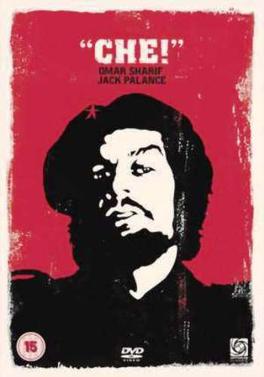
Che!

So by all accounts, everyone agrees a movie is awful. It's made some lists as one of the worst movies ever made. It tackles a controversial subject matter when the wound was still fresh in one of the most turbulent times in world history. The man? Revolutionary Che Guevara. No, it's not Steven Soderbergh's two-part Che. Silly you, I reviewed that HERE and HERE two years ago. It's time for a flick that's been critically panned for years, and don't we all love that?!? Here's 1969's Che!

It's 1956 and a young Che Guevara (Omar Sharif) lands in Cuba with a small revolutionary force of around 80 men commanded by Fidel Castro (Jack Palance). Having studied to be a physician, Che is brought along to be a medic, to treat the wounded but quickly becomes much, much more. As the revolution picks up momentum and followers all across Cuba, Che becomes an essential figure in the fighting, even becoming Castro's right-hand man, a key strategist and tactician in the fighting. It all leads to an overthrow of the government as Fidel, Che and their followers take the head of the coup, installing their own socialist government in 1959. It's just the start though as Cuba becomes a thorn in the side of the United States and worldwide. The revolution has changed though, and Che begins to feel uncomfortable. Maybe he can be of more use elsewhere where the fighting still rages...

Judging by reviews, IMDB ratings, word of mouth, all of the above, this movie from director Richard Fleischer is considered an all-around dud. As a jumping off point, I don't know what it says about me that I didn't think it was that bad. Rather, I was entertained throughout so go figure. Whether you love it or hate it, it's certainly an interesting film. It was made just two years after Che's death in 1967 as the world was tearing itself apart with one bloody conflict after another. My biggest question is 'What was the rush?' in getting a Che Guevara movie into theaters. The script certainly has some issues, packing a ton of stuff (about 10 years) into a 96-minute movie. It has far too many preachy scenes where Sharif's Che expresses his beliefs to anyone and everyone who will listen, and many who couldn't care less. Is it a good movie? No, but it's a fascinating flick in a guilty pleasure sort of way.

Talk about a daunting task. Mr. Sharif, would you be interested in playing infamous revolutionary Che Guevara? Working with a flawed script that tries to accomplish too much in its relatively short running time, Sharif makes the most of it. The screenplay certainly seems based off Guevara's diary and sticks relatively close to the facts of the revolutionary's life. The moments when he's preaching -- repeatedly -- his revolutionary beliefs, his hatred of imperialism (especially America) get to be tedious, but it is in the other, quieter moments where Sharif does an admirable job. We start to see Guevara as a man obsessed with revolution, with chaos, with taking down the system. These beliefs ultimately prove to be his undoing as Che becomes blinded with his goals rather than seeing that his plans simply can't work.

Now the rest of the cast, one actor in particular, has taken some abuse for his role. That man? Steely-eyed, gravelly voiced Jack Palance as Fidel Castro. Wearing a prosthetic nose, sporting big, wire-rimmed glasses and always chomping on a cigar, Palance seems to be playing a stereotype, a cliche of Castro rather than a flesh and blood individual. Fascinating, but not in a good way. The unfortunate part of the cast is that it features a long list of recognizable character actors who popped up in countless 1960s/1970s flicks. Oh, the unfortunate part? They're basically background performers. Some get a line here and there, but for the most part, they walk with Che or are visible in action scenes and dialogue exchanges.

Too bad. Among Che's followers we see Cesare Danova, Robert Loggia, Woody Strode, Perry Lopez, Rudy Diaz, Tom Troupe, Barbara Luna, Linda Marsh and Sid Haig. Other key parts go to Frank Silvera, Albert Paulsen, Rodolfo Acosta, Abraham Sofaer, and Paul Picerni. Just wish they could have been better utilized.

The one thing I can give credit for to this film over the Soderbergh version is that 1969 Che! takes a stance on the revolutionary icon. He's one flawed individual for good and bad. We see what his actions cause in terms of consequence on himself and those around him. In a somewhat odd storytelling device, we see some of the cast directly addressing the camera like a documentary, addressing the developments in Che's life but also in Cuba and Bolivia. Things obviously get a tad dark in the last half hour as Che's efforts in Bolivia never develop as planned. So you know what? I liked this movie. It's not necessarily good, but it's always entertaining (sometimes in a bad way). Still, it's worth a look.

Che! (1969): ***/**** 

Monday, August 18, 2014

The Buccaneer

Ever heard the name Jean Lafitte? If you're a history buff, you should have. A French pirate and privateer, Lafitte operated out of New Orleans and the surrounding bayous through the early 1830s. His name though remains in American history for a big reason, Lafitte helping then-General and future President Andrew Jackson to victory at the Battle of New Orleans in 1815. It's a story told in a generally forgotten film from 1958, The Buccaneer.

War has broken out between the young United States of America and Great Britain, the power up for grabs after British forces capture Washington D.C., the American government barely escaping. Down in Louisiana, New Orleans is bracing for an attack, a small American army commanded by General Andy Jackson (Charlton Heston) ready to hold off a far superior British army. New Orleans will be the key as whoever holds the river will control the Mississippi River. The key to it all? A powerful, rich pirate named Jean Lafitte (Yul Brynner) who helps control the mouth of the Mississippi with his fortified pirate colony. Whichever side he sides with will have all the power and both the British and Americans are desperately trying to convince him. They're both very convincing, but what will Lafitte decide in the end?

Of all the wars America has fought in since the American Revolution in the 1770s and 1780s, the War of 1812 has to be one of those most easily forgotten. I can't even think of another film about the war. 'Buccaneer' is also noteworthy for its director, an actor making his only appearance behind the camera. Who you ask? That would be Anthony Quinn, Zorba himself taking a shot at directing. It is rumored that famed director Cecil B. DeMille did direct some of the movie while also appearing on-screen early for the prologue that sets up the history of what we're about to see in the film. What it tries to accomplish is admirable, bringing a part of American history to light that hasn't gotten the amount of attention that other wars, conflicts and incidents have. What it accomplishes in the end? That's more up in the air.

The biggest positive is Yul Brynner as infamous French pirate Jean Lafitte. As portrayed here, he's probably a little idealistic (but that's more the tone of the movie) as to the historical figure, but Brynner does a solid job. This is a man caught in the middle and trying to figure out what's his best play, whether it be with the British or the Americans. He thinks selfishly, knowing whichever way he chooses will affect his vast fleet of pirates but also thousands of other people. Dressed up as a bit of a dandy -- in one of the few roles I can think of where Brynner sports hair, even if it is a wig -- Brynner commits to the part. He has some fun with it, the best thing going in a story that tries to accomplish a lot in terms of scale and characters and history. His struggles are interesting throughout, a bit of a doomed character, and his scenes in the second half of the movie with Heston's Jackson provide the movie's strongest points.

The rest of 'Buccaneer' is more of a mixed bag. One of my biggest questions involves the sets. The entire movie is filmed on indoor sets, giving the story an odd, even cheap look. In some scenes, like the battle of New Orleans, it adds a cool claustrophobic effect to the proceedings, but for the most part it limits the potential. It's going for an epic scale, full of a long list of characters and big history, but never quite gets there. In other words, the DeMille touch...sorta. Everything is polished and colorful and too clean for an 1810s world. A pirate world at that! It's more than that though, a story that bounces around too much and simply takes too long to get where it needs to be. The last 45 minutes are 'Buccaneer' at its strongest, but the first hour and the last 15 minutes drag a bit too much. Elmer Bernstein's score is okay but not up there with his best.

So DeMille loved his epics, right? Nowhere else is that more evident in the casting. Check out the full cast and crew listing HERE. There's 200-plus names, a whole lot credited, a whole lot more uncredited. Just too much going on all over the place. There's Claire Bloom as the fiery daughter of a rival pirate captain, Charles Boyer as Lafitte's very French second-in-command, Inger Stevens as the beautiful daughter of the Louisiana governor (E.G. Marshall), Heston as Andrew Jackson, Henry Hull as his backwoods, buckskin wearing assistant, Lorne Greene as a rich resident of New Orleans, and George Matthews as Lafitte's loyal henchman of sorts. That's only part of the cast. There's too many familiar faces and recognizable names to mention. Among Lafitte's pirates we see Woody Strode to John Dierkes and many more. If you ask me, it speaks to a movie that was edited some heavily in post-production. 

If you stick around, the second half is significantly better than the first half. The battle of New Orleans isn't a long, drawn-out battle but what's there is enjoyable. Parts of the movie are really good but as a whole it wastes much of its potential. Too bad.

The Buccaneer (1958): **/****

Wednesday, July 30, 2014

Spartacus

I've been in Spartacus mode for about six months now. This spring I watched the entire run of Starz's Spartacus, I caught up with Howard Fast's novel Spartacus, found a couple non-fiction books about the famous slave turned gladiator at the library and then bought the TV miniseries that aired about 10 years ago. So what is there left? Naturally I tried to save the best for last, catching up recently with one of Hollywood's great historical epics, 1960's Spartacus.

It's the 70s B.C. in Rome when a Thracian slave named Spartacus (Kirk Douglas) is bought from a Libyan mine and sold to a gladiator school in Capua, Italy, several days ride from the city of Rome.  The popularity of gladiators is growing ever stronger, Spartacus thrust into training to become hopefully one of the best. He shows promise but also resents the life, the hatred beginning to grow at Rome's brutal, cruel insistence on slaves and slavery itself. Months into his training, Spartacus incites a brutal takeover, his fellow gladiators joining him in a bloody attack that gives them power and allows them to escape. At first content to be a roving band of marauding bandits, Spartacus organizes his fellow escaped gladiators into an army. They can be more than bandits. They can be an army. An army that with growth and training could challenge Rome itself. His name grows, his army increases with each passing day. In Rome, a powerful Senator and businessman, Marcus Crassus (Laurence Olivier), watches the effect the gladiator slave general has and braces for a reply...if it's not too late.

Wowza, what a good movie, the definition of a historical epic that dominated Hollywood through the 1950s and into the early 1960s. A somewhat checkered production had some issues, a 30-year old Stanley Kubrick replacing Anthony Mann just a week or so into filming. Oddly enough, it is a movie that Kubrick doesn't consider one of his own, not including it in the canon of his films. It is an epic, a smart, well-written, beautifully shot movie with an impressive cast. Composer Alex North turns in a perfect score, large in scale but also very emotional in the quieter moments. I was always a fan of the score, but it really resonated with me on the most recent viewing. There isn't a weakness here, author Howard Fast's novel come to life in truly epic form.

One of the biggest stars working in Hollywood at the time, Kirk Douglas was firmly behind this movie, helping ramrod it right into production and is listed as executive producer. I've always thought this is one of his strongest, if underappreciated, performances. As slave turned gladiator turned general, Douglas is Spartacus. He has several effective so-called "bigger scenes" but the more effective moments are the quiet ones. When he touches the hand of the woman he loves, the rage in his eyes as he's addressed by his superiors, the pride when his army stands up for him, this is an actor doing his absolute best. He brings a real-life character to life, and it's easy to see why so many followed him against Rome. Douglas is charismatic and welcoming from beginning to end. He's furious and full of hate at the Roman system that enlists hundreds of thousands of slaves. Ultimately, he's pushed too far, and his response is something that shakes the world. Just a great performance from a Hollywood legend.

What this flick is able to do so well is to blend so many different moving pieces together. It is an epic with a true ensemble cast, all of the assembled talent given a chance to shine. In one of the best love stories I can think of, Douglas has a great chemistry with Jean Simmons, playing Varinia, a slave from Brittania who becomes Spartacus' wife, friend and confidant. They just work. They're perfect together. There's one of the great actors of all-time, Laurence Olivier, relishing the part of Crassus, a criminally smooth, brilliant manipulator who yearns for power in all forms. There's Tony Curtis in one of his best roles, here as Antoninus, an educated slave who escapes from Olivier's Crassus and joins Spartacus' army. Opposites in most ways, the uneducated leader and the younger, educated fighter become very close, a father-son, brotherly relationship. There's Charles Laughton as Gracchus, the Roman senator with a long, distinguished career behind him, now opposing Crassus, and John Gavin as Caesar, the young and upcoming senator, both giving Rome's perspective as Spartacus' revolt grows and grows. Oh, and there's a scene-stealing Peter Ustinov as Batiatus, the owner of the gladiatoral school that Spartacus escapes from, an Oscar-winning part for Ustinov.

Oh, but there's more. Herbert Lom plays Tigranes, an oily pirate negotiating with Spartacus to get his army out of Italy. As for the gladiators turned army command, look for an underused John Ireland as Crixus with Harold J. Stone and Nick Dennis also standing out from the crowd with smaller supporting parts. One of three performances in 1960 that helped make him more than a physical presence, Woody Strode plays Draba, an experienced gladiator worn down by the constant killing in the arena. A small part but a key one to propel the story forward. And last but not least, gravelly-voiced Charles McGraw as Marcellus, the brutal gladiator instructor, a man tasked with turning slaves into killing machines intended for the gladiator ring. Strength from top to bottom, not a weak link in one of the great casts ever put together.

This is a thinking man's epic, not a true sword and sandal epic. The script from blacklisted author/writer Dalton Trumbo is a gem, giving a window into the politics of the time. The story moves amongst the ensemble from the gladiator school in Capua, to the streets and halls of the Roman Senate, to Spartacus' base at Mount Vesuvius to his camps moving across Italy. Trumbo's script is an idea-script, one about freedom and corruption, living life to its fullest even if the means seem impossible. We see the inner-workings of the Roman senate, of Spartacus' inner circle. You get a feeling of what the times were like in ancient Rome. Just a beautifully written script, Douglas saying "Screw it" to the blacklist that prevented Trumbo from writing for years.

'Spartacus' has moments both big and small here, both working seamlessly. The arena fight between Spartacus and Draba is a gem. Not drawn out but incredibly intense, including a great twist near its conclusion. The revolt in the school is quick and hard-hitting, the tension finally boiling to an unbearable point. As the rebellion grows -- the real-life history was called the Third Servile War -- Spartacus realizes the fight can be as big as his army wants it to be. The entire movie is a treat to watch, but I've always found the second half the film's strongest, especially when the tide turns against the slave army. Maybe the most iconic scene, "I'm Spartacus!," has become a punchline in pop culture, but in context, it is one of the most beautifully constructed, emotionally perfect scenes ever, the camera lingering on Douglas as an ideal conclusion. Watch it HERE with obvious spoilers. The same for a late scene between Spartacus and Antoninus discussing the impact of what they've done, Spartacus willing to Crassus "He'll come back and he'll be millions." Too many great moments to mention.

This isn't an action-heavy movie so beware going in if you're expecting 3 hours of battle scenes. Supposedly more battle scenes were filmed but never used, all in hopes of making the one major battle late in the film far more effective. It is, but this is not a movie interested in the scope and scale of battle. This is a story about the people. We see scenes with literally thousands of extras, but the camera zooms in on the faces, people we see popping up throughout the second half of the movie. Old and young, mothers and fathers, teenagers, kids, thin and fat. The moment where Spartacus walks through his camp on the eve of battle is perfect, the former slave truly realizing the scope of what his army has accomplished. The post-battle scene is that much more gut-wrenching as is the finale itself.

Just a classic. Enjoy it.

Spartacus (1960): ****/****

Wednesday, July 16, 2014

The Last Voyage

I don't like ships. I don't like boats. I'm not a big fan of big, wide-open water so yeah....the ocean, bigger lakes, they freak me out. Yeah, psychiatric session instead of a movie review! I digress though as an introduction only. Movies about ships sinking creep me out in a big way. I saw Titanic in theaters twice, but yowza, that scared me. How about an earlier, far less known film about a ship sinking? Enter 1960's The Last Voyage.

The S.S. Claridon is making its way across the Pacific Ocean, sailing from California to Japan. An ocean liner that's been sailing for 38 years, the Claridon is well past its prime and long overdue for a major overhaul. Its captain, Robert Adams (George Sanders), is aware of all of this but isn't concerned when a fire breaks out below deck. His crew is able to stop the fire, but it is only the start, a problem born from a faulty boiler....a boiler that explodes soon after. The crew desperately tries to stop the fire as water flows into a breach in the hull. Can the aging Claridon be saved or is it a doomed ship destined to sink? Among the passengers is the Henderson family, husband Cliff (Robert Stack) trying to save his wife, Laurie (Dorothy Malone), who is pinned under an immense piece of metal wreckage in their berth. Time is slipping away at an alarming rate, the water levels rising ever quicker.

I've seen bits and pieces of this 1960 disaster flick several times, but it was only on my last viewing where I was able to watch the entire film. From director and screenplay writer Andrew L. Stone, 'Voyage' is an excellent early example of a disaster film, a genre that would rise to new heights in the late 1960s, especially in the 1970s. It has a lot of touches that would become all too familiar in the coming years, but none of it feels overdone...thankfully. This is a well-told, well-acted and well-executed disaster film that focuses on a desperate fight for survival, an aging ship groaning as it sinks. The only question becomes how quick will it sink? I liked that 'Voyage' is content to just be an exciting, sometimes uncomfortable story. The 1970s disaster flicks were big, bigger and biggest, one topping the other with a ridiculous premise and an all-star cast. This flick, just a really good movie.

So what makes it that good, that enjoyable? Well, I liked Titanic a lot for all its excesses and spectacle, but at 220 minutes, it is a lllllong movie. That is not a concern here, 'Voyage' clocking in at just 91 minutes. There's no wasted time, no fluff here. As viewers, we're thrust into the fire on Claridon as the credits roll. We don't see how it started, who anyone is, just that there's a fire on-board and it needs to be dealt with NOW. The same for once the boiler goes. This is the situation. Let's deal with it. Even when we meet the characters -- Capt. Adams, the Hendersons, the crew -- they are as we meet them. We get a brief explanation of why the Hendersons are on-board the Claridon, but that's all. This is a movie in the moment about a ship sinking where backstories and motivations and who these people are....it's all extra and unnecessary. A survival disaster movie at its most simple and straightforward.

Who will live? Who will die?!? The true star power isn't there, but we get a handful or so of familiar faces. The Hendersons are more interesting once the ship gets into trouble, Stack, Malone and their daughter, Jill (Tammy Marihugh), the picture of the American family up until that point, all lovey-dovey. But a ship sinking? Let the drama begin! Sanders gets to be the stubborn ship captain, trying to bring the ship into port without any loss of life, in the process putting his passengers, his crew and his ship in danger. I thought the best parts go to Woody Strode and Edmond O'Brien though, Strode as Hank Lawson, a crewman, and O'Brien as Walsh, the second engineer, both men trying to save the ship while the passengers scramble to safety. It was a hell of a year for Strode who turned in scene-stealing memorable parts here, in Spartacus and Sergeant Rutledge. He's an imposing physical presence here, shirtless with a bandana around his neck, sprinting around the ship to help Stack's Cliff. O'Brien too stands out from the sinking ship chaos, balancing saving his crew with those passengers in danger. Also look for Jack Kruschen as the chief engineer.

There's nothing too fancy here from acting to story to effects. 'Voyage' was filmed in very 1960s stylish sets, sets that add a nice throwback feel to the film now as we watch it 50-plus years later. Titanic obviously set the bar ridiculously high, but what's accomplished here without any computer-generated effects is impressive in itself. Stone and his crew used the famous French liner, the SS Ile de France, for the actual scenes showing the water washing over the fast-sinking Claridon, giving a nice sense of what the hellish experience would certainly be like. All of the sinking scenes feel real, that lack of CGI effects actually aiding the cause. None of it feels forced, and it is interesting throughout. An easy movie to recommend, especially for all you diehard Titanic fans out there.

The Last Voyage (1960): ***/****

Friday, September 6, 2013

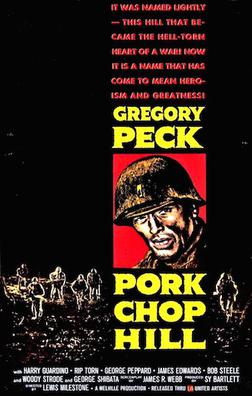
Pork Chop Hill

No soldier wants to die. But what about as a war nears its end? The end of the fighting may only be days away, maybe even hours away. So goes the background for the underrated Korean War drama from 1959, Pork Chop Hill.

It's April 1953 and both American and North Korean/Chinese commanders have agreed to a cease fire with the two sides meeting at Panmunjom. The negotiations though are moving along at a frustratingly slow pace with little being resolved. Near the front lines, the fighting rages on with Lt. Joe Clemons (Gregory Peck) and his King Company awaiting orders, supposedly to withdraw as the fighting dies down with negotiations picking up. The orders though are just the opposite, orders to move forward and take Pork Chop Hill, a worthless hill that's been lost and regained countless times. Now, the Chinese are in possession, but it is a spot on the line that's been deemed very important to negotiations. Clemons assembles his weary company, moving forward to take a hill that holds no military value.

Dubbed the Forgotten War, the Korean War pales in comparison to both World War II and Vietnam in terms of theatrical films released about them. From director Lewis Milestone (A Walk in the Sun, Halls of Montezuma, All Quiet on the Western Front), 'Hill' is a generally forgotten war film that certainly deserves better. It is similar in a lot of ways to 1962's Hell is For Heroes -- even using an eerily similar score from Leonard Rosenman -- and is based on a true story, the battle for Pork Chop Hill. It was filmed in black and white, a highly effective shooting technique, giving everything a sparse, cold and vacant look. Why isn't it remembered as the near-classic that it is? I've got no idea.

What jumped out at me on my recent viewing was the cynicism and darkness that's evident throughout. More surprising? It was made with cooperation from the U.S. Army which in itself isn't too surprising. It's that in exploring the battle, 'Hill' at times shows the complete ineptitude of the American commanders. Assaulting the hill, Clemon's company is put on the grid when American spotlights actually shine right on them in the dead of night. Other companies are given wrong orders, ranging from just plain wrong to misleading. Once King Company is in position, the rear command is genuinely confused, thinking they're fighting a mop-up action when in reality, they're holding on by their fingernails with limited ammunition, food and water. At one point, an U.S.O. photographer is sent up the hill to get photos of an American victory because the folks back home need to see an American win. Peck's reaction is priceless, a commander at wit's end who doesn't know what else to say.

This is an honest criticism of headquarters that's based in reality, and for a 1959 audience, it seems light years ahead of its time. If I didn't know better, it sounds like a Vietnam War movie like Platoon or Apocalypse Now more than a major studio release from 1959. Leading the way is the always reliable, always impressive Gregory Peck. His performance reminded me some of his Oscar-nominated turn in Twelve O'Clock High 10 years earlier. His Clemons is an effective commander simply trying to follow orders and get as many men through the battle unscathed as is possible. Even he is pushed to his limits as one bumbling order after another comes through, the commanders refusing to acknowledge that the battle isn't going as they expected. It's an understated part, but an emotionally effective one. We see the wear and tear on his face, his reassuring, confident tone slowly being worn down.

Beyond Peck though, 'Hill' is noteworthy for its supporting cast of rising and future stars. Harry Guardino and George Peppard play Forstman and Federson, two buddies lugging a machine gun around the hill. Rip Torn plays Lt. Russel, commander of the relief company assigned to help out King Company. 'Hill' is also one of the first war films to show integrated units, Woody Strode playing Franklin, a private fed up with the war, and James Edwards as Cpl. Jurgens, one of Clemon's most dependable, trustworthy men. Also cool casting is George Shibata as Lt. Ohashi, a Japanese-American soldier, Clemon's close friend and one of his platoon commanders. Also look for Norman Fell, Gavin MacLeod, Robert Blake, Biff Elliott, Martin Landau, Harry Dean Stanton, Clarence Williams III and several other familiar faces rounding out King Company's roster.

Clocking in at 97 minutes, a majority of 'Hill' is spent in the trenches and bunkers with King Company, a few asides here and there showing the negotiations of the cease fire. This is a movie interested in the nuts and bolts of the battle, the flanking movements, the reserve companies, the crossfires and preparations for counterattacks. It never gets bogged down though, the battle scenes uncomfortable and unsettling in their reality. It isn't graphic violence here, but that doesn't mean it's not hard to watch. Add in the psychological warfare of a Chinese broadcaster bombarding the American troops with propaganda, and you've got quite the battle here. It's not just bullets and soldiers anymore, but the effect it has on the soldiers' heads too. A great war movie, one that deserves more of a reputation/following.

Pork Chop Hill (1959): *** 1/2 /****

Tuesday, September 18, 2012

The Unholy Four

Have you ever met someone with amnesia? Me neither, but if we were to listen to movies and TV shows (especially 1960s sitcoms), apparently everyone and their mother has had amnesia only to snap out of it in time to wrap things up nicely. There's the serious amnesia ventures -- the Bourne movies -- and the less than serious -- a Gilligan's Island episode comes to mind -- and then there's 1970's The Unholy Four, a spaghetti western with an amnesiac main character.

As a diversion to a robbery of a stagecoach packed with gold dust, a diversion is caused across the street at the State Mental Institution. In the fiery aftermath, Chuck Mool (Leonard Mann) escapes with three other inmates. The only problem? Chuck is an amnesiac and doesn't remember a single thing about his life prior to the three years he spent in the institution. His fellow fugitives join him in looking for some answers until they find a town where Chuck is recognized. The quartet is caught in the middle now of two warring factions, the Udos, led by psychotic Tommy (Lucio Rosato), and the Caldwells, led by very skilled gunman, Joe (Helmuth Schneider). Hopefully Chuck can find the info he needs before he catches a bullet.

A little bit of a change of pace from a lot of spaghetti westerns, 'Unholy' surprised me in a lot of ways. Learned the phrase from over at the Spaghetti Western Database, but this is from a sub-genre of spaghetti westerns dubbed Autumnal Spaghettis. Instead of the scorched desert, the stories take place in gloomy, gothic-looking forests. From first-time director Enzo Barboni, it is a good mix of action and story (too much convoluted story at some points) whereas so many spaghetti westerns went down one road exclusively. Even at just 88 minutes, the story can be a tad on the slow side as revelations come to light, but I was never bored and enjoyed it until the end. Oh, and the score from Riz Ortolani is ridiculously out of place, but dammit, it sure is catchy. Listen below in the trailer link.

This was my first introduction to Mann, the young star just one year removed from his debut in 1969's The Forgotten Pistolero. He's far from your typical spaghetti lead; a little on the small side, almost pretty with his eyeliner, and a voice that doesn't sound like it has hit puberty yet. The character's background is interesting enough though to overshadow any issues I had with him. The rest of the Unholy Four are bright spots including Woody (Woody Strode, good scriptwriting, huh?), a man with immense strength and an unexplained religious background, Hondo (George Eastman), a gambler and dead shot with a rifle, and Silver (Pietro Martellanza), Woody's best friend and an expert knife thrower. None of the three are given any development so we don't know how/why they ended up in the Institution, but however you cut it, it's four pretty cool characters.

What is somewhat different here is the departure the story takes in the second half as we learn about Chuck's past, forgotten life. He is actually a Caldwell, but the Udos find him first and tell him he's an Udo. Clever, huh? Now it's just a matter of time before they can have Chuck unknowingly kill his own father (Schneider). Rosato's name -- Tom Udo -- is the same as Richard Widmark's iconic character in Kiss of Death, odd choice there. Some other key players include Sheila (Ida Galli), Chuck's former love, Giuseppe Lauricella as the elder Udo, and Alain Naya as Alan, Chuck's revenge-seeking brother. Lots going on in that second half -- more drama than action -- with the whole Prodigal son angle, the amnesia, betrayals, backstabbings and even some incest undertones. It's got it all!

I enjoyed the whole movie, but the end especially doesn't disappoint. The opening diversionary jail break, an encounter between the Four and a gang of five bounty hunters, both are small-scale but expertly put together action scenes. The finale though is the best, Chuck and Co. putting it all together for good against a waiting army of gunmen in an empty street. Nothing spectacular overall, but a highly entertaining spaghetti western that isn't ever mentioned with the best. You can watch the entire movie HERE at Youtube.

The Unholy Four <---trailer (1970): ***/****

Tuesday, July 10, 2012

The Italian Connection

Yes, I'm pretty cool when it comes to watching movies. Because I've got an odd memory for movies I'd like to see, I have an ever-growing list of films (literally, I've written down a list) I stumble across at Netflix, Amazon, IMDB, Turner Classic Movies and on and on. Usually I limit it to harder to find movies that aren't readily available, movies you're glad you find and usually by accident. I stumbled across 1972's The Italian Connection years ago and was finally able to find a halfway decent, watchable copy.

A low-level pimp, Luca Canali (Mario Adorf) has gotten on the bad side of the wrong people. An American mob boss has put a hit contract on the pimp, claiming that he helped steal millions of dollars worth of heroin as it was being shipped. The boss has hired two American hired guns, Dave Catania (Henry Silva) and Frank Webster (Woody Strode), to kill Luca and to do so slowly, painfully and graphically as a message to anyone else doing the same thing. The hired guns head to Italy to hunt Luca, but the pimp isn't even aware he's in trouble. Has someone been setting him up?

This was a movie that was worth the wait in an odd way. Part of director Fernando Di Leo's unofficial Italian crime trilogy, it's gritty, low-brow in most instances and entertaining in almost all instances. There's just something oddly appealing about the forthright nature of these Euro crime movies. They don't seem to care that at some point in the film, they will almost certainly insult or offend someone. Gratuitious violence, random bits of nudity, the definition of politically incorrect, and the best part is that Di Leo and Co. just don't give a damn. Either you like it or you don't. Simple as that. If you do, sit back and enjoy. If not? No skin off the Italian director's back.

One of the same appeals here for me in these Italian/European crime flicks is a similar feeling I have watching spaghetti westerns. When things weren't always going well in the U.S., many American actors -- some past their prime, others rising stars -- headed to Europe for these audience friendly cult favorites. A German-Italian actor, Adorf really seems to relish the part here as Luca, a pimp but gosh darn it! Just an all-around nice guy! All he wants to do is hang out with his daughter and be civil with his ex-wife (Sylva Koscina). Now that wouldn't be an interesting movie to watch, would it? No, not at all, so we've got to piss off Luca and give him a reason to go on a murderous rampage. With a part that could have been too exaggerated (like his part in Caliber 9), Adorf does a good job of keeping the character grounded in some sort of reality. I only knew him through Peckinpah's Major Dundee, but another solid intro to Adorf.

Years ago when I found this movie via IMDB, it was because of the rest of the cast -- no disrespect to Mr. Adorf. Silva and Strode as American hit men taking it to the road? How can you go wrong? Not surprisingly, Silva is the more showy of the duo, a hard-drinking, hard-living, womanizing killer. Strode is just the opposite, all business with no distractions. Moral of the story though, they work well together as a killing duo. In fact, the story suffers when they're not around, and unfortunately through the middle portions, there is a lot of those situations. A whole movie could have been devoted to them, and I'd be cool with that. Also look for Thunderball co-stars Adolfo Celi and Luciana Paluzzi as an Italian mob boss and the hit men's tour guide of sorts.

Building the story, Di Leo seems to revel in lulling you to sleep...to a point at least. The first 45 minutes are painfully slow at times as characters, setting and background fall into place. The last 45 minutes are an adrenaline rush, one crazy action sequence after another piled on top of each other. Watch one of the truly adrenaline-pumping chases HERE, via car and on foot. The finale too lives up to expectations, Luca playing cat and mouse with Dave and Frank in a junkyard. A flawed crime flick, but a good flawed crime flick and highly entertaining.

The Italian Connection <---trailer (1972): ***/****

Friday, January 6, 2012

The Deserter

When a poster at a message board brought the movie up, I didn't believe him, thinking the movie he talked about was made up. As a western fan, how had this one slipped past me? Somehow it did, probably thanks to no U.S. DVD release and an old VHS (thank you Amazon vendors). The movie? A spaghetti western of sorts, think The Dirty Dozen in the West. It's 1970's The Deserter.

Returning from a patrol, Captain Viktor Caleb (Bekim Fehmiu) finds his wife on the brink of death, raped and tortured by an Apache war party. He mercifully ends her suffering, shooting her, and abandons his post but not before shooting the commander, Maj. Brown (Richard Crenna), who he blames. Two years pass and the cavalry Border Command has a new commander, General Miles (John Huston). Caleb has spent two years waging his own war on the Apaches, but Miles needs his help. An Apache chief, Mangus Durango, is organizing a huge war party that threatens to wipe out everyone in the territory. Their only hope? Caleb selects a small group of men and train them to fight like Apaches, striking the Apache camp in Mexico before the slaughter begins.

From American director Burt Kennedy, 'Deserter' isn't your prototypical spaghetti western. It was filmed in Almeria, Spain -- with some familiar locations for spaghetti fans -- and features a quirky but memorable score from Piero Piccioni. Listen to the main theme HERE. As opposed to bandits and gunslingers, the story obviously focuses on the cavalry and the Apaches so it's a cool change of pace. Mostly though, it is an above average men on a mission story, one of my favorite sub-genres in movies. A small group of men, all experts and specialists in their own way assigned an almost impossible, nearly suicidal mission. The movie follows the cookie-cutter formula, but in a good way. First, lay things out and assemble the team. Second, train them. And third, unleash them for their mission.

My rating far down below may be high in the eyes of some readers, but there's a reason. This isn't a great, classic movie that will live on in movie history. On the other hand, it is a great, fun and entertaining movie that quickly climbed into my list of favorites upon first viewing. Kennedy was a workmanlike director more than an auteur, but he knows how to manage this movie. The screenplay by western regular Clair Huffaker is a gem, nothing original but full of great one-liners, the perfect dialogue for a team of tough as nails "volunteers." This always sounds like a cop-out to me, but it's just a fun movie. Sit back and enjoy 100 minutes of running and gunning action in the desert.

Read some reviews about this generally forgotten western, and you'll find plenty of criticism of the casting of star Fehmiu in the lead. A Yugoslavian actor, this is one of his few English-speaking roles. I had absolutely no problem with him as Caleb and even think his steely-eyed, ice water running through his veins acting style is a high point of the film. Caleb doesn't care about living or dying, just avenging his wife's brutal death. That can be an appealing trait in a lead character. While I came to like Fehmiu as Caleb, what drew me into this movie was the supporting cast.

Big names? No, not especially, but reading the cast listing should put a smile on any western fan's face. Crenna is solid as needed as Caleb's opposition, and Huston is a scene-stealer as General Miles, chewing the scenery like only he can. Then there's Caleb's squad, a who's who of western characters. Start with Slim Pickens and Ricardo Montalban as Tattinger, a crotchety veteran scout, and Natchai, an Apache scout, both of them Caleb's closest friends. Not enough? There's also Chuck Connors as Reynolds, a dynamite-wielding chaplain, Ian Bannen as Crawford, an English soldier touring the Southwest, Brandon De Wilde as Ferguson, the young, unproven officer, Woody Strode as Jackson, the strong man and troublemaker, Albert Salmi as Schmidt, the soldier with a grudge against Caleb, Patrick Wayne as Robinson, the Gatling gun operator with his brother, Doc Greaves as Scott, the doctor, and recognizable spaghetti face Fausto Tozzi as Orozco, the knife fighter.

Good cast much?  If you can't go along with that group, westerns probably aren't your thing. It is a men on a mission movie, and that means....wait for it...action! Most of it is saved for the last 40 minutes, but the training sequences leading up to it are equally as fun, a quick montage highlighting all the mayhem. The mission is the high point though, and even though some night scenes are limited by obviously indoor sets, it isn't a deal breaker. Men on a mission movie means casualties though, and the results here were surprising as to who makes it and who doesn't. Violent, bloody and chaotic, a worthwhile end to an underrated western.

Now this link won't be to a pristine, widescreen print, but it you're curious about seeing the movie you can see it at Youtube HERE. It's a Public Domain print and looks to be missing about 6 minutes from the VHS I have, but when a movie is as hard to find as this one, take what you can. Hope you enjoy it as much as I do!

The Deserter <---trailer (1971): ****/****   

Monday, August 23, 2010

The Sins of Rachel Cade

Where many actresses get lost in the shuffle of male-dominated ensemble casts, Angie Dickinson seemed to revel in it.  Movies like Rio Bravo, Ocean's 11, Death Hunt, and many more were all examples of male-heavy casts with a female character that in the wrong hands could have been thrown by the wayside. But even looking like a typical cute blonde who probably weighed 90 or so pounds, she always handled herself well.  Given a rare chance to star in her own movie, she delivers a strong performance in an otherwise average movie, 1961's The Sins of Rachel Cade. 

In the Belgian Congo in 1939, American missionary and nurse Rachel Cade (Dickinson) arrives at a somewhat isolated mission only to have the doctor in charge drop dead from a heart attack.  Forced to take over the not so friendly mission, Rachel does her best to offer medical treatment to the African villagers while also trying to teach them the ways of God, Jesus and the Bible from a Christian perspective.  Nothing goes smoothly, but it gets more interesting when two different men, local commander Henri Derode (Peter Finch) and a suave doctor (Roger Moore) begin to show interest in the pretty young nurse, forcing her to decide if she can live by the lessons and teachings she gives to the local villagers.

After seeing Dickinson in mostly supporting roles or at least parts that usually relegated her to love interests, it was cool to see actually see her in a starring role.  Her Rachel Cade is an interesting character, starting off as innocent, somewhat naive, and in some ways condescending to others' beliefs.  I realize as a missionary that is her job, her mission, but she dismisses the beliefs of the villagers who have had those beliefs their whole lives.  Still, even as she struggles with some inner demons and hypocritical feelings, it is a fascinating character to watch.  Dickinson never gets too high or too low so Rachel is a little too laid back at times, but because we see her develop over several years, that's the character.  Relatively calm even when everything around her seems to be falling apart.

Finch and Moore provide some interesting counters, and not just in who they play.  Both Englishmen, Finch plays a French officer (thankfully not trying an accent) and a very young-looking Moore plays an American doctor from Boston (still sounding like a Brit).  Rachel feels something for both men and ends up getting involved in a very serious way with one -- no SPOILERS today, folks -- that makes her question the morality of what's she doing.  Of the two, Finch delivers the better performance, Moore playing his typically suave, ultra-charming character he perfected years later with the James Bond movies.  Other good parts include Errol John as Kulu, Rachel's assistant open to embracing a Christian God, Frederick O'Neal as the local chief curious to Rachel's motivations and actions, and Rafer Johnson and Charles Wood as two of Rachel's helpers in the makeshift hospital.

Dealing with conversations about personal religious beliefs and what religion works and doesn't work, I struggled at times with how preachy the story could be.  I haven't read the novel the movie was based on so I don't know what director Gordon Douglas was working with, but it is a very one-track story.  Christianity good, African beliefs bad, no middle ground.  Juano Hernandez plays a local medicine man/chief who may or may not believe in what he preaches, and Woody Strode plays an imposing medicine man who looks more like a witch doctor than anything else. The portrayal -- however true it is, I don't know -- seems very stereotypical to me and full of political incorrectness.  Because of that portrayal, it seems obvious that of course Rachel is going to have success with converts to Christianity.

Simply in the moviemaking process, I struggled to get into this movie.  It was filmed on an indoor set for this African village/mission Rachel comes to work at.  Filming in Africa would have been no doubt rather expensive, but find somewhere outdoors that could have even slightly resembled the African jungle.  You're very aware you're watching a movie that was filmed on a studio set and not anywhere on location.  Composer Max Steiner's score is all right but doesn't leave much of a lasting impression. I had a hard time really getting into this story, and I don't know why.

The story lacks a certain amount of energy as it finds a rhythm among Rachel's mission, her personal feelings, and all the conflicts going around in the village.  When issues do come up with Rachel finally caving in to some of her wants and desires, it is handled in such a PG fashion that it lacks any punch.  Were we supposed to be shocked when Rachel reveals she is pregnant?  Douglas probably couldn't get away with much by 1961 standards, but watching the movie some 50 years later, it is very noticeable.  The whole movie is fairly dated, but some good acting brings it up a notch and at least makes the movie watchable.

The Sins of Rachel Cade <---TCM clip (1961): **/****

Sunday, August 22, 2010

The Last Rebel

Michael Jordan, Pele, Shaquille O'Neal, all superstar athletes who took a turn at the movie business, some with better results than others.  Kazaam comes to mind as a not so quality venture.  It's the rare athlete who has the same talent on-screen that they had playing on their court, diamond, field, whatever.  In the 1960s and 1970s one of the biggest stars both on and off the field was AFL/NFL quarterback Joe Namath, also known as Broadway Joe for his ability to dominate the spotlight.  Like so many stars, he gave movies and television a shot, including an appropriately forgotten spaghetti western, 1971's The Last Rebel.

In most variations of athlete turned movie star, the athlete plays a variation of himself/herself, if not just actually playing themselves.  MJ played MJ in Space Jam, Pele played a soccer star, Shaq was a genie (check that one), but Broadway Joe doesn't go that route, instead playing a Confederate soldier turned gunfighter in the days and months following the Civil War.  I've been watching spaghetti westerns for years, and I can almost always find something to recommend about them.  They're often enough so bad they're good.  But The Last Rebel?  Possibly the worst movie I've ever seen.  And I've seen a fair share of stinkers, but this may take the cake.

When news reaches Missouri that the Union has won the Civil War, Confederate soldiers Hollis (Namath) and Matt (Jack Elam) light out for the west rather than be thrown in some prison camp while everything cools down.  Heading west, the unlikely duo becomes a trio when Hollis rescues a black man, Duncan (Woody Strode) from a lynch mob.  Looking for a way to earn some money, the trio rides into a not so friendly town with a not so friendly sheriff (scruffy looking Ty Hardin) who doesn't take kindly to strangers in his town.  Honestly, some more stuff happens, backstabbing, betrayal, a fair share of sex, then a showdown and credits roll.  End of movie.  Good enough plot description for you?

I honestly try and keep an open mind whenever I start a new movie, no matter what I've heard going in.  That plot description isn't leaving anything out at all.  That's it.  To say this awful spaghetti western even has a plot is a stretch.  In a 90-minute movie, I'd wager half of it is long, unedited shots of two or three of our characters riding through the countryside with a truly out of place soundtrack playing over the visual.  Trying to show a passage of time is one thing, but this was just bizarre.  A 30-second uncut scene of Namath and Elam has the duo ride across a ridge or over a hill, but instead of proceeding to them riding into a town, we get another shot of them riding across a ridge or over another hill.  Truly embarrassing stuff almost right from the get-go.

At a certain point, I almost felt bad for Namath.  His part isn't so much acting as reciting lines and squinting, shrugging and generally looking uncomfortable no matter what he's doing.  But Namath was a sex symbol in his playing days so he does bed down a handful of women in the movie, including saloon girl Pearl (Victoria George, a bright spot for her appearance and general lack of clothes). There's also the bizarre scene where Hollis -- acquiring the rank 'Captain' out of nowhere -- rides onto a Spanish hacienda and sleeps with two different Mexican sisters in the same night, just a room apart.  Then, oh yeah, gotta go back to new love of your life Pearl.  It's probably not fair to call this acting to begin with, but Namath should have stuck with that football thing.  I hear he was halfway decent.

Heading into the movie, I thought a saving grace might be the trio of actors in support of Namath in the lead, Elam, Strode and Hardin.  Well, thanks to a complete lack of any sort of script or story to move things along, the three are beyond wasted.  Elam has the most screentime, but that doesn't mean much.  He growls a lot and looks at the camera with that shifty look of his.  Other than a weird monologue he has with a random black boy (honestly, the kid's credited as 'The Black Boy'), Strode has about 18 words of dialogue.  Not lines, just words.  As for Hardin, it's just bad news.  He's the bad guy I guess, but we're never told why.  He's a sheriff, of course he wants to protect his town.  But he has a gnarly looking beard so he must be the bad guy.  Hardin disappears for about 40 minutes, only to reappear when Namath needs to kill someone.

Director Denys McCoy understandably didn't get another movie to direct after this gem.  A star-driven vehicle is one thing, but at least give Namath something to do other than sleep with random women.  It is one of the most random, truly pointless movies I've ever seen.  Nothing can really save this one.  No script, no plots, no interesting characters other than the mostly nude Victoria George, and a soundtrack that features 70s rock and ballads all add up to a sorry excuse for a movie.  I'll give anything a try, but this was a painful experience, and that's from someone who loves spaghetti westerns.  Steer clear.

The Last Rebel <---TCM clip (1971): 1/2 /****  

Friday, August 20, 2010

Shalako

By 1968, James Bond himself, Sean Connery, was riding high off the success of the first five 007 movies he made, most recently with You Only Live Twice.  When he wasn't playing Bond, Connery did his damnedest to avoid being typecast, generally succeeding with a wide-ranging list of roles that continued into the 1970s and 1980s.  But in all those movies, he only did one western, and it's a good one, 1968's Shalako.

Based on a Louis L'Amour novel, this Euro-western has a lot going for it with a lot of different elements thrown together in the final product.  Start with the uniquely international cast that includes American, English, French, Scottish, German and Spanish actors and actresses, all of them with speaking roles.  While the story ends up being somewhat familiar late in the movie, the build-up to that point is different from about 99.9% of other westerns.  At times it can be a little too much with so many different elements working together and sometimes against each other, but the positives outweigh the negatives...for me at least.

Frontiersman and former U.S. cavalry officer Shalako Carlin (Connery) stumbles across an Apache ambush, saving a beautiful French woman, Countess Irina Lazaar (Brigitte Bardot), from certain death. Irina is part of a European hunting party headed by Baron Von Halstatt (Peter Van Eyck), Sir Charles Daggett (Jack Hawkins), and U.S. senator Henry Clark (Alexander Knox) who are touring the American west, killing any animals they see, their wives along for the adventure. Knowing what awaits them, Shalako tries to convince them to leave the territory as the Apaches don't take kindly to anyone riding onto their land.  The party ignores him, but when their guide, Bosky Fulton (Stephen Boyd) and his men double-cross them, they have no one to turn to other than Shalako.

Above all else, I'd say watch this movie for the cast, starting with Connery and on down the line through all the supporting parts, some much bigger than others.  If anything, there may be too many names involved because characters aren't given the attention they deserve at times.  Connery's Shalako -- an all around badass like most L'Amour heroes -- doesn't even dominate the screen, and the movie's named after him!  Those I could get into the plot review are just some of the names, there's also Honor Blackman as Hawkins' wife, Woody Strode as an Apache chief (not as bad as a Mongol bandit I guess), Valerie French as the senator's wife, and Julian Mateos and Don Barry as two gunmen along for the ride.

Seeing Connery in a western setting might seem odd -- Scottish actor dudes up in bucksins and six-shooter -- but it works.  He is typical of most L'Amour heroes in his ability to handle himself in even the hairiest situation, loyal and honest, and does the right thing over the thing that makes the most sense.  In the end, you know he'll win and get the girl.  Oops, did I just give away the ending?  My bad.  Director Edward Dmytryk had a bit of a predicament with leading lady Bardot, the definition of a 1960s sex kitten. Basically do you make her look like a woman on the frontier or like, well, Brigitte Bardot.  He goes with option B.  Hair always look perfect as does the makeup.  I'll disagree with a lot of reviews, I thought Connery and Bardot had good chemistry, and her sexy French accent goes a long way.  It just does, no other explanation needed.

Keeping it all together is the movie's biggest problem as Dmytryk juggles all these characters and subplots.  The story is at its strongest when sticking with Shalako and the motley crew of survivors he's leading.  Boyd is always a solid villain but his character could basically be erased from the storyline and it wouldn't skip a beat.  Van Eyck and Hawkins do what they can with stiff upper lip aristocratic characters.  If nothing else, there is more eye candy than usual in a typical western.  Along with Bardot -- who is given a topless scene with strategically placed hands -- there's Blackman and French, neither of whom are too bad to look at.

I wish there was more I could say about this Euro-western, but I'm drawing a blank.  The cast is solid if under utilized, the action is exciting, and the Spanish desert fills in nicely for the American southwest.  Be forewarned, there's a truly awful theme song -- give it a listen HERE -- that plays over the credits on either end of the movie.  I'll apologize in advance for the song being stuck in your head for the next few days.  It is a western that does nothing spectacularly, but instead does everything in a solid, workmanlike manner.

Shalako <---TCM clip (1968): ***/**** 

Thursday, August 19, 2010

7 Women

When I think of John Ford, I typically think of westerns, and male-dominated westerns at that.  If his movies had female characters, they were almost always in the background or as a source of conflict between two men.  Some directors worked well with actresses, but from what I've read about Ford he was much more comfortable directing men.  Certain actresses continually popped up in his movies, but almost always playing basically the same character over and over again.  It's funny then that in a career that included almost 150 movies, his last movie is a female-dominated cast in 1966's 7 Women.

Ford making some interesting decisions late in his career was nothing new.  With Cheyenne Autumn, the director admitted he owed an apology to how Native Americans had been treated in many of his movies, telling their story in this big budget if average western.  In The Man Who Shot Liberty Valance, Ford explored the idea of legend versus fact and the idea of romanticism in the old west.  With '7 Women,' he has a story that could have easily been set in the wild west like so many of his movies were.  But he picks an incredibly unique setting to tell a story that is completely different from any other movie in the Ford lexicon.

In 1935 in northern China along the Mongolian border, Agatha Andrews (Margaret Leighton) is in charge of a Catholic mission that helps any Chinese refugees on the isolated frontier.  She has help from a handful of women who have sacrificed much to be there in this dangerous situation where everything from bandits to diseases threaten everyone inside.  A new doctor, Dr. Cartwright (Anne Bancroft), arrives and quickly finds out how rigid, how very strict Andrews' mission is.  Cartwright is more of a free spirit and doesn't fit in so well, but that's the least of everyone's problems. A warlord/bandit chief, Tunga Khan (Mike Mazurki), is on a rampage across the frontier with the mission right in his path. 

Along with Leighton and Cartwright, the 7 women of the title include Sue Lyon as Emma, a young innocent girl somewhat naive to what's going on, Flora Robson and Anna Lee as two survivors from a nearby mission, Mildred Dunnock as Jane, Agatha's assistant, and Betty Field as Florrie, a middle-aged woman going through her first pregnancy and one of the most shrill, annoying characters I've ever seen in a movie.  It easily could have been '8 Women' but Ford chose to leave out Jane Chang's character for some reason.  Cough RACISM Cough.  Just kidding. These women of all shapes, sizes and creeds certainly cover the gamut, giving a nice diversity as they are forced to cope in these horrific situations where no one is there to protect them other than themselves.

With so many characters, it would have been easy for all the performances to get lost among themselves, but I don't think Anne Bancroft was going to allow it.  This is hands down the reason to see this movie for her performance, rising above a script that really doesn't have much going for it early on.  Dr. Cartwright is as tough as they come, a woman who put herself through school in the 1920s when female doctors weren't exactly commonplace.  Bancroft gives her a hard edge that has enabled her to survive on her own these years, but it's in the last 30 minutes where her character's true colors come to light.  She's spent most of the movie arguing with Leighton's Agatha character, but Bancroft's Cartwright makes a noble decision, leading to a very effective and more than a little surprising ending.

Of the rest of the women, Robson stands out as a fellow missionary who respects Cartwright for all her differences when no one else does.  She is underused unfortunately, but what's there is certainly a positive addition to the movie.  Lyon too represents herself well as the young Emma, torn between her duty and what she sees in the new doctor who is unlike so many other women she's met in her life.  As Agatha, Leighton is the self-righteous, condescending she-devil who thinks she is above criticism but feels incredibly comfortable dishing it out.  Also joining the cast is Eddie Albert as Florrie's Bible-spouting husband, Charles.  Like his wife, this character comes across as easily unlikable early on but he too comes around, realizing how ridiculous his stance is.

Now it is a John Ford movie, and there has to be some element of racism or politically incorrect moments, doesn't there?  I don't mean that as negatively as it sounds, and I am a huge Ford fan, but something almost always pops up in his movies.  Here it is Mazurki and Woody Strode as Mongolian bandits. Mazuriki is laughable as bandit chief Tunga Khan, and Strode looks ridiculous with eye makeup that attempts to make him look like a Mongolian.  Close but no cigar.

It's certainly a change of pace for Ford, and being his last movie, it is an intriguing watch.  It is different from any other Ford movie I've come across and is worth a watch for that reason alone, all flaws aside.  You can watch it at Youtube starting with Part 1 of 9.  Listen to the early parts of the credit, and guess who the composer is.  It took me about two notes, and if you said Elmer Bernstein, you win a cookie.

7 Women <---trailer (1966): ** 1/2 /****