The Sons of Katie Elder

The Sons of Katie Elder
"First, we reunite, then find Ma and Pa's killer...then read some reviews."
Showing posts with label Claudia Cardinale. Show all posts

Friday, January 15, 2016

The Professionals

The western is my genre, my spirit animal, my go-to when I'm looking for a type of movie I just know I'll like. There are very few so-called "perfect" westerns out there, but I've got my favorites. Some are obvious, highly respected and known by even non-western fans. One that seems to get lost in the shuffle at times? A classic, a true gem, and one I never tire of, 1966's The Professionals.

It's 1917 and the Mexican Revolution is still raging strong all over the country. Along the U.S./Mexico border, four men, Rico Fardan (Lee Marvin), Bill Dolworth (Burt Lancaster), Hans Ehrengard (Robert Ryan) and Jake Sharp (Woody Strode), have been brought together to perform a dangerous mission. The little group, each of them a specialist in one way or another, has been hired by rancher and oil tycoon Joe Grant (Ralph Bellamy) to ride deep into Mexico and rescue his wife, Maria (Claudia Cardinale), who's been kidnapped by a bandit and revolutionary, Jesus Raza (Jack Palance). Maria is believed to be stashed away in a hacienda in the mountains with Raza's small army standing guard. This quartet is the best of the best with few equals, but even this job seems to be too much, especially if they haven't been told the whole truth of what they're riding into. Can they pull off the job?

Aired recently on Turner Classic Movies, host Robert Osborne introduced the movie stating that director Richard Brooks deserves more of a reputation, of a following for a career that produced six Oscar nominations and plenty of good to great to classic movies, as a director, producer and writer. For me, this is easily his best work. It's one of my favorites, and I always enjoy catching up with it. Mutually appreciated by both audiences and critics, 'Professionals' is one of the best westerns of the 1960's and really, one of the best westerns of all-time. It picked up two Oscar nominations, one for Brooks' directing and one for his script. Not a flaw in sight. Sit back and enjoy this one, hopefully with a big tub of popcorn.

Let's get the boring technical stuff out of the way. Boring, but necessary. Brooks earned a Best Director nomination for blending a movie that features the technical, storytelling, characters, humor, action and visual look. With filming locations in the Valley of Fire, Death Valley, along with Nevada, California and Sonora, the visual appeal is evident. On the trail thanks to some key landmarks, you're always aware of where you are. As well, the traveling and action scenes are aided immensely by composer Maurice Jarre's score, especially the main theme. Listen HERE. Throw it all together, and you feel like you're right there with our Professionals in the sweaty, sun-baked desert where bandits and revolutionaries are there behind every rock waiting to ambush you.

The cast is pretty insane in terms of pure talent and star power, but with each repeated viewing, it always comes back to the script for me. Adapting a western novel called 'A Mule for the Marquesa,' Brooks transformed a good book into a great movie. This is a story that loves it characters, both the good and bad, and more importantly, knows them well. The script absolutely crackles, Lancaster and Marvin especially relishing delivering one memorable one-liner after another. I can't think of too many westerns that have the ability to tread that fine line between serious action and a sense of humor. Read IMDB's memorable quotes HERE. What's impressive? Even out of context, they still can put a smile on your face, give you a good laugh. When you actually see Lancaster, Marvin and Co. deliver said lines? Oh my, you're in for a treat.

I love a good men-on-a-mission movie, and this one belongs right at the top with The Magnificent Seven, The Guns of Navarone and The Dirty Dozen as my favorites. Seriously...Lancaster, Marvin, Ryan and Strode...oh, and Palance, Cardinale and Bellamy! That sound you hear is my head exploding from awesomeness. Brooks' script introduces our characters with lightning-fast ease and we get to know them in that quick flash. Marvin's Fardan is an ex-soldier, a leader, an organizer and a planner, Ryan's Ehrengard a horse wrangler, a cowboy and the very best, Strode's Jake an expert tracker and scout and specialist with bow and arrow, and last but not least, Lancaster's Dolworth is a mercenary, a philosophizing dynamite expert. That is a ridiculously talented cast with a lousy script, but combined with Brooks' script, the end result is some of the most memorable western characters ever with a story to boot. You can't pass that up now, can you?!?

When I think of Burt Lancaster and Lee Marvin working together here, it puts a smile on my face. Their Bill Dolworth and Rico Fardan are the heart of the movie, mercenaries, soldiers and adventurers who are good friends who have worked together in the past, including previously in the Mexican Revolution. They too have a history with Palance's Raza, making their job a touch more difficult. What the script and actors do so effortlessly is bring these characters to life. They're tough, rough-hewn men who live by their word and their hard-fought ability to survive. They fight because they're good at it, and maybe, just maybe, they like it a little bit. Their one-on-one scenes are some of the most memorable in the entire movie. When you throw the always reliable Robert Ryan and Woody Strode into the mix, you're in for a treat.

Okay, we need an actor in the mid 1960's to play a Mexican revolutionary....naturally, it's Jack Palance! His Raza though is an underrated character, an equal to our Professionals, a somewhat disillusioned fighter who fights on because he loves Mexico, the people, and wants those in power out.  Then there is Claudia Cardinale, maybe the most beautiful woman to ever grace the screen. Her Maria has some tricks up her sleeves as we're introduced to her about halfway through. Bellamy is perfect in his part, beginning and end, as the worrying Joe Grant (or is he...). Also look for Jorge Martinez de Hoyos, Joe De Santis and Rafael Bertrand in key supporting parts. In a scene-stealing part, Marie Gomez plays Chiquita, one of Raza's soldiers who has a history with Lancaster's Bill.

What's funny about 'Professionals' is that it isn't an action-heavy story. Yes, there's gunfights, chases and some memorable sequences, but it isn't a 2-hour action scene. It's the better for it. We get to know our characters really well in quick scenes featuring Brooks' snappy dialogue. When the action does come, is it ever worth it, especially the pre-dawn attack on Raza's hacienda deep in the mountains. Loud and chaotic, it is a gem. The other action is on a smaller-scale, tightly-edited firefights in claustrophobic canyons. So if there isn't an overabundance of action, who cares? The general tone of the movie aids that cause. It's not just a western. It's also a buddy flick, a heist movie, a chase story, a love story, a history lesson of sorts, and with a bit of a twist mystery in the second half of a 117-minute feature film.

They don't come along much better than this. One of those perfect action-adventure movies, one that's hard to poke holes in. A phenomenal cast, a memorable script, and all you can ask for in a western. A true classic, for fans of the genre and even those who aren't.

The Professionals (1966): ****/****
Rewrite of a March 2011 review

Thursday, March 7, 2013

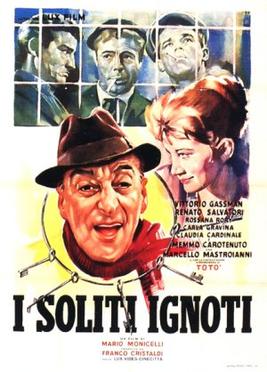
Big Deal on Madonna Street

From director Jules Dassin, 1955's Rififi is maybe the perfect heist movie. It succeeds on countless levels, one better than the other, and maybe most importantly/impressively, it has impacted just about every heist flick made in the 50-plus years since it's release in one way or another. The biggest compliment a movie can make is to imitate a predecessor, and 1958's Big Deal on Madonna Street takes the basic premise of Rififi and turns it into....a spoof? Color me surprised, but it works in a big way.

A small-time crook, Cosimo (Memmo Carotenuto) is arrested while trying to steal a car, found guilty and sentenced to jail. His timing is lousy though because he quickly hears about a foolproof plan, an intricate heist that will net quite a payday. What to do though? He needs a fall guy to take the blame for his actual crime, but his partner, Capannelle (Carlo Pisacane), can't find anyone. Instead, all his candidates team to find someone else, settling on struggling boxer Peppe (Vittorio Gassman), but even that plan doesn't go according to plan, Peppe ending up in jail with Cosimo. The boxer pulls a double cross though and finds out Cossimo's plan, and now with his motley team of amateur and small-time crooks, he intends to do the job himself.

It isn't quite fair to say that this Italian film from director Mario Monicelli is a straight remake of Dassin's 1955 film, but it does bear some striking resemblances. The most obvious connection is the actual heist scene, but even that is tweaked enough to set it apart. I loved this one. It is a spoof, but not in the modern sense of a spoof like the bizarrely stupid Scary Movie series. It's a smart humor mixed in with some rather dry laughs, proving spoof doesn't equal stupid.

Maybe it's the Italian charm, but 'Madonna' has style to burn that mixes the natural drama of an involved, complicated heist with that light sense of humor. For one, I love the look of the film, shot on location in and around Rome. No matter the era, Rome has a historic, beautiful look that translates ridiculously well to film. No sets here, just real-life Rome. Composer Piero Umiliani's score is perfect, a mix of fast-moving, light-hearted jazz and quieter moments as the heist comes together. Listen to a sample HERE.And then there's the style of the story. Title cards reminiscent of a 1920s silent movie keep the story moving along, filling in holes with the story so the 106-minute run-time is never lagging. They're genuinely funny messages on the title cards, but I also like the fact that it's subtle humor. Monicelli didn't feel the need to spell out everything little thing for us. Because of the title cards, the story does take some jumps and transitions but never in a bad way. It works, trusting the audience to figure things out to a point.

The biggest spoof aspect comes from the crew of amateur crooks and low-level thieves who team up to pull off a heist. Gassman is a strong lead, the tough boxer who ends up leading his motley crew through one ridiculous trial after another. His team includes Mario (Renato Salvatori), a thief who will buy and sell anything, Norma (Rossana Rory), Cossimo's former girlfriend, Capannelle (Pisacane), the aging, bumbling thief, Ferribotte (Tiberio Murgia), the gentlemanly thief trying to protect his single sister, Carmelita (Claudia Cardinale), Tiberio (Marcello Mastroianni), a down on his luck thief caring for his son since his wife was sent to jail, and Dante (Toto), the expert and veteran safecracker. Of the group, Gassman, Salvatori, Pisacane, Murgia and Mastroianni become the stars, the little group coming together nicely as the heist comes together. Great casting, good variety, and a perfect chemistry.

While the main focus is on the heist, there are certain departures that are handled really well. They're the type of departures that normally would drive me up a wall, but for whatever reason, they work here. Most come as off-shoots of the heist, like Gassman's Peppe trying to woo Nicoletta (Carla Gravina), a maid in an apartment the crew will have to use to get at a safe. The young maid doesn't go willingly, messing with Peppe as much as he does with her. The same goes for Mario and Carmelita. Ferribotte hides his beautiful sister away so only her fiance will ever see her, but Mario falls for her at first sight. It all works together nicely, the different storylines blending well.

In the end though, this is a heist movie, spoof/comedy or not. It has influenced plenty of other films itself and has been remade twice, 1984's Crackers and 2002's Welcome to Collinwood. Up until this point, the amateur masterminds have managed to overcome any number of shortcomings, but when the actual heist comes along, one thing leads to another. Moral of the story? Nothing -- nothing at all -- goes smoothly. One issue snowballs into another. One sight gag especially stood out, catching me by surprise in the movie's biggest laugh. The whole movie is funny, but the best and biggest laughs are saved for the heist. A nearly perfect movie. I loved it. Can't recommend it enough.

Big Deal on Madonna Street (1958): *** 1/2 /****      

Saturday, May 22, 2010

Rocco and His Brothers


A long movie does not necessarily have to be a bad movie.  Some of my favorite movies -- The Great Escape, The Alamo, The Godfather, The Good, the Bad and the Ugly -- all clock in around three hours if not longer.  But these long movies tend to work better in a historical context, the big epic movie.  It's not a hard and fast rule, but it certainly helps.  The Godfather is a 3-hour movie about a mafia family, but for lack of a more educated description; stuff happens.

One of Italy's neorealist films, 1960's Rocco and His Brothers, is a movie that clocks in at just under three hours, and in a similar fashion tells the relationships and inner workings of a large family.  Sure, those relationships develop over time and problems arise, but in telling a story as realistically and personally as possible, the sometimes slow pacing kills any energy that builds up.  Add to the mix characters making decisions that no human being would ever make, and I came away disappointed in a movie that's earned a reputation of a classic.

After the family patriarch dies, the Parondi clan moves north to Milan, leaving their simpler life in the Italian countryside behind them.  The mother, Rosaria (Katina Paxinou), hopes to receive some help settling in from her oldest son, Vincenzo (Spiro Focas), who's moved to the city and is engaged to Ginetta (Claudia Cardinale). Rosaria disapproves of the engagement so now the family and her five sons must figure a way to survive on their own with no means of support.  Vincenzo ends up moving out and living with Ginetta so the other four brothers have to scramble for work.

The second oldest brother, Simone (Renato Salvatori), drifts along until he's spotted working in a gym and starts boxing, quickly rising through the ranks.  Then there's Rocco (Alain Delon), a good-natured, very kind young man who always looks out for his mother and brothers, often at his own expense.  Ciro (Max Cartier) goes to trade school so he can get a job at the Alfa Romeo factory, and the youngest, teenager Luca (Rocco Vidolazzi) makes deliveries for a pharmacy.   Everything seems like they're on the right track, but conflicts and rivalries pop up among the brothers, tearing them apart with little hope of bringing them back together.

In terms of style, 'Rocco' is can't miss with that Italian neorealism filmmaking easily seen throughout the movie.  Filmed in black and white on location in Rome and Milan, director Luchino Visconti delivers a movie that is gorgeous to look at.  The camerawork isn't aggressive but you're always aware the lens is right there in the streets or the crowded apartments with the characters.  Long shots/takes pop up throughout the movie almost as if the camera is there with the characters watching the plot develop.  In a cool little bit of personal style, each segment is introduced with a brother's name as their personal story comes to the forefront.

But as talented as Visconti is and as beautiful a movie as he creates, the visual and the realism only last for so long.  This is a llllllllllllong movie where just about every one of its 175-minute running time is noticeable.  Overall, not much happens other than long scenes of dialogue here and there, then longer segments where nothing is said at all. 

Even with five brothers, the Parondi mother, and a long list of supporting characters, the story centers on Rocco, the saintly brother, and Simone, the supremely flawed brother on a bad road.  Delon is one of my favorites, and his character is beyond likable without a dent in the armor with at least a couple allusions to him being a Christ-like figure.  Salvatori as Simone is everything Rocco isn't.  He drinks, gambles, runs around with women but truly loves one, a prostitute, Nadia (Annie Girardot) and lets his brief success and power go to his head.

The conflict between these two brothers is the key driving force in the 2nd half of the movie as Simone hits wall after wall, causing one problem after another, and driving his family away even though they're trying to help him.  Leading that charge is Rocco who is able to look past all these horrific flaws and decisions because at the core of the problem, Simone is his brother and he can look past it all.  I won't spoil how the relationship develops and climaxes, but let's say Nadia is involved and she ends up with the brother she wants nothing to do with.  Rocco makes decision after decision trying to help his brother when in real life, it feels like NO ONE would ever allow themselves to be stepped on and marched over as much as he does.

I understand making Rocco's character as likable as he is.  After his father dies, Rocco steps into the role of looking out for his family because no one else can.  But there's a limit to that.  I've always had a pet peeve about characters -- not just in movies but also books, TV -- that make a decision(s) because the story requires it.  Add to that element the issue that Simone is impossible to root for, impossible to get behind, and it just becomes more infuriating.  The ending itself is ambiguous and forces you to decide how everything is resolved.  Ideally, Rocco comes to his senses, but that's just too easy.

Knowing this movie was held in high regard by critics and fans alike, I wanted to like this movie, even more so considering the talent involved in front of and behind the camera.  But all things considered, the flaws were just too much.  The movie is far too long, incredibly slow-moving, and the characters make decisions that no sane person would ever make for the sake of the story.  I'll give it 2 stars because it's trying to be something more, and even if it fails, it was a worthy attempt.

Rocco and His Brothers <----trailer (1960): **/****

Wednesday, November 18, 2009

Don't Make Waves

When it comes to movies, I can B.S. my way through a lot of different films, westerns, war, action, adventure, and comedy to sound remotely intelligent. Then there's those genres that I've never really had much of an interest in and typically avoid the bubonic plague, stuff like musicals, horror, musicals, torture porn, and even musicals. One I've always been aware of but had no real interest in investing any time was a staple of the 60s (so I hear) was the beach/surfing movie. My previous knowledge extended to a Family Guy spoof so really involved as you can see.

Not having ever sought out a beach movie, I stumbled across one on TCM last night called 'Don't Make Waves' released in 1967. The listing sounded stupid enough -- a swimming-pool salesman gets mixed up with beauty queens and bodybuilders when he falls in love -- and the cast didn't sound half bad so I gave it a shot. That's not fair I guess, the two leads sounded interesting, Tony Curtis who I wouldn't typically associate with a light-hearted beach movie, and Italian beauty Claudia Cardinale, an actress I often associate with darker, more serious movies. So with little expectations, I jumped right in.

Traveling to California in his beaten-up, broken down VW Bug, Carlo Cofield (Curtis) pulls over at a hillside rest stop overlooking the Pacific for lunch, only to have his car roll down the mountain and blow up when a woman's car's bumper hooks his and carries it away. The woman, Laura Califatti (Cardinale) offers to bring Carlo to her apartment while she finds the insurance papers. Of course, she can't find the papers so he stays over that night and is woken up by some incessant knocking at the door. Laura opens the door for Rod Preston (Robert Webber in top form a-hole mode), the married man she's having an affair with.

Rod wastes little time kicking the half-naked Carlo out of the apartment, forcing him to sleep on the beach. He wakes up early the next morning and decides to go for a swim, only to be knocked out by a surfboard belonging to a bikini-clad skydiver, Malibu (Sharon Tate). Waking up to see her, Carlo is quickly head over heels and decides he's got to break Malibu and her bodybuilding boyfriend, Harry (David Draper), up so he can swoop in. Carlo's best option? Blackmail Rod into giving him a job with his swimming pool company and begin to woo Malibu. That enough for you? I just wrote two whole paragraphs about the plot in a beach movie, and I'm pooped.

That's just skimming the surface of what's going on in this always entertaining and often ridiculous 97-minute beach movie. Director Alexander Mackendrick made some good movies in his short career, Sweet Smell of Success and The Ladykillers among others, but this one is all over the place. The first 30 minutes are a good start that provides some actual laughs, but once Carlo's plan goes into action the story goes all over the place. Famous ventriloquist Edgar Bergen makes an odd appearance without his dummy as an astrologist going by the name Madame Lavinia, and then Joanna Barnes pops in here and there for a few scenes as Rod's ignored wife.

There are some genuinely funny scenes, but the story bounces around so much it's hard to remember them. Everything leads up to an uniquely bizarre ending as the various storylines come together to be resolved, in where else? A seaside house about to slide down the hill end over end into the ocean. Let's face it, you get some good thinking done in a situation like that. With all this craziness going on, it would have been nice for even a little background. Curtis' Carlo goes from down on his luck dupe to a sophisticated con man in the matter of a scene or two, no explanation given. What gives?

As for what pulled me in, Curtis and Cardinale are good leads. I've always been a fan of Curtis as a comedic actor, and he doesn't disappoint here. Cardinale is drop dead gorgeous, and this is one of the few early movies where she wasn't dubbed so you get to hear her heavily accented English. Mackendrick also displays Cardinale in various stages of undress throughout, but one-ups himself with Sharon Tate. Almost always in a bikini, Tate gets an extremely subtle trampoline jumping scene that goes on for nearly two minutes. Before her career was tragically cut short when she was murdered by the Mansons, Tate clearly made an impact judging just by the amount of fan videos put up on Youtube for her part as Malibu.

Now with all this said, complaints, bitching, criticisms, I was entertained from start to finish. It's a stupid movie with so much going on that a fair share of things gets lost along the way. Come on now, there's Tony Curtis, Claudia Cardinale, gorgeous southern California locations, body builders, bikini-wearing skydivers, Edgar Bergen 'playing' a girl, and Jim Backus playing himself. How can you lose? Scary thought, this was based on a book which I might just have to check out. If curious at all about this odd little gem, here's Part 1 of 10 at Youtube with the Byrds singing the theme.

Don't Make Waves <----trailer (1967): ** 1/2 /****

Sunday, February 1, 2009

Netflix review #3: Lost Command

Last year I was able to catch "Battle of Algiers" on TCM after hearing so many rave reviews about the almost-documentary film detailing a part of the Algerian War in the late 1950s and early 1960s. It was one of the best movies I saw last year so when I saw there was a more Hollywood take on the war, I had to at least give it a try.

Lost Command tells the story of the Algerian fight for independence mostly from the French perspective, including Lt. Colonel Pierre Raspeguy's 10th Parachute Regiment as they tangle with a rebel group in the hills and then dealing with terrorists in Algiers. Anthony Quinn plays Raspeguy, a veteran soldier worn down by all the fighting but who still feels the need to accomplish his mission. The movie begins at the disastrous battle at Dien Bien Phu as the Vietminh capture the last of Raspeguy and his men.

After spending several months in a prison camp, Raspeguy and his men are released, but the colonel finds out his regiment has been disbanded. It isn't long before the French command offers him a new regiment, albeit with men that were rejects from other units. Raspeguy agrees, and with some men from his previous unit, including Alain Delon's Capt. Esclavier, begins to train his men.

The story is good, and by the end the characters are more than just cardboard cutouts. Delon is a good counter to Quinn, his Esclavier is an idealist who needs a reason to fight, not just for the thrill of it all. In an odd choice for casting, George Segal plays Mahidi, an Arab leading a group of rebels and an ex-paratrooper who served with Raspeguy. Michele Morgan and Claudia Cardinale are the love interests, with Cardinale getting a chance to play a more villainous role. Raspeguy's men include Maurice Ronet as Boisfeuras, Maurice Sarfati as Merle, Jean-Claude Bercq as Orsini, Syl Lamont as Verte, and Gordon Heath as Dia. Spaghetti western fans should look for small parts for Al Muloch and Aldo Sambrell. Also look for Gregoire Aslan.

The high points of the movie, besides the strong cast, are the action scenes. Three major set pieces are featured, the opening attack at Dien Bien Phu including a parachute drop gone horribly wrong, an ambush of the 10th Regiment by Algerian rebels, and a firefight on a mountain side as Raspeguy and his men attempt to stop Mahidi from acquiring an arms shipment. All three battles have an epic feel to them, especially the finale.

The DVD has a widescreen presentation of the movie that's never looked better and is a significant improvement from the pan-n-scan VHS tape. The Spanish locations benefit the most with the widescreen. Special features are two trailers, one for Lost Command and one for The Guns of Navarone. An action picture more than anything, I highly recommend this one.
Lost Command (1966): ***/****