The Sons of Katie Elder

The Sons of Katie Elder
"First, we reunite, then find Ma and Pa's killer...then read some reviews."
Showing posts with label Sidney Lumet. Show all posts

Wednesday, March 4, 2015

The Verdict

For me, Paul Newman will always be amiable outlaw Butch Cassidy. He'll always be Henry Gondorff from The Sting. I've seen a lot of Newman's films from a career that spanned six decades, but not all of them. My biggest gap is probably the 1980s which as I look into it, is a big old knowledge gap. Newman was nominated for three different Oscars for acting during that decade, including a supremely strong performance in 1982's The Verdict.

A Boston lawyer who's fallen on some extremely tough times, Frank Galvin (Newman) isn't what he used to be. Once a promising lawyer, Galvin is an alcoholic, an ambulance chaser who has had only four cases over the previous three years. And he lost every single one of them. There's a new case on his schedule though, seemingly a slam dunk. A young woman giving birth was given the wrong anesthetic and four years later still remains in a coma in a nursing home. The hospital the event occurred in was a Catholic hospital with the archdiocese looking to move on from the incident, looking to settle without going to trial though. A huge payday is in the waiting, both for the plaintiff's family but also for Galvin for his fee. Something clicks in the experienced lawyer's mind though. Something just not right. He turns down a generous settlement and decides to go to trial. Though his intentions are pure, Galvin may be in far over his head.

This 1982 courtroom drama from director Sidney Lumet aired recently as part of Turner Classic Movie's 31 Days of Oscar. It's based off a screenplay from David Mamet of Glengarry Glen Ross and The Untouchables fame among others. Oh, and that Paul Newman guy is pretty good. I'd never seen this movie before -- not even a scene -- but I'm glad I caught up with it. Somber, even downbeat, with a harsh story to tell, it deserves the reputation it has. I loved Lumet's shooting style with an unobtrusive camera that simply films the action. It isn't moving frenetically with zooms and close-ups. Lumet sets the camera up and lets the cast act. Just ACT. We get long, uninterrupted scenes of dialogue where Newman and his co-stars have the audience's full attention. In an age where movies are all about the style, it's refreshing to see a movie so uninterested. Here's the story, the cast, and the acting. Go and do your thing.

The heart of the movie -- not so surprisingly -- is an excellent performance from Paul Newman, a performance that earned him a Best Actor nomination (he lost to Ben Kingsley's Ghandi). This isn't Butch or Gondorff or Fast Eddie, a confident world-beater with a smile on his face. Newman brings to life a lawyer riddled with self-pity who drinks and drinks, trying to put his past behind him. At one point, he was a damned good lawyer but a decision he makes for the good...almost finishes him. It's a fascinating character, one you're rooting for but with a grain of salt. You can't help but wonder how he's going to miss this seemingly gimme of a case up in the courtroom. Most memorable is just the quietness of Galvin. Newman doesn't have huge, LOOK AT ME moments. It is a quiet, subtle performance with the most emotional scene coming in his closing statement. My other favorite? The moment he makes the decision to take the case to trial, a quiet moment sitting by the patient's bed. Just good stuff.

This isn't the deepest of casts, but what's there is choice. Also picking up an Oscar nomination -- for Best Supporting Actor -- is James Mason as Concannon, the defense lawyer who at one point is dubbed the Angel of Death. No plan, no scheme, no bribe is too much for this lawyer who will get his defendants acquitted at all costs. Charlotte Rampling is excellent too as Laura, a woman coming off a divorce that Galvin meets in a bar and starts to help the beat-up lawyer in his case. In a thankless role, Jack Warden nonetheless makes the most of it as Morrisey, Galvin's former professor and current friend who becomes his right-hand man in the case. Also look for Milo O'Shea, Edward Binns, and Joe Seneca in key supporting roles.

Like the best courtroom dramas, 'Verdict' makes you feel like you're there in the courtroom as part of the jury. And as usual, what's my biggest takeaway? The American court system is a frightening one. Nothing is off limits including straight-up cheating, bribes and all sorts of letter of the law garbage. The idea of the court system is impressive, built on an ideal of justice as Galvin describes. In reality, it just isn't the same. Winning the case takes priority regardless of the means. We see that over and over again as the case develops, in and out of the courtroom.

'Verdict' becomes a little predictable in its second half, but it's never dull or disappointing. I especially liked the somewhat open-ended finale with Newman -- again -- nailing a quiet, dignified scene. Yes, it's a courtroom drama, but more accurately, this is a character study of a talented lawyer who's fallen on some hard times and sees a chance at some sort of redemption, both for the family he's trying to get a settlement but also for himself. Just an excellent all-around movie, most notable for Newman's Oscar-nominated performance.

The Verdict (1982): *** 1/2 /****

Monday, June 3, 2013

The Offence

From beat cops to detectives, the police see things on a daily basis that must question any faith in humanity they have left. Murder, rape, beatings, they see it all. I'm assuming it would wear on most people, right? You can only see so much of the nastiness before it just takes you down. From director Sidney Lumet, that's 1972's The Offence.

Police are on constant alert in pursuit of a child rapist who has managed to evade their arrest efforts. Among the pursuing officers is Detective Sergeant Johnson (Sean Connery), a 20-year veteran of the police force. As the police continue the search, another crime is called in, the young girl still missing. Combing the area she was last seen, Johnson stumbles upon her in the woods. As the search continues for the rapist, a suspect, a man named Baxter (Ian Bannen) is brought in. Even under intense interrogation, Baxter gives up nothing even though circumstantial evidence seems to point to him being the guilty party. Watching the interrogation produce nothing but frustration, Johnson decides to have a go for himself, but the veteran cop has had enough. He throws policy out the window and goes to work on the suspect.

From director Lumet comes this crime/police drama that is uncomfortable and unsettling to watch from the very start. Everything about it is dark and dreary, but that in itself isn't a bad thing. A movie about the police efforts to arrest a child rapist is obviously going to be insanely, appropriately dark. It isn't quite the movie I thought it would be either, not by a long shot. We even see a huge plot twist in the opening, slow motion heavy intro without actually knowing what it is or what's going on. As it develops though, it becomes too dark for its own good. It becomes so downbeat and uncomfortable that it ceases to be a movie I enjoyed watching. I wasn't expecting a happy-go-lucky police investigation story, but this was so dark it pushed me away in the end.

A year removed from his last official James Bond entry (he'd return with the unofficial Never Say Never Again), Connery picks the perfect part to avoid being typecast as he entered a new phase in his career. This is the perfect anti-007. Too often, people think Connery couldn't act and was solely able to play everyone's favorite secret agent. This part will certainly turn some opinions, or it should. Playing Sgt. Johnson, this is one impressive part that is authentic, intimidating and frightening in its realness. This is a man who's come unhinged from reality. Year after year of horrific crime after horrific crime has worn him down to the point where he can't handle the brutality of the world he's become so (unfortunately) familiar with. A scene with his beleaguered wife (Vivien Merchant) is beyond uncomfortable to watch as he takes his aggressions out on her via one horrific putdown after another. It's one of Connery's greatest performances, unfortunately one that's not remembered as one.

Stylistically, Lumet leaves his personal touch all over this film, for good and bad. At 110 minutes, 'Offence' is both innovative in its style and sluggish. Lumet has some scenes that go on for far too long. A conversation is wrapped up, a character leaves a room, and the camera lingers with no movement. This happens repeatedly and serves no real purpose. The storytelling technique is impressive, showing us what happened, and then retreating back to the background of what's just happened. Ah, but that's not enough. We see what happened -- we think -- and things move on, but there's more to it. In another flashback, we see it again as Connery's Johnson interrogates Bannen's Baxter. It all comes together nicely. A solid montage of Johnson remembering all the horrors he's seen on the job (watch it HERE) sets the stage for his complete deterioration as a police officer, his confrontation with his wife bringing it all to the surface as she asks if she can help him work through his internal struggles.

Among all these pretty solid techniques and acting is a mess of a movie though. Once things get going as we see Johnson's struggles become a reality, it doesn't quite know how to get to the finale. A really cheesy, over the top scene with police superintendent Trevor Howard feels out of place and forced as Connery and Howard scream at each other in trying to find the truth. No doubt about it, this is a smart movie that presents a change of pace story from the usual police drama. It doesn't always deliver though, and in the process, presents a lot of questions and what-ifs that are never dealt with. Much of the movie works, but the parts that don't really flop. Gotta go right down the middle here.

 The Offence (1972): ** 1/2 /****

Thursday, May 17, 2012

Family Business

When I think of director Sidney Lumet, I think of any number of movies, many of them classics. 12 Angry Men, Network, Fail-Safe, Dog Day Afternoon. But once you get past those well-known classics, I can't say I'm too familiar with Lumet's 40-some other movies. Stumbled across one at Netflix that sounded intriguing, 1989's Family Business.

Just a few months away from getting his Masters, Adam McMullen (Matthew Broderick) decides he doesn't like where his life is heading and drops out. Instead of finishing out school, he stumbles across a plan -- a heist -- that could net him $1 million dollars. He needs help though and seeks out his grandfather, Jessie (Sean Connery), a lifelong crook, to join him in the job. Never one to go the easy route, Jessie agrees, approaching his son and Adam's father, Vito (Dustin Hoffman), to join in. Vito has done his best to make sure Adam doesn't go down this route, but with intentions of protecting his son, agrees to help out on the seemingly easy, flawless robbery.

Every director has their hits and misses, the classics, the bombs and those that fall somewhere in between. Judging solely by IMDB ratings (and those are unquestionable, right?), Lumet doesn't have any real bomb, just an awful stinker. He just has weaker efforts, and from the ratings/votes and my initial thoughts, this is one of his weaker efforts. That's not to say it is a bad movie, just not as good as some of his other movies I've seen. A lot of his touches are there, especially a character-heavy story that allows the actors to really delve into backgrounds and relationships. It is dialogue heavy -- not a bad thing with Connery, Hoffman and Broderick around -- and isn't particularly flashy. Meat and potatoes kind of camera work, the focus clearly on the actors and their talents.

In terms of comparing it to a more well-known (or at least more recent/familiar) film, all you have to do is look at Lumet's recent films, 2007's Before the Devil Knows You're Dead. It is similar in its story matter, family members involved in a heist. And if heist movies have taught us anything, it's that nothing....NOTHING...will go even somewhat as planned. Seeing crooks/thieves turn on each other is one thing, but what about when your partners in crime are your family members? What would a grandfather do when his son or grandson are in trouble or vice versa? Are you more prone to risk everything because it's your flesh and blood under the gun? I love heist movies -- always have, always will -- but in 'Family' Lumet adds that family element that gives the story a unique edge. It becomes more emotional and more effective.

Most of my reasoning for checking 'Family' out was the casting. My first thought was that Connery and Hoffman were odd choices to play father and son (there's only 7 years age difference), but once you get past the fact they look nothing alike, it's not a deal-breaker. The three generation heist crew is a cool little plot device, young Adam looking up to his crook of a grandfather while holding resentment for his father for giving him everything he ever needed. The performances are uniformly good, allowing me at least to look past the names and see the characters. Connery is the flashiest, and he doesn't disappoint, a long-time crook encouraging his grandson to do what he wants, not what he's been told to do. Hoffman is the most effective, a father torn by his own past that he gave up, accepting a vastly different life than the one he figured. Broderick is solid as Adam, the least likable of the three. It's hard to get behind the character, who comes across as a spoiled brat. The dynamic among the three -- physical appearances aside -- is what works so well.

All of that laid out, I didn't love the movie. I think it struggles to find a right balance between comedy and drama. It never out and out tries to be a laugh out loud comedy, but the tone is all over the place. Some attempts at comedy -- two gags during the heist -- work well, but it does a complete 180 degree turn afterward and hits you with the heavy drama. All the dialogue does get a little much as the 113-minute movie starts to lag in the second half right when it should be picking up steam. I can't put my finger on it. 'Family' is missing that one element that would bring it all together. It is still a solid, very watchable movie, but not one I feel the need to revisit anytime soon.

Family Business <---trailer (1989): ** 1/2 /****

Monday, January 31, 2011

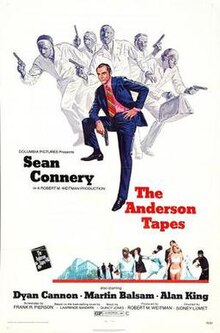
The Anderson Tapes

In a little over two years writing reviews here, I've watched my fair share of heist movies (11 if I've got the tags right).  It's that perfect blend of action, suspense and drama all wrapped up into one as -- typically -- a group of specialists work together to steal something thought unattainable.  Inception had dreams, Goldfinger was Fort knox, and Heat was piles of money.  It's almost always one specific thing.  That's not the case with 1971's The Anderson Tapes where the target isn't one thing, but one apartment building and everything in it.

To say director Sidney Lumet is slumming here isn't fair, but I'll admit it was the first thing I thought when his name popped up in the opening credits.  This is the man who directed 12 Angry Men, Network, Dog Day Afternoon, Serpico, and so many more classic movies, and now he's directing a good old-fashioned heist movie?  With a director of his caliber, I don't know if you can call it slumming, but it's a hell of a lot of fun to see someone like Lumet try a more mainstream movie dead set on entertaining more than delivering a message.  It is a movie that isn't particularly unique compared to most heist movies, but it is solid all around and very entertaining.

After 10 years in prison for a burglary charge, master thief Duke Anderson (Sean Connery) visits an old girlfriend, Ingrid (Dyan Cannon), who lives in a posh apartment in New York City. Duke is looking for a job to pull off -- any job at all -- and realizes it's staring him dead in the face. Ingrid's building has 12 separate apartments owned by doctors and lawyers and all of society's best (translation = richest).  Duke goes about putting together a motley crew of crooks and ex-cons to pull off the job, even going to the mob and kingpin, Angelo (Alan King) for backing. But as he goes about planning the elaborate heist of 12 apartments at one time, Duke realizes security has changed since he went into jail?  Security cameras are everywhere, and it seems someone is watching him.

Released in 1971, this is a movie that at the time must have felt like a futuristic look at security with all its high-tech equipment.  Now in 2011, it seems very dated that a team of crooks would be even slowed up by a security camera here and there.  Composer Quincy Jones' score even plays that up with a robotic, electronic sound which is more distracting than necessary. The subplot with Anderson being constantly videotaped (hence the title of the movie) is disappointing though, not really going anywhere.  It is the type of story where all these unknown elements feel like they're building to a huge, twist ending, but it never comes.  The final scene is disappointing in that way as so many different elements and unanswered questions don't gel in the end.

That complaint aside, I really enjoyed this movie.  This was one of Connery's movies in between James Bond roles, and before he returned to the part in Diamonds are Forever later in 1971.  He is one of my all-time favorite actors so seeing him in a well-made heist movie is a cinch for me.  His Duke Anderson is tough, intelligent and after 10 years in jail...desperate.  He wants and needs to pull of a job.  It's as high risk as they come, but the potential for payout at the end is huge so he puts it all on the line.  I would have liked a little more resolution late in the movie with his character, but it does make it pretty clear what happens to him.  Connery has a good chemistry too with Cannon in their few scenes together (he plays up his sexy, hairy Bond angle). If nothing else, 'Anderson' is worth seeing to get a glimpse of Connery without his toupee, just his thinning hair here.

So in the action equivalent of a men on a mission movie, Connery's Anderson must assemble a team of specialists to help him pull off the job.  This is where 'Anderson' is better than most, the supporting cast.  Martin Balsam is a scene-stealer and downright hilarious as Haskins, a gay interior decorator along to pick out what's valuable and what isn't worth stealing in the building.  Stereotypical and a little politically incorrect? You bet, but it's funny. In one of his first featured roles, a young Christopher Walken plays the Kid, a young ex-con who's an expert in safecracking and dismantling alarms. There's also Val Avery as Parelli, the mob muscle, Dick Anthony Williams as Spencer, the getaway driver, Stan Gottlieb as Pop, an ex-con struggling to adjust to life outside prison, and Paul Benjamin as Spencer's former partner in crime along to help. With smaller parts, Anderson's crew makes the most of it, helping each character leave a lasting impression even with their limited screen-time.

Prior to the heist, there is little in the way of explanation of how Duke and Co. are going to pull this off so not surprisingly, the 40-minute heist sequence to close the movie out is a high point.  Lumet films in it a unique way, showing the team get into an apartment, flash to the occupants later being interviewed by the police explaining what happened, and then bouncing back to inside the apartment during the job.  It's a cool technique that keeps you guessing because if you pay attention in the background, you see clues of how the job went and if it was successful or not.  In the heist, look for Ralph Meeker as a police commander brought in to deal with the crooks, and future SNL star Garrett Morris as a leader of a SWAT team. Nothing new, nothing flashy here, just a solid, exciting heist movie with a good cast.

The Anderson Tapes <---trailer (1971): ***/****       

Wednesday, June 30, 2010

The Deadly Affair

Whenever possible I do my best to avoid sounding like an arrogant American moviegoer.  No nudity and no explosions?  Count me out.  I do my best to at least give movies a try regardless of the country they're from.  If it sounds halfway decent, that's all I need.  Movies from England are usually a safe bet starting with the lack of a language barrier or subtitles, although in some cases, those subtitles wouldn't hurt.  That's where I'll start with 1966's The Deadly Affair.

A British production through and through, 'Affair' is the anti-Bond movie with its lack of action, sex and any sense of humor.  Typically, I can keep up with thick/heavy British accents (a talent derived from years of watching Michael Caine movies), but subtitles or closed captioning always helps in a pinch.  Directed by Sidney Lumet -- typically one of my favorite directors -- this semi-spy flick has so many actors mumbling and whispering through their parts that I was more than a little confused just 10 or 15 minutes in.  Even trying to keep up, the story was difficult to follow...to a point.  A "twist" late seemed incredibly obvious to me, but maybe I had time to think about, being confused and all.

After meeting with a possible Communist working for the British government, agent Charles Dobbs (James Mason) is shocked to find out the man killed himself -- even after a positive ruling from Dobbs to their superiors. An old friend and former agent, Dieter Fry (Maximilian Schell), is visting but Dobbs must put his friendship to the side as he investigates.  With some help from a retired detective (Harry Andrews), he begins to piece things together with much of the mystery surrounding the death coming back to the man's wife (Simone Signoret).  Through it all though something isn't adding up, and Dobbs realizes he's stepped into something much bigger than he anticipated.

First off, the casting is impeccable.  Not so impeccable?  Mason mumbles his way through his part, Signoret's thick French accent is tough to decipher at times, and Andrews talks in an ultra-fast fashion that combined with his own accent makes most of his lines nearly impossible to understand.  Combine all three of those elements, and I was confused almost from the start.  The story features a fair share of twists -- which obviously didn't help -- but even then the it is so slow-moving that often enough these twists don't register as a surprise.  It's clear this English man didn't kill himself.  It's only a matter of who was involved and most importantly, why.

On to a theory I have that I've dubbed 'the Law and Order guest star rule.'  Watch an episode of Law and Order.  If there's a guest star in the cast, put all your money on them being the bad guy/killer/rapist/thief/kidnapper.  Figure that NBC didn't pay them just to hang around.  Their services are going to be put to use.  The theory applies to movies too involving any sort of mystery.  In 'Affair,' it is the question of who is the murderer.  SPOILERS  STOP READING SPOILERS  Not surprisingly, it's Schell.  He makes an appearance early and then reappears in the last 15 minutes.  It is obvious from his entrance he's the bad guy.  One, he is Maximilian Schell, and two, he's still Maximilian Schell.  END OF SPOILERS

Beyond the murder mystery and the government intrigue, the pacing lacks any sort of energy.  Mason is having marital problems with wife Ann (Harriet Andersson) because she basically sleeps with anyone who says 'howdy' to her.  Mason's Dobbs is unbelievably forgiving in a storyline that goes nowhere.  One semi-twist involves who Ann is sleeping with, but you should really see it coming from miles off.  There are other little oddities that include long scenes of watching Shakespearean plays while Dobbs and Andrews' Mendel try to piece things together.  Out of place and with the ability to grind the story to a complete halt, I'm sure I missed something important, but by that point I just didn't care.

Not much else to say here.  Disappointing of course because Lumet is typically such a reliable director, and the cast he's working with is certainly impressive.  I'll recommend this one for fans of any of the actors or Lumet completists, but for not much else.  I'm sure some subtitles couldn't hurt a second viewing, but that first one was painful enough.

The Deadly Affair <----TCM trailer (1966): * 1/2 /****       

Saturday, April 3, 2010

Dog Day Afternoon

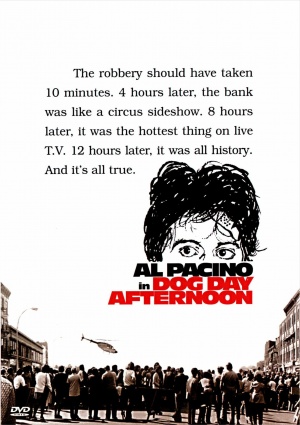
Over the last year or so I've tried to catch up on all the classic movies I've missed.  You know, those ones where people responded "WWWWWWWWWhat?" when you tell them you haven't seen them.  I never intentionally dodged these movies, I just never actively sought them out.  My problem in some cases is that I know these movies are held in high regard, and therefore expect more out of them.  Raging Bull more than lived up to expectations, Goodfellas was highly enjoyable, and Judgment at Nuremberg was a powerfully effective movie.  The latest one I've watched was 1975's Dog Day Afternoon.

I'll point this out first that I really enjoyed the movie, but I didn't love it.  Certain parts worked perfectly, like director Sidney Lumet filming this true story like a documentary in the New York locations the story took place and Al Pacino's incredible performance.  Lumet's pseudo-documentary style is appropriate for the story, giving the viewer a feeling of being a fly on the wall as the story develops.  My only real complaint is that in its effort to be truthful with the facts, the movie is a little long.  The first hour moves along at a quick pace, but somewhere in the second hour, the pacing hits a wall.  All the momentum built up is lost, and while the ending is worth the wait, it can't save or solve the pacing issues.

On a scorching hot summer day in August 1972, two men, Sonny Wortzik (Pacino) and Sal Naturile (John Cazale) walk into a Brooklyn bank with a rifle and a machine gun to rob the place.  Right away, nothing goes smoothly, starting with the bank having just over $1,000 after a deposit was picked up.  Minutes go by longer than they had planned, and the phone rings.  Detective Eugene Moretti (Charles Durning) is on the other end, and he wants to talk.  The bank is surrounded by police, and there's no way out. Sonny refuses and with eight hostages -- the bank manager, 6 tellers, and a bank guard -- starts to negotiate a way out of the mess he's gotten himself into.  Huge crowds form outside along with media and hundreds of cops, but a strange thing happens.  Sonny becomes a hero to the crowd, but no matter what he does, there's no easy way out of the situation.

The circus-like atmosphere that develops following the botched bank robbery is an indictment of the times, with Sonny blatantly playing to the crowds, like THIS well-known scene.  He screams at the police officers surrounding him to back off and holster their weapons.  At one point, he throws money -- fake $5 bills -- to the gathering crowds and becomes a fan favorite to them.  This is Pacino at his best in the role, a blend of calm intellect and brash outbursts all rolled into one.  I won't go as far as saying I was rooting for Pacino's Sonny, but the fact that he's even a little bit sympathetic is a testament to Pacino's acting.  This also earned him his 4th straight Best Acting Oscar nomination -- of which he won NONE -- and is a total departure from most of his other roles.

For such a big story, the cast is rather small which works surprisingly well.  It's a big story, but the key moments are these interactions between a handful of characters.  Cazale was only in six movies before dying at 43 of bone cancer, and he doesn't disappoint in any of them.  His Sal has a tortured past of which we find out very little, but it's shown he's not a very smart person and is much more of a follower than a leader.  Durning gets a flashier part as Det. Moretti, the police officer with the unpleasant task of negotiating the situation to save the lives of Sonny's hostages.  Unfortunately, Durning's Moretti basically disappears once the FBI shows up and is gone in the last 45 minutes.  Sully Boyar as Mulvaney, the bank manager, and Penelope Allen as Sylvia, the head bank teller, are the only hostages to make much of an impression.  Chris Sarandon received an Oscar nomination for his part as Leon, but I'll go into that next.

SPOILERS for this paragraph SPOILERS I don't know if it's a twist because the Netflix movie sleeve says it in the first sentence of the description -- thanks for that, Netflix -- but Sarandon is Leon, Sonny's lover/husband, and the reason Sonny planned the robbery.  He wanted to get money so Leon could have a sex-change operation because he thinks he's a woman trapped in a man's body.  This revelation comes about halfway through the movie and certainly comes as a bit of a shock (and that's knowing it is coming).  It isn't meant as a judgment that Sonny is gay or bisexual, instead Lumet just lays this all out for us to explain his motivations.  Sonny is married with kids, and when we see his background and personal life, it is clear why he's done what he has.  His wife is shrill, his mother overbearing, and the man he loves isn't all there in the head.  He has been pushed too far and knows nowhere else to turn other than this desperate ploy.

The real-life incident 'Dog Day' is based on took about 14 hours, and in the movie the pacing starts to drag once the sun goes down as the story tries to show everything that happened.  The real-life Sonny claimed only about 30% of the movie is true/factual.  Certain scenes go on too long -- especially conversations Sonny has with his wife, mother and Leon -- and had me looking for the fast forward button.  But still, the positives definitely outweigh the negatives, especially Pacino's performance and Lumet's direction.  I won't say it is a classic because there are some serious flaws, but it is still a great movie.

Dog Day Afternoon <----trailer (1975): ***/**** 

Saturday, March 6, 2010

Serpico

Starting off his Hollywood career, Al Pacino started off with an incredible run of performances beginning with 1972's The Godfather.  It continued with Serpico, The Godfather 2, and Dog Day Afternoon.  The common link?  He was nominated for an Oscar for each performance -- one supporting nod and three lead roles -- and somehow didn't win even one.  How he didn't win for Godfather 2 just confuses me, but that's for another time.

1973's Serpico is based on the real-life trials of Frank Serpico, a New York City cop who went against the grain in trying to be the best cop he can be.  There are two types of performances Pacino does when he's at his best.  One, think Scarface or Any Given Sunday, where he is over the top in almost every scene.  He's effective doing that because he commits so whole-heartedly to the part.  Two, there's Serpico, Heat, The Godfather trilogy, where he plays a highly intelligent, relatively calm character who has moments of huge, emotional outbursts.  I prefer him with the second option, and as much as I love Michael Corleone, Pacino's Frank Serpico might be his all-time best performance.

From as long as he can remember, Frank Serpico (Pacino) has wanted to be a police officer.  He graduates the academy and becomes a patrolman at an NYC precinct.  But right away, Serpico sees being a police officer isn't everything it's cracked up to be.  He wants to do his job as best he can without all the corruption that goes on behind the scenes.  Serpico refuses to take any pay-offs in any form and quickly draws the ire of superiors and co-workers.  He bounces from precinct to precinct with the hope of finally gaining detective status and the gold shield that comes with the position.  But after years of seeing this corruption, Serpico realizes he has nowhere else to turn and must take action against the rampant illegal activities crippling the police force.

Getting his nomination the second time around, Pacino lost to Jack Lemmon in 'Save the Tiger' which I haven't seen, but I assume it has to be pretty great.  Lemmon also beat out Jack Nicholson (The Last Detail), Marlon Brando (Last Tango), and Robert Redford (The Sting).  Playing a real person can be a daunting task so Pacino met the real-life Serpico and followed him around for several weeks, and it pays off.  By a certain point in the movie, it doesn't feel like Al Pacino playing a cop.  You're just watching Frank Serpico.  And as a character study of a man who just wants to do what he think is right, this movie is a classic.

Taking place over several years, the story follows Serpico's police career so other characters -- in his professional and personal life -- drift in and out.  The one constant is Pacino who is in just about every scene in this 129-minute flick.  He presents Serpico as a pretty even-keeled guy who is genuinely confused when a fellow officer hands him an envelope full of money.  He clearly never thought of this as a perk of the job and doesn't know what to do.  This situation builds and builds over the years because Serpico gains a reputation as being untrustworthy because he doesn't take the pay-offs.  As a cop, he works as a plainclothes officer, growing a thick beard and generally looking like a hippie with his clothes.  And that's usually a good sign for me in judging a role, Pacino becomes Serpico.  I'll have to check out 'Save the Tiger' but it has its work cut out because this was a great performance.

In bringing this story to the big screen, director Sidney Lumet wisely chose to film on the streets of New York.  We're not talking downtown Manhattan either with locations including Brooklyn, the Bronx, and Queens helping bring the gritty story to life.  Parts of New York City in the 1970s certainly had a rundown look so a plainclothes officer working the streets had to blend in.  As Serpico points out, 'our undercovers wear black shoes and white socks.'  Translated? They stick out like a sore thumb. Some of the better supporting parts here include Jack Kehoe as Keogh, a fellow officer trying to convince Serpico to go along with the others, Tony Roberts and Edward Grover as two police officers who side with the much-maligned Frank, and John Randolph as Chief Green, a higher-up in the police department.

The one flaw I can point out is that the last 30 minutes gets a little repetitive but not enough to derail the movie, not by a long shot.  Pacino's performance is too strong and doesn't allow the movie to derail in any form.  The ending is a bittersweet one that tells what Serpico ended up doing later in his life.  The real-life Frank Serpico is a fascinating individual with Pacino and Lumet painting a great picture and a great movie of his heroic actions.  Definitely check this one out.

Serpico <----trailer (1973): *** 1/2 /****

Thursday, February 18, 2010

Murder on the Orient Express

Different directors have different personalities, different ways audiences look at them.  Michael Bay?  Loud, explosive movies. James Cameron? Huge blockbusters. Still chugging along at 86 years old, director Sidney Lumet has had a knack for working with some of Hollywood’s biggest stars in movies with a long list of those biggest stars.  Working off an Agatha Christie source novel, 1974’s Murder on the Orient Express assembles one of the most impressive casts ever assembled.

Playing Belgian detective Hercule Poirot, Albert Finney leads this cast in an enjoyable, ridiculous murder mystery set in the 1935.  Finney is in just about every scene and dominates the movie.  I’ve never read a Christie novel or anything at all related with Poirot, but this character reminded me of Peter Falk’s TV detective Columbo.  A quirky, eccentric detective solves convoluted crimes that no person in their right mind should be able to comprehend. 

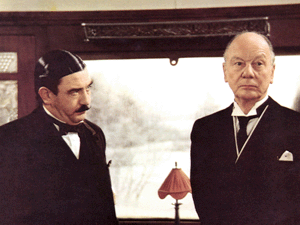
Boarding the Orient Express after receiving orders to return to London, famed detective Hercule Poirot (Finney) is given a berth on the crowded train thanks to a railroad official (Martin Balsam) and long-time friend. But on the second night out, a mysterious American passenger, Ratchett (Richard Widmark), is murdered, stabbed through the midsection 12 times.  The railroad official turns to Poirot to solve the murder before the train reaches the next station.  A snow-covered pass blocks the train’s way, giving Poirot free range to go about solving the mystery.  The detective quickly figures out that Ratchett was involved in a well-known kidnapping case.  So was it a hired killer, or was one of the many passengers onboard the murderer?

The murder mystery itself is an interesting one that unfolds quickly in the first 30 minutes or so.  The whole next hour is devoted to a series of interrogations/interviews as Finney’s Poirot and Balsam’s Bianchi assemble the evidence concerning Ratchett’s murder.  With a dialogue-heavy movie, the story sinks or swims on these scenes. In that sense, it swims long and hard.  Finney earned an Oscar nomination for his performance, and it’s a treat to watch him interact with his supporting cast.

The cast is a who’s who of Hollywood stars from the Golden Age and then a newer wave of younger stars making a name for themselves and then a few in between.  Describing all these characters would require a whole other review in itself so I’ll try and keep it shorter.  Along with Finney, Balsam, and Widmark, there’s a list of names that include Anthony Perkins, Ingrid Bergman (Oscar-nominated supporting part), Lauren Bacall, Sean Connery, Michael York, Jacqueline Bisset, Vanessa Redgrave, Jean-Pierre Cassel, and John Gielgud. Most of them are given a brief intro and then their interrogations with Poirot.  Basically that amounts to a cameo-like role for all of them, but it’s great just to see all those big-names working together.

SPOILERS Don’t read anymore if you want to know who the murderer is SPOILERS.  Poirot does his detective work and then confronts all the train’s passengers.  His conclusion? They all murdered Ratchett, each stabbing him once with the same knife.  Each passenger has a connection to an infamous kidnapping case that Widmark’s Ratchett masterminded, resulting in the death of five people.  So working together, the murdering dozen or so have planned this murder to a fault…they just didn’t plan on Poirot being onboard.  This twist is stupid, ridiculous, over the top, and somehow…it works.  The ending itself is a bit of a letdown, but that’s a minor complaint. 

The reveal itself is well-handled in an almost 30-minute scene where all the clues and evidence comes together.  Lumet handles it perfectly with quick flashbacks to Poirot’s questioning as Finney seemingly lose his mind only to figure everything out.  And that’s why this is a movie worth watching, the performances from Finney to the long list of A-list actors making the most of their supporting roles.  More than a little beyond the limits of believability, but still fun from beginning to end.

Murder on the Orient Express <----trailer (1974): ***/**** 


Friday, February 12, 2010

Network

Ah, the American public, always easy pickings for a roasting. Movies have done it left and right, like Billy Wilder's Ace in the Hole, and why not? As an enormous power in terms of what we'll watch, won't watch, what we'll pay to see, the public is as fickle as the weather. And to be fair, it's just not the U.S. So who has to decide what we watch, read and experience in terms of movies, TV shows, books, magazines, anything really. So goes 1976's Network, a not so subtle dig at the decline of television and news journalism into pandering for whatever audiences want.

Like any movie dealing with a timely issue, it's important to look at that time it's made in. Network was released in the mid 1970s after the U.S. had left Vietnam and just a few years removed from the Watergate scandal. There were issues to say the least, especially in the minds of the American people. So Network comes along with director Sidney Lumet presenting a cynical, very dark look at TV and the business it truly is to make money and be successful. Studio execs will do ANYTHING if the ratings are good, even to the point of taking a life.

After working for the UBS broadcasting station for many years, news anchor Howard Beale (Peter Finch) is being let go. Howard's wife has left him and his job was really all he had so on-air he tells his viewers that on a show a week away he is going to kill himself...on air for millions of people to see. Instantly, the ratings shoot up, and the network has a hit on their hands. They can't possibly take him off the air, instead giving Beale a stage to rant and rave about whatever suits him. The network's programming director, Diane Christensen (Faye Dunaway), plays it up, making it such a hit that almost half of the country is watching Beale's new show. All the while, Beale's close friend and boss, Max Schumacher (William Holden), wonders what's happened to the business he grew up with, and if there's any way to get back to the good old days.

That's basically the story in a nutshell, and I don't want to tell too much more because it will take away from the appeal of the movie, especially the last half hour. As presented, the UBS network is fourth in the ratings behind CBS, NBC, and ABC so working with a fictional channel, Lumet pulls out all the stops in portraying a cutthroat, profit above all else company. Dunaway's Diane is all business, all the time and can't carry on a personal life, Holden's Max is fighting to hold on to the last traces of a business that used to be, and Finch's Beale runs with the plan presented to him, preaching to his audiences nightly.

This movie had Oscars written all over it, getting 10 nominations and winning four. And while it's hard to dispute the movie didn't deserve them, I felt like I was watching something surreal, something completely over the top as the story unfolded, especially in the ending. Lumet was going for a satire of the TV industry, and it works -- the networks are skewered over an open fire -- but at times it's too much. Am I supposed to laugh or chuckle at what's going on, or be alarmed at what we're seeing? Probably a little of both, but the turns and twists just felt like too much to me.

What I won't argue with is the phenomenal casting, especially the three leads already mentioned and then throw in Robert Duvall for good measure. Finch was the first actor to be given a posthumous Oscar for his win in Best Actor. I personally would have given it to Holden (who was also nominated), but Finch is at a scenery-chewing, scene-stealing best as Howard Beale, an overnight ratings sensation. Most of his role requires him to deliver long, raving speeches -- and his "I'm as mad as hell" speech is top notch -- and he's presented both as a tragic figure and a bit of a stooge. Holden on the other hand, is much more subdued but equally effective as Max. His scene where he SPOILERS breaks up with Diane earns him the Oscar for me. Dunaway fully deserved her Oscar for Best Actress and is quickly becoming one of my favorite actresses.

Did I like Network? Yes, parts of it I loved. But as cynical as I can be in viewing and reviewing movies at times, I wish this was a little less cynical, maybe a little more subtle in its execution. Ned Beatty has a speech late in the movie that is rightfully impressive but I feel like I've heard it before. Maybe I shouldn't fault Network because other movies since 1976 have dealt with similar subjects, but it's hard not to. I completely recommend this movie to anyone who hasn't seen it for the performances alone, but I was a little disappointed with it. Thought provoking? Sure, but not a classic in my mind.

Network <----trailer (1976): ** 1/2 /****