Just over two years ago -- good lord, I'm getting old -- I wrote a review of the 1972 revisionist western The Life and Times of Judge Roy Bean. Based ever so loosely on the life of Judge Roy Bean, it's a mess of a movie if a quasi-interesting one. Some 30 years earlier though, an earlier film delved into the life of the infamous western figure. Interesting, but like its predecessor, still flawed. And away we go with 1940's The Westerner.
As settlers and homesteaders move into the wilds of Texas in the years following the Civil War, one man maintains his iron rule on his own territory. That man is Judge Roy Bean (Walter Brennan), a self-appointed judge who lives and rules by a very strict set of rules and laws. His typical verdict is simple no matter the crime; hanging. One day, the Judge meets a prisoner that he can't quite bring to send to the hanging tree. That man is Cole Harden (Gary Cooper), an amiable enough, fast talking cowboy making his way from job to job. Cole is accused of stealing a man's horse, and if there was ever a crime worthy of hanging in the old west, it would be horse thieving. The drifting cowboy is able to save himself from the noose, and he makes a fast friend in Judge Roy Bean. Their friendship though is threatened by an escalating range war, the cowboys readying to fight the homesteaders.
I liked a lot about this 1940 western from director William Wyler. For starters, the black and white look is perfect from the start. The outdoor scenes were filmed in the desert around Tucson, Arizona, adding a sense of realism to the story. The indoor scenes are mostly relegated to Bean's saloon-turned-courthouse in the Texas border country, almost like a play. I won't mention each of the names involved with the script -- there's 6 different names according to IMDB -- but the final product is full of darkly funny scenes that mix well with some great dialogue between Brennan and Cooper. A very natural back and forth makes any scene the duo is in that much more entertaining.
Having already won two Best Supporting Actor awards (1936 and 1938), Brennan made it a third win with his performance here as Judge Roy Bean. It is by far the best thing going for this Wyler-directed western. He makes a pretty nasty character always interesting to watch, if not particularly likable. He lives and rules by his own special laws which are steadfast....until they don't benefit him, in which case he tweaks the rules. Bean is stringent in that once he's ruled, the ruling is done. At one point, the Judge even hangs a man....a man who's already dead. Bean also has one obsession; his love for stage actress Lilly Langtry (Lilian Bond). His saloon is decorated with posters and cards and postcards of the lovely actress. He's never seen her, never met her, but he's desperately and madly in love. It's an oddly human (if not quite endearing) trait to one nasty dude.
For about 45 minutes, I loved this movie. We're introduced to Bean, his town and his posse of 'Yes Men' gunfighters (Paul Hurst and Chill Wills among them), and then Cooper's Cole (no relation to the real-life Cole Hardin) appears on the scene seemingly a sure thing for the hangman's noose. It is an extended scene with its intro and fallout that lasts more than 30 minutes. Bean in all his self-righteous judgment and Cole in his desperation to save his own skin are perfect with some surprisingly funny exchanges. Cooper was worried heading into the movie that Brennan would overshadow his secondary part, and he's right to a point, but he does a solid job (as expected) as the laconic but quick-thinking Cole. The running scene has several sight gags, some interesting twists and a great payoff. If only the rest of the movie could have kept up that energy, but unfortunately, it just doesn't.
The last half of the movie follows Cole and the Judge on opposite sides of a range war. No one seems to be able to convince Bean of anything, but he respects Cole (while also wanting one of the cowboy's prize possessions) enough to listen to him. Well, sort of. The range war feels forced, especially the slamming of a love interest -- Doris Davenport as Jane Ellen, the daughter of a farmer (Fred Stone) -- smack dab right into a story that just didn't need it. The range war offers a couple surprising twists, but the second half just never maintains the energy or momentum of the first half of the movie. Still a worthwhile movie for Brennan and Cooper throughout, but it's a mixed bag in the end because of the disappointing second half. Also look for Forrest Tucker and Dana Andrews.
The Westerner (1940): ** 1/2 /****
The Sons of Katie Elder
"First, we reunite, then find Ma and Pa's killer...then read some reviews."
Showing posts with label Gary Cooper. Show all posts
Friday, April 12, 2013
Friday, November 30, 2012
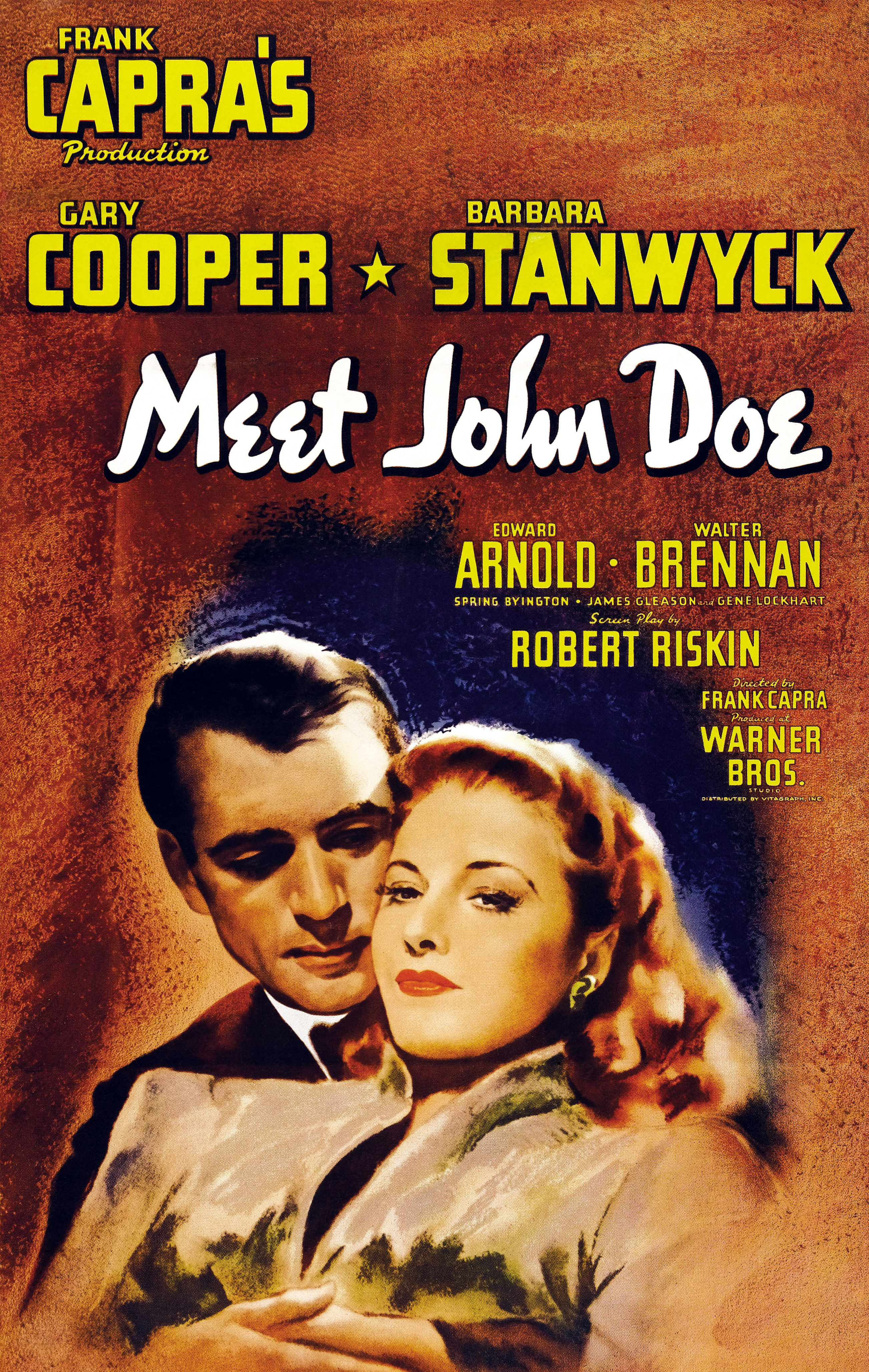
Meet John Doe
Released in the U.S. in spring of 1941, Meet John Doe is a successful movie that can chalk up at least part of its success to its release timing. At the tail end of the Great Depression and watching the world fall into WWII, the U.S. was at one of its historical low points. So how about a movie with a positive message that encourages the individual to work with others? Sounds simple, right?
Squeezed out of a job when a new owner takes over at her newspaper, columnist Ann Mitchell (Barbara Stanwyck) goes out guns blazing. She writes a column from "John Doe," a reader who's become disillusioned and frustrated with humanity and civilization, vowing to kill himself by jumping off City Hall on Christmas Eve. Uh-oh, we've got a problem. Readers are curious, wanting to save John Doe. Where to find a reader who never existed? Ann and the paper hire John Willoughby (Gary Cooper), an ex-baseball player turned drifter, to pose as John Doe. The response is tremendous though across America, but even Ann could not have planned what John Doe becomes as certain parties become involved with the grassroots movement.
In his last film before making almost a dozen WWII documentaries, director Frank Capra does not disappoint here. His films have a certain style to them, and not just in the visual sense. Maybe not in a visual sense at all. At their base, these are good-hearted stories that want to believe there's genuine good in people. There are those that are inherently good and those that are inherently bad with little to no middle ground. You're either one or the other. Watch enough of his movies, and you see those traits pop up in countless stories and characters.
As a story, this 1941 Capra film is a forerunner of later classics A Face in the Crowd and Network. It shows the rise -- and the inevitable and eventual fall -- of an individual, a person who inspires charity, faith and belief in the masses. Here, Cooper's John Doe is just looking for a meal, a place to sleep at night with a roof over his head. He has no ulterior motives. It's Ann who sees the potential for good, and there's a plenty. The John Doe movement -- help thy neighbor, be friendly, be helpful to all -- takes the country by storm. The ulterior motive comes from Ann's boss, D.B. Norton (Edward Arnold, doing what he does best, being BAD), who sees the power that can be manipulated with the John Doe movement. For a country struggling to get back on the right track, the message was simple (and appealing); work together, work to help and good things will happen.
Capra's films in general had a great sense of the Everyman, the normal guy. Obviously here, the focus is entirely on that individual in all his different forms. Who better to play the face of the Everyman than all-American actor Gary Cooper? In a career of iconic roles, this is certainly up there as one of his best.He does a fine job representing the average American. The shady nature of his business deal with Ann quickly hits hard, but he sees there's certainly potential for good too on an immense scale. He has a great believable chemistry with Stanwyck, the brow-beaten journalist who similarly sees the chance to do something in the country if people would just try. In addition to Arnold's snaky D.B. Norton, the cast includes Walter Brennan as the Colonel, John's questioning drifting partner who hates the system, and for the most part, people, and James Gleason as Connell, Ann's boss who sees what Norton is up to.
A sucker for anything in the dark, realist mode in films, I didn't always love 'Doe.' The sugary sweet outlook on life gets to be a little much at times, and the pacing can be a tad slow. One scene introducing the John Doe clubs goes on forever, Regis Toomey's Bert character explaining in expansive detail how the club came to be in his little town. The story is at its strongest at its darkest points. Norton's plan is hinted at -- uh-oh, sense of doom! -- and when it's revealed, the rug is pulled out from under John, Ann, and millions of Americans. As sweet as Capra's outlook can be at times, it's equally dark in these instances and equally effective. There are scenes where the symbolism is far too heavy-handed (portraying John as a martyr...a la Jesus), but what makes it bearable is the message of goodness. Well worth checking out. You can watch the movie in its public domain format HERE at Youtube.
Meet John Doe <---trailer (1941): ***/****
Squeezed out of a job when a new owner takes over at her newspaper, columnist Ann Mitchell (Barbara Stanwyck) goes out guns blazing. She writes a column from "John Doe," a reader who's become disillusioned and frustrated with humanity and civilization, vowing to kill himself by jumping off City Hall on Christmas Eve. Uh-oh, we've got a problem. Readers are curious, wanting to save John Doe. Where to find a reader who never existed? Ann and the paper hire John Willoughby (Gary Cooper), an ex-baseball player turned drifter, to pose as John Doe. The response is tremendous though across America, but even Ann could not have planned what John Doe becomes as certain parties become involved with the grassroots movement.
In his last film before making almost a dozen WWII documentaries, director Frank Capra does not disappoint here. His films have a certain style to them, and not just in the visual sense. Maybe not in a visual sense at all. At their base, these are good-hearted stories that want to believe there's genuine good in people. There are those that are inherently good and those that are inherently bad with little to no middle ground. You're either one or the other. Watch enough of his movies, and you see those traits pop up in countless stories and characters.
As a story, this 1941 Capra film is a forerunner of later classics A Face in the Crowd and Network. It shows the rise -- and the inevitable and eventual fall -- of an individual, a person who inspires charity, faith and belief in the masses. Here, Cooper's John Doe is just looking for a meal, a place to sleep at night with a roof over his head. He has no ulterior motives. It's Ann who sees the potential for good, and there's a plenty. The John Doe movement -- help thy neighbor, be friendly, be helpful to all -- takes the country by storm. The ulterior motive comes from Ann's boss, D.B. Norton (Edward Arnold, doing what he does best, being BAD), who sees the power that can be manipulated with the John Doe movement. For a country struggling to get back on the right track, the message was simple (and appealing); work together, work to help and good things will happen.
Capra's films in general had a great sense of the Everyman, the normal guy. Obviously here, the focus is entirely on that individual in all his different forms. Who better to play the face of the Everyman than all-American actor Gary Cooper? In a career of iconic roles, this is certainly up there as one of his best.He does a fine job representing the average American. The shady nature of his business deal with Ann quickly hits hard, but he sees there's certainly potential for good too on an immense scale. He has a great believable chemistry with Stanwyck, the brow-beaten journalist who similarly sees the chance to do something in the country if people would just try. In addition to Arnold's snaky D.B. Norton, the cast includes Walter Brennan as the Colonel, John's questioning drifting partner who hates the system, and for the most part, people, and James Gleason as Connell, Ann's boss who sees what Norton is up to.
A sucker for anything in the dark, realist mode in films, I didn't always love 'Doe.' The sugary sweet outlook on life gets to be a little much at times, and the pacing can be a tad slow. One scene introducing the John Doe clubs goes on forever, Regis Toomey's Bert character explaining in expansive detail how the club came to be in his little town. The story is at its strongest at its darkest points. Norton's plan is hinted at -- uh-oh, sense of doom! -- and when it's revealed, the rug is pulled out from under John, Ann, and millions of Americans. As sweet as Capra's outlook can be at times, it's equally dark in these instances and equally effective. There are scenes where the symbolism is far too heavy-handed (portraying John as a martyr...a la Jesus), but what makes it bearable is the message of goodness. Well worth checking out. You can watch the movie in its public domain format HERE at Youtube.
Meet John Doe <---trailer (1941): ***/****
Labels:
1940s,
Barbara Stanwyck,
Frank Capra,
Gary Cooper,
Walter Brennan
Thursday, November 17, 2011
Vera Cruz
When audiences saw 1954's Vera Cruz in theaters, I'm curious what their reaction was. Did they appreciate it, realizing they were seeing something new and different? Was it too much of a departure for western fans who liked their good guys very good and their bad guys very bad? It's easy to look back now and see the impact it made on countless other westerns, even heavily influencing the whole sub-genre of spaghetti westerns.
With the Civil War ended and his Louisiana plantation destroyed, former Confederate officer Ben Trane (Gary Cooper) heads south into Mexico looking to start over. He meets Joe Erin (Burt Lancaster), another American if somewhat younger, looking to prosper from the Franco-Mexican War. Joe has with him a gang of gunfighters, adventurers and saddle tramps so Trane joins them, signing on with the French forces, including Marquis Henri (Cesar Romero). They're hired to escort Countess Marie (Denise Darcel) to the port city of Vera Cruz, but something doesn't seem on the up and up. On the trail Ben and Joe figure out why. The Countess' wagon is loaded with $3 million in gold, and now all bets are off.
The Magnificent Seven, The Wild Bunch, Sergio Leone's Dollars trilogy (For a Few Dollars More specifically), those are just a few of the movies heavily influenced by director Robert Aldrich's 1954 western. Vera Cruz was one of the first westerns to take a heavily cynical look at the west and all its violence and greed. It has a mean streak painted right up its back that few other movies couldn't even think of at different points. Little kids are used as hostages by main characters (supposed good guys), brutal betrayals wait around every corner, and the violence can be a little startling in its execution; not often shown but implied. One character gets lanced through the throat, others are shot point blank in the face, one Mexican revolutionary is cornered and run through by French lancers. Startling and effective, always entertaining.
The reason I mention 'Few Dollars More' is the relationship and uneasy partnership formed between Cooper's Trane and Lancaster's Joe, an obvious influence on Clint Eastwood and Lee Van Cleef in Leone's spaghetti western. Both fast on the draw, they form that partnership out of necessity and a certain respect, but that doesn't mean they have to trust each other. Cooper is the unquestioned hero/good guy, but even he has a darker side. Lancaster is easier to read, his Joe telling you whatever you want to here and going along with it as long as it benefits him. He'd betray you with the snap of a finger. Lancaster's devilish grin says all you need to know about his Joe Erin. They have a great back and forth consistently throughout the movie, two legends playing off each other effortlessly.
Filmed in Mexico -- similar locations to The Wrath of God -- Vera Cruz has a feeling of authenticity, of being right there in 1866 as the Mexican Juaristas fight Maximilian's French forces. Aldrich filmed in Technicolor, and the movie has a distinct look to it, somehow colorful and washed out. There are some great individual shots Aldrich does with the camera, one reveal of a plaza ringed with revolutionaries, the other a possible betrayal showing a line of gunmen waiting to turn. Hugo Friedhofer's score is probably the most mainstream thing going for the movie, a more traditional score, but that's not a bad thing. Little things definitely work here to boost up some cool, even iconic scenes like Ben and Joe showing off their abilities at a ball in Maxmilian's court.
Aldrich specialized in guy's guys movies, and his cast is impressive. Along with Romero is Henry Brandon as Capt. Danette, a smarmy French officer looking down on Erin's gang. Darcel is Lancaster's perfect female counter, a beautiful woman ready to betray anyone for her own good, with Sara Montiel playing Nina, a young Mexican woman hovering around the escort. Joe's gang of ruffians and gunslingers should please most western fans with some future stars involved, including Charles Bronson, Jack Elam and Ernest Borgnine while also including Archie Savage as Ballad, a black former Union soldier, James Seay and James McCallion. All smaller parts, but fun ones still, Bronson even getting to play a harmonica, foreshadowing Leone's Once Upon a Time in the West.
Clocking in at just over 90 minutes, Vera Cruz never really slows down, macho head games, showdowns, chases, ambushes and betrayals around every corner. Definitely stick this one through to the end. A Juarista assault on a French garrison has a ton of action, and the shootout among the gang is a doozy, especially the surprising ending. An above average, exciting and influential western, Vera Cruz is a must-see.
Vera Cruz <---TCM trailer/clips (1954): *** 1/2 /****
With the Civil War ended and his Louisiana plantation destroyed, former Confederate officer Ben Trane (Gary Cooper) heads south into Mexico looking to start over. He meets Joe Erin (Burt Lancaster), another American if somewhat younger, looking to prosper from the Franco-Mexican War. Joe has with him a gang of gunfighters, adventurers and saddle tramps so Trane joins them, signing on with the French forces, including Marquis Henri (Cesar Romero). They're hired to escort Countess Marie (Denise Darcel) to the port city of Vera Cruz, but something doesn't seem on the up and up. On the trail Ben and Joe figure out why. The Countess' wagon is loaded with $3 million in gold, and now all bets are off.
The Magnificent Seven, The Wild Bunch, Sergio Leone's Dollars trilogy (For a Few Dollars More specifically), those are just a few of the movies heavily influenced by director Robert Aldrich's 1954 western. Vera Cruz was one of the first westerns to take a heavily cynical look at the west and all its violence and greed. It has a mean streak painted right up its back that few other movies couldn't even think of at different points. Little kids are used as hostages by main characters (supposed good guys), brutal betrayals wait around every corner, and the violence can be a little startling in its execution; not often shown but implied. One character gets lanced through the throat, others are shot point blank in the face, one Mexican revolutionary is cornered and run through by French lancers. Startling and effective, always entertaining.
The reason I mention 'Few Dollars More' is the relationship and uneasy partnership formed between Cooper's Trane and Lancaster's Joe, an obvious influence on Clint Eastwood and Lee Van Cleef in Leone's spaghetti western. Both fast on the draw, they form that partnership out of necessity and a certain respect, but that doesn't mean they have to trust each other. Cooper is the unquestioned hero/good guy, but even he has a darker side. Lancaster is easier to read, his Joe telling you whatever you want to here and going along with it as long as it benefits him. He'd betray you with the snap of a finger. Lancaster's devilish grin says all you need to know about his Joe Erin. They have a great back and forth consistently throughout the movie, two legends playing off each other effortlessly.
Filmed in Mexico -- similar locations to The Wrath of God -- Vera Cruz has a feeling of authenticity, of being right there in 1866 as the Mexican Juaristas fight Maximilian's French forces. Aldrich filmed in Technicolor, and the movie has a distinct look to it, somehow colorful and washed out. There are some great individual shots Aldrich does with the camera, one reveal of a plaza ringed with revolutionaries, the other a possible betrayal showing a line of gunmen waiting to turn. Hugo Friedhofer's score is probably the most mainstream thing going for the movie, a more traditional score, but that's not a bad thing. Little things definitely work here to boost up some cool, even iconic scenes like Ben and Joe showing off their abilities at a ball in Maxmilian's court.
Aldrich specialized in guy's guys movies, and his cast is impressive. Along with Romero is Henry Brandon as Capt. Danette, a smarmy French officer looking down on Erin's gang. Darcel is Lancaster's perfect female counter, a beautiful woman ready to betray anyone for her own good, with Sara Montiel playing Nina, a young Mexican woman hovering around the escort. Joe's gang of ruffians and gunslingers should please most western fans with some future stars involved, including Charles Bronson, Jack Elam and Ernest Borgnine while also including Archie Savage as Ballad, a black former Union soldier, James Seay and James McCallion. All smaller parts, but fun ones still, Bronson even getting to play a harmonica, foreshadowing Leone's Once Upon a Time in the West.
Clocking in at just over 90 minutes, Vera Cruz never really slows down, macho head games, showdowns, chases, ambushes and betrayals around every corner. Definitely stick this one through to the end. A Juarista assault on a French garrison has a ton of action, and the shootout among the gang is a doozy, especially the surprising ending. An above average, exciting and influential western, Vera Cruz is a must-see.
Vera Cruz <---TCM trailer/clips (1954): *** 1/2 /****
Friday, November 11, 2011
The Hanging Tree
Playing again with perceptions, I have an image of Gary Cooper as the perfect leading man. No flaws, just a strong, resolute, good man that he so often plays with his characters. Call it Sgt. York Syndrome, or Friendly Persuasion Fever. I see more and more with his roles that he didn't have to play that character as he was capable of so much more, darker, more in-depth characters, like 1959's The Hanging Tree.
In the Montana hills during a gold strike in 1873, Dr. Joseph Frail (Cooper) rides into a gold boom-town and sets up shop. He quickly helps a young gunshot victim, Rune (Ben Piazza), who was shot but managed to escape while robbing the sluice of a miner, Frenchy Plante (Karl Malden). No one saw Rune to identify him, leaving only Frail that knows what he was caught attempting. Frail holds it over his head, insisting he work off his "bill" while not telling him that he threw away the bullet he dug out of his shoulder. Rune agrees, but news hits the town of a woman struggling to survive in the wilderness his problems are pushed aside. The woman, Elizabeth Mahler (Maria Schell), a Swedish immigrant, is found near death. Frail treats her, but questions arise about his intentions. Can the doctor's path come back to haunt him again?
It's odd to see a leading man in a role like this as Cooper plays. He is the star, but with an ensemble cast that features four key parts, Cooper is often pushed to the side in the second act. Of his time in front of the camera through, the screen veteran makes the most of it, again showing his darker, flawed side. His Dr. Frail means well in almost all of his intentions, but the execution of those intentions leave something to be desired. He wants to help those around him, but his manner of doing so is odd. Because he doesn't care what others think of him, Frail obviously rubs some people the wrong way. In the dark, tragic character department, he's also trying to right a wrong, redeem himself for a past action that hovers around him wherever he goes. Somewhat underused, but a great part for Cooper.
Because I feel the need to categorize every movie, I guess you can say this is a western...sort of. The TCM description/review said a movie that's 'Not for all tastes.' It isn't a shoot 'em up, guns blazing western. From director Delmer Daves, this qualifies more as a psychological western, focused more on the individual personalities and dynamics than the wild west action. All the characters are scarred in some way, flawed in another and thrust into this difficult time and place to survive in. Because of that, the pacing can be a little slow at times as the story struggles to pick up any momentum. It took me three different sit-downs to get through the 106-minute movie. When it works, it really works though.
It's also different from most westerns in the setting, the mountains and hills of Montana in the 1870s. There aren't gunfighters or cowboys and Indians. Instead, it's gold prospectors, shop owners, doctors, fanatical preachers, and even families with children around. The look of the movie is great, Daves filming the story in Washington. There is also a very entertaining and completely wrong toned theme song, sung by Marty Robbins. Give it a listen HERE. It's catchy. I'll give him that, even if it sounds like it should have been in a lighter western.
What works through some of the slower portions of the movie is the characters around Dr. Frail, especially Schell's Elizabeth. I probably complain too much about this, but if a western is going to feature a female lead, this is a good example. Elizabeth was traveling with her father when their stagecoach was held up, her father killed in the robbery. In the wilderness, she starts walking and barely survives, brought back to good health by Frail once she's found. She wants to start out on her own, creating a life for herself. Schell's Elizabeth is a good-natured but strong-willed woman, liking to think the best of people but knowing that isn't always the case. Granted, she's put into an unnecessary love triangle between Frail and Rune, but Daves handles it in the right way. Very solid performance and a strong female performance.
My only experience with Piazza was his small part in The Blues Brothers -- trust me, you'll recognize him -- but in his second feature film, he manages to keep up with Gary Cooper. Malden does what he does best, shows off his versatility. He could play good and bad, sometimes within the same role, like here. You know from his introduction he's up to no good, and a confrontation is coming. Karl Swenson is good as Fraunce, the general store owner and friend of Frail's, while George C. Scott has a small part as a Bible-beating "healer" who sees competition in Frail.
The movie picks up steam toward the last 30 minutes, a mob mentality taking over as the psychological effects start to kick in, the very powerful affect gold has on people. Startling in its brutality, the ending works although the final shot leaves the conclusion to your own interpretation. Slow moving at times, but a worthwhile, underrated psychological western.
The Hanging Tree <---TCM trailer (1959): ***/****
In the Montana hills during a gold strike in 1873, Dr. Joseph Frail (Cooper) rides into a gold boom-town and sets up shop. He quickly helps a young gunshot victim, Rune (Ben Piazza), who was shot but managed to escape while robbing the sluice of a miner, Frenchy Plante (Karl Malden). No one saw Rune to identify him, leaving only Frail that knows what he was caught attempting. Frail holds it over his head, insisting he work off his "bill" while not telling him that he threw away the bullet he dug out of his shoulder. Rune agrees, but news hits the town of a woman struggling to survive in the wilderness his problems are pushed aside. The woman, Elizabeth Mahler (Maria Schell), a Swedish immigrant, is found near death. Frail treats her, but questions arise about his intentions. Can the doctor's path come back to haunt him again?
It's odd to see a leading man in a role like this as Cooper plays. He is the star, but with an ensemble cast that features four key parts, Cooper is often pushed to the side in the second act. Of his time in front of the camera through, the screen veteran makes the most of it, again showing his darker, flawed side. His Dr. Frail means well in almost all of his intentions, but the execution of those intentions leave something to be desired. He wants to help those around him, but his manner of doing so is odd. Because he doesn't care what others think of him, Frail obviously rubs some people the wrong way. In the dark, tragic character department, he's also trying to right a wrong, redeem himself for a past action that hovers around him wherever he goes. Somewhat underused, but a great part for Cooper.
Because I feel the need to categorize every movie, I guess you can say this is a western...sort of. The TCM description/review said a movie that's 'Not for all tastes.' It isn't a shoot 'em up, guns blazing western. From director Delmer Daves, this qualifies more as a psychological western, focused more on the individual personalities and dynamics than the wild west action. All the characters are scarred in some way, flawed in another and thrust into this difficult time and place to survive in. Because of that, the pacing can be a little slow at times as the story struggles to pick up any momentum. It took me three different sit-downs to get through the 106-minute movie. When it works, it really works though.
It's also different from most westerns in the setting, the mountains and hills of Montana in the 1870s. There aren't gunfighters or cowboys and Indians. Instead, it's gold prospectors, shop owners, doctors, fanatical preachers, and even families with children around. The look of the movie is great, Daves filming the story in Washington. There is also a very entertaining and completely wrong toned theme song, sung by Marty Robbins. Give it a listen HERE. It's catchy. I'll give him that, even if it sounds like it should have been in a lighter western.
What works through some of the slower portions of the movie is the characters around Dr. Frail, especially Schell's Elizabeth. I probably complain too much about this, but if a western is going to feature a female lead, this is a good example. Elizabeth was traveling with her father when their stagecoach was held up, her father killed in the robbery. In the wilderness, she starts walking and barely survives, brought back to good health by Frail once she's found. She wants to start out on her own, creating a life for herself. Schell's Elizabeth is a good-natured but strong-willed woman, liking to think the best of people but knowing that isn't always the case. Granted, she's put into an unnecessary love triangle between Frail and Rune, but Daves handles it in the right way. Very solid performance and a strong female performance.
My only experience with Piazza was his small part in The Blues Brothers -- trust me, you'll recognize him -- but in his second feature film, he manages to keep up with Gary Cooper. Malden does what he does best, shows off his versatility. He could play good and bad, sometimes within the same role, like here. You know from his introduction he's up to no good, and a confrontation is coming. Karl Swenson is good as Fraunce, the general store owner and friend of Frail's, while George C. Scott has a small part as a Bible-beating "healer" who sees competition in Frail.
The movie picks up steam toward the last 30 minutes, a mob mentality taking over as the psychological effects start to kick in, the very powerful affect gold has on people. Startling in its brutality, the ending works although the final shot leaves the conclusion to your own interpretation. Slow moving at times, but a worthwhile, underrated psychological western.
The Hanging Tree <---TCM trailer (1959): ***/****
Labels:
1950s,
Delmer Daves,
Gary Cooper,
George C Scott,
Karl Malden,
westerns
Wednesday, May 18, 2011
Love in the Afternoon
One of the biggest stars to come out of Hollywood's Golden Era, Gary Cooper was at the top of his game in the 1930s and 1940s. By the 1950s on the other side of 50 years old, Cooper's star faded some. He still made some great movies -- Vera Cruz and Friendly Persuasion are personal favorites -- but he didn't age well as cancer slowly spread through his system. He didn't always look well on screen, but he continued on working up to his death in 1961.
The image of Gary Cooper is what many movie fans remember most about him. I always think of Sgt. York, the country boy turned war hero in WWI. I think of Sheriff Will Kane, defending his town against a gang of outlaws even when the entire town turns their back on him. That's Gary Cooper, and without sounding cheesy, he's a symbol of Americana. He's honest, strong, steadfast, and when the chips are down, he's at his best. That is what makes Billy Wilder's 1957 film, Love in the Afternoon, so hard to digest. Cooper plays a philandering ladies man who moves from one woman to the next as he travels across the world. The movie is enjoyable enough, but it is an epic case of miscasting when it comes to Cooper's character.
Growing up in Paris, young Ariane (Audrey Hepburn) lives in an apartment with her father, Claude (Maurice Chevalier), hoping to one day be a concert cellist. Claude is a private detective, specializing in some of the sleazier cases in Paris. Ariane is a little naive to the ways of the world but can't help but be interested in her father's files, reading all about the steamy adventures of globe-trotting lovers. She takes a special interest in one case, one Frank Flanagan (Cooper), an American businessman with his hand in everything. He has a woman in every city, leaving them as quickly as he meets them. Ariane knows that a scorned husband is gunning for Flanagan, and at the last minute, saves him. She quickly falls for the older American, and he's curious about this mysterious Parisian girl. There's no way they should work, but can they?
Director Billy Wilder is too talented for this movie not to be worthwhile. He's just too good behind the camera, and it feels funny to write this, but this is the first review I've done here in over two years of his movies. He never had a dud in his career, just degrees of average to above average. This is a 1950s romantic comedy, full of style and story. It is well-written, and while the Parisian locations aren't used to their potential (Cooper and Hepburn are never outside if I recall), the Paris setting is hard to beat. I enjoyed the movie, appreciated the comings and goings of the story, and watching Cooper and Hepburn is never a bad thing.
The basic premise of the story though is that we have to buy Gary Cooper as this philandering, globe-trotting, worldly businessman. It's just not happening. Cooper was Grace Kelly's husband, Dorothy McGuire's husband. Flanagan would be TMZ fodder in the modern age, always in the news for his social shenanigans with any number of women. Wilder supposedly originally wanted Cary Grant in the role, and that makes sense. You would believe Grant as this character. Cooper -- as talented as he is -- just was not the right choice for this character. He's too old, and he looks it. It is hard to believe a beautiful young woman like Hepburn's Ariane falling for him as quickly as she does. This isn't a movie-killer, but it is certainly something you can't help but notice.
Because Cooper is too talented an actor for this movie to be a complete botched effort, it is still watchable, especially because of Miss Hepburn. The 27-year old actress was at the height of her success and popularity in 1957. She might be a couple years too old to play Ariane, but it works. As was the case with many of her roles (pre-Breakfast at Tiffanys at least), she plays the innocent, even naive young woman to a T. Ariane wants to be in love and quickly falls for Cooper's Flanagan (why, we never know, he's not smooth or charming). What's great about the character is how she ropes Flanagan in, pretending to be a female version of him, an exotic guy friend in cities all over the world. Hepburn sells it too, throwing off the cuff remarks left and right, Cooper slowly losing his mind, aware that he could be getting played but not knowing how to prove it.
If this is what romantic comedies were still like in 2011, the movie world would be a better place. It just would. The humor is smart, coming from interesting situations and worthwhile conversations. It's never obvious, painful slapstick humor. So while Cooper may have been miscast, the banter between him and Hepburn is well-written and well-delivered. Chevalier is great in the supporting role as Ariane's private detective father, and John McGiver is memorable as Monsieur X, one of Claude's customers. Also worthwhile, Flanagan's almost live-in band, the Gypsies, a jazz band who plays for him and his lady friends in his hotel room. The movie isn't great, and is a bit long in the tooth at 130 minutes, but it's good, old-fashioned moviemaking that rises above its flaws.
Love in the Afternoon <---trailer (1957): ** 1/2 /****
The image of Gary Cooper is what many movie fans remember most about him. I always think of Sgt. York, the country boy turned war hero in WWI. I think of Sheriff Will Kane, defending his town against a gang of outlaws even when the entire town turns their back on him. That's Gary Cooper, and without sounding cheesy, he's a symbol of Americana. He's honest, strong, steadfast, and when the chips are down, he's at his best. That is what makes Billy Wilder's 1957 film, Love in the Afternoon, so hard to digest. Cooper plays a philandering ladies man who moves from one woman to the next as he travels across the world. The movie is enjoyable enough, but it is an epic case of miscasting when it comes to Cooper's character.
Growing up in Paris, young Ariane (Audrey Hepburn) lives in an apartment with her father, Claude (Maurice Chevalier), hoping to one day be a concert cellist. Claude is a private detective, specializing in some of the sleazier cases in Paris. Ariane is a little naive to the ways of the world but can't help but be interested in her father's files, reading all about the steamy adventures of globe-trotting lovers. She takes a special interest in one case, one Frank Flanagan (Cooper), an American businessman with his hand in everything. He has a woman in every city, leaving them as quickly as he meets them. Ariane knows that a scorned husband is gunning for Flanagan, and at the last minute, saves him. She quickly falls for the older American, and he's curious about this mysterious Parisian girl. There's no way they should work, but can they?
Director Billy Wilder is too talented for this movie not to be worthwhile. He's just too good behind the camera, and it feels funny to write this, but this is the first review I've done here in over two years of his movies. He never had a dud in his career, just degrees of average to above average. This is a 1950s romantic comedy, full of style and story. It is well-written, and while the Parisian locations aren't used to their potential (Cooper and Hepburn are never outside if I recall), the Paris setting is hard to beat. I enjoyed the movie, appreciated the comings and goings of the story, and watching Cooper and Hepburn is never a bad thing.
The basic premise of the story though is that we have to buy Gary Cooper as this philandering, globe-trotting, worldly businessman. It's just not happening. Cooper was Grace Kelly's husband, Dorothy McGuire's husband. Flanagan would be TMZ fodder in the modern age, always in the news for his social shenanigans with any number of women. Wilder supposedly originally wanted Cary Grant in the role, and that makes sense. You would believe Grant as this character. Cooper -- as talented as he is -- just was not the right choice for this character. He's too old, and he looks it. It is hard to believe a beautiful young woman like Hepburn's Ariane falling for him as quickly as she does. This isn't a movie-killer, but it is certainly something you can't help but notice.
Because Cooper is too talented an actor for this movie to be a complete botched effort, it is still watchable, especially because of Miss Hepburn. The 27-year old actress was at the height of her success and popularity in 1957. She might be a couple years too old to play Ariane, but it works. As was the case with many of her roles (pre-Breakfast at Tiffanys at least), she plays the innocent, even naive young woman to a T. Ariane wants to be in love and quickly falls for Cooper's Flanagan (why, we never know, he's not smooth or charming). What's great about the character is how she ropes Flanagan in, pretending to be a female version of him, an exotic guy friend in cities all over the world. Hepburn sells it too, throwing off the cuff remarks left and right, Cooper slowly losing his mind, aware that he could be getting played but not knowing how to prove it.
If this is what romantic comedies were still like in 2011, the movie world would be a better place. It just would. The humor is smart, coming from interesting situations and worthwhile conversations. It's never obvious, painful slapstick humor. So while Cooper may have been miscast, the banter between him and Hepburn is well-written and well-delivered. Chevalier is great in the supporting role as Ariane's private detective father, and John McGiver is memorable as Monsieur X, one of Claude's customers. Also worthwhile, Flanagan's almost live-in band, the Gypsies, a jazz band who plays for him and his lady friends in his hotel room. The movie isn't great, and is a bit long in the tooth at 130 minutes, but it's good, old-fashioned moviemaking that rises above its flaws.
Love in the Afternoon <---trailer (1957): ** 1/2 /****
Friday, December 31, 2010
Task Force
All those things were bouncing around in my head as I watched 1949's Task Force this week. It tells the partial story of the development of carriers in the Navy and their involvement with pilots and aviation to advance the Navy's capabilities. They started off as basically sailing airfields on the oceans where rickety planes could land when necessary and developed into immense, very necessary war machines by World War II. A character mentions early on that when trying to land on the flat top of a carrier deck it looks a lot like a tombstone with your name on it, the ship bucking and rolling with the sea. The movie is certainly informative about the subject, but it's missing something, and I wish I could give it a higher rating.
As a young pilot in the Navy, Jonathan Scott (Gary Cooper) is among the first pilots to be trained in carrier landings. Through all the difficulty in this extremely dangerous training, he sees the benefits of a plane being able to land on a ship as it sails across the ocean, and the Navy has a convert. The higher-ups in the Navy don't see the benefit a carrier would have weighed against the huge costs and risks involved. With help from his commanding officer, Capt. Pete Richard (Walter Brennan), Scott continues to work toward the development of carrier task forces in the U.S. Navy, often causing ripples when he should sit back and shut up. Aided on the home front by his wife, Mary (Jane Wyatt), Scott continues on as the Navy continues to develop, unknowingly working toward the coming conflict in WWII where carriers will play a key role in the Pacific theater.
I'll say this first so no one accuses me of hating America or anything similar, but I do like Gary Cooper. I don't love him though. So many of his parts are so bland, so vanilla, that I don't consider myself a huge fan of his. I've never avoided a movie of his because I saw his name and thought 'Hey, that guy sucks!' but at the same time I don't always seek him out. His part here as Capt. Jonathan Scott falls somewhere in the middle of the movies I've seen with him. It's not a particularly lively performance, and he comes across as a bit too whiny for my liking. He has some good interactions with Brennan (solid as ever) and his marriage with Wyatt's Mary doesn't feel as out of place as so many other armed forces marriages in movies, but something's just missing overall in the movie, and that's not a criticism of Cooper or his acting.
All I can wrap my head around is that this movie is basically a documentary about the history of the Navy carrier, but instead of a voiceover provided we get actors stepping into the roles. If anything, Cooper's part is the tour guide, navigating the viewer through this story. He does provide a voiceover of how things are changing for the Navy, but it becomes tedious. If I wanted to watch a history of the U.S. Navy, I'd turn on the History Channel and get caught up with a better made documentary about the subject. As is typical with these movies, a title card thanks the Navy for all their help in making the movie, and cynical guy that I am I couldn't wonder how much control the government and the armed forces had in what the story did and didn't cover. As for Cooper's part, it's a lose-lose battle for him in a part that could have been filled by any cookie-cutter actor.
What saves the movie late is the depiction of the Navy in the days, weeks and months following the sneak attack on Pearl Harbor December 7th, 1941. Pearl Harbor and the battle of Midway are both covered in detail in the movie's last 45 minutes. The problem is though that no matter how good these segments are, there are whole movies devoted to these stories (1976's Midway is a personal favorite) that cover the subject better. Still, that's not a fair criticism of Task Force because director Delmer Daves is doing what he can with what's in front of him. It's easy to forget now some 70 years later, but the course of the war changed at Midway, and if the U.S. had lost that battle WWII might have gone a very different route. As Brennan's character explains, 'The west coast better be ready to fight on the beaches.' One of the darker times in American history, and one where the armed forces came through in a must-win situation.
This isn't a bad movie at all, it's just not a great movie either. It certainly has some potential with an interesting story, but it focuses on trying to tell too big of a story instead of keying in on the most interesting parts of the story. The movie on the whole lacks any real heart, any reason for us to get invested with the story and its characters. It is informative but not very exciting in getting its info out. Worth watching for WWII buffs probably.
Task Force <---trailer (1949): ** 1/2 /****
Labels:
1940s,
Delmer Daves,
Gary Cooper,
Walter Brennan,
WWII
Saturday, July 3, 2010
The Wreck of the Mary Deare
Looking for a sign as to whether a movie is worth checking out? Do some research and find out the pre-production in the movie. Was it a smooth production, on-time and under budget? Did stars and directors drop out? Reading about 1959's The Wreck of the Mary Deare, I found that Alfred Hitchcock was originally attached to the movie only to drop out because he couldn't figure out what to do with the source novel. Hitchcock bailed and worked on a different movie that ended up being halfway decent, North by Northwest. As for the movie he left behind, that one wasn't so lucky.
Director Michael Anderson stepped in to helm the movie that has a lot working for it, and a lot of things that just don't add up. The cast features two highly regarded actors -- one on the rise, one in his last movie -- and a story that should have been more interesting. It attempts to keep you guessing by keeping you in the dark, but in the process just ends up being frustratingly boring. By the time everything gets figured out there are some good reveals in a story that does come together, but even then it's so low-key that it barely registers.
Salvaging wrecks and abandoned ships in the Atlantic Ocean, Captain Mike (Ben Wright) and partner John Sands (Charlton Heston) stumble upon a large vessel in the English Channel apparently on fire with no one at the controls. Sands gets on board hoping to claim the abandoned vessel and salvage it for a pretty penny only to find a man, Gideon Patch (Gary Cooper), claiming to be the captain. He enlists Sands help in docking the ship, the Mary Deare, in the Minquiers where they'll abandon it and find land where Patch can tell his side of the story at a court of inquiry. Sands is instantly suspicious of Patch's motives, but the drive and greed for the salvage rights keeps him involved. Waiting at the court of inquiry though is a prosecutor (Michael Redgrave) who isn't going to pull any punches in finding out what really happened.
The high seas is as good a place to start a story because honestly, anything can happen there because you're relying on principles and morals of individuals to come out on top. There's no one to police crimes. You're on the water alone and are forced to fend for yourself. The opening sequences as Heston's Sands explores the empty Mary Deare are well-handled, full of tension because we wonder what really happened? Where's the crew? But once Cooper shows up, there's at least a wordless half hour of these two trying to keep the ship afloat and beach it in the Minquiers, a rock-ridden area off the coast of France. The pacing is really off and coming so early it makes it difficult to get into the movie.
More than that, the guessing game as to what really happened aboard the Mary Deare becomes tiresome. Here's a scene that is repeated at least five times. Sands: What happened? Patch: I can't tell you yet, just trust me. Curiosity only takes you so far unless you're given some sort of reason to be pulled along. There are some clues, big business intrigue, large monetary payouts, betrayals and murder all involved as Patch tries to prove his innocence so he can one day captain another ship. The intrigue gives Richard Harris (in just his 3rd movie) a crack at playing a bad guy as well, playing Higgins, a treacherous second officer. Harris is one of my favorites, but I prefer him as a roguish hero more than a straight bad guy. Truth be told, he's an intimidating villain.
Reading about the movie, the tipping point was Cooper and Heston starring together in a movie. This would be Cooper's second-to-last movie before his death in 1961 while Heston was in the midst of a string of roles that made him one of Hollywood's most bankable stars. There's a decent chemistry between the two actors, and they do dominate much of the screentime, but something is missing. Beyond the acting and on-screen persona, Cooper seems tired and looks to be going through the motions. Even when trying to swing opinion to his side, he's just not that convincing. Heston's part could have been filled by just about anyone, requiring him to follow along at Cooper's coattails, asking a question now and then and generally being frustrated. For two names as big as theirs, I expected more from the two lead roles.
That rings true for the whole movie, I expected more of...well, everything. The acting is nothing to write home about, the story is dead in the water almost from the beginning and attempts to liven it up fall short. As a whole, the movie feels very flat without a sense of energy or urgency to get things going and make it better. A disappointing end result.
The Wreck of the Mary Deare <----trailer (1959): **/****
Director Michael Anderson stepped in to helm the movie that has a lot working for it, and a lot of things that just don't add up. The cast features two highly regarded actors -- one on the rise, one in his last movie -- and a story that should have been more interesting. It attempts to keep you guessing by keeping you in the dark, but in the process just ends up being frustratingly boring. By the time everything gets figured out there are some good reveals in a story that does come together, but even then it's so low-key that it barely registers.
Salvaging wrecks and abandoned ships in the Atlantic Ocean, Captain Mike (Ben Wright) and partner John Sands (Charlton Heston) stumble upon a large vessel in the English Channel apparently on fire with no one at the controls. Sands gets on board hoping to claim the abandoned vessel and salvage it for a pretty penny only to find a man, Gideon Patch (Gary Cooper), claiming to be the captain. He enlists Sands help in docking the ship, the Mary Deare, in the Minquiers where they'll abandon it and find land where Patch can tell his side of the story at a court of inquiry. Sands is instantly suspicious of Patch's motives, but the drive and greed for the salvage rights keeps him involved. Waiting at the court of inquiry though is a prosecutor (Michael Redgrave) who isn't going to pull any punches in finding out what really happened.
The high seas is as good a place to start a story because honestly, anything can happen there because you're relying on principles and morals of individuals to come out on top. There's no one to police crimes. You're on the water alone and are forced to fend for yourself. The opening sequences as Heston's Sands explores the empty Mary Deare are well-handled, full of tension because we wonder what really happened? Where's the crew? But once Cooper shows up, there's at least a wordless half hour of these two trying to keep the ship afloat and beach it in the Minquiers, a rock-ridden area off the coast of France. The pacing is really off and coming so early it makes it difficult to get into the movie.
More than that, the guessing game as to what really happened aboard the Mary Deare becomes tiresome. Here's a scene that is repeated at least five times. Sands: What happened? Patch: I can't tell you yet, just trust me. Curiosity only takes you so far unless you're given some sort of reason to be pulled along. There are some clues, big business intrigue, large monetary payouts, betrayals and murder all involved as Patch tries to prove his innocence so he can one day captain another ship. The intrigue gives Richard Harris (in just his 3rd movie) a crack at playing a bad guy as well, playing Higgins, a treacherous second officer. Harris is one of my favorites, but I prefer him as a roguish hero more than a straight bad guy. Truth be told, he's an intimidating villain.
Reading about the movie, the tipping point was Cooper and Heston starring together in a movie. This would be Cooper's second-to-last movie before his death in 1961 while Heston was in the midst of a string of roles that made him one of Hollywood's most bankable stars. There's a decent chemistry between the two actors, and they do dominate much of the screentime, but something is missing. Beyond the acting and on-screen persona, Cooper seems tired and looks to be going through the motions. Even when trying to swing opinion to his side, he's just not that convincing. Heston's part could have been filled by just about anyone, requiring him to follow along at Cooper's coattails, asking a question now and then and generally being frustrated. For two names as big as theirs, I expected more from the two lead roles.
That rings true for the whole movie, I expected more of...well, everything. The acting is nothing to write home about, the story is dead in the water almost from the beginning and attempts to liven it up fall short. As a whole, the movie feels very flat without a sense of energy or urgency to get things going and make it better. A disappointing end result.
The Wreck of the Mary Deare <----trailer (1959): **/****
Sunday, July 19, 2009
Beau Geste
Director William Wellman pulls this off with his 1939 classic Beau Geste, a story of three brothers who enlist in the French Foreign Legion. The story opens with a relief column nearing Fort Zinderneuf, a far-off post near an oasis that came under siege by Arab tribesmen. But as the relief draws closer, they find the whole garrison massacred to a man, and the commanding officer dead on the parapets with a French bayonet through his heart. With no enemy dead anywhere in sight and no legionnaires to tell the story, the question arises; what happened to these 50 legionnaires?
After the cool opening sequence at the scene of the massacre, the story flashes back to 15 years prior where three brothers, Beau, Digby and John, have been adopted by a rich English woman, Lady Patricia (Heather Thatcher) The three orphans live the life of luxury, playing war games and playing pranks on each other and their 'cousin' Gussie, the heir to quite a family fortune. But the years pass and Lady Patricia receives a note from her long lost husband saying he'll soon return for the Blue Water diamond, the last thing of any value they own. Before he can retrieve it though, the diamond is stolen by someone living in the house. But who was it?
In hopes of removing suspicions from his younger brothers, Beau (Gary Cooper) takes the blame and enlists in the French Foreign Legion to avoid embarrassment for his family. But it's not too soon before brothers Digby (Robert Preston) and John (Ray Milland) join up too with their big brother. It's in the legion they come under the command of sadistic Sergeant Markoff (Brian Donlevy), who was humiliated at his last post and now seeks to redeem himself, no matter the cost even if it is his own men's lives. It is when Markoff finds out the Geste brothers may be diamond thieves that the real conflict arises, the sergeant splitting the trio up, Beau and John to Zinderneuf as replacements and Digby to another fort for mounted infantry training.
The French Foreign Legion is often presented as this glamorous, honorable fighting unit, but in just about every movie I can think of some unlucky company is getting massacred or abandoned at some far out post with no hope of outside help or survival. In Beau Geste, it's no different. The soldiers at Zinderneuf hope to lead a mutiny against Markoff, but that plan gets put on hold when the Arab tribesmen arrive en masse. The battle scenes are exciting from the start even if we know the end result. The desert outside Yuma, Arizona fills in nicely for the Sahara desert, oasis and all, with the set of the fort a perfect setting for the drama to unfold.
As for the cast, it would be hard to ask for a better one. As the title character, Cooper does what he does best, the sort of everyman role who is noble, honorable, and always looking out for those around him, especially his younger brothers. Preston and Milland round out the trio of brothers, Milland getting slightly more screen time and the love interest, and with Cooper provide the heart, the backbone of the movie. Their scenes together ring true whether it be with the comedic introductions or later in the movie when they've enlisted in the Legion. The three actors bring the characters to life, much like the three leads in another 1939 classic with a somewhat similar story, Gunga Din.
In a role he received a Best Supporting Actor nomination for, Donlevy has a great part as Markoff, the sadistic, half crazy sergeant who will drive his men to the breaking point and then keep on pushing. He wants his good name back and all the medals and privileges that come with a promotion, and as he sees it, it's all in grasp if he wins a significant battle, casualties be damned. Unfortunately for Donlevy, 1939 was the year of Gone With the Wind, Stagecoach, Mr. Smith Goes to Washington, so he didn't get the win, but it's still one of his best parts. Also in the cast is a very young Susan Hayward as Isobel, the love interest who grew up with the Gestes but starts to fall for the youngest brother, John. Just some of the other legionnaires include J. Carrol Naish, Albert Dekker, Broderick Crawford, and Charles Barton.
Labeled as Hollywood's strongest overall year just for the sheer number of classics that were released, 1939 was quite a year for the movies. The old reliable 'they don't make 'em like that anymore' applies to any number of movies from that year, especially Beau Geste. It is good old-fashioned entertainment with an exciting story, strong and likable characters and some creativity in telling the story. With a DVD released just weeks ago, don't skip this one by. A true classic from start to finish.
Subscribe to:
Posts (Atom)