The Sons of Katie Elder

The Sons of Katie Elder
"First, we reunite, then find Ma and Pa's killer...then read some reviews."
Showing posts with label NYC. Show all posts

Friday, April 11, 2014

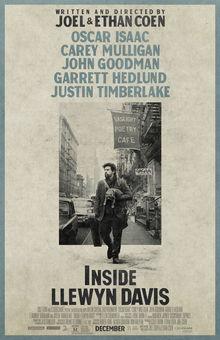
Inside Llewyn Davis

Maybe more than any other film that was considered for some Academy Award nominations, 2013's Inside Llewyn Davis landed with a thud when the nominations were actually released in February. It picked up just two nominations -- for Best Cinematography and Best Sound Mixing -- but won neither. Should it have picked up some other nominations? That's for others to decide. What isn't up for discussion is that awards season success aside, this is a good movie.

It's 1961 in New York City's Greenwich Village and Llewyn Davis (Oscar Isaac) is looking for work and more importantly, some money. A folk musician with a bit of a following, Llewyn released an album with a partner in recent years, but he's on his own now and struggling a bit to get by. His name has a reputation -- somewhat -- as a talented musician who's also a bit flighty. Mostly though, Llewyn wants to sing, to perform, to get his name out there and really to take his career to the next level. He's nearing rock bottom though, his money running out almost completely. It's the dead of winter and he's overextended all his relationships, his friendships, his business connections. He feels he's close, but he just needs that one break...if he can find it.

Another movie that proved difficult to write a one-paragraph plot synopsis. From the Coen brothers, Joel and Ethan, 'Inside' is a stylish, well-told, throwback-type story that follows about a week in the life of a struggling musician. It's easy to see why there was some outrage when it didn't pick up any prominent Oscar nominations. I'll get into some real analysis later, but the gist is this; it's a really good movie. Not quite a comedy, not a straight drama, it's just good.

The most obvious place to start is with directors/writers/producers Joel and Ethan Coen. There is a certain style in each and every one of their movies from Blood Simple to Fargo, True Grit to No Country for Old Men, O Brother, Where Art Thou to The Big Lebowski. The stylistic choice here is picking the location, 1960s New York City (with some out of state departures). From the look of the movie with the hairstyles, the wardrobe, the cars, the mindset, all these little things add up to one great puzzle. From beginning to end, you feel like you're in 1960s NYC. The visual is almost bland, washed out colors permeating almost every scene. As for the folk background, 'Inside' has an extreme love and appreciation for the folk music scene of the 1960s. It feels authentic down to the smallest detail, and that authenticity goes a long way. The story drifts at times, it's both dark and funny and dramatic, but it just feels real.

A young actor with a ton of potential, Oscar Isaac nails the lead part here as folk singer Llewyn Davis. He's had key supporting parts in Drive, The Bourne Legacy, 10 Years (where he also sang), and Robin Hood, but this is quite the breakout leading part. For starters, Llewyn is far from a likable character. He has moments where you feel sympathy for him, but mostly, his issues are self-made. We learn why he's on his own now and not working as a duo anymore. We learn how he's got to this spot, and most importantly, we see that desperation and frustration of an artist/musician who just wants his shot at the big time. Unlikable qualities aside, with a general lack of sympathy, I still found myself rooting for Llewyn....only to see him rip that away quickly with some jackass move. Like the story though, this has the distinct feel of an authentic character, a person with hopes and dreams, aspirations that just haven't been there so far. Likable? Nope. Interesting, fascinating to watch? Yes, you bet. Interesting to see where Isaac goes next, especially because many thought he should have picked up a Best Actor nomination for his part.

Those Cohens, they specialize in ensemble casts like nobody's business. I guess talented actors and actresses want to work with them for some reason. I especially liked Carey Mulligan as Jean, a fellow folk singer who has a checkered past with Llewyn including one major current issue. Justin Timberlake is excellent too as Jim, Jean's fiance, a singer who's carved a name out for himself already.  The pairing of John Goodman as existential-thinking jazz musician Roland Turner is a scene-stealer, Garrett Hedlund providing some 1960s beatnik background as beat poet Johnny Five, Llewyn carpooling to Chicago with the odd duo. F. Murray Abraham has a good part as a Chicago club owner who's got some pull with record labels, giving Llewyn an impromptu audition. Also look for Ethan Phillips and Robin Bartlett as the Gorfeins, a middle-aged married couple who love Llewyn and allow him to crash on their couch from time to time. Max Casella also has a fun part as Papi, a club owner who likes Llewyn and keeps offering him different gigs.

An interesting movie for a whole lot of different reasons, most of them positive. The only one I didn't like was a stylistic choice with a framing device at the beginning and end, but it's not a huge deal. In general, there's plenty of things that can/will draw you in. There's a handful of musical numbers performed -- Isaac especially impressing -- with a nice nod to Bob Dylan late if you're paying attention. But across the board, whether it's the music, the story, the style, the acting, it's just good stuff. Enjoy it, appreciate it.

Inside Llewyn Davis (2013): ***/****

Tuesday, February 18, 2014

Winter's Tale

If there's ever a weekend meant for sappy, sugary sweet, lovey-dovey movies, it has to be Valentine Day weekend. Audiences had two options this past weekend when it comes to the romantically pleasant love story, Endless Love and 2014's Winter's Tale. Reviews were almost uniformly negative -- some scathingly so -- but I thought there was too much positive going on to make it that bad. Was I correct? Well, there are positives, but when it's bad.....it's bad.

In New York City in 1916, Peter Lake (Colin Farrell) is an accomplished thief who's run into a bit of trouble. In the city, he has no rivals, but a former boss and mentor of sorts, Pearly Soames (Russell Crowe), wants him dead, and he's willing to pay a hefty price to get it done. Every job Peter pulls off, he's being hunted by Pearly's criminal underworld thugs. Picking a safe at one luxurious NYC house, Peter is surprised to find the supposedly empty house not empty at all, a pretty 21-year old woman, Beverly (Jessica Brown Findlay), dying of tuberculosis and already having outlived the diagnosis from her doctors. Beverly doesn't scream or freak out, Peter undone some by her response. Instead, she invites him to sit down for tea, and they talk. Their connection is instantaneous, their attraction evident from the first words they share though. It almost feels like the universe has brought these two young people together for a reason. Could something be going on with far bigger implications? Are they meant to do something special?

I saw the trailers for this romantically-charged period piece this past fall and was intrigued. It looked sappy and overdone -- like Valentine's Day bait at most -- but I was intrigued. It was a love story that didn't look too cheesy. 'Tale' is based off a 1983 novel from author Mark Helprin, and it's rocking 4 out of 5 stars currently at Amazon (buy it HERE, because Amazon needs my help). As the release date drew closer, I was actually looking forward to seeing it. The premise -- and there's far more than my simple plot description above -- of 1910s New York City, a criminal underworld connection, true love, lost love, and quasi-time travel seemed like literature at its best, or at least something that appeals to me. It sure sounded like the Pete Hamill novel 'Forever' in some ways, a favorite of mine. And the end result? Wow. I don't know exactly where to start.

There is potential here. There is, but there is also a reason critics are tearing it to pieces. My favorite review goes to Richard Roeper -- read HERE -- who certainly enjoyed bringing up all the most cringe-worthy moments. This is a story about true love, the universe, good and evil, miracles, destiny, finding a purpose in life, accomplishing what you're supposed to accomplish. All well and good, right? Sure, it's a lot to deal with but it certainly could have worked. It doesn't. 'Tale' is too dreamy, too loving, too sugary sweet with voiceover narrations about stars, people dying and becoming stars, about angels ascending and descending from Earth and Heaven and Hell. The basic premise is that true love brings out a true miracle in everyone. Everyone has that one miracle, that one thing in life that is pure and good and perfect. In many cases, it's love. Crowe as Pearly is a demon who's job is to prevent those miracles. Working against him are creatures and beings trying to help individuals complete their mission.

Yeah, and there it goes. Things start to disintegrate quickly, and yes, there's just too much going on. The creature helping Peter accomplish his miracle -- is it to save Beverly? Hhhmmm, I don't know.... -- is an immaculate white horse that Peter calls 'Horse,' but it sounds dreamy with an accent. Oh, and the horse flies, sprouting wings as necessary to escape dangerous situations. Pearly especially wants to kill the horse. Oh, and Pearly says the horse is "actually a dog" which...we...never...actually...see. And it's never explained. Crowe overacts like his life depends on it, similarly rocking an Irish(?) accent, his demon turning into a maniacal-looking animal when it gets angry. Pearly also visits a special guest two times, Lucifer himself played by Will Smith. Yes, you read that right. Will Smith. His Lucifer has a touch of gray, wears big, gold earrings, a stylish black blazer and in 1916 NYC wears a Jimi Hendrix t-shirt. The scene where he blows up on Pearly, reprimanding him for an idea, is laughably bad. I'm assuming it was meant to be a big, frightening dramatic moment, and I laughed. Out loud.

What did work for me was the crux of the story, the relationship between Peter and Beverly. I'm a Colin Farrell fan so that helps, but the character is interesting. His backstory is glossed over too much (including an 1895 "flashback" and one scene with wise Indian Graham Greene) and his hair is just odd, but it is interesting, the doomed anti-hero (relative, he's a nice thief) trying to save his love. A twist about 3/4 of the way through the movie has him doomed to walk the Earth not knowing who he is, not able to remember who he is or why he's been forced to do this, but the high points for the character are his scenes with Beverly, Brown Findlay having a solid chemistry with Farrell throughout. Again, I liked the premise, the doomed lovers trying to reverse that doomed quality, to make things right. In execution, it doesn't always work well. There's simply too much going on, the story trying to be an end-all declaration on everlasting love. Helprin's novel is pretty massive so I'm assuming lots of exposition, explanation, development, maybe whole plotlines were excised. What's left is a shell of what could have been a good movie.

But the star power! The Star Power! The supporting parts are in name only, the script not doing anyone any favors, but the acting is surprisingly bad. William Hurt is awkwardly odd as Isaac, Beverly's worrying father who sleepwalks through his part, including one painfully forced scene with Peter where they discuss grammar and pronunciation. Jennifer Connelly is really over the top as Virginia, a single mom with a daughter (Ripley Sobo, a good little actress) dying of cancer in 2014 NYC who meets Peter, not questioning too much what's going on. And in the Hollywood legend department, Eva Marie Saint plays an old woman in 2014 who Peter meets and may have known before. Also look for Kevin Corrigan and Kevin Durand as two of Pearly's henchmen.

Bad is one thing, forced bad is another. The script in first-time director Akiva Goldsman's film makes some odd choices. Eva Marie Saint plays an editor-in-chief of an NYC newspaper who if my math is correct, is 104 years old!!! In the newspaper business!!! The universe "providing" is one thing, but come on. I'm really wavering here. I genuinely liked parts of this movie, but when it flops, it does so in a big way. I'm not going to recommend it, not as a genuinely good movie, but I also won't rip it as the all-time bomb it's being made out to be. Just don't go in expecting the skies to open up. You'll get some laughs out of it for sure. Intentional laughs? I doubt it. A two-star review teetering on less.

Winter's Tale (2014): **/****

Saturday, April 6, 2013

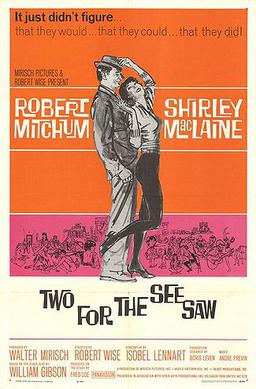
Two for the Seesaw

In January 1958, Two for the Seesaw starring Henry Fonda and Anne Bancroft debuted on Broadway and was quite the success. It ran for 750 performances and even was nominated for the 1958 Tony Award for Best Play. Successful stage plays often make the jump to film, and four years later the highly successful Broadway play made that jump with 1962's Two for the Seesaw.

Several months removed from the separation from his wife of 12-plus years, Omaha lawyer Jerry Ryan (Robert Mitchum) has packed up his belongings and with just limited cash has moved to New York City. He's been in NYC, wasting away, saving what little money he has and living day-to-day, often wondering if it's worth going on. One night at a party, he meets Gittel Moscawitz (Shirley MacLaine), a 29-year old young woman living in Greenwich Village. He can't quite put his finger on it, but Jerry is drawn to the quirky New Yorker with an honesty and forthrightness he's never seen before. They bond quickly, finding a common ground through their own past relationships and inner demons, and soon enough they're in an exclusive relationship. Jerry tries to start up his law career again, and Gittel works to open a dance studio, but their past demons threaten to tear the relationship apart before it can even get started.

There's quite a list of worthy stage plays that have made the jump from play to film, ranging from 12 Angry Men to Annie, West Side Story to The Sound of Music, Oliver! to Chicago, and many more. I've never written a thing about stage plays, Broadway, anything, so I can only imagine how difficult the transition is from stage to film, but director Robert Wise pulls it off nicely here. Maybe the biggest key is the choice to film in black and white. This will sound obvious -- maybe even odd/dumb -- but you lose the color, but there's an added depth to the visual. It doesn't hurt either than now in 2013, there's a distinct nostalgic, retro feel as you watch the film. For the most part, 'Seesaw' is limited to just two small sets; Jerry's rinky-dink, poorly furnished apartment, and Gittel's cramped little Greenwich Village studio.

It works in a simple way. The camera is always right there on the floor in these cramped little apartments with Jerry and Gittel. One technique I found particularly effective was the couple talking on the phone from each other's apartment. Wise shoots the apartments as if they were right next to each other, a dark, shadowed wall separating them. They're miles away, but in the visual sense, it's just a few feet. Much like a stage play, his scenes are dialogue heavy and are in no rush to get anywhere. They develop at a natural pace, just two people talking to each other. Some go on too long (more on that later), but it stays true to its stage roots, and that's a bonus. Another obvious plus is Wise shooting on-location in NYC. I knew about two seconds into the movie I was going to like it. The opening shot has Mitchum's Jerry standing on the Manhattan Bridge, and it's a beauty. Over the opening credits, Jerry walks through various parts of NYC, and because it's the best description I can come up with....it looks so ridiculously cool. Big, wide open shots of 1962 NYC is a sight to behold. Watch it HERE at Youtube.

Once again sticking to the stage roots, the cast is primarily just Mitchum and MacLaine. Yes, other supporting parts are around for a scene or two, but the two stars are literally in every single scene, whether it be together or on the phone. There's only a few where they're even separate from each other. Kinda a daunting premise for an actor, huh? Both actors are up to the challenge. Some critics complain that Mitchum is too old for the part, and too old for MacLaine (17 years younger at the time), but I don't get it. I think they're perfect for each other, and they show a chemistry that carries the movie. For all his tough guy antics, Mitchum had great chemistry with many of his on-screen co-stars from Jane Russell to Deborah Kerr and many more. A whole lot of other, deeper and far more specific things could be stated, but it comes down to this. I liked the two performances a lot, and that can fix a lot of issues in a film.

Now that said, there are issues. At 119 minutes, 'Seesaw' is long and lags in the final 30 minutes. That's never good when things are coming together and wrapping up toward the finale. Not just on an emotional level, but the last half hour is painfully slow to watch. The ending gets points for not going for an easy, happy ending, but getting there is a trial. Getting up to that point, it works. We watch a developing relationship with all its flaws and imperfections in both individuals, both wanting things to work out while working through their own issues. I really struggled through the ending, but I very much liked the build-up. A mixed bag, but Mitchum and MacLaine are two Hollywood legends for a reason. Definitely give it a try. Oh, and this isn't the romantic comedy the above poster would have you think it is. Just an FYI.

Two for the Seesaw (1962): ***/****

Wednesday, August 19, 2009

Edge of the City

This has been bugging me since I finished 1957's Edge of the City yesterday, and I'm having trouble with it. I can't think of a buddy movie made before 1957, but I know there has to be examples out there. Now officially they didn't become known until the late 1960s or early 1970s with movies like Butch Cassidy and the Sundance Kid, but EotC is if nothing else a quasi-buddy movie with some racial undertones, and one I can highly recommend.

Made a year before the much more well-known The Defiant Ones, Edge of the City tells the story of two men, one white and one black, who become close friends in a short time, but one of their pasts comes back to haunt them. Axel North (John Cassavetes) walks into a shipping yard in New York looking for a job. He gets a job and is put to work with Charlie Malik (Jack Warden) and his work gang but quickly rubs Charlie the wrong way. Instead, Axel bonds with Tommy Tyler (Sidney Poitier) and joins his crew in the train yards.

But it's no time before Axel's somewhat checkered past comes back to haunt him. He becomes fast friends with Tommy and his wife Lucy (Ruby Dee) and even starts to date a teacher in the neighborhood, Ellen (Kathleen Maguire), but everything starts to unravel when news of his past gets out to certain people. The problems build to a twist I did not see coming, and an ending that is probably really authentic for the situation, and therefore that much more heartbreaking. It's a testament to these actors and their ability because the ending hits so hard.

Usually playing supporting parts in TV shows, Cassavetes gets a shot here in one of his first starring roles. An intense actor in every sense of the world, he creates a 3-D, believable, sympathetic character you can't help but root for. His Axel has made mistakes in the past and is trying to hide from them. He's a shy guy and doesn't want to face those problems, whether it be talking to his parents (Robert F. Simon and Ruth White, both great in their two scenes) or addressing any sort of confrontation with coworkers, especially Warden's Charlie, a great villainous, heavy role. It's the type of role that made me question why Cassavetes didn't become a bigger star, a more well-known name, because he clearly has the ability to act with the best.

Matching Cassavetes, Poitier's Tommy Tyler is a family man, a young husband with a wife and 2 kids trying to get by. Tommy becomes a bit of a big brother to Axel, looking out for him and helping him find his way. They talk together about their pasts but are also able to just go out and have a good time, having a beer at the bowling alley. Poitier gets to have some fun with the part, Tommy being an extremely outgoing guy both at work and home. For such a well-respected actor, I still think of him as completely underrated, and this is a great part for him. The two men present a believable friendship, Youtube clip here with quasi-spoilers, that carries the movie.

Released in 1957, I can't know what kind of reaction it got from critics and audiences, but it's the type of basic story, a black man befriending a white man, that could still push peoples' buttons today in 2009. And because of that, a movie released over 50 years ago, it's refreshing to see a story like this. Not once do Tommy and/or Axel mention that they have different skin color. It's not an issue for either of them, only some around them, but give director Martin Ritt credit. He tells the story by letting the actors do what they do and not calling attention to himself.

The strategy pays off because the characters and their relationships and interactions come across as authentic. A friendship starts with one man standing up for another and goes from there. A relationship begins with an awkard introduction between Axel and Ellen and turns into something more. The movie has an authentic, almost documentary-like feel to the story. The camera's never invasive and just follows the story. Filmed in New York and New Jersey in black and white, Ritt presents a realistic portrayal of lower middle class folks, some with pasts they'd rather forget.

I'd never heard of this one before stumbling across it on TCM, and it only caught my eye because of the two stars. I was glad I did watch it, and hopefully it continues to climb into the lexicon of movie fans because it's that good. It's been released on DVD as part of the Sidney Poitier Collection, but if you don't want to buy the set keep your eye out for it on the TCM upcoming schedule.

Edge of the City <----trailer (1957): *** 1/2 /****

Monday, June 22, 2009

Netflix review #23: Madigan

At the top of any list of tough guy directors with Sam Peckinpah and Robert Aldrich, one that certainly belongs is Don Siegel. In the 60s and 70s, Siegel made a string of strong, gritty, realistic movies, often starring Clint Eastwood, that were often ahead of their times and rarely disappointing. Maybe most well known for directing Dirty Harry, Siegel actually made two lesser cop films in 1968, Coogan's Bluff which I reviewed a few months back, and Madigan. Neither are as good as Dirty Harry, but both have redeeming qualities.

In the 60s and 70s when everyone from John Wayne and Steve McQueen were making cop movies, it seemed every well-known guy's guy actor was taking a crack at the genre. And why not really? With American audiences becoming more cynical and wanting the more hard-hitting stories, movies could delve into tougher subjects and even previously taboo topics, like sex, drugs, racism, all that good stuff. Released in 1968, Madigan starts to incorporate those things, but it's almost just testing the waters. A villain who likes kinky sex? Mention it and move on. A cop who 'forgets' suspects' rights? Hint at it and change the topic!

New York detectives Daniel Madigan (Richard Widmark) and Rocco Bonaro (Harry Guardino) are looking to bring a witness in for questioning in a murder case. But what starts as routine investigating takes a nasty turn when the witness, Barney Benesch (Steve Ihnat), takes advantage of a brief lapse of concentration from the two veteran detectives. He pulls a gun on them, takes their guns and escapes into the city. Both detectives have come under fire in the past for their rough methods, but they're given 72 hours to bring Benesch in.

Looking down on all that happens from City Hall, police commisioner Anthony X. Russell (Henry Fonda) is trying to juggle any number of prickly cases, including the Madigan debacle, but also a possible corruption scandal with his close friend and Chief Inspector Charles Kane (James Whitmore). Russell has a past with Madigan and neither man thinks the other is completely on the up and up.

My first reaction after finishing the movie was that Siegel, typically as good as they get with telling a no-frills story that gets right to the point, bit off more than he could chew here. There's too much going on in the way of story here. It's not a long movie at just 101 minutes so both stories, Madigan and Bonaro hunting down the fugitive and Russell trying to keep rein on the city, suffer from lack of development. Both stories are interesting, but each could have had their own movie. Instead, we get a sometimes rushed, not all the way developed procedural cop movie.

Siegel's films almost always did a fine job casting, and for all its faults, Madigan has a strong cast top to bottom. Widmark was an anti-hero in the 1950s before anyone even knew what that meant so as Madigan he's an ideal choice. Det. Madigan is not a likable character with little in the way of redeeming qualities. He's completely driven by his job and cheats on his wife, Julia (a good part for Inger Stevens), mostly because he can. As his superior though, Fonda sleepwalks through his part as the police commisioner. It's not a great part to begin with, but even Fonda doesn't do much with it.

With Widmark, the best parts go to Guardino and Whitmore, two great, often underappreciated character actors. Guardino had already worked with Siegel in 1962's Hell is For Heroes, a WWII movie everyone should see, and would work with him again in Dirty Harry. The New York actor is an ideal sidekick to Widmark because he doesn't have to do much to be noticed. He's a good presence and works well with Widmark. Whitmore does the same as a veteran cop who's risen through the ranks but now sees his career possibly tumbling down around him for a decision he was forced to make. The rest of the cast includes Susan Clark, Michael Dunn, Don Stroud, Sheree North, Raymond St. Jacques, and Frank Marth.

Being a Siegel cop movie, certain touches are there that would be hard to miss. This isn't a good guys vs. bad guys cop movie from the 1950s. Right off the bat, there's nudity in the first scene. The villain is known for his kinky sex preferences and somewhat easier to track because of it. There's police brutality, hinted at more than shown, and quite a bit of shoot first, ask questions later mentality. None of these things are pushed too far or overdone, but even a year or two previously, these subjects might have shocked audiences.

So I can't say I loved the movie or even really enjoyed it, but because of the strong casting, especially Widmark in the lead, and Siegel's typically consistent style, I can mildly recommend Madigan. Here's the trailer with surprisingly enough, female nudity. I can't think of a trailer that's gotten away with that other than red-band trailers, even now in 2009.

Madigan (1968): **/****

Thursday, June 18, 2009

The Taking of Pelham 1 2 3

Asking movie fans about remakes can be a touchy subject. I tend to agree most of the time that remakes aren't necessary depending on the movie and studios should just come up with new, creative ideas instead of going back to the well repeatedly. On the other hand, I don't get it when fans are against ANY remake. If you don't want to see it, don't. I've rarely gone into a remake thinking, "Hey, I bet this is better than the original." I'm usually looking for an entertaining story with some alterations to the story, casting, whatever. I got that with the new The Taking of Pelham 1 2 3.

The original Pelham One Two Three is a cult classic in its own right with Walter Matthau and Robert Shaw as the two leads with one big claim to fame, providing inspiration for Quentin Tarantino's Reservoir Dogs. So the remake, with bigger names headlining, still had some pretty big shoes to fill. Is it as good as the original? I'll have to think about that, but gut reaction, close but not as good.

The story is the same with a few slight changes. On a New York subway train, Pelham 123, four men led by Ryder (John Travolta) hijack a single car with its 18 passengers. Getting in contact with the Metro Transit Authority headquarters, they make their demands. They want $10 million in one hour or else they will start shooting a passenger for every minute they're late. At the other end of the radio at MTA HQ is Walter Garber (Denzel Washington), a former supervisor demoted to a desk job while under investigation for supposedly taking a bribe. What follows is a cat and mouse game as Ryder and Garber talk back and forth while NY desperately tries to put together the $10 million ransom.

The heist-like premise is a good one that quickly brings up interesting questions. They've hijacked a train, but how will they escape once they get the money? They're underground after all. It's a tense movie as Ryder, either the sanest villain ever or the craziest, I just can't decide, plays mind games with Garber and hostage negotiator Camonetti (John Turturro, good as always). A SWAT team waits at either end of the single car waiting for the order to take down the hijackers while inside the quartet are one push away from blowing away the hostages.

Enough has been changed that director Tony Scott left his mark on the movie to set it apart from the original. There's an element of technology added to the heist as Ryder has a wireless connection to Google his counterpart on the other end of the radio, and the aspect of the stock market comes up. The heist isn't as straightforward as the original with bigger plans at work, but with a reveal of Ryder's identity late in the movie the additions work. Scott's movies are often more known for their style and flash than story, and that's true here to a point, lots of slow motion blurry shots, quick cuts that can be hard to keep up with, but the director doesn't go too far with it.

There's a natural tension in the story that would be hard to mess up from the director's chair. An hour is not a long time, especially when talking about getting $10 million from a bank and then driving it through NY traffic with the time remaining. The mayor (James Gandolfini in a great part) does question at some point, "Why didn't we just use a helicopter?" Because Mr. Mayor, then we couldn't have the cool race through Manhattan as a squad car with motorcycle escort weaves through traffic.

Working with Scott for the fourth time, Washington is the heart of the movie. His Garber character is an everyman, John Smith trying to care for his family, go to work and pay his mortgage and his kids' tuition. It's the type of part that Washington could do with his eyes closed, and he doesn't disappoint. Most of the running time, all Garber can do is talk, desperately trying to stop Ryder or at least slow him down. There's a twist that works to a fault and does come as a surprise because well....he's Denzel Washington. Hamming it up as the villain, Travolta goes too far at times, but for the character his theatrics are appropriate. He's the bad guy you love to hate but can laugh at too with how off the wall some of his comments can be.

'Pelham' is Washington's and Travolta's movie. The rest of the cast makes the most of smaller parts, especially Turturro and Gandolfini, but other than those two parts no one stands out. One of my favorite character actors Luis Guzman is criminally underused in his part as Ramos, one of the four hijackers. The other two hijackers, Victor Gojcaj and Robert Vataj, are intimidating, but I don't even recall hearing their names. The two are characters with automatic weapons, and that's it, but I guess that is what the script called for. Michael Rispoli and Ramon Rodriguez are good in smaller roles as two members of MTA headquarters.

I didn't love the remake like I wanted to, but I did enjoy it. I can chalk up a lot of that to the trailer which really convinced me to see it. The ending is forced a little too much for me, but the build-up makes up for that. So overall, it lived up to my expectations of a remake. Good but not great, and worth a watch. I do recommend seeing the original, if for nothing else than to compare the two. Go see the Pelham remake, if for nothing else than Washington in a great part going toe to toe with villainous Travolta.

Monday, June 1, 2009

Badge 373

In the vein of The French Connection, Dirty Harry, and Bullitt comes 1973's Badge 373. This was the 1970s when movie audiences liked their cops treading that fine line between raging psychopaths and honorable officers trying to protect citizens. The characters weren't always easy to like, but that's the fun of the anti-hero.

Starring as Eddie Ryan, the real-life inspiration for The French Connection, Robert Duvall gets to really dig into his part. One of my favorite actors, Duvall has always been a criminally underrated actor to me. He wasn't a crazy, over the top method actor like Dustin Hoffman, but he was certainly capable of pulling off roles that required some dark, very bleak background. And coming just a year since the monumental success of The Godfather where he played Tom Hagen, Duvall was riding high in 1973.

Duvall's performance can't help but remind of Gene Hackman's Academy Award winning performance in The French Connection. As Ryan, he's been warped by what he's seen on the streets a vice cop. Ryan is racist, completely intolerant of Hispanics especially, and isn't afraid to bend the rules if it will help close a case or put a crook behind bars. He's a tough cop who's capable of quick outbursts of violence, but it's these feelings that stop him from getting close to anyone, even to Maureen (Verna Bloom), a waitress he dates who has a similar background. Her past isn't perfect, but she just wants to be happy.

As far as Badge 373's plot, there's nothing you haven't seen before in other police procedural movies and shows. Ryan is suspended when an investigation is started as to whether he killed a suspect, a Puerto Rican gangster, who fell off a roof during an interrogation. During his suspension, he takes a job as a bartender where he meets Maureen. One night, his old partner, Gigi Caputo, comes in and catches up with him, but the next morning Eddie gets a call. Gigi's dead, his throat cut from ear to ear. So starts a vengeance trail as Ryan, without badge or gun, investigates what his possibly dirty partner was into.

Politically correct this movie is not, but that's what makes the movies from the 70s so good. No one was interested in appealing to people's sensitive sides. Stories were told, and if you were insulted, tough luck. The bad guys here are Puerto Ricans looking to free their country with a bloody revolution. Ryan begins to find out Gigi was following a huge shipment of machine guns meant to start the fighting. The always slimy Henry Darrow stars as Sweet William, the Hispanic guns dealer Ryan's come across in the past. I have yet to see Darrow in a movie or TV show where he wasn't the villain, and he doesn't disappoint here as Duvall's adversary. Also in the cast is the real Eddie Egan as Lt. Scanlon, Ryan's superior who wants to help the veteran cop out even at a hefty cost.

As Ryan investigates his partner's death, the story drags at points, but it's never boring. Instead of a car vs. L-train chase, we get Duvall taking over a bus and trying to escape from a mob of Puerto Rican gangsters in a cool chase scene through New York. The violence is quick and sometimes shocking with squibs exploding left and right. The language is the same way with plenty of good old cussing and enough ethnic slurs to make just about anybody wince. But that's the whole feel of the movie, it's a story of a cop looking for revenge that goes for realism instead of big, extravagant action.

Duvall is the reason to watch Badge 373. Watching him go from quiet scenes with Bloom to rage-filled outbursts against gangsters is a treat, just like it was watching Hackman, Eastwood and McQueen do it in their movies. There's nothing groundbreaking here, but it's worth a watch, especially if you're a fan of gritty 1970s cop thrillers.

Thursday, April 2, 2009

Netflix review #13: Across 110th Street

As the times were changing in the late 60s and early 70s, one part of popular culture that took full advantage was the movie industry. Directors got to attack issues and present them to the viewers. Drugs, sex, racism, Vietnam, all ripe for the picking. I finished a cop/blaxploitation movie today called Across 110th Street which was a perfect example of what a procedural cop movie can be when it gets everything just right.

In a dreary, rundown Harlem apartment, two white mobsters and three black mobsters are counting the week's take when someone knocks at the door. It's two black cops, or so they think. It's a robbery and when one of the hoods goes for a gun it turns into a massacre as all five men are killed and during the getaway, two cops are killed. The trio of robbers, including the getaway driver, escape with over $300,000 in mob money and it doesn't sit well. The question is who will get to these men first? The cops looking for justice and to put these men behind bars or the mafiosos looking for revenge.

Made in 1972, the movie has a dark, gritty look to it similar to The French Connection, another cop movie that has a similar sinister tone about the world. 110th Street was filmed in New York, and the movie greatly benefits from it. The whole thing feels real, like you're there with the NY detectives walking the streets looking for information. With the filming locations, nothing seems forced, and the story just flows along.

The big name here is Anthony Quinn as Captain Matelli, a veteran NY detective who's seen people at their worse and always gets the job done, even if his methods aren't exactly popular. Yaphet Kotto is a strong counter to Quinn as Lt. Pope, the younger officer assigned to lead the case because of his race. Pope tries to do things by the book because he believes in doing right and to a certain extent, he doesn't know better. The escalating confrontations between Maldetti and Pope provide much of the movie's tension when it comes to racism, but it's just the start.

Joining the supporting cast is Tony Franciosa as Nick D'Salvio, the mafia enforcer given the task of bringing in the three robbers. A gray-haired Franciosa is just the right amount of driven to do his job and then the opposite, slightly crazy and a huge racist. Paul Benjamin (later of Escape from Alcatraz) plays Jim Harris, one of the robbers and the most 3-D of them. Harris is an ex-con with epilepsy trying to make ends meet with his wife when he stumbles upon this mafia bank and tries to knock it off. It's a credit to Benjamin that his character is sympathetic. He's a murderer and a robber, but at the same time you feel for him. Ed Bernard and Antonio Fargas (Starsky and Hutch's Huggy Bear) round out the trio of robbers.

With so many strong performances, the movie never slows down. Each scene has a different character on screen, and the interactions feel natural throughout. Everyone has their motivation whether it be for revenge, doing your job, or even loyalty and survival. It builds to a moving ending on several different levels, especially the final shot which is reminiscent of the ending of The Defiant Ones with Sidney Poitier and Tony Curtis. You can see it here, but obviously there's MASSIVE SPOILERS if you haven't seen the movie.

The DVD is a good purchase. The movie is in widescreen presentation that is grainy but it works for the tone and theme of the film. Don't get me wrong though, it's grainy but still a very watchable movie. Special features is just a trailer that highlights the opening robbery. Don't miss this one, a cop movie tied up in a blaxploitation story that produces an underappreciated semi-classic from the early 1970s.

Across 110th Street (1972): *** 1/2 /****

Thursday, March 26, 2009

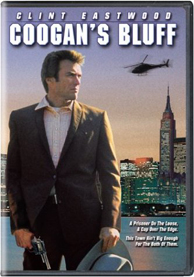
Coogan's Bluff

With work picking up some of late, I haven't been watching as many movies, but in my effort to see all of Clint Eastwood's movies I watched Coogan's Bluff today. For a very basic review, think of Dirty Harry in New York and you've got this movie. Don Siegel, the same director as 1971's Dirty Harry, directs here too so this is almost like a dry-run for the rogue cop movie that took the country by storm.
Piute county Deputy Sheriff Walt Coogan out of Arizona is good at what he does, but in doing his job he tends to piss people off, including the sheriff. So after one such incident, he's sent on a mission to New York City to extradite a prisoner. But arriving in NY, Coogan gets fed up with all the procedures and rules he'll have to follow to get custody of the prisoner, a hop-head named Jim Ringerman. Coogan bluffs his way into the hospital Ringerman is at after he took some LSD. But on the way to the airport, he escapes with some help from his girlfriend. Now Coogan's on his own in a city he can't stand, and nothing's going to stop him from bringing his man back.

Director Siegel had a specialty for tough, gritty movies where guys were guys and that's how it was. Coogan's Bluff definitely falls into that category. The movie has a rough feel to it and seems to have been shot on a lower budget. At times, it tries too hard including one long sequence at a rave. The scene almost calls out 'hey, look, this is how the late 60s were!' Toward the end of the movie, it's almost like Siegel and Co. realized they didn't know how to finish the movie and the story/plot becomes disjointed. A cool action sequence at the end makes up for it though.

Two action scenes stand out here, helped in great part by Eastwood doing many of his own stunts. One has Coogan taking on a group of six or seven thugs in a pool hall. It's a pretty vicious fight as pool cues and balls are flying, as are some of the thugs. The finale action is an exciting motorcycle chase near the Cloisters Museum in Manhattan, another case where you can clearly see Eastwood on the bike.

Joining the cast is Lee J. Cobb, a great character actor who made a career out of playing crotchety old guys who complain about everything. Cobb plays Lt. McElroy, the NY police officer who must work with Coogan even if he does disagree with his methods. Susan Clark plays Julie Roth, a probation officer who Coogan meets and takes a keen interest in in more ways than one. Don Stroud, who would play a rival of Eastwood's again in Joe Kidd, is good in a smaller part as Ringerman, the drug-addicted prisoner trying to avoid extradition back to Arizona where he committed an unidentified crime. Tisha Sterling has a memorable part as Linny Raven, Ringerman's girl who you're never quite sure what her motives are.

The DVD is a good deal but a bit of a disappointment. The widescreen presentation is there and looks good, but no special features at all. Still, it's worth it for the movie alone, even just to see a dry-run of Dirty Harry.

Coogan's Bluff (1968): ***/*****