I think one of the best ways to describe director Monte Hellman is interesting, maybe even quirky. A director with movies like Two Lane Blacktop, Cockfighter, and China 9, Liberty 37 to his name, Hellman specialized in odd, typically pretty low budget flicks. He also had a friendship and solid working relationship with a huge rising star in the 1960s. That name? Keep reading with 1966's Ride in the Whirlwind.
Riding south through Texas to find more work in the border country, three cowboys, Vern (Cameron Mitchell), Wes (Jack Nicholson) and Otis (Tom Filer) are casually making their way down the trail. They ride up to an isolated line shack in the mountains, a group of five men hiding out there and suspicious of this trio of newcomers. Why? The men are what's left of a gang of stagecoach robbers led by Blind Dick (Harry Dean Stanton) on the run from a posse after a robbery produced a dead stagecoach guard. Upon seeing that the three cowboys don't present a challenge, Dick allows them to eat and drink with them, even staying the night. Seeing the clues all around them, Vern, Wes and Otis immediately know they're not being told everything. They need the rest though and agree to ride out the next morning. They wait too long though. A posse shows up the next morning, and now these cowboys are in some serious trouble.
Shot back-to-back with another 1966 Hellman western, The Shooting, 'Whirlwind' is a little-known, mostly forgotten western. It was released in a time when the perception of the western genre was changing to a more cynical, realistic and sinister outlook. These flicks were dubbed revisionist westerns as they gave a new look at a genre that was always good guys vs. bad guys. Nothing is clean or easy. It's a dirty, gritty world where survival reigns above all else. Both Shooting and Whirlwind were filmed in Utah, the budget for both films a combined $150,000. That wouldn't cover the catering for most modern movies!
In the revisionist vein, 'Whirlwind' is worthwhile because of that darkness. If there was a such thing as a tragic western, this would be it. The iconic image of the cowboy is a genre archetype, maybe the most important western archetype. The three cowboys we meet -- Vern, Wes and Otis -- aren't heroes. They're not lightning-fast gunslingers. They're not maniacal killers. They are cowboys, plain and simple. We learn little to nothing about them, only that they're hard-working saddle tramps who are most comfortable in the saddle. Their laconic, easy-going demeanor feels real, very natural and not forced at the least. They sit around a campfire talking about where they hope to go, what jobs they hope to get. They don't want the trouble they find themselves in, but there's no clean way out of it. They have to make decisions about how far they want to go to make sure they get out unscathed.
It sounds so criminally simple, but the mistaken identity angle works perfectly. That's where the tragic element comes into play. They're just trying to do their job. They don't want anything to do with this trouble. The focus is on Nicholson and Mitchell, the younger cowboy with a lot of experience just the same and the more veteran cowboy with a few more miles on his backside. Without knowing much about them, I found myself liking them. The rest of the cast is generally unknown, Harry Dean Stanton as Blind Dick the lone exception. George Mitchell and Kathleen Squire are a husband and wife on their small ranch the cowboys meet on the trail with Millie Perkins as their semi-curious daughter.
So what's the big issue? Almost everything I've brought up until now seems like a glowing review. It could have been a classic, but it isn't. At 82 minutes, 'Whirlwind' is a short movie but it ain't a quick movie. Hellman has said in interviews he tries to focus on the visual and leave dialogue by the wayside. That's fine but when nothing happens for long stretches of an already short, slightly sluggish movie, we've got an issue. Reality is almost always a plus in a western -- and it is here -- but there just isn't much in the way of energy as our cowboys are on the run with the posse closing in not too far behind. I liked where it went late with a dark ending that could have been far darker. I liked the movie for a lot of reasons, but it could and probably should have been better. Still worth checking out if you can track it down.
Ride in the Whirlwind (1966): ** 1/2 /****
The Sons of Katie Elder
"First, we reunite, then find Ma and Pa's killer...then read some reviews."
Showing posts with label Jack Nicholson. Show all posts
Friday, November 7, 2014
Thursday, November 6, 2014
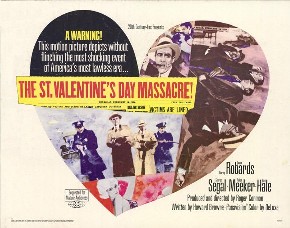
The St. Valentine's Day Massacre
I grew up in Chicago so I love just about everything in the Windy City, all the sports teams, the downtown area, all that great food from Chicago style hot dogs to Chicago style pizza. But that Chicago history? My goodness, there are some dark moments from the Black Sox scandal to the Chicago Fire, the riots at the 1968 Democratic convention and generally all sorts of political corruption and deception. One of the most violent incidents in the city's history? That's told in a 1967 B-movie, The St. Valentine's Day Massacre.
It's early 1929 and the streets of Chicago are filled with warring gangsters from two rival gangs. On one side is Al Capone (Jason Robards), a brutal, possibly maniacal Italian gangster with Mafia ties, who rules Chicago's South Side with an iron fist. Running the city's North side is George 'Bugs' Moran (Ralph Meeker), his Irish gang trying to hold onto their territory. Things across the city are building to an unavoidable confrontation as both sides fight for control of thousands of speakeasies, Prohibition still raging. Capone has grown tired of Moran's gang trying to build up their power and has put into work a plan to execute his rival gang leader. Can one gang win out over the other? Can anyone win with the city's streets riddled with bullets and blood?
Everyone's heard of producer/director extraordinaire Roger Corman? He's one of Hollywood's all-time greats at getting movies made on the cheap so basically the King of B-Movies. That's not a bad thing, and I say it as a compliment. This generally forgotten 1967 gangster flick is one of his best, telling the true story of one of Chicago's darkest moments. It was filmed on studio streets -- cheaper than Chicago's downtown area -- but it works, giving the city a closed in, wintery and claustrophobic effect. This is a flick that works almost like a quasi-documentary, like something you'd see on The History Channel...but darker, much darker. With narrator Paul Frees and his perfectly gravelly voice laying things out, introducing dates, people and times, it all fits together like puzzle pieces.
Where 'Massacre' separates itself from the quasi-documentary feel is that darkness, that gangster world we're thrust into. Low budget though it may be, the movie looks great with countless gangsters wearing impeccably cool suits with fedoras, rocking vicious tommy guns and 1920s boats of cars that look as cool as ever now in 2014 as they would have in 1929. As for the real life gangsters, this isn't The Godfather where you kinda sorta maybe sympathize with the Corleones, however vicious and murdery they are. There ain't a single sympathetic character anywhere in sight. These are nasty, brutal, violent folks interested in making money and killing some rival gangsters in the process. You're not rooting for anybody. You're not hoping these guys come out unscathed. You just wanna see how it all shakes out and who's gonna make it. Let me tell you...not many do.
One of the coolest aspects of 'Massacre' is its ridiculously deep cast. We're not talking a disaster flick type of cast full of aging A-list stars. We're talking a couple very solid movie stars/actors at the top and a cast backing them up absolutely packed to the guts with familiar, recognizable character actors. As for the leads, Robards is terrifyingly hammy as everyone's favorite Chicago gangster, Al Capone. He's got that look in his eye, you just never know what he's going to do next. Meeker is excellent too in a more understated but just as sinister part, Bugs Moran, an Irish gangster and Capone's main rival for power. Also look for a young George Segal in one of his best early roles, playing Peter Gusenberg, one of Moran's enforcers/lieutenants working closely with his brother, another enforcer, Frank (David Canary) while constantly fighting with live-in girlfriend (Jean Hale).
Okay, brace yourself because you're about to get hit with a whole lot of links to actor's IMDB pages. These are all the real-life people involved in the 1920s world of Chicago gang wars, an extremely interesting historical time if you're interested in the subject matter. On the Capone side keep an eye out for Clint Ritchie as the massacre's mastermind, Frank Silvera, Harold J. Stone, Paul Richards, Joe Turkel, Alex Rocco, Leo Gordon, John Agar, and Richard Bakalyan and Jack Nicholson (Yes, that Jack Nicholson) as two hired mafia killers. On the Moran side of things, watch for Bruce Dern, Kurt Kreuger, Tom Reese. Some appearances are quicker than others, but it's cool to see so many people in one movie, even if it is only for a scene or two.
Just an entertaining dark and dirty movie. If you're a fan of history whether it be Chicago or gangsters or anything in between, this gritty, cynical, particularly vicious flick is for you. I loved it.
The St. Valentine's Day Massacre (1967): *** 1/2 /****
It's early 1929 and the streets of Chicago are filled with warring gangsters from two rival gangs. On one side is Al Capone (Jason Robards), a brutal, possibly maniacal Italian gangster with Mafia ties, who rules Chicago's South Side with an iron fist. Running the city's North side is George 'Bugs' Moran (Ralph Meeker), his Irish gang trying to hold onto their territory. Things across the city are building to an unavoidable confrontation as both sides fight for control of thousands of speakeasies, Prohibition still raging. Capone has grown tired of Moran's gang trying to build up their power and has put into work a plan to execute his rival gang leader. Can one gang win out over the other? Can anyone win with the city's streets riddled with bullets and blood?
Everyone's heard of producer/director extraordinaire Roger Corman? He's one of Hollywood's all-time greats at getting movies made on the cheap so basically the King of B-Movies. That's not a bad thing, and I say it as a compliment. This generally forgotten 1967 gangster flick is one of his best, telling the true story of one of Chicago's darkest moments. It was filmed on studio streets -- cheaper than Chicago's downtown area -- but it works, giving the city a closed in, wintery and claustrophobic effect. This is a flick that works almost like a quasi-documentary, like something you'd see on The History Channel...but darker, much darker. With narrator Paul Frees and his perfectly gravelly voice laying things out, introducing dates, people and times, it all fits together like puzzle pieces.
Where 'Massacre' separates itself from the quasi-documentary feel is that darkness, that gangster world we're thrust into. Low budget though it may be, the movie looks great with countless gangsters wearing impeccably cool suits with fedoras, rocking vicious tommy guns and 1920s boats of cars that look as cool as ever now in 2014 as they would have in 1929. As for the real life gangsters, this isn't The Godfather where you kinda sorta maybe sympathize with the Corleones, however vicious and murdery they are. There ain't a single sympathetic character anywhere in sight. These are nasty, brutal, violent folks interested in making money and killing some rival gangsters in the process. You're not rooting for anybody. You're not hoping these guys come out unscathed. You just wanna see how it all shakes out and who's gonna make it. Let me tell you...not many do.
One of the coolest aspects of 'Massacre' is its ridiculously deep cast. We're not talking a disaster flick type of cast full of aging A-list stars. We're talking a couple very solid movie stars/actors at the top and a cast backing them up absolutely packed to the guts with familiar, recognizable character actors. As for the leads, Robards is terrifyingly hammy as everyone's favorite Chicago gangster, Al Capone. He's got that look in his eye, you just never know what he's going to do next. Meeker is excellent too in a more understated but just as sinister part, Bugs Moran, an Irish gangster and Capone's main rival for power. Also look for a young George Segal in one of his best early roles, playing Peter Gusenberg, one of Moran's enforcers/lieutenants working closely with his brother, another enforcer, Frank (David Canary) while constantly fighting with live-in girlfriend (Jean Hale).
Okay, brace yourself because you're about to get hit with a whole lot of links to actor's IMDB pages. These are all the real-life people involved in the 1920s world of Chicago gang wars, an extremely interesting historical time if you're interested in the subject matter. On the Capone side keep an eye out for Clint Ritchie as the massacre's mastermind, Frank Silvera, Harold J. Stone, Paul Richards, Joe Turkel, Alex Rocco, Leo Gordon, John Agar, and Richard Bakalyan and Jack Nicholson (Yes, that Jack Nicholson) as two hired mafia killers. On the Moran side of things, watch for Bruce Dern, Kurt Kreuger, Tom Reese. Some appearances are quicker than others, but it's cool to see so many people in one movie, even if it is only for a scene or two.
Just an entertaining dark and dirty movie. If you're a fan of history whether it be Chicago or gangsters or anything in between, this gritty, cynical, particularly vicious flick is for you. I loved it.
The St. Valentine's Day Massacre (1967): *** 1/2 /****
Monday, October 6, 2014
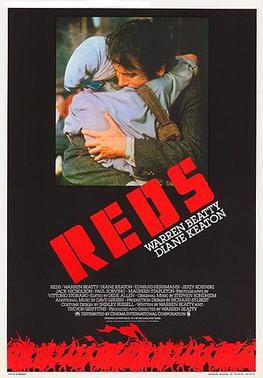
Reds
The amount of information, facts and tidbits I don't know about Russian history could full volumes. I love history -- ALL of it -- but something about the immensity of Russia and its history has proved rather intimidating to me. Where to even start? Well, movies seem to agree with me. I liked but didn't love 1965's Doctor Zhivago, but there's another Russian epic that's long been recommend to me. Let's get going with 1981's Reds.
Living in Portland, Oregon in 1915, Louise Bryant (Diane Keaton) has a relatively safe if dull life. She's married, does art and is a hopeful writer. Then, she meets John Reed (Warren Beatty), a highly respected if somewhat controversial writer with an impressive following. She is immediately drawn to him and ends up following him to New York City to be with him while also hopefully pursuing a career as a writer and a journalist. There's a relative catch though. John is a staunch supporter of the socialist movement, a movement that threatens to tear World War I apart as workers around the world, especially in Russia, begin to push for more rights, more privileges. In the midst of World War I (and with the Russian Revolution looming), Louise has entered into one of history's most tumultuous times. She loves John and he loves her, but the world seems on the brink of blowing itself up. What will happen next?
For years, my Mom has recommended this movie to me. It's one of her all-time favorites, and she knows far more about the time and backstory than I do. For some background reading, read about the Russian Revolution HERE at Wikipedia. It's not even fair to say this is a Russian Revolution movie. This is a story about two people's lives amidst that turbulent time in world history with a heavy socialist focus. For more reading, read about John Reed and Louise Bryant, two incredibly interesting individuals. It is a big, epic movie, clocking in at equally intimidating 194 minutes, and took Beatty (who starred, directed, produced and wrote) and his cast and crew a full year to film. That's before you consider a lengthy editing process. Beatty is no dummy, taking on films that mean something to him, and this is the definition of that. This is a message movie, an intellectual, thought-out, impressive film. Is it good though?
I will say it is more interesting than it is good, if that makes sense. 'Reds' picked up 12 Oscar nominations, ultimately winning three, including Beatty as Best Director. For a movie that clocks in at almost three and a half hours, it did well at the box office and resonated with critics and has developed quite a following among fans. It was filmed in New York City, Finland, England, Sweden and Spain. So....yeah, what else? 'Reds' is an epic. The scale and immensity is impressive. This is an epic about an idea though, the idea of socialism. This is 194 minutes of almost entirely talking. This is talking about a principle, about government, about corruption, about history, about the system. 'Reds' isn't Lawrence of Arabia or The Godfather or Gone With the Wind. It is its own epic, and with Beatty backing it all the way, it is quite okay with being its own film. I struggled at times because it is such a smart, well-written movie. Is that enough to hamstring a film? I don't know, but definitely know what you're getting into here.
Picking up two of the film's four Oscar acting nominations, Beatty and Keaton carry the film. Either one or the other is in almost every scene, and apparently the filming was so strenuous on their off-screen relationship they ultimately broke up. I didn't necessarily buy their doomed love, their unexplained chemistry. What did I buy? Their performances themselves are excellent. These are two extremely intelligent individuals, drawn to each other but who's personalities butt heads because they're both so strong-willed. Based on historical figures, both characters are 3-D, blood and guts people, not cardboard cutouts. Kudos to both actors who again make their characters interesting/fascinating if not necessarily likable.
Up until 2012's Silver Linings Playbook, 'Reds' was the last film to receive Oscar nominations for all four acting categories. The culprits? Jack Nicholson as playwright/writer Eugene O'Neill and Maureen Stapleton as famed anarchist Emma Goldman. These aren't huge supporting parts, but what's there is choice, two actors making the most of their relatively small screentime. Also look for Edward Herrmann, Jerzy Kosinski, M. Emmet Walsh, Paul Sorvino, William Daniels, Gene Hackman, and R.G. Armstrong in supporting parts. Some of them are pretty quick, none of them truly developed, and a couple are nothing more than a single scene. Of the smaller parts, Kosinski is memorable as a socialist leader working with Reed and Hackman as a booze-loving, honest newspaper editor.
One of the best choices Beatty makes as a director was a wise style choice. Along with the actual story, interviews with those who knew Reed and Bryant during the 1910s and 1920s are interspersed throughout the movie. These people -- now in their 70s and 80s -- reminiscing about John and Louise, about the times, about how things have changed, these are the moments that proved most memorable for me. Check out the list of witnesses HERE. So as I mentioned before, this is an excellent movie. One you appreciate and admire and respect. I felt like I learned some things as the story develops, but did I love the movie like I hoped I would? Nope. Still very much worth checking out, but not quite the movie I was expecting.
Reds (1981): ** 1/2 /****
Living in Portland, Oregon in 1915, Louise Bryant (Diane Keaton) has a relatively safe if dull life. She's married, does art and is a hopeful writer. Then, she meets John Reed (Warren Beatty), a highly respected if somewhat controversial writer with an impressive following. She is immediately drawn to him and ends up following him to New York City to be with him while also hopefully pursuing a career as a writer and a journalist. There's a relative catch though. John is a staunch supporter of the socialist movement, a movement that threatens to tear World War I apart as workers around the world, especially in Russia, begin to push for more rights, more privileges. In the midst of World War I (and with the Russian Revolution looming), Louise has entered into one of history's most tumultuous times. She loves John and he loves her, but the world seems on the brink of blowing itself up. What will happen next?
For years, my Mom has recommended this movie to me. It's one of her all-time favorites, and she knows far more about the time and backstory than I do. For some background reading, read about the Russian Revolution HERE at Wikipedia. It's not even fair to say this is a Russian Revolution movie. This is a story about two people's lives amidst that turbulent time in world history with a heavy socialist focus. For more reading, read about John Reed and Louise Bryant, two incredibly interesting individuals. It is a big, epic movie, clocking in at equally intimidating 194 minutes, and took Beatty (who starred, directed, produced and wrote) and his cast and crew a full year to film. That's before you consider a lengthy editing process. Beatty is no dummy, taking on films that mean something to him, and this is the definition of that. This is a message movie, an intellectual, thought-out, impressive film. Is it good though?
I will say it is more interesting than it is good, if that makes sense. 'Reds' picked up 12 Oscar nominations, ultimately winning three, including Beatty as Best Director. For a movie that clocks in at almost three and a half hours, it did well at the box office and resonated with critics and has developed quite a following among fans. It was filmed in New York City, Finland, England, Sweden and Spain. So....yeah, what else? 'Reds' is an epic. The scale and immensity is impressive. This is an epic about an idea though, the idea of socialism. This is 194 minutes of almost entirely talking. This is talking about a principle, about government, about corruption, about history, about the system. 'Reds' isn't Lawrence of Arabia or The Godfather or Gone With the Wind. It is its own epic, and with Beatty backing it all the way, it is quite okay with being its own film. I struggled at times because it is such a smart, well-written movie. Is that enough to hamstring a film? I don't know, but definitely know what you're getting into here.
Picking up two of the film's four Oscar acting nominations, Beatty and Keaton carry the film. Either one or the other is in almost every scene, and apparently the filming was so strenuous on their off-screen relationship they ultimately broke up. I didn't necessarily buy their doomed love, their unexplained chemistry. What did I buy? Their performances themselves are excellent. These are two extremely intelligent individuals, drawn to each other but who's personalities butt heads because they're both so strong-willed. Based on historical figures, both characters are 3-D, blood and guts people, not cardboard cutouts. Kudos to both actors who again make their characters interesting/fascinating if not necessarily likable.
Up until 2012's Silver Linings Playbook, 'Reds' was the last film to receive Oscar nominations for all four acting categories. The culprits? Jack Nicholson as playwright/writer Eugene O'Neill and Maureen Stapleton as famed anarchist Emma Goldman. These aren't huge supporting parts, but what's there is choice, two actors making the most of their relatively small screentime. Also look for Edward Herrmann, Jerzy Kosinski, M. Emmet Walsh, Paul Sorvino, William Daniels, Gene Hackman, and R.G. Armstrong in supporting parts. Some of them are pretty quick, none of them truly developed, and a couple are nothing more than a single scene. Of the smaller parts, Kosinski is memorable as a socialist leader working with Reed and Hackman as a booze-loving, honest newspaper editor.
One of the best choices Beatty makes as a director was a wise style choice. Along with the actual story, interviews with those who knew Reed and Bryant during the 1910s and 1920s are interspersed throughout the movie. These people -- now in their 70s and 80s -- reminiscing about John and Louise, about the times, about how things have changed, these are the moments that proved most memorable for me. Check out the list of witnesses HERE. So as I mentioned before, this is an excellent movie. One you appreciate and admire and respect. I felt like I learned some things as the story develops, but did I love the movie like I hoped I would? Nope. Still very much worth checking out, but not quite the movie I was expecting.
Reds (1981): ** 1/2 /****
Thursday, July 24, 2014
The Missouri Breaks
By the late 1960s, the idea of the good guys vs. bad guys westerns were a definite thing of the past. Spaghetti westerns helped blow the genre up, but back in the states, the concept of a revisionist western started to pop up more and more. Some are excellent -- Ulzana's Raid, The Hired Hand, The Culpepper Cattle Co. among others -- but for the most part, I've always felt they tried too hard to tear down the myths and legends, kneecapping themselves in the process. Somewhere in between is 1976's The Missouri Breaks, a truly odd film with some great moments canceled out by a fair share of bizarre moments.
On the wild frontiers of Montana, a horse rustler, Tom Logan (Jack Nicholson), and his gang have run into some trouble. One of their own has been captured and hung by a local land and cattle baron, Braxton (John McLiam), who took the law into his own hands. With his options somewhat limited, Logan puts a risky plan into action. He buys a small ranch near Braxton's home and poses as a farmer and horse trader, basically stealing from him from right under his nose. The plan seems just crazy enough to work, Logan's "farm" posing as a stop along the trail for stolen horses being transported. Sick of seeing his stock continually stolen, Braxton goes one step further to stop the unknown rustlers. He hires a regulator, a hired gun and killer, Robert E. Lee Clayton (Marlon Brando), to finish off the rustlers. The rancher might not know the extent of what he's gotten himself into, Logan and his gang in an identical spot. What does Clayton's arrival hold for all of them?
I like the idea behind most of the revisionist westerns. The American west in the 19th Century was a horrifically violent, tough place to start a life. In other words, the west wasn't the ideal, idyllic world many westerns show. From director Arthur Penn (Bonnie and Clyde), 'Missouri' is dark, gritty, violent, brutal and truly, truly bizarre. It is a little too long at 125 minutes -- aimlessly drifting a little much for my liking -- and definitely tries too accomplish a lot, maybe too much. The production was more than a touch checkered with difficulties, both Brando and Nicholson demanding massive rewrites for their characters. Somewhere in this movie is a genuinely good movie, but it gets lost in a maze of misguided attempts at humor, some physical and raunchy, and moments of heavy drama. It all tries to be too quirky and off-the-wall. If you're going to be different with story and characters, so be it. Just do it. Don't aggressively call attention to it at all times.
Massive rewrites aside, I did like Jack Nicholson as the leader of a gang of horse rustlers, Tom Logan. One of the biggest stars of the 1970s, Nicholson embraces the character, the anti-hero who as presented, isn't such a bad guy. It isn't exactly a sympathetic character, but it is certainly an interesting one. We're not given much background -- just a blink and you'll miss it description about his past -- but then again, a tough as nails anti-hero doesn't need a whole lot of background. There's that Nicholson energy in patches, those outbursts, that nasty grin where you just know he's up to something. He's aided by his gang, especially Cal (Harry Dean Stanton), his right-hand man and an underplayed psycho of sorts. Nicholson and Stanton have a couple very strong scenes together, quiet scenes as the duo talks. The gang also includes Little Tod (Randy Quaid), Cary (Frederic Forrest), and Si (John P. Ryan).
As good as Nicholson is though, what most viewers will take away from 'Missouri' is Marlon Brando. The definition of a method actor, Brando takes this part to places I've never seen before in a western. There have been psychos, there have been unhinged killers, even deranged lunatics, but nothing like this. Brando's Clayton favors flowery perfumes, rocks an Irish brogue that drifts in and out, uses a high-powered sniper rifle, a dainty Mexican pistol with flowers on the handle and a knife-like throwing object that looks like a crucifix. He also quotes literature, is profoundly uncomfortable in his interactions, poses as a priest and a woman and becomes obsessed with completing the job. He's going up against someone in Nicholson who could similarly chew some scenery, but this performance from Brando is both profoundly good and profoundly bad. It's just unreal. It is a part that has to be seen to be believed.
An interesting movie if not a particularly good one. It's all over the place in the end. Too much time is spent with Nicholson's Logan and Braxton's daughter, Jane (Kathleen Lloyd), and their budding relationship. At different points, Clayton and Braxton both from a distance watch Logan and Jane engage in some sex on the prairie. Who could pass that up? The last 30/40 minutes are the movie at its best -- Clayton officially going rogue -- but even then, the ending taps the brakes some when it could have gone for a great finale. The big picture is this, I think 'Missouri' simply tackles too much. At different points, it is equal parts weird, funny, dramatic, comedy falling short, oddly sexual, and quirky for the sake of being quirky.
A missed opportunity with just enough -- just -- to give it a very mild recommendation. Definitely know what you're getting into though, especially with the Godfather himself, Marlon Brando.
The Missouri Breaks (1976): ** 1/2 /****
On the wild frontiers of Montana, a horse rustler, Tom Logan (Jack Nicholson), and his gang have run into some trouble. One of their own has been captured and hung by a local land and cattle baron, Braxton (John McLiam), who took the law into his own hands. With his options somewhat limited, Logan puts a risky plan into action. He buys a small ranch near Braxton's home and poses as a farmer and horse trader, basically stealing from him from right under his nose. The plan seems just crazy enough to work, Logan's "farm" posing as a stop along the trail for stolen horses being transported. Sick of seeing his stock continually stolen, Braxton goes one step further to stop the unknown rustlers. He hires a regulator, a hired gun and killer, Robert E. Lee Clayton (Marlon Brando), to finish off the rustlers. The rancher might not know the extent of what he's gotten himself into, Logan and his gang in an identical spot. What does Clayton's arrival hold for all of them?
I like the idea behind most of the revisionist westerns. The American west in the 19th Century was a horrifically violent, tough place to start a life. In other words, the west wasn't the ideal, idyllic world many westerns show. From director Arthur Penn (Bonnie and Clyde), 'Missouri' is dark, gritty, violent, brutal and truly, truly bizarre. It is a little too long at 125 minutes -- aimlessly drifting a little much for my liking -- and definitely tries too accomplish a lot, maybe too much. The production was more than a touch checkered with difficulties, both Brando and Nicholson demanding massive rewrites for their characters. Somewhere in this movie is a genuinely good movie, but it gets lost in a maze of misguided attempts at humor, some physical and raunchy, and moments of heavy drama. It all tries to be too quirky and off-the-wall. If you're going to be different with story and characters, so be it. Just do it. Don't aggressively call attention to it at all times.
Massive rewrites aside, I did like Jack Nicholson as the leader of a gang of horse rustlers, Tom Logan. One of the biggest stars of the 1970s, Nicholson embraces the character, the anti-hero who as presented, isn't such a bad guy. It isn't exactly a sympathetic character, but it is certainly an interesting one. We're not given much background -- just a blink and you'll miss it description about his past -- but then again, a tough as nails anti-hero doesn't need a whole lot of background. There's that Nicholson energy in patches, those outbursts, that nasty grin where you just know he's up to something. He's aided by his gang, especially Cal (Harry Dean Stanton), his right-hand man and an underplayed psycho of sorts. Nicholson and Stanton have a couple very strong scenes together, quiet scenes as the duo talks. The gang also includes Little Tod (Randy Quaid), Cary (Frederic Forrest), and Si (John P. Ryan).
As good as Nicholson is though, what most viewers will take away from 'Missouri' is Marlon Brando. The definition of a method actor, Brando takes this part to places I've never seen before in a western. There have been psychos, there have been unhinged killers, even deranged lunatics, but nothing like this. Brando's Clayton favors flowery perfumes, rocks an Irish brogue that drifts in and out, uses a high-powered sniper rifle, a dainty Mexican pistol with flowers on the handle and a knife-like throwing object that looks like a crucifix. He also quotes literature, is profoundly uncomfortable in his interactions, poses as a priest and a woman and becomes obsessed with completing the job. He's going up against someone in Nicholson who could similarly chew some scenery, but this performance from Brando is both profoundly good and profoundly bad. It's just unreal. It is a part that has to be seen to be believed.
An interesting movie if not a particularly good one. It's all over the place in the end. Too much time is spent with Nicholson's Logan and Braxton's daughter, Jane (Kathleen Lloyd), and their budding relationship. At different points, Clayton and Braxton both from a distance watch Logan and Jane engage in some sex on the prairie. Who could pass that up? The last 30/40 minutes are the movie at its best -- Clayton officially going rogue -- but even then, the ending taps the brakes some when it could have gone for a great finale. The big picture is this, I think 'Missouri' simply tackles too much. At different points, it is equal parts weird, funny, dramatic, comedy falling short, oddly sexual, and quirky for the sake of being quirky.
A missed opportunity with just enough -- just -- to give it a very mild recommendation. Definitely know what you're getting into though, especially with the Godfather himself, Marlon Brando.
The Missouri Breaks (1976): ** 1/2 /****
Wednesday, December 11, 2013
The Bucket List
What do you want to do before you die? Things you want to see and do, people you want to meet, places you want to visit, that sort of thing. It's a simple thought, all the things the world has to offer before you....kick the bucket! Words are fun! That's the basic premise behind 2007's The Bucket List.
Sharing a hospital room, Carter Chambers (Morgan Freeman) and Edward Cole (Jack Nicholson) seemingly have very little in common. Carter is family fan with a wife, kids and grandchildren, working for years as a mechanic to support them all. Edward is rich beyond any needs -- he actually owns the hospital, a lot of hospitals -- without any family other than a quartet of ex-wives. The only thing they really have in common is their diagnosis, both men have been diagnosed with terminal lung cancer and have been given anywhere from six months to a year to live. Bonding almost in spite of their differences, they decide to make the most of their last few months, doing all those things they wanted to do but never got around to. Leaving their hospital rooms behind, Carter and Edward intend to enjoy what little time they have.
From director Rob Reiner, this 2007 drama-comedy was mismarketed if you ask me. It was billed as a lighthearted comedy of sorts, goofy and dumb as two old guys make their way around the world doing all sorts of crazy stuff. 'List' does have those moments where the physical comedy is embraced, but thankfully not used too much and overdone. What is it then? It is a pretty good human drama with some touches of humor. 'List' embraces the inherent darkness of its premise, two senior citizens finding out their death is coming sooner than they expected, while still having those moments of humor. Just a fair warning, don't go in expecting 90-plus minutes of laugh out loud goofiness. There are some laughs, but it's far more of a drama than it was made out to be.
Now all that said, laughs in a comedy or some actual emotions in a drama, it's Morgan Freeman and Jack Nicholson. This is quite the legendary one-two punch in terms of acting power, and we're the beneficiaries of the casting. Neither performance is of the award-winning variety, the script from Justin Zackham a solid job, but both actors play up their parts. Freeman is his typical reliable self as Carter, a family man who's started to struggle with his older years, especially now that he's more of a grandparent than a parent. He's not upset he had to care his family, but he does wish maybe he could have accomplished more. Nicholson seems to be playing a variation on...well, himself, but there's depth to his Edward Cole part. He's been married four times but he also loves being single which causes some problems. Very different individuals but very interesting characters.
So what are they up to? They intend to accomplish a lot, ranging from visiting the Great Pyramids in Cairo and the base of Mount Everest in the Himalayas in Nepal, from skydiving to driving classic Shelby Mustangs, doing a safari to visiting the Taj Mahal. The episodic storytelling is cool, covering a lot of ground, even if the CGI is especially bad in the skydiving sequence. The checking off of items on the bucket list becomes secondary though, the focus more on the odd couple-like friendship that develops between the two men. During their travels and adventures, they do get to know each other, know what drove them to this point, what their lives have been like. Their scenes in the hospital are just as good as they first get to know each other, both knowing the other is struggling but able to move on and just talk or play cards. There's an effortless charm to the friendship/relationship, a chemistry that pros like Freeman and Nicholson make look criminally easy.
The rest of the cast is limited to a couple key supporting parts. Sean Hayes is very good as Cole's much-maligned assistant, always ready to bust his boss if he's asking for it. Also look for Rob Morrow as Cole's doctor who must give him the tough news while Beverly Todd plays Carter's wife of 40-plus years. Freeman and Nicholson are in almost every single scene -- together or separately -- so much more of a supporting cast wouldn't have been needed.
I wasn't sure what to expect of the ending here. My doomsday scenario had some miracle cure being invented so that the characters we've come to like are somehow, some way saved from certain death. I won't give any spoilers away, but it is a very effective ending. There is a relative twist revealed in the last 20-25 minutes that caught me by surprise mostly because I thought I had it figured out long before the reveal. The finale itself works well, a fitting end about two different men with very different backgrounds who become friends through their similar, life-altering medical conditions. An enjoyable, low-key movie.
The Bucket List (2007): ***/****
Sharing a hospital room, Carter Chambers (Morgan Freeman) and Edward Cole (Jack Nicholson) seemingly have very little in common. Carter is family fan with a wife, kids and grandchildren, working for years as a mechanic to support them all. Edward is rich beyond any needs -- he actually owns the hospital, a lot of hospitals -- without any family other than a quartet of ex-wives. The only thing they really have in common is their diagnosis, both men have been diagnosed with terminal lung cancer and have been given anywhere from six months to a year to live. Bonding almost in spite of their differences, they decide to make the most of their last few months, doing all those things they wanted to do but never got around to. Leaving their hospital rooms behind, Carter and Edward intend to enjoy what little time they have.
From director Rob Reiner, this 2007 drama-comedy was mismarketed if you ask me. It was billed as a lighthearted comedy of sorts, goofy and dumb as two old guys make their way around the world doing all sorts of crazy stuff. 'List' does have those moments where the physical comedy is embraced, but thankfully not used too much and overdone. What is it then? It is a pretty good human drama with some touches of humor. 'List' embraces the inherent darkness of its premise, two senior citizens finding out their death is coming sooner than they expected, while still having those moments of humor. Just a fair warning, don't go in expecting 90-plus minutes of laugh out loud goofiness. There are some laughs, but it's far more of a drama than it was made out to be.
Now all that said, laughs in a comedy or some actual emotions in a drama, it's Morgan Freeman and Jack Nicholson. This is quite the legendary one-two punch in terms of acting power, and we're the beneficiaries of the casting. Neither performance is of the award-winning variety, the script from Justin Zackham a solid job, but both actors play up their parts. Freeman is his typical reliable self as Carter, a family man who's started to struggle with his older years, especially now that he's more of a grandparent than a parent. He's not upset he had to care his family, but he does wish maybe he could have accomplished more. Nicholson seems to be playing a variation on...well, himself, but there's depth to his Edward Cole part. He's been married four times but he also loves being single which causes some problems. Very different individuals but very interesting characters.
So what are they up to? They intend to accomplish a lot, ranging from visiting the Great Pyramids in Cairo and the base of Mount Everest in the Himalayas in Nepal, from skydiving to driving classic Shelby Mustangs, doing a safari to visiting the Taj Mahal. The episodic storytelling is cool, covering a lot of ground, even if the CGI is especially bad in the skydiving sequence. The checking off of items on the bucket list becomes secondary though, the focus more on the odd couple-like friendship that develops between the two men. During their travels and adventures, they do get to know each other, know what drove them to this point, what their lives have been like. Their scenes in the hospital are just as good as they first get to know each other, both knowing the other is struggling but able to move on and just talk or play cards. There's an effortless charm to the friendship/relationship, a chemistry that pros like Freeman and Nicholson make look criminally easy.
The rest of the cast is limited to a couple key supporting parts. Sean Hayes is very good as Cole's much-maligned assistant, always ready to bust his boss if he's asking for it. Also look for Rob Morrow as Cole's doctor who must give him the tough news while Beverly Todd plays Carter's wife of 40-plus years. Freeman and Nicholson are in almost every single scene -- together or separately -- so much more of a supporting cast wouldn't have been needed.
I wasn't sure what to expect of the ending here. My doomsday scenario had some miracle cure being invented so that the characters we've come to like are somehow, some way saved from certain death. I won't give any spoilers away, but it is a very effective ending. There is a relative twist revealed in the last 20-25 minutes that caught me by surprise mostly because I thought I had it figured out long before the reveal. The finale itself works well, a fitting end about two different men with very different backgrounds who become friends through their similar, life-altering medical conditions. An enjoyable, low-key movie.
The Bucket List (2007): ***/****
Labels:
2000s,
Comedy,
Jack Nicholson,
Morgan Freeman,
Rob Reiner
Tuesday, November 12, 2013
Back Door to Hell
Early in his career before he was a bankable star, Jack Nicholson was like a lot of young actors. He was just looking to make a name for himself. He even wrote a screenplay, 1963's Thunder Island, that impressed producers and studios, one giving him a $400,000 budget to film two (obviously pretty cheap) movies, filmed back-to-back in the Philippines. Let's start with 1964's Back Door to Hell.
It's just days away from the Allied invasion of the Philippines in 1944, and a three-man commando team headed by Lt. Craig (Jimmie Rodgers) slips onto the islands with a timely, dangerous mission. Along with radio man Burnett (Nicholson) and veteran sergeant Jersey (John Hackett), Craig must find the location of a key Japanese communications center and knock it out. The center though is far behind enemy lines inland, but the location is far from definite. With time working against them, the commandos seek the help of a local Filipino guerrilla unit led by an American-hating fighter, Paco (Conrad Maga), who resents the Americans for taking so long to return. Working together, the commandos and the guerrillas move away from the coast, but there's issues. The Japanese have discovered the commandos have landed and are on their trail. Can they get to the communications center before the Japanese catch them?
It's clear from the start this flick was made on a shoestring budget. The film quality is less than impressive, we never see more than a handful of Japanese soldiers, the already thin story is fleshed out with lots of "walking shots" as our commandos walk across the Philippines, so on and so forth. It only clocks in at a sparse 75 minutes, not wasting time with any real background or bigger picture. It's a thinly decorated men-on-a-mission movie with no spare parts. The music from composer Mike Velarde gets to be a little aggressive, heavy during the action scenes, little too Spanish/jazz guitar in the quieter moments.
Obviously almost 50 years later, there's got to be a reason this one is remembered at all. It isn't the straightforward story. It's the acting of a young Jack Nicholson -- just 27 years old at the time -- that makes it even slightly memorable. His Burnett, the team's expert radioman, is friends with Hackett's Jersey, the two regular army soldiers showing off a good chemistry. While the script does no favor to anyone involved, Nicholson is solid in a part that doesn't give him much to do. Hackett too is solid, the sergeant who knows Lt. Craig's real background. As for Craig, played by pop singer Jimmie Rogers, it just isn't good. Rogers looks like he's reading his lines, glances off screen as if he's forgetting, only then looking back to finish his thoughts/lines. It's just a bad part, one that's supposed to be charismatic and interesting.
Nicholson is by far the biggest name here, the rest of the cast filled out with relative to literal unknowns. I thought Maga was the movie's strongest part as Paco, leader of the Filipino guerrillas. His resentment toward the Americans taking their sweet time returning to the Philippines adds a solid, dark dimension to an otherwise pretty straightforward war story. Annabelle Huggins plays Maria, a female guerrilla fighter, who is the female equivalent of Rogers. The scene between Maria and Lt. Craig is mind-numbing in its badness. Also look for Johnny Monteiro as Ramundo, a bandit posing as a guerrilla fighter, and Joe Sison as the Japanese officer leading the hunt for the commandos.
An early effort from director Monte Hellman, 'Hell' isn't that bad or that good. It's generally pretty harmless. It does benefit from the on-location shooting in the Philippines, especially a small-scale battle between the commandos and their Japanese pursuers in a tiny Filipino village. The location shooting is authentic, it looks it, and it gives a nice touch of reality to a generally familiar war story. Not too much to analyze here, a B-movie that is decently entertaining enough, especially for Nicholson fans.
Back Door to Hell (1964): **/****
It's just days away from the Allied invasion of the Philippines in 1944, and a three-man commando team headed by Lt. Craig (Jimmie Rodgers) slips onto the islands with a timely, dangerous mission. Along with radio man Burnett (Nicholson) and veteran sergeant Jersey (John Hackett), Craig must find the location of a key Japanese communications center and knock it out. The center though is far behind enemy lines inland, but the location is far from definite. With time working against them, the commandos seek the help of a local Filipino guerrilla unit led by an American-hating fighter, Paco (Conrad Maga), who resents the Americans for taking so long to return. Working together, the commandos and the guerrillas move away from the coast, but there's issues. The Japanese have discovered the commandos have landed and are on their trail. Can they get to the communications center before the Japanese catch them?
It's clear from the start this flick was made on a shoestring budget. The film quality is less than impressive, we never see more than a handful of Japanese soldiers, the already thin story is fleshed out with lots of "walking shots" as our commandos walk across the Philippines, so on and so forth. It only clocks in at a sparse 75 minutes, not wasting time with any real background or bigger picture. It's a thinly decorated men-on-a-mission movie with no spare parts. The music from composer Mike Velarde gets to be a little aggressive, heavy during the action scenes, little too Spanish/jazz guitar in the quieter moments.
Obviously almost 50 years later, there's got to be a reason this one is remembered at all. It isn't the straightforward story. It's the acting of a young Jack Nicholson -- just 27 years old at the time -- that makes it even slightly memorable. His Burnett, the team's expert radioman, is friends with Hackett's Jersey, the two regular army soldiers showing off a good chemistry. While the script does no favor to anyone involved, Nicholson is solid in a part that doesn't give him much to do. Hackett too is solid, the sergeant who knows Lt. Craig's real background. As for Craig, played by pop singer Jimmie Rogers, it just isn't good. Rogers looks like he's reading his lines, glances off screen as if he's forgetting, only then looking back to finish his thoughts/lines. It's just a bad part, one that's supposed to be charismatic and interesting.
Nicholson is by far the biggest name here, the rest of the cast filled out with relative to literal unknowns. I thought Maga was the movie's strongest part as Paco, leader of the Filipino guerrillas. His resentment toward the Americans taking their sweet time returning to the Philippines adds a solid, dark dimension to an otherwise pretty straightforward war story. Annabelle Huggins plays Maria, a female guerrilla fighter, who is the female equivalent of Rogers. The scene between Maria and Lt. Craig is mind-numbing in its badness. Also look for Johnny Monteiro as Ramundo, a bandit posing as a guerrilla fighter, and Joe Sison as the Japanese officer leading the hunt for the commandos.
An early effort from director Monte Hellman, 'Hell' isn't that bad or that good. It's generally pretty harmless. It does benefit from the on-location shooting in the Philippines, especially a small-scale battle between the commandos and their Japanese pursuers in a tiny Filipino village. The location shooting is authentic, it looks it, and it gives a nice touch of reality to a generally familiar war story. Not too much to analyze here, a B-movie that is decently entertaining enough, especially for Nicholson fans.
Back Door to Hell (1964): **/****
Wednesday, September 18, 2013
As Good as It Gets
What do you think of when you hear the name James L. Brooks? I, for one, had to look the name up. I recognized it, but no one film instantly jumped out at me. Without the huge notoriety or name recognition, Brooks has a handful of classics and near-classics to his name whether it be directing or writing. How about one where he did both? That's 1997's As Good as It Gets.
Living in a spacious NYC apartment, Melvin Udall (Jack Nicholson) is a famous author who churns out one classic love story and novel after another. His personality doesn't match the writing style though. Melvin is obsessive-compulsive, racist, a homophobe and basically hates everyone. He has no real friends, tolerating a semi-friendly waitress, Carol (Helen Hunt), at a restaurant he eats at everyday, and basically tries to avoid contact with everyone. His cozy little world riddled with OCD is thrown for a loop when his neighbor, Simon (Greg Kinnear), a gay artist, is horrifically beaten, and Melvin is forced to care for his tiny little dog, Verdell. Melvin has had quite the past with both Simon and Verdell but can't get out of the arrangement and agrees to watch the dog until Simon recovers. It's one little thing that changes Melvin's ways as an odd three-way friendship is forged among the author, the waitress and the gay artist. It's three very different people, but they seem to have found a unifying bond among them.
A favorite among critics and audiences in 1997, 'Good' earned over $140 million in theaters and was an even bigger success at the Oscars with Nicholson winning Best Actor and Hunt winning Best Actress. Oh, and there were five other nominations including Best Picture and Best Supporting Actor for Kinnear. My recent viewing was my first for this film, and I enjoyed it a lot. How come? I can't really describe it. None of the characters are all that likable, and in a meandering sort of way, I never really knew where it was going or what it was trying to say. What then is the answer? I think it resonated with audiences because it is about people, their lives, their struggles inside themselves and interacting with others. Can't everybody see the appeal in that in some way? It feels real. No explosions or shootouts, just some solid dramatic moments, one on top of the other.
An acting legend, Nicholson has won three separate Oscars and earned 12 nominations overall. I'm partial to his performance in One Flew Over the Cuckoo's Nest as his best, but against a talented field in 1997 -- Matt Damon, Peter Fonda, Dustin Hoffman and Robert Duvall -- Nicholson delivers a gem. The fact that we like this character even a smidge is a testament to Nicholson's ability. His Melvin Udall -- the perfect name for this character -- is a racist, prejudiced, obsessive-compulsive individual while also becoming a famous author. He has absolutely no filter in whatever he says and basically only thinks of himself at all times, how things affect him. Just about everyone who meets him is disgusted by him, and he welcomes it. That he finds some sort of odd companionship with a squirrelly little dog named Verdell is beyond perfect. I liked the movie throughout, but there's no doubt Nicholson is the best part of the movie.
While Nicholson's performance was the most noteworthy for me, all three lead performances are really worth mentioning. Mostly known from TV sitcom Mad About You and as the girl from Twister, Hunt shows what a talented actress she really is. A single mom with a son who has horrific asthma attacks almost at will, her Carol works as a waitress and has the unpleasant title of being Melvin's favorite waitress. She's trying to do what's best for her son and is put in an interesting predicament by Melvin even if his reasons for doing a very generous thing seem almost entirely intentional. In the smallest of the three parts, Kinnear is very good without being stereotypical as a struggling artist in NYC, a gay man who resents Melvin more and more for his brutally inappropriate comments about his sexuality.
Also look for Cuba Gooding Jr. in a solid part as Simon's agent who's trying to help him become a successful artist. Shirley Knight is very good as Beverly, Carol's very helpful mother and also watch for Yeardley Smith, Skeet Ulrich, Harold Ramis, and even future SNL star (and more) Maya Rudolph in supporting parts. Look quick for Rudolph or you'll miss her.
If I have one complaint with 'Good' it is that at 139 minutes it is a tad on the long side. There are some big, dramatic moments (but not overdone thankfully), but for the most part the story leans more toward the episodic. We meet the characters, see them interact in a variety of places and fashions. Late in the movie, Melvin, Carol and Simon go on a road trip with an odd purpose, an extended sequence that works well but I questioned where it was going. It does eventually get there, it just takes a little while with an effective ending. Funny, very dark, emotional, and based in some sort of personal reality, this is a good one.
As Good as It Gets (1997): ***/****
Living in a spacious NYC apartment, Melvin Udall (Jack Nicholson) is a famous author who churns out one classic love story and novel after another. His personality doesn't match the writing style though. Melvin is obsessive-compulsive, racist, a homophobe and basically hates everyone. He has no real friends, tolerating a semi-friendly waitress, Carol (Helen Hunt), at a restaurant he eats at everyday, and basically tries to avoid contact with everyone. His cozy little world riddled with OCD is thrown for a loop when his neighbor, Simon (Greg Kinnear), a gay artist, is horrifically beaten, and Melvin is forced to care for his tiny little dog, Verdell. Melvin has had quite the past with both Simon and Verdell but can't get out of the arrangement and agrees to watch the dog until Simon recovers. It's one little thing that changes Melvin's ways as an odd three-way friendship is forged among the author, the waitress and the gay artist. It's three very different people, but they seem to have found a unifying bond among them.
A favorite among critics and audiences in 1997, 'Good' earned over $140 million in theaters and was an even bigger success at the Oscars with Nicholson winning Best Actor and Hunt winning Best Actress. Oh, and there were five other nominations including Best Picture and Best Supporting Actor for Kinnear. My recent viewing was my first for this film, and I enjoyed it a lot. How come? I can't really describe it. None of the characters are all that likable, and in a meandering sort of way, I never really knew where it was going or what it was trying to say. What then is the answer? I think it resonated with audiences because it is about people, their lives, their struggles inside themselves and interacting with others. Can't everybody see the appeal in that in some way? It feels real. No explosions or shootouts, just some solid dramatic moments, one on top of the other.
An acting legend, Nicholson has won three separate Oscars and earned 12 nominations overall. I'm partial to his performance in One Flew Over the Cuckoo's Nest as his best, but against a talented field in 1997 -- Matt Damon, Peter Fonda, Dustin Hoffman and Robert Duvall -- Nicholson delivers a gem. The fact that we like this character even a smidge is a testament to Nicholson's ability. His Melvin Udall -- the perfect name for this character -- is a racist, prejudiced, obsessive-compulsive individual while also becoming a famous author. He has absolutely no filter in whatever he says and basically only thinks of himself at all times, how things affect him. Just about everyone who meets him is disgusted by him, and he welcomes it. That he finds some sort of odd companionship with a squirrelly little dog named Verdell is beyond perfect. I liked the movie throughout, but there's no doubt Nicholson is the best part of the movie.
While Nicholson's performance was the most noteworthy for me, all three lead performances are really worth mentioning. Mostly known from TV sitcom Mad About You and as the girl from Twister, Hunt shows what a talented actress she really is. A single mom with a son who has horrific asthma attacks almost at will, her Carol works as a waitress and has the unpleasant title of being Melvin's favorite waitress. She's trying to do what's best for her son and is put in an interesting predicament by Melvin even if his reasons for doing a very generous thing seem almost entirely intentional. In the smallest of the three parts, Kinnear is very good without being stereotypical as a struggling artist in NYC, a gay man who resents Melvin more and more for his brutally inappropriate comments about his sexuality.
Also look for Cuba Gooding Jr. in a solid part as Simon's agent who's trying to help him become a successful artist. Shirley Knight is very good as Beverly, Carol's very helpful mother and also watch for Yeardley Smith, Skeet Ulrich, Harold Ramis, and even future SNL star (and more) Maya Rudolph in supporting parts. Look quick for Rudolph or you'll miss her.
If I have one complaint with 'Good' it is that at 139 minutes it is a tad on the long side. There are some big, dramatic moments (but not overdone thankfully), but for the most part the story leans more toward the episodic. We meet the characters, see them interact in a variety of places and fashions. Late in the movie, Melvin, Carol and Simon go on a road trip with an odd purpose, an extended sequence that works well but I questioned where it was going. It does eventually get there, it just takes a little while with an effective ending. Funny, very dark, emotional, and based in some sort of personal reality, this is a good one.
As Good as It Gets (1997): ***/****
Thursday, July 25, 2013
Broadcast News
Here in 2013, we have something called the 24-hour news cycle. If something major happens, it is reported in minutes (sometimes seconds) and channels like CNN, MSNBC, Fox News and countless others keep on reporting until something new comes up. Kinda terrifying in a way, don't you think? How do they do it? How do they manage it? Well, it may seem a little dated now 26 years later, but 1987's Broadcast News gives quite the look into the world of television news.
Working for a major news outlet's Washington bureau, Jane Craig (Holly Hunter) is an up and coming producer working behind the scenes. She's knowledgeable about an endless line of subjects and when it comes to working on deadline under pressure, there are few that can top her ability. Jane is close with one of her reporters, Aaron Altman (Albert Brooks), a similarly very intelligent field reporter, the two forming quite the news team and friendship beyond the news. They both worry about the future of the business, focus turning more to looks, pandering and emotion over news, especially when the news outlet hires Tom Grunick (William Hurt), a young, handsome anchor who's good at what he does but without the education, the background, the desire to tell the news. Basically....he's nice to look at. Jane starts to worry about herself having met Tom. She likes him, is drawn to him, but will she stand by her morals and beliefs or what she thinks she wants?
Written and directed by James L. Brooks, 'News' still resonates now in 2013 for anyone who's ever watched a nightly news broadcast, a breaking news story or even just wondered how it all comes together. It is smart, well-written and well-acted, a rare blend of drama and comedy (of the romantic variety too....uh-oh!). Voted by the American Film Institute as one of the funniest 100 movies of all time -- coming in at No. 64 -- the best aspect of 'News' is Brooks' script. It covers a lot of ground in its 133 minutes, and audiences ate it up, not to mention during the awards season when it picked up seven different Oscar nominations (including all 3 starring roles, best director, best picture) although it didn't win a single one. I thought Brooks especially deserved an Oscar win, but that's just me. Any-hoo, here we go....
It is rare to see a movie with characters who are both sympathetic, believable and unlikable all at the same time. That's life, huh? None of us are perfect, but we rarely see that in films as scripts call for very broad strokes to bring characters to life. A bad guy is a bad guy, a good guy is a good guy. It's pretty black and white. Not the case here. Hunter, Brooks and Hurt do phenomenal jobs bringing these characters to life. At different points you do like each of them, hate/dislike each of them, and root for each of them. Hunter's Jane wants to stand by her beliefs, but she's also a woman and wants to be seen as sexy too. Hurt's Tom wants to be good at what he does, but he's got some other issues he's working with too. Brooks' Aaron wants the fame and respect, but he wants to earn it the right way. He doesn't want any favors done for him. He's going to make it to the top his way.
Now here comes the issue I had. No, it's not a dealbreaker although it did threaten to bring the movie down a notch or two. Great characters, really well thought out script, and it resorts to.....a love triangle? Is there a lazier approach in a romantic comedy available to a scriptwriter than a love triangle? It makes it all seem so trivial. Oh no! Jane has an epic crush on the very handsome but all style and no substance Tom? Oh no! She also likes Aaron because he's good at what he does and is her neurotic, intelligent equal? Oh, the horror! In a movie that delves into the world of television news and does it so well, the script resorts to a love triangle? Because we like the characters, it's a tolerable plot device, but I resented its use just the same. To Brooks' credit, he doesn't wrap it up in tidy fashion with a bow. The final scenes feature a few reveals that show everything doesn't end up the way you think it would.
Those three performances dominate the screentime, but watch out for some good supporting parts. Jack Nicholson is buried down in the cast listing for his smaller part as Bill Rorisch, the legendary nightly news anchor who everyone at the bureau respects and idolizes. Robert Prosky, Joan Cusack, Lois Chiles, Christian Clemenson and Peter Hackes all star as different personalities around the bureau, studios and bullpen.
As good as the characters are, the most memorable parts of 'News' are the set pieces. We see Jane and Aaron out in the field, working in the studio to get a piece done under a ridiculous deadline so the national news can air it, the in-office tension over how a package lands. The best part though is obvious, a breaking news story in Europe about an American base being attacked. Rushing to report the news, Tom is sent to the anchor desk, Jane in his ear guiding him through it, and a disappointed Aaron still helping out from home. It's a great look into the inner workings of the business in all its adrenaline, chaos and up-to-the-minute developments. It's a really good movie that I think could have been a great movie. Still, I liked it a lot, mostly for the 3-D characters who actually behave and act like human beings. Go figure.
Broadcast News (1987): ***/****
Working for a major news outlet's Washington bureau, Jane Craig (Holly Hunter) is an up and coming producer working behind the scenes. She's knowledgeable about an endless line of subjects and when it comes to working on deadline under pressure, there are few that can top her ability. Jane is close with one of her reporters, Aaron Altman (Albert Brooks), a similarly very intelligent field reporter, the two forming quite the news team and friendship beyond the news. They both worry about the future of the business, focus turning more to looks, pandering and emotion over news, especially when the news outlet hires Tom Grunick (William Hurt), a young, handsome anchor who's good at what he does but without the education, the background, the desire to tell the news. Basically....he's nice to look at. Jane starts to worry about herself having met Tom. She likes him, is drawn to him, but will she stand by her morals and beliefs or what she thinks she wants?
Written and directed by James L. Brooks, 'News' still resonates now in 2013 for anyone who's ever watched a nightly news broadcast, a breaking news story or even just wondered how it all comes together. It is smart, well-written and well-acted, a rare blend of drama and comedy (of the romantic variety too....uh-oh!). Voted by the American Film Institute as one of the funniest 100 movies of all time -- coming in at No. 64 -- the best aspect of 'News' is Brooks' script. It covers a lot of ground in its 133 minutes, and audiences ate it up, not to mention during the awards season when it picked up seven different Oscar nominations (including all 3 starring roles, best director, best picture) although it didn't win a single one. I thought Brooks especially deserved an Oscar win, but that's just me. Any-hoo, here we go....
It is rare to see a movie with characters who are both sympathetic, believable and unlikable all at the same time. That's life, huh? None of us are perfect, but we rarely see that in films as scripts call for very broad strokes to bring characters to life. A bad guy is a bad guy, a good guy is a good guy. It's pretty black and white. Not the case here. Hunter, Brooks and Hurt do phenomenal jobs bringing these characters to life. At different points you do like each of them, hate/dislike each of them, and root for each of them. Hunter's Jane wants to stand by her beliefs, but she's also a woman and wants to be seen as sexy too. Hurt's Tom wants to be good at what he does, but he's got some other issues he's working with too. Brooks' Aaron wants the fame and respect, but he wants to earn it the right way. He doesn't want any favors done for him. He's going to make it to the top his way.
Now here comes the issue I had. No, it's not a dealbreaker although it did threaten to bring the movie down a notch or two. Great characters, really well thought out script, and it resorts to.....a love triangle? Is there a lazier approach in a romantic comedy available to a scriptwriter than a love triangle? It makes it all seem so trivial. Oh no! Jane has an epic crush on the very handsome but all style and no substance Tom? Oh no! She also likes Aaron because he's good at what he does and is her neurotic, intelligent equal? Oh, the horror! In a movie that delves into the world of television news and does it so well, the script resorts to a love triangle? Because we like the characters, it's a tolerable plot device, but I resented its use just the same. To Brooks' credit, he doesn't wrap it up in tidy fashion with a bow. The final scenes feature a few reveals that show everything doesn't end up the way you think it would.
Those three performances dominate the screentime, but watch out for some good supporting parts. Jack Nicholson is buried down in the cast listing for his smaller part as Bill Rorisch, the legendary nightly news anchor who everyone at the bureau respects and idolizes. Robert Prosky, Joan Cusack, Lois Chiles, Christian Clemenson and Peter Hackes all star as different personalities around the bureau, studios and bullpen.
As good as the characters are, the most memorable parts of 'News' are the set pieces. We see Jane and Aaron out in the field, working in the studio to get a piece done under a ridiculous deadline so the national news can air it, the in-office tension over how a package lands. The best part though is obvious, a breaking news story in Europe about an American base being attacked. Rushing to report the news, Tom is sent to the anchor desk, Jane in his ear guiding him through it, and a disappointed Aaron still helping out from home. It's a great look into the inner workings of the business in all its adrenaline, chaos and up-to-the-minute developments. It's a really good movie that I think could have been a great movie. Still, I liked it a lot, mostly for the 3-D characters who actually behave and act like human beings. Go figure.
Broadcast News (1987): ***/****
Labels:
1980s,
Albert Brooks,
Holly Hunter,
Jack Nicholson,
William Hurt
Sunday, March 27, 2011
Carnal Knowledge
As America went through countless changes in the late 1960s, most parts of sub-culture went and changed right along with it. Movies are at the top of that list, and the first thing that comes to my mind was the complete 180 scripts and studios did in handling on-screen violence. Think of Bonnie and Clyde or The Wild Bunch, and you've got violence unlike anything seen before in mainstream movies. Right there with the portrayal of violence was an honesty about sex and adult relationships, especially in 1971's Carnal Knowledge.
One of the funniest, more bizarre things that makes me chuckle every time I read an opinion like this is how Americans portray and react to sex and violence in movies, TV, and pop culture. Movies like the Saw series where people's bodies are hacked up into countless pieces? Sure, kid, go ahead and see it. The slightest peek at a woman's breast? Run for the hills! Scandal! R-rating! Call it a double standard, a backwards way of looking at things, but it's how things go. Shown on TCM a few weeks back in the dead of the night (probably the safest time it could be shown), this movie tackles the sexual revolution head on with a brutal, forthright honesty that is missing from most similar movies.
As students at college in the 1950s, friends and roommates Jonathan (Jack Nicholson) and Sandy (Art Garfunkel) have one thing and one thing only on their minds; sex. It's what they talk about, what they think about, and generally it drives their lives. Sandy meets a co-ed from a nearby girls school, Susan (Candice Bergen), and starts dating her, hopefully getting to the point where their relationship takes the next step. Jonathan gets involved in a way a close friend shouldn't, ending up messing up his head and putting him down a bad path. He eventually ends up a New York model, Bobbie (Ann-Margret), who he hits it off with immediately, but after their relationship develops, he doesn't know where to go or what to do because he doesn't want to get married.
That is a bare-bones description of director Mike Nichols' story that is told in episodic fashion, almost three 30-minute TV shows edited into one. I don't want to say much more without giving away major plot points that would ruin the movie for someone going in with a fresh slate. The first episode is Jonathan and Sandy at college in the 1950s, the second focusing on Jonathan and Bobbie living in NYC in the 1960s, and then the third is a quick wrap-up, the two friends fully grown now and warped by where their lives have taken them.
With a talented writer/director as Nichols, it would hard for this movie not to be well done. It is brutally honest in its portrayal of relationships between men and women and how ideas and perceptions about sex changed over a 20-year plus span. The TCM intro said 'MA for Mature Audience and L for language' but I really had no idea what I was getting into. If this movie was released today in 2011, you can just hear mothers' groups complaining about it, trying to get it banned from theaters. It is refreshing in its honesty, but there's a problem I had. I didn't like either of the main characters, and only one of the supporting players. I'm not sure 'didn't like' is a strong enough description. I hated them.
Now that said, Nicholson and Bergen are some of the best actors/actresses around, and they deliver great performances, but as the people they are portraying, I hated them. SPOILERS STOP READING SPOILERS After hearing Sandy's feelings about Susan, Jonathan goes out on a dates with, eventually has sex with her, develops feelings, finally realizes he's taken it too far, and they mutually decide to end it. Are we supposed to congratulate you for making a tough decision? You went behind your best friend's back and slept with his girlfriend. That doesn't give a pass to Bergen's Susan by any means, but Nicholson's actions bothered me more. END OF SPOILERS The real world ain't always that pleasant, I get it, and relationships are tough, and as shown here, relationships bring out the worst in everyone. But man alive, something redeeming would have been nice.
So while their performances are all really well handled, I couldn't stand most of the characters. Garfunkel just isn't a strong enough actor to share as much time as he did with Nicholson who overshadows him. Also seeing Garfunkel with his white guy afro completely neutralizes him as any sort of love interest. He just looks too ridiculous. The one character I liked (and not just because she's naked or half-naked most of her time on-screen) was Margret's Bobbie. She is a woman in her late 20s just looking for some sort of happiness, thinking she's found it in Nicholson's Jonathan. Their confrontation is a frightful one, a screaming match that must have been a doozy to film. I genuinely felt for her character while slamming home the final nail in Jonathan's coffin. He pushed her to this place where she's struggling so badly, but he hates what she's become. Pick one or the other, amigo. You can't have both ways.
Judging this solely on the movie aspects is a lot easier. Nichols uses several techniques which were also signs of the times, directors trying to expand the movie-going experience. He uses long, unedited takes of characters just discussing, just talking, going back and forth. It had to put more pressure on the actors to get it right, but they rise to the occasion. Also, he has Nicholson and Garfunkel talk directly into the camera, having the viewer step in as the other friend. It's a simple device, but it was cool in the way it put us right into the story. For supporting performances, look for Rita Moreno, Carol Kane, and Cynthia O'Neal as other love interests that drift in and out of the story as needed. Disregard the tone of the trailer below. This is not a comedy regardless of the big band music used.
Carnal Knowledge <---trailer (1971): **/****
One of the funniest, more bizarre things that makes me chuckle every time I read an opinion like this is how Americans portray and react to sex and violence in movies, TV, and pop culture. Movies like the Saw series where people's bodies are hacked up into countless pieces? Sure, kid, go ahead and see it. The slightest peek at a woman's breast? Run for the hills! Scandal! R-rating! Call it a double standard, a backwards way of looking at things, but it's how things go. Shown on TCM a few weeks back in the dead of the night (probably the safest time it could be shown), this movie tackles the sexual revolution head on with a brutal, forthright honesty that is missing from most similar movies.
As students at college in the 1950s, friends and roommates Jonathan (Jack Nicholson) and Sandy (Art Garfunkel) have one thing and one thing only on their minds; sex. It's what they talk about, what they think about, and generally it drives their lives. Sandy meets a co-ed from a nearby girls school, Susan (Candice Bergen), and starts dating her, hopefully getting to the point where their relationship takes the next step. Jonathan gets involved in a way a close friend shouldn't, ending up messing up his head and putting him down a bad path. He eventually ends up a New York model, Bobbie (Ann-Margret), who he hits it off with immediately, but after their relationship develops, he doesn't know where to go or what to do because he doesn't want to get married.
That is a bare-bones description of director Mike Nichols' story that is told in episodic fashion, almost three 30-minute TV shows edited into one. I don't want to say much more without giving away major plot points that would ruin the movie for someone going in with a fresh slate. The first episode is Jonathan and Sandy at college in the 1950s, the second focusing on Jonathan and Bobbie living in NYC in the 1960s, and then the third is a quick wrap-up, the two friends fully grown now and warped by where their lives have taken them.
With a talented writer/director as Nichols, it would hard for this movie not to be well done. It is brutally honest in its portrayal of relationships between men and women and how ideas and perceptions about sex changed over a 20-year plus span. The TCM intro said 'MA for Mature Audience and L for language' but I really had no idea what I was getting into. If this movie was released today in 2011, you can just hear mothers' groups complaining about it, trying to get it banned from theaters. It is refreshing in its honesty, but there's a problem I had. I didn't like either of the main characters, and only one of the supporting players. I'm not sure 'didn't like' is a strong enough description. I hated them.
Now that said, Nicholson and Bergen are some of the best actors/actresses around, and they deliver great performances, but as the people they are portraying, I hated them. SPOILERS STOP READING SPOILERS After hearing Sandy's feelings about Susan, Jonathan goes out on a dates with, eventually has sex with her, develops feelings, finally realizes he's taken it too far, and they mutually decide to end it. Are we supposed to congratulate you for making a tough decision? You went behind your best friend's back and slept with his girlfriend. That doesn't give a pass to Bergen's Susan by any means, but Nicholson's actions bothered me more. END OF SPOILERS The real world ain't always that pleasant, I get it, and relationships are tough, and as shown here, relationships bring out the worst in everyone. But man alive, something redeeming would have been nice.
So while their performances are all really well handled, I couldn't stand most of the characters. Garfunkel just isn't a strong enough actor to share as much time as he did with Nicholson who overshadows him. Also seeing Garfunkel with his white guy afro completely neutralizes him as any sort of love interest. He just looks too ridiculous. The one character I liked (and not just because she's naked or half-naked most of her time on-screen) was Margret's Bobbie. She is a woman in her late 20s just looking for some sort of happiness, thinking she's found it in Nicholson's Jonathan. Their confrontation is a frightful one, a screaming match that must have been a doozy to film. I genuinely felt for her character while slamming home the final nail in Jonathan's coffin. He pushed her to this place where she's struggling so badly, but he hates what she's become. Pick one or the other, amigo. You can't have both ways.
Judging this solely on the movie aspects is a lot easier. Nichols uses several techniques which were also signs of the times, directors trying to expand the movie-going experience. He uses long, unedited takes of characters just discussing, just talking, going back and forth. It had to put more pressure on the actors to get it right, but they rise to the occasion. Also, he has Nicholson and Garfunkel talk directly into the camera, having the viewer step in as the other friend. It's a simple device, but it was cool in the way it put us right into the story. For supporting performances, look for Rita Moreno, Carol Kane, and Cynthia O'Neal as other love interests that drift in and out of the story as needed. Disregard the tone of the trailer below. This is not a comedy regardless of the big band music used.
Carnal Knowledge <---trailer (1971): **/****
Wednesday, September 1, 2010
Ensign Pulver
Released in 1955 in movie theaters after a successful run on Broadway, Mister Roberts is a WWII classic of a cargo supply ship thousands of miles from the fighting in the Pacific dealing with the extreme boredom of the war. Henry Fonda plays the titular character in one of his most memorable roles, James Cagney plays the captain who might as well have a bullseye on his back, and Jack Lemmon won an Oscar for his part as Ensign Pulver, the morale and laundry officer. It's a classic for a reason including one of the more moving endings to a movie.
Naturally with all that going for it, especially the ending wrapped up with a nice, tidy bow, a sequel was made with the same characters played by different actors. If that's not a recipe for success, I don't know what is. The result is 1964's Ensign Pulver, an unnecessary sequel if there ever was. My complaints about sequels is that usually they're just money generators. The few good ones are those that build on the original, whether it is answering unsolved questions or plot lines or finding a new direction to go. 'Ensign' falls short of either, basically continuing the story Mister Roberts started. The only problem? There was no need to continue it.
It's in the waning months of WWII in the Pacific and far from the battle and action is a supply cargo ship off a small island with no strategic purpose at all, the ship's commander, Captain Morton (crooner Burl Ives), still insisting on doing things as if they were near the front. In the process, he drives his crew crazy with all of his punishments and strictness. Ensign Frank Pulver (Robert Walker Jr.) is content to ride out the war without causing as much as a wave, but even he is finally pushed too far. With some help from the on-board medical officer, Doc (Walter Matthau), Pulver begins to plot against the captain, each plan more ridiculous than the next.
Fairly or unfairly when looking at a sequel with a different cast than the original, you're going to compare. So before a word is spoken here, 'Ensign' is swimming against the current. Jack Lemmon or Walker Jr.? Tut-tut, that's a stupid question. James Cagney or Burl Ives? Cagney going away. Matthau is the one improvement I thought over William Powell's Doc, but a 33% isn't that good overall. More than anything else though, the biggest problem here is basically a retelling of the story from Mister Roberts. Pointless much? Sure, there's more comedy, but that's not necessarily a good thing. Just because a movie is popular doesn't mean it deserves a sequel, and this one's pretty bad.
In a supporting role in the original, Jack Lemmon is a scene-stealer, and overall the cast has a great dynamic. Stepping into the Pulver role, Walker Jr. just isn't up to the task. The character is whiny, self righteous, and shrill to boot, an unlikely trio of character traits for someone we're supposed to be rooting for. His Pulver goes on rants that the crew don't think much of him while minutes before he was content to stay in his bunk and ride out the rest of the war with as little personal interaction as possible. He's given the most coincidental love interest as well, a pretty nurse named Scotty (Millie Perkins), but that never amounts to much. It's hard to blame Walker Jr. for not being Jack Lemmon, but I'm going to do it anyways. He's no Jack Lemmon, and we're moving on.
An immense man physically, Burl Ives did his fair share of movies while also recording countless songs and albums as a singer. He could be a good actor, but this part is too cartoonish overall. It's just one thing after another where as an audience we're pushed to the point where you just want someone to shoot him. Ives also has a scene where his shirt is off, and let me say this, most unnecessary, uncomfortable topless scene in a movie ever. Matthau as Doc is typically strong, the one man who the captain may listen to, and he doesn't do that too often. His part provides some laughs in an otherwise bland attempt at humor. Also in the cast is Larry Hagman, Tommy Sands in a good part as a sailor trying to get a leave home, and a young Jack Nicholson in one of his early movies as Yeoman Dolan.
A rehash of a popular story is one thing, and the first hour is halfway decent just because of the subject matter, but the story crashes into a brick wall about 60-plus minutes in. Ives' Captain is washed over board in a storm, and Pulver jumps in to save him. Unbeknownst to the rest of the crew, Pulver and the Captain are awash at sea in a small raft. When they do find out the captain may be dead, the crew celebrates in a fashion that makes The Village People's 'In the Navy' look incredibly heterosexual. The twists and plot points in the last hour are those of a madcap 1960s comedy, not a halfway decent service comedy. All the stops are pulled out with some Pacific native stereotypes, and a dozen or so coincidences too many. The ending tries to do a 180 and get all serious, but that never really comes together. So moral of the story? Steer clear of this one, stick with Henry Fonda and the original.
Ensign Pulver <---TCM trailer (1964): * 1/2 /****
Naturally with all that going for it, especially the ending wrapped up with a nice, tidy bow, a sequel was made with the same characters played by different actors. If that's not a recipe for success, I don't know what is. The result is 1964's Ensign Pulver, an unnecessary sequel if there ever was. My complaints about sequels is that usually they're just money generators. The few good ones are those that build on the original, whether it is answering unsolved questions or plot lines or finding a new direction to go. 'Ensign' falls short of either, basically continuing the story Mister Roberts started. The only problem? There was no need to continue it.
It's in the waning months of WWII in the Pacific and far from the battle and action is a supply cargo ship off a small island with no strategic purpose at all, the ship's commander, Captain Morton (crooner Burl Ives), still insisting on doing things as if they were near the front. In the process, he drives his crew crazy with all of his punishments and strictness. Ensign Frank Pulver (Robert Walker Jr.) is content to ride out the war without causing as much as a wave, but even he is finally pushed too far. With some help from the on-board medical officer, Doc (Walter Matthau), Pulver begins to plot against the captain, each plan more ridiculous than the next.
Fairly or unfairly when looking at a sequel with a different cast than the original, you're going to compare. So before a word is spoken here, 'Ensign' is swimming against the current. Jack Lemmon or Walker Jr.? Tut-tut, that's a stupid question. James Cagney or Burl Ives? Cagney going away. Matthau is the one improvement I thought over William Powell's Doc, but a 33% isn't that good overall. More than anything else though, the biggest problem here is basically a retelling of the story from Mister Roberts. Pointless much? Sure, there's more comedy, but that's not necessarily a good thing. Just because a movie is popular doesn't mean it deserves a sequel, and this one's pretty bad.
In a supporting role in the original, Jack Lemmon is a scene-stealer, and overall the cast has a great dynamic. Stepping into the Pulver role, Walker Jr. just isn't up to the task. The character is whiny, self righteous, and shrill to boot, an unlikely trio of character traits for someone we're supposed to be rooting for. His Pulver goes on rants that the crew don't think much of him while minutes before he was content to stay in his bunk and ride out the rest of the war with as little personal interaction as possible. He's given the most coincidental love interest as well, a pretty nurse named Scotty (Millie Perkins), but that never amounts to much. It's hard to blame Walker Jr. for not being Jack Lemmon, but I'm going to do it anyways. He's no Jack Lemmon, and we're moving on.
An immense man physically, Burl Ives did his fair share of movies while also recording countless songs and albums as a singer. He could be a good actor, but this part is too cartoonish overall. It's just one thing after another where as an audience we're pushed to the point where you just want someone to shoot him. Ives also has a scene where his shirt is off, and let me say this, most unnecessary, uncomfortable topless scene in a movie ever. Matthau as Doc is typically strong, the one man who the captain may listen to, and he doesn't do that too often. His part provides some laughs in an otherwise bland attempt at humor. Also in the cast is Larry Hagman, Tommy Sands in a good part as a sailor trying to get a leave home, and a young Jack Nicholson in one of his early movies as Yeoman Dolan.
A rehash of a popular story is one thing, and the first hour is halfway decent just because of the subject matter, but the story crashes into a brick wall about 60-plus minutes in. Ives' Captain is washed over board in a storm, and Pulver jumps in to save him. Unbeknownst to the rest of the crew, Pulver and the Captain are awash at sea in a small raft. When they do find out the captain may be dead, the crew celebrates in a fashion that makes The Village People's 'In the Navy' look incredibly heterosexual. The twists and plot points in the last hour are those of a madcap 1960s comedy, not a halfway decent service comedy. All the stops are pulled out with some Pacific native stereotypes, and a dozen or so coincidences too many. The ending tries to do a 180 and get all serious, but that never really comes together. So moral of the story? Steer clear of this one, stick with Henry Fonda and the original.
Ensign Pulver <---TCM trailer (1964): * 1/2 /****
Labels:
1960s,
Burl Ives,
Jack Nicholson,
Robert Walker JR,
Walter Matthau,
WWII
Sunday, January 3, 2010
Chinatown
Now officially one of Nicholson's best roles was in the closing months of 1969 -- an Oscar-nominated role in Easy Rider -- but he just kept on rolling into the 70s. And while his turn as Randall MacMurphy in One Flew Over the Cuckoo's Nest will most likely always be remembered as Nicholson's best and most famous role, another part deserves recognition, his turn as private detective Jake 'J.J.' Gittes in Roman Polanski's 1974 detective story and period piece Chinatown.
This may come across more critically than I intend it to, but Nicholson in his personal life has become a caricature of himself in certain ways. It's easy to forget what a great actor he really is with 12 Oscar nominations to his name. His turn as Jake Gittes is typically solid Nicholson, both fiery and emotional but also calm and understated at times when the scene calls for it. He brings some charm to a character that could easily be despicable in the hands of a lesser actor, and as the lead character serves as the audience's guide because he sees exactly what we see and little else as a 1930s murder sets off an odd set of circumstances.
Working as a private detective in 1930s Los Angeles, Jake 'J.J.' Gittes (Nicholson) specializes in marriage cases and one day takes on a contract from a woman questioning if her husband is cheating on her. The husband, Hollis Mulwray (Darrell Zwerling), has become a notable public figure recently as head of the water department for a city suffering through a drought. Jake discovers Hollis is seeing a woman, but soon after the story breaks, the real Mrs. Mulwray, Evelyn (Faye Dunaway), shows up questioning how Jake got onto her husband's case. But before Jake can resolve anything, Hollis turns up dead in one of the city's water reservoirs. So starts a mystery that begins to unravel for Jake that includes corruption, phony business deals, and all sorts of shady dealings that Evelyn may or may not be involved with.
Made and released in 1974, Chinatown brings late 1930s Los Angeles to life so perfectly, so vividly that it's incredibly easy to get caught up in this winding murder mystery. Polanski films all over the city in a wide variety of locations, and everything looks immaculate from the backgrounds to the clothes -- all the guys go for the cool, stylish suit and a fedora look -- to the period cars. Everything looks and feels so authentic you're waiting for Robert Mitchum or Barbara Stanwyck to walk onto the set and join Nicholson and Dunaway in their scenes. All this is helped by Jerry Goldsmith's score that blends jazzy themes with understated music that helps drive the story and action along.
The DVD special features offered interviews with screenwriter Robert Towne, Polanski, and producer Robert Evans, all of them agreeing that this is a movie that would be difficult to make for today's audiences, and they're right. I try to avoid huge generalities about audiences because movies are subjective to each and every person watching, but movies now in 2010 and their audiences are different. Chinatown is never slow-paced, but Polanski does take his time building the story. It is a mystery that requires you to pay attention with clues hinted at and then dealt with later. This all comes together in a famously downbeat ending -- very 70s in its cynicism -- with one of the all-time great lines, 'Forget it, Jake. It's Chinatown.'
As I wrote before, Nicholson's private detective is a great performance and Dunaway is an ideal choice for a character we're led to believe is the femme fatale present in almost every noir ever made. Not so fast though as her Evelyn isn't letting Jake in on everything he needs to know, including one rather large twist toward the end. A great counter to Nicholson, and one of Dunaway's best parts which also earned an Oscar nomination (the movie earned 11 overall). Hollywood legend John Huston is on-screen for maybe 10 minutes tops in an 130-minute movie, but leaves a huge impression, as for what that impression is I'll let you find out what. Perry Lopez, Burt Young, Richard Bakalyan, Diane Ladd, Roy Jenson and John Hillerman round out the cast.
A classic film on many levels starting with the acting and continuing on down the line with Polanski's directing and John Alonzo's cinematography that echoes movies made 30 and 40 years earlier, Chinatown should definitely be on your list to see.
Chinatown <----trailer (1974): ****/****
Labels:
1970s,
Burt Young,
Faye Dunaway,
Film Noir,
Jack Nicholson,
John Huston,
Perry Lopez
Subscribe to:
Posts (Atom)