Movie star, actor, singer and entertainer, Frank Sinatra was able to pick and choose his roles as he saw fit by 1968. He picked movies he wanted to do, not just for the sake of doing a movie. With 1968's The Detective, Sinatra was at the helm of a police drama that was ahead of its time and helped kick the door open for where the genre would go at the end of the 1960s and into the 1970s.
A veteran detective with years of experience in New York City, Joe Leland (Sinatra) has seen it all, and it's starting to wear on him more than a little bit. He's been called in to investigate a particularly gruesome murder, the son of a rich businessman killed and disfigured. Rumor has it the dead man was gay, Leland and his fellow detectives forced to explore the gay sub-culture (its the 1960s, just go with it) to see if they can track down the murderer. The case has gained notoriety in the headlines, putting Leland and the precinct in the spotlight to solve it and solve it quickly. It's the kind of case that can make or break a police officer. Solve it and quickly rise through the ranks? Don't? Well, a scapegoat will be needed. It's not the only case on the docket though, crimes -- murders and more -- rolling in on a daily basis. Hopefully, Leland can keep it together long enough to find his man.
The appeal in this police drama from director Gordon Douglas is obvious. Made during one of the most turbulent times in Hollywood history (and American history at that point), 'Detective' embraces the sharp-edged, rougher mindset perpetuating the minds of the audiences. It isn't interested in being politically correct...at all. A gay man being murdered (with his penis cut off) provides quite the jumping off point, constant mention of "fags" and "homos," as well as an almost laughable portrayal of a homosexual meeting point. Beyond that though, it's a brutally realistic story in terms of the storytelling. Sex, violence, one-night stands, drugs, city corruption, 'Detective' is ready, willing and able to dive in head first and get dirty.
For all the positives though, there's the obvious counter of the negatives. In a movie that runs 114 minutes, I thought too much time was spent getting to know Sinatra's Leland via a series of flashbacks. It serves to give some cool background, but there's a limit. We see Leland meet Karen (Lee Remick) who he eventually marries. If cop movies have taught us anything though, it's that a cop's marriage has never gone smoothly in the history of law enforcement. The subject matter may have seemed ahead of its time in 1968, but it makes the story lag. We hear Joe talk about all the women he's been with, we hear Karen discuss her troubled past, her series of one-night stands, her inability to hold a relationship. A little bawdy if you ask me (that's sarcasm by the way). Seeing Remick's Karen say 'Let me make love to you this time' is a little scandalous for the time, but when the murder cases are far more interesting, those wavy-screened flashbacks kill the momentum.
I've always thought Sinatra was an underrated actor. Was he a great actor? No, but he was far better than people remember him. He does a no-nonsense tough guy like nobody's business. As we see with his dating/marrying Karen, Joe is exceptionally smooth, looking like he's almost bored with the process. He's that cool. More than that though, I appreciated the human side of Sinatra's part as longtime detective Joe Leland. The job is beating him down as he sees the lowest of lows, what people can do to each other in day-to-day life. He comes from a family of police officers and does it because it's in his blood, not because he loves it. Joe is good at what he does, but as he sees the violence and corruption, he begins to question how much more he can take. Uninterested in being a PR police man, he wants to do his job. An underrated part, Sinatra is the best part of this one.
Give Sinatra credit when it's due. Other actors wanted to work with the guy. Including Remick, the cast is pretty impressive. The list of Leland's fellow detectives include Robert Duvall, Jack Klugman, Ralph Meeker and Al Freeman Jr, Horace McMahon playing the precinct commander. Jacqueline Bisset plays a widow who approaches Leland with a case involving her dead husband, supposedly by suicide but she believes otherwise. Also look for Tony Musante, Lloyd Bochner and William Windom as possible suspects in the cases Leland is pursuing.
I wanted to like this one more, mostly because there was so much potential for a really good to maybe even near-classic status. The flaws are pretty big though, especially the intense focus on Leland's personal life. I thought the twists in the movie's last act were pretty solid too, catching me by surprise, but even in that aspect, the execution is pretty weak as the film limps to the finish. Really good performance from Sinatra and a solid cast overall, but it never lives up to what it could have been.
The Detective (1968): **/****
The Sons of Katie Elder
"First, we reunite, then find Ma and Pa's killer...then read some reviews."
Showing posts with label Jacqueline Bisset. Show all posts
Wednesday, December 4, 2013
Thursday, July 11, 2013
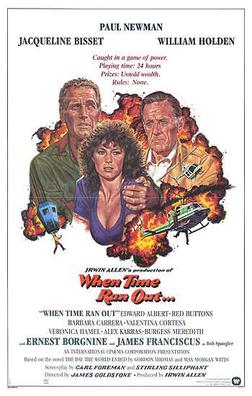
When Time Ran Out
With The Poseidon Adventure and The Towering Inferno to his name, producer Irwin Allen had quite the track record when it came to disaster flicks. In this case, he went back to the well once too often, and the end result is a less than quality final product, 1980's When Time Ran Out.
On a remote island in the Pacific, extremely successful businessman Shelby Gilmore (William Holden) is putting the final touches on his newly constructed hotel resort with his partner, Bob Spangler (James Franciscus), a longtime native of the island. Miles away from the oceanside resort is a volcano that's been dormant for over 60 years, but it is starting to show signs of another eruption but on a far greater scale than it's ever shown. Drilling an oil well on the island with his crew, Hank Anderson (Paul Newman) sees all the telltale signs of what's to come, but he can't convince Spangler to prep for what promises to be an epic disaster (money is a powerful motivator, isn't it?). As he makes a last ditch effort to convince others, the volcano explodes in grand fashion. Can all the island inhabitants and guests find a way to survive?
Like any successful genre, 'Time' follows the formula laid out by countless other disaster flicks. Assemble an all-star cast of actors and actresses, put them in some ridiculously perilous situation, and see who survives. The only problem? Well, other than the script that is. By 1980, the genre had outlasted its welcome a bit. Audiences had seen just about every calamity a disaster film could throw at them. How many times can you see the same movie over and over again, just replacing the man-made disasters, natural disasters or various diseases? 'Time' bombed in theaters and received some very poor reviews. Star power aside, it's got nothing going for it. Other than that? It's a real winner.
What sucked me in was the casting. To be fair, these are all cardboard cutouts of real characters, but the star power is legitimate. Newman is sleepwalking as Hank, the quiet oil driller who steps up as a hero because all disaster movies need a hero. He's also in trouble when he meets his ex, Kay (Jacqueline Bisset, around to wear a low-cut, tight T-shirt), who's now dating Holden's Shelby. Uh-oh, relationship drama! Sit back though, we're just getting started. Franciscus is the big villain -- $ $ for eyes -- who's cheating on his wife, Nikki (Veronica Hamel), with a hotel employee, Iolani (Barbara Carrera), who's engaged to islander Brian (Edward Albert). And just because, there's also Ernest Borgnine's NYC cop tracking a possible crook (Red Buttons) while Burgess Meredith and Valentina Cortese play an old married couple. There's also Alex Karras as Newman's right hand man, Pat Morita as a saloon owner and Sheila Allen as Mona, his wife.
Now more than just the all star cast is how the all star cast is treated. You could do a drinking game with these movies, or you could keep a scorecard. Every time a celebrity dies, take a shot. Throw $20 in and whoever guesses which celebrities survive and which ones don't gets all the money. The volcano explodes about halfway through director James Goldstone's flick, giving plenty of time for all the celebrity carnage. There's some surprises here, but nothing gigantic. Still, you've got to stick with it. Who makes it?!? Who doesn't?!?
Mostly though, the issue here is that it's just too dumb for it's own good. The volcano explodes so Newman's Hank leads a small group of individuals away from the fast-moving lava. Seems like sound thinking, right? Oh, no, they're all celebrities! Something bad might happen to them! It's beyond cliched here. The group must actually walk along a mountain ledge that's about to fall apart. Then, they've got to navigate a rickety wooden bridge that stands over a deep, flowing river of lava! That extended sequence goes on for about 20 minutes and actually ends with Meredith saving two kids by walking a tight rope (read = thin wooden rail) with a balancing act. The scene goes on and on, lacking any real tension.
For a movie budgeted at $20 million, it's hard to see where all that cash went. The special effects are laughable, especially the projectiles thrown from the volcano, usually landing directly on the hotel and/or people. The two sequences above were clearly shot on a poorly lit indoor stage, adding a nice touch of realism to the proceedings. That's a joke by the way. Then, at different points, the volcano is either right on top of the hotel or miles away as needed. Whatever is most appropriate for that given shot. This one's a dud. Even the all star cast couldn't save this one.
When Time Ran Out (1980): */****
On a remote island in the Pacific, extremely successful businessman Shelby Gilmore (William Holden) is putting the final touches on his newly constructed hotel resort with his partner, Bob Spangler (James Franciscus), a longtime native of the island. Miles away from the oceanside resort is a volcano that's been dormant for over 60 years, but it is starting to show signs of another eruption but on a far greater scale than it's ever shown. Drilling an oil well on the island with his crew, Hank Anderson (Paul Newman) sees all the telltale signs of what's to come, but he can't convince Spangler to prep for what promises to be an epic disaster (money is a powerful motivator, isn't it?). As he makes a last ditch effort to convince others, the volcano explodes in grand fashion. Can all the island inhabitants and guests find a way to survive?
Like any successful genre, 'Time' follows the formula laid out by countless other disaster flicks. Assemble an all-star cast of actors and actresses, put them in some ridiculously perilous situation, and see who survives. The only problem? Well, other than the script that is. By 1980, the genre had outlasted its welcome a bit. Audiences had seen just about every calamity a disaster film could throw at them. How many times can you see the same movie over and over again, just replacing the man-made disasters, natural disasters or various diseases? 'Time' bombed in theaters and received some very poor reviews. Star power aside, it's got nothing going for it. Other than that? It's a real winner.
What sucked me in was the casting. To be fair, these are all cardboard cutouts of real characters, but the star power is legitimate. Newman is sleepwalking as Hank, the quiet oil driller who steps up as a hero because all disaster movies need a hero. He's also in trouble when he meets his ex, Kay (Jacqueline Bisset, around to wear a low-cut, tight T-shirt), who's now dating Holden's Shelby. Uh-oh, relationship drama! Sit back though, we're just getting started. Franciscus is the big villain -- $ $ for eyes -- who's cheating on his wife, Nikki (Veronica Hamel), with a hotel employee, Iolani (Barbara Carrera), who's engaged to islander Brian (Edward Albert). And just because, there's also Ernest Borgnine's NYC cop tracking a possible crook (Red Buttons) while Burgess Meredith and Valentina Cortese play an old married couple. There's also Alex Karras as Newman's right hand man, Pat Morita as a saloon owner and Sheila Allen as Mona, his wife.
Now more than just the all star cast is how the all star cast is treated. You could do a drinking game with these movies, or you could keep a scorecard. Every time a celebrity dies, take a shot. Throw $20 in and whoever guesses which celebrities survive and which ones don't gets all the money. The volcano explodes about halfway through director James Goldstone's flick, giving plenty of time for all the celebrity carnage. There's some surprises here, but nothing gigantic. Still, you've got to stick with it. Who makes it?!? Who doesn't?!?
Mostly though, the issue here is that it's just too dumb for it's own good. The volcano explodes so Newman's Hank leads a small group of individuals away from the fast-moving lava. Seems like sound thinking, right? Oh, no, they're all celebrities! Something bad might happen to them! It's beyond cliched here. The group must actually walk along a mountain ledge that's about to fall apart. Then, they've got to navigate a rickety wooden bridge that stands over a deep, flowing river of lava! That extended sequence goes on for about 20 minutes and actually ends with Meredith saving two kids by walking a tight rope (read = thin wooden rail) with a balancing act. The scene goes on and on, lacking any real tension.
For a movie budgeted at $20 million, it's hard to see where all that cash went. The special effects are laughable, especially the projectiles thrown from the volcano, usually landing directly on the hotel and/or people. The two sequences above were clearly shot on a poorly lit indoor stage, adding a nice touch of realism to the proceedings. That's a joke by the way. Then, at different points, the volcano is either right on top of the hotel or miles away as needed. Whatever is most appropriate for that given shot. This one's a dud. Even the all star cast couldn't save this one.
When Time Ran Out (1980): */****
Wednesday, May 15, 2013
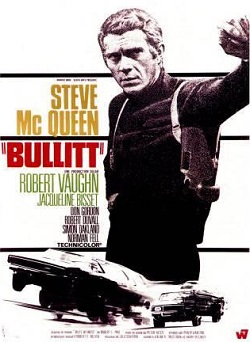
Bullitt
Let's cut away all the fluffiness and cut right to the bone. Steve McQueen is maybe the coolest actor to ever work in Hollywood. An underrated actor who had an incredible on-screen presence, he had his biggest success and popularity in the late 1960s. The Cincinnati Kid, Nevada Smith, Thomas Crown Affair, The Sand Pebbles, all excellent parts in good to great films. Nowhere was McQueen more at his coolest than 1968's Bullitt.
A respected and hard-edged San Francisco detective, Frank Bullitt (McQueen) has been tasked with a somewhat dull but essential task from ambitious politician Walter Chalmers (Robert Vaughn). Prepping for a Senate hearing about a Mafia takedown, Chalmers has enlisted a key witness (Felice Orlandi), and Bullitt and two other detectives must babysit him over a weekend until the hearing. Instead, the witness is killed by two assassins, forcing Bullitt to find out what's going on. Something doesn't fit together as he examines the clues and evidence, but the pressure is on. Chalmers needs a scapegoat, and Bullitt seems like the perfect target to take the fall. Knowing he's been backed into a corner, Bullitt has an extremely limited window to find out exactly what's going on.
The late 1960s were one of the most influential periods in Hollywood history, changing the way films were made and more importantly, the stories that were told. From director Peter Yates, 'Bullitt' is a police/cop movie like none before it. It is a smart, stylish cop drama/thriller that for me, gets better with each viewing. For starters, it was filmed in San Francisco, setting the stage for Dirty Harry, McQ and a whole cop genre to move into the city. It is an ideal backdrop for the story; a polished, good-looking city that is nonetheless hiding secrets. The score from Lalo Schifrin is a good mix of quiet, soothing jazz and faster-paced, more traditional yet still exciting musical cues (listen HERE). The style in an almost documentary-like fashion reflects some of the French crime thrillers that I've really come to appreciate, giving 'Bullitt' a different edge more than just the same old, same old cops and robbers story.
That starts with Steve McQueen as Detective Frank Bullitt, a veteran cop who always gets the job done but usually how he wants to do it, not how he should do it. That basic write-up is as cliched as the countless cop movie stereotypes that have been done to death in the years since, but McQueen gives the lead performance a different edge. Never one for huge dialogue scenes, McQueen's Bullitt is a huge presence whenever he's on-screen. He does more with a look here or there than many actors could do with an entire monologue with the camera trained on them. There's a self-assured confidence in the part, a quietness about it too. Bullitt is an expert at what he does, but he's not interested in fame or accolades. He does it because he's really good, so good that he's become almost desensitized to the violence he sees on a daily basis. McQueen is cool, acts cool and looks cool (I have a way with words, don't I?).
Okay, so we've talked about the plot, Steve McQueen's badass-ness (is that a word?), and hhhmmm, what else? Oh, right, the cars. Some 45 years since its release, 'Bullitt' is still remembered fondly for an infamous car chase that opened the door for countless knockoffs, remakes and retries. Driving his 1968 Ford Mustang, McQueen pursues two assassins (driver Bill Hickman, killer Paul Genge) in, around and through San Fran, two muscle cars going at it for everything they're worth. Schifrin's soundtrack is left by the wayside, just the sounds of the two engines doing battle providing all the soundtrack that's needed. Looking back on it now, it isn't a flashy sequence, but it is clear how much it has influenced just about every movie car chase since. It is an extended sequence that runs about 10 minutes total (near the film's halfway point), one that will definitely get the adrenaline pumping.
Now sometimes at the expense of the film's style is the film's story. It took me three or four viewings to really get everything down just right. Not to throw this out there as a cop-out, but an understanding of the story isn't a must here. You watch for the style. Some reviewers/critics have an issue with the pacing, some point-blank stating that it's a boring movie. It isn't an action-packed movie, that's for sure. 'Bullitt' takes its time but always knows where it wants to go. A chase through a hospital is subtle and underplayed but incredibly full of tension, as is the finale at the San Francisco airport as Bullitt chases a suspect across runways in use. We see little departures into San Fran with Bullitt's girlfriend, Cathy (Jacqueline Bisset), on dates and at work, to Bullitt's apartment, to follow up with witnesses. It's rarely flashy, but there's something charming just the same about that assured style.
Backing McQueen up, Vaughn does what he does best; gentlemanly slimy to perfection. His Chalmers is smooth and suave, but he's really a snake waiting in the grass to strike. Don Gordon (a longtime, close friend of McQueen) is nicely cast as Delgetti, Bullitt's longtime partner with Simon Oakland and Norman Fell as their superiors. Also look for Robert Duvall in a small but key (and effective) part as a cab driver whose help Bullitt enlists as he tries to figure everything out.
One of my favorites, an iconic flick from the 1960s, and one of Steve McQueen's all-time bests. Haven't seen it? What's wrong with you?!? Highly recommended.
Bullitt (1968): ****/****
Rewrite of November 2009 review
Friday, February 4, 2011
Casino Royale (1966)
After a four-year gap since Pierce Brosnan's final James Bond movie, MI6 agent 007 returned in a big way in 2006 with Daniel Craig taking over the part of the secret agent. It was a huge success and served as an excellent reboot for the franchise, quickly climbing into my top 5 all-time Bond flicks. Why did it work? Like most of the best movies from the franchise, it stuck close to the Ian Fleming source novel that had not been made previously...in a serious fashion at least. That's where 1966's awful Casino Royale jumps in.
By 1966, star Sean Connery had already completed four 007 movies and had turned James Bond into one of the world's biggest stars. It was so popular that spoofs started popping up like James Coburn as Derek Flint and Dean Martin as Matt Helm among others. I get it, strike when the iron is hot, but in a saturated market of spy and espionage movies -- serious and spoof -- don't you want to at least turn out a quality product? With six different directors shooting different portions of the movie, this was like How the West Was Won: 007 Style. Besides an occasional laugh here and there, the only redeeming quality is an out-of-this world (if wasted) cast, but more on that later.
All over the world, American, British, Russian, and French agents are turning up dead and their agencies don't have the slightest clue or evidence as to who's pulling off the jobs. The agency heads turn to retired MI6 agent, Sir James Bond (David Niven), to root out the problem. Bond is a legend in the espionage business, but his best days are behind him, and he questions what has happened to the field he worked so well in, carving out a name and reputation for himself. He concocts a crazy plan to smoke out whoever is behind the murders; using his name, agents all over the world (Peter Sellers, Ursula Andress, Daliah Lavi, Joanna Pettet, Woody Allen, Terence Cooper) will see if working as bait draws the mastermind out of his lair. The plan might be too good though because SMERSH and mastermind Le Chiffre (Orson Welles) send agents to kill the original and still best James Bond around.
Now anyone familiar with Casino Royale -- Fleming's novel or the Craig movie -- knows that the plot described there is nothing like the book or the movie. Bond's effort to detain Le Chiffre at the baccarat table is handled in a scene that takes about 10 minutes, not an entire movie. Using other spy spoofs as an example, there is clearly potential here. A character as ripe for the picking as James Bond is hard to mess up in the humor department, but this movie is a mess. For all the subtle, perfectly delivered lines that pepper the script, there's huge scenes of excess of physical and slapstick humor that even Mel Brooks must have shaken his head at. The finale is the worst of all with one of the 14 directors obviously not knowing where to cut things off.
Let's start with the crazy amount of talent involved here behind the camera, including John Huston (also playing M in one scene) and Robert Parrish among four other less notable names. The writing too includes Sellers, Billy Wilder, and Joseph Heller. How did this much talent put together such an awful movie? On top of the cast listed above, there's also parts for Deborah Kerr, William Holden, Jean-Paul Belmondo, Peter O'Toole (on-screen for about 6 seconds), Charles Boyer, George Raft, Jacqueline Bisset, and Barbara Bouchet. What's worse is that the cast appears to be having a blast making the picture. It's just that much worse that what they're working with is beneath all of their talent. Bit parts and extended cameos for almost all of these names limit actual on-screen time, but just in terms of name power, this movie is impressive.
The only star that I thought was legitimately good was David Niven as retired 007, Sir James Bond, enjoying his retirement in an isolated English country villa only to be thrust back into the world of espionage. Because it is an older Bond, Niven has some fun with the part, poking fun at Connery's portrayal especially. He gets some good laughs from his constant curiosity of how all secret agents have become sex fiends, leaving lonely, beautiful women in every city all over the Earth. He shakes his head at all the changes he sees in the life of a spy only to embrace them once he's back into it. A professional plain and simple, Niven makes the most of the material, rising above it to deliver a worthwhile performance.
So this movie was bad, downright awful at times, okay? I am scraping the bottom of the barrel here looking for something to write about. Most of the movie was just so stupid and dumb I can't even complain. It's so bad it is surreal at times. So what can I recommend? If nothing else with this overabundance of characters, the script calls for a long list of beautiful actresses who are required to wear slinky outfits and do little else. Kerr, Lavi, Pettet, Andress, and Bouchet are all half-naked for about 90% of the movie, and that's all I've got. So stupidly bad, this movie has to be seen to be believed.
Casino Royale <---trailer (1966): */****
By 1966, star Sean Connery had already completed four 007 movies and had turned James Bond into one of the world's biggest stars. It was so popular that spoofs started popping up like James Coburn as Derek Flint and Dean Martin as Matt Helm among others. I get it, strike when the iron is hot, but in a saturated market of spy and espionage movies -- serious and spoof -- don't you want to at least turn out a quality product? With six different directors shooting different portions of the movie, this was like How the West Was Won: 007 Style. Besides an occasional laugh here and there, the only redeeming quality is an out-of-this world (if wasted) cast, but more on that later.
All over the world, American, British, Russian, and French agents are turning up dead and their agencies don't have the slightest clue or evidence as to who's pulling off the jobs. The agency heads turn to retired MI6 agent, Sir James Bond (David Niven), to root out the problem. Bond is a legend in the espionage business, but his best days are behind him, and he questions what has happened to the field he worked so well in, carving out a name and reputation for himself. He concocts a crazy plan to smoke out whoever is behind the murders; using his name, agents all over the world (Peter Sellers, Ursula Andress, Daliah Lavi, Joanna Pettet, Woody Allen, Terence Cooper) will see if working as bait draws the mastermind out of his lair. The plan might be too good though because SMERSH and mastermind Le Chiffre (Orson Welles) send agents to kill the original and still best James Bond around.
Now anyone familiar with Casino Royale -- Fleming's novel or the Craig movie -- knows that the plot described there is nothing like the book or the movie. Bond's effort to detain Le Chiffre at the baccarat table is handled in a scene that takes about 10 minutes, not an entire movie. Using other spy spoofs as an example, there is clearly potential here. A character as ripe for the picking as James Bond is hard to mess up in the humor department, but this movie is a mess. For all the subtle, perfectly delivered lines that pepper the script, there's huge scenes of excess of physical and slapstick humor that even Mel Brooks must have shaken his head at. The finale is the worst of all with one of the 14 directors obviously not knowing where to cut things off.
Let's start with the crazy amount of talent involved here behind the camera, including John Huston (also playing M in one scene) and Robert Parrish among four other less notable names. The writing too includes Sellers, Billy Wilder, and Joseph Heller. How did this much talent put together such an awful movie? On top of the cast listed above, there's also parts for Deborah Kerr, William Holden, Jean-Paul Belmondo, Peter O'Toole (on-screen for about 6 seconds), Charles Boyer, George Raft, Jacqueline Bisset, and Barbara Bouchet. What's worse is that the cast appears to be having a blast making the picture. It's just that much worse that what they're working with is beneath all of their talent. Bit parts and extended cameos for almost all of these names limit actual on-screen time, but just in terms of name power, this movie is impressive.
The only star that I thought was legitimately good was David Niven as retired 007, Sir James Bond, enjoying his retirement in an isolated English country villa only to be thrust back into the world of espionage. Because it is an older Bond, Niven has some fun with the part, poking fun at Connery's portrayal especially. He gets some good laughs from his constant curiosity of how all secret agents have become sex fiends, leaving lonely, beautiful women in every city all over the Earth. He shakes his head at all the changes he sees in the life of a spy only to embrace them once he's back into it. A professional plain and simple, Niven makes the most of the material, rising above it to deliver a worthwhile performance.
So this movie was bad, downright awful at times, okay? I am scraping the bottom of the barrel here looking for something to write about. Most of the movie was just so stupid and dumb I can't even complain. It's so bad it is surreal at times. So what can I recommend? If nothing else with this overabundance of characters, the script calls for a long list of beautiful actresses who are required to wear slinky outfits and do little else. Kerr, Lavi, Pettet, Andress, and Bouchet are all half-naked for about 90% of the movie, and that's all I've got. So stupidly bad, this movie has to be seen to be believed.
Casino Royale <---trailer (1966): */****
Tuesday, December 14, 2010
The Life and Times of Judge Roy Bean
When people get more cynical, so do their movies. In the 1930s, westerns portrayed good guys wearing white hats and bad guys in black duds. By the time Clint Eastwood came along in the spaghetti westerns gunning down anything that would net him a buck, things were up for grabs. Then in the late 1960s and 1970s, somebody decided to put a new spin on the old west, stories that were more cynical in nature that attempted to show what the west was really like. Goodbye romantic, hello cynicism. Say howdy to the revisionist western.
If you look at the list of westerns included in the Wikipedia entry, there are some good entries, but for the most part I don't necessarily like revisionist westerns. They try much too hard to show you that what you've been watching all these years is garbage. Take 1972's The Life and Times of Judge Roy Bean, directed by one of my favorites, John Huston. In telling the story of real-life Roy Bean, this western blends some really awkward comedic moments, overlong sub-plots that go nowhere, some hypocritical views on just about everything (can't decide if that was intended), and in general a waste of a very strong cast.
Sometime around the turn of the century, "outlaw" Roy Bean (Paul Newman) rides into west Texas past the Pecos River, an area notorious for hiding bandits and criminals. At one saloon, they turn on him and leave him for dead only to have the wounded man come back and gun them all down. Disgusted by what he's seen, Bean sets up shop as a judge, administering his unique brand of justice to anyone and everyone looking for trouble. Word spreads and soon he even has deputies who help him out, all in the name of Texas and Lilly Langtry (Ava Gardner), a stage actress from the east, a woman Bean has always been in love with. But Bean's style of justice may catch up with him as civilization follows him around every corner, and his time may be running out.
I don't know where to start with this one because to be fair, Huston doesn't know where to start either. Roy Bean was a real-life judge in west Texas who ended up becoming a legendary figure after he died. So with this revisionist western instead of telling a story that showed what the actual man was like, Huston goes for the ridiculous legend. At a run-time of 120 minutes (a very long 120 minutes), 'Life' is all over the place with no sense of where it's going. The tone ranges from slapstick comedy that produces its fair share of groans -- it did from me at least -- to an oddly serious finale. It tries to be funny while also delivering a hacked up message about the changing times and the last few years of the wild west. Pick one or the other and go with it, but don't waver between the two.
A bright spot not surprisingly is Newman in the titular role, rising above materiel that at times is just beneath him. Newman's parts in the 1970s typically covered a wide variety of movies, and this surely doesn't disappoint. What works is that he commits so fully to this part. His beliefs are ridiculously hypocritical, and he'll string anyone up at the drop of a hat if he disagrees with what's been said or done. If you're loyal to him, he'll be loyal to you, but for heaven's sake don't turn on him. This isn't a part on par with his best performances like Butch Cassidy or Lucas Jackson, but it's a quality one. Even when the movie is dull to watch, it's worthwhile to check out Newman.
So with a story that is light on story and heavy on non-related vignettes, we get a chance to see a long list of actors play small parts (some being on-screen no more than a few seconds). Gardner makes an appearance in the movie's final scene in a moving scene that comes along a little too late. Anthony Perkins is a scene-stealer as a traveling preacher who realizes Newman's Bean may be a little off his rocker but doesn't want to get shot bringing the topic up. Ned Beatty, Matt Clark, Jim Burk, Bill McKinney, and Steve Kanaly are underused but all solid as Bean's loyal deputies. Also watch for Victoria Principal, Tab Hunter, Huston as a grizzled old mountain man, Stacy Keach as an albino gunman, Roddy McDowall, Anthony Zerbe, and Jacqueline Bisset in parts that range from bad to good, your decision on where they fall.
I will give Huston credit for trying new things. Early on, we get narration from Perkins and Hunter, but instead of just hearing it, the camera is placed right in front of them as they ride into town. They're looking right at the audience, addressing us in a cool change of pace, a unique little technique. But then the narration resorts to been there, done that voiceovers. It's just an odd movie overall, one with plenty of flaws but enough positives to give it a mild recommendation.
The Life and Times of Judge Roy Bean <---trailer (1972): **/****
If you look at the list of westerns included in the Wikipedia entry, there are some good entries, but for the most part I don't necessarily like revisionist westerns. They try much too hard to show you that what you've been watching all these years is garbage. Take 1972's The Life and Times of Judge Roy Bean, directed by one of my favorites, John Huston. In telling the story of real-life Roy Bean, this western blends some really awkward comedic moments, overlong sub-plots that go nowhere, some hypocritical views on just about everything (can't decide if that was intended), and in general a waste of a very strong cast.
Sometime around the turn of the century, "outlaw" Roy Bean (Paul Newman) rides into west Texas past the Pecos River, an area notorious for hiding bandits and criminals. At one saloon, they turn on him and leave him for dead only to have the wounded man come back and gun them all down. Disgusted by what he's seen, Bean sets up shop as a judge, administering his unique brand of justice to anyone and everyone looking for trouble. Word spreads and soon he even has deputies who help him out, all in the name of Texas and Lilly Langtry (Ava Gardner), a stage actress from the east, a woman Bean has always been in love with. But Bean's style of justice may catch up with him as civilization follows him around every corner, and his time may be running out.
I don't know where to start with this one because to be fair, Huston doesn't know where to start either. Roy Bean was a real-life judge in west Texas who ended up becoming a legendary figure after he died. So with this revisionist western instead of telling a story that showed what the actual man was like, Huston goes for the ridiculous legend. At a run-time of 120 minutes (a very long 120 minutes), 'Life' is all over the place with no sense of where it's going. The tone ranges from slapstick comedy that produces its fair share of groans -- it did from me at least -- to an oddly serious finale. It tries to be funny while also delivering a hacked up message about the changing times and the last few years of the wild west. Pick one or the other and go with it, but don't waver between the two.
A bright spot not surprisingly is Newman in the titular role, rising above materiel that at times is just beneath him. Newman's parts in the 1970s typically covered a wide variety of movies, and this surely doesn't disappoint. What works is that he commits so fully to this part. His beliefs are ridiculously hypocritical, and he'll string anyone up at the drop of a hat if he disagrees with what's been said or done. If you're loyal to him, he'll be loyal to you, but for heaven's sake don't turn on him. This isn't a part on par with his best performances like Butch Cassidy or Lucas Jackson, but it's a quality one. Even when the movie is dull to watch, it's worthwhile to check out Newman.
So with a story that is light on story and heavy on non-related vignettes, we get a chance to see a long list of actors play small parts (some being on-screen no more than a few seconds). Gardner makes an appearance in the movie's final scene in a moving scene that comes along a little too late. Anthony Perkins is a scene-stealer as a traveling preacher who realizes Newman's Bean may be a little off his rocker but doesn't want to get shot bringing the topic up. Ned Beatty, Matt Clark, Jim Burk, Bill McKinney, and Steve Kanaly are underused but all solid as Bean's loyal deputies. Also watch for Victoria Principal, Tab Hunter, Huston as a grizzled old mountain man, Stacy Keach as an albino gunman, Roddy McDowall, Anthony Zerbe, and Jacqueline Bisset in parts that range from bad to good, your decision on where they fall.
I will give Huston credit for trying new things. Early on, we get narration from Perkins and Hunter, but instead of just hearing it, the camera is placed right in front of them as they ride into town. They're looking right at the audience, addressing us in a cool change of pace, a unique little technique. But then the narration resorts to been there, done that voiceovers. It's just an odd movie overall, one with plenty of flaws but enough positives to give it a mild recommendation.
The Life and Times of Judge Roy Bean <---trailer (1972): **/****
Thursday, February 18, 2010
Murder on the Orient Express
Different directors have different personalities, different ways audiences look at them. Michael Bay? Loud, explosive movies. James Cameron? Huge blockbusters. Still chugging along at 86 years old, director Sidney Lumet has had a knack for working with some of Hollywood’s biggest stars in movies with a long list of those biggest stars. Working off an Agatha Christie source novel, 1974’s Murder on the Orient Express assembles one of the most impressive casts ever assembled.
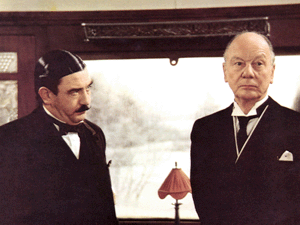
Playing Belgian detective Hercule Poirot, Albert Finney leads this cast in an enjoyable, ridiculous murder mystery set in the 1935. Finney is in just about every scene and dominates the movie. I’ve never read a Christie novel or anything at all related with Poirot, but this character reminded me of Peter Falk’s TV detective Columbo. A quirky, eccentric detective solves convoluted crimes that no person in their right mind should be able to comprehend.
Boarding the Orient Express after receiving orders to return to London, famed detective Hercule Poirot (Finney) is given a berth on the crowded train thanks to a railroad official (Martin Balsam) and long-time friend. But on the second night out, a mysterious American passenger, Ratchett (Richard Widmark), is murdered, stabbed through the midsection 12 times. The railroad official turns to Poirot to solve the murder before the train reaches the next station. A snow-covered pass blocks the train’s way, giving Poirot free range to go about solving the mystery. The detective quickly figures out that Ratchett was involved in a well-known kidnapping case. So was it a hired killer, or was one of the many passengers onboard the murderer?
The murder mystery itself is an interesting one that unfolds quickly in the first 30 minutes or so. The whole next hour is devoted to a series of interrogations/interviews as Finney’s Poirot and Balsam’s Bianchi assemble the evidence concerning Ratchett’s murder. With a dialogue-heavy movie, the story sinks or swims on these scenes. In that sense, it swims long and hard. Finney earned an Oscar nomination for his performance, and it’s a treat to watch him interact with his supporting cast.
The cast is a who’s who of Hollywood stars from the Golden Age and then a newer wave of younger stars making a name for themselves and then a few in between. Describing all these characters would require a whole other review in itself so I’ll try and keep it shorter. Along with Finney, Balsam, and Widmark, there’s a list of names that include Anthony Perkins, Ingrid Bergman (Oscar-nominated supporting part), Lauren Bacall, Sean Connery, Michael York, Jacqueline Bisset, Vanessa Redgrave, Jean-Pierre Cassel, and John Gielgud. Most of them are given a brief intro and then their interrogations with Poirot. Basically that amounts to a cameo-like role for all of them, but it’s great just to see all those big-names working together.
SPOILERS Don’t read anymore if you want to know who the murderer is SPOILERS. Poirot does his detective work and then confronts all the train’s passengers. His conclusion? They all murdered Ratchett, each stabbing him once with the same knife. Each passenger has a connection to an infamous kidnapping case that Widmark’s Ratchett masterminded, resulting in the death of five people. So working together, the murdering dozen or so have planned this murder to a fault…they just didn’t plan on Poirot being onboard. This twist is stupid, ridiculous, over the top, and somehow…it works. The ending itself is a bit of a letdown, but that’s a minor complaint.
The reveal itself is well-handled in an almost 30-minute scene where all the clues and evidence comes together. Lumet handles it perfectly with quick flashbacks to Poirot’s questioning as Finney seemingly lose his mind only to figure everything out. And that’s why this is a movie worth watching, the performances from Finney to the long list of A-list actors making the most of their supporting roles. More than a little beyond the limits of believability, but still fun from beginning to end.
Murder on the Orient Express <----trailer (1974): ***/****
Subscribe to:
Posts (Atom)