The Sons of Katie Elder

The Sons of Katie Elder
"First, we reunite, then find Ma and Pa's killer...then read some reviews."
Showing posts with label Jack Watson. Show all posts

Tuesday, August 12, 2014

The Wild Geese

A little bit of a spin on the wild west gunslinger, today's discussion centers around the mercenary, the hired gun who will take just about any job as long as the money is good. And if movies have taught us anything, mercenaries had lots of work throughout Africa in the 1960s and since with movies like Dark of the Sun, The Dogs of War and most recently Tears of the Sun. What about the best of the bunch? It's a movie many American viewers may not have heard of because it didn't get much of a release in the states. That movie? One of my favorites, 1978's The Wild Geese.

 A brutally efficient mercenary with years of experience under his belt, Allan Faulkner (Richard Burton) has agreed to take on a dangerous mission in Africa courtesy of the equally brutal, efficient and greedy merchant banker, Sir Edward Matherson (Stewart Granger). With lucrative copper mining rights on the line, Matherson needs Faulker to rescue a deposed African leader, Julius Limbani (Winston Ntshona), a leader of the people and a good man, to retake the government and settle things down. Taking a hefty payday, Faulker assembles an experienced, effective unit of 50 mercenaries, including fellow officers Lt. Shawn Fynn (Roger Moore), Capt. Rafer Janders (Richard Harris) and Lt. Pieter Coetzee (Hardy Kruger), and goes about putting together an effective plan, a smash and grab job. Faulker has the men assembled to pull off the job with a minimum of danger, but no matter how well thought out the mission is, even these mercenaries can't know what awaits them when they drop into Africa.

This review comes just a day after my Von Ryan's Express review, one of the great entertaining war movies ever made. More than that, just a great action movie. Well, surprise surprise, but I put this 1979 mercenary-centric action/drama on the same level. Is it a great movie in the vein of The Godfather or Lawrence of Arabia? Heck no, but it doesn't need to be! I watched a version that was 128 minutes long, and it is one extended thrill ride from beginning to end. Director Andrew McLaglen is far from a great director, but this is one of his best (if not THE best) movies. It is gritty, graphic, rough and tumble and the definition of a great tough guy flick. This is a movie that earns it's "Guy's Guy" type of movie, even if that theme song (listen HERE) seems a little out of place. But that's for the opening and closing credits. Enough with that. Let's get to the action!

Okay, not quite yet there with the casting. In the men-on-a-mission vein of The Guns of Navarone or Where Eagles Dare, here's one of the all-time great tough guy casts. The script calls for some older mercenaries, giving stars who weren't exactly A-list stars a chance at the spotlight again, and let me tell you, they don't disappoint. In a part of his career where the films weren't exactly great (an understatement), Richard Burton absolutely nails the part as Faulkner, a weathered, experienced mercenary who doesn't care for much other than the money he makes and the booze he can drink. Not exactly a stretch, but let's not nitpick. His officers include Harris as Janders, the master tactician and planner, Moore as Fynn, the born soldier who can fly or drive anything with a motor, and Kruger as Coetzee, the South African experienced bush fighter who has quite a few racist tendencies. They each get their moments to shine, the tough guy quartet killing it throughout with an easygoing, likable chemistry.

But wait....there's more!!! Along with Granger's quick appearance, there's Barry Foster and Patrick Allen as other shadowy characters involved in putting the mission together. Filling out the mercenary lineup are scene-stealing Jack Watson as foul-mouthed drill instructor Sandy Young, John Kani as Sgt. Jesse, the youngest of the bunch but an incredibly capable fighter, Kenneth Griffith as Witty, the flamboyantly gay medic, with Ronald Fraser, Ian Yule (an actual former mercenary), Percy Herbert, and Glyn Baker rounding out the crew. Also look for Jeff Corey and Frank Findlay in small parts. Just a cool, underrated supporting cast with plenty of memorable, recognizable faces.

Based off a novel by Daniel Carney and a Reginald Rose screenplay, one of 'Wild's' most underrated aspects is its script. Yes, it is familiar. Yes, it is politically incorrect one moment and somewhat preachy the next. But in the end, you throw it all together and all those separate ingredients work well together. It follows the men-on-a-mission formula nicely, going from assembling the team, to training the team, to unleashing the mercenaries on their dangerous mission deep in Africa, a regiment of brutal Simbas waiting to wipe them out if given the chance. There's too many good moments to mention from the Wild Geese free-falling out of a plane at 25,000 feet to Watson's hysterical rants during the training sequences to the almost non-stop smartass attitudes that produce a ton of memorable one-liners, some funny and some highly effective in the old drama department. Just a lot of positives on display here across the board.

But the biggest positive? The action of course! It's so good that the DVD actually offers a stand-alone menu where you can watch solely the explosions, shootouts and all sorts of hell that breaks loose. Without giving away any spoilers, the mission doesn't go off quite as planned, Faulkner and his men forced to improvise deep in enemy territory. Most of the last hour of the film is one extended action scene with some occasional dialogue to break things up. The highlight is the last 30 minutes, the mercenaries shooting it out with a large force of Simbas hell bent on stopping them from escaping. It's bloody, graphic and uncomfortable and features some surprising twists too as the body count rises ever higher. The action turns into a chaotic chase across the African savannah, lines and flanks shifting minute to minute. What an action movie.

This can be a difficult movie to track down. Years ago, I was lucky enough to track down a Tango DVD of this 1978 mercenary flick. It's currently available at Amazon for a very reasonable $12.99 if you're curious. As I mentioned, is it a perfect film? Nope, and again, it isn't meant to be. Instead, it is pure escapism, pure entertainment, and for me that's all I'm looking for. Familiar but highly entertaining story, action to burn and one of my all-time favorite casts. Can't recommend this one enough.

The Wild Geese (1978): ****/****
Rewrite of June 2009 review

Monday, May 27, 2013

The Devil's Brigade

In tribute to all our veterans, here's a Memorial Day review. As a movie fan, Memorial Day was a huge weekend for me growing up. I looked forward to watching old war movies on TNT in round-the-clock marathons, WWII flicks that are some of my favorites like The Dirty Dozen, Kelly's Heroes and an underrated classic and one of my all-time favorites, 1968's The Devil's Brigade.

It's 1942 and with World War II very much yet to be decided, Lt. Colonel Robert Frederick (William Holden) has been summoned to a staff meeting in England. Even though he has no combat experience, Frederick is being given command of a new unit, the First Special Service Force. Their ultimate mission is still to be decided but the Colonel prepares for the training that awaits his brigade that consists of a crack unit of well-trained Canadian troops commanded by Dunkirk veteran Maj. Alan Crown (Cliff Robertson) and an unruly, misfit group of American troops headed by the similarly unruly Maj. Cliff Bricker (Vince Edwards). The two sides bristle immediately, but training continues. If Frederick can manage to keep his men together, their services are very much needed, including a dangerous mission on the Italian front.

From veteran director Andrew McLaglen, 'Brigade' is based on a real-life military unit, the First Special Service Force. Released just a year after The Dirty Dozen, it bears some striking similarities, but it more than capably carves out its own niche in war movie department. It is one of the great men-on-a-mission movies, and that's saying something considering the late 1960s were rampant with them. McLaglen filmed on location in Italy for much of the second half of the movie, giving an authentic look and feel to the proceedings as the Brigade goes into battle. Composer Alex North turns in a gem of a soundtrack, his theme for the Brigade (listen HERE) one that you'll be whistling for days. The main theme is a highlight, but North specializes in the quieter, darker and more sinister moments leading up to the battle in the finale.

More of a workmanlike director than an auteur, McLaglen specialized in movies like this with impressive casts of male stars. This 1968 WWII flick is loaded with star power. As Colonel Frederick, Holden doesn't get a flashy part, but he leads the way just the same. His officer wants to prove himself while also proving how capable his men are too. The best part in the film goes to Robertson as Maj. Crown, an intelligent, well-spoken and brutally capable officer who survived the Dunkirk disaster. It is a smart, underplayed role, and he steals every scene he's in. As his American counterpart, Edwards too is very solid. His Maj. Bricker is blunt and without a filter, a scrounger and hustler with the best of them. Also look for Dana Andrews, Michael Rennie and Carroll O'Connor as American generals, all making cameo appearances.

Ah, yes, and then there's the rest of the cast. If the star power above wasn't enough, McLaglen assembles a deep, talented cast of tough guys to fill out the ranks of the brigade. Leading the American contingent, look for Claude Akins, Andrew Prine, Richard Jaeckel, Luke Askew, Tom Troupe, Bill Fletcher and Tom Stern. For the Canadian half of the Brigade, watch out for Jack Watson, Harry Carey Jr., Jeremy Slate, Richard Dawson and Jean-Paul Vignon. It's cool just seeing all these recognizable faces here together, some leaving more of an impression than others. Jaeckel as Omar Greco, an acrobat trying to escape but finding a home instead, especially stands out as does Akins as Rocky, the American bully, Prine as Ransom, a smart misfit, Watson as Peacock, the tough but gentlemanly Canadian and Slate as O'Neill, the hand-to-hand combat instructor.

I think it's the cast that separates the movie from so many other solid WWII movies. It's a familiar formula here; introduce everyone, train them, have them put their differences aside following some male bonding and then unleash them on the enemy. The male bonding comes courtesy of a barroom brawl (watch HERE) with some rowdy lumberjacks, a great scene. The script is ideal in its ability to let these tough guys be tough guys. It's fun, natural with chemistry and features some great one-liners. Other highlights include Slate's introduction in a showdown with Akins (watch HERE), a 30-mile hike where the rivalry develops further, and many others. Moral of the story is this, we need these parts to be effective for the second half of the movie to truly work. And you bet it does.

The last hour follows the Brigade as it enters combat. Required to prove themselves and their ability, Frederick leads a patrol behind the lines to a heavily guarded Italian town crawling with Germans. It's a lighter action scene, but memorable just the same. The best part though is in the finale, the Brigade ordered to attack the apparently impenetrable Mount la Difensa (where the Service Force really made a name for themselves), a mountain garrisoned by German infantry and heavy armor. First, they must scale a sheer cliff-face to mount a surprise attack on the garrison. It is a great action sequence, McLaglen filming in the trenches and dugouts as the Brigade begins their assault. We always know where the battle is, where it's going, and the sheer scale of it. When the casualties do come (and they do, quickly and with some surprises), it makes this extended battle sequence that much more effective emotionally.

This has always been one of my favorites, and I seem to pick something new up with each passing viewing (I'm guessing I'm somewhere between 20 and 30). This time? The darkness late, Frederick greeting his men as they prepare for battle. North's score goes dark, Dawson explaining "Haven't you ever heard a man say goodbye?" It's an eerie, uncomfortable moment. Spot-on too, considering the Brigade sustained 77% casualties in the coming battle. 'Brigade' doesn't have the reputation of so many other WWII movies of the time, but it deserves some attention. A hidden gem.

The Devil's Brigade (1968): ****/****
* Rewrite of June 2010 review

Sunday, April 29, 2012

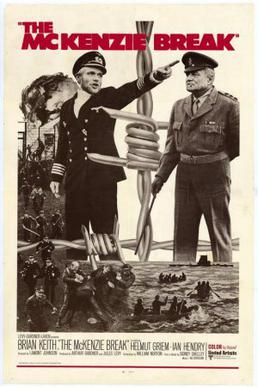
The McKenzie Break

While there have been obvious exceptions, I usually think of WWII prisoner of war movies from the Allied P.O.W.'s perspective. Movies like The Great Escape, Stalag 17, Bridge on the River Kwai among others. The lack of Axis POW movies can be explained with the fact that many prisoners spent the war in the U.S., but I suppose there's a more obvious one. The appeal of prisoner of war movies is the escape. You're rooting for the prisoners to get out. This may just be a personal thing, but unless I'm given some sort of motivation, I ain't rooting for German/Japanese prisoners to escape, like 1970's The McKenzie Break.

It is late in World War II, but the fighting rages on, even in isolated northern Scotland at a German P.O.W. camp in McKenzie commanded by the British, including Major Perry (Ian Hendry). Perry's prisoners are almost exclusively officers -- no enlisted men here -- and thanks to their ranking officer, a U-boat commander, Captain Willi Schlueter (Helmut Griem), those prisoners have organized. While they're still prisoners, they essentially run the camp, Perry unable to enforce even the most basic rules and laws. An Irishman and former journalist working for British Intelligence, Captain Jack Connor (Brian Keith), has been assigned to the McKenzie camp to aid the situation. What exactly are these German prisoners up to? Can Connor figure out their plan before it is unleashed?

As I'm planning what to write here, I'll say this out front. If it comes across poorly or naive, I apologize. I know atrocities were committed on both sides during WWII, but I'm more familiar with those of the German/Japanese forces against Allied prisoners than the other way around. The victors write the history books and all that. So anyways, here goes. Almost all countries signed the Geneva Convention, a document protecting prisoners of war as much as possible, basically treating them like humans. As presented in 'McKenzie' and making it difficult to watch, only so much can be done. German forces always seemed ready to brutally respond to any prisoner issues, but Hendry's Major Perry seems helpless here even when German prisoners physically assault his guards. He makes the point that any action against these prisoners will be taken against Allied prisoners in Germany which is true. Maybe it's just a deeper seeded issue, a more human way of doing your job. At what cost and how far does a country and its people go? Maybe the Germans were just more comfortable in their brutality? Sorry for a somewhat off tangent. Just had to say it.

I've mentioned before, and I'll most likely mention it again, but I'm a sucker for prisoner of war movies. They're unique to war movies because they can focus on the natural tension of the conflict without getting anywhere near the battlefield. Director Lamont Johnson is at the helm of a dreary-looking film (I suppose on-location Ireland doesn't get a lot of sun) that certainly adds some dimension to the story. It is refreshing to see the Allies as the guards and the Germans as the prisoners in this tweak of a familiar story-line. The opening set-piece especially sets the tone, Perry's complete failure at "commanding" his McKenzie camp. Watch it HERE. I kept waiting for the order to fire on the prisoners -- physical assault on guards seems like reason enough -- but the opener does a great job of setting things up. This is not your typical camp where the prisoners meekly assemble and wait out the end of the war, no matter how the war effort is going for the Germans.

Amidst all the bigger picture elements in 'McKenzie' is a simple plot device that is as close to a sure-thing as you can get; a cat and mouse game between two intelligent minds, in this case Keith's Capt. Connor and Griem's Schleuter. Connor knows his German counterpart is up to something, Griem knows Connor is hot on his trail. Keith does a great job in the part, a cynical, honest quasi-soldier who isn't interested in chain of command, honor, bravery, and the so-called glory of war. He's doing his job as if he was a civilian, military protocol be damned. Griem as U-boat commander Schleuter is the villain here, not just an enemy. A devout Nazi and former member of the Hitler Youth, he is an elitist, racist, brutal officer, obsessed with helping the German and Nazi war effort. No cost is too high for this young officer. At one point, he even organizes the murder of one of his own men, a homosexual. The banter between the rival officers is pitch-perfect, neither man letting on how much he knows, both men knowing they're facing a worthy competitor.

Not many other parts really stand out, but Hendry especially does his best. It's not that his Major Perry is a bad officer, but he's at the end of his rope and limited by orders from above. Too bad his character is basically pushed to the side once Connor shows up. Patrick O'Connell does a fine job as Sgt. Major Cox, the head non-commissioned officer who works with Connor and is drawn to his more straightforward approach to handling the issue of how to handle the German prisoners. Even Jack Watson has a small but interesting part as General Kerr, Connor's commander and old friend who wants the problem to be solved quickly, efficiently and quietly. Horst Janson plays Lt. Neuchl, the gay German officer who feels the wrath of his fellow soldiers.

Having watched countless prisoner of war movies, I was a little upset with myself about the conclusion I'd come to. It sounds obvious, I'm not going to root for the Germans to escape, just like I didn't want Hardy Kruger to escape in The One That Got Away. I want Keith's Capt. Connor to get his hands on these guys before they can reach safety. The final 45 minutes pick up the pace as the story reveals more of itself, not just prisoners trying to escape but why they're doing so with orders coming from German High Command. On the other side, Connor sees potential for an impressive coup. Which one will work? The ending is especially clever in its development in this underrated P.O.W. movie.

The McKenzie Break <---trailer/clips (1970): ***/****

Saturday, February 18, 2012

Juggernaut

The formula for disaster movies is pretty simple. Put together an all-star list of celebrities and movie stars and basically start throwing all sorts of apocalyptic measures of death at them. Sounds fun, doesn't it? That formula is improved when these casts are in a place they can't escape; a building in The Towering Inferno, a plane in Airport (and its sequels and knock-offs), or a boat like The Poseidon Adventure or 1974's Juggernaut.

On board the ocean liner Brittanica, Captain Alex Brunel (Omar Sharif) is in charge of 1,200 passengers traveling from England to New York City. The ship is only a day or so removed from port when a message comes in. A terrorist identified only as Juggernaut has placed seven bombs on-board the ship. He's demanding a ransom of half a million pounds to be delivered by dawn the next morning. If he doesn't receive the money, the bombs will explode. Working against a clock, a bomb disposal team led by Lt. Commander Anthony Fallon (Richard Harris) and right hand man, Charlie Braddock (David Hemmings), are flown in to defuse the bombs. Can they disarm them in time?

My usual picture of disaster movies is chaotic throngs of nameless individuals running around like their hair is on fire, old people and children trampled underfoot. Then Gene Hackman or Paul Newman steps to the forefront and saves the day, calming the masses with one soothing speech. In a lot of ways then, director Richard Lester has created the anti-disaster movie. A somber falls over the ship when the news of the bomb is released, the passengers realizing they can do nothing but sit back and wait, and hope. There is an almost documentary-like feel to Juggernaut, and a general low-key feeling of high-tension situation. It isn't the chaos or violence that erupts, but that sense of doom and dread knowing death waits with the sunrise. A disaster movie doesn't have to be aggressive and in your face to be effective. It just has to hit you emotionally in some way, and it does here. How would you respond in this dire situation?

Maybe Juggernaut doesn't have the huge names other disaster movies do, but it's still a memorable cast listing. More on Harris and Hemmings later, but let's start with Mr. Sharif, calmly cool as the Britannic's captain. He's given little to do other than try and stay calm, but because it is Omar Sharif it is at least watchable in its ho-hum ways. Anthony Hopkins plays Superintendent McCleod, a police officer leading the investigation to find the bomber back in England, also working with some extra motivation, his wife (Caroline Mortimer) and kids are on board. Ian Holm is Porter, the Britannic's company owner trying to fix the situation as best as possible. Shirley Knight plays a single woman who hooks up with Sharif's captain, trying to figure the man out. Roy Kinnear and Jack Watson play two members of the crew while Clifton James has a good part as an American politician with a unique outlook on the situation.

With a story that focuses on the horrific situation more than the personal aspect of the characters, something has got to keep you interested at that individual, person-to-person level. For me, that part came through with Harris and Hemmings as the leaders of the bomb squad. An early introduction shows them disarming a bomb in a London museum only to be called away to another rescue mission. We learn little about them other than Harris' Fallon has yet to meet a bomb he can't defuse, but because of the horrifying aspects of their job, it becomes personal. They live on a day-to-day basis, surviving one day at a time because honestly, they have no idea when their end will come. Harris is a scene stealer and the best thing going for Juggernaut, confident, cocky and ready with a joke because that's the only way he knows how to cope. His brotherly relationship with Hemmings is spot-on, a friendship that could only be a product of years of working together in this death-defying situation.

As mentioned before, what sets Juggernaut apart from so many other still entertaining movies is the bomb aspect. Much of the second half of the movie is spent with Harris, Hemmings and their team sitting in front of these seven bombs placed in oil drums that will explode if moved even a little. Harris' Fallon goes first, experimenting to see what will work, his team following suit. If something goes wrong (i.e. the bomb explodes), the team picks up where he left off. Tension doesn't begin to describe these scenes. The camera is right there on the ground with them in the dark passageways of this immense ocean liner. That documentary feel gives you the sensation of being there with them. The clock keeps ticking down, and what do you think happens? It's a cliche, but a good one. A blue wire and a red wire. Which one do you cut?

Is it possible for a disaster movie to be low-key and still be effective? Juggernaut proves that it can. Not remembered with some of the classic disaster flicks, but it is a good one nonetheless. Good cast, unique twist on a familiar formula, and tension and adrenaline to spare. Well worth checking out.

Juggernaut <---trailer (1974): ***/****

Friday, January 29, 2010

Tobruk

Before the History Channel became more interested in reality-based programming in the last year or so, this network focused more on (and it's a novel concept) history programming. Makes sense to me. Some dubbed it 'the Hitler Channel' because so much of their schedule was devoted to WWII shows, but that was just a small portion of their schedule. For years on Sunday mornings, History would show older war movies, ranging from classics to cheap retreads, and when I could be bothered to get up early I'd tune in and see some of my favorites, one of them being 1967's Tobruk.

It's a story set in 1942 North Africa as an inexperienced American army joins British forces in trying to keep German commander Erwin Rommel from completely booting the Allies out of the continent. I don't have numbers to back this up, but it seems to me a majority of WWII movies tend to focus on post D-Day stories as the Allies trudge across Europe. Personally though, the early stages of the war are just as interesting to me with TV shows that included The Rat Patrol and movies like The Hill and Play Dirty all set in North Africa with Tobruk added to that list.

Captured by French authorities and about to be shipped off to a German prison camp, Canadian officer Major Donald Craig (Rock Hudson) is rescued by a team of commandos led by Capt. Kurt Bergman (George Peppard), a German Jew fighting with the S.I.G (Special Investigation Group) in the Allied forces. Craig, a member of the Long Range Desert Group, has been busted out to guide a dangerous mission behind enemy lines. The commando commander, Colonel Harker (Nigel Green), has two objectives, destroy the harbor guns in Tobruk to help the invasion force and to destroy Rommel's fuel depot. Harker's men will pose as P.OW.s with Bergman's German Jews posing as their German escorts as the convoy travels over 800-miles across the desert to accomplish their mission.

Threading the needle to get to Tobruk, Harker's commandos and Bergman's unit face German minefields, patrols appearing out of nowhere, even their own fighters attacking what they think is a German column. But worst of all, there seems to be a traitor among Bergman's men, and when they pick up two German sympathizers with news that Egypt will join the fight against the Allies, their mission becomes even more important. It's a large-scale story in the vein of The Guns of Navarone (harbor guns moved from the Mediterranean to Tobruk) and Where Eagles Dare, and while not on par with those WWII action/adventures, it is still an above average flick.

For a WWII adventure to be nominated for an Academy Award -- any award -- says something. Tobruk was nominated for special effects (Howard A. Anderson and Albert Whitlock) and for good reason. The effects during the action sequences were ahead of their time, especially the finale as the commandos try to pull off both aspects of their mission as an invasion force readies to hit the beach. This is one of those battle sequences that really makes you feel like you're there scrunched up behind a rock, hoping a bullet doesn't find you. Even better, with the use of many of these effects it looks like the stars, especially Peppard, did many of their own stunts.

Tobruk's action is so good in fact it was used over again 4 years later in 1971's Raid for Rommel. Whole scenes were cut from Tobruk and inserted right into the 1971 vehicle starring Richard Burton with a similar storyline. And the action is the reason to seek this movie out, and that's considering a story that is pretty decent compared to most shoot 'em up flicks. Right from the start there's a commando rescue, but that is just the beginning. Tobruk never goes too long without some suspense, some adventure of some sort. The ending is something else with tanks, flamethrowers, motorcycles and commandos descending rappel cords off a cliff all thrown into the mix.

Getting to the finale is a lot of fun too with the three leads playing off each other well, especially Peppard and Green. Peppard steals the movie as a German Jew looking for revenge, any sort of vengeance against Germany for what they're doing to his people. He's ruthless in his actions and is more than willing to sacrifice himself for the cause. Green is the stiff upper-lip commander who clashes instantly with Peppard's Bergman, even questioning his motives. Their rivalry drives the movie, both actors rising above what could have been cardboard cutouts of characters. Hudson isn't at his best -- a soldier sick of war who does his job and nothing more -- but it is a decent enough part.

Other supporting parts include one of my personal favorites Jack Watson doing what he does best, playing the tough sergeant, with a similar end result to at least two other movies of his I can think of. Guy Stockwell is Lt. Mohnfeld, one of Bergman's officers, and Norm Rossington and Percy Herbert as two commandos around for some comedic relief. Tobruk's screenwriter Leo Gordon, who usually played tough guys in supporting roles, gets a crack to play one of the good guys for a change as well as Sgt. Krug. A WWII movie that's a lot of fun, a good old-fashioned popcorn flick. Of course, there's no DVD release but who knows, maybe History Channel will put it on one Sunday morning.

Tobruk <---trailer (1967): *** 1/2 /****

Friday, April 17, 2009

Grand Prix

One of my favorite things about movies is that if someone wants badly enough to make a movie on a specific topic, it's going to happen. And sometimes, more than one person likes that topic so moviegoers are hit with a wave of similar movies. Think of all the quasi-Lord of the Ring movies to come out in recent years, or the sci-fi avalanche that resulted from the original Star Wars trilogy. In the late 60s, it was racing movies as stars and directors turned their attention to fast cars. I've always liked Steve McQueen's 1971 semi-documentary Le Mans and I'd like to see Paul Newman's 1969 racing movie Winning. But the first of these late 60s and early 70s racing movies was 1966's Grand Prix.

I'd read many positive reviews of director John Frankenheimer's race epic that clocks in at just under three hours so I went into the movie really hoping to enjoy it. It tells the story of a whole season of Formula One racing in Europe and the U.S. through the eyes of four drivers. There's Pete Aron (James Garner), an American racer who's been in a two-year long slump but has a chance to climb back to the top with a Japanese racing team owned by Izo Yamura (Toshiro Mifune). Jean-Pierre Sarti (Yves Montand) is a veteran driver tiring of racing but still at the top of his game. He's married but is separated from his wife and during the season falls for an American photojournalist, Louise Frederickson (Eva Marie Saint). A new driver, up and coming Nino Barlini (Antonio Sabato) makes a splash on the circuit after becoming a champion motorcycle driver. And last, there's Scott Stoddard (Brian Bedford), a British driver trying to live up to the expectations set by his racing father.

The movie starts with a bang on the opening race of the season at Monte Carlo with a great credit sequence, and here's an extended clip just so you can get an idea of the racing footage. Teammates Aron and Stoddard have a miscommunication mid-race and Aron's car is destroyed and he's shaken up while Stoddard is badly broken up and so starts the tension. Director Frankenheimer clearly pulled out all the stops when it came to the racing footage. Cameras are placed on the cars, facing forward so you get a sense of how fast these cars are going and backward where we see the drivers. Then there's the big wide shots of the racers zipping by.

Not being a Nascar fan, I thought this would get repetitive over the course of the movie. I couldn't have been more wrong. The races never get old, and I recommend watching the movie for those alone. Here's a few more samples, the F1 Spa-Francorchamps and then the finale with SPOILERS at the Italian Monza course with its high banking turns. The footage is so good the race sequences feel like a documentary. It's by far the best racing footage I've come across in movies, right up there with Le Mans.

It's a shame then that Frankenheimer couldn't just have made a racing movie that ran about 2 hours and stopped there. The movie as is drags incredibly slowly once the racers leave their cars on the tracks. It took me a handful of sittings to get through the movie because of that slow pace. Each of the drivers has their personal issues to deal with, but the only one that comes across as sympathetic is Montand's Sarti.

Of course that doesn't mean the huge international cast isn't good. Garner was and still is a cool actor, making seem like he's not even trying. As Aron, the down but not out racer, he may not be the most sympathetic character but as a sort of underdog I was rooting for him. Sabato is having a lot of fun as the rags to riches Italian driver, and Bedford is good but doesn't leave a huge impression. Mifune rises above what could be a cliched role, and Marie Saint is a good counter to Montand. Jack Watson has a small but strong part as Jeff Jordan, Stoddard's fiery race manager. Adolfo Celi makes a quick appearance too as a race team owner.

Rewatching these racing clips as I post, I can't help but feel the adrenaline rush just watching them. And that's the reason to watch Grand Prix, here's a trailer. With so many directors relying on CGI these days, it's hard to imagine better quality race movies coming out. So even though the non-race sequences can be painfully slow, I'm highly recommending this one because I loved the races more than I hated the love stories.