The Sons of Katie Elder

The Sons of Katie Elder
"First, we reunite, then find Ma and Pa's killer...then read some reviews."
Showing posts with label Lee Marvin. Show all posts

Friday, January 15, 2016

The Professionals

The western is my genre, my spirit animal, my go-to when I'm looking for a type of movie I just know I'll like. There are very few so-called "perfect" westerns out there, but I've got my favorites. Some are obvious, highly respected and known by even non-western fans. One that seems to get lost in the shuffle at times? A classic, a true gem, and one I never tire of, 1966's The Professionals.

It's 1917 and the Mexican Revolution is still raging strong all over the country. Along the U.S./Mexico border, four men, Rico Fardan (Lee Marvin), Bill Dolworth (Burt Lancaster), Hans Ehrengard (Robert Ryan) and Jake Sharp (Woody Strode), have been brought together to perform a dangerous mission. The little group, each of them a specialist in one way or another, has been hired by rancher and oil tycoon Joe Grant (Ralph Bellamy) to ride deep into Mexico and rescue his wife, Maria (Claudia Cardinale), who's been kidnapped by a bandit and revolutionary, Jesus Raza (Jack Palance). Maria is believed to be stashed away in a hacienda in the mountains with Raza's small army standing guard. This quartet is the best of the best with few equals, but even this job seems to be too much, especially if they haven't been told the whole truth of what they're riding into. Can they pull off the job?

Aired recently on Turner Classic Movies, host Robert Osborne introduced the movie stating that director Richard Brooks deserves more of a reputation, of a following for a career that produced six Oscar nominations and plenty of good to great to classic movies, as a director, producer and writer. For me, this is easily his best work. It's one of my favorites, and I always enjoy catching up with it. Mutually appreciated by both audiences and critics, 'Professionals' is one of the best westerns of the 1960's and really, one of the best westerns of all-time. It picked up two Oscar nominations, one for Brooks' directing and one for his script. Not a flaw in sight. Sit back and enjoy this one, hopefully with a big tub of popcorn.

Let's get the boring technical stuff out of the way. Boring, but necessary. Brooks earned a Best Director nomination for blending a movie that features the technical, storytelling, characters, humor, action and visual look. With filming locations in the Valley of Fire, Death Valley, along with Nevada, California and Sonora, the visual appeal is evident. On the trail thanks to some key landmarks, you're always aware of where you are. As well, the traveling and action scenes are aided immensely by composer Maurice Jarre's score, especially the main theme. Listen HERE. Throw it all together, and you feel like you're right there with our Professionals in the sweaty, sun-baked desert where bandits and revolutionaries are there behind every rock waiting to ambush you.

The cast is pretty insane in terms of pure talent and star power, but with each repeated viewing, it always comes back to the script for me. Adapting a western novel called 'A Mule for the Marquesa,' Brooks transformed a good book into a great movie. This is a story that loves it characters, both the good and bad, and more importantly, knows them well. The script absolutely crackles, Lancaster and Marvin especially relishing delivering one memorable one-liner after another. I can't think of too many westerns that have the ability to tread that fine line between serious action and a sense of humor. Read IMDB's memorable quotes HERE. What's impressive? Even out of context, they still can put a smile on your face, give you a good laugh. When you actually see Lancaster, Marvin and Co. deliver said lines? Oh my, you're in for a treat.

I love a good men-on-a-mission movie, and this one belongs right at the top with The Magnificent Seven, The Guns of Navarone and The Dirty Dozen as my favorites. Seriously...Lancaster, Marvin, Ryan and Strode...oh, and Palance, Cardinale and Bellamy! That sound you hear is my head exploding from awesomeness. Brooks' script introduces our characters with lightning-fast ease and we get to know them in that quick flash. Marvin's Fardan is an ex-soldier, a leader, an organizer and a planner, Ryan's Ehrengard a horse wrangler, a cowboy and the very best, Strode's Jake an expert tracker and scout and specialist with bow and arrow, and last but not least, Lancaster's Dolworth is a mercenary, a philosophizing dynamite expert. That is a ridiculously talented cast with a lousy script, but combined with Brooks' script, the end result is some of the most memorable western characters ever with a story to boot. You can't pass that up now, can you?!?

When I think of Burt Lancaster and Lee Marvin working together here, it puts a smile on my face. Their Bill Dolworth and Rico Fardan are the heart of the movie, mercenaries, soldiers and adventurers who are good friends who have worked together in the past, including previously in the Mexican Revolution. They too have a history with Palance's Raza, making their job a touch more difficult. What the script and actors do so effortlessly is bring these characters to life. They're tough, rough-hewn men who live by their word and their hard-fought ability to survive. They fight because they're good at it, and maybe, just maybe, they like it a little bit. Their one-on-one scenes are some of the most memorable in the entire movie. When you throw the always reliable Robert Ryan and Woody Strode into the mix, you're in for a treat.

Okay, we need an actor in the mid 1960's to play a Mexican revolutionary....naturally, it's Jack Palance! His Raza though is an underrated character, an equal to our Professionals, a somewhat disillusioned fighter who fights on because he loves Mexico, the people, and wants those in power out.  Then there is Claudia Cardinale, maybe the most beautiful woman to ever grace the screen. Her Maria has some tricks up her sleeves as we're introduced to her about halfway through. Bellamy is perfect in his part, beginning and end, as the worrying Joe Grant (or is he...). Also look for Jorge Martinez de HoyosJoe De Santis and Rafael Bertrand in key supporting parts. In a scene-stealing part, Marie Gomez plays Chiquita, one of Raza's soldiers who has a history with Lancaster's Bill.

What's funny about 'Professionals' is that it isn't an action-heavy story. Yes, there's gunfights, chases and some memorable sequences, but it isn't a 2-hour action scene. It's the better for it. We get to know our characters really well in quick scenes featuring Brooks' snappy dialogue. When the action does come, is it ever worth it, especially the pre-dawn attack on Raza's hacienda deep in the mountains. Loud and chaotic, it is a gem. The other action is on a smaller-scale, tightly-edited firefights in claustrophobic canyons. So if there isn't an overabundance of action, who cares? The general tone of the movie aids that cause. It's not just a western. It's also a buddy flick, a heist movie, a chase story, a love story, a history lesson of sorts, and with a bit of a twist mystery in the second half of a 117-minute feature film.

They don't come along much better than this. One of those perfect action-adventure movies, one that's hard to poke holes in. A phenomenal cast, a memorable script, and all you can ask for in a western. A true classic, for fans of the genre and even those who aren't.

The Professionals (1966): ****/****
Rewrite of a March 2011 review

Thursday, February 12, 2015

The Klansman

It seems pretty simple if you ask me. You're making a movie so you want to assemble the best group of talent you can to make a successful movie. Right? Well, sometimes even that isn't enough. Sometimes even a ton of talent can't prevent a stinker. Here we are with another iTunes discovery I found, 1974's The Klansman.

In a small Southern town during the Civil Rights movement, Sheriff Track Bascomb (Lee Marvin) constantly has his hands full keeping the peace. His work is cut out for him with the KKK boasting a strong contingent in the county, but a majority of the population is African-American. The problem? It's the whites who control his job security come election time. It's a lose-lose battle, and it's about to be much, much worse. A white woman is raped by a black man and soon after the bodies begin to pile up until ultimately part of the KKK rapes a black woman. An upcoming demonstration to get the African-Americans in town to get out and vote is fast approaching, and the county has turned into a powder keg just waiting to be set off. Track is in trouble and his saving grace may be a rich local man, Breck Stancill (Richard Burton), who has absolutely no use for the KKK or its "objectives." The problem though...Stancill may be too extreme in his counter to help.

I was born in 1985 so it's difficult for me to get my ahead around the Civil Rights movement. Sure, I can read books, watch movies, shows and documentaries about it, but I'll never really know horrific the time truly was. It is a time period often explored through film, recently with movies like Selma but also including Malcolm X, In the Heat of the Night, Mississippi Burning and many more. This may sound obvious, but if you're going to take on a Civil Rights movie, it should probably have...well, a serious tone. Or at least I'd think so. You don't want to get too over the top. Just let the story and characters speak for themselves. 'Klansman' decided not to go down that route.

Yikes. What a stinker. This racially-charged drama is from director Terence Young who directed far better movies like Dr. No, Thunderball, From Russia With Love, Triple Cross and several others. This is just a lousy movie. It starts with the tone. Frighteningly enough, the racism we see on display from our KKK members was probably pretty accurate. On the other hand, it plays out here in almost cartoonish fashion to the point I was laughing out loud at this dreck. The n-word is used so many times by sneering, driveling hillbilly yokels you become numb to it. And that becomes the issue. 'Klansman' is so overdone and over the top that any potential impact or message is beyond muddled. Instead, it plays out like a spoof of sorts. If the message is 'No one wins with racism'.....well, thanks. Quite the message.

Searching through the iTunes movie library, this one caught my eye because of the cast assembled. Unfortunately, that's as far as it went. I didn't look any further into it, and I most definitely should have. There goes $2.99 (even off a gift card) I'll never get back. The production stories indicated that star Richard Burton needed three bottles of vodka a day to get over a back injury. It shows. Delivering his lines in an odd Southern(ish) accent, Burton mumbles and stumbles his way through the movie in a really bad part. The scary part? Co-star Lee Marvin supposedly matched Burton drink-for-drink and ends up delivering the movie's best performance. His Sheriff is torn between his duty, what he believes, what the job means in support of his family, and what he knows is right and wrong.

Too bad then that Marvin's pretty decent performance is lost in a winding, kinda episodic story that doesn't really know where it's going or how to get there. There are too many characters, too many subplots that go by the wayside. The rest of the cast includes Cameron Mitchell as Deputy Butt Cutt Cates, hamming it up with hate, O.J. Simpson (taking a break from football) as Garth, a rifle-wielding vigilante, Lola Falana as Loretta, a friend of Breck's who becomes a KKK target, David Huddleston as the mayor and KKK head honcho, Luciana Paluzzi (obviously dubbed) as Trixie, the police secretary who has a thing with Breck, and Linda Evans as Nancy, the white woman raped in the movie's opening scenes.

It's just a bad movie that doesn't deserve too much more analysis. Bad script, out of place soundtrack, and an ending that would have been halfway decent if the build-up wasn't so painful. I wouldn't have continued watching if I hadn't paid $2.99 to rent it. Watch at your own risk!!!

The Klansman (1974): */****

Monday, January 5, 2015

The Raid (1954)

My movie list of hard to find films and hidden gems seems to get shorter every year. One, I'm proud of my persistence in tracking some down that aren't readily available. Two, I'm realizing how many movies I actually watch. Yeah, I kinda have a problem in that department. I read about this Civil War drama years ago when I stumbled across its ridiculously cool tough guy cast. Where'd I find it? Fox Movies Retro On-Demand. Here's 1954's The Raid.

It's fall of 1864 and the tide of the Civil War has fully turned in favor of the Union forces on all fronts. At a prison camp in the northeast, a group of Confederate prisoners led by Major Neal Benton (Van Heflin) plots their escape and manage to break out, hoping to head north into Canada. From there? Hopefully lead raids into Union territory to help ease the pressure on Southern forces. Their first target is a small town in Vermont, St. Albans, that offers several banks just waiting to be knocked off with the funds meant to help the Confederate cause. With his fellow escapees and several other Rebel soldiers hiding out in Canada, Benton puts the plan into play. He starts off posing as a landowner and businessman just visiting St. Albans, but all the while he's putting the pieces together to pull off the successful raid and robbery. There's so many pieces though and success depends on everything going off without a hitch. Can Benton and his Confederates succeed and get out alive in the process?

The American Civil War lasted four years, three weeks and six days between 1861 and 1865 with hundreds of thousands of soldiers killed, wounded and crippled. It is probably the darkest time in American history -- or certainly one of them -- and in general, is a historical era underutilized in film. There just aren't many Civil War movies out there for viewing pleasure. The unfortunate part? A movie like this is a prime example, a true story of a real-life incident. Read through the history books and there are literally hundreds and thousands of stories like this just waiting to be told. Sure, there are the major battles like Gettysburg, Shiloh and Antietam, but what about stories like these? Read about the real-life raid HERE if you're curious.

I was very glad to finally track this one down. From director Hugo Fregonese, 'Raid' clocks in at a crisp 83 minutes and has that distinct B-movie feel but is never held down by its relatively small scale and budget. It's dark and dirty and nasty with the raid being unleashed partially as a counter to Sherman's march through Georgia. In other words, it's about the war, but it's more too. It's about revenge. Title cards introduce the days as the raid draws closer, Benton's plan being put into action with minute details. Much of the story takes place in the St. Albans set with some brief detours into the prison camp and also across the U.S./Canada border. 'Raid' is content to not be an epic but to tell a little known story that's become a footnote in most Civil War and history books. Nothing flashy, but well done and always interesting.

Now what originally caught my eye with this 1954 Civil War drama was the cast. There's some established stars and some rising stars who would go onto bigger and better things in the late 1950s and into the 1960s and beyond. Heflin is just solid as always, the relative anti-hero and leader of the raid. We learn his family was murdered and his home burned down, the desire for revenge coursing through his body. His men include Lee Marvin as a fiery, unpredictable and possibly unhinged Confederate fanatic, Peter Graves as Benton's loyal, capable second-in-command, James Best, an uncredited Claude Akins and later, John Dierkes. Some cool names working together, giving some variety to the Rebel group.

A big plus to the story is that nothing is black and white. It isn't Confederates good and Union bad or vice versa. It's both. This was war, and there was nothing particularly pleasant about it. We get to meet some of the St. Alban residents, starting with Anne Bancroft (just 23 years old) as a widowed boarding house owner (with young Tommy Rettig playing her son), Richard Boone as a Union officer trying to overcome a mistake he made in combat, and assorted other townspeople from farmers to business owners to preachers. It adds a cool element to the story as we see this raid won't be as easy as planned once Benton gets to meet people around town.

If there is a relative disappointment, it comes in the finale, the actual raid. The quick-moving story builds and builds, and the raid is well done as Fregonese sticks pretty close to the facts of the 1864 raid. Unfortunately, the ending just kinda...well, ends. It's fairly accurate to the truth, but this is one case where maybe stretching the truth even a little would have livened things up a touch. As is, the ending scene is rather abrupt as 'THE END' pops up on the screen. It is still a worthwhile movie but the ending could have been far stronger. Still, it tells a little known slice of Civil War history that simply isn't very well known. Worth tracking down a copy for sure.

The Raid (1954): ** 1/2 /****

Thursday, May 22, 2014

The Delta Force

Here's a universal truth for you that just about everyone can agree about. Chuck Norris is in fact, an amazingly bad ass movie star. His movies aren't always that great -- sometimes they're not even good, sometimes they're truly bad -- but through it all, Chuck Norris and all his awesome facts, is one cool dude. I haven't seen many of his movies, but I do my best to catch up with them, like 1986's The Delta Force, loosely based on the true story of real-life 1985 hijacking of TWA Flight 847.

Flying out of Cairo with scheduled stops at Athens, Rome and New York City, ATW Flight 282 takes off with 100-plus passengers on-board. Not too long after takeoff, terrorists from the New World Revolutionary Organization led by a man named Abdul (Robert Forster) hijack the plane, starting a chain of events as the plane tries to find a landing site to deal with the terrorists and all their hostages. While the terrorists' demands are up in the air, an elite American special forces out, the Delta Force, led by Colonel Nick Alexander (Lee Marvin) and his second-in-command, Major Scott McCoy (Norris), is scrambled to help rescue the hostages. Can the Delta Force get their in time and rescue the hostages in time against nearly insurmountable odds as the terrorists prep to go out in a blaze of glory?

What an odd, weird movie. From director Menahem Golan (who co-wrote the script with James Bruner), 'Delta' was filmed on-location at a new studio in Jerusalem, the GG Israel Studios. The Israeli locations are pretty cool, adding an authentic look and feel to the story. Now with that said, it's a big old mess of a flick with some -- if not enough -- entertaining qualities. It mixes touches of disaster movies, action heavy shoot 'em ups and plenty of patriotic flag-waving, bouncing back and forth among the different angles. It's almost schizophrenic, never finding a rhythm. We go from on-board hostages to diplomatic and government situations, airport to Delta Force, hostages to terrorists. I felt like key parts of the story that explain what went on are completely missing. Title cards try and explain how and when and where, but there seems to be chunks completely cut away. Different segments with no real unifying link.

Instead of that focus on story and character and plot development, 'Delta' rides on one thing; Chuck Norris' awesomeness. That's it. That's all. Unfortunately, he's kept in the background for most of the first hour of the movie.When his McCoy is on-screen, Norris makes the most of it, his experienced Delta Force leader worn down by the horrors of fighting. That said, he sure embraces that whole fighting thing. The last 45 minutes (more on it later) are one scene after another where Norris' McCoy goes all America on some terrorist ass. He jumps off buildings, shoots, punches, and stabs countless terrorists while riding a motorcycle rigged with seemingly infinite rockets and missiles. In another way of showing how cool he is, McCoy typically likes to enter or leave a room by jumping through a window, opening the door for all sorts of badass entrances. Great drama it is not, but in the badass department, 'Delta' succeeds thanks to Norris.

In his last movie before his death a year later in 1987, Marvin is as cool as ever as Col. Alexander, the no-nonsense, smart-ass Delta Force leader, always ready with a quick shot from the hip or a snappy one-liner. Their scenes aren't too long, but Marvin and Norris are an excellent team together. Who else to look for? How about Robert Vaughn as the Delta Force commander back in Washington D.C. Oh, and some of the hostages? George Kennedy, Martin Balsam, Shelley Winters, Joey Bishop, Lainie Kazan, and a young Kim Delaney as a nun with Bo Svenson as the pilot of the hijacked jet airliner. Not a bad cast by any means, just the opposite, but the disjointed story doesn't give most of them a chance to do anything. George Kennedy manages to rise above the story, as do Balsam and Svenson.

If you can make it to the last 45 minutes, you'll be rewarded. It's almost non-stop from there until the final scene, making up for the slowish first 80 minutes and its schizophrenic nature that's all over the freaking place. In general, it's a pretty cheesy 1980s action movie with all sorts of good cliches and stereotypes. The Delta Force theme is unintentionally funny -- nice work from composer Alan Silvestri -- with an almost pleasant, light-hearted feel to it. Listen HERE if curious. You almost expect to be played over a sports movie montage.

Not a bad movie, not necessarily a good movie either, but entertaining enough. Cool cast that isn't used to its potential, but Marvin and Norris make it worthwhile.

The Delta Force (1986): ** 1/2 /****

Tuesday, April 1, 2014

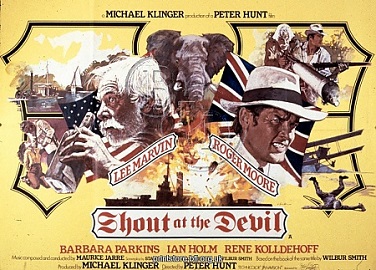
Shout at the Devil

Do you know the author Wilbur Smith? If you're an action fan, like your tough guys as tough as nails mercenaries, like Africa serving as a backdrop to action-packed stories, then he may be the author for you. One of my favorite action movies is based off a Smith novel, 1968's Dark of the Sun, and in the same vein is a mercenary story in Africa flick, 1976's Shout at the Devil.

It's 1913 in Africa and international tensions are mounting with war potentially on the horizon. In Tanganyika, a region in East Africa, an Irish-American poacher, Flynn Patrick O'Flynn (Lee Marvin) has a plan in place to poach several tons of ivory, netting a huge profit. The region is part of German-controlled territory, so Flynn would like to pose as Brits...but he needs a Brit, tricking a down-on-his-luck Englishman, Sebastian Oldsmith (Roger Moore), to accompany him, the profit providing quite the incentive. The expedition proves fruitful, but they also find themselves in some trouble with Herman Fleischer (Reinhard Kolldehoff), the German commissioner in the area tasked with keeping the region "German safe." Fleischer has been after O'Flynn for years, and he's right within his grasp now. Can O'Flynn and Sebastian get out in time? Can Fleischer finally catch up with his target?

My biggest issue over the years with this movie was....well, finding it. It has been heavily cut so depending on the version you're missing anywhere from 20 to 40 minutes. And finally on MGM-HD, I found the full version, clocking in at 150 minutes and looking good in a pristine print. Director Peter Hunt tackles a lot with this pre-World War I mercenary adventure story, 'Devil' covering about a year and a half or so in its leisurely running time. It was filmed on location in Malta and more shockingly, in South Africa, a no-no at the time considering that whole apartheid thing. To each their own I guess, right? Some on-location issues aside, there's much more to worry about here. When 'Devil' is good, it's decent. When it's not good, it can be painfully slow-going with some odd shifts in tone.

And that becomes the biggest detriment to the movie. I haven't read Smith's source novel, but Hunt's film simply tries to tackle too much. Did this movie really need to be 150 minutes long? Episodic is a fair description, but one episode aimlessly transitions to another. There's no real unifying link. Killing elephants, ambushed, running, a river chase, shipwrecked, brief interlude for love, robbing taxes from poor African villages, it goes on and on. The tone is ridiculously all over the place, an uncomfortable sequence of shooting elephants (I'm not sure if they really shot elephants but it sure looks like it) followed by a goofy knock-down fight later between Marvin and Moore. Composer Maurice Jarre's score is equally schizophrenic, hurting the effort too, goofy and dumb followed with bloody and dark and twisted. Pick one or the other and go with it, or at least find a better balance between the two. As is, the movie struggles to find that good, watchable and mindless middle ground.

What originally caught my eye was the casting, especially Lee Marvin and Roger Moore as the Odd Couple partners working together for some cash in 1913 Africa. Without any recognizable names in the rest of the cast, the success here depends on almost solely on the duo. Unfortunately, it never clicks here. Lee Marvin is one of my favorites in everything from The Dirty Dozen to The Professionals, but this isn't his best work. His O'Flynn is an archetypal character, a hard-drinking, hard-living mercenary of sorts, but it is such a broad character that it never resonated with me. It's not a particularly likable character, Marvin hamming it up too much. Moore is better, but the Sebastian character is dealt the Action Movie Killer....a love interest in the form of O'Flynn's daughter, Rosa (Barbara Parkins). The potential for the two main characters is really there, potential for the movie to take over, but like much of the rest of the movie, it falls short.

Some extended sequences do work, much of them coming in the second half as things take a darker turn for good. One quick action scene has O'Flynn, Sebastian and their men ambushing a German convoy on the delta's flatlands, brutal and quick. The finale too is pretty cool, an extended sequence that's about a half-hour long, Moore's Sebastian sneaking onto a German battleship and planting a bomb only to realize an hour later he's got to stop the explosion. An exciting, action-packed finale. It just takes too long getting there. Is it funny or really dark? Is it neither? A more pointed story would have gone a long way, but as is, 'Devil' is a big disappointment. Also look for Ian Holm in a fun part as Mohammad, O'Flynn's mute assistant, always ready with a soothing bottle of gin.

Shout at the Devil (1976): **/****

Monday, February 17, 2014

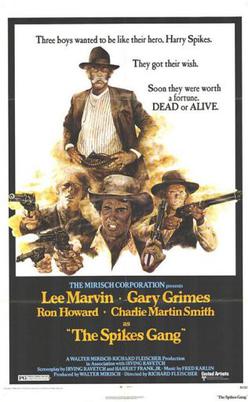
The Spikes Gang

Growing up is tough, and yes, here we are with another coming of age movie. No, it's not a teenager in the 1980s, a little boy growing up in Germany during the Holocaust, but a sub-genre from one of my favorite genres, growing up in the wild west. Movies from The Culpepper Cattle Co. to True Grit and others, it's an always interesting sub-genre. We can definitely add 1974's The Spikes Gang to the list.

Living with his parents on an isolated farm in Texas, teenager Wilson Young (Gary Grimes) has had about enough of his father's strict, one might say cruel, treatment. Walking around out in the isolated brush country with his two friends, Les (Ron Howard) and Tod (Charles Martin Smith), Will finds the body of a seemingly dead man. He isn't though, the three teenagers nursing the severely wounded man back to health. They find out the man is Harry Spikes (Lee Marvin), a notorious bank robber who thanks the boys for their help and rides out. Not soon after, Will, Les and Tod all leave home, vowing to live life and explore the world and all it has to offer. Life on the road isn't everything it's made out to be though, the trio ending up in a Mexican prison with no hope...until now. Spikes lucks upon them, bribing the guard to let them out. His solution? He likes the boys and teaches them how to become bank robbers, forming the oddest gang of bank robbers around.

I was worried as I watched the credits for this Richard Fleischer-directed western. The soundtrack was a soft, folksy-sounding guitar playing, and I'm thinking I stumbled into a lyrical, whimsical 1970s western where everyone's nice and cute and the world is just dreamy. Well, I'm glad I stuck with it. There certainly are moments like that, the three boys hitting the road and ready to experience the world. That sentiment is quickly thrown out the window, and the movie gets better immediately. With no money and starving, Will decides to rob a bank out of nowhere. They get away with some money but Tod accidentally shoots a passerby trying to stop them. From there, the story's previously happy, go-lucky story degenerates, getting darker with each passing scene. Is that a good thing? Um, yes, my name is Tim. Have you read any of my reviews?

This is a gem of a western, one that deserves a much bigger reputation. Fans of westerns typically love or hate 1970s westerns, movies that ripped away the idea that the wild west was glamorous, romantic or anything like most John Wayne westerns. As an interesting touch, 'Spikes' was filmed in Almeria and Andalucia in Spain, the familiar locations for countless spaghetti westerns. So we've got an unsentimental American western interested in exposing the myths of the old west in locations made famous by spaghetti westerns, a genre similarly interested in blowing open the American west. How can you lose? The 96-minute western covers a lot of ground but never feels rushed, an episodic story a positive here. We see some quick appearances from Arthur Hunnicutt as a past-his-prime gunslinger/saddle tramp, Noah Berry Jr. as an unlikely ally, and it all works in perfect fashion.

Beyond the story, the movie works because of the cast. It starts with Lee Marvin as infamous bank robber Harry Spikes. This is a part equal parts charming/disarming and frightening in its reality. He genuinely likes the three boys, looking after them, feeding them, buying them clothes and guns, teaching them how to become outlaws, but he's also brutally honest about it. If they get hurt, he'll leave them. This is a dangerous profession he's chosen and the boys have chosen. It can end at any time, and all it takes is one bullet. Marvin's performance is a gem, one that deserves to be considered one of his best. It's funny, charming, disturbing at times, and he steals every scene he is in. This isn't a part that requires him to be in every scene, drifting in and out at times as needed. When he's on-screen though, it's impossible to look away.

With a lead performance like Marvin as Harry Spikes, it'd be easy for his teenage counterparts to get lost in the shuffle. These are three talented young actors though, and any such worry is unfounded. The best part is for Gary Grimes as Will, the unofficial leader of the trio. He's sick of his father's constant nagging (and occasional beatings with a belt), opting to hit the road. The transformation he goes through is the most profound, the darkest of the three. He was a specialist in the youngster role in 70s westerns, also starring in Culpepper Cattle Co. and Cahill, U.S. Marshal, ultimately retiring from acting in the late 1970s. It's a very human part with some startling developments late. The same year Happy Days premiered, Howard is also very good as Will's closest friend, a logical thinker who's almost the group's conscious. Martin Smith too is excellent as Tod, the most religious and worrisome of the trio.

I wasn't sure exactly where this 1974 western was heading although there were some hints at the finale. The ending is perfectly executed, a major twist revealing itself in the last 15 minutes. It isn't glossy, polished or romantic. This is the west as it was. Dark, nasty, bloody and all about survival. In other words, it's realistic and far from a happy ending. I loved this western, can't recommend it enough.

The Spikes Gang (1974): *** 1/2 /****

Sunday, August 18, 2013

The Comancheros

Following Texas' war for independence with Mexico in 1836, the expansive republic was on its own for government, economy and protection without help from outsiders. Who came to the forefront to help protect the fledgling republic? The Texas Rangers, and no, not the Major League Baseball team, instead a small group of law officers who patrolled Texas trying to protect its citizens. Recurring characters in the western genre, one of the best portrayals of the Rangers is 1961's The Comancheros.

It's 1843 when a Louisiana gambler, Paul Regret (Stuart Whitman), finds himself on the run following an accidental death in a duel. Regret heads for Texas but as he readies to disembark from the riverboat, he is instead arrested for murder by a Texas Ranger, Captain Jake Cutter (John Wayne). The duel was fair by all accounts, but the dead man was the son of a powerful judge who wants vengeance. Intending to bring Regret back to Louisiana, Cutter instead finds himself working with the man. All through the territory, Comanche raiding parties are attacking one ranch and homestead after another. Cutter has long thought the Comanches are being led by a gang of white men who pull the strings, but he has no proof. Posing as a gunrunner and with Regret as his somewhat unwilling partner, Cutter heads into Comanche territory and finds just what he thought he would, a gang of drifters, bandits and killers -- Comancheros -- working with the Comanches. Can they get out alive?

The 1960s were a big time for John Wayne. He wasn't just a box office star, but by now after 30-plus years in the business, he was a screen legend. This was the decade where -- for better or worse -- he started playing himself more than meaty roles like The Searchers, She Wore a Yellow Ribbon, and The Man Who Shot Liberty Valance. His mindset changed some as he started to make movies that typically had one objective....please the audience. These were movies meant to entertain, movies the whole family could go see. They would revolve around action-packed stories, good casts of familiar faces, great locations and whistle-worthy scores, movies like this one, The Undefeated, Sons of Katie Elder, McLintock!, Donovan's Reef and Hatari. This is a prime example of that type of movie. It's fun, exciting and with a whole lot of action. A groundbreaking, innovative western? Nope, but as far as popcorn movies go, it's hard to beat.

This obviously isn't a comedy western, but it isn't as dark and downbeat as the plot description might imply. For me, the best thing going for 'Comancheros' has always been the pairing of Wayne and Whitman, an Odd Couple pairing that works extremely well. It almost plays like a buddy western movie, the resolute Ranger and the roguish gambler. Wayne especially gets to show off a comedic side that most of his movies just didn't allow. His backwoods Ranger mispronounces Monsieur as Mon-sewer, providing some good laughs throughout. Whitman too looks right at home alongside the Duke, the duo exchanging some great dialogue scenes together on the trail. It looks easy watching them. Regret is far from a veteran trailsman, but he picks it up quick. Cutter bristles at times with his prisoner's unique ways, but thrust into a do-or-die situation, they end up becoming unlikely friends. Two good lead performances for sure.

While the A-list names might not be there, 'Comancheros' offers a very solid cast, one all western fans should appreciate. Lee Marvin makes what amounts to a cameo as Tully Crow, a brutal, vicious Comanchero, stealing the show and providing some great moments with Wayne in their scenes together. The one weak point is Ina Balin as Pilar, a beautiful young woman who falls for Regret and vice versa. Her scenes are pretty painful, especially as she "analyzes" love. Nehemiah Persoff is similarly a scene-stealer as Graile, the handicapped, brutal leader of the Comancheros with Michael Ansara as his sadistic henchman, Amelung, and also look for Jack Elam as one of the Comancheros. As for the other Rangers, look for Bruce Cabot as Major Henry and Patrick Wayne as Tobe, a young ranger along on the mission into Comanchero territory. Also look for the beautiful Joan O'Brien as Melinda, a widow who cares deeply for Cutter (and maybe more...uh-oh!) with Wayne's daughter Aissa playing Melinda's daughter.  

Looking at the credits, Michael Curtiz is listed as the director, but Curtiz became sick during filming and was unable to complete the movie, dying soon after its release. Wayne stepped in and directed in uncredited fashion, finishing the movie. The story itself is pretty episodic, the first 45 minutes spent with the hunt and escape and hunt and escape between Regret and Cutter. It covers a lot of ground before the Comancheros are even introduced, but it's never dull and never really slows down. There actually isn't a ton of action, but what's there is enjoyable. What is noteworthy is a talented cast clearly having some fun with a story that's hard not to go along with. Also worth mentioning, Elmer Bernstein's memorable score, especially the theme. Listen to it HERE. Get your popcorn ready, sit back and enjoy this one.

The Comancheros (1961): ***/****

Tuesday, April 16, 2013

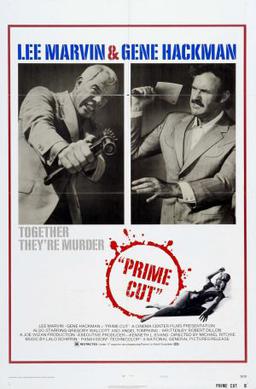
Prime Cut

Some movies are just a variety of odd, weird and offbeat. That can be a good thing as long as a movie commits to being quirky. I don't really know what to make of 1972's Prime Cut having just finished it. It is all of those things, but the best part? It embraces the quirkiness and goes with it. Better because it's weird.

Working as an enforcer for the Irish mob in Chicago, Nick Devlin (Lee Marvin) has pretty much seen it all. This time around, he's got a job that even he couldn't quite plan for. With some help from three young Irish enforcers, Nick must head to Kansas City to deal with Mary Ann (Gene Hackman), a mobster himself running a crooked slaughterhouse with some secrets. Several other enforcers have been sent with lousy results. The last one? Mary Ann had him ground up and sent back to Chicago as sausage (quite literally, he's sausage links). Nick isn't one to shy away from a job -- any job -- so he travels to Kansas City and get the $500,000 that Mary Ann owes the Irish mob. The experienced enforcer doesn't quite know everything though, finding upon arrival that even Mary Ann has some tricks up his sleeve.

This is truly a flick that defies just about any description I can come up with. From director Michael Ritchie, I figured it would be a pretty straightforward, enjoyable gangster flick starring the always reliable, always tough Lee Marvin. It's an apt description to a point, but it's also so much more, and for the good. Because it covers so much ground and does it effectively, calling it a crime thriller with pulpy undertones on top of an out of left field love story with an almost existential feel to the fast-paced story that an art house film might be proud of is....very fair. It's all of that, and it does it well. Impressive considering the flick only runs 88 minutes and never really slows down. I was expecting one movie and got another instead, for the better.

Let's start with probably the most normal thing about 'Cut,' and that's Lee Marvin (a favorite here at Just Hit Play). The description of his part sounded a little bit like Point Blank, and at it's most basic, it is. He does the tough guy anti-hero part like nobody's business. A former Marine, he handles the action scenes expertly and capably, but he's not a one-trick pony. Marvin can deliver a snappy one-liner with the best. His Nick Devlin has quite the past (hinted at more than shown), but it's a great lead character. How about Gene Hackman as a villain? Sounds good, right? How about an over the top villain named Mary Ann who oozes sleaze and slime and runs a corrupt slaughterhouse where you can buy top choice meat.....and drugged up young women sold as slaves? Yep, that's a good villain if there ever was. Hackman's part isn't gigantic, but every time he is on-screen, you can't help but love to hate him.

So where to start in general? There's a lot of worthy jumping off points, but the obvious is the opening credits, a montage of the inner workings of Mary Ann's slaughterhouse. Uh-oh, is that a shoe...and then a man being ground up? Watch it HERE. It's an unsettling, realistic opening that certainly sets the tone. Not subtle by any means, things get switched up then in the next scene as Nick, three enforcers and a driver drive to KC in a montage scene reminiscent of a French art house crime thriller. It's quite the change of pace from one scene to the next. Things get ratcheted up then when we meet Mary Ann, Nick walking through his display barn only to see naked young women (heavily drugged) lying in cattle pens for buyers to purchase. The meeting between Nick and Mary Ann (again, why the woman's name?) is perfect, two sides testing the other for all they're worth. Some of these transitions could be kind of jarring if handled incorrectly, but Ritchie manages to make this mess of a story work, and work well.

It's the balance that works. I wouldn't have expected an endearing love story to develop between Marvin's Nick and a young woman he rescues from Mary Ann's sale, Poppy, played in her screen debut by Sissy Spacek. She comes from a sheltered past where she was raised to be sold as a slave, but she's managed to rise above it -- focusing on the simple positives of life -- and finds an ally in Nick, her rescuer. Having rescued her, Nick buys a handful of different dresses and takes her out for an expensive dinner. While everyone else stares at her revealing dress, Nick -- ever the gentleman -- stares them down, teaching her which silverware to use and when. It's almost surreal in its oddness. I make no bones about my dislike of force-feeding a love story into a movie that doesn't need it, but when handled correctly (like here), it's hard to make any complaints.

Then there's the more pulpy crime stuff I expected going in. That's not a negative by any means. It is a tough guy film and that means a whole lot of crazy 1970s action. Probably the most memorable scene is a confrontation at a crowded country fair, Nick running with Poppy from Mary Ann's small army of overall-wearing, shotgun-wielding country boys. The capper is a gem, the duo running in an immense open wheatfield from a thresher. Watch it HERE. The big blowout is saved for last, Nick -- using a submachine gun -- and his remaining enforcers approaching Mary Ann's farm fortress through a field of sunflowers. It's a tense, well-choreographed sequence that sets up the actual finale quite well.

As for the rest of the cast, Gregory Walcott is quite memorable as Weenie, Mary Ann's thuggish, perverted brothers, and Angel Tompkins as Clarabelle, Mary Ann's wife who has a past with Nick. William Morey (in his only role) plays Shay, Nick's driver who's worked many times in the past with him, with Clint Ellison, Howard Platt and Les Lannom as the young enforcers. This is one epically weird movie overall, but I loved just about everything it offers. It most definitely is weird so know what you're getting into, but I highly recommend this one.

Prime Cut (1972): *** 1/2 /****

Monday, May 28, 2012

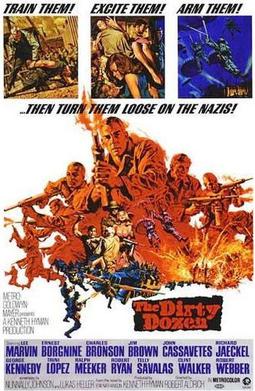
The Dirty Dozen

One of the all-time great tough guy casts -- if not the greatest -- in one of my favorite genres. A movie that stands the test of time that is action-packed, darkly funny and amazingly entertaining. It has taken abuse over the years by some because of its shocking ending, but it also has built up a diehard following by those who will defend it to the last (including me). One of my favorite movies ever, and a Memorial Day themed review, 1967's The Dirty Dozen.

An American army officer with a record a mile long, Major John Reisman (Lee Marvin) has been given a mission that even he doesn't believe is real. It's late spring 1944, and as the Allies prepare for the D-Day invasion, the Allied high command (including Ernest Borgnine) delivers his impossible, suicidal mission. Reisman is to take 12 prisoners either sentenced to death or years of imprisonment and hard labor, train them, and then in the days before the D-Day landing, drop them into German-occupied France. Their mission? Attack a German chateau, killing as many high ranking German officers as possible, hopefully wreaking havoc on the high command. Can Reisman get the prisoners to work together before they kill him?

This is a movie that is a perfect storm of timing, casting and story. A story of 12 convicted criminals -- rape, murder, robbery -- turned commandos who resent any sort of authority given a mission to kill enemy officers in cold blood? Could that story even remotely fly in any time other than late 1960s America? It was a time when America was changing, a darker, more cynical time in our history. Director Robert Aldrich taps into something special there. 'Dozen' has a unique look to it, interesting camera angles, a catchy theme for the Dozen -- listen HERE -- and a general feel of giving the middle finger to any sort of power or authority figure. Could there be a more perfect movie for a 1967 audience?

I could write a whole review discussing the characters and the long list of tough guy actors who play them, but I doubt many people would read 10,000 rambling words about how the cast of The Dirty Dozen is the coolest thing ever. Let's start with Lee Marvin, an all-around bad-ass who by the mid 1960s had become a major, bankable star. His Major Reisman, a sarcastic, quick-witted, smart-mouthed and brutally effective officer, is probably his most well known role, and he owns this movie. With the cast behind and around him, that's saying something. Marvin delivers brutally funny one-liners left and right, handles the action scenes flawlessly, and is believable as the cynical leader of this group of crook commandos. With those type of men behind him, you need someone like him to lead. Richard Jaeckel is a scene-stealer as Sgt. Bowren, the MP assigned to work with Reisman in training and execution of the mission. Along with Borgnine, the High Command and other Allied officers include Robert Webber, George Kennedy and Ralph Meeker. Oh, and Robert Ryan as a stiff-collared officer from the 101st. Enough for you? No?

And then there's the Dirty Dozen. The group includes Charles Bronson as Wladislaw, the former officer sentenced to hang for killing one of his own men, a medic carrying medical supplies away from battle. There's former NFL star Jim Brown as Jefferson, an African American soldier who killed in self defense but is sentenced to hang nonetheless. John Cassavetes was nominated for a Best Supporting Actor Oscar as Franko, a Chicago hood who killed a London man for $10 worth of cash. Telly Savalas is Maggot, a psychopathic Southerner convinced God works through him. Clint Walker is Posey, an Apache with rage issues, Donald Sutherland is Pinkley, a dimwitted soldier, and singer Trini Lopez plays Jiminez. Rounding out the Dozen are character actors Tom Busby, Ben Carruthers, Stuart Cooper, Colin Maitland, and Al Mancini as Bravos, the smallest of the bunch but with a mean/funny streak. The focus is Bronson, Brown, Cassavetes, Walker, Savalas and Sutherland, none of them disappointing, all of them living up to the hype, all given a chance to shine.  

What has helped 'Dozen' gain its cult-like following over the years is its humor in looking at and poking some fun at war in general. Sutherland's dimwitted Pinkley is forced to inspect a crack platoon of Ryan's Col. Breed in one of the most memorable, truly funny scenes. Watch it HERE. Reisman later arranges for eight London prostitutes to visit the Dozen as their training winds down. The facial expressions exchanged back and forth are priceless. The high point comically -- however dark it is -- comes in the War Games sequence, the Dozen forced to prove their worth by capturing Col. Breed's headquarters. They resort to cheating, con jobs, stealing, and all sorts of trickery. After the extended training sequence -- which has its fair share of funny moments -- the War Games development and the eventual payoff provides some great laughs.

The portion of the movie though that tends to drive people away is the attack on the chateau. SPOILERS AHEAD SPOILERS STOP READING Here's the plan, courtesy of Reisman, which you can watch HERE. It of course, doesn't go as planned, Reisman, Bowren and the Dozen forced to improvise. Their solution is simple; throw grenades and gasoline down air chutes and burn (think napalm) the German officers to death. Heroic? No, I would say not. It's a movie though. These guys aren't portrayed as heroes. These are prototypical 1960s anti-heroes! What does work? The entire finale sequence (around 45 minutes long) is dripping with tension, and once the adrenaline starts pumping, it doesn't stop. The Dozen start to get picked off -- including two legitimate shockers -- as the bullets start flying. I've seen this movie 50 times and still root for two characters especially to make it, knowing all the while they won't. The means are brutal, but as far as an entertaining action sequence goes, it is one of the best.

I'm not sure what this says about me, but I grew up watching this movie a lot. Introduced to it via Memorial Day war movie marathons, it will be always be one of my favorites. I love its cynical, dark look at war. I love the ridiculously strong cast from top to bottom. It is funny, entertaining, action-packed, and a true example of 'They don't make them like that anymore.' A classic.

The Dirty Dozen <---trailer (1967): ****/****

Sunday, March 18, 2012

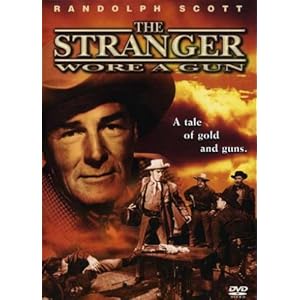
The Stranger Wore a Gun

While many movies in the 1950s tried to offer something that television simply couldn't match, many westerns dug their heels in and refused to change/adjust. The result? A lot of straightforward, traditional efforts that were like most westerns released over the previous 20-plus years. If you haven't figured it out, none of this is particularly positive, like 1953's The Stranger Wore a Gun, a B-western in every regard.

After the bloody raid on Lawrence, Kansas by William Quantrill, Confederate rider Jeff Travis (Randolph Scott) leaves Quantrill's raiders and heads west. But even after the end of the Civil War, the memory persists in his head, and more importantly, so does the stigma of being one of Quantrill's guerrilla riders. Wanted for a murder he didn't commit, Travis heads to Prescott, Arizona on the advice of long-time friend, Josie (Claire Trevor). He finds a job with a former Confederate soldier who wants the Confederacy to live on, Jules Mourret (George Macready), but finds out quickly that Jules is willing to go to some dark places to accomplish his goal. For Travis though, it could be too late to make a change.

With so many 1950s westerns, I feel like my reviews lean toward cookie-cutter. They're the same thing over and over again, just changing the names and places. Like so many 1950s westerns, 'Stranger' has its good and bad, but the biggest thing is that nothing at all is particularly memorable. Director Andre De Toth goes about his job with workmanlike precision, telling a familiar story that doesn't throw anything new at the viewer. The stories are forgettable, the characters interchangeable, and if you've got more than two or three functioning brain cells, you know how it's going to end before it started. Some of the California locations look very nice here, but it does absolutely nothing to distinguish it from the thousands of other westerns you could watch. Not bad, not good, and not memorable in the least.

Starring in many of these westerns was Randolph Scott, a stout, resolute western hero in that second rung of western stars. His biggest problem? Unless he was working with directors like Budd Boetticher and Sam Peckinpah, his typically solid lead parts were lost in a sea of bad B-movies. Playing Jeff Travis, he's one of the better things going for 'Stranger.' His motivations aren't always explained -- he's running from his Confederate past by working for a Confederate trying to revive the Confederacy?....right -- but in a sea of mediocrity, his performance stands out. Trevor does what she does best, playing the damaged society woman, Macready is an average at best villain, and Joan Weldon plays a wooden requisite pretty girl (another trademark of a low budget 1950s western) that Scott's Travis must decide if he really loves, with Pierre Watkin playing her father.

Enough beating around the bush, let's get to some negatives! Anyone who's seen Treasure of the Sierra Madre is familiar with the infamous 'We don't need no stinking badges!' line delivered by bandit chief Rodolfo Bedoya. Instead of one well-handled scene, he gets a much bigger role here with a similar character, the stereotypes amped up....a lot. His "portrayal" of Degas, a Mexican bandit and gang leader, is laughable and painful to watch. He laughs hysterically for no apparent reason at least three different times, and speaks in an odd variation of Spanglish. His sidekick, Shorty (Joseph Vitale), is just as bad, speaking in halted, quasi-threatening tones. Way, way too much of a good thing here. Also worth mentioning -- I suppose -- is the 3-D filming technique. We get guns "fired at" the camera, not to mention torches, punches, vases, you name it, thrown at us. Oooohhhh, startling! There's also a bizarre technique where rocks/brush are placed in front of stock footage, apparently to make it look more realistic? I guess. I can't come up with anything else. It's bad. That's what I'm going for.

One positive -- however small -- with many of these 1950s westerns is that future stars who shot to fame in the 1960s got their start with supporting roles. Here in 'Stranger' there's Lee Marvin and Ernest Borgnine as Kurth and Slager, two of Jules' henchmen. Hindsight is 20-20, but it's clear the talent they're working with even in supporting roles. Not a ton to recommend overall, and maybe I'm reaching for straws, but something's got to get you through these B-movies.

The Stranger Wore a Gun <---TCM trailer (1958): **/****

Saturday, July 9, 2011

Pocket Money

My high school and college Spanish only takes me so far when it comes to actually understanding the language. That can be a problem when trying to understand and keep up with a Spanish movie, or at least an American-made movie dubbed into Spanish.  That's where I was first introduced to 1972's Pocket Money, a late night showing of this modern western. When I saw stars Paul Newman and Lee Marvin, I sat down and trudged through it, trying to keep up with the language the best I could.

Long story short? My Spanish isn't that good if I have to rush to keep up. I had no real concept of what was going on but went along for the ride. The problem arose that this was not a movie available in any formats, and TCM wasn't showing it as part of their rotation.  Well, finally it was released on DVD as part of a Newman film collection, and how many years later I was able to catch up with it. I knew going in that it wasn't either actor's best work, but as a fan of both, I wanted to give it a try...in English this time around.

A down on his luck Arizona cowboy, Jim Kane (Newman) has been dealt some bad news when he finds out the horses he's brought to market have to be quarantined with the horse equivalent of an STD. He needed the money he would get for the sale to pay off a bank loan, but now he's up the creek. Looking for work -- any sort of work -- Kane makes a deal with a somewhat shady businessman, Bill Garrett (Strother Martin), to herd cattle up from Mexico into the U.S. for an upcoming rodeo. Something about the deal doesn't strike Kane quite right, but desperate for the cash he takes the job. With help from an old friend and "cattle broker," Leonard (Marvin), he heads south to round up the animals, but nothing is going to go as planned for this perpetually down on his luck cowboy.

The ingredients for a really solid modern western were all here.  Marvin and Newman working together for the only time was the only selling point I needed to hear.  The plot reminded me some of Cormac McCarthy's All the Pretty Horses, and when I saw Terrence Malick had written the script I was psyched.  Throw in supporting parts for Martin, Wayne Rogers, Matt Clark, Hector Elizondo, Gregory Sierra, and Fred Graham too. Something doesn't make the transition though because the end result is a story that meanders along too much with an already short 99 minute run-time and never really gets anywhere, finishing where it started. It isn't a bad movie, just one that fails to make much of an impression.  I watched it last night and early this morning, and I'm already struggling to remember much about it. That's never a good thing.

If you're going to watch this movie though, I'm guessing it will be because of Newman and Marvin in the two lead roles.  What makes it worthwhile seeing these two legends work together is that they both play against type.  Newman's Jim is a nice enough guy, a hard worker, and a decent cowboy, but he just isn't the sharpest crayon in the box.  Stupid is too harsh, and dim-witted sounds too comical, but there's a naivete to the character that you rarely see in a Paul Newman movie. The same for Lee Marvin as Leonard, a businessman and cowboy who always wears a suit and tie while working. He's not as intense or intimidating as so many other roles, but Marvin easily slides into the part.

The chemistry between the two is not in question here.  With a story bouncing around between some dramatic scenes and some comedic exchanges, the duo makes it look effortless.  It's more impressive when you consider the script just doesn't give them much to do.  Maybe it was just early in his career as he was finding his voice, but Malick's script is not a strong one. It relies far too heavily on the star power without developing any sense of pacing or character development. As a topper, it's never quite clear what's going on.  There are moments of great quality, especially Marvin's speech to their Mexican cowhands and Newman's confrontation with Martin over their deal, but the long stretches of nothingness handicap the movie too much overall.

I can't put my finger on what went wrong with this movie.  Is it drama or comedy? Is it neither? Maybe I'm judging it too harshly, but I came away empty from it as if the movie had left no impression on me at all.  I don't know what else to say. The Mexican locations are authentic -- appropriately enough -- and Carole King's song (listen HERE) is pretty standard fare for a folk song theme played over the opening and closing credits. I wish the movie was better, but it never amounts to anything.

Pocket Money <---Youtube clip (1972): **/****

Tuesday, June 7, 2011

I Died a Thousand Times

As summer nears and all the big blockbusters hit theaters in the coming weeks and months, it is time to look ahead and see how many remakes and sequels are heading our way.  Long story short...there's a lot of them, some more necessary than others. As I've mentioned before, it's a huge pet peeve for me.  Why come up with something original or interesting or unique when you can just re-do something that was previously successful?  Remakes have always been made, but it seems like a more recent trend, or maybe there's just more out now.  Well, I can eat my words with 1955's I Died a Thousand Times.

Reading the movie's description at TCM's website, my first thought was 'That sounds familiar.' A simple Google search later, and it was easily figured out why.  It is a straight remake of 1941's High Sierra, a film noir classic from director Raoul Walsh and starring Humphrey Bogart and Ida Lupino. Both movies were released by Warner Bros. Pictures although 'Thousand Times' does take advantage of the recent widescreen-processing in production (it looks great, more on that later). It just seems an odd choice for a remake.  The 1941 version is a classic film noir, one held in high regard by reviewers and fans alike. So why remake it? Big pile of cash I'd assume.

Paroled early after serving part of a armed robbery sentence, well-known and feared gangster Roy Earle (Jack Palance) heads west, a new job already waiting for him. An old friend and partner, Big Mac (Lon Chaney Jr.), has set up a heist at a lavish resort where the end result could be almost a half million bucks.  He meets his inexperienced cohorts, Babe (Earl Holliman) and Red (Lee Marvin), as they wait for the signal from their inside man (Perry Lopez) to pull the job. Roy kills time with a poor family from Ohio, including their clubfooted daughter, Velma (Lori Nelson), and also with a dance hall girl, Marie (Shelley Winters) who tags along with Red. Going stir crazy just sitting and waiting around, the call finally comes to pull off the job, but even with an experienced crook like Roy along, nothing goes as planned.

Without a specific way of explaining it or putting it into words, there is a look to 1950s films that just appeals to me.  Movies were still in the early stages of taking advantage of that new widescreen process, especially here with CinemaScope. Even watching the film on TV, it looks gigantic, and I can only imagine what it looked like on a big screen in theaters. Director Stuart Heisler filmed his movie with cinematographer Ted D. McCord in Pine Hills, California, and it looks gorgeous. The Sierra mountains never looked better, and even some studio inserts for outdoor shots can't ruin it. The picture is BIG and the California desert and the tiny resort towns and stops along the highway provide a great, stark setting for this heist remake.

If there is anyone you don't want to follow in their footsteps as an actor, Humphrey Bogart has to be at the top of the list. His High Sierra performance is one of his best; a likable, sympathetic bad guy.  Stepping into the role, Jack Palance is a more than solid option to take over the Roy Earle character. Palance was an always intense actor who just by giving a look can intimidate.  Adding that sympathetic edge to his character, Palance's Roy is that tragic, doomed bad guy (whether you've seen the original or not, it's obvious from the start). This is supposed to be his last job, and through Winters' Marie and Nelson's Velma, he is looking for some sense of normalcy. Neither woman is the right choice for him, but he doesn't know that.  Roy wants to settle down, and even though he has a mean streak a mile wide, I genuinely liked this character. An underrated Palance performance.

As for the supporting cast, it is a case of the names being more impressive than the actual performances. That's not necessarily the fault of the cast, just a script that doesn't give the actors and actresses a lot to do. Instead, there's too many characters. Holliman and Marvin are generally wasted as Babe and Red, Roy's partners in the heist.  Winters is at her clingy, annoying best as Marie, a young woman who has to be around a man. She seems to play this part a lot. Pedro Gonzalez Gonzalez plays Chico, a helpful hotel attendant similar to the character he played in 1959's Rio Bravo four years later. Chaney Jr. isn't around much as Big Mac, but his quick scene with Palance is memorable.  Nelson is the surprisingly dark character, Velma, with Olive Carey and Ralph Moody playing her parents. Even look for very young Nick Adams and Dennis Hopper in small parts.  Dub Taylor has a quick appearance too as a gas station attendant.

Watching a remake when you're familiar with the original is tricky because you're basically watching the same movie. The 1955 version of High Sierra is virtually identical with nothing new or different really thrown in. The story lags some after the heist goes down, almost like some time needed to be killed before the finale.  The ending is the same and works just as well, mostly because it is an appropriate ending.  So watching the same movie, there has to be something to recommend for anyone who's seen High Sierra.  The cast -- especially Jack Palance in the lead -- makes this one worth watching. Check out High Sierra too, and compare.

I Died a Thousand Times <---TCM trailer (1955): ***/****

Thursday, April 21, 2011

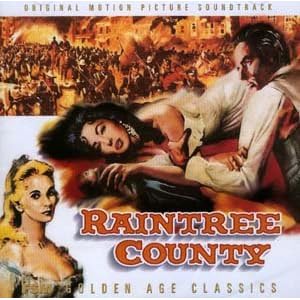
Raintree County

The conversation about the best Civil War epic will typically always begin and end with one movie, 1939's Gone With the Wind, a classic film and one of the best movies ever made in Hollywood history.  In general though, Hollywood hasn't gone to the Civil War well too often, and I've never been able to figure out why.  Movies like Gettysburg and Gods and Generals were made because Ted Turner has lots of money and is a Civil War buff. Glory is a classic true story that I think is the best depiction of the war around. Well, there's another epic, 1957's Raintree County.

The main problem with this MGM epic is that it tries to be Gone With the Wind 2 too much instead of blazing its own trail.  I was surprised though to read the hate this movie gets whether it be the cast being miscast, the story being too simple, or just overall, it's a boring movie. I think two of those three are legitimate issues to have with the movie, but there's something appealing about Raintree County that will take more than that to ruin the movie. The 1950s and early 1960s were the time of the epic in Hollywood, 3-hour movies where no expense was spared. Gigantic budgets, big-time directors, all-star casts, they just don't make them like this anymore.  It's a time capsule of a different era in Hollywood, and an interesting one at that.

It's 1859 in Freehaven, Indiana in Raintree County and young John Shawnessy (Montgomery Clift) is about to graduate from the local college. He's ready for the future with his longtime sweetheart, Nell (Eva Marie Saint), when he meets Susanna (Elizabeth Taylor), a Southern belle visiting Freehaven from Louisiana. John falls for her immediately as does she for him. It doesn't take long before Susanna tells him that she's pregnant with his child so they marry and move to the South. With a conflict brewing about states' rights and the ability to own slaves though, John insists they move back to Raintree County. As the Civil War breaks out though with the attack on Fort Sumter, he finds out that his young wife has a secret that could tear them apart. His life thrown on its side, John must now make a huge decision, all the while the North fighting the South around them.

The biggest surprise I found reading reviews here was about the casting and acting of Clift and Taylor.  Montgomery Clift was involved in a horrific car accident during filming that caused production to shut down for two months while waiting for him to heal so there is already a stigma attached to the part and the movie as unlucky, and in some circles, just plain bad.  I don't know if Clift was the right choice for the lead role, but it's the rare movie he's not very watchable in that lead role. It's not his best performance, but it's still good.  More surprising is that Elizabeth Taylor earned a nomination for her performance.  No disrespect to the recently passed Miss Taylor, but this was just too hammy of a performance. She's Scarlet O'Hara on steroids, chewing the scenery left and right, a fragile woman screaming and crying at every turn because of her past. She treads that fine line between highly dramatic and soap opera, but too often it leans toward the soap opera acting, loud, confrontational and overbearing.

Say what you will about the two leads, but one thing that's untouchable is the rest of the cast.  That's always one of the best things to come out of these Hollywood epics, casts that feature a who's who list of stars playing supporting roles.  For this particular epic we've got Marie Saint as the innocent, incredibly sweet Nell, Nigel Patrick as Professor Stiles, a fast-talking, intelligent, philanderer of a man, Lee Marvin as Orville 'Flash' Perkins, John's drinking buddy and a brawler of a man, Rod Taylor as Garwood Jones, a Northern politician who leans toward Southern rights, Agnes Morehead and Walter Abel as John's parents, and DeForest Kelley as a Confederate officer John comes across in Georgia. Of all the performances, Patrick and Marvin especially shine.  Patrick's Professor is that good sort of scenery chewing, verbose and expressive, a man who loves life and everything about it. Marvin's Flash is a similar character if from a little lower class.  He loves to fight and compete, loves women, and loves to drink.

Director Edward Dmytryk was given a $5,000,000 budget to make this movie, a huge sum at the times. While the film struggled with audiences, it wasn't for lack of effort.  It was nominated for best costumes and best art direction and deservedly so.  Raintree County is a stunningly beautiful movie with beautiful locations (Kentucky and Mississippi mostly), huge sets filled with hundreds of extras, and a screen so full of action, details, and vivid colors that you can overlook the somewhat stilted dialogue or slow-moving story (it clocks in at just under 3 hours). This is an EPIC, a type of movie they just don't make anymore. The story -- based off a novel -- tries to tackle a lot of topics because honestly, the Civil War had a lot of topics worth covering.  It's too much at different points and not enough, focusing on the same thing over and over instead of focusing on the more interesting aspects, Abolitionism, slavery, the actual fighting. Like any movie, it is good and bad. You just hope the good outweighs the bad, and for me it did.

One reason I've assumed the Civil War has never been made into many feature films is the expense of creating huge battle scenes. The actual combat of the war is the second half of the movie after a brief intermission.  The sequences are large-scale but don't linger, and were even re-used five years later in How the West Was Won.  Clift's John ends up with General Sherman's army in Georgia, and for me this was the movie at its best. Battle sequences are handled with an effective, well-done montage, and Dmytryk paints a picture of what 1864-5 Georgia must have been like, war-torn, terrifying, and a host for all sorts of evil.  Working off a novel and trying to stay true to the source, I understand you have to go with what is in front of you.  Dmytryk's epic is solid and I enjoyed it from beginning to end. It could have been better, but it's the rare movie that couldn't be better. There are only so many Hollywood epics like this so enjoy them for what they are.

Raintree County <---trailer (1957): ***/****   

Tuesday, October 19, 2010

The Big Red One: The Reconstruction

Director Sam Fuller made a career of making tough, hard-edged movies that didn't venture far from film noir, war movies, and the occasional western.  But before he ever got into movies, Fuller was an American infantry soldier in WWII.  Late in his career, he wrote and directed a movie that told the story of his time in the army in the 1st Infantry Division, a movie with the unit's nickname as its title, 1980's The Big Red One. For years, the movie was only available in a heavily edited version that cut almost 50 minutes from Fuller's intended final cut.  Now it is available as Fuller intended in a restored version that runs 163 minutes.

Where some movies ring false in their portrayal of soldiers in war, Fuller does his best to avoid that problem.  It is a semi-biographical account of his experiences in the war as his squad survives the European theater of war.  Some scenes ring true with an authenticity that only a real soldier could no, but surprisingly enough that authenticity isn't sustained through the whole movie.  In trying to be too cute or too philosophical, Fuller's storytelling and narration become too cliched in an almost embarrassing way.  So like any movie, there's the good and the bad, but I'm still wavering on how much I actually liked this movie.

It's 1942 and the American army is preparing to hit the beaches at North Africa.  In the 1st Infantry Division, 16th Regiment, a soldier known only as the Sergeant (Lee Marvin) prepares to lead his squad into battle. The fight is a success, and the Allies continue their attacks throughout Africa and Europe as the war progresses.  Four men, Zab (Robert Carradine), Griff (Mark Hamill), Johnson (Kelly Ward), and Vinci (Bobby Di Cicco), from the Sergeant's squad seem immune to getting hit or wounded, earning them the nickname 'Sergeant's Four Horsemen.' They fight across Africa and into Sicily, Italy, France and Germany, fighting in most of the ETO's major battles, including D-Day, Battle of the Bulge and many others.  As the war looks to be drawing to a close, can these four survivors and their sergeant make it all the way through?

Telling a story that covers three-plus years and a never-ending sense of moving around, Fuller doesn't so much as tell a story as show a series of vignettes that show the everyday life of these soldiers; long periods of boredom and marching/camping broken up by quick, startling instances of horrific violence.  Nothing wrong with that, but it can get a little tedious at times.  The soldiers talk like soldiers do (obviously filtered/censored some), but at times it gets to be too much.  Carradine's Zab provides the narration, and as good as it can be at times, it tries too hard to say something profound about war.  The action is handled on a smaller scale and is effective enough, but like the dialogue and storytelling, it starts repeating itself and with 162 minutes, that leaves a lot of room for repeating.

Sometimes lost in that shuffle is the four privates that become known as the Sergeant's Four Horsemen.  The only one to really distinguish himself from the rest is Hamill as Pvt. Griff, a sharpshooter who begins to freeze in combat.  Fresh off the success of the first two Star Wars movies, Hamill makes his character interesting because as a viewer you can appreciate what he's going through.  I'd be scared stiff to if I was getting shot at by complete strangers in a situation that makes little sense to the individual.  The other three aren't quite as good.  Carradine's narration is the best part about Zab who otherwise spends his time chomping on cigars.  He tries to sound tough, but it's never believable.  Ward and Di Cicco are cardboard cutouts of characters and never give us any reason to root for them.  Some sort of background other than 'Johnson had hemorrhoids and Vinci was from Brooklyn' would have been nice too.

Making The Dirty Dozen, Marvin swooped in and took over a role intended for John Wayne.  Same goes here as he steps into the shoes of the Sergeant after a version starring Wayne was brought up in the 1950s.  A Marine in WWII who fought in the Pacific, Marvin is the best thing the movie has going for it.  A little old maybe to play his character at 56, he still pulls the part off.  He's tough, a strong leader and is going to do his best to get his men through the war unscathed.  The choice to dub him solely 'the Sergeant' could have been a little pretentious on Fuller's part, but it works.  During WWII, there were thousands of soldiers like Marvin's tough Sergeant, and in a lot of ways, Marvin is representing every single one of them. A little too old, sure, but Marvin was born to play a role like this.

Watching the movie with almost 50 minutes reinserted into the final cut certainly makes a difference, but at times it felt like a wasted opportunity.  It's longer, but instead of seeing new, interesting things that develop the characters, we get tedious battle scenes that are still somehow too short.  Certain moments ring true beautifully like Marvin's Sgt. carrying a young boy who survived a concentration camp, Johnson delivering a baby in a sweaty, cramped tank, the discovery of the concentration camp, and an honesty that seems to be missing from so many war movies.  A good finished product, but it never lives up to its potential.

The Big Red One <---trailer (1980): ** 1/2 /****

Sunday, April 25, 2010

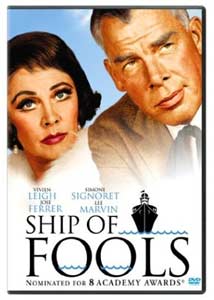
Ship of Fools

In 1933, the Nazi Party took over in Germany, a power that would run through the end of WWII in 1945.  At the time, no one really could known what was coming with Adolf Hitler and the Nazis in charge of Germany, but it was a turning point in history for how it changed the world and the millions of lives it impacted.  Even at first, did the German people know what they were voting for when the Nazi Party took office?  We'll never know, but 1965's Ship of Fools explores the idea of what is to come.

Director Stanley Kramer made a name for himself with movies just like this, big pictures with big casts and some big ideas.  'Fools' has the feel of a 1970s disaster movie except without the disaster.  Throw a group of people into a confined setting and let the fireworks begin.  Here though, there's no fireworks.  It is a movie that at 149-minutes is one of the most dialogue-heavy movies I've ever seen, some good and some bad.  With a huge cast, lots of tumultuous relationships, and some bigger takes on love, prejudice, and common decency, 'Fools' has a lot going on, too much if you ask me.  A streamlined version couldn't have hurt.

In 1933 in the port of Vera Cruz, Mexico, a German cruise ship leaves port bound for a quick stop in Cuba and then on home to mother Germany.  On board is a good sample section of Germans, Jews, Austrians, a few Americans from a variety of backgrounds, and over 500 field workers being sent back to Cuba because the work has dried up.  The Nazi Party has taken power in Germany, and the election is still at the forefront of discussion.  The trip to Germany is expected to take almost a month, and on this trip, nothing is going to go smoothly.

Don't take any of that to mean this is an action movie, far from it.  Here is just some of the characters involved.  The ship's doctor (Oskar Werner) is coming off heart troubles and is generally depressed at the plight of the world, but he bonds with an upper-class woman (Simone Signoret) who helped arm a workers rebellion.  A boorish German Austrian (Jose Ferrer) spouts the power of the Nazis and their plans to build a super race. A young American couple (George Segal and Elizabeth Ashley) try to figure out if they're meant to be together.  A hard-edged, washed up American baseball player (Lee Marvin) tries to figure out what to do with his life, all the while talking often with a recent divorcee (Vivien Leigh).  A German Jew salesman (Heinz Ruhmann) tries to shrug of the increasingly anti-Semitic feelings on board. The problem isn't with the strength of the casting -- all those mentioned turn in fine performances -- but with the fact that all those mentioned are about half of the storylines.

There is many more storylines with many more characters as Kramer attempts to show a wide variety of people, families, and individuals on board this second rate ship.  It's just too much as the camera bounces from story to story -- some much better than others -- instead of focusing on the key, interesting ones.  There's an odd inclusion of a Spanish flamenco group who are really nothing more than a pimp who sells his dancers and also feature two satanic little kids who at one point throw a dog overboard.  Many of these characters could have been more interesting with some more development, but it felt like Kramer was more interested in quantity over quality, and he throws a lot at the viewer before quickly moving on to another subplot.

'Fools' is based off a novel, but to me it had the distinct feel of a stage play with almost nothing to distract from the always ongoing dialogue.  Besides a tangent here and there, the 149-minutes is almost all dialogue, sometimes between two people and others among a group.  With all these presentations of what love is and its power/effect, the story does tread that line between intellectual and pretentious, usually ending up on the right side.  Michael Dunn (Dr. Loveless in Wild, Wild West) plays Glocken, the character who opens and closes the movie by addressing the viewer, telling us what we are to see and then summing it up.  It was a performance that earned him an Oscar nomination, and for good reason.  Dunn was a dwarf, and in any other movie he may have seemed out of place, but here he's probably the most normal of them all.

With such a dialogue-heavy movie, it's the actors/actresses who shine.  Leigh in her last-ever movie is remarkable in a very strong performance.  Werner isn't easy to like because he seems so down on himself and the world, but the character comes around in the end -- which is a downer.  Signoret and Werner have a chemistry together that is unlike a typical budding movie romance.  Ruhmann and Dunn have a similar chemistry -- hold the romance -- as two Jews forced to eat separately from the rest of the German passengers, both men able to laugh off the prejudice.  A scene late in the movie as they discuss this growing prejudice is eerie because as viewers we of course know what is to come during the Holocaust.

If this was from any other director, the rating might have gone up, but Kramer has Mad, Mad World and Nuremberg to his name among others, and 'Fools' just doesn't live up to those expectations.  It could have though, and that's what is disappointing.  The potential is there for a great movie.  Cut about 30 minutes and some of those extra, wasted characters, and you've got a gem of a movie.  Still, it's not a bad movie, just one with some fairly major flaws.  Check it out for the depth of a great cast and a window into 1933 and what was coming down the road. Don't be thrown off by the DVD either, this is not some light-hearted romance.

Ship of Fools <----trailer (1965): ** 1/2 /****