The Sons of Katie Elder

The Sons of Katie Elder
"First, we reunite, then find Ma and Pa's killer...then read some reviews."
Showing posts with label Robert Mitchum. Show all posts

Sunday, January 31, 2016

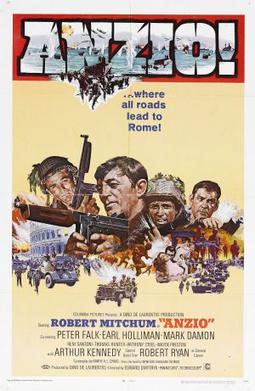
Anzio


Over the 1950's and 1960's, World War II movies were a dime a dozen hitting theaters. Even with the abundance of movies though, some theaters of war were often ignored, or at least covered less. Case in point? The Italian Campaign as Allied forces took Sicily and then Italy in horrific fighting that claimed thousands and thousands of lives in what some said/say was a waste of manpower. So while 1968's Anzio may not be a good movie, I can't help it. I'm a fan so sue me.

It's early 1944 and the fighting has dragged to a stalemate between Allied and Axis forces along the Monte Cassino line. The Allied forces are planning an invasion in Italy above the fighting as Cassino, intending to land some 70,000 troops north of the fighting at the port of Anzio. Among those landing is a war correspondent, Dick Ennis (Robert Mitchum), who will tag along with an American Ranger battalion (specially-trained infantry) as they hit the beaches. An expected hot landing is anything but...the troops hit the beaches with little to no resistance. There's no German forces for miles. On a patrol into the Italian countryside, Ennis and a corporal from the First Special Service Force, Jack Rabinoff (Peter Falk), discover just how open the countryside is. Back at the Allied beachhead though, no one on the general staff believes them. While the Allies dig in and establish a strong beachhead, the Germans take advantage, assembling a line as deadly as anything the war has seen.

If you're looking for a more detailed description of the Battle of Anzio, check out the Wikipedia page. I'm currently reading Alex Kershaw's The Liberator, an excellent read that explores the fighting in Italy in some detail. What's here in this 1968 war film is a condensed version with some embellishments and names changed. The actual battle of Anzio was a horrific miscalculation on the parts of the Allied commanders who made cautious decisions that ended up costing thousands of lives needlessly in fighting that could have been easily avoided. See? We learned something today!

'Anzio' itself is an interesting mess of a movie. It's from the 1960's, the age of the big, epic war films like The Great Escape, Battle of the Bulge, The Guns of Navarone, a trend that would continue into the 1970's. From director Edward Dmytryk (and Duilio Coletti in whatever the "Italian version" is), 'Anzio' is part of a trend of flicks dubbed Macaroni war movies (instead of spaghetti, get it?!?), films made with mostly Italian backing albeit with smaller budgets. Dino De Laurentiis produced the war film, bringing a respectable budget that's seen in landing shots where landing crafts empty of hundreds of soldiers hitting the beaches. There is a big budget feel (some of the time) as this story develops about one of the most costly battles of WWII. More detail later, but there's also truly odd moments sprinkled throughout, giving Dmytryk's film an off-balanced feel to the proceedings. More later!

Two performances here have always appealed to me, Robert Mitchum as war correspondent Dick Ennis, a character very loosely based on famed writer Ernie Pyle. Interesting tidbit? Mitchum earned an Oscar nomination for his performance in 1945's The Story of G.I. Joe, the story of Ernie Pyle in Italy! Ennis is a frontline guy, always sticking with the troops at the front even when he doesn't have to be. Mitchum treads that fine line between looking worn out and being interested, but that laconic, tired look favors Ennis well. He's sick of war, sick of stupid orders and commands that costs unnecessary lives. A good performance for Mitchum. As for Falk, it is an...interesting performance. His Jack Rabinoff is a SOLDIER. He loves fighting. He's good at it (maybe too good), and his backstory of how he ended up in the First Special Service Force is quite revealing. Again, there's some odd moments, but Falk brings a ton of energy, some humor to the part that's hard not to like.

This quasi-epic war film resorts to more familiar territory in the second half. Following a horrific German ambush, a small group of Rangers, including Ennis and Rabinoff, must get back to their own lines to report what the Allies are about to march into. If it's familiar, so be it. It's more at home. It's more comfortable. Among the survivors, look for Earl Holliman as the capable Sergeant Abe Stimmler, Reni Santoni as Pvt. Movie (always ready with an impression), an underused Mark DamonThomas HunterGiancarlo Giannini, and Joseph Walsh. In the epic vein, we also get unnecessary cameos from Robert Ryan and Arthur Kennedy with Kennedy at least getting something to do. Ryan is in two scenes, and he only speaks in one! Also look for ever the German, Wolfgang Preiss as Field Marshal Kesselring, the Allies' opposition across the line.

Where 'Anzio' falls in parts is its odd tone and general lack of epic qualities, even though it thinks it is an epic. It is NOT. It's a good, old-fashioned war flick. Simply put, it tries to cover too much ground in 117 minutes. The song that plays over the opening credits, This World is Yours (listen HERE), is awful. Truly out of place. The score itself is hit-and-miss, but when it works, I liked it a lot. As for the tone, this is a story that just refuses to pick one tone and go with it. Is it dark? Is it a light war film? While things are somewhat ironed out (not really), we get a painful scene of Falk's Rabinoff sitting in an ambulance with three prostitutes as he sings "Bye, Bye Blackbird" with them. There's another scene later where he does the same thing. What the hell is going on?!? Don't even get me started about the general combat tactics here either, highly-trained American troops charging into machine gun fire without even raising their weapons or trying to throw a grenade at the nest. Meh, run!!!

Now all that said, I've always liked this movie and held it up on my most recent reviewing. I love the Italian filming locations, especially the shots of Rome. I've always been a big fan of Mitchum and Falk, and even considering some script idiosyncrasies, they're both pretty good here, as is the whole supporting cast. Through all the general craziness and oddness, there's some...oddly charming. The action is harsh, including a late battle between our survivors and four German snipers, and from beginning to end, it is entertaining. It ain't a classic. So be it. It's very entertaining.

Anzio (1968): ***/****
Rewrite of May 2009 review

Friday, December 18, 2015

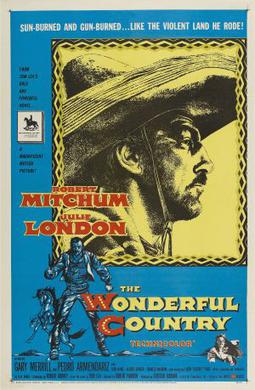
The Wonderful Country

Compared to the 1960's, the 1950's just doesn't stand up for me when it comes to the western genre. Movies were too much soap opera, not enough wild west. Sure, there were plenty of good to great to classic entries, but the following decade was a stretch of a genre at its best. Closing out the decade strong though was a 1957 western that's been generally forgotten over the years, The Wonderful Country.

Working for the powerful Castro family in Mexico, gunfighter and hired gun Martin Brady (Robert Mitchum) is crossing the Rio Grande and entering the United States. An incident from his past drastically changed his life, forcing him to retreat into Mexico where he developed a name for himself as quite the dangerous pistolero. Now, he's on a mission from the Castros to pick up an illegal shipment of repeating rifles and ammunition. It isn't soon after crossing the border that his horse throws him, breaking Martin's leg. He can't ride so he's forced to wait and heal in the border town, shipping the guns and ammunition back to Mexico without him. So with nothing to do but wait, Martin sits back and heals but doesn't quite know what awaits him. People from his past, new acquaintances, and those who want to see him dead, they all await in the coming weeks, especially when news reaches town that the gun shipment has been stolen. But by who?

What an interesting, genuinely odd, even offbeat movie. I watched this western from director Robert Parrish years ago and revisited it recently when it popped up on MGM-HD. I liked it a lot then, and a second viewing produced the same result...albeit with the same response. This is an odd movie, no doubt about it. There are touches of an almost art-house film sprinkled throughout. The story is disjointed to say the least, covering months (and maybe more) from beginning to end but with no real sense of the passage of time. But coursing through it all, an odd energy hangs in the air that I found appealing. A bit of a mess but a good mess to watch.

Robert Mitchum was the best. He had no rivals, a rogue in Hollywood before it was cool to be a rogue. He was one of the first anti-heroes too, the tortured hero who transitioned into bigger and better. One of his specialties? As I've mentioned before, Mitchum was drawn to Mexico including this film but also The Wrath of God, Villa Rides, 5 Card Stud, Bandido and probably several more I'm forgetting. Who better then to play an expatriate American who embraced the Mexican lifestyle almost entirely? I can't think of anyone.

Mitchum's Martin Brady is the one constant through all the craziness and winding story. Yeah, his accent is a little rough at times, but when he speaks Spanish, this isn't an actor remembering his lines. He speaks it fluently. But the character as a whole is interesting because it feels so ahead of its time. This is the somber, even doomed gunfighter running from his past but not really knowing what the future holds for him. All he's known is his pistol, but his ability with the gun has him tied down so he can't escape. From the look of the character -- the immense sombrero, the stubble, the vaquero attire -- to the potentially doomed development, it's a more than worthwhile lead performance.

The rest of the cast is more of an ensemble with a few bright spots. Julie London plays Helen Colton, the wife of the local army outpost commander, Major Stark Colton (Gary Merrill), a generally ineffective officer. Helen has a past and is drawn to Mitchum's Brady but she may have other ideas. But then things get weird in almost variety show ensemble territory, including Albert Dekker (a Texas Ranger captain), Jack Oakie (a well-meaning railroad man), scene-stealing Charles McGraw (an amiable doctor), former Negro League/MLB pitcher Satchel Paige (a cavalryman, a Buffalo Soldier), Anthony Caruso (a Mexican farmer), Mike Kellin (a Mexican pistolero), Victor Manuel Mendoza (the army officer) and his brother, the Governor (Pedro Armendariz), John Banner (the German store owner), Jay Novello (a Mexican soldier and Brady's friend) and Max Slaten (his naive visiting nephew). Enough for you? McGraw is especially good, as is Armendariz in a smaller part.

Definitely worth mentioning is the visual appeal of the movie. 'Country' filmed on-location in Mexico, making the movie look almost like a country's tour guide. Some locations are familiar from other like-minded westerns, but for the most part, you're seeing a country as it is, not done up for the sake of a movie. With a Mexican-themed score combined with that beautiful countryside serving as a backdrop, we've got a winner in the technical department. Sure, the story drifts along too much, bouncing from one character and situation to the next almost without warning, but this is a movie that's very enjoyable if you drift along with it. Not a classic, but a pretty darn good western.

The Wonderful Country (1959): ***/****

Tuesday, November 17, 2015

The Hunters

The 1950's were a mixed bag when it comes to war films. There's some classics -- The Bridge on the River Kwai, Stalag 17 -- but I've noticed a trend. There are almost-classics (or at least above average) that are undone by unnecessary love stories jammed into a war story. Otherwise good flicks ruined by scenes of passionate hugging and soldiers and the women they love holding each other cheek-to-cheek. Gasp! The horror! Add 1958's The Hunters to the list.

It's 1952 and the Korean War is raging. On the ground, the fighting is the same, infantry going toe-to-toe for every inch of ground. Up in the air though, things have changed with both sides using jets to control the skies. At an Air Force base in Japan, WWII veteran pilot Cleve "Iceman" Saville (Robert Mitchum) is back at it, going through indoctrination before taking over a fighter group. The aerial dogfights are a mess, the Chinese pilots not as skilled but all it takes is luck sometimes to survive the fighting. Among Saville's group are two pilots, both problems for vastly different reasons. Lt. Ed Pell (Robert Wagner) is a hotshot pilot, desperately wanting to be an ace while Lt. Carl Abbott (Lee Philips) is struggling with a drinking problem. Oh, and Saville has the hots for his wife, Kris (May Britt). As if the fighting to curb Communism wasn't enough...

Okay, here we go...Battle Cry, Force of Arms, Darby's Rangers, Never So Few, all war flicks somewhat to completely undone by stories harping on sluggish love stories typically featuring ZILCH in the chemistry department between its love interests. That's just off the top of my head too. There's more. You just know they're out there....

From director and producer Dick Powell, 'Hunters' is a pretty interesting flick. Enough time had passed since the end of the Korean War that viewers would have had a chance to breathe a little bit, put the conflict behind them. The subject matter, while dark, is far from anti-war and the film itself comes across as slightly shallow. There's just not that much meat there in a story that could have had plenty. It is a good-looking movie -- the print shown on Turner Classic Movies looked gorgeous -- with a decent cast, interesting story and some real potential that never quite takes off. If anything, any depth or a story with an edge is left behind in the wake of...

SPECTACLE. This is a movie about flying jets, fighter planes that zip across the sky and do things that no machine should be able to do. Think of it this way. An audience in 1958 would have been dazzled to see the acrobatics, the dogfights, the impressive speed. This was incredibly new to that audience. Now in 2015, it's an incredibly cool time capsule. The aerial footage is genuinely incredible. The stunts, the long shots of seemingly countless jets racing across the sky, well, Cinemascope never looked so good! Even the shots of the cast in the jets doesn't scream out how obvious it could have been. There's at least a semblance of reality that these guys are actually flying. So while the love story does its best to drag things down, these adrenaline-pumping aerial sequences are pretty freaking cool.

A favorite here at Just Hit Play, Mitchum is excellent here as Major Cleve Saville, a pilot from WWII who can't stay away when there's a fight (and he's a damn good pilot too). His Saville is the 'Hunter' of the title, a diehard pilot who has ridiculously keyed-in focus, blocking out all else to go for the kill during a dogfight. Now, some years since WWII has ended, has Saville changed? Has he mellowed? Mitchum is that low-key, laid back anti-hero the movie needs. Is it acting? Does he just not care? Somewhere in the middle most likely, but it's an interesting performance. You see a former hotshot pilot who's matured some and sees the dangers in what he used to be in those pilots now flying with him. I liked Wagner's Pell, a fast-talking, talented pilot who similarly may push too far. Also look for Richard Egan, John Gabriel and Stacy Harris as other pilots at the base.

That damn love story though. It doesn't help that Mitchum and Britt have little to no chemistry, dragging these already sluggish scenes to an even more screeching halt. No chemistry translates to no energy, especially when Philip's whiny Abbott starts to drink and question and get mad that his wife is drawn to a....blah blah blah. It's not good. When 'Hunters' sticks with the war drama, it's a pretty decent movie, especially in the second half as several pilots find themselves fighting through enemy territory after being forced to bail out from their jets. Some real drama, some tension, some nerves, it's all there. If there had been 103 minutes of that instead of what we have, we'd be talking a pretty decent (if somewhat formulaic) final product. So instead, we get a mixed bag.

A slight recommendation because Mitchum is impeccably cool, Wagner is a lot of fun, and those aerial sequences are impressive whether it's 1958 or 2015.

The Hunters (1958): ** 1/2 /**** 

Thursday, April 23, 2015

His Kind of Woman

Occasionally I have some genuine freak-out moments. Case in point? I’ve been writing movie reviews here with Just Hit Play since January 2009. I must be getting old! I’ve mentioned before though the timing of starting some of these reviews. I watched some good, even great, movies in the months right before I started this site but never reviewed them, not feeling confident enough to review months later from memory. That’s today’s review, a film noir from 1951, His Kind of Woman, that’s one of my favorites.

A down on his luck gambler living in Los Angeles, Dan Milner (Robert Mitchum) is drifting along with the clothes on his back and very little money in his pocket. Then, his luck turns on a dime, but it seems so easy. A mysterious man with underworld connections offers him a huge payday if he’ll simply leave the country and visit Mexico. There’s a catch though. He can’t know why, only get to a remote hotel on the Baja California peninsula and wait. From there, he won’t be able to return to the United States for at least a year. Suspicious but in need of the money, Milner takes the deal and heads to Mexico. There at the hotel, he meets a beautiful singer, Lenore (Jane Russell), in pursuit of a popular Hollywood actor, Mark Cardigan (Vincent Price), and an odd assortment of guests and locals. Milner sits back and waits for what’s heading his way. What has he gotten himself into exactly?

I saw this 1951 film noir in November 2008, two months before I started writing these reviews. Talk about bad timing, huh? I loved it, something pulling me in and keeping me interested throughout its two-hour running time. It comes from bazillionaire Howard Hughes and had a whole bunch of production problems that become evident in the final act. Now that said, there’s something charming and fun about it from beginning to end. It hasn’t been distributed much, if at all, since its release and ‘Kind’ doesn’t have a huge following. The moral of the story is simple. It should. I highly recommend it.

To say this is a film noir is limiting. It is to be sure, but it tries to do a lot more and generally, succeeds on most of those fronts. Director John Farrow (and an uncredited Richard Fleischer when Hughes didn’t like Farrow’s work) is at the helm of an equal parts film noir, love story, comedy with some action and shootouts thrown in. It isn’t always perfect, but the script makes a mostly successful go at it. Six different people are listed at the IMDB page for this movie as having written part of ‘Kind’ (again reflecting the behind the scenes drama). It’s smart. The dialogue crackles. The story is sorta kinda there, relying on the actors to bring the at-times slow story to life. I think the biggest compliment I can say is that it almost plays like a spoof of the film noir genre itself…but never truly becomes a spoof. Now that takes some doing. Not too light, not too heavy-handed, but more importantly and more successfully, somewhere in between.

Just a few weeks ago, I reviewed 1952’s Macao, another pairing of stars Robert Mitchum and Jane Russell. I watched ‘Kind’ back in 2008 in my Jane Russell phase. I’d never seen her films but fell hard for her right away, and this was only my second Russell film I believe. Again, talk about an on-screen match made in heaven. It’s easy to say Mitchum does the same thing movie in and movie out – that laconic, loner anti-hero – but he brings a different edge and energy with each passing film. I loved his Milner character, a man who knows he’s in trouble but keeps going along to figure out what’s up. The same for Russell’s Lenore, a young woman looking for love but with a fair share of failed attempts behind her. The duo just WORKS so well together. Their scenes are pretty pitch perfect throughout. They’re believable, you like them, and they seem to like each other. How can you go wrong?

What surprised me about the movie’s general unknown quality is the cast. With the cast assembled, how does it not have more of a reputation even by accident? Mitchum and Russell are excellent, but it’s Vincent Price who steals the show. His Mark Cardigan is an Errol Flynn-like movie star, a swashbuckler who’s looking for his movie star life to become his real life. A little too much at times, but very funny. Still not enough? There’s also Tim Holt as an investigating cop, Charles McGraw as a thug and enforcer, Raymond Burr as a mobster trying to get back into the U.S., Jim Backus as a talkative investment banker, Philip Van Zandt as the hotel owner, and an uncredited Anthony Caruso a brooding sidekick to Burr. Not bad at all.

An additional character worth mentioning is the hotel set on the Baja California peninsula. It’s so 1940s/1950s stylish with its bungalows and pool and just some really cool architecture. The sets date the movie a bit, but it truly becomes an additional character. The ending? Yeah, things fall apart a bit as the last 40 minutes get a little too kooky. Even when it goes off the tracks though, ‘Kind’ is still a really fun movie. Definitely worth seeking out, the 1951 film noir popping up occasionally on Turner Classic Movie’s schedule.

His Kind of Woman (1951): *** 1/2 /****

Wednesday, April 15, 2015

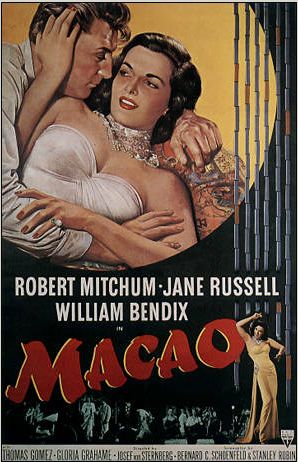
Macao

They don't have the all-time classics to their names that other film couples did. They weren't Tracy and Hepburn or Bogart and Hepburn or Wayne and O'Hara. But you know what stars Robert Mitchum and Jane Russell had in their two films together? An easy-going, sizzling charm that oozed off the screen. I'm hoping to write reviews for both soon, starting here with 1952's Macao, their second pairing.

Just 40 or so miles from Hong Kong, the city of Macao in the years following World War II has become a den of gambling, corruption, violence and any number of any other vices. One particularly crooked casino owner with his hands in everything, Vince Halloran (Brad Dexter), is especially worried though after he and his men killed an investigating officer from New York. They're playing the waiting game for the officer's replacement...and maybe some more heavy duty reinforcements. Coming ashore from a ship traveling from Hong Kong, all but three passengers are recognized, leading Halloran to believe one of them is the cop. The suspects? A Navy veteran on the run, Nick Cochran (Mitchum), a talkative salesman, Lawrence Trumble (William Bendix), and a nightclub singer looking for a job, Julie Benson (Russell). Who is the right one to target? Just which one is the cop looking to take Halloran in?

If that doesn't sound like the most pointed plot description, well, it ain't. Director Josef von Sternberg (along with some uncredited work from Nicholas Ray) was a silent film director who drifted along a touch when the sound era moved into the film industry. The Wikipedia page for 'Macao' specifically says "When von Sternberg's scenes made no sense dramatically..." so you know he wasn't always interested in a Point A to Point B (or C-through-Z) story to begin with. Production actually wrapped on filming in 1950, and then the finished product sat on the shelf for most of two years. How come? Producer Howard Hughes' track record basically. Decisions didn't have to make a whole lot of sense when your boss is one of the world's richest people. What's the end result then for this shelved, quasi-film noir?

It's good to great early on because of its randomness and general kookiness. It derails some in the last 20 minutes of its 80-minute running time. Let's focus on the positive though. 'Macao' is genuinely fun as everything is laid out and established. It mixes classic film noir with international intrigue with the huge chemistry between Mitchum and Russell with some laughs along the way. Long story short...it is a pleasant, enjoyable movie. It is dark, but not as dark as most film noirs. Some reviews point to that lack of a unified tone as a negative but the helter-skelter tone really worked for me. Should it have? Probably not but something clicks for me. Filmed in black and white with some stock footage of Macao and Hong Kong mixed in with the seedy Hollywood sets for the two cities, Sternberg's film has style and a great visual look.

Blah blah blah with all that film analysis. Let's talk about movie star chemistry!!! Robert Mitchum and Jane Russell are two of my favorites. Mitchum was that perfect tough guy anti-hero who just didn't give a crap. Russell was a solid actress, singer and performer who fit in well with the tough guys when her film roles allowed it. The end result? Two actors who don't look like they're acting. They're just hanging out, having a ton of fun bringing these two characters together. Their chemistry is evident from Scene No. 1 and never lets up. Not remembered as a great role -- and rightfully so -- Mitchum is pretty perfect, laconic and laid back with a checkered past hanging over his head. The same for Russell's Julie, bouncing from city to city looking for work. Oh, and Russell is drop dead gorgeous here. Hughes made her a star by utilizing her....natural talent I'll say. She's beautiful, and she's even given a chance to sing two songs.

The rest of the cast is solid throughout. I especially liked Bendix as Lawrence C. Trumble, fast-talking, looking to blow off some steam traveling salesman. His almost manic delivery pairs well with Mitchum's slower-paced line reads. Dexter is perfectly slimy as Halloran, the black market casino dealer always with an eye on shady deals and easy money. Also look for Thomas Gomez as the corrupt police officer working with Halloran, poorly and under-used Gloria Grahame as Halloran's much-maligned girlfriend, Philip Ahn as Halloran's steely-eyed enforcer, and Vladimir Sokoloff as a mysterious blind man who seems to pop up at the right moment whenever needed. A fun cast with some cool parts.

Now that line before about von Sternberg's lack of dramatic timing, yeah, that comes into play in the last 20 minutes. The cool, couldn't care less style loses all momentum. The finale turns into a big chase scene that doesn't keep the adrenaline flowing unfortunately. The ending itself feels a tad rushed, a disappointing end to an otherwise very enjoyable movie.

Macao (1952): ** 1/2 /****

Friday, February 13, 2015

The Story of G.I. Joe


I went to Indiana University in Bloomington for college, getting my journalism degree from the IU School of Journalism. The building was named Ernie Pyle Hall or shortened to 'the Pyle.' The school was named after famed journalist and war correspondent Ernie Pyle who rose to fame during World War II for his columns about the fighting in Europe and the Pacific. His exploits were given a feature film adaptation in a criminally forgotten war film, 1945's The Story of G.I. Joe.

It's 1942 in North Africa and inexperienced American troops are being pushed back on all fronts against the veteran German troops. A journalist and columnist from Indiana, 42-year old Ernie Pyle (Burgess Meredith) joins the American infantry on the front lines looking to tell their stories for the American people back in the states. The tide begins to turn though as the green Americans learn how to fight, pushing the Germans back and winning North Africa. As the war jumps to Italy, Pyle is right there with the troops, documenting everything he sees. Pyle keeps moving around but always seems to find himself with one infantry company with its commander, Captain Bill Walker (Robert Mitchum), and troops not only getting to know him but welcoming him in, the journalist becoming one of them. What does the war hold though? What awaits both Pyle and the American troops?

What an excellent movie. I think the biggest compliment I can give is that 'Joe' is one of the most authentic war movies ever made. It's not just authentic though. It's real, emotional and resonates long after viewing. Director William Wellman wants to tell the story of the grunts, the men on the front lines and does so without any huge displays of patriotism or heroism. These are just 20-somethings who just want to get home. The quickest way to accomplish that? Win the next battle and the next until they get to Berlin. We don't meet any staff officers or get a wider, bigger picture of the war. We get to know the troops, see them on the march, in combat, waiting and waiting. In ways that movies with a much bigger reputation/following didn't do, you really get the sense of what it was like being in the infantry in WWII.

That authenticity comes from Pyle's writings, two of his compilation books serving as inspiration for the screenplay (writers Leopold Atlas, Guy Endore, Philip Stevenson) that was nominated for an Academy Award. Pyle's columns were simple and straightforward, effective because he got a message across that left quite the impression. A relative unknown at the time, Meredith was cast as Pyle, bringing the man to life with a quiet, understated performance. He steals the movie in subtle fashion. Like Pyle's columns, Meredith isn't overbearing or trying too hard. Like good journalists, he listens and looks and waits for the story. He doesn't force it.

It's a feeling that reflects the entire movie. Nothing feels forced. A lot of ground is covered, but you don't feel rushed. There's a natural flow to the story. Overall, 'Joe' is ahead of its time. It was released the summer of 1945 as the war was winding down, but there's not an ounce of propaganda involved. It's just war. We see the effects of battle on the troops, some eventually cracking. We see the looks in the soldiers' faces as they look back on a fallen comrade. They don't talk about the power or glory of war. It's a dirty, nasty business and people die. It is a little touch, but the soldiers have beards and mustaches, the product of days and weeks up at the front without a rest. 'Joe' was filmed in a stark, minimalist black and white that leaves all the focus on the story. There are some beautiful shots throughout mixed in with all the dreary waiting and waiting for something to happen.

In 1945, Mitchum had been working for several years in Hollywood, usually with supporting roles. This is a supporting role, but my goodness, what a part. He was nominated for a Best Supporting Actor for his performance as Lt. (later Captain) Walker, the commander of C Company, 18th Infantry. With Meredith as Pyle, Mitchum's Walker provides the heart of the movie. A genuine friendship develops between the two men, one a 43-year old writer, the other a young officer trying to get his men through the war unscathed. Like his best parts, Mitchum is the picture of realism. There aren't BIG, LOUD moments but real, emotional ones. His scene with Pyle during the battle for Monte Cassino shows the wear and tear on him, the war stripping him down as he sees the casualties mount. It is a subtle, perfect scene, Mitchum showing all the talent we'd come to expect to see in the coming years.

One other performance is really worth mentioning, and that's Freddie Steele as Sgt. Warnicki, a hard-edged, tough NCO who all the men look up to, including Walker and Pyle. A former boxer who had a short-lived career in Hollywood, Steele is excellent. It's just a fascinating character. His main storyline is that he receives a record from his wife who's recorded his young son's voice, a voice he's never heard. Problem? He needs a record player, the payoff a heartbreaking conclusion. The other infantry include Wally Cassell as fun-loving Dendaro, John R. Reilly as Murphy, a washed-out pilot, and William Murphy as Mew, just trying to fill out his life insurance form.

There are too many moments to mention. There's combat -- Walker and Warnicki working up a bombed-out street to take out 2 German snipers -- and then the more personal, the company resting on Christmas in a brief respite from battle. I loved Mew trying to figure out what name to write on his insurance form. I loved Arab, the little mutt dog the company adopts. It all builds to a very real, very moving, heartbreaking ending. This is war seen through the eyes of one of the best war correspondents to ever write. An excellent movie, one of the best war movies ever made.

The Story of G.I. Joe (1945): ****/****
Rewrite of March 2009 review

Tuesday, February 3, 2015

The Longest Day

When you look back through history, certain dates hold a higher place in the history books. It can be someone's birth, someone's death, or just have an amazing historical significance in terms of impact on the world. High up on that list is June 6, 1944, the day Allied forces invaded Normandy, better known as D-Day. In the age of gigantic, sprawling epics, one of the best movies of the 1960s tackles the immense subject, 1962's The Longest Day.

A plot description wouldn't do this flick justice. It's just infeasible. The history will serve as a big enough jumping off point. After four-plus years of war, Allied forces had massed for months, all prepping for the invasion of Europe, hopefully taking back the continent from Adolf Hitler and his Nazi Third Reich. The invasion was months and years in planning, millions of men, millions of tons of equipment, thousands and thousands of ships, trucks, jeeps and tanks waiting to be unleashed at Normandy and in the French countryside. What was the mystery? The Allies tried desperately to keep the location of the invasion -- Normandy -- secret to help save lives and make the invasion smoother. The Germans similarly tried desperately to discover where the attack was coming. The war hung in the balance along with millions of lives, not just those taking part in the attack but all over the world. Not bad for historical significance, huh?

So tackling that premise in movie form seems a rather daunting task if you ask me. In the age of the epic, this one doesn't disappoint. At 178 minutes, 'Longest' covers a ridiculous amount of ground in a story that takes place over about a 36-hour time span. We see the Allies deciding the time is finally right after days of wavering while the Germans decide if this is the actual invasion or just a feint, a distraction to throw them off. Based on the book by Cornelius Ryan, it is told in docu-drama style as we meet all the participants from the high command to the soldiers, paratroopers to resistance fighters, townspeople to priests and everything and everyone in between. This isn't a movie about characters, but instead about the spectacle and immensity of what happened. If the Allied invasion on D-Day didn't work, who knows how the world would have changed?

Just a huge movie but one that never feels rushed or forced. The three-hour running time absolutely flies by. It was filmed in black and white, giving it an appropriately dated look. Maybe color takes away from what's on-screen, but the decision to film in black and white simply put, works. Ken Annakin, Andrew Marton and Bernhard Wicki combine to direct this behemoth epic and to handle it well. Technically speaking, it is a virtually flawless film. Some stock footage is sprinkled here and there, but many of the locations where the actual events took place were used as filming locations. Talk about authenticity, it can be downright eerie watching some of the scenes knowing the locations' history. The score from Maurice Jarre is used in appropriate doses with the main theme (listen HERE) a memorable piece of music that's always stuck with me.

As an epic though, one thing was required more than just about anything else. That requirement? A cast of seemingly thousands. Literally everyone in Hollywood and stars internationally were required to star in this movie. Okay, a slight exaggeration, but you get my point. Most of these parts were nothing more than cameos, but just as a taste of the ridiculous star power on display, we get John Wayne, Robert Mitchum, Robert Ryan, Henry Fonda, Richard Burton, Edmond O'Brien, Rod Steiger, even a pre-James Bond Sean Connery. Many of those parts only required an on-screen appearance of a minute or two -- some for much more -- but their presence alone...just wowza. The scary part? That's only a somewhat small taste of the depth of the cast that truly brings an international flavor to the D-Day proceedings with German, French, British, American and many more brought together.

The Longest Day is an epic, plain and simple, but for every scene where the scope and scale impresses, I loved the quieter, personal and often times, terrifyingly real scenes just as effective and memorable. I loved Richard Todd as a paratrooper commander tasked with landing in France via glider and taking a key bridge and holding until reinforcements arrive...if they can. The scene where American paratroopers, including strung-up Red Buttons, overshoot their landing zone and land in a German town is tragic and moving. One paratrooper (Sal Mineo) making a tragic decision is surprising and intensely real. I especially liked the simplicity of a late scene between Burton's RAF pilot and Richard Beymer's American paratrooper discussing the necessary evil of the day but also the lunacy of it. I think the best, most iconic moment has Hans Christian Blech's German officer finally spotting the invasion force in the English Channel when the fog clears. His face drops and he mumbles 'Die invasion,' all set to Beethoven's Fifth Symphony. Just a ton of great moments like this.

The other counter to those scenes are the BIG moments, and that's where the technical comes into play. One tremendous scene has a German fighter strafing the beaches, all of which we see from the perspective of the plane. Hundreds and thousands of extras scramble for cover underneath in a remarkable visual scene. The same later in 'Longest' when French commandos fight their way up a street in a French town, a helicopter (I think) filming all the action. As well, the scene of the paratroopers coming down on the German-held Sainte-Mere-Eglise is a horrifying scene that utilizes some very cool camerawork. Also look for a cool scene where American Rangers -- including Robert Wagner, George Segal, Paul Anka, Fabian, Tommy Sands -- scale the cliffs of Pointe de Huc, all trying to knock out a key German emplacement. Some especially memorable moments, not all of them action scenes.

Because I don't want to forget anyone but don't want to overdo it describing EVERY character, also look for Eddie Albert, Irina Demick, Mel Ferrer, Steve Forest, Gert Frobe, Leo Genn, Jeffrey Hunter, Curd Jurgens, Peter Lawford, Christian MarquandRoddy McDowall, Kenneth More, Wolfgang Preiss, Ron Randell, Jean Servais, Norman Rossington, Tom Tryon, Peter van Eyck and Stuart Whitman. Okay, I'll take a breath now.

The Longest Day isn't the best war movie around, but it's one of my favorites. It tries to accomplish a ton and succeeds on just about every level. The history, the scale, the spectacle, the gigantic cast, the moments that resonate amongst all the epic qualities. It also serves as an excellent companion piece to the more recent Saving Private Ryan. Nowhere near as violent, but a more far-reaching story. A gem from the age of epics.

The Longest Day (1962): ****/****

Thursday, October 10, 2013

Track of the Cat

John Wayne will always be remembered as an actor and a movie star. Fair? Yes. But during a long and distinguished career, he accomplished a lot of things behind the camera and backing movies as a producer, including starting his own production company, Batjac Productions. He starred in several of those movies -- Hondo, Island in the Sky, The High and the Mighty -- but not all of them. With Batjac backing, here's 1954's Track of the Cat.

It's the first heavy snow in the California mountains and the Bridges family preps for a heavy snowfall. Their ranch sits in an isolated valley with mountains ringing it all around, and as they prep for the weather hear the growls of an immense panther in the trees, not to mention its tracks around their cattle. One of their ranch hands speaks of a legendary black panther that's terrorized these mountains for years so could this be that animal? With their cattle at risk, brothers Curt (Robert Mitchum) and Arthur (William Hopper) pack food and supplies and bundle up to head into the wilderness to hopefully put an end to the panther. But as they head out, the rest of the Bridges family, including youngest brother, Harold (Tab Hunter), await their return back at the ranch. Under high tensions though, personal issues and long-held grudges come to the surface, threatening to tear the Bridges family apart.

The positives of 'Cat' are pretty evident. Working off a novel by author Walter Van Tilburg Clark, director William A. Wellman originally intended to shoot his film in black and white.....in color!!! Is your mind blown as much as mine? Most of the movie is shot in shades of white, gray and black. That way when we do see colors, they really do pop off the screen. The visual look of the film in general is a big success, even if there's too much use of pretty obvious indoor sets, thanks in great part to the filming locations in Washington at Mount Rainier. You know what looks like real-life mountains and not a mountain studio set? Real-life mountains! Also, composer Roy Webb turns in a solid score, a little over the top at times in telegraphing what's coming but still pretty good.

So we've got a real winner on our hands, huh? No, not really. Things play out like a Greek tragedy meets Russian classics versus Shakespearean dramas...except not that good. It is incredibly dark, which I usually eat up, but it's so heavy-handed and obvious that it loses any impact it could/should have had. That's one thing, but it also tries to be profound and existential with a message. Good and evil! What are you? Quasi-spoiler alert.....we never actually see the black panther terrorizing the mountains so we're led to believe that the panther is some sort of all-incarnate evil, right? It divides the family along very broad lines, all those bottled up emotions exploding outward in one big explosion. Then, out of nowhere we get these cutesy moments that are out of place and unnecessary. It can't find the right tone, going for an incredibly dark story Greek mythology would be proud but not getting there.

The cast itself is hamstrung by a script that writes in cliched, stereotypical and somewhat obvious parts. Mitchum makes the most of it as Curt, the brother who runs the ranch and made it what it is but he's also an intimidating bully to anyone who won't go along with him. Hopper is his complete opposite as Arthur, the good brother who reads poetry and tries to defend those bullied members of his family. Hunter looks surprised with big eyes a lot, his limited range crippling the part of Harold, the youngest brother who's had a girlfriend/friend, Gwen (Diana Lynn), move in with the Bridges. Gwen has caught the eye of Curt and basically thrown everyone for a loop. There's also the family patriarch (Philip Tonge), a preening drunk, and family matriarch (Beulah Bondi), a Bible-thumping, manipulative nut, and Grace (Teresa Wright), the only Bridges sister who hates her life, her family and everything basically. In a bizarre bit of casting, Carl Switzer -- formerly Alfalfa in The Little Rascals and wearing a ton of makeup -- plays Joe Sam, an elderly Indian supposedly over a 100 years old who works for the Bridges.

I didn't like this movie. I read about it for years and was at least mildly curious to watch it. Too much time is spent back at the Bridges ranch and not enough time with Curt out on the trail of the never-seen black panther. It tries too hard almost from the start and never really picks up any momentum over a 102-minute running time. Very disappointed.

Track of the Cat (1954): * 1/2 /****

Monday, June 10, 2013

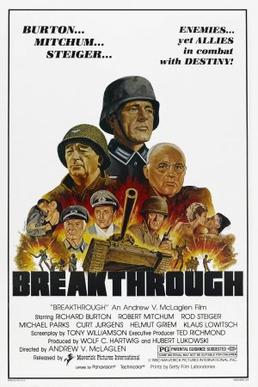
Breakthrough (1979)

Released in 1977, Sam Peckinpah's Cross of Iron is a forgotten masterpiece, a war movie that doesn't get the credit it deserves. Not necessarily remembered as a classic, it ends on a particularly downbeat if effective ending, making the news that there's a sequel kinda hard to believe. I'm a big fan of Peckinpah's original so here goes with the unlikely follow-up, 1979's Breakthrough.

Under a withering Russian attack, German forces are retreating all along the Western Front. Among them is Sgt. Rolf Steiner (Richard Burton), a hardened veteran who's seen all the fighting can offer throughout the war. Amidst the fighting, he's granted a 14-day leave in Paris, but just as he settles in, the Allies attack at Normandy with his division transferred to the fighting. Upon catching up with his men, Steiner is given a dangerous mission that could ultimately bring the war to an end, but at minimum could save thousands of lives. In between Allied and German lines, Steiner meets an American officer, a tanker, Col. Rogers (Robert Mitchum), who isn't sure whether he can believe what Steiner is telling him. A decision must be made though quickly with an Allied offensive imminent.

In terms of original to sequel, this 1979 WWII flick from director Andrew V. McLaglen bears little resemblance to its predecessor. The ending in 'Iron' is open for interpretation as to whether certain characters survive, but this sequel answers that question (They make it by the way). And other than character names and that this too is a World War II movie, there are no real unifying links. It seems an odd movie and storyline to continue, but whatever, it happened so here we sit. It's not a particularly good movie -- most reviews rip it pretty mercilessly -- but I managed to get some enjoyment out of it. Then again, I'm a sucker for basically any western and war movie. You've been warned!!!

So now that I've established that I liked this movie, let's move ahead with ripping the movie some! While I like many of McLaglen's films (The Wild Geese, The Devil's Brigade), I can admit he was far more a workmanlike director than a master filmmaker. To say the story drifts a little bit would be a vast understatement. It starts in Russia, moves to Paris, jumps to Normandy and involves German and Allied knowledge of assassination attempts on Hitler. Oh, and Steiner's commanding officer, Major Stansky (Helmut Griem), is power hungry and doesn't care who gets caught up in the killing, civilians and innocents alike. The budget is obviously pretty limited with a fair amount of stock footage used from other war movies of the era. The score is atrocious, an oddly horrific mix of spaghetti western tones, country music, odd rock and roll notes, and hippie-psychedelic noises. It's not just bad, it's distracting, and that's significantly worse.

Here's the issue that I'm noticing in a lot of reviews. The cast here has some pretty impressive name recognition -- more than Peckinpah's original -- but it's not necessarily good performances. It's a fair criticism that most of the big names gathered are clearly phoning it in. On the other hand....oh, Richard Burton and Robert Mitchum! Replacing James Coburn, Burton does a decent job as war-weary Steiner. Mitchum is clearly not too interested in the part, but I like Mitchum so there. Also look for Rod Steiger, pissed off as usual and screaming orders as an American general, Webster. Michael Parks has a good supporting part as Sgt. Anderson, Mitchum's assistant and jeep driver. Klaus Lowitsch returns from 'Iron' as Cpl. Kruger, Steiner's fellow NCO and close friend. Curd Jurgens also plays a familiar role, an aristocratic German general frustrated with Hitler's leadership.

Schizophrenic story with far too much going on, aging stars with less than spectacular acting jobs, and a budget that's limited in basically all aspects. The action is okay, including the finale as Maj. Stansky attempts to set up an ambush for an attacking American tank battalion, but that's really the only memorable set piece. Why did I even remotely like this movie? I have no freaking idea. I was entertained throughout -- maybe because of the badness -- and that's all I'm looking for. Also worth mentioning, do a shot every time Mitchum asks about the anti-tank emplacements. You'll be drunk in minutes.

Breakthrough (1979): ** 1/2 /****  

Saturday, April 6, 2013

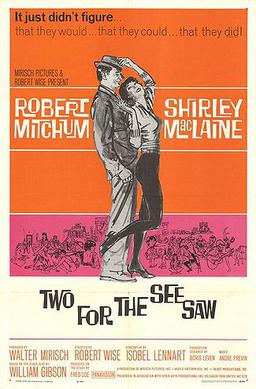
Two for the Seesaw

In January 1958, Two for the Seesaw starring Henry Fonda and Anne Bancroft debuted on Broadway and was quite the success. It ran for 750 performances and even was nominated for the 1958 Tony Award for Best Play. Successful stage plays often make the jump to film, and four years later the highly successful Broadway play made that jump with 1962's Two for the Seesaw.

Several months removed from the separation from his wife of 12-plus years, Omaha lawyer Jerry Ryan (Robert Mitchum) has packed up his belongings and with just limited cash has moved to New York City. He's been in NYC, wasting away, saving what little money he has and living day-to-day, often wondering if it's worth going on. One night at a party, he meets Gittel Moscawitz (Shirley MacLaine), a 29-year old young woman living in Greenwich Village. He can't quite put his finger on it, but Jerry is drawn to the quirky New Yorker with an honesty and forthrightness he's never seen before. They bond quickly, finding a common ground through their own past relationships and inner demons, and soon enough they're in an exclusive relationship. Jerry tries to start up his law career again, and Gittel works to open a dance studio, but their past demons threaten to tear the relationship apart before it can even get started.

There's quite a list of worthy stage plays that have made the jump from play to film, ranging from 12 Angry Men to Annie, West Side Story to The Sound of Music, Oliver! to Chicago, and many more. I've never written a thing about stage plays, Broadway, anything, so I can only imagine how difficult the transition is from stage to film, but director Robert Wise pulls it off nicely here. Maybe the biggest key is the choice to film in black and white. This will sound obvious -- maybe even odd/dumb -- but you lose the color, but there's an added depth to the visual. It doesn't hurt either than now in 2013, there's a distinct nostalgic, retro feel as you watch the film. For the most part, 'Seesaw' is limited to just two small sets; Jerry's rinky-dink, poorly furnished apartment, and Gittel's cramped little Greenwich Village studio.

It works in a simple way. The camera is always right there on the floor in these cramped little apartments with Jerry and Gittel. One technique I found particularly effective was the couple talking on the phone from each other's apartment. Wise shoots the apartments as if they were right next to each other, a dark, shadowed wall separating them. They're miles away, but in the visual sense, it's just a few feet. Much like a stage play, his scenes are dialogue heavy and are in no rush to get anywhere. They develop at a natural pace, just two people talking to each other. Some go on too long (more on that later), but it stays true to its stage roots, and that's a bonus. Another obvious plus is Wise shooting on-location in NYC. I knew about two seconds into the movie I was going to like it. The opening shot has Mitchum's Jerry standing on the Manhattan Bridge, and it's a beauty. Over the opening credits, Jerry walks through various parts of NYC, and because it's the best description I can come up with....it looks so ridiculously cool. Big, wide open shots of 1962 NYC is a sight to behold. Watch it HERE at Youtube.

Once again sticking to the stage roots, the cast is primarily just Mitchum and MacLaine. Yes, other supporting parts are around for a scene or two, but the two stars are literally in every single scene, whether it be together or on the phone. There's only a few where they're even separate from each other. Kinda a daunting premise for an actor, huh? Both actors are up to the challenge. Some critics complain that Mitchum is too old for the part, and too old for MacLaine (17 years younger at the time), but I don't get it. I think they're perfect for each other, and they show a chemistry that carries the movie. For all his tough guy antics, Mitchum had great chemistry with many of his on-screen co-stars from Jane Russell to Deborah Kerr and many more. A whole lot of other, deeper and far more specific things could be stated, but it comes down to this. I liked the two performances a lot, and that can fix a lot of issues in a film.

Now that said, there are issues. At 119 minutes, 'Seesaw' is long and lags in the final 30 minutes. That's never good when things are coming together and wrapping up toward the finale. Not just on an emotional level, but the last half hour is painfully slow to watch. The ending gets points for not going for an easy, happy ending, but getting there is a trial. Getting up to that point, it works. We watch a developing relationship with all its flaws and imperfections in both individuals, both wanting things to work out while working through their own issues. I really struggled through the ending, but I very much liked the build-up. A mixed bag, but Mitchum and MacLaine are two Hollywood legends for a reason. Definitely give it a try. Oh, and this isn't the romantic comedy the above poster would have you think it is. Just an FYI.

Two for the Seesaw (1962): ***/****

Tuesday, January 8, 2013

One Minute to Zero

When a war movie is made and released while said war is still very much being fought, you're going to get a different movie in tone and message than one released years after the end of the war. Wordy opening, huh? It's the truth though. With a film meant to encourage and move audiences during a war, it's just going to be a different film. An above average take on the Korean War comes from 1952's One Minute to Zero.

It's early in the fighting between the North and South Koreans and WWII Army vets Colonel Steve Janowski (Robert Mitchum) and Sgt. Baker (Charles McGraw) are training South Korean troops to ready them for combat. As the fighting intensifies though, Janowski and Baker are tasked with a bigger mission. The North Koreans are sneaking through American lines disguised as refugees, even forcing the refugees to hide guns and ammunition. Janowski meets an American woman, Linda (Ann Blyth), working with the United Nations, but their new relationship is threatened by the increasing conflict all around them.

Released right in the middle of the Korean War, 'Zero' is guilty of being a little heavy-handed at times. It's understandable. The goal was likely to convince American viewers that the American forces were in the right. We see the evil Communist North Koreans holding guns on South Korean refugees (babies and all), we see executed American troops, we see McGraw's Sgt. Baker teaching little kids how to blow bubbles with their bubble gum. North Korean troops are basically nastiness and evil incarnate while the Americans are for the most part, always in the right. Thankfully, director Tay Garnett doesn't go too far with his message. It's there, and yes, it can be heavy-handed, but it's never truly painful to watch like some propaganda war films.

'Zero' handles its story the right way in juggling a war story and a love story. In that way, it reminded me a lot of a film made seven years later, 1959's Never So Few. Neither film focuses exclusively on the war or love angle, and that's a good thing. For the most part, it bounces back and forth between the two. Mitchum's Colonel Janowski is a longtime vet who's risen through the ranks. He's used to fighting, but not quite like what he's seeing in Korea. As the love interest, Blyth's Linda is still coping with the loss of her husband late in WWII. She has genuine feelings for Steve, but she doesn't want to see another love ripped away from her again in war. As a bonus, Linda isn't a damsel in distress. She's working near the front lines with the United Nations at aid stations. She too sees the horrors of war.

Joining the fighting in Korea early on, Mitchum's Janowski works with an American infantry battalion, including Captain Ralston (Richard Egan), a capable officer who focuses on the mission but also watches out for his men as best as possible. Ralston's men include Wally Cassell, Hal Baylor, Alvin Greenman, and Lalo Rios. William Talman has a strong supporting part as Colonel Parker, Janowski's long-time friend and an Air Force pilot with Margaret Sheridan as his wife.

While there are moments nearing cringe-inducing territory, there are others that are equally effective in the opposite direction. Janowski and Baker teaching South Koreans how to take out a Russian tank is a gem early on in the story. I thought the best sequence though has Janowski, Ralston and Baker deciding what to do with a road crammed for miles with Korean refugees. It is know that North Korean guerrillas are hiding amidst the refugees, but something has to be done. The refugees are let through a checkpoint, but Janowski calls in artillery fire that drops closer and closer to the refugees. He hopes to call their bluff with the guerrillas revealing themselves. It is an incredibly intense sequence with a surprising end result, especially considering this would have been shown to a 1952 audience.

The highlight though was the finale as Janowski, Baker, Ralston and an infantry battalion head far behind North Korean lines to slow up a military convoy delivering badly need supplies to the front. They're forced to hold a position for considerably longer than planned, and supplies begin to dwindle as North Korean forces move in for the kill. It's an impressive extended sequence that is more effective in showing the sacrifices made by soldiers than any far more obvious flag-waving scene. Maybe it is a flag-waving scene, but it works extremely well just the same. It takes a little while for this Korean War love/war story to get going, but once it does, it doesn't slow. Well worth sticking with it through the end.

One Minute to Zero (1952): ***/****

Wednesday, August 22, 2012

The Sundowners

Teaming up for John Huston's Heaven Knows, Mr. Allison in 1957, stars Deborah Kerr and Robert Mitchum made up a perfect pair in an underrated movie. Don't fix what isn't broken, right? Just three years later, the duo teamed up again with equally positive results, this time in 1960's The Sundowners.

Working and living in the Australian Outback, Irish-Australian Paddy Carmody (Mitchum) is constantly on the go, taking odd jobs wherever he can to support his family. Along for the ride with him is his wife, Ida (Kerr), and his teenage son, Sean (Michael Anderson Jr.). While Paddy loves the roving, even nomadic lifestyle, Ida and Sean want to settle down somewhere, especially one farm along a river they find in Bulinga. Paddy can't quite bring himself to do it, refusing to be tied down anywhere, but for the sake of his family, he takes a job shearing sheep at a ranch with hopes of saving enough money to purchase the farm. Paddy's old ways may prove to be harder to fix than anything as Ida and Sean dream of their farm.

Thanks to my own forgetfulness and stubbornness, this 1960 movie from director Fred Zinnemann has long avoided me. I was finally able to catch up with it, and it was well worth the wait. This is a big movie, clocking in at 133 minutes, with a scale that's meant to impress you. According to the always-reliable Wikipedia page, Zinnemann spent 12 weeks in Australia shooting everything from the land itself to shots of sheep herding. The actual movie -- filmed on location with the cast in Australia -- looks great, from the vast horizons in the Outback to the towns that pop up along the way. Some money was clearly spent on establishing that sense of reality, and it pays dividends immediately.

For all its impressive scale though, 'Sundowners' is most successful because it works in terms of story on a personal level. It is a big, expansive story, but the focus is on the Carmody family and their journey (through good and bad) as they search for some sort of normal. Paddy? He loves his roving life. Ida and Sean? They want a home to call their own. In terms of its portrayal of a family, the story reminded me at times of a John Ford story where family (immediate and extended) is the most important thing in life. Thankfully, it avoids all the schmaltzy, sugary sweet portrayals of family that Ford often fell back on. No slapstick humor here, just the authentic feel of a family striving to be together and to be something together.

Some actors and actresses just have chemistry, and that's certainly the case with Kerr and Mitchum working together. Showing off that same chemistry they had in 'Mr. Allison,' the duo gets the ball rolling immediately. Some on-screen couples just had that back and forth that doesn't feel like acting. Like here, it has the very real feel of a couple that has spent years and years married through the trials and tribulations, the good and the bad. Who better to play an amiable but sometimes hard-drinking middle-aged man who refuses to be tied down to one single place? I can't come up with anyone better than Mitchum for that part. As for Kerr, she is quickly climbing my list of favorite actresses. She has this easy-going charm that is hard not to fall for. Her Ida obviously loves Paddy, but she admits he also can drive her batty at times too. Their relationship doesn't feel forced. It feels genuine.

What will set this apart from a lot of aspiring epics is the cast. We're not talking Ben-Hur or Lawrence of Arabia here. Instead, it's an epic-looking movie that focuses on a handful of key characters on a smaller scale so in other words? Not a big cast. Peter Ustinov is a scene-stealer as Rupe Venneker, a former ship's captain (possibly) who headed back to land and in general loves everything about life. He signs on with the Carmodys as they undertake driving a sheep herd to market, working as a drover alongside Paddy, and becomes almost an adopted member of the family. In just his second credited role, Anderson Jr. holds his own on-screen with Kerr, Mitchum and Ustinov. His wide-eyed innocence at the world is a good fit alongside his roving Dad, weary Mom, and always mischievous (in a good way) Rupe. In an Oscar nominated part for Best Supporting Actress, Glynnis Johns plays Mrs. Firth, a hotel/saloon owner who takes a shine to Ustinov's Rupe. Also, look for John Meillon, Ronald Fraser and Chips Rafferty as some of Paddy's fellow sheep-shearers.

Struggling in theaters in 1960, 'Sundowners' apparently didn't catch on with audiences. Zinnemann thought it was because it was advertised as a From Here to Eternity knock-off of sorts. Again, Wikipedia is never wrong, right? Whatever the reason for its struggles, I liked it. It's nothing profound or different, but just a good story about family. The road-weary Kerr looking at a done-up woman on a train and wanting to be her, even just for a second. The roving Mitchum, genuinely distraught after a mistake he made cost the family dearly. It's the little things in this quasi-epic that never aspires to EPIC status, but it just don't need to. Enjoy.

The Sundowners <---TCM trailer/clips (1960): ***/****

Monday, June 11, 2012

The Wrath of God

Why do some movies just reach out and grab you? You know the movie. The one most of your friends have never heard of and give you that 'What the hell are you talking about?' look. It's that hidden gem of a movie that you stumbled across at Netflix, the one you started watching at 2 in the morning when you couldn't sleep. Because you found it, and it seems to have been forgotten among a sea of movies, it's almost your movie. I've got a handful of them, one of my favorites being 1972's The Wrath of God.  

It's the 1920s in an unidentified Central American country, and three men have been brought together to pull off a suicidal, basically impossible mission. First is Emmet Keogh (Ken Hutchison), an IRA gunman on the run. Second, there's Jennings (Victor Buono), a portly, double-dealing and conniving businessman who can never turn away at a chance at some easy cash. And third, there's Father Van Horne (Robert Mitchum), a defrocked priest now working as a con man with some tricks up his sleeve. They have a simple choice in front of them; stand in front of a firing squad or work together to kill Tomas de la Plata (Frank Langella), a maniacal revolutionary who rules his region with a tyrannical fist. Can the unlikely, unholy trio pull the job off and get out alive?

A little known western from 1972 with a solid cast, a somewhat goofy tone that has some fans thinking it's a spoof (I for one, do not), and action, drama and humor. What to take away from it? According to anything written about the movie from director Ralph Nelson, it was beset with problems from the start. Co-star Hutchison severely cut his hand, almost died and was forced to miss several weeks of filming. That's kind of a problem when Hutchison is in almost every scene. Starring in her last movie, Rita Hayworth was struggling with Alzheimer's and couldn't remember her lines. Now this may just be me, but you know what? Somehow and some way, it all works for the better. Yes, it's an odd, weird, even goofy mess of a movie, but it's damn entertaining.

'Wrath' has lots of little things going for it, the things that help make a good movie great. From composer Lalo Schifrin comes a crazy, off the wall, jazzy and Mexican themed score that sounds like an offbeat spaghetti western score (listen to samples HERE). Nelson filmed on location in Mexico using some familiar, memorable spots that you'll have seen in Vera Cruz, Big Jake, The Wild Bunch, and The War Wagon. The finale at the de la Plata hacienda is especially cool, using the same location as the finale to 1954's Vera Cruz. The best thing going though is the script. The movie is based off a Jack Higgins novel (written as James Graham), and while I like the novel, it doesn't have the dark humor the movie does. The whole movie is basically one great one-liner after another, but it never feels forced. Read IMDB's Memorable Quotes HERE for a sample. Credit to Mitchum, Buono and Hutchison especially for committing to the lines because it could have felt cheesy from the get-go in lesser hands.  

Mitchum was the only big, recognizable star in the cast, but that ends up working as a positive for the film. He was often criticized for being too calm, too lackadaisical, for being downright bored in his parts. This is a showy, scene-stealing part, and Mitchum runs away with it. Having some fun with previous "religious" parts like Night of the Hunter and Five Card Stud, he plays Father Oliver Van Horne, a somewhat disheveled, former priest (backstory explained late) now working as a conman and hired gun. He carries a large case loaded with an automatic machine gun and hiding over $50,000. Mitchum clearly looks like he's having some fun here. Hutchison and Buono too stand out, Hutchison as the fiery IRA gunman who gets a love interest, Chela (model Paula Prentiss in one of her 3 career roles), a mute Indian girl, and Buono as the portly, boozing dealer who always looks out for himself first and foremost. The trio has this really easy-going, likable chemistry that carries the movie, a nice positive when they're in almost every scene together.

The other three main parts are basically extended cameos. Playing the maniacal laughing, insane Tomas de la Plata, Langella hams it up like nobody's business. He hates priests after seeing sketchy, immoral priests in his village growing up so when Mitchum's Van Horne shows up, he basically loses his mind. Langella has some great exchanges with Mitchum too, overplaying vs. underplaying. In her last film, Hayworth is clearly struggling with her part, but it's still cool to see her working with the cast. Also hamming it up is John Colicos as Colonel Santilla, the conniving officer trying to get his rival de la Plata knocked off in any way possible. His spelling out the suicide mission to his self-named 'Unholy Trinity' is a priceless scene. Gregory Sierra is solid too as Jurado, de la Plata's one-eyed henchman. Fans of The Wild Bunch should check out the cast too, where you'll see Jorge Russek, Chano Urueta, Aurora Clavel, and Enrique Lucero, all of them playing supporting parts much like in Peckinpah's film.

A quasi-revolutionary western that isn't interested in breaking any ground sure ain't a bad thing. In many of his movies, Nelson was just interested in making entertaining, well-made and exciting movies. 'Wrath' is 3-for-3 there. It's fun from beginning to end, the last 30 minutes especially standing out as Van Horne, Keogh and Jennings make their move in taking out de la Plata. A bloody shootout in a village square leads into a bloodier shootout at the de la Plata hacienda, Van Horne wrapping it up nicely with a great closing line. Is the movie great? By no means, but I love it just the same. It's different, it's funny, and whether it's laughs or action, it should keep you entertained. Now about finding a DVD copy of it.....yeah, that's another story.

The Wrath of God (1972): *** 1/2 /****

Wednesday, May 23, 2012

Going Home

Not bad, and not good but leaning more toward the 'bad department,' I watched 1971's Going Home recently. Never a good sign when it takes three or four sittings to get through a 90-minute movie. So what drew me into this one? That would be the appearance of Robert Mitchum, one of my favorites, in the leading role. Damn you, Mitchum. You win this time....even though it's not your fault this one stinks.

Just six years old, Jimmy Graham sees the aftermath of his father, Harry (Mitchum), killing his mother. When Harry is sent to jail, Jimmy is sent to one foster home and summer camp after another. Thirteen years go by though, and 19-year old Jimmy (Jan-Michael Vincent) wants some answers. He goes to visit his father in prison only to discover he was paroled several months before. He manages to track him down, but where does he even start? How do you restart any sort of a father-son relationship after such a traumatic incident and so many years later? Both Jimmy and Harry are dealing with their own personal demons inside, and a reconciliation won't come easy for either of them.

I'd like to say there was some potential here, but I really can't say for sure. Director Herbert B. Leonard's film is a mess almost from the start. There are times it seems pointed in one direction, and then without warning it does a U-turn, and we're heading elsewhere on a dime. One of my biggest complaints is that it tries to be too 1970s folksy, complete with upbeat, out of place country theme and soundtrack. The story that follows is dark, depressing and even upsetting at times. I don't know what the ultimate goal was. What was Leonard trying to say? Whatever it was, it felt like he came up short or at least missed the point.

A lack of focus in storytelling is one thing, but 'Home' drags its feet basically the entire movie. We're not talking a long movie at all -- just over 90 minutes long -- but we still get repeated scenes of Vincent's Jimmy walking around, running somewhere, moping about his problems. Not one or two, but five and six times. I know it's meant to show his anguish inside, all those years of pent-up frustration, but convincing is one thing. This is just repetitive. It's downright dull. And while I like Jan-Michael Vincent, this isn't a great part for him. Mostly, he just looks pissed off and frowns or pouts. That's part of the frustration of the movie. It's clear he wants some answers from his father, but what are his intentions? Does he actually want to reunite with him, does he just want those answers, or is there an ulterior motive here? Even when the movie ended, it was hard to tell.

There were times when Vincent's character does have his moments, mostly thanks to Mitchum's part pulling him along. Whether as a youngster making his name for himself in the 1940s/1950s or here as an established star, nobody did personal demons better than Mitchum. He knows he made an epically wrong decision years before attacking and ultimately killing his wife, but he's trying to make some sort of amends and move on. His Harry is tortured, seemingly regretting what he did so many years before. In a few key scenes, he carries Vincent along, and their exchanges are both interesting and worthwhile. But most of the time, the script doesn't give him enough to do. Also worth mentioning is a very good supporting part for Brenda Vaccaro as Jenny, Harry's girlfriend caught up in the middle of the situation.

Running out of anything even somewhat worthwhile to criticize/praise here so this is going to be a shorter review. There just isn't much positive here to recommend. If an intention was clearer as to where it wanted to go, at least criticisms could be made on achieving or missing that goal. But that never comes along. The story drifts along, some despicable things are done back and forth, and some 90 minutes later, it's mercifully over. Pass on this forgotten movie.

Going Home <---Youtube clip (1971): * 1/2 /****

Wednesday, May 16, 2012

Rampage

Released in 1962, Hatari! starred John Wayne, Hardy Kruger, Red Buttons and existed mostly to show off its African locations as Wayne's team of specialists capture exotic animals and sell them to zoos around the world. It's good enough, entertaining but generally forgettable. It was a big success though, and what does success mean in the movies? The same old stories shoved right down our throats, like 1963's Rampage

Working for whoever will pay him, trapper and big game tracker Harry Stanton (Robert Mitchum) is the best at what he does; finding and capturing exotic animals for zoos all around the world. Visiting Berlin, he's approached for a job that even he's not sure he can pull off. Traveling to Malaysia, Harry must capture two tigers, but that's just the start. He must also track and capture the Enchantress, a half-tiger, half-leopard, a rare animal that's been spotted several times. Along for the hunt of sorts is a big-game hunter and guide, Otto Abbot (Jack Hawkins), who immediately butts heads with the equally strong-willed Harry. The rivalry for supremacy is one thing, but it gets ratcheted up even more when Otto's girlfriend, Anna (Elsa Martinelli), accompanies them on the dangerous hunt.

Like the much-better Hatari!, 'Rampage' works at its best when it is on location. According to the recent airing on TCM, director Phil Karlson shot on location in Hawaii (filling in nicely for Malaysia). It is a beautiful movie to watch, boasting a very 1960s look and style to it. The first hour-plus serves as a nice tour of "Malaysia," Harry's crew of Sakai hunters (including guide Sabu) navigating their way through the lush, green jungles full of beautiful streams, cliffs, hills and waterfalls. It has a distinct cheese-ball quality, not quite low budget, but getting there. It is a popcorn film, one that transports you to somewhere else and lets you enjoy the adventure and the scenery for a little while. Composer Elmer Bernstein aids the cause with his score, at times jazzy and fun, other times emotionally more effective, bits of 'The Great Escape' evident at times.

When I did stumble across this late night on TCM, I was surprised I'd never seen it, much less heard of it, considering its star power at the top. Now to be fair, both Mitchum and Hawkins made much better movies with much better roles. I wouldn't calling this slumming for either actor, but neither delivers a career-defining role. Still, it's fun to see them in a more mainstream, straight entertainment part. As he always was, Mitchum is effortlessly cool. The early 1960s were transitional for Mitchum, the veteran actor finding his nice, but this is a fun, lead man type part. Hawkins too is perfect for the part, a great actor who could more than hold his own but seemed at his best as the second fiddle and/or banana to the lead. They have some great banter back and forth, that banter eventually turning into a heated rivalry (more later there). Also starring in Hatari!, Martinelli just isn't a great actress. Words that come to mind? Eye candy. One scene has her swimming naked, some "digital" rocks obscuring her.....talents?

Did it seem like the movie -- and this review -- was going too smoothly? Yeah, I thought so too. 'Rampage' couldn't have just been content with a hunting/safari trip to exotic locations, could it? No, that would far too easy. Instead, the story resorts to one of my favorite plot devices, the love triangle. The second Martinelli's Anna was introduced, I groaned as both Harry and Otto stare her down. Oh, so the movie's about this. Yeah! I thought watching Mitchum and Hawkins fight over her might be interesting, but nothing even somewhat entertaining comes of it. Is there any doubt who she will end up with in the end? If you said she ends up with Sabu, slap yourself for me. The love triangle is dull, drawn out, and predictable. The supposedly impossible hunts for the tigers and the Enchantress end up being relatively easy, the story clearly wanting to get back to the love triangle.

Making it worse is that 'Rampage' has no real idea how to wrap things up. I can't help but wonder if Michael Crichton was a fan of this movie because the end could be a forerunner for The Lost World. The Enchantress has been captured, its delivered to Berlin and what happens? SPOILERS STOP READING SPOILERS In an effort to have Anna all to himself, Otto traps Harry in the train car, lets the Enchantress out, and runs. Cue the Berlin zoo director who opens the car and unleashes the exotic animal on a sea of expectant, waiting fans. Cornball much? As if the love triangle aspect wasn't painful enough to watch, we've now got to see a homicidal, lunatic in Otto trying to kill Harry who just wants to capture his prize. What a big, old mess.

Rampage <---TCM clips (1963): **/****