The Sons of Katie Elder

The Sons of Katie Elder
"First, we reunite, then find Ma and Pa's killer...then read some reviews."
Showing posts with label Mike Kellin. Show all posts

Thursday, January 21, 2016

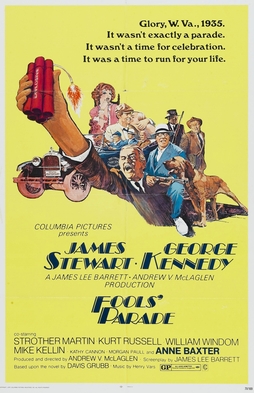
Fools' Parade

So you know what sounded pretty awful? The Great Depression. Man, I'm good at writing introductions to these reviews, aren't I? For every well-known Depression-era movie out there, it seems like there's that many more generally forgotten in a wave of flicks. Here's one I stumbled across on a cable movie channel recently and simply couldn't pass up because of an impressive cast, 1971's Fools' Parade.

It's 1935 and three convicts are being released from a West Virginia penitentiary, including Mattie Appleyard (James Stewart), Lee (Strother Martin) and Johnny (Kurt Russell), all of them having served their sentence for varying crimes. They're driven to the train station by a vicious prison guard, Doc Council (George Kennedy), who ominously states that he'll see them soon. The trio boards the train with plans of opening a general store down the train line, using Mattie's hard-earned savings as a bankroll to get things started. There's a problem though as they get further away from the town and penitentiary. Mattie's check -- earned and saved from 40 years in prison -- can only be cashed back in Glory...where they've been less than pleasantly told to never come back. If they do, Council will be waiting for them. That's not their only problem. Council may not even be waiting that long to hunt them down...

From the older classic like The Grapes of Wrath to the newer entries like O, Brother, Where Art Thou, Depression-era flicks are a cool little genre of flicks that doesn't always get a ton of attention. Maybe it's the whole soul-killing tone of these flicks. Maybe. I don't know. The 1970's especially had some cool entries, including this flick, Emperor of the North Pole, Hard Times, Paper Moon and Dillinger among others. 'Parade' belongs in that group. It's dark(ish), gritty and has the look and feel of one of America's roughest historical stretches.

So why then does this 1971 drama with some light comedy touches have virtually no reputation? Virtually no following? Well, for starters, it most definitely and assuredly is very, very odd. I can't specifically put a finger on said oddness, but it is. It's there. It...is...odd. Maybe as close as I can get is the tone, or lack of. From director Andrew McLaglen and a screenplay by James Lee Barrett, 'Parade' is just a bit of an oddball flick. It's able to build up an impressive sense of doom early on but it never quite takes off. Things slowly derail as the 98-minute running time nears its finish. Still, this is a movie that's never dull or boring. Very watchable, just odd.

Sometimes, an all over the place tone comes in second to something, anything else that's far more appealing. Here, that's easy. It's the cast. That cast. We mostly follow our three recently-freed crooks in Stewart, Martin and Russell. Stewart's Mattie served a 40-year sentence for killing two men, Martin's Lee six years for bank robbery, and Russell's Johnny a shorter sentence for an incident with a girl that's generally left unexplained. The story doesn't linger long on our trio's past criminal transgressions (wisely), instead focusing on them trying to start over again, albeit at different points in their lives. I especially liked Stewart as Mattie, sporting a bizarre-looking glass eye, the oldest of the three who most strongly wants that fresh start. He stashed away all his money during his 40-year sentence (earning a ridiculous-sounding $25,000) and now meets all sorts of roadblocks in getting that cash. Martin's Lee is seemingly a little simple-minded in his obsession with putting together a general store inventory while Russell's Johnny is stubbornly loyal to Mattie. Still, there's something charming about the trio, and there is a solid chemistry among the group.

An interesting cast all-around. When he wanted to, George Kennedy could play one interesting bad guy, and that's on display here. It's just creepy watching him. You're rooting for him to get his due and get it badly. Who else to watch for? An unrecognizable Anne Baxter as a madam who's fallen on hard times, William Windom as an unlucky traveling salesman, Mike Kellin and Morgan Paull as Doc's oddball killers, Robert Donner as a train conductor, Katherine Cannon as Baxter's lone "girl," and David Huddleston as the greedy bank owner. Quite the eclectic bunch!

I can't quite put my finger on it as to 'why' exactly, but I very much enjoyed this movie. Though the subject matter is dark, it is an easy-going, mostly pleasant movie. Yeah, it is a touch slow at times for a movie that runs just 98-minutes, but it is never dull. The West Virginia filming locations are an ideal backdrop for the story as well, giving it an authentic sense of watching where this story would have actually happened. Worth a watch. Apparently, it's somewhat difficult to find so here's my help to the situation. I watched it on Retro, a movie channel coupled with the Encore package on cable. It's a movie I recommend tracking down. Hope you enjoy it!

Fools' Parade (1971): ***/****

Sunday, January 3, 2016

Hell is For Heroes

In a career shortened by his tragic death at the age of 50, Steve McQueen turned in one memorable performance after another. Films like The Sand Pebbles and The Great Escape and Bullitt come to mind as frequent mentions as the King of Cool's most iconic roles (and rightfully so. They're gems). But how about an underrated performance that doesn't get its due? I've always thought 1962's Hell is For Heroes belonged in McQueen's best performance list. What do you think?

It's 1944 in France along the Siegfried Line and rumors are spreading that troops will be heading home soon. As the infantry waits, Private John Reese (McQueen) arrives as a replacement for an already undermanned squad commanded by Sgt. Larkin (Harry Guardino) with the platoon led by Sgt. Pike (Fess Parker). The troops aren't going home though. They're being sent back on the line. Larkin's squad is in for a surprise though. The entire company was moved in during the night, but many of the men were pulled back during the night and relocated up the line to serve as a reserve for an expected German counterattack. What's that mean for Larkin's squad? The sergeant and his five men, including Reese, must hold an extended portion of the line until reinforcements can arrive. Can they? What if the Germans catch on to who they're actually facing off against?

I think this is one of the best, most underrated war films ever made. It is rarely mentioned in conversations of great war films, but it certainly belongs in the conversation. Director Don Siegel -- one of the all-timers at tough guy flicks -- helms a low-budget (but never in a bad way) war story that genuinely tries to show the horrors of war on a more personal level. This isn't armies clashing over territory. This is a half-dozen tired American soldiers simply trying to survive against overwhelming odds and in spite of idiotic orders. There's no picture of the war or fighting on a grand scale. We're in the trenches and foxholes with the soldiers who are interested in getting some sleep, eating some good food and not being shot at for a change.

What's always appealed to me about Siegel's film is the stark, bleak look. 'Heroes' is filmed in black and white, an excellent decision that helps focus the story more on the soldiers and their bleak situation with little in the way of distraction. Much of the story is focused then on a stretch of line marked with trenches, dugouts, bombed-out pillboxes, dragon's teeth, foxholes and all the remnants of previous fighting littering the ground. Across the line a few hundred yards, the German infantry -- mostly unseen -- waits like a presence just waiting to strike. An obvious impact on TV's Combat!, 'Heroes' has a memorable look, Siegel not undone by his relatively small budget. Throw in a wartime score from Leonard Rosenman -- not used often, highly effective when used -- that's moody and dark and scene-setting and you've got all the ingredients! Watch the opening/closing credits HERE for a sample.

The thing holding it all together though is McQueen's performance as Private John Reese, a brutally efficient soldier and fighter who's most effective in combat. Once removed from the fighting, he starts to get in trouble. This is a performance built on such an intimidating presence that McQueen was supposedly incredibly difficult to work with on-set, rarely getting out of character. His physical appearance is gaunt with several day-old stubble on his face. For lack of a better description, Reese is a psychopath, albeit an incredibly capable soldier. One of the earliest method actors, McQueen radiates intensity and rage here like few performances I've ever seen. He barely speaks and when he does, he's short, quick and to the point. But my goodness, it is a highly memorable performance, one tortured individual who is most at home when the bullets are flying through the air and death is ever-present. One of my first thoughts when watching The Hurt Locker was that Jeremy Renner's character could have been Reese's son! What a performance from McQueen.

The entire ensemble is a strong one with McQueen leading the way. Fess Parker is solid as Pike, the tough sergeant trying to hold his men together even considering the hellish fighting they've been through. Larkin too is a capable soldier, Guardino doing a fine job of showing his unease at what he likely should do and what he's been ordered to do. His squad includes James Coburn as Henshaw, a mechanical genius, Bobby Darin as Corby, a scrounger always ready with a joke/quip, Mike Kellin as Kolinsky, the worrier, and Bill Mullikin as Cumberly, the cheery soldier with a positive outlook. The squad gets unlikely reinforcements in the form of Bob Newhart's Pvt. Driscoll, a typist who finds himself at the front line, and Nick Adams as Homer, a young Polish man who tags along with the squad. Also look for Joseph Hoover as Capt. Loomis, the company commander, and L.Q. Jones appearing very briefly as a supply sergeant.

This is one of the earliest examples of a real look at war I can think of. Sure, Darin has some jokes and Newhart briefly gets to do a telephone bit, but the message of the story is the absolute horror of war. There's nothing glamorous or glorifying about it. It's men killing men in horrific fashion. 'Heroes' is interested in small unit pictures, squad vs. squad, as we see some of the ruses Larkin's men use to trick the Germans into thinking there's far more of them than there really is. When the violence and gunfire erupts, it's quick, unsettling and vicious. Characters die in truly uncomfortable ways that isn't just "Bang...You're Dead." One characters screams "My guts! My guts! Don't tell my wife it was like this!" as he bleeds out before a medic arrives. Generally forgotten, 'Heroes' was one of the first to show war as it really was, laying the groundwork for many future war films.

Take this next part with a grain of salt (I'm not sure how true it is), but I've read Siegel simply ran out of money late in filming and the studio didn't give him anymore. What's next? An improvised ending that is actually one of the most memorable, startling endings I've ever seen. It stays in tune with the movie's general downbeat tone with no happy endings in sight. What I've always wondered then is this...what was the original ending if there was more of a budget? I'm still searching for that answer! In the meantime, it's an excellent movie, one that deserves far more of a reputation among war movie fans. It's a gem.

Hell is For Heroes (1962): ****/****
Rewrite of December 2010 review

Friday, December 18, 2015

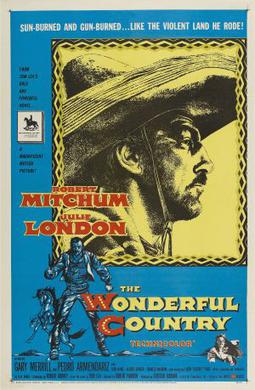
The Wonderful Country

Compared to the 1960's, the 1950's just doesn't stand up for me when it comes to the western genre. Movies were too much soap opera, not enough wild west. Sure, there were plenty of good to great to classic entries, but the following decade was a stretch of a genre at its best. Closing out the decade strong though was a 1957 western that's been generally forgotten over the years, The Wonderful Country.

Working for the powerful Castro family in Mexico, gunfighter and hired gun Martin Brady (Robert Mitchum) is crossing the Rio Grande and entering the United States. An incident from his past drastically changed his life, forcing him to retreat into Mexico where he developed a name for himself as quite the dangerous pistolero. Now, he's on a mission from the Castros to pick up an illegal shipment of repeating rifles and ammunition. It isn't soon after crossing the border that his horse throws him, breaking Martin's leg. He can't ride so he's forced to wait and heal in the border town, shipping the guns and ammunition back to Mexico without him. So with nothing to do but wait, Martin sits back and heals but doesn't quite know what awaits him. People from his past, new acquaintances, and those who want to see him dead, they all await in the coming weeks, especially when news reaches town that the gun shipment has been stolen. But by who?

What an interesting, genuinely odd, even offbeat movie. I watched this western from director Robert Parrish years ago and revisited it recently when it popped up on MGM-HD. I liked it a lot then, and a second viewing produced the same result...albeit with the same response. This is an odd movie, no doubt about it. There are touches of an almost art-house film sprinkled throughout. The story is disjointed to say the least, covering months (and maybe more) from beginning to end but with no real sense of the passage of time. But coursing through it all, an odd energy hangs in the air that I found appealing. A bit of a mess but a good mess to watch.

Robert Mitchum was the best. He had no rivals, a rogue in Hollywood before it was cool to be a rogue. He was one of the first anti-heroes too, the tortured hero who transitioned into bigger and better. One of his specialties? As I've mentioned before, Mitchum was drawn to Mexico including this film but also The Wrath of God, Villa Rides, 5 Card Stud, Bandido and probably several more I'm forgetting. Who better then to play an expatriate American who embraced the Mexican lifestyle almost entirely? I can't think of anyone.

Mitchum's Martin Brady is the one constant through all the craziness and winding story. Yeah, his accent is a little rough at times, but when he speaks Spanish, this isn't an actor remembering his lines. He speaks it fluently. But the character as a whole is interesting because it feels so ahead of its time. This is the somber, even doomed gunfighter running from his past but not really knowing what the future holds for him. All he's known is his pistol, but his ability with the gun has him tied down so he can't escape. From the look of the character -- the immense sombrero, the stubble, the vaquero attire -- to the potentially doomed development, it's a more than worthwhile lead performance.

The rest of the cast is more of an ensemble with a few bright spots. Julie London plays Helen Colton, the wife of the local army outpost commander, Major Stark Colton (Gary Merrill), a generally ineffective officer. Helen has a past and is drawn to Mitchum's Brady but she may have other ideas. But then things get weird in almost variety show ensemble territory, including Albert Dekker (a Texas Ranger captain), Jack Oakie (a well-meaning railroad man), scene-stealing Charles McGraw (an amiable doctor), former Negro League/MLB pitcher Satchel Paige (a cavalryman, a Buffalo Soldier), Anthony Caruso (a Mexican farmer), Mike Kellin (a Mexican pistolero), Victor Manuel Mendoza (the army officer) and his brother, the Governor (Pedro Armendariz), John Banner (the German store owner), Jay Novello (a Mexican soldier and Brady's friend) and Max Slaten (his naive visiting nephew). Enough for you? McGraw is especially good, as is Armendariz in a smaller part.

Definitely worth mentioning is the visual appeal of the movie. 'Country' filmed on-location in Mexico, making the movie look almost like a country's tour guide. Some locations are familiar from other like-minded westerns, but for the most part, you're seeing a country as it is, not done up for the sake of a movie. With a Mexican-themed score combined with that beautiful countryside serving as a backdrop, we've got a winner in the technical department. Sure, the story drifts along too much, bouncing from one character and situation to the next almost without warning, but this is a movie that's very enjoyable if you drift along with it. Not a classic, but a pretty darn good western.

The Wonderful Country (1959): ***/****

Wednesday, September 16, 2015

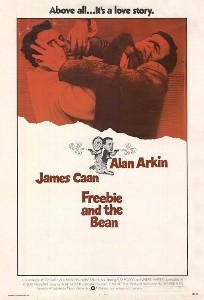
Freebie and the Bean

Let's get down to business. And I mean business. The buddy cop genre is the greatest genre in the history of cinema. Go ahead. I dare you to identify one that is better. See? You simply can-not. There were sprinklings before here and there, but the genre took off in the 1980's. One of those early sprinklings? An oddball, off-the-wall, politically incorrect comedy from 1974's Freebie and the Bean.

Longtime partners working the Intelligence Unit in San Francisco, Bean (Alan Arkin) and Freebie (James Caan) usually get the job done, sometimes in spite of themselves with their constant bickering. Their latest target? The duo has long sought to put well-known and long successful racketeer Red Meyers (Jack Kruschen) behind bars. After most of a year investigating, they've got the evidence -- finally -- but the key witness can't be put into custody for three more days. The solution? Freebie and Bean must shadow Meyers and make sure nothing goes wrong before they can officially arrest him. There are problems of course. Many people would be in trouble should Meyers testify so a hit man from Detroit (maybe more) has been dispatched to finish him. Oh, and it's Super Bowl week. Oh, and Freebie and Bean might kill each other in the process. What could possibly go wrong?

Reading some reviews and message boards about this 1974 buddy cop flick, I saw a lot of people questioning why this is a movie just about completely forgotten over the years. I'm glad I wasn't the only one to think of that issue. I love James Caan and Alan Arkin, and I'd never even vaguely, remotely even kinda heard of it. Why is that? Well, it's not a classic, but it's pretty good. It is kooky, completely without a story, has tonal shifts left and right, is especially goofy and is incredibly politically incorrect. There are flaws, but my goodness, is it a fun ride.

Arkin and Caan. Caan and Arkin. How can you possibly go wrong? You can't here. Two of my favorite actors working together make it look effortless. As you expect from any buddy cop pairing, the duo has to bitch and moan and criticize and ridicule...even though they're the best of friends. Arkin is Bean, a Mexican officer, all business, no nonsense. Caan is Freebie, wild and all over the place and not one to turn down a free gift here and there (hence the nickname). The story drifts as needed, and you get a sense the script was a couple set pieces, an outline of a story, and just blank sports for Arkin and Caan to improvise, to fire lightning fast insults and jokes and one-liners for as long as they could. Too many classic lines to mention -- most of them foul-mouthed, racist, sexist and generally inappropriate -- but quite the Batman and Batman (no Robin here) to lead the way.

'Freebie/Bean' comes from director Richard Rush and comes as a bit of fresh air considering the time it was released. We're talking cynical cop flicks like French Connection, Bullitt, the Dirty Harry movies and plenty others. It's just a funny movie. That's all and that's it. That's not a bad thing. You sit back and enjoy it because there isn't any messages in sight or anything dark or hard-hitting. These are two cops who are friends and fight like an old married couple bombing their way through San Francisco who stop at nothing to put their case together. If half the city should be destroyed in the process....well, so be it. We had a good time. San Francisco looks great as a backdrop as well, an interesting choice considering so many cop movies were shot on-location there. Moral of the story? As much as I love those previously mentioned flicks, it's cool to see a cop movie do a complete 180.

Who else to look for? Some fun, familiar faces. Kruschen has a ton of fun as Meyers, the racketeer who can't believe how stupid the cops pursuing him really are. Loretta Swit of MASH fame plays his pretty young wife. Also look for Alex Rocco as the conviction rate-minded district attorney, Mike Kellin as the boys' lieutenant, Paul Koslo and Christopher Morley as a couple witnesses, and a scene-stealing Valerie Harper as Bean's possibly cheating wife, Consuelo.

So there's gotta be something wrong...right? It's the bizarre, often out of left field shifts in tone. It's dark and funny and politically incorrect, and then a complete direction change into a never-ending car and motorcycle chase (had...HAD to be an influence on The Blues Brothers) that relies on sight gags and Keystone Cops-esque humor. There's little warning too as things shift, especially toward the end with more than a few crazy twists, some that work, some that are shocking, and one that almost had me questioning the whole movie. Thankfully, it was a twist within a twist in a mystery surrounded by a paradox. Anyhoo, this is all complaining to complain. The movie is a ton of fun with one laugh after another. It's James Caan and Alan Arkin basically spending 2 hours causing collateral damage and bitching at each other in their downtime. If that's not a recipe for success, I don't know what is.

Freebie and the Bean (1974): ***/****