The Sons of Katie Elder

The Sons of Katie Elder
"First, we reunite, then find Ma and Pa's killer...then read some reviews."
Showing posts with label Raoul Walsh. Show all posts

Sunday, December 6, 2015

The Lawless Breed

The Wild West in the post-Civil War years was synonymous with a lot of things, but maybe none more than the infamous gunslingers, gunfighters and pistoleros that roamed the country. Some are instantly recognizable like Billy the Kid, Jesse James, Wild Bill Hickok, while others don't have that notoriety. Take John Wesley Hardin for instance, reputed to have killed more than 40 people depending on what you read. Stick with Wikipedia though for any facts because 1953's The Lawless Breed...well, it's a steaming pile of you know what.

It's the years following the Civil War in Texas and young John Wesley Hardin (Rock Hudson) has grown up under a strict, God-fearing father who's tried to instill his own strict beliefs in his son. Wes as he's called, he's not interested. He's worked long and hard to be fast with a six-shooter and wants nothing more than to marry his longtime crush, Jane (Mary Castle), and start working at building up a farm where he can care for and sell horses. That's his plan at least. His father's actions push him away to the point young Wes finds himself in a saloon in a card game that goes poorly quickly. A man across the table draws first, but Wes outdraws him, killing him. Witnesses say otherwise though, forcing Hardin on the run as he tries to prove his innocence. The rewards and bounties grow larger and so does the body count as Wes tries to put the killing behind him (sort of). Can he though or will his name and reputation be too much?

My timing here is interesting. I'm currently reading Larry McMurtry's Streets of Laredo, his sequel to one of my favorite books, Lonesome Dove. John Wesley Hardin is a supporting character in the western novel, portrayed as an unhinged killer with no qualms about shooting anyone for any reason. Then, I saw this pop up on a movie channel and thought I'd give it a try. I shouldn't have...

From director Raoul Walsh, 'Breed' is based off the autobiography Hardin wrote about his life while serving a prison sentence in the 1880s/1890s. To say it stretches the truth a little is a massive understatement. It portrays Hardin as a kid who ends up in the wrong place time and time again and has to kill people over and over again because there's just no alternative. Yuck. Gag me. It's like an anti-revisionist western, hell-bent on portraying one of the west's more dastardly killers as...well, a decent guy! The script is a mess, drifting along far too much even at just 83 minutes, and though the casting is interesting (at times), most of it falls short because that source material is just so weak. Both in character portrayal and visual look, 'Breed' is too clean, too polished and too manicured as it tries to make a killer into the unlikeliest of heroes.

A rising star by 1953, Hudson gives it a go, but this isn't great casting for John Wesley Hardin. It tries to portray him as misunderstood but the next second it shows him as a bit of a scamp, a liar and a gambler who doesn't intend to keep his promises. If we're supposed to feel sympathy for this fella, there's an epic misfire. No matter what happens, the character just keeps digging deeper and deeper, never realizing it's all his fault and that he's to blame. If you're not on our "hero's" side, then things are going to get rough before they get better.

The rest of the cast has some name recognition, but again, the script does them no favors. Julie Adams is Rosie, the saloon girl turned potentially more with Wes, representing herself fairly well with a script that has her wearing very little and leaning forward a lot seductively. I'm sure her back was bothering her, nothing sinister about being able to see down her shirt/dress/blouse. In the oddity department, John McIntire plays dual roles, one as Wes' Bible-thumping Dad and the other as his more fun-loving but hard-working uncle. The Uncle is better than the Dad, but still, it's odd to just go along with.  Also look for Dennis Weaver, Lee Van Cleef, Michael Ansara, Forrest Lewis, and Hugh O'Brian in supporting parts.

I kept waiting for something enjoyable, entertaining or interesting to come along but to no avail. By the time the framing device of Wes and his autobiography wraps up...well, it's not good. The newspaper editor looks longingly off-camera and when asked how the story ends says "I'm not sure. It's a story that hasn't ended yet." The ending itself is laughable compared to Hardin's real-life death, read about that HERE with SPOILERS obviously, to the point I actually groaned when "The End" popped up on the screen. It's a B-western, but it's a bad one with very little other than the lovely Julie Adams to recommend giving it a watch. Give it a big, old wide berth!

The Lawless Breed (1953): */****

Wednesday, January 14, 2015

The Sheriff of Fractured Jaw

Here's an odd formula for you. A very British actor, a busty bombshell, a British western (British?!?) and filming locations that would go onto bigger and better things within five years. What does all that add up to? A mostly entertaining, often fascinating 1960 western, The Sheriff of Fractured Jaw.

The son of the owner of a firearms company based in England, Jonathan Tibbs (Kenneth More) is looking for something to do. He doesn't feel quite at home in his father's company and is more comfortable building all sorts of crazy gadgets and contraptions. It doesn't take Tibbs too long to figure out a solution. Reading the newspaper one day, he reads a story about the violent wilds of the American west...where guns are quite prevalent. His rationalization? Where there's violence...there's guns so Tibbs packs up and heads to the American west in hopes of expanding his father's business. After plenty of travel, he ends up in the lawless town of Fractured Jaw where sheriffs can't seem to stick around too long. Well, they've got a new one. Through a series of misunderstandings and miscommunications, Tibbs becomes the new sheriff and the key to getting through it? A tough saloon owner, Kate (Jayne Mansfield), who takes a liking to the semi-clueless Brit. 

Go figure. This oddball, schizophrenic formula....it kinda works. In one of his last films, director Raoul Walsh helms this goofy, off the wall western. He was past his heyday back in Hollywood's Golden Age, working often with swashbuckling star Errol Flynn, but it's just one more choice you'd think wouldn't work but ends up working quite well. I'll watch anything western but a British western? It wouldn't/shouldn't seem to fit. Look, this isn't a classic. Far from it, things falling apart nicely in the last 30 minutes. When it does work, it's a pleasant change of pace, an entertaining mess. Oh, and those filming locations? 'Fractured' films on-location in Almeria, Spain where in about four years hundreds of spaghetti westerns were filmed. Makes sense, don't it?

Okay, let's cast a male and female lead, two actors who you'd never think would star in a British comedy western together. Hmm, and they're going to have to show off some lovey-dovey chemistry? How about Kenneth More and Jayne Mansfield? DONE! But once again, 'Fractured' gets the last laugh. More is by far the best thing the movie has to offer. A character development that depends on misunderstandings sounds tenuous at best, but More just commits. He plays it all straight and never seems to be going really hard at getting the laughs. He just gets them. The fish out of water routine -- the gentlemanly Brit in the rough and tumble west -- works over and over again. More's Tibbs is a gentleman, polite and trying to make friends and in the process never seems to realize he's doing everything in about the exact wrong way you're supposed to do it. An example? Indians attack the stagecoach he's on so naturally he tries to approach them peaceably to tell them to stop. Oh, by the way. His plan works.

Because More is so good, the chemistry with Mansfield works. One of the biggest sex symbols of the 1950s and into the 1960s, Mansfield isn't a great actress but she makes a go of it. She's here to look sexy, wear very tight dresses and let her natural endowments do the rest. She also sings three different songs, but she's dubbed so that's not her real singing voice. Instead, we're left to consider how anyone could actually be built like that. She's a real-life Barbie doll!

Who else to look for? Some familiar western faces to help ease viewers into...GASP...a British western!!! Henry Hull gets the most screentime as Masters, the Mayor of Fractured Jaw who likes Tibbs immediately, even if he has no idea that his new sheriff can barely handle a gun, much less live up to a reputation of a hardened fast draw. Also look for Bruce Cabot as a rancher who wants to test Tibbs, William Campbell as the real deal, a real fast draw and gunfighter, and Robert Morley as Tibbs' uncle.

So 'Fractured' runs about 103 minutes and for 60 minutes or so, it's really good. Then it takes a detour it never really recovers from. More's Tibbs gets caught up in a sticky situation with two warring ranches and their armies of gunslingers as well as an Indian tribe looking to stir up some trouble. The fish out of water bit wears a little thin as things are stretched out to fill that running time. Still, the first hour is really fun, and I enjoyed it a lot. So in the end, it's an enjoyable mess with some surprisingly good performances. Yep, a British comedy western actually works. I would have bet big money against that thought!

The Sheriff of Fractured Jaw (1960): ** 1/2 /****

Monday, June 16, 2014

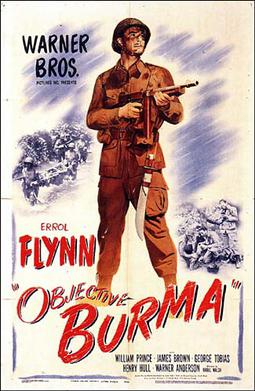
Objective, Burma!

With any actor or actress with a devoted fan following, that following is going to have differing opinions. What is your favorite film? This one or that one? All of them? When we're talking about an actor who worked over multiple decades, it gets that much tougher. Take Errol Flynn who started working in the 1930s and stayed in films through the 1950s. He's got more than a few gems to his name, but my favorite is and always will be 1945's Objective, Burma!

It's 1944 in Burma and Allied forces are preparing to invade the country they were kicked out of by Japanese forces two years earlier. The men across the branches are just waiting for their orders. Among the forces waiting to unleash the attack is Capt. Nelson (Flynn), an officer in command of a platoon of paratroopers. With his friend and second-in-command, Lt. Sid Jacobs (William Prince), Nelson will lead a behind the lines mission into Burma, his men tasked with finding and destroying a key radar station used by the Japanese forces. A 2,000 man garrison isn't too far away from the radar station, meaning Nelson's paratroopers must drop in miles away and find the hidden radar station, all the while avoiding thick Japanese patrols. With a newspaper reporter, Mark Williams (Henry Hull), along to report on the mission, the paratroopers take off from their base with a dangerous mission ahead of them. As prepared as they are though, nothing can really prepare them for what awaits.


What a great movie, one that qualifies in the overused at times but appropriate 'They don't make them like that anymore' category. As far as pure action/adventure movies go, this 1945 WWII flick from director Raoul Walsh is simply hard to beat. It was released in theaters in early 1945, the war winding down but the fighting still very much going on both in the Pacific and Europe. It was a movie ahead of its time, patriotic but not flag-waving and propaganda thankfully. With an Oscar-nominated score from composer Franz Waxman (one that would be used again in the similarly-themed Merrill's Marauders), the action in the 142-minute movie is always on the go, never really slowing down. You feel like you're there with the soldiers, seeing their exhaustion, beards and facial hair appearing as the mission goes awry. It's the perfect popcorn movie, but there are other layers and levels to appreciate. A war movie that still resonates almost 70 years later.

At the tail end of his heyday in terms of popularity, Flynn is the without a doubt, no question star here. I love his performance, especially because he switches things up a bit. Flynn was Robin Hood, a pirate, a swashbuckler, a ladies man, but here, he is just a very capable, very tough and well-liked officer. His Captain Charlie Nelson has been tasked with a dangerous mission that will prove essential to the Allied war effort. Is he rattled, even nervous? Yes, every minute, but he embraces it, hides the feeling away and shows that confidence and even a little bit of a swagger so his men need to see. Flynn was an underrated actor -- for me at least -- but that's one of his biggest attributes. He was confident. He was cool, smooth, and he looked like he belonged on-screen. If it looks like he's not acting, that's the work of an actor who could make it look effortless. At one point with the mission in doubt, one of Nelson's men encourages the other men with "I'd follow him down the barrel of a cannon." Little schmaltzy? Sure, but it works in context, and you see why. I'd follow Errol Flynn into battle too!

Take a look at the cast and you see some names and faces you recognize, but this is Flynn's movie. The rest of the cast becomes part of the unit picture, men brought together from disparate backgrounds forced to work together to get the job done. I liked Hull's journalist, a crotchety old writer trying to tell the story of the soldiers. Nelson's friendship with Prince's Jacobs certainly adds another layer to the story as well. As for Nelson's paratroopers, look for James Brown, George Tobias, John Alvin, Richard Erdman, Joel Allen, and uncredited parts for Anthony Caruso and George Tyne in uncredited parts. Warner Anderson and Hugh Beaumont (Beaver Cleaver's Dad) play higher-ranking officers while Mark Stevens gives a solid supporting part as Lt. Barker, a pilot with the closest ties to Nelson's paratroopers. I liked Tobias, and there's another paratrooper I can't identify by name who has a great bit with a Japanese soldier.

There's so much good going on here, things I picked up on during a recent viewing. It is that perfect war action movie, but it's more. There are a handful of scenes that really resonate, giving an eye into the eyes and thoughts of the paratroopers. Prior to jumping into Burma, the camera moves along a row of faces, the men reacting differently to their upcoming jump and mission. When the mission goes awry, we see the looks on their faces when they have to adjust on the fly. I thought the highlight though was when Nelson and his men come across the mutilated bodies of the paratroopers who didn't make it, the result of a Japanese ambush. One soldier remains, Walsh filming only the man in a door frame so we can't see what's been done to him. We only know he's been cut up, shot up, and he's bleeding out. Over the course of the movie, we see the exhaustion set in, the frustration weighing on all their shoulders. An epically exciting action movie? Yes, and much more.

That is one of the huge appeals for 'Burma.' The action is everywhere, and it doesn't disappoint. The attack on the radar station is the biggest set piece, the rest of the shooting all about the tension and the chase. We don't see the Japanese in frame a lot, but their off-screen presence is a menacing, intimidating cloud hanging over the paratroopers just waiting to strike. The final sequence is especially effective, the pursuing Japanese trying to infiltrate the paratroopers' position on a lonely isolated hill marked by trenches and foxholes. Filmed in the dark with little music, it is a doozy of a success. The whole movie is, one of the great war movies around.

Objective, Burma! (1945): ****/****

Sunday, November 20, 2011

The King and Four Queens

Where to start with 1956's The King and Four Queens? You know, other than "I really didn't like it." Billed as a comedy western, it never amounts to anything and had me wondering where all that comedy went. Some interesting casting and a good director, but it is a story that would have benefited from a much darker, more cynical approach. Of course I say that about a lot of movies, but here goes anyways.

Riding into a lonely western town, Dan Kehoe (Clark Gable) has possibly stumbled onto riches more than he ever imagined. A bartender tells him of $100,000 worth of gold but with an interesting backstory. The four McDade brothers pulled off a robbery of the gold, but three were killed and one escaped and has been hiding ever since. The gold is believed to be guarded at Saddle Mound, the McDade ranch run by Ma McDade (Jo Van Fleet), and the four possible widows of the brothers. Dan has $ in his eyes, and he intends to get that gold, even with the protective Ma around, guarding her daughter-in-laws and the gold with her rifle. Let the charming and seduction begin.

This movie has 1950s American western syndrome. It has all the elements of a potentially entertaining, successful western but never finds a way to gel all those elements together. Even late in his career, Gable is a worthy leading man, and director Raoul Walsh was a more than capable hand with a story like this. Shot on location in Utah, the locations are stunningly beautiful, providing a great backdrop for a lackluster story that never goes anywhere. Composer Alex North's score doesn't leave much of an impression, positive or negative.

Like so many 1950s American westerns, 'King' goes more for the psychological edge which sounds weird considering it is a comedic western. At least, it's listed as that. It isn't funny in the slightest, and the story of a saddle tramp -- even one as charming as Clark Gable -- wooing four lonely, attractive and man-happy widows and their controlling, intimidating mother-in-law just isn't funny at its most basic. If you're going to make this a comedy, just commit. Make it ridiculous. Make it stupid, but you have to try and provide some sort of laughs.

This is going to sound ridiculous after I ripped the movie the last two paragraphs, but there were times watching this western where I couldn't help but think of a well-written play, if not Shakespeare along those lines certainly. If Walsh didn't want to commit to a slapstick comedy, then go the other way. Make this western the darkest thing you've ever seen. A saddle tramp charming, seducing and manipulating four attractive young widows to gain the gold they're hiding sounds like a naturally pretty dark scenario, but that's not the case here. Disappointing end result. Maybe there's potential for a Skin-a-max movie with this story. Who knows, it couldn't be much duller than this movie.

Working with what they've got in terms of a script, the cast does their best with what's in front of them. Gable is okay as Kehoe, but it isn't the most energetic part or most interesting. Jo Van Fleet has the strongest part as Ma McDade, family matriarch who's seen her family torn apart and is desperately trying to hold on to what's left. The widows include Eleanor Parker as Sabina, smart and crafty and up to something, Jean Willes as the fiery and hot-tempered Ruby, Barbara Nichols as Birdie, the dance hall girl, and Sara Shane as Oralie, the quiet, even meek widow.  Look for Jay C. Flippen as a helpful bartender, Arthur Shields as a priest, and Roy Roberts as a curious sheriff.

Never a good sign when the best thing a movie has going for it is the location shooting. Dull western that wastes a decent cast. Thankfully it's only 84 minutes long. Still.....pass.

The King and Four Queens <---early scene (1956): */****

Sunday, June 12, 2011

Silver River

By 1948, times had changed for Hollywood legend Errol Flynn. The swashbuckling, high seas adventures just weren't there anymore, and his best roles were behind him. Flynn would continue acting right up until his death in 1959, but after 1945's Objective Burma!, he didn't have another classic (or even near-classic) to his name.  He is one of Hollywood's more interesting stars and personalities, a hard lifestyle taking its toll on him as he died young at just 50 years old.  The movies continued though in the late 1940s and into the 1950s, including one last hurrah with an old directing pal.

The movie is 1948's Silver River, teaming Flynn with frequent collaborator director Raoul Walsh. The actor-director combo worked together often in the 1940s, producing some really solid efforts like They Died With Their Boots on, Northern Pursuit, Desperate Journey, Uncertain Glory, and Objective Burma!  Working together one last time with 'River,' it has all the markings of a big budget 1940s western. The scope and scale is impressive, with money clearly not an issue here.  More than all the little details is something that sets this otherwise ordinary western apart. Flynn plays a bad guy...sort of...kind of.  I'll explain later.

Cashiered out of the U.S. Cavalry for a supposed act of cowardice and treachery at the battle of Gettysburg, Captain Mike McComb (Flynn) heads west looking for a second chance.  With him is Pistol Porter (Tom D'Andrea), another soldier blamed for the act, but before they go west, the duo finds their way into piles and piles of some cash from the army. They plan to head to Nevada where they set up a gambling house, initially tangling with a miner (Bruce Bennett) and his feisty wife, Georgia (Ann Sheridan). Feeling like he's been burned for doing nothing wrong in the past, McComb now doesn't care who gets caught in his path. He starts to build an empire dollar by dollar and business by business.  But has his seemingly limitless power gone too far?

This has all the positives and negatives of a lot of the Flynn westerns I've seen, and more than that (not to pile on Errol Flynn, one of my favorites) 1940s westerns in general.  They're BIG. The sets are large, the musical score loud and obvious, the cast features hundreds of extras in the background along with the requisite big names leading the way, and it's fun to watch if not particularly taxing.  The stories get to be too soapy though, too theatrical. Maybe the biggest thing working against it is that the story -- especially with Silver River -- keep you at a distance. There's no real heart or emotion to the story, and the actors always seem to be playing the same variation of themselves.  With a movie that moves slowly along at 110 minutes, that lack of interest in what happens to characters can be a problem, if you're into that sort of thing. I'm weird that way.

The supporting cast is pretty hit or miss here.  I liked Ann Sheridan working with Flynn in Edge of Darkness, but something doesn't ring true here.  As a love interest, it feels forced, things moving along because the story requires it. She hates Flynn's McComb, then really hates him, despises him...and BAM! She loves him with a passion. Because I sometimes lack a delicate way of saying things, I'll just say it. She's got a dudely factor going on her. Not a tomboy or anything, more like she is a DUDE. The always reliable Thomas Mitchell carries the movie in its slower moments as Plato Beck, a drunken lawyer who becomes McComb's right-hand man. It is basically a fat juicy fastball for Mitchell, playing a character he played in countless other movies. D'Andrea has the thankless part as the humorous sidekick, Bennett is solid but not flashy with Barton MacLane and Monte Blue as McComb's chief rivals, neither making an impression more than 'Hey, cool mustache.'

Enough with all that, let's get to Errol Flynn, the definition of a heroic, swashbuckling adventurer, playing a bad guy. The story isn't quite rags to riches, but it is close if nothing else. The opening is a cool sequence, Flynn's McComb burning a million dollars in U.S. Army payroll rather than let it fall into Confederate hands at Gettysburg in July 1863. He's crucified for it, and kicked out of the army. He feels taken advantage of and starts to look out for No. 1 alone, everyone else be damned.  We're not talking a brutal, vicious bad guy callously shooting down innocent people, but for Flynn, it is most definitely a departure.  People get trampled and left by the wayside because of his actions. As a big fan of Flynn and all the movies I've seen him in, it was fun to see him play against perception, and he looks to be having some fun with it too.

I should have been skeptical though as McComb takes a turn for the legitimately evil department. From his director's chair, Walsh starts tapping the breaks on the old evil speedometer. SPOILERS STOP READING SPOILERS McComb basically gets Bennett's husband character killed and then swoops in on his grieving widow. First, he tries to correct his mistake but fails. If you're making the character bad, just do that. Don't go half-hearted toward it. His rise and fall doesn't come as a surprise, but in the end, he redeems himself because he sees what a jackass he's been.  For a rise and fall from glory story to work, the fall has to be believable.  Think Scarface.  EPIC fall there, and some of that effort would have been good.  Still, it's fun to see Errol Flynn play against type, and that makes the movie watchable on its own.

Silver River <---trailer (1948): ** 1/2 /****   

Wednesday, May 11, 2011

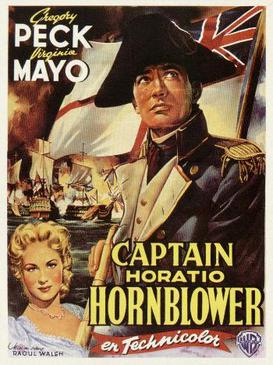
Captain Horatio Hornblower R.N.

The romance of the high seas in decades past has long been a source of story-telling, from books to movies and everything in between.  What's odd is that like so many things of the past, there is little to nothing glamorous or romantic about the high seas in a time where it took years to get from one location to another.  You lived in a cramped boat, had little quality food and less drinking water, and there is always the possibility of a gruesome death from disease and sea battles.  Sounds like a pretty horrific lifestyle, doesn't it?

Maybe it is the beauty of the ocean, hundreds and thousands of miles of open water.  Maybe it is the sight of the tall, wooden ships sailing across the water.  Maybe it is just the time of so long ago.  One of the most recognizable and loved fictional historical characters on the high seas was Horatio Hornblower, an officer in the Royal Navy during the Napoleonic wars. In a series of books written by author C.S. Forester, Hornblower sailed the seas, battling England's enemies wherever he went. A&E had a TV show appropriately titled show 'Hornblower' that ran for five years. Before all that though, there was 1951's Captain Horatio Hornblower R.N.

It's 1807 and Captain Horatio Hornblower (Gregory Peck) is at the helm of the HMS Lydia, a small British warship sailing around Cape Horn and heading toward Central America on a secret, very dangerous mission. His crew is suspicious of where he's leading them, questioning what he's up to.  Their objective is to help a Panamanian revolutionary leading an uprising against their Spanish occupiers. But just days after leaving an enormous cache of weapons with them, they discover that Spain has allied with England in an effort to defeat French dictator Napoleon.  His decision on what to do is made more difficult when a young British woman, Lady Barbara (Virginia Mayo), engaged to a British admiral, is placed in his care.  Now Hornblower must balance out his duty to England, the Navy and his crew with concerns over Barbara's safety.

That is about as condensed a plot description as you're going to get from this Raoul Walsh-directed sea epic. There is not so much a linear story line that has a beginning, a middle, and an end as much as it is Hornblower's adventures on the seas.  None of this is to be taken as a criticism because if anything the movie works better because of that lack of focused storytelling.  Instead, things sort of flow along, introducing problems here and there, situations to be solved, enemies to face and ultimately destroy.  Yes, Hornblower wins...spoilers, I guess.

That may be the best thing this sea epic has going for it.  Filmed in technicolor, the movie looks a little dated with its somewhat faded colors and obvious stage work.  It all adds to the appeal, adding to the mystique of the high seas.  This is how people must imagine life at sea, not what it was actually like.  Balancing out the scenes shot on-board the Lydia (and a later ship Hornblower commands) are gorgeous shots of these clippers cutting across the ocean.  You watch these scenes and understand why some people are drawn to sea travel.  There is something unexplainable about the beauty of an old warship with all its sails up cutting through the water.

Who better to play the stoic, courageous, noble British Navy captain than Gregory Peck, still rising to stardom at the age of 35. This is going to sound ridiculous considering Peck's legendary status as one of Hollywood's all-time greats, but the more I see of his films, the more I like him as an actor.  He has this balance on-screen, one minute the serious, stone-faced commander who makes difficult decision as easily as snapping his fingers. The next, he's stuttering upon meeting Mayo's Lady Barbara, fumbling for the right words. He gives Hornblower a personality, a likable quality that even in his most trying times, he's going to make the right decision. I don't often think of Peck as a love interest in his movies, but his chemistry with Mayo is spot-on, making their budding romance that can't be tougher to watch. It is 1951 though so you kind of know where things will end up...don't you?

Joining Peck on-board the Lydia is a supporting cast that does not disappoint in the least.  His fellow officers include Robert Beatty as Lt. Bush, Moultrie Kelsall as Lt. Crystal, Terence Morgan as Lt. Gerard, and James Kenney as Midshipman Longley, the youngest of the officers.  As for the crew, watch out for a very young-looking Stanley Baker and a scene-stealing James Robertson Justice as Quist. The crew gets their chance to shine in several exciting sea battles as these warships fire point blank into each other with cannon fire.  Enough action to keep you entertained without overdoing it.  The balance of the movie help make this movie what it is, a little bit of something for everyone watching. You can watch it at Youtube, starting HERE.

Captain Horatio Hornblower R.N. <---trailer (1951): *** 1/2 /**** 

Friday, April 22, 2011

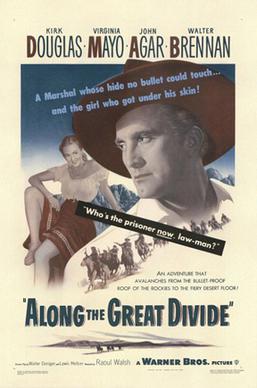
Along the Great Divide

Making his screen debut in John Ford's 1948 cavalry western Fort Apache, John Agar seemed to have all the makings of a star. In the next two years, he starred in two more John Wayne movies, holding his own alongside the Duke I always thought.  But after Sands of Iwo Jima in 1949, that stardom never came for Agar.  Instead, he was relegated to B-movies where he worked consistently into the 1970s and 1980s.  A good if not great actor, Agar was often cast as a second or third banana, the key supporting character, like in 1951's Along the Great Divide.

This western from director Raoul Walsh is an interesting one for several reasons. For one, it was star Kirk Douglas' first western, first of many really as he would return to the genre often during his career. Building off Douglas' strong performance in the lead role though, 'Divide' is a dark western, not like the whitewashed, bland westerns that were so often the product of the 1950s.  It had the potential to be extremely dark at that, but it is the 1950s, and we're not talking a spaghetti western here (unfortunately).  As I was watching this Walsh western though, I couldn't help but think that I'd seen this movie before.  It took me about 15 minutes in, and I had it figured, but I won't give it away yet. Read the plot summary and see if you can figure it out too.

Riding through the desert, U.S. Marshal Len Merrick (Douglas) and two deputies, Billy (Agar) and Lou (Ray Teal) stumble across a lynching. They save rancher Pop Keith (Walter Brennan) from another rancher, Roden (Morris Ankrum) who claims that Keith rustled 15 head of his cattle and murdered his oldest son in the process. Merrick can't prove either way if Keith is guilty or innocent but overpowers the lynch mob, promising to take the old rancher into the nearest town, Santa Loma, for a fair trial.  They hit the trail, picking up Keith's daughter Ann (Virginia Mayo) along the way.  But as they cut across the desert hoping to reach the next waterhole in time, Merrick sees that Roden has kept his word and is charging after them, ready to shoot them all to gain vengeance for his son's death.

This isn't a dead-on comparison where I'm saying they were identical movies, but it's pretty damn close with a few tweaks here and there.  Two years later, director Anthony Mann revamped this basic story with 1953's The Naked Spur, a classic western that is far better remembered than Along the Great Divide.  The story and characters are just too close for Mann not to have been influenced by this western.  Yes, certain things were changed. Douglas is a Marshal, not a bounty hunter like Jimmy Stewart. Brennan isn't a bad guy the way Robert Ryan was, but other things certainly ring true.  Janet Leigh is a spot-on copy of Mayo's character, and Agar and Teal were basically reworked into Ralph Meeker and Millard Mitchell.  I don't say any of this as a judgment or condemnation of The Naked Spur, a western I very much enjoyed.  Instead, I think it speaks to Along the Great Divide which jumps up a notch in my book because of how heavily it influenced 'Spur.'

By 1951, Kirk Douglas was a star, but still a rising star.  His best work was still ahead of him, but his Len Merrick character certainly shows the potential of his ability.  He was an intense actor, capable of high drama and comedy at the same time, and he always had quite a presence on-screen, especially when handling a majority of his own stunts.  So in his first western, Douglas shows a knack for playing that heroic lead who isn't so heroic.  His good guys always had a sense of being not quite so good, men with checkered pasts that rear their ugly heads at the worst possible time.  That is Len Merrick in a nutshell, a marshal trying to prove himself, partially for some sort of redemption for a past deed gone horribly wrong, one that still plagues his mind.  I liked this character though from the start as his ultra-driven motivations take over, pushing those around him to the limit as they struggle with a lack of water in the blazing desert heat.  A good first performance in a western, and a strong indication of what is to come.

More than just The Naked Spur, 'Great Divide' reminded me of several other movies, similar stories with a group of people trying to survive the hell that is the desert. At different points I thought of The Treasure of the Sierra Madre, The Professionals, 3 Godfathers, Yellow Sky and several other westerns and quasi-westerns.  That's basically my only real complaint here with Walsh's western. The story is predictable, and if you're paying attention at all, you know the ending almost from the first scene.  Walter Brennan played his fair share of bad guys, but it's clear this old, coot of a rancher isn't a killer.  It can be a little cookie-cutter at times as the story develops, the pieces falling into place.  On the positive though, it's never boring at 88-minutes, and Walsh films enough on location in the Sierra Madres and Mojave Desert to recommend the movie on just a visual level.  Filmed in black and white, that desert has an intimidating beauty about it, daring riders to come on in and see if they can make it.

I thought Douglas stole the movie here as the tortured U.S. Marshal, but the rest of the cast led by Brennan is nothing to shake your head at.  His Pop Keith character isn't a killer, but he's got a devious streak in him that the story keeps you guessing with as to his actual background.  Mayo as his daughter Ann is the necessary love interest, an easy on the eyes love interest at that.  Agar especially represents himself well as young deputy Billy who looks up to Merrick like a big brother while Teal plays a character he played countless times in other westerns, a gunslinger willing to go on either side of the law, usually the side that pays better.  Ankrum is good as rancher Roden while James Anderson plays his surviving son. An unfortunately little known western, but one I enjoyed very much. Definitely worth watching too if you're a fan of The Naked Spur.

Along the Great Divide <---TCM clips (1951): ***/****   

Thursday, December 2, 2010

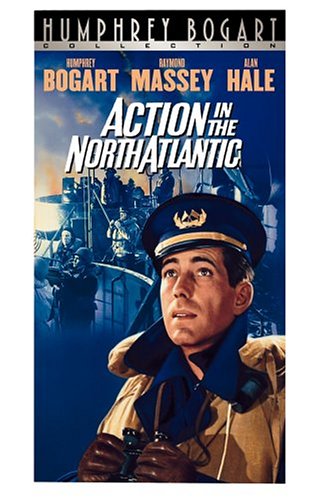
Action in the North Atlantic

Early in World War II, one of the biggest issues facing United States involvement in the war was getting our troops, equipment and materiel across the Atlantic Ocean to the European mainland.  The problem wasn't the ships, there were plenty of those, but the German navy -- especially the U-boats -- which wreaked havoc on those ships, sending thousands of ships and even more men to the bottom of the ocean. But even as the sunk tonnage went up, the ships kept making the dangerous journey.  That's the story of 1943's Action in the North Atlantic.

Now for all you non-history buffs out there, 1943 was right in the midst of World War II when the war was still very much in the balance.  Hollywood did its best to turn out stories that would inspire on the home front and convince Americans that this was a war that needed to be won.  In other words, we're not talking a whole lot of subtlety here, just straight propaganda.  It would be interesting had this movie been made in the 1960s or even now in the 21st Century just to get a different perspective on the story.  But it didn't happen that way, and we get a movie that is very much a prisoner of the time it was made in.  Not always a bad thing.

Sailing to deliver a dangerous shipment of thousands of gallons of fuel, a ship of Merchant Marines commanded by Capt. Steve Jarvis (Raymond Massey) and first officer Joe Rossi (Humphrey Bogart) is attacked and sunk by a German U-boat.  Jarvis, Rossi and some of the crew survive and are picked up, welcomed home as conquering heroes.  It's not long before Jarvis gets a new ship with much of the same crew as they hope to help the war effort aboard the USS Seawitch.  Their first mission is an important one as they will sail as part of an immense convoy traveling from the US all the way to Russia with badly-needed supplies and materiel.  A convoy this big can't help but attract attention, and it seems like it will only be a matter of time before the Germans come around.

Dripping with propaganda and messages of hope, 'Atlantic' is a good example of the movies Hollywood churned out during the war.  The story itself is an interesting one that deserves to be told in an honest, straightforward manner.  Unfortunately, we get the portrayals of these American sailors as angelic men who could do no wrong, and their German counterparts as evil, sadistic bastards who laugh as they ram doomed Americans.  On the positive side, director Lloyd Bacon (Raoul Walsh is an uncredited director here) commits to this garbage all the way. It doesn't hit you over the head the way some early 1940s movies do in getting its message across.  Bogie's final monologue could have been too sappy, but in his hands it is the ideal capper to a solid story.

Now at 126 minutes final running time, 'Atlantic' could use some trimming.  With much of the story taking place at sea, we get some pretty seamless shots of actual ships sailing on the ocean with some well-handled miniature shots.  Of course, that only goes so far.  Stock footage is overused to the point where you can fast forward through large chunks of the story without missing a beat.  The movie is obsessed with showing you what life on a ship is like, but it gets tedious, and it does so quickly.  There's also the portrayal of the German U-boat chasing the Seawitch.  I'm guessing all-told, there is probably about 20-30 minutes of the Germans in the 2-hour movie.  They even speak German...but with no subtitles!  Do you know how boring a movie gets when you can't understand a thing anyone is saying? It's a 2-hour movie, and I watched it in about 90 minutes because the fast forward got a workout.

The saving grace is the cast, including one of my favorites in Bogart.  The man was a chameleon when it came to the roles he could play, and he shows it off here.  This isn't a part that requires a ton of heavy lifting, but Bogart handles it as smoothly as possible. He gets a love interest (easy on the eyes Julie Bishop) that feels tacked on and doesn't serve a real purpose, but Bogart also gets to play the up-and-up hero for a change too.  No concerns if he's the anti-hero just waiting to reveal himself, Bogie is the all-American hero here.  Massey is all right as Capt. Jarvis, but he doesn't have to do much other than growl and talk about how badly he wants to get revenge on the Germans.  I'm sure 1943 audiences ate it all up.

Working from a John Howard Lawson screenplay, 'Atlantic' at its best is when it is dealing with the daily lives of the crew, merchant marines who weren't officially part of the Navy but nonetheless did their best to aid the war effort. The interactions among the crew and the relationships, the friendships, the arguing that develop feel authentic from the start, and you like this motley group of sailors who include Alan Hale, Dane Clark, Sam Levene, Peter Whitney, and Dick Hogan. I don't know what it's like to work and live on a ship for days, weeks and months at a time, but this felt real to me, and not forced.  So in spite of its flaws, I'll still recommend this WWII flick.

Action in the North Atlantic <---trailer (1943): ***/****   

Friday, November 19, 2010

White Heat

Certain movie one-liners just resonate with fans more than others.  The best are those that everyone knows.  Knowing the context or even seeing the movie are not requisites for knowing the line.  I'd never seen 1949's White Heat, but having seen enough movie montages and read enough about the most famous lines in movie history, I'd stumbled across this movie's most classic line. In terms of describing a character in as few words as possible, James Cagney's 'Made it, Ma! Top of the world!' is hard to beat.

I've written before that Cagney as a movie star was never one of my favorites, his acting style very theatrical and over the top.  I've come around some as I've seen in him a few of his more subdued parts.  The one movie I was told I had to give a chance was this one, White Heat.  If I didn't like it, I was in the free and clear and should probably steer clear of his lesser efforts.  Well, no problem there.  Cagney's performance is theatrical and over the top but it is a part that demands he be both of those things.  Considered his best acting job for a reason, this is a perfect introduction for anyone looking to get to know one of Hollywood's biggest stars of the 1930s and 1940s.

Running his brutal gang, Cody Jarrett (Cagney) faces a difficult decision.  After a highly successful train robbery that netted over $300,000 but also produced four dead bodies, Jarrett is feeling the heat as FBI agent Philip Evans (John Archer) leads the manhunt to bring him to justice. Cody takes a lesser rap for a heist he didn't actually take part in, but it gives him an alibi for the job that would have sent him to the electric chair.  Evans knows he's been duped with Jarrett taking a short sentence that will have him out on the streets in 2 years.  He brings in one of his best undercover agents, Vic Pardo (Edmond O'Brien), and plants him in Jarrett's cell as a convict.  Notoriously hot-tempered, Jarrett still takes to Vic and takes him under his wing almost like a little brother.  Evans' plan works as Jarrett organizes a daring escape with Vic as the newest member of his dangerous gang.

Director Raoul Walsh wastes about four minutes post-credits before showing that his main character Cody Jarrett is one of the nastiest gangsters you're ever going to come across in a movie.  In the opening heist of a train carrying a Wells Fargo shipment of cash, Jarrett callously guns down the engineer and his assistant at the very mention of his name (Henry Fonda had a similar reaction some 19 years later in Once Upon a Time in the West).  That was part of the appeal of this movie, it's not a conventional 1940s flick where you can predict everything coming 15 or 20 minutes before it happens.  The characters aren't particularly likable -- no redeeming qualities in sight for the most part -- and the attitudes toward sex and violence are far more lenient than most movies that came out of this stage in Hollywood's history.  Of course, there is that Cagney guy leading the way.

In my messed up head watching movies about the bad guys (simplistic description, but it gets the idea across), I typically find myself rooting for said bad guys.  Cagney pushes my tolerance for rooting for the bad guy because Cody Jarrett is one nasty dude.  However, the fact that I was even contemplating being in this guy's corner is a testament to not only Cagney's acting ability but the strength of the screenplay.  It digs into this character and really fleshes him out.  He's the definition of a mama's boy with Ma Jarrett (Margaret Wycherly) doting on her son as she helps him run his gang. It is 1949 though so while certain things are hinted at (cough Oedipus complex cough) the hint is as far as things go.  Then there's Cody's slutty wife Verna (Virginia Mayo) who latches on to whoever can get her the farthest in life with as much money and worldly possessions as possible.

So throw all this together along with a gang of murderers and cutthroats, and you kinda see where Cody's coming from.  Not rationalizing here, just explaining.  He has to be the nastiest S.O.B around or else he would get taken down in minutes by the wolves nipping at his heels.  It's always refreshing to see a character fleshed out as much as this.  There are moments where you are disgusted by his actions, but then you see him looking out for O'Brien's Vic like a little brother, and you feel for him.  Of course, from the moment this character is introduced, you know what fate he's going to meet.  It's never in doubt.  Cody Jarrett is going out in a blaze of glory like no other.  The ending -- as Jarrett, Pardo and the gang knock off a payroll at a chemical plant -- is a whopper of a finish, leading to the oft-repeated line 'Top of the world.' A finale that's about as good as they get.

I'm not sure how Cagney wasn't nominated in some way for his part as homicidal Cody Jarrett, but the lead performance is just one of many rock-solid acting jobs pulled here.  Wycherly as Ma Jarrett is the picture of a devoted mother who knows her son is doomed but can't stop him, Mayo the femme fatale, Steve Cochrane as treacherous Big Ed Somers, and O'Brien especially as Pardo.  In a similar way to the viewer, Pardo has this unexplainable connection to Jarrett.  That's the movie in a nutshell.  You're drawn in by this character you should despise but just can't come around.  A must-see.

White Heat <---trailer (1949): *** 1/2 /**** 

Wednesday, August 25, 2010

Uncertain Glory

In all the Errol Flynn flicks I've reviewed, I've done my best to avoid saying the same thing repeatedly about him.  He was at his best and most popular when he was the swashbuckler, the pirate, Robin Hood saving Maid Marian.  At the height of his popularity though, Flynn did his best to avoid being typecast although in the process he still typically played pretty heroic characters, just not on the high seas. Somewhere in between is 1944's Uncertain Glory, not quite a villain and not quite a good guy...until the end that is.

Working with a director in Raoul Walsh he worked with a handful of times, Flynn doesn't play the straight as an arrow, charming hero...sort of. It is the 1940s, and Warner Brothers wasn't about to cast one of their biggest stars as a villain.  But in a departure from his typically heroic roles, Flynn gets to play a character that if nothing else is deeply flawed.  His intentions are consistently in question from beginning to end, and his criminal background is mysterious and hinted at more than anything is revealed.  So even though the ending doesn't come as much of a surprise, it is still interesting to see a deviation from the typical Errol Flynn hero character.

It's the middle of WWII, and French prisoner Jean Picard (Flynn) is about to be killed on a guillotine after being caught after years of robbery, heists, and most recently, murder (although we never find out about that).  But at the last possible second as Picard is about to be strapped down an Allied bombing raid flies over, killing everyone involved except the doomed Picard.  Funny how that works, huh?  Given a new lease on life, the crook escapes only to be caught in the days following by detective Marcel Bonet (Paul Lukas), a police officer who doggedly pursued Picard over the years. As they travel back across France to complete Jean's sentence, Picard comes up with a plan.  A saboteur has recently blown up a key bridge held by the Germans, and 100 hostages have been taken prisoner to be shot if the saboteur doesn't reveal himself.  Sentenced to death regardless, Jean wonders, what if he said he was responsible?  

For all his character background, we're never given a crystal clear version of what Flynn's character did in the past.  We hear about crimes that include bank robberies and large-scale heists, even a murder, but never anything specifically.  So in that sense, Flynn's Jean is a bad dude, but the nicest bad dude around.  What worked for the character was his motivation, or lack of in many cases.  At first when the idea of posing as the saboteur is presented, Picard seems genuine, making a noble sacrifice to save 100 hostages.  But as the story develops, you're never quite sure what he is up to.  Does he intend to go through with this honorable plan?  Or given a chance, does he intend to escape for good?  To Flynn's credit, he keeps you guessing until the end.

I'm always a fan of war movies that delve deeper into the war effort than just the front lines and the soldiers.  Besides the cartoonishly evil portrayal of Germans and the Gestapo, this is certainly one of those efforts that gives something different.  But even with this unique story, Walsh struggles with where to take it all, seemingly knowing the end result but not how to get there.  It's more than a little predictable, and at a certain point you assume Flynn is going to go through with it.  Honestly, would Warner Brothers release a movie where heroic Errol Flynn bails on saving 100 innocent people's lives for his own well-being?  I think not.  There was a chance for a great twist in the last 30 minutes involving French villagers setting Jean up for the sabotage, not knowing he's actually going to admit to the deed, but it never materializes into anything.

About midway through the movie, something that had been bothering me finally figured itself out.  This movie is basically a 1940s version of Midnight Run, the 80s comedy starring Robert De Niro and Charles Grodin.  But instead of an odd couple road movie, we get a semi-serious look at WWII France with a police detective and a slippery crook.  There are flaws here that really slow the movie down.  Instead of just turning Jean in, Lukas' Bonet agrees to let him live out the last three days of his life to their fullest.  Granted, the Nazis have set a deadline on the saboteur revealing himself, but it is a stupid decision both in terms of story and the character.  We also get to watch a painfully slow romance with a young French woman (Jean Sullivan) and Jean. Just have Bonet deliver Jean, and you've got a much quicker and better movie.

In a minor complaint, the movie is also about five minutes too long.  Instead of ending it at the logical point, two more scenes come along that needlessly beat home the point that we've been hit over the head with for the last 90 minutes.  It is still a good ending, but cut out those last two scenes and it is much more emotionally effective. This Flynn venture was recently released on DVD for the first time with four other movies -- check it out HERE -- if interested in checking it out.

Uncertain Glory <---TCM trailer (1944): **/****

Sunday, September 13, 2009

The Naked and the Dead

When I think of author Norman Mailer, one thing comes to mind. Big books, real big books. I haven't read any of Mailer's stories, partly because I get intimidated when I see a paperback I could knock someone out with if using it as a weapon. His take on WWII in the Pacific, based on his own service, was a huge hit upon its release and surprise, surprise, turned into a movie of the same name, The Naked and The Dead.

Now looking at a reissue of Mailer's novel, the Amazon listing has it as over 700 pages so any movie version is going to have to cut things out. The 1958 movie clocks in at 131 minutes so I tried to keep that in mind while watching it. TCM's Robert Osborne said the novel upon its initial release was a huge success because of its 'salty language' with plenty of four-letter words and its frank way of dealing with some touchy subject matters. Of course, a movie from 1958 had to strip much of that away with censors. So right off the bat, the movie already has two strikes against it, but I'll move on.

The story centers around an American infantry battalion on an unnamed Pacific island midway through the war. Three main characters step to the front, giving the viewer a good sense of all the different ranks in the battalion. First, there's Sgt. Sam Croft (Aldo Ray in a part he was born to play), the leader of an intelligence and recon platoon that is understrength after several campaigns on the front lines. His men hate him almost to a man, and he gives them good reason. Croft is sadistic, killing unarmed prisoners callously and then prying the gold teeth out of their mouths. Second, there's Lt. Robert Hearn (Cliff Robertson), a young officer with connections back home. Translation = Earns a job far from the front lines. And third, there's General Cummings (Raymond Massey), the battalion commander obsessed with casualty estimates and striking fear into his men's hearts, often for pointless power trips.

I liked the idea of seeing the war from different perspectives, from the high-ranking general to the men on the front line. With war movies, it's typically one or the other. But in the execution, something doesn't translate. The first 70 minutes are extremely reliant on dialogue scenes meant to flesh out the main characters. Maybe this was the purpose, but none of the three are particularly likable. Croft is pure evil, Hearn is a cocky, arrogant spoiled son of a you know what, and Cummings borders on the crazy. These early scenes drag on too much.

The pace picks up when a twist to the storyline is thrown in. On this Japanese-held island, Cummings' advance has slowed to a halt. He puts into action a plan that should break the stalemate, but he needs behind the lines info. Croft and his platoon are selected to go behind the Japanese lines and set up an observation post for their advancing battalion mates. After pissing off Cummings, Hearn is given command of the platoon. So now, they're not only tangling with Japanese patrols, but a fight for power between Hearn and Croft.

The patrol segment is by far the better part of the movie. There's a natural tension as Croft and his men walk through the jungle (Panama substitituing for the actual Pacific) trying to get to their objective while avoiding the Japanese. What I enjoyed most in the movie was Croft's platoon which includes Richard Jaeckel, William Campbell, James Best as the bible-thumping, drawling medic, Jerry Paris and Rat Packer Joey Bishop as two Jewish soldiers, Robert Gist, and L.Q. Jones at his overacting best. Jaeckel and Jones are really the only ones given any development, and reading the book reviews it seems the platoon's back story was sacrificed from the 700-page plus behemoth.

For a WWII movie, the action is pretty sparse and when it comes along, it's pretty disappointing. The gunfire sounds like prop guns and the explosions look as staged as a movie explosion can be. As mentioned before with the censors, the violence is often off-screen, like a Japanese patrol burning in a lit-up field, and comes off as too tame. It's hard to judge a movie for the time it was made in, but if this movie was released in the 90s we're talking a Pacific version of Saving Private Ryan.

So compared to other WWII movies in the 50s and 60s, this one is pretty average but a lot of my complaints come from the censors. Director Raoul Walsh tried to make the definitive, honest look at a platoon of soldiers in the Pacific in WWII, but it is hamstringed by any number of forces working against it. Worth a watch for Aldo Ray's performance and the list of character actors who make up his platoon, but otherwise this one's only worth it for diehard war movie fans.

The Naked and The Dead (1958): **/****