The Sons of Katie Elder

The Sons of Katie Elder
"First, we reunite, then find Ma and Pa's killer...then read some reviews."
Showing posts with label Paul Newman. Show all posts

Thursday, June 11, 2015

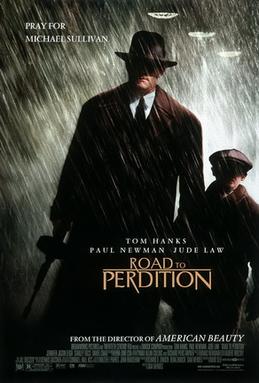
Road to Perdition

Right up there with pizza, hot dogs, baseball and the Windy City nickname, the city of Chicago is often remembered for....you guessed it. Gangsters! From Al Capone to the Untouchables and a whole lot of violence in between, Chicago's gangster history is well-documented, a feature well covered in film and pop culture. One of the best though? It's not based on a true story, but you can definitely see it happening in real life. Here is the excellent, beautifully told, stylish gangster drama, 2002's Road to Perdition.

It's the late 1920s and young Michael Sullivan (Tyler Hoechlin) is your typical 12-year old. He fights with his younger brother, struggles some at school, and loves reading about heroes of the old west. That relatively peaceful life is about to be thrown for a loop. His father, Michael Sullivan Sr. (Tom Hanks), is a brutally efficient enforcer for an Irish mob boss, John Rooney (Paul Newman), in Rock Island, Illinois.  One night, Michael follows his father on a nighttime job and witnesses a hit that he clearly was not supposed to see. The unintentional incident steamrolls into something far bigger and far deadlier than young Michael ever intended. Now, father and son are on the road, hiding out and simply trying to survive, all the while a sinister hired killer, Maguire (Jude Law), hot on their trail. The elder Sullivan is now looking out for himself, his son, the killer hunting them and at the same time enacting a plan to exact vengeance on those who have wronged him.

That's not my best work putting together a plot synopsis. I don't want to give too much away in terms of the story because there are some genuinely good twists that do come as a bit of a shock. A lot going on in terms of storytelling overall, but getting there is half the fun in this 2002 gangster/crime drama.

There are more action-packed gangster flicks, more mainstream than this film, but I don't know if there's too many better. You look at the entire package, and this is one excellent movie, a classic if you ask me. This is director Sam Mendes' follow-up to 1999's American Beauty, and 'Perdition' is a gem. I'll get more specific as we go, but there's just so much going on and it all flows together. The story is exceedingly simple but with complex layers mixed in. It's not always clear where it's going, but Mendes know where it is going, and that's what is most important. The characters, the story, the filming techniques. It is all pretty flawless if you ask me. My recent viewing was the first in many years, and it resonated more now than in previous viewings. Scary to think 'Perdition' is already 13 years old but this is a film that has definitely held up.

This isn't a perfect movie. But judging it solely based on technical features? It's pretty perfect. The cinematography, the set design, the style, the musical score, the scene-to-scene visuals, my goodness, 'Perdition' is on point. Cinematographer Conrad L. Hall (earning an Academy Award win) is at the helm of a gorgeous movie. It's not a colorful movie -- lots of dark tones -- but entire scenes appear almost as if they were lifted out of a painting. You feel like you're in 1930s gangster-dominated Chicago throughout. The cars, the sets -- including Chicago locations -- the wardrobe, everything feels like you've time-traveled. Some movies, they don't call attention to these things. 'Perdition' does it in effortless fashion. It doesn't call attention to its prowess, it just does it and lets you appreciate it all. Also picking up a nomination (albeit without the win) is Thomas Newman for his musical score, a heavily Irish-themed score that elevates the movie in so many scenes, one after another. Give it a sample HERE.

The guts of the story is the father-son relationship between Michael Sr. and Michael Jr., but also between Michael and his surrogate father of sorts, Newman's Rooney. There's also Rooney's tortured relationship with his own son, Connor (Daniel Craig). Hanks plays against type a bit as Sullivan, dubbed the Angel of Death, a hard-edged man who is far from an emotional father. He struggles to be close with his eldest son mostly because he sees so much of himself in his son. Likewise, the son wants to be close to his father but isn't quite sure of how to go about that. Through the most unfortunate of situations, they're forced to become closer on the road, running for their lives, and with Michael trying to exact revenge against his previous employers. Their scenes together are quiet and understated, two individuals getting to really know each other for the first time. An excellent performance from Hanks as well as young Hoechlin who holds his own and then some.

Across the board, there isn't a weak performance in the cast. As John Rooney, Paul Newman is a scene-stealer in an emotional, quiet part. Not a ton of screentime, but he steals those scenes like a true pro. It's cool as well to see a pre-James Bond Daniel Craig as his weaselly son, Connor, always causing trouble that he can't get himself out of. Also in the playing against type department, Law is perfectly creepy as Maguire, the sinister hired killer who's tracking the Sullivans as they're on the run. Yeah, he's efficient and almost emotionless, but he clearly gets some enjoyment out of his horrifically bloody work. Also look for Stanley Tucci as Frank Nitti, an Al Capone underboss in Chicago, Jennifer Jason Leigh as Michael's loving wife, Liam Aiken as Peter, the younger Sullivan brother, and Ciaran Hinds as an underboss for Rooney who may be in some hot water.

For a gangster/mobster movie, the action isn't left and right machine gun pacing. When it comes, the violence is quick and startling but not horrifically graphic. Because it isn't used as much, when it does pop up on-screen, it is far more emotionally effective. One late shootout is easily top 5 most stylish action scenes I've ever watched, silence and darkness lingering in the air. The immediate follow-up is equally memorable, an extended shot following one character through an elegant Chicago hotel with quite the punch of a finale. The ending isn't especially surprising but it is especially effective. A great movie, one I really enjoyed catching up with and can easily and highly recommend.

Oh, and just as a trivia tidbit, my Uncle Bob is an extra in the movie. He's clearly visible in one scene a little over halfway through the movie as Hanks' Michael walks into a bank. Yeah, he steals the movie.

Road to Perdition (2002): ****/****

Wednesday, March 4, 2015

The Verdict

For me, Paul Newman will always be amiable outlaw Butch Cassidy. He'll always be Henry Gondorff from The Sting. I've seen a lot of Newman's films from a career that spanned six decades, but not all of them. My biggest gap is probably the 1980s which as I look into it, is a big old knowledge gap. Newman was nominated for three different Oscars for acting during that decade, including a supremely strong performance in 1982's The Verdict.

A Boston lawyer who's fallen on some extremely tough times, Frank Galvin (Newman) isn't what he used to be. Once a promising lawyer, Galvin is an alcoholic, an ambulance chaser who has had only four cases over the previous three years. And he lost every single one of them. There's a new case on his schedule though, seemingly a slam dunk. A young woman giving birth was given the wrong anesthetic and four years later still remains in a coma in a nursing home. The hospital the event occurred in was a Catholic hospital with the archdiocese looking to move on from the incident, looking to settle without going to trial though. A huge payday is in the waiting, both for the plaintiff's family but also for Galvin for his fee. Something clicks in the experienced lawyer's mind though. Something just not right. He turns down a generous settlement and decides to go to trial. Though his intentions are pure, Galvin may be in far over his head.

This 1982 courtroom drama from director Sidney Lumet aired recently as part of Turner Classic Movie's 31 Days of Oscar. It's based off a screenplay from David Mamet of Glengarry Glen Ross and The Untouchables fame among others. Oh, and that Paul Newman guy is pretty good. I'd never seen this movie before -- not even a scene -- but I'm glad I caught up with it. Somber, even downbeat, with a harsh story to tell, it deserves the reputation it has. I loved Lumet's shooting style with an unobtrusive camera that simply films the action. It isn't moving frenetically with zooms and close-ups. Lumet sets the camera up and lets the cast act. Just ACT. We get long, uninterrupted scenes of dialogue where Newman and his co-stars have the audience's full attention. In an age where movies are all about the style, it's refreshing to see a movie so uninterested. Here's the story, the cast, and the acting. Go and do your thing.

The heart of the movie -- not so surprisingly -- is an excellent performance from Paul Newman, a performance that earned him a Best Actor nomination (he lost to Ben Kingsley's Ghandi). This isn't Butch or Gondorff or Fast Eddie, a confident world-beater with a smile on his face. Newman brings to life a lawyer riddled with self-pity who drinks and drinks, trying to put his past behind him. At one point, he was a damned good lawyer but a decision he makes for the good...almost finishes him. It's a fascinating character, one you're rooting for but with a grain of salt. You can't help but wonder how he's going to miss this seemingly gimme of a case up in the courtroom. Most memorable is just the quietness of Galvin. Newman doesn't have huge, LOOK AT ME moments. It is a quiet, subtle performance with the most emotional scene coming in his closing statement. My other favorite? The moment he makes the decision to take the case to trial, a quiet moment sitting by the patient's bed. Just good stuff.

This isn't the deepest of casts, but what's there is choice. Also picking up an Oscar nomination -- for Best Supporting Actor -- is James Mason as Concannon, the defense lawyer who at one point is dubbed the Angel of Death. No plan, no scheme, no bribe is too much for this lawyer who will get his defendants acquitted at all costs. Charlotte Rampling is excellent too as Laura, a woman coming off a divorce that Galvin meets in a bar and starts to help the beat-up lawyer in his case. In a thankless role, Jack Warden nonetheless makes the most of it as Morrisey, Galvin's former professor and current friend who becomes his right-hand man in the case. Also look for Milo O'Shea, Edward Binns, and Joe Seneca in key supporting roles.

Like the best courtroom dramas, 'Verdict' makes you feel like you're there in the courtroom as part of the jury. And as usual, what's my biggest takeaway? The American court system is a frightening one. Nothing is off limits including straight-up cheating, bribes and all sorts of letter of the law garbage. The idea of the court system is impressive, built on an ideal of justice as Galvin describes. In reality, it just isn't the same. Winning the case takes priority regardless of the means. We see that over and over again as the case develops, in and out of the courtroom.

'Verdict' becomes a little predictable in its second half, but it's never dull or disappointing. I especially liked the somewhat open-ended finale with Newman -- again -- nailing a quiet, dignified scene. Yes, it's a courtroom drama, but more accurately, this is a character study of a talented lawyer who's fallen on some hard times and sees a chance at some sort of redemption, both for the family he's trying to get a settlement but also for himself. Just an excellent all-around movie, most notable for Newman's Oscar-nominated performance.

The Verdict (1982): *** 1/2 /****

Thursday, August 7, 2014

Silent Movie

Certain names rise above the genre they're associated with. And when you talk about the comedy genre in Hollywood, few names hold such power, respect and name recognition as Mel Brooks. A director, writer, actor and producer extraordinaire, Brooks did it all with too many classics to even mention to his name. And what do you get with power and an ability to make some serious amounts of cash? A movie like the 1976 comedy Silent Movie.

A very successful movie director, Mel Funn (Brooks) has fallen on some very rough times as he has retreated into a bottle.  After years away from movies, Funn has a script that will hopefully turn his career around. With his friends and sidekicks at his side, Marty Eggs (Marty Feldman) and Dom Bell (Dom DeLuise), Funn heads into Hollywood with his script and convinces a Big Studio executive (Sid Caesar) to back his movie....if he can get some big stars attached to the production. With their work cut out for them, Funn and Co. set out to find enough big movie stars to work with but it's going to be easier said than done. A film studio, Engulf and Devour, has been scooping up struggling movie studios left and right, and they'd like nothing more than to buy up Big Studio too. Can Funn put his drinking problem aside to get his dream movie made? What is that dream movie? Well, Funn intends to make a silent movie. Dun-dun-duh!!!

Ready for a twist? Writing, starring and directing 'Silent,' Brooks is at the helm of an actual....silent movie!!! You know, because there's always so much demand for that throwback feel of a silent movie! It plays as a tribute to the slapstick stars of the silent era like Charlie Chaplin and Buster Keaton, even evoking moments of The Three Stooges, The Marx Brothers, Abbott and Costello, and Laurel and Hardy. Famously, only one word is audibly spoken in this comedy, dialogue cards popping up as our stars discuss and talk on-screen silently. We're introduced to sight gags, musical cues, sound effects throughout the 87-minute running time, a series of jokes on top of each other. Brooks has a ton of fun with those little moments, the soundtrack setting up a joke and then pulling out the rug from under us.

That's all well and good, the tribute working well. But still, I don't think the movie is as funny as the movie thinks it is. The script is interesting, the stars very talented, and a handful of cameos providing some memorable moments. 'Silent' is going for the laughs, but they're not necessarily there in the end. I chuckled a couple times, smiled a bunch, laughed out loud once or twice but at no point did I think I was watching a hilarious, laugh-riddled comedy. None of this is to say it's not good. It is good, but 'Silent' isn't even close to as funny as it think it truly is. Moments work, a sight gag here and there, but as a whole, there's no unifying link that holds it all together unfortunately.

So, yes, the laughs aren't there in abundance as I might have liked. There are moments though that work because quite honestly, there's too much talent assembled here for it to not be somewhat entertaining. So Brooks, Feldman and DeLuise? Yeah, they have their moments. It's the little things, not the big moments. It's how they walk in step inches apart from each other. It's how they hug like they've won the lotto when the movie gets approved, prompting the beginning of a running gag with on-lookers muttering a perfectly placed slur. They each get their bits, Brooks the leader who falls for a sexy seductress (Bernadette Peters) sent by Engulf and Devour to destroy Funn. Feldman's Eggs is always trying to hook up with beautiful women, usually going down in flames, while DeLuise's Bell is perpetually drinking Coke and always needing to go to the bathroom. Great comedic minds at work.

Also look for Harold Gould as Engulf and Ron Carey as Devour, the studio heads so desperately trying to stop Funn from making a successful movie. Huge, over the top parts with so obviously evil villains.

All things considered, the best thing for me from 'Silent' was the cameos, some big-time stars poking fun at themselves with some quick appearances. That group includes Burt Reynolds, James Caan, Liza Minnelli, Anne Bancroft, Marcel Marceau and Paul Newman. Reynolds especially stands out, playing up his good looks into a star obsessed with his own looks. The scene where Funn, Eggs and Bell end up in the shower with him is pretty perfect, one of the moments I genuinely laughed out loud. Caan too is very good, playing the kinda slow movie star who invites Funn and Co. into his off-balance trailer as they serve some lunch. It is a solid example of how subtle physical humor can work in an almost effortless fashion.

Still, I struggled to get through this one. No cohesive link, some solid moments lost in a wave of lesser moments that don't work so well. Not a positive rating, but it's still one I can mildly, mildly, recommend because when it works, it works real well.

Silent Movie (1976): **/****

Thursday, July 11, 2013

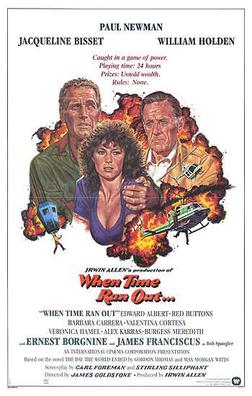
When Time Ran Out

With The Poseidon Adventure and The Towering Inferno to his name, producer Irwin Allen had quite the track record when it came to disaster flicks. In this case, he went back to the well once too often, and the end result is a less than quality final product, 1980's When Time Ran Out.

On a remote island in the Pacific, extremely successful businessman Shelby Gilmore (William Holden) is putting the final touches on his newly constructed hotel resort with his partner, Bob Spangler (James Franciscus), a longtime native of the island. Miles away from the oceanside resort is a volcano that's been dormant for over 60 years, but it is starting to show signs of another eruption but on a far greater scale than it's ever shown. Drilling an oil well on the island with his crew, Hank Anderson (Paul Newman) sees all the telltale signs of what's to come, but he can't convince Spangler to prep for what promises to be an epic disaster (money is a powerful motivator, isn't it?). As he makes a last ditch effort to convince others, the volcano explodes in grand fashion. Can all the island inhabitants and guests find a way to survive?

Like any successful genre, 'Time' follows the formula laid out by countless other disaster flicks. Assemble an all-star cast of actors and actresses, put them in some ridiculously perilous situation, and see who survives. The only problem? Well, other than the script that is. By 1980, the genre had outlasted its welcome a bit. Audiences had seen just about every calamity a disaster film could throw at them. How many times can you see the same movie over and over again, just replacing the man-made disasters, natural disasters or various diseases? 'Time' bombed in theaters and received some very poor reviews. Star power aside, it's got nothing going for it. Other than that? It's a real winner.

What sucked me in was the casting. To be fair, these are all cardboard cutouts of real characters, but the star power is legitimate. Newman is sleepwalking as Hank, the quiet oil driller who steps up as a hero because all disaster movies need a hero. He's also in trouble when he meets his ex, Kay (Jacqueline Bisset, around to wear a low-cut, tight T-shirt), who's now dating Holden's Shelby. Uh-oh, relationship drama! Sit back though, we're just getting started. Franciscus is the big villain -- $ $ for eyes -- who's cheating on his wife, Nikki (Veronica Hamel), with a hotel employee, Iolani (Barbara Carrera), who's engaged to islander Brian (Edward Albert). And just because, there's also Ernest Borgnine's NYC cop tracking a possible crook (Red Buttons) while Burgess Meredith and Valentina Cortese play an old married couple. There's also Alex Karras as Newman's right hand man, Pat Morita as a saloon owner and Sheila Allen as Mona, his wife.

Now more than just the all star cast is how the all star cast is treated. You could do a drinking game with these movies, or you could keep a scorecard. Every time a celebrity dies, take a shot. Throw $20 in and whoever guesses which celebrities survive and which ones don't gets all the money. The volcano explodes about halfway through director James Goldstone's flick, giving plenty of time for all the celebrity carnage. There's some surprises here, but nothing gigantic. Still, you've got to stick with it. Who makes it?!? Who doesn't?!?

Mostly though, the issue here is that it's just too dumb for it's own good. The volcano explodes so Newman's Hank leads a small group of individuals away from the fast-moving lava. Seems like sound thinking, right? Oh, no, they're all celebrities! Something bad might happen to them! It's beyond cliched here. The group must actually walk along a mountain ledge that's about to fall apart. Then, they've got to navigate a rickety wooden bridge that stands over a deep, flowing river of lava! That extended sequence goes on for about 20 minutes and actually ends with Meredith saving two kids by walking a tight rope (read = thin wooden rail) with a balancing act. The scene goes on and on, lacking any real tension.

For a movie budgeted at $20 million, it's hard to see where all that cash went. The special effects are laughable, especially the projectiles thrown from the volcano, usually landing directly on the hotel and/or people. The two sequences above were clearly shot on a poorly lit indoor stage, adding a nice touch of realism to the proceedings. That's a joke by the way. Then, at different points, the volcano is either right on top of the hotel or miles away as needed. Whatever is most appropriate for that given shot. This one's a dud. Even the all star cast couldn't save this one.

When Time Ran Out (1980): */****

Friday, September 7, 2012

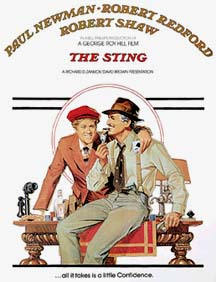
The Sting

Pairing Paul Newman and Robert Redford, the duo ended up being a match made in heaven for 1969's Butch Cassidy and the Sundance Kid. Could the pairing work again? Oh, you bet. Teaming up again for 1973's The Sting, Newman and Redford again show off an impeccable chemistry, a great back and forth, and a whole lot of talent in one of the 1970s best movies and one of my all-time favorites.

Working in 1936 Joliet just outside of Chicago, con man Johnny Hooker (Redford) pushes too far on one con when he and his partner, Luther (Robert Earl Jones), steal some $11,000 from a money runner working for big-time New York mobster Doyle Lonnegan (Robert Shaw). The mobster hears about it and in the aftermath, Luther is killed. On the run and always looking over his shoulder, Hooker seeks out Henry Gondorff (Newman), an infamous con man himself who's now on the run from the F.B.I. after a con of his went south. Hooker teams up with Gondorff, hoping to run a long con on Lonnegan to exact some revenge. With countless thieves, con men and grifters working their magic, a long list of things need to happen to pull the job off, but Gondorff and Hooker go to work knowing if the con fails, they may pay for it with their lives.

 The Newman-Redford pairing -- along with Butch and Sundance director George Roy Hill -- is clearly one that works and is a key reason for the movie's success. I don't say this often because I don't want to overdo and/or overuse it, but The Sting is one of those rare perfect movies. All the scenes work without any extra fat on the bone. Even at 129 minutes, it flows effortlessly. The script (which won an Oscar) is one of the all-time greats. On first viewing, it might be a little difficult to keep up with everything, but in the end it fits together like puzzle pieces clicking into place. Smart, funny and well-written, the script helps bring this criminal underworld to life....in a nice way. It's the 1930s "criminal" underworld that the movies presented.

A period piece like this depends on a couple different thing. The first and usually most important? Does it look and feel authentic to the period it is set in? That's a safe answer here. The look of the movie ends up being an additional character. You genuinely feel like you're watching 1930s Chicago from the sets to the bad-ass suits to the cars zipping around the downtown streets. Much of the film was shot in California backlots, but several scenes were filmed on-location in Chicago, including LaSalle Street Station, Union Station and the Penn Central Freight Yards. What most people will remember from 'Sting' though is the music, starting with Scott Joplin's whistle-worthy theme, The Entertainer. It gives the story a light-hearted touch -- almost a goofy feel -- but it ends up working perfectly with the tone. The locations, sets, costumes, and music all contribute to a great retro style -- along with title cards introducing the scenes -- that is hard to replicate.

So Newman and Redford, pretty cool, huh? They just don't make stars like this anymore. Watching talented actors of this caliber on-screen, it's just fun. Their chemistry never feels forced. It's just two guys playing off each other like they have been doing it their entire lives. While both actors play prominent roles, more focus is given to Redford's Johnny Hooker, a talented if younger grifter looking for some revenge. He learns the ropes from Newman's more experienced, somewhat grizzled con man. Redford was even nominated for an Oscar for his performance, but both have their moments. Newman especially gets some laughs in his scene where he meet Shaw's Lonnegan, posing as a drunken but rather lucky poker player who throws the hook out there so the crew can reel in their target. Putting on a big, boisterous entrance, Newman (entering with "Sorry I was late, I was taking a crap") hits all the right notes in a part that allows Redford most of the spotlight.  

In one of his most memorable roles before his death at the age of 51, Shaw is a great villain to counter Newman and Redford's very likable crooks. His Lonnegan will kill anyone who gets in his way and isn't picky or squeamish about doing so. As for the rest of the cast, Charles Durning is appropriately double-handed as Lt. Snyder, a Joliet cop with a grudge against Hooker. Putting together a team of thieves, Gondorff assembles Kid Twist (Harold Gould), the smooth-talking organizer, J.J. Singleton (Ray Walston), the veteran con man with a knack for investigating, Eddie Niles (John Heffernan), the numbers specialist, Billie (Eileen Brennan), his madam of sorts, and Erie Kid (Jack Kehoe), Hooker's former partner who's down on his luck. Dana Elcar has a small part too as F.B.I. agent Polk, hot on Gondorff's trail.

What I love most about The Sting though is how it all comes together in the end. We're given all these clues, characters and situations early on, but we're never quite sure how it fits together. The title cards sort of help -- The Hook, The Set-Up, The Sting -- but it's great to see the con come together so smoothly. Gondorff has hinted that it's not always the job that's the toughest. It's the aftermath and getting away alive. With that in mind, the last 30 minutes throws a handful of twists our way, all of them working, some working epically well. It's a great finale full of twists, surprises and some laughs. A great movie from start to finish.

The Sting <---trailer (1973): ****/****

Thursday, June 21, 2012

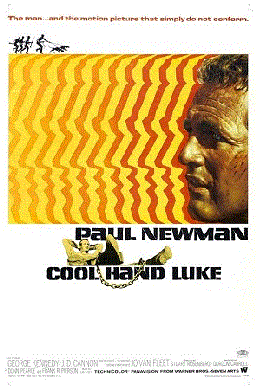
Cool Hand Luke

Heroes are supposed to be noble, loyal, honor-bound and always do what's right. But in the 1960s and its increased cynicism from the audience, was that concept of a hero really going to fly? The idea of an anti-hero started popping up in the 1950s thanks to James Dean and Marlon Brando among others, but for me, the one that kicked the door open in the 1960s was Paul Newman in 1967's Cool Hand Luke.

Having taken the heads off of a long row of parking meters, a drunken Lucas Jackson (Newman) is arrested and sentenced to a two-year sentence on a chain gang in Florida. He meets the Captain (Strother Martin) and his bevy of guards who keep their prison camp roster of 50 prisoners busy on the roads six days a week, but this camp has had nothing like Luke. Easy going enough early on in his sentence, he begins to bristle at being imprisoned, at being told what he's supposed to do. He becomes a hero to his other prisoners, forming a friendship with head honcho, Dragline (George Kennedy), but Luke can only take being held down for so long, and he wants out now.

Paul Newman is one of my all-time favorites, and this is HIS iconic part. Butch Cassidy, The Hustler, The Sting, and many others, all memorable roles, but nothing quite like this one. Want a face for a 1960s audience looking for something different? In steps Lucas Jackson, a man who has little regard for what society says he should do with his life, even less regard for any sort of authority hovering over him. Newman makes Luke -- dubbed 'Cool Hand' for a bluff in poker -- a charming, likable individual, his easy-going, natural smile disarming you in a second. We learn a lot about this character with little background (a veteran, countless jobs, a drifter), finding out that no one and no thing will slow him down. He will do things on his terms, and anyone else can be damned. Newman at his best.

With Newman's Oscar-nominated part at the head, 'Cool' has become one of the seminal movies of the late 1960s, ranking up there with The Wild Bunch, The Graduate, Bonnie and Clyde and several others I'm missing. This is a movie made for a late 1960s audience that isn't content with the status quo. No respect for authority or the so-called 'system'? Check. An anti-hero that wants to do things and live his life his way? Double check. The system are Martin's quiet but intense Captain, Boss Godfrey (Morgan Woodward), the silent guard who wears his ever-present aviator glasses, along with steely-eyed Luke Askew, Richard Donner and John McLiam.  The system is the villain here, imprisoning and breaking the individual down to conform. It's easy to see the appeal in 1967, and just as easy to see now 45 years later in 2012. The thinker, the free spirit, the intelligent rebel, it's an appealing character and premise to root for.

Because Newman's performance is so strong at the top, another part of the film gets lost in the shuffle, and that's the ensemble cast all around him from Martin and Kennedy to the guards to the prisoners. Martin is perfect in his few scenes, including muttering the iconic 'What we have here is failure to communicate.' Kennedy won an Oscar for his part as Dragline, an illiterate but intelligent and fast-talking prisoner who all the other prisoners look up to. Newman and Kennedy play off each other impeccably, the subtle, underplayed Luke with the showier, aggressive and funny Dragline. Other prisoners include J.D. Cannon, Lou Antonio, Robert Drivas, Harry Dean Stanton, Dennis Hopper, Wayne Rogers, Ralph Waite, Joe Don Baker, Dick Davalos and Buck Kartalian among others. Clifton James and Anthony Zerbe are good as prisoners turned associates who help the guards. 

Like any movie that lives on so many years after its release, there's got to be something to make it memorable, and director Stuart Rosenberg doesn't disappoint. The most obvious is Luke stating he can eat 50 eggs in an hour, a classic sequence in its humor, but there's so much more. Luke singing Plastic Jesus -- watch HERE -- after receiving some distressing news is an all-time great. There's Luke earning everyone's respect in a brutal, knock-down boxing match (watch HERE), refusing to go down even when he's beat. There's a teenager washing a car, driving the on-looking prisoners wild (HERE), and up there with Plastic Jesus for the most moving scene, Luke talking with his dying mother, Arletta (Jo Van Fleet). Almost scene-to-scene is aided by composer Lalo Schifrin's amazingly spot-on music, especially the main theme which you can listen to HERE.  

What struck me most in my latest viewing was the darkness of the story. The first hour is generally light-hearted, introducing characters, backgrounds and interactions, setting us up by liking Newman's Luke so much in spite of his bullheaded stubbornness. I'd forgotten then how intensely dark and at times uncomfortable the second half of the movie is. From the start, we know Luke is heading down a bad road, but that unbearable tension and impending sense of doom keeps building. The movie still has its lighter touches -- Luke's escapes provide some unlikely humor -- but there will not be a truly happy ending here. In the end though, one of the final shots shows that free spirits might not always win, but that also doesn't mean the system, authority and power positions will win either. The symbolism can be a little obvious, a little heavy-handed, but the message still strikes a chord.

A classic from beginning to end. End of story.

Cool Hand Luke <---trailer (1967): ****/****

Friday, February 24, 2012

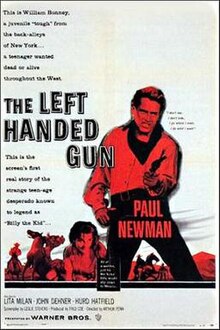
The Left Handed Gun

One of the most well known names to come out of the old west, William Bonney was better known as Billy the Kid, a gunslinger who reportedly killed 21 people in his short 21-year life. This controversial figure has become a favorite in the western genre, his quick, violent life being translated to the screen countless times. The problem? None of them are very good, all of them extremely flawed, especially 1958's The Left Handed Gun.

A drifter and gunslinger without much to his name, William Bonney (Paul Newman) is hired by rancher John Tunstall (Colin Keith-Johnston) to work as a cowhand. In the midst of a cattle range war, Tunstall is killed soon after by rival factions, leaving Bonney looking for vengeance. The four men responsible for the murder are basically let off without a slap on the wrist with young Billy deciding it's up to him to administer justice. With two other cowhands, he sets out to kill the men, one by one, gaining quite a reputation in the process. His name might be too big though with a new governor moving into the territory. Billy's friend, Pat Garrett (John Dehner), has been hired as a marshal to bring him in, and a tortured Billy seems to be running out of time.

The history here is one of the most well-known and still disputed stories involving the wild west. The general facts are known, the names, places and times, but it seems everyone has an opinion about Billy the Kid, especially his death in 1881. There is a comfort level then with a movie like this with anyone even remotely familiar with the Lincoln County War. Anyone not familiar? Oh, boy, this could be interesting. Director Arthur Penn takes a revisionist look at the story. That isn't automatically a bad thing. Many revisionist westerns try to paint the west as it really was, not as it is remembered. Mostly because of Newman's performance the movie is at least watching, but at other times it is surreal in its execution...and not in a good way.

Depending on the account you read, Billy the Kid was an amiable young man who was personable, intelligent and that his outlaw exploits were greatly exaggerated. How then does 'Left Handed' portray him? An uncaged animal who has the maturity of a 13-year old boy, the emotions of a schizophrenic, and personal demons that threaten to cripple his every move. Newman does what he can with the part, making it interesting if not very good, overacting like a crazy man. But no matter what he does, the portrayal of Billy is just plain weird. With his friends Tom Folliard (James Best) and Charlie Boudre (James Congdon), Billy is a cackling, giggling pre-teen who can snap into psycho with the snap of a finger, ready to gun down anyone. His struggles with women leads to the possible rape of Lita Milan's Celsa, a pretty Mexican girl. His vengeance comes after knowing Tunstall for a day (as the movie says, not real life), Billy clearly looking for some sort of father figure. He wastes away as the bodies mount, an anti-hero to conquer all anti-heroes. Worst though, I'm not sure what Penn is going for or what he's trying to say.

The part of Billy was originally given to James Dean, but the young actor was killed before production started and in stepped Paul Newman. The original casting is perfect because Billy here is basically Rebel Without a Cause with a six-shooter. I give Newman credit for committing to this part. He is eternally watchable no matter the part, and that is on display here. In the hands of a lesser actor, this part would have been a trainwreck, the overemotional, high strung gunslinger basically being asked to be gunned down. To a point, Newman keeps it grounded as much as he can, but the movie on the whole does nothing to help him. In its attempts to make the events "real," the story ends up being so theatrically ridiculous, so BIG emotionally, that it all falls apart.

There just isn't much going for this movie. The score from Alexander Courage basically blares in your ear the whole time, telling you what to feel emotionally. Dehner as Pat Garrett has potential, including several good scenes with Billy, but his reason for hunting down the Kid is laughable, and the theatrics of his explosion are equally laughable. Yes, big, angry eyes and screaming. The black and white shooting offers a stark look at the story, a washed out feel to this dark story, but it seems just one town set was used repeatedly. Oh, and for trivia buffs out there, Billy the Kid wasn't a left handed gun. He was a righty. Read about it HERE. It might be more interesting than the overdone movie.

The Left Handed Gun <---trailer (1958): * 1/2 /****

Friday, October 14, 2011

Lady L

The more I see of Paul Newman, the more I come to respect him as an actor. I don't always enjoy his choice of movies or parts, but I can give credit where credit is due.  He branched out, playing an eclectic list of characters and individuals over a 50-plus year career.  Some efforts fall far short -- playing a Mexican bandit in The Outrage comes to mind -- but when it would have been easy to be typecast, Newman tried something else. In a hit or miss historic romantic comedy, 1965's Lady L, Newman adds another oddity to his listing, a French thief who joins a revolutionary group.

This is a movie that is also known for its director, taking a trip from around the camera where he was usually in front of it acting, Peter Ustinov. The actor from movies like Spartacus and Quo Vadis takes a crack at directing, one of just six films he did over his career. It is an odd movie overall with a story that doesn't sound like a comedy but ends up being just that, a love story with some weirdly funny (and others not so funny) moments.

An old woman nearing her 80th birthday, Lady Louise (Sophia Loren) sits down with a writer and old friend, Percy (Cecil Parker), to tell him the story of her life growing up. As a young woman, Louise worked in a Paris bordello as a laundry girl where she meets Armand (Newman), an anarchist bank robber who the French police would like nothing more than to arrest him. She joins him in his adventures and misadventures, quickly falling in love with him. Adventurous Armand eventually ends up with an extremist group looking to assassinate a Bavarian prince, causing Louise to question if she can put up with him. She meets Lord Lendale (David Niven), questioning even more now who she belongs with. Could it work somehow to be with both men?

Like most flawed movies, I'm going to slightly recommend this movie mostly because of the casting. How often are you going to see a grouping of Sophia Loren, Paul Newman and David Niven?  Even when the script and the story is too cutesy for its own good, these three keep it grounded at least a little bit.  Loren -- wearing heavy make-up as an old woman -- gets to show her comedic and dramatic sides, Newman plays the straight man in the ever-growing ridiculous story, and Niven gets to play a variation of himself, a prim and proper Englishman looking for a wife, possibly finding it in Loren's Louise. None of the parts are among any of the three's best, but it's still fun to see actors of their caliber working together.

Writing the plot description made me realize how off the wall this story is. Reading some background on it, 'Lady' sounded like a romantic period piece. Well, partially. The choices made are odd, especially Newman's Armand as an anarchist thief, eventually joining a revolutionary group trying to assassinate anyone and everyone. The assassination attempt is played for laughs -- Ustinov making a cameo as Prince Otto of Bavaria -- so it's hard to criticize too much, but it comes off in poor taste (to me at least). Niven's Lendale later welcomes the members of the group to stay at his villa, preparing their next attack in peace and quiet. It sounds so ridiculous that it almost works, but the story itself is too weird, too different to fully work.

Now in that craziness there are some funny moments, many coming from Claude Dauphin's part as Inspector Mercier, head of the French police trying to arrest Armand. His team of inspectors isn't quite the Keystone Cops, but their efforts to arrest Armand are surprisingly funny, alerting each other the presence of the thief through a series of gruffer and louder throat clearings. Newman's introduction is funny as well, a bank robbery where nothing is at it seems. I did laugh a few times throughout the movie, but the chuckles were lost in a sea of otherwise boring scenes.

Not a long review for this movie because I neither hated it or loved it. The movie has a great look to it, large sets and lavish costumes that reflect the setting of pre-World War I Europe in the first decades of the 1900s. It's funny, but too much and too little at different times. The cast is good but not overly impressive. Average movie that could have been better.

Lady L <---TCM trailer/clips (1965): **/****

Tuesday, September 6, 2011

Paris Blues

Celebrities should stick to what they do best. Movie stars do movies, musicians do music, and sports stars stick to sports. Of course, as the people watching those celebrities, we're not always so lucky as they make crossovers into other ventures. They're not all bad though depending on the talent involved and the right situation. An iconic musician known for his gift to play the jazz trumpet and his instantly recognizable raspy singing voice, Louis Armstrong was first and foremost a musician, but even he made some ventures into film with 14 credits to his name. I was genuinely surprised to see him pop up in 1961's Paris Blues where he has small part as a jazz trumpeter and band leader. Obviously quite a stretch for Armstrong. It's a good example of how the right script and character can work for a non-actor in a movie that pleasantly surprised me.

Aired recently as part of TCM's day-long tribute to Joanne Woodward in the Summer Under the Stars festival, this is a movie that has several individuals working together in collaborations that obviously worked for everyone involved. Director Martin Ritt made five movies with star Paul Newman over a 10-year span with Ritt also working with star Sidney Poitier several times. Throw in Newman's marriage to Woodward -- the husband and wife were in 10 movies together -- and you've got a feeling of familiarity and comfort all over the picture...in a good way. It has the feel of a film noir from the late 1940s with its black and white filming but with a stylish, artsy feel to the proceedings thanks to the Paris setting. In general, 'Blues' plays more like a French movie than a U.S.-produced film, relying more in realism and honesty than everything ending up wrapped nicely with a bow. For me, always a fan of realism in a movie over sugary goodness, that's always a good thing.

Living in Paris, Ram Bowen (Newman) is following his dream, trying to make it big as a jazz musician with his band. He's written a jazz piece with one of his band members, the very talented and versatile Eddie Cook (Poitier), and hoping he signs a deal somewhere to rise to stardom. He's living life completely devoted to music, void of basically anything else meaningful. One night after a show, Ram meets Lilian (Woodward) and her friend, Connie (Diahann Carroll), two American women on vacation from America. Ram gets off to a rocky start with single mom Lilian, not showing much interest in her at all, but he comes around and hits it off with her. Both Ram and Lilian and Eddie and Connie start seeing each other every day, the relationships developing quicker than any of the four ever imagined happening. But this short vacation romance, is it doomed to failure? Ram is driven by his music, and Eddie has no interest in returning to the U.S. where he's judged by his skin color, not his musical ability. What will win out in the end?

This 1961 romantic drama is a prime example of a time gone past when romance and/or a love story in a movie didn't mean cheesy, over the top romantic comedy. It is stylish and low-key without a lot of ridiculous theatrics or cliched plot devices. I liked the movie that much more because it didn't try to be anything ridiculously unique. Ritt and his script are quite content to focus on two relationships -- both with their good and bad features -- that develop quickly but with an end in sight. All four individuals are looking for a feeling of right in their lives, whether they know it or not. They want to be happy in their day-to-day lives and have to figure out what that means. Is it a long-term relationship with someone you love, or is it a goal and a dream down the road that you must continue to work at? The decision isn't an easy one, including an ending that surprised me in its honesty, especially because it makes sense. A different ending that was more tidy would have been easier, but it would have rang false. Not the case here.

In general, I watched this movie because of its two leads, Newman and Poitier.  The story itself -- which I ended up getting sucked into and really liking -- didn't jump out at me right away, the cast did.  Issues I have with the movie had little to do with the performances from those two acting heavyweights either. Newman was in his roguish period where he played moody, temperamental a-holes who you don't necessarily like, but they're interesting to watch. He has a great chemistry with Woodward -- good thing considering their marriage -- and his character in general is interesting. A talent who hasn't quite hit the big time even as he so desperately wants to. That half of the story was the one I was much more interested in. Poitier and Carroll don't quite have the same interest level. Poitier is underused, and the character isn't given much to do, but that's not his fault. He brings his typical charm and professionalism to the role. Carroll's character is the problem, a  pretentious, manipulative individual who I didn't like from the get-go. Whenever her character is on-screen I found myself wishing she wasn't. That's never good.

There are few cities as perfectly suited for setting a movie as Paris, one of the most gorgeous cities anywhere.  Unfortunately, the movie is undone at times by back projection shots where the cast is "inserted" into Paris via a background shot.  Other shots have studio sets filling in for the City of Lights.  Still, there is enough actual shots of Paris to keep it interesting.  The setting ends up becoming another character by the end. It is a city full of cultures and individuals with their own unique, Bohemian lifestyles. It was a time in the 1960s where people gathered in smoke-filled bars and listened to jazz bands just go to town.  'Blues' certainly brings that atmosphere to life. As for the cast, Armstrong is basically playing himself, but it's what his character represents -- success and popularity on a grand scale -- that is important. Barbara Laage plays Marie, Ram's casual love affair, the resident and necessary sexy French woman while Serge Reggiani is a scene-stealer as Gypsy, a member of Ram's band, a supremely talented guitarist struggling with a drug addiction.

As I try to wrap this review up, I'm seeing that I'm painting a more negative picture of the movie than I'm intending to. Other than Carroll's shrill character, my only real complaint are a handful of scenes that push Duke Elllington's jazz score to the forefront of the movie. There are long scenes of jazz musicians going crazy on their solos, adoring fans and crowds staring at them taking it all in. I'm not a jazz fan so these scenes are probably lost on me. Jazz music just seems like freestyle to me, a lot of long, tedious songs that don't really go anywhere or do anything. The exception is a cool three-way song between Armstrong (actually playing) and Newman and Poitier (pretending to play). So over-reliance on those jazzy scenes aside, I liked the movie, the positives outweighing the negatives. A pleasant surprise overall.

Paris Blues <---TCM trailer/clips (1961): ***/****

Saturday, July 9, 2011

Pocket Money

My high school and college Spanish only takes me so far when it comes to actually understanding the language. That can be a problem when trying to understand and keep up with a Spanish movie, or at least an American-made movie dubbed into Spanish.  That's where I was first introduced to 1972's Pocket Money, a late night showing of this modern western. When I saw stars Paul Newman and Lee Marvin, I sat down and trudged through it, trying to keep up with the language the best I could.

Long story short? My Spanish isn't that good if I have to rush to keep up. I had no real concept of what was going on but went along for the ride. The problem arose that this was not a movie available in any formats, and TCM wasn't showing it as part of their rotation.  Well, finally it was released on DVD as part of a Newman film collection, and how many years later I was able to catch up with it. I knew going in that it wasn't either actor's best work, but as a fan of both, I wanted to give it a try...in English this time around.

A down on his luck Arizona cowboy, Jim Kane (Newman) has been dealt some bad news when he finds out the horses he's brought to market have to be quarantined with the horse equivalent of an STD. He needed the money he would get for the sale to pay off a bank loan, but now he's up the creek. Looking for work -- any sort of work -- Kane makes a deal with a somewhat shady businessman, Bill Garrett (Strother Martin), to herd cattle up from Mexico into the U.S. for an upcoming rodeo. Something about the deal doesn't strike Kane quite right, but desperate for the cash he takes the job. With help from an old friend and "cattle broker," Leonard (Marvin), he heads south to round up the animals, but nothing is going to go as planned for this perpetually down on his luck cowboy.

The ingredients for a really solid modern western were all here.  Marvin and Newman working together for the only time was the only selling point I needed to hear.  The plot reminded me some of Cormac McCarthy's All the Pretty Horses, and when I saw Terrence Malick had written the script I was psyched.  Throw in supporting parts for Martin, Wayne Rogers, Matt Clark, Hector Elizondo, Gregory Sierra, and Fred Graham too. Something doesn't make the transition though because the end result is a story that meanders along too much with an already short 99 minute run-time and never really gets anywhere, finishing where it started. It isn't a bad movie, just one that fails to make much of an impression.  I watched it last night and early this morning, and I'm already struggling to remember much about it. That's never a good thing.

If you're going to watch this movie though, I'm guessing it will be because of Newman and Marvin in the two lead roles.  What makes it worthwhile seeing these two legends work together is that they both play against type.  Newman's Jim is a nice enough guy, a hard worker, and a decent cowboy, but he just isn't the sharpest crayon in the box.  Stupid is too harsh, and dim-witted sounds too comical, but there's a naivete to the character that you rarely see in a Paul Newman movie. The same for Lee Marvin as Leonard, a businessman and cowboy who always wears a suit and tie while working. He's not as intense or intimidating as so many other roles, but Marvin easily slides into the part.

The chemistry between the two is not in question here.  With a story bouncing around between some dramatic scenes and some comedic exchanges, the duo makes it look effortless.  It's more impressive when you consider the script just doesn't give them much to do.  Maybe it was just early in his career as he was finding his voice, but Malick's script is not a strong one. It relies far too heavily on the star power without developing any sense of pacing or character development. As a topper, it's never quite clear what's going on.  There are moments of great quality, especially Marvin's speech to their Mexican cowhands and Newman's confrontation with Martin over their deal, but the long stretches of nothingness handicap the movie too much overall.

I can't put my finger on what went wrong with this movie.  Is it drama or comedy? Is it neither? Maybe I'm judging it too harshly, but I came away empty from it as if the movie had left no impression on me at all.  I don't know what else to say. The Mexican locations are authentic -- appropriately enough -- and Carole King's song (listen HERE) is pretty standard fare for a folk song theme played over the opening and closing credits. I wish the movie was better, but it never amounts to anything.

Pocket Money <---Youtube clip (1972): **/****

Tuesday, June 14, 2011

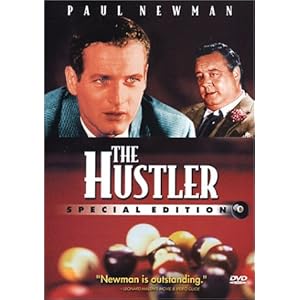
The Hustler

Airing for five seasons between 1959 and 1964, The Twilight Zone produced countless classic episodes, shows that have lived on over the last 50-plus years.  I can think of a dozen or so that I could rattle off, one better than the next. One that always stuck with me though starred Jonathan Winters and Jack Klugman as an established pool shark, a legend, and the up and coming shark looking to make a name for himself. Somewhere, sometime in my head, I convinced myself that it was the basis for 1961's The Hustler. Not quite, but the basic premise and set-up is similar.

Even more than three years since his death in 2008, it's hard to believe that Hollywood acting legend Paul Newman passed on.  He was and is one of the greats, a movie star and an actor. What is odd though -- for me -- is that I was always a fan of his without actually seeing many of his movies.  As I seek more of them out, I've come to a realization. Newman's performances are rarely if ever in question. His acting is almost always top-notch. It's the movie as a whole though that doesn't always quite live up to expectations. I'm not quite sure where 'The Hustler' falls.

A pool hustler who travels the backroads and little towns looking for a game, Eddie Felson (Newman) has his sights set on a living legend in pool halls, Minnesota Fats (Jackie Gleason). He gets his wish, playing Fats in a marathon game of straight pool, even going up as much as $18,000 at one point. Eddie pushes too far though and keeps playing, losing it all and putting him right back where he started. Eddie meets Sarah (Piper Laurie), a similarly jaded individual with her fair share of problems, the two bonding through their problems and finding someone else exactly like the other. Eddie starts to scrape together money, hoping to get a rematch with Fats, even signing on with shady gambler/bookie/businessman, Bert Gordon (George C. Scott), to bankroll him. All Eddie wants is a shot at Fats, the money doesn't mean much. He wants the fame, the reputation, the recognition, but for him, it may be too late.

Cool Hand Luke is my favorite Newman movie, and probably my favorite role of the actor's, but I think this may be his best acting performance overall.  I've always liked Newman as an actor because he's very natural onscreen, but he is also actually acting. He's capable of humor and high drama and everything in between.  This is a part that certainly leads to the high drama.  Eddie -- dubbed Fast Eddie for his hustling ability -- is at first just a young rising star who wants his shot at the legend. It's quickly apparent that his ego and pride is going to get the best of him.  He is obsessed, hitting rock bottom immediately. His character is so blinded by his drive that he doesn't realize he's destroying himself in the process of trying to better himself.  Newman dives into this character head first, committing from the get-go, and he brings this tragic character to life vividly.

There is a style to so many 1960s movies that is just hard to explain. They're cool because they're cool, and they know it. They don't have to try to be stylish or edgy. They just are. Director Robert Rossen here turns in one of the most effortlessly stylish and cool movies I can think of. The movie is shot in black and white which I'm always a fan of. It's easy to say now because I've already seen the movie in B&W, but it's hard to imagine it in color. As is, the movie is stripped down and bare-bones. It just works that way, reflecting what's going on in Eddie's head. Anything extra or not essential gets thrown by the wayside. The best parts of the movie are shot in smokey, dingy pool halls, but there is an unexplained coolness to them. Maybe just because its the 1960s, maybe it is the jazzy score from Kenyon Hopkins, the movie is fun to watch.

With a movie that runs 134 minutes, there are moments of perfection followed by stretches of dullness and boredom. The introduction is classic in the pre-credits sequence, and the epic duel between Eddie and Fats is a landmark sequence that goes on for most of a half hour (Newman and Gleason doing a lot of their own trick shots too, impressive). I would have never thought watching pool would be fascinating, but 'Hustler' proves otherwise. Gleason is a scene-stealer, and he basically has about 14 lines of dialogue. He's impeccably cool and calm, understated and confident in his ability. Just when Eddie thinks he has him, Fats cleans up, puts his jacket back on and is ready for a new round. You feel intimidated just watching him, much less playing him. Gleason disappears then until the end, but he makes every second onscreen count.

This early pool marathon session does two things, it sets the story off at a brisk, exciting pace (the good), and then lets the story sink some (that's the bad for those slow readers out there) in terms of pacing.  After the game, the story just lags, boring me as Eddie meets equally troubled Sarah (Laurie does a fine job with the part). The character study is interesting, seeing what makes this man tick, but I got bored seeing it develop. Scott's reappearance late as Gordon is a movie-saver, adding a dark, seedy element to the story. The ending is quite a downer, but in an appropriate way, a fitting end for Eddie. I loved Newman's performance, liked other parts of the movie, and was bored in still others. A mixed bag, but still a good movie.

The Hustler <---trailer (1961): ** 1/2 /**** 

Tuesday, May 31, 2011

Slap Shot

Growing up, I watched and played just about any sport on God's green Earth. Baseball, basketball, football, soccer, and everything in between.  Still do. But one sport I never embraced to this day is hockey. Part of that has to do with the Chicago Blackhawks being a black hole for hockey until recently.  More than that though, I was just never interested. That's the big reason I'd never seen 1977's Slap Shot before this weekend. Hockey just doesn't get me like so many other sports.

This was a sports movie that is often at the top of the list of the best sports movies ever made.  After seeing none of it for years, I was excited to see this one.  Star Paul Newman teams with director George Roy Hill for the third time (joining Butch Cassidy and the Sundance Kid and The Sting), and the Netflix recommended rating said I would love the movie. It's a foul-mouthed, filthy, raucous, at times hilarious comedy. So what happened? By the end, I was bored to tears. What's going on?

A grizzled, long-time veteran of hockey's minor leagues, Reggie Dunlop (Newman) is a player/coach for the Charlestown Chiefs. He's on the last legs of his career, sticking with hockey mostly because he knows little else to do.  The local mill is closing soon though, and Dunlop fears the team will feel the repercussions, finding out that team General Manager Joe McGrath (Strother Martin) knows the team will fold at the end of the season. With nothing to lose, Reggie starts to work his magic in trying to save the franchise. For one, he floats a rumor that an investor in Florida is interested in buying the team. Second, he turns the team's style into good, old-fashioned goon style hockey, letting the Hanson brothers wreak havoc on opponents. Fans eat up the new brutal style, filling arenas wherever the Chiefs go. Could the team somehow be saved?

I am a sucker for sports movies....any sports movie.  Underdog sports story? Yeah, count me in. Then throw in a story not of the highest level of sports, but the dingy, ratty minor leagues, and you've got a winner. That's what produces the biggest laughs here, the cheap goings on in the day-to-day running of a barely successful minor league hockey franchise. There's Martin's GM McGrath selling off equipment his team needs during the season. There is the clueless radio play-by-play man (Andrew Duncan), asking ridiculous questions and generally not knowing anything about the team. There is the newspaper beat writer (M. Emmet Walsh) who eats up everything Reggie feeds him. Throw in the always cheesy 1970s sense of style, and it all works together nicely, bringing this never glamorous life to the big screen in a generally funny way.

It's the rare movie where Paul Newman gets overshadowed, but it happens here. Meet the Hanson Brothers, the thugs of the Chiefs and the fan favorites in Charlestown and the most hated players in every road team's arena. There is Jeff, Steve and Jack -- ages 18, 19, and 20 -- hockey players with no real skill, but they're goons on the ice...and they're great at it. These three brothers are hysterical. They scream like lunatics at Reggie's pre-game speeches. They drive remote control cars in their hotel rooms. Their looks (including low, shoulder-length hair and wearing their thick, bottle rim glasses) just provide the capper. The brother trio produces the movie's best laughs, especially their on-ice antics.  

So the Hanson brothers steal the movie, but Newman in the lead is no slouch. It's just not his best work either although it is remembered as one of his best parts/movies.  For a movie known as a foul-mouthed comedy, it spends too much time on Reggie's love life, especially with his separated wife, Francine (Jennifer Warren). The Chiefs' best player, Ned Braken (Michael Ontkean), is also annoying as hell, a player who wants to play the right way and objects to Reggie's new thuggish plan. One of the most unlikable characters I can think of.  The Chiefs' roster is where the movie has some fun, including "Killer" Carlson (Jerry Houser), a player who embraces his inner goon, Yvon Barrette as the smallish goalie, Denis, the French Canadian making an attempt at speaking English, and Brad Sullivan as ladies man Morris, among several other laugh-worthy teammates.  

I liked this movie for awhile. The opener is very strong, Carr "interviewing" French-speaking Denis, watch it HERE. The humor is pretty low-brow at times, the type of stuff you would hear in locker rooms of any sports team.  It's funny because it is real. This is how things go, but soon after the Chiefs turn to thuggery on the ice, the movie's humor goes away and never resurfaces.  There's so much spent on the forced drama angle -- Braden and his long-suffering wife (Lindsay Crouse) -- instead of the hockey and the interesting characters. I found myself bored with the last 45 minutes, fast forwarding through whole scenes. The humor gets left behind and Capt. Buzzkill arrives in the form of some dramatic moments.

Then there is the ending, one of the most bizarre finales I can think of (and not in an especially good way). It's just ridiculous, and even stupid (which is saying something considering the low-brow humor there to begin with) as the Chiefs battle for the league's championship. It borders on the surreal, and doesn't make much sense anyways, no matter how you look at it. The actual ending -- the last shot -- has a heavy dose of drama again, a message that feels out of place here.  I certainly wanted to like this movie, and I did like parts of it a lot, but mostly I came away disappointed.

Slap Shot <---trailer (1977): **/****

Sunday, April 3, 2011

Sometimes a Great Notion

Spend enough time in front of a camera, and an observant actor/actress is going to pick certain things up.  More than just acting, you see what it takes to actually make a movie from a business perspective.  There is a notion that actors turned directors are primadonna who just want a chance to show off their all-around skills.  I usually think of the positive examples though, actors who became successful, respected directors like Clint Eastwood, Robert Redford and Warren Beatty.  One of my favorite actors, even Paul Newman took a crack at movie-making from the director's chair.

Released in 1970, Sometimes a Great Notion was just Newman's second directing effort.  It was nominated for two Academy Awards -- neither of which won -- and features an all-star cast, all of whom deliver performances worth talking about individually.  As a collective group, they are great together.  Based on a novel by One Flew Over the Cuckoo's Nest author Ken Kesey, 'Notion' has still somehow managed to be generally forgotten over the last 40-plus years despite the talent involved in the production. It was only recently that it became available on DVD through the Warner Archive.  Why has it been forgotten?  Who knows for sure. What I do know is that it is definitely worth catching up with now.

In a small tight-knit coastal town in Oregon, the local loggers union is and has been on strike for quite awhile. Only one company remains open, the one belonging to the Stamper family, long-time residents of the area. Family patriarch Henry (Henry Fonda) is hobbled by a recent fall that broke his left arm, but with sons Hanks (Newman) and Joe Ben (Richard Jaeckel), is in good hands. While everyone else objects to them continuing to work, the Stampers don't really give a damn, claiming they need to keep their word and fill contracts. If everyone else wants to go on strike, let them. In the midst of the work stoppage, half-brother and semi-hippie Leeland (Michael Sarrazin) returns home with some previous issues welling up among the family.  The Stampers try and piece it all together, figure it out, all the while worrying that the union will take drastic measures to put them out of business.

I read about this movie years ago but was never able to track down a copy or stumble across it on TV, but thanks to Netflix Instant watch, I did finally get a chance to watch it.  As a director, Newman carves out a little niche of Americana here with his story of the Stamper family.  At times, it reminded me of a 1970s version of John Steinbeck's The Grapes of Wrath in its portrayal of the not so perfect, never easy life of a middle to lower class American family.  They are close-knit, all of them willing to stand up for the other, but that doesn't mean everything is perfect. Hank's wife Viv (Lee Remick) is struggling to continue on with the life she leads. Sarrazin's Lee marvels how the family and the business goes on, some of the time completely oblivious to the problems around them. But when backed into a corner, family issues and personal problems will get thrown aside because family comes first, last and always.

A sucker for strong ensemble casts, I fell hook, line and sinker for this one.  I loved, LOVED this movie.  Why it isn't held in higher regard I just don't know because it certainly deserves more recognition than it's gotten.  The cast is the biggest reason for high marks. Newman's Hank is that quintessential Newman character, a bit of a rebel, someone who does things his way and doesn't really care what others think of him.  Sarrazin's Lee is his polar opposite, a product of the late 1960s who's embrace a different lifestyle but returns to his estranged family after his life took a new turn. Half-brothers with quite a past (no SPOILERS here), the two men are vastly different but also perfectly similar. Lifestyles and outlook on life are different, but they are both strong-willed, smart, incredibly stubborn and both hard workers. They butt heads because they are so alike. Remick is typically solid as the quiet, attentive wife trapped in a life she doesn't think is so glamorous anymore, and Fonda is the perfect choice to play the Stamper patriarch. A tough son of a bitch and crude to boot, he keeps his family going almost by force of will alone.  The supporting cast includes some very recognizable 1970s face including character actors Roy Jenson, Charles Tyner, Jim Burk, and Joe Maross as town heavies trying to influence the Stamper's decision.

Telling a story revolving around family, certain stereotyped characters are going to be common place -- the prodigal son, the tough patriarch, the tough and intelligent first son, the affable if somewhat simple younger brother -- but working with Kesey's novel, Newman and the cast rise above anything that might be seem commonplace.  There are elements of a Greek tragedy here because from the start there is just an assurance, a guarantee that everything will not end well for the Stampers.  The shoe drops late as the family tries to fill their contracts SPOILERS from here on in SPOILERS with Fonda's Henry and Jaeckel's Joe Ben both dying when a tree splinters, the explosion setting off a chain reaction. Henry loses an arm and later dies in the hospital while Joe Ben gets pinned under an immense fallen log and later drowns. His death scene is so heartbreakingly real with the darkest, black humor rolling through as an undercurrent, it's just perfect.  It is well-written drama at its best, characters you've come to love put into these life and death situations.  Newman's reaction comes from the gut, his heart tearing itself apart because he wasn't able to death. END OF SPOILERS You can watch the whole scene HERE.

One of two Oscar nominations 'Notion' earned, Richard Jaeckel got the nod for Best Supporting character, eventually losing out to Ben Johnson for The Last Picture Show (an equally deserving part).  I've long been a fan of Jaeckel, one of those great character actors who started out playing heavies and then worked his way up into key supporting roles.  He's given a chance here to not just be a tough guy here, instead showing off his acting chops.  His Joe Ben is married (wife Linda Lawson) with two kids and has in recent years found God. He's not a simple man or a stupid one, but he also isn't overly intelligent or could ever be accused of being a thinker. The character is one that's hard not to love, making his late death even more tragic.  Pinned under the log, he jokes with Newman's Hank about what's happening, laughing at the situation he finds himself in. It is genuinely funny and equally tragic, one of the greatest, most emotional death scenes I've ever watched.

Nothing flashy here, just a good old-fashioned story about a family living and trying to survive.  The cast is phenomenal, the musical score from Henry Mancini quiet and moving, the setting unique if the circumstances aren't.  If nothing else, the look at the logging business is incredibly interesting to watch. There's something primal about watching a tree hundreds of feet tall being cut down, falling back to the ground with a deafening crash. It provides a great setting for this story, an underrated 1970s classic with a perfectly appropriate ending in tone, story and character. The movie is available to watch at Youtube, starting HERE with Part 1 of 11.

Sometimes a Great Notion <---trailer (1970): ****/****

Tuesday, December 14, 2010

The Life and Times of Judge Roy Bean

When people get more cynical, so do their movies.  In the 1930s, westerns portrayed good guys wearing white hats and bad guys in black duds.  By the time Clint Eastwood came along in the spaghetti westerns gunning down anything that would net him a buck, things were up for grabs.  Then in the late 1960s and 1970s, somebody decided to put a new spin on the old west, stories that were more cynical in nature that attempted to show what the west was really like.  Goodbye romantic, hello cynicism.  Say howdy to the revisionist western.

If you look at the list of westerns included in the Wikipedia entry, there are some good entries, but for the most part I don't necessarily like revisionist westerns.  They try much too hard to show you that what you've been watching all these years is garbage.  Take 1972's The Life and Times of Judge Roy Bean, directed by one of my favorites, John Huston.  In telling the story of real-life Roy Bean, this western blends some really awkward comedic moments, overlong sub-plots that go nowhere, some hypocritical views on just about everything (can't decide if that was intended), and in general a waste of a very strong cast.

Sometime around the turn of the century, "outlaw" Roy Bean (Paul Newman) rides into west Texas past the Pecos River, an area notorious for hiding bandits and criminals.  At one saloon, they turn on him and leave him for dead only to have the wounded man come back and gun them all down. Disgusted by what he's seen, Bean sets up shop as a judge, administering his unique brand of justice to anyone and everyone looking for trouble.  Word spreads and soon he even has deputies who help him out, all in the name of Texas and Lilly Langtry (Ava Gardner), a stage actress from the east, a woman Bean has always been in love with. But Bean's style of justice may catch up with him as civilization follows him around every corner, and his time may be running out.

I don't know where to start with this one because to be fair, Huston doesn't know where to start either.  Roy Bean was a real-life judge in west Texas who ended up becoming a legendary figure after he died.  So with this revisionist western instead of telling a story that showed what the actual man was like, Huston goes for the ridiculous legend.  At a run-time of 120 minutes (a very long 120 minutes), 'Life' is all over the place with no sense of where it's going.  The tone ranges from slapstick comedy that produces its fair share of groans -- it did from me at least -- to an oddly serious finale.  It tries to be funny while also delivering a hacked up message about the changing times and the last few years of the wild west.  Pick one or the other and go with it, but don't waver between the two.

A bright spot not surprisingly is Newman in the titular role, rising above materiel that at times is just beneath him.  Newman's parts in the 1970s typically covered a wide variety of movies, and this surely doesn't disappoint.  What works is that he commits so fully to this part.  His beliefs are ridiculously hypocritical, and he'll string anyone up at the drop of a hat if he disagrees with what's been said or done.  If you're loyal to him, he'll be loyal to you, but for heaven's sake don't turn on him.  This isn't a part on par with his best performances like Butch Cassidy or Lucas Jackson, but it's a quality one.  Even when the movie is dull to watch, it's worthwhile to check out Newman.

So with a story that is light on story and heavy on non-related vignettes, we get a chance to see a long list of actors play small parts (some being on-screen no more than a few seconds).  Gardner makes an appearance in the movie's final scene in a moving scene that comes along a little too late.  Anthony Perkins is a scene-stealer as a traveling preacher who realizes Newman's Bean may be a little off his rocker but doesn't want to get shot bringing the topic up. Ned Beatty, Matt Clark, Jim Burk, Bill McKinney, and Steve Kanaly are underused but all solid as Bean's loyal deputies. Also watch for Victoria Principal, Tab Hunter, Huston as a grizzled old mountain man, Stacy Keach as an albino gunman, Roddy McDowall, Anthony Zerbe, and Jacqueline Bisset in parts that range from bad to good, your decision on where they fall.

I will give Huston credit for trying new things.  Early on, we get narration from Perkins and Hunter, but instead of just hearing it, the camera is placed right in front of them as they ride into town. They're looking right at the audience, addressing us in a cool change of pace, a unique little technique.  But then the narration resorts to been there, done that voiceovers.  It's just an odd movie overall, one with plenty of flaws but enough positives to give it a mild recommendation.

The Life and Times of Judge Roy Bean <---trailer (1972): **/****

Saturday, December 11, 2010

Butch Cassidy and the Sundance Kid

When you start reading about movie stars, the flicks they were in, and the processes it took to get these movies made, interesting tidbits of trivia always seem to pop up.  Some of my favorites are finding out what movies the stars didn't pick to act in.  Can you imagine Steve McQueen playing The Sundance Kid alongside Paul Newman? I can't say I'm not curious to see how that would have turned out, but it's hard to picture anyone but Newman and Robert Redford in the classic 1969 western Butch Cassidy and the Sundance Kid.

Say anything you want about this movie, but I've yet to find anyone who can't appreciate the chemistry between Newman and Redford.  It's a change of pace for a western released in the late 1960s, a mix of comedy and action with a big dollop of the buddy movie thrown in.  It doesn't go as far as revising the old west, but it certainly is a more romantic portrayal of a time that was really anything but romantic.  Director George Roy Hill tells the story of two real outlaws though, and he picked the right two historical bandits. Yes, they robbed banks and trains, rustled cattle, and lived outside of the law, but all sorts of records exist that in real life these two men were actually pretty affable guys.  That's the movie. If there are two better characters, more likable characters in a movie, I'm hard-pressed to think of them.

It's the first few years of the 1900s, and the wild west is dying out as civilization, technology, and the future are taking over.  Leading the Hole in the Wall gang, outlaws Butch Cassidy (Newman) and the Sundance Kid (Redford) hang on to the last gasps of the life they know, robbing banks and trains for the easy pickings.  But the window is closing on the outlaw life as the railroad company hires a super-posse to hunt them down and kill them.  So along with Sundance's girlfriend, Etta Place (Katharine Ross), the outlaw duo travel to Bolivia to avoid being caught.  But no matter what they do, it doesn't seem to work for them, and it's only a matter of time before the door completely closes on them.

Reviewing this movie, it's hard to describe the plot because there isn't much of a plot.  And as I read back over, that review is much darker than the actual tone of the movie.  However, whether you know the real life history of Butch and Sundance or not, at a certain point you can predict how this movie is going to end.  It is a western that deals with the closing days of the west, and the men who refuse to change with the times.  'B and S' doesn't go down the dark route that The Wild Bunch does, but that doesn't take away from the still-moving ending (but more on that later).  The tone here is light and comedic, only building to a darker conclusion because it is the natural course of things.  There's no way to change the ending without seriously handicapping the rest of the movie.

For starters, Newman and Redford are two of the most likable Hollywood stars to ever star in a movie.  Then throw in this great script from William Goldman that allows them to have these great dialogue exchanges full of great comedic one-liners, and you've got this perfect storm of acting and writing.  Read IMDB's Memorable Quotes for an idea of some of the phenomenal writing, which even out of context is still priceless. Newman as the affable, joking Butch and Redford as the more serious Sundance have this banter down to an art with a chemistry that hasn't been duplicated in westerns or action movies since.  The best test is the end though after  a gunfight goes horrifically wrong and both men -- gravely wounded -- continue to bitch and moan at each other.  Staring death in the face (whether they know it or not), they still argue back and forth.  Outlaws yes, and maybe a bit more romantically portrayed than actual wild west outlaws, but my all-time favorite teaming of two actors.

With a virtually plotless story, the movie allows Newman and Redford to experiment with their parts, and certain parts resonate more than others.  Burt Bacharach's Raindrops Keep Falling On My Head is very much a sign of the times the movie it was made, but it isn't as bad as some critics make it out.  It's all part of the generally light-hearted, comedic tone of the movie.  A great extended sequence that runs almost a full half hour as Butch and Sundance running from a faceless posse we never seen in close-up, continually asking 'Who are those guys?, leading up to the infamous, hysterical cliff exchange (watch HERE). But for all the comedy, there's emotion here, including one of my favorites as the duo takes jobs as payroll guards and are forced to shoot it out with a gang of Bolivian bandits.  Sundance's softly delivered line 'We went straight...now what?" says it all, and leads into the frustratingly depressing ending.

Stop reading if you don't want to know the ending SPOILERS Forced back to a life of robbing and stealing, Butch and Sundance get cornered in a small Bolivian mountain village.  Facing Bolivian police, they make a desperate grab for more ammunition only to have a company of Bolivian cavalry arrive to help the police.  With nowhere to go and not knowing what awaits them outside, Butch and Sundance go out in a blaze of glory, charging into a wall of gunfire.  I've read that their deaths were actually filmed (or so I've heard), but thankfully Goldman uses a freeze frame instead, and it's a wise decision.  As a viewer, we like these characters too much to see them go out like Bonnie and Clyde or The Wild Bunch.  The gunfight leading up to the finale is a doozy (watch it HERE) and worth mentioning in its own right. The ending of course isn't a happy one, but it's a necessary one.  Still, it's hard either way.  There's a moment where Sundance steps out into the open over a wounded Butch to protect him that says everything about these two men. Friends till the end.

So can you tell I like this movie?  Yeah, me neither.  As a western fan, I'm a sucker for just about anything, but Butch and Sundance is a step above.  Newman and Redford have never been better, and together they are perfect.  In the supporting cast look for Strother Martin as Percy Garrett, a "colorful" mine owner, Jeff Corey as a sheriff who delivers a speech that predicts what awaits Butch and Sundance, and Cloris Leachman as Dolores, a hooker with an eye on Butch. I don't say it often, but one of those few perfect movies.

Butch Cassidy and the Sundance Kid <---trailer (1969): ****/****