One of my favorite movies growing up -- and still is -- is the 1966 western Nevada Smith starring Steve McQueen. Wouldn't you know it? It's a prequel to a novel by Harold Robbins called The Carpetbaggers. How's that work? Well, it does and it doesn't. I'm still looking for the book, but I can check the film adaptation off the list. That's 1964's The Carpetbaggers.
It's the early 1920s and Jonas Cord Jr. (George Peppard) is a young man without a care in the world. Any problems he has, his rich father will solve or give him money or turn a blind eye to his antics. When Jonas' father suddenly dies from an aneurysm, a whole business empire is thrust upon Jonas. Will it crumble with the irresponsible Jonas at its helm? Far from it if he has anything to do with it. Young Cord wants to expand and grow and dominate the world. He starts the steady climb up, parlaying one factory into another and there's no market anywhere that Jonas doesn't want his hand in. He wants the power, the money, the prestige and nothing is going to stop him. But in the 1920s and 1930s, can anything actually slow Jonas down? Maybe only himself.
This was a movie I've long been aware of, one that I was vaguely familiar with because of 1966's Nevada Smith. For quite awhile it lingered on my Netflix Saved queue and lingered and lingered. Seriously....do people just hold onto the movies for months at a time?!? 'Carpetbaggers' finally popped up on the Retro Movie Channel, and I had to jump. I'm glad I did. From director Edward Dmytryk, it is a well-told story about business, ego, power, corruption and all that good, dark, sexy stuff that audiences can't turn away from. It clocks in at 150 minutes which might seem long, but the story moves at a lightning pace throughout. The timeline covers around 20 years but never feels rushed. We see the important moments from the good to the mostly bad to the really bad and often painful.
There's something simple and appealing about rise to power stories. How do they climb up? How do they stay there? What, if anything, will ultimately prove to be their downfall? This is a dark movie. There aren't good guys, just less bad guys. Everyone is out for themselves and willing to screw anyone over to get what they want with Peppard's Jonas leading the way. 'Carpetbaggers' takes place in posh hotel suites, busy movie sets, on new-model airplanes, in factories and follows Jonas with every decision he makes. It's nothing crazy original -- sure seems like a Howard Hughes-esque main character -- but there's something enjoyable, entertaining and appealing about this flick. I especially liked composer Elmer Bernstein's musical score with some familiar touches from other scores but forming its own identity. Listen HERE to the main theme.
Look at George Peppard's 1960s filmography, and you only see a couple classic movies, Breakfast at Tiffany's and How the West Was Won. But there's more there to appreciate, but he's got a handful or two of really solid movies worth seeking out. This film definitely counts. Peppard specialized in playing the anti-hero, that a-hole lead you just hate but can't look away from.This is a character who's icy, calculating, brutally efficient and with some deep-seeded personal issues. Obviously this isn't a character you're rooting for, but he's perfectly fascinating. We want to see what makes him tick. We want to see his next brutal takeover, whether it's on a personal basis or putting together a corporate buyout. An excellent performance from one of my favorites, Mr. Peppard. Nice work all around.
Peppard's Cord is the lightning rod for the story, but we meet a whole lot of other folks, most of them just as egotistical, greedy and downright lousy. Some good performances in a deep cast, starting with Alan Ladd in one of his all-time best parts as aging cowboy Nevada Smith. A checkered past to his name, Nevada tries to help Jonas knowing it can never really work. There's also Carroll Baker as Rina, Jonas' stepmother who's the same age as him and looking to make a name for herself. Slinking it up and quite sexy, Baker delivers an excellent part. There's also key supporting parts for Elizabeth Ashley (Jonas' wife), Robert Cummings (an agent turned producer), Martha Hyer (another femme fatale), Lew Ayres (Jonas' much-maligned yet capable accountant), Martin Balsam (a rival movie studio owner), Ralph Taeger (a pilot and business part of Jonas'), Archie Moore (the house servant who knows all) and Leif Erickson (Jonas' tough-love father).
If there's a weak point, it comes in the ending. I was looking for something better, something more appropriate and something DARKER. This is a tidy ending. An easy ending. The build-up makes up for it though to the point the last five minutes can't and won't ruin things. As for the connection to 1966's prequel, Nevada Smith, I think it is best to consider it two unrelated movies. Things don't jive just right, especially Brian Keith's Jonas turning into manipulative, evil Leif Erickson. One produced the other so that's cool, but that's about it. Both excellent movies, and let's leave it at that.
The Carpetbaggers (1964): ***/****
The Sons of Katie Elder
"First, we reunite, then find Ma and Pa's killer...then read some reviews."
Showing posts with label George Peppard. Show all posts
Tuesday, October 7, 2014
Monday, April 21, 2014
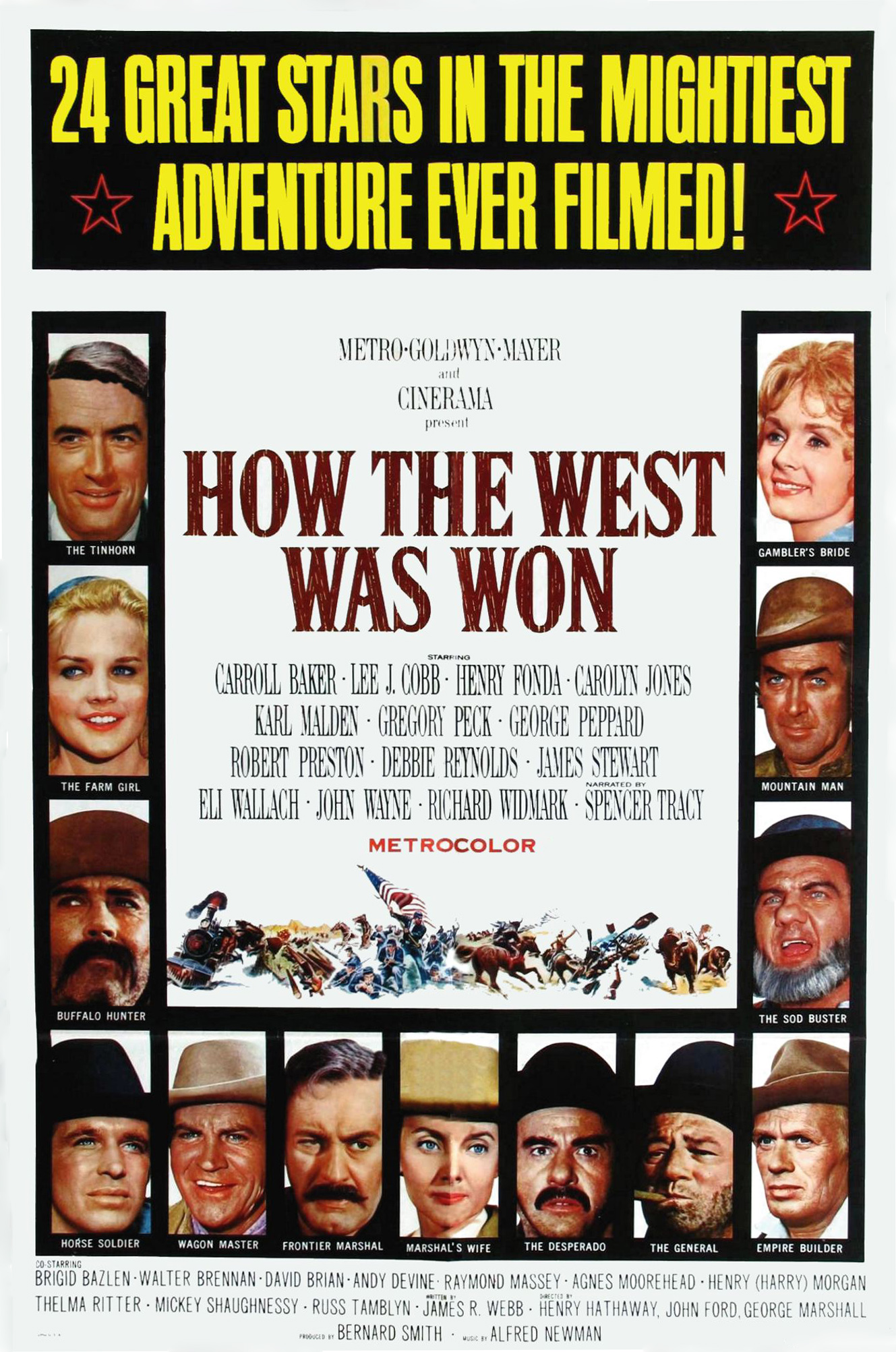
How the West Was Won
In the age of the epics -- the 1950s and 1960s -- some just stand above the rest. It's the stories, the cast, the scope. I don't love 1962's How the West Was Won but as far as epics go, there are very few in its neighborhood. There are obvious flaws, but when it works, it works in a big way. An impressive all-star cast, a story about the development of the American west and a shooting technique that is must-see. That's a winning formula.
A 162-minute film is broken up into five separate segments, the story following the Prescott-Rawlings family as it moves west and settles between the 1840s and the 1880s. It was directed by three different directors and covers a ton of ground. And away we go!
1. The Rivers (directed by Henry Hathaway): It's the 1840s, and the Prescott family, led by patriarch Zebulon (Karl Malden), is moving west and looking for a new life. In Zebulon's family is two daughters, Eve (Carroll Baker), looking for a new life in the west, and Lillith (Debbie Reynolds), wanting to stay in the far-more civilized East. In their dangerous travels on the rivers, they also meet Linus Rawlings (James Stewart), a mountain man with a canoe full of pelts.
Also starring: Lee Van Cleef, Walter Brennan, Agnes Moorehead, Brigid Bazlen.
2. The Plains (directed by Hathaway): Having worked for years on her own as a singer and dancer, Lillith Prescott (Reynolds) has just inherited a gold mine in the wake of the California gold rush. She heads west on a wagon train led by trail driver Richard Morgan (Robert Preston) with a gold-seeking gambler, Cleve Van Valen (Gregory Peck), also along too.
Also starring: Thelma Ritter.
3. The Civil War (directed by John Ford): The war between the states in its early months, young Zeb Rawlings (George Peppard) leaves home with the blessing of his mother, Eve, to join the Ohio volunteers in the fighting. Like so many others, he thinks the war will be full of glory and be over quickly. Zeb finds out how very wrong he is at the bloody battle of Shiloh.
Also starring: John Wayne (as General Sherman), Russ Tamblyn (as a Confederate deserter), Harry Morgan (as General Grant), Andy Devine, Ken Curtis, Raymond Massey (as Abraham Lincoln).
4. The Railroad (directed by George Marshall): In the years following the Civil War, railroad companies race across the U.S. to link the two coasts. Now in the cavalry, Zeb Rawlings (Peppard) finds himself balancing out what his duty requires of him with what he knows is right, the railroad, including brutal supervisor Mike King (Richard Widmark), pushing the Arapahoes to their limit.
Also starring: Henry Fonda as Jethro Stuart, a former mountain man.
5. The Outlaws (directed by Hathaway): Having left the cavalry behind, Zeb Rawlings is now a family man with two kids, now trying to leave his profession as a lawman behind. He receives a letter from his aunt, Lillith (Reynolds), and readies the family to move. As they travel though, Zeb runs into Charlie Gant (Eli Wallach), a notorious outlaw gunning for Zeb.
Also starring: Lee J. Cobb, Carolyn Jones.
This is a movie that's simply put, BIG. It was filmed in Cinerama, three cameras filming each scene and then splicing the action together. The result? An immense look at the expansion of the west. Shots look like panoramic paintings, putting a whole new scope on the growth and development of the American west. It is a beautiful movie. Certain sequences especially stand out -- the camera on a raft trying to survive river rapids, an Indian attack on a wagon train, a stampeding buffalo herd trampling a railroad camp, a runaway train during an attempted robbery -- over the course of the movie, but visually there just isn't a weak spot. I love composer Alfred Newman's score -- listen to an extended sample HERE -- as it gives a moving background to the story. Countless gorgeous filming locations, providing a great backdrop while also transitioning from segment to segment.
It had been years since I watched this movie straight through in one sitting before my recent revisit of this 1962 epic. As you compare the five separate segments, I don't think it's really in question which one is the strongest. It's John Ford's Civil War segment, doing in 20 minutes what entire movies couldn't do in bringing the Civil War to life. Quick, dark, visually striking and unsettling, it is a gem of a sequence, especially Peppard meeting Tamblyn's Confederate deserter after the battle. The second strongest segment for me is the opening 'Rivers' with Stewart, Baker, Reynolds and Malden all leaving a positive impression. All five segments could be stretched out to a feature length film on their own, but these two especially stand out. They get their message across in a quick window and in both cases left me wanting more. Kudos to Ford and Hathaway for their work here.
What struck me more on the rewatch was the other three segments. They are by no means bad segments, but they're just not as good as the other two. I've always thought the weakest was the Plains segment, things feeling too rushed in general. The same qualifies for the Railroad and Outlaws portions. By the time you take away the Entr'Acte, intermission, and Finale music, we're looking at a movie with five segments covered in about 150 minutes (give or take). None of these three are given a chance to breathe to the point they feel downright rushed. As for some other positives? I loved the transitional scenes -- narrated by Spencer Tracy, directed in uncredited fashion by Richard Thorpe -- that set things up, explaining how America has changed, how its people change. These quick montages provide the heart of the movie, almost like a documentary in some ways. Like any movie that tries to accomplish so much, there's good and bad. The positives -- especially the Civil War middle -- is enough to outweigh the negatives thankfully.
One of my biggest worries in reviewing this 1962 epic was that the cast is too big. There's no way I was gonna be able to get all those names tagged with a 200-character limit. Who stands out? Stewart i excellent as Linus Rawlings, Fonda is good in a quick part as Jethro Stuart, and Baker is very strong too. The best parts though are Debbie Reynolds as Lillith and George Peppard as Zeb, the two hearts of the family. One or both is in every segment, the audience seeing them age, learn and adapt as America grows with them. Their scenes together in the Outlaws portion ring especially true. However you cut it though, just an impressive cast from top to bottom, one of the best ever assembled for a Hollywood film.
A doozy of a movie for what it's trying to accomplish. It falls short at times, but this is a movie worth watching for what it represents alone. This is a throwback film, a true epic that strives to be something great. If it doesn't live up those high hopes, so be it. The effort is admirable, a fascinating story of America growing up over an extremely turbulent portion of its history. Oh, and Debbie Reynolds singing A Home in the Meadow (listen HERE) is a truly beautiful song, a fitting one for the movie.
How the West Was Won (1962): ***/****
A 162-minute film is broken up into five separate segments, the story following the Prescott-Rawlings family as it moves west and settles between the 1840s and the 1880s. It was directed by three different directors and covers a ton of ground. And away we go!
1. The Rivers (directed by Henry Hathaway): It's the 1840s, and the Prescott family, led by patriarch Zebulon (Karl Malden), is moving west and looking for a new life. In Zebulon's family is two daughters, Eve (Carroll Baker), looking for a new life in the west, and Lillith (Debbie Reynolds), wanting to stay in the far-more civilized East. In their dangerous travels on the rivers, they also meet Linus Rawlings (James Stewart), a mountain man with a canoe full of pelts.
Also starring: Lee Van Cleef, Walter Brennan, Agnes Moorehead, Brigid Bazlen.
2. The Plains (directed by Hathaway): Having worked for years on her own as a singer and dancer, Lillith Prescott (Reynolds) has just inherited a gold mine in the wake of the California gold rush. She heads west on a wagon train led by trail driver Richard Morgan (Robert Preston) with a gold-seeking gambler, Cleve Van Valen (Gregory Peck), also along too.
Also starring: Thelma Ritter.
3. The Civil War (directed by John Ford): The war between the states in its early months, young Zeb Rawlings (George Peppard) leaves home with the blessing of his mother, Eve, to join the Ohio volunteers in the fighting. Like so many others, he thinks the war will be full of glory and be over quickly. Zeb finds out how very wrong he is at the bloody battle of Shiloh.
Also starring: John Wayne (as General Sherman), Russ Tamblyn (as a Confederate deserter), Harry Morgan (as General Grant), Andy Devine, Ken Curtis, Raymond Massey (as Abraham Lincoln).
4. The Railroad (directed by George Marshall): In the years following the Civil War, railroad companies race across the U.S. to link the two coasts. Now in the cavalry, Zeb Rawlings (Peppard) finds himself balancing out what his duty requires of him with what he knows is right, the railroad, including brutal supervisor Mike King (Richard Widmark), pushing the Arapahoes to their limit.
Also starring: Henry Fonda as Jethro Stuart, a former mountain man.
5. The Outlaws (directed by Hathaway): Having left the cavalry behind, Zeb Rawlings is now a family man with two kids, now trying to leave his profession as a lawman behind. He receives a letter from his aunt, Lillith (Reynolds), and readies the family to move. As they travel though, Zeb runs into Charlie Gant (Eli Wallach), a notorious outlaw gunning for Zeb.
Also starring: Lee J. Cobb, Carolyn Jones.
This is a movie that's simply put, BIG. It was filmed in Cinerama, three cameras filming each scene and then splicing the action together. The result? An immense look at the expansion of the west. Shots look like panoramic paintings, putting a whole new scope on the growth and development of the American west. It is a beautiful movie. Certain sequences especially stand out -- the camera on a raft trying to survive river rapids, an Indian attack on a wagon train, a stampeding buffalo herd trampling a railroad camp, a runaway train during an attempted robbery -- over the course of the movie, but visually there just isn't a weak spot. I love composer Alfred Newman's score -- listen to an extended sample HERE -- as it gives a moving background to the story. Countless gorgeous filming locations, providing a great backdrop while also transitioning from segment to segment.
It had been years since I watched this movie straight through in one sitting before my recent revisit of this 1962 epic. As you compare the five separate segments, I don't think it's really in question which one is the strongest. It's John Ford's Civil War segment, doing in 20 minutes what entire movies couldn't do in bringing the Civil War to life. Quick, dark, visually striking and unsettling, it is a gem of a sequence, especially Peppard meeting Tamblyn's Confederate deserter after the battle. The second strongest segment for me is the opening 'Rivers' with Stewart, Baker, Reynolds and Malden all leaving a positive impression. All five segments could be stretched out to a feature length film on their own, but these two especially stand out. They get their message across in a quick window and in both cases left me wanting more. Kudos to Ford and Hathaway for their work here.
What struck me more on the rewatch was the other three segments. They are by no means bad segments, but they're just not as good as the other two. I've always thought the weakest was the Plains segment, things feeling too rushed in general. The same qualifies for the Railroad and Outlaws portions. By the time you take away the Entr'Acte, intermission, and Finale music, we're looking at a movie with five segments covered in about 150 minutes (give or take). None of these three are given a chance to breathe to the point they feel downright rushed. As for some other positives? I loved the transitional scenes -- narrated by Spencer Tracy, directed in uncredited fashion by Richard Thorpe -- that set things up, explaining how America has changed, how its people change. These quick montages provide the heart of the movie, almost like a documentary in some ways. Like any movie that tries to accomplish so much, there's good and bad. The positives -- especially the Civil War middle -- is enough to outweigh the negatives thankfully.
One of my biggest worries in reviewing this 1962 epic was that the cast is too big. There's no way I was gonna be able to get all those names tagged with a 200-character limit. Who stands out? Stewart i excellent as Linus Rawlings, Fonda is good in a quick part as Jethro Stuart, and Baker is very strong too. The best parts though are Debbie Reynolds as Lillith and George Peppard as Zeb, the two hearts of the family. One or both is in every segment, the audience seeing them age, learn and adapt as America grows with them. Their scenes together in the Outlaws portion ring especially true. However you cut it though, just an impressive cast from top to bottom, one of the best ever assembled for a Hollywood film.
A doozy of a movie for what it's trying to accomplish. It falls short at times, but this is a movie worth watching for what it represents alone. This is a throwback film, a true epic that strives to be something great. If it doesn't live up those high hopes, so be it. The effort is admirable, a fascinating story of America growing up over an extremely turbulent portion of its history. Oh, and Debbie Reynolds singing A Home in the Meadow (listen HERE) is a truly beautiful song, a fitting one for the movie.
How the West Was Won (1962): ***/****
Friday, October 4, 2013
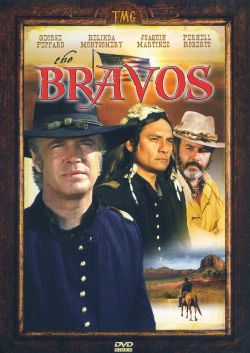
The Bravos
The TV movie is seemingly a thing of the past. In the 1970s and 1980s, TV movies and miniseries dominated the landscape, movie stars making the jump to television as roles presented themselves. Now with cable, dish and satellite, it's hard to consider what's even a TV movie and what isn't. Heading into the wayback machine, it's easy to identify them from the past, like 1972's The Bravos, a western with some potential that doesn't quite live up to it but is entertaining just the same.
It's just a year or two since the end of the Civil War, and the U.S. is focusing on expansion westward. At a remote outpost on the frontier, Major John Harkness (George Peppard) is doing his best to work himself out of quite the situation. His garrison is just 77 men and supplies and ammunition are running low. Those are problems enough, but reports are coming in from his patrols that the Navajo tribes seem to be joining up in the mountains. One report even has their numbers somewhere around 2,000. With so small a force though, Harkness has little options as to what he should do. The situation at the outpost is thrown for another loop when a small wagon train led by egotistical trail guide Jackson Buckley (Pernell Roberts) arrives seeking supplies for their coming trip. That's not all though. Buckley killed three young Kiowa warriors on the trail, Kiowas who were trying to join up with the gathering Navajo warriors. Can help arrive in time to stave off a brutal massacre?
It was pretty evident early-on that this was a TV western, a fact I wasn't aware of until after I started watching (clever Encore Westerns). From director Ted Post, 'Bravos' is a solid, entertaining western that is at times limited by its smallish budget. The 2,000 warrior war party is only mentioned as we never see more than 15 or 20 murdering Indians at a time. What does work though? It's a TV movie, but it was filmed on location in Sedona, Arizona, the sparse, windy and winter-bound desert providing quite the backdrop for the story. It's easy to understand the fear of living out there. Anything could be hiding in that desert just waiting to strike. As well, the set for the cavalry outpost is pretty cool, a crumbling little fort with obvious defensive deficiencies. Also worth mentioning is the musical score from composer Leonard Rosenman, similar to his score from 1962's Hell is For Heroes.
One of my favorite tough guys stars, Peppard does a good job here leading a capable cast. His Maj. Harkness has been dealt the lousiest of hands, his garrison undermanned, under-supplied and waiting for an inevitable attack against horrific odds. Somehow, he's got to keep his command together even as his officers and enlisted men question what the point of it all is for. A weak subplot involves his son (Vincent Van Patten) who was kicked out of his Eastern school arriving at the outpost at the worst possible moment. Peppard has a knack for being a condescending tough guy, that ever-present smirk on his face, and it works here well. His officers include George Murdock as the questioning second-in-command, Dana Elcar as the fort surgeon, Ron Kelly as the cigar-chomping lieutenant, and John Kellogg as the loyal sergeant-major.
For a TV western, a pretty good cast has been assembled with some familiar faces. It's cool to see L.Q. Jones get a major role, playing the capable scout, Ben Lawler, who always seems to tangle with Harkness despite their long-standing friendship. Jones and Peppard sparkle in their scenes together. Roberts get to preen and yell as the overmatched trail guide, blustering his way through his "occupation" of which he knows little other than money. A young Bo Svenson players Bucholz, a former soldier on the run with Buckley's wagon train, playing a key part in a mission late. Clint Ritchie is solid too as Cpl. Love, the trusted enlisted man seemingly always leading another five-man patrol. Because a love story was needed (????), Belinda Montgomery plays Heller, a young woman traveling with her fiance, Garratt (Barry Brown).
The biggest place the flick is hit by is in the action department. We're not talking any major battles, gunfights or chases across the desert. What we do get is a shootout here and there, the biggest being "an attack" on the fort by some sniping Navajo warriors. The best part though is a dangerous mission late as Harkness, Lawler and Bucholz head out into the wilderness to rescue Harkness' son from a raiding party. No spoilers here, but it's a cool premise and it is executed really well. You don't need a cast of thousands (hundreds, even tens I suppose) to be effective as is on display here.
Unfortunately though, then the movie just ends, almost like the TV movie just ran out of money or time to fit in a two-hour slot. One thing is resolved, but several other key things need to be dealt with. Nope, not here. Credits roll and the movie is over. I still liked the build-up, but it is a finale that feels forced in all sorts of ways. At 97 minutes, maybe it was getting too long. Maybe some resolution was cut out, but what we get is disappointing. Give it a try at Youtube HERE in its entirety. It's got enough going for it to recommend but know you'll most likely be disappointed with the finale.
The Bravos (1972): ** 1/2 /****
It's just a year or two since the end of the Civil War, and the U.S. is focusing on expansion westward. At a remote outpost on the frontier, Major John Harkness (George Peppard) is doing his best to work himself out of quite the situation. His garrison is just 77 men and supplies and ammunition are running low. Those are problems enough, but reports are coming in from his patrols that the Navajo tribes seem to be joining up in the mountains. One report even has their numbers somewhere around 2,000. With so small a force though, Harkness has little options as to what he should do. The situation at the outpost is thrown for another loop when a small wagon train led by egotistical trail guide Jackson Buckley (Pernell Roberts) arrives seeking supplies for their coming trip. That's not all though. Buckley killed three young Kiowa warriors on the trail, Kiowas who were trying to join up with the gathering Navajo warriors. Can help arrive in time to stave off a brutal massacre?
It was pretty evident early-on that this was a TV western, a fact I wasn't aware of until after I started watching (clever Encore Westerns). From director Ted Post, 'Bravos' is a solid, entertaining western that is at times limited by its smallish budget. The 2,000 warrior war party is only mentioned as we never see more than 15 or 20 murdering Indians at a time. What does work though? It's a TV movie, but it was filmed on location in Sedona, Arizona, the sparse, windy and winter-bound desert providing quite the backdrop for the story. It's easy to understand the fear of living out there. Anything could be hiding in that desert just waiting to strike. As well, the set for the cavalry outpost is pretty cool, a crumbling little fort with obvious defensive deficiencies. Also worth mentioning is the musical score from composer Leonard Rosenman, similar to his score from 1962's Hell is For Heroes.
One of my favorite tough guys stars, Peppard does a good job here leading a capable cast. His Maj. Harkness has been dealt the lousiest of hands, his garrison undermanned, under-supplied and waiting for an inevitable attack against horrific odds. Somehow, he's got to keep his command together even as his officers and enlisted men question what the point of it all is for. A weak subplot involves his son (Vincent Van Patten) who was kicked out of his Eastern school arriving at the outpost at the worst possible moment. Peppard has a knack for being a condescending tough guy, that ever-present smirk on his face, and it works here well. His officers include George Murdock as the questioning second-in-command, Dana Elcar as the fort surgeon, Ron Kelly as the cigar-chomping lieutenant, and John Kellogg as the loyal sergeant-major.
For a TV western, a pretty good cast has been assembled with some familiar faces. It's cool to see L.Q. Jones get a major role, playing the capable scout, Ben Lawler, who always seems to tangle with Harkness despite their long-standing friendship. Jones and Peppard sparkle in their scenes together. Roberts get to preen and yell as the overmatched trail guide, blustering his way through his "occupation" of which he knows little other than money. A young Bo Svenson players Bucholz, a former soldier on the run with Buckley's wagon train, playing a key part in a mission late. Clint Ritchie is solid too as Cpl. Love, the trusted enlisted man seemingly always leading another five-man patrol. Because a love story was needed (????), Belinda Montgomery plays Heller, a young woman traveling with her fiance, Garratt (Barry Brown).
The biggest place the flick is hit by is in the action department. We're not talking any major battles, gunfights or chases across the desert. What we do get is a shootout here and there, the biggest being "an attack" on the fort by some sniping Navajo warriors. The best part though is a dangerous mission late as Harkness, Lawler and Bucholz head out into the wilderness to rescue Harkness' son from a raiding party. No spoilers here, but it's a cool premise and it is executed really well. You don't need a cast of thousands (hundreds, even tens I suppose) to be effective as is on display here.
Unfortunately though, then the movie just ends, almost like the TV movie just ran out of money or time to fit in a two-hour slot. One thing is resolved, but several other key things need to be dealt with. Nope, not here. Credits roll and the movie is over. I still liked the build-up, but it is a finale that feels forced in all sorts of ways. At 97 minutes, maybe it was getting too long. Maybe some resolution was cut out, but what we get is disappointing. Give it a try at Youtube HERE in its entirety. It's got enough going for it to recommend but know you'll most likely be disappointed with the finale.
The Bravos (1972): ** 1/2 /****
Labels:
1970s,
Bo Svenson,
George Peppard,
L.Q. Jones,
Pernell Roberts,
westerns
Friday, September 6, 2013
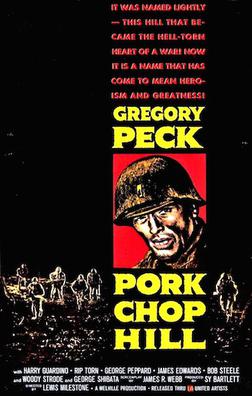
Pork Chop Hill
No soldier wants to die. But what about as a war nears its end? The end of the fighting may only be days away, maybe even hours away. So goes the background for the underrated Korean War drama from 1959, Pork Chop Hill.
It's April 1953 and both American and North Korean/Chinese commanders have agreed to a cease fire with the two sides meeting at Panmunjom. The negotiations though are moving along at a frustratingly slow pace with little being resolved. Near the front lines, the fighting rages on with Lt. Joe Clemons (Gregory Peck) and his King Company awaiting orders, supposedly to withdraw as the fighting dies down with negotiations picking up. The orders though are just the opposite, orders to move forward and take Pork Chop Hill, a worthless hill that's been lost and regained countless times. Now, the Chinese are in possession, but it is a spot on the line that's been deemed very important to negotiations. Clemons assembles his weary company, moving forward to take a hill that holds no military value.
Dubbed the Forgotten War, the Korean War pales in comparison to both World War II and Vietnam in terms of theatrical films released about them. From director Lewis Milestone (A Walk in the Sun, Halls of Montezuma, All Quiet on the Western Front), 'Hill' is a generally forgotten war film that certainly deserves better. It is similar in a lot of ways to 1962's Hell is For Heroes -- even using an eerily similar score from Leonard Rosenman -- and is based on a true story, the battle for Pork Chop Hill. It was filmed in black and white, a highly effective shooting technique, giving everything a sparse, cold and vacant look. Why isn't it remembered as the near-classic that it is? I've got no idea.
What jumped out at me on my recent viewing was the cynicism and darkness that's evident throughout. More surprising? It was made with cooperation from the U.S. Army which in itself isn't too surprising. It's that in exploring the battle, 'Hill' at times shows the complete ineptitude of the American commanders. Assaulting the hill, Clemon's company is put on the grid when American spotlights actually shine right on them in the dead of night. Other companies are given wrong orders, ranging from just plain wrong to misleading. Once King Company is in position, the rear command is genuinely confused, thinking they're fighting a mop-up action when in reality, they're holding on by their fingernails with limited ammunition, food and water. At one point, an U.S.O. photographer is sent up the hill to get photos of an American victory because the folks back home need to see an American win. Peck's reaction is priceless, a commander at wit's end who doesn't know what else to say.
This is an honest criticism of headquarters that's based in reality, and for a 1959 audience, it seems light years ahead of its time. If I didn't know better, it sounds like a Vietnam War movie like Platoon or Apocalypse Now more than a major studio release from 1959. Leading the way is the always reliable, always impressive Gregory Peck. His performance reminded me some of his Oscar-nominated turn in Twelve O'Clock High 10 years earlier. His Clemons is an effective commander simply trying to follow orders and get as many men through the battle unscathed as is possible. Even he is pushed to his limits as one bumbling order after another comes through, the commanders refusing to acknowledge that the battle isn't going as they expected. It's an understated part, but an emotionally effective one. We see the wear and tear on his face, his reassuring, confident tone slowly being worn down.
Beyond Peck though, 'Hill' is noteworthy for its supporting cast of rising and future stars. Harry Guardino and George Peppard play Forstman and Federson, two buddies lugging a machine gun around the hill. Rip Torn plays Lt. Russel, commander of the relief company assigned to help out King Company. 'Hill' is also one of the first war films to show integrated units, Woody Strode playing Franklin, a private fed up with the war, and James Edwards as Cpl. Jurgens, one of Clemon's most dependable, trustworthy men. Also cool casting is George Shibata as Lt. Ohashi, a Japanese-American soldier, Clemon's close friend and one of his platoon commanders. Also look for Norman Fell, Gavin MacLeod, Robert Blake, Biff Elliott, Martin Landau, Harry Dean Stanton, Clarence Williams III and several other familiar faces rounding out King Company's roster.
Clocking in at 97 minutes, a majority of 'Hill' is spent in the trenches and bunkers with King Company, a few asides here and there showing the negotiations of the cease fire. This is a movie interested in the nuts and bolts of the battle, the flanking movements, the reserve companies, the crossfires and preparations for counterattacks. It never gets bogged down though, the battle scenes uncomfortable and unsettling in their reality. It isn't graphic violence here, but that doesn't mean it's not hard to watch. Add in the psychological warfare of a Chinese broadcaster bombarding the American troops with propaganda, and you've got quite the battle here. It's not just bullets and soldiers anymore, but the effect it has on the soldiers' heads too. A great war movie, one that deserves more of a reputation/following.
Pork Chop Hill (1959): *** 1/2 /****
It's April 1953 and both American and North Korean/Chinese commanders have agreed to a cease fire with the two sides meeting at Panmunjom. The negotiations though are moving along at a frustratingly slow pace with little being resolved. Near the front lines, the fighting rages on with Lt. Joe Clemons (Gregory Peck) and his King Company awaiting orders, supposedly to withdraw as the fighting dies down with negotiations picking up. The orders though are just the opposite, orders to move forward and take Pork Chop Hill, a worthless hill that's been lost and regained countless times. Now, the Chinese are in possession, but it is a spot on the line that's been deemed very important to negotiations. Clemons assembles his weary company, moving forward to take a hill that holds no military value.
Dubbed the Forgotten War, the Korean War pales in comparison to both World War II and Vietnam in terms of theatrical films released about them. From director Lewis Milestone (A Walk in the Sun, Halls of Montezuma, All Quiet on the Western Front), 'Hill' is a generally forgotten war film that certainly deserves better. It is similar in a lot of ways to 1962's Hell is For Heroes -- even using an eerily similar score from Leonard Rosenman -- and is based on a true story, the battle for Pork Chop Hill. It was filmed in black and white, a highly effective shooting technique, giving everything a sparse, cold and vacant look. Why isn't it remembered as the near-classic that it is? I've got no idea.
What jumped out at me on my recent viewing was the cynicism and darkness that's evident throughout. More surprising? It was made with cooperation from the U.S. Army which in itself isn't too surprising. It's that in exploring the battle, 'Hill' at times shows the complete ineptitude of the American commanders. Assaulting the hill, Clemon's company is put on the grid when American spotlights actually shine right on them in the dead of night. Other companies are given wrong orders, ranging from just plain wrong to misleading. Once King Company is in position, the rear command is genuinely confused, thinking they're fighting a mop-up action when in reality, they're holding on by their fingernails with limited ammunition, food and water. At one point, an U.S.O. photographer is sent up the hill to get photos of an American victory because the folks back home need to see an American win. Peck's reaction is priceless, a commander at wit's end who doesn't know what else to say.
This is an honest criticism of headquarters that's based in reality, and for a 1959 audience, it seems light years ahead of its time. If I didn't know better, it sounds like a Vietnam War movie like Platoon or Apocalypse Now more than a major studio release from 1959. Leading the way is the always reliable, always impressive Gregory Peck. His performance reminded me some of his Oscar-nominated turn in Twelve O'Clock High 10 years earlier. His Clemons is an effective commander simply trying to follow orders and get as many men through the battle unscathed as is possible. Even he is pushed to his limits as one bumbling order after another comes through, the commanders refusing to acknowledge that the battle isn't going as they expected. It's an understated part, but an emotionally effective one. We see the wear and tear on his face, his reassuring, confident tone slowly being worn down.
Beyond Peck though, 'Hill' is noteworthy for its supporting cast of rising and future stars. Harry Guardino and George Peppard play Forstman and Federson, two buddies lugging a machine gun around the hill. Rip Torn plays Lt. Russel, commander of the relief company assigned to help out King Company. 'Hill' is also one of the first war films to show integrated units, Woody Strode playing Franklin, a private fed up with the war, and James Edwards as Cpl. Jurgens, one of Clemon's most dependable, trustworthy men. Also cool casting is George Shibata as Lt. Ohashi, a Japanese-American soldier, Clemon's close friend and one of his platoon commanders. Also look for Norman Fell, Gavin MacLeod, Robert Blake, Biff Elliott, Martin Landau, Harry Dean Stanton, Clarence Williams III and several other familiar faces rounding out King Company's roster.
Clocking in at 97 minutes, a majority of 'Hill' is spent in the trenches and bunkers with King Company, a few asides here and there showing the negotiations of the cease fire. This is a movie interested in the nuts and bolts of the battle, the flanking movements, the reserve companies, the crossfires and preparations for counterattacks. It never gets bogged down though, the battle scenes uncomfortable and unsettling in their reality. It isn't graphic violence here, but that doesn't mean it's not hard to watch. Add in the psychological warfare of a Chinese broadcaster bombarding the American troops with propaganda, and you've got quite the battle here. It's not just bullets and soldiers anymore, but the effect it has on the soldiers' heads too. A great war movie, one that deserves more of a reputation/following.
Pork Chop Hill (1959): *** 1/2 /****
Wednesday, January 23, 2013
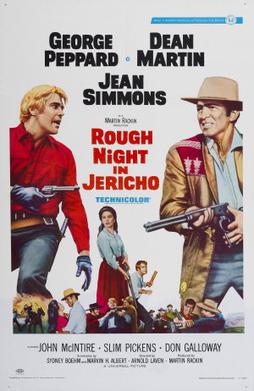
Rough Night in Jericho
Dean Martin is one of my favorite movie stars and/or entertainers. As far as his movies go, I typically think of the Rat Packer as a heroic good guy, ranging from drama in movies like Some Came Running or The Sons of Katie Elder to goofy comedies like the Matt Helm spoofs. But in a few departures from that heroic good guy, Martin switched it up, playing some bad guys, like 1967's Rough Night in Jericho.
Working with his longtime friend and former peace officer, Ben Hickman (John McIntire), former deputy and gunslinger Dolan (George Peppard) ride into the town of Jericho looking to set up a business. They've been hired by a widow, Molly (Jean Simmons), to help revive a stagecoach company that's recently gone under. What they find is something far different from what they expected. The town is run by sheriff turned town boss Alex Flood (Martin) who has his hand in every business and establishment in and around Jericho. Not surprisingly, Flood wants the new stagecoach company gone, even wounding Hickman as they arrive. Molly begs Dolan to help get rid of Flood, but ever the gambler, he doesn't like his odds. But in trying to push them out of Jericho, Flood pushes too far, and Dolan is going to push right back.
This is just another in a long list of reasons why I like westerns. Released in 1967 when westerns were very much trying to change with the times (cough more violence cough), I had never even remotely heard of 'Jericho.' From director Arnold Laven, it stars two of my favorite stars in Martin and Peppard, but it had never even crossed my radar. Always keep looking for those hidden gems because you never know when you will find one. It's somewhat limited by a smallish budget -- lots of indoor sets standing in for "outdoor" scenes -- and the score from Don Costa isn't anything out of this world. But in the end, things fall into place for an enjoyable, sometimes surprisingly violent western.
Your enjoyment will no doubt come from how big a fan you are of 1. westerns and 2. Dean Martin and George Peppard. I'm guilty on both counts so read on with a grain of salt. For starters, it's always fun to see an actor play against type like Martin is doing here. His Alex Flood is a charming, capable, intimidating bad guy; a former sheriff who cleaned up the town and basically took over in the process. Peppard does what he does best; cocky disinterest, looking like he's bored at times but being eternally cool in the process. Their scenes together are the high point of this western. Two tough guys talking over a bottle of whiskey, over a card game, both trying to intimidate the other one into leaving town. I loved the dynamic, both men knowing what the other is capable, but neither willing to blink or give up.
Playing the love interest of the not so painful love triangle, Jean Simmons wouldn't seem to be an obvious choice for a western. Go figure, but she's a worthy opponent and target for Martin and Peppard. Slight and soft with her voice, she's nonetheless one tough lady, even when Martin's Flood starts whaling on her. McIntire is in bed (wounded) much of the movie, but once he heals up, his crotchety veteran of the west fits right in with the toughness of the story. Filling out the ranks as Flood's evil henchmen who will no doubt meet nasty fates are Slim Pickens, Steve Sandor and and Brad Weston. Don Galloway has a good supporting part as Jase, the former sheriff of Jericho run out of town because he stands up to Flood over a hanging.
Two years before the groundbreaking The Wild Bunch was released, here comes 'Jericho.' Obviously not on par with that classic, this movie is nonetheless surprisingly violent. It's not as graphic, but it's certainly getting there. It is effective though because it is a surprise. At one point, we see a man get blasted in the face by a shotgun, blood flowing down his hands and arms. Realistic? No, but the point is made. Plenty of blood squibs (cheesy maybe, better than people clutching at wounds? Yes) as countless good and bad guys bite the dust. A highlight in the nastiness department comes in a fight between Slim Pickens and Peppard, Pickens' evil Yarbrough favoring a horse whip. Brutal, knockdown fight that feels real, not forced at all. Lots of positives, only a few minor negatives. Generally forgotten, well worth tracking down.
Rough Night in Jericho (1967): ***/****
Working with his longtime friend and former peace officer, Ben Hickman (John McIntire), former deputy and gunslinger Dolan (George Peppard) ride into the town of Jericho looking to set up a business. They've been hired by a widow, Molly (Jean Simmons), to help revive a stagecoach company that's recently gone under. What they find is something far different from what they expected. The town is run by sheriff turned town boss Alex Flood (Martin) who has his hand in every business and establishment in and around Jericho. Not surprisingly, Flood wants the new stagecoach company gone, even wounding Hickman as they arrive. Molly begs Dolan to help get rid of Flood, but ever the gambler, he doesn't like his odds. But in trying to push them out of Jericho, Flood pushes too far, and Dolan is going to push right back.
This is just another in a long list of reasons why I like westerns. Released in 1967 when westerns were very much trying to change with the times (cough more violence cough), I had never even remotely heard of 'Jericho.' From director Arnold Laven, it stars two of my favorite stars in Martin and Peppard, but it had never even crossed my radar. Always keep looking for those hidden gems because you never know when you will find one. It's somewhat limited by a smallish budget -- lots of indoor sets standing in for "outdoor" scenes -- and the score from Don Costa isn't anything out of this world. But in the end, things fall into place for an enjoyable, sometimes surprisingly violent western.
Your enjoyment will no doubt come from how big a fan you are of 1. westerns and 2. Dean Martin and George Peppard. I'm guilty on both counts so read on with a grain of salt. For starters, it's always fun to see an actor play against type like Martin is doing here. His Alex Flood is a charming, capable, intimidating bad guy; a former sheriff who cleaned up the town and basically took over in the process. Peppard does what he does best; cocky disinterest, looking like he's bored at times but being eternally cool in the process. Their scenes together are the high point of this western. Two tough guys talking over a bottle of whiskey, over a card game, both trying to intimidate the other one into leaving town. I loved the dynamic, both men knowing what the other is capable, but neither willing to blink or give up.
Playing the love interest of the not so painful love triangle, Jean Simmons wouldn't seem to be an obvious choice for a western. Go figure, but she's a worthy opponent and target for Martin and Peppard. Slight and soft with her voice, she's nonetheless one tough lady, even when Martin's Flood starts whaling on her. McIntire is in bed (wounded) much of the movie, but once he heals up, his crotchety veteran of the west fits right in with the toughness of the story. Filling out the ranks as Flood's evil henchmen who will no doubt meet nasty fates are Slim Pickens, Steve Sandor and and Brad Weston. Don Galloway has a good supporting part as Jase, the former sheriff of Jericho run out of town because he stands up to Flood over a hanging.
Two years before the groundbreaking The Wild Bunch was released, here comes 'Jericho.' Obviously not on par with that classic, this movie is nonetheless surprisingly violent. It's not as graphic, but it's certainly getting there. It is effective though because it is a surprise. At one point, we see a man get blasted in the face by a shotgun, blood flowing down his hands and arms. Realistic? No, but the point is made. Plenty of blood squibs (cheesy maybe, better than people clutching at wounds? Yes) as countless good and bad guys bite the dust. A highlight in the nastiness department comes in a fight between Slim Pickens and Peppard, Pickens' evil Yarbrough favoring a horse whip. Brutal, knockdown fight that feels real, not forced at all. Lots of positives, only a few minor negatives. Generally forgotten, well worth tracking down.
Rough Night in Jericho (1967): ***/****
Labels:
1960s,
Dean Martin,
George Peppard,
Jean Simmons,
John McIntire,
Slim Pickens,
westerns
Friday, August 26, 2011
One More Train to Rob
Thanks to Netflix's recent change in billing, I had to choose whether to pay an extra $8 bucks a month to keep my 'Instant Viewing' where I can watch movies and TV through their website. I didn't watch enough of either to make it worthwhile so I'm sticking with the DVD plan instead. My plan at first was to watch all the Instant Movies I could in the period before the new policy came into effect, but then 1971's One More Train to Rob came along.
I'm pretty much a sucker for any hard to find movie with a somewhat recognizable cast, especially movies from the 1960s and 1970s. Hundreds and maybe thousands of movies aren't available in any format so when you stumble across them, you've got to take advantage of the situation. Case in point here, a western available through Instant Watch with some good names -- including Just Hit Play favorite George Peppard -- and a unique, at least somewhat interesting premise. It never quite clicks into place, and a snail's pace in the first hour dooms the movie to the point where an entertaining second hour can't save it.
After a successful train robbery, well-known bank/train robber Harker Fleet (Peppard) is betrayed by several members of his gang including Timothy Xavier Nolan (John Vernon) and Jim Gant (Steve Sandor). He ends up serving a three-year jail sentence, getting out early for good behavior. Harker finds that his girlfriend, Katy (Diana Muldaur), is engaged to Nolan now as his former partner has become a rich businessman. However, Nolan is in some financial trouble, and Harker sees a way to exact his revenge. A mine in the area owned by Chinese immigrants is producing large quantities of gold, but Nolan can't get anywhere near the place. Harker on the other hand is able to dupe the Chinese into thinking he's on their side and work from the inside. Who is working against who though? Everyone has their own intentions and means of getting over $500,000 in gold that's ready for shipment.
Depending on where/what you read, director Andrew V. McLaglen takes a lot of heat for his average to below average to God-awful movies. The son of actor Victor McLaglen, he started directing western TV shows in the 1950s and parlayed that into feature films in the 1960s, many of them working with John Wayne. Was the younger McLaglen an auteur, a highly skilled, talented individual behind the camera? Nope, not really. He was a workmanlike director who got the job done usually without much in the way of personal style. I grew up watching many of his movies so I can overlook some of his deficiencies (Bandolero!, Shenandoah, The Devil's Brigade, The Wild Geese are some of my favorites). However as much as I tried here I struggled with 'Train to Rob.'
A western that came along in 1971 when most westerns were pessimistic and generally trying to bust all sort of wild west myths and lore, 'Train' is an oddity. Think John Wayne western without the Duke. It was made on a small budget -- or at least it looks like it -- and looks to have been shot mostly in the studio and on the studio backlot. The script can't make up its mind whether it is a darkly comedic western with slapstick or a hard-hitting, double crossing western where anyone and everyone is capable of a betrayal. The first hour is painfully slow at times, and I struggled to even get to the 60-minute mark. A dark western can also be funny and cynical, but McLaglen and the screenplay never makes up its mind. The second hour is a significant improvement over the first, helping the movie redeem itself at least a little bit.
Before his turn as Hannibal Smith in The A-Team in the 1980s, Peppard had a stretch of movies in the late 60s and early 70s that didn't produce a single classic, just a lot of really enjoyable, exciting action/adventure movies like Tobruk, Cannon For Cordoba, and The Executioner among others. So while I didn't love this movie by any means, I very much liked Peppard's Harker Fleet. As an actor, Peppard had a knack for playing the likable yet condescending a-hole. That is Harker Fleet in a nutshell, a lovable, conniving rogue who you can't help but like. His romantic scenes with Muldaur's Kate have a great chemistry, and his back and forth banter with Vernon's Nolan (sporting an odd but funny Irish accent) are priceless. In the midst of all the boredom and needless background, we get some great scenes of actors just looking like they're having fun.
The cast deserved more than this, and I think that's what is most disappointing. In little glimpses, this movie had some potential. One scene with Peppard and Vernon beating the hell out of each other ends in a discussion as to how they should double-cross everyone around them, both actors laughing hysterically. It doesn't feel forced or like acting, just a real laugh, a funny moment in a sea of nothing. Playing up the stereotypical Chinese miners, the miners include France Nuyen as prostitute turned savior Ah Toy, Soon-Tek Oh as Yung, the unofficial leader of the group, and Richard Loo as Mr. Chang, the wise old Asian man who knows everything. If I could recommend anything here, just skip to the one-hour mark, and you'll get the best parts of the movie.
One More Train to Rob (1971): ** 1/2 /****
I'm pretty much a sucker for any hard to find movie with a somewhat recognizable cast, especially movies from the 1960s and 1970s. Hundreds and maybe thousands of movies aren't available in any format so when you stumble across them, you've got to take advantage of the situation. Case in point here, a western available through Instant Watch with some good names -- including Just Hit Play favorite George Peppard -- and a unique, at least somewhat interesting premise. It never quite clicks into place, and a snail's pace in the first hour dooms the movie to the point where an entertaining second hour can't save it.
After a successful train robbery, well-known bank/train robber Harker Fleet (Peppard) is betrayed by several members of his gang including Timothy Xavier Nolan (John Vernon) and Jim Gant (Steve Sandor). He ends up serving a three-year jail sentence, getting out early for good behavior. Harker finds that his girlfriend, Katy (Diana Muldaur), is engaged to Nolan now as his former partner has become a rich businessman. However, Nolan is in some financial trouble, and Harker sees a way to exact his revenge. A mine in the area owned by Chinese immigrants is producing large quantities of gold, but Nolan can't get anywhere near the place. Harker on the other hand is able to dupe the Chinese into thinking he's on their side and work from the inside. Who is working against who though? Everyone has their own intentions and means of getting over $500,000 in gold that's ready for shipment.
Depending on where/what you read, director Andrew V. McLaglen takes a lot of heat for his average to below average to God-awful movies. The son of actor Victor McLaglen, he started directing western TV shows in the 1950s and parlayed that into feature films in the 1960s, many of them working with John Wayne. Was the younger McLaglen an auteur, a highly skilled, talented individual behind the camera? Nope, not really. He was a workmanlike director who got the job done usually without much in the way of personal style. I grew up watching many of his movies so I can overlook some of his deficiencies (Bandolero!, Shenandoah, The Devil's Brigade, The Wild Geese are some of my favorites). However as much as I tried here I struggled with 'Train to Rob.'
A western that came along in 1971 when most westerns were pessimistic and generally trying to bust all sort of wild west myths and lore, 'Train' is an oddity. Think John Wayne western without the Duke. It was made on a small budget -- or at least it looks like it -- and looks to have been shot mostly in the studio and on the studio backlot. The script can't make up its mind whether it is a darkly comedic western with slapstick or a hard-hitting, double crossing western where anyone and everyone is capable of a betrayal. The first hour is painfully slow at times, and I struggled to even get to the 60-minute mark. A dark western can also be funny and cynical, but McLaglen and the screenplay never makes up its mind. The second hour is a significant improvement over the first, helping the movie redeem itself at least a little bit.
Before his turn as Hannibal Smith in The A-Team in the 1980s, Peppard had a stretch of movies in the late 60s and early 70s that didn't produce a single classic, just a lot of really enjoyable, exciting action/adventure movies like Tobruk, Cannon For Cordoba, and The Executioner among others. So while I didn't love this movie by any means, I very much liked Peppard's Harker Fleet. As an actor, Peppard had a knack for playing the likable yet condescending a-hole. That is Harker Fleet in a nutshell, a lovable, conniving rogue who you can't help but like. His romantic scenes with Muldaur's Kate have a great chemistry, and his back and forth banter with Vernon's Nolan (sporting an odd but funny Irish accent) are priceless. In the midst of all the boredom and needless background, we get some great scenes of actors just looking like they're having fun.
The cast deserved more than this, and I think that's what is most disappointing. In little glimpses, this movie had some potential. One scene with Peppard and Vernon beating the hell out of each other ends in a discussion as to how they should double-cross everyone around them, both actors laughing hysterically. It doesn't feel forced or like acting, just a real laugh, a funny moment in a sea of nothing. Playing up the stereotypical Chinese miners, the miners include France Nuyen as prostitute turned savior Ah Toy, Soon-Tek Oh as Yung, the unofficial leader of the group, and Richard Loo as Mr. Chang, the wise old Asian man who knows everything. If I could recommend anything here, just skip to the one-hour mark, and you'll get the best parts of the movie.
One More Train to Rob (1971): ** 1/2 /****
Labels:
1970s,
Andrew McLaglen,
George Peppard,
John Vernon,
westerns
Tuesday, January 11, 2011
Breakfast at Tiffany's
I can't remember the last movie that threw me off as much as the 1961 classic Breakfast at Tiffany's. I'd never seen it before today and knew nothing about it other than the setting of 1960s New York City, the style, and of course, Audrey Hepburn. My sister swears by this movie so really, that was my only exposure to it. So over the years, did I convince myself that the movie was something else, something vastly different? I didn't know what to expect heading into the movie and was quickly surprised by the route this story took. I don't even know where to start so bear with me.
My biggest preconceived notion of this movie heading into it was that it was the epitome of timeless style, the very beautiful Audrey Hepburn representing this ideal woman that all other women aspire to be. There are posters, books, puzzles, coffee cups, t-shirts, anything at all you care to name with Hepburn on it. So why does this movie get held in such high regard? Is it the style alone? Because honestly, this is an incredibly depressing movie. It's based on a novella from Truman Capote -- master of weirdness and eccentricity -- and is definitely a casualty of the decade/era it was released. So here goes, I'll try and be fair.
Washed-up writer Paul Varjak (George Peppard) is moving into his newly furnished New York City apartment when he meets one of the other tenants in the building, Holly Golightly (Hepburn). To say the least, Paul doesn't know what to make of this young woman, a carefree individual who seems to float along wherever life will take her. She is the oddest of oddballs and lives on a series of whims and gut feelings, not wanting to get pegged down wherever she is or whatever she is doing. Paul is instantly intrigued (and probably a little attracted) by Holly, but he just can't figure her out. They seem like such different people, but really, they're almost the same person and as Paul figures out, they belong together. Can he convince Holly of that though?
Okay, for openers director Blake Edwards is handicapped by 1960s censors and limitations around his storytelling. He is limited by what he can actually do or have characters talk about so instead of actual revelations or explanations we get subtle roundabouts and hints at what is going on. I was more than a little taken aback to find out that Hepburn's Holly is a call girl and Peppard's Paul is a gigolo. Really?!? None of this is ever directly addressed, but it's fairly obvious to put 2 and 2 together to make four. Weirder though, Holly is a call girl/escort who takes the money of the guy she's with and then bails on him, later calling him a 'rat' or 'super-rat.' Paul seems to have one customer -- Patricia Neal's 2-E, a middle-aged married woman -- after giving up a potentially lucrative writing career.
So the stylish duo is a call girl and a gigolo, not a movie breaker in the least, right? Okay, it did take awhile to get used to that idea, especially in a movie released in theaters in 1961 and held in such high regard some 50 years later. But that's the least of the problems if you ask me. At a certain point you just accept what the characters are. It's that the movie doesn't know what it wants to say or where to go. Are we supposed to support Holly or even like her? In reality, her character is not likable but as a wise IMDB poster explains...'She's pretty so we like her.' Is it a drama or a romantic comedy? Is it neither? Are we supposed to drift along and let the movie wash over us? I was surprised by where the movie went in the last half hour, but it was one in a long line of surprises.
Now where I can understand moviegoers falling in love with 'Tiffany's' is in the casting of Hepburn and Peppard. Throw aside the fact that both characters are willing to sleep with you for cash. There hasn't been a more classically beautiful actress in Hollywood before or since Audrey Hepburn. She's that perfect blend of cuteness and being amazingly sexy. She's headstrong and funny, adorable and cute, vulnerable and exciting, all rolled into one. The chemistry Hepburn has with Peppard is top-notch and is believable in a way that never makes you question if they're acting. They're just good together, plain and simple. Hepburn is the vision of beauty as Holly, a stylish icon that will not be soon forgotten in movie lore. Yes, her character isn't always likable -- Peppard either to a lesser degree -- but credit to both actors for making Holly and Paul not despicable to the point where you hate them and the movie they're in.
Maybe this is a movie that will hit me differently after I digest it fully in a couple of days, but I doubt it. As a whole, finished product, it is an odd movie and there's no other way to describe it. Also in the cast is Buddy Ebsen as Doc, a man from Holly's past, Martin Balsam as O.J., her quasi-agent, and Mickey Rooney in one of the most grossly stereotypical performances I've ever seen, playing an Asian man living in Holly's building. If it was intended as humor, it falls horrifically short. Too bad because Rooney is typically one of the most reliable character actors around. All in all, I can't give this a positive rating, but if I was it'd be because I looked at it through romantic comedy-colored glasses. Hepburn is perfect, Peppard is cool and NYC never looked so stylish.
Breakfast at Tiffany's <---trailer (1961): ** 1/2 /****
My biggest preconceived notion of this movie heading into it was that it was the epitome of timeless style, the very beautiful Audrey Hepburn representing this ideal woman that all other women aspire to be. There are posters, books, puzzles, coffee cups, t-shirts, anything at all you care to name with Hepburn on it. So why does this movie get held in such high regard? Is it the style alone? Because honestly, this is an incredibly depressing movie. It's based on a novella from Truman Capote -- master of weirdness and eccentricity -- and is definitely a casualty of the decade/era it was released. So here goes, I'll try and be fair.
Washed-up writer Paul Varjak (George Peppard) is moving into his newly furnished New York City apartment when he meets one of the other tenants in the building, Holly Golightly (Hepburn). To say the least, Paul doesn't know what to make of this young woman, a carefree individual who seems to float along wherever life will take her. She is the oddest of oddballs and lives on a series of whims and gut feelings, not wanting to get pegged down wherever she is or whatever she is doing. Paul is instantly intrigued (and probably a little attracted) by Holly, but he just can't figure her out. They seem like such different people, but really, they're almost the same person and as Paul figures out, they belong together. Can he convince Holly of that though?
Okay, for openers director Blake Edwards is handicapped by 1960s censors and limitations around his storytelling. He is limited by what he can actually do or have characters talk about so instead of actual revelations or explanations we get subtle roundabouts and hints at what is going on. I was more than a little taken aback to find out that Hepburn's Holly is a call girl and Peppard's Paul is a gigolo. Really?!? None of this is ever directly addressed, but it's fairly obvious to put 2 and 2 together to make four. Weirder though, Holly is a call girl/escort who takes the money of the guy she's with and then bails on him, later calling him a 'rat' or 'super-rat.' Paul seems to have one customer -- Patricia Neal's 2-E, a middle-aged married woman -- after giving up a potentially lucrative writing career.
So the stylish duo is a call girl and a gigolo, not a movie breaker in the least, right? Okay, it did take awhile to get used to that idea, especially in a movie released in theaters in 1961 and held in such high regard some 50 years later. But that's the least of the problems if you ask me. At a certain point you just accept what the characters are. It's that the movie doesn't know what it wants to say or where to go. Are we supposed to support Holly or even like her? In reality, her character is not likable but as a wise IMDB poster explains...'She's pretty so we like her.' Is it a drama or a romantic comedy? Is it neither? Are we supposed to drift along and let the movie wash over us? I was surprised by where the movie went in the last half hour, but it was one in a long line of surprises.
Now where I can understand moviegoers falling in love with 'Tiffany's' is in the casting of Hepburn and Peppard. Throw aside the fact that both characters are willing to sleep with you for cash. There hasn't been a more classically beautiful actress in Hollywood before or since Audrey Hepburn. She's that perfect blend of cuteness and being amazingly sexy. She's headstrong and funny, adorable and cute, vulnerable and exciting, all rolled into one. The chemistry Hepburn has with Peppard is top-notch and is believable in a way that never makes you question if they're acting. They're just good together, plain and simple. Hepburn is the vision of beauty as Holly, a stylish icon that will not be soon forgotten in movie lore. Yes, her character isn't always likable -- Peppard either to a lesser degree -- but credit to both actors for making Holly and Paul not despicable to the point where you hate them and the movie they're in.
Maybe this is a movie that will hit me differently after I digest it fully in a couple of days, but I doubt it. As a whole, finished product, it is an odd movie and there's no other way to describe it. Also in the cast is Buddy Ebsen as Doc, a man from Holly's past, Martin Balsam as O.J., her quasi-agent, and Mickey Rooney in one of the most grossly stereotypical performances I've ever seen, playing an Asian man living in Holly's building. If it was intended as humor, it falls horrifically short. Too bad because Rooney is typically one of the most reliable character actors around. All in all, I can't give this a positive rating, but if I was it'd be because I looked at it through romantic comedy-colored glasses. Hepburn is perfect, Peppard is cool and NYC never looked so stylish.
Breakfast at Tiffany's <---trailer (1961): ** 1/2 /****
Tuesday, November 9, 2010
Cannon for Cordoba
What I love more and more about movies as I look harder for those hard-to find gems is that there is always another gem around the corner. They are the movies that you read about but can't find or can't afford that pricey VHS through an Amazon vendor. They're the ones with these great casts that have somehow escaped your grasp for years. I love stumbling across one of these older gems more than I appreciate seeing a really good new movie at the theaters. For me, most of these gems are westerns or war movies, including 1970's Cannon For Cordoba.
I read about this American western shot in Spain a few years back and was immediately interested but just couldn't find a copy anywhere, and it never seemed to be on TV anywhere. Well, just like I was able to watch 1965's The Glory Guys last week, I found 'Cordoba' available through Netflix's Instant watch feature. I knew from the first time I read about the movie I'd like it because it comes from the always reliable 'men on a mission' sub-genre that stretches across countless types of movies. It is a mix somewhere between The Guns of Navarone, The Magnificent Seven, and The Professionals so it is fair to say you won't see anything you haven't seen before. It is a western that follows the formula closely and is the better for it, even if it isn't anything new.
It's 1916 and General Black Jack Pershing (John Russell) is on the Texas/Mexico border with the U.S. army doing his best to protect the border from bandit attacks, none of whom is worse than a rogue general named Cordoba (Raf Vallone). In a raid, Cordoba and his own army steals six artillery pieces and transport them back to his mountaintop fortress. Pershing has no option but to send some men undercover into Mexico to destroy the guns and possibly bring Cordoba out alive. He chooses an officer, Captain Rod Douglas (George Peppard) to the lead the raid that will have his team travel 200 dangerous miles into Mexico. On his team are three men from his unit (Don Gordon, Pete Duel, and Nico Minardos), a Mexican officer (Gabriele Tinti) and a beautiful, mysterious woman who will be used as bait looking for revenge (Giovanni Ralli). The odds are stacked against them though, and Douglas isn't sure any of them will come back.
Director Paul Wendkos sticks close the successful men on a mission formula from beginning to end here, and turns in a finished product that will never be thought of as classic, but it's like comfort food. Just cause you've seen it before doesn't mean it's a bad thing. He lays things out with an evil general as the villain, establishes a suicidal mission, assembles a team of specialists to pull off the job, throws in some curveballs, and lets the action take over. Throw in a solid if unspectacular score from composer Elmer Bernstein, beautiful location shooting in Spain, a touch of nudity here and there, and enough action to fill in all the gaps. It's typical of cheaper but well made westerns from the late 1960s and early 1970s that weren't trying to change the world. They were content to be damn entertaining, and whoever didn't like it didn't have to watch.
After some huge success in the early 1960s, Peppard was at a bit of a crossroads in his career, taking parts wherever he could get them. He's not slumming here, but the part and movie as a whole clearly isn't as large scale as he'd probably like. Playing Capt. Douglas, Peppard is a nice choice to lead a small team of specialists on a suicide mission. He was cool in just about everything he did, and his cigar chomping (hello Hannibal!), don't give a damn officer is a solid anti-hero to lead the proceedings. His team is made up of TV actors, and the four are given just enough background to make them interesting. Gordon is the soldier looking for revenge against Peppard, Duel is Andy, the fun-loving nut of the group ready to turn on anyone and everyone, Minardos is the Greek immigrant with a touch for explosives, and Tinti is the loyal Mexican officer also looking for some vengeance. I was surprised by which ones of the group actually makes it through the mission, but that's always part of the fun with these men on a mission movies.
This is an action western, and Wendkos does not disappoint. Three huge set pieces dominate the gunplay, all building up to the explosive finale that is just an orgy of gunfire, explosions and nameless henchmen getting blown away. Cordoba's raid on the cannons starts things off on a big scale, followed by Peppard's team tangling with some of Cordoba's men in a ruined, crumbling church. Smaller scale, but still exciting. Then in the finale, the actual suicidal mission. For one, Cordoba's mountaintop fortress is a very cool set so placing a battle in its midst with chaos and explosions everywhere is a great finish. It reminded me some of the ending to another Wendkos western, Guns of the Magnificent Seven, in terms of the large scope it takes. Exciting to the very end with some good twists.
For a story set in the Mexican Revolution, 'Cordoba' does follow a fair share of genre conventions, all the better to stick with that formula. You've got the generic evil general, the waves of nameless men in his armies more interested in women and drinking than fighting, and the requisite European general -- Swedish, not German this time -- played by Hans Meyer. Vallone is given little to do as the evil Cordoba, but he looks the part with that menacing glint in his eyes. He of course gets his comeuppance in the end as the bad guy always does. A classic this is not, but an exciting, always entertaining western that is worth tracking down. No luck finding a trailer either, my apologies.
Cannon for Cordoba (1970): ***/****
I read about this American western shot in Spain a few years back and was immediately interested but just couldn't find a copy anywhere, and it never seemed to be on TV anywhere. Well, just like I was able to watch 1965's The Glory Guys last week, I found 'Cordoba' available through Netflix's Instant watch feature. I knew from the first time I read about the movie I'd like it because it comes from the always reliable 'men on a mission' sub-genre that stretches across countless types of movies. It is a mix somewhere between The Guns of Navarone, The Magnificent Seven, and The Professionals so it is fair to say you won't see anything you haven't seen before. It is a western that follows the formula closely and is the better for it, even if it isn't anything new.
It's 1916 and General Black Jack Pershing (John Russell) is on the Texas/Mexico border with the U.S. army doing his best to protect the border from bandit attacks, none of whom is worse than a rogue general named Cordoba (Raf Vallone). In a raid, Cordoba and his own army steals six artillery pieces and transport them back to his mountaintop fortress. Pershing has no option but to send some men undercover into Mexico to destroy the guns and possibly bring Cordoba out alive. He chooses an officer, Captain Rod Douglas (George Peppard) to the lead the raid that will have his team travel 200 dangerous miles into Mexico. On his team are three men from his unit (Don Gordon, Pete Duel, and Nico Minardos), a Mexican officer (Gabriele Tinti) and a beautiful, mysterious woman who will be used as bait looking for revenge (Giovanni Ralli). The odds are stacked against them though, and Douglas isn't sure any of them will come back.
Director Paul Wendkos sticks close the successful men on a mission formula from beginning to end here, and turns in a finished product that will never be thought of as classic, but it's like comfort food. Just cause you've seen it before doesn't mean it's a bad thing. He lays things out with an evil general as the villain, establishes a suicidal mission, assembles a team of specialists to pull off the job, throws in some curveballs, and lets the action take over. Throw in a solid if unspectacular score from composer Elmer Bernstein, beautiful location shooting in Spain, a touch of nudity here and there, and enough action to fill in all the gaps. It's typical of cheaper but well made westerns from the late 1960s and early 1970s that weren't trying to change the world. They were content to be damn entertaining, and whoever didn't like it didn't have to watch.
After some huge success in the early 1960s, Peppard was at a bit of a crossroads in his career, taking parts wherever he could get them. He's not slumming here, but the part and movie as a whole clearly isn't as large scale as he'd probably like. Playing Capt. Douglas, Peppard is a nice choice to lead a small team of specialists on a suicide mission. He was cool in just about everything he did, and his cigar chomping (hello Hannibal!), don't give a damn officer is a solid anti-hero to lead the proceedings. His team is made up of TV actors, and the four are given just enough background to make them interesting. Gordon is the soldier looking for revenge against Peppard, Duel is Andy, the fun-loving nut of the group ready to turn on anyone and everyone, Minardos is the Greek immigrant with a touch for explosives, and Tinti is the loyal Mexican officer also looking for some vengeance. I was surprised by which ones of the group actually makes it through the mission, but that's always part of the fun with these men on a mission movies.
This is an action western, and Wendkos does not disappoint. Three huge set pieces dominate the gunplay, all building up to the explosive finale that is just an orgy of gunfire, explosions and nameless henchmen getting blown away. Cordoba's raid on the cannons starts things off on a big scale, followed by Peppard's team tangling with some of Cordoba's men in a ruined, crumbling church. Smaller scale, but still exciting. Then in the finale, the actual suicidal mission. For one, Cordoba's mountaintop fortress is a very cool set so placing a battle in its midst with chaos and explosions everywhere is a great finish. It reminded me some of the ending to another Wendkos western, Guns of the Magnificent Seven, in terms of the large scope it takes. Exciting to the very end with some good twists.
For a story set in the Mexican Revolution, 'Cordoba' does follow a fair share of genre conventions, all the better to stick with that formula. You've got the generic evil general, the waves of nameless men in his armies more interested in women and drinking than fighting, and the requisite European general -- Swedish, not German this time -- played by Hans Meyer. Vallone is given little to do as the evil Cordoba, but he looks the part with that menacing glint in his eyes. He of course gets his comeuppance in the end as the bad guy always does. A classic this is not, but an exciting, always entertaining western that is worth tracking down. No luck finding a trailer either, my apologies.
Cannon for Cordoba (1970): ***/****
Labels:
1970s,
Don Gordon,
George Peppard,
John Russell,
Paul Wendkos,
Raf Vallone,
westerns
Thursday, June 10, 2010
Operation Crossbow
Most of the war movies I watch are depictions of front-line action or at least the generals/headquarters making the decisions that affect the front-line soldiers. But what about the Intelligence agencies doing their damnedest to help the war effort through espionage, gaining information and sabotage behind enemy lines. So goes 1965's Operation Crossbow, a British-Italian production telling the true story of British efforts to slow down Germany's rocket/technological advances as WWII reaches its middle years.
As much as WWII was about one Allied soldier facing one Axis soldier, there was a race at home to be the first country to develop the atom bomb. On less destructive levels, both sides tried to create weapons technology that could cause more death and destruction than the average grenade or artillery shell. Obviously, these advances were kept as top secret as possible, but that doesn't mean each side wasn't trying to one-up their enemy by playing a little defense courtesy of the Intelligence community doing a little sabotage.
It's midway through 1943, and the Germans have developed a new flying bomb that they plan to unleash on London and other English cities. The Allies are aware of the new development, and do their best to slow down the advances by consistently bombing German work sites where they believe the bombs to be built and launched. But as dangerous as the bombs are, the Germans have a new weapon in the late stages of development; the V-2 rocket, that could drastically change the course of the war, including the D-Day invasion. Facing such a huge game changer, Allied Intelligence is forced to use a desperate plan; send Allied agents into Germany disguised as engineers who will help develop the rockets.
You might have noticed there's not a single actor/actress listed in the plot description. Basically, it would have taken too long to include them and make that paragraph a behemoth to read. Like other big budget war movies, 'Crossbow' utilizes an ensemble cast with talent from all over the world taking part. And in terms of story, the ensemble works better because the plot is very episodic. The first 30 minutes is almost exclusively from the German perspective, the next 30 the Allied Intelligence, and the last hour mostly with the agents working deep undercover. Each of these segments could have been expanded for their own movie, but together they work to form a coherent storyline.
The cast listing is an odd one because producer Carlo Ponti listed his wife Sophia Loren as the lead when really she makes a 20-minute or so appearance and is an add-on more than anything else. That's not being critical of Loren because she's a fine actress, but big picture her part isn't essential to the movie. Starring as Germans the ensemble includes Paul Henreid and Helmut Dantine as two high-ranking German generals, Barbara Rutting as German aviator Hannah Reitsch, and Anthony Quayle as Bamford, a secret agent/spy. Allied Intelligence includes Richard Johnson, Trevor Howard, John Mills and Richard Todd as the men trying to halt the German advances. The agents sent into Germany include George Peppard, Jeremy Kemp and Tom Courtenay, all posing as deceased scientists so they can access the German rocket plants with Lilli Palmer playing a resistance contact.
The whole movie is a good example of a solid WWII ensemble, but the best and most interesting/exciting part is when the story follows these three agents. They are all forced to become someone else, knowing if they are caught they will be summarily shot on site. Even getting to that point is difficult as Peppard's Lt. Curtis finds out when the scientist he is posing as is visited by his wife (Loren). Courtenay's Henshaw is dealt a cruel twist of fate and must decide how much he is willing to sacrifice. Kemp's Bradley is dropped into Germany as a last-minute resort with little knowledge of the man he's impersonating. Their scenes as they try to dupe the Germans are tense and difficult to watch, those scenes where you get butterflies hoping everything doesn't hit the fan.
Crossbow's story covers a lot of ground -- almost a year and a half -- but never feels like we're being let out. Supposedly a much longer finished product was turned in by director Michael Anderson only to have it cut heavily to the movie we see now which clocks in at just under two hours. You can see where certain segments were cut, especially the German segment to open the movie, and other odd instances like Peppard gaining a bandage on his forehead, but we never see why. But these are little things, not big disturbances that could ruin the movie.
While the V-2 rocket was actually used by Germany in WWII -- over 3,000 were fired at England -- the movie does have to have some sort of resolution if not necessarily a happy ending. The finale is a whopper as Peppard and Kemp desperately try to pinpoint their underground location to a passing bomber force. The huge underground facilities sets look like something out of a James Bond movie and provide quite an ending to a strong story. Not as well know as some of its 1960s WWII counterparts, but definitely worth a watch or two.
Operation Crossbow <----trailer (1965): ***/****
As much as WWII was about one Allied soldier facing one Axis soldier, there was a race at home to be the first country to develop the atom bomb. On less destructive levels, both sides tried to create weapons technology that could cause more death and destruction than the average grenade or artillery shell. Obviously, these advances were kept as top secret as possible, but that doesn't mean each side wasn't trying to one-up their enemy by playing a little defense courtesy of the Intelligence community doing a little sabotage.
It's midway through 1943, and the Germans have developed a new flying bomb that they plan to unleash on London and other English cities. The Allies are aware of the new development, and do their best to slow down the advances by consistently bombing German work sites where they believe the bombs to be built and launched. But as dangerous as the bombs are, the Germans have a new weapon in the late stages of development; the V-2 rocket, that could drastically change the course of the war, including the D-Day invasion. Facing such a huge game changer, Allied Intelligence is forced to use a desperate plan; send Allied agents into Germany disguised as engineers who will help develop the rockets.
You might have noticed there's not a single actor/actress listed in the plot description. Basically, it would have taken too long to include them and make that paragraph a behemoth to read. Like other big budget war movies, 'Crossbow' utilizes an ensemble cast with talent from all over the world taking part. And in terms of story, the ensemble works better because the plot is very episodic. The first 30 minutes is almost exclusively from the German perspective, the next 30 the Allied Intelligence, and the last hour mostly with the agents working deep undercover. Each of these segments could have been expanded for their own movie, but together they work to form a coherent storyline.
The cast listing is an odd one because producer Carlo Ponti listed his wife Sophia Loren as the lead when really she makes a 20-minute or so appearance and is an add-on more than anything else. That's not being critical of Loren because she's a fine actress, but big picture her part isn't essential to the movie. Starring as Germans the ensemble includes Paul Henreid and Helmut Dantine as two high-ranking German generals, Barbara Rutting as German aviator Hannah Reitsch, and Anthony Quayle as Bamford, a secret agent/spy. Allied Intelligence includes Richard Johnson, Trevor Howard, John Mills and Richard Todd as the men trying to halt the German advances. The agents sent into Germany include George Peppard, Jeremy Kemp and Tom Courtenay, all posing as deceased scientists so they can access the German rocket plants with Lilli Palmer playing a resistance contact.
The whole movie is a good example of a solid WWII ensemble, but the best and most interesting/exciting part is when the story follows these three agents. They are all forced to become someone else, knowing if they are caught they will be summarily shot on site. Even getting to that point is difficult as Peppard's Lt. Curtis finds out when the scientist he is posing as is visited by his wife (Loren). Courtenay's Henshaw is dealt a cruel twist of fate and must decide how much he is willing to sacrifice. Kemp's Bradley is dropped into Germany as a last-minute resort with little knowledge of the man he's impersonating. Their scenes as they try to dupe the Germans are tense and difficult to watch, those scenes where you get butterflies hoping everything doesn't hit the fan.
Crossbow's story covers a lot of ground -- almost a year and a half -- but never feels like we're being let out. Supposedly a much longer finished product was turned in by director Michael Anderson only to have it cut heavily to the movie we see now which clocks in at just under two hours. You can see where certain segments were cut, especially the German segment to open the movie, and other odd instances like Peppard gaining a bandage on his forehead, but we never see why. But these are little things, not big disturbances that could ruin the movie.
While the V-2 rocket was actually used by Germany in WWII -- over 3,000 were fired at England -- the movie does have to have some sort of resolution if not necessarily a happy ending. The finale is a whopper as Peppard and Kemp desperately try to pinpoint their underground location to a passing bomber force. The huge underground facilities sets look like something out of a James Bond movie and provide quite an ending to a strong story. Not as well know as some of its 1960s WWII counterparts, but definitely worth a watch or two.
Operation Crossbow <----trailer (1965): ***/****
Friday, January 29, 2010
Tobruk
It's a story set in 1942 North Africa as an inexperienced American army joins British forces in trying to keep German commander Erwin Rommel from completely booting the Allies out of the continent. I don't have numbers to back this up, but it seems to me a majority of WWII movies tend to focus on post D-Day stories as the Allies trudge across Europe. Personally though, the early stages of the war are just as interesting to me with TV shows that included The Rat Patrol and movies like The Hill and Play Dirty all set in North Africa with Tobruk added to that list.
Captured by French authorities and about to be shipped off to a German prison camp, Canadian officer Major Donald Craig (Rock Hudson) is rescued by a team of commandos led by Capt. Kurt Bergman (George Peppard), a German Jew fighting with the S.I.G (Special Investigation Group) in the Allied forces. Craig, a member of the Long Range Desert Group, has been busted out to guide a dangerous mission behind enemy lines. The commando commander, Colonel Harker (Nigel Green), has two objectives, destroy the harbor guns in Tobruk to help the invasion force and to destroy Rommel's fuel depot. Harker's men will pose as P.OW.s with Bergman's German Jews posing as their German escorts as the convoy travels over 800-miles across the desert to accomplish their mission.
Threading the needle to get to Tobruk, Harker's commandos and Bergman's unit face German minefields, patrols appearing out of nowhere, even their own fighters attacking what they think is a German column. But worst of all, there seems to be a traitor among Bergman's men, and when they pick up two German sympathizers with news that Egypt will join the fight against the Allies, their mission becomes even more important. It's a large-scale story in the vein of The Guns of Navarone (harbor guns moved from the Mediterranean to Tobruk) and Where Eagles Dare, and while not on par with those WWII action/adventures, it is still an above average flick.
For a WWII adventure to be nominated for an Academy Award -- any award -- says something. Tobruk was nominated for special effects (Howard A. Anderson and Albert Whitlock) and for good reason. The effects during the action sequences were ahead of their time, especially the finale as the commandos try to pull off both aspects of their mission as an invasion force readies to hit the beach. This is one of those battle sequences that really makes you feel like you're there scrunched up behind a rock, hoping a bullet doesn't find you. Even better, with the use of many of these effects it looks like the stars, especially Peppard, did many of their own stunts.
Tobruk's action is so good in fact it was used over again 4 years later in 1971's Raid for Rommel. Whole scenes were cut from Tobruk and inserted right into the 1971 vehicle starring Richard Burton with a similar storyline. And the action is the reason to seek this movie out, and that's considering a story that is pretty decent compared to most shoot 'em up flicks. Right from the start there's a commando rescue, but that is just the beginning. Tobruk never goes too long without some suspense, some adventure of some sort. The ending is something else with tanks, flamethrowers, motorcycles and commandos descending rappel cords off a cliff all thrown into the mix.
Getting to the finale is a lot of fun too with the three leads playing off each other well, especially Peppard and Green. Peppard steals the movie as a German Jew looking for revenge, any sort of vengeance against Germany for what they're doing to his people. He's ruthless in his actions and is more than willing to sacrifice himself for the cause. Green is the stiff upper-lip commander who clashes instantly with Peppard's Bergman, even questioning his motives. Their rivalry drives the movie, both actors rising above what could have been cardboard cutouts of characters. Hudson isn't at his best -- a soldier sick of war who does his job and nothing more -- but it is a decent enough part.
Other supporting parts include one of my personal favorites Jack Watson doing what he does best, playing the tough sergeant, with a similar end result to at least two other movies of his I can think of. Guy Stockwell is Lt. Mohnfeld, one of Bergman's officers, and Norm Rossington and Percy Herbert as two commandos around for some comedic relief. Tobruk's screenwriter Leo Gordon, who usually played tough guys in supporting roles, gets a crack to play one of the good guys for a change as well as Sgt. Krug. A WWII movie that's a lot of fun, a good old-fashioned popcorn flick. Of course, there's no DVD release but who knows, maybe History Channel will put it on one Sunday morning.
Tobruk <---trailer (1967): *** 1/2 /****
Labels:
1960s,
George Peppard,
Jack Watson,
Nigel Green,
Percy Herbert,
Rock Hudson,
WWII
Thursday, March 19, 2009
Netflix review #11: The Blue Max
Looking for a safe spot in the middle of no-man's land, German infantryman Bruno Stachel dives into a muddy crater full of dead soldiers. High above in the skies, he sees two planes in a dogfight and smiles. Fast forward two years where Stachel has graduated from flight school and is arriving at his new squadron. Even new to the group, Stachel makes no excuses, he's there for one thing and one thing only; the Blue Max, a medal awarded to pilots with 20 kills. He doesn't care who else is killed around him, he will get the medal.
Obsessed with the pursuit, Stachel alienates the members of his squadron and its commander. On the other hand, the German Officer corps sees a hero in the making, a lower class pilot fearlessly flying against British fighters. That's not all the people who are impressed with Stachel as one German general's wife takes a keen interest in the young, cocky pilot.
By far the best thing about the movie was the aerial sequences of which there are many. No CGI here, all those planes and pilots are real. Even the scenes with the stars flying don't look too fake even if it's apparent that Peppard and Jeremy Kemp aren't actually flying. As well, these aren't modern day jet fighters or even the WWII fighters that at least looked somewhat sturdy. These planes were a little more than a decade removed from the Wright brothers taking flight at Kitty Hawk. It's too bad then that the rest of the movie drags. At 156 minutes, most scenes that don't involve the dogfights are pretty slow-moving.
One other flaw is in the characters. Peppard gives an excellent performance as Stachel, the arrogant, ruthless pilot, but he's extremely unlikable. I'm not saying all characters have to be saints, but it'd be nice to have one redeeming quality in a main character. I never was on his side and by the end hoped he would get his due. James Mason plays a German general loyal to the cause who sees a hero in the young pilot. Ursula Andress is good as Kaeti, Mason's wife who takes an interest in Stachel. Before nudity became common in movies in the 70s, Andress is always half-naked, covered up by a towel or a chair as she walks across a room. Jeremy Kemp and Karl Michael Vogerty play Willi Klugerman and Otto Heidemann, a rival pilot and the squadron commander who see Stachel as he really is.
The DVD offers the movie in a widescreen presentation that looks very clear compared to some of the scenes I've seen when the movie's aired on AMC. Special features are just a trailer, and then the same trailer in Spanish and Portuguese, along with five trailers for other Fox War classics. A movie I really wanted to like but never really got into it. Worth watching for the aerial dogfight sequences.
Labels:
1960s,
George Peppard,
James Mason,
Jeremy Kemp,
Ursula Andress,
WWI
Subscribe to:
Posts (Atom)