The Sons of Katie Elder

The Sons of Katie Elder
"First, we reunite, then find Ma and Pa's killer...then read some reviews."
Showing posts with label Anthony Quayle. Show all posts

Wednesday, December 30, 2015

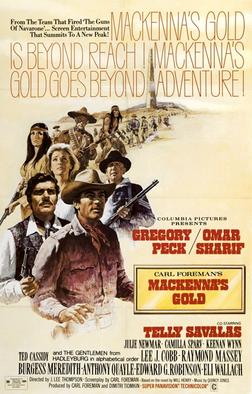
Mackenna's Gold

Oh, cable, how I love you. I basically have two channels on if I'm watching TV, either MLB Network or Encore Westerns. A whole channel devoted to western TV shows and movies?!? Aaahhh my head just exploded! It gives me a chance to revisit a whole bunch of movies I haven't seen in years, like 1969's Mackenna's Gold, a big-budget, all-star extravaganza that I remember liking (I think) on my first viewing. Does it hold up?

A marshal for the western town of Hadleyburg, Mackenna (Gregory Peck) is out on the trail when he's ambushed by an old Apache man who dies after a quick shootout. Before he dies, the Apache gives Mackenna a map to a famous, supposedly lost, canyon of gold ('Canon del Oro') that treasure hunters have long sought. Mackenna throws the map in the fire but not before noticing a couple landmarks on it. He's soon cornered by a Mexican bandit, Colorado (Omar Sharif), and his gang who similarly are looking for the canyon of gold. They're not alone. The desert seems full of treasure hunters and gold-hopefuls desperately searching for the gold. Discovering that Mackenna may hold the key to finding the canyon, he's taken along as Colorado's unwilling prisoner. The supposed location is days away across the vast desert with Mackenna, Colorado and his men forced to deal with a do-good posse out of Hadleyburg, an intervening cavalry troop and an Apache war party. How far will the prospect of gold drive all these folks?

I'm a sucker for westerns -- good and bad -- but this one is bad and just not that enjoyable. Talk about a movie where the ingredients don't come together (at all), and you've got this movie. The talent on-hand is unquestionable from director J. Lee Thompson, stars Gregory Peck and Omar Sharif leading a ridiculously deep cast, a cool, potential-filled story and a drop-dead look to it all...it should have been so much better. Or I guess I'd settle for just 'good' too. The formula seems to go after a western Guns of Navarone meets Treasure of the Sierra Madre combination, but it never jells into anything remotely coherent or especially enjoyable. That's tough to say because a cast this good should make a movie pretty decent on its own but alas, it wasn't meant to be this time! If you're looking for a Peck-Thompson-Carl Foreman pairing, stick with 'Navarone.'

Kudos to Encore Westerns. Watching the movie for the second time but first time since 2009, I watched it in widescreen, as it was meant to be. Thompson filmed in Super Panavision 70, a filming technique that fills the screen to epic proportions, almost like a panoramic picture. Shooting on-location in Monument Valley, Glen Canyon and Canyon de Chelly in Arizona adds a great visual appeal to the movie. Shots of riders galloping across these expanses are excellent to watch, a sight to behold, and unfortunately, one of the few genuine positives to take away from a western that's too long at 128 minutes. When a movie's looks are the best thing going...that's never a good thing.

Poor Gregory Peck, he looks like he's as bored as all get-out and doesn't quite know what to do. One of my all-time favorite actors, he's undone by all the shenanigans going on around him. Getting to play straight man to a murdering bandit, a gold-for-eyes posse, a bloodthirsty Apache war party, a murdering cavalry sergeant (an underused Telly Savalas), and all sorts of ancient legends coming to life is never a good thing. As reliable as anyone who's ever graced the screen, Peck is given little more to do than look out for Camilla Sparv's damsel in distress while navigating a love triangle with Julie Newmar's Apache warrior and Sparv. Yeah, you read that right. Catwoman plays an Apache warrior and looks great doing it! She even gets an odd nude swimming scene where she tries to kill both Peck and Sparv. So there's that!

So much of the rest of the cast is simply miscast. I like Sharif in just about any film he's ever done, but he's an odd choice to play our Mexican bandit, Colorado. His gang includes Keenan Wynn as a Mexican bandit named Sanchez, with Ted Cassidy (Lurch from The Addams Family), Rudy Diaz and Robert Phillips as Apache warriors. All spot-on casting! Brace for this list of appearances that amount to little more than cameos, members of a "posse" out of Hadleyburg that's looking for gold. The group includes Eli Wallach, Anthony Quayle, Lee J. Cobb, Burgess Meredith, Raymond Massey and Edward G. Robinson!!! Look at that Hollywood royalty! Unfortunately, they're introduced, given nothing to do and there basically because of their name recognition. So....yeah....there's that! Quite the cast, huh? I just wish they were given more to do. Maybe that character development was cut from the rumored 3-hour version of the film. Yeah, that's it I'm sure.
  
Just too many moving pieces that never get going in the same direction. There's virtually no story, just some character introductions and then they're off into the desert. The only detour are various ways to kill off characters in waves. Then, there's the beautiful location shooting, with a slight problem. Countless times, one after another, we see the location shots and then a quick cut to our actors in front of a rear projection shot. Nothing takes you out of the story's momentum like Peck, Sharif and Co. riding a "horse" as they tear across the desert. Throw in some odd, out of place narration (it's not Victor Jory's fault!), some painful theme ballads, and generally odd cutting and editing that is more and more jarring with each passing scene.

There's a meanness to the story that's hard to account for. Characters are introduced for the sake of dispatching them in unceremonious fashion, but the general tone of the movie itself isn't that dark. It feels like they're going for that "Greed will make you do horrible things" tone, but it's too light, fluffy and goofy to pull it off. There's some potential obviously with the all-star cast, some equally impressive camera angles and shots, and the location shooting, but there's just too much negative going on to ignore it. A stinker.

Mackenna's Gold (1969): **/****

Tuesday, November 19, 2013

21 Hours at Munich


It was an event in history that captivated the world in its truth. The Munich massacre in 1972 at the Summer Olympic Games was unbelievable in the sense that it really happened. It is an event that shows how far motivated people will go to accomplish what they want, the depths they'll go to. As far as film versions go, the story spawned Steven Spielberg's Munich, a story about the fallout after the massacre, but there is a version of the facts, a TV movie from 1976, 21 Hours at Munich.

It's early on September 5, 1972 and the summer Olympic games are in full swing in Munich, West Germany. In the predawn darkness, eight members of the terrorist group Black September headed by a man named Issa (Franco Nero) sneak into the Olympic Village where athletes from around the world bunk and take 11 Israeli athletes captive. German officials from both the police and the government descend on Olympic Village, including Dr. Manfred Schneider (William Holden), the Chief of Police, to negotiate with the terrorists and find out what they want in exchange for the Israeli hostages. The clock is ticking though, the demands more ludicrous than they could have ever imagined. With the lives of the hostages at stake, the German government and the Olympic committee work to resolve the situation knowing that Issa and his compatriots will kill their hostages if they feel their demands won't be met. What can be done either way?

Besides a lousy print on Netflix, I'd never been able to track this one down until I found it recently on MGM-HD on TV. Finally a good print for a pretty good movie. From director William A. Graham, 'Hours' was originally a TV movie that received a theatrical release in some countries overseas. While the scope isn't huge like a theatrical epic, it doesn't have that distinct feel of a TV movie. Shown on TV just four years after the real-life events that inspired it, it certainly seems like the wounds would have been too fresh for audiences. That's probably going to go a long way in determining if you will like or dislike this movie. It isn't supposed to be entertaining. Interesting? Yes, very much so, but if you're remotely aware of the incident, you know how it ends. It becomes more and more uncomfortable to watch, a painfully tense movie that builds to its inevitably dark, frustrating conclusion.

Sticking as close to the facts as possible, 'Hours' is particularly memorable because of the facts. The truth of the story leads to some incredible set pieces to watch. If you've seen Steven Spielberg's Munich, you've got an idea of what to expect. Sneaking into the Olympic Village and taking the Israeli hostages, the opening sequence is beyond tense. Done with almost no dialogue, it's like we're there with them as the athletes run, hide, fight back as they realize what's going on. The Israeli wrestling coach, Moshe Weinberg, fights back in an incredibly heroic way, as does Yossef Gutfreund (Paul L. Smith), an Israeli wrestling judge), who first discovers the Black September attackers and desperately tries to hold them back at the door. Knowing the truth, reading about it, it all adds up to that incredibly discomforting level that makes it incredibly tough to watch. But at the same time, seeing the harrowing truth of it all makes it real in a visceral, blood-curdling, shiver up your spine way.

The same qualifies for the finale as the hostages and their Arab captors have been transported to an airport/airfield outside Berlin. A plan has been devised to take out the Black September members, but it's come together quickly, not to mention it's pitch dark and far from an ideal situation of how to rescue the Israeli athletes. We see how the plan crumbles in execution, all the little things becoming big problems. Without giving anything away (for those that don't know the truth), it's an incredible ending, a moving, equally uncomfortable finale to a story that defies logic, in the sense that something this horrific could happen at all.

Taking a backseat to the story is a very capable cast. Nero ends up delivering the best performance as Issa, leader of the Black September terrorists. It's a great part because it is a villainous part -- a pretty obvious one -- but Nero makes Issa a human being, not some ridiculously cliched international villain. Sympathetic? Nope, not supposed to be. Fascinating? You bet. His cat and mouse negotiating game with the always solid William Holden becomes the most interesting part of the fast-developing story. Also look for Shirley Knight as an Olympic committee member tasked with being a go-between with Issa and those trying to stop him, Anthony Quayle as a veteran officer of the Israeli special forces/secret service, Richard Basehart as a member of the German government spearheading the rescue effort, and Noel Willman as another German official closely working with Holden's Schneider.

With the feel of a documentary, 'Hours' presents the facts and lets them be. It was filmed on the actual locations where the Munich incident took place in Olympic Village. The actual on-location sites provide an eerie, dream-like feel to the fast-developing story, knowing what actually happened there just a few years before. If you can track a copy down or stumble onto at MGM-HD, I highly recommend it. Well worth it.

21 Hours at Munich (1976): *** 1/2 /****

Wednesday, May 8, 2013

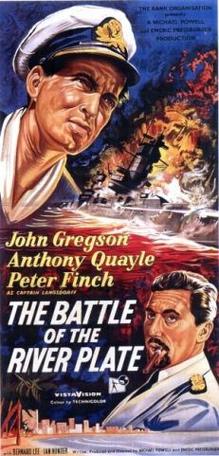
Pursuit of the Graf Spee

In the early years of World War II, Germany ruled the seas as its enemies jumped into a new age of naval warfare. The battleship Bismarck was the most infamous example of German firepower on the high seas, a ship that terrorized Allied shipping. Another example -- a significantly lesser-known one -- is the pocket battleship Graf Spee, a cruiser dubbed a battleship that caused an international sensation late in 1939, a story told in 1956's Pursuit of the Graf Spee.

As 1939 comes to a close, British merchant marine Captain Dove (Bernard Lee) sees his ship sunk by a German cruiser, the Graf Spee, that is gaining notoriety around the world for its ability to disrupt Allied shipping. On board the German cruiser, Dove meets its captain, Langsdorff (Peter Finch), who tells him that he will be kept with other prisoners until they can be dealt with. The days and weeks pass though and Dove is joined by countless other prisoners who tell him a rumor of coming trouble. The British are sending a three-cruiser convoy in pursuit to hunt down the infamous German warship. Outnumbered but not necessarily outgunned, the Graf Spee is ready for a battle, but the coming fight involves more than either side was planning for, including international negotiations and intrigue.

From directors Michael Powell and Emeric Pressburger, 'Pursuit' is an interesting movie, but for reasons I really didn't see coming. A forerunner of 1960s/1970s WWII movies like Midway, The Longest Day, A Bridge Too Far, Tora Tora Tora, this British-made film plays like a documentary at times. Big, expansive story telling a true historical battle and a big impressive cast set the backdrop. What I was most impressed with was the use of real ships that give the story a sense of authenticity and realism. There are some truly impressive shots of these immense, destructive warships at sea, and some equally enjoyable shots of cast and crew on-board these ships.

Beyond that though, the movie stays on a superficial for its first half of the 119-minute running time. It gets bogged down quickly in the details and the naval tactics of the history. It's apparently very accurate, but that doesn't make the story interesting to watch. The commander of the cruiser convoy (Anthony Quayle) sits down with his ship commanders and explains what their plan of attack is. Then we see the attack after an excruciatingly long segment of the ships scanning the horizons for the Graf Spee that plays in real-time (seemingly of course). The actual battle is ships miles away from each other just blasting away at each other. While we see the effects as the shells land and tear the ships apart, it is far from exciting to watch. I never felt emotionally or personally invested in the story that sticks to close to its quasi-documentary style.   

After the slow-moving naval intro that never really caught my attention, 'Pursuit' finally picked up pace in the second half when it takes a surprising turn. Severely damaged in the battle, the Graf Spee makes a beeline for the neutral harbor of Montevideo with the British not far behind. What follows is an interesting twist of that international intrigue as the Uruguayan government (including minister Peter Illing) decides what to do with the situation as several foreign ministers (Anthony Bushell = British, Douglas Wilmer = French, John Chandos = German) try to get their two cents in. At the same time, intelligence agents (Michael Goodliffe and William Squire) attempt to decipher what the Germans will do. An American radio rep (Lionel Murton) for NBC describes the action from shore as huge crowds gather on the beaches and docks to see what happens. The story just plays differently, and it plays well with a change of pace.

The overall casting has its positives and negatives. 'Pursuit' features a lot of impressive names, but like the early goings in the story, it has a superficial feel to it. The naval battle is especially affected in negative fashion, faceless sailors in white yelling amidst smoke and chaos. The captains of the British cruisers include John Gregson, Ian Hunter and Jack Gwillim with Patrick Macnee as one of their subordinates. Also look for Christopher Lee as Manolo, a passionate Uruguayan bar owner who bothers Murton's radio man, with Donald Moffat as a signalman in his film debut, and Anthony Newley and Nigel Stock with small, uncredited supporting parts. I wanted to like this one more, but it's too uneven and missing that special something (energy is my final verdict) that brings a movie up a notch. The second half is considerably better so stick with it for the payoff.

Pursuit of the Graf Spee (1956): ** 1/2 /****     

Thursday, June 10, 2010

Operation Crossbow

Most of the war movies I watch are depictions of front-line action or at least the generals/headquarters making the decisions that affect the front-line soldiers.  But what about the Intelligence agencies doing their damnedest to help the war effort through espionage, gaining information and sabotage behind enemy lines.  So goes 1965's Operation Crossbow, a British-Italian production telling the true story of British efforts to slow down Germany's rocket/technological advances as WWII reaches its middle years.

As much as WWII was about one Allied soldier facing one Axis soldier, there was a race at home to be the first country to develop the atom bomb.  On less destructive levels, both sides tried to create weapons technology that could cause more death and destruction than the average grenade or artillery shell.  Obviously, these advances were kept as top secret as possible, but that doesn't mean each side wasn't trying to one-up their enemy by playing a little defense courtesy of the Intelligence community doing a little sabotage.

It's midway through 1943, and the Germans have developed a new flying bomb that they plan to unleash on London and other English cities.  The Allies are aware of the new development, and do their best to slow down the advances by consistently bombing German work sites where they believe the bombs to be built and launched.  But as dangerous as the bombs are, the Germans have a new weapon in the late stages of development; the V-2 rocket, that could drastically change the course of the war, including the D-Day invasion.  Facing such a huge game changer, Allied Intelligence is forced to use a desperate plan; send Allied agents into Germany disguised as engineers who will help develop the rockets.

You might have noticed there's not a single actor/actress listed in the plot description.  Basically, it would have taken too long to include them and make that paragraph a behemoth to read.  Like other big budget war movies, 'Crossbow' utilizes an ensemble cast with talent from all over the world taking part.  And in terms of story, the ensemble works better because the plot is very episodic.  The first 30 minutes is almost exclusively from the German perspective, the next 30 the Allied Intelligence, and the last hour mostly with the agents working deep undercover.  Each of these segments could have been expanded for their own movie, but together they work to form a coherent storyline.

The cast listing is an odd one because producer Carlo Ponti listed his wife Sophia Loren as the lead when really she makes a 20-minute or so appearance and is an add-on more than anything else.  That's not being critical of Loren because she's a fine actress, but big picture her part isn't essential to the movie.  Starring as Germans the ensemble includes Paul Henreid and Helmut Dantine as two high-ranking German generals, Barbara Rutting as German aviator Hannah Reitsch, and Anthony Quayle as Bamford, a secret agent/spy.  Allied Intelligence includes Richard Johnson, Trevor Howard, John Mills and Richard Todd as the men trying to halt the German advances.  The agents sent into Germany include George Peppard, Jeremy Kemp and Tom Courtenay, all posing as deceased scientists so they can access the German rocket plants with Lilli Palmer playing a resistance contact.

The whole movie is a good example of a solid WWII ensemble, but the best and most interesting/exciting part is when the story follows these three agents.  They are all forced to become someone else, knowing if they are caught they will be summarily shot on site.  Even getting to that point is difficult as Peppard's Lt. Curtis finds out when the scientist he is posing as is visited by his wife (Loren).  Courtenay's Henshaw is dealt a cruel twist of fate and must decide how much he is willing to sacrifice.  Kemp's Bradley is dropped into Germany as a last-minute resort with little knowledge of the man he's impersonating.  Their scenes as they try to dupe the Germans are tense and difficult to watch, those scenes where you get butterflies hoping everything doesn't hit the fan.

Crossbow's story covers a lot of ground -- almost a year and a half -- but never feels like we're being let out.  Supposedly a much longer finished product was turned in by director Michael Anderson only to have it cut heavily to the movie we see now which clocks in at just under two hours.  You can see where certain segments were cut, especially the German segment to open the movie, and other odd instances like Peppard gaining a bandage on his forehead, but we never see why.  But these are little things, not big disturbances that could ruin the movie.

While the V-2 rocket was actually used by Germany in WWII -- over 3,000 were fired at England -- the movie does have to have some sort of resolution if not necessarily a happy ending.  The finale is a whopper as Peppard and Kemp desperately try to pinpoint their underground location to a passing bomber force.  The huge underground facilities sets look like something out of a James Bond movie and provide quite an ending to a strong story.  Not as well know as some of its 1960s WWII counterparts, but definitely worth a watch or two.

Operation Crossbow <----trailer (1965): ***/**** 

Friday, September 11, 2009

The Guns of Navarone

Author Alistair MacLean was a master of thrillers, suspense and adventure in his long career. Of all his books though, two have become classics unto themselves thanks to the movies that resulted from their stories, 1969's Where Eagles Dare and 1961's The Guns of Navarone. Both movies share similarities, but when comparing them 'Navarone' is the better movie and has helped serve as a blueprint for adventure movies ever since.

In both MacLean novels, the setting is WWII with an almost suicidal men on a mission story. Everything points against an expert team getting the job done, but somehow they pull through in the end. No real spoilers there. In Navarone, it's 1943 and the war is still up for grabs. In the Mediterranean on the Greek island of Kheros, 2,000 British soldiers are trapped with no way of escaping. Allied Intelligence learns the Germans are planning an assault on the island with only a week to prepare. The Allies plan to rescue the men on Kheros, but there's a problem. The only way to get ships through is a channel near the island of Navarone where two huge radar-controlled guns will sink anything in range.

With time running out, Commodore Jensen (James Robertson Justice in a great cameo appearance) assembles a crack team of operators to get to the German-held island of Navarone and destroy the guns. First up, Captain Keith Mallory (Gregory Peck), a guerilla fighter in Crete who's survived 18 months behind enemy lines and who has a special talent that will come into play. Joining Mallory is his partner in Crete, Andrea Stavros (Anthony Quinn), a Greek officer extremely capable with his hands, a knife or a sniper rifle who also has an ax to grind with Mallory. The duo will lead the team of British commandos that include Maj. Roy Franklin (Anthony Quayle), Cpl. Miller (David Niven), the explosives expert, Pvt. Butcher Brown (Stanley Baker), a specialist with machines and knives, and Pvt. Spyro Pappadimos (James Darren), a young soldier adept at killing.

The commando team must sail to Navarone and get onto the island by scaling a 400-ft cliff. They will receive help from 2 Greek resistance fighters, Maria (Irene Papas) and Anna (Gia Scala), but even with that help, they must deal with horrific weather conditions, German patrols getting ever closer, and the mounting evidence that a traitor is among the group.

In the trailer (link later), Peck somewhat arrogantly states that this may be the most exciting adventure movie you will ever see. I'd normally have an issue with someone telling me that, but I find it hard to disagree with the statement. At a somewhat leisurely 156 minutes, the movie flies by with director J. Lee Thompson letting the tension and momentum build as the team tries to overcome the odds to blow up the guns and save the men on Kheros. The movie puts together a series of great set pieces, including the team arriving at Navarone in a heavy storm and then having to scale a supposedly unguarded 400-ft cliff. Thompson doesn't rush these scenes and lets them develop.

For an adventure movie, there isn't a ton of action. It's more of a build-up with anticipation of what could happen if something goes wrong. You're constantly on edge that at any moment the Germans could close in and capture the team. So with an average amount of action, it's the actors who benefit the most. Peck is an ideal choice for the unlikely leader who must step into a command position, and Niven would seemingly be out of place in a WWII adventure movie, but he's perfect. Early on, Niven's Miller is a mood-lightener with his almost constant one-liners. It's as the movie progresses, that Niven becomes the conscience, debating about the futility of what they're doing. Great parts for both actors.


And while Peck and Niven are very good lead, Anthony Quinn makes this movie special. His Andrea Stavros is a man of few words who lets his actions speak for themselves. He lost his wife and children early in the war and seeks revenge on the Germans and also Peck's Mallory who he holds responsible. One of the coolest scenes has Stavros holding off a German patrol with only a sniper rifle on a mountainside. He later meets the team, arriving at the predestined location before them, greeting Mallory and Miller with a calm 'Good evening, gentlemen' while he smokes a pipe. In a long line of great characters, this is one of Quinn's best.

Watching this movie every year or so, it never gets old. Aided by one of Dimitri Tiomkin's best scores and a great script from producer Carl Foreman, it truly is one of the best action/adventure movies ever. Also look for a young Richard Harris early as an exhausted 'bloody' pilot. Exciting from beginning to end with a chaotic final act, The Guns of Navarone is one of the best men-on-a-mission movies you'll ever watch. If you haven't seen it, the DVD is a cheap one and worth a blind buy. If you don't want to buy it, check out Youtube where you can see it part-by-part.

The Guns of Navarone <-----trailer (1961): ****/****

Saturday, August 8, 2009

The Wrong Man

So imagine this, one day you're coming home from work only to have two police detectives stop you and take you to the precinct. They've got eyewitnesses who can put you at the scene of several different hold-ups and even pick you out of a line-up. Your handwriting sample is even eerily similar to the note left at the crime scene, and your alibi doesn't hold up. Everything, and so it seems everyone, is against your innocence. What do you do?

That's the question facing Christopher Emmanuel 'Manny' Balestrero (Henry Fonda) in Alfred Hitchcock's The Wrong Man from 1956. Manny is the typical husband who with his wife Rose (Vera Miles) has a nice little life with their two kids and house. Manny works as a bass player at a local club at nights and while he doesn't pull in a ton of money, his family is happy and well cared for even if money isn't always readily available. One day, he does to the insurance agent to see how much he can borrow so Rose can have her wisdom teeth removed.

So starts the process as the tellers at the agency think he's the man who held them up several months before. The police get involved and before you know it, Manny is looking at serious jailtime for a handful of stickups that he swears he was not a part of. But even with his supposed innocence, the evidence starts to build up making the viewer wonder if maybe he is guilty. Who better to star in that part than Henry Fonda? Other than his shocking portrayal of a villain in Sergio Leone's Once Upon a Time in the West, I can't think of another movie where Fonda was the bad guy. He's Joe America so how could he be responsible for all these accusations?

Director Alfred Hitchcock is dealing here with a story and circumstance that he perfected over the years; that of a man thrust into a situation where he doesn't always know what is going on and must find a way to right the ship. Think of The Man Who Knew Too Much or North by Northwest as two other examples. He excelled with stories like this and keeps the viewer guessing. Hints are dropped throughout that maybe Manny did go through with the crimes. Could he have done it? After all, we've just met the guy and at least in my case, made the assumption that Fonda, in character or not, couldn't have been a stick-up artist.

By the end of the movie though, everything is just wrapped up too nicely with a little bow on top to cap it off. I don't know what I was expecting from the ending, maybe a twist like so many of Hitchcock's other films, but it doesn't reveal itself here. I guess the enjoyment is supposed to come from the build-up as the evidence mounts against Manny, and the effect it has on his wife Rose who starts to unravel under all the pressure. Speaking of that, Miles delivers a strong performance as Rose, a sort of common housewife who just wants what is best for her family and starts to blame herself for all their problems.

Other names in the cast include Anthony Quayle as Frank O'Connor, Manny's lawyer, and Harold J. Stone and Charles Coooper as the two lead detectives on the case who want to believe Manny's claims of innocence even when nothing seems to point in that direction.

I wanted to like The Wrong Man more, and parts are very good, but the ending just doesn't do it for me. Hitchcock opens the film with some on-screen narration, saying it's a true story so that the ending is what happened in real life. But for me, I guess having seen enough other Hitchcock movies I had the wool pulled over my eyes waiting for the big reveal, the big twist that never comes. Still a strong effort from Hitchcock thanks to the performances of Fonda and Miles, but it's not top tier Hitchcock thriller.

The Wrong Man <----trailer (1956): ** 1/2 /****