The Sons of Katie Elder

The Sons of Katie Elder
"First, we reunite, then find Ma and Pa's killer...then read some reviews."
Showing posts with label Errol Flynn. Show all posts

Tuesday, December 23, 2014

The Adventures of Robin Hood

Errol Flynn was a lot of things in a legendary career early in Hollywood's history. He was a swashbuckler, a boxer, a gunfighter, a rabble-rouser in his personal life, someone who lived life to the fullest. But what is that one role, that one part that is instantly recognized as his best? Well, that one's easy, 1938's The Adventures of Robin Hood.

It's 1191 A.D. and the English king, Richard the Lionheart, has been captured by the enemy while returning from the Crusades. In steps his greedy, manipulative brother, Prince John (Claude Rains), who takes over the crown and instantly starts to take advantage of his power. In a growing battle between the Normans and the Saxons, the put-upon people need help, someone to fight back. That man? A Saxon nobleman, Robin Hood (Flynn), who takes to Sherwood Forest with a gang of bandits to be a constant thorn in the side of Prince John and his enforcer, Sir Guy of Gisbourne (Basil Rathbone). They're not any bandits though. They aren't in for personal gain. Robin and his men become heroes as they give their spoils to the people from the money to the food they take. What's their end goal though? Can they somehow take down Prince John?

So everyone has heard of Robin Hood right? His historical reality has long been debated because...well, people just aren't sure he existed. So real or not, the character has become an instantly recognizable individual in literature and storytelling. From directors Michael Curtiz and William Keighley, 'Adventures' was a profoundly important film in Hollywood history. It's the big, splashy, colorful adventure film that helped set the stage for action and adventure films for years to come. The action-packed story with romance and intrigue and all sorts of craziness picked up four Oscar nominations, winning three, and is a perennial entry on all sorts of 'Best' lists, including several AFI lists. Can't go wrong, right?

Start with Errol Flynn. He's one of my favorite movie stars ever, the type of star/actor I'll check out a movie solely because he's in it. There aren't a lot of those stars around then or now. But in a career of memorable parts, this is THE part. He was meant to play Robin Hood. Flynn brings the perfect energy to this folklore character. That infectious smile, that loving-life laugh, that physicality as he swings across the scene (quite literally), fights his way through one sword fight after another, and unleashes arrow after arrow at his pursuers. You can't help but like the character, Flynn bringing him to life and influencing every other Robin Hood portrayal to follow for years whether it be on film, on television and even literature. That Errol Flynn guy. He knew what he was doing.

'Adventures' boasts a solid all-around cast in support of Flynn. The villains are perfectly dastardly, doing all sorts of malicious evil. Rains is the smooth, suave Prince John (slightly effeminate) while Rathbone gets to play the far more sinister Sir Guy, progressively becoming more obsessed with capturing and hanging Robin. Frequent Flynn co-star Olivia De Havilland (they would work together in 8 films) is memorable as Maid Marian, promised to Sir Guy while falling for Robin when she's taken prisoner. Their chemistry is evident throughout just like it was in all their pairings together. As for Robin's Merry men, look for Patrick Knowles as Will Scarlett, Eugene Pallette as Friar Tuck, Alan Hale as Little John, and Herbert Mundin as Much, a mousey squirrel. There's also Melville Cooper as the semi-bumbling but amusing Sheriff of Nottingham and Ian Hunter as King Richard.

Here's my spot here. I appreciate what this movie meant in terms of Hollywood and historical significance, but I didn't love the movie. I liked it a lot, but a slower last 45 minutes left me disappointed. Still....it's a really good movie. It's that perfect popcorn escapism, great good guys and black and white bad guys. The color scheme is a gem, one of the first Hollywood films to really embrace shooting in color. Robin and his Merry men in their Lincoln green uniforms, Prince John and Sir Guy in their bright red, the colors are rich and vivid throughout. As well, the Oscar-winning score from composer Erich Wolfgang Korngold is a gem, several instantly recognizable themes keeping the action flowing throughout (listen HERE). The action is fun and full of some great stunts, several large-scale battles and scuffles dotting the story. An easy movie to recommend.

The Adventures of Robin Hood (1938): ***/****

Monday, June 16, 2014

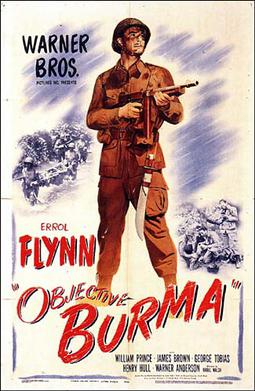
Objective, Burma!

With any actor or actress with a devoted fan following, that following is going to have differing opinions. What is your favorite film? This one or that one? All of them? When we're talking about an actor who worked over multiple decades, it gets that much tougher. Take Errol Flynn who started working in the 1930s and stayed in films through the 1950s. He's got more than a few gems to his name, but my favorite is and always will be 1945's Objective, Burma!

It's 1944 in Burma and Allied forces are preparing to invade the country they were kicked out of by Japanese forces two years earlier. The men across the branches are just waiting for their orders. Among the forces waiting to unleash the attack is Capt. Nelson (Flynn), an officer in command of a platoon of paratroopers. With his friend and second-in-command, Lt. Sid Jacobs (William Prince), Nelson will lead a behind the lines mission into Burma, his men tasked with finding and destroying a key radar station used by the Japanese forces. A 2,000 man garrison isn't too far away from the radar station, meaning Nelson's paratroopers must drop in miles away and find the hidden radar station, all the while avoiding thick Japanese patrols. With a newspaper reporter, Mark Williams (Henry Hull), along to report on the mission, the paratroopers take off from their base with a dangerous mission ahead of them. As prepared as they are though, nothing can really prepare them for what awaits.


What a great movie, one that qualifies in the overused at times but appropriate 'They don't make them like that anymore' category. As far as pure action/adventure movies go, this 1945 WWII flick from director Raoul Walsh is simply hard to beat. It was released in theaters in early 1945, the war winding down but the fighting still very much going on both in the Pacific and Europe. It was a movie ahead of its time, patriotic but not flag-waving and propaganda thankfully. With an Oscar-nominated score from composer Franz Waxman (one that would be used again in the similarly-themed Merrill's Marauders), the action in the 142-minute movie is always on the go, never really slowing down. You feel like you're there with the soldiers, seeing their exhaustion, beards and facial hair appearing as the mission goes awry. It's the perfect popcorn movie, but there are other layers and levels to appreciate. A war movie that still resonates almost 70 years later.

At the tail end of his heyday in terms of popularity, Flynn is the without a doubt, no question star here. I love his performance, especially because he switches things up a bit. Flynn was Robin Hood, a pirate, a swashbuckler, a ladies man, but here, he is just a very capable, very tough and well-liked officer. His Captain Charlie Nelson has been tasked with a dangerous mission that will prove essential to the Allied war effort. Is he rattled, even nervous? Yes, every minute, but he embraces it, hides the feeling away and shows that confidence and even a little bit of a swagger so his men need to see. Flynn was an underrated actor -- for me at least -- but that's one of his biggest attributes. He was confident. He was cool, smooth, and he looked like he belonged on-screen. If it looks like he's not acting, that's the work of an actor who could make it look effortless. At one point with the mission in doubt, one of Nelson's men encourages the other men with "I'd follow him down the barrel of a cannon." Little schmaltzy? Sure, but it works in context, and you see why. I'd follow Errol Flynn into battle too!

Take a look at the cast and you see some names and faces you recognize, but this is Flynn's movie. The rest of the cast becomes part of the unit picture, men brought together from disparate backgrounds forced to work together to get the job done. I liked Hull's journalist, a crotchety old writer trying to tell the story of the soldiers. Nelson's friendship with Prince's Jacobs certainly adds another layer to the story as well. As for Nelson's paratroopers, look for James Brown, George Tobias, John Alvin, Richard Erdman, Joel Allen, and uncredited parts for Anthony Caruso and George Tyne in uncredited parts. Warner Anderson and Hugh Beaumont (Beaver Cleaver's Dad) play higher-ranking officers while Mark Stevens gives a solid supporting part as Lt. Barker, a pilot with the closest ties to Nelson's paratroopers. I liked Tobias, and there's another paratrooper I can't identify by name who has a great bit with a Japanese soldier.

There's so much good going on here, things I picked up on during a recent viewing. It is that perfect war action movie, but it's more. There are a handful of scenes that really resonate, giving an eye into the eyes and thoughts of the paratroopers. Prior to jumping into Burma, the camera moves along a row of faces, the men reacting differently to their upcoming jump and mission. When the mission goes awry, we see the looks on their faces when they have to adjust on the fly. I thought the highlight though was when Nelson and his men come across the mutilated bodies of the paratroopers who didn't make it, the result of a Japanese ambush. One soldier remains, Walsh filming only the man in a door frame so we can't see what's been done to him. We only know he's been cut up, shot up, and he's bleeding out. Over the course of the movie, we see the exhaustion set in, the frustration weighing on all their shoulders. An epically exciting action movie? Yes, and much more.

That is one of the huge appeals for 'Burma.' The action is everywhere, and it doesn't disappoint. The attack on the radar station is the biggest set piece, the rest of the shooting all about the tension and the chase. We don't see the Japanese in frame a lot, but their off-screen presence is a menacing, intimidating cloud hanging over the paratroopers just waiting to strike. The final sequence is especially effective, the pursuing Japanese trying to infiltrate the paratroopers' position on a lonely isolated hill marked by trenches and foxholes. Filmed in the dark with little music, it is a doozy of a success. The whole movie is, one of the great war movies around.

Objective, Burma! (1945): ****/****

Wednesday, August 8, 2012

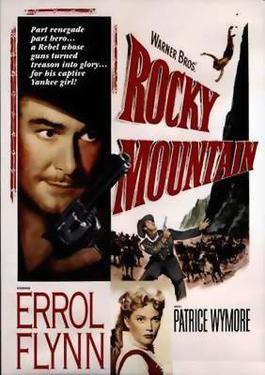
Rocky Mountain

As far as the American Civil War, there just haven't been much in the way of movies about the topic. Sure, there's been epics -- Gettysburg, Glory, Cold Mountain -- but overall as a sub-genre, there's been less compared to almost any other war America was involved in. I don't know that for sure, I'm just assuming. Westerns set during the time though have their own little niche, especially when Union and Confederate forces must band together and fight, like 1950's Rocky Mountain.

Leading a small seven-man squad west for a secret mission that could save the Confederacy, Capt. Lafe Barstow (Errol Flynn) has his mind set on the mission and that alone. Their plan? Start an uprising in California, hoping to take attention -- and troops -- away from fighting in the east. His plan takes a hit though when Barstow's squad fights off a Shoshone attack and rescues a beautiful young woman, Johanna (Patrice Wymore) from a wrecked stagecoach. On their way to meet the hopeful leader of the uprising, Cole Smith (Howard Petrie), Barstow must not make a decision. Johanna's fiance is a Union officer and will no doubt come looking for her. His squad is stuck in the middle, forced to continue the mission or save Johanna, worrying about Shoshone war parties and Union patrols all around them.

Forgetting to record this when it recently aired on TCM, I was pleasantly surprised to find it available for viewing at Netflix. I was even more pleasantly surprised after watching it. The late 1940s and early 1950s were an important transition for westerns. It wasn't so much the white-hatted good guys vs. the black-hatted bad guys. Most characters had flaws, even inner demons they had to deal with. From director William Keighley, 'Rocky' isn't quite there....but it's getting there. The Union and Confederacy teaming up was used several times after (Escape from Fort Bravo, Major Dundee), but this is one of the first I can come up with. It's the little things here. The men have beards, stubble, and look like they've been sweating in the desert heat. At least some effort was made to make it seem authentic. I give points just for the attempt. When that attempt works? Win-win for the viewer.

A couple more 'little things' here that help make 'Rocky' a little more memorable. Keighley filmed his western in black and white, pretty typical for the time in a western. Would it have been an interesting movie to watch in color? Yeah, you bet, 1948's She Wore a Yellow Ribbon coming to mind. But the rocky, barren desert is aided by the black and white filming, giving a starkness to the setting that color might have canceled out. He films on location in New Mexico, using some familiar locations including some that fans of John Ford's Fort Apache will notice (more on that later). Also, 'Rocky' borrows an instantly recognizable musical score from composer Max Steiner, using his They Died With Their Boots On theme. Give it a listen HERE starting at a :49.

His star fading a bit by 1950, Errol Flynn nonetheless makes the most of his last western. He just looks comfortable in the part. His Capt. Barstow is a strong leader, liked and respected by his men, but he also has a moral compass that won't let him turn his back on what's right and wrong. The only slow moments here are his not-so-surprising romance with Wymore's Johanna. She's engaged to Union cavalry officer, Lt. Rickey (Scott Forbes), but can't help be drawn to the very attractive Capt. Barstow. Playing the sneaky, sniveling Cole Smith, Petrie is a background player, but his character plays a key role late. Also look for western vet and character actor Chubby Johnson as Craigie, the stagecoach driver with no allegiances to North or South, just himself, bringing some homespun charm to this small but funny part.

What drew me to the movie -- right up there with Errol Flynn -- was the story that sounded like such an obvious forerunner to movies like Escape from Fort Bravo and Major Dundee. Nowhere was that more evident than Flynn's small squad of Confederate misfits. Not any huge names here, but western fans will no doubt get a kick out of watching the group. It includes Guinn Williams as Pap, the old man of the group, Dickie Jones as Jimmy, the soft-spoken youngster who fights like mad while also looking out for his mutt of a dog, Slim Pickens (in his first credited role) as Plank, a plainsman who served time in prison, Robert Henry as Kip, a young man and heir to a plantation back home, Sheb Wooley as Rawlins, the steamboat man with a mean streak, Peter Coe as Pierre, the Frenchman from Louisiana, and Rush Williams as Jonas, the plainsman and dead shot with a rifle. Not a weak link in the bunch, but Jones especially stands out, including one scene he has with Wymore discussing his brief encounter with Robert E. Lee before Gettysburg. Just seven solid supporting parts for Flynn.

It's the rare western I can't find something positive to talk about. And about an hour into 'Rocky' I was liking it a lot if not loving it. And then there's the last 25 minutes. I have this picture of 1940s and 1950s movies typically ending rather happily; guy gets the girl, everyone makes it. That certainly ain't the case here. Somewhat short on action to this point -- not an issue in the least -- the finale has Flynn's Barstow and his squad making a dangerous decision separate from the mission. I won't give spoilers away, but I was shocked by this ending in its brutal honesty. It was also filmed in the same canyon as the massacre in Fort Apache. Flynn addressing his men says after a chase "They've seen our backs....let's show them our fronts." It's a line that could sound cheesy, but in a western in this situation with Flynn delivering it, it works in a big way. I loved the honesty of the ending. LOVED it. It takes a pretty good western and makes it a near classic instead.

Rocky Mountain <---trailer (1950): *** 1/2 /****

Thursday, July 21, 2011

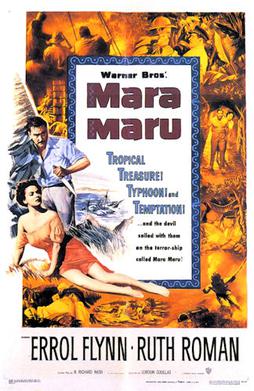
Mara Maru

Inevitably with movie stars, that star is going to fade a bit if your career has any sort of prolonged success. Audiences may tire of you a bit, or maybe the scripts just aren't there anymore.  How do you respond then? By 1952, Errol Flynn had his heyday in the late 1930s and throughout much of the 1940s. He continued acting up until his death in 1959 at the age of 50, but his movies through the 1950s just weren't par on with his previous work. A decent movie but not particularly memorable in any way, 1952's Mara Maru is one of those flicks.

Working with partner, Andy (Richard Webb), and former war buddy, Greg Mason (Flynn) runs and operates a successful salvaging business based out of post-WWII Manila.  Returning from a job, Mason finds Andy dead just a few hours after he was talking about a life-altering job, a treasure of over a million dollar's worth of diamonds at the bottom of the ocean. Mason is sure someone is trying to blackmail him for the murder, especially when shadowy businessman Brock Benedict (Raymond Burr) approaches him with a deal to recover the diamonds. Mason agrees to take on the job, hoping to move away with past love and Andy's recent widow, Stella (Ruth Roman), with his take from the job. With a nosy, greedy private detective, Ranier (Paul Picerni), along, the group heads out on the high seas to the location that only Mason knows for sure. 

One of those unheralded directors that never quite reached stardom, Gordon Douglas has quite a string of movies to his name from a 20-plus year career. He didn't have a personal touch that instantly alerted you to a Gordon Douglas movie, but his best efforts always had a knack for bringing a hard-edged, tough professionalism to his stories. 'Mara Maru' is listed as an adventure, but it is actually a little bit of everything. It is an adventure thrown in with some film noir and a murder mystery with a 'Who done it?' feel.  It is a little uneven because of that, the story not always sure what it wants to accomplish.

With a 98-minute run time, my biggest complaint would be an over-reliance on the script. This is a very talkative movie, but not the kind of dialogue that is that memorable. Long scenes of dialogue bring the first half of the movie to a snail's pace as all the characters and mysteries are presented.  It's not all bad though. The murder mysteries can't really be called a mystery because if you can't figure out who's pulling the strings, you should probably head back to elementary school.  Douglas does film in a shadowy black and white for that film noir feel, but it is so shadowy some scenes are difficult to follow. The same for the underwater salvage scenes which mainly consist of Flynn's stunt double walking slowly in a underwater diving suit.

Even in movies that weren't up to his standard, Flynn is always interesting to watch. I won't say he sleepwalks through this part, but the same energy just isn't there that you would have seen in his classics years before.  I don't know where you attribute that. The script? The direction? The only exception is Burr and Picerni who brings their typical flair to their parts. Burr is most remembered for his TV role as lawyer Perry Mason, but he made a name for himself in the 1950s as a menacing, intimidating bad guy. Picerni has some fun as a keeps you guessing P.I., always looking to make a quick buck. Roman too doesn't look very interested in being there for the movie, playing all sides for the best hand.

This review is going to be a short one just because there isn't much to talk about. It's not a bad movie, but I didn't like it either. Errol Flynn is cool as always, but that only takes it so far.

Mara Maru (1952): **/****

Monday, July 18, 2011

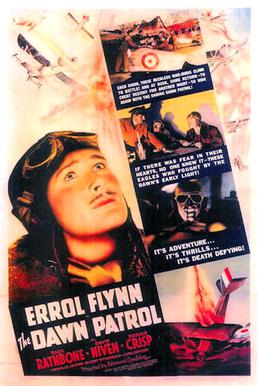
The Dawn Patrol

Just a few years after the turn of the century in 1903, the Wright Brothers were the first men to actually fly a plane -- sort of -- and over the last 100 years aviation has advanced by leaps and bounds. Think about just 10 years later though as the world was plunged into a world war. As thousands of soldiers blindly charged into enemy machine guns on the ground, planes were becoming part of war as well as pilots, fighters, and bombers all took to the skies in hopes of gaining a strategic edge on the enemy. World War I has always been vastly underrepresented in films, but there is potential for lots of good stories.

Maybe its the aviation aspect that studios assume viewers will be more interested in flying, but thankfully World War I pilots have been in several worthwhile movies. Most recently Flyboys struggled in theaters telling the story of American pilots flying with the French early in the war. George Peppard starred in The Blue Max, the story of a German infantry soldier turned national hero. One of the best though is 1938's The Dawn Patrol, an anti-war film that is both thrilling to watch and able to strike a nerve emotionally.  That's a good combination if there ever was one.

It's 1915 in France and as a leader of one of the flights in the British 59th Squadron and one of the few pilots with experience, Capt. Courtney (Errol Flynn) consistently finds himself leading rookie, inexperienced pilots on missions where they rarely return.  The war demands new pilots though and as quick as they're taught how to fly they are thrown into the fire. Courtney is constantly at odds with squadron commander Major Brand (Basil Rathbone) who realizes the idiocy of the orders he's receiving but can do nothing about it. Courtney's actions one day in destroying a rail depot actually gets Brand promoted, leaving the command post open to which Courtney is promoted. With close friend and fellow pilot, Lt. Scott (David Niven), taking over one of the flights, Courtney steps into the command position, immediately seeing that there will be no winners in this war.

I've long been aware of this movie, but just never got around to seeing it. I had a picture of gallant, heroic Errol Flynn single-handedly winning World War I from his fighter plane, dispatching hundreds of Germans at will.  Flynn does play the gallant, heroic pilot, but in terms of the rest of the movie I couldn't have been more wrong. Just a year before WWII started in a time when I think of blatant, painful propaganda movies, this is an anti-war movie screaming for someone to listen to the complete idiocy of war and armed combat. Director Edmund Goulding has a film here that doesn't pull any punches. An assembly line of pilots is sent to their deaths because the war requires it, not because it makes any sense. Someone has to fight, and these inexperienced pilots fit the bill.

The best utilization of this is when Niven's Lt. Scott sees his younger brother, Donnie (Morton Lowry), among the newest batch of replacements. Up to this point both Scott and Courtney have balked at what they're doing, but the new pilots are nameless, faceless and interchangeable individuals. Now they have a boy in front of them fresh out of flight school who with his barely 10 hours of time in a plane is expected to tangle with German aces. Niven's Scott begs, implores Courtney to ground his younger brother, giving him a few days to teach him how to survive. Courtney wants to do so, desperately wants to, but as commanding officer where can he draw the line? He can't because he would have to do this for every new pilot. It tears him up inside, sending these young men to almost certain death, but he's left no other option.

Robin Hood is Flynn's more well-known and even iconic role from 1938, but his part as Captain Courtney in The Dawn Patrol is without question the better part for him. I've always liked Flynn as an actor, but I've been critical at times because he does seem to play similar characters. It is roles like this that show he may play similar characters, but he was more than a movie star, he was an actor. Courtney is forced to go through a transformation because his duty calls for it, not because he wants to. Sending men to their death takes its toll on him, but he continues on. Flynn was just 29 years old at the time, and Niven just 28 as they filmed, both showing they were on their way to bigger and better. They have a friendship on-screen that reflects their friendship off-screen so their characters are unquestionably genuine.

With some impressive aerial footage of World War I era planes, it's impossible not to get sucked into the action.  We're watching these flimsy planes that look like a stiff wind would rip them apart as they maneuver and tear through the skies. In an age of planes that travel hundreds of miles in minutes, watching a movie like this can seem like ancient history. The best part of the movie though are the quieter moments, Scott and Courtney reminiscing before a mission that has little chance of success. It's the pilots wearily accepting their orders, hiding the disappointment and running out to their planes. It is Lt. Scott addressing his flight of the squadron, the movie beginning as it ends. There will be no victors, just survivors. These were gentleman fighting a brutish war, much of the time treating their German counterparts with respect. A great scene has Courtney drinking with a downed German pilot (Carl Esmond) just a few hours after shooting him down. There is a surreal nature to the proceedings that just couldn't be made up.

Rightfully so this is remembered as an Errol Flynn movie, and both Flynn and Niven are perfectly cast. Rathbone though is particularly memorable as Major Branch, the commander who wishes he could be up in the sky with his pilots instead of behind a desk. Donald Crisp is good in a supporting part as Phipps, the squadron adjutant while Barry Fitzgerald plays Bott, the squadron mechanic. This is a criminally underrated war movie, one that surprises in the effectiveness of its message. Well worth checking out.

The Dawn Patrol <---trailer (1938): *** 1/2 /****

Friday, July 1, 2011

Montana

Within the western genre are a long list of sub-genres that just about every entry applies to in one way or another.  Six typical western plots include empire building, revenge, the gunfight (movies built around a gunfight), historical (the Alamo, the Little Big Horn), the big ranch, and finally cowboys and Indians.  One of my favorite sub-entries is the cattle drive which can fit into at least two of those categories.  Centennial had The Longhorns in the miniseries, Lonesome Dove is an all-time classic and one of my favorites and countless others pepper the horizon (Cowboy, Culpepper Cattle. Co, The Tall Men).

For all the westerns about cattle though, what about that other dreaded animal that made its presence known on the western trails?  Yes, that's right. We're talking about sheep.  Range wars were fought and waged for years because of this conflict. Cattle owners despised sheep because the animals destroyed the grazing pastures, eating the grass from its roots.  No one believed either side could co-exist so instead they fought with deaths on each side. The cattle vs. sheep premise at the heart of 1950's Montana, an odd little western but an interesting one at that.

Leading his herd of sheep into Montana territory and all its grazing lands, Morgan Lane (Errol Flynn) is put on the defensive when one of his herders is murdered while on watch. Having been booted from the area before for his work with sheep, Lane isn't about to take what the cattle owners are throwing at him. Instead, he goes into the nearest town posing as a traveling salesman and begins to woo Maria Singleton (Alexis Smith), one of the most influential women in the area and an owner of vast stretches of land. She has no idea that Lane is a sheepherder and leases him land that will prove ideal for grazing sheep or cattle. Maria finds out though as the confrontation builds between the sheepherders and the cattle ranchers, and Lane's ready for a fight.

There is a polish to these Warner Bros. westerns from the 1940s and 1950s (and even a few earlier in the 1930s) that dates these movies, and not always in a good way.  I love spaghetti westerns and all their grittiness. I love American westerns from the 1960s and 1970s that tried to paint the 19th Century American west as it really was; violent, dirty, and sweaty.  These earlier westerns though always have the cast and extras dressed immaculately, the towns are always  orderly and nicely constructed, and the bad guy will always...always lose. I don't dislike these westerns by any means, I just don't enjoy them as much. That's one problem with Montana. It's too clean, too nice, and just too polished.

The oddities come fast and furious with this western. Flynn's previous westerns usually tipped the scales at around two hours, some clocking in at longer lengths than that.  Montana on the other hand doesn't even break the 80-minute mark, much less at 90 minutes.  It is only 76 minutes long and feels far too short. The ending comes together far too quickly with a rushed feel.  Other oddities? Flynn sings a duet with co-star Smith that feels out of place. Maybe not in the musical Oklahoma, but in this western? It's a flop. I want Flynn kicking ass, not singing.  Also, Austrian actor S.Z. Sakall as Papa Schultz, a traveling salesman Flynn's Lane poses with as his partner. His accent is so heavy it is indecipherable, and the attempts at humor never amount to anything. Thankfully he disappears about halfway into the movie never to return. No explanation either, just a good, old fashioned disappearance.

Looking for a positive from this otherwise average western is the casting of a strong female lead in Alexis Smith as cattle baron Maria Singleton. As I've mentioned in a handful of other western reviews, female members of the cast are too often there just to be saved. In the process of being saved, they whine, complain and look scared. In other words, they're useless characters.  Give them something to do! Women helped tame the west too. For the most part, Smith gets to do that. Flynn's character dupes her on two different occasions so maybe she isn't the sharpest tool in the shed, but she's formed a cattle empire with two partners that rules over the Montana territory. Maria is tough and willing to fight for what she wants.  Granted, by the end she wavers in the face of true love, but Smith gets points for the effort. Can't blame her for the script forcing her back into the 'need a man' ways.

As for the rest of the movie, it's okay if nothing special.  This is Flynn on the backside of his career, but he's still that lovable rogue that audiences loved in the 1930s when he shot to stardom. Regardless of the role, it's hard not to like him. The rest of the cast leaves little impression other than Paul E. Burns as Tecumseh, an old timer who has lived in Montana since the 1850s, and Charles Irwin as Mac, one of Lane's top sheepherders. There are better movies out there and there are much worse. It's a decent enough way to pass 76 minutes, but not a memorable western. Worth watching once if nothing else.

Montana <---trailer (1950): **/****

Sunday, June 12, 2011

Silver River

By 1948, times had changed for Hollywood legend Errol Flynn. The swashbuckling, high seas adventures just weren't there anymore, and his best roles were behind him. Flynn would continue acting right up until his death in 1959, but after 1945's Objective Burma!, he didn't have another classic (or even near-classic) to his name.  He is one of Hollywood's more interesting stars and personalities, a hard lifestyle taking its toll on him as he died young at just 50 years old.  The movies continued though in the late 1940s and into the 1950s, including one last hurrah with an old directing pal.

The movie is 1948's Silver River, teaming Flynn with frequent collaborator director Raoul Walsh. The actor-director combo worked together often in the 1940s, producing some really solid efforts like They Died With Their Boots on, Northern Pursuit, Desperate Journey, Uncertain Glory, and Objective Burma!  Working together one last time with 'River,' it has all the markings of a big budget 1940s western. The scope and scale is impressive, with money clearly not an issue here.  More than all the little details is something that sets this otherwise ordinary western apart. Flynn plays a bad guy...sort of...kind of.  I'll explain later.

Cashiered out of the U.S. Cavalry for a supposed act of cowardice and treachery at the battle of Gettysburg, Captain Mike McComb (Flynn) heads west looking for a second chance.  With him is Pistol Porter (Tom D'Andrea), another soldier blamed for the act, but before they go west, the duo finds their way into piles and piles of some cash from the army. They plan to head to Nevada where they set up a gambling house, initially tangling with a miner (Bruce Bennett) and his feisty wife, Georgia (Ann Sheridan). Feeling like he's been burned for doing nothing wrong in the past, McComb now doesn't care who gets caught in his path. He starts to build an empire dollar by dollar and business by business.  But has his seemingly limitless power gone too far?

This has all the positives and negatives of a lot of the Flynn westerns I've seen, and more than that (not to pile on Errol Flynn, one of my favorites) 1940s westerns in general.  They're BIG. The sets are large, the musical score loud and obvious, the cast features hundreds of extras in the background along with the requisite big names leading the way, and it's fun to watch if not particularly taxing.  The stories get to be too soapy though, too theatrical. Maybe the biggest thing working against it is that the story -- especially with Silver River -- keep you at a distance. There's no real heart or emotion to the story, and the actors always seem to be playing the same variation of themselves.  With a movie that moves slowly along at 110 minutes, that lack of interest in what happens to characters can be a problem, if you're into that sort of thing. I'm weird that way.

The supporting cast is pretty hit or miss here.  I liked Ann Sheridan working with Flynn in Edge of Darkness, but something doesn't ring true here.  As a love interest, it feels forced, things moving along because the story requires it. She hates Flynn's McComb, then really hates him, despises him...and BAM! She loves him with a passion. Because I sometimes lack a delicate way of saying things, I'll just say it. She's got a dudely factor going on her. Not a tomboy or anything, more like she is a DUDE. The always reliable Thomas Mitchell carries the movie in its slower moments as Plato Beck, a drunken lawyer who becomes McComb's right-hand man. It is basically a fat juicy fastball for Mitchell, playing a character he played in countless other movies. D'Andrea has the thankless part as the humorous sidekick, Bennett is solid but not flashy with Barton MacLane and Monte Blue as McComb's chief rivals, neither making an impression more than 'Hey, cool mustache.'

Enough with all that, let's get to Errol Flynn, the definition of a heroic, swashbuckling adventurer, playing a bad guy. The story isn't quite rags to riches, but it is close if nothing else. The opening is a cool sequence, Flynn's McComb burning a million dollars in U.S. Army payroll rather than let it fall into Confederate hands at Gettysburg in July 1863. He's crucified for it, and kicked out of the army. He feels taken advantage of and starts to look out for No. 1 alone, everyone else be damned.  We're not talking a brutal, vicious bad guy callously shooting down innocent people, but for Flynn, it is most definitely a departure.  People get trampled and left by the wayside because of his actions. As a big fan of Flynn and all the movies I've seen him in, it was fun to see him play against perception, and he looks to be having some fun with it too.

I should have been skeptical though as McComb takes a turn for the legitimately evil department. From his director's chair, Walsh starts tapping the breaks on the old evil speedometer. SPOILERS STOP READING SPOILERS McComb basically gets Bennett's husband character killed and then swoops in on his grieving widow. First, he tries to correct his mistake but fails. If you're making the character bad, just do that. Don't go half-hearted toward it. His rise and fall doesn't come as a surprise, but in the end, he redeems himself because he sees what a jackass he's been.  For a rise and fall from glory story to work, the fall has to be believable.  Think Scarface.  EPIC fall there, and some of that effort would have been good.  Still, it's fun to see Errol Flynn play against type, and that makes the movie watchable on its own.

Silver River <---trailer (1948): ** 1/2 /****   

Saturday, August 28, 2010

The Edge of Darkness

Just how involved was the war effort on the home front to help aid the cause in WWII? Major movie studios became involved, producing feature length and documentary movies as a form of positive propaganda to help convince audiences how necessary total victory would be.  It was a different time, a different era in the world because now in 2010 can you imagine movie studios releasing movies about the Iraqi/Afghanistan conflicts?  Maybe it's just that the times have changed, maybe audiences just aren't as naive, or maybe it's just a different war.

Released in 1943 as WWII was still in the balance, Edge of Darkness (not to be confused with the Mel Gibson vehicle) was one of those studio ventures released in the hopes of showing that countries around the world and their populations were fighting for their freedom and not just the armies.  Almost completely isolated from the war by land, the U.S. never first hand experienced the war like Europe or Asia did.  But studios did their best to illustrate all the far-reaching effects of the war.  Very similar to 1942's Commandos Strike at Dawn, 'Darkness' is an exciting, well-made if flawed look at the resistance effort against the Germans in Norway.

In charge of a small occupying force of just 150 soldiers, German Major Koenig (Helmut Dantine) has his work cut out for him in the small coastal Norwegian town where his men are heavily outnumbered.  Koenig is aware of who the leaders of a so-far quiet resistance movement in the town, including the unofficial leader, fisherman Gunnar Brogge (Errol Flynn) and others from the village, the doctor, the butcher, the innkeeper among others. So badly outnumbered, Koenig can't arrest any of these leaders without causing an uproar and possibly a violent revolt.  A British agent (Henry Brandon) is able to provide Brogge and his resistance members with rifles and ammunition so they sit back and anxiously wait for their chance to strike at their German occupiers.

Director Lewis Milestone makes an interesting choice in his storytelling technique with a perfect opening sequence. A German patrol arrives in this vacant fishing village, walking through the streets only to find the dead bodies of both German soldiers and many of the villagers.  It seems no one has survived this bloody confrontation, but who knows for sure?  The rest of the story is a flashback leading up this opening, everything that caused it.  It is a really cool technique that's been used to death since, but it works as a great mood and tone setter, putting you on the defensive right away.  You think you know how the movie is going to go because you believe you've just seen the ending, but there's a few tricks up Milestone's sleeve here.

Leading a large ensemble cast, Flynn plays Gunnar Brogge, the brave leader of the Norwegian resistance in the village.  Flynn was in the news at the time for a statutory rape case filed against him, and from here on his career did suffer to a point even though he was acquitted.  It's a solid part if not a particularly memorable one, but the movie suffers when he's not around.  The rest of the ensemble is more hit or miss.  Ann Sheridan plays Karen Stensgard, the daughter of the local doctor played by Walter Huston who isn't quite sure if violence is the answer. Sheridan is a great female character who rises above just being a love interest, and Huston was never one to disappoint with a supporting part.  There's some really awful supporting parts though including Nancy Coleman in a laughably bad part as a Polish refugee caught up in the violence. With Flynn and Sheridan and Huston there for support, the positives outweigh the negatives.

Released in the midst of WWII, there's no chance Milestone's movie is going to show the Germans in a positive light.  This is about as straight a propaganda movie as you're going to watch.  Dantine's Major Koenig is the prim and proper raving lunatic always shouting about duty and honor to Hitler and the Third Reich, and his soldiers are nothing more than raping, murdering machines.  The Norwegians on the other hand are angelic, perfect people oppressed by an invading army.  In reality, this isn't far from the truth, but there is no gray ground here, just black and white, good and evil.  Speeches overheard on the radio from Winston Churchill and Franklin Delano Roosevelt encourage listeners to salute the brave Norwegian fighters, and if you don't get the message watching the movie, you must have zoned out at a certain point.

The best is saved for last when our answers are resolved as Brogge, Karen and the whole fishing village go on the offensive.  The extended battle is about 25 minutes, starting in the village and moving up to the hotel in the hills serving as German HQ.  The scale is impressive, and the action exciting with a couple great surprise moments, one being a priest revealing a tommy gun to mow down German soldiers, and two, Karen using a sniper rifle to pick off a soldier raising the Nazi flag.  Subtle? Nowhere in sight.  But a cool action sequence gets cooler.  A message of hope for anyone who would have been watching in 1943, and still a good movie today.

Edge of Darkness <---TCM trailer (1943): ***/**** 

Wednesday, August 25, 2010

Uncertain Glory

In all the Errol Flynn flicks I've reviewed, I've done my best to avoid saying the same thing repeatedly about him.  He was at his best and most popular when he was the swashbuckler, the pirate, Robin Hood saving Maid Marian.  At the height of his popularity though, Flynn did his best to avoid being typecast although in the process he still typically played pretty heroic characters, just not on the high seas. Somewhere in between is 1944's Uncertain Glory, not quite a villain and not quite a good guy...until the end that is.

Working with a director in Raoul Walsh he worked with a handful of times, Flynn doesn't play the straight as an arrow, charming hero...sort of. It is the 1940s, and Warner Brothers wasn't about to cast one of their biggest stars as a villain.  But in a departure from his typically heroic roles, Flynn gets to play a character that if nothing else is deeply flawed.  His intentions are consistently in question from beginning to end, and his criminal background is mysterious and hinted at more than anything is revealed.  So even though the ending doesn't come as much of a surprise, it is still interesting to see a deviation from the typical Errol Flynn hero character.

It's the middle of WWII, and French prisoner Jean Picard (Flynn) is about to be killed on a guillotine after being caught after years of robbery, heists, and most recently, murder (although we never find out about that).  But at the last possible second as Picard is about to be strapped down an Allied bombing raid flies over, killing everyone involved except the doomed Picard.  Funny how that works, huh?  Given a new lease on life, the crook escapes only to be caught in the days following by detective Marcel Bonet (Paul Lukas), a police officer who doggedly pursued Picard over the years. As they travel back across France to complete Jean's sentence, Picard comes up with a plan.  A saboteur has recently blown up a key bridge held by the Germans, and 100 hostages have been taken prisoner to be shot if the saboteur doesn't reveal himself.  Sentenced to death regardless, Jean wonders, what if he said he was responsible?  

For all his character background, we're never given a crystal clear version of what Flynn's character did in the past.  We hear about crimes that include bank robberies and large-scale heists, even a murder, but never anything specifically.  So in that sense, Flynn's Jean is a bad dude, but the nicest bad dude around.  What worked for the character was his motivation, or lack of in many cases.  At first when the idea of posing as the saboteur is presented, Picard seems genuine, making a noble sacrifice to save 100 hostages.  But as the story develops, you're never quite sure what he is up to.  Does he intend to go through with this honorable plan?  Or given a chance, does he intend to escape for good?  To Flynn's credit, he keeps you guessing until the end.

I'm always a fan of war movies that delve deeper into the war effort than just the front lines and the soldiers.  Besides the cartoonishly evil portrayal of Germans and the Gestapo, this is certainly one of those efforts that gives something different.  But even with this unique story, Walsh struggles with where to take it all, seemingly knowing the end result but not how to get there.  It's more than a little predictable, and at a certain point you assume Flynn is going to go through with it.  Honestly, would Warner Brothers release a movie where heroic Errol Flynn bails on saving 100 innocent people's lives for his own well-being?  I think not.  There was a chance for a great twist in the last 30 minutes involving French villagers setting Jean up for the sabotage, not knowing he's actually going to admit to the deed, but it never materializes into anything.

About midway through the movie, something that had been bothering me finally figured itself out.  This movie is basically a 1940s version of Midnight Run, the 80s comedy starring Robert De Niro and Charles Grodin.  But instead of an odd couple road movie, we get a semi-serious look at WWII France with a police detective and a slippery crook.  There are flaws here that really slow the movie down.  Instead of just turning Jean in, Lukas' Bonet agrees to let him live out the last three days of his life to their fullest.  Granted, the Nazis have set a deadline on the saboteur revealing himself, but it is a stupid decision both in terms of story and the character.  We also get to watch a painfully slow romance with a young French woman (Jean Sullivan) and Jean. Just have Bonet deliver Jean, and you've got a much quicker and better movie.

In a minor complaint, the movie is also about five minutes too long.  Instead of ending it at the logical point, two more scenes come along that needlessly beat home the point that we've been hit over the head with for the last 90 minutes.  It is still a good ending, but cut out those last two scenes and it is much more emotionally effective. This Flynn venture was recently released on DVD for the first time with four other movies -- check it out HERE -- if interested in checking it out.

Uncertain Glory <---TCM trailer (1944): **/****

Friday, June 11, 2010

Dive Bomber

When you think that in just over 100 years how far aviation has come, it's a truly amazing thing.  We've gone from a 12-second flight at Kitty Hawk to jets and planes that can go cross country in a few hours as well as reach altitudes previously thought unheard of.  Packed into the 103 years is countless stories of aviation technology advancing as pilots, scientists, doctors and many more worked to improve and make flying more efficient.  That is the basic premise of 1941's Dive Bomber

Considering the timing of the release of the movie -- August 1941 -- just a few months before the Japanese attack on Pearl Harbor makes this war flick a fascinating look into a pre-war United States armed forces.  Made with the full backing of the U.S. Navy, the film almost seems like a dare to any possible enemies.  "Come and get us, we're ready for you."  And above all else, the planes are the reason to see this movie, and there are lots of them, but more on that later.  Because remember, you can always have too much of a good thing.

Working as a flight surgeon in Hawaii, Dr./Lt. Doug Lee (Errol Flynn) loses a patient in surgery who blacked out during a dive bombing exercise and almost severed his spinal cord in the crash.  Lee notices that this problem is facing pilots through the armed forces and starts to work on solving the issue.  He goes through flight training and teams with Dr. Lance Rogers (Ralph Bellamy) as they begin to explore options on preventing dive bomber pilots from blacking out mid-dive.  With help from a test pilot, Joe Blake (Fred MacMurray), the trio push the limits of how far and how high pilots can go, realizing a pressurized suit might be the best option in solving the problem. 

In a movie centered around pilots and aviation, a certain amount of flying sequences are to be expected, but director Michael Curtiz doesn't know when to stop.  I'm assuming to a certain point that with their full backing the Navy insisted on a set number of these sequences to show how skilled and talented their pilots were.  And honestly, these flying scenes are something else as we see all sorts of formations and aerial tricks performed in the skies.  But by the 10th or 12th time we see these long, uncut shots it all gets a little tedious.  And with a movie that is far too long at 132 minutes, these scenes become more and more obvious as something worth cutting.

The flight sequences if nothing else balance the good and the bad, but I realized something about midway through the movie.  You know what isn't that exciting to watch?  Scientific experiments, even those dealing with flight and highly-trained pilots.  The first hour is interesting as Lee, Rogers and Blake put aside their differences and work together.  They make a big breakthrough that should help prevent pilots blacking out, and everything seems peachy.  Then you realize there's another 70 minutes to go of more pressurized experiments and tedious aerial shots.  Somebody should have snuck into the editing room with a pair of scissors and helped the movie out. 

But as is so often the case with movies from Hollywood's Golden Age, producers and studios insisted on fleshing out so many things that are completely unnecessary to the essential story.  Alexis Smith plays the cutest stalker around who keeps following Flynn's doctor/pilot wherever he's stationed.  She's just so darn cute he doesn't seem bothered by her stalkerish tendencies.  Then there's the comedic segments where Lee's assistant, Lucky (Allen Jenkins), has to avoid his recently divorced wife who is trying to get his money.  He avoids her by hiding in an isolation ward not once, not twice, but three times in scenes that go on far too long. Oh, that 1940s humor, it is a humdinger!

Even with all those complaints, the movie has some interesting elements, most of them related to the casting.  Playing a Navy doctor is a bit of a change of pace for ladies man Flynn, but it's a good change of pace.  Bellamy is a good counter to the charming Flynn, and MacMurray is the arrogant a-hole who ends up coming around in the end because 'aw shucks, let's all be friends!'  The three do have a good chemistry together and help move the slower parts along.  My recommendation is watch the first hour, and then stop.  You're going to see the same thing over and over again.

Dive Bomber <---trailer (1941): **/****

Wednesday, March 24, 2010

Dodge City

I've covered this before, but when I watch enough older movies (pre-1950s or so) it keeps coming up.  If possible, watch these movies with the mindset you're watching them in the year they were released.  New innovations come along every few years with movies starting with the jump from silent to sound and building onward with color, widescreen, 3-D, CGI, and more recently with Avatar, whole new ways of filming human acting.  It's hard sometimes though because well, it isn't 1939.  What was appealing in 1939 doesn't necessarily translate well to 2010.  That was my feeling with 1939's Dodge City.

Look at the all years in Hollywood history and 1939 is often labeled the greatest year in movie history, and for good reason.  Here's a list of the more impressive flicks.  And even though Dodge City is on that list, I'm not judging or comparing it to Gone With the Wind or The Wizard of Oz.  But like both those movies, it is about the spectacle of what's happening on-screen.  It's filmed in Technicolor with lots of bright, vivid colors that look almost fake, huge sets filled with seemingly hundreds of extras, and a story as big as the taming of the west.

After helping the railroad reach Dodge City, Wade Hatton (Errol Flynn) returns after years away from the wild, rumbling boom town with friends Rusty (Alan Hale) and Tex (Guinn Williams).  The town they've helped build has gone to hell and any attempts at civilizing the town are stopped by a cattle man, Jeff Surrett (Bruce Cabot).  Townspeople he has business deals with or owes money end up shot in the back with no witnesses.  The town calls for Hatton to become sheriff and clear Surrett out, and at first he's completely unwilling.  But something changes when an action of Surrett's pushes him too far.  He takes the badge and starts to clean the town up, but Surrett is standing in his way and shows no sign of giving up.

The story is nothing new for a western, but that's not a complaint, just an observation.  The problem is that all the other little things add up to be a problem.  In the casting, Ann Sheridan gets third billing for a part that requires her to sing two or three times as a dance hall girl.  These scenes have a line of dance hall girls dancing on-stage for a saloon full of raucous cowboys and grind the already slim story to a halt.  They're cool enough to look at visually but too distracting overall.  The same goes for the exterior shots of Dodge City (with studios in California filling in for Kansas) which are content to show crowded streets with all their extras.  And even if the spectacle of the movie was more appealing, it pales in a big way compared to Gone With the Wind's spectacle.

The least of the problems is Errol Flynn as tough gunfighter with a golden heart, Wade Hatton.  He's a good example of what western heroes were before Sergio Leone got his hands on the genre in the 1960s.  Hatton is a good man, looking out for women and children first, and when pushed too far, watch out bad guys because he's coming after you.  Frequent Flynn co-star Olivia de Haviland is the love interest who hates Flynn until it's important for her to turn a page and like him.  The duo worked many times together and for good reason.  They had some great chemistry that comes naturally and never looks like they had to force things along.

As his rival, Cabot is a solid villain.  Thanks to his pairings later in his career with John Wayne, it would be easy to think Cabot usually played a variation on the trusty sidekick.  But early in his career, he played his fair share of bad guys, especially in the 30s.  His voice sounds like a deep growl, and he was a physically intimidating actor so he is a good counter to Flynn's heroic good guy.  Victor Jory is also solid as one of Surrett's gunslingers who wouldn't bat an eye at shooting a guy in the back.  Hale and Williams are the annoying, not so funny amusing sidekicks who are there to get a laugh or two.  I like both actors but their parts just aren't funny.

The movie does pick up speed once Hatton becomes sheriff in Dodge City, and the finale starts off promising as Hatton and Co. shoot it out with Surrett on a burning train.  But the ending limps to the finish, almost like director Michael Curtiz just ran out of money.  SPOILER Surrett and his cronies escape and are making their getaway only to have Hatton and Rusty pick them off as they run.  No big showdown, no worthy end for a quality bad guy.  Just a quick shot of a dead Surrett after he's been thrown from his horse.  Surprise, surprise, but Hatton also gets the girl.  I know, it surprised me too.  END OF SPOILER

This is not a bad movie in any way, and it feels wrong giving it a negative review for a movie that's main goal is to be entertaining.  But all the spectacle moments take away from a story that could have been good, if not great.  Errol Flynn is always worth a watch, Olivia de Haviland is a great actress, and Bruce Cabot's a good villain, but that's about it.  Average western worth checking out if you're looking for a decent enough way to kill two hours.  An Errol Flynn fan has posted many of his movies at Youtube, including Dodge City, starting with Part 1 of 10.

Dodge City <----trailer (1939): **/****

Wednesday, February 10, 2010

Desperate Journey

Before becoming one of the U.S.'s most popular presidents, Ronald Reagan made quite a name for himself in the 1930s and 1940s as a movie star. Makes that whole 'Star Wars' idea a little funnier if you ask me. He was usually limited to B-movies, but as an actor he had an easy-going, likable way about him on the screen. Reagan often played second banana to the main star of the movie and made a career -- a movie career at least -- at playing the funny sidekick.

By 1942, Reagan had already teamed once with Errol Flynn in 1940's Santa Fe Trail when they teamed up again for a WWII adventure, 1942's Desperate Journey, that is pretty blatant propaganda watching it now over 70 years later. It's not subtle in the least, and why should it be? Released in September 1942, the U.S. was only a few months removed from entering the war in the North African campaign, and maybe the home front needed some boosting. That propaganda borders on the painfully unfunny at times, but the movie itself is interesting enough to recommend.

Flying a dangerous mission to take out a German railroad yard, Flight Lieutenant Terry Forbes (Flynn) is forced to take command when the commander is killed. Forbes' bomber is able to take out the objective, but the plane is shot down in the process, and it's not long before German forces have scooped them up. The five crew survivors are interrogated by an SS major (Raymond Massey), but they manage to escape with key information about underground Messerschmidt factories. Among the group is a Scottish veteran of WWI (Alan Hale), a cocky American navigator (Reagan), an American flight officer (Arthur Kennedy), and a young British officer (Ronald Sinclair) trying to live up to his father's reputation. Can the five somehow get back to England with their news before the Germans catch them again?

The whole premise is pretty ridiculous and far-fetched in itself but it's entertaining enough. Flynn's Forbes is pretty gung-ho as the flight lieutenant who wants to take the war right at the German war effort. He's a leader who questions himself because the actions he undertook ended up taking the lives of some of his crew, but Flynn is also Joe America (even though he was Australian), the ideal soldier to lead the fight against the Nazis. With his gung-ho attitude, Flynn isn't content with just getting the news back to England, wanting to sabotage anything he can on the way back.

A reviewer at IMDB does point out that the Germans are rather cartoonish or particularly evil with little middle ground, asking where are Colonel Klink and Sergeant Schultz? Hogan's Heroes reference there for you. Their efforts are pretty clumsy in capturing the prisoners as it seems Massey's German major is the only one actually taking part in the chase. For five prisoners with news that could cripple the Germans, wouldn't more people join in the effort? Flynn and Co. even make it across Germany and into the Dutch countryside with little issue or much in the way of danger...and in German uniforms at that, even boarding Goerring's private train at one point.

Now all that said, the movie is incredibly entertaining, a good old-fashioned popcorn movie. The action is exciting -- especially the last half hour as the Germans close in -- including a car chase across the empty Dutch countryside with some boats of cars chugging along. Credit for making it so damn entertaining is the casting, especially Flynn as a WWII version of a swashbuckler who even manages to flirt some with a comely resistance fighter (Nancy Coleman). Reagan and Hale go for the laughs, hamming it up in some scenes that are hard to watch they feel so out of place. Kennedy is the straight man trying to keep the mission on the others' minds.

As for the propaganda, there's several scenes of dialogue where the cast is talking directly to the viewer. Coleman's resistance fighter tells Flynn (and American) to tell everyone that there's people fighting back against the Axis powers and don't forget about them. Flynn's final line is almost laughable "Now for Australia and a crack at those Japs!" but at the time I'm sure it probably drew some cheers from audiences. It's all part of this ridiculously over the top, far-fetched action adventure that is entertaining almost in spite of itself.

Desperate Journey <-----trailer (1942): ***/***

Wednesday, February 3, 2010

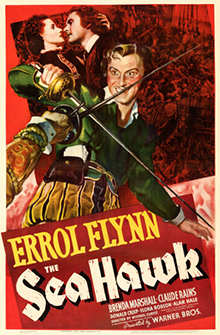
The Sea Hawk

A couple weeks ago I reviewed 1936's Charge of the Light Brigade and as I thought about it since realized I was probably more than a little harsh on star Errol Flynn. I wrote that "he probably didn't act a day in his life" because he seems to always play the ultra-suave, extremely cool hero that saves the day and gets the girl. It came off as more critical than I intended because one of my other favorites, John Wayne, made a career out of playing the same basic character repeatedly. Should we hold it against somebody because they found their niche and ran with it?

It's hard to be critical of Flynn as a movie star because for the most part his movies are so damn entertaining, straight popcorn flicks. But looking at the 1930s and 1940s, he is clearly one of Hollywood's biggest stars. Just look at the movies he made over a 10-year period. He made more classics or near-classics that many actors/actresses make in a career. And as I wrote, just about all those movies has him as a swash-buckling rogue of one sort or another (settings vary) who always ends up on top with a girl on his arm, like 1940's The Sea Hawk.

Flynn plays Geoffrey Thorpe, an English privateer in the late 1500s working for Queen Elizabeth as one of many 'sea hawks.' These English privateers -- or pirates to their enemies -- harass rival countries' ships and keep England flowing in money, gold and treasure. Thorpe's 'Albatross' one day attacks a Spanish galley brimming with treasure and two key passengers onboard, the new Spanish ambassador traveling to England, Don Jose Alvarez (Claude Rains) and his niece Dona Maria (Brenda Marshall). Thorpe delivers his prized catch to Queen Elizabeth (a great performance for Flora Robson) who promptly ignores Alvarez's demands he be put in chains.

Queen Elizabeth has bigger plans for Thorpe and the Albatross. Rumors are swirling that Spain's King Philip is assembling the powerful Spanish Armada with hopes of conquering England. Elizabeth does not have a navy to protect her country -- other than the Sea Hawks -- and no money with which to build a navy. She sends Thorpe on a dangerous mission to Central America; attack the gold convoy coming out of the Spanish mines at Vera Cruz and bring it back so she can assemble a navy in time. Off Thorpe goes, leaving Dona Maria behind. But the plan won't be so easy as Alvarez and the treacherous Wolfingham (Henry Daniell) are at work to make sure the plan fails.

Typecast as a swashbuckler early in his career, it's only fitting that Flynn was in fact very good at fencing having been trained in the art. The training obviously shows because in several of his movies, including The Sea Hawk, Flynn engages in several exciting, intricate-looking sword fights. At one point, Thorpe even takes on four English guards at once in the shadowy court of Queen Elizabeth. It is something so little that as an audience we take for granted sometimes with CGI and stunt doubles, but Flynn handling his own stunts helps make the movie more realistic and for me, much more enjoyable. It's cool to see one of Hollywood's biggest stars at the time going toe to toe like that.

The film opens with a bang as Thorpe's Albatross overwhelms Alvarez's Spanish galley, watch it HERE, with a pretty cool introduction for Flynn as we've heard about his character for most of 10 or 15 minutes. The action sequence does continue into Part 3 for those wanting to continue on. The attack is a great scene in itself, both epically grand as two huge ships duke it out and then on a smaller scale as the two crews engage in hand-to-hand combat to save their ships. The resolution to the fight is particularly unique as how to stop a conflict like that.

Playing Captain Geoffrey Thorpe, Flynn is at his coolest, a driven, patriotic man fighting for queen and country, and of course, the girl. Marshall made 20 movies in a short time and then left show business, and as she shows here as Dona Maria, she's not the greatest actress around but she has some potential. Rains is a worthy villain as always, and Donald Crisp makes the most of a smaller part as Sir John, one of Elizabeth's loyal court members. Often pairing with Flynn as a sidekick, the loyal right hand man, Alan Hale plays Mr. Pitt, the burly, brawling sailor. Robson is actually playing Queen Elizabeth for a second time and almost steals the movie away from Flynn and her co-stars as the outspoken ruler of England.

A movie that's a lot of fun with plenty of action, over-the-top dialogue and some cheesy romance. It's not my favorite Errol Flynn movie, but the swashbuckling actor was never one to disappoint with his action and adventure movies.

The Sea Hawk <----trailer (1940): ***/****

Sunday, January 24, 2010

The Charge of the Light Brigade

Depending on when a movie was made and released has a huge impact on the tone that story will take, especially when dealing with historical fact. Compare The Green Berets to Oliver Stone's Platoon and it's hard to believe they're about the same movie. But even looking at those two movies, it's Vietnam and there is only so much you can change about the history involved. What about changing a battle completely and the subsequent result as is depicted in 1936's The Charge of the Light Brigade?

Made even more famous by a poem by Alfred Tennyson (check out that poem HERE), the actual charge of the Light Brigade is one of the most disastrous military events in British history. During the Crimean War, a miscommunication in orders leads to 600 light cavalry charging the wrong enemy position, one heavily guarded by Russian artillery, and being cut to pieces in the process. A movie version released in 1968 told that story, a cynical view of the incident that showed the "battle" for what it was...a disaster. But the 1936 version takes an interesting stance, the Light Brigade knew it was riding into certain death and still did it, and then changes the end result of the battle. Patriotic? Sure. Altering history? You bet. Does it all work? Not really.

It's 1854 and British soldier and member of the 27th Lancers Geoffrey Vickers (Errol Flynn) is returning from a mission and is going to see his fiance, Elsa (Olivia de Havilland) for the first time in many months. In his absense, Vickers isn't aware that Elsa has fallen in love with his brother, Perry (Patric Knowles). As he comes to term with this revelation, Geoffrey must also join the fight against a Suristani leader at the head of a nationwide uprising, Surat Khan (C. Henry Gordon) that could destroy every British outpost in India. After Khan leads an attack and massacres one of these outposts, Vickers and the entire 27th Lancers are aching for revenge and they get that chance when war breaks out and Khan sides with the Russians, hiding out with their artillery on the Balaklava Heights.

The first 60-75 minutes of the movie feels more like a French Foreign Legion movie than the background of the 27th Lancers. It works well enough but seems incredibly forced in giving the Light Brigade a motive, a reason for exacting revenge on their biggest enemy. Changing things for the sake of patriotism is a decision director Michael Curtiz made, and that doesn't work for a long list of reasons. Gordon's Khan comes across as a stereotypically evil Asian villain with no real motivation other than to kill as many British soldiers as possible. The first hour is entertaining as Vickers and his unit fights Khan, but it feels oddly out of place.

SPOILERS for the rest of the review. My biggest issue with the movie is changing the charge from a disaster where the Light Brigade is torn apart to a battle that ultimately leads to a British victory -- which it didn't -- as the brigade knowingly undertakes a suicide charge straight into cannons pointed down their throats. Making it worse, Flynn's Vickers receives orders the brigade should withdraw several miles, disregards those orders, and rewrites them so the brigade will instead attack through a mile-long valley rimmed by artillery. It pissed me off that one man would willingly send so many to their deaths, even if the Light Brigade is itching for a fight. It's changing history for the sake of changing something and it feels false right up until the very end.

All my issues aside, the attack charge is a remarkable feat in filmmaking. Hundreds of riders on horseback filled out the ranks for this epic charge, giving it an authentic depiction that no computer of CGI could do. There's something to be said for hundreds of stuntmen actually undertaking the filming of the not-so disastrous battle. Watch it HERE courtesy of a Youtube user. The scene is tainted because of the use of trip wires strung across the valley with horses running at a full gallop into those wires. Several hundred horses were killed in the process and forced the government to guarantee the safety of animals in motion pictures. It's an incredible sequence, but it is hard not to wince during the scenes.

Playing Geoffrey Vickers, Errol Flynn plays Errol Flynn as he always did. That's not a criticism because Flynn was quite a presence, a huge movie star and impeccably cool on-screen. But at the same time, it's hard to judge if he ever acted a day in his life. Queen of the 1930s de Havilland is a woman torn by two men she both loves in a part that's not as strong as most of her performances. Henry Stephenson and Nigel Bruce play stiff upper lip British officers, and David Niven, one of my favorites, has a small but good part as Randall, one of Vickers' closest friends and fellow soldier.

A film that's remembered as one of the classics of Hollywood's Golden Age, the changes to history proved to be too much for me. Making an idiotic mistake into a heroic, intentional decision did not work for me at all. Errol Flynn is very cool, as always, and the charge in the finale is something to behold, but the flaws definitely outweigh the positives.

The Charge of the Light Brigade <----trailer (1936): **/****