The Sons of Katie Elder

The Sons of Katie Elder
"First, we reunite, then find Ma and Pa's killer...then read some reviews."
Showing posts with label E.G. Marshall. Show all posts

Monday, August 18, 2014

The Buccaneer

Ever heard the name Jean Lafitte? If you're a history buff, you should have. A French pirate and privateer, Lafitte operated out of New Orleans and the surrounding bayous through the early 1830s. His name though remains in American history for a big reason, Lafitte helping then-General and future President Andrew Jackson to victory at the Battle of New Orleans in 1815. It's a story told in a generally forgotten film from 1958, The Buccaneer.

War has broken out between the young United States of America and Great Britain, the power up for grabs after British forces capture Washington D.C., the American government barely escaping. Down in Louisiana, New Orleans is bracing for an attack, a small American army commanded by General Andy Jackson (Charlton Heston) ready to hold off a far superior British army. New Orleans will be the key as whoever holds the river will control the Mississippi River. The key to it all? A powerful, rich pirate named Jean Lafitte (Yul Brynner) who helps control the mouth of the Mississippi with his fortified pirate colony. Whichever side he sides with will have all the power and both the British and Americans are desperately trying to convince him. They're both very convincing, but what will Lafitte decide in the end?

Of all the wars America has fought in since the American Revolution in the 1770s and 1780s, the War of 1812 has to be one of those most easily forgotten. I can't even think of another film about the war. 'Buccaneer' is also noteworthy for its director, an actor making his only appearance behind the camera. Who you ask? That would be Anthony Quinn, Zorba himself taking a shot at directing. It is rumored that famed director Cecil B. DeMille did direct some of the movie while also appearing on-screen early for the prologue that sets up the history of what we're about to see in the film. What it tries to accomplish is admirable, bringing a part of American history to light that hasn't gotten the amount of attention that other wars, conflicts and incidents have. What it accomplishes in the end? That's more up in the air.

The biggest positive is Yul Brynner as infamous French pirate Jean Lafitte. As portrayed here, he's probably a little idealistic (but that's more the tone of the movie) as to the historical figure, but Brynner does a solid job. This is a man caught in the middle and trying to figure out what's his best play, whether it be with the British or the Americans. He thinks selfishly, knowing whichever way he chooses will affect his vast fleet of pirates but also thousands of other people. Dressed up as a bit of a dandy -- in one of the few roles I can think of where Brynner sports hair, even if it is a wig -- Brynner commits to the part. He has some fun with it, the best thing going in a story that tries to accomplish a lot in terms of scale and characters and history. His struggles are interesting throughout, a bit of a doomed character, and his scenes in the second half of the movie with Heston's Jackson provide the movie's strongest points.

The rest of 'Buccaneer' is more of a mixed bag. One of my biggest questions involves the sets. The entire movie is filmed on indoor sets, giving the story an odd, even cheap look. In some scenes, like the battle of New Orleans, it adds a cool claustrophobic effect to the proceedings, but for the most part it limits the potential. It's going for an epic scale, full of a long list of characters and big history, but never quite gets there. In other words, the DeMille touch...sorta. Everything is polished and colorful and too clean for an 1810s world. A pirate world at that! It's more than that though, a story that bounces around too much and simply takes too long to get where it needs to be. The last 45 minutes are 'Buccaneer' at its strongest, but the first hour and the last 15 minutes drag a bit too much. Elmer Bernstein's score is okay but not up there with his best.

So DeMille loved his epics, right? Nowhere else is that more evident in the casting. Check out the full cast and crew listing HERE. There's 200-plus names, a whole lot credited, a whole lot more uncredited. Just too much going on all over the place. There's Claire Bloom as the fiery daughter of a rival pirate captain, Charles Boyer as Lafitte's very French second-in-command, Inger Stevens as the beautiful daughter of the Louisiana governor (E.G. Marshall), Heston as Andrew Jackson, Henry Hull as his backwoods, buckskin wearing assistant, Lorne Greene as a rich resident of New Orleans, and George Matthews as Lafitte's loyal henchman of sorts. That's only part of the cast. There's too many familiar faces and recognizable names to mention. Among Lafitte's pirates we see Woody Strode to John Dierkes and many more. If you ask me, it speaks to a movie that was edited some heavily in post-production. 

If you stick around, the second half is significantly better than the first half. The battle of New Orleans isn't a long, drawn-out battle but what's there is enjoyable. Parts of the movie are really good but as a whole it wastes much of its potential. Too bad.

The Buccaneer (1958): **/****

Monday, February 25, 2013

The Left Hand of God

The lives, missions, and beliefs of priests lends well to film adaptations. Think of movies like Keys of the Kingdom, I Confess, The Mission, The Scarlet and the Black, Going My Way, Boys Town and many others. How about a priest sub-genre? Priests who aren't what they seem, films like 1972's The Wrath of God and 1955's The Left Hand of God.

It's 1947 in a remote province of China, and Father O'Shea (Humphrey Bogart) is on his way to an isolated Catholic miss deep in the hills. His predecessor was killed, and the mission is has been missing a priest for months. Three other Americans await, Dr. David Sigman (E.G. Marshall), his wife, Beryl (Agnes Moorehead), and Anne (Gene Tierney), a widow working at the mission. O'Shea's work is cut out for him, the local villagers happy he's there but also worrisome about his arrival. The biggest problem though isn't from the villagers though, but instead the new priest. O'Shea has a secret that threatens to tear the village apart. One of the few men who knows the secret? A warlord, Mieh Yang (Lee J. Cobb), who with his small army of killers poses a huge threat to the poor farming villages.

Based on a novel by William Barrett, this priestly-based story went through its fair share of incarnations and stars before it finally ended up in the hands of director Edward Dmytryk who eventually decided Bogart would be an ideal choice for the part (Kirk Douglas and Gregory Peck were attached to star in earlier incarnations). The film itself is nothing classic, nothing particularly different or unique, but it is nonetheless an enjoyable, well done movie that I was interested in from beginning to end. I'll say it again, familiarity can be a good thing when handled right (read: not boring). Substituting Malibu Canyon, California for China doesn't seem like an obvious choice, but it works in the same way MASH did replacing California for Korea. Composer Victor Young's score is a step above the rest, not your standard epic score.

After reviewing We're No Angels in late 2012, here's another Bogart film from late in the Hollywood icon's career. With Angels, The Harder They Fall, The Desperate Hours and this film (his last four films before his death in 1957), Bogie takes somewhat atypical roles. They're different, not just typical tough guy parts. Semi-spoiler alert......Bogie isn't a priest, taking the disguise and cover story to escape a troublesome situation. I won't spoil the details here, but an effective flashback lays it all out. It's not a showy or scene-stealing part by any means, but there's something charming about it. Bogie's Jim Carmody -- formerly Father O'Shea -- is quite capable of handling himself but there's a certain element of his lifestyle and past that makes him vulnerable.

Without ever becoming sappy, 'Hand' does a fine job of developing the character. We see his interactions with the cynical Dr. Sigman, a physician trying to consider the bottom line and frustrated with Chinese ways, with the widowed Scotty who sees him for the good he does, and most importantly, the Chinese villagers. Converts to Catholicism, they're seeking answers while also looking for a priest to lead the community. Several scenes show Bogie's Father O'Shea interacting with the village children, a good running bit that could have been pushed too far but knows when to tap the brakes. Bogie does a great job with these scenes, especially with his village assistant/quasi-altar boy, John (Victor Sen Yung), and also talking things out with a father (Benson Fong) who loses his wife and newborn baby minutes apart.

Clocking in at just 87 minutes, 'Hand' lacks the epic scale that the story could have required. It's pretty straightforward and to the point but never in a bad way. Marshall, Moorehead, and Tierney all provide solid support for Bogart, three differing performances that show a variety of responses to his arrival and impact. Cobb as the Chinese warlord is an odd choice to play....well, a Chinese warlord, but he avoids being stereotypical or cliched. Bad eye makeup? Yes. Bad performance? No, it could have been awful. Also look for Philip Ahn in a small part as Yang's assistant. Nothing flashy, but I liked this one a lot, especially for a late role for Bogie, and a goodie at that.

The Left Hand of God (1955): ***/****

Thursday, October 25, 2012

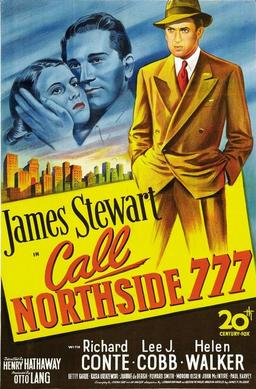
Call Northside 777

This is going to sound simple, but certain movies make me think of the message. Watching old films from basically any Hollywood film is one of my favorite things to do. It can give a window into times long since past. We see towns and cities as they were, not as they are. An all-around solid quasi-documentary, film noir-ish mystery, 1948's Call Northside 777 is a gem.

A reporter for the Chicago Times newspaper, reporter P.J. McNeal (James Stewart) is given a new assignment. An 11-year old murder case from 1932 is in the news, both Frank Wiciek (Richard Conte) and Tomek Zaleska (an uncredited George Tyne) serving 99-year prison sentences for the murder of a Chicago police officer. Wiciek's mother, Tillie (Kasia Orzazewski), a blue collar worker if there ever was, has offered a $5,000 reward for finding the real murder, exonerating her son. McNeal writes the mother's story, but it grabs attention of readers who want more of this story leaving McNeal to explore the long-retired murder case. Ever the suspicious reporter, McNeal goes along but questions the case. Could Frank actually be guilty?

Based on a true story involving the murder of a Chicago police officer (read about it HERE, SPOILERS obviously), 'Call' is an interesting movie for all the right reasons. From director Henry Hathaway, it is part documentary, part investigative procedural, part film noir. The good thing? It moves among those three different genres effortlessly. Clocking in at 112 minutes, it isn't always the quickest-paced flick, but it moves around a lot so that's excusable. A story in the shadows, taking advantage of the black and white photography, it's a great movie to watch.

For me though, this movie is worthwhile for two reasons. One, Hathaway filmed on location in Chicago. This is a great window into late 1940s Chicago. Trivia question and answer for you, but this was the first Hollywood feature film to film on location in Chicago. Where so many films from the 1940s would limit themselves to Hollywood sets, 'Call' gets a whole lot of points for filming in downtown Chicago, but the suburbs as well. Curious what the Windy City looked like 60-plus years ago? This is your movie. The other reason; as a writer who's written for the Chicago Sun-Times, it's a great precursor for All the President's Men. We see how journalists and investigators worked in a pre-Internet age, doing their investigating the old-fashioned way. It's the little things, ain't it?

Already an established star by 1947, Stewart does a solid, workmanlike job as reporter P.J. McNeal. Cynical to a point because the job requires it, McNeal is skeptical of the whole case but takes it on because it's a decent story that readers are curious about it. As the real story comes out though, he starts to question even more, giving Stewart a good chance to flex a little dramatically. Go crusading journalist! Conte is solid in a supporting role as the possibly falsely-convicted Frank while Orzazewski is a scene-stealer as his mother, Tillie. Usually a tough guy actor, Lee J. Cobb plays Kelly, McNeal's editor at the Chicago Times. Joanne De Bergh has a small but essential part as Helen, Frank's wife who supports his innocence. Also look for John McIntire as a former state's attorney trying to cover his butt and an uncredited E.G. Marshall in a small part.

There are some oddities here I feel I have to point out. For a story that's built on the small details, the little pieces of evidence, the movie itself.....isn't. Several rather key questions go unanswered in the end. We find out what happens to Conte's Frank, but what about his supposed partner, Tyne's Tomek? Why is Cobb's editor so dead-set on following this story up? A backstory is hinted at, but never dealt with. The ending is effective, but with a 112-minute movie, it comes together a little quickly, almost like Hathaway ran out of time or money. Still, these are problems but not ones that can ruin a movie. Highly recommend checking this one out.

Call Northside 777 <---trailer (1948): ***/****

Thursday, August 23, 2012

The Bamboo Prison

Here we are again, the propaganda movie. I feel bad. I do, but I've got little else to go on here. Subtle, underplayed propaganda = anywhere from good to tolerable. Heavy-handed, aggressively in your face propaganda = not good to not tolerable. Unfortunately, 1954's The Bamboo Prison goes down the heavy-handed route.

Having marched for over 40 days, Corporal Brady (Brian Keith) and the remnants of a column of prisoners of war finally reach their destination; a brutal, under-supplied camp run by the North Korean army and several Russian/Communist advisers. Getting the scoop from his fellow prisoners, Brady discovers that one American P.O.W., Sgt. John Rand (Robert Francis), is a collaborator working with their captors for better treatment and billeting. Brady quickly finds out there's more than meets the eye when it comes to this believed collaborator. Rand is really an intelligence officer planted in the camp hoping to find proof/documentation of Communist atrocities committed against the POW's. Can he get the proof before a Russian counterpart figures him out?

Released just a year after the conclusion of the Korean War, 'Prison' was no doubt an incredibly timely story for audiences. Beyond it's issues with the propaganda angle -- more to come in that department -- the movie is undone by a general stupidity I had trouble getting past. At just 79 minutes, it doesn't really know where it wants to get other than delivering the "Communists are epically bad" message. Director Lewis Seiler was a talented director, even handling other propaganda-ish movies like Guadalcanal Diary, but the story here is too convoluted for its own good. Rambling, oddly and aggressively trying to be funny, it's a mess.

Propaganda in film can be good. I've said that before, and I'll most likely say it again. The story in 'Prison' has Francis' Rand searching for proof of Communist atrocities, anything from brainwashing to brutal physical beatings to lack of supplies and clothing. Brief sidenote; can't he just see these atrocities? What exactly is he looking for? Does pretending to be a collaborator actually help that much? Here's the thing. All those things were done by Communist/North Korean forces. There's evidence of it, but that doesn't make it any more pleasant to watch. We are subjected to long monologues about the Communist ideal, and then shown how evil it is. Movies like The Manchurian Candidate showed that this subject could be handled in a subtle but still scary and effective fashion. That isn't the case here.

Star of just four movies before his death at age 25 in 1955 in an airplane crash, Francis isn't the best choice to play this character. As was the case with his other roles, he just is not a very expressive actor. His line deliveries come across as beyond static. Monotone, wooden, one-note, all adjectives would apply here. His Rand is also given a love interest, Tanya (Dianne Foster), a Russian ballerina married to a Communist adviser/brainwasher. Those scenes -- lacking any real chemistry -- can be painful to watch. In the sidekick role, Keith is wasted as the tough, no-nonsense Cpl. Brady. He's introduced, and you think he's going to be a main character but unfortunately not. His character disappears for long stretches, only to pop up when Rand needs some help.

Then there's the portrayal of the American and international prisoners of war. For a camp that's supposed to be one step above Hell, the prisoners don't seem to mind too much. They're always laughing it up, hamming it up, and all at their Communist captors' expense. Haha communism! You're so stupid! The prisoners include Jerome Courtland as Arkansas, a shrill Southerner with that stereotypical drawl, E.G. Marshall as Father Dolan, Earle Hyman as Doc, the black medic (another redeeming part), Jack Kelly as Slade, the fast-talking car salesman, King Donovan as Pop, the family man trying to get home (bet that ends well for you, buddy), Pepe Hern as Ramirez, the Mexican soldier, Leo Gordon as Pike, the hot-headed prisoner, and Dickie Jones as Jackie, the youngster. At different points, they sing together, do impressions of Bogie, and all sorts of prisoner of war hijinks. Yeah for being a prisoner of war!

There just isn't much going on here in that whole positive vein. The ending is ridiculously stupid, making us question what the hell Sgt. Rand was even thinking all along. Has he started to believe all the things he was pretending to believe? Eh, not worth analyzing. Just not a good movie.

The Bamboo Prison <--- TCM trailer/clips (1954): * 1/2 /****

Friday, January 27, 2012

Pushover

As I mentioned in my review of Billy Wilder's The Apartment, I have a hard time seeing Fred MacMurray as anything but the star of Disney movies like The Absent-Minded Professor and The Shaggy Dog or on the TV show My Three Sons. An all-American Dad if there ever was one so I have trouble going along with his darker roles like in 1954 film noir Pushover

Working a case, middle-aged police officer Paul Sheridan (MacMurray) meets Lona (Kim Novak), the girlfriend of a gangster, Wheeler (Paul Richards) who's recently robbed a bank, escaping with $210,000 but killing a bank guard in the process. Bored with his life, Paul falls for her hard even when she figures out he's a cop. Upset with her situation of an absentee boyfriend, Lona similarly falls for Paul. Paul's precinct is working a stakeout in hopes of catching Lona's boyfriend, putting Paul in an interesting predicament. He comes up with a plan though, leaving his whole life behind him, taking the money if Wheeler shows up, and starting life over with Lona. Nothing comes easy though.

As a film noir, this has all the requisite pieces from the shadowy setting to the femme fatale in Novak to the anti-hero looking out for himself. Making her film debut, Novak is a bright spot as Lona McLane, the gangster's girlfriend frustrated with her situation. The 21-year old beauty was always gorgeous, but director Richard Quine shoots her like an angel....albeit one with a manipulative streak. Drop dead gorgeous came to mind anytime she was on the screen. Also a positive is the opening bank robbery, a silent sequence interrupted by gunfire. The early portions of the movie are especially good, MacMurray and Novak getting away with some risque scenes (for the time at least).

But as things start to develop with the gangster, the girl and the cash, my problems with MacMurray arose once again. I just don't buy him as a bad guy. Check that. He's not a bad guy, just a weak good guy who makes some epically bad, stupid decisions. The reviews pointed out that Novak manipulates MacMurray's Paul into stealing the stolen money, but I didn't see that. He is attracted to a younger, beautiful woman and sees a whole new life through her. The Paul character is still too much of a weakling though, and I had trouble buying him in the lead role. The other police officers include his partner, McAllister (Philip Carey), who's looking for a wife, Lt. Eckstrom (E.G. Marshall), the officer in charge, and Dolan (Allen Nourse), the veteran cop nearing his retirement and pension.

Once MacMurray's plan hits the fan, the story picks up to a pretty breakneck pace. It is 1954, and the Hollywood movie code still dictated that bad guys got their due. So in other words, once Paul starts making bad decisions, there's no end in sight. One mistake rolls onto another one, especially when Lola's neighbor (Dorothy Malone) sees Paul coming out of her apartment. It's only a matter of time before Paul's flimsy house of cards comes tumbling down, and when he does it is epically bad.

I should mention one thing though that ranks up there with MacMurray as some major issues in this 1954 film noir. A stakeout isn't exactly an exciting visual experience. Instead of spicing it up, Pushover actually shows it in all its excruciating detail. In an 88-minute movie, we get uninterrupted shots of policemen looking through binoculars, officers walking to a car and changing positions with other officers, that sort of thing. Pretty exciting, huh? Yeah, you bet. On the whole, the movie is pretty decent, but the negatives are hard to avoid.

Pushover <---TCM trailer/clips (1954): ** 1/2 /****

Sunday, October 16, 2011

Town Without Pity

Shows like Law and Order, Boston Legal, Perry Mason, and L.A. Law explore the topic. Countless courtroom dramas show the profession for what it is, warts and all. That job? Defense counsel. Being a lawyer is one thing, but I've always questioned part of the profession. Your job is to defend someone as they go through a trial the legal system allows them. Morally, ethically, your fundamental beliefs, how do you defend someone if you know they're guilty? I've never been able to wrap my head around it.

One of the best efforts to show this premise -- a defense lawyer in a seemingly open and shut case -- is 1961's Town Without Pity, more proof you should scour TV listings. Basically completely forgotten over the last 50 years, director Gottfried Reinhardt's film questions the struggles and inner turmoils a lawyer goes through. How far do you go to help save your clients? At what cost do you do so? When is it too far, or is there a limit?

A lawyer in the U.S. Army serving as part of the occupation forces in Germany, Major Steve Garrett (Kirk Douglas) has been called in for a particularly touchy case. A 16-year old German girl, Karin (Christine Kaufmann), has been raped by four U.S. Army soldiers (Robert Blake, Richard Jaeckel, Frank Sutton and Mal Sondock). With the German people calling for a brutal response, the Army High Command wants an example to be made of these four soldiers. In other words, Garrett's work is cut out for him. Prosecuting counsel (E.G. Marshall is Douglas' courtroom rival/opponent) is seeking the death penalty, putting Garrett in a spot. He has a way to ensure long prison sentences will be the judgment, not the death penalty, but it is a morally questionable strategy, one Garrett desperately wants to avoid.

This movie surprised me in a lot of ways, most of them positive. I thought it would be one thing, and it ends up being something completely different. This isn't a movie about guilt or why the soldiers did what they did. That's all but established right off the bat. Without being pretentious or condescending, 'Town' explores mob mentality and its roots in the individual. Why do people do what they do? Why do they revel in other people's pain and discomfort? As Douglas' Garrett investigates his case, he finds a town ready and willing to turn on one of their own.  There's his opening. A case study? Maybe not, it is after all a movie. It goes deeper than I thought it would, but in a good way. The heart of the movie is Douglas though, and he doesn't disappoint.

Playing defense counsel Maj. Steve Garrett, Douglas' performance will no doubt decide if this movie sinks or swims for most viewers.  He's defending rapists of a 16-year old girl, and their guilt is never truly in question. Garrett has to decide what his limit is. The law states that if the key witness can't complete their testimony, the death penalty cannot be enact. For Garrett? That means taking apart on the witness stand a 16-year old girl a few weeks removed from a vicious, brutal rape at the hands of four men. At what point does it become too much? He clearly doesn't want to do it, but his job almost requires him to do it. Intense in a way few actors can be, Douglas hits a home run with the part, wrestling inside with what he should do. Can he live with his decision once the trial is said and done? Only he knows for sure.

Douglas holds the movie together, key supporting parts revolving around him as the case and trial develops. The four soldiers are kept in the background surprisingly enough. Blake is the possible nut, Sutton the weasel trying to convince everyone of his innocence, Jaeckel the decorated vet who's come to terms with his actions, and Sondock the possibly slow soldier. Marshall is good in a thankless role as the prosecuting attorney, doing his best to keep up with Douglas. Kauffmann too is an eye opener as the possibly not so innocent Karin. Barbara Rutting is solid as Inge Koerner, a reporter looking for all sides of the story. Hans Nielsen plays Karl, Karin's father who believes his daughter is an innocent angel capable of nothing but good.

When I saw composer Dimitri Tiomkin's name listed in the cast/crew listing, I was encouraged, but this score is a doozy, a whopper of a badly inappropriate score. An odd mix of jazz and various other genres/samples, it just isn't the right choice for this dark, cynical story. It drives the action like the story of a thriller, not a story surrounding a rape case. Out of place doesn't begin to describe it. The theme song by Gene Pitney -- listen HERE -- will get stuck in your head. Guaranteed, no doubt about it, but it only plays at the beginning and end of the movie so it isn't as noticeably bad as the musical score.

This is a movie that had me wondering about halfway through how things would be wrapped up. I assumed no happy ending -- correct with that guess -- but not in the way Reinhardt's movie goes. The trial becomes an afterthought, just what it caused sending vibrations through the community that are felt everywhere.  A moving ending to a wrongly forgotten courtroom drama.

Town Without Pity <---trailer (1961): ***/****

Saturday, May 28, 2011

The Journey

One of the 1950's most popular films, 1956's The King and I was loved by audiences, award shows, and critics alike.  Maybe the biggest reason for the movie's popularity -- besides the Rodgers and Hammerstein music and the epic story -- was the pairing of its two stars, Yul Brynner and Deborah Kerr.  I haven't seen the movie in years but still remember their chemistry. It was only a matter of time before they were paired in a movie together again, that coming three years later with 1959's The Journey.

The story is based during the Hungarian Revolution of 1956. My background in said revolution is that there was in fact a revolution in Hungary in 1956.  As much as I like history, you just can't read and learn about everything.  The setting -- while specific -- is applicable to any world conflict. It is based in individuals in a bad situation trying to reach some sort of safety, some feeling of normalcy.  Through these situations, you often bond through your trials. For all its uniqueness concerning a conflict in a far-off part of the world though, 'Journey' isn't always the most exciting movie, resorting to its star power to carry it through the slower portions.

It's 1956 in Budapest, Hungary, and an English woman, Diane Ashmore (Kerr), arrives at the airport trying to get out of the country and back home to England.  She's given some tough news though; the Hungarian people are revolting against their Russian/Soviet rulers, and all traffic in and out of the country has been canceled. However, transportation has been arranged for Diane and 13 other international passengers trying to leave Hungary. They will board a bus and drive the 250 miles to safety at the Austrian border. Before they reach the border though, they're stopped and inspected by the local commander, a Russian major, Surov (Brynner), who won't let them pass until everyone is approved. Diane starts to worry because she knows a secret about a fellow passenger on board, Fleming (Jason Robards), that threatens to get them all shot.

This is an all-around kind of weird movie. It isn't like so many other movies, but not always in a good or bad way. It is just different. Director Anatole Litvak films his movie in Hungary on some of the locations where the actual revolution took place just three years before in 1956. It certainly gives the movie a feeling of realism, of authenticity that couldn't have been duplicated on a Hollywood backlot (even if it does look like a studio at times). Instead, much of the story is set in a small hotel and its surrounding buildings.  There is a washed out look to The Journey that I suppose could have been the TCM print, but I don't know for sure. I can't put my finger on it, but something about the film just didn't click with me.

With two leads like Kerr and Brynner at the forefront of the movie, it's understandable that you want them to carry the movie as much as possible.  Their performances are the least of the movie's problems.  Their chemistry together is hard to disagree with. They're just good together.  Kerr is quiet and composed, eventually pushed to the point of nerves taking over while Brynner is bigger than life, able to dominate the screen just by standing there.  But in developing these characters, the story requires them to fall for each other. The final 20-30 minutes come along, and they're fighting off urges that I just didn't see building up throughout the movie. It's dialogue and more dialogue and more dialogue. The movie is a tad long at 126 minutes, taking quite awhile to get where it's going.

As if Kerr and Brynner weren't enough to satisfy most moviegoers, Jason Robards makes his feature film debut as Fleming, the mysterious passenger on-board who has all the other passengers concerned what he's up to. SPOILERS STOP READING SPOILERS Kerr is trying to sneak him out of the country, past lovers reunited after he escaped from a Russian prison. END OF SPOILERS Robards is one of the more underrated actors from the era, and he shows off the talent we'd all get to see in the coming years. Filling out the international list of passengers is Robert Morley as the scene-stealing, stiff upper lip Englishman, Deverill, E.G. Marshall and Anne Jackson as an American couple traveling with their kids (including a 5-year old Ron Howard), and other characters from Egypt, France, Germany, and in an interesting twist, a Jewish man. There was potential here for more development among these characters, and yes, I know the focus is on the leads. The 14 passengers though screamed out for a mini-series, something that would have given them a chance to shine. Also look for Senta Berger in a bit part as a serving girl at the hotel.

Maybe the biggest problem 'Journey' has going for it is a lack of focus. Brynner's Surov is investigating these international passengers, but nothing ever seems to get done. He spends most of the time riding his prized horse, eating and drinking with the passengers who are scared to death of him, and all the while, Kerr's Diane worries he'll figure out what's going on. By the way, he does....and pretty quickly.  There is no urgency though at all, and the movie's pacing suffers.  The ending makes up for it some in terms of surprise and shock value, a moving finale that definitely caught me off guard. I just wish more of the movie could have been like that.

The Journey <---trailer (1959): ** 1/2 /****

Tuesday, August 17, 2010

The Bridge at Remagen

One Memorial Day I don't know how many years back, I stumbled across a WWII movie on Turner Classic Movies that I'd never seen before, much less heard of.  1969's The Bridge at Remagen is based on a WWII battle, but because of a general lack of big names -- whether it be the director or the cast -- is not mentioned in discussions of other 1960s MGM war movies. It is a product of the times as America was fully involved by 1969 in Vietnam, but it is a very effective look at the closing days of the war.

Too often war movies pick a side and go from there, disregarding the other side completely.  Some of the better ones at least attempt to show both sides of the war.  It is said of war that 'the victors write the history books' but in many ways, the soldiers on either side are very similar.  They're fighting because that is what they're told to do, their superiors deciding what should or shouldn't be done.  Director John Guillermin splits time evenly between the Americans and Germans, giving an excellent look at one of the key battles late in WWII with an underrated cast and some great action.

It's March 1945 and the German armies are in full retreat.  The Allied forces are nipping at their heels, chasing them back into Germany.  The German High Command has ordered all bridges over the Rhine River destroyed to help slow down the Allied charge, but one bridge at Remagen remains. General Von Brock (Peter van Eyck) sees that 75,000 German troops will be cut off if the bridge is destroyed and instead sends a close friend and fellow officer, Major Paul Krueger (Robert Vaughn), to hold the bridge as long as possible. Just miles away, the Allies charge forward hoping to catch the German defenses napping, at their front an armored infantry unit commanded by Lt. Hartman (George Segal), who after weeks at the point is leading an exhausted unit.  But pressure from HQ and the battalion commander (Bradford Dillman) keeps the men going, hoping to end the war as quickly as possible.        

Where this reflects the times is the portrayal of a war near its end, the soldiers deteriorating with pure exhaustion.  The end of the war is near, and the Germans are turning on each other.  Vaughn's Krueger is promised a defense that doesn't exist and reinforcements that can't be moved.  The SS and Gestapo run rampant, ruling with an iron fist.  The ranks are thinned by deserters, and refilled with old men and young boys.  The Americans are always on the move, pushing themselves and the Germans to their absolute limits.  They're bone tired but they have no option but to follow orders.  The rules of war are gone to a certain point, and survival has taken priority over everything else.  It is a cynical story at times, the effects of war wearing men down on both sides.  Frightening at times to see the portrayal of the closing days of the war presented in a realistic fashion.

The portrayal of the opposing forces is seen through the eyes of two junior officers, both with different missions but driven to the same point.  Segal is perfect as Lt. Hartman, a company commander at his wit's ends when it comes to commanding.  He's trying to protect his men as best as possible, but HQ has their objectives.  Guest star E.G. Marshall as an American general callously states "100 may die, but 10,000 will be saved." An honest statement in the big picture, but when you're part of the 100, does it matter?  Across the river is Vaughn's Krueger, a career German officer -- not a Nazi -- disobeying orders but still trying to save as many men as possible.  The two actors don't share any scenes together, but there is a bond between them nonetheless.  They may be on opposite sides of the war, wearing different uniforms, but in many ways they're the same.

In the honest portrayal of a war in its closing days, both sides aren't shown as particularly heroic.  Ben Gazzara is a scene-stealer as Sgt. Angelo, one of Hartman's men who is a good soldier under fire but rubs the Lt. the wrong way by picking clean the bodies of dead German soldiers.  Gazzara is so good in the part that you forget at times how despicable his actions are.  He balances the good with the bad, the power of his actions wearing on him.  Forced to kill a Hitler Youth teenager, he almost snaps when confronted.  All of the Americans aren't shown in a positive light, including Hartman's unit which includes Bo Hopkins, Matt Clark, Robert Logan, Steve Sandor, and Tom Heaton. Dillman's Barnes is a good officer but he has no idea how to interact or treat his men. The Germans too are at each other's throats.  Look for Hans Christian Blech in a solid supporting part as one of Krueger's officers.

Bouncing back and forth between the American and German perspective could have caused a disjointed story, but that's never really a problem.  Instead, it drives the pace at a lightning speed as the Germans fall back, the Americans pushing forward.  The action scenes are well-handled and nicely choreographed starting with the filming locations in Czechoslovakia where a bridge similar in appearance to the actual Remagen bridge was used.  There is an epic scale to the battles with the end result possibly being an earlier end to the war, but on a personal level we see Hartman's men ordered across a bridge fully expecting it to blow at any moment.  Full of tension from the beginning, the battle sequences are aided by Guillermin's camerawork, right there on the ground with the foot soldiers.

A highly underrated WWII story.  Elmer Bernstein's score (Main Theme listen HERE) borrows from some of his more notable musical scores, and at times sounds more like a western theme, but for the most part it's good. You can watch the whole movie in a widescreen version via Youtube, starting with Part 1 of 11. Don't let the lack of big names scare you away from this one. An all-around solid look at the closing days of WWII and one of its key engagements.

The Bridge at Remagen <---trailer (1969): **** /****

Tuesday, June 22, 2010

The Silver Chalice

They can't all be winners, right?  Over a long career, at some point movie stars have to have a dud every so often.  In most cases though you'll never hear the star actually admit that part of the equation.  Well, most cases other than Paul Newman.  One of Hollywood's greatest actors and a true legend, even Newman had to start somewhere, making his screen debut in 1954's The Silver Chalice. It's been critically roasted, and more than that, roasted by Newman who took out a full page ad in a newspaper in the 1960s to encourage TV viewers not to watch this movie when it was shown on TV.  Now that's the kind of honesty we need more of.

Let's get this out of the way early.  'Chalice' is a bad movie, a truly bad movie, that is entertaining in its awfulness.  It was an early trendsetter in huge Biblical epics like The Ten Commandments, The Robe, King of Kings, Spartacus and many others.  But you know what all those epics had going for them?  A somewhat decent script and some actual scale in terms of sets, costuming and 'a cast of thousands.'  Directed by Victor Saville, 'Chalice' has none of those things.  Other than an impressive cast full of not quite yet stars and some hopefully unintentionally funny scenes, this one is a big stinker.

Twenty years after the death and resurrection of Jesus Christ, a Greek silversmith in Antioch by the name of Basil (Newman) is fighting for his freedom after his uncle throws him into slavery.  He is offered freedom by a man named Joseph of Arimathea (Walter Hampden) who presents a challenge for him as an artist.  Joseph owns the cup Jesus used during the Last Supper and wants to give it a proper resting place in the form of an immense chalice that will feature the faces of all those closest to Jesus, mainly the apostles.  Basil accepts the challenge and goes to work, but surrounding powers want to get their hands on the Holy Grail, including a revolutionary group led by Mijamin (Joseph Wiseman) and a magician named Simon (Jack Palance).

I'll start with the positives -- however few there were.  The cast is something to behold because many of the actors and actresses involved went on to much bigger and better things, Newman obviously at the top of that list.  There's also Italian beauty Pier Angeli, future Bonanza star Lorne Greene as Peter, a young Natalie Wood as a slave girl, E.G. Marshall as Basil's adopted father, Michael Pate as Angeli's worrying father, and Virginia Mayo as the key ingredient in the always interesting love triangle. Of course some of these parts are nothing more than a 'blink and you'll miss them' appearance, but with as 'involving' as the story is, it shouldn't be hard.

One of the selling points of these huge historical epics was the lavish sets, costumes and uses of thousands of extras.  'Chalice' basically passes on all three of those -- okay, the costumes are interesting.  The sets are absolutely ridiculous, and I'm guessing about $18 was spent putting them together.  It's very clear these are on soundstages with gigantic stage-like curtains in the background standing in for actual background.  At times, the sets look like Legos or Duplos assembled by toddlers.  They're so bad it becomes funny to see how cheesy they look.  Check out the backgrounds in THIS scene, the inside of a temple. It looks like they drew in 'the bricks' with a sharpie marker.

Newman later stated in interviews that he thought this was his worst ever performance.  I haven't seen all of them, but I'm inclined to agree.  He's miscast as a Greek to begin with, and he hasn't developed that on-screen persona, that charm that made him so likable in so many later movies.  The rest of the cast isn't exactly challenging for any Oscars either.  Mayo looks done up like some sort of drag queen with eyebrows that look like they'd stab someone.  Her sexy magician's assistant (seems right at home in a biblical movie) is torn between Basil and Simon, but she looks too ridiculous to even take too seriously.  As for the rest of the cast, Angeli has a sexy accent, and Wiseman is a creepy enough 2nd villain.

But more than all the cheap sets and sluggish dialogue, the one star really breathing some life into the movie is Jack Palance as Simon, a magician who believes he has the talent, the ability to convince the Christians he is more powerful than Christ.   He chews scenery like nobody's business, hamming it up with his monologues and magic tricks.  His Simon also provides one so unintentionally funny moment late in the movie that I almost felt bad for having laughed...almost being the key word.  It's the one true worthwhile part of this dud, but if curious, watch it at Youtube starting here with Part 1 of 15.

The Silver Chalice <----trailer (1954): * 1/2 /****