The Sons of Katie Elder

The Sons of Katie Elder
"First, we reunite, then find Ma and Pa's killer...then read some reviews."
Showing posts with label Bradford Dillman. Show all posts

Wednesday, March 11, 2015

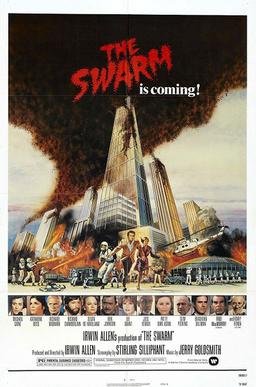
The Swarm

I'm not always the quickest learner so I'll take the blame for this one. I guess I should have learned quicker. While there are exceptions, there just weren't many good disaster movies in the 1970s and then into the 1980s. So for every Airport, Towering Inferno and Poseidon Adventure, there are movies like 1978's The Swarm. Yep, another nail in the coffin of a genre struggling to hold on for dear life.

At an isolated army installation in the American Southwest, a heavily armed patrol slowly navigates the eerily empty facility. What the hell happened here? Deep underground at the installation, the investigating patrol finds several dead bodies and a few lucky survivors, including a mysterious doctor, Brad Crane (Michael Caine), who says he's an expert on the world of insects. A much larger army force, commanded by crotchety General Slater (Richard Widmark), arrives soon after, and they're too stunned at what they find and what Crane claims is behind the mysterious attack. The responsibility goes to....an immense swarm of African killer bees. Bees!!!! Making the situation worse, there's no cure for the bees' surprisingly venomous sting and seemingly no one is immune. It looks like nothing can stop the not-so-fast moving bees, and they're heading for Houston.

Sometimes you DO just know. When this 1978 disaster flick from director Irwin Allen -- Master of Disaster flicks -- popped up on Turner Classic Movies' schedule, I had to set it to record. I HAD to. Movies with casts like this don't pop up too often so I had to at least give it a try. Worst case, it's just entertaining in a bad, guilty pleasure fashion, right? Well, that's what you would think. This wasn't even good in a 'So bad it's good' way. It just isn't entertaining. Apparently, I'm not the only one who thinks so. 'Swarm' is on all sorts of worst movies ever made lists and bombed in epic fashion in theaters back in 1978. If that's not a recipe for success, I don't know what is!

Maybe the most frightening thing to take away from this bee-disaster flick is that there's a director's cut available out there clocking in at 156 minutes. The TCM version I saw was an already painfully long 116 minutes. God knows what else could be expanded on in an additional 40 minutes because I was losing interest in the shortened version at the 60-minute mark. For goodness sake, 'Swarm' utilizes a love triangle featuring Olivia de Havilland, Ben Johnson and Fred MacMurray (in his last role) as a subplot! Yes, because that's what we need, three Hollywood legends in a senior citizen love triangle in a disaster flick where a swarm of killer bees are the villains. Seems reasonable, don't it? I can't say I'd be too interested in seeking out that longer version of a dud like this.

Star Michael Caine has said this is the worst movie he ever made, and it's hard to disagree. As the insect/bug specialist, Caine looks to be immensely bored throughout. If there's a slightly redeeming quality in 'Swarm,' it's that the cast is epically impressive. Now are any of them given much of anything to do? That would be a big N-O, but still, look at all those Hollywood stars! Along with Caine and perpetually angry Widmark, look for Katharine Ross, Henry Fonda and Richard Chamberlain as some of the scientists tasked with halting the advance of the bees.  Also look for Lee Grant, Jose Ferrer, Patty Duke, Bradford Dillman, Slim Pickens, and Cameron Mitchell in other supporting parts, some more painfully forced than others.

Things unfortunately develop in more spoof-fashion than straight disaster flick. How many slow motion bee attack scenes can we witness before it just becomes laughable? Because the movie is about bees, we get one hilarious scene after another about our very talented cast discussing what the bees' intentions are, if they're seeking revenge, if there is a major bee plan to take over the world. It's all done so straight that it becomes spoof-like, and that's never a good thing. The problem is there just isn't that one reason to sit back and watch this one, and that's considering the star power on hand. The cast is given little to nothing to do, the killer bees are a laughable "villain," and the entertainment value just isn't there. Give this one a wide berth.

The Swarm (1978): */****

Thursday, February 13, 2014

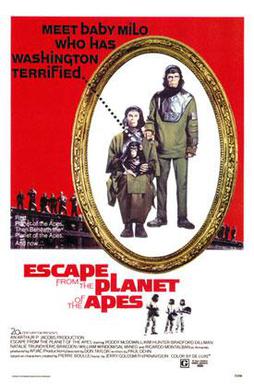
Escape from the Planet of the Apes

Sometimes a series is too successful to just let it end naturally. Following the success of Planet of the Apes and Beneath the Planet of the Apes, Fox Studios wanted another sequel, but there was a problem. Without giving too much away, the ending for 'Beneath' well....didn't really leave any opening for a follow-up. That's what screenwriters are for and ta-da! The series continued! A third movie in the series, 1971's Escape from the Planet of the Apes.

On a warm sunny day off the coast in southern California, a spaceship is discovered floating in the Pacific. The ship is brought ashore, the Army waiting to welcome the astronauts on-board but no one is sure where the spaceship came from or who is in fact on-board. Those waiting are stunned when the three astronauts remove their helmets, revealing themselves as apes. The three astronauts? Dr. Cornelius (Roddy McDowall), his wife, Dr. Zira (Kim Hunter) and Dr. Milo (Sal Mineo). The arrival of talking, intelligent apes stuns the world, forcing the government to decide what to do with the ape trio. Some are welcoming, Cornelius and Zira especially becoming instantly famous in pop culture. Others though aren't so welcoming, questioning where these apes came from and what is their intention in coming to Earth? Both sides need to find a happy medium, but some are sure the presence alone of these futuristic astronauts is a threat to the future of mankind.

So as we talked about, Beneath the Planet of the Apes didn't leave much of an opening for the series to continue, Charlton Heston insisting that be it for the series. Money is a powerful motivator though, isn't it? The series continues, but back on Earth in modern times. Director Don Taylor begins the second half of the series, catapulting the franchise in a different route for its final three films, composer Jerry Goldsmith returning as well with a great score. The premise linking 'Beneath' and 'Escape' is a tad contrived, a tad forced when you think about how 'Beneath' ended but for the sake of where the series is going, it's not so bad. Why does it stand out from the rest?

Two reasons. McDowall and Hunter. Playing Cornelius, McDowall returns to the series after being unable to to star in 'Beneath' because of a scheduling conflict. Less than pleased with her characterization in 'Beneath' (or maybe lack of), Hunter returned because she liked the script. The story is a departure from the first two movies, but this returning duo is perfect. Where we saw Heston's Taylor and James Franciscus' Brent struggling to adjust in a simian world, we now see Cornelius and Zira going through the same struggles in a human world. Where everything else has changed around them, having a spouse is a constant. Their chemistry is perfect, two intelligent individuals deciding what should be their next step, how best to survive in this human world. They have these perfect little moments, Cornelius trying on suits, Zira trying on stylish dresses, Cornelius standing up for his wife, Zira fighting for respect that carries the story surprisingly well on an emotional level.

It's cool to see Cornelius and Zira -- key supporting parts in the first two movies, still supporting parts -- step into the lead roles. That added dimension carries the movie. Who else to look for? Bradford Dillman and Natalie Trundy as Lewis Dixon and Stephanie Branton, two doctors and animal psychiatrists who become almost public relations representatives for Cornelius and Zira, but more importantly, they become trusted friends. Eric Braeden is Dr. Otto Hasslein, the scientific adviser to the President (William Windom), who questions that if these apes come from Earth's future...why did they leave?  It's Eric Braeden so yes, he's a villain. Mineo makes the most of his smallish part as Dr. Milo, the third ape to travel through time with Cornelius and Zira, while Ricardo Montalban is a scene-stealer as Armando, the charming, friendly owner of a circus who works with Lewis and Stephanie. Also look for Jason Evers and Albert Salmi as Braeden's two henchmen, while John Randolph is the head of the commission investigating what to do with the visiting simians.  

There are portions of this movie that are really sweet, great emotional moments that work because of the chemistry between McDowall and Hunter. Following the trend of the first two movies though, things take a turn for the dark though near the halfway point of the 98-minute movie. The time travel aspect comes up, if someone from the future knows what's going to happen, can we change it by wiping them out? We discuss issues of nuclear war, experimentation on animals, prejudices against races and cultures, but it is all handled in subtle enough fashion that it works. The ending is pretty heartbreaking in itself, but as the series has set us up for, there's a great twist in the final scene. Definitely stick with it to the final credits.

Another worthy Planet of the Apes movie, throwing us for a loop but all for the interesting. Coming up next, the final two films in the series, Conquest of Planet of the Apes and Battle for the Planet of the Apes, neither of which I've seen in one sitting. Stay tuned!

Escape from the Planet of the Apes (1971): ***/****

Saturday, August 6, 2011

Sudden Impact

Growing up watching westerns, I will always associate Clint Eastwood with the genre, most notably his spaghetti westerns with Italian director Sergio Leone.  He of course is known for any number of other things, including become an Oscar-winning director as he started working behind the camera instead of in front of it.  So while I picture him as the Man With No Name, a roaming gunfighter looking to make a buck, ask another fan and you will probably get a completely different answer depending on the fan.

Name Eastwood's most famous character over the course of his career, and I'd bet 8 or 9 people out of 10 would say Dirty Harry instead, San Francisco homicide detective Harry Callahan.  It's easy to understand why as Eastwood created one of the most recognizable, iconic characters in movie history with this tough as nails police officer who does things his way, procedure and laws be screwed. Starting with 1971's Dirty Harry, Eastwood played Callahan five times, the fourth effort coming with 1983's Sudden Impact after a seven-year break since 1976's The Enforcer.

Working a case with Mafia connections, San Francisco homicide detective Harry Callahan (Eastwood) is up to his usual shenanigans.  He meets a mob boss in public and berates him, the boss actually dying of a heart attack.  His superiors are sick of his troublesome attitude and complete disregard for procedures and the laws, assigning him to a case in the tiny, seemingly peaceful coastal town of San Paulo involving a brutal murder where the victim was shot in the crotch and in the forehead. Callahan sees a connection with his case though as more bodies start to mount up. A victim of a vicious gang rape 10 years earlier, Jennifer Spencer (Sondra Locke), has returned, killing off the men who raped her. No one thinks much of his hunch though, meaning Callahan is on his own...as usual. Criminals watch out because here comes Dirty Harry.

The threat with any series/franchise is the proceedings getting stale at a certain point. Like any series, Dirty Harry doesn't always keep up the momentum. The first two movies of five -- Dirty Harry and Magnum Force -- are a cut above the last three, but that doesn't mean they aren't good movies...just not as good.  In terms of story, this has to be the darkest of the five, a rape victim gunning for her rapists.  With Eastwood directing though, I think too much time was spent on Locke's Jennifer character. By the last 30-45 minutes of the movie, the story focuses more on Jennifer than on Harry.  Credit to Eastwood girlfriend and underrated actress Sondra Locke for bringing her character to life, but I watch these movies for Dirty Harry above all else.

That is what is so appealing about vigilante movies like this, even if Callahan's vigilantism is toned down a bit here.  In his world, there are no shades of gray. There is black and white, good and bad, and if you can't pick a side, Callahan will pick one for you.  As a veteran inspector, he's just sick of the countless crimes he sees around him. He always gets his guy -- sometimes stretching the limits of the law to do so -- only to see the system let the bad guys back on the street. The bad guys here are ridiculously evil, not a human bone or redeeming quality in sight. The rapists include Paul Drake as the psychotic Mick, Audrie Neenan, and Jack Thibeau. This is a Dirty Harry movie that's tired of bosses, superiors, and all-around tools so the uppity-ups include Pat Hingle as the San Paulo police chief, and Bradford Dillman and Michael Currie as his San Fran bosses. If we've learned anything from these movies though, it's that Dirty Harry doesn't do well when told what to do.

This isn't a great cop movie regardless of who the main character is.  It starts off on a great note, the first 30 minutes full of energy, action and one-liners as Eastwood has some fun with the character, delivering the iconic 'Go ahead, make my day' line when stopping a robbery in progress. Watch that scene HERE. The remaining 90 minutes are far from boring, but they have the feel of being phoned in.  It lacks the energy that the first half hour has.  The movie is at its best when Eastwood is front and center. At different points, Harry takes on the mob, chases a suspect by driving a retirement home bus, practices with his cannon of a Magnum pistol, and hangs out with his bulldog, Meathead.  Albert Popwell plays Horace, a friend on the force, while Mark Keyloun has a good supporting part as Bennett, a young San Paulo officer working with Callahan. Overall, the character has become more of a caricature of itself as opposed to an even somewhat realistic character.

Still, all things consider, it's Clint Eastwood as Dirty Harry, and it's hard to pass that up. There is something simple and perfect in terms of entertainment value watching Callahan lose his mind and take his anger out on any crook stupid enough to tangle with him. There is no question that in the end he will get his man, just how and when.  Sudden Impact doesn't bring anything new to the procedural cop drama or the Dirty Harry series, but it is a solid if unspectacular (and still entertaining) movie, mostly because Clint Eastwood is still and always will be cooler than anyone and everyone.

Sudden Impact <---trailer (1983): ** 1/2 /****

Tuesday, August 17, 2010

The Bridge at Remagen

One Memorial Day I don't know how many years back, I stumbled across a WWII movie on Turner Classic Movies that I'd never seen before, much less heard of.  1969's The Bridge at Remagen is based on a WWII battle, but because of a general lack of big names -- whether it be the director or the cast -- is not mentioned in discussions of other 1960s MGM war movies. It is a product of the times as America was fully involved by 1969 in Vietnam, but it is a very effective look at the closing days of the war.

Too often war movies pick a side and go from there, disregarding the other side completely.  Some of the better ones at least attempt to show both sides of the war.  It is said of war that 'the victors write the history books' but in many ways, the soldiers on either side are very similar.  They're fighting because that is what they're told to do, their superiors deciding what should or shouldn't be done.  Director John Guillermin splits time evenly between the Americans and Germans, giving an excellent look at one of the key battles late in WWII with an underrated cast and some great action.

It's March 1945 and the German armies are in full retreat.  The Allied forces are nipping at their heels, chasing them back into Germany.  The German High Command has ordered all bridges over the Rhine River destroyed to help slow down the Allied charge, but one bridge at Remagen remains. General Von Brock (Peter van Eyck) sees that 75,000 German troops will be cut off if the bridge is destroyed and instead sends a close friend and fellow officer, Major Paul Krueger (Robert Vaughn), to hold the bridge as long as possible. Just miles away, the Allies charge forward hoping to catch the German defenses napping, at their front an armored infantry unit commanded by Lt. Hartman (George Segal), who after weeks at the point is leading an exhausted unit.  But pressure from HQ and the battalion commander (Bradford Dillman) keeps the men going, hoping to end the war as quickly as possible.        

Where this reflects the times is the portrayal of a war near its end, the soldiers deteriorating with pure exhaustion.  The end of the war is near, and the Germans are turning on each other.  Vaughn's Krueger is promised a defense that doesn't exist and reinforcements that can't be moved.  The SS and Gestapo run rampant, ruling with an iron fist.  The ranks are thinned by deserters, and refilled with old men and young boys.  The Americans are always on the move, pushing themselves and the Germans to their absolute limits.  They're bone tired but they have no option but to follow orders.  The rules of war are gone to a certain point, and survival has taken priority over everything else.  It is a cynical story at times, the effects of war wearing men down on both sides.  Frightening at times to see the portrayal of the closing days of the war presented in a realistic fashion.

The portrayal of the opposing forces is seen through the eyes of two junior officers, both with different missions but driven to the same point.  Segal is perfect as Lt. Hartman, a company commander at his wit's ends when it comes to commanding.  He's trying to protect his men as best as possible, but HQ has their objectives.  Guest star E.G. Marshall as an American general callously states "100 may die, but 10,000 will be saved." An honest statement in the big picture, but when you're part of the 100, does it matter?  Across the river is Vaughn's Krueger, a career German officer -- not a Nazi -- disobeying orders but still trying to save as many men as possible.  The two actors don't share any scenes together, but there is a bond between them nonetheless.  They may be on opposite sides of the war, wearing different uniforms, but in many ways they're the same.

In the honest portrayal of a war in its closing days, both sides aren't shown as particularly heroic.  Ben Gazzara is a scene-stealer as Sgt. Angelo, one of Hartman's men who is a good soldier under fire but rubs the Lt. the wrong way by picking clean the bodies of dead German soldiers.  Gazzara is so good in the part that you forget at times how despicable his actions are.  He balances the good with the bad, the power of his actions wearing on him.  Forced to kill a Hitler Youth teenager, he almost snaps when confronted.  All of the Americans aren't shown in a positive light, including Hartman's unit which includes Bo Hopkins, Matt Clark, Robert Logan, Steve Sandor, and Tom Heaton. Dillman's Barnes is a good officer but he has no idea how to interact or treat his men. The Germans too are at each other's throats.  Look for Hans Christian Blech in a solid supporting part as one of Krueger's officers.

Bouncing back and forth between the American and German perspective could have caused a disjointed story, but that's never really a problem.  Instead, it drives the pace at a lightning speed as the Germans fall back, the Americans pushing forward.  The action scenes are well-handled and nicely choreographed starting with the filming locations in Czechoslovakia where a bridge similar in appearance to the actual Remagen bridge was used.  There is an epic scale to the battles with the end result possibly being an earlier end to the war, but on a personal level we see Hartman's men ordered across a bridge fully expecting it to blow at any moment.  Full of tension from the beginning, the battle sequences are aided by Guillermin's camerawork, right there on the ground with the foot soldiers.

A highly underrated WWII story.  Elmer Bernstein's score (Main Theme listen HERE) borrows from some of his more notable musical scores, and at times sounds more like a western theme, but for the most part it's good. You can watch the whole movie in a widescreen version via Youtube, starting with Part 1 of 11. Don't let the lack of big names scare you away from this one. An all-around solid look at the closing days of WWII and one of its key engagements.

The Bridge at Remagen <---trailer (1969): **** /****