The Sons of Katie Elder

The Sons of Katie Elder
"First, we reunite, then find Ma and Pa's killer...then read some reviews."
Showing posts with label Historical epics. Show all posts

Monday, February 22, 2016

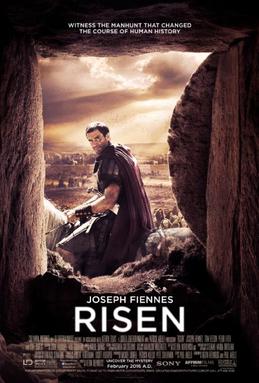
Risen

I was raised as a Catholic, going to church every weekend with my Dad and my sister. Over the years, I've mostly left organized religion behind. I struggle with my beliefs in religion, of a higher being, of faith in general. Through the ups and downs though, I've always been fascinated with the story of Jesus. Whether he was the Son of God or just a man (or both), it is a truly interesting, layered individual, one we'll never fully know. Slinking into theaters this weekend is 2016's Risen, the story of how Jesus' supposed Resurrection from the dead sparked quite a tense situation in Jerusalem.

Stationed in Jerusalem -- in 33 A.D. -- a Roman tribute, Clavius (Joseph Fiennes), is in command of a veteran legion tasked with helping keep the peace. Upon arriving back at the garrison having put down a small rebellion in the hills, Clavius is summoned by the Roman governor of Jerusalem, Pontius Pilate (Peter Firth). While Clavius was away, Pilate ordered the crucifixion of  a preacher from Nazareth who was causing problems on all fronts. Now that the preacher is dead, it is feared by many in power that the man's message of resurrection from the dead in 3 days will now incite more disbelief, more fervor, more fight against the Romans. Sure enough, on the morning of the third day, the body is missing from the tomb it had been buried in. What happened? Was the body stolen? Is there something more powerful going on? With Pilate's less than patient mandate to get the job done and do it quickly, Clavius must get to the truth of it all. What really happened to the preacher from Nazareth known as Jesus?

Semi-SPOILERS AHEAD For those that believe Jesus is the Son of God, the thought he rose from the dead is a matter of truth. For others? It's far more incredulous. I don't know where I stand exactly on the subject. I'd like to believe, but I just don't know. 'Risen' -- though it keeps you guessing throughout -- attacks the subject as if Jesus (called by his actual name, Yeshua) did in fact rise from the dead. It's not overtly religious as a film, but your personal beliefs-faith-convictions will no doubt impact what you take away from the film, or if you even like it. I liked it a lot for all the right reasons. End of Semi-SPOILERS.

In the heyday of the EPIC roadshow film hitting theaters -- the 1950's and 1960's -- historical epics were quite common in theaters, specifically biblical epics. How then do you inject some life into a sub-genre that's long since lost its popularity? With an original story like this! Director Kevin Reynolds wrote a screenplay with Paul Aiello that turns one of the most famous stories in history -- Jesus' death and Resurrection -- into a mystery, a police procedural of sorts. How genuinely original and creative is that? If it sounds too straightforward...well, it is a perspective on a familiar story just waiting to be told. Some general background info and knowledge wouldn't hurt here either going in. A lot going on, a lot of names and history so while it's never out-and-out confusing, it could be a lot to juggle if you're unfamiliar with the story and its players.

One of the archetypal characters in biblical epics were non-believers who wanted to believe -- sometimes against their better judgment -- who are then brought into the growing Christian faith. In steps Joseph Fiennes as Clavius, a longtime Roman soldier who's grown weary of the life full of death, blood and destruction. When instructed to find out what happened to Jesus, he doggedly pursues the clues of a case that just seems too impossible to be even remotely true. A man couldn't really rise from the dead now, could he? The transformation Clavius goes through is believable and very effective because Fiennes does such a fine job with the lead performance. An underrated actor all around, he's one of the best things going here in 'Risen.' We see a man tortured inside by his own doubt, comparing everything he knows and believes to all those things that you have to take on faith (no matter how difficult). A layered performance, a fascinating character and our point person in solving one of history's great stories and mysteries.

This isn't an all-star cast full of thousands. There's some recognizable names and faces with an ensemble cast that fills in around Fiennes as necessary. Firth is excellent as Pilate, given some depth here and not just as a cardboard cutout, the easy villain. Tom Felton (Draco Malfoy himself) plays Lucius, Clavius' young aide, inexperienced but wanting to learn. Who else to look for? A lot of familiar names if you're familiar with the story, including Mary Magadelene (Maria Botto), Joseph of Arimathea (Antonio Gil) , and Jesus' disciples, most notably Simon Peter (Stewart Scudamore) and Bartholomew (Stephen Hagan).

Filmed on-location in Spain, 'Risen' has that sun-drenched, sandy, dusty look of so many past epics from The Greatest Story Ever Told to King of Kings, Ben-Hur to Gladiator and so many others. In that sense, Reynolds' film feels like a bit of a throwback to biblical epics of old, albeit with such a cool twist leading the story. How do you prove a man did or didn't die? Finding his body and quickly before it rots to the point it can no longer be identified. In 33 A.D. in the heat of the desert...that's not long. It's never slow-moving, always moving forward, always working toward something bigger in a finished product that runs 107 minutes. There are times I thought it dragged some in the second half when things should have been picking up momentum, but the ending itself -- and some twists along the way in getting there -- certainly make up for it.

In an odd way of looking at 'Risen' as a police procedural of sorts, the story works as it drops hints and clues where it's going. The story we follows begins with us being thrown right into the tail end of Jesus' crucifixion, and away we go from there. There are references to the bloodied crown of thorns, the shroud of Turin, several Bible passages about the days and weeks following the death and Resurrection -- specifically the Upper room -- which we just don't know much about other than some vague(ish) references. The best thing going here (along with Mr. Fiennes) is a moving performance by Cliff Curtis as Jesus, a quiet, dignified performance that just works so well. I don't want to give too much away, but it's an excellent appearance. The second half does take some surprising twists that lean toward the more religious nature so be forewarned going in.

But taking it all in, I loved it. A bit of a throwback to days of old with Hollywood historical epics mixed in with some new elements of a biblical detective story. Fiennes is excellent, but the whole cast is very good. It's not making much money in theaters, but the reviews are fair to middling (with some that actually liked it) so take advantage during the Lenten season and go see this one. And that's from a heathen like me!

Risen (2016): ***/****

Thursday, December 17, 2015

In the Heart of the Sea

Whether you've read it or not, everyone has heard of Moby Dick, the classic novel by author Herman Melville, right? Right?!? I'd hope so. If not, go check out a library. What many folks don't know is that Melville's story is partially based on a true story, the tragic story of the Essex (don't read if you don't want to find out some MAJOR SPOILERS). It's gotten a feature film adaptation getting somewhat mixed reviews, but you should decide for yourself with 2015's In the Heart of the Sea.

It's 1820 on Nantucket and the whaling ship the Essex is set to embark on a long voyage that will last at least a year and could stretch as long as two or three. The ship has a new commander, George Pollard (Benjamin Walker), who's relatively inexperienced but who will be aided by a very capable first officer, Owen Chase (Chris Hemsworth). With a crew of 21, the Essex sets sail on a voyage that will take them south through the Atlantic and west into the Pacific as they seek to fill their hold with hundreds of barrels of oil they will produce by killing as many whales as they can track. After months at sea though, they have little to show for their work, forcing Walker to give the orders to go further out into the Pacific where reports of waves of whales offer an enticing potential for success. What awaits though in the vast expanses of the unexplored ocean? Even the experienced sailors on-board the Essex couldn't predict what awaits them.

This recent release from director Ron Howard is based on a book of the same name by author Nathan Philbrick. SPOILERS AHEAD SPOILERS Writing in a simple, straightforward style (much appreciated!), Philbrick goes into detail of the time, the people and the tragic events that took place. While thousands of miles away from land in the Pacific, the Essex was attacked by an immense sperm whale and ultimately sunk, leaving the crew stranded at sea with limited supplies and no real hope of rescue in sight. Knowing it is the truth, it is a terrifying story to read, to know that these men experienced that pure terror. Melville's novel actually ends about halfway through the real-life story so don't think you've read and/or seen it all already! An interesting, uncomfortable read, but one that's worth it if you're a reader. RELATIVE END OF SPOILERS

Howard has tackled a pretty massive undertaking in turning the story and Philbrick's book into a feature film. The book itself isn't that big -- about 250 pages -- but it covers a ton of ground, both in terms of story, character and setting the time period. 'Heart' then has to cram all that into a movie that's about two hours long. It was originally scheduled to be released last March but was pushed back to a December release, and that's never a good thing. The story itself is interesting, and the acting is solid throughout with a cool storytelling and framing device, but it's missing that special something. The music is okay but nothing too memorable. The visual look of the movie is interesting, a bluish/green hue permeating the story. But when taken as a whole, 'Heart' doesn't have that one thing to take it up a notch or two from good to great or even really good.

Where it succeeds is the scope and scale. An early shot of the Essex is startling, a ship that's 87 feet long and barely makes a blip on the ocean's expanse. This is a little ship in a big old ocean. Long establishing shots of the ocean are unsettling, especially considering where the story is heading. There's no easy rescue available. If something happens, these men are on their own. That premise hits you at your very core, makes you realize how desperate survival really can be. The whale attack on the Essex is a quick, unsettling scene that I wish was actually a little longer and more drawn out to really let it breathe. The tension-building and foreshadowing of what's coming is highly effective, a massive whale bigger than any ever seen doing something that has never been seen just waiting in the unexplored depths of the ocean to strike. So yeah, the scope and scale are on point, but as for the more emotional moments...

They just aren't there. I felt very little connection with any of the characters, an issue with the immensity of the story. You've got so much to do as a director, so many goals you want to achieve, but what do you cut? Unfortunately here in 'Heart,' it's that emotional connection that allows us to get to know the characters, to sympathize with them through their horrifying trials at sea where death seems far more welcome than living at so many times. Hemsworth is solid, a capable officer seeking a captaincy of his own with one more successful voyage. Walker too is good as Pollard, a rivalry developing between the two men about how to command, a deep-rooted issue going back to both men's backgrounds and history. This puns sounds so horrifically forced and gimmicky considering the film's title, but it has very little heart. Characters pass away or disappear and we couldn't identify them if we tried. The scale/scope is excellent, but I wish it had evened out some.

Also look for Cillian Murphy in a solid supporting part as Matthew Joy, the Essex's second officer and a longtime friend of Hemsworth's Chase. Tom Holland plays Thomas Nickerson, a teenage Nantucket boy going on his first voyage. In a cool storytelling device, Ben Whishaw (Q in the Bond movies) plays Melville, seeking out a much-older Nickerson in late 1840's Nantucket, Brendan Gleeson as solid as always as Nickerson with Michelle Fairley playing his wife. Among the crew of the Essex, we see a couple faces pop up several times but never get to know them well either. Also look for Jordi Molla as a Spanish ship captain with a warning for the Essex crew as they prepare to head out to the Pacific.

Like so many historical epics and period pieces, 'Heart' seems like a prime candidate for a miniseries of some sort. Maybe a two or three-part series that would have been able to explore in more depth the the time the story takes place in, some more whaling background, the Essex's crew, the attack, and their desperate fight for survival in the wake of the improbable attack by the immense sperm whale inspired Melville to write Moby Dick. A good effort but ultimately a disappointing effort that doesn't live up to its potential.

In the Heart of the Sea (2015): ** 1/2 /****

Friday, October 9, 2015

The Conqueror (1956)

I love John Wayne so let's get that out of the way. I've seen just about every single one of his feature-length films, and more than a few of his ventures are on the Just Hit Play All-Time Favorite List. I can be honest though when necessary, and the 1950's were far from the Duke's strongest decade. Though there were some gems -- Rio Bravo, The Searchers, Hondo among others -- there were some duds, real tankers. Blood Alley, The Barbarian and the Geisha, Legend of the Lost, all not remembered so fondly but one rises (or sinks?) above the rest. Definitely Wayne's worst film and one remembered as one of the worst of all-time, 1956's The Conqueror.

"Why is it so bad, Tim?" you might ask. Why? Well, John Wayne, the all-American movie star takes a crack at playing the infamous Mongol warrior and leader Genghis Khan. Yeah, you read that right. John Wayne plays Genghis Khan. And away we go!

Ruling his tribe/clan of Mongols on the Asian Steppe, fiery, brutal warrior Temujin (Wayne) has caused himself some issues. Namely, a violent conflict he's started with a rival tribe because he kidnapped said tribe leader's wife-to-be, Bortai (Susan Hayward). The equally fiery woman wants nothing to do with Temujin and making it worse, her father killed Temujin's father years before. Uh-oh, family drama! Even as war looms and his people threaten to leave him entirely, Temujin refuses to give up his kidnapped bride who wants nothing to do with him (or does she?!?). Instead, the Mongol leader looks to form an uneasy alliance with a past enemy to hold his power and hopefully gain much, much more. Can it all hold together long enough for Temujin to do what he needs to do to reach out and grab everything he wants? The answer lies on a trail of bodies and a river of blood across the Steppe.

Well, that was a fun plot synopsis to write! It's not too often I get to write a trail of bodies and a river of blood in a review. It's an easy plot to spell out because it is just so criminally bad. We will address John Wayne as Genghis Khan in a bit -- that's too easy -- but there's so much badness here in all-around fashion. The script offers one stilted scene of dialogue after another and then one betrayal and backstabbing after another. Imagine the Indians in 1950's westerns -- Me Indian. How! -- but transitioned to a war on the Asian steppe. Yeah, it's just as bad and cliched and just plain dumb as you'd expect. Actor-turned-director Dick Powell is at the helm of a real stinker here, basically from beginning to end. It doesn't build to bad. It just IS bad.

Okay, John Wayne as Genghis Khan. Let's process this. Let's rationalize. It can't be as bad as it sounds, right? No, it's exactly how it sounds. In the late 1940's and into the 1950's, Wayne really developed as an actor, piling up some of his best roles -- She Wore a Yellow Ribbon, Red River, Sands of Iwo Jima, The Searchers -- but this is just uncomfortable to watch. As Ben Manckiewicz said during the recent airing of 'Conqueror' on TCM, Wayne has said in interviews he played Khan as an American cowboy, a tough gunfighter and wouldn't you know it? That formula doesn't work. He's trying so give him credit because it would have been easy to phone this one in (real easy). Wayne just has too much working against him from the aforementioned dialogue that sounds especially stiff coming from the Duke down to the ridiculous mustache wardrobe set him up with. Bad. Really bad so be forewarned.

No one in the cast escapes the wrath of the script to be honest. Hayward was one tough actress, but she doesn't have much chemistry with Wayne and that's a problem when the driving force of the movie is their passion-filled, love-hate relationship. Hayward does get a bizarre, forced striptease/sexy dance of sorts so....there's that, I guess? Pedro Armendariz plays Temujin's half-brother, Jamuga, his conscious, a wise sidekick who recommends what to do next. Also look for Agnes Moorehead, Thomas Gomez, William Conrad, John Hoyt and Ted de Corsia in supporting parts. Familiar faces Lee Van Cleef and Leo Gordon get supporting background parts. A whole bunch of very non-Asian actors playing Asian parts and the end results are just as bad as you figured they would be. Not a winner in the bunch!

If there's a positive, it comes as a bit of a loaded statement. The scope and scale of the movie is impressive. The battle scenes of colliding, thundering armies crashing into each other are something to behold. The stuntwork is impressive throughout as hundreds of riders fill the screen in lavish uniforms set against the stunning backdrop of the Utah desert. Then there's the issue...the filming locations were 100-miles south of nuclear testing sites and judging by the amount of cast members that would die from cancer over the coming years, it seems the U.S. government's promise that the nuclear fallout wouldn't head their direction...well, that's garbage. Much of the cast and crew would die over the next 5, 10 and 20-plus years from varying cancers, quite possibly from the arduous filming schedule in the Utah desert. If that's not tragic, I don't know what is.

So here we are. The fact that 'Conqueror' has a 3.3 rating on IMDB is a testament to John Wayne fans who are fighting a heck of a battle to bring that number up at least a little. This movie is just as bad and worse as you've heard. I lost interest pretty quickly but stuck it out, hoping things might improve at some point. That's the worst kind of a bad movie, one that's almost impossible to even enjoy in guilty pleasure fashion. Give this one a wide, big-old berth, and that's coming from one of the biggest John Wayne fans around.

The Conqueror (1956): */****

Tuesday, June 23, 2015

History's Texas Rising

I am a self-admitted, fully nuts, obsessed Alamo nut. I grew up watching Disney's Davy Crockett episodes and John Wayne's The Alamo and have been reading and watching everything I could find in the many years since. A few years back, I found out I was even related to one of the Alamo defenders who died in the infamous 1836 battle. So when I discovered that History was doing a TV miniseries about the Texas Revolution following the battle of the Alamo, I almost lost my mind. Here it is, the recent five-part TV miniseries, 2015's Texas Rising.

It's March 6, 1836, and Mexican forces under president and dictator Antonio Lopez de Santa Anna (Olivier Martinez) have wiped out the Alamo garrison in a brutal, bloody massacre. Some miles to the west, Texas forces under General Sam Houston (Bill Paxton) are trying to build an army to combat Santa Anna's troops that severely outnumber the Texans. Much of Houston's staff and many of his men want to turn and fight the Mexicans, avenge the Alamo massacre, but Houston knows -- even though it's difficult -- that he must pick and choose his spot to fight, even if it means retreating much to the chagrin of his men. So as Houston's men move east across Texas, Santa Anna's forces chase close behind, both sides waiting for their moment to strike. Many will be impacted, from a former slave, Emily West (Cynthia Addai-Robinson), to a deaf Texas Ranger named Erastus Smith (Jeffrey Dean Morgan). In the process, a whole bunch of history will be made.

Much like the western genre, the TV miniseries has gone the way of the do-do bird. Basically, it's extinct. History (formerly the History Channel) seems to have found a way to revive it starting with Hatfields and McCoy and more recently the so-so but generally well-received Sons of Liberty. This recent venture is a five-part miniseries, covering about eight months in 1836 following the massacre at the Alamo. It's a daunting task taken on by director Roland Joffe and his cast and crew with tons of moving pieces from real-life historical figures and events, an immense backdrop, characters covering the entire gamut and so much more. The verdict? Pretty good but not great. I think Joffe and his screenplay writers did a pretty admirable job assembling this whole story into something digestible for casual fans and diehard fans of the time and history.

Maybe the biggest thing going for 'Rising' is that the history just isn't as well known as what precedes the story we see. It starts with an effective scene that takes place maybe an hour or so after the end of the Battle of the Alamo. Most Texas Revolution-themed movies use the following history as an afterthought, but here, it's the guts of the story. Plain and simple, it's cool to see the Runaway Scrape with some detail. Houston and Santa Anna are at the forefront, but we also see Colonel James Fannin (Rob Morrow) and the disaster he causes at Goliad. We see President Andrew Jackson (Kris Kristofferson) back in Washington, keeping tabs on the ever-escalating conflict in Texas. We get a genuine picture of the history and the bigger picture of the time and its impact. I won't bore with the history details, but there's also cool parts for Jeff Fahey, Crispin Glover, Chad Michael Murray while also meeting real-life figures life Alamo messenger Juan Seguin and Mexican officer Juan Almonte. Some cool parts.

The focus of course is on two things, Houston vs. Santa Anna and then the early development of the Texas Rangers. Paxton and Martinez both have some fun with their parts, generally avoiding cliches that could have gone really badly. Paxton's Houston speechifies too much, but in the quieter, more personal moments, you feel like you get a picture of the man who became known as the Father of Texas. Martinez is okay but the script has Santa Anna portrayed far more as a straight villain, a bloodthirsty dictator and ruler. By all accounts, this portrayal is at least somewhat accurate, but it plays too much like an over the top Bond villain.

My favorite part of the movie though was those Texas Rangers, led by Morgan's Erastus 'Deaf' Smith. A hero of the Texas Revolution, 'Deaf' (pronounced 'deef') finally gets his due, and Morgan gives the miniseries' strongest performance. He's dying of tuberculosis but he's going to play out his hand as the revolution heats up. A very strong part for an underrated actor. His men include Brendan Fraser as a white man who lived with the Comanches, Christopher McDonald (Yes, Shooter McGavin) as Karnes, Smith's right-hand man, Jeremy Davies as cowardly Knowles, Rhys Coiro as ladies man Vern, Joe Egender as goofy Beans, Stephen Monroe Taylor as outlaw on the run Gator Davis, and Trevor Donovan as Kit Acklin, a good rider, good guy and a trustworthy partner. The scenes focusing on the Rangers were the movie's strongest I thought whether it be on the trail, in camp or during battle. Some fun parts with Morgan, Fraser and McDonald especially standing out.

It's the rare miniseries that is able to juggle so many balls in the air, and 'Rising' has its flaws. For the most part, the historical accuracy is pretty decent with a few liberties taken here and there. Not much is known about the real-life Emily West so the script fills in the holes by adding a love interest with Sam Houston. It feels forced although Paxton and Robinson do have some chemistry. There are too many plotlines, as simple as that. Thomas Jane and Sarah Jones play the Wykoffs, a family moving into Texas with a story that never gets much development. Robert Knepper's evil empresario is too evil for his own good venturing into caricature as well. Things move around a lot to cover so much ground so it's understandable to get mixed up if you're not familiar with the history. History also aired quick mini-movies about a subplot that seemingly got cut for time. Face it. There's a TON to be dealt with, and 'Rising' I thought did an admirable job juggling it all.

What else to look for? I especially liked Ray Liotta's especially dark turn as Lorca, an Alamo defender who though badly wounded survives the massacre and goes on the warpath, murdering all the Mexicans he meets. I also liked the subplot between two real-life rangers, Jack Hays (Max Thieriot) and Bigfoot Wallace (Robert Baker) as they ride across Texas toward the fighting.

I very much enjoyed this History venture into a known part of history that definitely needs more spotlight. It's cool seeing these people and stories so often brushed to the side in the portrayals of Texas history. From the Alamo to Goliad to the Runaway Scrape to San Jacinto to the fallout following as Texas becomes its own republic, 'Rising' tackles a lot and comes through pretty well. I look forward to seeing this one on DVD again soon. Definitely worth giving a shot, especially if you're a history/Texas/Alamo buff!

Texas Rising (2015): ***/****

Friday, May 22, 2015

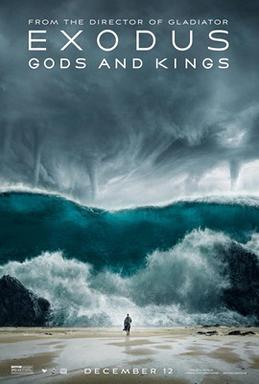
Exodus: Gods and Kings

Like the western, the historical epic has seemingly gone the way of the dodo bird. The genre was at its most popular in the 1950s and 1960s, turning out gigantic epics like The Ten Commandments, Ben-Hur, El Cid, Spartacus, The Greatest Story Ever Told, and that's just some of the biblical epics. About a year ago, I was naturally curious when I read that director Ridley Scott was at the helm of a new epic about Moses and the Hebrews' escape from Egypt. Reviews were mixed to negative, but it managed to make decent money in theaters. So where does 2014's Exodus: Gods and Kings fall? Let's see.

In ancient Egypt, a new pharaoh, Ramses II (Joel Edgerton), has been appointed after his father dies. The fiery new pharaoh has help at his side in the form of his stepbrother, Moses (Christian Bale). Many years before, an orphaned infant Moses was picked up in the Nile River and taken into the home and temple of the then pharaoh, Ramses' father. The Hebrew man grew up somewhat knowing his past, his blood, but he's moved on...until now. Seeing his stepbrother as a potential threat to his throne, Ramses exiles his brother. Moses survives though, starts a family in a far-off, isolated village and moves on. Years pass though and he continues to hear the plight of the Hebrew people working as slaves under Egyptian rule, still the cruel Ramses. There has long been rumors and teachings that someone will save the Hebrews, and that man may just be Moses himself. Can he realize it? Can he go back to Egypt and convince his brother to peacefully let the slaves go?

So basically everyone knows the story of Moses, of the Hebrew slaves in Egypt, the plagues one after another, the parting of the Red Sea and the eventual 40 years of wandering in the desert. I read about it a ton as a kid growing up, at home and in school, and then I saw the 1956 epic The Ten Commandments, still shown on ABC every Easter. That's both a good and bad thing for Scott's epic. It's familiar...but it's familiar. I liked it but didn't love it. There's the necessary spectacle and scale you need in a biblical/historical epic and a solid cast, but there are equal part flaws and misses that handicap the movie's potential.

There seems to be a trend going on in history books, on history documentaries, miniseries, all of the above. I think it's a good trend, one I've enjoyed watching as it develops. It's pretty simple. Look at history with a questioning eye. Did the Exodus story happen just as the Old Testament said it did? No, probably not, and that's where Scott steps in. In the movie's strongest moments, he's able to blend that Old Testament story with a fresh eye, a clean look at the story. In a different sense (and a necessary one), he tries to distance himself from The Ten Commandments, many viewers most familiar connection to the story. What was Moses like? What was Ramses like? What was the world they lived in throughout ancient Egypt? It provides a fascinating jumping off point into a dark, dirty, violent and particularly nasty world that we thought we knew.

Christian Bale is one of my favorites. I thought he was the best thing going by far in American Hustle, his Batman movies are great, and if he's in a cast, I'm pretty likely to at least give the movie a chance. In a cast that features quite a cast but not much in the term of characters, Bale is the one to get out unscathed and represent himself quite well. His Moses is a three-dimensional person, a man struggling with what may be his destiny, his fate, the thing he's supposed to do with his life. Is it going to be easy? Not in the least, and that's what he's grappling with. When it comes right down to it, will he make that difficult decision? Bale isn't great, but he's pretty good in a cool leading role. Edgerton too is one of my favorites, a budding star looking for those great roles that will propel him into stardom, but this isn't it. The script does him no favors, an old school, power-hungry villain who comes across as more cliched than a real person. Too bad because Bale and Edgerton's scenes together are a high point. I just wish there was more of them.

The rest of the cast is given little to nothing to do. The names are impressive but any sense of character development was left by the wayside. Look for John Turturro, Sigourney Weaver, Aaron Paul, Maria Valverde, Andrew Tarbet and Ben Kingsley in smaller parts. Two solid smaller parts go to Ben Mendelsohn as a cruel district commander who couldn't care less about the slaves he rules over and young Isaac Andrews as Malak, a child who is God's human representation on Earth, communicating with Moses about what's to come. A scary, intense performance from a talented young actor. I especially liked Bale and Andrews together in their scenes, especially when Paul's Joshua looks on, not seeing Bale talk to anything at all. What he sees is a man seemingly talking to himself in the middle of the desert. Uh-oh, here we go with some faith-based questions again!

 Now if the focus isn't on character development, it's gotta be somewhere else, right? You would be correct. 'Exodus' embraces the moment in terms of scale and gigantic qualities you'd come to expect from a historical and Biblical epic. The plaques and plights an angry, violent Old Testament God sends down upon Ramses and Egypt are a sight to behold from the locusts, frogs, blood in the water, to the diseases, and most frighteningly, the killing of all the first born sons of Egyptians, these scenes are the movie at its best, strongest and most comfortable. But by far, the most exhilarating scene is the chase across the Red Sea, Moses and thousands of fleeing Hebrews pursued by Ramses and his chariot army as the receding sea charges back at them, the waves growing ever-higher. An incredible sequence, one of those great uses of computer-generated imagery. So in epic terms, this movie is a huge success and well worth seeking out.

I just wish there was more heart somewhere mixed in with the scale and spectacle. It's a pretty decent movie with some great moments. Still worth recommending -- especially to fans of biblical and historical epics -- but it's good. It could have been much more.

Exodus: Gods and Kings (2014): ** 1/2 /****

Thursday, April 9, 2015

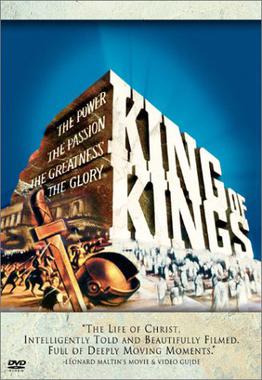
King of Kings

Is there a more daunting task as an actor to play a man millions of people around the world believe to be the Son of God? Sure, any portrayal of a real-life person has to be intimidating, but playing Jesus? That's gotta be on a whole other level. As I learned from the Internet, this movie was the first American film to show an actor's face portraying Jesus Christ. Here it is, a childhood favorite and one I revisited this past Easter weekend, 1961's King of Kings.

This is the story of Jesus (Jeffrey Hunter), a man who grew up in tumultuous times in Judea as Roman occupiers keep the Jewish/Hebrew people oppressed under their thumb. Revolts and rebellions rise up from year to year as Judea seeks its freedom, its independence to get away from the control of the Roman empire. Into this world, Jesus grows up into manhood ready to do his life's calling. Having worked his entire life and living in the Galilean town of Nazareth as a carpenter, Jesus in his late 20's ventures out into the world to embrace his calling as the messiah, the son of God who will teach the world how to live. It is a message that preaches peace but will no doubt send ripples throughout the Roman empire. As Jesus travels around the country with a small group of disciples, his name, his message and his words begin to spread. His followers increase, but so does the danger around him as many want nothing more than to kill him before he becomes too dangerous.

A plot description for a film about the life of Jesus Christ is pretty unnecessary, but I had to lay things out at least a little bit. In the age of the historical film epic, this entry from director Nicholas Ray has always been one of my favorites. I grew up watching it with my Mom every spring, and even years later, it holds up. If anything, I liked it more as a 29-year old viewer as opposed to a 10-year old kid. A whole lot of history is covered in 168 minutes but things never feel rushed. 'King' was filmed on-location in Spain with countless lavish sets and natural backdrops adding an incredibly authentic feel to the proceedings. The TCM print shown on Easter looked PHENOMENAL. Just a stunningly good-looking visual movie. The musical score from composer Miklos Rozsa is pretty perfect too, big and booming mixed in with softer, quieter and just as effective emotional moments. Listen to a sample HERE.

What struck me most in this 1961 epic about Jesus is that...well, it isn't just about Jesus. Ray and writer Philip Yordan use Jesus, his life and his teachings to tell a story about the times this man lived his life. Yes, the focus is on him, but it isn't exclusively focused on him. The casting is very solid with Jeffrey Hunter playing Jesus. Up there with The Searchers as his most famous, respected and recognizable role, Hunter does an excellent job here. It isn't the most human part, but that's not his fault. Hunter is sincere and likable and genuine with a script that keys in on Jesus' teachings more than getting to know the man as a person, as an individual. What works so well is the quieter moments and the impact we see as viewers that this man has on those around him, both the believers and the non-believers. Hunter never became the huge star he could have before his tragic death in 1969, but performances like this show his acting skill.

Four years later, a similarly-themed Jesus epic -- The Greatest Story Ever Told -- would set the bar for ridiculously overdone all-star casts. That ain't the case here. Ray fills out some major roles with recognizable faces and some stars, but this is even't close to being considered an all-star cast. Oh, and that's a good thing. The best supporting part goes to Ron Randell as Lucius, a Roman officer in the garrison at Jerusalem tasked with figuring out if Jesus is a threat to be dealt with. A human, questioning part, and a really good one. Next up, Irish actress Siobhan McKenna as Mary, Jesus' mother, making the character memorable with just a few quick scenes. And then there's the most recognizable face, Robert Ryan getting a meaty part as John the Baptist, a prophet more fiery than Jesus but who preaches the same peaceful message, one predicting the coming of the Son of God.

Who else to look for? If you're familiar with Jesus and the gospels, you know the names. Also in the cast are Pontius Pilate (Hurd Hatfield), Roman governor of Judea, Claudia (Viveca Lindfors), Pilate's more open-minded wife, Herod Antipas (Frank Thring), the Judean governor, his wife, Herodias (Rita Gam), and his stepdaughter, Salome (Brigid Bazlen), disciples Peter (Royal Dano) and Judas (Rip Torn), Barabbas (Harry Guardino), and Mary Magdalene (Carmen Sevilla).

Working consistently throughout the 1950s, director Ray carved a niche for himself as a director of smaller scale human dramas. A biblical epic about Jesus? Not his usual cup of tea. For all the immense scale though, it is the softer, quieter scenes that work. Quick montages of Jesus' miracles set to Rozsa's score are beautiful and effective. The sermon on the mount boasts all sorts of massive scale but is effective because of the dialogue and Hunter's acting. Certain events are glossed over more than others with a bigger focus late on the Passion and Resurrection. Obviously not nearly as graphic as the Passion of the Christ, it remains a moving finale.

King of Kings works because it doesn't try to be gigantically epic. It is content to tell a big story -- maybe history's BIGGEST story -- and to tell it well. Well worth it though, definitely worth checking out. Also listen for Ray Bradbury's uncredited narration, Orson Welles reading said narration, and future familiar face from the spaghetti western genre, Aldo Sambrell, making his screen debut.

King of Kings (1961): ****/****

Tuesday, March 3, 2015

James A. Michener's Texas

Well, it's that time of the year again. Time for Alamo and Texas independence-themed reviews! Today's entry is a 1994 TV movie that aired over two nights. I remember watching it, just in that fun stage as I was really getting into history for the first time. Loved it then, liked it years later when I re-visited it, and here we sit, watching it some 21 years since I first watched it. Now I'm 29 and have everything figured out. Right? Right?!? Here's 1994's Texas.

It's 1821 and Stephen F. Austin (Patrick Duffy) is leading several hundred American settlers into the Mexican province of Texas. The settlers will help tame this wild territory that is as wild as they come, all the while doing so as Mexican citizens. The years pass though and tensions begin to rise between the Mexican government down in Mexico City and the ever-increasing number of Americans flowing into the territory. Among the settlers are a widowed mother, Mattie (Chelsea Field), trying to create a new life, a Scottish farmer, MacNab (Daragh O'Malley), who's son, Otto (Rick Schroder), will play a huge role in Texas' future, and a Mexican landowner and vaquero, Benito Garza (Benjamin Bratt), who sees the trouble coming on the horizon. As the 1820s turn into the 1830s, the tensions heat up to the point where war looks more and more likely. The war for Texas Independence is fast approaching.

From the time I saw Disney's Davy Crockett and then John Wayne's The Alamo, I was immediately intrigued by the story of the Alamo. I still am. I'll read, watch, look into anything about the subject so growing up, this ABC miniseries was right up my alley. In the years, I expanded my horizons some to include the entire Texas Revolution. So where do we start? Nine-year old me wasn't quite so harsh on what he watched. 29-year old me? Eek. I still like it because of the subject matter, but my goodness, this miniseries just isn't very good. Sure, condensing 15 years of story into a 3-hour miniseries is a daunting task....but still. The miniseries is based off an immense, humongous, if you hit someone with it you'd knock them out book from author James Michener. Well worth checking out for a good read and a good workout.

The Texas Revolution packed a ton of action into about seven months, something History's Texas Rising will hopefully bring to life come Memorial Day. What do we get here? A love triangle between politically-minded Austin, independent Mattie and fiery Benito. For real? A love triangle? Gag me. That's the crux of the first half of the running time with a surprising payoff in the second half. Come on though, Texas history and we get two guys fighting over the same woman? The budget is somewhat limited, borrowing footage liberally from previous Alamo/Texas movies like 1955's The Last Command and another TV movie, Gone for Texas. I guess it shouldn't come as a surprise that a movie made 39 years before doesn't exactly fit in with a 1994 TV movie. The attempt and effort is impressive overall, but ultimately it falls short.

Going for that big miniseries feel, we get some familiar faces in the cast but no HUGE stars. Schroder, Bratt and Duffy are the most memorable characters, bringing them to life where others remain mostly cliches or cardboard cutouts of real individuals. The relationship between Schroeder's young Otto and Bratt's Benito is a high-point, a brotherly relationship developing between the American teenager and the Mexican cowboy. That relationship takes some surprising twists as the war approaches, the two men deciding what's most important to them. Duffy too is strong as Austin, the father of Texas who's left out of the history books far too often. Field's character is interesting but is handed no favors by the screenplay that has love tearing at her from both sides. Oh, the horror!

As far as instantly recognizable Texas personalities go, we also get to meet Stacy Keach as Sam Houston, sneering and growling throughout, and our Alamo trio of Jim Bowie (an excellent if somewhat over the top David Keith), William Travis (Grant Show), and Davy Crockett (John Schneider in a small part). I also liked country singer Randy Travis as Captain Sam Garner, a Texas Ranger commander, and Frederick Coffin as Zeve Campbell, a fellow settler and friend of MacNab's. Anthony Michael Hall feels out of place and forced as the cowardly, big-talking Yancey Quimper. There's also a small part for Maria Conchita Alonso. Oh, and someone named Charlton Heston -- whoever that is -- provides the narration.

While I was still entertained overall, that entertainment came as more of a guilty pleasure this time around. The music is okay, but overdone at times, and the acting ranges from good to acceptable to hysterically overdone. Without a doubt the second half is the stronger half as Texas is plunged into the revolution, but even that's limited. The entire Alamo battle sequence is lifted from Last Command, and the Battle of San Jacinto is about 15 minutes straight of slow motion, blood-squibbed garbage. Probably best suited for history, Texas and Alamo buffs.

Texas (1994): ** 1/2 /**** 

Wednesday, February 11, 2015

The Mask of Zorro

My first introduction the character of Zorro goes back to a Disney Sing-A-Long VHS tape (Yes, VHS, and it was awesome), the theme imprinting itself on my young brain. Listen HERE, and you're welcome. The Zorro character has gone onto bigger and better things, including a late 90s swashbuckling adventure that I missed out as a 13-year old. Here's 1998's The Mask of Zorro.

It's the early 1820s in California -- then still a Spanish territory -- and the people are constantly kept down by the Spanish governor, Don Rafael Montero (Stuart Wilson). Providing a thorn in his side is Don Diego de la Vega (Anthony Hopkins), a rich landowner who has an alter-ego known as Zorro, a masked bandit and expert swordsman who protects the people and baffles the Spanish governor. Montero finally catches up with Zorro though before being sent back to Spain amidst a revolution, dumping the landowner turned bandit in a dumpy prison while also wreaking havoc on Vega's family. Some 20 years later, Vega is wasting away but he manages to pull off a daring escape. What prompts it? He finds out Montero has returned to California with plans to take over the territory. Vega needs help to exact revenge though and finds it in the form of a vengeful Mexican bandit, Alejandro (Antonio Banderas), who must undergo quite the transformation -- with Vega's help -- to exact his revenge and possibly save California in the process from a whole lot of trouble.

The Zorro character's inception dates back to author Johnston McCulley in the late 1910s, the character appearing in some pulp fiction with his popularity quickly spreading. Zorro has appeared in books since then as well as comic books, TV shows and movies on an international level, not just in the United States. As I mentioned, I missed this 1998 adventure when it first came out -- being a punky teenager and all -- but here I sit to catch up with it. 'Mask' was a big success, earning positive reviews and making $250 million in theaters. The reasoning?

From director Martin Campbell, 'Mask' feels like a throwback to swashbuckling movies of Hollywood's Golden Age dating back to the 1930s and 1940s. What did it remind me of most? Maybe the best adventure flick of all time, 1939's The Adventures of Robin Hood. No, this isn't even remotely classic, but my goodness, what a fun movie. The production was somewhat troubled with some casting drama and Robert Rodriguez dropping out (with Campbell replacing him), but it doesn't affect things in the least. The formula is simple. The good guys are honorable, loyal and heroic. The bad guys are evil, despicable, greedy, backstabbing and will no doubt get their comeuppance. The story is a tad long at 136 minutes, but there's not much downtime with a series of swordfights and action scenes sprinkled throughout. In an age where action movies often have a message, it's fun to see a movie that's just....fun.

Who better to play the suave, smooth swordsman than suave, smooth Antonio Banderas? I submit that NO ONE would have been better. Just like in Desperado, probably his most well-known roles along with Puss-In-Boots, Banderas just commits to the part. He's manic energy on the screen, and it works so effortlessly and well. You like Banderas' Alejandro turned Zorro, you're rooting for him, and Banderas looks to be having a ton of fun every minute he's on-screen. It's the Spanish actor at his best. It doesn't hurt either that his supporting cast is excellent, especially his chemistry with Hopkins (a somewhat unlikely Spaniard) and Catherine Zeta-Jones as Elena, the governor's daughter -- with a secret -- who takes a liking to Alejandro, all the while not knowing who he is or what he's up to. The mentor-student relationship between Hopkins and Banderas is excellent, and the chemistry between Zeta-Jones is palpable, whether it be their salsa dance scene or their later swordfight.

So Banderas, Hopkins and Zeta-Jones, that's enough, right? Those are the best parts, but there's more. Wilson is okay as the bigger villain, that dastardly greedy returning governor, but the best villain is Matt Letscher as Captain Harrison Love, apparently a U.S. Army officer working with the Mexicans? It's never really explained, but who cares I guess, he's easy to hate. Also look for Stuart Wilson and Pedro Armendariz Jr. as two Dons, landowners who team up with Montero in his plot to take over California. Smaller parts go to Victor Rivers as Alejandro's brother, a famous bandit, while western character actor L.Q. Jones delivers a small but memorable part as Three-Fingered Jack, an infamous bandit.

As I read some about the making of the movie, it was cool to find out at least part of the story and characters are based in reality of 1850s California history. Now there are some major freedoms taken with that story, but it's always interesting. With a score from composer James Horner and filming on-location in Mexico, the look, sound and feel of the movie is pretty spot-on. The set pieces from a fun training montage to the action-heavy finale at a gold mine carved into the side of a mountain are all pretty memorable. It's that pretty perfect popcorn movie. Sit back and enjoy.

The Mask of Zorro (1998): ***/****

Tuesday, December 23, 2014

The Adventures of Robin Hood

Errol Flynn was a lot of things in a legendary career early in Hollywood's history. He was a swashbuckler, a boxer, a gunfighter, a rabble-rouser in his personal life, someone who lived life to the fullest. But what is that one role, that one part that is instantly recognized as his best? Well, that one's easy, 1938's The Adventures of Robin Hood.

It's 1191 A.D. and the English king, Richard the Lionheart, has been captured by the enemy while returning from the Crusades. In steps his greedy, manipulative brother, Prince John (Claude Rains), who takes over the crown and instantly starts to take advantage of his power. In a growing battle between the Normans and the Saxons, the put-upon people need help, someone to fight back. That man? A Saxon nobleman, Robin Hood (Flynn), who takes to Sherwood Forest with a gang of bandits to be a constant thorn in the side of Prince John and his enforcer, Sir Guy of Gisbourne (Basil Rathbone). They're not any bandits though. They aren't in for personal gain. Robin and his men become heroes as they give their spoils to the people from the money to the food they take. What's their end goal though? Can they somehow take down Prince John?

So everyone has heard of Robin Hood right? His historical reality has long been debated because...well, people just aren't sure he existed. So real or not, the character has become an instantly recognizable individual in literature and storytelling. From directors Michael Curtiz and William Keighley, 'Adventures' was a profoundly important film in Hollywood history. It's the big, splashy, colorful adventure film that helped set the stage for action and adventure films for years to come. The action-packed story with romance and intrigue and all sorts of craziness picked up four Oscar nominations, winning three, and is a perennial entry on all sorts of 'Best' lists, including several AFI lists. Can't go wrong, right?

Start with Errol Flynn. He's one of my favorite movie stars ever, the type of star/actor I'll check out a movie solely because he's in it. There aren't a lot of those stars around then or now. But in a career of memorable parts, this is THE part. He was meant to play Robin Hood. Flynn brings the perfect energy to this folklore character. That infectious smile, that loving-life laugh, that physicality as he swings across the scene (quite literally), fights his way through one sword fight after another, and unleashes arrow after arrow at his pursuers. You can't help but like the character, Flynn bringing him to life and influencing every other Robin Hood portrayal to follow for years whether it be on film, on television and even literature. That Errol Flynn guy. He knew what he was doing.

'Adventures' boasts a solid all-around cast in support of Flynn. The villains are perfectly dastardly, doing all sorts of malicious evil. Rains is the smooth, suave Prince John (slightly effeminate) while Rathbone gets to play the far more sinister Sir Guy, progressively becoming more obsessed with capturing and hanging Robin. Frequent Flynn co-star Olivia De Havilland (they would work together in 8 films) is memorable as Maid Marian, promised to Sir Guy while falling for Robin when she's taken prisoner. Their chemistry is evident throughout just like it was in all their pairings together. As for Robin's Merry men, look for Patrick Knowles as Will Scarlett, Eugene Pallette as Friar Tuck, Alan Hale as Little John, and Herbert Mundin as Much, a mousey squirrel. There's also Melville Cooper as the semi-bumbling but amusing Sheriff of Nottingham and Ian Hunter as King Richard.

Here's my spot here. I appreciate what this movie meant in terms of Hollywood and historical significance, but I didn't love the movie. I liked it a lot, but a slower last 45 minutes left me disappointed. Still....it's a really good movie. It's that perfect popcorn escapism, great good guys and black and white bad guys. The color scheme is a gem, one of the first Hollywood films to really embrace shooting in color. Robin and his Merry men in their Lincoln green uniforms, Prince John and Sir Guy in their bright red, the colors are rich and vivid throughout. As well, the Oscar-winning score from composer Erich Wolfgang Korngold is a gem, several instantly recognizable themes keeping the action flowing throughout (listen HERE). The action is fun and full of some great stunts, several large-scale battles and scuffles dotting the story. An easy movie to recommend.

The Adventures of Robin Hood (1938): ***/****

Wednesday, December 10, 2014

Giant

So there's the United States, but if you ask some people from Texas, there's a different way of looking at it. There's 49 states that make up the U.S., and then there's TEXAS!!! A giant state with some giant personality, it needs a movie just as big as the idea of the state to really get the message across. Here's an epic that certainly tries, 1956's Giant.

It's the early 1910s and young, powerful Texas rancher Jordan 'Bick' Benedict (Rock Hudson) travels to a farm in Maryland to buy a strong, beautiful young horse. There, he finds what he's looking for and much, much more. Instantly struck, Bick marries the seller's daughter, Leslie (Elizabeth Taylor), who's as equally moved by the big, strong Texan. Leslie travels back to Texas with Bick where she's stunned by the immensity of the Benedict ranch, hundreds of thousands of acres with cattle numbering in the thousands. The life is hard but worthwhile...for those accustomed to it. Leslie is used to a certain openness about living and prejudices and beliefs, none of which she finds in Texas. The marriage is just weeks old, but Bick and Leslie begin to butt heads almost immediately. The young couple with everything at their disposal, right at their fingertips, is heading into a turbulent time, both for themselves but also for Texas.

Some movies just scream EPIC, and in the age of the monster budget, historical epics, this 1956 Texas family drama from director George Stevens certainly qualifies. Based off a novel from author Edna Ferber, this is a big old movie. At the time, it was the most expensive film ever made. The scope and scale is gigantic. Stevens took advantage of the widescreen filming techniques, filling the screen with the wide expanses of the Texas plains in all its sunny and sandy glory. Visually, 'Giant' is a stunner. Dimitri Tiomkin's score is solid but more subdued than most of his more well-known scores and with an obvious reliance on some patriotic Texas songs. A must in an epic -- seemingly -- is to get a message across though, to say something. That's where 'Giant' seems to stumble in a big way. I don't know if it's trying to say much of anything. That's for a little later. For now, here's some positives to take away.

So big story, big setting....yeah, we need a big cast. Two rising stars who were definitely on the way to bigger and better things in Rock Hudson and Elizabeth Taylor. I was interested in these characters which is a credit to Hudson and Taylor because let's be honest. These aren't especially likable characters. They bicker, fight and argue about anything and everything. Love at first sight....until real life settles in. So they're not especially likable, but they do a fine job bringing these characters to life. It feels like real life, two madly in love individuals figuring out marriage and love isn't so easy. Neither is a truly great performance, but they're very solid performances just the same. 

Unfortunately, 'Giant' was remembered both then and now for the sudden, tragic death of one of its cast members. That actor? The iconic James Dean, star of just three movies before his sudden passing in 1955 before the film was completely finished, just 24 years old when he died. Here, he plays Jett Rink, a lower class cowboy working on the Benedict Ranch, a thorn in Bick's side but liked by everyone else. Jett was my favorite character, a remotely sympathetic anti-hero just trying to make his way, to carve out a niche for himself. A late monologue had to be re-recorded because the dubbing hadn't been completed before his surprising death during post-production. It's a quiet, understated part with some great moments (early on at least), especially when Jett's land proves to be far more valuable than originally thought. An obvious influence on many actors who would rise to stardom in the coming years, Dean is a gem.

Okay, enough with the relative positives. I love epics, especially those from the 1950s and early 1960s. This one pushed even me to the limits to the point I struggled to get through the last hour-plus in a movie that already runs 201 minutes. The first 90-120 minutes are pretty good if nothing classic in my mind. Then from there on in, the story jumps to when Bick and Leslie are far older, their empire grown, their family established and all grown up. At this point, all the issues introduced early are basically brushed aside. The story -- not exactly fast-moving up to this point -- grinds to a complete halt. Characters are introduced and dispatched with little fanfare. It drifts aimlessly until an ending that to put it lightly is disappointing. Was there an ending in mind that actually accomplished something? 'Giant' limps to the finish line after a painfully slow 3-hour road trip.

That's the biggest issue. What -- if anything -- is it trying to say? It's obviously a story focused on family and Texas and all their drama. Let's say this though. There is A LOT of drama. It's everything from marital strife to racism, sexism to political corruption, old school versus new school, parenting methods to manipulation of all sorts and on countless different levels, cattle ranching to becoming an oil baron. Pick one, or even two or three, and run with it. Instead, Giant just barrels ahead with all of the above and lets things fall where they may.

Now back to the casting. The characters may not always be very good, but the star power is impressive. Mercedes McCambridge does what she does best as Luz, Bick's sister who's a tomboy, a bit of a spinster, and if this movie was in 2014...a tough as nails lesbian. Chill Wills is solid in a more subdued part as Bick's very Texas uncle. As for the younger generation that pops up in the last third of the movie, look for Carroll Baker, Sal Mineo, Earl Holliman, and Dennis Hopper. Oh, and for good measure, Paul Fix and Rod Taylor have underused supporting parts so there's that. A big disappointment for me though, one I really, REALLY wanted to love. I came away barely tolerating it. A major disappointment.

Giant (1956): **/**** 

Monday, October 20, 2014

Rough Riders

Okay, history nerd alert. Who's your favorite United States president? Mine's easy to peg; Theodore Roosevelt, a President who did a little bit of everything. Beyond his two-term presidency though, what is he most known for? His involvement in the Spanish American War, told quite well in a 1997 TV miniseries, Rough Riders.

It's 1898 and the American government is in a bit of a spot. News of Spanish atrocities and cruel leadership in Cuba are making international news to the point American intervention seems like a sure thing. Who's at the forefront of that movement? Assistant secretary of the Navy Theodore "Teddy" Roosevelt (Tom Berenger). He's been given approval to assemble a volunteer regiment of cavalry that will be sent to Cuba with American forces to stop the Spanish. Who is he looking to volunteer? Cowboys, mountain men, trailsmen, and anyone who can handle themselves when the bullets start to fly. He gets that and more as the volunteers assemble in Texas for training. What awaits the regiment of rough-hewn volunteers? Only the fighting in Cuba will tell.

Over the last month or so, this becomes the third TNT TV movie I've reviewed with 2001's Crossfire Trail and 1997's Buffalo Soldiers. I wish TNT still made historically-based movies like this! This 1997 miniseries is probably the network's biggest venture, a movie with impressive scale, a deep cast and a 187-minute running time. It comes from director John Milius (who also wrote the script with Hugh Wilson), a good, underrated tough guy director to helm a good tough guy flick like this. 'Riders' doesn't rewrite the historical epic/action genre, just content to tell a historical story that is known if not widely known. Elmer Bernstein turns in a fine throwback(ish) musical score, the cast looks to be having a lot of fun, and seeing a story that sticks pretty close to the historical truth? How can you lose?

The historical truth is pretty daunting for a filmmaker to take on. 'Riders' does a good job portraying not just Roosevelt and his famous cavalry volunteers, but many involved in the war from a variety of perspectives. We see the government, including President William McKinley (Brian Keith, a Milius favorite) and his secretary of state (R. Lee Ermey). We see the journalists/writers from William Randolph Hearst (George Hamilton) to Stephen Crane (Adam Storke), Frederick Remington (Nick Chinlund) to Edward Marshall (Williamt Katt). From the military perspective, we see Gary Busey and Dale Dye (a Marine Corps veteran) in power positions trying to lead the Cuban expedition. 'Riders' more than justice to the times, tackling a lot but doing a good job across the board in setting the stage for our historical story. It could have been easy for it to all slip away, but Milius helms it all nicely.

This is an ensemble cast -- a pretty strong one at that -- but I thought Tom Berenger stood out from the rest as future President Teddy Roosevelt. You read about Roosevelt, and it sounds like a caricature but no. This was one fiery, lively, opinionated, fun-loving man with some wide-ranging interests. Berenger brings him to life from his unique speech patterns to his very physical movements and non-stop energy. He makes Roosevelt more though, a human being, not just a caricature. We see Teddy with his wife (Illeana Douglas) who he misses to an extreme level, how he bonds with his men around a campfire during training, how he's emotionally distraught at seeing his men killed in battle, the exhaustion that sets in after a costly battle. Big and boisterous but never overdone, Berenger does an excellent, scene-stealing job as Roosevelt. I also learned something from the film, finding out Roosevelt wasn't always the commander of the Rough Riders. He became the commander but no spoilers.

Okay, a movie about the Rough Riders so let's talk about Teddy Roosevelt's Rough Riders. Milius uses a familiar, well-worn and effective formula here; the unit picture. Assemble a group of men from different backgrounds, put them together, let them train and bond and then throw them into battle. There's a lot of characters so there's not always a ton of development but who stands out from the rest? Brad Johnson plays Nash, an outlaw (with partner Buck Taylor) who joins the outfit to escape a posse. Sam Elliott brings his tough guy swagger to play Capt. Bucky O'Neill, an Arizona lawman turned drill sergeant. And also, Chris Noth plays Craig Wadsworth, an upper class New Yorker looking to prove himself in battle. It's a very solid cast, and that's just the start. The rest of the group isn't necessarily big names, but there's familiar faces playing some cool characters.

Who else to look for? Joining Noth as the upper-class NYC gentlemen are Holt McCallany, Mark Moses, Titus Welliver and James Parks. As for the less-gentlemanly among the Rough Riders, watch for Geoffrey Lewis, Francesco Quinn, Eric Allan Kramer, Bob Primeaux, and in an excellent supporting part, Marshall R. Teague as a young Black Jack Pershing, commander of a regiment of Buffalo Soldiers fighting alongside the Rough Riders.     

Nothing too fancy here, just a good, entertaining movie with a throwback kind of feel. The first 90 minutes sets up the background, assembling the regiment and introducing the characters, and then throwing them into training. By the end of the first half, we're thrust into the fighting in Cuba. The centerpiece of the second half of 'Riders' is not surprisingly the attack on San Juan Hill, the battle that made the Rough Riders an instantly recognizable name and regiment. There are some slow moments building up to the battle, but the actual assault on the heavily fortified hill is a gem of an extended sequence. An excellent flick on all accounts. History buffs will especially enjoy it so it gets an easy recommendation from this guy.

Rough Riders (1997): ***/****

Monday, October 6, 2014

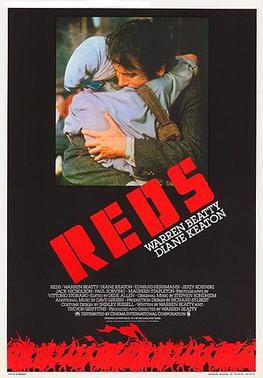
Reds

The amount of information, facts and tidbits I don't know about Russian history could full volumes. I love history -- ALL of it -- but something about the immensity of Russia and its history has proved rather intimidating to me. Where to even start? Well, movies seem to agree with me. I liked but didn't love 1965's Doctor Zhivago, but there's another Russian epic that's long been recommend to me. Let's get going with 1981's Reds.

Living in Portland, Oregon in 1915, Louise Bryant (Diane Keaton) has a relatively safe if dull life. She's married, does art and is a hopeful writer. Then, she meets John Reed (Warren Beatty), a highly respected if somewhat controversial writer with an impressive following. She is immediately drawn to him and ends up following him to New York City to be with him while also hopefully pursuing a career as a writer and a journalist. There's a relative catch though. John is a staunch supporter of the socialist movement, a movement that threatens to tear World War I apart as workers around the world, especially in Russia, begin to push for more rights, more privileges. In the midst of World War I (and with the Russian Revolution looming), Louise has entered into one of history's most tumultuous times. She loves John and he loves her, but the world seems on the brink of blowing itself up. What will happen next?

For years, my Mom has recommended this movie to me. It's one of her all-time favorites, and she knows far more about the time and backstory than I do. For some background reading, read about the Russian Revolution HERE at Wikipedia. It's not even fair to say this is a Russian Revolution movie. This is a story about two people's lives amidst that turbulent time in world history with a heavy socialist focus. For more reading, read about John Reed and Louise Bryant, two incredibly interesting individuals. It is a big, epic movie, clocking in at equally intimidating 194 minutes, and took Beatty (who starred, directed, produced and wrote) and his cast and crew a full year to film. That's before you consider a lengthy editing process. Beatty is no dummy, taking on films that mean something to him, and this is the definition of that. This is a message movie, an intellectual, thought-out, impressive film. Is it good though?

I will say it is more interesting than it is good, if that makes sense. 'Reds' picked up 12 Oscar nominations, ultimately winning three, including Beatty as Best Director. For a movie that clocks in at almost three and a half hours, it did well at the box office and resonated with critics and has developed quite a following among fans. It was filmed in New York City, Finland, England, Sweden and Spain. So....yeah, what else? 'Reds' is an epic. The scale and immensity is impressive. This is an epic about an idea though, the idea of socialism. This is 194 minutes of almost entirely talking. This is talking about a principle, about government, about corruption, about history, about the system. 'Reds' isn't Lawrence of Arabia or The Godfather or Gone With the Wind. It is its own epic, and with Beatty backing it all the way, it is quite okay with being its own film. I struggled at times because it is such a smart, well-written movie. Is that enough to hamstring a film? I don't know, but definitely know what you're getting into here.

Picking up two of the film's four Oscar acting nominations, Beatty and Keaton carry the film. Either one or the other is in almost every scene, and apparently the filming was so strenuous on their off-screen relationship they ultimately broke up. I didn't necessarily buy their doomed love, their unexplained chemistry. What did I buy? Their performances themselves are excellent. These are two extremely intelligent individuals, drawn to each other but who's personalities butt heads because they're both so strong-willed. Based on historical figures, both characters are 3-D, blood and guts people, not cardboard cutouts. Kudos to both actors who again make their characters interesting/fascinating if not necessarily likable.

Up until 2012's Silver Linings Playbook, 'Reds' was the last film to receive Oscar nominations for all four acting categories. The culprits? Jack Nicholson as playwright/writer Eugene O'Neill and Maureen Stapleton as famed anarchist Emma Goldman. These aren't huge supporting parts, but what's there is choice, two actors making the most of their relatively small screentime. Also look for Edward Herrmann, Jerzy Kosinski, M. Emmet Walsh, Paul Sorvino, William Daniels, Gene Hackman, and R.G. Armstrong in supporting parts. Some of them are pretty quick, none of them truly developed, and a couple are nothing more than a single scene. Of the smaller parts, Kosinski is memorable as a socialist leader working with Reed and Hackman as a booze-loving, honest newspaper editor.

One of the best choices Beatty makes as a director was a wise style choice. Along with the actual story, interviews with those who knew Reed and Bryant during the 1910s and 1920s are interspersed throughout the movie. These people -- now in their 70s and 80s -- reminiscing about John and Louise, about the times, about how things have changed, these are the moments that proved most memorable for me. Check out the list of witnesses HERE. So as I mentioned before, this is an excellent movie. One you appreciate and admire and respect. I felt like I learned some things as the story develops, but did I love the movie like I hoped I would? Nope. Still very much worth checking out, but not quite the movie I was expecting.

Reds (1981): ** 1/2 /****

Monday, August 18, 2014

The Buccaneer

Ever heard the name Jean Lafitte? If you're a history buff, you should have. A French pirate and privateer, Lafitte operated out of New Orleans and the surrounding bayous through the early 1830s. His name though remains in American history for a big reason, Lafitte helping then-General and future President Andrew Jackson to victory at the Battle of New Orleans in 1815. It's a story told in a generally forgotten film from 1958, The Buccaneer.

War has broken out between the young United States of America and Great Britain, the power up for grabs after British forces capture Washington D.C., the American government barely escaping. Down in Louisiana, New Orleans is bracing for an attack, a small American army commanded by General Andy Jackson (Charlton Heston) ready to hold off a far superior British army. New Orleans will be the key as whoever holds the river will control the Mississippi River. The key to it all? A powerful, rich pirate named Jean Lafitte (Yul Brynner) who helps control the mouth of the Mississippi with his fortified pirate colony. Whichever side he sides with will have all the power and both the British and Americans are desperately trying to convince him. They're both very convincing, but what will Lafitte decide in the end?

Of all the wars America has fought in since the American Revolution in the 1770s and 1780s, the War of 1812 has to be one of those most easily forgotten. I can't even think of another film about the war. 'Buccaneer' is also noteworthy for its director, an actor making his only appearance behind the camera. Who you ask? That would be Anthony Quinn, Zorba himself taking a shot at directing. It is rumored that famed director Cecil B. DeMille did direct some of the movie while also appearing on-screen early for the prologue that sets up the history of what we're about to see in the film. What it tries to accomplish is admirable, bringing a part of American history to light that hasn't gotten the amount of attention that other wars, conflicts and incidents have. What it accomplishes in the end? That's more up in the air.

The biggest positive is Yul Brynner as infamous French pirate Jean Lafitte. As portrayed here, he's probably a little idealistic (but that's more the tone of the movie) as to the historical figure, but Brynner does a solid job. This is a man caught in the middle and trying to figure out what's his best play, whether it be with the British or the Americans. He thinks selfishly, knowing whichever way he chooses will affect his vast fleet of pirates but also thousands of other people. Dressed up as a bit of a dandy -- in one of the few roles I can think of where Brynner sports hair, even if it is a wig -- Brynner commits to the part. He has some fun with it, the best thing going in a story that tries to accomplish a lot in terms of scale and characters and history. His struggles are interesting throughout, a bit of a doomed character, and his scenes in the second half of the movie with Heston's Jackson provide the movie's strongest points.

The rest of 'Buccaneer' is more of a mixed bag. One of my biggest questions involves the sets. The entire movie is filmed on indoor sets, giving the story an odd, even cheap look. In some scenes, like the battle of New Orleans, it adds a cool claustrophobic effect to the proceedings, but for the most part it limits the potential. It's going for an epic scale, full of a long list of characters and big history, but never quite gets there. In other words, the DeMille touch...sorta. Everything is polished and colorful and too clean for an 1810s world. A pirate world at that! It's more than that though, a story that bounces around too much and simply takes too long to get where it needs to be. The last 45 minutes are 'Buccaneer' at its strongest, but the first hour and the last 15 minutes drag a bit too much. Elmer Bernstein's score is okay but not up there with his best.

So DeMille loved his epics, right? Nowhere else is that more evident in the casting. Check out the full cast and crew listing HERE. There's 200-plus names, a whole lot credited, a whole lot more uncredited. Just too much going on all over the place. There's Claire Bloom as the fiery daughter of a rival pirate captain, Charles Boyer as Lafitte's very French second-in-command, Inger Stevens as the beautiful daughter of the Louisiana governor (E.G. Marshall), Heston as Andrew Jackson, Henry Hull as his backwoods, buckskin wearing assistant, Lorne Greene as a rich resident of New Orleans, and George Matthews as Lafitte's loyal henchman of sorts. That's only part of the cast. There's too many familiar faces and recognizable names to mention. Among Lafitte's pirates we see Woody Strode to John Dierkes and many more. If you ask me, it speaks to a movie that was edited some heavily in post-production. 

If you stick around, the second half is significantly better than the first half. The battle of New Orleans isn't a long, drawn-out battle but what's there is enjoyable. Parts of the movie are really good but as a whole it wastes much of its potential. Too bad.

The Buccaneer (1958): **/****