The Sons of Katie Elder

The Sons of Katie Elder
"First, we reunite, then find Ma and Pa's killer...then read some reviews."
Showing posts with label Cliff Robertson. Show all posts

Monday, August 10, 2015

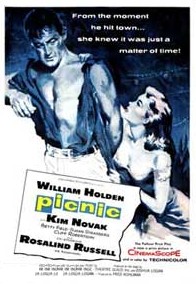
Picnic

I tend to think of the 1950's as a pleasant mix of Leave it to Beaver and Happy Days. Naturally, that's not what the entire decade in the U.S. was like, but isn't it fun to think of it that way? They were more innocent times before the hair on fire 1960's rolled around, huh? Some of those 1950's movies though, you could see an indication of what was to come. One sexually charged or sexually repressed movie after another hit theaters, many of them based off scandalous novels or stage plays. One I've always been curious to watch and was finally able to track down? That's 1955's Picnic.

A freight train rolls into a quiet Kansas town on a hot summer day, and a man named Hal Carter (William Holden) jumps off. A drifter without a home or too much money in his pocket, Hal hopes to reunite with a friend from college and maybe get a job out of it...if possible. It doesn't take too long for Hal to find the friend, Alan Benson (Cliff Robertson), the well-to-do son of one of the richest men in town. Even after years apart and with both men having gone down such different paths, the two fraternity buddies pick things up like they were never apart. It's Labor Day, and Hal's timing is pretty good as the whole town is heading off to an immense picnic, a farewell of sorts to the summer. Hal is a little wary of the gathering as the outsider in town but ends up going. Problem? You bet, especially when Hal sets his sights on Madge (Kim Novak), Alan's beautiful girlfriend who comes from a poor(ish) family. Let the drama begin.

In the button-down, gentlemanly, poodle-skirt era of the 1950's, people simply did not have sex. It was simply...FORBIDDEN. Or so the movies would have you think. This was a huge time of change in Hollywood as studios got away from all sorts of production codes that limited what could and couldn't be shown. So as a result, audiences got a lot of sexually charged, forbidden love movies, often set in little towns where sexual frustrations apparently ran rampant. We got movies like this, Peyton Place, God's Little Acre, A Streetcar Named Desire, Baby Doll and plenty more I'm probably forgetting. All that repression and frustration always explodes in dramatic fashion! Ah, emotions and feelings! Yeah, at times, things can go a little overboard. That's Picnic. Some good moments, some good performances, with some really heavy, overdone moments.

'Picnic' is based off a Pulitzer Prize winning play that took Broadway by storm in 1953. Director Joshua Logan helmed both the play and the feature film, picking up an Oscar nomination in the process. In its filming techniques, 'Picnic' never feels like a stage-based play turned feature film. You can't say that for a lot of like-minded films. Logan filmed on-location in Hutchinson, Kansas and explores the town. You get a feel for the town, its people and its energy. The movie itself clocks in at 115 minutes and can clearly be divided in two parts. That first hour sets the stage, introducing all this hidden drama, rivalries, personal problems and lets the tension build into the high-drama of the second half as all those issues come to center stage. As for me? I loved the first hour and tolerated the second. More on that to come.

The cast doesn't feature a ton of big names, but that's not a bad thing. Holden took some heat because at 37 he was probably a little too old for the Hal part, but probably doesn't mean much. He brings the right energy to the part, hiding some personal demons while presenting an outgoing, fun-loving, likable persona. Really? He's a man in his mid-20s trying to find his lot in life, and so far, he's come up empty wherever he's turned. This isn't always a likable character, but Holden's Hal is a sympathetic one. His chemistry with Novak's Madge is perceptible in the air, just two people drawn to each other and they can't explain it. Novak would develop into a solid actress over the years, but here, her performance is a little rough. As a presence, she's unquestioned, stunningly beautiful, her Madge sick of everyone judging her by looks and looks alone.

Who else to look for? 'Picnic' was actually Cliff Robertson's first credited feature film, his Alan being an interesting mix, a spoiled kid who doesn't want to be the spoiled kid. We do get to see a mean streak in him though so stay tuned. Betty Field plays Flo, Madge's single mother, badgering and worrying and overbearing, while Susan Strasberg is Millie, Madge's tomboy little sister, smart, a reader and sick of Madge.  Rosalind Russell hams it up as Rosemary, a 40-something schoolteacher in town, with a suitor/boyfriend of sorts in shop owner, Howard (Arthur O'Connell in an Oscar-nominated turn). Also look for Verna Felton as Helen Potts, the adorable next door neighbor, a bit of a conscience for the film/town, and Nick Adams as a horny teenager.

When Picnic is good, it's really good. But when it goes? Man, it goes. Everything comes to crazy fruition at the tail end of the picnic, and all hell breaks loose. The key, momentum-changing shift is started when a shirt gets torn, and literally everyone FREAKS THE EF OUT. A movie based on a stage play becomes very stagey and overdone and hammy. EMOTIONS and FEELINGS are everywhere. It's not that the drama isn't effective. It's that it lacks all subtlety at all. It becomes painful to watch at times. The ending itself is built up as a happy ending (of sorts), but man, when you think about it, this is NO happy ending at all. Still...it's a very cool final shot, so that counts for something right?

An interesting mix in the end. I really liked parts of it, especially Holden's performance, but the whole thing gets to be a little much in the end. The positives serve as a time capsule of sports. The entire story takes place in a 24-hour time period, and my goodness, it was quite the sunny, beautiful Labor Day. This is a beautiful movie to sit back and watch and appreciate it. We get a picture of 1950's life, especially in the extended picnic sequence as the whole town comes together to celebrate. Before all hell breaks loose in the emotions department in the second half, you get a sense of a more innocent time, and then Holden's shirt gets ripped and all bets are off. Still, there's enough to recommend but be forewarned that things turn into a sappy, tawdry soap opera in the second half.

Picnic (1955): ** 1/2 /****

Wednesday, January 29, 2014

PT 109

John F. Kennedy  is known for any number of things from a tragically shortened life. His beautiful wife, Jackie, his supposed affairs with Marilyn Monroe among others, his charm and popularity, his turbulent presidency that included the Cuban Missile Crisis, and most tragically, his assassination under the rifle of Lee Harvey Oswald. One of the most fascinating parts of his adventure-filled life? His World War II exploits as told in 1963's PT 109.

While the fighting rages in the Solomon Islands in the Pacific in 1943, Lt. John F. Kennedy (Cliff Robertson) arrives at a small naval base specializing in patrol torpedo boats (PT) meant to keep Japanese forces at bay. Kennedy is given command of PT 109, a beat-up old boat that has seen far better days. He's given just a week to get the 109 ready for action, assembling a crew, including Ensign Leonard Thom (Ty Hardin), cleaning the boat, and rehabbing the engines. They manage to come in under deadline, Kennedy, his crew and the 109 thrust immediately into action. The day-to-day life of a PT boat is a dangerous one though, the boats meant to be used to buy time while the U.S. Navy still tries to recover from Pearl Harbor. Patrols, routine or not, rescues, deliveries, Kennedy and his crew take it all on, but the mission that will put them all in the history books awaits one pitch-black night in the Blackett Strait in the Solomon Islands.

One of my favorite movies growing up, I can still go back and visit this 1963 WWII movie from director Leslie H. Martinson and enjoy it from beginning to end. This isn't the most hard-hitting of movies, but like some other WWII movies from Warner Bros., there is a distinct visual look, a professionalism and a straightforward style that plays well. Could things be tightened up a bit with a 140-minute movie? Sure, here and there, but it's an excellent story and film just the same. It was filmed in the Florida Keys, and it's sunny and sandy with plenty of palm trees to help stand in for the Solomon Islands in the Pacific. The musical score from composers David Buttolph and William Lava knows when to lighten the mood and when to show the developing drama, a score that sounds similar to another Warner Bros. WWII movie, 1962's Merrill's Marauders.

Released in theaters less than six months before his death in Dallas, PT 109 was made with the help of Kennedy right in the midst of his term as President. He even had final say on the actor who would play him, Robertson being his ultimate choice. It ends up being a great pick, one that makes the movie far more memorable in my eyes. Besides the striking physical resemblance -- look at Robertson in an iconic JFK picture HERE -- Robertson nails the heroic, likable, charming part of a future American president. That's the movie's goal, to show Kennedy as a hero. More on the details in the next paragraph, but Kennedy's actions were more than enough so Martinson didn't have to stretch things too much. Robertson's Kennedy is smart, quick with a comeback and a plan, a leader who's respected by his men and fellow officers, and a capable commander with a knack for doing the right thing. It's not the most in-depth characterization, but it never set out to be. Kudos to Robertson, already one of my favorites.

Semi-SPOILERS from here on in. The truth of the story behind PT 109 is remarkable in itself. Patrolling in the Blackett Strait a dark August night, the 109 was struck by a Japanese destroyer similarly on patrol. Kennedy's boat was ripped in two pieces, two crewmen killed in the collision. Banding the men together, Kennedy got the survivors to swim to a far-off island and hopefully wait for survival. What followed is and was an inspiring story in itself, Kennedy ultimately winning the the Congressional Medal of Honor for his heroic actions. The movie itself is divided into two halves, the first introducing Kennedy, the crew, the boat and their exploits, the second half following its chapter in history as a Japanese destroyer tears the little boat apart. Both halves are excellent, but it's hard to beat the second half as the survivors desperately wait for help in one form or another, Kennedy swimming out into the Strait at night to flag down an American ship.

While the focus is obviously on Robertson as Kennedy, the supporting cast is very solid without stealing the spotlight. Hardin as 2nd-in-command Ensign Thom has a good chemistry with Robertson, Robert Blake, Norman Fell, and Biff Elliot starring as the most visible of the 109's crew. James Gregory is a scene-stealer as Commander Ritchie, the leader of a squadron of PT boats, a veteran officer who's never seen combat but is always searching for the best out of his men. Even Robert Culp shows up at the halfway point as Ensign Barney Ross, an old friend of Kennedy's who ends up on the 109 for its fateful mission, Michael Pate making a memorable appearance as Evans, an Australian coastwatcher who plays an integral part in the eventual rescue of Kennedy and the remaining survivors. Also lending his voice talents in an uncredited narrator role is Andrew Duggan

This isn't a WWII movie that rewrites the genre. It is a movie meant to honor the heroics of future president John F. Kennedy, and it does it well. Exciting with some good action, some genuine laughs and some lighter moments, and Robertson in a great leading part as Kennedy himself.

PT 109 (1963): *** 1/2 /****
Rewrite of August 2010 review

Tuesday, October 15, 2013

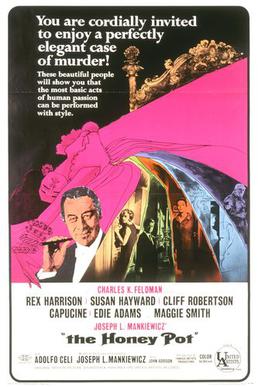
The Honey Pot

I like to think I know at least some background on anything from movies to television, sports to music. And then there's....plays!!! I've never been a huge fan of theater so I can honestly say I know little to nothing about a whole lot of plays, theaters, and writers, like Volpone, a play from the 1600s from playwright Ben Jonson. How about an introduction with 1967's The Honey Pot?

Even with all his millions, his whiskey, his cigars and his huge Venetian mansion, quirky millionaire Cecil Fox (Rex Harrison) is bored to tears. He's always taken pride in living life to the fullest, but in his middle years he's looking for some entertainment. Fox comes up with an idea while watching Jonson's Volpone, bringing the play to life, his life. He hires an on-and-off actor, William McFly (Cliff Robertson), as his assistant in his own personal play, the millionaire putting his diabolically "fun" plan into effect. Fox is going to pretend he's dying following a heart attack and he intends to settle up his vast fortunes, assembling three former loves in his Venetian mansion and letting the hijinks begin. McFly takes the job somewhat suspiciously but he goes along with it. What exactly is Cecil Fox up to? What is his ultimate goal in pulling off this ultra-involved prank?

I had never heard of this 1967 quasi-comedy from director Joseph Mankiewicz until it recently popped up on Turner Classic Movie's schedule. The plot sounded interesting enough, but mostly it was the cast that caught my attention. On top of Harrison and Robertson, we get Susan Hayward as Lone Star Crockett, a quirky American businesswoman with her hand in the oil business, Maggie Smith as Lone Star's nurse, Sarah, Capucine as Princess Dominique, and Edie Adams as a sex kitten American movie star. Oh, and there's also Adolfo Celi as a Venetian police officer who gets pulled into Fox's elaborate practical joke. Not too bad in the casting department, huh? That's what I thought, and I was right. Above all else, if you're going to give this one a try, go in because of the casting.

I especially liked the dynamic between Harrison and Robertson. Neither man knows exactly what the other one is up to, but they both know the other is up to something at least mildly sinister. Who will figure it out first? They have an appealing, easy-going chemistry that gives an energy to each of their scenes together, whether it be putting all the details of their plan together or just sitting across from each other at a poker game. Harrison's Cecil gets a chance to go one-on-one with Hayward's bajillionaire, Capucine's royalty and Adams' actress, each bringing a different dynamic to their scenes and background. I especially liked Hayward as Lone Star with all her quirks and idiosyncrasies. Robertson too gets a possible romance with Smith's Sarah, Lone Star's nurse who begins to smell a rat somewhere in this Venetian mansion.

So where exactly does this one hit a rough spot? Well, to be fair, it's not just one specific scene. It's an entire script from Mankiewicz, based off Thomas Serling's novel which is based off the original Volpone. The movie is a rather leisurely 132 minutes, and that's just the version released in the United States. In the United Kingdom, a 150-minute long version was released in theaters. I'm all for well-written dialogue. I don't know if this is as well-written as it thinks it is. It's smart and clever, witty and quick, but it's not the end all, be all dialogue that it believes it is. 'Pot' is too smarmy for its own good. The dialogue goes on and on seemingly without end. There are no memorably choreographed set pieces, nothing at all really to break up the monotony. It runs over two hours, but this is a story that goes on and on. It feels long. It is long.

'Pot' is listed as a comedy crime thriller which is fine and dandy. When one of the above characters is murdered nearing the hour-mark, things are definitely thrown for a loop. It's dark, but it ceases to be funny from there on in. One character begins to piece things together, but can the mystery be unraveled in time? It's not especially funny, especially the ending with all its forced attempts at humor, and the drama isn't dramatic enough. Pick a tone and stick with it! Funny or drama! It can work in the right situation, but this wasn't it. A very disappointing negative review.

The Honey Pot (1967): **/****     

Monday, May 27, 2013

The Devil's Brigade

In tribute to all our veterans, here's a Memorial Day review. As a movie fan, Memorial Day was a huge weekend for me growing up. I looked forward to watching old war movies on TNT in round-the-clock marathons, WWII flicks that are some of my favorites like The Dirty Dozen, Kelly's Heroes and an underrated classic and one of my all-time favorites, 1968's The Devil's Brigade.

It's 1942 and with World War II very much yet to be decided, Lt. Colonel Robert Frederick (William Holden) has been summoned to a staff meeting in England. Even though he has no combat experience, Frederick is being given command of a new unit, the First Special Service Force. Their ultimate mission is still to be decided but the Colonel prepares for the training that awaits his brigade that consists of a crack unit of well-trained Canadian troops commanded by Dunkirk veteran Maj. Alan Crown (Cliff Robertson) and an unruly, misfit group of American troops headed by the similarly unruly Maj. Cliff Bricker (Vince Edwards). The two sides bristle immediately, but training continues. If Frederick can manage to keep his men together, their services are very much needed, including a dangerous mission on the Italian front.

From veteran director Andrew McLaglen, 'Brigade' is based on a real-life military unit, the First Special Service Force. Released just a year after The Dirty Dozen, it bears some striking similarities, but it more than capably carves out its own niche in war movie department. It is one of the great men-on-a-mission movies, and that's saying something considering the late 1960s were rampant with them. McLaglen filmed on location in Italy for much of the second half of the movie, giving an authentic look and feel to the proceedings as the Brigade goes into battle. Composer Alex North turns in a gem of a soundtrack, his theme for the Brigade (listen HERE) one that you'll be whistling for days. The main theme is a highlight, but North specializes in the quieter, darker and more sinister moments leading up to the battle in the finale.

More of a workmanlike director than an auteur, McLaglen specialized in movies like this with impressive casts of male stars. This 1968 WWII flick is loaded with star power. As Colonel Frederick, Holden doesn't get a flashy part, but he leads the way just the same. His officer wants to prove himself while also proving how capable his men are too. The best part in the film goes to Robertson as Maj. Crown, an intelligent, well-spoken and brutally capable officer who survived the Dunkirk disaster. It is a smart, underplayed role, and he steals every scene he's in. As his American counterpart, Edwards too is very solid. His Maj. Bricker is blunt and without a filter, a scrounger and hustler with the best of them. Also look for Dana Andrews, Michael Rennie and Carroll O'Connor as American generals, all making cameo appearances.

Ah, yes, and then there's the rest of the cast. If the star power above wasn't enough, McLaglen assembles a deep, talented cast of tough guys to fill out the ranks of the brigade. Leading the American contingent, look for Claude Akins, Andrew Prine, Richard Jaeckel, Luke Askew, Tom Troupe, Bill Fletcher and Tom Stern. For the Canadian half of the Brigade, watch out for Jack Watson, Harry Carey Jr., Jeremy Slate, Richard Dawson and Jean-Paul Vignon. It's cool just seeing all these recognizable faces here together, some leaving more of an impression than others. Jaeckel as Omar Greco, an acrobat trying to escape but finding a home instead, especially stands out as does Akins as Rocky, the American bully, Prine as Ransom, a smart misfit, Watson as Peacock, the tough but gentlemanly Canadian and Slate as O'Neill, the hand-to-hand combat instructor.

I think it's the cast that separates the movie from so many other solid WWII movies. It's a familiar formula here; introduce everyone, train them, have them put their differences aside following some male bonding and then unleash them on the enemy. The male bonding comes courtesy of a barroom brawl (watch HERE) with some rowdy lumberjacks, a great scene. The script is ideal in its ability to let these tough guys be tough guys. It's fun, natural with chemistry and features some great one-liners. Other highlights include Slate's introduction in a showdown with Akins (watch HERE), a 30-mile hike where the rivalry develops further, and many others. Moral of the story is this, we need these parts to be effective for the second half of the movie to truly work. And you bet it does.

The last hour follows the Brigade as it enters combat. Required to prove themselves and their ability, Frederick leads a patrol behind the lines to a heavily guarded Italian town crawling with Germans. It's a lighter action scene, but memorable just the same. The best part though is in the finale, the Brigade ordered to attack the apparently impenetrable Mount la Difensa (where the Service Force really made a name for themselves), a mountain garrisoned by German infantry and heavy armor. First, they must scale a sheer cliff-face to mount a surprise attack on the garrison. It is a great action sequence, McLaglen filming in the trenches and dugouts as the Brigade begins their assault. We always know where the battle is, where it's going, and the sheer scale of it. When the casualties do come (and they do, quickly and with some surprises), it makes this extended battle sequence that much more effective emotionally.

This has always been one of my favorites, and I seem to pick something new up with each passing viewing (I'm guessing I'm somewhere between 20 and 30). This time? The darkness late, Frederick greeting his men as they prepare for battle. North's score goes dark, Dawson explaining "Haven't you ever heard a man say goodbye?" It's an eerie, uncomfortable moment. Spot-on too, considering the Brigade sustained 77% casualties in the coming battle. 'Brigade' doesn't have the reputation of so many other WWII movies of the time, but it deserves some attention. A hidden gem.

The Devil's Brigade (1968): ****/****
* Rewrite of June 2010 review

Sunday, January 8, 2012

Escape from L.A.

If you're going to do a sequel, you might as well commit and do it right, right? You'd think so, or at least that's usually my hope when I stumble across a sequel -- especially an unnecessary one. That is partially why I avoided John Carpenter's 1996 sequel Escape from L.A.. The 1981 original doesn't need a sequel so somewhat skeptical, I dove in.

It's 2013 and the United States is very much a dystopian country still, even 16 years since Special Forces soldier turned criminal Snake Plissken (Kurt Russell) rescued the President in New York. Now though, an immensely powerful earthquake has ripped Los Angeles apart, the city now an island destination for any "undesirables." Now a new religious fanatic (Cliff Robertson) has become the President, and his extremist daughter (A.J. Langer) has hijacked an item that could destroy the world, retreating to L.A. to work with fellow extremist Cuervo Jones (Georges Corraface). Snake's services are called on once more. Blackmailed and working against a deadline of death, Snake must sneak into L.A., retrieve the item, kill the daughter, and only then will he be safe. Can he pull off the impossible again?

I didn't love the original Escape from New York, but I certainly liked it. Made on a small budget, there was a certain B-movie charm to Carpenter's film. It was cheesy and ridiculous and over the top and most importantly of all, fun to watch. The dystopian setting of an America that is nothing like the country we know now is ideal, opening the door for all kinds of outlets to take a story. Carpenter and Russell worked together a handful of times over their careers, clearly enjoying making movies together. Russell liked it so much -- and playing Snake too -- that he worked with Carpenter on writing a sequel. It was held up for years, finally coming to fruition in the mid 1990s. With that long of a wait and this much talent involved, why then is the sequel so bad?

The obvious answer is that it is basically the same movie. Sequels are fine when they add another step, a new layer to a pre-existing world and characters. But making the same movie -- quite literally -- with all the same features, characters and settings? Replacing New York with Los Angeles isn't unique or new. It's a road trip. I guess I just expected more. If you've got 15-plus years to write a sequel, couldn't you manage something better than this?  It bombed in theaters, not making a profit, so I'm not the only one with complaints. The repeat of New York's success is one thing, but this 'Escape' has too much really awful CGI, too many similar characters, and did I mention the almost identical story?

What carries both movies on different levels is Kurt Russell. 'New York' is just a genuinely good B-movie that's aided and boosted by Russell. 'L.A.' is basically watchable only because of Russell. Snake Plissken is Russell's most iconic character from a successful career, and there's nothing about him that isn't cool. Okay, check that, the odd, fetishisized leather outfit is a little much. But other than that, Snake is the perfect anti-hero. A high profile crook with a reputation, he has no regard for any authority and only goes along with the plan because his life depends on it. Yes, he growls everything he says. Yes, he makes some awfully stupid decisions. But is he cool doing it? Yes, Kurt Russell is awesome, and he's cooler than you.

While the rest of the cast and characters are pretty ridiculous, Carpenter nonetheless assembles quite a cast. Start with Robertson, having some fun taking some jabs at the religious nuts. His U.S. President is one big stereotype, hamming it up like nobody's business. Stacy Keach plays Malloy, Snake's "handler" of sorts, with Michelle Forbes as his assistant. Steve Buscemi, Bruce Campbell, Valeria Golino and Peter Fonda play just some of the eccentric nuts trying to survive in Los Angeles who Snake runs across, Buscemi and Fonda making the best impressions. Look also for Pam Grier as Hershe Las Palmas, a drag queen who Snake used to work with on other jobs. I've gotta admit though, it's a little unsettling hearing a man's voice coming from Grier's mouth.

So watching a rehash of the more enjoyable Escape from New York, there are some saving graces in this most unnecessary of sequels. The ending features a couple very cool twists, some you can see coming if you're paying attention, but enjoyable nonetheless. Was there ever any doubt Snake was going to get duped repeatedly by these morons? I think not. Cool character, cool ending, but that doesn't save the movie.

Escape from L.A. <---trailer (1996): * 1/2 /****

Sunday, October 30, 2011

633 Squadron

More than any other war, World War II has produced hundreds and probably thousands of movies telling the countless stories of the war from all angles. I've done my fair share of WWII reviews -- over 100 as I write this one -- and I'm quite sure I won't run out anytime soon. Among the thousands of movies are selections from most of the countries involved, especially England. Over the 1950s and 1960s, some of the best WWII movie were British, seeing similar production value, stories, and actors returning for multiple roles. An underrated one not often remembered so fondly (unfortunately so) is 1964's 633 Squadron.

The commander of 633 Squadron, Wing Commander Roy Grant (Cliff Robertson) has been given his most difficult mission. His squadron of international pilots flying for the British have their work cut out for them on this specific mission. It's spring 1944, and the coming D-Day invasion looms. Deep in the Norwegian fjords lies a factory producing rocket fuel that will be used to repel the landings while also assaulting England from across the Channel. Grant and his pilots must fly through a gauntlet of fire in the fjords, hoping to knock out the factory. The Norwegian resistance (headed by George Chakiris) will work to knock out some of the antiaircraft positions along the fjord. No matter what happens though, the mission seems like suicide. With thousands of lives at stake, can 633 Squadron pull off the job?

I've always enjoyed these British war movies, on the big scale like Battle of Britain to the smaller-scaled The Dam Busters. They don't glorify war or glamorize death, knowing that an effort to make war heroic would be foolhardy. War isn't heroic. It's a dirty, brutal business. The men fighting on the other hand are incredibly heroic, and that's what these movies go for. To save the lives of thousands, sometimes the life of the smaller group down to the individual had to be sacrificed. Given a chance to abort the mission, Robertson's Grant refuses the offer, continuing the mission knowing that the casualties will almost certainly be extreme. As for the familiar faces, look for Harry Andrews as Air Vice Marshal Davis with Michael Goodliffe and Donald Houston as two of his higher-ranking staff.  

Showing the heroic actions of the men and not necessarily the heroism of war itself, the movie separates itself from the pack in its portrayal of the final assault through the fjords. Without giving anything away, basically nothing in the hours leading up to the mission goes right. Andrews' Air Vice Marshal gives the squadron the option to abort the mission, but Robertson's Grant pushes on, weighing the sacrifices they must give with those who have already died and the thousands more who might die as a result in the future. Don't be confused. The ending mission may be successful, but at a heavy cost. The movie ends on a high, positive note, touting the heroism of the fighter crews as it should, especially considering the price paid for the mission's success.

In a recent line of Robertson reviews, add '633' to the list. One of my favorite actors, Robertson is a strong lead here as Wing Commander Grant, an American pilot leading this international squadron. It's a stock character; an officer weary of war, sick of seeing his men killed in a futile effort, just wanting it all to be over. Nothing fancy, nothing showy, just a good performance. George Chakiris is badly miscast as Erik, a Norwegian resistance fighter who's sister, Hilde (Maria Perschy), is attracted to Robertson's character. Mostly, Chakiris just doesn't look the part, but he isn't given much to do in a smaller part. As for the squadron, some of the names include John Meillon, John Bonney, Angus Lennie, Scott Finch, and Julian Sherrier, the collective group being more important than the individual.

One of the best reasons to see this movie is not surprisingly for the aerial sequences. Aviator buffs will no doubt eat this movie up, especially the impressive amounts of footage of the Mosquito aircraft. Some footage is re-used over and over again, but the shots of these aircraft zipping through narrow fjords and valleys is impressive. It puts it all into perspective how dangerous these missions were, and the little kid in all of us who's fascinated by flight and aviation can't help but be entertained. Ron Goodwin's majestic score doesn't hurt either (listen HERE) playing over the aviation sequences, a similar sounding score to his Battle of Britain and Force 10 from Navarone scores.

On a purely entertaining level, the final assault on the fjord is noteworthy for another thing; it's major impact on George Lucas and Star Wars. The ending basically lays out the blue print for Luke Skywalker's Death Star trench run at the end of Star Wars, a group of pilots flying through hellacious amounts of fire in hopes of reaching their objective at the end of the gauntlet. Watch THIS very clever mash-up of the sequences from 633 with the dialogue from Star Wars, obvious SPOILERS of course. Imitation is the best form of flattery, huh?  

This is an underrated WWII movie that deserves better. It isn't anything groundbreaking or Earth-shattering. Instead it is a story about the heroic pilots who put it all on the line when called upon to do their duties. Highly recommend seeking this one out.

633 Squadron <---trailer (1964): ***/****

Monday, October 10, 2011

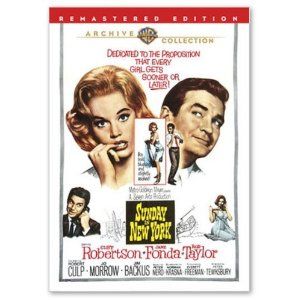
Sunday in New York

A member of one of Hollywood's royal families, Jane Fonda can be remembered for a lot of things. Her controversial visit to North Vietnam, earning her the nickname Hanoi Jane, is certainly at the top of that list. In the 1980s, she "reinvented" herself in a way, releasing a series of exercise tapes. None of this even mentions her film roles, including campy space sex romp Barbarella or her five Academy Award nominations or two Oscar wins. Before all that though? A handful of light 1960s romantic comedies, including 1963's Sunday in New York.

Now as I write this in an age of inept, annoying and downright awful romantic comedies, it's safe to say that the concept of romantic comedies has taken a bit of a hit, a public relations debacle. At some point, romantic comedies stopped being romantic, smart and enjoyable, resorting to moronically stupid stories that put stereotypes to shame and characters doing things no sane or rational person would ever do. Just because it was released in the 1960s doesn't mean these are perfect movies. But there is a charm, a style, and a sense of enjoyment that has been lost in so many movies since.

After a bad breakup with her fiance, 22-year old Eileen (Fonda) visits her older brother, Adam (Cliff Robertson), in New York City, planning to spend a week or so with him and just get away from her problems. She corners him, asking if men are only interested in sex in relationships. A globe-trotting airline pilot and all-around ladies man, Adam does the only thing he can do for his sister's benefit...he lies. Eileen isn't so sure, meeting Mike (Rod Taylor) later that day and hitting it off immediately with him. She intends to put Mike to the test to see if he'll be interested if she throws herself at him.  Her plan doesn't go quite as planned though, putting her in an awkward situation when her ex-fiance, Russ (Robert Culp), bursts into the apartment with Eileen and Mike only wearing bath robes. Uh-oh, Eileen's got some explaining to do.

More than the well-written, semi-intelligent script or the interesting and still believable characters, there is that style and charm in 'Sunday' that you just can't duplicate.  Director Peter Tewksbury shot the movie on location in NYC, and let's face it, it is hard to mess up that city in a movie, especially downtown Manhattan.  It could serve as a companion piece to Breakfast at Tiffany's, (released two years earlier), serving as a time portal into a very cool city some 50 years back. All the guys wear suits (at all times too), the ladies get dolled up to go out. Adam's apartment -- where much of the shenanigans take place -- is immense and ends up being an additional character. Imagine the Friends' apartment in 1963, and you've got your set. The whole story takes place in under 24 hours -- that one rainy Sunday afternoon -- but never feels rushed. Charm and style, 'Sunday' has it to spare.

As for the semi-intelligent part involving the script, this movie was probably a little shocking to audiences in 1963. Now, it seems tame although there are some instances that caught me off guard watching it for the first time. Fonda's Eileen is a virgin, wondering if she's the last one on the planet. Culp's Russ dumped her because their relationship wasn't developing physically quick enough for his liking. Fonda even makes a reference to Russ having to play "handball" several times a week (that line and Fonda's delivery really cracked me up).  The point is though, it's never dirty or filthy, just adults talking about sex and relationships.  It will seem tame to modern audiences, but you enjoy the story and its developments and the characters. Smart? Maybe not, but it feels real.

A well-written script is one thing, but having the actors/actresses to pull it off is another thing. 'Sunday' goes 4-for-4 in that department. Fonda is the all-American girl here, so perfectly cute that you can't help but like her.  Her chemistry with Taylor is as natural as they come, their friendship/relationship serving as an easy blue print for what romantic comedies should aspire for. As for Taylor and Robertson, neither would seem like an obvious choice for their parts, both men more at home in a "guy's movie." They're too talented not to leave a positive impression though, both getting a chance to show off their lighter, comedic sides. Culp is the unknowing dupe, the somewhat sympathetic but mostly clueless boyfriend. Also look for Jim Backus as Drysdale, Robertson's flight controller boss, and Jo Morrow as Mona, Adam's girlfriend who just can't seem to buy a break.

For all my writing about an intelligent romantic comedy, the last third of the movie does resort to a needlessly ridiculous plot twist about a case of mistaken identity. Culp thinks Taylor is Fonda's brother, not a stranger she just met, and Robertson is Taylor's pilot friend. Yep, I Love Lucy syndrome, a "dilemma" that could be solved with one simple explanation. It never panders or tries too hard to be funny though, just going along with the developments. A high point is Robertson and Taylor dancing together, showing Fonda how to explain the situation. Physical comedy that isn't overdone. It's just right. Now if only some more recent romantic comedies could be even halfway as good as this one....then we'd have something.

Sunday in New York <---TCM trailer (1963): ***/****

Sunday, October 9, 2011

Underworld U.S.A.

A talented actor and a star who never rose to any sort of cult or iconic status, Cliff Robertson died September 10th at the age of 88, capping a career that dated back to the 1950s. He started off like so many actors in television before making the jump to feature films. Robertson starred in over 50 movies, including most recently in the Spiderman movies when he was introduced to a new generation of moviegoers. Never a huge star, he remains one of my favorites, starring in movies like PT 109 and The Devil's Brigade.

After spending most of the 1950s in television, Robertson did turn to feature films in the 1960s, including 1961's Underworld U.S.A., one of his best roles and an impressive starring debut. The movie comes from director Sam Fuller, a WWII vet and a director who was as tough as they come both personally and in his movies. 'Underworld' would serve as a good double feature with Fuller's 1963 movie, Shock Corridor, and for all the wrong reasons. What starts as an interesting film noir gets too hammy, too over the top before all is said and done. In a cast full of relative unknowns, Robertson is the best thing going in this hyper film noir.

As a 14-year old kid, Tolly Devlin sees his father beaten to death in an alley but is only able to identify one of the four killers. He turns to a life of petty crime and ends up in prison serving an extended sentence, stumbling across the one killer he can identify, dying from a heart ailment. Now in his late 20s, Tolly (Robertson) gets the names from the dying man and upon earning his parole goes to work exacting his revenge. The three men are all higher-ups in a national crime syndicate so instead of callously gunning them down, Tolly works from the inside, rising through the ranks of the criminal underworld. He slowly climbs to a position where he can do something only to find out the D.A.'s investigator, Driscoll (Larry Gates), is closing in on the men Tolly wants to get at. Could he manipulate even the Feds into helping him finish his revenge? 

All the elements of a successful film noir movie are here; the dark, dank backstreets, the anti-hero, the damaged woman, the irredeemable baddie, the back stabbing and murder. The black and white filming gives a throwback feel to 'Underworld' to the late 1940s when noir was at the height off its popularity. In an effort to make the familiar noir formula more interesting though, Fuller amps it up to an 11 or so. It becomes too over the top, leaving even somewhat believable in the rearview mirror. A syndicate hitman (Richard Rust) revels in running over a little girl on her bike, later burning a man alive and similarly enjoying it a tad too much.

I guess it is the portrayal of the mobsters that bugged me the most. Connors (Robert Emhardt) is in charge of the national syndicate, ruling with an iron and unbending fist. They are so ridiculously over the top that the portrayal is unintentionally funny more than evil and intimidating. The syndicate is fronted by a nationwide charity that even sponsors a weekly kids swimming day at their own pool, pretending to be a reputable business. The three killers of Tolly's father include Paul Dubov, Gerald Milton and Allan Gruener, but they're not the bad guys so much as Rust's psychotic hired killer and Emhardt's Connors, who dominate the "badness" for lack of a better description. Just as the cherry on top, not only are these mobsters completely ridiculous, they're also mind-blowingly stupid, not realizing that trouble has started soon after the new guy -- Tolly -- arrived on the scene.

Through his career, Robertson had a knack for playing flawed heroes, the lead who was fighting through personal struggles. Of all the movies I've seen though, this character, Tolly Devlin, is the darkest by far. He's the anti-hero, which is a more appropriate description than 'the good guy' because he just isn't a good guy. Devlin is the lesser of two evils compared to the syndicate he's trying to take down.  He's obsessed with exacting revenge no matter the cost, including sacrificing a possible relationship with Cuddles (Dolores Dorn), a young woman caught up in the syndicate's web, and turning his back on surrogate mom, Sandy (Beatrice Kay). Robertson brings Devlin to life, giving him an obsession, a cynicism and a general darkness that can be startling to watch. He has a look in his eye that makes you think he is capable of anything. I prefer Robertson in a more traditional hero role, but it's a nice change of pace to see otherwise.

The reviews are surprisingly positive for this movie. I don't think it is a bad movie, but at the same time the effort and intention comes across much too hard in the attempt. Tap the brakes or something there, Mr. Fuller.  Just like Fuller's Shock Corridor, the effort in making a unique story is so interested in impressing the viewer that it loses all sense of reality.  The finale -- the last 20 minutes or so -- is a fitting end, one that's telegraphed basically from the beginning. You know how this movie will end. So while it's not a favorite of mine, I can appreciate 'Underworld' for Cliff Robertson's performance. RIP Cliff, you'll be missed.

Underworld U.S.A. <---TCM clips/trailer (1961): ** 1/2 /****

Sunday, September 18, 2011

Charly

Through all the enhancements and developments in acting through Hollywood's history, the Academy Awards have done their fair share of changing too.  Is there a go-to thing an actor or actress can do to ensure themselves a nomination for Best Actor or Best Supporting Actress? It obviously takes a ton of talent and some luck at that, but it's easy enough to figure out. For years, it was big, verbose, stagey performances. Through the 1960s as method acting came into play, it was moodier, darker performances. In the early 2000s, it was actors dulling themselves down to play characters you'd never expect.

A tricky ground for an actor/actress to play is that of a mentally handicapped individual.  As Robert Downey Jr. so famously said in Tropic Thunder (and while I laugh, there's an uncomfortable truth about it), "You never go full retard."  For a person to play the part of a handicapped individual, you're treading that fine line.  Are you embracing the part, truly discovering and showing what it is like to be that person? Or are you just pandering to an audience for sympathy, mimicking someone who doesn't deserve that treatment? One of the best examples came in 1968's Charly with actor Cliff Robertson -- a favorite of Just Hit Play -- winning the 1969 Best Actor's Academy Award for his performance of a man with the IQ of 59.

Living on his own in a small, poorly furnished one-room apartment and working as a janitor as a bakery, Charly Gordon (Robertson) is trying to make himself smarter. He is mentally challenge and with an IQ of just 59 struggles to adjust at times in a modern and often times unforgiving world.  Charly has spent two years attending night school, learning from his teacher, Alice (Claire Bloom) how to read and write even if the process is slow-going. Alice approaches Charly one day with an offer. A team of doctors have developed a somewhat controversial medical surgery/procedure on the brain that makes the patient exponentially more intelligent. A genuinely good person who wants to improve himself, Charly is an ideal case study, and that's exactly what he is. He undergoes the surgery and slowly but surely starts to see improvement. There's so much in fact that he develops the intelligence of a genius. Something else awaits him though as he changes, something even a superior intellect could figure out or stop.

When I first watched this movie, I was curious mostly to see Robertson's Academy Award winning performance. He's one of my favorite actors, and I thought he never quite got his due. Revisiting the movie how many years later, I had forgotten how dark the movie is, how cynical its look at the real world really is. With the naivete and innocence of a child, Charly goes through life just trying. That's all. He tries. His co-workers rip him mercilessly for kicks, but he thinks they mean well. After his surgery, Charly sees a mentally challenged man working as a waiter laughed at by the crowd in a restaurant when he drops a tray of glasses. For any number of reasons, it is a difficult movie to watch, to see man's apparently inherent ability to be cruel for no apparent reason. Post-surgery, Charly asks 'Why would the people who would never dream of laughing at a blind or crippled man laugh at a moron?' It's a valid question and one without an easy answer.

Watching other Robertson movies, I think of The Devil's Brigade, PT 109, Too Late the Hero, Three Days of the Condor, action, war and thrillers. He's a really good actor and cool in all those movies (I have a way with words, don't I?), but this is his best performance by far. He walks that fine line between cliched and stereotype of playing a retarded man. His Charly is a believable person, not a caricature of what people think a mentally challenged individual would be. Above all else, you like this character.  You're rooting for him to succeed, to better himself. He is as innocent as they come without a mean bone in his body. He brings Charly Gordon to life, and then when Charly does change as an individual, becoming "normal" (for lack of a better word, society's normal I guess), you believe that transformation too.

Where the movie succeeds most for me is the first hour where we get to know Charly before he undergoes his surgery.  We see his tiny even depressing apartment with a small fridge, two chairs, a bed and a chalkboard where he writes his next day's activities. He goes to work where he thinks the people making fun of him are his best friends because he doesn't know any better. Charly goes to night school, learning to read and write, and ultimately goes through testing with Bloom's Alice and a team of doctors. One particularly effective bit has Charly "racing" a mouse named Algernon who's undergone the surgery, seeing who can complete a maze quicker. In a weird way, they become friends, but it works and makes sense. Above all else, Charly and his interactions with those around him feel genuine, and it keeps the movie grounded throughout.

The movie has its issues though, issues that keep it from being a classic. Director Ralph Nelson is undone at times by 1960s syndrome, or whatever you'd like to call the psychedelic elements of his story. The split screen effect feels dated now and serves no real purpose. A weird acid trip toward the end of the movie is truly bizarre as Charly lashes out, trying to discover the world in a way he's never seen.  It's like the similar scene in Easy Rider where Peter Fonda and Dennis Hopper trip out on acid.  A nightmare sequence near the finale is unsettling in a similar fashion, but in a positive sense that shows the struggles Charly is going through. And better or worse, the story drags some once Charly has undergone the surgery. It's not boring, but it's just not as interesting seeing the change in the character.

Rewatching the movie though, my issues are ultimately left behind because Robertson's lead performance as Charly Gordon is that good.  It is an incredibly moving story that does do its fair share of pulling at your heart strings.  You think you know where it's going, and then Nelson pulls the rug out from under you.  He saves the biggest shock for last, one of the most powerful endings I can think of. Moving doesn't do enough to describe the effectiveness of the final shot, a freeze frame that stayed with me long after watching the movie. Great performance, almost great movie. You can watch the movie at Youtube, starting HERE with Part 1 of 11.

Robertson died recently, passing away on September 10, 2011.  He was an underrated actor who didn't always get his due, and he will be missed.

Charly (1968): *** 1/2 /****

Tuesday, August 16, 2011

Too Late the Hero

By 1970, the United States had been involved in the Vietnam War for going on five years. The American public had grown tired of a war that was producing no results and eating up American soldiers' lives by the thousands. As a country, we grew sick of authority and power figures, losing faith in the people we were supposed to trust. This distrust and frustration with the system came out in countless outlets, especially in films and even more so in war films, like 1970's Too Late the Hero.

From director Robert Aldrich comes this war movie that has been generally forgotten over the last 40-plus years.  Is there a chance it is too cynical, too dark, too anti-war?  It certainly could be any of those reasons, and while it is not a great anti-war movie, it certainly is a good one. Just three years earlier, Aldrich had directed the classic anti-war movie The Dirty Dozen, a mix of incredibly dark humor, anti-establishment sentiment and in general a disdain for anything related to the powers that be. With 'Hero,' he takes it up a notch. Think Dirty Dozen mixed with The Guns of Navarone and Play Dirty, and you've got this war flick.

A day away from a month's leave, American Navy officer Lt. Sam Lawson (Cliff Robertson) is instead assigned a dangerous mission in the southwest Pacific in 1942. He's sent to a small, seemingly inconsequential island in the New Hebrides to join a British outfit fighting Japanese forces on an island. Lawson's services as a translator -- he speaks Japanese working for intelligence -- are needed as he joins a small patrol trekking across the island to a Japanese base. Their mission? Knock out the radio so an American naval convoy can pass by the island safely and have Lawson transmit a message to Japanese headquarters so as to no alert the enemy of the coming attack. The men on the patrol are a mixed bunch including troublemaker and medic Pvt. Tosh Hearne (Michael Caine) and is commanded by a courageous if inept officer, Lt. Hornsby (Denholm Elliott). As they approach their objective though, a wild card emerges, news of a Japanese counterattack that intelligence is unaware of.

Is there a such thing as a war movie that is too opposed to war, too anti-war in its general sentiment?  That's always my issue with movies like this.  Think Platoon, All Quiet on the Western Front, Born on the 4th of July, Full Metal Jacket. All high quality, solid movies, but because they're not necessarily entertaining it can be hard to go back and revisit the films with multiple viewings. That's my problem at least. I bought Too Late the Hero seven years ago, watched it once and even though I enjoyed it, did not watch it again until this summer.  It can be a tad on the slow side -- meandering along at 134 minutes -- and stretches go by where not much happens. It is an incredibly dark film overall, making it hard to go along for the ride. None of this is intended to steer you away from the movie, but instead serve as fair warning heading in.

Where Aldrich's The Dirty Dozen had some redeeming characters, 'Hero' has none of them.  There are few positive qualities in any of them. Robertson's Lawson is basically trying to sit out the war in a rear echelon radio post and goes along only when there are no other options. He blatantly refuses to go along with an order on the mission, using a discrepancy to hide his cowardice. Caine's Tosh is a little better, but he is truly only looking out for himself. Screw the lives of others if his life is the necessary sacrifice. It is hinted that Elliott's Hornsby is gay, but it's not important overall. He's both brutally cold and stupidly inept in his command. Harry Andrews is the British commander ready to sacrifice his men as needed, and in a cameo Henry Fonda basically blackmails Lawson into going on the mission. The patrol includes Ian Bannen, Percy Herbert, Ronald Fraser, and Lance Percival among other interchangeable characters there to be fodder for the Japanese.

Setting the movie apart from so many other anti-war films that are content in delivering their 'War is hell!' message is a script from Aldrich that revels in being unique, in going where many war films don't want to go. It is genuinely unique. As the survivors of the patrol race back through the jungle to the relative safety of their own base, the Japanese are in hot pursuit with some psychological warfare prepared. A Japanese major, Yamaguchi (Ken Takakura), uses loud speakers and an amplification system to address the men he's pursuing, offering them terms of surrender with an ever-shrinking deadline. The Japanese aren't the bloodthirsty savages here for the most part, and as is the case with Takakura's Yamaguchi, he's just a soldier trying to do his duty. The booming voice through the jungle is a nice touch though, an enemy that cannot be seen and only be heard.

The best though by far is the finale so OBVIOUS SPOILERS from here on in. SPOILERS STOP READING SPOILERS Needing to deliver the news of the coming Japanese attack, only two survivors make it back -- Tosh and Lawson.  The only problem? The only way back to the base is an open stretch of land, a veritable no man's land. The Japanese have it covered, and any attempt to cross the vast openness is basically a suicide mission. Tosh and Lawson attempt it, running like madmen in a zig-zag pattern in an attempt to make it hard to pick them off.  Aldrich shoots this adrenaline-pumping sequence from a distance, making sure we can't see which man is which. I won't spoil the ending as to who makes it -- or do both make it? Hhhmmm, interesting -- but it is a whopper of an ending and another unique touch, something I'd never seen before in a war movie. Watch it HERE with more OBVIOUS SPOILERS.

This certainly isn't a perfect war movie, but as far as anti-war movies go it's hard to beat. Maybe some of the reasoning I've come up with is because it hasn't been fondly remembered since its 1970 release. It is a bit of a hidden gem.  An appropriate if not so subtle message tries too hard at times, but the idea is there. Throw in some great performances from a deep cast -- especially Robertson and Caine -- and it is definitely worth a watch.

Too Late the Hero <---trailer (1970): ***/**** 

Sunday, September 13, 2009

The Naked and the Dead

When I think of author Norman Mailer, one thing comes to mind. Big books, real big books. I haven't read any of Mailer's stories, partly because I get intimidated when I see a paperback I could knock someone out with if using it as a weapon. His take on WWII in the Pacific, based on his own service, was a huge hit upon its release and surprise, surprise, turned into a movie of the same name, The Naked and The Dead.

Now looking at a reissue of Mailer's novel, the Amazon listing has it as over 700 pages so any movie version is going to have to cut things out. The 1958 movie clocks in at 131 minutes so I tried to keep that in mind while watching it. TCM's Robert Osborne said the novel upon its initial release was a huge success because of its 'salty language' with plenty of four-letter words and its frank way of dealing with some touchy subject matters. Of course, a movie from 1958 had to strip much of that away with censors. So right off the bat, the movie already has two strikes against it, but I'll move on.

The story centers around an American infantry battalion on an unnamed Pacific island midway through the war. Three main characters step to the front, giving the viewer a good sense of all the different ranks in the battalion. First, there's Sgt. Sam Croft (Aldo Ray in a part he was born to play), the leader of an intelligence and recon platoon that is understrength after several campaigns on the front lines. His men hate him almost to a man, and he gives them good reason. Croft is sadistic, killing unarmed prisoners callously and then prying the gold teeth out of their mouths. Second, there's Lt. Robert Hearn (Cliff Robertson), a young officer with connections back home. Translation = Earns a job far from the front lines. And third, there's General Cummings (Raymond Massey), the battalion commander obsessed with casualty estimates and striking fear into his men's hearts, often for pointless power trips.

I liked the idea of seeing the war from different perspectives, from the high-ranking general to the men on the front line. With war movies, it's typically one or the other. But in the execution, something doesn't translate. The first 70 minutes are extremely reliant on dialogue scenes meant to flesh out the main characters. Maybe this was the purpose, but none of the three are particularly likable. Croft is pure evil, Hearn is a cocky, arrogant spoiled son of a you know what, and Cummings borders on the crazy. These early scenes drag on too much.

The pace picks up when a twist to the storyline is thrown in. On this Japanese-held island, Cummings' advance has slowed to a halt. He puts into action a plan that should break the stalemate, but he needs behind the lines info. Croft and his platoon are selected to go behind the Japanese lines and set up an observation post for their advancing battalion mates. After pissing off Cummings, Hearn is given command of the platoon. So now, they're not only tangling with Japanese patrols, but a fight for power between Hearn and Croft.

The patrol segment is by far the better part of the movie. There's a natural tension as Croft and his men walk through the jungle (Panama substitituing for the actual Pacific) trying to get to their objective while avoiding the Japanese. What I enjoyed most in the movie was Croft's platoon which includes Richard Jaeckel, William Campbell, James Best as the bible-thumping, drawling medic, Jerry Paris and Rat Packer Joey Bishop as two Jewish soldiers, Robert Gist, and L.Q. Jones at his overacting best. Jaeckel and Jones are really the only ones given any development, and reading the book reviews it seems the platoon's back story was sacrificed from the 700-page plus behemoth.

For a WWII movie, the action is pretty sparse and when it comes along, it's pretty disappointing. The gunfire sounds like prop guns and the explosions look as staged as a movie explosion can be. As mentioned before with the censors, the violence is often off-screen, like a Japanese patrol burning in a lit-up field, and comes off as too tame. It's hard to judge a movie for the time it was made in, but if this movie was released in the 90s we're talking a Pacific version of Saving Private Ryan.

So compared to other WWII movies in the 50s and 60s, this one is pretty average but a lot of my complaints come from the censors. Director Raoul Walsh tried to make the definitive, honest look at a platoon of soldiers in the Pacific in WWII, but it is hamstringed by any number of forces working against it. Worth a watch for Aldo Ray's performance and the list of character actors who make up his platoon, but otherwise this one's only worth it for diehard war movie fans.

The Naked and The Dead (1958): **/****

Tuesday, May 19, 2009

J.W. Coop

Usually when a movie star is the key force behind a movie being made, it's a good thing. They feel so strongly about the subject that the feeling is transferred to the movie. One example, John Wayne's The Alamo in which Wayne starred, directed, produced and helped fund. People say its too long, but I love it. Made early in the 1970s, J.W. Coop comes from a similar background.

Underrated Cliff Robertson wrote, produced, directed, and starred and had his company back the movie about an aging rodeo star. While Robertson is good in the title role, the movie never quite lives up to expectations. It's like so many other 1970s road movies that you've seen before and most likely will see again.

Robertson plays J.W. Coop, a rodeo star fresh out of prison after a 10-year stint for passing a bad check, a little severe if you ask me. Coop returns home to see his mother (Geraldine Page, actually a year younger than Robertson), only to find she's lost her mind. With nothing holding him down at home, JW hits the road with hopes of making up for lost time on the rodeo circuit. It's when he finds out how another cowboy is making a living, flying to countless different rodeos, that Coop decides he wants to be the champ.

Nothing too far-fetched here, but the movie bounces around so much with little explanation. First, Coop just wants to return to the rodeo. But then he meets an attractive hippie (model Cristina Ferrare) and changes his mind for no reason that's ever really explained. That's my problem with much of the movie. It tries too hard to be creative or innovative, whether it be in the storytelling or just how things are shot. Quick cutting isn't necessary in most cases, it just calls attention to itself.

As the title character, Robertson gives a quiet performance where he takes in all the action around him. Not much dialogue for Coop, but the actor/director is content to show where JW's at through long shots that remain on the aging rodeo star. He's a tired man who isn't always quite sure how much things have changed in the years he was in prison. Ferrare is the only real co-star here as Bean, the young hippie who starts a relationship with JW. Page appears in just one scene and is frighteningly effective, but that's the first 15 minutes of the movie. R.G. Armstrong makes an appearance as a fellow cowboy, but it's nothing memorable other than to say 'Hey, that's R.G. Armstrong!'

I'm just not quite sure about this movie. The middle section, about 30 minutes to 90 minutes is good, but the bookends just don't work. The opening takes much too long to build up any speed, and the ending has so much going on in the last 20 minutes that everything feels rushed. The ending works even if it's apparent about halfway through the movie how it's going to end. Still, I'm not sure how we're supposed to interpret the ending. It goes two ways, either J.W. lives or he dies, and I think it's Option No. 2, but that could just be me.

Released the same year as J.W. Coop, Sam Peckinpah's Junior Bonner is a similar movie, an aging rodeo star, Steve McQueen instead of Robertson, returns home to find that so much he knew growing up has changed. Comparing the two movies though, Junior Bonner knows what it's trying to say and doesn't waver from beginning until end. J.W. Coop has a similar message, but has it's fair share of trouble getting that message across. Worthwhile for Robertson in a strong part and some cool rodeo footage, but otherwise an average movie. Here's a cool montage done of stills from the movie, SPOILERS though, so be forewarned.

J.W. Coop (1972): **/****