The Sons of Katie Elder

The Sons of Katie Elder
"First, we reunite, then find Ma and Pa's killer...then read some reviews."
Showing posts with label Jeremy Slate. Show all posts

Monday, May 4, 2015

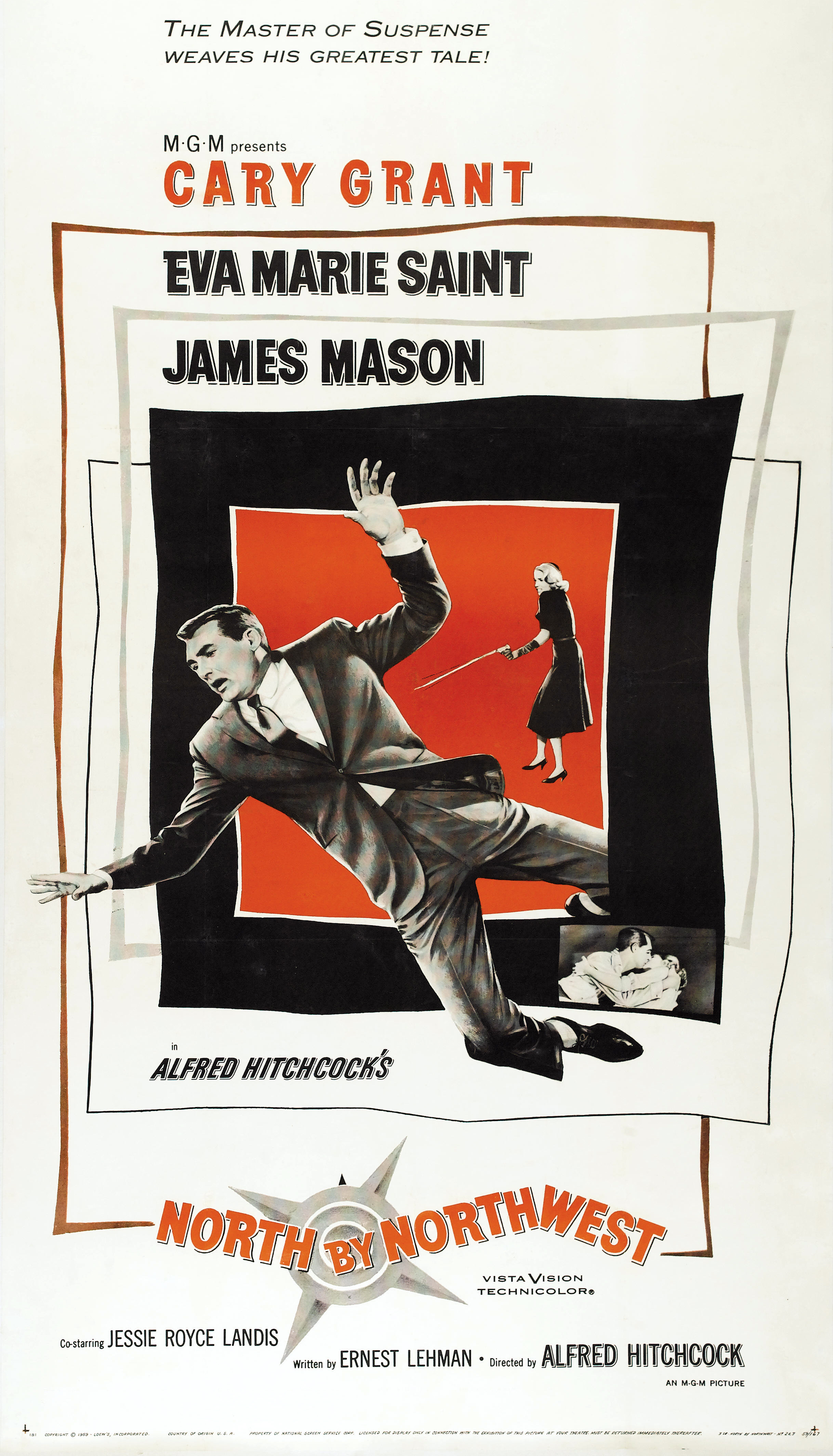
North by Northwest

Name a great director. A truly great one. Someone like Stanley Kubrick, John Ford, Billy Wilder, Orson Welles, and for today's review, Alfred Hitchcock. Ask any fan what their favorite movie is from their favorite actor, and you'll no doubt get some great answers; some agreed upon on and others surprising. For Mr. Hitchcock though, the Master of Suspense himself, that favorite movie is not worth arguing about, and I don't think it's that close either. Here's 1959's North by Northwest, my favorite Hitchcock movie by far and one of the best movies ever.

Working as an ad executive in New York City, Roger Thornhill (Cary Grant) leads quite the bachelor life in Manhattan. Well, he did lead quite the bachelor life. Visiting clients at lunch, Thornhill is taken by gunpoint out of the restaurant and driven to an isolated countryside mansion far from the city. There he meets a mysterious but eerily calm man, Vandamm (James Mason), who begins to ask him questions, questions that Thornhill has absolutely no idea how to answer. What do the questions lead Thornhill to believe? These men believe he's some sort of secret agent, a government official who's trying to stop them from doing...well, something. Vandamm and Co. have had enough though and decide to kill Thornhill, but he manages to escape. Now what? No one believes his improbable story. NO ONE. These men won't leave him alone though, and now, Thornhill is being framed for murder. He goes on the run, and the key to his safety may be a similarly mysterious but very beautiful young woman (Eva Marie Saint). Can Thornhill figure it out before his time runs out?

Sometimes, you just tip your cap to someone at the top of their game. That's Alfred Hitchcock here directing this 1959 mystery thriller. With more than a few genuine classics to his name already, Hitchcock hits this one out of the stadium. It's perfect. Smart, funny, frightening, impressive, so many adjectives come to mind. It's that Hitchcock does it all so seamlessly too. One scene, the tension is dripping off the screen. The next Grant and Saint engage some of the more scandalous dialogue to come out of the dialogue. Next up, a ridiculously charged chase scene. The movie clocks in at 136 minutes and covers a ton of ground, impressive when you consider the story basically has no plot, no huge reveals. So as I said, tip your cap. Some movies are untouchable, and this is planted firmly on that list. A master director at his absolute best.

A true test of a director's legacy is that all-important impact he/she makes with their films. One of Hitchcock's many, even countless impressions he's made is a little ditty called the 'macguffin.' It is a plot device that is SO FREAKING IMPORTANT, but never gets explained in the least. Like AT ALL. That's this entire movie. It's a movie about secret agents and the hidden government offices who run them. It's about bad guys who hold diabolical government secrets and must be stopped at all costs. So in that sense, there's literally no plot here. Yeah, Grant's Thornhill must stop Mason's Vandamm but...whatever. This is an epic case of mistaken identity that snowballs into something far more sinister, dangerous and potentially deadly. It takes a brave, talented and gutsy director to pull something like that off. I've always thought the 1950s were Hitchcock's strongest decade, and this is leading the way out front.

I got the sense watching 'Northwest' recently for this review that the Thornhill character was probably written for a younger actor. You know what though? It doesn't matter. Yeah, maybe Cary Grant was a little older than intended for the character, but his charming, likable on-screen persona and his smooth, deadpan delivery is beyond perfect for the part. As this case of mistaken identity unravels, Grant's charming, gentlemanly indignation fits effortlessly into the story. His chemistry with the lovely Eva Marie Saint is one of the best in film history, simple as that. Their dialogue is scandalous even a little bit now, ahead of its time for sure. You watch their scenes together and marvel. Just sit back and enjoy it. Hitchcock reveled in thumbing his nose at Hollywood's so-called rules, and my goodness, he pushes the envelope any time he can. I have to wonder, did the censors and studio just allow it? It's just too good to pass up.

The cast is so disgustingly good everywhere you look. Mason is the perfect foil to Grant, similarly charming, calculating and with a touch of diabolical intent. His henchmen are terrifying without saying more than a few words, Martin Landau and the creepiest eyes ever and Adam Williams as his knife-wielding enforcer. Just eight years older than Cary Grant, Jessie Royce Landis has a ball as Thornhill's worrying mother, the comic straight woman to all these antics, including her classic encounter with Landau and Williams in a packed elevator. There's also a great little part as Leo G. Carroll as the Professor, a mysterious, distinguished man interested in seeing how the proceedings develop. There's too many other familiar faces with small parts that pop up here and there to mention, but I noticed a cool, quick and you'll blink moment with a young Jeremy Slate as an alert policeman in Grant Central Station. A cool, very early part for a Just Hit Play favorite!

I hadn't watched this movie in years straight through, and man, it was fun catching up with this classic film. From Saul Bass' incredible credit sequence -- watch it HERE -- to composer Bernard Herrmann's phenomenal musical score -- give it a listen HERE -- this movie is technically perfect. Hitchcock uses some great visual tricks from matte paintings and green-screen techniques that trick your eye into seeing something you're not and doing it without calling attention to those techniques. Again, Hitchcock puts it all together. Sit back and take it all in.  

Talk to fans of the movie, and there's countless scenes that they'll mention as their favorites. There's the climactic chase ON Mount Rushmore (WHAT?!?), the painfully tension-riddled scene at an isolated crossroads with quite a twist in maybe the movie's most iconic scenes, and that's just two I'm willing to mention. If you haven't seen this movie, you are in for a treat. If you have seen it, go back and revisit 'Northwest.' There are few movies that click on all cylinders like Hitchcock's classic film does. From New York City to Chicago to Rapid City, a thrill a minute ride. A true, TRUE classic.

North by Northwest (1959): ****/****
Monday, May 27, 2013

The Devil's Brigade

In tribute to all our veterans, here's a Memorial Day review. As a movie fan, Memorial Day was a huge weekend for me growing up. I looked forward to watching old war movies on TNT in round-the-clock marathons, WWII flicks that are some of my favorites like The Dirty Dozen, Kelly's Heroes and an underrated classic and one of my all-time favorites, 1968's The Devil's Brigade.

It's 1942 and with World War II very much yet to be decided, Lt. Colonel Robert Frederick (William Holden) has been summoned to a staff meeting in England. Even though he has no combat experience, Frederick is being given command of a new unit, the First Special Service Force. Their ultimate mission is still to be decided but the Colonel prepares for the training that awaits his brigade that consists of a crack unit of well-trained Canadian troops commanded by Dunkirk veteran Maj. Alan Crown (Cliff Robertson) and an unruly, misfit group of American troops headed by the similarly unruly Maj. Cliff Bricker (Vince Edwards). The two sides bristle immediately, but training continues. If Frederick can manage to keep his men together, their services are very much needed, including a dangerous mission on the Italian front.

From veteran director Andrew McLaglen, 'Brigade' is based on a real-life military unit, the First Special Service Force. Released just a year after The Dirty Dozen, it bears some striking similarities, but it more than capably carves out its own niche in war movie department. It is one of the great men-on-a-mission movies, and that's saying something considering the late 1960s were rampant with them. McLaglen filmed on location in Italy for much of the second half of the movie, giving an authentic look and feel to the proceedings as the Brigade goes into battle. Composer Alex North turns in a gem of a soundtrack, his theme for the Brigade (listen HERE) one that you'll be whistling for days. The main theme is a highlight, but North specializes in the quieter, darker and more sinister moments leading up to the battle in the finale.

More of a workmanlike director than an auteur, McLaglen specialized in movies like this with impressive casts of male stars. This 1968 WWII flick is loaded with star power. As Colonel Frederick, Holden doesn't get a flashy part, but he leads the way just the same. His officer wants to prove himself while also proving how capable his men are too. The best part in the film goes to Robertson as Maj. Crown, an intelligent, well-spoken and brutally capable officer who survived the Dunkirk disaster. It is a smart, underplayed role, and he steals every scene he's in. As his American counterpart, Edwards too is very solid. His Maj. Bricker is blunt and without a filter, a scrounger and hustler with the best of them. Also look for Dana Andrews, Michael Rennie and Carroll O'Connor as American generals, all making cameo appearances.

Ah, yes, and then there's the rest of the cast. If the star power above wasn't enough, McLaglen assembles a deep, talented cast of tough guys to fill out the ranks of the brigade. Leading the American contingent, look for Claude Akins, Andrew Prine, Richard Jaeckel, Luke Askew, Tom Troupe, Bill Fletcher and Tom Stern. For the Canadian half of the Brigade, watch out for Jack Watson, Harry Carey Jr., Jeremy Slate, Richard Dawson and Jean-Paul Vignon. It's cool just seeing all these recognizable faces here together, some leaving more of an impression than others. Jaeckel as Omar Greco, an acrobat trying to escape but finding a home instead, especially stands out as does Akins as Rocky, the American bully, Prine as Ransom, a smart misfit, Watson as Peacock, the tough but gentlemanly Canadian and Slate as O'Neill, the hand-to-hand combat instructor.

I think it's the cast that separates the movie from so many other solid WWII movies. It's a familiar formula here; introduce everyone, train them, have them put their differences aside following some male bonding and then unleash them on the enemy. The male bonding comes courtesy of a barroom brawl (watch HERE) with some rowdy lumberjacks, a great scene. The script is ideal in its ability to let these tough guys be tough guys. It's fun, natural with chemistry and features some great one-liners. Other highlights include Slate's introduction in a showdown with Akins (watch HERE), a 30-mile hike where the rivalry develops further, and many others. Moral of the story is this, we need these parts to be effective for the second half of the movie to truly work. And you bet it does.

The last hour follows the Brigade as it enters combat. Required to prove themselves and their ability, Frederick leads a patrol behind the lines to a heavily guarded Italian town crawling with Germans. It's a lighter action scene, but memorable just the same. The best part though is in the finale, the Brigade ordered to attack the apparently impenetrable Mount la Difensa (where the Service Force really made a name for themselves), a mountain garrisoned by German infantry and heavy armor. First, they must scale a sheer cliff-face to mount a surprise attack on the garrison. It is a great action sequence, McLaglen filming in the trenches and dugouts as the Brigade begins their assault. We always know where the battle is, where it's going, and the sheer scale of it. When the casualties do come (and they do, quickly and with some surprises), it makes this extended battle sequence that much more effective emotionally.

This has always been one of my favorites, and I seem to pick something new up with each passing viewing (I'm guessing I'm somewhere between 20 and 30). This time? The darkness late, Frederick greeting his men as they prepare for battle. North's score goes dark, Dawson explaining "Haven't you ever heard a man say goodbye?" It's an eerie, uncomfortable moment. Spot-on too, considering the Brigade sustained 77% casualties in the coming battle. 'Brigade' doesn't have the reputation of so many other WWII movies of the time, but it deserves some attention. A hidden gem.

The Devil's Brigade (1968): ****/****
* Rewrite of June 2010 review

Wednesday, October 12, 2011

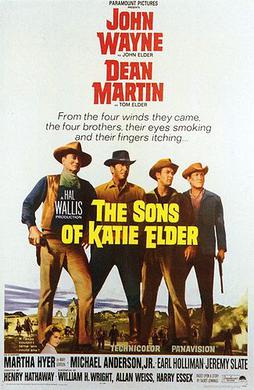
The Sons of Katie Elder

At the height of his long and very popular career in 1964, John Wayne was diagnosed with lung cancer. He underwent surgery to remove one of his lungs and two ribs, putting him out of commission for awhile. Production was even delayed on the movie he was working on, but he returned following the surgery and a cancer-free Wayne returned with a bang, bringing his usual imposing presence to the criminally underrated 1965 western, The Sons of Katie Elder.

It's been 10 years since gunfighter John Elder (Wayne) has returned home to Clearwater, Texas, but when news reaches him that his mother, Kate, has died, he returns home. There he finds his three younger brothers, Tom (Dean Martin), a gambler, Matt (Earl Holliman), a hardware store owner, and Bud (Michael Anderson Jr.), the youngest. Dealing with the guilt of not having seen his mother in years, John and his brothers find out their father was killed just six months earlier under suspicious circumstances. The Elder ranch is now owned by Morgan Hastings (James Gregory), but no one is quite sure how he came to be the owner. The Elders want some answers as to what exactly happened, but mostly they're trying to do something for their long-suffering mother. John intends to do a right, proving that Kate's faith in her sons was well founded.

Coming back from cancer (although it would eventually kill him), this 1965 film marked a big of a turning point for the Duke. From here on in through the end of his career, Wayne could be accused more of playing himself repeatedly in more viewer-friendly, cookie-cutter movies. He knew what his fans liked, and he intended to give it to them. Take none of that as a negative, I love many of the post-1965 movies Wayne made. They're fun to watch and easy to digest. There are good guys and bad guys with little middle ground. You know how it will end before it even starts. Once again, the movie equivalent of comfort food. 'Sons' has a ton going for it, ranging from Elmer Bernstein composing one of his most underrated and memorable scores ever (listen to the main theme HERE) to the location shooting in Durango, Mexico and along the Rio Grande. It's the little things that count.  

There are better, more iconic westerns, but I think 'Sons' would be a fitting introduction to someone who either isn't a fan or just doesn't care for westerns. Above all else, this is a movie -- not just a western -- about family, in this case a family coming back together after years apart. Wayne is the oldest brother, John, a gunfighter who's name precedes him wherever he goes. Martin is the wily gambler, Holliman the button-down businessman, and Anderson Jr. the college dropout. The movie's best moments come from the quartet of brothers reuniting, talking, fighting, working to make the Elder name something to be proud of in their Ma's name. There isn't a weak performance in the bunch. The chemistry is spot-on, the dialogue crackles like four brothers actually would talk -- in love and fighting -- and when the time comes they put aside their differences to work together.

Who ends up being one of the more memorable characters is the never seen Katie Elder. We hear a lot about her from anyone who ever met her, not one person having something negative to say about her. Martha Hyer's Mary Gordon, the boarding house owner, gives a great monologue about Katie lying about her boys, telling the town they always sent money, always wrote to check in. Some of the best parts of Bernstein's score come in these quieter moments as both the Elders and the population of Clearwater reflect on Katie's passing. All she leaves behind is two worn dresses, a rocking chair, and a "legacy" of her four boys. The movie's final shot is a touching one, surprising for a western oater.

Not enough yet? Still haven't sold you on this one? 'Sons' has one of the best supporting casts to come out of a 1960s western. Start with Gregory as Hastings, the businessman looking to put Clearwater on the map, no morals needed. A young Dennis Hopper plays Hastings' squirrelly son, Dave. Western vet and character actor Paul Fix is a scene-stealer as Sheriff Billy Wilson, an old friend of the Elders trying to keep peace in his town with fiery deputy, Ben Latta (Jeremy Slate in a solid supporting role), at his side. In a small but key role, George Kennedy is particularly intimidating as Curley, a hired gun working for Hastings. Also look for John Doucette, John Qualen, Sheldon Allman, and Strother Martin in supporting roles.

From director Henry Hathaway, 'Sons' is never listed as one of the all-time western greats or even among John Wayne's best. Why? I'm not sure. There isn't a ton of action, most of the gunplay saved for the last 30 minutes, including a high tension shootout in El Saltito, Mexico, a gorgeous and familiar location for western fans. The story is very much more interested in characters and their dynamic than making a shoot 'em up flick. It's a wise choice. The script is about as perfect as a western can get, and the cast beyond perfect. Underrated in any number of categories, and one all movie fans should be able to enjoy -- western or not.

P.S. Watch the movie and tell me otherwise. I'm convinced Dean Martin's Tom is supposed to die in the end. One throwaway line saves him, but it always felt tacked on to me. Any opinions?

The Sons of Katie Elder <---trailer (1965): ****/****

Wednesday, January 5, 2011

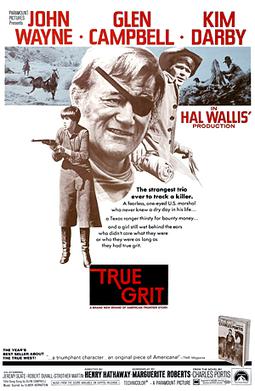
True Grit (1969)

Through a career that spanned four decades by the time 1969 had rolled around, John Wayne had somehow only been nominated for one Oscar in his entire career.  His part in 1949's Sands of Iwo Jima earned him a Best Actor nod which he would lose to Broderick Crawford in All the King's Men.  My complaint isn't that Wayne lost, but he had some excellent parts during his career that included The Searchers, The Quiet Man, Red River, and She Wore a Yellow Ribbon among others.  Well, in 1969 Wayne won his first and only Oscar for his performance in True Grit, an award that obviously came about because of that movie but was almost a symbolic Lifetime achievement award.

Recently this flick has been in the news because the Coen brothers remade it with their movie hitting theaters in the last few weeks.  My worry was that it was a movie that didn't need to be remade so why touch it?  Honestly, the 1969 version isn't a great western, but it is remembered so fondly because of what it meant for John Wayne, his career and his fans.  It's a pretty standard oater and a good example of the type of movies Wayne made at this later point in his career.  Familiar story, good vs. bad, lots of recognizable faces, and nothing really groundbreaking.  But in the end, it's entertaining and a pleasant enough way to pass a couple of hours.

For those not familiar with the story, here's a basic description. The 1969 and 2010 versions are pretty identical story-wise, but here goes. Teenager Mattie Ross (Kim Darby) travels to Fort Smith, Arkansas in 1880 looking for help in tracking down the man, Tom Chaney (Jeff Corey), who gunned down her father in cold blood. She finds no takers other than U.S. Marshal Rooster Cogburn (Wayne), a one-eyed, drunk who is a few years past his prime.  With a Texas Ranger, La Beouf (country singer Glen Campbell), Mattie and Rooster head into the Indian territory to hunt down Chaney and bring him back, hearing rumors he has joined up with outlaw Lucky Ned Pepper (Robert Duvall) and his gang.

Call it his best performance if you want (I don't think it's even close, he had much better) but this may be the one Wayne is most remembered for.  Criticisms aside, and I don't have many, but he had better parts that showed off his ability, Wayne does deliver a great performance and one that he fully deserved his Oscar for.  To a certain point, he is playing a caricature of himself.  He later joked that if he knew all it would take to win an Oscar was put on an eye patch he would have done it years before.  Wayne was an underrated comedic actor, and his Rueben 'Rooster' J. Cogburn shows that off.  He's rough and ready but has a softer side to when it comes to Mattie who can both drive him nuts and have him develop a fatherly bond with her at the same time.  Watch his Oscar acceptance speech HERE for a simple, effective and very moving look at Wayne and this part which finally earned him some Academy Award consideration.

So Wayne is obviously the biggest selling point here, but the problem is what else is there to sell?  As good as Wayne is as Rooster, his two main supporting parts are about as awful as they can be. The Mattie character is key, and as was the case with the remake, annoying but endearing in an odd way.  You're supposed to root for in spite of how ridiculously annoying, how brutally honest she is.  Darby just can't manage it in one of the most grating performances I've ever come across.  You just can't get behind this character.  A similar problem exists for Campbell as Texas Ranger La Beouf.  First, this country singer can't act a lick.  His character is supposed to be the polar opposite of Rooster, but just like Darby's Mattie it's hard to find a reason to like him.  If nothing else, his character redeems himself in the end...twice actually.  Still, it's not enough to save the part.  Check out the remake for how these characters should and could have been played.

Having watched both versions in little less than a week, I had to laugh at the idea that the Coen brothers did something vastly different with their version. Working off the Charles Portis novel, whole scenes, whole exchanges of dialogue are exactly the same between the two movies.  The tone is obviously different -- more light-hearted here -- and the only huge difference is the period authentic dress, dialogue, and accuracy in general.  Director Henry Hathaway films this story in Mexico, California and Colorado and ends up with a beautifully photographed film that looks absolutely nothing like the setting it takes place in, but that's just a minor detail, right? Elmer Bernstein's score sounds like a mix of a lot of his movies, but not necessarily in a bad way.  You'll notice a lot of familiar notes if you're familiar with his work at all, but the main theme is a good one.

You can't help but compare the two, and all I could come up with involving both was that the story itself is lacking something.  Portis was known for straightforward stories that didn't pull punches.  If anything, True Grit is too simplistic, too straightforward.  At times, it's even a little dull.  This is a movie about characters, and for the most part they're interesting even if we don't like them.  Story gets lost in the shuffle at times, but sit back and enjoy getting to know the main characters.  Of the rest of the cast, Duvall makes basically a small cameo, Jeremy Slate and Dennis Hopper are two of his gang, and Strother Martin is a haggling horse trader who incurs Mattie's wrath.

True Grit <---trailer (1969): ***/****

Monday, May 10, 2010

Hell's Angels '69

By the late 1960s, movie studios seemed to start catching on that the same-old movies weren't appealing to audiences so there were releases like Bonnie and Clyde, The Graduate, Easy Rider, among many more.  They reflected the changing times that were seeing a hippie/drug culture grow bigger and bigger, basically groups that were fed up with the status-quo and society's "norms."  Easy Rider specifically opened up a whole new genre of movies that had only been touched upon in the previous decade or so.

I don't know if it has an official name, but let's call it the biker genre where motorcycle gangs roamed the country causing havoc wherever they went.  I've only seen a couple, but from what I've read they were typically low-budget, drive-in type movies that cost as much to make as people spent to get into the drive-in or theater.  But I'll say it again, low budget doesn't mean bad.  It can be appealing in a lot of ways.  Last week's TCM Underground movie was called Hell's Angels '69, released in 1969 at the height of these biker movies.  Even though the IMDB rating is pretty low at 5.0/10 -- give or take a few decimal points -- the movie is pretty good, probably due to the talent involved.

Heading west on their motorcylces, brothers Chuck (Tom Stern) and Wes (Jeremy Slate) meet a gang of Hell's Angels and do their best to start off on good terms with these tough, very anti-social bikers.  The Angel's are a little skeptical of them but allow the brothers to ride along with them a little while as they all continue west.  Chuck and Wes though have a plan that unbeknownst to the Angel's involves them.  The brothers plan to break off from the group and head into Las Vegas where they'll be staying at Caesar's Palace.  Years of preparation has gone into putting this plan into action...they're going to knock off the casino for all the money they can carry using the Hell's Angels as a diversion.

Think of this as the original Ocean's 11 except instead of Frank Sinatra and the Rat Pack we get a gang of dirty, long-haired bikers.  It's one of the more unlikely heist movies I've come across, but at the same time, it's one of the better ones because of the story's simplicity.  The robbery itself is so simple -- even with the diversion -- that it surprised me that it didn't have a twist.  The last 30 minutes are the aftermath of the casino robbery as a Las Vegas detective (G.D. Spradlin, Senator Geary from Godfather II) tries to piece everything together while the brothers put their escape plan into effect.  Don't be disappointed though, the bikers figure out they've been duped and head out on the vengeance trail.  The movie is named after them so it's not like they'd disappear at the best part.

With B-movies, you have to expect a certain amount of cheese from the proceedings, but for the most part, 'Angel's' is free of it.  Sure, there is a lot of footage of the gang riding around, doing tricks, riding through Vegas, that does nothing to advance the story at all, but that's to be expected to a certain point.  It looks like Stern and Slate did a fair share of their own riding so that's always a positive too.  With one exception of an actor I recognized from another movie, the Angel's are played by actual members of the gang out of Oakland.  I won't post links because for most this was their only role, but it adds a sense of reality and for lack of a better word, coolness, that these bikers are authentic.

As the brothers leading the charge, Stern and Slate do double duty here, writing the script together while Stern also produced and put up a lot of his own money to get the movie made.  They had worked together the year before in The Devil's Brigade so I'd assume they met there and formed a fast friendship.  Because they both had something invested in the movie, it comes across better.  Stern was only in a handful of movies, and Slate was typically a supporting player so it's definitely cool to see them step into starring roles.  For one, they look alike, and they have a definite chemistry together so the brothers come across as very believable.  There are two twists -- one more important than the other -- in the last half hour that involve their backgrounds and their motivation for the robbery.

The story never really lags, but two key scenes stand out to me as out of the ordinary for a drive-in B-movie.  The build-up to the heist, the robbery and the aftermath are handled nicely in an exciting way that keeps you guessing as to what's going to happen.  Then, in the finale, there's a tension-filled chase on dirtbikes (SPOILERS watch it HERE) as the brothers run from the Hell's Angels.  The ending is a bit of a shocker, but it also leaves it open for your own interpretation as to their situation.  Surprisingly good low budget movie, and certainly a strong introduction to the all-powerful biker genre of the late 1960s.

Hell's Angel's '69 <----trailer (1969): ***/****