I remember watching 1999's The Talented Mr. Ripley with the family, a rental from Blockbuster (YES, a video store) on a Saturday night. Before I could really appreciate what was going on, maybe even accurately describe it, I know I liked the creepy, stylish thriller. It is an uncomfortable, beautifully shot film with a handful of interesting performances. Wouldn't you know it though? It isn't the first film based off Patricia Highsmith's novel of the same name. That would be 1960's Purple Noon.
Hired by a rich businessman in San Francisco, young Tom Ripley (Alain Delon) has been sent to Italy with a job, a potentially very lucrative job. Tom has been hired to find Philippe Greenleaf (Maurice Ronet), the businessman's son, somewhere in Italy and bring him home, receiving $5,000 for his troubles if he can pull it off. Upon meeting Philippe though, Tom forms an unlikely friendship with the vain, egotistical and spoiled young man. It is a friendship of extreme highs and lows, Philippe constantly pushing and testing Tom. Finally with a deadline fast approaching, Tom decides he's has just about enough, especially when Philippe flat-out tells him he won't leave Italy to return to San Francisco. Deciding he wants more than just the delivery fee for his services, Tom puts a drastic plan into action, a plan that will need all sorts of luck to pull off. Can he do it? Can he get away with it?
Just another reason to always be on the lookout for those hidden gems that are out there. As a fan of the 1999 Mr. Ripley, I was curious to see how this 1960 French version differed, if at all. I haven't read Highsmith's source novel, but I intend to now. There are differences, but the basic gist is there throughout as the two films follow a similar formula. Director Rene Clement has a movie here dripping with style, a style that's pretty effortless. His camera lingers for long, uninterrupted shots that keep the focus on his stars and cast. The music by Nino Rota is underplayed, adding a sinister touch to the developing thriller, and yes, filming on location in Italy turned out to be a good thing. Who knew?!? The main backdrops are both Rome and Naples, both Italian cities adding a depth and visual look to the story. It is a sun-drenched beautiful movie, beginning to end.
Over recent years, I guess I can say I "discovered" Alain Delon. The French actor didn't star in a ton of American movies, but I stumbled across him as I watched director Jean-Pierre Melville's French heist/crime thrillers, Delon a favorite star to work with. Way back in 1960 though, he was a relative unknown having only acted in a handful of smaller scale movies. Given his first starring role in a major release, Delon doesn't disappoint. This is one creepy, underplayed and sinister performance, Delon doing it with ease and adding a sense of charm to the ever-creepier proceedings. Delon's Tom Ripley is a mystery, a man from a lower class background who sees the potential (however dark and morbid) to better himself. He adds some great touches to that morbidity, reveling in the moment when he should be horrified at what he's just done. A frightening performance, one that pulls you in to see if somehow, some way, Tom can pull it all off.
This was Delon's movie, and what a performance. That said, there isn't a weakness in the entire cast that features a handful of other key parts. Ronet is exceptionally unlikable as Philippe, the worst kind of person who's charming and good-looking and knows it, pushing the limits with everyone and anyone to see what he can get away with, especially Tom. Considering how Philippe treats him, you don't give a pass to Tom, but you at least understand what drove him to do what he does. Marie Laforet plays Marge, Philippe's fiance who is another frequent target of his outbursts, finding a friend of sorts in sympathetic Tom. Also look for Erno Crisa as a police inspector, Frank Latimore as a partying friend of Philippe's, and Billy Kearns as a more polished, suspicious friend of Philippe's.
I love movies like this with a story that's hanging on the edge. Will our protagonist be caught? Will he somehow pull it off? As I mentioned before, it's not that we're rooting for him, but that doesn't take away from the suspense. There are more scenes than I can mention, Tom's delicate plan hanging in the balance, maybe one mistake from everything blowing up in his face. The ending delivers an excellent twist too, one different from the 1999 version, and I'm curious to see what the novel's version is. A beautiful stylish movie with a scene-stealing, sinister Delon. A very easy movie to recommend.
Purple Noon (1960): ***/****
The Sons of Katie Elder
"First, we reunite, then find Ma and Pa's killer...then read some reviews."
Showing posts with label French Cinema. Show all posts
Thursday, July 3, 2014
Thursday, February 27, 2014
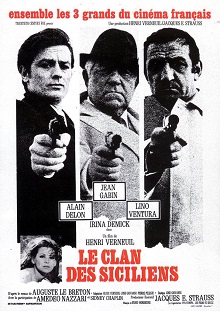
The Sicilian Clan
Well, here we are again, and it's been too long. Mostly because they're not readily available in the U.S., I have to search out Euro-crime thrillers from the 1960s and 1970s on Netflix, on Youtube, and occasionally random channels on TV. So when I do find one, I better savor it, right? Not an issue with 1969's The Sicilian Clan, a very stylish, very easy movie to like.
About to be sent to trial over the murder of two police officers, accused killer and thief Roger Sartet (Alain Delon) instead manages a daring escape aided by a former partner in crime, Aldo (Yves Lefebvre). In exchange for helping him pull off the escape, Sartet agrees to work with Aldo's family, the Manalese clan, a small-scale but successful Sicilian crime family, headed by patriarch Vittorio (Jean Gabin). Their plan? Take down a heavily guarded diamond exhibit displayed in Rome, state of the art technology intended to trip them up at any given moment. It seems an impossible, even suicidal objective with virtually no shot of succeeding. With some help from an American mafioso counterpart, Sartet and the Manalese clan put a plan into action though. It's as daring as they come, but some rivalries and personal motivations threaten to tear it apart before the heist is ever put into action. Their time is limited too, the police commissioner, Le Goff (Lino Ventura), obsessively searching for Sartet.
These movies never get old. Okay, well that's not completely true. There are some duds, but even the duds usually have something worth recommending. This one from director Henri Verneuil is a gem so no worries in that department. When it works, it just does, plain and simple. There is a style that helps carry the sub-genre from one movie to another. The on-location shooting never hurts, especially here in Paris, but the music goes a long way too. Here it's one of the best composers ever, Ennio Morricone providing a score that's equal parts playful and catchy with darker samples as needed. Listen to a sample HERE. For me though, the most appealing part of the Euro-crime genre is simple. These movies are cynical, brutal and dark. A majority of the stories play like tweaked American film noirs. Crime doesn't pay, the crooks are pretty nasty, the cops sometimes more so, and we're rarely talking about a happy Hollywood ending.
Released in 1969, this French crime thriller's appeal is more than obvious. One movie that stars Alain Delon, Lino Ventura and Jean Gabin?!? These were three iconic actors in France, internationally, in the genre, in all sorts of ways, so to see them working together in a single movie is just a lot of fun. There are lots of characters, but the ensemble cast leaves the focus on this trio. Delon is one of my favorites, his cool, calm, even icy demeanor just reflecting well as the anti-hero you can't help but like. Gabin is the smooth one here though, his Vittorio almost monotone in his delivery. His facial expressions almost never change, nothing rattling him. Even when things go awry, he calmly deals with, internalizing the rage. As for Ventura, it's cool to see him in a non-villain role, his Le Goff an experienced police officer who becomes almost obsessed with catching the murdering Sartet. All characters/actors that are capable of carrying a movie on their own, working together in a very worthwhile ensemble.
Who else to look out for? Those are the most recognizable names, but there's some cool supporting parts. Vittorio's sons include Lefebvre and Marc Porel, his son-in-law played by Philippe Baronnet, all three taking active parts in their crime family. Aldo's wife, Jeanne, is played by Irina Dernick, a Frenchwoman who takes a liking to Delon's Sartet as a fellow Frenchman as she's not used to living with all these Sicilians. Amedeo Nazzari is excellent as Tony, an American mobster who's worked with Vittorio in the past, working together again to pull off this diamond heist. Tony sends one of his men, Sydney Chaplin playing the alcoholic crook, Jack. Danielle Volle has a small but necessary (and good) part as Sartet's sister, worried about her brother's well-being.
And now for that heist. This is a genre that's done just about everything it can do to throw something new and original and fresh at the audience. Well, kudos to you The Sicilian Clan. This is definitely something new. When the diamond exhibit is introduced, I thought I was watching Rififi or Le Cercle Rouge (actually released a year later in 1970), but I was in for a surprise. 'Sicilian' doesn't go for the status quo....at all. This French crime thriller definitely comes up with something new and different, Sartet, Vittorio and the Manalese clan working with Tony and his New York mobsters to pull off the job. No spoilers here, the heist coming together nicely. If you think about it, there is a flaw in their plan that involves kidnapping -- it's rather unnecessary if you ask me -- but you get so caught up in what they're doing it isn't a huge issue. It becomes far more about 'Can they pull it off?'
But as Euro-crime thrillers have taught me, that ending.....well, the heist is usually the easy part. It's the fallout that provides the most drama. Again, I'm not going to spoil how it develops because even though it is hinted at in the build-up, it gets lost in the shuffle. When it does reveal itself, yeah, it works after some initial issues I had with it. The twist comes from a special place in the Mafia family lexicon. Don't....go....against....the....Family. That's it. Don't mess it up, and you'll probably be okay. It is quite an ending, very appropriate to the general darkness of the genre. An excellent movie, one very much worth catching up to.
The Sicilian Clan (1969): *** 1/2 /****
About to be sent to trial over the murder of two police officers, accused killer and thief Roger Sartet (Alain Delon) instead manages a daring escape aided by a former partner in crime, Aldo (Yves Lefebvre). In exchange for helping him pull off the escape, Sartet agrees to work with Aldo's family, the Manalese clan, a small-scale but successful Sicilian crime family, headed by patriarch Vittorio (Jean Gabin). Their plan? Take down a heavily guarded diamond exhibit displayed in Rome, state of the art technology intended to trip them up at any given moment. It seems an impossible, even suicidal objective with virtually no shot of succeeding. With some help from an American mafioso counterpart, Sartet and the Manalese clan put a plan into action though. It's as daring as they come, but some rivalries and personal motivations threaten to tear it apart before the heist is ever put into action. Their time is limited too, the police commissioner, Le Goff (Lino Ventura), obsessively searching for Sartet.
These movies never get old. Okay, well that's not completely true. There are some duds, but even the duds usually have something worth recommending. This one from director Henri Verneuil is a gem so no worries in that department. When it works, it just does, plain and simple. There is a style that helps carry the sub-genre from one movie to another. The on-location shooting never hurts, especially here in Paris, but the music goes a long way too. Here it's one of the best composers ever, Ennio Morricone providing a score that's equal parts playful and catchy with darker samples as needed. Listen to a sample HERE. For me though, the most appealing part of the Euro-crime genre is simple. These movies are cynical, brutal and dark. A majority of the stories play like tweaked American film noirs. Crime doesn't pay, the crooks are pretty nasty, the cops sometimes more so, and we're rarely talking about a happy Hollywood ending.
Released in 1969, this French crime thriller's appeal is more than obvious. One movie that stars Alain Delon, Lino Ventura and Jean Gabin?!? These were three iconic actors in France, internationally, in the genre, in all sorts of ways, so to see them working together in a single movie is just a lot of fun. There are lots of characters, but the ensemble cast leaves the focus on this trio. Delon is one of my favorites, his cool, calm, even icy demeanor just reflecting well as the anti-hero you can't help but like. Gabin is the smooth one here though, his Vittorio almost monotone in his delivery. His facial expressions almost never change, nothing rattling him. Even when things go awry, he calmly deals with, internalizing the rage. As for Ventura, it's cool to see him in a non-villain role, his Le Goff an experienced police officer who becomes almost obsessed with catching the murdering Sartet. All characters/actors that are capable of carrying a movie on their own, working together in a very worthwhile ensemble.
Who else to look out for? Those are the most recognizable names, but there's some cool supporting parts. Vittorio's sons include Lefebvre and Marc Porel, his son-in-law played by Philippe Baronnet, all three taking active parts in their crime family. Aldo's wife, Jeanne, is played by Irina Dernick, a Frenchwoman who takes a liking to Delon's Sartet as a fellow Frenchman as she's not used to living with all these Sicilians. Amedeo Nazzari is excellent as Tony, an American mobster who's worked with Vittorio in the past, working together again to pull off this diamond heist. Tony sends one of his men, Sydney Chaplin playing the alcoholic crook, Jack. Danielle Volle has a small but necessary (and good) part as Sartet's sister, worried about her brother's well-being.
And now for that heist. This is a genre that's done just about everything it can do to throw something new and original and fresh at the audience. Well, kudos to you The Sicilian Clan. This is definitely something new. When the diamond exhibit is introduced, I thought I was watching Rififi or Le Cercle Rouge (actually released a year later in 1970), but I was in for a surprise. 'Sicilian' doesn't go for the status quo....at all. This French crime thriller definitely comes up with something new and different, Sartet, Vittorio and the Manalese clan working with Tony and his New York mobsters to pull off the job. No spoilers here, the heist coming together nicely. If you think about it, there is a flaw in their plan that involves kidnapping -- it's rather unnecessary if you ask me -- but you get so caught up in what they're doing it isn't a huge issue. It becomes far more about 'Can they pull it off?'
But as Euro-crime thrillers have taught me, that ending.....well, the heist is usually the easy part. It's the fallout that provides the most drama. Again, I'm not going to spoil how it develops because even though it is hinted at in the build-up, it gets lost in the shuffle. When it does reveal itself, yeah, it works after some initial issues I had with it. The twist comes from a special place in the Mafia family lexicon. Don't....go....against....the....Family. That's it. Don't mess it up, and you'll probably be okay. It is quite an ending, very appropriate to the general darkness of the genre. An excellent movie, one very much worth catching up to.
The Sicilian Clan (1969): *** 1/2 /****
Labels:
1960s,
Alain Delon,
French Cinema,
Heist movies,
Jean Gabin,
Lino Ventura
Wednesday, August 14, 2013
Shoot the Piano Player
Taking a film class in my college years, I was introduced to the French New Wave with an example here and there. I wasn't especially impressed, but I could at least appreciate what the new type of film accomplished. They broke with tradition in terms of storytelling, camera techniques and even just what the actual film could get away with showing audiences. Often enough, I think these films become too self consciously obnoxious, begging audiences to appreciate how original and unique they are. Well, I found one I liked, 1960's Shoot the Piano Player.
Working at a small but successful bar in Paris, Charlie Kohler (Charles Aznavour) lives a quiet life playing the piano for bar patrons on a nightly basis. Trying to forget about an incident from his past, he's content to live his life, play the piano and care for his younger brother, Fido (Richard Kanayan). One night, his brother, Chico (Albert Remy), comes running into the bar, begging him for help because he's got two double-crossed mobsters on his tail. Charlie helps him escape, but the mobsters come looking for him in hopes of getting some answers as to his brother's whereabouts. He does his best to avoid them, hiding out with the help of a longtime crush and co-worker at the bar, Lena (Marie Dubois). Charlie thinks he's managed to shake them, but far from it. The mobsters go after Fido instead to get to Charlie that will hopefully lead to Chico too.
This is a film that defies a simple plot explanation. From director Francois Truffaut, 'Shoot' plays like a tribute on steroids to American crime and film noir stories. It is based off a novel by noir author David Goodis with some pretty major tweaks. Truffaut set out to do something different that audiences hadn't seen, and he succeeds. The opening 10 minutes meander to say the least, following Chico on the run in the Paris night as he talks for minutes (literally) with a complete stranger about marriage. Charlie isn't even the focus of the story until 20 minutes in. A long flashback is dropped into the story explaining Charlie's past and then goes right back to the present time. It's never difficult to follow, but it does force viewers to keep you on your toes, especially with some fast-moving subtitles. I can only imagine what 1960 audiences thought when they watched this one.
Some unique storytelling techniques are one thing, but where Truffaut and the New Wave directors set themselves apart from the norm was in terms of style. His camerawork is aggressive and right there with the action. He follows the action close-up, walking with characters, putting a camera in the front seat of the car. There is a touch of that independent, roguish filmmaking with the camera. Some edits and cuts are rough, other scene wipes coming out of nowhere. More than that, it's how Truffaut pushed the limits. A prostitute (Michele Mercier) climbs into bed with Charlie topless and sits there for several seconds. First off, American movies were still shy about actual sex on-screen (even the implication), much less show nudity. Later, one of the mobsters (Claude Mansard) admits he once wore women's panties, capping off an odd conversation with his partner (Daniel Boulanger) about sex and how all women want "It." Can you imagine any of that in an American film from 1960? Even a little? Um....no.
With so many new techniques in storytelling and camerawork going on, the characters get a tad lost in the shuffle at times. The best though is Aznavour -- a French singer, songwriter and actor -- as Charlie, a quiet, shy diminutive piano player. It's a "hero" unlike any I've seen in a film noir, a hero of sorts that constantly questions what he should, his voiceover narration providing some really funny moments (like THIS one). In a weird way, we feel sympathetic for him, not because he's a particularly sympathetic character, but because there's this almost pathetic aura hanging over him. Whatever it is, Aznavour does a fine job. Mansard and Boulanger similarly play against type as the pursuing henchmen. They're not just killing machines; they have a sense of humor, they argue. It's just one more thing that tries to be different -- and succeeds in most ways -- from the norm in a familiar genre.
More than just the stylistic differences is Truffaut's ability to juggle so many different tones in his ever-moving story. It is a romance, especially Charlie's explained past with a former love (Nicole Berger) but also his current relationships with Lena and Clarisse. It is a film noir, Charlie forced to go on the run to protect himself and Lena. Most surprisingly, it can be really funny. Mansard's hit man says "May my mother drop dead if I'm not telling the truth" followed by a cutaway of an older woman keeling over and dying. It's incredibly dark, but it works. All these different ingredients just shouldn't work so well, but they do. The pieces fit together like a puzzle for the better.
So while things may meander around a bit, introducing characters and backgrounds, Truffaut throwing different things are way.....well, because he can. Too often the French New Wave films were condescending in their unique qualities, but 'Shoot' manages to keep it unique and original without being too cute. I liked it a lot, and that's more than I can say for so many other films from the genre.
Shoot the Piano Player (1960): ***/****
Working at a small but successful bar in Paris, Charlie Kohler (Charles Aznavour) lives a quiet life playing the piano for bar patrons on a nightly basis. Trying to forget about an incident from his past, he's content to live his life, play the piano and care for his younger brother, Fido (Richard Kanayan). One night, his brother, Chico (Albert Remy), comes running into the bar, begging him for help because he's got two double-crossed mobsters on his tail. Charlie helps him escape, but the mobsters come looking for him in hopes of getting some answers as to his brother's whereabouts. He does his best to avoid them, hiding out with the help of a longtime crush and co-worker at the bar, Lena (Marie Dubois). Charlie thinks he's managed to shake them, but far from it. The mobsters go after Fido instead to get to Charlie that will hopefully lead to Chico too.
This is a film that defies a simple plot explanation. From director Francois Truffaut, 'Shoot' plays like a tribute on steroids to American crime and film noir stories. It is based off a novel by noir author David Goodis with some pretty major tweaks. Truffaut set out to do something different that audiences hadn't seen, and he succeeds. The opening 10 minutes meander to say the least, following Chico on the run in the Paris night as he talks for minutes (literally) with a complete stranger about marriage. Charlie isn't even the focus of the story until 20 minutes in. A long flashback is dropped into the story explaining Charlie's past and then goes right back to the present time. It's never difficult to follow, but it does force viewers to keep you on your toes, especially with some fast-moving subtitles. I can only imagine what 1960 audiences thought when they watched this one.
Some unique storytelling techniques are one thing, but where Truffaut and the New Wave directors set themselves apart from the norm was in terms of style. His camerawork is aggressive and right there with the action. He follows the action close-up, walking with characters, putting a camera in the front seat of the car. There is a touch of that independent, roguish filmmaking with the camera. Some edits and cuts are rough, other scene wipes coming out of nowhere. More than that, it's how Truffaut pushed the limits. A prostitute (Michele Mercier) climbs into bed with Charlie topless and sits there for several seconds. First off, American movies were still shy about actual sex on-screen (even the implication), much less show nudity. Later, one of the mobsters (Claude Mansard) admits he once wore women's panties, capping off an odd conversation with his partner (Daniel Boulanger) about sex and how all women want "It." Can you imagine any of that in an American film from 1960? Even a little? Um....no.
With so many new techniques in storytelling and camerawork going on, the characters get a tad lost in the shuffle at times. The best though is Aznavour -- a French singer, songwriter and actor -- as Charlie, a quiet, shy diminutive piano player. It's a "hero" unlike any I've seen in a film noir, a hero of sorts that constantly questions what he should, his voiceover narration providing some really funny moments (like THIS one). In a weird way, we feel sympathetic for him, not because he's a particularly sympathetic character, but because there's this almost pathetic aura hanging over him. Whatever it is, Aznavour does a fine job. Mansard and Boulanger similarly play against type as the pursuing henchmen. They're not just killing machines; they have a sense of humor, they argue. It's just one more thing that tries to be different -- and succeeds in most ways -- from the norm in a familiar genre.
More than just the stylistic differences is Truffaut's ability to juggle so many different tones in his ever-moving story. It is a romance, especially Charlie's explained past with a former love (Nicole Berger) but also his current relationships with Lena and Clarisse. It is a film noir, Charlie forced to go on the run to protect himself and Lena. Most surprisingly, it can be really funny. Mansard's hit man says "May my mother drop dead if I'm not telling the truth" followed by a cutaway of an older woman keeling over and dying. It's incredibly dark, but it works. All these different ingredients just shouldn't work so well, but they do. The pieces fit together like a puzzle for the better.
So while things may meander around a bit, introducing characters and backgrounds, Truffaut throwing different things are way.....well, because he can. Too often the French New Wave films were condescending in their unique qualities, but 'Shoot' manages to keep it unique and original without being too cute. I liked it a lot, and that's more than I can say for so many other films from the genre.
Shoot the Piano Player (1960): ***/****
Tuesday, September 4, 2012
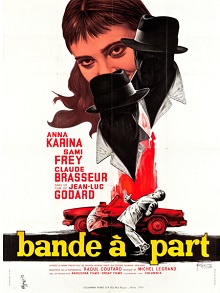
Band of Outsiders
From the two film classes I took in school to basically everything I've read about movies in general, French director Jean-Luc Godard is thought of as one of the most talented, innovative filmmakers to ever make a film. Why then can I not enjoy his films? Talent is one thing, but I've yet to truly enjoy one of them, including 1964's Band of Outsiders.
Living with her aunt in Paris, young, quiet Odile (Anna Karina) goes about her business without really offending anyone. At a English-speaking class she takes, Odile meets Franz (Sami Frey) and Arthur (Claude Brasseur), two friends who have both taken a liking to her. There is something else going on though because Odile told both men that her aunt's live-in boyfriend has thousands and thousands of dollars hidden away in the house, and she knows where it is. Both Franz and Arthur want to rob the house blind -- and Odile seems just fine with that -- but as the plan starts to develop, things go awry almost immediately.
I get it. I do. Godard is a freaky talented filmmaker. As a forerunner of the French New Wave that helped throw the accepted notions of filmmaking on its side, Godard was a director ahead of his time. His stories were darkly humorous, his characters far from perfect and were some of the first anti-heroes, but mostly it was his visual style that separated himself from the rest. With his camera, he was a master. As is the case here, Godard utilizes incredible tracking shots -- with characters walking and driving -- and generally just doesn't go for the status quo. Characters directly address the camera, and when they're not, that camera is moving around on a swivel like it's life depended on it.
In a time when a lot of movies just placed a camera in front of the action and just let things happen, it's a visual treat to watch a visually interesting movie to watch. It's hard to describe that because it sounds so criminally simplistic. These are great movies to watch. But to enjoy? I'm not there yet. The story and tone is hard to wrap my head around. Is it funny? Is it serious? Is it both? I'm okay with it bouncing back and forth a little bit, but not as much as 'Outsiders' does. The problem on top of that is simple though. The attempts at humor aren't funny. Franz and Arthur as movie characters are movie afficionados. In one "shootout," the duo blast away at each other, and after two or three minutes of stumbling and falling around, Arthur quasi-dies. Funny it is not, and worse than that, it's tedious humor.
The story never develops into anything interesting, and when the attempt is made, it's too late. A lousy story on top of dull, uninteresting characters though is basically a deal-breaker. Frey's Franz has no personality. His purpose for being there is to be Arthur's opposite; nice, polite and handsome. That's it. Brasseur's Arthur is pointedly aggressive, brutally honest and an obvious manipulator. The worst though is Karina's Odile, an innocent of sorts who gets in far over her head. The Odile character is one of the most obnoxious, mind-blowingly stupid I've ever seen in a movie. When the robbery plan comes to its execution, she starts flailing around, begging her partners in crime not to be her partners in crime. Oh, and these amateur crooks are stopped in their tracks by the ultimate security measure.....a locked door! Oh no, the injustice! How ever will our intrepid heroes make it through?!?
Because it is trying something different, I can't completely torch this movie. An obvious influence on Quentin Tarantino, a dance sequence (Yes, a dance sequence) is both bizarre and oddly appealing to watch (short clip HERE). Later, to "kill time," the trio visits the Louvre in record time. How do we see that? The three running through the Louvre in a series of uncut shots. It's almost surreal watching it. Is it surreal good though or surreal bad? It ends up being somewhere in between unfortunately. I'll keep looking for that Godard film I truly enjoy.
Band of Outsiders <---trailer (1964): **/****
Living with her aunt in Paris, young, quiet Odile (Anna Karina) goes about her business without really offending anyone. At a English-speaking class she takes, Odile meets Franz (Sami Frey) and Arthur (Claude Brasseur), two friends who have both taken a liking to her. There is something else going on though because Odile told both men that her aunt's live-in boyfriend has thousands and thousands of dollars hidden away in the house, and she knows where it is. Both Franz and Arthur want to rob the house blind -- and Odile seems just fine with that -- but as the plan starts to develop, things go awry almost immediately.
I get it. I do. Godard is a freaky talented filmmaker. As a forerunner of the French New Wave that helped throw the accepted notions of filmmaking on its side, Godard was a director ahead of his time. His stories were darkly humorous, his characters far from perfect and were some of the first anti-heroes, but mostly it was his visual style that separated himself from the rest. With his camera, he was a master. As is the case here, Godard utilizes incredible tracking shots -- with characters walking and driving -- and generally just doesn't go for the status quo. Characters directly address the camera, and when they're not, that camera is moving around on a swivel like it's life depended on it.
In a time when a lot of movies just placed a camera in front of the action and just let things happen, it's a visual treat to watch a visually interesting movie to watch. It's hard to describe that because it sounds so criminally simplistic. These are great movies to watch. But to enjoy? I'm not there yet. The story and tone is hard to wrap my head around. Is it funny? Is it serious? Is it both? I'm okay with it bouncing back and forth a little bit, but not as much as 'Outsiders' does. The problem on top of that is simple though. The attempts at humor aren't funny. Franz and Arthur as movie characters are movie afficionados. In one "shootout," the duo blast away at each other, and after two or three minutes of stumbling and falling around, Arthur quasi-dies. Funny it is not, and worse than that, it's tedious humor.
The story never develops into anything interesting, and when the attempt is made, it's too late. A lousy story on top of dull, uninteresting characters though is basically a deal-breaker. Frey's Franz has no personality. His purpose for being there is to be Arthur's opposite; nice, polite and handsome. That's it. Brasseur's Arthur is pointedly aggressive, brutally honest and an obvious manipulator. The worst though is Karina's Odile, an innocent of sorts who gets in far over her head. The Odile character is one of the most obnoxious, mind-blowingly stupid I've ever seen in a movie. When the robbery plan comes to its execution, she starts flailing around, begging her partners in crime not to be her partners in crime. Oh, and these amateur crooks are stopped in their tracks by the ultimate security measure.....a locked door! Oh no, the injustice! How ever will our intrepid heroes make it through?!?
Because it is trying something different, I can't completely torch this movie. An obvious influence on Quentin Tarantino, a dance sequence (Yes, a dance sequence) is both bizarre and oddly appealing to watch (short clip HERE). Later, to "kill time," the trio visits the Louvre in record time. How do we see that? The three running through the Louvre in a series of uncut shots. It's almost surreal watching it. Is it surreal good though or surreal bad? It ends up being somewhere in between unfortunately. I'll keep looking for that Godard film I truly enjoy.
Band of Outsiders <---trailer (1964): **/****
Thursday, June 14, 2012
A Man Escaped
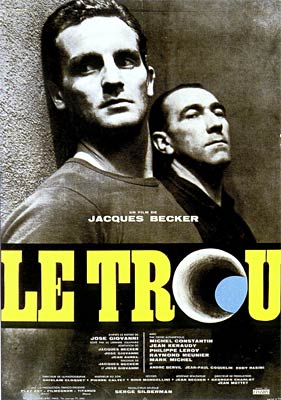
When I discovered a few years back the French New Wave movies of the 1950s and 1960s, I dove in headfirst. My first impression back in school -- Breathless -- was less than impressive, but one movie after another impressed me, especially the work of Jean-Pierre Melville and Jacques Becker, especially Becker's 1960 classic Le Trou. I couldn't help but think of that film while watching an earlier French film, 1956's A Man Escaped.
In the midst of World War II, a French resistance fighter, Fontaine (Francois Leterrier), is captured by German soldiers after blowing up an important bridge. He is transported to a prison packed with resistance and guerrilla fighters run by the Gestapo. Death hangs in the air, the prisoners almost to a man waiting to find out their sentence and when they will be executed. Fontaine knows his date is coming and decides to do something about it. In a heavily guarded prison with high walls surrounding the place, can Fontaine manage an escape? He has no supplies and little in the way of tools, but locked away in his own cell, all he's got is time to hatch a plan. With the Germans waiting though, maybe it isn't too much time.
There are prison escape movies, and then there's this movie. From director Robert Bresson, 'Escaped' sets the groundwork in one way or another for basically any movie made since even remotely focusing on a prison escape. It's influences are easy to see from 1960's Le Trou to Escape from Alcatraz starring Clint Eastwood and countless other examples. Bresson films on the smallest of scales, right at the ground level on an ultra-personal level. There's only a few sets -- Fontaine's cell, the wash room, a hallway -- and only a few detours, one being Fontaine's desperate escape attempt in the opening scene that goes unseen on the streets of Paris. Filmed in black and white with dialogue held to a minimum, this is a minimalist escape story at its best. Throw in uses of Mozart for parts of the soundtrack, and you've got a winner.
I try to avoid using 'minimalist' as a description because I feel like I misuse it at times, and basically, it can sound kind of movie reviewer pretentious. But in 'Escaped,' it's a dead-on description. There is one pointed objective here. E-S-C-A-P-E. There's nothing else. We learn little about Fontaine, and what we do learn is enough. His options are simple; escape or die. Doesn't get much more nerve-wracking than that, does it? Even the WWII setting just gets the ball rolling. It could be looked at as an existential, artsy look at one man's desperate attempts at survival. This could be any country, any era, any time period as long as you've got an imprisoned man desperately seeking freedom. No wasted subplots or extraneous background. This is a meat and potatoes kind of story.
Now having said that, this admittedly won't be everyone's cup of tea. Just 99 minutes, the dialogue is truly kept to a minimum. Long scenes in Fontaine's cell have him quietly working as his escape; quietly chipping and hacking at the door frame, knowing that at any second a guard could discover his plans. Other scenes have Fontaine walking through the prison halls, cleaning himself, all the while Leterrier providing narration as to his thoughts, mindset, objectives and how his plans are progressing. Bresson's shooting style is of a fly on the wall in an almost documentary-like feel. Little editing, little to no actual spoken dialogue, and a feeling of reality and confinement. I came away somewhat disappointed with the ending, but looking back on it, I shouldn't have. The whole movie is minimalist. Why was I expecting something different in the finale?
In one of the first examples of method acting, Leterrier is in basically every single scene, but like the minimalist story, his performance is underplayed and generally authentic. Somehow he stays calm throughout his attempt so even a little emotion would have been cool to see. He's not obsessed with escape -- visibly at least, his emotions are in check -- but it becomes an end all, be all objective. Leterrier does a great job with the straightforward and at times profound narration, using his eyes the rest of the time to get his message across. Charles Le Clainche (his only film role) has the best supporting part as Jost, a German soldier jailed for desertion who is thrown in Fontaine's cell with him. Other prisoners he comes across include Maurice Beerblock as Blanchet, Roland Monod as a priest, serving as the conscience of the prisoners, Jacques Ertaud as Orsini, Fontaine's cellmate across the hall, and Roger Treherne as Terry, an older prisoner with some freedoms.
I feel like I'm not doing a great job of selling this movie, but it most definitely deserves a watch. It is a movie that I can't see being made in any other time or place. This was a movie meant to be made in France in the 1950s as film and cinema was changing in a big way. Maybe not a movie you truly enjoy, but one you have to experience.
A Man Escaped <---trailer (1956): ***/****
In the midst of World War II, a French resistance fighter, Fontaine (Francois Leterrier), is captured by German soldiers after blowing up an important bridge. He is transported to a prison packed with resistance and guerrilla fighters run by the Gestapo. Death hangs in the air, the prisoners almost to a man waiting to find out their sentence and when they will be executed. Fontaine knows his date is coming and decides to do something about it. In a heavily guarded prison with high walls surrounding the place, can Fontaine manage an escape? He has no supplies and little in the way of tools, but locked away in his own cell, all he's got is time to hatch a plan. With the Germans waiting though, maybe it isn't too much time.
There are prison escape movies, and then there's this movie. From director Robert Bresson, 'Escaped' sets the groundwork in one way or another for basically any movie made since even remotely focusing on a prison escape. It's influences are easy to see from 1960's Le Trou to Escape from Alcatraz starring Clint Eastwood and countless other examples. Bresson films on the smallest of scales, right at the ground level on an ultra-personal level. There's only a few sets -- Fontaine's cell, the wash room, a hallway -- and only a few detours, one being Fontaine's desperate escape attempt in the opening scene that goes unseen on the streets of Paris. Filmed in black and white with dialogue held to a minimum, this is a minimalist escape story at its best. Throw in uses of Mozart for parts of the soundtrack, and you've got a winner.
I try to avoid using 'minimalist' as a description because I feel like I misuse it at times, and basically, it can sound kind of movie reviewer pretentious. But in 'Escaped,' it's a dead-on description. There is one pointed objective here. E-S-C-A-P-E. There's nothing else. We learn little about Fontaine, and what we do learn is enough. His options are simple; escape or die. Doesn't get much more nerve-wracking than that, does it? Even the WWII setting just gets the ball rolling. It could be looked at as an existential, artsy look at one man's desperate attempts at survival. This could be any country, any era, any time period as long as you've got an imprisoned man desperately seeking freedom. No wasted subplots or extraneous background. This is a meat and potatoes kind of story.
Now having said that, this admittedly won't be everyone's cup of tea. Just 99 minutes, the dialogue is truly kept to a minimum. Long scenes in Fontaine's cell have him quietly working as his escape; quietly chipping and hacking at the door frame, knowing that at any second a guard could discover his plans. Other scenes have Fontaine walking through the prison halls, cleaning himself, all the while Leterrier providing narration as to his thoughts, mindset, objectives and how his plans are progressing. Bresson's shooting style is of a fly on the wall in an almost documentary-like feel. Little editing, little to no actual spoken dialogue, and a feeling of reality and confinement. I came away somewhat disappointed with the ending, but looking back on it, I shouldn't have. The whole movie is minimalist. Why was I expecting something different in the finale?
In one of the first examples of method acting, Leterrier is in basically every single scene, but like the minimalist story, his performance is underplayed and generally authentic. Somehow he stays calm throughout his attempt so even a little emotion would have been cool to see. He's not obsessed with escape -- visibly at least, his emotions are in check -- but it becomes an end all, be all objective. Leterrier does a great job with the straightforward and at times profound narration, using his eyes the rest of the time to get his message across. Charles Le Clainche (his only film role) has the best supporting part as Jost, a German soldier jailed for desertion who is thrown in Fontaine's cell with him. Other prisoners he comes across include Maurice Beerblock as Blanchet, Roland Monod as a priest, serving as the conscience of the prisoners, Jacques Ertaud as Orsini, Fontaine's cellmate across the hall, and Roger Treherne as Terry, an older prisoner with some freedoms.
I feel like I'm not doing a great job of selling this movie, but it most definitely deserves a watch. It is a movie that I can't see being made in any other time or place. This was a movie meant to be made in France in the 1950s as film and cinema was changing in a big way. Maybe not a movie you truly enjoy, but one you have to experience.
A Man Escaped <---trailer (1956): ***/****
Wednesday, October 19, 2011
The Wages of Fear
I was first introduced to Henri-Georges Clouzot's 1953 classic film The Wages of Fear on late night TV, always a bad place to discover a movie. I didn't know it at the time, but I was watching a heavily cut version that was about 20 minutes short of the original 1953 release, including completely editing out the ending Clouzot intended. Sign of a good movie? I loved the edited version, but short of dropping $45 on the Criterion Collection DVD, I could never track down the longer version. Thanks Turner Classic Movies, it was worth the wait.
Might as well say this early. 'Fear' is one of the best movies ever made, an example of pure cinema, a movie that is criminally simplistic in its execution. This is a story of desperation and life and death, the extreme and foolhardy choices an individual will make to alter and hopefully better his life. If you're skeptical about watching a French movie or reading subtitles, get over yourself. Because of its subject matter, you can't help but feel a bit uncomfortable watching Clouzot's film, but that's the goal. Sit back and let this one wash over you.
In a remote region of South America, an oil well owned by an American company, Southern Oil Company (SOC), has caught fire. The only solution to handle the blaze is to blow up the well, sealing it off. The only problem? The nitroglycerin needed is hundreds of miles away in a decrepit little village full of international tramps and vagabonds. The company offers a huge payday to any drivers willing to try and attempt to deliver the nitro, one of the most unstable elements in explosives around. Four men are accepted, Mario (Yves Montand), Jo (Charles Vanel), Luigi (Folco Lulli), and Bimba (Peter van Eyck), the four splitting up to drive two trucks packed with the nitro. With thousands of dollars at stake, the two trucks set out on a 300-mile plus trip through hell where any bump in the road, any disruption at all could set the nitro off, killing the drivers in an instant. A suicide mission if there ever was, can this quartet pull off the job?
It is hard to put into words how ridiculously tense this 1953 French film really is. An early introduction of the power of nitroglycerin sets the stage when a single drop of the liquid touches the ground, producing a deafening roar in a confined setting. If a single drop produces that effect, what would a whole truckload produce if something went wrong? Almost 90 minutes of a 131-minute movie are spent on the road with the two trucks and their respective drivers, and you're waiting at the edge of your seats, living and dying with every bump, every noise, every little pothole in the road. That's all it will take to set it off, and in an instant life is gone and death takes over. It is an amazing movie to watch, a sick beauty to it all.
To amplify this incredible tension, Clouzot makes a brilliant decision. His first 45 minutes are almost painfully slow, laying out the groundwork of this desperate group of men in an isolated South American village. The only way out is a tiny airport. They need money to buy a ticket, but there's no work or jobs and so they waste away. These are desperate men, pushed to the limit where a suicide mission delivering nitro is seen as a positive. Through this first segment, we get to meet the players, Mario, a French playboy yearning for Paris, Jo, an aging gangster not as young or tough as he once was, Luigi, a hard-working Italian who discovers he may be dying of a lung disease, and Bimba, a Dutch pilot with a tortured past. It is slow going at times, but these scenes are needed. The adrenaline of the driving scenes are incredible on their own, but knowing the characters and their motivations? It amps that adrenaline up to an almost painful level. We want these characters to succeed. Slow at times? You bet, but completely necessary and a brilliant choice.
The performances here are primal and perfect, human beings at their most basic level; survival. Montand is one of my favorite actors, and his performance rivals his equally impressive turn in Le Cercle Rouge. His Mario is the main character, and one who isn't always a likable guy, or at least someone who's easy to like. He becomes obsessed with mission, willing to risk it all even when it would be so easy to turn back. Vanel is perfectly cast as his opposite, the new arrival in town who seems to have it all figured out. Only when his back is up against the wall does he realize he's not who he thought he was. Lulli and van Eyck aren't given the same screentime, but their performances are just as impressive, putting a desperation and a human edge on these two men. The director's wife Vera Clouzot plays Linda, Mario's girl in the village with William Tubbs playing O'Brien, the brutal, cynical local American head of SOC who hires the men for their mission.
The simplicity of the mission and the story on the whole is what sets this movie apart. A handful of sequences keep the momentum going from the second the two trucks -- a few miles apart -- leave the village for the oil well. The opener is a beat-up dirt road with two options. Floor it across the road, negating the bumps in a quick ride, or slowly go over it, taking significantly longer. Unable to communicate, what if the back truck decides to speed while the lead truck goes slowly? A second sequence is a hairpin turn on a mountainside, a rickety platform the only support the truck will have. The third is a giant boulder in the road, the four drivers using a tiny supply of nitro to blow it up. The last is a perilous drive through an oil-filled hole, the desperation weighing down on the drivers. These sequences are incredible to watch and be a part of. It's hard to express the power here of these scenes. They need to be seen to be believed and appreciated.
Now for the ending, one pretty typical of French films in the 1950s and 1960s. An epic downer, but in a way you wouldn't expect. The movie delivers its fair share of shocking moments, but Clouzot's ending is the most shocking without a doubt. Like the best surprise endings, it leaves you feeling like you've been punched in the stomach. The movie is one of the all-time bests, an incredibly dark, cynical look at human life and what drives us. How far would you go? Would you go through what these four men did? What's your limit?
Also worth checking out the American remake, one of the few remakes to rival the original, 1977's Sorcerer, which I reviewed a couple years back. Read the review HERE. It's an early review so bear with me. TCM offers three clips which you can watch HERE of 'Fear.'
The Wages of Fear <---trailer (1953): ****/****
Might as well say this early. 'Fear' is one of the best movies ever made, an example of pure cinema, a movie that is criminally simplistic in its execution. This is a story of desperation and life and death, the extreme and foolhardy choices an individual will make to alter and hopefully better his life. If you're skeptical about watching a French movie or reading subtitles, get over yourself. Because of its subject matter, you can't help but feel a bit uncomfortable watching Clouzot's film, but that's the goal. Sit back and let this one wash over you.
In a remote region of South America, an oil well owned by an American company, Southern Oil Company (SOC), has caught fire. The only solution to handle the blaze is to blow up the well, sealing it off. The only problem? The nitroglycerin needed is hundreds of miles away in a decrepit little village full of international tramps and vagabonds. The company offers a huge payday to any drivers willing to try and attempt to deliver the nitro, one of the most unstable elements in explosives around. Four men are accepted, Mario (Yves Montand), Jo (Charles Vanel), Luigi (Folco Lulli), and Bimba (Peter van Eyck), the four splitting up to drive two trucks packed with the nitro. With thousands of dollars at stake, the two trucks set out on a 300-mile plus trip through hell where any bump in the road, any disruption at all could set the nitro off, killing the drivers in an instant. A suicide mission if there ever was, can this quartet pull off the job?
It is hard to put into words how ridiculously tense this 1953 French film really is. An early introduction of the power of nitroglycerin sets the stage when a single drop of the liquid touches the ground, producing a deafening roar in a confined setting. If a single drop produces that effect, what would a whole truckload produce if something went wrong? Almost 90 minutes of a 131-minute movie are spent on the road with the two trucks and their respective drivers, and you're waiting at the edge of your seats, living and dying with every bump, every noise, every little pothole in the road. That's all it will take to set it off, and in an instant life is gone and death takes over. It is an amazing movie to watch, a sick beauty to it all.
To amplify this incredible tension, Clouzot makes a brilliant decision. His first 45 minutes are almost painfully slow, laying out the groundwork of this desperate group of men in an isolated South American village. The only way out is a tiny airport. They need money to buy a ticket, but there's no work or jobs and so they waste away. These are desperate men, pushed to the limit where a suicide mission delivering nitro is seen as a positive. Through this first segment, we get to meet the players, Mario, a French playboy yearning for Paris, Jo, an aging gangster not as young or tough as he once was, Luigi, a hard-working Italian who discovers he may be dying of a lung disease, and Bimba, a Dutch pilot with a tortured past. It is slow going at times, but these scenes are needed. The adrenaline of the driving scenes are incredible on their own, but knowing the characters and their motivations? It amps that adrenaline up to an almost painful level. We want these characters to succeed. Slow at times? You bet, but completely necessary and a brilliant choice.
The performances here are primal and perfect, human beings at their most basic level; survival. Montand is one of my favorite actors, and his performance rivals his equally impressive turn in Le Cercle Rouge. His Mario is the main character, and one who isn't always a likable guy, or at least someone who's easy to like. He becomes obsessed with mission, willing to risk it all even when it would be so easy to turn back. Vanel is perfectly cast as his opposite, the new arrival in town who seems to have it all figured out. Only when his back is up against the wall does he realize he's not who he thought he was. Lulli and van Eyck aren't given the same screentime, but their performances are just as impressive, putting a desperation and a human edge on these two men. The director's wife Vera Clouzot plays Linda, Mario's girl in the village with William Tubbs playing O'Brien, the brutal, cynical local American head of SOC who hires the men for their mission.
The simplicity of the mission and the story on the whole is what sets this movie apart. A handful of sequences keep the momentum going from the second the two trucks -- a few miles apart -- leave the village for the oil well. The opener is a beat-up dirt road with two options. Floor it across the road, negating the bumps in a quick ride, or slowly go over it, taking significantly longer. Unable to communicate, what if the back truck decides to speed while the lead truck goes slowly? A second sequence is a hairpin turn on a mountainside, a rickety platform the only support the truck will have. The third is a giant boulder in the road, the four drivers using a tiny supply of nitro to blow it up. The last is a perilous drive through an oil-filled hole, the desperation weighing down on the drivers. These sequences are incredible to watch and be a part of. It's hard to express the power here of these scenes. They need to be seen to be believed and appreciated.
Now for the ending, one pretty typical of French films in the 1950s and 1960s. An epic downer, but in a way you wouldn't expect. The movie delivers its fair share of shocking moments, but Clouzot's ending is the most shocking without a doubt. Like the best surprise endings, it leaves you feeling like you've been punched in the stomach. The movie is one of the all-time bests, an incredibly dark, cynical look at human life and what drives us. How far would you go? Would you go through what these four men did? What's your limit?
Also worth checking out the American remake, one of the few remakes to rival the original, 1977's Sorcerer, which I reviewed a couple years back. Read the review HERE. It's an early review so bear with me. TCM offers three clips which you can watch HERE of 'Fear.'
The Wages of Fear <---trailer (1953): ****/****
Thursday, August 5, 2010
Le Cercle Rouge
Before I started this blog a little over a year and a half ago, I had watched a handful of movies that I didn't feel like reviewing. Sure, it was only a week or two since I'd seen them, but as much as possible I wanted to review a flick with the flick fresh in my mind. One movie I really wanted to review was a Netflix rental that has quickly climbed to a non-existent list of my favorite movies (okay, I have a definitive Top 5), 1970's Le Cercle Rouge or for us non-French speaking moviegoers, The Red Circle. With some leftover b-day money, I bought the pricey Criterion Collection DVD, and 18 months later after initial viewing, here's the review.
Over a three-year span, French director Jean-PierreMelville had one of the best strings of movies ever for a director starting with Le Samourai in 1967, continuing with Army of Shadows in 1969 and wrapping up with 1970's Cercle Rouge. I've yet to see a Melville film I didn't enjoy, but 'LCR' was my favorite. It's a slower-paced heist movie that features the director's typically cool gangsters in a world where everyone looks out for themselves and anyone would turn you in if it would benefit them even a little bit. But more than that, it is a surprisingly deep look at the criminal underworld, and the way complete strangers bond and work together in strenuous situations...in this case a jewelry heist.
In Paris, three men are about to work together for the first time on a perfectly planned jewelry heist that will net them almost $20 million francs. There's Corey (Alain Delon), a recently released prisoner who has nothing left for him back home and vows to never return to prison. Supremely cool, calm and collected, nothing seemingly can get to him. Second is Vogel (Gian Maria Volonte), an escaped fugitive who accidentally meets Corey, the two forming a quick friendship when they realize how similar they are. Last there's Jansen (Yves Montand), a former cop and expert marksman struggling with a drinking problem, a man just looking for redemption and a second chance. But while these three conspire together to pull the jewelry heist, a police inspector (Andres Bourvil) investigates anything and everything he can about Vogel, wanting to catch the man who slipped through his grasp.
For fans of Melville, this is a prime example of when a director figures everything out in the moviemaking process, knowing exactly what he wants in a finished product. He puts it together here. His characters are loners, men of principle who even in the underworld hold honor and respect to a high degree. The gangsters wear suits, trench coats and hats, smoke cigarettes and drink hard liquor. There is always a cool, light jazz soundtrack playing over their actions. They populate late night clubs and lonely, dusty apartments. And no matter what, these guys are cool to the utmost. It is a highly stylized, very suave and most likely idealized view of the criminal underworld, but you know what? It doesn't matter. Melville drops you into this gangster's world, and you just go along for the ride.
We go into this world with the three men who've never worked together, and know very little about each other. But with little to no background on Corey (what was he in prison for?) or Vogel (why was he arrested?), Melville makes these characters who would be very easy to dislike the ones you side with. This is a performance that ranks with Le Samourai as Delon's best. His Corey is so quietly understated you wonder if Delon is even acting or just playing himself. In terms of pure cool, it doesn't get better than this character. The same for Volonte as Vogel, an intense part as this mysterious crook we know nothing about. Montand gets the most background for his character and doesn't disappoint. Separately, all three parts are perfect, but together, they're as good as it gets in movies. The scenes among the three are pitch perfect, each character knowing what is expected of them. These men are professionals and they know how to get the job done.
The tour-de-force scene is an almost 30-minute extended sequence with not a word spoken as Corey, Vogel and Jansen pull off the heist. With an obvious comparison to Jules Dassin's Rififi, Melville creates a tension that is hard to explain. You're so geared up during the scene because any sound, any sound at all, will spell doom for this criminal trio. The security system they're going up against features sensors, hidden locks, and a wide array of technology to deter them. In terms of pure moviemaking skill, I don't know if Melville was ever better than he was here. The whole heist is about as ideally laid out as a movie could do. The whole movie is good, but that extended scene sets it apart from most.
MILD SPOILERS If you've watched any Melville movies, you'll know he's from the old school way of thinking; if your character has done something bad, he's going to have to pay for it. Le Cercle Rouge applies in every way. I'm not going to spoil it here, but it's certainly not a happy ending. The police closing in as the three desperately look to get some cash out of the deal, they make a gutsy play. It's an ending that caught me by surprise the second time around as much as the first one. It is a surprisingly moving if downbeat ending that shows the honor and loyalty these crooks have working together. They're partners, and that's how it is, end result be damned.
It all comes together with a fictional quote that explains the title, the red circle. Men of a certain ilk like these criminals are destined to end up in the same place as unpleasant as it assuredly will be. There's nothing they can to do avoid it, this is the path they've chosen. In the end, they're going to end up together in this 'red circle.' And in the end for Melville, that's where they'll be no matter if it's far from happy. A great ending to one of my favorite movies.
Le Cercle Rouge <----French trailer (1970): ****/****
Over a three-year span, French director Jean-PierreMelville had one of the best strings of movies ever for a director starting with Le Samourai in 1967, continuing with Army of Shadows in 1969 and wrapping up with 1970's Cercle Rouge. I've yet to see a Melville film I didn't enjoy, but 'LCR' was my favorite. It's a slower-paced heist movie that features the director's typically cool gangsters in a world where everyone looks out for themselves and anyone would turn you in if it would benefit them even a little bit. But more than that, it is a surprisingly deep look at the criminal underworld, and the way complete strangers bond and work together in strenuous situations...in this case a jewelry heist.
In Paris, three men are about to work together for the first time on a perfectly planned jewelry heist that will net them almost $20 million francs. There's Corey (Alain Delon), a recently released prisoner who has nothing left for him back home and vows to never return to prison. Supremely cool, calm and collected, nothing seemingly can get to him. Second is Vogel (Gian Maria Volonte), an escaped fugitive who accidentally meets Corey, the two forming a quick friendship when they realize how similar they are. Last there's Jansen (Yves Montand), a former cop and expert marksman struggling with a drinking problem, a man just looking for redemption and a second chance. But while these three conspire together to pull the jewelry heist, a police inspector (Andres Bourvil) investigates anything and everything he can about Vogel, wanting to catch the man who slipped through his grasp.
For fans of Melville, this is a prime example of when a director figures everything out in the moviemaking process, knowing exactly what he wants in a finished product. He puts it together here. His characters are loners, men of principle who even in the underworld hold honor and respect to a high degree. The gangsters wear suits, trench coats and hats, smoke cigarettes and drink hard liquor. There is always a cool, light jazz soundtrack playing over their actions. They populate late night clubs and lonely, dusty apartments. And no matter what, these guys are cool to the utmost. It is a highly stylized, very suave and most likely idealized view of the criminal underworld, but you know what? It doesn't matter. Melville drops you into this gangster's world, and you just go along for the ride.
We go into this world with the three men who've never worked together, and know very little about each other. But with little to no background on Corey (what was he in prison for?) or Vogel (why was he arrested?), Melville makes these characters who would be very easy to dislike the ones you side with. This is a performance that ranks with Le Samourai as Delon's best. His Corey is so quietly understated you wonder if Delon is even acting or just playing himself. In terms of pure cool, it doesn't get better than this character. The same for Volonte as Vogel, an intense part as this mysterious crook we know nothing about. Montand gets the most background for his character and doesn't disappoint. Separately, all three parts are perfect, but together, they're as good as it gets in movies. The scenes among the three are pitch perfect, each character knowing what is expected of them. These men are professionals and they know how to get the job done.
The tour-de-force scene is an almost 30-minute extended sequence with not a word spoken as Corey, Vogel and Jansen pull off the heist. With an obvious comparison to Jules Dassin's Rififi, Melville creates a tension that is hard to explain. You're so geared up during the scene because any sound, any sound at all, will spell doom for this criminal trio. The security system they're going up against features sensors, hidden locks, and a wide array of technology to deter them. In terms of pure moviemaking skill, I don't know if Melville was ever better than he was here. The whole heist is about as ideally laid out as a movie could do. The whole movie is good, but that extended scene sets it apart from most.
MILD SPOILERS If you've watched any Melville movies, you'll know he's from the old school way of thinking; if your character has done something bad, he's going to have to pay for it. Le Cercle Rouge applies in every way. I'm not going to spoil it here, but it's certainly not a happy ending. The police closing in as the three desperately look to get some cash out of the deal, they make a gutsy play. It's an ending that caught me by surprise the second time around as much as the first one. It is a surprisingly moving if downbeat ending that shows the honor and loyalty these crooks have working together. They're partners, and that's how it is, end result be damned.
It all comes together with a fictional quote that explains the title, the red circle. Men of a certain ilk like these criminals are destined to end up in the same place as unpleasant as it assuredly will be. There's nothing they can to do avoid it, this is the path they've chosen. In the end, they're going to end up together in this 'red circle.' And in the end for Melville, that's where they'll be no matter if it's far from happy. A great ending to one of my favorite movies.
Le Cercle Rouge <----French trailer (1970): ****/****
Monday, March 1, 2010
Classe Tous Risques
Having seen a handful of movies starring Lino Ventura, I feel safe saying that the guy just can't play anything else than a villain. That's not a dig or a criticism, just an observation. He's really good at playing the bad guys. Even in a movie like Melville's Army of Shadows where he's a French resistance leader fighting the Germans, Ventura puts off this aura of intimidation and fear that makes you think he's a villain even as you're rooting for him.
In 1960's Classe tous risques, Ventura's part certainly treads that line between good and bad. He's a gangster, but he's also a dad looking out for his two young sons, ages 8 and 5. But in looking out for his kids, Ventura's Abel character breaks the law left and right, pulling off robberies, knocking off a couple guys, whatever it takes. There are moments where his character is incredibly sympathetic, but it's not long before he reminds you he's a killer and a gangster.
After four years on the run, infamous gangster Abel Davos (Ventura) is sneaking back into Paris with his family. Sneaking into the country proves to be more difficult than planned and his wife and partner are killed in a shootout with customs officials. Stranded in the middle of Italy with little money, no resources and his two kids, Abel turns to members of his old gang now living in Paris for help. They recruit a young thief, Eric Stark (Jean-Paul Belmondo), to drive an ambulance to pick him and the kids up and bring them back to Paris. It's during this rather tense journey that Abel forms a quick friendship with Eric, but he's got other things on his mind. Abel starts to question why didn't his friends come help him personally instead of sending this youngster?
Directed by Claude Sautet, 'Classe' (translated as Consider All Risks) has all the elements of a high-quality noirish gangster movie. It's filmed in black and white and the French and Italian locations look phenomenal, both the scenes in the cities and countryside. There's something to be said for filming on location, and that's a big appeal of the French new wave. They feel incredibly realistic with a gritty on the street look. So whether the movie is good or bad, there's always something enjoyable to notice.
All that said, I didn't love this one. There is little action involved with an extended chase occupying much of the first 30 minutes or so, on foot, in cars, and in boats so all the biggies. But the remainder of the story is more of a slow burn with the threat of being captured providing some tense moments. That's the issue though, the detective (Jacques Dacqmine) is hot on Abel's trail but never too hot. An unnecessary subplot with Belmondo's Stark and a young actress (Sandra Milo) is added that seems ridiculous in this story. Driving through Italy, Stark picks her up on the side of the road and offers a ride. Surprisingly enough, they fall for each other, and much of the last 30 minutes is spent on their budding relationship. So when the story should be focusing on the noose tightening around Abel, we get a date between Stark and Liliane.
As pointed out before, I'm all for the downer endings, especially in stories with gangsters and gunfighters. How often does it end well for killers and thieves in real life? But in movies they always seem to make it. 'Classe' has its equivalent of a downer ending, but not in a good way. All this great tension is built up, and then there's no pay-off. It just ends, like that. Cue the credits, or in this case 'Fin.' It does work for the story, but it's dispatched with too quickly. Some quick narration explains what happens in two or three sentences, and that's it. I felt kind of cheated out of a better ending.
The relationship between an older vet of the biz and a relative newcomer is nothing unique to movies. Name a genre, and you can probably pick an example of that storytelling technique. It works especially well here because Ventura and Belmondo are such strong, reliable actors. Their ages differ by many years, but they're similar in many ways and seem to live by the same code and principles. Improving the movie would have been easy for me, add more about Ventura's Abel and Belmondo's Eric. The rest of the cast is solid, especially two of Abel's old cronies (Michel Ardan and Claude Cerval) and a fence (Marcel Dalio) who's worked with Abel before, sometimes more willingly than others.
'Classe' falls in the middle when comparing some other French gangster movies. The cast -- especially pros like Ventura and Belmondo -- is worth recommending, and the cinematography does not disappoint. Composer Georges Delerue provides a nice score that's both appropriately loud when needed and soothing in the quieter scenes. While it's not a classic, it's still good. And an average movie that strives to be great tends to be better than an average movie that just settles for the status quo.
Classe tous risques <----trailer (1960): ** 1/2 /****
In 1960's Classe tous risques, Ventura's part certainly treads that line between good and bad. He's a gangster, but he's also a dad looking out for his two young sons, ages 8 and 5. But in looking out for his kids, Ventura's Abel character breaks the law left and right, pulling off robberies, knocking off a couple guys, whatever it takes. There are moments where his character is incredibly sympathetic, but it's not long before he reminds you he's a killer and a gangster.
After four years on the run, infamous gangster Abel Davos (Ventura) is sneaking back into Paris with his family. Sneaking into the country proves to be more difficult than planned and his wife and partner are killed in a shootout with customs officials. Stranded in the middle of Italy with little money, no resources and his two kids, Abel turns to members of his old gang now living in Paris for help. They recruit a young thief, Eric Stark (Jean-Paul Belmondo), to drive an ambulance to pick him and the kids up and bring them back to Paris. It's during this rather tense journey that Abel forms a quick friendship with Eric, but he's got other things on his mind. Abel starts to question why didn't his friends come help him personally instead of sending this youngster?
Directed by Claude Sautet, 'Classe' (translated as Consider All Risks) has all the elements of a high-quality noirish gangster movie. It's filmed in black and white and the French and Italian locations look phenomenal, both the scenes in the cities and countryside. There's something to be said for filming on location, and that's a big appeal of the French new wave. They feel incredibly realistic with a gritty on the street look. So whether the movie is good or bad, there's always something enjoyable to notice.
All that said, I didn't love this one. There is little action involved with an extended chase occupying much of the first 30 minutes or so, on foot, in cars, and in boats so all the biggies. But the remainder of the story is more of a slow burn with the threat of being captured providing some tense moments. That's the issue though, the detective (Jacques Dacqmine) is hot on Abel's trail but never too hot. An unnecessary subplot with Belmondo's Stark and a young actress (Sandra Milo) is added that seems ridiculous in this story. Driving through Italy, Stark picks her up on the side of the road and offers a ride. Surprisingly enough, they fall for each other, and much of the last 30 minutes is spent on their budding relationship. So when the story should be focusing on the noose tightening around Abel, we get a date between Stark and Liliane.
As pointed out before, I'm all for the downer endings, especially in stories with gangsters and gunfighters. How often does it end well for killers and thieves in real life? But in movies they always seem to make it. 'Classe' has its equivalent of a downer ending, but not in a good way. All this great tension is built up, and then there's no pay-off. It just ends, like that. Cue the credits, or in this case 'Fin.' It does work for the story, but it's dispatched with too quickly. Some quick narration explains what happens in two or three sentences, and that's it. I felt kind of cheated out of a better ending.
The relationship between an older vet of the biz and a relative newcomer is nothing unique to movies. Name a genre, and you can probably pick an example of that storytelling technique. It works especially well here because Ventura and Belmondo are such strong, reliable actors. Their ages differ by many years, but they're similar in many ways and seem to live by the same code and principles. Improving the movie would have been easy for me, add more about Ventura's Abel and Belmondo's Eric. The rest of the cast is solid, especially two of Abel's old cronies (Michel Ardan and Claude Cerval) and a fence (Marcel Dalio) who's worked with Abel before, sometimes more willingly than others.
'Classe' falls in the middle when comparing some other French gangster movies. The cast -- especially pros like Ventura and Belmondo -- is worth recommending, and the cinematography does not disappoint. Composer Georges Delerue provides a nice score that's both appropriately loud when needed and soothing in the quieter scenes. While it's not a classic, it's still good. And an average movie that strives to be great tends to be better than an average movie that just settles for the status quo.
Classe tous risques <----trailer (1960): ** 1/2 /****
Labels:
1960s,
French Cinema,
Gangsters,
Jean-Paul Belmondo,
Lino Ventura
Tuesday, February 23, 2010
Touchez Pas Au Grisbi
During the Great Depression when families had very little money, going to the movies provided a cheap alternative to more expensive field trips. And above all else, some genres appealed to audiences more, especially gangster flicks with stars like James Cagney and Edward G. Robinson among fan favorites. Their popularity waned, but the damage – in a good way – was done. A generation of young directors were influenced heavily by these films, and then grew up to make their own personal gangster films.
This influence was especially noticeable in French films, more specifically French New Wave, starting in the late 1940s and continuing on into the 50s and 60s. These were usually darker stories heavy on style that tended to live in the underworld of crooks, criminals, and gangsters. Of course, these weren’t low level thugs who looked one step above a homeless person. These gangsters were well to do, wearing a suit and a fedora, dropping huge amounts of cash wherever they went with a woman always on their arms, and a cool jazz soundtrack playing as a soundtrack.
What is so surprising with so many of these movies is that the gangsters – typically villains in most American movies – end up being the sympathetic figure amidst all the violence and chaos. They’re on the wrong side of law, but somehow it’s easy to look past their profession. In Jacques Becker’s 1954 gangster flick Touchez Pas au Grisbi, Jean Gabin is Max, a slightly past his prime gangster looking to get out of the business. That’s a storyline that is as old as movies itself, but Becker’s movie is an underrated and forgotten classic.
A respected and well-liked gangster, Max is hoping to get out of the business as he sees all the young men taking over. With his long-time partner in crime, Riton (Rene Dary), Max has pulled off one last heist that netted the duo $50 million in gold bars. But in trying to impress his younger girlfriend, Josy (Jeanne Moreau), Riton spills their secret, and it’s not long before Josy tells her new boyfriend, a ruthless mobster, Angelo (Lino Ventura), who quickly forms a plan to get his hands on the gold. Now instead of looking to put his criminal past behind him, Max is forced to fend off Angelo’s deadly attacks if he wants to hang on to his gold.
These French gangster movies are heavy on style but never at the expense of the story. That’s not to say the stories are overly complicated (‘Touchez’ is based on a French novel), but there also aren’t twists and turns in the plot around every corner. Becker films in black and white, giving the Parisian night both eerie and intimidating while also creating an incredibly visual experience. There’s something appealing about the simplicity of the story. Of course, it is a product of the times, and these French New Wave gangster movies aren’t exactly known for their happy endings. This isn’t as downbeat as say Le Samourai or Breathless, but its close.
Stepping into that anti-hero role that is so familiar to the crime genre – and many others for that matter, like westerns – Gabin delivers an amazingly understated but still powerfully effective performance as Max. He’s a veteran of the underworld, and there’s little he hasn’t seen. Max is loyal to his friend and partner Riton, even when it would be more logical to cut him loose and work on his own. Everyone seems to like Max who is devoutly loyal to his friends, even rival Angelo who goes after his gold only because it’s a business, not because he’s got anything against him. I haven’t seen Gabin in other movies, but this was quite an introduction. It’s also an obvious influence on Jean-Pierre Melville’s Le Samourai with Alain Delon playing a similar character in tone and demeanor.
Max is a pretty even-keeled guy unless you push him too far. Watching Angelo’s deception provides some tense moments as Max figures things out, and when Riton is kidnapped, Max decides things have gone too far. Working with a local high-ranking gangster (Paul Frankeur) and an up and coming youngster (Michel Jourdan), Max arranges a pick-up, a trade straight up with the gold and Riton. It’s a great sequence, and the one scene with some heavy-duty action. The scene unfolds in the dead of night on a country road with a startling finish that has its fair share of irony with the idea that crime don’t pay. It’s a good kicker to the story that is heavy on style with some strong acting. Don’t be scared by the subtitles, the Frenchies know how to make a gangster movie like nobody’s business.
Touchez Pas au Grisbi <----trailer (1954): *** 1/2 /****
This influence was especially noticeable in French films, more specifically French New Wave, starting in the late 1940s and continuing on into the 50s and 60s. These were usually darker stories heavy on style that tended to live in the underworld of crooks, criminals, and gangsters. Of course, these weren’t low level thugs who looked one step above a homeless person. These gangsters were well to do, wearing a suit and a fedora, dropping huge amounts of cash wherever they went with a woman always on their arms, and a cool jazz soundtrack playing as a soundtrack.
What is so surprising with so many of these movies is that the gangsters – typically villains in most American movies – end up being the sympathetic figure amidst all the violence and chaos. They’re on the wrong side of law, but somehow it’s easy to look past their profession. In Jacques Becker’s 1954 gangster flick Touchez Pas au Grisbi, Jean Gabin is Max, a slightly past his prime gangster looking to get out of the business. That’s a storyline that is as old as movies itself, but Becker’s movie is an underrated and forgotten classic.
A respected and well-liked gangster, Max is hoping to get out of the business as he sees all the young men taking over. With his long-time partner in crime, Riton (Rene Dary), Max has pulled off one last heist that netted the duo $50 million in gold bars. But in trying to impress his younger girlfriend, Josy (Jeanne Moreau), Riton spills their secret, and it’s not long before Josy tells her new boyfriend, a ruthless mobster, Angelo (Lino Ventura), who quickly forms a plan to get his hands on the gold. Now instead of looking to put his criminal past behind him, Max is forced to fend off Angelo’s deadly attacks if he wants to hang on to his gold.
These French gangster movies are heavy on style but never at the expense of the story. That’s not to say the stories are overly complicated (‘Touchez’ is based on a French novel), but there also aren’t twists and turns in the plot around every corner. Becker films in black and white, giving the Parisian night both eerie and intimidating while also creating an incredibly visual experience. There’s something appealing about the simplicity of the story. Of course, it is a product of the times, and these French New Wave gangster movies aren’t exactly known for their happy endings. This isn’t as downbeat as say Le Samourai or Breathless, but its close.
Stepping into that anti-hero role that is so familiar to the crime genre – and many others for that matter, like westerns – Gabin delivers an amazingly understated but still powerfully effective performance as Max. He’s a veteran of the underworld, and there’s little he hasn’t seen. Max is loyal to his friend and partner Riton, even when it would be more logical to cut him loose and work on his own. Everyone seems to like Max who is devoutly loyal to his friends, even rival Angelo who goes after his gold only because it’s a business, not because he’s got anything against him. I haven’t seen Gabin in other movies, but this was quite an introduction. It’s also an obvious influence on Jean-Pierre Melville’s Le Samourai with Alain Delon playing a similar character in tone and demeanor.
Max is a pretty even-keeled guy unless you push him too far. Watching Angelo’s deception provides some tense moments as Max figures things out, and when Riton is kidnapped, Max decides things have gone too far. Working with a local high-ranking gangster (Paul Frankeur) and an up and coming youngster (Michel Jourdan), Max arranges a pick-up, a trade straight up with the gold and Riton. It’s a great sequence, and the one scene with some heavy-duty action. The scene unfolds in the dead of night on a country road with a startling finish that has its fair share of irony with the idea that crime don’t pay. It’s a good kicker to the story that is heavy on style with some strong acting. Don’t be scared by the subtitles, the Frenchies know how to make a gangster movie like nobody’s business.
Touchez Pas au Grisbi <----trailer (1954): *** 1/2 /****
Labels:
1950s,
French Cinema,
Gangsters,
Jacques Becker,
Jeanne Moreau,
Lino Ventura
Sunday, February 7, 2010
Le Trou
Last year, Jean-Pierre Melville's Le Cercle Rouge was the best movie I saw, and this year, 1960's Le Trou is an early candidate for best movie...personally that is. Directed by Jacques Becker -- who died before the movie was even released -- this is a story that is captivating in every way, surprising considering VERY LITTLE actually happens. Based on a true story of a prison break from a French prison in 1947, this is storytelling at its finest with no wasted moments, no wasted shots. These prisoners are going to escape no matter what it takes, and Becker shows this in excruciating detail. It's a movie that may drive you nuts, but is it ever worth it.
Awaiting sentence for the attempted murder of his wife, convict Claude Gaspard (Marc Michel) is moved from his cell as it undergoes some rehabbing. Gaspard moves into another cell already occupied by four other prisoners, all lower to middle class men who are suspicious of the more upper class new guy. But he gains their trust, and they let him in on their secret. All four men are facing lengthy sentences -- at best, some face death -- and are planning a jail break. Gaspard can join in on the escape as long as he helps out in the process. Claude agrees, and they go about finding a way out. But can they pull it off before any of the five are convicted, or what seems more imminent, Claude being moved back to his original cell?
Brace yourself, I'm pulling out what little movie knowledge I have when it comes to sounding like a movie snob. Becker films 'Le Trou' like a documentary with no music and a minimalist style. His camerawork is never invasive and allows the viewer to be the fly on the wall in this cramped little cell where five men have been forced to live. Casting these five men, Becker picked four relatively unknown actors and one person who was a real-life prison escapee. Along with Michel's Gaspard, there's Geo (Michel Constantin), Roland (Jean Keraudy, the real life convict), Manu (Philippe Leroy), and Monseigneur (Raymond Meunier). We're given little to no background about these four men, but by the end you're fully rooting for them to pull off the impossible and get out for good.
This lack of backstory is essential because the story keys in exclusively on the relationship among these five men and their one, united goal of escape. Everything else would have just been fat on the bone. The techniques used in the escape are nothing new, just men putting their head down and going to work. Instead of a montage of the process, Becker uses long shots with no cuts, like when the cellmates break through the floor with a crowbar. The shot goes on and on as one by one these men tire before passing the bar off. There's nothing going on other than the bar hitting the concrete slab (we don't even see the faces, just hands and crowbar) and the tension built up is indescribable. They do seem to be making a lot of noise -- one of the few flaws in the movie, no one hears what's going on? Really? -- in the process.
Several scenes like that eat up several minutes that are oddly transfixing in their execution, but the best segment is an almost 25-minute scene (starts HERE and continues into the next two segments) as the escape process is revealed. They've broken through the floor and come out in the prison's extensive cellar that's linked by pitch black corridors. The goal? To find a sewer shaft that goes out under the wall of the prison and out to freedom. Manu and Roland walk through these corridors, very aware guards are patrolling the same shadowy, poor lit areas, trying to find the shaft. It's an incredible sequence that unfolds in real-time until they find out they'll have to tunnel their way around another concrete wall, only to realize it's almost time for a bed check. Ranks with Rififi's heist sequence as one of the most riveting ever committed to film.
Lost in the reality of the movie is the incredible job done by these actors in portraying their characters. Claude is given the most background, Geo some, Roland is an expert escapee, Monseigneur is the elder statesman, and Manu is suspicious of Claude. That's pretty much it, but by the end it feels like we've somehow gotten to know these men. No background and dialogue is kept to a minimum, but even then, the characterization still works. Keraudy was not an actor but still delivers one of the best performances I've ever seen, subtle but strong, and Leroy's Manu is just as impressive. He holds everything close to his chest, but this escape attempt allows him to open up some and trust.
This all builds and builds until it feels like we as viewers have been there with them all along finding their way to freedom. Even at over 2 hours, the storytelling is never dull and keeps you riveted until the very end. As for the ending, it's one of those finales that makes you feel like you've been punched in the stomach...repeatedly. In terms of the movie's tone and story, a happy ending probably would not have worked, but this one just hurts. It's an incredible ending though and features one of the creepiest reveals I've ever seen in a movie just in terms of catching you off-guard and sending a chill down your back.
I guess that's enough rambling about one movie, but I was blown away by this French prison drama. Very real from beginning to end without a fake moment or even a "big movie moment." It's one of the most realistic movies I've ever seen and was clearly setting the groundwork for years to come in prison movies. Watch Escape from Alcatraz or The Shawshank Redemption and tell me Le Trou didn't make an impact. Le Trou is available to watch on Youtube, starting here with Part 1 of 12. It's not a movie that will suffer watching it on the computer so feel free to give it a try.
Le Trou (1960): ****/****
Tuesday, December 15, 2009
Brotherhood of the Wolf
One movie that absolutely refuses to be identified by just one genre is 2001's Brotherhood of the Wolf. I can say with complete conviction that it is a science fiction, martial arts, action adventure historical period piece with a dose of romance thrown in for good measure. It is all of those things and none of them at the same time, the story bouncing around so much you won't even notice how absolutely crazy the whole thing is. I intentionally didn't review this right after I watched it because I wasn't quite sure what I'd watched. I knew I enjoyed it but didn't want to overdo it. Well, 24 hours later, I think I might like it even more.
Director Christophe Gans uses the true story/legend of the Beast of Gevaudan as the basis for this extravagantly told, beautifully shot genre mixer. The legend tells of a freakishly large wolf that terrorized a region in France for over three years, killing over 100 people and wounding many more. With that as the very basic background, Gans injects gallons of steroids into the story to turn it into what it is now. This is not a movie that is based in reality in the least so know what you're getting yourself into while watching it. I was skeptical going in but found those concerns quickly fading away.
It's 1764 and a mysterious beast is terrorizing the French region of Gevaudan. As the bodies continue to mount, the king sends one of his naturalists to investigate the goings on and see what's happening. That naturalist is Gregorie de Fronsac (Samuel Le Bihan) who travels with a sidekick, Iroquois warrior/mystic Mani (Mark Dacascos). Arriving in the region, Fronsac and Mani find a wide variety of people, some more willing to help than others. Fronsac quickly falls for Marianne de Morangias (Emilie Dequenne), a daughter of a local nobleman. But even as he falls in love with Marianne, more attacks come and the evidence leads Fronsac to believe this wolf is an immense creature the likes of which have never been seen. With the government and church involved, Fronsac goes about capturing and killing the beast.
To say this is a werewolf movie or even a thriller wouldn't do it justice. As much as I enjoyed this movie, I'm finding it difficult as to what I should talk about...mostly because there's TOO MUCH to talk about. The story is jumpy at times but necessarily so because so many characters and situations need to be dealt with. But even with that jumpy story, the movie's 150-minute run time moves along at a lightning pace. Throughout though, there's one constant, the cinematography. This is one of the most drop dead beautiful movies I've ever seen full of colors, light and shadows that make each scene look like a painting. Gans clearly spared nothing in terms of sets and wardrobe to make this movie feel authentic as possible.
If I was going to break down this movie subgenre by subgenre and character by character, I'd need a much bigger, much longer post so I'm going to try and key in on what appealed most to me, starting with the ridiculously cool choreographed action scenes Sam Peckinpah, Bruce Lee and John Woo would be proud of. Check this montage out, just watch it on mute. Fronsac and Mani's introduction is something straight out of a western. Riding into the region in a pouring rain, the duo meet a gang of disguised soldiers. Mani single-handedly takes them out in a slow-motion sequence that brings everything to a halt as the raindrops bounce off him. It's a hauntingly beautiful scene that sets the stage very nicely for what is to come. And while there is elements of horror and romance, the movie is at its best in its action scenes of which there are many.
In a movie as extravagantly over the top as 'Brotherhood' is, it would be easy for the cast to get lost in the shuffle. But here the actors/actresses seem to embrace the movie's oddness and uniqueness. Le Bihan and Dacasco carry the movie as Fronsac and Mani, two of the coolest characters I've ever seen in a movie. Fronsac is a man who loves life but is very capable of defending himself, and Mani is a warrior mystic able to communicate with and through nature with some bad ass martial arts moves to boot. Other strong performances include Vincent Cassel as Jean Francois, Marianne's older brother and a renowned hunter, Monica Bellucci as Sylvia, a prostitute with ties to everyone and anyone including Fronsac, and Jeremie Renier as Thomas, a young marquis along for the hunt.
Without overselling it with this movie -- trust me, I'm trying not to -- I can't recommend this one enough. It is an epic movie that blends a long list of genres together and does it successfully. How often can you say that? There's an interesting love story, great action sequences, very cool characters, a memorable musical score from Joseph LoDuca, elements of science fiction and the supernatural to go along with a historical epic, Brotherhood of the Wolf has it all. It is a French-language movie so beware you'll be reading subtitles, God forbid. Know that you're watching an absolutely crazy movie going in, and hopefully you'll love it too.
Brotherhood of the Wolf <----trailer (2001): ****/****
Thursday, June 25, 2009
Rififi
Sooner or later I'll find a caper/heist film that I don't like, but I hope it's a ways down the road. After watching a handful of Jean-Pierre Melville gangster/heist movies this year, I watched Rififi, a 1955 French movie that is often labeled as one of the best for its genre with one scene in particular standing out, that even 54 years later hasn't been topped.
Fresh out of jail for good behavior after serving a 5-year sentence for a diamond heist, Tony Stephanois (Jean Servais) looks for ties to his previous life including former girlfriend and love, Mado (Marie Sabouret). As he looks for her, Tony is so dedicated he even turns down an offer from his nephew, Jo (Carl Mohner), and a low-level but easygoing hood, Mario (Robert Manuel), to take part in an easy heist of a jewelry store. But when Tony finds out Mado quickly hooked on with another man soon after he was sent away, the veteran thief agrees to take part in the job but with some new demands. This won't be some smash and grab job, they're going after the big diamonds in the store safe. So recruiting a safecracker from Milan, Cesar (Jules Dassin), the four begin to plan the perfect heist.
Filmed in black and white, director Jules Dassin, doing double duty as director and actor, creates an atmospheric setting for his heist picture with on location shooting in Paris. He takes his time, in more ways than one, developing the story. What I've enjoyed about some of these older heist movies is that they were allowed to build and develop. So often now, movies have to get right to the heist and getaway with all its inherent action. But Dassin shows in detail the preparation and planning as the quartet case the jewelry store from an adjacent apartment and figure how to take out an alarm system that goes off with the slightest vibration or sound. It builds the tension, and then makes the actual heist more nervewracking because as the viewer we know what's coming.
The build-up is great, but the heist is something I'd never seen before. It starts about 45 minutes in and last almosts a full half-hour as Tony and Co. work their way into the jewelry store and then work on the safe. What's so impressive about that? Not a word is spoken the whole time, instead the sound of tools or nervous breathing from the four serving as the soundtrack. You can watch it in four different parts, one, two, three and four with the actual heist starting midway through the first link and continuing into the next three. I'd recommend just watching the whole movie, but the heist alone is worth it.
Another positive of non-Hollywood movies is that lack of a need or desire to make everything a happy ending with the nice little bow to finish things off. I loved the new Ocean's Eleven with George Clooney and Brad Pitt, but it wasn't exactly dealing in reality. Rififi is unsentimental, always dark, and more than a little narcissistic at times. The heist proves to be the easy part with the selling of the diamonds proving to be the most difficult. Human nature comes into play as a local mafioso, Pierre Grutter (Marcel Lupovici), and his two brothers catch wind of the heist. Nothing comes easy for Tony, Jo, Mario and Cesar, and the ending is anything but neat or tidy.
The casting is good, especially Servais in the lead. Tony is cynical and beaten down by his past and with one last heist looking to hit it big. There's a humanity to his character that comes across well with his great-nephew, Jo's son Tonio. He's got a hard edge to him, but in his interactions with the little boy he opens up and is always spoiling him with presents. Mohner as Jo is the young thug trying to get into the business who puts his family at risk with his work, and Manuel as Mario is a strong counter to the others. He is always ready with a laugh but is also prepared when the work starts. Dassin as Cesar gets to play the loverboy, the Italian safecracker always trying to impress the ladies.
Really one of the best heist/caper movies around, and one fully deserving of its reputation. Check out the trailer that's been dubbed into English and plays up the sex, of which there's very little, and violence, a few shootings late. The trailer does have some spoilers and hints at the ending so be forewarned going in. Don't be scared by the subtitles, Rififi is one of the best.
Fresh out of jail for good behavior after serving a 5-year sentence for a diamond heist, Tony Stephanois (Jean Servais) looks for ties to his previous life including former girlfriend and love, Mado (Marie Sabouret). As he looks for her, Tony is so dedicated he even turns down an offer from his nephew, Jo (Carl Mohner), and a low-level but easygoing hood, Mario (Robert Manuel), to take part in an easy heist of a jewelry store. But when Tony finds out Mado quickly hooked on with another man soon after he was sent away, the veteran thief agrees to take part in the job but with some new demands. This won't be some smash and grab job, they're going after the big diamonds in the store safe. So recruiting a safecracker from Milan, Cesar (Jules Dassin), the four begin to plan the perfect heist.
Filmed in black and white, director Jules Dassin, doing double duty as director and actor, creates an atmospheric setting for his heist picture with on location shooting in Paris. He takes his time, in more ways than one, developing the story. What I've enjoyed about some of these older heist movies is that they were allowed to build and develop. So often now, movies have to get right to the heist and getaway with all its inherent action. But Dassin shows in detail the preparation and planning as the quartet case the jewelry store from an adjacent apartment and figure how to take out an alarm system that goes off with the slightest vibration or sound. It builds the tension, and then makes the actual heist more nervewracking because as the viewer we know what's coming.
The build-up is great, but the heist is something I'd never seen before. It starts about 45 minutes in and last almosts a full half-hour as Tony and Co. work their way into the jewelry store and then work on the safe. What's so impressive about that? Not a word is spoken the whole time, instead the sound of tools or nervous breathing from the four serving as the soundtrack. You can watch it in four different parts, one, two, three and four with the actual heist starting midway through the first link and continuing into the next three. I'd recommend just watching the whole movie, but the heist alone is worth it.
Another positive of non-Hollywood movies is that lack of a need or desire to make everything a happy ending with the nice little bow to finish things off. I loved the new Ocean's Eleven with George Clooney and Brad Pitt, but it wasn't exactly dealing in reality. Rififi is unsentimental, always dark, and more than a little narcissistic at times. The heist proves to be the easy part with the selling of the diamonds proving to be the most difficult. Human nature comes into play as a local mafioso, Pierre Grutter (Marcel Lupovici), and his two brothers catch wind of the heist. Nothing comes easy for Tony, Jo, Mario and Cesar, and the ending is anything but neat or tidy.
The casting is good, especially Servais in the lead. Tony is cynical and beaten down by his past and with one last heist looking to hit it big. There's a humanity to his character that comes across well with his great-nephew, Jo's son Tonio. He's got a hard edge to him, but in his interactions with the little boy he opens up and is always spoiling him with presents. Mohner as Jo is the young thug trying to get into the business who puts his family at risk with his work, and Manuel as Mario is a strong counter to the others. He is always ready with a laugh but is also prepared when the work starts. Dassin as Cesar gets to play the loverboy, the Italian safecracker always trying to impress the ladies.
Really one of the best heist/caper movies around, and one fully deserving of its reputation. Check out the trailer that's been dubbed into English and plays up the sex, of which there's very little, and violence, a few shootings late. The trailer does have some spoilers and hints at the ending so be forewarned going in. Don't be scared by the subtitles, Rififi is one of the best.
Labels:
1950s,
Film Noir,
French Cinema,
Heist movies,
Jules Dassin
Monday, April 27, 2009
Bob Le Flambeur
Living in Paris, a middle-aged gambler and former gangster named Bob is on the bad end of a very unlucky streak. He leads an expensive life, all the while looking out for the well-being of those in trouble or need around him. So combine the two, bad luck and a generous spirit, and Bob is in trouble looking for a way to get back on the right track. It's through a friend and former gangster turned club owner, Roger (Andre Garet, apparently a real-life gangster), that Bob hears about the casino at Deauville. On the next Grand Prix race day, the casino will have over $800 million francs in its vault. Desperate to get back on a winning streak no matter the cost, Bob begins to organize a meticulously planned heist.
Style-wise the differences are huge comparing this movie to Melville's later gangster pics like Le Samourai or Le Cercle Rouge. Late in his career, the director refined a style built on the visual with little dialogue or music being used. So with that said, 'Bob' is a very talkative film but not too talky. Filmed in black and white, the visual element is still there with plenty of shadows and dark streets used to set the mood. And filmed on a small budget, there's a grittiness, a reality to the movie with many shots being filmed with a handheld camera.
Another big difference is in the make-up of the main character, Bob, the high-rolling gambler. Compared to Alain Delon or Lino Ventura, who were both extremely suave/cool but not always likable, Bob is downright friendly. His flaw is his gambling addiction, always ready to turn his winnings into bigger winnings. But other than that, he's a reformed gangster who lives on the up and up. He looks out for people in trouble, two people in particular, Anne (Isabelle Corey), a young woman just trying to get by in life, and Paolo (Daniel Cauchy), a young hood who so desperately wants to be respected as a gangster. While the performances from the two young actors are good if not great, it's Roger Duchesne as Bob that makes the movie work. Flaws aside, I liked this character and wanted him to get back on the winning track. I was rooting for him to pull off the heist.
Like his later movies, there's a cynicism to 'Bob' that works because it isn't forced. Things don't always go smoothly in life, and Bob has been on both sides of that. He wins thousands at a horse race, but loses it hours later in a backroom at a casino. That's why the ironic ending works so well. It builds and builds and even though you see it coming, you hope it doesn't head where it's going. Of course, it goes exactly that way. While it's not as dark as Melville's other films, it certainly qualifies as a downer.
The Criterion Collection DVD is a single disc, but more than worthwhile. The movie is shown in a fullscreen presentation that really makes the black and white cinematography come to life over 50 years later. Special features include a 22-minute interview done in 2002 with Cauchy that covers everything from the background of the movie to Melville as a director, another 20-minute radio interview with Melville completed in 1962, and a trailer to cap it all off. A good precursor for his later classics, Bob Le Flambeur is definitely worth checking out.
Bob Le Flambeur (1956): ***/****
Labels:
1950s,
French Cinema,
Heist movies,
Jean-Pierre Melville
Monday, March 30, 2009
Netflix review #12: Le Doulos
The French master of the cool, suave gangster movie, Melville made a career out of movies about gangsters, hit men, thieves and elaborately planned heists. I haven't loved all of his movies I've seen, but each one had something worth recommending, Le Doulos included. Even not completely understanding what all the twists and turns in the movie were, I can appreciate the style, the cinematography and the two leads.
Fresh out of jail, a thief named Maurice (Serge Reggiani) is looking for revenge. He knocks off one man who's befriended him, supposedly to redeem himself for killing Maurice's girlfriend years before. Stashing a gun, hot jewelry and thousands of dollars in cash, Maurice plans a robbery that is supposed to go smoothly. Of course it doesn't, and Maurice's partner and a police lieutenant are killed in the ensuing shootout. What went wrong? Everything points to Maurice's friend, Silien (Jean Paul Belmondo), who has a reputation all around town as possibly being an informer for the police. Could he have turned in his friend? Maurice is convinced that's what happened and begins to plot more revenge.
There were a ton of twists and turns here with the big reveal coming late in the movie. Through the twists and turns, countless scenes go by but because we don't know what the character's motivation is, it's hard to comprehend what's actually going on. The reveal explains much of what we've seen, but by then I was so confused I felt like I needed to go back and watch the whole thing again.
And now to the positives. One scene in particular jumps out, an 8-minute interrogation scene with Belmondo's Sallien and a police chief. What sets it apart from any other similar scene? It's all done in one take as the camera follows the dialogue and movements of the two characters in a spacious police office. In a time when cuts in a movie aren't even perceptible to the human eye, it's nice to see a scene play out slowly and build up. The same can be said for the opening, one long tracking shot that goes on for almost 4 minutes. Le Doulos' opening made me think of a similar beginning to Melville's Army of Shadows seven years later.
By now, I've learned Melville is not content with a happy ending, and the one here really comes together in the closing minutes, lots of tension and nerves. Much of the tension is built around the relationship between Maurice and Silien, friends in the past but something doesn't feel right. Credit goes to Reggiani and Belmondo for keeping the viewer on edge. Like Maurice, we're not quite sure what's going on.
So overall, it's tough to rate this one. I enjoyed it, I think, but didn't love it. I'd probably have to go back and watch it again to see if it works thanks to the information delivered in the reveal of the actual police informer. Still, I think it's worth recommending, but know what you're getting yourself into. Like Melville's other movies, it is very stylized, very cool, but the plot is extremely difficult to follow. It's probably better to just sit back and try to enjoy the movie and don't overthink it.
Le Doulos (1962): ** 1/2 /****
Labels:
1960s,
French Cinema,
Jean-Paul Belmondo,
Jean-Pierre Melville
Wednesday, March 4, 2009
Army of Shadows
The movie has very little action and in style terms is very similar to the other Melville films I saw. Dialogue seems to be used as a last resort with whole scenes with only a few words spoken, instead looks are exchanged and long tracking shots of characters moving keep the story going. One painfully tense scene involves two prisoners under guard speaking in French so the German won't understand them. Hearing them, we know their desperate plan to escape, but a camera pan around the little room while waiting for the move has the scene dripping with tension. Another scene in one long shot is the Germans entering Paris in 1940. It goes on for minutes as a column and band comes into frame far off in the distance and then approaches the camera. It's only as the lead soldier is about to step on the camera the shot freezes and the opening credits roll. The shot is so simple but it looks so cool. Melville is a master at turning the simple into the supremely cool. Here's the first ten minutes.
And that's what I liked about the movie, it doesn't go for the easy story with lots of ambushes and Frenchmen gunning down hundreds of Germans. Shadows is more about the behind-the-scenes, the everyday life of the men and women of the resistance. It's a long movie at 2 hours and 25 minutes, but it moves along quickly all the way until the final, somewhat surprising cut before the credits. I guess I should have figured by now, but Melville isn't one for neat, tidy endings.
Lino Ventura is the lead here as Phillippe Gerbier, a civil engineer who escapes from the Germans after a short stay in an internment camp, not quite a concentration camp but the same idea. It's not long before he's a key member of the resistance, leading his close-knit squad of fighters. Ventura's performance is an understated but memorable one, a man who wants to get the job done whatever it may be. Paul Meurisse co-stars as Luc Jardie, the chief, the head of the resistance, an intellectual now fighting with a "carful of killers" as Gerbier says.
The rest of the team includes Jean-Francois (Jean-Pierre Cassel), a young man looking for a way to get back at the Germans, Mathilde (Simone Signoret), the lone woman in the group who is as brave as any of the men she works with, quickly building respect/admiration, Le Masque (Claude Mann), a man who at first doesn't think he'd be able to do what is required of him but becomes as integral a part as anyone, Felix (Paul Crauchet), Gerbier's right hand man, and Le Bison (Christian Barbier), the scrounger and getaway driver. Knowing very little about these characters, I still found myself sympathizing with them, a testament to Melville's ability.
The Criterion Collection DVD, only saw Disc 1, has a menu that says Army of Shadows was not released in the U.S. until 2006. Don't miss out on your chance now to see this classic. Here's the American re-release trailer.
Subscribe to:
Posts (Atom)