The Sons of Katie Elder

The Sons of Katie Elder
"First, we reunite, then find Ma and Pa's killer...then read some reviews."
Showing posts with label Jules Dassin. Show all posts

Friday, February 1, 2013

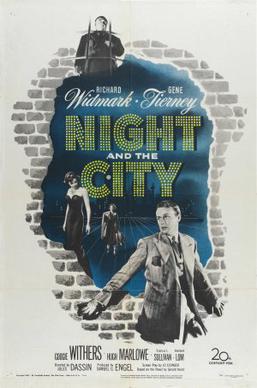
Night and the City

A director with over 20 credits to his name, Jules Dassin has his fair share of classics and memorable movies. But as a director, he hit his stride and reeled off a crazy list of film noir successes in the late 1940s including Brute Force, Thieves' Highway, The Naked City, and welcoming in the new decade, 1950's Night and the City.

An American living in London and trying to make things work with his longtime girlfriend, Mary (Gene Tierney), Harry Fabian (Richard Widmark) wants nothing more than to make it big and make a name for himself. The only problem? Harry has no real charm or talent to do it other than his own charm. In other words, he's a hustler and a con man, always looking for the big thing that will rocket him to the top. In debt and in trouble, Harry might finally have found his in. He meets Gregorious (real-life strongman/wrestler Stanislaus Zbyszko), an internationally renowned wrestler trying to build up the wrestling community/shows in London. It seems like a sure thing, an easy way to make a ton of money, but there's another problem. Gregorious' son, Kristo (Herbert Lom), already has a stranglehold on London wrestling and isn't going to give it away easily.

Released in the heyday of the film noir, 'City' has a trump card that makes it different (and better) from many other noirs of the time. I always think of noirs as taking places in NYC, Los Angeles, any number of small, grimy American towns with all sorts of shady dealings going on in the back alleys. As for this film? Dassin doesn't film his noir in a studio or back lot, he shot on location in and around London. It's a great look to the film, giving the sense of another character in the already incredibly dark story. Sure, much of the story takes place inside (in a studio), but whenever possible, Dassin shot on the streets, alleys, docks and landmarks of London. Filming in black and white, Dassin plays on the usual noir conventions -- darkness, smoke and shadows -- and transports it to London. It's a beyond perfect choice.

Another convention of the noir genre is the general nastiness of the world. Anyone and everyone is looking out for themselves. In other words, always watch your back. Even in the nastiest of movies, there was always that one beacon of light, one good person. Beyond a poor dock owner (Maureen Delaney) who's mixed up in the black market but a good person, there's nary a redeemable character anywhere in sight. In terms of story alone, this is easily one of the darkest, most cynical film noirs I've ever seen. We see the London criminal underworld in all that darkness. But with a talented director like Dassin behind the camera, it's an incredibly stylish if dark look at that world. Dassin uses his camera like few other directors of the time did, including one tracking shot from the back of an open-top convertible navigating London at night. It's a very simple, straightforward scene, but it looks great, and it was certainly far ahead of its time in style.

Still carving out a name for himself as an actor after the star-making role in Kiss of Death, Widmark again shows a knack for playing less than sympathetic characters (if significantly psychotic than Tommy Udo). If there was ever a doomed character in a film noir, Widmark's Harry Fabian has to be near the top of the list. The best part? He's not completely unsympathetic. Harry desperately wants to be something, but he's got no actual way to do it. Instead, he cons, hustles, talks and connives his way into everything he wants and needs. Widmark does a great job showing both sides of this character, but it's apparent from the start where things will end up. In his desperation, Harry simply pushes too far, pitting both sides against each other, and his precarious house of cards hangs in the balance. Another above average performance from a rising star.

And then there's the rest of the nastiness, a whole bunch of similarly despicable characters with their eyes always on the cash. Fabian works for Phillip Nosseross (Francis L. Sullivan), a condescending, immense man who owns a successful night club (maybe a strip club of sorts) with his wife, Helen (Googie Withers). She's also working with Fabian -- behind her husband's back -- to open up a nightclub with a forged license. In a smaller but still effective part, Lom is an ideal intense villain who does have a bit of a human side (however limited). The real-life strongman, Zbyszko is a natural on-screen, a scene-stealer as Gregorious, trying to create a name for a young Greco-Roman wrestler, Nikolas (Ken Richmond). His part is also highlighted by a brutal, knock-down fight with a rival wrestler, the Strangler (Mike Mazurki). Another halfway decent person is Hugh Marlowe's Adam, Mary's neighbor who may have his eyes set on her. Those are the big parts, but even the bit parts are nasty, all of which we see as Harry explores London.

I liked this one a lot right from the start. The only weakness comes in the finale. It's far from slow-moving, but the pacing takes a little time getting to where it wants to be. The issue is that anyone with a working brain knows exactly where it's going. It's not enough to ruin the movie -- not by a long shot -- but it's a minor flaw worth pointing out. An otherwise excellent film noir with a great cast, great look and perfect use of on-location shooting.

Night and the City (1950): ***/****     

Friday, August 31, 2012

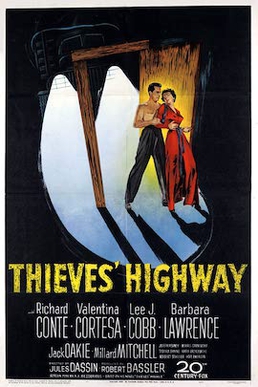
Thieves' Highway

I hate it when that happens. You know what I mean. A movie comes highly recommended in one way or another -- a friend, a movie review, an IMDB rating, a Netflix recommendation -- and you assume you're really going to enjoy it a lot...only to, well, come away somewhat empty. That was my biggest reaction from 1949's Thieves' Highway, a highly recommended if not hugely well-known film noir.

A war veteran returning home to his family and girlfriend, Polly (Barbara Lawrence) in Fresno, Nico Garcos (Richard Conte) is stunned by what he finds. His father has been crippled in a driving accident, but it's more than that. The circumstances were shady at best as conniving businessman Mike Figlia (Lee J. Cobb) also robbed him of $1,900 that he owed him in the process. Nico is enraged, wanting to exact revenge, and he concocts a plan with a down-on-his-luck truck driver, Kinney (Millard Mitchell), to buy and ship a truck-full of apples that Figlia would be interested in purchasing. Nico has his plan, but even he can't be too sure of what is in store for all involved.

From director Jules Dassin, 'Thieves' has a lot going for it. As a film noir, it is highly effective in its amoral portrayal of that seedy underbelly of the criminal black market. Conte is the anti-hero, revenge on his mind and little else. Cobb is the conniving, slimy Figlia, a villain without anything even remotely close to being a redeeming quality. The look of the movie -- much of it shot on location in Fresno and its markets -- is perfect; that blend of shadowy, smoky doom that film noirs specialized in. You just know nothing good is going to come out of that shadowy alleyway, don't you? It is a particularly nasty world, one of manipulation, greed, bribery, and a me-first and screw the rest sort of attitude.

So as a fan of incredibly dark stories, why then didn't I like this one? I can't quite put my finger on it. Maybe I've seen the darkness of such stories and it doesn't hit me as much as it might have audiences in 1949. Mostly though, I never felt a connection to any of the proceedings, whether it be the characters or the developing story. There was a little part of me that was incredibly amused by the portrayal of the seedy underworld of.....produce???? Yeah, I suppose the apple business is pretty cutthroat. I don't mean to minimize the movie like that, but it never felt quite as sinister as it could have. Yes, everyone is in it for themselves, and Conte's Nico wants to right a wrong and exact revenge on the man who crippled his father, but it's never truly an interesting story, for me at least.

The reviews I've read are almost uniformly positive about the casting, and I agree to a point. Many though tout Conte as delivering a career-best performance. I'm not seeing it. I'm a fan -- if not a huge one -- but I always think of Conte at his best in a key supporting role. When he has to carry a movie on his own, I've never thought too highly of those movies. Mostly, he doesn't look too interested in the revenge angle. His easy-going delivery is broken up by these quick outbursts of rage/anger, but they never felt even close to being realistic. On the other hand, Lee J. Cobb is at his best, a villain you love to hate. He has eyes for making as much of a profit as he can with no regard for anything else. If lives are destroyed in the process, so be it. He doesn't care as long as he's making some money.

The rest of the cast are familiar members from the Film Noir Stock Characters list. Valentina Cortese plays Rica, the subtly played hooker with a heart of gold. She takes some money from Cobb's Figlia to keep Nico busy, but quickly realizes the error of her ways (good timing, huh?). I didn't really see much in the way of chemistry between Cobb and Cortese either. Mitchell is solid if unspectacular as the equally ambitious truck driver, Kinney, while Joseph Pevney and Jack Oakie are underused as Pete and Slob, two rival truck drivers trying to move in on Nico's plan. Their bumbling partner act is played for laughs early, but thankfully, the duo takes a turn for the serious as things escalate.

Who knows? Maybe I'm missing something here. I've been guilty of that before. As a fan of dark, realistic stories, I thought this one sounded like a sure thing. The dog eat dog world portrayed in 'Thieves' is interesting on a small level, but it never amounted to much for me. Making it worse, the happy ending comes completely out of left field. At least stick to your guns. If you're going for dark, stay dark.

Thieves' Highway <---trailer (1949): **/****

Monday, February 22, 2010

The Naked City

A combination of some French New Wave techniques, pseudo-documentary filmmaking and just a hint of some film noir, 1948’s The Naked City, directed by Jules Dassin, is a movie both a sign of the times it was made in and a sign of the things that were yet to come in moviemaking.  But at its most basic, Dassin’s film is enjoyable, always entertaining, and a fascinating look into what police work used to be in a pre-computer, pre-Internet time.

Shows like CSI (and all its incarnations), Law and Order, NYPD Blue, and a long list of procedural police shows on television – not to mention countless cop movies – have given viewers a window into what it must be like in solving a case.  Of course, there’s that flaw that every crime can be solved in an hour with all sorts of ridiculous technology at the police’s disposal.  But what about those police officers who had to walk the streets, knock on doors, and work the phones to follow evidence and get their man?  It seems like such a dated procedure watching it in film-form, but it worked for many years.  Damn technology, always making things easier for us.

One lazy Monday morning, a young, blonde dress model is murdered in her apartment. The Homicide squad is called to the crime scene where the young woman was seemingly drowned in her bathtub.  But evidence points out that she was knocked out with chloroform and forcibly held under water when she started to struggle.  Two detectives, Lt. Dan Muldoon (Barry Fitzgerald), a 30-plus year veteran of the force, and Lt. Jimmy Halloran (Don Taylor), a WWII veteran and a relative newbie on the force, take the lead, trying to figure out the murderer.  The evidence they have is minimal, and all they have is a name to work with; Henderson.  But as the hours turn into days, their chances of closing the case get slimmer and slimmer.

Where those already mentioned TV shows tend to wrap up their cases in an hour – and seemingly in a single day and often in a few hours – Dassin’s movie has no such luxury.  With little evidence to work with, the New York homicide detectives are forced to follow each and every lead they have, no matter how inconsequential they may seem.  That’s what Dassin revels in with this 96-minute police procedural.  Those tiny leads are filtered out, and the police try to figure out what is and isn’t important.  It’s surprisingly effective because there’s no big twist, no huge revelation. This is a murder case with no frills, plain and simple.

Muldoon and Halloran – two good Irish cop names if there ever were – are the stars of the film.  Irish actor Fitzgerald plays Muldoon a cop who’s seen everything and has a knack for figuring cases out.  Whenever he’s convinced there’s an unknown suspect, he dubs him ‘J. McGillicuddy’ instead of John Doe until they can figure out who he is.  Muldoon takes the young detective in Halloran under his wing, teaching him as best he can.  Halloran is a good cop, if inexperienced, and thrives in situations where he’s forced to track down leads and work the streets for information.  They form a good team together as the case unfolds in front of them.

Made in 1948, the best part of Dassin’s movie is its realism in terms of story and style.  With the exception of scenes in the police office or in a few apartments, the movie was shot entirely on location in New York City.  Scenes of Taylor’s Halloran interviewing witnesses on the street were filmed on those streets.  The finale especially stands out as the murderer makes a run for it with the police chasing him, leading up an exciting showdown on the Brooklyn Bridge.  It’s authentic from the start, and serves as quite a time capsule for late 1940s New York City.  That on-location shooting gives the movie an authentic feel that just couldn’t have been duplicated on a Hollywood set.
This isn’t a great movie, but the no-frills storytelling pays off in the end.  It’s a straightforward look at the nitty gritty police work, the day-to-day and even hour-to-hour development of the cases they’re trying to solve.  None of the cast other than Fitzgerald and Taylor are that memorable, but overpowering acting from a supporting cast would seem out of place.  Dassin lets his two leads work things out and in the end, get the job done.  Couldn't find a trailer online, but you can watch the movie at Youtube, starting with Part 1 of 10.
The Naked City 

Thursday, June 25, 2009

Rififi

Sooner or later I'll find a caper/heist film that I don't like, but I hope it's a ways down the road. After watching a handful of Jean-Pierre Melville gangster/heist movies this year, I watched Rififi, a 1955 French movie that is often labeled as one of the best for its genre with one scene in particular standing out, that even 54 years later hasn't been topped.

Fresh out of jail for good behavior after serving a 5-year sentence for a diamond heist, Tony Stephanois (Jean Servais) looks for ties to his previous life including former girlfriend and love, Mado (Marie Sabouret). As he looks for her, Tony is so dedicated he even turns down an offer from his nephew, Jo (Carl Mohner), and a low-level but easygoing hood, Mario (Robert Manuel), to take part in an easy heist of a jewelry store. But when Tony finds out Mado quickly hooked on with another man soon after he was sent away, the veteran thief agrees to take part in the job but with some new demands. This won't be some smash and grab job, they're going after the big diamonds in the store safe. So recruiting a safecracker from Milan, Cesar (Jules Dassin), the four begin to plan the perfect heist.

Filmed in black and white, director Jules Dassin, doing double duty as director and actor, creates an atmospheric setting for his heist picture with on location shooting in Paris. He takes his time, in more ways than one, developing the story. What I've enjoyed about some of these older heist movies is that they were allowed to build and develop. So often now, movies have to get right to the heist and getaway with all its inherent action. But Dassin shows in detail the preparation and planning as the quartet case the jewelry store from an adjacent apartment and figure how to take out an alarm system that goes off with the slightest vibration or sound. It builds the tension, and then makes the actual heist more nervewracking because as the viewer we know what's coming.

The build-up is great, but the heist is something I'd never seen before. It starts about 45 minutes in and last almosts a full half-hour as Tony and Co. work their way into the jewelry store and then work on the safe. What's so impressive about that? Not a word is spoken the whole time, instead the sound of tools or nervous breathing from the four serving as the soundtrack. You can watch it in four different parts, one, two, three and four with the actual heist starting midway through the first link and continuing into the next three. I'd recommend just watching the whole movie, but the heist alone is worth it.

Another positive of non-Hollywood movies is that lack of a need or desire to make everything a happy ending with the nice little bow to finish things off. I loved the new Ocean's Eleven with George Clooney and Brad Pitt, but it wasn't exactly dealing in reality. Rififi is unsentimental, always dark, and more than a little narcissistic at times. The heist proves to be the easy part with the selling of the diamonds proving to be the most difficult. Human nature comes into play as a local mafioso, Pierre Grutter (Marcel Lupovici), and his two brothers catch wind of the heist. Nothing comes easy for Tony, Jo, Mario and Cesar, and the ending is anything but neat or tidy.

The casting is good, especially Servais in the lead. Tony is cynical and beaten down by his past and with one last heist looking to hit it big. There's a humanity to his character that comes across well with his great-nephew, Jo's son Tonio. He's got a hard edge to him, but in his interactions with the little boy he opens up and is always spoiling him with presents. Mohner as Jo is the young thug trying to get into the business who puts his family at risk with his work, and Manuel as Mario is a strong counter to the others. He is always ready with a laugh but is also prepared when the work starts. Dassin as Cesar gets to play the loverboy, the Italian safecracker always trying to impress the ladies.

Really one of the best heist/caper movies around, and one fully deserving of its reputation. Check out the trailer that's been dubbed into English and plays up the sex, of which there's very little, and violence, a few shootings late. The trailer does have some spoilers and hints at the ending so be forewarned going in. Don't be scared by the subtitles, Rififi is one of the best.