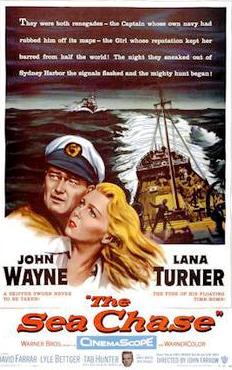
First and foremost, John Wayne was one of the screen's most iconic cowboys. Sure, he took some detours along the way as soldiers, cops and on occasion, as sailors and captains. It can be kinda odd seeing him at see instead of in the saddle, but some of the ventures are pretty good, especially 1955's The Sea Chase. And it's not just the Duke that's interesting, but some generally unique choices in storytelling and tone. And away we go on the high seas!
It's the late 1930's and the German steam freighter Ergenstrasse, commanded by German captain Karl Ehrlich (Wayne), is in port in Sydney, Australia. Ehrlich has fallen from some impressive heights in the German navy because he refuses to support the Nazi party, but he's a supremely capable officer with a solid reputation among fellow sailors. Then the whole world is turned upside down when World War II breaks out, leaving the Ergenstrasse far from home and badly under-supplied. Before they slip out from Sydney though, Ehrlich is visited by the German consul who thrusts a German spy on-board, Elsa Keller (Lana Turner), who has important information and needs to get back to German soil. The British Navy doesn't want to let Ehrlich's ship get through though, setting off a cat-and-mouse across the Pacific and Atlantic of who can out-maneuver the other.
This isn't a movie remembered as one of John Wayne's best, but from the star's weakest decade overall, it's a pretty good entry. It isn't a classic, but I found it damn entertaining, director John Farrow at the helm (shipping/sailing pun intended) of a war thriller that's been generally forgotten. John Wayne as a German captain during WWII? Even if he despises the Nazi party, that's a risky play for a star associated with America and patriotism. 'Chase' was filmed in Australia and Hawaii, its sun-drenched locations giving the thriller one purty look. It isn't flashy, but it certainly gets the job done.
So Wayne as a German captain works surprisingly well. He commits himself to the part in the same way he would a cowboy or a soldier. His Karl Ehrlich is a career man, someone who lives by his word and expects others around him to do the same. Nothing is aggressive or heavy-handed about the background, just that Wayne's Ehrlich has little use for Hitler and the Nazis and is paying for those feelings by being sent to captain the far-off German steamer with no value and no hope of promotion. He knows getting back to Germany will end in trouble for his own future, but it is his duty and he feels compelled to do it, troubling results be damned. He looks comfortable to in the role and compared to some of those 1950's duds -- like The Conqueror or Blood Alley -- it's a classic!
In a long, distinguished career, Wayne wasn't always given too many roles with love interests. Okay, that's not true. Love interests other than Maureen O'Hara. Some reviews seem to disagree with me, but I thought the Duke and the lovely Lana Turner were pretty good together. They've both got somewhat checkered pasts and neither has a future that seems too pleasant, but those two stubborn kids, wouldn't you know that they end up falling for each other a tiny bit? Oh, sorry, SPOILER. A good pairing, the only time these two Hollywood legends worked together. It's a very solid pairing.
If a John Wayne at sea love story isn't your thing, the supporting cast here should pull you in. They're not always given a lot to do in a 117-minute running time, but the character actor star power is ON-POINT here. It's cool just seeing all these fellas together, starting with David Farrar as Napier, Ehrlich's friend and a British officer leading the chase, and Lyle Bettger as Chief Officer Kirchner, a die-hard, loyal follower of the Nazi party who's gonna cause all sorts of problems. As for the Ergenstrasse crew -- and I take a deep breath -- look for Tab Hunter, James Arness, Richard Davalos, Luis Van Rooten, John Qualen, Paul Fix, Alan Hale Jr., Peter Whitney, Claude Akins, John Doucette, and Adam Williams. Not bad, huh? Movie nerds will definitely appreciate that character actor-studded cast.
There are some slower portions during the midsection as Ehrlich and the Ergenstrasse improvises and picks up some supplies at a remote Pacific island. It's necessary though as we get to know the persistently stubborn captain and his beautiful German spy on-board. The international intrigue though picks up, especially when Bettger's Kirchner goes on his own and makes a dangerous command decision that puts the whole crew at risk. There's nothing too flashy from beginning to end, but this is a pretty solid sea thriller, meant to be watched on a rainy Sunday afternoon or late at night with some popcorn. A cool change of pace for the Duke with the beautiful Lana Turner and a fun supporting cast. Definitely worth a watch.
The Sea Chase (1955): ***/****
The Sons of Katie Elder
"First, we reunite, then find Ma and Pa's killer...then read some reviews."
Showing posts with label Claude Akins. Show all posts
Saturday, January 9, 2016
Monday, January 5, 2015
The Raid (1954)
My movie list of hard to find films and hidden gems seems to get shorter every year. One, I'm proud of my persistence in tracking some down that aren't readily available. Two, I'm realizing how many movies I actually watch. Yeah, I kinda have a problem in that department. I read about this Civil War drama years ago when I stumbled across its ridiculously cool tough guy cast. Where'd I find it? Fox Movies Retro On-Demand. Here's 1954's The Raid.
It's fall of 1864 and the tide of the Civil War has fully turned in favor of the Union forces on all fronts. At a prison camp in the northeast, a group of Confederate prisoners led by Major Neal Benton (Van Heflin) plots their escape and manage to break out, hoping to head north into Canada. From there? Hopefully lead raids into Union territory to help ease the pressure on Southern forces. Their first target is a small town in Vermont, St. Albans, that offers several banks just waiting to be knocked off with the funds meant to help the Confederate cause. With his fellow escapees and several other Rebel soldiers hiding out in Canada, Benton puts the plan into play. He starts off posing as a landowner and businessman just visiting St. Albans, but all the while he's putting the pieces together to pull off the successful raid and robbery. There's so many pieces though and success depends on everything going off without a hitch. Can Benton and his Confederates succeed and get out alive in the process?
The American Civil War lasted four years, three weeks and six days between 1861 and 1865 with hundreds of thousands of soldiers killed, wounded and crippled. It is probably the darkest time in American history -- or certainly one of them -- and in general, is a historical era underutilized in film. There just aren't many Civil War movies out there for viewing pleasure. The unfortunate part? A movie like this is a prime example, a true story of a real-life incident. Read through the history books and there are literally hundreds and thousands of stories like this just waiting to be told. Sure, there are the major battles like Gettysburg, Shiloh and Antietam, but what about stories like these? Read about the real-life raid HERE if you're curious.
I was very glad to finally track this one down. From director Hugo Fregonese, 'Raid' clocks in at a crisp 83 minutes and has that distinct B-movie feel but is never held down by its relatively small scale and budget. It's dark and dirty and nasty with the raid being unleashed partially as a counter to Sherman's march through Georgia. In other words, it's about the war, but it's more too. It's about revenge. Title cards introduce the days as the raid draws closer, Benton's plan being put into action with minute details. Much of the story takes place in the St. Albans set with some brief detours into the prison camp and also across the U.S./Canada border. 'Raid' is content to not be an epic but to tell a little known story that's become a footnote in most Civil War and history books. Nothing flashy, but well done and always interesting.
Now what originally caught my eye with this 1954 Civil War drama was the cast. There's some established stars and some rising stars who would go onto bigger and better things in the late 1950s and into the 1960s and beyond. Heflin is just solid as always, the relative anti-hero and leader of the raid. We learn his family was murdered and his home burned down, the desire for revenge coursing through his body. His men include Lee Marvin as a fiery, unpredictable and possibly unhinged Confederate fanatic, Peter Graves as Benton's loyal, capable second-in-command, James Best, an uncredited Claude Akins and later, John Dierkes. Some cool names working together, giving some variety to the Rebel group.
A big plus to the story is that nothing is black and white. It isn't Confederates good and Union bad or vice versa. It's both. This was war, and there was nothing particularly pleasant about it. We get to meet some of the St. Alban residents, starting with Anne Bancroft (just 23 years old) as a widowed boarding house owner (with young Tommy Rettig playing her son), Richard Boone as a Union officer trying to overcome a mistake he made in combat, and assorted other townspeople from farmers to business owners to preachers. It adds a cool element to the story as we see this raid won't be as easy as planned once Benton gets to meet people around town.
If there is a relative disappointment, it comes in the finale, the actual raid. The quick-moving story builds and builds, and the raid is well done as Fregonese sticks pretty close to the facts of the 1864 raid. Unfortunately, the ending just kinda...well, ends. It's fairly accurate to the truth, but this is one case where maybe stretching the truth even a little would have livened things up a touch. As is, the ending scene is rather abrupt as 'THE END' pops up on the screen. It is still a worthwhile movie but the ending could have been far stronger. Still, it tells a little known slice of Civil War history that simply isn't very well known. Worth tracking down a copy for sure.
The Raid (1954): ** 1/2 /****
It's fall of 1864 and the tide of the Civil War has fully turned in favor of the Union forces on all fronts. At a prison camp in the northeast, a group of Confederate prisoners led by Major Neal Benton (Van Heflin) plots their escape and manage to break out, hoping to head north into Canada. From there? Hopefully lead raids into Union territory to help ease the pressure on Southern forces. Their first target is a small town in Vermont, St. Albans, that offers several banks just waiting to be knocked off with the funds meant to help the Confederate cause. With his fellow escapees and several other Rebel soldiers hiding out in Canada, Benton puts the plan into play. He starts off posing as a landowner and businessman just visiting St. Albans, but all the while he's putting the pieces together to pull off the successful raid and robbery. There's so many pieces though and success depends on everything going off without a hitch. Can Benton and his Confederates succeed and get out alive in the process?
The American Civil War lasted four years, three weeks and six days between 1861 and 1865 with hundreds of thousands of soldiers killed, wounded and crippled. It is probably the darkest time in American history -- or certainly one of them -- and in general, is a historical era underutilized in film. There just aren't many Civil War movies out there for viewing pleasure. The unfortunate part? A movie like this is a prime example, a true story of a real-life incident. Read through the history books and there are literally hundreds and thousands of stories like this just waiting to be told. Sure, there are the major battles like Gettysburg, Shiloh and Antietam, but what about stories like these? Read about the real-life raid HERE if you're curious.
I was very glad to finally track this one down. From director Hugo Fregonese, 'Raid' clocks in at a crisp 83 minutes and has that distinct B-movie feel but is never held down by its relatively small scale and budget. It's dark and dirty and nasty with the raid being unleashed partially as a counter to Sherman's march through Georgia. In other words, it's about the war, but it's more too. It's about revenge. Title cards introduce the days as the raid draws closer, Benton's plan being put into action with minute details. Much of the story takes place in the St. Albans set with some brief detours into the prison camp and also across the U.S./Canada border. 'Raid' is content to not be an epic but to tell a little known story that's become a footnote in most Civil War and history books. Nothing flashy, but well done and always interesting.
Now what originally caught my eye with this 1954 Civil War drama was the cast. There's some established stars and some rising stars who would go onto bigger and better things in the late 1950s and into the 1960s and beyond. Heflin is just solid as always, the relative anti-hero and leader of the raid. We learn his family was murdered and his home burned down, the desire for revenge coursing through his body. His men include Lee Marvin as a fiery, unpredictable and possibly unhinged Confederate fanatic, Peter Graves as Benton's loyal, capable second-in-command, James Best, an uncredited Claude Akins and later, John Dierkes. Some cool names working together, giving some variety to the Rebel group.
A big plus to the story is that nothing is black and white. It isn't Confederates good and Union bad or vice versa. It's both. This was war, and there was nothing particularly pleasant about it. We get to meet some of the St. Alban residents, starting with Anne Bancroft (just 23 years old) as a widowed boarding house owner (with young Tommy Rettig playing her son), Richard Boone as a Union officer trying to overcome a mistake he made in combat, and assorted other townspeople from farmers to business owners to preachers. It adds a cool element to the story as we see this raid won't be as easy as planned once Benton gets to meet people around town.
If there is a relative disappointment, it comes in the finale, the actual raid. The quick-moving story builds and builds, and the raid is well done as Fregonese sticks pretty close to the facts of the 1864 raid. Unfortunately, the ending just kinda...well, ends. It's fairly accurate to the truth, but this is one case where maybe stretching the truth even a little would have livened things up a touch. As is, the ending scene is rather abrupt as 'THE END' pops up on the screen. It is still a worthwhile movie but the ending could have been far stronger. Still, it tells a little known slice of Civil War history that simply isn't very well known. Worth tracking down a copy for sure.
The Raid (1954): ** 1/2 /****
Monday, July 28, 2014
Tentacles
Some movies just defy description. They're just that bad. Now, you know what movie is pretty great? 1975's Jaws, the first true summer blockbuster. You know what isn't so good about it? The seemingly countless sequels, ripoffs and countless quasi-remakes. Some of them are pretty awful but pretty entertaining if you're looking for a laugh. Then there's 1977's Tentacles. It isn't entertaining. It. Is. Just. Bad.
At Ocean Beach, a quiet seaside resort, not much in terms of danger ever goes on....until now. Several people have gone missing in the water, including one diver who went looking for the missing persons. Their bodies have been discovered, their skeletons stripped almost entirely of skin and the marrow sucked out of their bones. What could possibly doing this? A veteran newspaper reporter, Ned Turner (John Huston), is on the prowl, suspecting a huge corporation drilling in the ocean may be at fault. Keeping on the trail, Turner continues to look for an explanation, even turning to a famed animal trainer and experienced diver, Will Gleason (Bo Hopkins), for help. Looking at those who've been attacked and the mounting piles of evidence, Gleason suspects the attacks could have come from a giant octopus, a creature not known for attacking humans. Could Turner be onto something, linking the attacks to the corporation? Lives depend on them finding the answer.
Wow, what a bad, just plain awful, lousy movie. I like some of the Jaws ripoffs from Orca to Grizzly, both lousy movies, but my goodness, are they entertaining in their lousiness. This U.S./Italian co-production from director Ovidio G. Assonitis doesn't even qualify in the lousiness department. You know what the best thing going for this movie is? The music, composer Stelvio Cipriani turning in a memorable, foreboding score. Listen HERE for an extended sample. In a disaster-themed, killer animal on the loose movie, when the music is the biggest positive, you know you're in trouble. It just isn't good to the point it is painfully boring. 'Tentacles' follows the Jaws formula to a T, duplicating entire scenes, characters and story development. At no point is it ever scary or foreboding so go watch Jaws or even Jaws 2, Orca, or Grizzly for a far better time.
I'll give disaster movies credit where it's due. You get to see a lot of movie stars in one place at the same time. Now.....the performances aren't going to be very good, but it's an abundance of movie stars!!! How can you lose?!? Well, we do so there's that. No one seems particularly interested, but there is name recognition. Huston is a good choice to play a crotchety, grizzled reporter with Shelley Winters starring as his sister, a single mom who's always looking to seduce a younger man. Give him credit, Bo Hopkins commits to the material, even if his part is a pretty odd one. He's at one with animals, especially when his wife (Delia Boccardo) comes into danger. Also starring is Claude Akins as the overworked, overstressed town sheriff trying to save his townspeople. Cesare Danova plays the maligned corporation representative who must answer all the questions, knowing his company could be held responsible for the attacks. The rest of the speaking parts are badly dubbed English from Italian-speaking actors.
A master of the 1970s disaster movie cameo, Henry Fonda also makes a quick appearance as Mr. Whitehead, the President of Trojan Construction who's looking to make a buck. If some people get killed in the process....meh, whatever happens.
I don't know what to say here. It's not that the movie is bad because it is more than that. A bad movie can be entertaining, but this disaster knockoff is pure and simple boring as watching paint dry on a wall, as watching grass grow. The octopus attacks are laughable, seemingly also making an octopus a killing creature that sprints across the top of the ocean. Oh, no! It's shooting ink at me!!! The reasoning seems far-fetched even for a poorly written script, construction vibrations deep on the ocean floor infuriating the creature to the point it feels the need to kill and to kill often. A seemingly unstoppable killing machine in nature is a cool premise and a great jumping off point, but this one never does anything with it.
Then there's the end. Hopkins' animal trainer who's coming off an extreme incident with the bends unleashes his two killer whales to take out the octopus. I can't say I've seen too many movies where animals become hired killers, but this one counts. When things should be raring to go in the finale, it just doesn't. The underwater scenes go on and on without a sense of urgency. That's the entire movie, long stretches of boredom broken up by slightly less boring animal attacks. Some cool names in the cast, but even that is wasted. Steer clear or the tentacles may get you!
Tentacles (1977): */****
At Ocean Beach, a quiet seaside resort, not much in terms of danger ever goes on....until now. Several people have gone missing in the water, including one diver who went looking for the missing persons. Their bodies have been discovered, their skeletons stripped almost entirely of skin and the marrow sucked out of their bones. What could possibly doing this? A veteran newspaper reporter, Ned Turner (John Huston), is on the prowl, suspecting a huge corporation drilling in the ocean may be at fault. Keeping on the trail, Turner continues to look for an explanation, even turning to a famed animal trainer and experienced diver, Will Gleason (Bo Hopkins), for help. Looking at those who've been attacked and the mounting piles of evidence, Gleason suspects the attacks could have come from a giant octopus, a creature not known for attacking humans. Could Turner be onto something, linking the attacks to the corporation? Lives depend on them finding the answer.
Wow, what a bad, just plain awful, lousy movie. I like some of the Jaws ripoffs from Orca to Grizzly, both lousy movies, but my goodness, are they entertaining in their lousiness. This U.S./Italian co-production from director Ovidio G. Assonitis doesn't even qualify in the lousiness department. You know what the best thing going for this movie is? The music, composer Stelvio Cipriani turning in a memorable, foreboding score. Listen HERE for an extended sample. In a disaster-themed, killer animal on the loose movie, when the music is the biggest positive, you know you're in trouble. It just isn't good to the point it is painfully boring. 'Tentacles' follows the Jaws formula to a T, duplicating entire scenes, characters and story development. At no point is it ever scary or foreboding so go watch Jaws or even Jaws 2, Orca, or Grizzly for a far better time.
I'll give disaster movies credit where it's due. You get to see a lot of movie stars in one place at the same time. Now.....the performances aren't going to be very good, but it's an abundance of movie stars!!! How can you lose?!? Well, we do so there's that. No one seems particularly interested, but there is name recognition. Huston is a good choice to play a crotchety, grizzled reporter with Shelley Winters starring as his sister, a single mom who's always looking to seduce a younger man. Give him credit, Bo Hopkins commits to the material, even if his part is a pretty odd one. He's at one with animals, especially when his wife (Delia Boccardo) comes into danger. Also starring is Claude Akins as the overworked, overstressed town sheriff trying to save his townspeople. Cesare Danova plays the maligned corporation representative who must answer all the questions, knowing his company could be held responsible for the attacks. The rest of the speaking parts are badly dubbed English from Italian-speaking actors.
A master of the 1970s disaster movie cameo, Henry Fonda also makes a quick appearance as Mr. Whitehead, the President of Trojan Construction who's looking to make a buck. If some people get killed in the process....meh, whatever happens.
I don't know what to say here. It's not that the movie is bad because it is more than that. A bad movie can be entertaining, but this disaster knockoff is pure and simple boring as watching paint dry on a wall, as watching grass grow. The octopus attacks are laughable, seemingly also making an octopus a killing creature that sprints across the top of the ocean. Oh, no! It's shooting ink at me!!! The reasoning seems far-fetched even for a poorly written script, construction vibrations deep on the ocean floor infuriating the creature to the point it feels the need to kill and to kill often. A seemingly unstoppable killing machine in nature is a cool premise and a great jumping off point, but this one never does anything with it.
Then there's the end. Hopkins' animal trainer who's coming off an extreme incident with the bends unleashes his two killer whales to take out the octopus. I can't say I've seen too many movies where animals become hired killers, but this one counts. When things should be raring to go in the finale, it just doesn't. The underwater scenes go on and on without a sense of urgency. That's the entire movie, long stretches of boredom broken up by slightly less boring animal attacks. Some cool names in the cast, but even that is wasted. Steer clear or the tentacles may get you!
Tentacles (1977): */****
Labels:
1970s,
Bo Hopkins,
Claude Akins,
Disaster Movies,
Henry Fonda,
John Huston,
Shelley Winters
Monday, July 21, 2014
Rio Bravo
Do you have a favorite western? No? What's wrong with you?!? Do a search for top 10 lists, of fans and critics alike pointing out their favorite westerns, and you'll see countless picks. One that pops up often that I'm not a huge fan of is 1952's High Noon. You know who else isn't a big fan? The Duke himself, John Wayne. Working with a deep cast, a talented director and a great script, here's Wayne's response to High Noon, 1959's Rio Bravo.
In the Texas border town of Rio Bravo, Sheriff John T. Chance (Wayne) finds himself in a bit of a spot. A man named Joe Burdette (Claude Akins) callously shot down an unarmed man in a bar argument and is now sitting in Chance's jail. A murderer in itself isn't big news, but when Joe's brother is one of the richest men in Texas -- and with a small army of gunmen at his side -- that provides some problems for Chance. Burdette has bottled up the town so Chance can't transport his prisoner and he can't bring help in either. All the sheriff is left with is two deputies, Dude (Dean Martin), a drunkard, and Stumpy (Walter Brennan), an aging crippled man, to help do the job. With the town waiting to see what happens, Burdette's gunmen similarly waiting on the streets, Chance goes about putting a plan into action to get out alive and bring Joe Burdette to justice.
Wowza, what a good movie, a western that deserves its classic status. I grew up watching this Howard Hawks-directed western a lot as a kid and recently revisited it for the first time in years. The plot description proved a little rough because....well, the script is excellent, but the story isn't the most well-connected, concise of stories. If there's a complaint, it's that at 141 minutes and with an episodic story, things can be a tad slow at times, but you never really notice it (or I didn't at least). It isn't a comedy western, and it isn't a cynical, ultra-dark western, but somewhere in between as it mixes comedy (the script again), the drama and the action. Old Tucson is a great location spot for the town of Rio Bravo, that archetypal winding, dusty western town. Composer Dimitri Tiomkin turns in a great subtle score -- very whistle-worthy -- and even test runs part of the score he'd use a year later in The Alamo. All key contributions to a winning formula.
Of all his movies, John Wayne is most associated with the western genre. Many consider his western roles -- The Searchers, Red River, She Wore a Yellow Ribbon, The Shootist -- to be among his strongest. Maybe not the showiest part, but Wayne's leading role here as Rio Bravo sheriff John T. Chance is Wayne at his tough, likable, easy-going best. If not his best acting performance, it's one of his most visually iconic, the vest over the red or blue shirt, the bent-up hat brim, the ever-present Winchester rifle in his hand. In the acting department, this is one of my favorites of the Duke's. He makes it look criminally easy what he's doing. He lets those around him show off more with "bigger" performances, content to do his thing. In the process, you can't help but watch him. He's the tough lead, the lead with some great comedic timing, and has one of his all-time best love interests in the form of Angie Dickinson as Feathers, a young woman with some troubles behind her. That chemistry is perfect, Wayne's Chance more and more exasperated with each passing scene. Just a great underplayed performance.
As a director, one of Hawks' specialties was the bonds and friendships formed among men in serious situations, a life and death drama. I don't know if that dynamic was ever better than it was here. There isn't a weak spot in the bunch with Wayne as Chance and Martin and Brennan as his maligned deputies. Even teen idol Ricky Nelson manages to find a good spot as Colorado Ryan, a young gunslinger looking to mind his business....at first. Facing seemingly insurmountable odds, they bond, put their differences aside and become stronger as a collective group. Their chemistry is evident throughout, their dialogue crackling with each passing scene. Sure, they sing a couple songs together (My Rifle, My Pony and Me, Cindy, listen HERE) but it's Dean Martin! You're rooting for these guys, each of the quartet bringing something different to the table. Just hard to beat, one of the best, underrated casts in a western.
That's where the script steps to the plate. We don't get much in the way of backstory about most of the characters. In a line here and there, we pick up more than you'd think. We learn what drove Dude to drink, why cackling, ranting Stumpy has a limp, why Chance carries a rifle. Good, interesting characters we get to know quickly, and from there, the cast does the rest. Also look for Ward Bond (in his last film role) as Pat Wheeler, a freight owner who offers to help Chance, an underused, sneering Akins at his best, John Russell as his intimidating older brother, Nathan, Pedro Gonzalez Gonzalez as Carlos, the hotel owner, and Estelita Rodriguez as his wife, Consuela.
So there isn't the most pointed story here. So be it, Hawks was never interested in the most linear, fast-paced stories. The pacing works here, too many episodic moments to mention. The opener is several minutes of silence as we're introduced to Chance and Dude, ultimately seeing Joe gun an unarmed man down. My personal favorite is a set piece with Chance and Dude following a wounded hired killer with muddy boots into a saloon...only they can't find him. It's a great little scene with an excellent payoff. The movie is full of such great moments, including the finale as Chance and Co. go toe-to-toe with the Burdettes during a prisoner exchange with Old Tucson again providing a pitch perfect backdrop to the western action.
Is it a perfect movie? No, but as far as entertaining movies goes, this one is hard to beat whether it is a western or not. The cast is perfectly used, showing off a chemistry that makes it fun to watch. Some truly funny laughs (Chance calling Stumpy "a treasure" and kissing him on his bald head), some great dialogue and one-liners, and a script that provides some great quotables. Hard to beat, and one of my favorite movies. If you're a fan, check out both El Dorado and Rio Lobo, Hawks basically remaking his own movie twice more.
Rio Bravo (1959): ****/****
In the Texas border town of Rio Bravo, Sheriff John T. Chance (Wayne) finds himself in a bit of a spot. A man named Joe Burdette (Claude Akins) callously shot down an unarmed man in a bar argument and is now sitting in Chance's jail. A murderer in itself isn't big news, but when Joe's brother is one of the richest men in Texas -- and with a small army of gunmen at his side -- that provides some problems for Chance. Burdette has bottled up the town so Chance can't transport his prisoner and he can't bring help in either. All the sheriff is left with is two deputies, Dude (Dean Martin), a drunkard, and Stumpy (Walter Brennan), an aging crippled man, to help do the job. With the town waiting to see what happens, Burdette's gunmen similarly waiting on the streets, Chance goes about putting a plan into action to get out alive and bring Joe Burdette to justice.
Wowza, what a good movie, a western that deserves its classic status. I grew up watching this Howard Hawks-directed western a lot as a kid and recently revisited it for the first time in years. The plot description proved a little rough because....well, the script is excellent, but the story isn't the most well-connected, concise of stories. If there's a complaint, it's that at 141 minutes and with an episodic story, things can be a tad slow at times, but you never really notice it (or I didn't at least). It isn't a comedy western, and it isn't a cynical, ultra-dark western, but somewhere in between as it mixes comedy (the script again), the drama and the action. Old Tucson is a great location spot for the town of Rio Bravo, that archetypal winding, dusty western town. Composer Dimitri Tiomkin turns in a great subtle score -- very whistle-worthy -- and even test runs part of the score he'd use a year later in The Alamo. All key contributions to a winning formula.
Of all his movies, John Wayne is most associated with the western genre. Many consider his western roles -- The Searchers, Red River, She Wore a Yellow Ribbon, The Shootist -- to be among his strongest. Maybe not the showiest part, but Wayne's leading role here as Rio Bravo sheriff John T. Chance is Wayne at his tough, likable, easy-going best. If not his best acting performance, it's one of his most visually iconic, the vest over the red or blue shirt, the bent-up hat brim, the ever-present Winchester rifle in his hand. In the acting department, this is one of my favorites of the Duke's. He makes it look criminally easy what he's doing. He lets those around him show off more with "bigger" performances, content to do his thing. In the process, you can't help but watch him. He's the tough lead, the lead with some great comedic timing, and has one of his all-time best love interests in the form of Angie Dickinson as Feathers, a young woman with some troubles behind her. That chemistry is perfect, Wayne's Chance more and more exasperated with each passing scene. Just a great underplayed performance.
As a director, one of Hawks' specialties was the bonds and friendships formed among men in serious situations, a life and death drama. I don't know if that dynamic was ever better than it was here. There isn't a weak spot in the bunch with Wayne as Chance and Martin and Brennan as his maligned deputies. Even teen idol Ricky Nelson manages to find a good spot as Colorado Ryan, a young gunslinger looking to mind his business....at first. Facing seemingly insurmountable odds, they bond, put their differences aside and become stronger as a collective group. Their chemistry is evident throughout, their dialogue crackling with each passing scene. Sure, they sing a couple songs together (My Rifle, My Pony and Me, Cindy, listen HERE) but it's Dean Martin! You're rooting for these guys, each of the quartet bringing something different to the table. Just hard to beat, one of the best, underrated casts in a western.
That's where the script steps to the plate. We don't get much in the way of backstory about most of the characters. In a line here and there, we pick up more than you'd think. We learn what drove Dude to drink, why cackling, ranting Stumpy has a limp, why Chance carries a rifle. Good, interesting characters we get to know quickly, and from there, the cast does the rest. Also look for Ward Bond (in his last film role) as Pat Wheeler, a freight owner who offers to help Chance, an underused, sneering Akins at his best, John Russell as his intimidating older brother, Nathan, Pedro Gonzalez Gonzalez as Carlos, the hotel owner, and Estelita Rodriguez as his wife, Consuela.
So there isn't the most pointed story here. So be it, Hawks was never interested in the most linear, fast-paced stories. The pacing works here, too many episodic moments to mention. The opener is several minutes of silence as we're introduced to Chance and Dude, ultimately seeing Joe gun an unarmed man down. My personal favorite is a set piece with Chance and Dude following a wounded hired killer with muddy boots into a saloon...only they can't find him. It's a great little scene with an excellent payoff. The movie is full of such great moments, including the finale as Chance and Co. go toe-to-toe with the Burdettes during a prisoner exchange with Old Tucson again providing a pitch perfect backdrop to the western action.
Is it a perfect movie? No, but as far as entertaining movies goes, this one is hard to beat whether it is a western or not. The cast is perfectly used, showing off a chemistry that makes it fun to watch. Some truly funny laughs (Chance calling Stumpy "a treasure" and kissing him on his bald head), some great dialogue and one-liners, and a script that provides some great quotables. Hard to beat, and one of my favorite movies. If you're a fan, check out both El Dorado and Rio Lobo, Hawks basically remaking his own movie twice more.
Rio Bravo (1959): ****/****
Sunday, July 13, 2014
The Lonely Man
One of those great Hollywood tough guys, Jack Palance was without a doubt, one of the best heavies around in film. He was great in those tough, can't keep down parts that ranged from heroes to dastardly villains, especially in 1953's Shane where he played one of the western genre's all-time great villains. So in the 1950s as he played a lot of anti-heroes, a lot of out-and-out bad guys, it's cool to see him in a well-told, somber western from 1957, The Lonely Man.
In a quiet, dusty western town, a man with quite the reputation, Jacob Wade (Palance), rides up the street looking to find someone. His reputation leans heavily toward the wrong side of the law, Wade gaining notoriety as a gunfighter, a killer, a bandit, and wherever he goes, that name precedes him. He finds the man he's looking for, Riley (Anthony Perkins), a young man, a bit of a loafer around town who goes about his own business quietly. Who is he? He's Wade's son, the son he hasn't seen in over 15 years since leaving him and the boy's mother, hitting the outlaw trail of sorts. After all those years apart though, Wade wants to do right by his son, setting him up with a ranch, some cattle. It will be small at first, but with some hard work, it can flourish....if Riley wants anything to do with his long-lost father's help. It's more than that though. Men from Wade's past are on his trail, men looking to exact revenge on the infamous gunslinger.
Well, here we sit. It is movies like this that make me such a huge fan of the western. There's nothing particularly out of this world unique, nothing you probably haven't seen in other, more well-known westerns over the years. And you know what? There's nothing wrong with that. From director Henry Levin, 'Lonely' is a well-told, old-fashioned story that I liked from the beginning. It gets to the core of what can be so right about westerns. Ultimately, it's about doing what's right, even if it'd be easier to turn and ride out. It's about living up to your word, standing by a friend when he's in trouble, and doing your damnedest to live up to what you should be whether it's loyal, honest or hard-working. As Davy Crockett said, 'Know you're right and go ahead.' In story terms, it doesn't get more straightforward than that.
We get that perspective that would be dealt with years later in movies like Ride the High Country, The Magnificent Seven and The Wild Bunch through the eyes of Palance's Jacob Wade (apparently not related to THIS Jake Wade). His outlaw is trying to put that outlaw past behind him, but that past may not allow it. He regrets the things he's done, the men he's killed, those he's put at risk. It may be too late to save himself, but in his son, there remains some sort of hope for a better future. Palance could be a gem at chewing the scenery, but he was at his best here when he underplays everything. He keeps it inside, the emotions brewing and waiting for an outburst. It is a part that brims with intensity, but it never comes over the top. The chemistry between Palance and Perkins is excellent, a father who wants to help the son he abandoned (supposedly), a son who wants nothing to do with the offer of help. The father-son dynamic works across most genres, and that's no different in the western.
Now that supporting cast. Yikes, just yikes. Some of those familiar faces would go onto bigger and better in the coming years, but that's our benefit. There's a very deep cast that western fans will definitely appreciate from top to bottom. Neville Brand gets the lead villain part as King Fisher, a former saloon owner who has a bullet he carries with Wade's name on it, some of the lead still in his leg. His gang includes Lee Van Cleef, Elisha Cook Jr., and Adam Williams. Robert Middleton has a strong, key supporting part as Ben Ryerson, a former member of Wade's gang, now riding with him trying to put the boy on the right track. There's also a quick part for Claude Akins, a former gang member looking for some "help" with John Doucette riding by his side. Even look for Denver Pyle in an early appearance as a sheriff who knows Wade's reputation.
There's some issues here, but nothing huge. The story is a tad slow, even at 88 minutes dragging in bits and pieces. The subplot with Elaine Aiken's Ada, a saloon girl who rode with Wade and wanted to settle down with him, doesn't develop as much as it could have. When Perkins' Riley shows some interest, I'd had about enough with that part of the story. For the most part though, things work and they work well. A somber, soft score permeates the emotionally-charged family story, and the locations in the Alabama Hills in California are a gorgeous backdrop to the developments across the board. It isn't a perfect western, but it is a really good one that genre fans will definitely enjoy. You pretty much know where it's building early on, but getting to the finale was part of the fun. An easy western to recommend.
The Lonely Man (1957): ***/****
In a quiet, dusty western town, a man with quite the reputation, Jacob Wade (Palance), rides up the street looking to find someone. His reputation leans heavily toward the wrong side of the law, Wade gaining notoriety as a gunfighter, a killer, a bandit, and wherever he goes, that name precedes him. He finds the man he's looking for, Riley (Anthony Perkins), a young man, a bit of a loafer around town who goes about his own business quietly. Who is he? He's Wade's son, the son he hasn't seen in over 15 years since leaving him and the boy's mother, hitting the outlaw trail of sorts. After all those years apart though, Wade wants to do right by his son, setting him up with a ranch, some cattle. It will be small at first, but with some hard work, it can flourish....if Riley wants anything to do with his long-lost father's help. It's more than that though. Men from Wade's past are on his trail, men looking to exact revenge on the infamous gunslinger.
Well, here we sit. It is movies like this that make me such a huge fan of the western. There's nothing particularly out of this world unique, nothing you probably haven't seen in other, more well-known westerns over the years. And you know what? There's nothing wrong with that. From director Henry Levin, 'Lonely' is a well-told, old-fashioned story that I liked from the beginning. It gets to the core of what can be so right about westerns. Ultimately, it's about doing what's right, even if it'd be easier to turn and ride out. It's about living up to your word, standing by a friend when he's in trouble, and doing your damnedest to live up to what you should be whether it's loyal, honest or hard-working. As Davy Crockett said, 'Know you're right and go ahead.' In story terms, it doesn't get more straightforward than that.
We get that perspective that would be dealt with years later in movies like Ride the High Country, The Magnificent Seven and The Wild Bunch through the eyes of Palance's Jacob Wade (apparently not related to THIS Jake Wade). His outlaw is trying to put that outlaw past behind him, but that past may not allow it. He regrets the things he's done, the men he's killed, those he's put at risk. It may be too late to save himself, but in his son, there remains some sort of hope for a better future. Palance could be a gem at chewing the scenery, but he was at his best here when he underplays everything. He keeps it inside, the emotions brewing and waiting for an outburst. It is a part that brims with intensity, but it never comes over the top. The chemistry between Palance and Perkins is excellent, a father who wants to help the son he abandoned (supposedly), a son who wants nothing to do with the offer of help. The father-son dynamic works across most genres, and that's no different in the western.
Now that supporting cast. Yikes, just yikes. Some of those familiar faces would go onto bigger and better in the coming years, but that's our benefit. There's a very deep cast that western fans will definitely appreciate from top to bottom. Neville Brand gets the lead villain part as King Fisher, a former saloon owner who has a bullet he carries with Wade's name on it, some of the lead still in his leg. His gang includes Lee Van Cleef, Elisha Cook Jr., and Adam Williams. Robert Middleton has a strong, key supporting part as Ben Ryerson, a former member of Wade's gang, now riding with him trying to put the boy on the right track. There's also a quick part for Claude Akins, a former gang member looking for some "help" with John Doucette riding by his side. Even look for Denver Pyle in an early appearance as a sheriff who knows Wade's reputation.
There's some issues here, but nothing huge. The story is a tad slow, even at 88 minutes dragging in bits and pieces. The subplot with Elaine Aiken's Ada, a saloon girl who rode with Wade and wanted to settle down with him, doesn't develop as much as it could have. When Perkins' Riley shows some interest, I'd had about enough with that part of the story. For the most part though, things work and they work well. A somber, soft score permeates the emotionally-charged family story, and the locations in the Alabama Hills in California are a gorgeous backdrop to the developments across the board. It isn't a perfect western, but it is a really good one that genre fans will definitely enjoy. You pretty much know where it's building early on, but getting to the finale was part of the fun. An easy western to recommend.
The Lonely Man (1957): ***/****
Monday, March 3, 2014
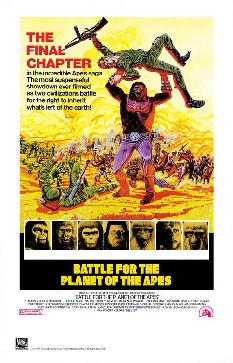
Battle for the Planet of the Apes
Here we sit. It's been a long ride full of ups and downs, but we made it through, and I'd like to thank all of those who supported me along the way. Yes, it is officially time to wrap up the Planet of the Apes series. It is time for 1973's Battle for the Planet of the Apes. Pretty dramatic, huh?!? I should totally do voiceover work.
It has been 12 years since the highly intelligent, thoughtful talking chimp, Caesar (Roddy McDowall) led the bloody revolt that gained apes -- the chimps, orangutans, and gorillas -- their freedom from their cruel human masters. It was a revolt that set off a chain reaction, countries and cities turning on each other, nuclear weapons wiping whole cities off the face of the Earth. Caesar and a small community of apes and humans manage to escape the destruction, building a city in the wilderness and starting their own civilization of sorts. It is a tenuous situation though, Caesar dealing with the apes' control over the humans, an ape general, Aldo (Claude Akins), eager to gain power, and the possibility of another group of human survivors -- mutated beings -- invading his territory. Can he hold it all together?
I've long been a fan of the Planet of the Apes series so it's been fun catching up with the series, especially watching all five movies straight through for the first time ever. It's cool to see the continuity among the five flicks, see recurring characters, recurring stories and plotlines. This fifth entry, from director J. Lee Thompson (who also directed Conquest), was released as part of the collection as an 'Extended Version,' running 93 minutes with about 10 minutes of additional footage reinserted. Not going to lie here, I was kinda disappointed with this final entry. There are positives -- more in that department later -- but there are also far too many negatives. The story seems like a jumbled collection of the previous storylines -- especially Beneath and Conquest -- and doesn't create enough of its own identity. Fans of the series will definitely enjoy it, but as far as series finales go, this one could have been better.
What are the biggest issues? Well, the script for starters. Reading about the Extended Cut (with spoilers), it's cool to see what footage was added back into the movie. Some scenes work better than others, some lack any rhythm or pacing. The exploration of the bombed-out city should be adrenaline-pumping, but the build-up is slow that it loses any momentum. It also seems thrown together for the sake of a sequel, an unnecessary one at that. It's only 12 years since the end of 'Conquest,' but the apes speak clearly and perfectly understandable. A whole species learns to speak in a little over a decade? Why did the humans go with the apes? Was it for survival? A whole sub-culture comes together so quickly, rushed backstory like the entire movie. There are portions that work as it tries to connect and wrap up with the rest of the series, especially the connection to Beneath, the villain, Governor Kolp (Severn Dearden), having an assistant, Mendez (Paul Stevens), the same name as the leader of the mutants in Beneath, the Alpha bomb there too. Little touches like that are pretty cool, especially for nerds like me
The biggest positive is the face of the franchise right there with Charlton Heston, Roddy McDowall, who starred in four of the five movies playing two different roles. His Caesar is the intelligent, thoughtful leader of the ape civilization, juggling countless roles. He's a leader, a father, a friend, and he's got to keep all the plates spinning at once. McDowall is the heart of it all, and not surprisingly, he kills the part. He is the link through it all, the best aspect of the character being his interest, his curiosity about his past. What were his parents like? How did they end up on a human-ruled Earth? What led to their tragic deaths? As a family man, we meet his wife, Lisa (Natalie Trundy, who also starred in four Ape movies), and his teenage son, Cornelius (Bobby Porter), who just wants to be a kid, Caesar doing his best to make his son's life smooth and easy. Any issues the movie may have, McDowall is above it. A fitting lead performance to wrap things up.
The rest of the cast is okay, some solid names, some recognizable faces, but nothing really eye-popping. Akins hams it up like a crazy person, his General Aldo really just a child in a position of power. He's the polar opposite of Caesar, fiery and emotional, but an action he takes certainly takes drives the story forward. For some of the other key ape performances, Lew Ayres is a scene-stealer as Mandemus, the senior citizen ape placed in charge of the armory, his logical thinking tripping everyone up, and Paul Williams as Virgil, the intellectual, the thinker who plays Devil's Advocate to just about everything Caesar does, but in a helpful fashion. Austin Stoker plays MacDonald, the face of the human group living with the apes. He has a good chemistry with McDowall's Caesar in their scenes together in an underused part.
I don't know. I came away disappointed. Maybe it tries to do too much, maybe it's just not very good. If you're a fan of the series, you've got to see it to wrap things up. There, plain and simple. It lacks that special something to hold it all together. A framing device with John Huston making a quick appearance as the Lawgiver tries to show that the Apes timeline can and should be adjusted, but everything else in the series seems to suggest otherwise. If it didn't, everything would collapse in on itself in the space time continuum. Yeah, time travel analysis. Didn't see that coming, did you?!? Watch it for the series, for the sci-fi aspect, just enough positives in a movie that lacked some energy. Still, it's been a hugely entertaining series, a fun ride over five movies. Thanks to the girlfriend for the Christmas present. Now, I've just gotta get her to watch them...
Battle for the Planet of the Apes (1973): ** 1/2 /****
It has been 12 years since the highly intelligent, thoughtful talking chimp, Caesar (Roddy McDowall) led the bloody revolt that gained apes -- the chimps, orangutans, and gorillas -- their freedom from their cruel human masters. It was a revolt that set off a chain reaction, countries and cities turning on each other, nuclear weapons wiping whole cities off the face of the Earth. Caesar and a small community of apes and humans manage to escape the destruction, building a city in the wilderness and starting their own civilization of sorts. It is a tenuous situation though, Caesar dealing with the apes' control over the humans, an ape general, Aldo (Claude Akins), eager to gain power, and the possibility of another group of human survivors -- mutated beings -- invading his territory. Can he hold it all together?
I've long been a fan of the Planet of the Apes series so it's been fun catching up with the series, especially watching all five movies straight through for the first time ever. It's cool to see the continuity among the five flicks, see recurring characters, recurring stories and plotlines. This fifth entry, from director J. Lee Thompson (who also directed Conquest), was released as part of the collection as an 'Extended Version,' running 93 minutes with about 10 minutes of additional footage reinserted. Not going to lie here, I was kinda disappointed with this final entry. There are positives -- more in that department later -- but there are also far too many negatives. The story seems like a jumbled collection of the previous storylines -- especially Beneath and Conquest -- and doesn't create enough of its own identity. Fans of the series will definitely enjoy it, but as far as series finales go, this one could have been better.
What are the biggest issues? Well, the script for starters. Reading about the Extended Cut (with spoilers), it's cool to see what footage was added back into the movie. Some scenes work better than others, some lack any rhythm or pacing. The exploration of the bombed-out city should be adrenaline-pumping, but the build-up is slow that it loses any momentum. It also seems thrown together for the sake of a sequel, an unnecessary one at that. It's only 12 years since the end of 'Conquest,' but the apes speak clearly and perfectly understandable. A whole species learns to speak in a little over a decade? Why did the humans go with the apes? Was it for survival? A whole sub-culture comes together so quickly, rushed backstory like the entire movie. There are portions that work as it tries to connect and wrap up with the rest of the series, especially the connection to Beneath, the villain, Governor Kolp (Severn Dearden), having an assistant, Mendez (Paul Stevens), the same name as the leader of the mutants in Beneath, the Alpha bomb there too. Little touches like that are pretty cool, especially for nerds like me
The biggest positive is the face of the franchise right there with Charlton Heston, Roddy McDowall, who starred in four of the five movies playing two different roles. His Caesar is the intelligent, thoughtful leader of the ape civilization, juggling countless roles. He's a leader, a father, a friend, and he's got to keep all the plates spinning at once. McDowall is the heart of it all, and not surprisingly, he kills the part. He is the link through it all, the best aspect of the character being his interest, his curiosity about his past. What were his parents like? How did they end up on a human-ruled Earth? What led to their tragic deaths? As a family man, we meet his wife, Lisa (Natalie Trundy, who also starred in four Ape movies), and his teenage son, Cornelius (Bobby Porter), who just wants to be a kid, Caesar doing his best to make his son's life smooth and easy. Any issues the movie may have, McDowall is above it. A fitting lead performance to wrap things up.
The rest of the cast is okay, some solid names, some recognizable faces, but nothing really eye-popping. Akins hams it up like a crazy person, his General Aldo really just a child in a position of power. He's the polar opposite of Caesar, fiery and emotional, but an action he takes certainly takes drives the story forward. For some of the other key ape performances, Lew Ayres is a scene-stealer as Mandemus, the senior citizen ape placed in charge of the armory, his logical thinking tripping everyone up, and Paul Williams as Virgil, the intellectual, the thinker who plays Devil's Advocate to just about everything Caesar does, but in a helpful fashion. Austin Stoker plays MacDonald, the face of the human group living with the apes. He has a good chemistry with McDowall's Caesar in their scenes together in an underused part.
I don't know. I came away disappointed. Maybe it tries to do too much, maybe it's just not very good. If you're a fan of the series, you've got to see it to wrap things up. There, plain and simple. It lacks that special something to hold it all together. A framing device with John Huston making a quick appearance as the Lawgiver tries to show that the Apes timeline can and should be adjusted, but everything else in the series seems to suggest otherwise. If it didn't, everything would collapse in on itself in the space time continuum. Yeah, time travel analysis. Didn't see that coming, did you?!? Watch it for the series, for the sci-fi aspect, just enough positives in a movie that lacked some energy. Still, it's been a hugely entertaining series, a fun ride over five movies. Thanks to the girlfriend for the Christmas present. Now, I've just gotta get her to watch them...
Battle for the Planet of the Apes (1973): ** 1/2 /****
Wednesday, November 20, 2013
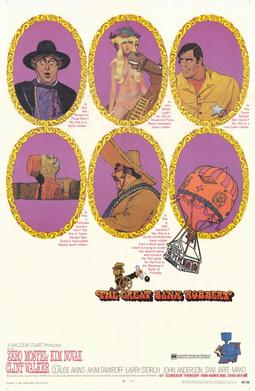
The Great Bank Robbery (1969)
From banks to trains, stagecoaches to payrolls and everything in between, wild west bandits, robbers and thieves had plenty of choices as to who and where to rob. But how about an impenetrable bank built specifically to hold back any would-be robbers? That's the basis for 1969's The Great Bank Robbery, a western spoof.
Having just pulled off a successful robbery of a government gold shipment, notorious outlaw Slade (Claude Akins) heads to the town of Friendly, Texas to stash his takings in a bank built by outlaws for outlaws. No one....no one can rob it. Well, that perfect bank is about to be tested. A con man and robber posing as a priest, Rev. Pious Blue (Zero Mostel), with his assistants, including "Sister" Lyda (Kim Novak), to tunnel into the bank. At the same time, a Mexican bandit (Akim Tamiroff), and his gang are prepping for an attack on the town and bank. Also, a Texas Ranger, Ben Quick (Clint Walker), has been sent to Friendly to investigate and to see if he can get into the bank too. His plan? Hire a group of Chinese laundry workers to tunnel into the bank as well. Well, this should be interesting as all these different groups unknowingly working toward the same goal.
Western comedies usually aren't my thing....like at all. This one worried me some with its low IMDB rating and generally across the board negative reviews. Still, the cast sounded pretty appealing, and who am I kidding? I'll give any western -- even a spoof-life comedy -- a shot when it comes right down to it. Well, I'm really glad I did. Is it dumb, even too stupid for its own good? Oh, yes, very much. Director Hy Averback works on a straightforward, broad comedic strokes level. This is not any subtle English humor. This is stereotyped Mexican bandits and Chinamen, one goofier situation on top of each other, and a madcap finale that includes colliding horses and wagons, a getaway via a hot air balloon and a cannon cutting loose on a church steeple. Nothing academic, smart or subtle here. We're talking LAUGH! moments. That said, I cracked up and liked it a lot.
Committing to the goofiness is a very solid cast that embraces the stupid. Walker plays the straight man, Texas Ranger Ben Quicky who is a good trailsman, a fast draw with his pistol and a gentleman to the end. Mostel is a scene-stealer as Reverend Pious Blue, a con man with an eye on a pot of gold. He even gets a goofy musical number with a boys choir that comes out of nowhere. Novak gets to sex kitten it up as Sister Lyda, always with a couple strategic buttons undone here and there. Lyda ends up being a diversion for the questioning Ranger Quick. Their scene together when Lyda gives Ben some peyote candy is priceless (watch it HERE), the Ranger no idea he's hallucinating. As for Pious' "assistants," look for John Fiedler as Br. Dismas (explosives), Peter Whitney as Br. Jordan (tunneling/engineering), and Sam Jaffe as Br. Lilac (art forger). In addition to the stereotypical (if fun) Mexican bandit, Papa, played by Tamiroff, is Larry Storch as his dim-witted but well-meaning son, Juan.
My favorite part goes to western veteran/regular and character actor Claude Akins as the outlaw and man in black, Slade. His part is underplayed to perfection in putting a new spin on that familiar character of the western baddie. Akins as Slade is a philosophical wondering man, calling all those around him "Scum" and "Scum of the Earth." When he shoots people -- kinda a must in the business he's chosen -- he questions "Why do they always make me do that?" He's a brooding, almost depressed man, always keeping his right hand man, Jeb (Elisha Cook Jr.), down with a series of threats and putdowns. A great, scene-stealing part for the always reliable Claude Akins. Also look for John Anderson as Kincaid, the crooked mayor and bank owner, Mako as Secret Agent Fong, working with Quick to find out what's going on, and Ruth Warrick as Mrs. Applebee, a curvy townswoman who takes an interest in Reverend Pious.
I can appreciate this comedy isn't rewriting the genre, and maybe it isn't even that good. But I keep coming back to one of my old standbys. Was I entertained? Throughout, even if that madcap finale is a little much and the movie just sort of ends. The always reliable Clint Walker, sex kitten Novak with a quasi-nude scene, Akins in a memorable part, there's a lot going for this comedic western that isn't trying to rewrite the genre. It's supposed to be fun and goofy and stupid. I liked it throughout.
The Great Bank Robbery (1969): ***/****
Having just pulled off a successful robbery of a government gold shipment, notorious outlaw Slade (Claude Akins) heads to the town of Friendly, Texas to stash his takings in a bank built by outlaws for outlaws. No one....no one can rob it. Well, that perfect bank is about to be tested. A con man and robber posing as a priest, Rev. Pious Blue (Zero Mostel), with his assistants, including "Sister" Lyda (Kim Novak), to tunnel into the bank. At the same time, a Mexican bandit (Akim Tamiroff), and his gang are prepping for an attack on the town and bank. Also, a Texas Ranger, Ben Quick (Clint Walker), has been sent to Friendly to investigate and to see if he can get into the bank too. His plan? Hire a group of Chinese laundry workers to tunnel into the bank as well. Well, this should be interesting as all these different groups unknowingly working toward the same goal.
Western comedies usually aren't my thing....like at all. This one worried me some with its low IMDB rating and generally across the board negative reviews. Still, the cast sounded pretty appealing, and who am I kidding? I'll give any western -- even a spoof-life comedy -- a shot when it comes right down to it. Well, I'm really glad I did. Is it dumb, even too stupid for its own good? Oh, yes, very much. Director Hy Averback works on a straightforward, broad comedic strokes level. This is not any subtle English humor. This is stereotyped Mexican bandits and Chinamen, one goofier situation on top of each other, and a madcap finale that includes colliding horses and wagons, a getaway via a hot air balloon and a cannon cutting loose on a church steeple. Nothing academic, smart or subtle here. We're talking LAUGH! moments. That said, I cracked up and liked it a lot.
Committing to the goofiness is a very solid cast that embraces the stupid. Walker plays the straight man, Texas Ranger Ben Quicky who is a good trailsman, a fast draw with his pistol and a gentleman to the end. Mostel is a scene-stealer as Reverend Pious Blue, a con man with an eye on a pot of gold. He even gets a goofy musical number with a boys choir that comes out of nowhere. Novak gets to sex kitten it up as Sister Lyda, always with a couple strategic buttons undone here and there. Lyda ends up being a diversion for the questioning Ranger Quick. Their scene together when Lyda gives Ben some peyote candy is priceless (watch it HERE), the Ranger no idea he's hallucinating. As for Pious' "assistants," look for John Fiedler as Br. Dismas (explosives), Peter Whitney as Br. Jordan (tunneling/engineering), and Sam Jaffe as Br. Lilac (art forger). In addition to the stereotypical (if fun) Mexican bandit, Papa, played by Tamiroff, is Larry Storch as his dim-witted but well-meaning son, Juan.
My favorite part goes to western veteran/regular and character actor Claude Akins as the outlaw and man in black, Slade. His part is underplayed to perfection in putting a new spin on that familiar character of the western baddie. Akins as Slade is a philosophical wondering man, calling all those around him "Scum" and "Scum of the Earth." When he shoots people -- kinda a must in the business he's chosen -- he questions "Why do they always make me do that?" He's a brooding, almost depressed man, always keeping his right hand man, Jeb (Elisha Cook Jr.), down with a series of threats and putdowns. A great, scene-stealing part for the always reliable Claude Akins. Also look for John Anderson as Kincaid, the crooked mayor and bank owner, Mako as Secret Agent Fong, working with Quick to find out what's going on, and Ruth Warrick as Mrs. Applebee, a curvy townswoman who takes an interest in Reverend Pious.
I can appreciate this comedy isn't rewriting the genre, and maybe it isn't even that good. But I keep coming back to one of my old standbys. Was I entertained? Throughout, even if that madcap finale is a little much and the movie just sort of ends. The always reliable Clint Walker, sex kitten Novak with a quasi-nude scene, Akins in a memorable part, there's a lot going for this comedic western that isn't trying to rewrite the genre. It's supposed to be fun and goofy and stupid. I liked it throughout.
The Great Bank Robbery (1969): ***/****
Labels:
1960s,
Akim Tamiroff,
Claude Akins,
Clint Walker,
Comedy,
Elisha Cook Jr.,
John Anderson,
Kim Novak,
westerns,
Zero Mostel
Tuesday, November 5, 2013
Yellowstone Kelly
One of the turning points in the history of the taming of the west in the U.S., the massacre at the Little Big Horn has certainly received its due in film adaptations. Maybe more so is the fallout from the battle that wiped out George Custer and his famed 7th Cavalry. There's been a-plenty of westerns about what happened after the battle, like 1959's Yellowstone Kelly.
It's been several months since the Battle of the Little Bighorn, and well-known trapper and frontiersman Yellowstone Kelly (Clint Walker) has ridden down out of the hills with his trappings from a busy season. He catches a ride on a steamboat where he meets Anse Harper (Edd Byrnes), a young, inexperienced man traveling west, Kelly agreeing to take him along -- somewhat unwillingly -- when he heads back up into the mountains. Kelly is also approached by the cavalry to scout for them in helps of leading an expedition against the Sioux and Cheyenne. The veteran scout knows the land as well as anyone, but he also has an agreement with the warring Sioux so he declines the offer, instead heading out with Anse into the mountains. His decision has been made, but his involvement between the Indians and the cavalry is far from over.
From director Gordon Douglas, this 1959 western is a good but not great entry. It popped up recently on Encore Westerns and with no regular DVD out there for viewing, I wanted to give it a shot. If it doesn't do anything particularly new in the western genre, so be it. It's mostly entertaining. 'Kelly' benefits from some great location shooting in the Coconino National Forest and Sedona, Arizona. This is a Technicolor movie that needs to be viewed in widescreen. Just watching Walker's Kelly ride around through the mountains is a visual treat. Mountains, deserts, it's got it all to produce a great-looking movie. As well, the score from an uncredited Howard Jackson is good, borrowing from themes from They Died With Their Boots On, as well as a familiar tune here and there from The Charge at Feather River. It must be the Warner Brothers file archive.
Right in the midst of his successful TV run on Cheyenne, Walker takes a break to star here, and it's a good part. He's a good if not great actor, as much of a domineering physical presence as anything. The 6-foot-6 actor was certainly a presence on-screen, appearing to tower over his co-stars. He has a good chemistry with another TV star in Edd Byrnes. The experienced trailhand and scout working with the oppositely inexperienced younger man is a familiar genre convention, but it works well here. Neither Walker or Byrnes ever became huge stars, but the TV turned movie stars do very capably here. If there's a weak point, it's when Kelly and Harper rescue Wahleeah (Andra Martin), an Arapaho captive of the nearby Sioux tribe. Byrnes' Harper falls quickly for her, Kelly recommending he stays clear of her. It's just not as interesting as the other story. It's not awful, but it does slow things down in a 92-minute movie.
This must have been a TV stars convention here for the cast. Star of TV's Lawman, John Russell wears some skin darkener and wears a pair of braids as Gall, a Sioux chieftain who had his life saved by Walker's Kelly years before. Now, he has an uneasy deal with the scout about where he can/can't go. Ray Danton plays Sayapi, Gall's pissed off nephew who wants his Arapaho captive back, and he doesn't care who's trying to stop him. Leading the cavalry contingent is Rhodes Reason as Major Townes, an officer who seemingly learns nothing from the past (i.e. Custer) with Gary Vinson as his Lieutenant, Claude Akins and Warren Oates playing Sergeant and Corporal, no names provided.
The action is kept on the small scale for the most part. An early fistfight has Kelly and Harper teaming to tangle with Akins' Sergeant and his soldiers. The biggest fighting is saved for the finale between the cavalry and the attacking Indians on a desert hillside covered in trees. It's pretty quick and doesn't have a ton of scale, but it's a good action scene. That's the western itself. Nothing flashy, but I enjoyed it. A pleasant time-waster with good locations and cast.
Yellowstone Kelly (1959): ** 1/2 /****
It's been several months since the Battle of the Little Bighorn, and well-known trapper and frontiersman Yellowstone Kelly (Clint Walker) has ridden down out of the hills with his trappings from a busy season. He catches a ride on a steamboat where he meets Anse Harper (Edd Byrnes), a young, inexperienced man traveling west, Kelly agreeing to take him along -- somewhat unwillingly -- when he heads back up into the mountains. Kelly is also approached by the cavalry to scout for them in helps of leading an expedition against the Sioux and Cheyenne. The veteran scout knows the land as well as anyone, but he also has an agreement with the warring Sioux so he declines the offer, instead heading out with Anse into the mountains. His decision has been made, but his involvement between the Indians and the cavalry is far from over.
From director Gordon Douglas, this 1959 western is a good but not great entry. It popped up recently on Encore Westerns and with no regular DVD out there for viewing, I wanted to give it a shot. If it doesn't do anything particularly new in the western genre, so be it. It's mostly entertaining. 'Kelly' benefits from some great location shooting in the Coconino National Forest and Sedona, Arizona. This is a Technicolor movie that needs to be viewed in widescreen. Just watching Walker's Kelly ride around through the mountains is a visual treat. Mountains, deserts, it's got it all to produce a great-looking movie. As well, the score from an uncredited Howard Jackson is good, borrowing from themes from They Died With Their Boots On, as well as a familiar tune here and there from The Charge at Feather River. It must be the Warner Brothers file archive.
Right in the midst of his successful TV run on Cheyenne, Walker takes a break to star here, and it's a good part. He's a good if not great actor, as much of a domineering physical presence as anything. The 6-foot-6 actor was certainly a presence on-screen, appearing to tower over his co-stars. He has a good chemistry with another TV star in Edd Byrnes. The experienced trailhand and scout working with the oppositely inexperienced younger man is a familiar genre convention, but it works well here. Neither Walker or Byrnes ever became huge stars, but the TV turned movie stars do very capably here. If there's a weak point, it's when Kelly and Harper rescue Wahleeah (Andra Martin), an Arapaho captive of the nearby Sioux tribe. Byrnes' Harper falls quickly for her, Kelly recommending he stays clear of her. It's just not as interesting as the other story. It's not awful, but it does slow things down in a 92-minute movie.
This must have been a TV stars convention here for the cast. Star of TV's Lawman, John Russell wears some skin darkener and wears a pair of braids as Gall, a Sioux chieftain who had his life saved by Walker's Kelly years before. Now, he has an uneasy deal with the scout about where he can/can't go. Ray Danton plays Sayapi, Gall's pissed off nephew who wants his Arapaho captive back, and he doesn't care who's trying to stop him. Leading the cavalry contingent is Rhodes Reason as Major Townes, an officer who seemingly learns nothing from the past (i.e. Custer) with Gary Vinson as his Lieutenant, Claude Akins and Warren Oates playing Sergeant and Corporal, no names provided.
The action is kept on the small scale for the most part. An early fistfight has Kelly and Harper teaming to tangle with Akins' Sergeant and his soldiers. The biggest fighting is saved for the finale between the cavalry and the attacking Indians on a desert hillside covered in trees. It's pretty quick and doesn't have a ton of scale, but it's a good action scene. That's the western itself. Nothing flashy, but I enjoyed it. A pleasant time-waster with good locations and cast.
Yellowstone Kelly (1959): ** 1/2 /****
Labels:
1950s,
Claude Akins,
Clint Walker,
Edd Byrnes,
Gordon Douglas,
John Russell,
Warren Oates,
westerns
Monday, October 28, 2013
Skyjacked
Yeah, yeah, yeah, air travel is supposedly the safest form of travel around. I've heard it all. But I've also seen a lot of movies. And you know what happens in movies? Bad things happen to planes. Crashes, bombs, madmen hell-bent on doing all sorts of evil, engine failure, Gary Oldman, anything and everything. In other words, it's a prime jumping off point for a disaster flick, like 1972's Skyjacked, a solid if unspectacular entry to the genre.
A veteran airline pilot with a military background, Capt. Hank O'Hara (Charlton Heston) boards his flight to Minneapolis on a Boeing 707 like any other flight. Once the plane is airborne though, a passenger discovers a message in the bathroom. Written on the mirror in lipstick is a message telling O'Hara to divert the plane to Anchorage or a bomb will be exploded. Is it serious? Is it a prank? While they're trying to decide for sure, a second threat/message is found, demanding the flight be diverted immediately. O'Hara goes along with it, knowing nothing can be achieved by calling the bomber's bluff. The plane heads to Anchorage but the weather is horrific for hundreds of miles in every direction. Can O'Hara get the plane to its new destination? Can they find out who the bomber is in time?
Rampant during the 1970s before dying out a bit in the early 1980s, the disaster flick genre produced some classics, some duds and a whole lot of flicks right in between. From director John Guillermin, 'Skyjacked' is right in the middle there. It's not really good, and it's not really bad. In the end, it's an entertaining, sometimes very tense disaster flick that has it's moments. For the most part it avoids a lot of the overdramatic pratfalls that can doom any movie. A nutso bomber has a bomb on an airliner packed with passengers. Do we need much else in the drama department? We waste little time before getting on board and letting the fun begin. The story does take a surprising twist near the halfway point, but I thought it worked pretty well. Yeah, it comes out of left field, but considering who the bomber is, I liked it.
It is a disaster flick so who should star? If you answered anyone else other than Charlton Heston, shame on you. In the 1970s, his name seemed synonymous with the genre. Are they all great performances? Nah, not really, but him just being there definitely legitimizes the movie. He commits to the part, and it's always fun to see him do his thing. I liked his Capt. O'Hara, a tough as nails pilot who will do anything he can to ensure that his passengers, crew and plane makes it through okay. His crew includes Mike Henry as his co-pilot and Ken Swofford as his navigator with Yvette Mimieux as Angela, the head stewardess who had a previous "thing" with O'Hara. Wouldn't you know it? Those feelings might be creeping back up again! I know, right, I didn't see that coming either!
Following the disaster movie formula, we get a whole lot of characters rounding out the cast. Will everyone make it? Who goes nuts? No spoilers here as to the identity of the bomber mostly because I had it ruined for me via a Netflix plot description. Let's start with Walter Pidgeon as a U.S. Senator on the way to Washington D.C., his son (Nicholas Hammond) who has an interest in free-spirited Susan Dey. James Brolin plays a U.S. soldier trying to get to his sister's wedding with Roosevelt Grier sharing his row of seats with him as a musician traveling with his rather large instrument. Mariette Hartley is a very pregnant woman traveling by herself while Jeanne Crain and Ross Elliott play a married couple moving to a new job after some past job troubles. Mostly a cameo, Claude Akins plays a radar specialist who helps O'Hara bring the plane down safely. Not exactly the cast of Towering Inferno in terms of star power, but it's a fun cast with some cool supporting parts.
How about the weirder portions of the movie? My favorite has Heston's O'Hara smoking a pipe...in the cockpit. In general, there seems to be a lot of smoking on-board. I know its the 1970s, but talk about a funny time capsule. A close second in the ridiculous department is pregnant Mariette Hartley turning down a water for a....Bloody Mary. Maybe her going into labor is a drink-induced karma, who knows. There's also a couple of dreamy, cloud-like flashbacks that are pretty bad, but those pale in comparison to the bomber's hallucinations. The story isn't great, keeping things on a superficial level with basically all the characters, but I did enjoy it in a stupid, entertaining popcorn flick kind of way. Decent disaster flick.
Skyjacked (1972): ** 1/2 /****
A veteran airline pilot with a military background, Capt. Hank O'Hara (Charlton Heston) boards his flight to Minneapolis on a Boeing 707 like any other flight. Once the plane is airborne though, a passenger discovers a message in the bathroom. Written on the mirror in lipstick is a message telling O'Hara to divert the plane to Anchorage or a bomb will be exploded. Is it serious? Is it a prank? While they're trying to decide for sure, a second threat/message is found, demanding the flight be diverted immediately. O'Hara goes along with it, knowing nothing can be achieved by calling the bomber's bluff. The plane heads to Anchorage but the weather is horrific for hundreds of miles in every direction. Can O'Hara get the plane to its new destination? Can they find out who the bomber is in time?
Rampant during the 1970s before dying out a bit in the early 1980s, the disaster flick genre produced some classics, some duds and a whole lot of flicks right in between. From director John Guillermin, 'Skyjacked' is right in the middle there. It's not really good, and it's not really bad. In the end, it's an entertaining, sometimes very tense disaster flick that has it's moments. For the most part it avoids a lot of the overdramatic pratfalls that can doom any movie. A nutso bomber has a bomb on an airliner packed with passengers. Do we need much else in the drama department? We waste little time before getting on board and letting the fun begin. The story does take a surprising twist near the halfway point, but I thought it worked pretty well. Yeah, it comes out of left field, but considering who the bomber is, I liked it.
It is a disaster flick so who should star? If you answered anyone else other than Charlton Heston, shame on you. In the 1970s, his name seemed synonymous with the genre. Are they all great performances? Nah, not really, but him just being there definitely legitimizes the movie. He commits to the part, and it's always fun to see him do his thing. I liked his Capt. O'Hara, a tough as nails pilot who will do anything he can to ensure that his passengers, crew and plane makes it through okay. His crew includes Mike Henry as his co-pilot and Ken Swofford as his navigator with Yvette Mimieux as Angela, the head stewardess who had a previous "thing" with O'Hara. Wouldn't you know it? Those feelings might be creeping back up again! I know, right, I didn't see that coming either!
Following the disaster movie formula, we get a whole lot of characters rounding out the cast. Will everyone make it? Who goes nuts? No spoilers here as to the identity of the bomber mostly because I had it ruined for me via a Netflix plot description. Let's start with Walter Pidgeon as a U.S. Senator on the way to Washington D.C., his son (Nicholas Hammond) who has an interest in free-spirited Susan Dey. James Brolin plays a U.S. soldier trying to get to his sister's wedding with Roosevelt Grier sharing his row of seats with him as a musician traveling with his rather large instrument. Mariette Hartley is a very pregnant woman traveling by herself while Jeanne Crain and Ross Elliott play a married couple moving to a new job after some past job troubles. Mostly a cameo, Claude Akins plays a radar specialist who helps O'Hara bring the plane down safely. Not exactly the cast of Towering Inferno in terms of star power, but it's a fun cast with some cool supporting parts.
How about the weirder portions of the movie? My favorite has Heston's O'Hara smoking a pipe...in the cockpit. In general, there seems to be a lot of smoking on-board. I know its the 1970s, but talk about a funny time capsule. A close second in the ridiculous department is pregnant Mariette Hartley turning down a water for a....Bloody Mary. Maybe her going into labor is a drink-induced karma, who knows. There's also a couple of dreamy, cloud-like flashbacks that are pretty bad, but those pale in comparison to the bomber's hallucinations. The story isn't great, keeping things on a superficial level with basically all the characters, but I did enjoy it in a stupid, entertaining popcorn flick kind of way. Decent disaster flick.
Skyjacked (1972): ** 1/2 /****
Wednesday, October 23, 2013
The Sharkfighters
A WWII pilot serving in the Pacific is shot down, his plane crashing in the ocean. Besides worrying about pilots strafing him and finishing what they couldn't, besides worrying about being rescued before any survival supplies run out, that pilot had to worry about one major thing. What about sharks cruising for a meal? Like Robert Shaw's iconic monologue in Jaws, maybe sharks were the most dangerous thing of all. Enter 1956's The Sharkfighters, an interesting look at a Navy effort to create a shark repellent for downed pilots.
It's the middle of World War II, and Navy officer Lt. Commander Ben Staves (Victor Mature) has been tasked with a mission that could save many lives. It isn't behind the lines or even at the front lines, but instead on a small island off of Cuba where a Navy science team is at work. He has been placed in command of the small outpost that's been tasked with creating a shark repellent that downed pilots can use until rescue arrives. The team has been at it for months with little in the way of results, but with some harrowing personal background on the subject, Staves hopes to whip his team into shape and get them going toward something positive. The bays and water all around the island is a virtual shark hunting ground so the samples are there, but the team has to come up with something that can work first. And it better work because they have to do a human test -- man in the water with sharks and repellent -- before sending it to Washington D.C. for approval. Can they do it?
Nothing flashy here that calls attention to itself in this WWII adventure film from director Jerry Hopper that's based on a true story. As if the ocean wasn't scary enough in itself, how about sharks trying to eat you? That simple and very real fear goes a long way in making this story interesting. Now, if the scientific process to develop a shark repellent isn't the most exciting thing around, that's a fair criticism. I've read about downed pilots, shipwreck victims trying to survive as sharks swam all around them, and yeah, it's fair to say I'm deeply, deeply terrified at the thought. Just 73 minutes long, 'Sharkfighters' doesn't screw around, getting to the nitty gritty quickly. It was filmed on location in Cuba -- 3 years before Castro's takeover -- so if for nothing else, give it a try to see 1950s Havana and Cuba in general, some supremely cool locations. Composer Jerome Moross' score is decent too.
I got a kick out of a couple reviews pointing out that Mature took this film as a good chance to have a couple beers while shooting a pretty straightforward movie in Cuba. Fair? Yeah, I wouldn't pass that up either, but I thought Mature does a good job with his lead performance. He's no scientific experience or background with sharks, fish or the ocean, just a personal experience. The commander of a Navy destroyer, he saw his ship sunk by the Japanese and sharks decimate the survivors in the hours and days before they could be rescued. Like the movie itself, it's nothing flashy, but I've always been a Victor Mature fan, and he's good here. His Navy science team includes replaced commander and zoology expert Evans (Philip Coolidge), Ensign Harold Duncan (James Olson), a young chemist itching to get to the fighting, Chief Gordon (Claude Akins), the cameraman on board documenting the tests, and Carlos (Rafael Campos), a young Cuban man who helps on board.
The one odd point in a 73-minute movie for me was including Lt. Commander Staves' wife, Martha (Karen Steele), who moves to Havana with her husband and sees him on his few breaks. I'm assuming this addition to the script was an attempt to humanize Staves, to make him more than just a driven officer. We see a different side of him, but not necessarily a more interesting side of him. It isn't a long movie to begin with, and in the last 40 minutes or so it felt like far too much time was spent on the Staves' relationship rather than the mission at hand. I'm also assuming Steele was cast so Hopper and Co. would have an excuse to have a swimming at the beach scene, Steele wearing a clingy swimsuit. Subtle, it ain't.
For the most part, I liked this one. The tests of the repellent end up being the coolest thing going by far. We watch sharks swim around the test repellents and eagerly await a positive or a failure. Will the shark attack? Will it swim on? The highlight is not surprisingly the human test, a human subject -- no SPOILERS here as to who it is, silly reader -- getting into the water after 72 successful tests with fish and scraps. It's tense and simple and uncomfortable, a really high energy finale for a decent movie. Good, maybe even only average, but I enjoyed it. The positives definitely outweigh the negatives, and Cuba is a great backdrop to the story with much of the film spent in Havana and out on the water with Operation Shark Chaser.
The Sharkfighters (1956): ** 1/2 /****
It's the middle of World War II, and Navy officer Lt. Commander Ben Staves (Victor Mature) has been tasked with a mission that could save many lives. It isn't behind the lines or even at the front lines, but instead on a small island off of Cuba where a Navy science team is at work. He has been placed in command of the small outpost that's been tasked with creating a shark repellent that downed pilots can use until rescue arrives. The team has been at it for months with little in the way of results, but with some harrowing personal background on the subject, Staves hopes to whip his team into shape and get them going toward something positive. The bays and water all around the island is a virtual shark hunting ground so the samples are there, but the team has to come up with something that can work first. And it better work because they have to do a human test -- man in the water with sharks and repellent -- before sending it to Washington D.C. for approval. Can they do it?
Nothing flashy here that calls attention to itself in this WWII adventure film from director Jerry Hopper that's based on a true story. As if the ocean wasn't scary enough in itself, how about sharks trying to eat you? That simple and very real fear goes a long way in making this story interesting. Now, if the scientific process to develop a shark repellent isn't the most exciting thing around, that's a fair criticism. I've read about downed pilots, shipwreck victims trying to survive as sharks swam all around them, and yeah, it's fair to say I'm deeply, deeply terrified at the thought. Just 73 minutes long, 'Sharkfighters' doesn't screw around, getting to the nitty gritty quickly. It was filmed on location in Cuba -- 3 years before Castro's takeover -- so if for nothing else, give it a try to see 1950s Havana and Cuba in general, some supremely cool locations. Composer Jerome Moross' score is decent too.
I got a kick out of a couple reviews pointing out that Mature took this film as a good chance to have a couple beers while shooting a pretty straightforward movie in Cuba. Fair? Yeah, I wouldn't pass that up either, but I thought Mature does a good job with his lead performance. He's no scientific experience or background with sharks, fish or the ocean, just a personal experience. The commander of a Navy destroyer, he saw his ship sunk by the Japanese and sharks decimate the survivors in the hours and days before they could be rescued. Like the movie itself, it's nothing flashy, but I've always been a Victor Mature fan, and he's good here. His Navy science team includes replaced commander and zoology expert Evans (Philip Coolidge), Ensign Harold Duncan (James Olson), a young chemist itching to get to the fighting, Chief Gordon (Claude Akins), the cameraman on board documenting the tests, and Carlos (Rafael Campos), a young Cuban man who helps on board.
The one odd point in a 73-minute movie for me was including Lt. Commander Staves' wife, Martha (Karen Steele), who moves to Havana with her husband and sees him on his few breaks. I'm assuming this addition to the script was an attempt to humanize Staves, to make him more than just a driven officer. We see a different side of him, but not necessarily a more interesting side of him. It isn't a long movie to begin with, and in the last 40 minutes or so it felt like far too much time was spent on the Staves' relationship rather than the mission at hand. I'm also assuming Steele was cast so Hopper and Co. would have an excuse to have a swimming at the beach scene, Steele wearing a clingy swimsuit. Subtle, it ain't.
For the most part, I liked this one. The tests of the repellent end up being the coolest thing going by far. We watch sharks swim around the test repellents and eagerly await a positive or a failure. Will the shark attack? Will it swim on? The highlight is not surprisingly the human test, a human subject -- no SPOILERS here as to who it is, silly reader -- getting into the water after 72 successful tests with fish and scraps. It's tense and simple and uncomfortable, a really high energy finale for a decent movie. Good, maybe even only average, but I enjoyed it. The positives definitely outweigh the negatives, and Cuba is a great backdrop to the story with much of the film spent in Havana and out on the water with Operation Shark Chaser.
The Sharkfighters (1956): ** 1/2 /****
Wednesday, October 2, 2013
Incident at Phantom Hill
I've been watching westerns since I was little, and I'll be watching them for years to come hopefully. By now at the ripe old age of 28, I've seen just about all of the must-see westerns out there, but with a genre that's been around since the first films, I've got a whole lot more to catch up with, like 1966's Incident at Phantom Hill, a solid if not hugely known American western.
It's the final few weeks of the Civil War and a heavily guarded Union convoy is transporting over a $1 million in gold bars across the Texas desert. A capable, shifty bandit turned Confederate soldier, Joe Barlow (Dan Duryea), leads an attack on the convoy, massacring the guards and making off with the gold. Some weeks later a Union captain, Matt Martin (Robert Fuller), is tasked with a mission. Barlow has been captured and says he can lead him to where the gold is hidden in the desert. There's a catch though...the hiding spot is in land designated for the Comanches where no white man is allowed. If Martin is to accept the mission, it will be without any permission or backing from the U.S. Army. With some personal reasons of his own, Martin accepts and with Barlow and a small detachment of volunteer soldiers heads out into the desert. With so much gold on the line though, it's questionable if anyone with him can be trusted.
While this 1966 western has been on the Encore Westerns schedule on and off for several months now, I was never able to catch up with it. Until now! Thanks Encore On Demand! From director Earl Bellamy, 'Incident' is a solid western that isn't trying to be a classic in any vein. It's more than content to assemble a cool cast, throw them into a pretty dark post-Civil War western and let the chips fall where they may. 'Incident' was filmed in the California desert -- with some similar locations to TV's Hondo -- so if it doesn't look like Texas, so be it, it's a fitting backdrop to the story. Overall, it is a pretty simple formula but it works. A whole lot of gold, a vengeance-seeking Union officer, a murdering bandit and Confederate soldier, a motley collection of volunteers, lowlifes and drifters seeking the gold and Comanches on all sides. How can you go wrong?
The most interesting dynamic here was between Fuller's Capt. Martin and Duryea's Joe Barlow, completely unwilling partners. I haven't seen Fuller in much, but I liked him in The Magnificent Seven sequel 'Return of the 7.' Here, it's an okay part, but mostly his Capt. Martin seems irritated and yells every one of his lines and glares at everyone around him in between. I suppose that frustration comes from his ever-constant vigilance in watching Barlow, played to perfection by Duryea. Nothing about Duryea screams great villain, but he's perfect once again. He's slight in stature, his voice is really high, but it works. His Barlow is a murdering bandit, looking for a pardon for a pre-war murder of a U.S. marshal. He's like a rattlesnake lying in wait, just waiting for his chance to make his move on his captors and escape. I enjoyed the movie overall, but Duryea is the best thing going here.
Overall, I was surprised by the general nastiness of this western. At 87 minutes, it packs a whole lot of darkness into a short running time. That's fair I guess when you figure there's a million bucks in gold bars out there in the desert. More on the casting of the crew later, but Martin's detachment of volunteers range from psychopaths to drunks, pacifists to one soldier plagued with guilt. Along the way, the convoy runs into a knife-wielding hunter (Denver Pyle) and his gang who quickly catch on that Martin's men are onto something big. At a trading post, the owner (William Phipps) leers in not so subtle fashion at a woman (hinted at she's a prostitute) along for the ride. Martin intercedes, knowing what awaits if she's left behind. How did she get there in the first place? A sheriff (Don Collier) had "dated her" but kicked her out of town when a different, classier, more reputable girl came along. It all adds up to a surprisingly dark tone that works really well.
Onto the rest of the cast. Jocelyn Lane plays Memphis, the possible prostitute basically shanghaied onto the convoy. Lane is rather wooden, always immaculately decked out in wardrobe and makeup regardless of the desert setting. Martin's motley crew of men include Lt. Adam Long (Tom Simcox), the guilt-ridden survivor of the original massacre, Dr. Armstrong (Linden Chiles), a pacifist doctor struggling with all the patients he lost during the Civil War, Otto Krausman (Claude Akins), a murdering soldier hell bent on killing as many Comanches as he can to avenge his family, and O'Rourke (Noah Beery Jr.), a boozing Irishman. No big stars, but some solid, interesting characters. Also look for Paul Fix as the general who assigns Martin his mission.
Nothing flashy here as a western, just an entertaining one. Also listen in the opening massacre with part of 1965's Shenandoah's soundtrack used. Odd because it isn't credited, and nothing else is used. Yeah, movie nerd trivia! Western fans will definitely like this one, worth a watch for sure.
Incident at Phantom Hill (1966): ***/****
It's the final few weeks of the Civil War and a heavily guarded Union convoy is transporting over a $1 million in gold bars across the Texas desert. A capable, shifty bandit turned Confederate soldier, Joe Barlow (Dan Duryea), leads an attack on the convoy, massacring the guards and making off with the gold. Some weeks later a Union captain, Matt Martin (Robert Fuller), is tasked with a mission. Barlow has been captured and says he can lead him to where the gold is hidden in the desert. There's a catch though...the hiding spot is in land designated for the Comanches where no white man is allowed. If Martin is to accept the mission, it will be without any permission or backing from the U.S. Army. With some personal reasons of his own, Martin accepts and with Barlow and a small detachment of volunteer soldiers heads out into the desert. With so much gold on the line though, it's questionable if anyone with him can be trusted.
While this 1966 western has been on the Encore Westerns schedule on and off for several months now, I was never able to catch up with it. Until now! Thanks Encore On Demand! From director Earl Bellamy, 'Incident' is a solid western that isn't trying to be a classic in any vein. It's more than content to assemble a cool cast, throw them into a pretty dark post-Civil War western and let the chips fall where they may. 'Incident' was filmed in the California desert -- with some similar locations to TV's Hondo -- so if it doesn't look like Texas, so be it, it's a fitting backdrop to the story. Overall, it is a pretty simple formula but it works. A whole lot of gold, a vengeance-seeking Union officer, a murdering bandit and Confederate soldier, a motley collection of volunteers, lowlifes and drifters seeking the gold and Comanches on all sides. How can you go wrong?
The most interesting dynamic here was between Fuller's Capt. Martin and Duryea's Joe Barlow, completely unwilling partners. I haven't seen Fuller in much, but I liked him in The Magnificent Seven sequel 'Return of the 7.' Here, it's an okay part, but mostly his Capt. Martin seems irritated and yells every one of his lines and glares at everyone around him in between. I suppose that frustration comes from his ever-constant vigilance in watching Barlow, played to perfection by Duryea. Nothing about Duryea screams great villain, but he's perfect once again. He's slight in stature, his voice is really high, but it works. His Barlow is a murdering bandit, looking for a pardon for a pre-war murder of a U.S. marshal. He's like a rattlesnake lying in wait, just waiting for his chance to make his move on his captors and escape. I enjoyed the movie overall, but Duryea is the best thing going here.
Overall, I was surprised by the general nastiness of this western. At 87 minutes, it packs a whole lot of darkness into a short running time. That's fair I guess when you figure there's a million bucks in gold bars out there in the desert. More on the casting of the crew later, but Martin's detachment of volunteers range from psychopaths to drunks, pacifists to one soldier plagued with guilt. Along the way, the convoy runs into a knife-wielding hunter (Denver Pyle) and his gang who quickly catch on that Martin's men are onto something big. At a trading post, the owner (William Phipps) leers in not so subtle fashion at a woman (hinted at she's a prostitute) along for the ride. Martin intercedes, knowing what awaits if she's left behind. How did she get there in the first place? A sheriff (Don Collier) had "dated her" but kicked her out of town when a different, classier, more reputable girl came along. It all adds up to a surprisingly dark tone that works really well.
Onto the rest of the cast. Jocelyn Lane plays Memphis, the possible prostitute basically shanghaied onto the convoy. Lane is rather wooden, always immaculately decked out in wardrobe and makeup regardless of the desert setting. Martin's motley crew of men include Lt. Adam Long (Tom Simcox), the guilt-ridden survivor of the original massacre, Dr. Armstrong (Linden Chiles), a pacifist doctor struggling with all the patients he lost during the Civil War, Otto Krausman (Claude Akins), a murdering soldier hell bent on killing as many Comanches as he can to avenge his family, and O'Rourke (Noah Beery Jr.), a boozing Irishman. No big stars, but some solid, interesting characters. Also look for Paul Fix as the general who assigns Martin his mission.
Nothing flashy here as a western, just an entertaining one. Also listen in the opening massacre with part of 1965's Shenandoah's soundtrack used. Odd because it isn't credited, and nothing else is used. Yeah, movie nerd trivia! Western fans will definitely like this one, worth a watch for sure.
Incident at Phantom Hill (1966): ***/****
Labels:
1960s,
Claude Akins,
Dan Duryea,
Denver Pyle,
Noah Beery Jr,
Paul Fix,
Robert Fuller,
The Civil War,
westerns
Monday, May 27, 2013
The Devil's Brigade
It's 1942 and with World War II very much yet to be decided, Lt. Colonel Robert Frederick (William Holden) has been summoned to a staff meeting in England. Even though he has no combat experience, Frederick is being given command of a new unit, the First Special Service Force. Their ultimate mission is still to be decided but the Colonel prepares for the training that awaits his brigade that consists of a crack unit of well-trained Canadian troops commanded by Dunkirk veteran Maj. Alan Crown (Cliff Robertson) and an unruly, misfit group of American troops headed by the similarly unruly Maj. Cliff Bricker (Vince Edwards). The two sides bristle immediately, but training continues. If Frederick can manage to keep his men together, their services are very much needed, including a dangerous mission on the Italian front.
From veteran director Andrew McLaglen, 'Brigade' is based on a real-life military unit, the First Special Service Force. Released just a year after The Dirty Dozen, it bears some striking similarities, but it more than capably carves out its own niche in war movie department. It is one of the great men-on-a-mission movies, and that's saying something considering the late 1960s were rampant with them. McLaglen filmed on location in Italy for much of the second half of the movie, giving an authentic look and feel to the proceedings as the Brigade goes into battle. Composer Alex North turns in a gem of a soundtrack, his theme for the Brigade (listen HERE) one that you'll be whistling for days. The main theme is a highlight, but North specializes in the quieter, darker and more sinister moments leading up to the battle in the finale.
More of a workmanlike director than an auteur, McLaglen specialized in movies like this with impressive casts of male stars. This 1968 WWII flick is loaded with star power. As Colonel Frederick, Holden doesn't get a flashy part, but he leads the way just the same. His officer wants to prove himself while also proving how capable his men are too. The best part in the film goes to Robertson as Maj. Crown, an intelligent, well-spoken and brutally capable officer who survived the Dunkirk disaster. It is a smart, underplayed role, and he steals every scene he's in. As his American counterpart, Edwards too is very solid. His Maj. Bricker is blunt and without a filter, a scrounger and hustler with the best of them. Also look for Dana Andrews, Michael Rennie and Carroll O'Connor as American generals, all making cameo appearances.
Ah, yes, and then there's the rest of the cast. If the star power above wasn't enough, McLaglen assembles a deep, talented cast of tough guys to fill out the ranks of the brigade. Leading the American contingent, look for Claude Akins, Andrew Prine, Richard Jaeckel, Luke Askew, Tom Troupe, Bill Fletcher and Tom Stern. For the Canadian half of the Brigade, watch out for Jack Watson, Harry Carey Jr., Jeremy Slate, Richard Dawson and Jean-Paul Vignon. It's cool just seeing all these recognizable faces here together, some leaving more of an impression than others. Jaeckel as Omar Greco, an acrobat trying to escape but finding a home instead, especially stands out as does Akins as Rocky, the American bully, Prine as Ransom, a smart misfit, Watson as Peacock, the tough but gentlemanly Canadian and Slate as O'Neill, the hand-to-hand combat instructor.
I think it's the cast that separates the movie from so many other solid WWII movies. It's a familiar formula here; introduce everyone, train them, have them put their differences aside following some male bonding and then unleash them on the enemy. The male bonding comes courtesy of a barroom brawl (watch HERE) with some rowdy lumberjacks, a great scene. The script is ideal in its ability to let these tough guys be tough guys. It's fun, natural with chemistry and features some great one-liners. Other highlights include Slate's introduction in a showdown with Akins (watch HERE), a 30-mile hike where the rivalry develops further, and many others. Moral of the story is this, we need these parts to be effective for the second half of the movie to truly work. And you bet it does.
The last hour follows the Brigade as it enters combat. Required to prove themselves and their ability, Frederick leads a patrol behind the lines to a heavily guarded Italian town crawling with Germans. It's a lighter action scene, but memorable just the same. The best part though is in the finale, the Brigade ordered to attack the apparently impenetrable Mount la Difensa (where the Service Force really made a name for themselves), a mountain garrisoned by German infantry and heavy armor. First, they must scale a sheer cliff-face to mount a surprise attack on the garrison. It is a great action sequence, McLaglen filming in the trenches and dugouts as the Brigade begins their assault. We always know where the battle is, where it's going, and the sheer scale of it. When the casualties do come (and they do, quickly and with some surprises), it makes this extended battle sequence that much more effective emotionally.
This has always been one of my favorites, and I seem to pick something new up with each passing viewing (I'm guessing I'm somewhere between 20 and 30). This time? The darkness late, Frederick greeting his men as they prepare for battle. North's score goes dark, Dawson explaining "Haven't you ever heard a man say goodbye?" It's an eerie, uncomfortable moment. Spot-on too, considering the Brigade sustained 77% casualties in the coming battle. 'Brigade' doesn't have the reputation of so many other WWII movies of the time, but it deserves some attention. A hidden gem.
The Devil's Brigade (1968): ****/****
* Rewrite of June 2010 review
Thursday, August 9, 2012
First to Fight
An interesting mess of a movie, 1967's First to Fight at first gave me the impression of being a recruitment film made by the United States Marines. Little research proved nothing of the sort, but go figure. I maintain my stance. Moral of the story? The movie's all over the place; B-movie with a very low budget, soap opera quality love scenes, vicious if somewhat overdone battles, and at times it actually utilizes a pretty solid cast. Unfortunately in the end, it never amounts to much as a finished product.
The lone survivor from his unit after a horrifically costly firefight with the Japanese on Guadalcanal in 1942, Sgt. Jack Connell (Chad Everett) is awarded the Congressional Medal of Honor and shipped back home to help the war effort by encouraging Americans to buy war bonds. He can't help but think of the friends he left behind though and starts to question if he is more valuable in the Pacific fighting. Connell meets Peggy Sanford (Marilyn Devin), his "guide" on the war bond tour, and quickly hits it off, the couple marrying. Connell gets orders to report to Camp Pendleton as a drill instructor, but the thought still lingers. Should he volunteer for combat or keep his promise to Peggy to avoid the war?
Where to start here? I can't completely rip this movie from director Christian Nyby because at different points there are positives to take away from it. The problem with that is simple; the positives get buried under mountains of the negative. A B-movie does not necessarily mean a movie is bad, not by a long shot. That rogue, renegade, cheap shooting from the hip style can be an attribute to a lot of movies. 'Fight' doesn't qualify there. That cheap quality actually hamstrings the story. Any indoor sets look like retread sets from 1960s TV shows, and the musical score -- battle scenes an exception, those work -- is that aggressive, blaring type that DEFIES you not to be emotionally moved. Here's some advice. If you're a B-movie (yes, I'm talking to an abstract idea), just embrace it. Don't convince and beg us to like you.
Those are the little things that bother you (okay, just me) as you're watching a movie. Not enough to ruin a movie, but it certainly can bring a movie down a notch or two. The bigger issue here is the story, one straight from the War Cliches Department. The opening intro -- the bloody firefight on Guadalcanal -- opens things with a punch to the jaw in a highly effective action sequence. Most of the next hour though is spent on Jack and Peggy's oh-so-lovely relationship. It is Dullsville for sure. Everett quotes Bogie in two different scenes after the couple goes and watches Casablanca, then using 'As Times Goes By' as "their song." Oh, free advertising for Warner Bros. in an odd, extended clip from the movie. One montage actually has Jack and Peggy walking in place pointing at things as super-imposed images show all the fun stuff they're doing. Thankfully you can fast forward through these parts, but that's never a good sign when you're hoping to enjoy a movie.
Playing the lead character, Everett is an okay if not particularly flashy actor. Mostly known for his parts on TV shows and TV movies, he does the best he can with a character that for all his interesting background just isn't that interesting. The lovey-dovey relationship with Devin's Peggy of course doesn't help either. The last 30 minutes let Everett do some heavy lifting, and to be fair, he's very good as his now-Lieutenant returns to combat. What caught my eye when this movie appeared on TCM was the rest of the cast, some used better than others. A pre-stardom Gene Hackman is the best thing going here as Sgt. Tweed, the tough as nails Marine sergeant, a familiar/cliched part, but a scene-stealing one just the same. Dean Jagger is also solid as Colonel Baseman, Connell's commanding officer. Unfortunately Claude Akins is wasted in his two-scene appearance (maybe 3 combined minutes on-screen), and James Best is underused as Sgt. Ed Carnavan, Connell's best friend, a key part that's not given it's due. Also look for Norm Alden as one of Jack's Marines.
What will no doubt bring some viewers in is the WWII setting, and for the most part, that's why I can somewhat give this a recommendation. For all the unnecessary and repetitive Wilhelm screams (listen HERE) and "exploding" soldiers jumping and twirling off of trampolines, there is a bloody, chaotic realism to some of these scenes. The opening attack along a stream on Guadalcanal is a gem for all the right reasons. The same goes for Connell's return to combat on Saipan as his rifle platoon moves toward dug-in Japanese forces. Unfortunately there just isn't enough of that in a 92-minute movie. Too much time is spent on the generally unbelievable love story. When will movie studios learn? Make a love story or a war story. It's the rare combination that works.
First to Fight (1967): **/****
The lone survivor from his unit after a horrifically costly firefight with the Japanese on Guadalcanal in 1942, Sgt. Jack Connell (Chad Everett) is awarded the Congressional Medal of Honor and shipped back home to help the war effort by encouraging Americans to buy war bonds. He can't help but think of the friends he left behind though and starts to question if he is more valuable in the Pacific fighting. Connell meets Peggy Sanford (Marilyn Devin), his "guide" on the war bond tour, and quickly hits it off, the couple marrying. Connell gets orders to report to Camp Pendleton as a drill instructor, but the thought still lingers. Should he volunteer for combat or keep his promise to Peggy to avoid the war?
Where to start here? I can't completely rip this movie from director Christian Nyby because at different points there are positives to take away from it. The problem with that is simple; the positives get buried under mountains of the negative. A B-movie does not necessarily mean a movie is bad, not by a long shot. That rogue, renegade, cheap shooting from the hip style can be an attribute to a lot of movies. 'Fight' doesn't qualify there. That cheap quality actually hamstrings the story. Any indoor sets look like retread sets from 1960s TV shows, and the musical score -- battle scenes an exception, those work -- is that aggressive, blaring type that DEFIES you not to be emotionally moved. Here's some advice. If you're a B-movie (yes, I'm talking to an abstract idea), just embrace it. Don't convince and beg us to like you.
Those are the little things that bother you (okay, just me) as you're watching a movie. Not enough to ruin a movie, but it certainly can bring a movie down a notch or two. The bigger issue here is the story, one straight from the War Cliches Department. The opening intro -- the bloody firefight on Guadalcanal -- opens things with a punch to the jaw in a highly effective action sequence. Most of the next hour though is spent on Jack and Peggy's oh-so-lovely relationship. It is Dullsville for sure. Everett quotes Bogie in two different scenes after the couple goes and watches Casablanca, then using 'As Times Goes By' as "their song." Oh, free advertising for Warner Bros. in an odd, extended clip from the movie. One montage actually has Jack and Peggy walking in place pointing at things as super-imposed images show all the fun stuff they're doing. Thankfully you can fast forward through these parts, but that's never a good sign when you're hoping to enjoy a movie.
Playing the lead character, Everett is an okay if not particularly flashy actor. Mostly known for his parts on TV shows and TV movies, he does the best he can with a character that for all his interesting background just isn't that interesting. The lovey-dovey relationship with Devin's Peggy of course doesn't help either. The last 30 minutes let Everett do some heavy lifting, and to be fair, he's very good as his now-Lieutenant returns to combat. What caught my eye when this movie appeared on TCM was the rest of the cast, some used better than others. A pre-stardom Gene Hackman is the best thing going here as Sgt. Tweed, the tough as nails Marine sergeant, a familiar/cliched part, but a scene-stealing one just the same. Dean Jagger is also solid as Colonel Baseman, Connell's commanding officer. Unfortunately Claude Akins is wasted in his two-scene appearance (maybe 3 combined minutes on-screen), and James Best is underused as Sgt. Ed Carnavan, Connell's best friend, a key part that's not given it's due. Also look for Norm Alden as one of Jack's Marines.
What will no doubt bring some viewers in is the WWII setting, and for the most part, that's why I can somewhat give this a recommendation. For all the unnecessary and repetitive Wilhelm screams (listen HERE) and "exploding" soldiers jumping and twirling off of trampolines, there is a bloody, chaotic realism to some of these scenes. The opening attack along a stream on Guadalcanal is a gem for all the right reasons. The same goes for Connell's return to combat on Saipan as his rifle platoon moves toward dug-in Japanese forces. Unfortunately there just isn't enough of that in a 92-minute movie. Too much time is spent on the generally unbelievable love story. When will movie studios learn? Make a love story or a war story. It's the rare combination that works.
First to Fight (1967): **/****
Labels:
1960s,
Claude Akins,
Dean Jagger,
Gene Hackman,
James Best,
WWII
Wednesday, April 25, 2012
Waterhole #3
Throw together elements of It's a Mad, Mad World, Mackenna's Gold, and The Great Race and more or less you get 1967's Waterhole # 3. It comes from my not so favorite sub-genre, the comedic western, but that isn't what bothered me the most. Two major flaws trip up this otherwise pretty decent western.
A U.S. Army gold shipment of four gold bars valued at $100,000 is stolen by a gang and buried near a waterhole by their leader, Doc Quinlen (Roy Jenson). Through a run-in that gets violent quickly, gambler Lewton Cole (James Coburn) discovers a map that will lead him to the buried gold, but he's obviously not the only one looking for it. He steals a horse from Sheriff John Copperud (Carroll O'Connor) and heads off into the desert for the gold. Copperud and his daughter, Billee (Margaret Blye), are not far behind, both with their own motivations. Not far behind them? The double-crossed members of the gang and a cavalry troop looking to get its gold shipment back.
As a fan of westerns, I'll give them all a try; epic or small scale, heavy on action or more artsy, deathly serious or straight comedy. Mostly I was intrigued by this one because of the cast despite all the mixed to negative reviews I was reading. Even Netflix didn't think I'd love it, much less like it too much. For a comedic western, it isn't grating like so many other efforts. It is genuinely funny at times. The cast is too talented for it not to be at least funny by accident, even unintentionally. So where does it go wrong? Pick your poison. There's two guesses, one annoying and one somewhat ethically questionable.
Using the term 'ethically questionable' in any review sounds a little off to me, but it's all I can come up. As Coburn's Lewton heads for the gold in the desert, he's caught in the process of stealing O'Connor's horse, meeting Blye's Billee in the process. He forces himself on her, and even though she kisses back because his kiss must be just so magical....it's a rape scene. Lewton rapes Billee. So how to follow it up? Make it a funny rape scene. In a comedic western, I object to a main character raping a woman. Check that, I object to any character doing that, but you get my point. Is that worth being funny over? I don't care if it's a goofy, stupid movie. I felt funny rooting for Coburn's character after that scene. Oh, and he basically does the same thing toward the end of the movie. It hit a sour note with me, her father more interested in the gold, Billee discovering she loves him after being raped, Lewton playing it off like it was nothing. Ah, rape, one of the lighter topics to deal with.
Now in comparison to a comedic rape, my next objection is going to sound stupid and particularly tame. Making this comedic western more folksy and goofy is country singer Roger Miller's song Waterhole #3 (Code of the West) that basically plays over all the action in the 96-minute movie. Nothing like a folk country western song to rev things up! It talks about killing and raping not being so bad, and does a fantastic job of describing everything going on on-screen, what we've seen and what we're about to see. It's like closed captioning on steroids and set to a tune. Trying to show everyone how awful the song is, I of course cannot find a link to it anywhere on the plains of the Internet. Maybe that's a good thing.
The thing preventing me from completely trashing this movie was the cast. That whole rape thing aside, Coburn brings a certain charm to Lewton, a no-account gambler who's able to manipulate and twist anyone around him. O'Connor too gets to ham it up as the not-so-honest Honest John, Sheriff of Integrity, Arizona. The more obvious physical humor aside, I enjoyed Coburn and O'Connor's back and forth more than anything. In a horrifically written character, Blye is nice eye candy as Billee. Claude Akins plays Sgt. Fugger, the inside man on the robbery, with Jenson and Timothy Carey as the imposing but slow Hilb rounding out the gang. Bruce Dern is funny in his one scene as Tippen, the deputy who disappears on a never-seen posse. James Whitmore appears for two scenes as cavalry captain Shipley, while Joan Blondell is funny as Lavinia, the owner of a whorehouse where everything comes crashing down.
Too bad overall, two bad choices crippling this movie's chances. Take the incredibly unfunny rape/revenge storyline out, replace Miller's mind-numbing score, and you've got a pretty decent comedic western. That pains me a little to say. I'm not typically a fan of comedy being thrown in with a western, but Coburn and O'Connor make this at least partially worth watching. They're very good together, very funny, but it's still a mess of a movie.
Waterhole #3 <---Youtube clip (1967): **/****
A U.S. Army gold shipment of four gold bars valued at $100,000 is stolen by a gang and buried near a waterhole by their leader, Doc Quinlen (Roy Jenson). Through a run-in that gets violent quickly, gambler Lewton Cole (James Coburn) discovers a map that will lead him to the buried gold, but he's obviously not the only one looking for it. He steals a horse from Sheriff John Copperud (Carroll O'Connor) and heads off into the desert for the gold. Copperud and his daughter, Billee (Margaret Blye), are not far behind, both with their own motivations. Not far behind them? The double-crossed members of the gang and a cavalry troop looking to get its gold shipment back.
As a fan of westerns, I'll give them all a try; epic or small scale, heavy on action or more artsy, deathly serious or straight comedy. Mostly I was intrigued by this one because of the cast despite all the mixed to negative reviews I was reading. Even Netflix didn't think I'd love it, much less like it too much. For a comedic western, it isn't grating like so many other efforts. It is genuinely funny at times. The cast is too talented for it not to be at least funny by accident, even unintentionally. So where does it go wrong? Pick your poison. There's two guesses, one annoying and one somewhat ethically questionable.
Using the term 'ethically questionable' in any review sounds a little off to me, but it's all I can come up. As Coburn's Lewton heads for the gold in the desert, he's caught in the process of stealing O'Connor's horse, meeting Blye's Billee in the process. He forces himself on her, and even though she kisses back because his kiss must be just so magical....it's a rape scene. Lewton rapes Billee. So how to follow it up? Make it a funny rape scene. In a comedic western, I object to a main character raping a woman. Check that, I object to any character doing that, but you get my point. Is that worth being funny over? I don't care if it's a goofy, stupid movie. I felt funny rooting for Coburn's character after that scene. Oh, and he basically does the same thing toward the end of the movie. It hit a sour note with me, her father more interested in the gold, Billee discovering she loves him after being raped, Lewton playing it off like it was nothing. Ah, rape, one of the lighter topics to deal with.
Now in comparison to a comedic rape, my next objection is going to sound stupid and particularly tame. Making this comedic western more folksy and goofy is country singer Roger Miller's song Waterhole #3 (Code of the West) that basically plays over all the action in the 96-minute movie. Nothing like a folk country western song to rev things up! It talks about killing and raping not being so bad, and does a fantastic job of describing everything going on on-screen, what we've seen and what we're about to see. It's like closed captioning on steroids and set to a tune. Trying to show everyone how awful the song is, I of course cannot find a link to it anywhere on the plains of the Internet. Maybe that's a good thing.
The thing preventing me from completely trashing this movie was the cast. That whole rape thing aside, Coburn brings a certain charm to Lewton, a no-account gambler who's able to manipulate and twist anyone around him. O'Connor too gets to ham it up as the not-so-honest Honest John, Sheriff of Integrity, Arizona. The more obvious physical humor aside, I enjoyed Coburn and O'Connor's back and forth more than anything. In a horrifically written character, Blye is nice eye candy as Billee. Claude Akins plays Sgt. Fugger, the inside man on the robbery, with Jenson and Timothy Carey as the imposing but slow Hilb rounding out the gang. Bruce Dern is funny in his one scene as Tippen, the deputy who disappears on a never-seen posse. James Whitmore appears for two scenes as cavalry captain Shipley, while Joan Blondell is funny as Lavinia, the owner of a whorehouse where everything comes crashing down.
Too bad overall, two bad choices crippling this movie's chances. Take the incredibly unfunny rape/revenge storyline out, replace Miller's mind-numbing score, and you've got a pretty decent comedic western. That pains me a little to say. I'm not typically a fan of comedy being thrown in with a western, but Coburn and O'Connor make this at least partially worth watching. They're very good together, very funny, but it's still a mess of a movie.
Waterhole #3 <---Youtube clip (1967): **/****
Monday, April 23, 2012
Ride Beyond Vengeance
Though he starred in over 40 films and countless TV shows as a star and guest star, I'll always think of Chuck Connors
as The Rifleman, Lucas McCain, the single father who raised his son
Mark on their small New Mexico ranch. I'm a huge fan of the show and not
surprisingly, Connors. He parlayed his success into other shows and
movies, but he always seemed quite at home in the western, like 1966's
B-western Ride Beyond Vengeance.
After 11 years away from his wife trying to earn as much cash as possible, buffalo hunter Jonas Trapp (Connors) returns home to Coldiron, Texas with $17,000 in his saddlebags. As he nears the town, he's ambushed by three townspeople, Brooks Durham (Michael Rennie), the rich banker, Elwood Coates (Claude Akins), the drunken, deranged cowboy, and Johnsy Boy Hood (Bill Bixby), who scar him with a brand on his chest and steal his money, leaving him for dead. Jonas continues on, dead set on getting his money back and finding his wife, Jessie (Kathryn Hays), at the same time. Jonas finds Jessie is in love with Durham (thinking him long since dead), and the town doesn't appreciate his revenge-fueled return. Everything seems stacked against him.
An oddity among westerns, 'Vengeance' is hard to compare to any other western I've seen. I was pleasantly surprised by the opening, a modern day setting as a census taker (James MacArthur) prepares to leave Coldiron, stopping at a bar and talking to the bartender (Arthur O'Connell) about the town's history. He discovers the story of Jonas' return is the stuff of legend, living on for years to come. For a B-western shot on the cheap on a lightning-quick schedule, it seemed like a genuinely unique story opener. It sets the stage for some sort of surprise and epicness (yes, I make up words) to come. What could have happened almost 100 years before in a tiny, quiet Texas town that still resonates with its citizens? Oh, and what would a B-western be without a ballad theme? Give it a listen HERE.
And that's where the problem is. What follows is not epic, doesn't feature much in the way of surprises, and ends up being disappointingly flat in the end. I'll give credit where it's due. 'Vengeance' doesn't take the easy way out, focusing on character development instead of relying solely on shoot outs and gunfights. It is different in a way that I can't quite put my finger on, and that's not necessarily a good thing. The acting tends to be a little on the exaggerated side, the tone is incredibly dark, and there's a general feel of Gothic -- maybe Shakespearean -- undertones. On a more straightforward note, it's stupid at times. Not writing to his wife for 11 years, what did Jonas think was going to happen? She'd be waiting at the doorstep for him? It comes across as partially lazy in the storytelling department, a plot device necessary to move things along without making much sense. Aren't those the best?
Typecast to a certain point as Lucas McCain, Connors spent much of the rest of his career trying to play different roles, and this definitely qualifies. Probably a little too old for the part, this isn't his best acting job. He's rocking an unrecognizable accent, and generally is required to look pissed off at everyone around him. As for the rest of the cast, while there is some impressive name recognition, the performances don't amount to much. Rennie looks bored as Durham, Akins could have been legitimately drunk playing his part, and Bixby looks confused, but more on that later. Hays as the "love interest" just doesn't have much in the way of chemistry with Connors although to be fair, their parts consist of a handful of scenes of screaming at each other. Former Rifleman co-star Paul Fix has a small part too as Hanley, an old saddle tramp who helps Jonah in a cool connection to their successful run on TV.
Mostly with a whole lot of name recognition, the cast is wasted. Along with all those previously mentioned, there are parts for Joan Blondell as a drunken owner of a whorehouse, Gloria Grahame as a married woman cheating on her husband with Bixby, Frank Gorshin (Batman's The Riddler) as a lovelorn, drunken cowboy, and Gary Merrill as Dub Stokes, Jonah's tough-love stepfather. None of these parts are essential to the story, but even in their out of left field qualities, they disappear as quickly as they appear with no rhyme or reason. Cameos are one thing, pointlessly wasted cameos are another. As for the acting, it's laughable at times. A drunken Akins always talks to Whiskey Man, his imaginary friend he drinks with, and Bixby loses his mind when confronted by Jonas. Literally the guys goes nuts with no hints, foreshadowing or warning. He brands himself and runs into the woods laughing hysterically. It's Gothic on steroids, like nothing I've seen in a western.
It all comes to a head with that final resolution....sort of. It's a weak ending in general although a knock-down, brutal fight between Connors and Akins is surprisingly realistic with a minimum use of stunt doubles (watch it HERE). The resolution is built up as this event that made a lasting impression on this town, an event that's still talked about 75-plus years later. Really? That's what made such an impression? I was disappointed with the ending in this off-the-wall B-western that basically wastes a good cast and at least some potential.
Ride Beyond Vengeance (1966): * 1/2 /****
After 11 years away from his wife trying to earn as much cash as possible, buffalo hunter Jonas Trapp (Connors) returns home to Coldiron, Texas with $17,000 in his saddlebags. As he nears the town, he's ambushed by three townspeople, Brooks Durham (Michael Rennie), the rich banker, Elwood Coates (Claude Akins), the drunken, deranged cowboy, and Johnsy Boy Hood (Bill Bixby), who scar him with a brand on his chest and steal his money, leaving him for dead. Jonas continues on, dead set on getting his money back and finding his wife, Jessie (Kathryn Hays), at the same time. Jonas finds Jessie is in love with Durham (thinking him long since dead), and the town doesn't appreciate his revenge-fueled return. Everything seems stacked against him.
An oddity among westerns, 'Vengeance' is hard to compare to any other western I've seen. I was pleasantly surprised by the opening, a modern day setting as a census taker (James MacArthur) prepares to leave Coldiron, stopping at a bar and talking to the bartender (Arthur O'Connell) about the town's history. He discovers the story of Jonas' return is the stuff of legend, living on for years to come. For a B-western shot on the cheap on a lightning-quick schedule, it seemed like a genuinely unique story opener. It sets the stage for some sort of surprise and epicness (yes, I make up words) to come. What could have happened almost 100 years before in a tiny, quiet Texas town that still resonates with its citizens? Oh, and what would a B-western be without a ballad theme? Give it a listen HERE.
And that's where the problem is. What follows is not epic, doesn't feature much in the way of surprises, and ends up being disappointingly flat in the end. I'll give credit where it's due. 'Vengeance' doesn't take the easy way out, focusing on character development instead of relying solely on shoot outs and gunfights. It is different in a way that I can't quite put my finger on, and that's not necessarily a good thing. The acting tends to be a little on the exaggerated side, the tone is incredibly dark, and there's a general feel of Gothic -- maybe Shakespearean -- undertones. On a more straightforward note, it's stupid at times. Not writing to his wife for 11 years, what did Jonas think was going to happen? She'd be waiting at the doorstep for him? It comes across as partially lazy in the storytelling department, a plot device necessary to move things along without making much sense. Aren't those the best?
Typecast to a certain point as Lucas McCain, Connors spent much of the rest of his career trying to play different roles, and this definitely qualifies. Probably a little too old for the part, this isn't his best acting job. He's rocking an unrecognizable accent, and generally is required to look pissed off at everyone around him. As for the rest of the cast, while there is some impressive name recognition, the performances don't amount to much. Rennie looks bored as Durham, Akins could have been legitimately drunk playing his part, and Bixby looks confused, but more on that later. Hays as the "love interest" just doesn't have much in the way of chemistry with Connors although to be fair, their parts consist of a handful of scenes of screaming at each other. Former Rifleman co-star Paul Fix has a small part too as Hanley, an old saddle tramp who helps Jonah in a cool connection to their successful run on TV.
Mostly with a whole lot of name recognition, the cast is wasted. Along with all those previously mentioned, there are parts for Joan Blondell as a drunken owner of a whorehouse, Gloria Grahame as a married woman cheating on her husband with Bixby, Frank Gorshin (Batman's The Riddler) as a lovelorn, drunken cowboy, and Gary Merrill as Dub Stokes, Jonah's tough-love stepfather. None of these parts are essential to the story, but even in their out of left field qualities, they disappear as quickly as they appear with no rhyme or reason. Cameos are one thing, pointlessly wasted cameos are another. As for the acting, it's laughable at times. A drunken Akins always talks to Whiskey Man, his imaginary friend he drinks with, and Bixby loses his mind when confronted by Jonas. Literally the guys goes nuts with no hints, foreshadowing or warning. He brands himself and runs into the woods laughing hysterically. It's Gothic on steroids, like nothing I've seen in a western.
It all comes to a head with that final resolution....sort of. It's a weak ending in general although a knock-down, brutal fight between Connors and Akins is surprisingly realistic with a minimum use of stunt doubles (watch it HERE). The resolution is built up as this event that made a lasting impression on this town, an event that's still talked about 75-plus years later. Really? That's what made such an impression? I was disappointed with the ending in this off-the-wall B-western that basically wastes a good cast and at least some potential.
Ride Beyond Vengeance (1966): * 1/2 /****
Subscribe to:
Posts (Atom)

.jpg)