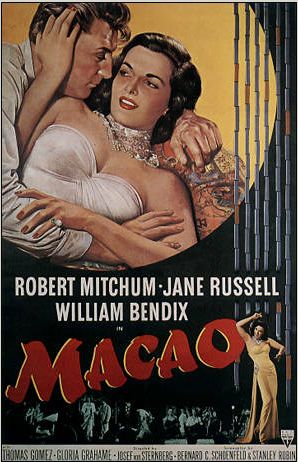
They don't have the all-time classics to their names that other film couples did. They weren't Tracy and Hepburn or Bogart and Hepburn or Wayne and O'Hara. But you know what stars Robert Mitchum and Jane Russell had in their two films together? An easy-going, sizzling charm that oozed off the screen. I'm hoping to write reviews for both soon, starting here with 1952's Macao, their second pairing.
Just 40 or so miles from Hong Kong, the city of Macao in the years following World War II has become a den of gambling, corruption, violence and any number of any other vices. One particularly crooked casino owner with his hands in everything, Vince Halloran (Brad Dexter), is especially worried though after he and his men killed an investigating officer from New York. They're playing the waiting game for the officer's replacement...and maybe some more heavy duty reinforcements. Coming ashore from a ship traveling from Hong Kong, all but three passengers are recognized, leading Halloran to believe one of them is the cop. The suspects? A Navy veteran on the run, Nick Cochran (Mitchum), a talkative salesman, Lawrence Trumble (William Bendix), and a nightclub singer looking for a job, Julie Benson (Russell). Who is the right one to target? Just which one is the cop looking to take Halloran in?
If that doesn't sound like the most pointed plot description, well, it ain't. Director Josef von Sternberg (along with some uncredited work from Nicholas Ray) was a silent film director who drifted along a touch when the sound era moved into the film industry. The Wikipedia page for 'Macao' specifically says "When von Sternberg's scenes made no sense dramatically..." so you know he wasn't always interested in a Point A to Point B (or C-through-Z) story to begin with. Production actually wrapped on filming in 1950, and then the finished product sat on the shelf for most of two years. How come? Producer Howard Hughes' track record basically. Decisions didn't have to make a whole lot of sense when your boss is one of the world's richest people. What's the end result then for this shelved, quasi-film noir?
It's good to great early on because of its randomness and general kookiness. It derails some in the last 20 minutes of its 80-minute running time. Let's focus on the positive though. 'Macao' is genuinely fun as everything is laid out and established. It mixes classic film noir with international intrigue with the huge chemistry between Mitchum and Russell with some laughs along the way. Long story short...it is a pleasant, enjoyable movie. It is dark, but not as dark as most film noirs. Some reviews point to that lack of a unified tone as a negative but the helter-skelter tone really worked for me. Should it have? Probably not but something clicks for me. Filmed in black and white with some stock footage of Macao and Hong Kong mixed in with the seedy Hollywood sets for the two cities, Sternberg's film has style and a great visual look.
Blah blah blah with all that film analysis. Let's talk about movie star chemistry!!! Robert Mitchum and Jane Russell are two of my favorites. Mitchum was that perfect tough guy anti-hero who just didn't give a crap. Russell was a solid actress, singer and performer who fit in well with the tough guys when her film roles allowed it. The end result? Two actors who don't look like they're acting. They're just hanging out, having a ton of fun bringing these two characters together. Their chemistry is evident from Scene No. 1 and never lets up. Not remembered as a great role -- and rightfully so -- Mitchum is pretty perfect, laconic and laid back with a checkered past hanging over his head. The same for Russell's Julie, bouncing from city to city looking for work. Oh, and Russell is drop dead gorgeous here. Hughes made her a star by utilizing her....natural talent I'll say. She's beautiful, and she's even given a chance to sing two songs.
The rest of the cast is solid throughout. I especially liked Bendix as Lawrence C. Trumble, fast-talking, looking to blow off some steam traveling salesman. His almost manic delivery pairs well with Mitchum's slower-paced line reads. Dexter is perfectly slimy as Halloran, the black market casino dealer always with an eye on shady deals and easy money. Also look for Thomas Gomez as the corrupt police officer working with Halloran, poorly and under-used Gloria Grahame as Halloran's much-maligned girlfriend, Philip Ahn as Halloran's steely-eyed enforcer, and Vladimir Sokoloff as a mysterious blind man who seems to pop up at the right moment whenever needed. A fun cast with some cool parts.
Now that line before about von Sternberg's lack of dramatic timing, yeah, that comes into play in the last 20 minutes. The cool, couldn't care less style loses all momentum. The finale turns into a big chase scene that doesn't keep the adrenaline flowing unfortunately. The ending itself feels a tad rushed, a disappointing end to an otherwise very enjoyable movie.
Macao (1952): ** 1/2 /****
The Sons of Katie Elder
"First, we reunite, then find Ma and Pa's killer...then read some reviews."
Showing posts with label Gloria Grahame. Show all posts
Wednesday, April 15, 2015
Saturday, December 7, 2013
The Good Die Young
Four actors that I like a lot but were never huge stars. A British crime drama with touches of American film noir. Oh, and I've never heard of this movie...at all. Released in 1954, The Good Die Young popped up recently on Turner Classic Movie's schedule, and I couldn't pass up the chance.
On a quiet night on the streets of London, four men sit in a car, one of them, 'Rave' Ravenscourt (Laurence Harvey) passing pistols out to the other three. The quartet is readying themselves to pull off a robbery that will net them each some serious money. What drove them to this point? How did they get here? How did they become so desperate that these four non-criminal types would turn to armed robbery? Rave, Joe Halsey (Richard Basehart), Eddie Blaine (John Ireland) and Mike Morgan (Stanley Baker) are just that though, incredibly desperate with nowhere else to turn. Can they somehow pull the job off?
Tweaked from a novel by Richard MacAulay, 'Die' certainly sounded pretty good to me. Director Lewis Gilbert's film was transplanted from America to London, a nice touch, and certainly pays tribute to its American film noir influences. Filmed in a shadowy, moody black and white, the look of the film reflects the pretty dark, doomed tone of the story. I liked composer Georges Auric's score, appropriately dark and foreboding, building up to the finale we all could see coming. As well, the acting is solid across the board, but I still managed to come away disappointed here. I'm disappointed I was disappointed too, mostly because I really wanted to like this one.
What mostly caught my eye was the casting of the four leads. Laurence Harvey, Richard Basehart, John Ireland and Stanley Baker?!? And in a quasi-film noir?!? The excitment unfortunately ends there. Following the quick, hard-hitting, mysterious opening, the rest of 'Die' is all flashback leading up to what we've already seen. The story bounces among the four different storylines/main characters, the quartet eventually meeting in a London bar and bonding over their generally pathetic situations. They meet everyday, drinking early and often even though none of them really have any money. Obviously, this part was necessary to show the depths they've all sunk to, but they get tedious...very quickly. The movie only runs 94 minutes, but it feels significantly longer. I guess I was expecting more of the crime drama angle so my expectations may have been slightly off, but I still struggled in those later portions before the actual crime.
The acting is still pretty decent even if it just gets to be one thing on top of another late. Harvey becomes the villain, his Rave a suave, smooth, debonaire gentleman who married Eve (Margaret Leighton), a very rich, well to do woman who's got a few years on him. Basehart's Joe is trying to get his British wife, Mary (Joan Collins), to come back to the states with him, ripping her from his evil mother-in-law's grip, (played by Freda Jackson). An infantryman in Germany, Ireland's Eddie is married to Denise (Gloria Grahame), a small-time actress aspiring to be more and with her co-stars too. Lastly, there's Baker's Mike, a boxer trying to leave the ring with the little money he's saved with his loving wife, Angela (Rene Ray), but her family keeps causing them issues. Of the four, Harvey and Baker represent themselves the best, or at least in the most interesting fashion. Also look for Robert Morley in a one-scene part as Rave's father who hates everything that his son has become.
If there is a saving grace in 'Die,' it's the last 20 minutes or so, the flashbacks left behind as the actual robbery develops. Harvey's Rave manages to convince them all to go in on the job, the amateur crooks deciding whether the reward is worth risk. If noirs and crime dramas have taught us anything, it's that crime just will not pay in the long run, and that foreboding sense comes true here. It's the ending you would expect here. I wanted to like the movie a whole lot more, but it loses its momentum in the first hour. Worth seeking out for the cast, but disappointing on most other levels.
The Good Die Young (1954): **/****
On a quiet night on the streets of London, four men sit in a car, one of them, 'Rave' Ravenscourt (Laurence Harvey) passing pistols out to the other three. The quartet is readying themselves to pull off a robbery that will net them each some serious money. What drove them to this point? How did they get here? How did they become so desperate that these four non-criminal types would turn to armed robbery? Rave, Joe Halsey (Richard Basehart), Eddie Blaine (John Ireland) and Mike Morgan (Stanley Baker) are just that though, incredibly desperate with nowhere else to turn. Can they somehow pull the job off?
Tweaked from a novel by Richard MacAulay, 'Die' certainly sounded pretty good to me. Director Lewis Gilbert's film was transplanted from America to London, a nice touch, and certainly pays tribute to its American film noir influences. Filmed in a shadowy, moody black and white, the look of the film reflects the pretty dark, doomed tone of the story. I liked composer Georges Auric's score, appropriately dark and foreboding, building up to the finale we all could see coming. As well, the acting is solid across the board, but I still managed to come away disappointed here. I'm disappointed I was disappointed too, mostly because I really wanted to like this one.
What mostly caught my eye was the casting of the four leads. Laurence Harvey, Richard Basehart, John Ireland and Stanley Baker?!? And in a quasi-film noir?!? The excitment unfortunately ends there. Following the quick, hard-hitting, mysterious opening, the rest of 'Die' is all flashback leading up to what we've already seen. The story bounces among the four different storylines/main characters, the quartet eventually meeting in a London bar and bonding over their generally pathetic situations. They meet everyday, drinking early and often even though none of them really have any money. Obviously, this part was necessary to show the depths they've all sunk to, but they get tedious...very quickly. The movie only runs 94 minutes, but it feels significantly longer. I guess I was expecting more of the crime drama angle so my expectations may have been slightly off, but I still struggled in those later portions before the actual crime.
The acting is still pretty decent even if it just gets to be one thing on top of another late. Harvey becomes the villain, his Rave a suave, smooth, debonaire gentleman who married Eve (Margaret Leighton), a very rich, well to do woman who's got a few years on him. Basehart's Joe is trying to get his British wife, Mary (Joan Collins), to come back to the states with him, ripping her from his evil mother-in-law's grip, (played by Freda Jackson). An infantryman in Germany, Ireland's Eddie is married to Denise (Gloria Grahame), a small-time actress aspiring to be more and with her co-stars too. Lastly, there's Baker's Mike, a boxer trying to leave the ring with the little money he's saved with his loving wife, Angela (Rene Ray), but her family keeps causing them issues. Of the four, Harvey and Baker represent themselves the best, or at least in the most interesting fashion. Also look for Robert Morley in a one-scene part as Rave's father who hates everything that his son has become.
If there is a saving grace in 'Die,' it's the last 20 minutes or so, the flashbacks left behind as the actual robbery develops. Harvey's Rave manages to convince them all to go in on the job, the amateur crooks deciding whether the reward is worth risk. If noirs and crime dramas have taught us anything, it's that crime just will not pay in the long run, and that foreboding sense comes true here. It's the ending you would expect here. I wanted to like the movie a whole lot more, but it loses its momentum in the first hour. Worth seeking out for the cast, but disappointing on most other levels.
The Good Die Young (1954): **/****
Monday, April 23, 2012
Ride Beyond Vengeance
Though he starred in over 40 films and countless TV shows as a star and guest star, I'll always think of Chuck Connors
as The Rifleman, Lucas McCain, the single father who raised his son
Mark on their small New Mexico ranch. I'm a huge fan of the show and not
surprisingly, Connors. He parlayed his success into other shows and
movies, but he always seemed quite at home in the western, like 1966's
B-western Ride Beyond Vengeance.
After 11 years away from his wife trying to earn as much cash as possible, buffalo hunter Jonas Trapp (Connors) returns home to Coldiron, Texas with $17,000 in his saddlebags. As he nears the town, he's ambushed by three townspeople, Brooks Durham (Michael Rennie), the rich banker, Elwood Coates (Claude Akins), the drunken, deranged cowboy, and Johnsy Boy Hood (Bill Bixby), who scar him with a brand on his chest and steal his money, leaving him for dead. Jonas continues on, dead set on getting his money back and finding his wife, Jessie (Kathryn Hays), at the same time. Jonas finds Jessie is in love with Durham (thinking him long since dead), and the town doesn't appreciate his revenge-fueled return. Everything seems stacked against him.
An oddity among westerns, 'Vengeance' is hard to compare to any other western I've seen. I was pleasantly surprised by the opening, a modern day setting as a census taker (James MacArthur) prepares to leave Coldiron, stopping at a bar and talking to the bartender (Arthur O'Connell) about the town's history. He discovers the story of Jonas' return is the stuff of legend, living on for years to come. For a B-western shot on the cheap on a lightning-quick schedule, it seemed like a genuinely unique story opener. It sets the stage for some sort of surprise and epicness (yes, I make up words) to come. What could have happened almost 100 years before in a tiny, quiet Texas town that still resonates with its citizens? Oh, and what would a B-western be without a ballad theme? Give it a listen HERE.
And that's where the problem is. What follows is not epic, doesn't feature much in the way of surprises, and ends up being disappointingly flat in the end. I'll give credit where it's due. 'Vengeance' doesn't take the easy way out, focusing on character development instead of relying solely on shoot outs and gunfights. It is different in a way that I can't quite put my finger on, and that's not necessarily a good thing. The acting tends to be a little on the exaggerated side, the tone is incredibly dark, and there's a general feel of Gothic -- maybe Shakespearean -- undertones. On a more straightforward note, it's stupid at times. Not writing to his wife for 11 years, what did Jonas think was going to happen? She'd be waiting at the doorstep for him? It comes across as partially lazy in the storytelling department, a plot device necessary to move things along without making much sense. Aren't those the best?
Typecast to a certain point as Lucas McCain, Connors spent much of the rest of his career trying to play different roles, and this definitely qualifies. Probably a little too old for the part, this isn't his best acting job. He's rocking an unrecognizable accent, and generally is required to look pissed off at everyone around him. As for the rest of the cast, while there is some impressive name recognition, the performances don't amount to much. Rennie looks bored as Durham, Akins could have been legitimately drunk playing his part, and Bixby looks confused, but more on that later. Hays as the "love interest" just doesn't have much in the way of chemistry with Connors although to be fair, their parts consist of a handful of scenes of screaming at each other. Former Rifleman co-star Paul Fix has a small part too as Hanley, an old saddle tramp who helps Jonah in a cool connection to their successful run on TV.
Mostly with a whole lot of name recognition, the cast is wasted. Along with all those previously mentioned, there are parts for Joan Blondell as a drunken owner of a whorehouse, Gloria Grahame as a married woman cheating on her husband with Bixby, Frank Gorshin (Batman's The Riddler) as a lovelorn, drunken cowboy, and Gary Merrill as Dub Stokes, Jonah's tough-love stepfather. None of these parts are essential to the story, but even in their out of left field qualities, they disappear as quickly as they appear with no rhyme or reason. Cameos are one thing, pointlessly wasted cameos are another. As for the acting, it's laughable at times. A drunken Akins always talks to Whiskey Man, his imaginary friend he drinks with, and Bixby loses his mind when confronted by Jonas. Literally the guys goes nuts with no hints, foreshadowing or warning. He brands himself and runs into the woods laughing hysterically. It's Gothic on steroids, like nothing I've seen in a western.
It all comes to a head with that final resolution....sort of. It's a weak ending in general although a knock-down, brutal fight between Connors and Akins is surprisingly realistic with a minimum use of stunt doubles (watch it HERE). The resolution is built up as this event that made a lasting impression on this town, an event that's still talked about 75-plus years later. Really? That's what made such an impression? I was disappointed with the ending in this off-the-wall B-western that basically wastes a good cast and at least some potential.
Ride Beyond Vengeance (1966): * 1/2 /****
After 11 years away from his wife trying to earn as much cash as possible, buffalo hunter Jonas Trapp (Connors) returns home to Coldiron, Texas with $17,000 in his saddlebags. As he nears the town, he's ambushed by three townspeople, Brooks Durham (Michael Rennie), the rich banker, Elwood Coates (Claude Akins), the drunken, deranged cowboy, and Johnsy Boy Hood (Bill Bixby), who scar him with a brand on his chest and steal his money, leaving him for dead. Jonas continues on, dead set on getting his money back and finding his wife, Jessie (Kathryn Hays), at the same time. Jonas finds Jessie is in love with Durham (thinking him long since dead), and the town doesn't appreciate his revenge-fueled return. Everything seems stacked against him.
An oddity among westerns, 'Vengeance' is hard to compare to any other western I've seen. I was pleasantly surprised by the opening, a modern day setting as a census taker (James MacArthur) prepares to leave Coldiron, stopping at a bar and talking to the bartender (Arthur O'Connell) about the town's history. He discovers the story of Jonas' return is the stuff of legend, living on for years to come. For a B-western shot on the cheap on a lightning-quick schedule, it seemed like a genuinely unique story opener. It sets the stage for some sort of surprise and epicness (yes, I make up words) to come. What could have happened almost 100 years before in a tiny, quiet Texas town that still resonates with its citizens? Oh, and what would a B-western be without a ballad theme? Give it a listen HERE.
And that's where the problem is. What follows is not epic, doesn't feature much in the way of surprises, and ends up being disappointingly flat in the end. I'll give credit where it's due. 'Vengeance' doesn't take the easy way out, focusing on character development instead of relying solely on shoot outs and gunfights. It is different in a way that I can't quite put my finger on, and that's not necessarily a good thing. The acting tends to be a little on the exaggerated side, the tone is incredibly dark, and there's a general feel of Gothic -- maybe Shakespearean -- undertones. On a more straightforward note, it's stupid at times. Not writing to his wife for 11 years, what did Jonas think was going to happen? She'd be waiting at the doorstep for him? It comes across as partially lazy in the storytelling department, a plot device necessary to move things along without making much sense. Aren't those the best?
Typecast to a certain point as Lucas McCain, Connors spent much of the rest of his career trying to play different roles, and this definitely qualifies. Probably a little too old for the part, this isn't his best acting job. He's rocking an unrecognizable accent, and generally is required to look pissed off at everyone around him. As for the rest of the cast, while there is some impressive name recognition, the performances don't amount to much. Rennie looks bored as Durham, Akins could have been legitimately drunk playing his part, and Bixby looks confused, but more on that later. Hays as the "love interest" just doesn't have much in the way of chemistry with Connors although to be fair, their parts consist of a handful of scenes of screaming at each other. Former Rifleman co-star Paul Fix has a small part too as Hanley, an old saddle tramp who helps Jonah in a cool connection to their successful run on TV.
Mostly with a whole lot of name recognition, the cast is wasted. Along with all those previously mentioned, there are parts for Joan Blondell as a drunken owner of a whorehouse, Gloria Grahame as a married woman cheating on her husband with Bixby, Frank Gorshin (Batman's The Riddler) as a lovelorn, drunken cowboy, and Gary Merrill as Dub Stokes, Jonah's tough-love stepfather. None of these parts are essential to the story, but even in their out of left field qualities, they disappear as quickly as they appear with no rhyme or reason. Cameos are one thing, pointlessly wasted cameos are another. As for the acting, it's laughable at times. A drunken Akins always talks to Whiskey Man, his imaginary friend he drinks with, and Bixby loses his mind when confronted by Jonas. Literally the guys goes nuts with no hints, foreshadowing or warning. He brands himself and runs into the woods laughing hysterically. It's Gothic on steroids, like nothing I've seen in a western.
It all comes to a head with that final resolution....sort of. It's a weak ending in general although a knock-down, brutal fight between Connors and Akins is surprisingly realistic with a minimum use of stunt doubles (watch it HERE). The resolution is built up as this event that made a lasting impression on this town, an event that's still talked about 75-plus years later. Really? That's what made such an impression? I was disappointed with the ending in this off-the-wall B-western that basically wastes a good cast and at least some potential.
Ride Beyond Vengeance (1966): * 1/2 /****
Friday, December 25, 2009
It's a Wonderful Life
If director Frank Capra can be accused of anything for his abilities as a moviemaker, it was that his films tended to be on the sentimental, downright sappy side. The description 'Capra-esque' is used all the time now to describe a movie that doesn't have a mean bone in its body. Is that really a bad thing? Coming from a movie fan who can be pretty cynical, doesn't really enjoy Hollywood happy endings, and is ready to roll his eyes at a moment's notice, that's saying something. 'Wonderful Life' is sappy, sentimental and meant to tug at your heart strings. What's wrong with a movie that is content being wholesome and entertaining?
For those people who haven't seen the movie -- I think they're called Communists -- here's the quick breakdown. George Bailey (James Stewart) is a family man in the town of Bedford Falls with his wife Mary (Donna Reed) and their four kids. George runs the Building and Loan, a small business that is basically all that remains in town not owning to rich old curmudgeon Mr. Potter (played to evil perfection by Lionel Barrymore). After years of struggling to stay above water financially, George has hit his breaking point. His partner and family relative Uncle Billy (Thomas Mitchell) lost $8,000 that the Building and Loan needs to survive. Looking at a lengthy jail sentence, George seeks a way out and comes to the conclusion he's worth more to his family dead than alive.
But standing on a bridge ready to jump into the freezing waters below, George instead has to jump in after another man that fell in. His name is Clarence (Henry Travers), an angel 2nd Class -- he doesn't have his wings yet -- and he's been sent to save George. But to convince him he's real, Clarence gives George a rare gift...to see what the world would be like if he was never born. Given this opportunity, George sees what a profound affect he's had on people all his life.
Much of the story is George's life seen in flashback as Clarence learns about the man he's supposed to save. This first 75 minutes is key, absolutely essential to show what George's makeup is. His life didn't turn out anywhere near what he had planned, but even with some detours and changes, he has a happy life through his marriage with Mary and his four children. He has family and friends and almost a whole town that needs him. These parts set the stage perfectly for the last hour of the movie as George is forced to take stock of his life and see what he's really accomplished with a life he thinks has been a waste to a certain point.
But the highlight of the movie is that final hour, one of the best extended sequences in the history of the movies. Watching George realize what's going on as he sees how different the world would be if he'd never been born is a series of perfect little vignettes. This leads him to realize his life was actually pretty great, building up to one of the all time great endings to a movie -- seen HERE if you've never seen it. Now I'm not usually a crier with movies, but I'll admit to crying like a little baby at this ending. It is the perfect ending to this story, well almost, but more on that later.
Jimmy Stewart had a lot of classics in his distinguished career, but this movie easily goes Top 5 with much of the praise coming from his performance. He brings George Bailey to life in creating one of Hollywood's greatest characters. As his wife, Donna Reed is the all-American girl everyone wants to marry, and the two do have great chemistry. On a side note, I find it hard to believe that Reed's Mary could not have found a husband if George wasn't around, but maybe that's just me. The supporting cast is just as good with Barrymore never more evil, Travers very funny as Clarence, the 293-year old angel, and Mitchell as bumbling Uncle Billy. There's also Ward Bond, Frank Faylen, Beulah Bondi, Gloria Grahame, and many more recognizable faces.
As absolutely perfect as the ending is in terms of producing an emotion in the audience, there is a question left unresolved. What about evil Mr. Potter? Saturday Night Live answered that question with one of their most inspired skits ever, check it out HERE at Hulu. The original though is the definition of a Christmas classic that's success just keeps on growing. If you haven't seen this movie yet, first what's wrong with you, and second go find it now.
It's a Wonderful Life <----trailer (1946): ****/****
Subscribe to:
Posts (Atom)