The Sons of Katie Elder

The Sons of Katie Elder
"First, we reunite, then find Ma and Pa's killer...then read some reviews."
Showing posts with label James Mason. Show all posts

Monday, May 4, 2015

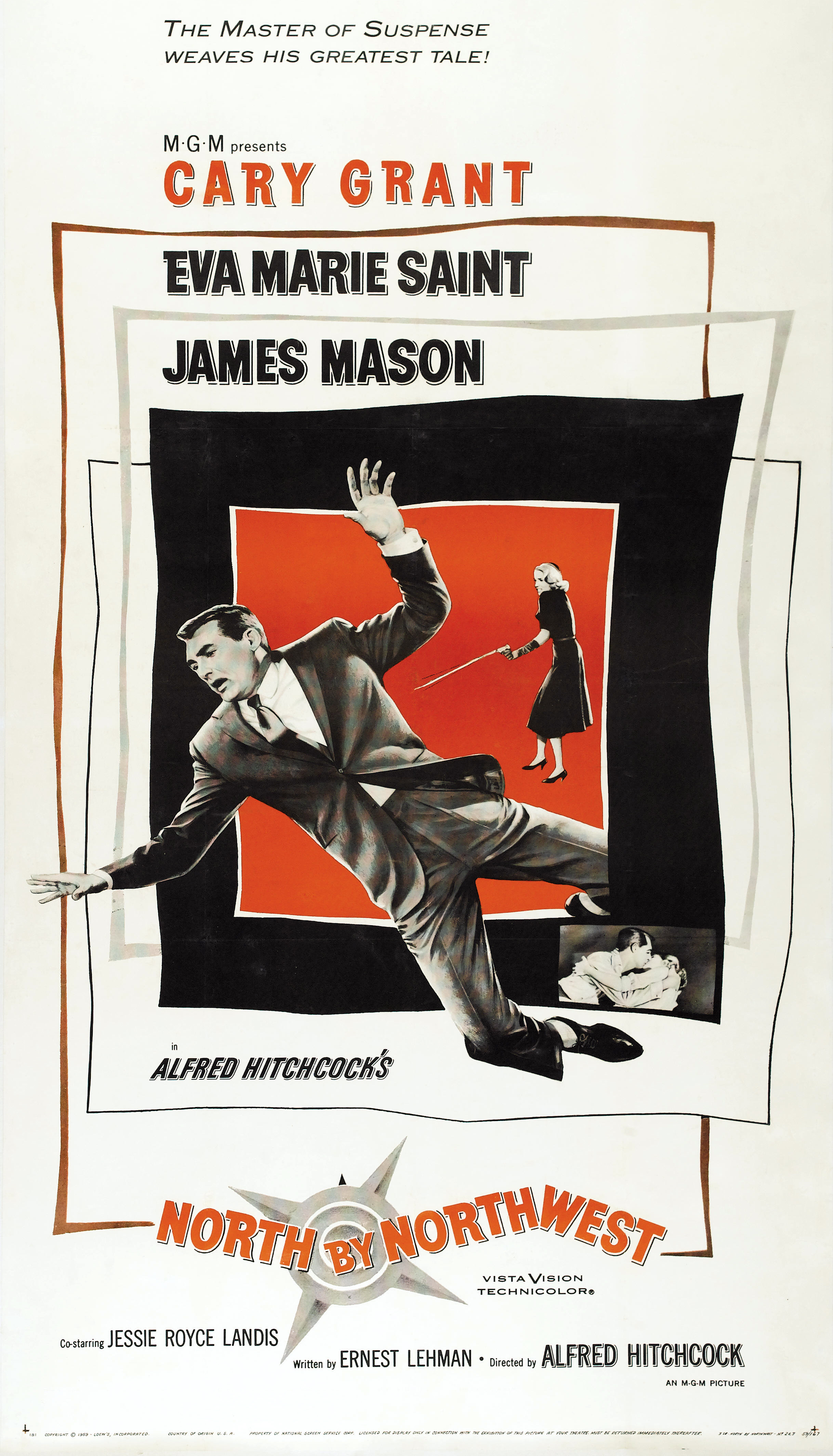
North by Northwest

Name a great director. A truly great one. Someone like Stanley Kubrick, John Ford, Billy Wilder, Orson Welles, and for today's review, Alfred Hitchcock. Ask any fan what their favorite movie is from their favorite actor, and you'll no doubt get some great answers; some agreed upon on and others surprising. For Mr. Hitchcock though, the Master of Suspense himself, that favorite movie is not worth arguing about, and I don't think it's that close either. Here's 1959's North by Northwest, my favorite Hitchcock movie by far and one of the best movies ever.

Working as an ad executive in New York City, Roger Thornhill (Cary Grant) leads quite the bachelor life in Manhattan. Well, he did lead quite the bachelor life. Visiting clients at lunch, Thornhill is taken by gunpoint out of the restaurant and driven to an isolated countryside mansion far from the city. There he meets a mysterious but eerily calm man, Vandamm (James Mason), who begins to ask him questions, questions that Thornhill has absolutely no idea how to answer. What do the questions lead Thornhill to believe? These men believe he's some sort of secret agent, a government official who's trying to stop them from doing...well, something. Vandamm and Co. have had enough though and decide to kill Thornhill, but he manages to escape. Now what? No one believes his improbable story. NO ONE. These men won't leave him alone though, and now, Thornhill is being framed for murder. He goes on the run, and the key to his safety may be a similarly mysterious but very beautiful young woman (Eva Marie Saint). Can Thornhill figure it out before his time runs out?

Sometimes, you just tip your cap to someone at the top of their game. That's Alfred Hitchcock here directing this 1959 mystery thriller. With more than a few genuine classics to his name already, Hitchcock hits this one out of the stadium. It's perfect. Smart, funny, frightening, impressive, so many adjectives come to mind. It's that Hitchcock does it all so seamlessly too. One scene, the tension is dripping off the screen. The next Grant and Saint engage some of the more scandalous dialogue to come out of the dialogue. Next up, a ridiculously charged chase scene. The movie clocks in at 136 minutes and covers a ton of ground, impressive when you consider the story basically has no plot, no huge reveals. So as I said, tip your cap. Some movies are untouchable, and this is planted firmly on that list. A master director at his absolute best.

A true test of a director's legacy is that all-important impact he/she makes with their films. One of Hitchcock's many, even countless impressions he's made is a little ditty called the 'macguffin.' It is a plot device that is SO FREAKING IMPORTANT, but never gets explained in the least. Like AT ALL. That's this entire movie. It's a movie about secret agents and the hidden government offices who run them. It's about bad guys who hold diabolical government secrets and must be stopped at all costs. So in that sense, there's literally no plot here. Yeah, Grant's Thornhill must stop Mason's Vandamm but...whatever. This is an epic case of mistaken identity that snowballs into something far more sinister, dangerous and potentially deadly. It takes a brave, talented and gutsy director to pull something like that off. I've always thought the 1950s were Hitchcock's strongest decade, and this is leading the way out front.

I got the sense watching 'Northwest' recently for this review that the Thornhill character was probably written for a younger actor. You know what though? It doesn't matter. Yeah, maybe Cary Grant was a little older than intended for the character, but his charming, likable on-screen persona and his smooth, deadpan delivery is beyond perfect for the part. As this case of mistaken identity unravels, Grant's charming, gentlemanly indignation fits effortlessly into the story. His chemistry with the lovely Eva Marie Saint is one of the best in film history, simple as that. Their dialogue is scandalous even a little bit now, ahead of its time for sure. You watch their scenes together and marvel. Just sit back and enjoy it. Hitchcock reveled in thumbing his nose at Hollywood's so-called rules, and my goodness, he pushes the envelope any time he can. I have to wonder, did the censors and studio just allow it? It's just too good to pass up.

The cast is so disgustingly good everywhere you look. Mason is the perfect foil to Grant, similarly charming, calculating and with a touch of diabolical intent. His henchmen are terrifying without saying more than a few words, Martin Landau and the creepiest eyes ever and Adam Williams as his knife-wielding enforcer. Just eight years older than Cary Grant, Jessie Royce Landis has a ball as Thornhill's worrying mother, the comic straight woman to all these antics, including her classic encounter with Landau and Williams in a packed elevator. There's also a great little part as Leo G. Carroll as the Professor, a mysterious, distinguished man interested in seeing how the proceedings develop. There's too many other familiar faces with small parts that pop up here and there to mention, but I noticed a cool, quick and you'll blink moment with a young Jeremy Slate as an alert policeman in Grant Central Station. A cool, very early part for a Just Hit Play favorite!

I hadn't watched this movie in years straight through, and man, it was fun catching up with this classic film. From Saul Bass' incredible credit sequence -- watch it HERE -- to composer Bernard Herrmann's phenomenal musical score -- give it a listen HERE -- this movie is technically perfect. Hitchcock uses some great visual tricks from matte paintings and green-screen techniques that trick your eye into seeing something you're not and doing it without calling attention to those techniques. Again, Hitchcock puts it all together. Sit back and take it all in.  

Talk to fans of the movie, and there's countless scenes that they'll mention as their favorites. There's the climactic chase ON Mount Rushmore (WHAT?!?), the painfully tension-riddled scene at an isolated crossroads with quite a twist in maybe the movie's most iconic scenes, and that's just two I'm willing to mention. If you haven't seen this movie, you are in for a treat. If you have seen it, go back and revisit 'Northwest.' There are few movies that click on all cylinders like Hitchcock's classic film does. From New York City to Chicago to Rapid City, a thrill a minute ride. A true, TRUE classic.

North by Northwest (1959): ****/****
Wednesday, March 4, 2015

The Verdict

For me, Paul Newman will always be amiable outlaw Butch Cassidy. He'll always be Henry Gondorff from The Sting. I've seen a lot of Newman's films from a career that spanned six decades, but not all of them. My biggest gap is probably the 1980s which as I look into it, is a big old knowledge gap. Newman was nominated for three different Oscars for acting during that decade, including a supremely strong performance in 1982's The Verdict.

A Boston lawyer who's fallen on some extremely tough times, Frank Galvin (Newman) isn't what he used to be. Once a promising lawyer, Galvin is an alcoholic, an ambulance chaser who has had only four cases over the previous three years. And he lost every single one of them. There's a new case on his schedule though, seemingly a slam dunk. A young woman giving birth was given the wrong anesthetic and four years later still remains in a coma in a nursing home. The hospital the event occurred in was a Catholic hospital with the archdiocese looking to move on from the incident, looking to settle without going to trial though. A huge payday is in the waiting, both for the plaintiff's family but also for Galvin for his fee. Something clicks in the experienced lawyer's mind though. Something just not right. He turns down a generous settlement and decides to go to trial. Though his intentions are pure, Galvin may be in far over his head.

This 1982 courtroom drama from director Sidney Lumet aired recently as part of Turner Classic Movie's 31 Days of Oscar. It's based off a screenplay from David Mamet of Glengarry Glen Ross and The Untouchables fame among others. Oh, and that Paul Newman guy is pretty good. I'd never seen this movie before -- not even a scene -- but I'm glad I caught up with it. Somber, even downbeat, with a harsh story to tell, it deserves the reputation it has. I loved Lumet's shooting style with an unobtrusive camera that simply films the action. It isn't moving frenetically with zooms and close-ups. Lumet sets the camera up and lets the cast act. Just ACT. We get long, uninterrupted scenes of dialogue where Newman and his co-stars have the audience's full attention. In an age where movies are all about the style, it's refreshing to see a movie so uninterested. Here's the story, the cast, and the acting. Go and do your thing.

The heart of the movie -- not so surprisingly -- is an excellent performance from Paul Newman, a performance that earned him a Best Actor nomination (he lost to Ben Kingsley's Ghandi). This isn't Butch or Gondorff or Fast Eddie, a confident world-beater with a smile on his face. Newman brings to life a lawyer riddled with self-pity who drinks and drinks, trying to put his past behind him. At one point, he was a damned good lawyer but a decision he makes for the good...almost finishes him. It's a fascinating character, one you're rooting for but with a grain of salt. You can't help but wonder how he's going to miss this seemingly gimme of a case up in the courtroom. Most memorable is just the quietness of Galvin. Newman doesn't have huge, LOOK AT ME moments. It is a quiet, subtle performance with the most emotional scene coming in his closing statement. My other favorite? The moment he makes the decision to take the case to trial, a quiet moment sitting by the patient's bed. Just good stuff.

This isn't the deepest of casts, but what's there is choice. Also picking up an Oscar nomination -- for Best Supporting Actor -- is James Mason as Concannon, the defense lawyer who at one point is dubbed the Angel of Death. No plan, no scheme, no bribe is too much for this lawyer who will get his defendants acquitted at all costs. Charlotte Rampling is excellent too as Laura, a woman coming off a divorce that Galvin meets in a bar and starts to help the beat-up lawyer in his case. In a thankless role, Jack Warden nonetheless makes the most of it as Morrisey, Galvin's former professor and current friend who becomes his right-hand man in the case. Also look for Milo O'Shea, Edward Binns, and Joe Seneca in key supporting roles.

Like the best courtroom dramas, 'Verdict' makes you feel like you're there in the courtroom as part of the jury. And as usual, what's my biggest takeaway? The American court system is a frightening one. Nothing is off limits including straight-up cheating, bribes and all sorts of letter of the law garbage. The idea of the court system is impressive, built on an ideal of justice as Galvin describes. In reality, it just isn't the same. Winning the case takes priority regardless of the means. We see that over and over again as the case develops, in and out of the courtroom.

'Verdict' becomes a little predictable in its second half, but it's never dull or disappointing. I especially liked the somewhat open-ended finale with Newman -- again -- nailing a quiet, dignified scene. Yes, it's a courtroom drama, but more accurately, this is a character study of a talented lawyer who's fallen on some hard times and sees a chance at some sort of redemption, both for the family he's trying to get a settlement but also for himself. Just an excellent all-around movie, most notable for Newman's Oscar-nominated performance.

The Verdict (1982): *** 1/2 /****

Thursday, October 4, 2012

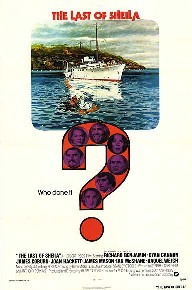
The Last of Sheila

Whodunit?!? Was it the suspicious relative who stands to earn millions of dollars on someone's death? Was it a hired gun? Oh, the murder mystery, where you can throw a long list of characters/suspects into  one story, and let the chaos ensue. There are comedies like Clue, dramas like Murder on the Orient Express, and somewhere in between the two genres, 1973's The Last of Sheila.

It has been a full year since the death by hit-and-run of the wife of powerful Hollywood producer Clinton Green (James Coburn), and he's got a plan. Green has invited six friends of both his and his dead wife to a week-long vacation in the Mediterranean on his expansive yacht. All of them with different motivations and reasonings, they all agree. Green has a complicated scavenger hunt for them that will take them to six different ports, all to see who can figure out the end game first. But as the clues come together, the guests begin to realize there may be something more sinister going on.

For the last couple of years, I've been aware of this 1973 murder mystery with a touch of comedy amidst a much darker undertone. I'll get into it more in a bit, but the star power is impressive so it would be hard to completely miss it. From writers Stephen Sondheim and Anthony Perkins (yes, the actor) comes a script that is very smart, very clever and very entertaining. The game turns into a genuine mystery as a second murder comes into question. It's fast paced though, and the first hour is basically perfect as clues start to come together about what exactly Green is up to.

And what is his plan? The Hollywood producer has issued each of his guests a notecard with a single message; "I am a....." They seem like personality traits taken from the ether, but the guests begin to figure out that Green has identified very specific traits from each of his guests, one more embarrassing than the others. One clue is the worst though. "I am a hit and run killer." Does Clinton Green hope to reveal the identify of his wife's murderer? The scavenger hunt provides two great mood-setting scenes, equal parts dark humor and then just plain old darkness. It's clever without being too clever, and in tone alone, it's different from basically any other murder mystery I've ever seen. Win-win.

Now onto that cast, and no James Coburn is not the only star. This is a part that's pitch perfect for him. He's likable, he's charming, and he's an a-hole. His Clinton Green knows how to get under someone's skin like he's being paid to do it. By the 1970s, Coburn seemed to specialize in these amoral characters with questionable....well, everything. Green lures his guests in with the promise of possibly producing a movie about his wife, and he wants them all involved. There's Tom (Richard Benjamin), a screenwriter fallen on tough times, and his wife, Lee (Joan Hackett), Christine (Dyan Cannon), a talent agent who's had a relationship with Clinton in the past, Philip (James Mason), a director now forced to direct TV commercials, and Anthony (Ian McShane), an assistant/agent for his movie star wife, Alice (Raquel Welch). Not a weak performance in the bunch.

From here on in, I continue admitting that I liked this movie a lot and will give it a positive rating. But following my enjoyment from the first hour, I didn't go along as much for the second hour. The story takes a very surprising twist around the 60-70 minute mark that I didn't see coming in the least. The remainder of the story twists, turns, veers, U-turns and brakes all over the place. It all comes together in a long, detailed and fast-moving scene late as everything comes together, but all I could think was that I was missing something. Definitely an ending (and its build-up) that would probably improve on multiple viewings. I'll add it to the list, but for now, I very much enjoyed my first viewing. Above average murder mystery.

The Last of Sheila <---trailer (1973): ***/****

Sunday, May 27, 2012

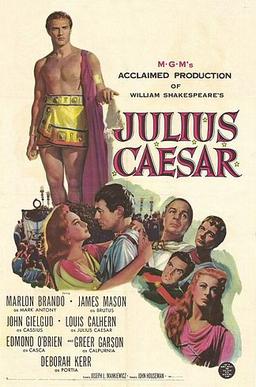
Julius Caesar (1953)

So this William Shakespeare guy....pretty talented, huh? A poet and playwright, he is basically the benchmark for everything in literature. And thanks to my upbringing in English classes through high school and college, I basically hate Shakespeare. I was forced to read his writings and resented basically every minute of it. That only partially explains my hate for 1953's Julius Caesar, but it is certainly part of it.

In ancient Rome, senator Julius Caesar (Louis Calhern) returns to an adoring public, many touting him as the future ruler of the Roman empire. Caesar's ambition is feared throughout the Senate, even leading many of his fellow Senators to plot against him, including the idealistic Brutus (James Mason) and cynical, scorned Cassius (John Gielgud). They worry that his ambition, along with close friend and fellow Senator, Mark Antony (Marlon Brando), will spell Rome's doom. They begin to form a plan, one that could change the country's future for years to come.

Now I'm going to say something early and just be done with it. I don't intend this review to sound like a whiny high school student although no doubt it will to a certain point. I can appreciate Shakespeare as an immense talent, but that doesn't mean I like anything about reading his work. I can appreciate that his talents have influenced basically every form of literature written since. But actually reading it? Some of the most difficult experiences I've ever had with the written word. Long, uninterrupted scenes of dialogue/monologues have a knack for putting me to sleep quickly. But....but.....even knowing this, I sought out this 1953 film, mostly because of the extraordinary talent assembled here. Unfortunately, I disliked it as much as I've always disliked Shakespeare's works whether it be in books and plays or film and television.

Where my objection comes from is Shakespeare's style. In writing, it is extremely difficult for me to get through the dialogue, and seeing it in a film didn't help. Well written it most certainly is, but it is stilted, awkward, forced and for me, difficult to follow. It doesn't seem to make a difference who's reciting the lines because the talent in this cast is truly impressive. And yes, I know these are stage-based stories, but seeing actors -- no matter the talent -- stand and wave and yell and recite several minutes of expressive yet still stilted dialogue doesn't scream out 'ENTERTAINING!' to me. Acting is one thing, and method acting a whole other beast, but I've never understood the appeal of loud, verbose, exaggerated stage acting, and that's what this movie is. It's 120 minutes of very talented actors talking and talking and...well, you get the idea.

With so much talent assembled for this film in the cast and director Joseph Mankiewicz behind the camera, I just assumed my issues would go by the wayside. With three movies to his name (Streetcar, The Men, Viva Zapata), Brando is a bright spot as Mark Anthony. His famous address of the Roman people following Caesar's assassination especially stands out. Then throw in Mason, Calhern, Gielgud, Edmond O'Brien, Greer Garson and Deborah Kerr? How could that not be worthwhile? I chalk it up more to Shakespeare's style than anything, but I just didn't care. I know the story, know where it will end up, and who makes it and who doesn't. Also look for Michael Ansara, Michael Pate, John Doucette, Lawrence Dobkin and Rhys Williams in smaller supporting parts.

I'm ready to take all sorts of heat for my dislike of this movie, but I hated it almost from the start. Besides the stilted, overdone stage acting, it is an incredibly dull story to watch. It was filmed in black and white on a soundstage, the camera and focus on the actors, not the huge scale or lavish sets. Bored to tears. There's just only so many ways to hear a classically trained actor speaking in the most prim and proper English ever written. So go ahead, let me have it if you so choose. I'm admitting I don't like Shakespeare. Karma is going to kick me square in the butt at some point.

Julius Caesar <---TCM trailer/clips (1953): */****

Saturday, April 21, 2012

The Desert Rats

When I think of Richard Burton, I think Actor with a capital A. A little eccentric, maybe a little more nutty, but at his heart a true actor in the sense of the word. What I like so much about Burton was that when he could have been some crazy, pretentious Shakespearean nutcase, he didn't...at least on film. He did fun, entertaining movies, not just acting movies. Early in his career in 1953's The Desert Rats, we get the best of both worlds.

It's spring 1941, and German Field Marshal Edwin Rommel (James Mason) and his army are pushing the Allied forces back further with each passing day. In the Libyan port city of Tobruk, Allied forces -- predominantly English and Australian -- have been completely cut off by Rommel's army and have been given the order to hold the city until relief comes. Among those soldiers trapped in the city is Capt. MacRoberts (Burton), a Scotsman who was one of the few survivors from his unit caught in a German ambush. He's given command of an inexperienced, newly arrived company of Australian infantry. He's forced to whip them into shape quickly as the German noose around the city tightens.

If it is a WWII movie about the North African campaign, it appears the story must focus solely on Tobruk. Whether it's this flick, Raid on Rommel, the aptly named Tobruk, Play Dirty, even The Rat Patrol, a North Africa campaign has to deal with this famous port city. Not a classic movie, it's especially interesting considering the time it was released. By 1953, WWII was still fresh enough in people's minds, but director Robert Wise isn't making a propaganda movie here. This isn't evil Nazis battling infallible Brits. It's just two sides fighting it out in the desert without any notion of  a bigger picture. It certainly marked a change in trends the years passed since the end of WWII.

For a generally forgotten WWII movie from the 1950s, I came away quite impressed with the action sequences. An extended siege -- the German siege of Tobruk lasted eight months -- isn't necessarily the most exciting thing to watch, but Wise keeps things moving in his 88-minute long movie. An early tank battle in a driving sandstorm sets the tone, not a huge scale battle but harrowing nonetheless. Commando raids across the desert to German lines are handled in a brutally efficient montage, and a deep behind enemy lines raid after a German ammo dump is the high point. The action isn't just there for action's sake though. We see the wearing down of the soldiers, the toll the extended siege has on them, especially in a fitting, moving finale as the end of the siege nears.

Just 28 years old when he starred in 'Desert Rats,' Burton is the unquestioned star here. He's a commander who looks out for his men, pushing them because he knows it will benefit them when the battles begin. His MacRoberts doesn't care if his men hate him. Their hatred can be a motivator as survival hangs in the balance. He has some excellent scenes with Robert Newton's Bartlett, MacRobert's former schoolteacher who's now a drunk and questioning his own bravery (or lack of). It's a subtle shift too, but the character ends up changing for the better by the end. Reprising his role from 1951's The Desert Fox, Mason is basically making a cameo appearance as Rommel, making the most of his few short scenes. Robert Douglas and Torin Thatcher play the British commanders in Tobruk with Chips Rafferty, Charles Tingwell, an uncredited Michael Pate, Charles Davis and Ben Wright playing some of MacRobert's men.

Covering so much ground in terms of time in an 88-minute movie, the story does feel rushed at different parts. A 2-hour movie could have fleshed things out a little, but as is, the movie is pretty solid on its own. There is that problem of having German characters talk in German for entire scenes without subtitles, but most of them are early on in the film. I have this weird thing about understanding what's going on in the movies I'm watching, but maybe that's just me. Subtitles, please! Still a very enjoyable, well-made WWII story.

The Desert Rats <---trailer (1953): ***/****

Wednesday, June 30, 2010

The Deadly Affair

Whenever possible I do my best to avoid sounding like an arrogant American moviegoer.  No nudity and no explosions?  Count me out.  I do my best to at least give movies a try regardless of the country they're from.  If it sounds halfway decent, that's all I need.  Movies from England are usually a safe bet starting with the lack of a language barrier or subtitles, although in some cases, those subtitles wouldn't hurt.  That's where I'll start with 1966's The Deadly Affair.

A British production through and through, 'Affair' is the anti-Bond movie with its lack of action, sex and any sense of humor.  Typically, I can keep up with thick/heavy British accents (a talent derived from years of watching Michael Caine movies), but subtitles or closed captioning always helps in a pinch.  Directed by Sidney Lumet -- typically one of my favorite directors -- this semi-spy flick has so many actors mumbling and whispering through their parts that I was more than a little confused just 10 or 15 minutes in.  Even trying to keep up, the story was difficult to follow...to a point.  A "twist" late seemed incredibly obvious to me, but maybe I had time to think about, being confused and all.

After meeting with a possible Communist working for the British government, agent Charles Dobbs (James Mason) is shocked to find out the man killed himself -- even after a positive ruling from Dobbs to their superiors. An old friend and former agent, Dieter Fry (Maximilian Schell), is visting but Dobbs must put his friendship to the side as he investigates.  With some help from a retired detective (Harry Andrews), he begins to piece things together with much of the mystery surrounding the death coming back to the man's wife (Simone Signoret).  Through it all though something isn't adding up, and Dobbs realizes he's stepped into something much bigger than he anticipated.

First off, the casting is impeccable.  Not so impeccable?  Mason mumbles his way through his part, Signoret's thick French accent is tough to decipher at times, and Andrews talks in an ultra-fast fashion that combined with his own accent makes most of his lines nearly impossible to understand.  Combine all three of those elements, and I was confused almost from the start.  The story features a fair share of twists -- which obviously didn't help -- but even then the it is so slow-moving that often enough these twists don't register as a surprise.  It's clear this English man didn't kill himself.  It's only a matter of who was involved and most importantly, why.

On to a theory I have that I've dubbed 'the Law and Order guest star rule.'  Watch an episode of Law and Order.  If there's a guest star in the cast, put all your money on them being the bad guy/killer/rapist/thief/kidnapper.  Figure that NBC didn't pay them just to hang around.  Their services are going to be put to use.  The theory applies to movies too involving any sort of mystery.  In 'Affair,' it is the question of who is the murderer.  SPOILERS  STOP READING SPOILERS  Not surprisingly, it's Schell.  He makes an appearance early and then reappears in the last 15 minutes.  It is obvious from his entrance he's the bad guy.  One, he is Maximilian Schell, and two, he's still Maximilian Schell.  END OF SPOILERS

Beyond the murder mystery and the government intrigue, the pacing lacks any sort of energy.  Mason is having marital problems with wife Ann (Harriet Andersson) because she basically sleeps with anyone who says 'howdy' to her.  Mason's Dobbs is unbelievably forgiving in a storyline that goes nowhere.  One semi-twist involves who Ann is sleeping with, but you should really see it coming from miles off.  There are other little oddities that include long scenes of watching Shakespearean plays while Dobbs and Andrews' Mendel try to piece things together.  Out of place and with the ability to grind the story to a complete halt, I'm sure I missed something important, but by that point I just didn't care.

Not much else to say here.  Disappointing of course because Lumet is typically such a reliable director, and the cast he's working with is certainly impressive.  I'll recommend this one for fans of any of the actors or Lumet completists, but for not much else.  I'm sure some subtitles couldn't hurt a second viewing, but that first one was painful enough.

The Deadly Affair <----TCM trailer (1966): * 1/2 /****       

Tuesday, October 13, 2009

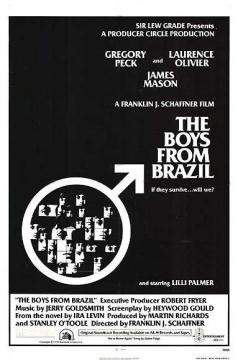
The Boys From Brazil

Depending on what movie you watch, cloning/reanimation/freezing can be handled quite differently. Think of Austin Powers and then compare it to real-life situation with baseball great Ted Williams. I realize they're different situations, but the idea is the same. What if someone from history thought far enough ahead to plan for a clone of themselves? Then think of it as one of the most hated people in history, and you've got 1978's The Boys From Brazil.

The idea of surviving Nazis trying to revive the Third Reich or even just blend in with society is nothing new in movies, with Marathon Man probably the best example. Late in WWII when it was clear the war had turned against Germany, many high-ranking officials and officers began to maneuver on how to survive in the world after the war. Some made their way to South America where support for the Nazi party still existed. Many just tried to get along and hide from the fact that they were still being hunted for their actions during WWII. But what if that wasn't all they were up to? What if they had plans to bring back Nazism into a world power?

In Paraguay in the early 1970s, inexperienced Nazi hunter and member of a young Jew organization, Barry Kohler (Steve Guttenberg) is onto something. He is convinced that retired, hiding Nazis are up to something, and even finds out their plan by bugging the villa they're staying in. Leading the group is Dr. Josef Mengele (Gregory Peck), a German doctor infamously known for his horrific, immoral actions during WWII in the concentration camps where he performed all sorts of scientific experiments on the unwilling prisoners. Convinced he is on to something huge, Barry contacts Ezra Lieberman (Laurence Olivier), a well-known Nazi hunter.

Ezra is not so easily convinced but while he's on the phone with Barry, the line suddenly goes dead and he can hear breathing at the other end. Suspicious of what might have happened, Lieberman begins to investigate the information Barry gave him even if it sounds incredibly strange. Mengele ordered that over a 2 1/2 year span, 94 men, all working in civil services, aged 65 will be murdered in locations all around the world. Confused as to how it all relates, Lieberman begins to look into the matter and does stumble upon Mengele's plan, a revival of the Nazi Party, a new Fourth Reich.

Based on a novel by Ira Levin and using real-life historical figures, The Boys From Brazil is successful as a 'what if?' in history. The true revelation of Mengele's plan is a doozy, and I won't spoil it here because part of the enjoyment from this movie is trying to figure it out as clues are slowly filtered out. The premise seems ridiculously complicated and over-the-top, but that's for after the movie. While watching the plan develop, I was too involved to think about how ridiculous it actually is. Just enjoy the movie and then rip it to pieces afterward.

With stars as huge as Gregory Peck and Laurence Olivier, you would think the leads are as solid as possible, at least I did. Peck plays the villainous Mengele, a brilliant mind who is also completely devoted to Adolf Hitler and his beliefs. With skin-lightening makeup and dyed hair, Peck doesn't look quite right, and his accent is in the evil German, Sgt. Schultz vein. Lines that are supposed to be dramatic and intimidating are instead unintentionally funny. Olivier is better as Nazi hunter Lieberman, a bit of an eccentric himself, but he still seems to go for a stereotypical older Jewis man in his characterization. Maybe I was expecting too much from these two Hollywood icons, but I came away disappointed with their performances.

The supporting cast is much better, especially third-billed James Mason. Playing Siebert, the leader of the extermination squads on the Eastern front in WWII, Mason makes the most of a role that only requires him to be onscreen in a handful of scenes. He is Mengele's security officer, making sure his plan comes to fruition even as that plan becomes more and more unwieldly. Other supporting roles go to Lilli Palmer as Ezra's sister/assistant, Denholm Elliott as a not so cooperative press agent working with Lieberman, John Dehner as a man involved with Mengele's plan whether he knows it or not, Walter Gotell as one of Mengele's key men, John Rubinstein as a friend of Barry's, and surprisingly enough, Guttenberg in a strong key role.

Aided by a solid, creepy score from Jerry Goldsmith, 'Brazil' is at its best when the story keeps you guessing. Mengele's diabolical plan for a Fourth Reich is an unexpected twist that caught me by surprise, both in terms of the story but also the science it involves. Just don't overthink this one while watching, and you'll be fine.

The Boys from Brazil <---trailer (1978): ** 1/2 /****

Thursday, March 19, 2009

Netflix review #11: The Blue Max

While hundreds of movies have been made about WWII, the war preceeding has been covered very little by comparison. I just finished one WWI movie that I really wanted to like but never really got into it, 1966's The Blue Max starring George Peppard.

Looking for a safe spot in the middle of no-man's land, German infantryman Bruno Stachel dives into a muddy crater full of dead soldiers. High above in the skies, he sees two planes in a dogfight and smiles. Fast forward two years where Stachel has graduated from flight school and is arriving at his new squadron. Even new to the group, Stachel makes no excuses, he's there for one thing and one thing only; the Blue Max, a medal awarded to pilots with 20 kills. He doesn't care who else is killed around him, he will get the medal.

Obsessed with the pursuit, Stachel alienates the members of his squadron and its commander. On the other hand, the German Officer corps sees a hero in the making, a lower class pilot fearlessly flying against British fighters. That's not all the people who are impressed with Stachel as one German general's wife takes a keen interest in the young, cocky pilot.

By far the best thing about the movie was the aerial sequences of which there are many. No CGI here, all those planes and pilots are real. Even the scenes with the stars flying don't look too fake even if it's apparent that Peppard and Jeremy Kemp aren't actually flying. As well, these aren't modern day jet fighters or even the WWII fighters that at least looked somewhat sturdy. These planes were a little more than a decade removed from the Wright brothers taking flight at Kitty Hawk. It's too bad then that the rest of the movie drags. At 156 minutes, most scenes that don't involve the dogfights are pretty slow-moving.

One other flaw is in the characters. Peppard gives an excellent performance as Stachel, the arrogant, ruthless pilot, but he's extremely unlikable. I'm not saying all characters have to be saints, but it'd be nice to have one redeeming quality in a main character. I never was on his side and by the end hoped he would get his due. James Mason plays a German general loyal to the cause who sees a hero in the young pilot. Ursula Andress is good as Kaeti, Mason's wife who takes an interest in Stachel. Before nudity became common in movies in the 70s, Andress is always half-naked, covered up by a towel or a chair as she walks across a room. Jeremy Kemp and Karl Michael Vogerty play Willi Klugerman and Otto Heidemann, a rival pilot and the squadron commander who see Stachel as he really is.

The DVD offers the movie in a widescreen presentation that looks very clear compared to some of the scenes I've seen when the movie's aired on AMC. Special features are just a trailer, and then the same trailer in Spanish and Portuguese, along with five trailers for other Fox War classics. A movie I really wanted to like but never really got into it. Worth watching for the aerial dogfight sequences.

The Blue Max (1966): **/****