The Sons of Katie Elder

The Sons of Katie Elder
"First, we reunite, then find Ma and Pa's killer...then read some reviews."
Showing posts with label Maximilian Schell. Show all posts

Saturday, May 11, 2013

The Brothers Bloom

Oh, con jobs, the second cousin to the heist film....but not related by blood. The two sub-genres are pretty close, using a lot of similar conventions, characters and stories. After all, you can only rob-con-steal in so many different ways. However, I love heist flicks, but I only like con job movies. Case in point, 2008's The Brothers Bloom, a movie that started off decent but derails in the second half.

From the time they were kids, bouncing from one foster home to another, brothers Stephen (Mark Ruffalo) and Bloom (Adrien Brody) have gotten better and better as con men. After 25-plus years of pulling cons -- most of them quite successful -- Bloom has decided he's had enough. Years of conning under his belt, he's lost track of who he is and who he pretends to be. He tries to leave his partnership with Stephen, but his highly convincing brother Stephen pulls him back in for one job. Bloom agrees and takes charge in a con meant to dupe a quirky East Coast millionaire, Penelope (Rachel Weisz), who inherited millions of dollars. Traveling around the world, they intend to convince her that they're smugglers, and she stands to make some money herself if she goes along with the plan. It isn't so simple though, especially when Bloom starts to fall for Penelope, threatening to ruin Stephen's plan.

Quirky is one thing. The quirkiest of all directors, Wes Anderson, has shown that with his films like Moonrise Kingdom, Life Aquatic, Rushmore, Royal Tennenbaums among others. But with a quirky, funny, little-off movie, there's a fine line. You have to be a little off-center with your humor, but you can't be obvious about it. The biggest issue for this film from director Rian Johnson? It is quirky, it knows it, and it aggressively wants to let you know it's not a normal, everyday comedy caper. For a flick to work like this, it has to be almost effortless to be effective. When it's trying to be different, it just doesn't work. Unfortunate here because there's a lot of potential that is ultimately untapped.

As for the general quirky nature of the story, it is both good and bad. In most cases, it just goes too far. It's an incredibly stylish movie, filming in Romania, Belgrade, Greece, Montenegro and Prague. Visually, it's a treat to watch as the locations add another layer to the story. As for the style in terms of the characters and their wardrobe, here's where we meet a problem. Stephen and Bloom are gentleman thieves, always wearing suits, vests, ties and hats. It feels and looks like a throwback to French films from the 1960s. It's a style ripped out of the sky because the story takes place in modern times. Con men that stand out like a sore thumb? That makes sense. The look of the movie is great, but like everything else, it calls attention to itself in a big way, and for me at least, that's off-putting.

Of all the things though that bothers me the most, it was the characters that put me off. Johnson also scripted the movie, but it never finds that right balance between reality and uniquely appealing (and trust me, it's trying). The best thing to develop is the relationship between Brody's Bloom and Weisz's Penelope, two very different people who are drawn to each other because they're different. While everything else is aggressively in your face (WE'RE BEING QUIRKY! LAUGH DAMMIT!), this comes across naturally. Ruffalo is okay, but he's the face of that aggressive quirkiness as is Rinko Kikuchi as Bang Bang, the brothers' accomplice, a specialist in nitroglycerin and woman of few words. Also look for Robbie Coltrane as the Belgian, a member of their conning team, Maximilian Schell as Diamond Dog, the brothers' former mentor turned bitter enemy and Ricky Jay as the narrator. In a weird, out of left field cameo, look for Joseph Gordon-Levitt as a club patron. Seriously, blink and you'll miss it.

The all over the place quirky humor is one thing, but 'Bloom' can't even choose that correctly. Is it a quirky comedy? Is it a crime thriller? Is it a violent story of betrayals? Unfortunately, the last 45 minutes are one and all of those. Not that I was really enjoying it to begin with, but the story completely unravels in the last act. Twist after pointless twist, one after another until things become almost completely unrecognizable, much less able to follow. There are moments I liked a lot, especially Weisz's performance including her exhibition of all the hobbies she's picked up over the years (watch it HERE). A ton of talent assembled with a lot of potential, but ultimately, it just tries too hard to make us like the movie. Good musical score, stylish title cards, but it never goes anywhere. I wanted to like it, but it so desperately wants us to like the film that it's almost painful to watch at times.

The Brothers Bloom (2008): **/****

Monday, June 6, 2011

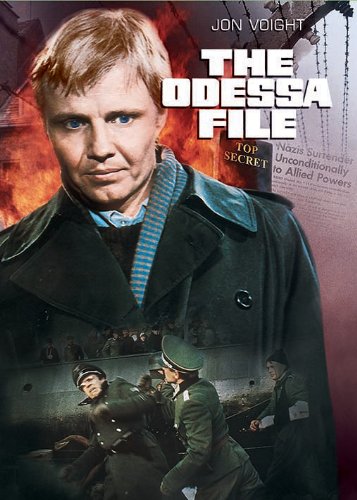
The Odessa File

Even knowing that they are true, it can be hard to comprehend the actions committed by the German SS in World War II involving the Holocaust, the concentration camps, and in general, war crimes on an epically large scale. Literally millions of people died at their hands in hopes of creating a master race of Aryans, and no matter what was said, they knew they were doing something wrong. As the war turned and a German defeat became inevitable, many of the highest ranking SS officers made preparations for new lives, leaving their old, highly checkered pasts behind them. What did they do with their new lives? Author Frederick Forsyth went into the topic with a 1972 novel that two years later was turned into a feature length film, 1974's The Odessa File.

I'm a huge fan of movies (if you hadn't figured that out), and an equally big fan of any sort of reading. I think one of the great treats is reading a book/novel, and then finding out that it was turned into a movie, especially a book you enjoyed a lot. You wonder how will it translate? Will it live up to expectations? What changes were made?  Does the visual in your head while you read match the screen version? Unfortunately in the examples I can think of, the film rarely lives up to the novel.  Just too much has to be sacrificed, and the movie suffers because of it. That was my biggest complaint with The Odessa File, and one odd example of bad casting.

A young German freelance journalist, Peter Miller (Jon Voight) stumbles into the diary of a concentration camp survivor at the camp at Riga. Living in 1963 Germany, Miller has seen the horrors of the war brushed out of the public view too often and is horrified at what he reads about Riga's commandant, dubbed 'the Butcher, Eduard Roschmann (Maximilian Schell). Convinced there's a story in the diary, Miller begins to investigate, seeing if he can find any trace of the long since disappeared SS officer. He begins to find clues that point to Roschmann still being very much alive, but has he dug himself into a hole? Someone seems very interested in keeping Roschmann's identity safe, and the life of one journalist isn't enough to stop them.

Like the other Forsyth novels I've read -- Day of the Jackal and The Dogs of War -- I very much enjoyed The Odessa File. It's the kind of low-key thriller that picks up momentum and intensity along the way, building to something you can't quite put your finger on.  When the reveal/surprise does come, it doesn't disappoint either. The premise is great, a well-organized and well-funded group protecting the identities of former SS officers and soldiers in a worldwide network that boggles the mind. Stumbling into this, Miller is almost immediately in over his head, and it is his head on the chopping block if something goes wrong.  Director Ronald Neame certainly has his work cut out for him because Forsyth's style isn't always movie-friendly, but he makes a go at it.

As an author, Forsyth is obsessed (in a good way) with the details, the little things that make a story feel authentic. That doesn't always work in a movie where the details are the first to go.  Even at 130 minutes, 'Odessa' is both a little long and too short.  What's there isn't always very interesting, and what was cut out could probably have done a good job of fleshing the movie out some.  Instead, there's little sense of urgency or fear. An organization of former Nazis is hunting you down, and this is the best you can do in terms of making an audience feel uncomfortable? Because of the cuts to the story, Voight's Miller hops around too much with too many things going unexplained.  I read the book just a week before watching the movie, and at times felt lost.

When reading a book, my head just naturally starts imagining what certain characters look like.  That's typically one of my biggest problems with film versions; the stars never match up with the image in my head. So goes Jon Voight as German freelance journalist Peter Miller in a case of miscasting.  I'm not a huge fan of Voight to begin with, but he just wasn't the right choice to play this character. Physically, he doesn't look anything like the book's protagonist, and his attempt at a German accent is just bad.  Worst of all though, he turns an interesting character into a bland one. Schell as Roschmann doesn't have a big part, but he certainly makes it memorable in his brief but effective scenes. Also look out for Derek Jacobi as an Odessa forger, Mary Tamm as Sigrid, Peter's girlfriend, and Shmuel Rodensky as famed Nazi hunter Simon Weisenthal among many others in an ensemble cast.

Both the novel and the movie claim that the story is based in the truth with a real-life ODESSA organization helping former Nazis and SS create new lives for themselves (certain names and places changed obviously). The novel's ending (including a great twist delivered by Miller) is appropriate and authentic to the real-life and fictional characters if not exactly a happy ending. The movie rewrites history somewhat in an ending that disappointed me, mostly because it ties everything up nicely when the effort just wasn't needed. The film version on the whole makes some odd choices, handicapping an otherwise interesting set-up and premise. Not horrible at all, but stick with the book.

The Odessa File <---trailer (1974): **/****

Wednesday, June 30, 2010

The Deadly Affair

Whenever possible I do my best to avoid sounding like an arrogant American moviegoer.  No nudity and no explosions?  Count me out.  I do my best to at least give movies a try regardless of the country they're from.  If it sounds halfway decent, that's all I need.  Movies from England are usually a safe bet starting with the lack of a language barrier or subtitles, although in some cases, those subtitles wouldn't hurt.  That's where I'll start with 1966's The Deadly Affair.

A British production through and through, 'Affair' is the anti-Bond movie with its lack of action, sex and any sense of humor.  Typically, I can keep up with thick/heavy British accents (a talent derived from years of watching Michael Caine movies), but subtitles or closed captioning always helps in a pinch.  Directed by Sidney Lumet -- typically one of my favorite directors -- this semi-spy flick has so many actors mumbling and whispering through their parts that I was more than a little confused just 10 or 15 minutes in.  Even trying to keep up, the story was difficult to follow...to a point.  A "twist" late seemed incredibly obvious to me, but maybe I had time to think about, being confused and all.

After meeting with a possible Communist working for the British government, agent Charles Dobbs (James Mason) is shocked to find out the man killed himself -- even after a positive ruling from Dobbs to their superiors. An old friend and former agent, Dieter Fry (Maximilian Schell), is visting but Dobbs must put his friendship to the side as he investigates.  With some help from a retired detective (Harry Andrews), he begins to piece things together with much of the mystery surrounding the death coming back to the man's wife (Simone Signoret).  Through it all though something isn't adding up, and Dobbs realizes he's stepped into something much bigger than he anticipated.

First off, the casting is impeccable.  Not so impeccable?  Mason mumbles his way through his part, Signoret's thick French accent is tough to decipher at times, and Andrews talks in an ultra-fast fashion that combined with his own accent makes most of his lines nearly impossible to understand.  Combine all three of those elements, and I was confused almost from the start.  The story features a fair share of twists -- which obviously didn't help -- but even then the it is so slow-moving that often enough these twists don't register as a surprise.  It's clear this English man didn't kill himself.  It's only a matter of who was involved and most importantly, why.

On to a theory I have that I've dubbed 'the Law and Order guest star rule.'  Watch an episode of Law and Order.  If there's a guest star in the cast, put all your money on them being the bad guy/killer/rapist/thief/kidnapper.  Figure that NBC didn't pay them just to hang around.  Their services are going to be put to use.  The theory applies to movies too involving any sort of mystery.  In 'Affair,' it is the question of who is the murderer.  SPOILERS  STOP READING SPOILERS  Not surprisingly, it's Schell.  He makes an appearance early and then reappears in the last 15 minutes.  It is obvious from his entrance he's the bad guy.  One, he is Maximilian Schell, and two, he's still Maximilian Schell.  END OF SPOILERS

Beyond the murder mystery and the government intrigue, the pacing lacks any sort of energy.  Mason is having marital problems with wife Ann (Harriet Andersson) because she basically sleeps with anyone who says 'howdy' to her.  Mason's Dobbs is unbelievably forgiving in a storyline that goes nowhere.  One semi-twist involves who Ann is sleeping with, but you should really see it coming from miles off.  There are other little oddities that include long scenes of watching Shakespearean plays while Dobbs and Andrews' Mendel try to piece things together.  Out of place and with the ability to grind the story to a complete halt, I'm sure I missed something important, but by that point I just didn't care.

Not much else to say here.  Disappointing of course because Lumet is typically such a reliable director, and the cast he's working with is certainly impressive.  I'll recommend this one for fans of any of the actors or Lumet completists, but for not much else.  I'm sure some subtitles couldn't hurt a second viewing, but that first one was painful enough.

The Deadly Affair <----TCM trailer (1966): * 1/2 /****       

Sunday, February 14, 2010

Judgment at Nuremberg

Even with Germany surrendering in May of 1945 and Japan surrendering a few months later in August, the war and conflict of WWII would continue on for years. As victors, the Allies presided over a series of tribunals meant to bring people to justice for the atrocities committed during the war, many of these trials having to do with the Holocaust and execution of POW's. These trials ended in extensive sentencing, both in terms of the death penalty and life-long prison sentences.

Less than 15 years removed from these tribunals, Stanley Kramer assembled a remarkable cast to tell the story of one of the actual Nuremberg trials in 1961's Judgment at Nuremberg. What's amazing about this movie is its honesty and frankness in dealing with the subject at hand, a touchy one at that in talking about the Holocaust. Kramer presents evidence, lets the characters tell their stories, and then makes a brave choice. He presents an option for you as a viewer to make up his/her own mind. What did these men on trial deserve? It's up to you.

Arriving in Germany, Maine district court judge Dan Haywood (Spencer Tracy) is preparing for the biggest trial he's ever presided over. It's 3 years since the end of the war, and four German judges (including Burt Lancaster) are on trial for their actions during WWII and the years leading up to it. Leading the prosecution is Colonel Tad Lawson (Richard Widmark), a WWII veteran who's prosecuted many of the German war criminals since the close of the war. His opponent on the defense is a intelligent, fiery German lawyer, Hans Rolfe (Maximilian Schell), who must present an incredibly difficult case that maybe even he does not believe.

Set almost entirely in a courtroom at Germany's Palace of Justice -- with a few quick detours -- Kramer's courtroom drama works as a series of linked vignettes dealing with one topic. Whole segments could be removed from the movie as a whole and still be worth watching on their own. At over 3 hours long, 'Nuremberg' is never rushed or too fast-paced with long, lingering shots from the camera as the testimony unfolds. Kramer allows his cast to get all the attention with only a few moments of in-your-face style from behind the camera, like an extreme zoom to a close-up of someone's face. It's a remarkable movie heavy on the dialogue that won an Oscar for its writing.

These courtroom vignettes would have worked as a stand alone, but assemble them together and you've got a classic. Two witnesses are called to the stand in two of the movie's strongest segments, Montgomery Clift as a German man forced to undergo a sterilization surgery during the war and Judy Garland as a young German woman involved in a controversial court ruling that Lancaster's Emil Janning ruled on. Both were nominated for their supporting roles -- more on that later -- in what amount to one or two scene appearances. Clift is absolutely heartbreaking (check out his testimony/part HERE) and nearly brought me to tears, and Garland is equally effective. The powers that be only gave them Oscar nominations, not the win, with best supporting actor and actress going to West Side Story's George Chakiris and Rita Moreno.

It blew my mind when I read that. I realize West Side Story is a classic -- never seen it myself -- but Clift and Garland provide some of the most effective, moving parts I've ever seen, and they got snubbed. Definitely two of the biggest such snubs in Oscar history. A bigger issue is that just about everyone in 'Nuremberg' deserved an Oscar win with Schell taking home the Best Actor. Schell has an impossible task in front of him, defending four men who helped send hundreds and maybe thousands of people to their deaths in the concentration camps. It's hard to side with his defense, but it makes you think. Provoking thought concerning something as inherently evil as the Holocaust is remarkable in itself.

Where else to start with this huge cast? Each star is given their moment to shine and not a one disappoints. Clift's testimony is early on and starts the ball rolling, and the momentum just keeps on building. Lancaster is silent for much of the movie, just a stoic presence in the dock, until he has an outburst and then gets his chance on the stand (watch it HERE). Tracy's world weary judge who's been voted out of his position back home has the biggest decision of them all, how to judge these men. And with bigger things at play, his decision is even tougher. His summation is a simple, beautifully effective description of the situation. Widmark gets the flashier part as the prosecuting attorney and makes him human, a veteran who was among the troops who liberated the concentration camps and now tries to understand the horrors and atrocities he saw. If that wasn't enough, Marlene Dietrich has a supporting role as a German widow.

The tribunal is making a judgment on these four men, but Kramer's movie explores more than just that. It is brought up several times that Germany and the German people are on trial too. On a much bigger level, 'Nuremberg' explores the Holocaust, human actions, and morality. How could people do such horrible things to another? Wouldn't they have to know they were doing something wrong? The good of the country, yes, or so they believe, but at what cost? One extended segment has Widmark on the stand showing film of the liberation of the camps as a silent court watches from their seats.  It's startling in 2010 to see that footage, much less 50 years ago in 1962.

A perfect example of how powerful a movie can be with a combination of acting and story with strong direction. Performances from a long list of Hollywood heavyweights -- Tracy, Lancaster, Schell, Clift, Garland, Dietrich and Widmark -- and a story dealing with an impossible subject make this a must-see and a true classic.

Judgment at Nuremberg <----trailer (1961): ****/****