The Sons of Katie Elder

The Sons of Katie Elder
"First, we reunite, then find Ma and Pa's killer...then read some reviews."
Showing posts with label Spencer Tracy. Show all posts

Monday, April 21, 2014

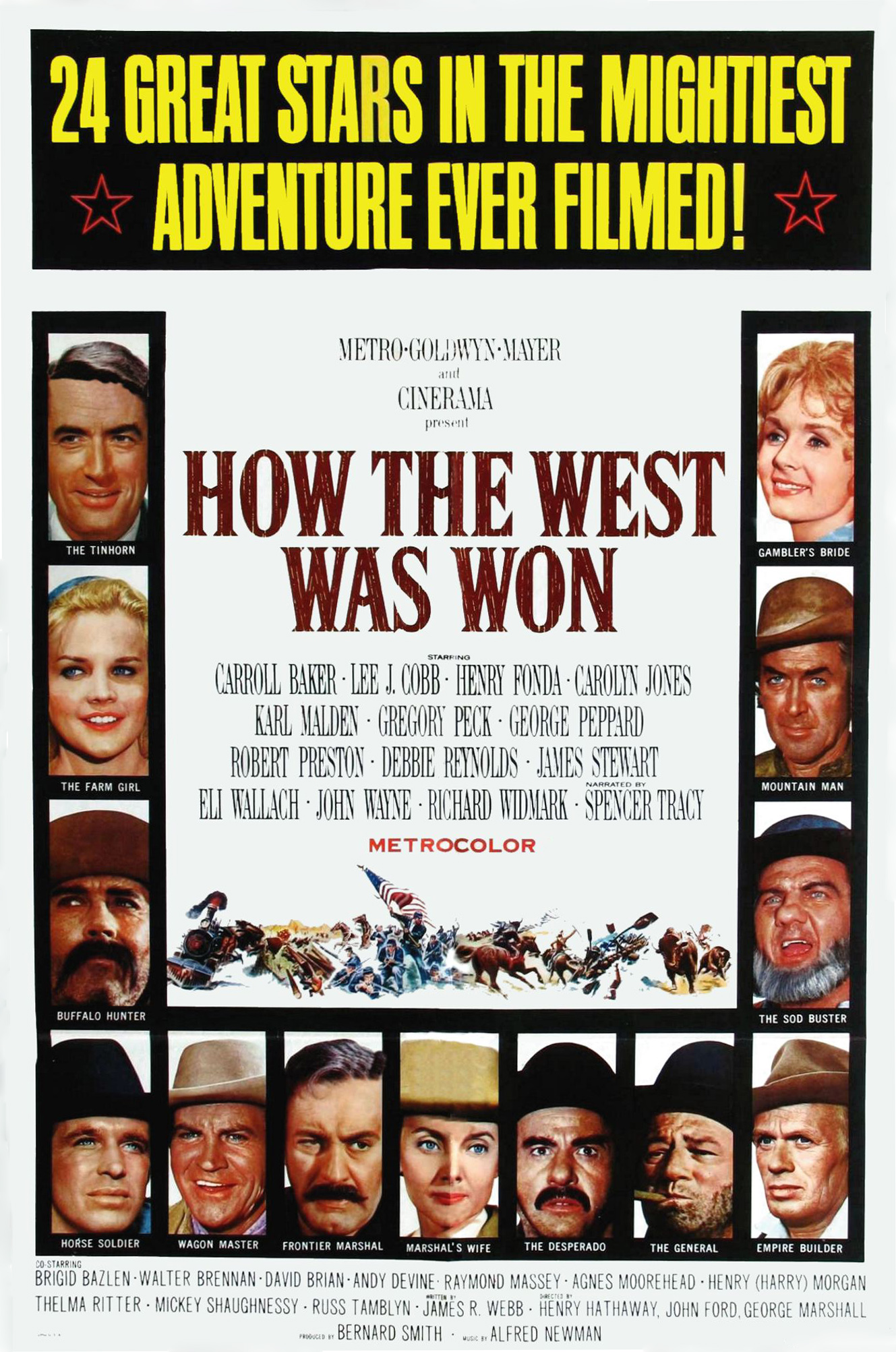
How the West Was Won

In the age of the epics -- the 1950s and 1960s -- some just stand above the rest. It's the stories, the cast, the scope. I don't love 1962's How the West Was Won but as far as epics go, there are very few in its neighborhood. There are obvious flaws, but when it works, it works in a big way. An impressive all-star cast, a story about the development of the American west and a shooting technique that is must-see. That's a winning formula.

A 162-minute film is broken up into five separate segments, the story following the Prescott-Rawlings family as it moves west and settles between the 1840s and the 1880s. It was directed by three different directors and covers a ton of ground. And away we go!

1. The Rivers (directed by Henry Hathaway): It's the 1840s, and the Prescott family, led by patriarch Zebulon (Karl Malden), is moving west and looking for a new life. In Zebulon's family is two daughters, Eve (Carroll Baker), looking for a new life in the west, and Lillith (Debbie Reynolds), wanting to stay in the far-more civilized East. In their dangerous travels on the rivers, they also meet Linus Rawlings (James Stewart), a mountain man with a canoe full of pelts.
Also starring: Lee Van Cleef, Walter Brennan, Agnes Moorehead, Brigid Bazlen.

2. The Plains (directed by Hathaway): Having worked for years on her own as a singer and dancer, Lillith Prescott (Reynolds) has just inherited a gold mine in the wake of the California gold rush. She heads west on a wagon train led by trail driver Richard Morgan (Robert Preston) with a gold-seeking gambler, Cleve Van Valen (Gregory Peck), also along too. 
Also starring: Thelma Ritter.

3. The Civil War (directed by John Ford): The war between the states in its early months, young Zeb Rawlings (George Peppard) leaves home with the blessing of his mother, Eve, to join the Ohio volunteers in the fighting. Like so many others, he thinks the war will be full of glory and be over quickly. Zeb finds out how very wrong he is at the bloody battle of Shiloh.
Also starring: John Wayne (as General Sherman), Russ Tamblyn (as a Confederate deserter), Harry Morgan (as General Grant), Andy Devine, Ken Curtis, Raymond Massey (as Abraham Lincoln).

4. The Railroad (directed by George Marshall): In the years following the Civil War, railroad companies race across the U.S. to link the two coasts. Now in the cavalry, Zeb Rawlings (Peppard) finds himself balancing out what his duty requires of him with what he knows is right, the railroad, including brutal supervisor Mike King (Richard Widmark), pushing the Arapahoes to their limit.
Also starring: Henry Fonda as Jethro Stuart, a former mountain man.

5. The Outlaws (directed by Hathaway): Having left the cavalry behind, Zeb Rawlings is now a family man with two kids, now trying to leave his profession as a lawman behind. He receives a letter from his aunt, Lillith (Reynolds), and readies the family to move. As they travel though, Zeb runs into Charlie Gant (Eli Wallach), a notorious outlaw gunning for Zeb.
Also starring: Lee J. Cobb, Carolyn Jones.

This is a movie that's simply put, BIG. It was filmed in Cinerama, three cameras filming each scene and then splicing the action together. The result? An immense look at the expansion of the west. Shots look like panoramic paintings, putting a whole new scope on the growth and development of the American west. It is a beautiful movie. Certain sequences especially stand out -- the camera on a raft trying to survive river rapids, an Indian attack on a wagon train, a stampeding buffalo herd trampling a railroad camp, a runaway train during an attempted robbery -- over the course of the movie, but visually there just isn't a weak spot. I love composer Alfred Newman's score -- listen to an extended sample HERE -- as it gives a moving background to the story. Countless gorgeous filming locations, providing a great backdrop while also transitioning from segment to segment.

It had been years since I watched this movie straight through in one sitting before my recent revisit of this 1962 epic. As you compare the five separate segments, I don't think it's really in question which one is the strongest. It's John Ford's Civil War segment, doing in 20 minutes what entire movies couldn't do in bringing the Civil War to life. Quick, dark, visually striking and unsettling, it is a gem of a sequence, especially Peppard meeting Tamblyn's Confederate deserter after the battle. The second strongest segment for me is the opening 'Rivers' with Stewart, Baker, Reynolds and Malden all leaving a positive impression. All five segments could be stretched out to a feature length film on their own, but these two especially stand out. They get their message across in a quick window and in both cases left me wanting more. Kudos to Ford and Hathaway for their work here.

What struck me more on the rewatch was the other three segments. They are by no means bad segments, but they're just not as good as the other two. I've always thought the weakest was the Plains segment, things feeling too rushed in general. The same qualifies for the Railroad and Outlaws portions. By the time you take away the Entr'Acte, intermission, and Finale music, we're looking at a movie with five segments covered in about 150 minutes (give or take). None of these three are given a chance to breathe to the point they feel downright rushed. As for some other positives? I loved the transitional scenes -- narrated by Spencer Tracy, directed in uncredited fashion by Richard Thorpe --  that set things up, explaining how America has changed, how its people change. These quick montages provide the heart of the movie, almost like a documentary in some ways. Like any movie that tries to accomplish so much, there's good and bad. The positives -- especially the Civil War middle -- is enough to outweigh the negatives thankfully.

One of my biggest worries in reviewing this 1962 epic was that the cast is too big. There's no way I was gonna be able to get all those names tagged with a 200-character limit. Who stands out? Stewart i excellent as Linus Rawlings, Fonda is good in a quick part as Jethro Stuart, and Baker is very strong too. The best parts though are Debbie Reynolds as Lillith and George Peppard as Zeb, the two hearts of the family. One or both is in every segment, the audience seeing them age, learn and adapt as America grows with them. Their scenes together in the Outlaws portion ring especially true. However you cut it though, just an impressive cast from top to bottom, one of the best ever assembled for a Hollywood film.

A doozy of a movie for what it's trying to accomplish. It falls short at times, but this is a movie worth watching for what it represents alone. This is a throwback film, a true epic that strives to be something great. If it doesn't live up those high hopes, so be it. The effort is admirable, a fascinating story of America growing up over an extremely turbulent portion of its history. Oh, and Debbie Reynolds singing A Home in the Meadow (listen HERE) is a truly beautiful song, a fitting one for the movie.

How the West Was Won (1962): ***/****

Monday, December 24, 2012

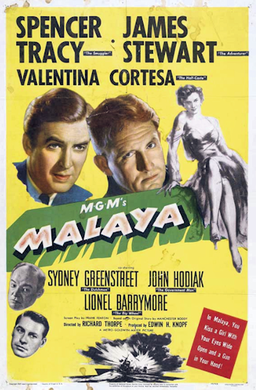
Malaya

Look down the right side of the page, and you'll see under 'Labels' quite a few war movies. For the most part though, most are about the actual fighting, the combat of war. What about the behind the scenes war angle though? How about the things that make a war possible, like production of planes, guns, materiel, and all that good stuff? A little change of pace today with 1949's Malaya, a shadowy film noir-ish story set in World War II.

Having just escaped the South Pacific with Japanese forces on his tail, newspaper reporter John Royer (James Stewart) is approached by a former boss (Lionel Barrymore) upon arrival. The conversation turns to Royer's exploits -- sometimes shady ones -- in Asia and the Pacific, Royer admitting he knows where quite a lot of raw rubber is being stored, harvested and hidden in Malaya. As the need for war materiel increases, so does the need for rubber, used to build countless key things needed to fight the war. With backing from the government (on a somewhat backdoor-ish deal), Royer agrees to go back to Malaya and see if he can buy as much as the rubber as possible and slip it out of the country. He needs help though and arranges for a friend, former partner and smuggler, Carnahan (Spencer Tracy), to aid the cause. Together, they head into Japanese-occupied territory on their nearly suicidal mission.

Considering the star power assembled here -- and there's more -- I was surprised I had never stumbled across this WWII flick before. I'm glad I did. From director Richard Thorpe, it's a mix between a behind the lines secret agent mission with many of the conventions viewers in 1949 had come to love about the film noir genre. Filmed in black and white with Malaya as the backdrop, it is a South Pacific film noir, and I can honestly say I've never seen a movie quite like that. Okay, maybe 1952's Macao. I loved the setting here, the crowded, smoky saloon and gambling house, the alleyways and dim streets, the expansive mansions and businesses in the countryside. The combination of the war movie and the crime noir just flows well together. It's always fun to see two such vastly different genres combine (usually not this well), but the end result is a lot of fun.

Not exactly a buddy movie, 'Malaya' nonetheless plays on some of those conventions that would become so familiar to audiences over the coming years. This film was the only on-screen pairing Tracy and Stewart ever made although they were together in 1962's How the West Was Won (Tracy narrating, Stewart acting). I'm never going to complain when a film pairs two Hollywood legends like this and lets them have at it. The two play well off each other. Stewart's Royer is a journalist with quite the checkered past, but with this mission, he wants to accomplish something, something meaningful. Tracy's Carnahan is a businessman and a convincing one. He looks out for himself more than anything, questioning Royer's patriotic actions. His bottom line? Usually dollar signs. Together though, they're great, always sarcastically calling each other 'Buddy!' as the mission develops. A WWII Odd Couple noir style of sorts, it's a winning combination.

Most movies would be quite content to pair two actors of that caliber together and let things be, but Thorpe doesn't settle for just two stars. This is one impressive cast, both in star power and performances delivered. Noir veteran and perpetual scene stealer Sydney Greenstreet plays the Dutchman, a saloon and gambling house owner with his hand in everything that could make him more money who joins in with Carnahan and Royer. Valentina Cortese is the checkered woman with a heart of gold, Luana, Carnahan's long-time love. John Hodiak is underused but reliable as always as Keller, a government agent working with Royer who puts the plan in motion for his Malayan plan. Barrymore too makes what amounts to a cameo as Manchester, a businessman working with several other very well to-do businessman to help the war effort. Also look for Gilbert Roland as Romano, one of the locals who teams up with Carnahan, utilizing his "unique" skill set to help in the thieving. Richard Loo gets to sneer and leer as Colonel Tomura, the Japanese officer suspicious of what's going on.

So a story that blends WWII and noir conventions? Not bad, not bad at all. How about elements of a western too? Why not?!? I very much enjoyed how the story plays out as Royer and Carnahan deal with various rubber plantation owners, working with some, intimidating others. We see their motives and intentions though, and that goes a long way. Royer is far from an idealist, but he wants to accomplish something. Carnahan is the opposite, thinking logically. Where it comes to a fork in the road is that both men come to a point where they want to do what's right. Is is the smart decision? No, if anything it's more dangerous, but there's a code of honor of sorts. As a man, what do you decide? The ending has a bit of a cop-out, but it's not a big deal. It's a movie that blends a whole lot of different things but manages to come out the better. Well worth checking out.

Malaya (1949): ***/****

Sunday, February 14, 2010

Judgment at Nuremberg

Even with Germany surrendering in May of 1945 and Japan surrendering a few months later in August, the war and conflict of WWII would continue on for years. As victors, the Allies presided over a series of tribunals meant to bring people to justice for the atrocities committed during the war, many of these trials having to do with the Holocaust and execution of POW's. These trials ended in extensive sentencing, both in terms of the death penalty and life-long prison sentences.

Less than 15 years removed from these tribunals, Stanley Kramer assembled a remarkable cast to tell the story of one of the actual Nuremberg trials in 1961's Judgment at Nuremberg. What's amazing about this movie is its honesty and frankness in dealing with the subject at hand, a touchy one at that in talking about the Holocaust. Kramer presents evidence, lets the characters tell their stories, and then makes a brave choice. He presents an option for you as a viewer to make up his/her own mind. What did these men on trial deserve? It's up to you.

Arriving in Germany, Maine district court judge Dan Haywood (Spencer Tracy) is preparing for the biggest trial he's ever presided over. It's 3 years since the end of the war, and four German judges (including Burt Lancaster) are on trial for their actions during WWII and the years leading up to it. Leading the prosecution is Colonel Tad Lawson (Richard Widmark), a WWII veteran who's prosecuted many of the German war criminals since the close of the war. His opponent on the defense is a intelligent, fiery German lawyer, Hans Rolfe (Maximilian Schell), who must present an incredibly difficult case that maybe even he does not believe.

Set almost entirely in a courtroom at Germany's Palace of Justice -- with a few quick detours -- Kramer's courtroom drama works as a series of linked vignettes dealing with one topic. Whole segments could be removed from the movie as a whole and still be worth watching on their own. At over 3 hours long, 'Nuremberg' is never rushed or too fast-paced with long, lingering shots from the camera as the testimony unfolds. Kramer allows his cast to get all the attention with only a few moments of in-your-face style from behind the camera, like an extreme zoom to a close-up of someone's face. It's a remarkable movie heavy on the dialogue that won an Oscar for its writing.

These courtroom vignettes would have worked as a stand alone, but assemble them together and you've got a classic. Two witnesses are called to the stand in two of the movie's strongest segments, Montgomery Clift as a German man forced to undergo a sterilization surgery during the war and Judy Garland as a young German woman involved in a controversial court ruling that Lancaster's Emil Janning ruled on. Both were nominated for their supporting roles -- more on that later -- in what amount to one or two scene appearances. Clift is absolutely heartbreaking (check out his testimony/part HERE) and nearly brought me to tears, and Garland is equally effective. The powers that be only gave them Oscar nominations, not the win, with best supporting actor and actress going to West Side Story's George Chakiris and Rita Moreno.

It blew my mind when I read that. I realize West Side Story is a classic -- never seen it myself -- but Clift and Garland provide some of the most effective, moving parts I've ever seen, and they got snubbed. Definitely two of the biggest such snubs in Oscar history. A bigger issue is that just about everyone in 'Nuremberg' deserved an Oscar win with Schell taking home the Best Actor. Schell has an impossible task in front of him, defending four men who helped send hundreds and maybe thousands of people to their deaths in the concentration camps. It's hard to side with his defense, but it makes you think. Provoking thought concerning something as inherently evil as the Holocaust is remarkable in itself.

Where else to start with this huge cast? Each star is given their moment to shine and not a one disappoints. Clift's testimony is early on and starts the ball rolling, and the momentum just keeps on building. Lancaster is silent for much of the movie, just a stoic presence in the dock, until he has an outburst and then gets his chance on the stand (watch it HERE). Tracy's world weary judge who's been voted out of his position back home has the biggest decision of them all, how to judge these men. And with bigger things at play, his decision is even tougher. His summation is a simple, beautifully effective description of the situation. Widmark gets the flashier part as the prosecuting attorney and makes him human, a veteran who was among the troops who liberated the concentration camps and now tries to understand the horrors and atrocities he saw. If that wasn't enough, Marlene Dietrich has a supporting role as a German widow.

The tribunal is making a judgment on these four men, but Kramer's movie explores more than just that. It is brought up several times that Germany and the German people are on trial too. On a much bigger level, 'Nuremberg' explores the Holocaust, human actions, and morality. How could people do such horrible things to another? Wouldn't they have to know they were doing something wrong? The good of the country, yes, or so they believe, but at what cost? One extended segment has Widmark on the stand showing film of the liberation of the camps as a silent court watches from their seats.  It's startling in 2010 to see that footage, much less 50 years ago in 1962.

A perfect example of how powerful a movie can be with a combination of acting and story with strong direction. Performances from a long list of Hollywood heavyweights -- Tracy, Lancaster, Schell, Clift, Garland, Dietrich and Widmark -- and a story dealing with an impossible subject make this a must-see and a true classic.

Judgment at Nuremberg <----trailer (1961): ****/****


Tuesday, January 12, 2010

The Seventh Cross

Released in 1944 as WWII was still raging in Europe and the Pacific, The Seventh Cross had to be one of, if not the first, major motion picture to deal with the Holocaust. The first major camp was even liberated by the Russians just a day before The Seventh Cross was released in theaters. People joke all the time about dealing with touchy subjects with the line "Oh, too soon?" and in this case the Holocaust in Europe was still very much an issue. Of course, to say this movie is purely a Holocaust movie would be misleading because the story moves away from the concentration camps quickly.

It's 1936 deep in Germany -- so the war hasn't even started yet for all you history majors -- and seven men escape from the Westhofen concentration camp. The group splits up to travel individually with the escape leader George Heissler (Spencer Tracy) narrowly escaping being picked up just minutes after leaving the camp. The search is on for these escapees and one by one they are picked up. The camp commandant vows to hang each of the prisoners from a row of crosses standing outside his office (hence the title), but Heissler eludes capture.

With no options and always close to exhaustion, Heissler must make his way to safety somehow. The Gestapo is looking for him and offers a reward for information on him. Unbeknownst to Heissler, an old friend, Franz Marnet (Herbert Rudley) is trying to get in contact with him to help him get out of Germany safely. Down to his last resort, George turns to an acquaintance from his past, a factory worker (Hume Cronyn) with a wife (Jessica Tandy) and three children. Time seems to be running out though for Heissler as the authorities close in.

For several reasons, this was a movie ahead of its time. For starters, it deals with the Holocaust in Germany from a different perspective. Instead of telling the story from inside the concentration camps, the whole movie is a chase through Germany. No time is wasted at all in the camp with the first shot showing the seven escapees cutting through the barbed wire. For the rest of the movie, we are given a glimpse into what German citizens dealt with before and during WWII. People and families disappear without a trace and no explanation. So when Heissler shows up asking for him with no knowledge of where he was, these people are curious as to his whereabouts.

It's also interesting to see a home-front war movie where most tend to deal in front line stories about the soldiers and officers fighting the battles. Granted, 'Cross' is several years before the war started, but there's a sense of what's to come. Cronyn's Paul Roeder works in a factory that's been converted to war materiel in an epic weapons build-up, and there's already a feeling of the Gestapo being like Big Brother with an ear to the ground and an interest in goings-on all around the country. Even the German citizens fear for what the secret police could be up to.

Through the casting, the picture of the German home front comes across clearly with a variety of people as George attempts to get out of the country. Tracy is very strong in his performance as a shell of the man he used to be, now trying to regain some of the dignity he used to have. It's through his travels he comes to trust again and see that man can be a compassionate, emotional individual. Cronyn and Tandy (some 40 years before Cocoon) are at their best, a typical young married couple who put everything at risk to help their old friend. There's also a young Swedish girl Toni (Signe Hasso) and a long list of underground members trying their best to save this one man, putting their lives on the line in the process.

A very enjoyable movie overall that does drag a bit in the second half. It would have been hard for director Fred Zinnemann to keep up the energy from the 1st hour, but it is not enough to not recommend this movie. So for a different, pretty unique look at pre-WWII Germany and the concentration camps and Holocaust, give this one a try.

The Seventh Cross <---trailer (1944): ***/****

Thursday, January 22, 2009

The Devil at 4 O'Clock

Years before the disaster genre became popular in the 1970s with movies like Earthquake and The Towering Inferno, a movie called The Devil at 4 O'Clock was released with all the makings of a disaster movie, good special effects, ensemble cast, and in this case, a less than happy Hollywood ending. I was kind of surprised reading the reviews for 'Devil' which were generally lukewarm, sometimes negative and rarely positive. It caught me off guard mostly because I really enjoyed it, especially after a somewhat slow first half hour.


In one of his later roles in his great career, Spencer Tracy plays Father Matthew Doonan, a priest on a remote Tahitian island who's lost his congregation. Years before, he helped build a children's hospital for lepers causing the citizens to basically shun him, even though the leprosy isn't contagious. But anyways, the damage is done, and after almost 20 years living and working on the island, a replacement, Father Joseph Perreau (Kerwin Matthews), is being sent to the island. Onboard Perrau's plane are three convicts on their way to a prison on Tahiti to serve 8-year sentences.


So after characters are introduced, everything hits the fan. The volcanic island comes to life, spewing lava and molten rock high into the air. Doonan insists on trying to get to the hospital before lava flows reach the children, but he can't find any help to get up there until the three convicts step up to the plate with hopes of having their sentences commuted. Frank Sinatra leads the three convicts as Harry, a self-proclaimed bum who falls for Camille (22-year old Barbara Luna), a blind woman working at the hospital. His partners are Marcel (Gregoire Aslan), a Frenchman who loves life and everything about it, and Charlie (Bernie Hamilton), a skeptic who's always had to look out for No. 1. As the lava makes its way down the mountain, can the unlikely group of four make it in time?


Most well known for his singing abilities, and rightfully so, Sinatra's acting career has always been underappreciated. With the right role, the Chairman of the Board got to show off his range, in dramatic parts like From Here to Eternity and straight action/adventure movies like Von Ryan's Express or thrillers like The Manchurian Candidate. This is one of those parts as Harry transforms from a down-and-out bum on his way to prison to a man looking to save those in serious danger.

Sure, parts of the movie drag on a little long, but the characters are believable and likable, even the convicts, and the Hawaiian locations don't hurt at all. The story deals with issues of faith, beliefs and principles without being preachy about it as well. It is a movie that has flown under the radar all these years, surprising when you consider the two leads in Tracy and Sinatra. It's not a perfect movie, but it's definitely worth checking out.