The Sons of Katie Elder

The Sons of Katie Elder
"First, we reunite, then find Ma and Pa's killer...then read some reviews."
Showing posts with label Brian Keith. Show all posts

Sunday, March 27, 2016

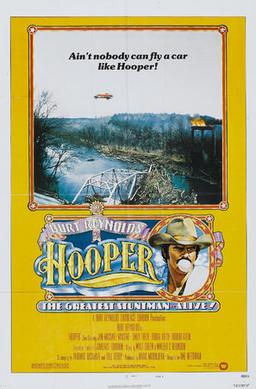
Hooper

Names like Yakima Canutt, Bud Ekins, Dar Robinson, Chuck Roberson, and Chuck Hayward may not ring a bell as an instantly recognizable Hollywood icons. They should though. These are just some of the thankless stars of the stunt business, doing the crazy stunts the actors/actresses just couldn't. Right up there with that crew (and countless others we could mention) was stuntman-actor-director Hal Needham. Who better to direct the story of an aging stuntman trying to hold on for a little more glory? N-O ONE. Here's 1978's Hooper.

For years now, Sonny Hooper (Burt Reynolds) has been the BEST stuntman working in Hollywood. Versatile in all his stunts, from car chases to aerial acrobatics, chases on horseback to a brutal fistfight, there's nothing Sonny can't do and there is no stunt he'll turn down. He'll try anything. That reckless attitude toward his work is catching up with him. He's now in his 40's and has a laundry list of broken bones and horrifically painful injuries to show for his well-earned reputation. Well, now that reputation is on the line a little bit. Though everyone still respects Sonny and looks to him to pull off the craziest of the crazy, there's a new kid on the lots, Ski (Jan-Michael Vincent), who's showing a similar knack for pulling off the impossible. How far will Sonny go to keep his unofficial title as 'Best Stuntman Around'? Maybe the most dangerous stunt of his career will do it...

Movies and stories about the making of said movies can be funny, dramatic, condescending, pretentious, revealing, and sometimes all of the above. A movie about stunt men being crazy and goofy and generally acting like idiots? Say what you want about Needham's 'Hooper,' but it is fun. It is dumb, slightly disjointed and drifts too much, but from beginning to end, it is F-un. At 100 minutes, it doesn't overstay its welcome and in the second half does feature some darker (potentially at least) moments. That said, it's a Burt Reynolds movie. Things aren't going to get too dark here. Sit back with a beer and enjoy this one.

Through the general goofiness, the most pleasant part of the story is seeing that behind-the-scenes world of the stunt men. They walk onto the set, do their stunt and...yeah, they're done for the day. Now yeah, those stunts are horrifically dangerous but you get the idea. They're celebrities among the cast and crew, albeit anonymously to the viewing public. Coming from Needham and Reynolds (who got his start as a stuntman), you know the respect will be there with the profession, along with the helter-skelter mindset of these nutcases who willingly put themselves in peril day-in and day-out. The conversation doesn't seem scripted, just guys being guys busting each other left and right. So as mentioned, the story isn't necessarily the most pointed thing around, just a series of connecting scenes linking it all together. Fun though. Definitely fun.

Who better to help us jump into the world of the stuntman headfirst than Burt Reynolds? Nobody! One of the biggest stars of the 1970's, this isn't a heavy acting part -- most of his best parts seem to be variations on his own personality -- but it is nonetheless a strong performance. You get a feel for Reynolds' Sonny, past his prime but still kicking strong. He's seen and done it all in a career that's not young anymore. Now, he has to decide how far he wants to push it. At the height of his star power, Reynolds is excellent. Playing off that familiar new fast gun in the area, Vincent is a good match for Reynolds. It's a rivalry between the dueling stuntmen, but there seems to be a genuine friendship and respect between the two men. Like I said, it never gets too dramatic along the way. The tone and spirit is generally pretty lighthearted.

The cast overall here is pretty impressive, especially if you're a fan of countless guy's guys movies from the 1960's and 1970's. Also keep an eye out for Sally Field (the girlfriend), Brian Keith (the former best stuntman around/potential father-in-law), James Best (Sonny's friend/manager), John Marley (the film's producer), Robert Klein (the ego-maniacal director), Adam West (the star), and even NFL QB Terry Bradshaw has a fun appearance. Also look for Jim Burk as a stuntman and friend of Sonny's. Burk was a frequent performer in John Wayne's later movies and finally gets a part that lets him say a few words.

The best thing going here is the actual stunts. Stands to reasons we're here for a stuntman movie so might as well see some ridiculously cool stunts, right? Reynolds does a lot of his own work, but 'Hooper' runs the gamut in terms of the variety of what we get to see. A whole bunch of craziness -- the movie they're working on seems like a James Bond knock-off -- and all of it leading to a ridiculously choreographed sequence that Klein's director wants shot in one take. ONE TAKE! It's lunacy but just go along with it. The capper? The longest car jump ever as Sonny and Ski are supposed to drive a rocket car over a river where a bridge has recently been demolished. Yeah, crazy, kooky stuff. Make sure to stick around for the end though with Reynolds pulling his usual shtick and breaking the fourth wall.

A fun movie. A dumb movie but fun!

Hooper (1978): ** 1/2 /****

Monday, October 20, 2014

Rough Riders

Okay, history nerd alert. Who's your favorite United States president? Mine's easy to peg; Theodore Roosevelt, a President who did a little bit of everything. Beyond his two-term presidency though, what is he most known for? His involvement in the Spanish American War, told quite well in a 1997 TV miniseries, Rough Riders.

It's 1898 and the American government is in a bit of a spot. News of Spanish atrocities and cruel leadership in Cuba are making international news to the point American intervention seems like a sure thing. Who's at the forefront of that movement? Assistant secretary of the Navy Theodore "Teddy" Roosevelt (Tom Berenger). He's been given approval to assemble a volunteer regiment of cavalry that will be sent to Cuba with American forces to stop the Spanish. Who is he looking to volunteer? Cowboys, mountain men, trailsmen, and anyone who can handle themselves when the bullets start to fly. He gets that and more as the volunteers assemble in Texas for training. What awaits the regiment of rough-hewn volunteers? Only the fighting in Cuba will tell.

Over the last month or so, this becomes the third TNT TV movie I've reviewed with 2001's Crossfire Trail and 1997's Buffalo Soldiers. I wish TNT still made historically-based movies like this! This 1997 miniseries is probably the network's biggest venture, a movie with impressive scale, a deep cast and a 187-minute running time. It comes from director John Milius (who also wrote the script with Hugh Wilson), a good, underrated tough guy director to helm a good tough guy flick like this. 'Riders' doesn't rewrite the historical epic/action genre, just content to tell a historical story that is known if not widely known. Elmer Bernstein turns in a fine throwback(ish) musical score, the cast looks to be having a lot of fun, and seeing a story that sticks pretty close to the historical truth? How can you lose?

The historical truth is pretty daunting for a filmmaker to take on. 'Riders' does a good job portraying not just Roosevelt and his famous cavalry volunteers, but many involved in the war from a variety of perspectives. We see the government, including President William McKinley (Brian Keith, a Milius favorite) and his secretary of state (R. Lee Ermey). We see the journalists/writers from William Randolph Hearst (George Hamilton) to Stephen Crane (Adam Storke), Frederick Remington (Nick Chinlund) to Edward Marshall (Williamt Katt). From the military perspective, we see Gary Busey and Dale Dye (a Marine Corps veteran) in power positions trying to lead the Cuban expedition. 'Riders' more than justice to the times, tackling a lot but doing a good job across the board in setting the stage for our historical story. It could have been easy for it to all slip away, but Milius helms it all nicely.

This is an ensemble cast -- a pretty strong one at that -- but I thought Tom Berenger stood out from the rest as future President Teddy Roosevelt. You read about Roosevelt, and it sounds like a caricature but no. This was one fiery, lively, opinionated, fun-loving man with some wide-ranging interests. Berenger brings him to life from his unique speech patterns to his very physical movements and non-stop energy. He makes Roosevelt more though, a human being, not just a caricature. We see Teddy with his wife (Illeana Douglas) who he misses to an extreme level, how he bonds with his men around a campfire during training, how he's emotionally distraught at seeing his men killed in battle, the exhaustion that sets in after a costly battle. Big and boisterous but never overdone, Berenger does an excellent, scene-stealing job as Roosevelt. I also learned something from the film, finding out Roosevelt wasn't always the commander of the Rough Riders. He became the commander but no spoilers.

Okay, a movie about the Rough Riders so let's talk about Teddy Roosevelt's Rough Riders. Milius uses a familiar, well-worn and effective formula here; the unit picture. Assemble a group of men from different backgrounds, put them together, let them train and bond and then throw them into battle. There's a lot of characters so there's not always a ton of development but who stands out from the rest? Brad Johnson plays Nash, an outlaw (with partner Buck Taylor) who joins the outfit to escape a posse. Sam Elliott brings his tough guy swagger to play Capt. Bucky O'Neill, an Arizona lawman turned drill sergeant. And also, Chris Noth plays Craig Wadsworth, an upper class New Yorker looking to prove himself in battle. It's a very solid cast, and that's just the start. The rest of the group isn't necessarily big names, but there's familiar faces playing some cool characters.

Who else to look for? Joining Noth as the upper-class NYC gentlemen are Holt McCallany, Mark Moses, Titus Welliver and James Parks. As for the less-gentlemanly among the Rough Riders, watch for Geoffrey Lewis, Francesco Quinn, Eric Allan Kramer, Bob Primeaux, and in an excellent supporting part, Marshall R. Teague as a young Black Jack Pershing, commander of a regiment of Buffalo Soldiers fighting alongside the Rough Riders.     

Nothing too fancy here, just a good, entertaining movie with a throwback kind of feel. The first 90 minutes sets up the background, assembling the regiment and introducing the characters, and then throwing them into training. By the end of the first half, we're thrust into the fighting in Cuba. The centerpiece of the second half of 'Riders' is not surprisingly the attack on San Juan Hill, the battle that made the Rough Riders an instantly recognizable name and regiment. There are some slow moments building up to the battle, but the actual assault on the heavily fortified hill is a gem of an extended sequence. An excellent flick on all accounts. History buffs will especially enjoy it so it gets an easy recommendation from this guy.

Rough Riders (1997): ***/****

Wednesday, June 11, 2014

The Mountain Men

Gunslingers, cavalry, wagon trains, settlers, stories and films of the settling of the west had them all in abundance. But what about some of the coolest, most interesting men who helped settle the American west. Those men? Mountain men. In film at least, they don't always get their due. There's movies like Jeremiah Johnson and a new one I can check off the list, 1980's The Mountain Men.

In the late 1830s along the Rocky Mountains, a veteran, very experienced mountain man named Bill Tyler (Charlton Heston) is coming down from the mountains with a pack mule full of beaver pelts. For the most part, Tyler likes to keep to himself, minding his own business, but when he meets a friend and fellow mountain man, Henry Frapp (Brian Keith), he decides to head to the yearly rendezvous. They want to sell their pelts, drink some whiskey and live it up a little. As the mountain man duo heads to the rendezvous, they run into trouble, a Blackfoot war party crossing their paths. Tyler rescues an Indian woman, Running Moon (Victoria Racimo), who just happens to be the squaw of the warrior leading the party, Heavy Eagle (Stephen Macht). Now instead of just looking to make some money for their winter work, Tyler and Frapp are now fighting it out with a Blackfoot war party.

The appeal of the mountain man is pretty obvious for me. Yeah, there's all those negatives -- impending doom around every corner, horrific weather, Indians trying to kill you, countless animals ready to rip you to pieces -- but is that such a big deal? Okay, sure, I guess. Maybe I'm thinking more of the romantic portrayal of the mountain men. These were the first white men to travel west into the American west, some of the first people to see some of our country's most beautiful features. They lived on their own, provided for themselves and lived among nature. Movies like this one and Jeremiah Johnson try to show that middle ground, the positive and the negative. From director Richard Lang, 'Mountain' is a beautiful movie that shows the epically big expanses of the west, filming on-location in several national parks and forests, Yellowstone, Grand Teton, Shoshone, Bridger-Teton included. You really get a sense of 1830s America, what these men saw.

If you're going to cast two hard-edged, rough-looking mountain men, you'd better get it right. I didn't love this movie, but it's hard not to appreciate the casting here. Charlton Heston and Brian Keith are pretty perfect together, both for their similarities and differences. While they're not trapping partners, they have worked together in the past and consider each other friends. Heston's Bill Tyler is more quirky, more inward, more odd in his tendencies. Keith's Frapp is his polar opposite, a motor mouth who's always talking about one thing or another, always looking for his next drink of whiskey. That odd couple dynamic works from beginning to end, especially late when Frapp decides to go with Tyler on a dangerous ride into the mountains. There is an easygoing, friendly chemistry that helps tie the episodic story together throughout.

The best supporting part goes to Racimo as Indian squaw Running Moon, desperately looking to escape from her life. It's a good part if a little forced for the sake of the story. Her chemistry with Heston is solid, but their relationship seems to develop rather quickly. Macht gets to play the stereotypically angry Indian warrior, his Heavy Eagle a menacing villain but not really given any development. Longtime Hollywood veteran Victor Jory makes his last on-screen appearance as Iron Belly, an ancient Indian chief, only on-screen for one scene. Seymour Cassel and William Lucking play two less likable mountain men, a bit of a rivalry developing when the discussion of a lost valley of untrapped waters comes up. There's at least six or seven other parts I could mention, but none are on-screen for more than a minute or two. We meet an Easterner heading west, but he disappears quickly. We meet a vengeful warrior, but same thing. He Gone.

And that in general is why this movie struggles at times. It covers a ton of ground in its relatively short 102-minute running time. Too much ground if you ask me, as if 'Mountain' had a set list of things it wants to accomplish. Running time be damned, the story was going to hit these bullet points. Too many characters, too many episodic stops along the way for the story. I liked some stops along the way -- especially the finale -- but it takes a meandering road to get there. Decent, even good, but could have been much better.

The Mountain Men (1980): ** 1/2 /****

Thursday, February 7, 2013

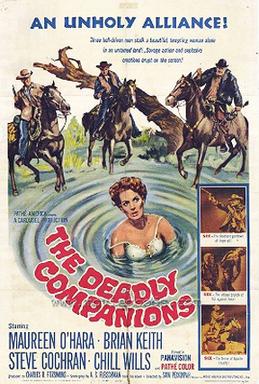
The Deadly Companions

By 1961, Sam Peckinpah had made a name for himself on the TV screen, writing, creating and even directing two different series, the classic The Rifleman and the lesser known The Westerner. The man that would go on to direct classics like The Wild Bunch, Straw Dogs, and Ride the High Country had to start somewhere though in films, and that's 1961's The Deadly Companions.

Drifting along from town to town, a man named Yellowleg (Brian Keith) teams up with two fellow drifters, Turk (Chill Wills) and Billy (Steve Cochran), agreeing to knock off a bank in a tiny, isolated desert town. As they ready to pull the job, the trio instead gets caught up in someone else's robbery, and a young boy is actually killed by Yellowleg in the process. The boy's mother, Kit (Maureen O'Hara), insists the boy be buried with her deceased husband, buried in the far-off and possibly abandoned town of Siringo. Feeling the extreme guilt over the accidental shooting, Yellowleg insists on guiding Kit through Apache territory to Siringo, but the dangerous journey holds secrets and trials that none of them were expecting. 

Everyone has to start somewhere, and for Peckinpah in films, this was it. It is an interesting debut -- both good and bad -- that certainly is a forerunner of his later movies. While limited by a smallish budget, Peckinpah shows a knack that viewers would come to expect with movies like The Wild Bunch and Ride the High Country. According to O'Hara's biography, the filming was a less than pleasant process as first-time feature film director Peckinpah adjusted to shooting on a bigger scale than TV allowed. It's interesting though because with the exception of maybe Junior Bonner or Ballad of Cable Hogue, this is probably his least violent film. There are flaws, but I also think there's a hidden gem among all those flaws.

Let's start with Brian Keith as Yellowleg, a former Union officer traveling the west looking for vengeance on the man who tried to scalp him during the Civil War. That man? Chill Wills' Turk, a former Confederate soldier on the brink of lunacy trying to revive the Confederacy. Keith's Yellowleg (we never learn his real name) wears his hat low on his hat, never taking it off, because of the scar across his forehead from the failed scalping. He's also carrying a bullet in his shoulder and struggles to fire his gun accurately because of the wound. Peckinpah favored wounded, scarred anti-heroes dealing with extreme internal demons struggling to come to terms with those demons. I like Keith more and more with each passing part, and this is a very good one, if not one that's easily remembered as one of his best.

That's what I like about this first Peckinpah feature film. It isn't a classic by any means. But considering it was released in 1961, it's hard not to be impressed. This is far from a typical western released in that year, starting to reflecting the changing times, and that's what surprised me (although I guess it shouldn't have. Peckinpah wasn't exactly a touchy-feely kind of guy). This is one epically dark western. Each and every character is a tortured individual, all struggling to cope with something. Even the bad guys -- perfectly cast Cochran and Wills -- are trying to rape O'Hara's Kit, rob banks, shoot Yellowleg in the back and so on. Not nice guys. The background gives it all more depth; a former Union soldier obsessed with revenge on the Confederate who tried to scalp him? Oh, and a little boy gets gunned down in the first 20 minutes? It's hard to imagine a 1961 getting any more dark. 

As I mentioned, this is far from an action-packed western. At the same time, it isn't exactly story-heavy either. It leans more toward episodic as Yellowleg, Kit, the two gunslingers and the dead boy make their way to Siringo. The focus is on Yellowleg's demons, Kit's mistrust and hatred of the man who killed her boy, and a vengeful Apache trying to kill them. I liked the dynamic between Keith and O'Hara especially. An IMDB reviewer compares it to an artsy Euro-western, and I'm hard pressed to disagree. The music from Marlin Skiles -- heavy on Spanish guitar, accordion and harmonica -- is oddly effective and appropriate. The look (including on-location shooting in Arizona, especially Old Tucson) is dreary and washed-out, reflecting the generally dark demeanor and tone of the story. Oh, and it is a Peckinpah film, watch for Strother Martin as a fire-breathing parson.

Things aren't perfect of course. At 93 minutes, 'Companions' can be a tad disjointed. Scenes transition from one to another without any real transition, scenes ending on odd notes as the screen fades to black. The ending especially is a little crazy as the studio took the finished film away from Peckinpah (a recurring trend later in his career) and reedited it into an indecipherable, completely out of place happy ending. It's still a good movie that doesn't deserve all the flak it takes, and one Peckinpah fans should definitely see. You can watch the entire movie HERE at Youtube, but it is a public domain print and therefore, not a good one. Hold out for another airing on TCM.

The Deadly Companions (1961): ***/****

Friday, December 21, 2012

The Violent Men

A western doesn't have to be done on a huge scale to be a true epic. Sometimes the beauty of an epic western is that it's done on a more personal scale, like 1955's The Violent Men. Echoing characters, relationships, betrayals and backstabbings that Greek mythology and William Shakespeare would have been proud of, this is an underrated gem.

Having been severely wounded during the Civil War, John Parrish (Glenn Ford) moves west and starts up a successful ranch as his wounds heal. It takes some three years, but he's healthy again and intends to sell the ranch and move back East with his fiance, Caroline (May Wynn). Against his better judgment, Parrish is going to sell the ranch to Lee Wilkison (Edward G. Robinson), the crippled owner of the Anchor ranch, the biggest cattle ranch in the territory. In an effort to buy up the whole valley, Wilkison and his wife, Martha (Barbara Stanwyck), try to low-ball Parrish. Making matters worse, they try to strong-arm him, killing one of his ranch hands. Quite content to take the low offer prior to the killing, Parrish has had enough. Outnumbered by Wilkison's small army of gunhands, Parrish -- a former cavalry officer -- goes on the offensive.

Though I've long been aware of this 1955 western from director Rudolph Mate, I never actively sought it out. For whatever reason, I looked it up on Netflix recently and seeing a very impressive cast, I gave it a shot. I'm glad I did. Partially because of its relatively short run-time at just 95 minutes, it isn't remembered as a classic, and I suppose it isn't. What it is is an above average, well-told, exciting adult western that doesn't settle for a status quo in a typical sense. It was filmed in the Alabama Hills in California (along with some location shooting in Old Tucson) and definitely has the look, if not the feel, of a much larger scaled, epic western. I also liked composer Max Steiner's score, sounding somewhat like a Dimitri Tiomkin score. Whatever it reminded me of, I liked it.

While there are very clearly good guys -- Ford's Parrish obviously -- and very clearly bad guys -- Robinson, Stanwyck and more -- this Mate-directed western is far from your typical good guys in white hats shooting it out with bad guys in black hats type of western. Comparing any western to Greek mythology or a Shakespearean play is opening the door for all sorts of criticism, but it's all deserved here. Ford's Parrish is the unquestioned hero while Robinson's Wilkison is the crippled, aging ranch owner. That would be a one-on-one showdown worth the price of admission, but that's the start. Robinson's brother, Cole (Brian Keith), is also having an affair with Martha, who wants nothing more than to own the valley, not really caring which man she's with to get there. Filling out the family tree is Judith (Dianne Foster), Lee and Martha's daughter, who knows exactly what's going on but doesn't know where to start or who to help. As a bonus, Wynn's fiance is also a cold-hearted you know what. Lots of betrayal, backroom deals and back-stabbings around every corner, and everyone is looking out for themselves.

With a cast this good, I probably would have gotten some enjoyment out of the story even if it was a dud. Watching this much talent on-screen can be fun in itself. On the positive though, the cast does a solid job from top to bottom here. The more I see Ford, the more I like him. His Parrish is a great hero, but one with a mean streak as needed. Robinson, Stanwyck and Keith are the three heads of one bad snake, all working against and with each other at the same time. It's only a matter of time before they start attacking each other. Foster is good too as the maligned Judith while Wynn is your pretty typical evil woman looking out for herself. Richard Jaeckel is all duded up as Wade Matlock, the Wilkison's top hired gun. His scenes with Ford are worth it to track the movie down on its own. Also look for Warner Anderson, Basil Ruysdael, Willis Bouchey, Jack Kelly and William Phipps in key supporting parts.

After a somewhat slow start as all the characters are introduced, the story picks up the Wilkisons try to strong-arm Parrish into selling his ranch. He puts his military background into effect, unleashing his own kind of strategic offensive on the better equipped, better outfitted Anchor ranch riders. The action picks up including a classic showdown between Ford and Jaeckel, a night ambush in a rocky canyon, and one form of guerrilla warfare after another. Not a lot of analysis needed for this one. It's a western that mixes elements of a good old-fashioned shoot 'em up with other more adult-themed elements. Well worth checking out.

The Violent Men (1955): ***/****

Monday, December 17, 2012

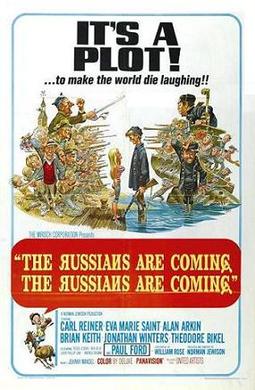
The Russians Are Coming The Russians Are Coming

From a screenplay by William Rose, 1963's It's a Mad Mad Mad Mad World is one of my all-time favorite comedies with its ridiculous cast, madcap comedy and general zaniness. Three years later, Rose tried to duplicate the success with the similar formula. Unfortunately, 1966's The Russians Are Coming The Russians Are Coming doesn't match up.

Off the East Coast and near Gloucester, a Russian sub is run aground by a captain (Theodore Bikel) who wants to get a good look at America. The Russians send a landing party to shore commanded by Lt. Rozanov (Alan Arkin) to find some sort of help....secretly of course. The little island is quiet though, everyone basically minding their own business. Rozanov and his eight-man patrol first go to the house of a vacationing writer, Walt Whittaker (Carl Reiner), and his family. As they ever so secretly and quietly seek help -- a powerboat to help pull the sub off a sandbar -- rumor spreads through the island like wildfire. Anyone and everyone who can carry a weapon takes to the streets to find the Russians.

Now, I'm no dummy. I knew going into this movie it was a comedy. Having watched it, I know it is a comedy. But reading that description, nothing at all screams comedy about it, and I think that may be the biggest thing working against this Norman Jewison-directed comedy. A madcap, screwball comedy about a bunch of strangers traveling a couple hundred miles to unearth some buried money? That's funny. A madcap, screwball comedy about a tiny New England island trying to hunt down some marauding Russians? Yeah, not so much. My first reaction was for the film to do a complete 180. An action movie, a drama, a politically-charged thriller with this basis premise would be a gem, full of tension and anxiety.

That's me in my own head though. The basic premise of the story just isn't funny then. I may have chuckled here and there, but I don't remember actually laughing out loud once. The comedy and laughs weren't there for me. As posses sprout up all over the island and everyone starts to freak out, the story bounces among five or six different developing situations (for the lack of any better description). Reiner's Walt tied up to a rather large woman (Tessie O'Shea) by the Russians and trying to escape? The town drunk chasing a horse (the entire movie) so he can warn the island Paul Revere-style what's going on? Screwball is one thing. Just stupid another.

If there is any saving grace here -- however slim -- it will be the cast. Now granted, none of the performances are that good or that funny, but come on.....star power! Reiner's Walt is married to Eva Marie Saint with some decent back and forths between the veteran actors. Young Sheldon Collins plays their shrill son, Pete. Arkin is a bright spot as Rozanov, but I think it's mostly because he gets to play a straight man to all the hijinks and shenanigans. His Russian accent is pretty funny too. Brian Keith and Jonathan Winters get to ham it up as the Sheriff and his deputy, but the biggest ham is Paul Ford as the island veteran leading the hunt with his ancient sword. Also look for John Phillip Law as one of Rozanov's sailors who instantly falls in love with the Whittaker's babysitter (Andrea Dromm).

Sorry to say, but I came away vastly disappointed with this comedy. At 126 minutes, it's just too long and even tedious. Making it worse, any scene with Russian being spoken doesn't feature subtitles. I don't care if it's made-up, jokey subtitles, but put something on the screen for long dialogue scenes! The romance between Law's sailor and the babysitter is painful to watch at times too. Apologize for the somewhat shorter review than usual, but I was completely unimpressed with this comedy.

The Russians Are Coming (1966): **/****

Wednesday, August 29, 2012

Violent Road

Released five years after the 1953 French classic The Wages of Fear (<---Just Hit Play review), 1958's Violent Road is an interesting, mostly entertaining and tense story. There's a slight problem though. If you've seen the French version, this is almost a cookie-cutter remake albeit for American audiences. That's not necessarily a deal breaker, but it sure hamstrings the movie from the start.

Just days removed from getting fired as a truck driver, Mitch Barton (Brian Keith) stumbles into a dying western town and quickly finds a job. After a launch went severely wrong, the Cyclone Rocket Company is relocating, but there's an issue. To get started at their new location, three truckloads of explosive, corrosive and sensitive chemicals must be transported across bumpy, dangerous desert roads, and there's a short window to do it. Never one to shirk a dangerous job, Mitch takes the job offer and recruits five other men -- two more drivers, three back-up driver/mechanics -- to help him pull it off. Working against the clock and the elements, it looks like a suicide mission with little chance at succeeding.

The threat with any remake is that it won't be nearly as good as the original. My question though with this 1958 flick is simple. Were they counting on a majority of American audiences not having seen 'Wages,' if they'd even heard of it? I'm not sure how much of a release the original French classic received in the U.S. Regardless, director Howard W. Koch transports the story from South America and moves it to the American southwest. It borrows liberally from Wages, tweaking a few things here and there (three trucks instead of two, six men on the mission and not just four) while also not going to quite the dark depths of the original. Not a bad thing, it just finds a different way to be dark.

Not as good as the original, 'Violent' is still a very watchable if derivative movie. It's worth a watch for sure. The black and white shooting looks great, giving that big open expansive desert a larger than life feel. Koch filmed his story in the Alabama Hills in California so we get some great footage of a time long since past, and as well, a pretty cool amount of footage of these three trucks gunning it across the desert. The story -- regardless of if you've seen the original -- is one you watch anxiously waiting something to go wrong. What is it? You're never sure. You watch from the edge of your seat waiting for anything; a wrong bump in the road, an explosion that will kill all involved. Not particularly original, you bet, but entertaining just the same.

Similar to why 'Wages' was successful, 'Violent' works because of the dynamic that grows among Mitch's crew. They're all chosen for this desperate, possibly suicidal job, and they all have their personal reasons for doing so. Yes, you guessed it. This is a men-on-a-mission movie in disguise. Keith gives a fine performance as Mitch, the no-nonsense leader of the desperate mission. It becomes almost an obsession to get the job done and get his men the money they're owed. His destined for hell group includes Sarge (Dick Foran), an ex-Marine who missed his glory days, Lawrence (Efrem Zimbalist Jr.), the company rep dealing wit the death of his family in the previous rocket accident, Ken (Sean Garrison), the fearless kid trying to earn the money to help care for his drunken brother, Manuelo (Perry Lopez), the mechanic who wants to go to school to become an engineer, and Ben (Arthur Batanides), the gambler always ready and willing to let his fate be decided on a roll of the dice. Nothing flashy, but all six are solid in bringing their characters to life, avoiding become just cardboard cutouts of real people.

Not a ton else to add to this review so I'll keep it a little shorter than usual. If you enjoyed 'Wages,' you'll no doubt get some enjoyment from this movie. If you haven't, it's a clean slate and a win-win. Nothing flashy at 86 minutes long, but a well-told story and an interesting bunch of characters. Worth a watch.

Violent Road (1958): ** 1/2 /****

Monday, August 27, 2012

Chicago Confidential

Part Law and Order, part Dragnet, 1957's Chicago Confidential is an odd duck in movie terms. It's not a bad movie, but it's not good either. You can easily see it playing in some dumpy drive-in or cheap second-run theater. The oddest thing? I can't help but wonder if district attorneys across the country paid to have it made. It's almost a recruiting video for the profession, wrapped up nicely in a quick 75 minutes.

The district attorney in Chicago, Jim Fremont (Brian Keith) seems destined for bigger and better things, maybe even in the governor's office. For now though, he has one huge case in front of him that could make or break his career aspirations. The head of a union, Artie Blaine (Dick Foran), has been accused of murder, killing one of his staff who was supposed to have confidential papers that could possibly cripple the union. It seems like an open and shut case with evidence mounting up against Blaine, but Fremont begins to smell a rat, and he's right. With help from Blaine's girlfriend, Laura (Beverly Garland), Fremont tries to prove the murder was a frame set up by the mob interested in infiltrating the up to now clean union.

Aired recently on TCM in a Dick Foran tribute day, 'Confidential' is a weird one. At just 75 minutes, it plays like an extended TV episode, maybe a two-part episode if anything. With such a short run time, it is too short to make much of an impression and not long enough to be truly bad. As it is, this Sidney Salkow-directed film just sort of is. Not bad, not good, just sort of there. The narration spells every little thing out for us as a moronic audience, and the sets look like they were pilfered from a police procedural TV show.

So why watch this one? It's unabashed desire to show how cool district attorneys is certainly unique if not interesting. You can see Sam Waterston's Jack McCoy of Law and Order taking that leading part that Keith plays. Strong, resolute, and undeterred by the threats of organized crime, Keith's D.A. Fremont is going to accomplish his objectives no matter the detours thrown at him. But it goes beyond that. When he starts to think Foran's Blaine is innocent, he goes on an investigation of his own. In the final scene when everything has been righted, the narrator says proudly "Nothing can stop a district attorney" or something of that ilk. Subtle it is not. Stupidly entertaining? A little.

In a part that doesn't give him much room to flex and show off his acting ability, Keith is serviceable as D.A. Fremont. He's doing the best he can with a poorly written, sometimes dull character. Foran similarly isn't given much to do other than looked worried and/or angry. Garland as the crusading girlfriend ends up being more shrill than anything else, grating with every passing scene. The bright spots? The bad guys, evil in everything they do and reveling in their despicable actions. Douglas Kennedy plays Harrison, the mobster using Blaine's union as a means of moving organized crime into the city. His two brutal thugs are played by John Indrisano and Jack Lambert, both uncredited parts that deserved some more screentime. Elisha Cook Jr. is good in a small part as Candymouth Dixon, a lush who accidentally witnesses the dumping of the body early on. Later the host of the 1960s classic Home Run Derby, Mark Scott plays a cop working with Fremont.

Through all of its faults, 'Confidential' is certainly trying to be something different. In terms of police procedurals, we see the wide variety of techniques used by law enforcement in the 1950s, especially an interesting bit about voice analysis as a key piece of evidence surfaces. But in the end, it never amounts to a whole lot. It's a generally dull story made tolerable by Keith and Foran in the leads.

Chicago Confidential <---trailer (1957): **/****

Thursday, August 23, 2012

The Bamboo Prison

Here we are again, the propaganda movie. I feel bad. I do, but I've got little else to go on here. Subtle, underplayed propaganda = anywhere from good to tolerable. Heavy-handed, aggressively in your face propaganda = not good to not tolerable. Unfortunately, 1954's The Bamboo Prison goes down the heavy-handed route.

Having marched for over 40 days, Corporal Brady (Brian Keith) and the remnants of a column of prisoners of war finally reach their destination; a brutal, under-supplied camp run by the North Korean army and several Russian/Communist advisers. Getting the scoop from his fellow prisoners, Brady discovers that one American P.O.W., Sgt. John Rand (Robert Francis), is a collaborator working with their captors for better treatment and billeting. Brady quickly finds out there's more than meets the eye when it comes to this believed collaborator. Rand is really an intelligence officer planted in the camp hoping to find proof/documentation of Communist atrocities committed against the POW's. Can he get the proof before a Russian counterpart figures him out?

Released just a year after the conclusion of the Korean War, 'Prison' was no doubt an incredibly timely story for audiences. Beyond it's issues with the propaganda angle -- more to come in that department -- the movie is undone by a general stupidity I had trouble getting past. At just 79 minutes, it doesn't really know where it wants to get other than delivering the "Communists are epically bad" message. Director Lewis Seiler was a talented director, even handling other propaganda-ish movies like Guadalcanal Diary, but the story here is too convoluted for its own good. Rambling, oddly and aggressively trying to be funny, it's a mess.

Propaganda in film can be good. I've said that before, and I'll most likely say it again. The story in 'Prison' has Francis' Rand searching for proof of Communist atrocities, anything from brainwashing to brutal physical beatings to lack of supplies and clothing. Brief sidenote; can't he just see these atrocities? What exactly is he looking for? Does pretending to be a collaborator actually help that much? Here's the thing. All those things were done by Communist/North Korean forces. There's evidence of it, but that doesn't make it any more pleasant to watch. We are subjected to long monologues about the Communist ideal, and then shown how evil it is. Movies like The Manchurian Candidate showed that this subject could be handled in a subtle but still scary and effective fashion. That isn't the case here.

Star of just four movies before his death at age 25 in 1955 in an airplane crash, Francis isn't the best choice to play this character. As was the case with his other roles, he just is not a very expressive actor. His line deliveries come across as beyond static. Monotone, wooden, one-note, all adjectives would apply here. His Rand is also given a love interest, Tanya (Dianne Foster), a Russian ballerina married to a Communist adviser/brainwasher. Those scenes -- lacking any real chemistry -- can be painful to watch. In the sidekick role, Keith is wasted as the tough, no-nonsense Cpl. Brady. He's introduced, and you think he's going to be a main character but unfortunately not. His character disappears for long stretches, only to pop up when Rand needs some help.

Then there's the portrayal of the American and international prisoners of war. For a camp that's supposed to be one step above Hell, the prisoners don't seem to mind too much. They're always laughing it up, hamming it up, and all at their Communist captors' expense. Haha communism! You're so stupid! The prisoners include Jerome Courtland as Arkansas, a shrill Southerner with that stereotypical drawl, E.G. Marshall as Father Dolan, Earle Hyman as Doc, the black medic (another redeeming part), Jack Kelly as Slade, the fast-talking car salesman, King Donovan as Pop, the family man trying to get home (bet that ends well for you, buddy), Pepe Hern as Ramirez, the Mexican soldier, Leo Gordon as Pike, the hot-headed prisoner, and Dickie Jones as Jackie, the youngster. At different points, they sing together, do impressions of Bogie, and all sorts of prisoner of war hijinks. Yeah for being a prisoner of war!

There just isn't much going on here in that whole positive vein. The ending is ridiculously stupid, making us question what the hell Sgt. Rand was even thinking all along. Has he started to believe all the things he was pretending to believe? Eh, not worth analyzing. Just not a good movie.

The Bamboo Prison <--- TCM trailer/clips (1954): * 1/2 /****

Saturday, July 28, 2012

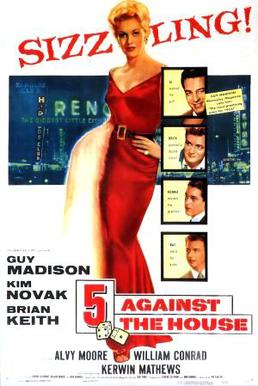
5 Against the House

Here's a thinker for you to puzzle. Have you ever thought what an episode of Happy Days would have been like if Richie, the Fonz and the gang tried to take down a casino? Or how about Betty, Veronica, Jughead and the crew? Oh, you haven't thought of that premise? Yeah, me either, but if it ever came to be, that movie would certainly have the feeling of 1955's 5 Against the House, a heist flick with some solid potential that's also weighed down by a lot of dead weight.

Heading back to a new semester at Midwestern University, four college students and friends -- Al (Guy Madison), Brick (Brian Keith), Roy (Alvy Moore) and Ronnie (Kerwin Matthews) -- stop in Reno to gamble a little at Harold's Club, a famous casino. They witness a botched robbery, overhearing a police officer mumble that no one could rob the place. As the semester wears on and things get boring, Ronnie comes up with a unique plan to do just that though; rob the place. His intention? Prove he can pull it off, then return the money (smart, huh?). Al is less than interested, focusing more on fiance Kay (Kim Novak), Roy goes along with it too a point, and Brick....well, Brick has his own plan.

From director Phil Karlson, this is an odd little movie. Comparing it to a Happy Days heist movies isn't fair, but that thought certainly crossed my mind as I was watching this quick 82-minute movie. There are good and bad -- like any movie I suppose -- but the bad is real bad. As we meet this foursome of friends, we're introduced to them through a nauseating and never-ending set of one-liners, most delivered by Moore. Madison walks around a casino telling them what time it is until they leave. Billed as a late film noir entry, it just ain't that type of movie. It's too light and fluffy early. The jokes are not only forced, but more importantly, just not very funny.

There's more to poke holes at, but that's the worst offender. The others involve two subplots, one more painful than the other. It's a heist movie, right? Then why is so much time spent on Al and Kay's budding romance? In one of her early roles, Novak looks great and sings two songs (sort of, she was dubbed for one), but she doesn't have chemistry with Madison at all. They fight, they kiss, they fight, and then they're back in love. A romance subplot is fine with me as long as it adds to a movie, not detracts from it. Anytime these two are on screen, it's a slow, halting trip. The other subplot has Roy and Ronnie convincing a freshman, Francis (Jack Dimond), to work as a servant-slave. Oh, those 1950s hijinks! It's just another example of the trying too hard, very forced and very unfunny humor that's jammed into the story.

So that gets the negatives out of the way, and we're onto the positives! Madison and Keith were 33 and 34 years old respectively when this was released so how do they come off as college students? Less than believable, but a key subplot involving them helps cushion that age difference. They're both veterans of the Korean War, Keith's shell-shocked Brick suffering through some version of post-traumatic stress disorder, Madison's Al doing his best to look out for a friend who saved his life. The relationship between the two "college students" is a high point of the film. Madison wasn't a great actor, but playing alongside Keith, they have an easy-going patter back and forth that reflects their history. Now if more time was spent on this aspect of the story, now we're onto something.

And then there's the heist aspect. In 1955, this is an early example of a heist film, and judging 'House' on that alone, it's a pretty solid movie. It was clearly an influence on the original Ocean's 11, released four years later. The heist is basically one big con job, pulling the wool over the casino's eyes while they steal away with the money. As part of a western fest, the quartet dress up as cowboys -- boots, beards and hats all -- to "blend in" with the rest of the clientele. Like much of the movie, the heist is low-key, but that doesn't away any of the tension. We're not sure exactly the details of the job, but we've gotten enough hints to see what's going on. As well, the film has several very cool on-location shots of mid 1950s Reno, a window, a time capsule into a very cool time in American history.

In the end, 'House' is a flawed venture. When it works, it's slightly above average. When it doesn't work, it struggles to maintain any pacing. Too bad a more pointed, heist-driven story with less romantic subplots couldn't have been used.

5 Against the House <---trailer (1955): ** 1/2 /****

Sunday, April 29, 2012

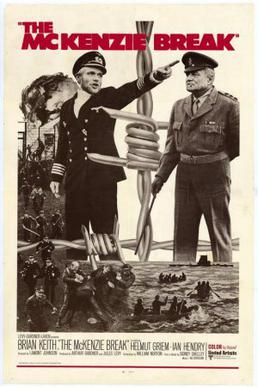
The McKenzie Break

While there have been obvious exceptions, I usually think of WWII prisoner of war movies from the Allied P.O.W.'s perspective. Movies like The Great Escape, Stalag 17, Bridge on the River Kwai among others. The lack of Axis POW movies can be explained with the fact that many prisoners spent the war in the U.S., but I suppose there's a more obvious one. The appeal of prisoner of war movies is the escape. You're rooting for the prisoners to get out. This may just be a personal thing, but unless I'm given some sort of motivation, I ain't rooting for German/Japanese prisoners to escape, like 1970's The McKenzie Break.

It is late in World War II, but the fighting rages on, even in isolated northern Scotland at a German P.O.W. camp in McKenzie commanded by the British, including Major Perry (Ian Hendry). Perry's prisoners are almost exclusively officers -- no enlisted men here -- and thanks to their ranking officer, a U-boat commander, Captain Willi Schlueter (Helmut Griem), those prisoners have organized. While they're still prisoners, they essentially run the camp, Perry unable to enforce even the most basic rules and laws. An Irishman and former journalist working for British Intelligence, Captain Jack Connor (Brian Keith), has been assigned to the McKenzie camp to aid the situation. What exactly are these German prisoners up to? Can Connor figure out their plan before it is unleashed?

As I'm planning what to write here, I'll say this out front. If it comes across poorly or naive, I apologize. I know atrocities were committed on both sides during WWII, but I'm more familiar with those of the German/Japanese forces against Allied prisoners than the other way around. The victors write the history books and all that. So anyways, here goes. Almost all countries signed the Geneva Convention, a document protecting prisoners of war as much as possible, basically treating them like humans. As presented in 'McKenzie' and making it difficult to watch, only so much can be done. German forces always seemed ready to brutally respond to any prisoner issues, but Hendry's Major Perry seems helpless here even when German prisoners physically assault his guards. He makes the point that any action against these prisoners will be taken against Allied prisoners in Germany which is true. Maybe it's just a deeper seeded issue, a more human way of doing your job. At what cost and how far does a country and its people go? Maybe the Germans were just more comfortable in their brutality? Sorry for a somewhat off tangent. Just had to say it.

I've mentioned before, and I'll most likely mention it again, but I'm a sucker for prisoner of war movies. They're unique to war movies because they can focus on the natural tension of the conflict without getting anywhere near the battlefield. Director Lamont Johnson is at the helm of a dreary-looking film (I suppose on-location Ireland doesn't get a lot of sun) that certainly adds some dimension to the story. It is refreshing to see the Allies as the guards and the Germans as the prisoners in this tweak of a familiar story-line. The opening set-piece especially sets the tone, Perry's complete failure at "commanding" his McKenzie camp. Watch it HERE. I kept waiting for the order to fire on the prisoners -- physical assault on guards seems like reason enough -- but the opener does a great job of setting things up. This is not your typical camp where the prisoners meekly assemble and wait out the end of the war, no matter how the war effort is going for the Germans.

Amidst all the bigger picture elements in 'McKenzie' is a simple plot device that is as close to a sure-thing as you can get; a cat and mouse game between two intelligent minds, in this case Keith's Capt. Connor and Griem's Schleuter. Connor knows his German counterpart is up to something, Griem knows Connor is hot on his trail. Keith does a great job in the part, a cynical, honest quasi-soldier who isn't interested in chain of command, honor, bravery, and the so-called glory of war. He's doing his job as if he was a civilian, military protocol be damned. Griem as U-boat commander Schleuter is the villain here, not just an enemy. A devout Nazi and former member of the Hitler Youth, he is an elitist, racist, brutal officer, obsessed with helping the German and Nazi war effort. No cost is too high for this young officer. At one point, he even organizes the murder of one of his own men, a homosexual. The banter between the rival officers is pitch-perfect, neither man letting on how much he knows, both men knowing they're facing a worthy competitor.

Not many other parts really stand out, but Hendry especially does his best. It's not that his Major Perry is a bad officer, but he's at the end of his rope and limited by orders from above. Too bad his character is basically pushed to the side once Connor shows up. Patrick O'Connell does a fine job as Sgt. Major Cox, the head non-commissioned officer who works with Connor and is drawn to his more straightforward approach to handling the issue of how to handle the German prisoners. Even Jack Watson has a small but interesting part as General Kerr, Connor's commander and old friend who wants the problem to be solved quickly, efficiently and quietly. Horst Janson plays Lt. Neuchl, the gay German officer who feels the wrath of his fellow soldiers.

Having watched countless prisoner of war movies, I was a little upset with myself about the conclusion I'd come to. It sounds obvious, I'm not going to root for the Germans to escape, just like I didn't want Hardy Kruger to escape in The One That Got Away. I want Keith's Capt. Connor to get his hands on these guys before they can reach safety. The final 45 minutes pick up the pace as the story reveals more of itself, not just prisoners trying to escape but why they're doing so with orders coming from German High Command. On the other side, Connor sees potential for an impressive coup. Which one will work? The ending is especially clever in its development in this underrated P.O.W. movie.

The McKenzie Break <---trailer/clips (1970): ***/****

Tuesday, April 10, 2012

The Alamo: 13 Days to Glory


In its history, Hollywood continues to go back to the well on certain historical events. The battle of the Alamo has been the focus of major studio productions like John Wayne's The Alamo in 1960 or more recently in the accurate, well-told 2004 version that flopped in theaters. It has even been shown as a background piece in movies focusing on the Texas revolution as a whole. Split the difference in years between the two major movies, and we get a TV movie from 1987, The Alamo: 13 Days to Glory.

It's February 1836 in San Antonio, Texas, and Colonel William Travis (Alec Baldwin) and Jim Bowie (James Arness) command a little over 100 volunteers, all the while awaiting the arrival of the Mexican army under the command of Antonio Lopez de Santa Anna (Raul Julia). When Santa Anna's army of several thousand men arrives, Travis, Bowie, Davy Crockett (Brian Keith) and their ragtag force retreat into the Alamo, an old Spanish mission, in hopes of stalling the army as long as possible. The fort is in ruins though, and Travis' command is far too small to defend it adequately. The Texans inside wait and wait for help, hoping reinforcements can arrive in time before Santa Anna's soldiers storm the walls.

Made for NBC in 1987, this made-for-TV movie is based off the novel of the same name from author Lon Tinkle. Veteran director Burt Kennedy takes the helm, working with a small budget that limited what he could do with the story. This is not the epic that Wayne made, '13 Days' instead made on a much smaller scale. There's never any sense of an enormous, overwhelming Mexican army waiting outside the walls, just a few extras in Mexican soldiers' uniform. Drawing further comparison to Wayne's version, the miniseries was filmed on location at Alamo Village, the set Wayne built for his 1960 film. It adds some needed realism to the scaled-down story with composer Peter Bernstein's score aiding the cause, especially in the final battle and the main theme.

Watching this since I was a kid, I have a soft spot for '13 Days' but I can still appreciate some of its truly bad, awful moments. Historical accuracy is one thing, but there are some real oddities here whether it be from a lack of budget or just a bad script. We see the same shots over and over again, a cannon being fired, the Alamo defenders firing in a volley, Mexican cavalry riding in front of Santa Anna's tent, just to name a few. There's also moments of mind-blowing stupidity, like Mexican artillery firing a cannon with a ramrod still in the gun's barrel. Other winners? Capt. Dickinson (Jon Lindstrom) tells wife, Susannah (Kathleen York), he'll be back at night to bring her into the Alamo. Oh, by the way, the Mexican army is on the edge of town. Colonel Fannin's relief column consists of about 15 men, a supply wagon and a cannon. Low budget for that one. It's those little things -- like David Ogden Stier's Col. Black, a fictional English officer fighting with the Mexicans -- that strike an odd, out of left field note.My favorite though is Alamo messenger Jim Bonham (Jim Metzler) calling Sam Houston (Lorne Green in a bizarre cameo) a coward. First, no such meeting ever occurred, but it is an unintentionally funny scene.

With such recognizable names as Crockett, Bowie, Travis and Santa Anna, '13 Days' goes 2-for-4 in the casting department. Keith and Arness are just too old to play Crockett and Bowie. Keith was 66 at the time, Arness was 64 while in 1836 Crockett was 50 and Bowie just 40 years old. They give it a valiant effort -- Keith's Crockett a mix of real-life David and legendary Davy, Arness' Bowie an imposing, intimidating figure -- but it never completely clicks. On the other hand, a young Alec Baldwin is a great choice to play Travis, a young, brash officer thrust into a command position, rising to the occasion with his life on the line. His line in the sand speech is one of the best from all the Alamo movies. '13 Days' is also one of the few movies to portray Santa Anna somewhat fairly, Julia doing a great job with the part. He's both an obsessed, possibly lunatic leader and also a president trying to save his country.

Thanks to Tinkle's novel, the TV miniseries also tries to turn the spotlight on some of the other Alamo defenders including Metzler's Bonham and Lindstrom and York as the Dickensons. York especially represents herself well as Susannah Dickinson, the strongest portrayal of the real life woman yet committed to the screen in an Alamo movie. There's also Travis' slave, Joe (Hinton Battle), Juan Seguin (Michael Wren), the Alamo messenger, and Eloy Casados as Gregorio Esparza, one of the Tejanos fighting in the Alamo. Other defenders include Tom Schanley as Danny Cloud, a Tennessean engaged to a local girl (shrill Laura Fabian), Tony Becker and Ethan Wayne (the Duke's son) as the Taylor brothers, George and Edward, Buck Taylor and Stan Ivar as Colorado Smith and Doc Sutherland, two more messengers, along with Gene Evans, Grainger Hines, Tom Everett, Jerry Potter and Jay Baker. With so many characters, most aren't given much development, just enough to introduce them and be somewhat interested in them.

With a few slower segments over its almost three-hour run-time, '13 Days' picks up in the final hour as reality sets in that no help is coming for the beleaguered defenders. It sets the tone well for men awaiting their death, wind whipping around the fort, silence hanging in the air. For its small scale and reliance on re-using shots repeatedly for action sequences, the final assault on the Alamo on March 6 is a surprisingly effective battle scene. You can watch the final attack HERE at Youtube. For the "big" shots, footage from 1955's The Last Command was used, some obvious editing showing how different the Alamo looked in the two films. The battle is easily the high point of the movie, making up for some of those slower portions. The defenders finally being overwhelmed supply some surprisingly emotional moments, again aided by the music.

Faults aside -- and there's a-plenty -- '13 Days' works fairly well because like most Alamo movies, it gets the message right. Outnumbered against an army of thousands and surrounded on all sides, less than 200 men decided to stick it out and fight, knowing death awaited them with that decision. When it would have been easy to surrender, they fought on. So even through the cheesiness, the bad casting, the general low budget feel, '13 Days' is still well worth a watch, especially for Alamo buffs.

The Alamo: 13 Days to Glory (1987): ***/****

Thursday, February 23, 2012

Fort Dobbs

Starring in TV's Cheyenne for seven seasons, Clint Walker shot to stardom as the burly hero of the long-running western. He never transitioned into a huge star in movies, but with a few exceptions (his supporting part in The Dirty Dozen among others) he was always quite at home in the western. Natural jump, right, TV to film? An underrated, exciting, well-made western, 1958's Fort Dobbs, was one he made during his Cheyenne run.

Having killed a man in the small town of Largo, Gar Davis (Walker) heads off into the desert ahead of a posse. Comanches are on the warpath and killing anyone in their path though, Gar stumbling across a dead man with an arrow in his back. He switches jackets with the corpse and manages to trick the posse into thinking the Comanches killed him. Gar is still on his own though amidst raiding Comanches until he walks onto a small ranch run by a wife, Celia Gray (Virginia Mayo), and her son, Chad (Richard Eyer), who are waiting for her husband to return. He agrees to help the Grays get to the relative safety of nearby Fort Dobbs, but Mrs. Gray begins to think that Gar has a secret, maybe even about her possibly missing husband.

This is an example of what a western can and should be. The story doesn't have to be on the level of The Searchers, Shane or High Noon where it delivers a message. It doesn't have to be mindlessly stupid either full of action and gunplay. From director Gordon Douglas, 'Dobbs' isn't a great, classic western. It is just a really good western, and that's fine with me. It is shot on a relatively small budget with Max Steiner's score sampling his score from They Died With Their Boots On and even borrows some action footage from 1953's The Charge at Feather River. But even on a small scale, it knows what it wants to do and how to get there. Unspectacular, solid entertainment that any western fan should be able to appreciate.

In the vein of the traditional, white-hat wearing hero from the 1940s westerns, Clint Walker is a great lead as Gar Davis. For starters, he looks like a western hero. Walker stood an imposing 6-foot-6 and weighed 235 pounds so he towers over basically everyone around him. When he starts talking, that deep, baritone voice sounds like it's going to bounce off of people and echo back. His backstory is explained late in the movie, giving Gar a slightly darker side albeit a righteous darker side. Don't go in thinking he's the flawless hero, but he is a good hero who will ultimately make the right choice. It's too bad Walker didn't become more of a star in films because as is the case here and yesterday's Gold of the Seven Saints, he's perfect for the western genre.

He is capably helped in three main supporting parts, all three of which could have gone obviously very wrong. We've got the damsel in distress, her possibly shrill, annoying son, and a smooth, conniving gunrunner. Credit to Mayo, Eyer and Brian Keith for making the most out of their parts. I've long been a fan of Virginia Mayo, an actress who was always able to hold her own against some of Hollywood's best tough guys. She's tough, smart and gorgeous, able to stand toe to toe with Walker. Eyer as her son, Chad, is also very good. So often in the 1950s (maybe more than any other decade), child actors could single-handedly ruin the movies they're in. In other films like Friendly Persuasion, The Desperate Hours, and The Seventh Voyage of Sinbad, Eyer shows he can act, genuinely act. He has a great scene with Walker too late in the movie, a natural, emotional scene for a 13-year old actor.

As for Mr. Keith, he's a scene stealer as Clett, a gunrunner who keeps crossing paths with Gar and Celia as they make a run for Fort Dobbs. He obviously has had some past run-ins with Gar, and that tension comes out in these scenes, especially when Keith's Clett goes after Mayo's Mrs. Gray. I'm used to seeing him as more of a straight-laced good guy (like in Nevada Smith) so it's great seeing him as a bad guy. It's more of a smooth, quick-talking bad guy, but you get the idea. The final confrontation between Gar and Clett is appropriately epic featuring some great dialogue that feels right at home in the western. It's not a huge part, but one that Keith knocks out of the park nonetheless.

The fairly straightforward story does just enough to keep you interested and/or guessing until the end. The Utah locations serve as a gorgeous backdrop to the trip to Fort Dobbs which upon arrival delivers quite a twist. The last 25-30 minutes are the more traditional cowboys and settlers vs. Indians story, but it's handled perfectly. The action is exciting, even surprisingly graphic, and in the end everything wraps up nicely. Russ Conway has a good part as the Largo Sheriff in this final portion. Good, underrated western. Definitely worth checking out.

Fort Dobbs <---Youtube montage (1958): ***/****

Sunday, May 30, 2010

Run of the Arrow

On April 9, 1865, the Civil War officially ended when Confederate general Robert E. Lee surrendered his army to General Ulysses S. Grant at Appomattox Courthouse in Virginia.  For many though, there was no end to the war.  Many in the South never acknowledged that the war was over and kept on fighting, some more violently than others.  1954's Vera Cruz dealt with some of these individuals who headed south into Mexico for a chance at more fighting and riches and power.

Those men were looking for a chance to keep on fighting.  In 1957's Run of the Arrow though, the main character is a patriot to the South and the Confederate army.  When the war does end, he refuses to be positive about the country coming together because in his mind, he's a Virginian and a Southerner before an American or a Yankee.  What to do? Why head west, young man.

Fed up with a post-war life in Virginia, infantryman and sharpshooter Private O'Meara (Rod Steiger) rides west beyond almost all signs of civilization.  He doesn't know what he's looking for, but somewhere down the road hopes to find some where or some place he can be happy.  On the trail, he meets an Indian scout for the cavalry and a member of the Dakota Sioux, Walking Coyote (Jay C. Flippen), who introduces him to the way and culture of his tribe.  O'Meara is sold on the lifestyle immediately and ends up joining a tribe lead by the warrior Blue Buffalo (Charles Bronson) and taking an Indian wife, Yellow Moccasin (Sara Montiel).  But this idyllic little life O'Meara has carved out for himself is endangered by the ever-advancing U.S. army trying to settle the west.

Storyline sound familiar? It should. It's called Dances With Wolves some 30 years later.  Of course, there are differences but the basic premise is the same.  Directed by the always tough, always reliable Sam Fuller, 'Arrow' is one of many westerns from the 1950s that dealt with more adult themes and messages, much like Anthony Mann's westerns.  This isn't good vs. evil.  There are all sorts of shades of gray here.  Even working through the flaws though, this movie gets points for an attempt at being honest and not whitewashing any of the history.

Fuller was a director extremely capable of filming action, but he leaves the battles and gunplay off to the side for much of the movie -- although the ending is a doozy in terms of on-screen violence.  This is more a story about principles, ideals and personal beliefs, what's important to an individual.  Steiger's O'Meara is so distraught at the end of the war that he turns his back on his country completely and moves on looking for a new life.  He ends up finding out that personal convictions and background are harder left behind than anticipated.  Working as a scout late in the movie, O'Meara has a great scene with an army engineer (Brian Keith in a phenomenal scene-stealing part) where they find out men are not so different -- black or white, North or South.  For a movie released in 1957, I was surprised at the story's honesty.

The movie's opening scenes jump out as impressive in terms of their effect on the overall storyline.  The movie opens on Palm Sunday as Lee surrenders to Grant.  A sharpshooter, O'Meara picks off a lone Union soldier but only wounds him.  He takes him to a field hospital where the man's life is saved, the bullet missing his heart by centimeters. It's the last shot fired in the war.  Years later, who is at the head of a U.S. cavalry company ready to wipe out O'Meara's new Sioux tribe? Lt. Driscoll (Ralph Meeker), the man O'Meara shot and saved years before who is now a bloodthirsty officer who wants to wipe out the Indians.  It's a great opening and really sets the tone for the rest of the movie.

As good as this movie can be at times, it's also embarrassingly weird at other times.  Jay C. Flippen as a Sioux warrior? Really? There was no one else available who is white?  The portrayal of the Sioux also seems more applicable to the Apaches of the Southwest, not the tribes of the plains.  It gets to a point where Fuller almost fetishsizes the Indian warriors who were nothing more than some barely there loinclothes and has them glistening in the sun.  It's distracting and seems like an odd choice for a director like Fuller who typically went for realism over style.

That said, the movie was surprisingly good.  Sure, Steiger's attempt at an Irish accent -- it tunes in and out -- is pretty awful, and a story that covers many years is condensed into 90 minutes seems rushed at times.  But on the whole, Fuller and a strong cast turn in a western that is enjoyable, thought-provoking, and in an extremely positive way...different.  The movie and story put a different spin on something that is too familiar in many other movies.  Definitely check out this quasi Dances With the Wolves inspiration.

Run of the Arrow <---trailer (1957): ***/****

Thursday, February 4, 2010

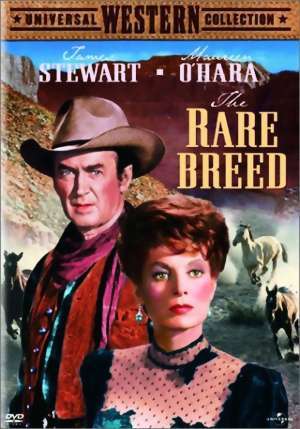
The Rare Breed

A few months back I reviewed a western from director Burt Kennedy named 'Young Billy Young' starring Robert Mitchum. Kennedy made a career of straight-laced, been there and done that movies that still managed to be entertaining. Another director from the 1960s, Andrew V. McLaglen, could have been separated at birth from Kennedy.

Comparing the two directors' filmographies, McLaglen comes out on top with a deeper selection of worthwhile movies. Of course, that doesn't necessarily mean he was a great director. More and more, I think his success in directing was a result of a nice trio to have when making a movie. One, great casting, two, lots of action, and three, a well-written script (with some obviously better than others). But looking through McLaglen's movies, they can't all be winners, like 1966's The Rare Breed.

A long-time television director who directed almost 200 combined episodes of Gunsmoke and Have Gun Will Travel, McLaglen had finally hit the jackpot on the big screen with McClintock and Shenandoah. Both stories had their similarities, tough, family men trying to live their lives amidst a strong conflict. Most of McLaglen's movies followed a tried and true formula and were the better for it. But with his next movie, The Rare Breed, he is undone by an awful script that is about as unbalanced as they come that results in an incredibly dull finished product.

After traveling from England to the U.S. with a prize hereford bull, Martha Price (Maureen O'Hara) hopes to crossbreed her Hereford bull with the famous longhorns that roam across Texas and the west. With her daughter Hilary (Juliet Mills) along, Martha finds a buyer who pays handsomely for the animal, and then a cowboy, 'Bulldog' Sam Burnett (James Stewart) to help get the Hereford where it needs to be. Seeing a chance for some quick, easy cash, Burnett makes a deal with another rancher to "lose" the animal en route. There's another cowboy on their trail, a gun-wielding psycho, Simons (Jack Elam), who has plans of his own for the bull and the money.

Netflix only slightly recommended this late 60s western, but with the talent involved I thought it was a safe bet that I'd enjoy it. I wasn't looking for an instant classic, just a good movie. The story and the characters though are so uneven and all over the place that 'Rare Breed' never gets into any rhythm. Even at just 97 minutes, it felt incredibly long, and I found myself fast-forwarding for most of the last hour. If a movie doesn't grab you early, it probably won't later on either.

The idea of the Hereford cow moving into the west is nothing new but still presents a unique setting. The cattle drive was an integral part of the west in the 1800s and has been used many times before, handled best in Lonesome Dove and in a similar way in James Michener's Centennial. All three, including 'Rare Breed,' deal with the changing times as technology and innovations in all fields push the wild west into the history books. But this McLaglen entry never takes a stand and says anything, if anything help push the good old days out the door.

A bright spot in this dud is James Stewart who brings his character to life where it just as easily could have been a cardboard cutout of a character. Unfortunately, the rest of the cast isn't so good, and it's not necessarily their fault. O'Hara was an ideal woman to ride along with the fellas in the action/adventure genre; she was tough but endearing, hardhewn but likable, and her looks never hurt. But her Martha is dead on arrival here and not a good role at all. In the weird casting department, Brian Keith plays Bowen, a mad Scotsman living on his forted-up ranch in Texas. Typically I like Keith, especially as a character actor, but here he is every stereotype imaginable of a Scottish man. Other cast members include Ben Johnson as a crippled cowboy who is gone by the 15-minute mark, Harry Carey Jr as Elam's partner (gone by the 45 minute mark), and Perry Lopez, who you'd better look fast for in the background.

If you're going to assemble a pretty solid cast like this, give them something to do at least. Elam's villain is dispatched about 45 minutes in, and with him goes any conflict or sense of danger the story had. The second Keith's son is introduced is also the exact second you can predict the ending to the movie. It's not that this is a bad movie, it just has a lazy feel to it. The music is generic, the script plodding, and some truly awful looking greenscreen effects. Some California locations look nice, but when the filming location is the best thing about the movie you know you're in trouble.

The Rare Breed <---trailer (1966): * 1/2 /****

Thursday, May 7, 2009

Netflix review #18: The Yakuza

Finishing a Robert Mitchum bio last week, I was in a Mitchum frame of mind when I filled up my Netflix queue. Having read about all these movies I'd only heard about, I thought I'd give some a shot. First up, 1974's The Yakuza directed by Sydney Pollack.

When his daughter is kidnapped by Japanese gangsters, American businessman George Tanner (Brian Keith) turns to old friend and army buddy Harry Kilmer (Mitchum) to help bring her back. Harry has to call in a favor of a man named Tanaka Ken (Ken Takakura) to first find Tanner's daughter and then bring her back to safety. Ken is a former Yakuza, a Japanese gangster, who after 10 years is forced into the life he so willingly left. The actual rescue goes smoothly, but that's when the real problems arise. A big man in the Yakuza, gangster Tono, still has issues with both Tanner and Kilmer.

For a movie listed as an intelligent thriller, it's awfully slow-paced and laid back. The plotline unravels slowly as we get to know other characters and sub-plots. For one, Harry's long-lost love Eiko (Keiko Kishi) lives in Tokyo with her young daughter. The background? As an occupation soldier following WWII, Harry saved Eiko and her daughter's life. They fell in love, only to have Ken, Eiko's brother, show up and say she can't love an American. He owes a great debt to Harry, but at the same time he's torn because of his beliefs. With all the unraveling plot, expect a fair share of twists and turns, one big reveal in particular.

What does work here is the strained relationship between Harry and Tanaka Ken. They have little in common and have fought in the past. But because of their crossed paths, each owes the other something. It's never easy to do, but it's the right thing to do. They have an obligation to live up to their shared pasts. Watching the movie, all I could think was that this would make a great western, just like Seven Samurai inspired The Magnificent Seven. Like those movies, the characters are looking for redemption, and they're honor-bound to get the job done.

With the slowish pace, the confrontations then are that much more startling. Pollack lulls you into a comfortable state with scenes of dialogue between all these different characters, and then WHAM! gunshots and samurai swords everywhere! Here's a good example, although here's a SPOILER warning because one main character is killed. But the best thing is the final showdown and Harry, armed with pistol and double-barreled shotgun, and Ken, with his samurai sword, seek revenge against a small army of Tono's henchmen.

Now as I'm writing this, I'm liking the movie more now than I did watching it. It's not a long movie at 111 minutes, but the storytelling pace can be so slow at times it feels much longer. The ideas were all there but something doesn't translate. With too many characters and backgrounds, some get left in the background. I would have liked to know more about Keith's Tanner, but instead he vanishes for large chunks of the movie. The same for Herb Edelman as Oliver, a man who adopted Japan as his home after WWII who goes way back with Harry and George. In general, it feels like Pollack wasn't quite sure where to go with the movie, especially after the final showdown.

As the grizzled, emotionally-scarred Harry, Mitchum is dead-on. He's laid back but ready for a fight at a moment's notice and more than capable of handling himself. In his early 50s, the actor had a world-weary look to him that fits the part so well. Takakura matches Mitchum well as Ken, a warrior himself forced to do something that doesn't come easy for him. Also standing out in the cast is Richard Jordan as Dusty, George's personal bodyguard sent along to help Harry out if he can. He's young but experienced and is starting to figure things out about the world.

I'm conflicted about this one because I'm somewhere in the middle on a rating. Some parts really worked, and others didn't. It's definitely a movie that would benefit from another viewing with all that's going on. I wanted to like this one, but it didn't grab me. So for now, I'll give it a positive rating with an asterisk next to it. Enough was worth watching to recommend this one.

The Yakuza (1974): **/****