The Sons of Katie Elder

The Sons of Katie Elder
"First, we reunite, then find Ma and Pa's killer...then read some reviews."
Showing posts with label Charles Bronson. Show all posts

Friday, May 1, 2015

Guns for San Sebastian

You know who’s pretty cool? Anthony Quinn. I don’t always think of Mr. Quinn as one of my favorite movie stars, but my goodness, did this man have a hell of a career. Zorba the Greek, The Guns of Navarone, Viva Zapata, Lawrence of Arabia, he did it all. One of my favorites though is a little known, generally forgotten quasi-spaghetti western from 1967,Guns for San Sebastian.

It’s the late 1740s in Mexico, and bandit Leon Alastray (Quinn) is in trouble and on the run. Wounded after the rest of his gang is killed or captured, Leon is saved by a faithful, well-meaning old priest, Father Joseph (Sam Jaffe). When Joseph refuses to turn Leon over, he quietly accepts his punishment to the far-off, possibly abandoned desert town of San Sebastian. Feeling like he owes the old priest, Leon accompanies him far out into the desert to the town and finds…nothing. When their plan goes awry though and the villagers return, it is Leon who must pretend to be a priest and help the village not just recover, but survive. Why? The villagers have come under the “protection” of a half-breed bandit, Teclo (Charles Bronson), who is also working with the warring Yaqui Indians. What is Leon to do?

This quasi-spaghetti western from director Henri Verneuil has virtually no reputation within the genre. Why? Well, it’s a spaghetti western in name only really. It isn’t gunfighter anti-heroes and evil bandits and extreme violence. To call it an epic isn’t fair, but it is an above average, highly entertaining period piece. It is set in Mexico in the 1740s so not your typical background setting, but for me, it worked because ‘Guns’ is trying something different. This is a gem, one of my favorite underrated movies that deserves a far bigger reputation.

For starters, it’s Anthony Quinn. What a great actor, what a great presence. Accused at times of stealing scenes and other times of chewing the scenery, I’ve always thought just the opposite. He just goes with the part. His Leon character is fascinating both within the spaghetti western but also the western genre in general. He’s not a cardboard cutout, an emotionless killer. Leon goes through a change over the course of the movie. We see him grow and develop and fight for what he believes is right. It just so happens that his decision-making now impacts a whole village. I’ll get into this more in a bit, but the obvious comparison for the film and character is The Magnificent Seven.

Quinn’s Leon has been a bad, bad dude with bounties over his head and soldiers always on his trail. Out of desperation and survival, he follows this priest into a desert wasteland. Once he arrives in San Sebastian, Leon starts to make tough choices, not just selfish choices. So where The Magnificent Seven had seven gunfighters, here we have only one, but the premise is the same, bad guys to anti-heroes to gunfighters doing what’s right, not necessarily what’s easy. He also gets to cozy up to one of the women in the village (Anjanette Comer) who knows his secret. It’s just a cool dynamic though, the supposed savior and the village needing some sort of help, familiar but tweaked.

So if we have an interesting flawed main character, we need a worthy opponent, right? Who better than Charles Bronson? In the mid 1960s headed to Europe and became one of the world’s biggest stars, and he’s having some fun here. It isn’t the most well-written, developed villain, but it’s a good part. Who else to look for? Jaffe is excellent in a smaller part and Comer is good too, shoving aside the helpless female role that’s all too familiar in the western. Jorge Martinez de Hoyos too has a fun part as Cayetano, an architect tasked with building a wall-like fort around San Sebastian to hold back an attack. Jaime Fernandez plays Golden Lane, the Yaqui chief, with some familiar faces among the villagers if you’re a fan of ‘Magnificent Seven’ and The Wild Bunch. There’s also small parts for Silvia Pinal, Leon Askin, Pedro Armendariz Jr., and Jorge Russek.    

‘Guns’ has a ton going for it beyond the acting. As mentioned, the story is both familiar and unique in how it develops. It was filmed on-location in Mexico with several familiar locations in and around Durango, including El Saltito waterfalls that’s also been seen in Major Dundee, The Train Robbers and Sons of Katie Elders among others. It’s the rare spaghetti western filmed away from Spain and Italy. Also, master of the genre when it comes to soundtracks, composer Ennio Morricone delivers an absolute gem, a beautiful score that isn’t as big and booming as some of his more well-known scores. Listen to an extended sample HERE.  Morricone’s score playing over the final scene is one of my all-time favorites. As always, it’s always a plus when the littler things come through in such strong fashion.

I’ve seen this movie three or four times now, and it gets better each time. Great performances, interesting story, an impressively staged, large-scale action scene, memorable score, and an excellent, appropriate ending. Highly recommended and well worth tracking down.

Guns for San Sebastian (1967): *** ½ /****

Thursday, November 20, 2014

Chato's Land

Here's one of my biggest pet peeves as I watch westerns. Well, any movie that resorts to this hackneyed technique. When you need someone to play a Native American character or a Mexican or an Asian or whatever....you just cast a white guy who can pass as a different ethnicity. It almost always fails in grand fashion...so when it does work? Enjoy it. Go figure, but Charles Bronson of all people makes for a passable Apache in 1972's Chato's Land.

Picking up supplies in a desert town in Arizona, Pardon Chato (Bronson), a half-breed, is told by the sheriff to leave the saloon without getting a drink. The sheriff draws on Chato, forcing the half-Apache, half-Mexican to turn and fire, killing the sheriff. Chato mounts his horse and rides out of town as news spreads across town. A former Confederate officer, Captain Quincey Whitmore (Jack Palance), organizes a posse and sets off into the desert in pursuit of the Apache fugitive, fully intending to hang Chato should he be captured. The posse has trouble tracking him though across the desert and begins to question if the hunt should be continued. But then when they seem to be at the end of their rope, the posse stumbles across Chato's home and more importantly, his wife and child. Now, the hunters have become the hunted.

A frequent collaborator with Charles Bronson, director Michael Winner takes a lot of grief because of his total filmography. They're not necessarily good films, but son of a gun, they're usually pretty entertaining. His forays into westerns though are pretty good, both 'Chato' and 1971's Lawman. Filmed in Almeria, typically a backdrop for spaghetti westerns, 'Chato' is a violent, dark, uncomfortable and yes, revisionist western. It isn't necessarily a movie you love, but one you watch with a sick sense of dread. This isn't the polished, clean western of the 1950s. This is a dark, filthy, world where violence and betrayal reign supreme. Horrific people in a dusty, sweaty world where anything and everything can and will kill you. If that doesn't sound like fun, I don't know what does!

A star in the 1960s, Charles Bronson became an international star in the 1970s with movies like this, Death Wish, The Mechanic and many others. What's impressive about his titular performance as Chato? Well, he's on-screen for maybe 15, maybe 20 minutes total. He says about 48 words the entire movie. This is a movie about his presence alone being the star. Bronson is ideal casting for this steely-eyed, cold, calculating and brutally efficient Apache warrior looking for revenge. The posse spends whole scenes talking about him, Chato waiting in the darkness or over the next ridge to attack, a one-man army. In the second half, Bronson strips down and wears nothing but a loincloth as he goes after the posse. The dude was 51 years old at the time and looks like he could kick anybody's ass. Like anybody. Go ahead, challenge him. It's weird that the title role is almost a cameo, but Bronson kills the part.

So who does he get around to killing on the posse? Another actor who found second life in Europe and internationally in the late 1960s and 1970s, Jack Palance. This is a great part for the grizzled actor with the perfectly, smoky (some would say evil) voice. He waxes eloquently about the Civil War, the desert, the Apaches, anything and everything. Not quite chewing the scenery, but he nibbles a bit. As for the posse, there's some townspeople (Richard Basehart, Paul Young, William Watson, Victor French), some ranchers doing their civic duty (James Whitmore, Roddy McMillan), a Mexican scout (Raul Castro) and three brothers who ranch and are looking for blood (Simon Oakland, Ralph Waite, Mr. Walton himself, and Richard Jordan). We see their unity at first, their eventual turning on each other, and then their desperate bid for survival. There's some cool names, lots of recognizable faces among the posse.

Now if you look back and read some original reviews, they were startlingly negative. I get it. It would be easy to peg this 1972 revenge western as a snuff film of sorts. Much of the second half of the movie is finding interesting ways for Bronson to kill the posse that isn't so pure, isn't so interested in justice or doing what's right. Given a chance to do something horrific, they don't hesitate. They don't flinch. We know virtually nothing about Chato, but we're rooting for him simply because he isn't the posse. And it's there where the snuff aspect comes out. Quite an ending, quite a final shot too. Know what you're getting into but a western definitely worth seeking out. Come on, how many movies can you see a man use a rattlesnake as a throwing weapon? Not too many, huh?

Chato's Land (1972): ***/****

Tuesday, May 6, 2014

The Magnificent Seven

Why do some movies stick with you more than others? I grew up watching westerns and war movies from the 1950s and 1960s, movies that still dominate my all-time Top 10, movies like The Alamo, The Great Escape, The Dirty Dozen, The Good, the Bad and the Ugly, The Professionals and several others. They still resonate now more than a few years later. Oh, and of course, 1960's The Magnificent Seven. Several years back I reviewed all four movies (the original and the 3 sequels), and it's been too long. Time for an updated review. The original and still best, one of the best westerns ever and a personal favorite.

South of the border in a small farming village, a bandit named Calvera (Eli Wallach) rides in and steals almost everything he and his gang of 40 bandits can carry, leaving just enough for the village to survive and start all over again. The villagers decide they've had about enough, riding north into Texas to buy guns so they can fight back against Calvera's gang. Instead, they meet Chris (Yul Brynner), a mysterious gunfighter clad in black who recommends they hire men rather than buy guns. Chris agrees to help, recruiting six other gunfighters from varying backgrounds, including an amiable drifter and gunfighter, Vin (Steve McQueen), to help out. The money is poor, the mission is more than difficult and the odds are stacked against them. Chris and the six gunslingers ride south, ready to help the village and fight off Calvera, odds be damned.

What a good movie. From director John Sturges (a master of 'Movies for Men'), 'Seven' came along at an interesting time for the western genre. Things, they were a'changing. Westerns were becoming more cynical, darker, more introspective, eventually transforming into the spaghetti western and the folksy, revisionist westerns of the 1970s. As fondly remembered as 'Seven' is now, it struggled in theaters in the U.S. upon its initial release, finding huge success in Europe and Asia before being re-issued in the U.S. several years later. It is an Americanized version of Akira Kurosawa's classic film, Seven Samurai, transplanting samurais for wild west gunfighters. It's interesting for any number of reasons, from the music to the budding star power on display, the dark tone to the exciting action scenes. A favorite of mine, a four-star review, and I won't really debate it. So there!

How about that casting?!? Much of the cast would go on to become huge stars, but here in 1960, they were relative unknowns. Brynner was the established star, The King and I, The Ten Commandments already to his name, and he's the pulse of the movie. His Chris is the unflappable leader of the group, a capable gunfighter who's also got all the qualities a leader should have. Loyal, strong, and tough. McQueen steps up to the plate in his first starring role. His Vin is easy-going, a drifter looking for work, quite good with his gun but maybe looking for something else in his life. Brynner and McQueen had a tumultuous relationship on the set -- McQueen trying to upstage the established star -- but the result is more than solid. Their chemistry crackles, their scenes together that perfect dynamic between the commander and his right-hand man. As the bandit Calvera, Wallach is an effortless scene-stealer, disappearing for huge stretches only to return with a vengeance.

And then there's the rest of the seven, because Brynner and McQueen weren't enough, right? Right?!? First, there's Charles Bronson as Bernardo O'Reilly, a half-Mexican, half-Irish gunman who has quite the reputation for cleaning up nasty jobs and his price is high...usually. He bonds with three boys from the village who "got him," promising to watch over him and care for his grave should he die in battle. Then, there's James Coburn as Britt, the laconic, knife-throwing specialist who has few equals with knife or gun. Coburn says about 30 words the entire movie and steals every scene he's in. Next, Robert Vaughn as Lee, a hired gun who's lost his edge, convinced he is facing his death. Next up, Brad Dexter as Harry Luck, a friendly gunslinger convinced there's more to the job than Chris is saying. Finally, there's Horst Buchholz as Chico, the young, unproven kid looking to make a name for himself with his more established cohorts.

As if that star power wasn't enough to carry a movie, I liked the characterization of these gunslingers more than anything. That's something I've picked up on repeated viewings as I got older. The portrayal of these hired guns is honest, not looking to glamorize these men. They're tied down by nothing, drift along from job to job, all the while risking their lives knowing that any job could be their last. What do they have? Their guns, their horse and maybe most importantly, their word. 'Seven' boasts one of my all-time favorite scenes, in westerns and films in general. Given a chance to run from a battle against seemingly insurmountable odds, they opt to stay. Coburn's Britt famously says "No one throws me my own guns and says run....Nobody." When offered the chance to run, Vaughn's Lee is told "Go ahead, Lee, you don't owe anything to anybody." His answer? "Except to myself." That's the essence and spirit of the movie. Men in a nasty situation doing what's right because it's what they should do, what is right. Profoundly simple, it always sticks with me, these men living by their code and what they believe in.

As for the villagers, look for Vladimir Sokoloff as the Old Man, the village patriarch who has little use for the whiny farmers, Jorge Martinez de Hoyos as Hilario, the fiery farmer ready to side with the gunmen, Pepe Hern and John Alonzo his close friends, Rico Alaniz as Sotero, the quasi-mayor of the village trying to weigh all his options and lastly, Rosenda Monteros as Petra, the young woman in the village who takes a liking to Buchholz's Chico. Also look for familiar western faces Robert J. Wilke and Whit Bissell in quick scenes.

More than anything else though, I think what's lasted the longest in the social conscience is composer Elmer Bernstein's musical score. The soundtrack is one of the all-time greats, the main theme a whistle-worthy track that will be running through your head for days. This is what big movie soundtracks can be. They add something to the movie itself, like a new but essential character. If you're not familiar with it (and even if you are), listen HERE. Just a great score, moving, adrenaline-pumping and emotional as needed. An all-time great score from an all-time great composer.

The story covers a lot of ground over its 128-minute running time. The story is fairly episodic, starting with the essential and entertaining recruiting of the team, Brynner's Chris seeking the gunmen out for the job. Each snippet gives each actor his chance to stand out on their own before becoming part of the group. Coburn's classic introduction especially stands out. From there, it's one great scene after another, both as entertainment value but also for delving into all the characters from the Seven to the villagers to Calvera. There isn't a ton of action, but the gunplay stands out, two featured sequences as the Seven tangle with Calvera's gang. It's the final battle that packs the emotional punch, the odds finally taking their toll on this group of gunfighters we've come to like and root for. It's a downbeat ending when you really consider it, but it's the right ending for this story and the characters.

Just a great movie. It was a favorite growing up and always will be. One of the best westerns ever, and an easy one to recommend for fans of the western genre or for someone just being introduced to the genre as a whole. A classic, plain and simple.

The Magnificent Seven (1960): ****/****
Rewrite of September 2009 review

Sunday, May 12, 2013

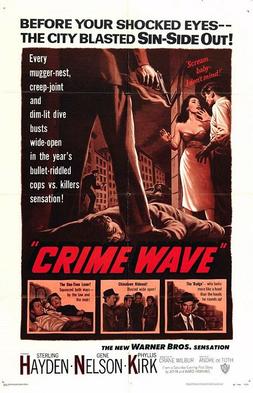
Crime Wave

I've been thinking about this for three days now since I watched 1954's Crime Wave, and I've got nothing. I really do try to come up with interesting intros to the reviews, even taking some pride in it. I'm stumped here though so let's cut to the chase. A film noir with a solid cast and director, I liked this movie a lot. Good enough? Yeah, let's get going.

In the dead of night in Los Angeles, three escaped convicts led by Doc Penny (Ted de Corsia) rob a gas station, grabbing $130, but as they make their getaway, an investigating police officer on patrol gets in their way and is callously gunned down. The news spreads through police departments/offices throughout the city, and in minutes, a huge manhunt led by Lt. Sims (Sterling Hayden) is under way. The city is all but shut down in hopes of capturing the trio, but they seem to have disappeared. Sims and the police start to investigate where they could be hiding with Sims thinking they've holed up somewhere with an ex-con. Suspect No. 1? An ex-con named Steve Lacey (Gene Lacey) who Sims put away years ago and has supposedly gone clean. Time is running out though, and there's a chance that maybe the crooks slipped away, the murder going unresolved.

I come away more and more impressed with the entire genre of film noir flicks the more I'm introduced to them. I was always aware of the more well-known, well respected noirs, but as I try to review more and more reviews, I'm finding more and more worthwhile entries to the genre. This one from director Andre de Toth is one that doesn't get much in the way of recognition, but it's everything that's right about the genre. It was filmed on location in Los Angeles, Burbank and Glendale, its shadowy streets, alleys and neighborhoods providing a backdrop to the story. It looks great, and it doesn't waste any time with its 75-minute running time. Cops, crooks, and those caught in the middle. Hard to mess up that formula, but de Toth does a great, workmanlike job here.

Early on in 'Crime,' I thought I was watching a quasi-remake of Jules Dassin's 1948 noir The Naked City. That film plays almost like a documentary of how the cops handle the investigation following a crime. Seeing both the police perspective and that of the crooks on the run, 'Crime' is similar in its portrayal. We see suspects brought in for questioning, the police searching for clues, following any leads that might lead to bringing the cop killers to justice. The story takes an interesting, even surprising turn in the second half, focusing more on Nelson's Steve and his troubles. He's moved on from his criminal past, marrying Ellen (Phyllis Kirk), a woman who accepts what he was but loves him for what he is now. This goes down the more traditional route in its noir roots, Steve, Sims and the police, and Doc and the crooks all converging on a collision course.

As far as casting goes, 'Crime' lacks the star power of more well-known film noirs, but I liked the cast. Hayden especially stands out as Lt. Sims, a veteran police officer who's seen just about everything the streets have to offer. Early on, he's so driven -- even obsessed -- I thought the story might have him develop into the bad guy. As the villain, de Corsia is appropriately greasy/slimy with a young Charles Bronson (listed as Buchinsky) and Nedrick Young as his convict cohorts. Jay Novello plays a doctor and ex-con who accidentally killed a patient, now working as a vet who gets caught up in the manhunt while the uncredited duo of Timothy Carey and Jim Hayward as two other ex-cons brought into Doc's plan. Dub Taylor makes a quick appearance as the gas station attendant while Hank Worden plays Steve's trusting boss.  

Not too much analysis required here. It's a good film noir with a solid story, good casting and quick-moving pacing. Not a hugely well known film noir, but one I enjoyed a lot. Oh, and 1950s Los Angeles looks pretty cool. It almost feels like Joe Friday should come in to assist on the investigation.

Crime Wave (1954): ***/****

Saturday, January 19, 2013

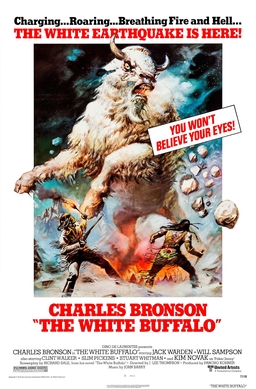
The White Buffalo

Gunfighter and army scout Wild Bill Hickok and Lakota warrior Crazy Horse are two of the most famous (even infamous), recognizable names in the history of the taming of the American west. At any point in their shortened lives -- they died a year apart in 1876 and 1877 -- did they meet? It's an interesting what-if and so goes 1977's The White Buffalo.

Having visited the East, Wild Bill Hickok (Charles Bronson) -- going under the alias 'James Otis' -- returns to the wild west. He has been tortured of late by a nightmare that plagues him night in and night out. It's the same nightmare each night; a vision of an immense white buffalo bearing down on him and ready to kill him in a second. Hickok doesn't know what to make of the dream, but when he hears rumors that a white buffalo has been spotted in the Black Hills, he goes on the hunt, bringing a trapper, Charlie Zane (Jack Warden), along for help. The famed gunfighter won't be alone though as they cross the path of Lakota chief Crazy Horse (Will Sampson) who similarly wants to hunt down and kill the alleged white buffalo. Which hunter will get him first?  

This was an odd western to watch. It's from director J. Lee Thompson of Cape Fear and The Guns of Navarone fame. The IMDB summary lists it as a quasi-Jaws ripoff, and it's not completely off base while also not being completely on-point either. Even three days since I've watched it, I'm still not sure exactly what I watched. It comes across as an odd, sometimes enjoyable episodic story that never quite finds a rhythm. Is it about Wild Bill making his return? Is it saying something more profound about the changing times of the west, and even the closing years of the "wild" west? Is it just a cool what-if about pairing two of the most interesting figures in American history? It's probably a little of all of them, but it is definitely hurt by not picking a route and sticking with it.

At its strongest, the focus is on the changing times of the west. Two men -- Hickok and Crazy Horse -- are very similar in personality, character and history. Their only difference? Hickok hates Indians, Crazy Horse hates the never-ending flow of white men into Indian land. As they both search for the white buffalo, they cross each others' paths, each saving the other man's life in a do-or-die situation. They put aside their hatred and differences aside in a quest to accomplish their mutual goals. I liked Bronson's performance a lot, even if it is pretty typical western anti-hero stuff. Sampson rises above a pretty stereotypically written part too as Crazy Horse. He avoids the stilted "Me Indian...you white man....How" conversation and plays well off of Bronson. The high point is Hickok and Crazy Horse talking across a campfire, both men wondering what the future holds.

Of the rest of the cast, Warden is the only one actually given anything more than a cameo. He has some good scenes with Bronson's Hickok, but it's a pretty standard meat and potatoes kind of role. Beyond those three parts, 'Buffalo' consists of a handful of really random cameos. We're not talking 10-15 minutes on-screen. We're talking individual scenes, some no more than a minute or two. Kim Novak gets the meatiest cameo as Poker Jenny, a woman from Hickok's past. Clint Walker also has some fun as Whistling Jack Kileen, a bear of a man gunning for Hickok. Also keep an eye out for Slim Pickens, Stuart Whitman, John Carradine, and Ed Lauter.

One of the oddest things though for 'Buffalo' is just that.....the buffalo. It doesn't look cheap, but it certainly tries for the Jaws-effect. We never really get a pristine, clear at the buffalo. Instead, we get extreme close-ups of the raging buffalo's eyes or his horns, we get far-off shots of the buffalo charging. It doesn't look ridiculous, but it sure approaches it. The final showdown among the buffalo, Hickok and Crazy Horse is pretty cool though. Sure, there are flaws. Any night scene was clearly shot on an indoor set with fake snow, trees and rocks. It looks pretty cheesy. There's also the cool scenes, an almost iconic shot of Hickok wearing his low-brimmed hat, his darkened glasses, his buckskin coat and brace of pistols. So in the end, it's a mixed bag, both good and bad.

The White Buffalo (1977): ** 1/2 /****

Saturday, October 6, 2012

The Stone Killer

The pairing of star Charles Bronson and director Michael Winner is no doubt best remembered for their 1974 film, Death Wish. Lost in the shuffle of the endless if entertaining sequels is that it's a pretty decent movie. The duo had worked together three times prior since 1972 though, including 1973's The Stone Killer, an interesting comparison piece compared to Death Wish. 

Police Lieutenant Lou Torrey (Bronson) is interested in results and little else. He doesn't care how or why it got done. Cases need to get solved, crooks need to be put away. Torrey is bounced from his NYPD precinct and moves west, taking a job on the L.A. police department. Transporting a murder suspect from NYC to L.A., Torrey barely survives a hit attempt, the suspect killed by a drive-by shooter. Torrey thinks back on what happened. The suspect talked -- at the time nonsensically -- of a coming hit. Could the man have been onto something? Torrey begins to investigate, and the clues lead right to the top of the Mafia.

I've mentioned this before. Crime thrillers from the 1970s have a certain charm that you're either going to love or hate with very little middle ground. They can be low-brow, aggressively violent, sexually suggestive (usually pretty obviously), and in general.....just a hell of a lot of fun to watch. That's what you will be getting here with this Bronson-Winner pairing. Bouncing back and forth between NYC and L.A., the story never slows down as Bronson's Torrey gets deeper into the case. The soundtrack from Roy Budd is an odd mix of jazz and funk (listen HERE), but it works in a ridiculous way. That low-budget, gritty, dirty feel permeates the story -- for the better -- and even when it's not a "good" movie, it's still highly entertaining.

Based off a book by John Gardner (with maybe the best title ever) titled 'A Complete State of Death,' 'Stone' gets some points for originality. Released the year after the classic The Godfather, there are similar/familiar touches of that mobster story. It was hard for every mob movie made after 1972 not to have at least some hints of it. The touches are there, but 'Stone' also has a unique streak. Martin Balsam plays Al Vescari, a Sicilian mobster with quite a bit of power who intends to exact some long-awaited revenge. His plan? Recruit disillusioned Vietnam vets with clean records, and train them to lead the assault on a mob war across the country. It's a cool gimmick, and one that's fun to watch.

Oh, Mr. Bronson, you're pretty cool, aren't you? By 1973, Charles Bronson was typically playing the same character over and over again. That's far from a bad thing. He's perfect at the stoic, silent anti-hero. His Torrey is fed up with all the protocols and rules that limit his effectiveness, and basically, he just doesn't care. He will get the job done no matter how brutal his tactics are. Like many of his parts, he gets to throw a couple wisecracks here and there, and genuinely looks like he's having fun. Considering the part he would play a year later in Death Wish, it's hard not to smile at his Torrey who is basically Paul Kersey with a badge. Also look for 1970s familiar faces Jack Colvin, Stuart Margolin, Paul Koslo, Norman Fell, Ralph Waite and a young John Ritter as a beat cop on the investigation.

In his 1970s flicks, Winner had a formula, and he sticks to it here. Action, action and....um....oh, right, action. In a 91-minute movie, he packs it in at an almost frenetic pace. An opening chase in an NYC apartment is quick and to the point to get things going. A mid-movie chase with Torrey (in a boat of a car) chasing Paul Koslo (on a motorcycle) is priceless, a true gem in the ridiculous department with Torrey's car seemingly indestructible. Watch it HERE. A final showdown at the desert hideout of the Mafia army is a solid finish as well, an entertaining finish for an entertaining movie. I know it's far from a classic, and maybe it's just a bad movie, but I liked it a lot. Watch the entire movie HERE at Youtube.

The Stone Killer <---clip (1973): ***/****  

Monday, May 28, 2012

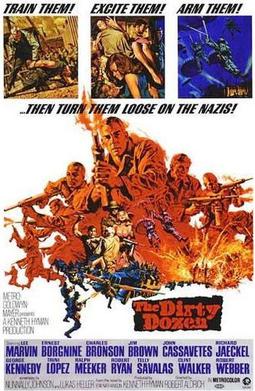
The Dirty Dozen

One of the all-time great tough guy casts -- if not the greatest -- in one of my favorite genres. A movie that stands the test of time that is action-packed, darkly funny and amazingly entertaining. It has taken abuse over the years by some because of its shocking ending, but it also has built up a diehard following by those who will defend it to the last (including me). One of my favorite movies ever, and a Memorial Day themed review, 1967's The Dirty Dozen.

An American army officer with a record a mile long, Major John Reisman (Lee Marvin) has been given a mission that even he doesn't believe is real. It's late spring 1944, and as the Allies prepare for the D-Day invasion, the Allied high command (including Ernest Borgnine) delivers his impossible, suicidal mission. Reisman is to take 12 prisoners either sentenced to death or years of imprisonment and hard labor, train them, and then in the days before the D-Day landing, drop them into German-occupied France. Their mission? Attack a German chateau, killing as many high ranking German officers as possible, hopefully wreaking havoc on the high command. Can Reisman get the prisoners to work together before they kill him?

This is a movie that is a perfect storm of timing, casting and story. A story of 12 convicted criminals -- rape, murder, robbery -- turned commandos who resent any sort of authority given a mission to kill enemy officers in cold blood? Could that story even remotely fly in any time other than late 1960s America? It was a time when America was changing, a darker, more cynical time in our history. Director Robert Aldrich taps into something special there. 'Dozen' has a unique look to it, interesting camera angles, a catchy theme for the Dozen -- listen HERE -- and a general feel of giving the middle finger to any sort of power or authority figure. Could there be a more perfect movie for a 1967 audience?

I could write a whole review discussing the characters and the long list of tough guy actors who play them, but I doubt many people would read 10,000 rambling words about how the cast of The Dirty Dozen is the coolest thing ever. Let's start with Lee Marvin, an all-around bad-ass who by the mid 1960s had become a major, bankable star. His Major Reisman, a sarcastic, quick-witted, smart-mouthed and brutally effective officer, is probably his most well known role, and he owns this movie. With the cast behind and around him, that's saying something. Marvin delivers brutally funny one-liners left and right, handles the action scenes flawlessly, and is believable as the cynical leader of this group of crook commandos. With those type of men behind him, you need someone like him to lead. Richard Jaeckel is a scene-stealer as Sgt. Bowren, the MP assigned to work with Reisman in training and execution of the mission. Along with Borgnine, the High Command and other Allied officers include Robert Webber, George Kennedy and Ralph Meeker. Oh, and Robert Ryan as a stiff-collared officer from the 101st. Enough for you? No?

And then there's the Dirty Dozen. The group includes Charles Bronson as Wladislaw, the former officer sentenced to hang for killing one of his own men, a medic carrying medical supplies away from battle. There's former NFL star Jim Brown as Jefferson, an African American soldier who killed in self defense but is sentenced to hang nonetheless. John Cassavetes was nominated for a Best Supporting Actor Oscar as Franko, a Chicago hood who killed a London man for $10 worth of cash. Telly Savalas is Maggot, a psychopathic Southerner convinced God works through him. Clint Walker is Posey, an Apache with rage issues, Donald Sutherland is Pinkley, a dimwitted soldier, and singer Trini Lopez plays Jiminez. Rounding out the Dozen are character actors Tom Busby, Ben Carruthers, Stuart Cooper, Colin Maitland, and Al Mancini as Bravos, the smallest of the bunch but with a mean/funny streak. The focus is Bronson, Brown, Cassavetes, Walker, Savalas and Sutherland, none of them disappointing, all of them living up to the hype, all given a chance to shine.  

What has helped 'Dozen' gain its cult-like following over the years is its humor in looking at and poking some fun at war in general. Sutherland's dimwitted Pinkley is forced to inspect a crack platoon of Ryan's Col. Breed in one of the most memorable, truly funny scenes. Watch it HERE. Reisman later arranges for eight London prostitutes to visit the Dozen as their training winds down. The facial expressions exchanged back and forth are priceless. The high point comically -- however dark it is -- comes in the War Games sequence, the Dozen forced to prove their worth by capturing Col. Breed's headquarters. They resort to cheating, con jobs, stealing, and all sorts of trickery. After the extended training sequence -- which has its fair share of funny moments -- the War Games development and the eventual payoff provides some great laughs.

The portion of the movie though that tends to drive people away is the attack on the chateau. SPOILERS AHEAD SPOILERS STOP READING Here's the plan, courtesy of Reisman, which you can watch HERE. It of course, doesn't go as planned, Reisman, Bowren and the Dozen forced to improvise. Their solution is simple; throw grenades and gasoline down air chutes and burn (think napalm) the German officers to death. Heroic? No, I would say not. It's a movie though. These guys aren't portrayed as heroes. These are prototypical 1960s anti-heroes! What does work? The entire finale sequence (around 45 minutes long) is dripping with tension, and once the adrenaline starts pumping, it doesn't stop. The Dozen start to get picked off -- including two legitimate shockers -- as the bullets start flying. I've seen this movie 50 times and still root for two characters especially to make it, knowing all the while they won't. The means are brutal, but as far as an entertaining action sequence goes, it is one of the best.

I'm not sure what this says about me, but I grew up watching this movie a lot. Introduced to it via Memorial Day war movie marathons, it will be always be one of my favorites. I love its cynical, dark look at war. I love the ridiculously strong cast from top to bottom. It is funny, entertaining, action-packed, and a true example of 'They don't make them like that anymore.' A classic.

The Dirty Dozen <---trailer (1967): ****/****

Saturday, February 25, 2012

Drum Beat

History provides all sorts of little tidbits, small, little-known stories that are often enough lost in the history books. The development of the American west had countless examples of this in the 19th Century, small-scale incidents that were major at the time, but were generally forgotten. Made in 1954, Drum Beat is a solid and generally forgotten western telling the story of the Modoc War in 1872 and 1873.

A well-known and respected Indian fighter, Johnny MacKay (Alan Ladd) has been tasked with a mission from President Grant (Hayden Rorke). In the Oregon territory, the Modoc tribe has left the reservation and causing problems for the white settlers. Johnny is hired as a peace commissioner with the hopes of both the white settlers and and Modoc Indians signing a treaty that will bring a halt to all the violence. He is skeptical of the two sides working together, but Johnny travels back west hoping to meet with Captain Jack (Charles Bronson), the chief of this group of Modocs. The Indians are less than cooperative though, and peace won't come easily.

From director Delmer Daves, this is a BIG western. It isn't an epic that runs 3-hours with intermission and a cast of thousands, but it is nonetheless big. It was filmed in Cinerama and takes full advantage of the on-location shooting in Sonora. You can see and feel the immensity of the frontier as the settlers tangle with the warring Indians. The developing story is somewhat familiar in that sense, but it never feels dull. Yes, there are scenes that rely solely on the natural background, long, uninterrupted scenes of riders moving across a horizon. At 111 minutes, it is a tad long in the tooth, but it's not a deal breaker. Victor Young's score is appropriately sweeping without overpowering anything on-screen, and thankfully the Ballad of Drum Beat is only played over the opening credits.

With Daves at the helm, the story is just solid. He's an underrated, underappreciated director who was consistent throughout his career, directing one excellent movie after another. The story is familiar here -- settlers/whites vs. Indians -- but it doesn't feel familiar. Credit to Ladd and Bronson there. I really liked Ladd's performance as Johnny MacKay, an Indian fighter who's good at what he does but doesn't necessarily enjoy it. Bronson as an Indian seems like a bad choice, but that too works. It borders on a caricature but never goes too far. He looks out for the best interest of his tribe...at first...only to get swept up in the glory of fighting. Their scenes together are surprisingly good, especially their final scene in the closing minutes. The fight leading up to that scene ain't too shabby either.

An ensemble cast of familiar faces backs up Ladd and Bronson, Audrey Dalton leading the way as Nancy, an Easterner who's moved west to help the cause and surprise, surprise...falls for Ladd's Johnny! Who saw that coming?!? Oh, everybody? My bad. Marisa Pavan and Anthony Caruso rise above stereotypes as Toby and Mannock, two peaceful Modocs working with Johnny and not against him. Robert Keith plays Bill, an older frontiersman with a grudge while Rodolfo Acosta and Perry Lopez play two of Bronson's warriors. Look for recognizable character actors Willis Bouchey, Elisha Cook Jr., Strother Martin and Denver Pyle in small parts.

As a quasi-western buff, I do have to poke some holes in this story. A title card starts with 'This is true except for the fictional characters and storylines needed to dramatize the truth.' So basically a cop-out. A true story until the truth isn't entertaining enough. Sonora, Arizona does not look like Oregon in the least, and the Modocs look and are portrayed more like Apaches than any other tribe. Just weird observations that ran through my head. Still a good movie, especially a large-scale battle on a Modoc fortress on an impenetrable rock formation, with an interesting cast.

Drum Beat <---credits/opening (1954): ***/****

Thursday, December 1, 2011

Target Zero

Cliched, familiar, flawed, been there and seen that, all things that came to mind while watching 1955's Target Zero, a Korean War story of a lost patrol trying to make it back to their own lines. I've seen this movie before with a different title, and typically I always like them. With a fun couple tweaks here, I liked this one too even if it could have been a B-movie classic.

After a day of heavy fighting, U.N. staffer/nurse Ann Galloway (Peggie Castle) finds herself behind enemy lines with no way to get back to safety. A British tank crew (commanded by Richard Wyler) stumbles upon her and picks her up, the battle-scarred tank running across the remnants of an American patrol, commanded by Lt. Flagler (Richard Conte). Working together, the ragtag group hopes to make it back to American lines, Flagler insisting they head for a strategic hill position. Can they make it through a gauntlet of North Korean soldiers? Will anyone even be at the hill if they make it?

The Lost Patrol, The Steel Helmet, Anzio, this story has been done before and will most likely be done again. The story of a small group of survivors banding together to make it through enemy-infested territory is nothing new to any war movie, Korean or not. But as is the case here, it's just familiar enough to be a fun ride to go along with. Flagler's patrol unknowingly walks into a minefield, hides out as a North Korean patrol walks by, fights among themselves. You name it. You've seen the stereotypes elsewhere if you've even seen a couple war movies. If you can get past the cliches -- or at least go along with them -- you'll most likely enjoy this movie at least a little bit.

Filling out the unit, I had trouble going along with Conte as Lt. Flagler, the idealistic officer who lives for his company and nothing else. Conte's a better villain than a leading man, and I don't see the appeal or respect his men have for him in 'Target.' His patrol includes Charles Bronson as the loyal sergeant, Chuck Connors as Moose, the radioman, L.Q. Jones as O'Hara, the fast-talking Southerner, Strother Martin, Abel Fernandez as Geronimo, an Apache, Don Oreck as Della Nueva, a Latino boxer, and an uncredited and unlisted Richard Park as Pvt. Man Koo, a South Korean soldier. The British tankers include John Alderson and Terence Marney while John Dennis and Aaron Spelling play two American soldiers picked up carrying a mortar tube and little else. Cool little group, Bronson standing out along with Connors and Jones.

Early on, I was more than pleased to see Castle's Ann introduced into the story. A female nurse along for the trip was certainly a unique addition to the story. It takes about 30 minutes before she falls madly in love with Conte's Flagler. She loves him because he's good to his men, because he's driven, because he's a good leader. Yeah, that's awesome. Their scenes together try to explain war, figure it all out, talking about death and moving on, finding a way to cope. Someone picked up War Movie Dialogue Cliches 101 and turned it into a script. Castle's performance is fine -- nothing against her -- but these scenes are painful to watch.

At times playing like an episode of Combat (that's a compliment, I love that show), 'Target' is at its best dealing with the action. It was filmed at Fort Carson, an Army base in Colorado, and it has a great look of a stark land -- in black and white at that -- where anything could happen and anyone could be hiding. Thanks to the filming location, there's also some great aerial footage of fighter jets helping the patrol. The ending certainly influenced 1962's Hell is For Heroes, the patrol stranded on a lonely hilltop ready to face an attack from the North Koreans.

The set-up and intro to that action finale is impressive, but the execution -- or lack of -- is a little disappointing. With a unit picture, usually some men in said unit get picked off, dying in battle. Not here (that page of War Movie Cliches must have fallen out). Everyone makes it. A darker ending is hinted at, including killing Castle's Ann before the North Koreans can get her, but 'Target' doesn't go that far. It's still an entertaining if flawed movie, worth a watch.

Target Zero (1955): ** 1/2 /****

Thursday, November 17, 2011

Vera Cruz

When audiences saw 1954's Vera Cruz in theaters, I'm curious what their reaction was. Did they appreciate it, realizing they were seeing something new and different? Was it too much of a departure for western fans who liked their good guys very good and their bad guys very bad? It's easy to look back now and see the impact it made on countless other westerns, even heavily influencing the whole sub-genre of spaghetti westerns.

With the Civil War ended and his Louisiana plantation destroyed, former Confederate officer Ben Trane (Gary Cooper) heads south into Mexico looking to start over. He meets Joe Erin (Burt Lancaster), another American if somewhat younger, looking to prosper from the Franco-Mexican War. Joe has with him a gang of gunfighters, adventurers and saddle tramps so Trane joins them, signing on with the French forces, including Marquis Henri (Cesar Romero). They're hired to escort Countess Marie (Denise Darcel) to the port city of Vera Cruz, but something doesn't seem on the up and up. On the trail Ben and Joe figure out why. The Countess' wagon is loaded with $3 million in gold, and now all bets are off.

The Magnificent Seven, The Wild Bunch, Sergio Leone's Dollars trilogy (For a Few Dollars More specifically), those are just a few of the movies heavily influenced by director Robert Aldrich's 1954 western. Vera Cruz was one of the first westerns to take a heavily cynical look at the west and all its violence and greed. It has a mean streak painted right up its back that few other movies couldn't even think of at different points. Little kids are used as hostages by main characters (supposed good guys), brutal betrayals wait around every corner, and the violence can be a little startling in its execution; not often shown but implied. One character gets lanced through the throat, others are shot point blank in the face, one Mexican revolutionary is cornered and run through by French lancers. Startling and effective, always entertaining.

The reason I mention 'Few Dollars More' is the relationship and uneasy partnership formed between Cooper's Trane and Lancaster's Joe, an obvious influence on Clint Eastwood and Lee Van Cleef in Leone's spaghetti western. Both fast on the draw, they form that partnership out of necessity and a certain respect, but that doesn't mean they have to trust each other. Cooper is the unquestioned hero/good guy, but even he has a darker side. Lancaster is easier to read, his Joe telling you whatever you want to here and going along with it as long as it benefits him. He'd betray you with the snap of a finger. Lancaster's devilish grin says all you need to know about his Joe Erin. They have a great back and forth consistently throughout the movie, two legends playing off each other effortlessly.

Filmed in Mexico -- similar locations to The Wrath of God -- Vera Cruz has a feeling of authenticity, of being right there in 1866 as the Mexican Juaristas fight Maximilian's French forces. Aldrich filmed in Technicolor, and the movie has a distinct look to it, somehow colorful and washed out. There are some great individual shots Aldrich does with the camera, one reveal of a plaza ringed with revolutionaries, the other a possible betrayal showing a line of gunmen waiting to turn. Hugo Friedhofer's score is probably the most mainstream thing going for the movie, a more traditional score, but that's not a bad thing. Little things definitely work here to boost up some cool, even iconic scenes like Ben and Joe showing off their abilities at a ball in Maxmilian's court.

Aldrich specialized in guy's guys movies, and his cast is impressive. Along with Romero is Henry Brandon as Capt. Danette, a smarmy French officer looking down on Erin's gang. Darcel is Lancaster's perfect female counter, a beautiful woman ready to betray anyone for her own good, with Sara Montiel playing Nina, a young Mexican woman hovering around the escort. Joe's gang of ruffians and gunslingers should please most western fans with some future stars involved, including Charles Bronson, Jack Elam and Ernest Borgnine while also including Archie Savage as Ballad, a black former Union soldier, James Seay and James McCallion. All smaller parts, but fun ones still, Bronson even getting to play a harmonica, foreshadowing Leone's Once Upon a Time in the West.

Clocking in at just over 90 minutes, Vera Cruz never really slows down, macho head games, showdowns, chases, ambushes and betrayals around every corner. Definitely stick this one through to the end. A Juarista assault on a French garrison has a ton of action, and the shootout among the gang is a doozy, especially the surprising ending. An above average, exciting and influential western, Vera Cruz is a must-see.

Vera Cruz <---TCM trailer/clips (1954): *** 1/2 /****

Sunday, October 2, 2011

Hard Times

In one of the first reviews I did a couple years ago, I said Charles Bronson is cooler than you. He was....that's all.  There's no argument or counter. Charles Bronson was cool as hell.  Later in his career, he got into a rut of Death Wish and Family of Cops movies, but in his heyday in the 1960s and 1970s there were few actors who were as popular as the coal-miner turned action star. He wasn't a great actor in the traditional sense, usually playing quiet anti-heroes who rose to the occasion as needed. But at his best, he was a brewing, intense presence of an actor, especially in 1975's Hard Times.

Whenever you read a list of 'Guy's Movies,' this should be at or near the top. This is a prototypical, definition of a guy's movie.  Tough guy actors, brutal story about street fighting, and without much in the way of romance or wasted subplots that go nowhere. If you're going to stop reading this review, here you go. 'Times' is 93 minutes of Charles Bronson whaling on people in knock-down, vicious street fights. Okay, it's more than that...but not by much. Who better to direct this guy's flick than Walter Hill? He was an underrated master at straightforward, hard-edged movies heavy on action and violence. In his directorial debut, Hill definitely comes out swinging -- pun intended.

A drifter and a loner traveling through 1933 Great Depression-riddled America, a man named Chaney (Bronson) jumps off a train and walks into a small Southern town. Looking to make some traveling money, he gets into a street fight, winning with one brutal, efficient knockout punch. There he meets Speed (James Coburn), a gambler, businessman and all-around con man, forming a partnership with the potential for lots of money to be made quickly. With opium-addicted trainer and cut man, Poe (Strother Martin), along, Chaney goes to work, and no one can stop him in a fight. He's just looking for some money though, and nothing else. No fame, no notoriety. Speed on the other hand has a different plan, including a fight worth thousands of dollars against high-stakes gambler and kingpin Chick Gandil (Michael McGuire). Will Chaney go along with it, even when a supposed ringer is brought in?

There is absolutely nothing flashy about this movie. Let's just get that out of the way. Hill isn't interested in it. His movie obviously isn't a documentary, but it definitely has the feel of one. It's a slice of life story, albeit one about a bare-knuckle street fighter. It has a folksy 1970s feel to it, a slice of American history as the country struggles through the Great Depression. Hill films his story entirely in New Orleans and never has a city looked so dirt-poor and grim and still manages to be appealing as New Orleans does here. The look of the movie feels real, not stagey or hokey or done-up like so many movies. The musical score leaves little impression, only making its presence known at the beginning and end. No frills film-making at its best, and no one knows how to do it better than Hill. His focus is on his characters and the harsh world they live in.

A poster at the IMDB actually listed every word Charles Bronson says in the entire movie. I'll say this...it isn't much. Chaney (no first name provided, or needed for that matter) is a man of few words, appropriately enough letting his fists do most of the talking.  Above all else in this movie, I loved this character. He's not showing off his ability or looking for fame. As he explains 'He knocks people down' and he's damn good at it. With little said in the way of words, Bronson makes Chaney sympathetic. We know absolutely nothing about his background or where he came from, and we don't need to know. Like so many Americans, he's had a rough time of it and is trying to keep on living. When asked if he's had a rough time, he answers 'Who hasn't?' We see a glimpse of his humanity with Jill Ireland's Lucy, but only briefly. It's in the end we see his true colors.

So I don't care if it was a movie, and the fights were staged. I want nothing to do with Bronson in a street fight. My uncle first recommended this movie to me, stating 'It's Charles Bronson beating the crap out of people." That's a pretty spot-on description. These fights are vicious, bone-rattling affairs that hurt just watching them. There is a distinct sound, a THWACK! as Bronson's punches land, especially when he throws three punches in quick succession (right! left! right!). A fight with Gandil's top fighter (Robert Tessier) is the most vicious, and an incredible scene to watch. In a grain mill or something of the sort in a fenced-off square ringed by bloodthirsty fans, they go to town. No finesse, no dancing around, just two men throwing hay-makers at each other. The final fight against the ringer, a Chicago fighter named Street (Nick Dimitri), couldn't live up to that prior fight, but still holds its own in terms of emotion and the bigger meaning, what Chaney risks to fight.

More than Bronson and the street fighting though, 'Times' has a lot going for it. Bronson and Coburn had worked together several times before, and here again they show a solid chemistry. Two of the all-time coolest actors working together is never a bad thing. Coburn's Speed is a hustler, almost always ending exactly where he started, with nothing. It's Chaney who has to save him. Martin is typically slick and oily as Poe.  Also watch for Felice Orlandi and Bruce Glover as two loan sharks on Speed's tail. An underrated movie overall, and a great example of how a simple and straightforward storytelling technique can work so well.

Hard Times <---trailer (1975): ***/****

Wednesday, June 1, 2011

The Great Escape

I have two favorite movies, neither of which I'm able to pick one over the other.  I love them both, and all other movies come after it, first is 1960's The Alamo which I've reviewed before and then there's 1963's The Great Escape. Introduced to it at a young age when I showed an interest in history, I've probably seen it 25 or 30 times straight through, and another 75 or 100 catching bits and pieces. For me, it is that rare perfect movie. Great story, impressive cast, exciting action, and one of the best soundtracks ever. You can't ask for much more.

In World War II, both the Allies and Axis forces had to deal with how to handle prisoners of wars. In Germany, the Luftwaffe, the German Air Force, was placed in charge of these Allied prisoners, placing them in P.O.W. camps all over their occupied territory. These prisoners -- as was their sworn duty -- tried countless escapes over the length of the war in typically small groups, sometimes getting as many as a dozen out. But one true story set the bar for heroism and courage among the prisoners, the true story of 76 prisoners escaping Stalag Luft III in March 1944. Literally hundreds of prisoners were involved in the effort as the escape even had an impact on D-Day some three months later.

It's 1943, and a new prison camp has been built. The German Luftwaffe has taken the worst prisoners from all their camps and thrown them in this new camp that features all the security aspects they've learned from previous camps.  In this "perfect" camp, the Germans (Hannes Messemer is the commandant) intend to watch these men very carefully. Leading the prisoners is Roger Bartlett (Richard Attenborough), dubbed 'Big X' for his leadership at the top of the 'X Organization,' a team of prisoners working together to bust out as many captured soldiers as they can. Bartlett has bigger plans though this time around. Instead of just getting two or three prisoners out, he intends to get 250 out of the camp with a large-scale plan that includes three extremely long tunnels under the barbed-wire fence. The plan seems impossible, but the prisoners go to work, slowly working their way toward escape.

Do you know the line 'They don't make them like they used to?' This movie applies. Director John Sturges (one of my favorites and an underrated filmmaker overall) turns in his all-time best film, one that stands at or near the top in the lexicon of World War II movies. It is based in fact, sticking to the details and truths in the story, without getting bogged down.  There is action, humor (never overplayed, just natural humor arising from the situation), and characters you love and are generally rooting for. Composer Elmer Bernstein turns in a score that is one of the greats, especially the main theme, listen HERE. Bernstein's score both drives the story as needed and keeps it grounded in the quieter, emotional scenes (including one where a tunnel is discovered and its tragic consequences).  Sturges filmed in Germany -- as his assistant said, 'Germany looks like Germany.' An entire camp was built, an exact duplicate of the actual camp, bringing this 1963 epic up another notch in terms of realism and authenticity.

Sturges' movies were famous for their male-dominated ensemble casts, but this may be his most impressive. Start with Steve McQueen as Hilts, the motorcycle-riding 'Cooler King,' the role that shot him to international stardom. Then there's James Garner as Hendley, the scrounger, and Attenborough as Bartlett, the prisoner's top man, a brilliant mind who comes up with this improbable plan. Not bad, huh? Oh yeah, there's also James Donald as Ramsey, the senior British officer, Charles Bronson and John Leyton as Danny and Willie, the tunnel kings, James Coburn as Sedgwick, the manufacturer, Donald Pleasence as Blythe, the forger, David McCallum as Ashley-Pitt, "dispersal," and Gordon Jackson as MacDonald, the intelligence officer. Other prisoners include Nigel Stock, Jud Taylor and Angus Lennie in a small but essential part as Ives, Hilt's progressively wire-happy partner. A more impressive cast could be impossible to assemble.

What is amazing is that even with all those stars -- some on the rise, some already established -- is that they all register, they all make a lasting impression in a positive way. More on McQueen later, but Attenborough delivers a career-best as Big X, the driven even obsessed leader who wants to take the war back to the Germans, not sitting out the war comfortably as his captors intend. Garner's Hendley bonds with Pleasence's Blythe in some of the movie's most touching scenes, two very different people forming a friendship. Bronson and Leyton as the tunnel kings certainly make an impression, carving three tunnels out of the Earth 30 feet below the surface. Bronson is at his best, a Polish flyer with claustrophobia who hides his fear of small, enclosed spaces and digs. Coburn doesn't get a ton to do compared to the others, but is his usual, laconic self. There is not a weakness in the cast from top to bottom.

When movie fans think of The Great Escape, they usually go right to Steve McQueen, a rising star who got his crack at the big time here and didn't disappoint.  His Capt. Virgil Hilts is one of his most iconic roles, the loner, trouble-making American prisoner who attempts escape attempt after attempt.  What's funny is that his character basically disappears for vast stretches of the movie, only to reappear after a stint in the cooler and steal every scene he is in. This is McQueen at his laid back, scene-stealing best. With all the notable actor's actors around him, he is the unquestioned star thanks in great part to the finale, a motorcycle chase across Germany with his captors in hot pursuit. It is one of the greatest chases sequences ever, caped with one of the most impressive stunts ever, a 7-foot jump by stunt man Bud Ekins over a high-strung barbed-wire fence. McQueen is my favorite, but this is always his best to me.

With a final run-time of 2 hours and 53 minutes, Sturges' true story doesn't have to rush along at a lightning pace...but does anyway. The first 105 minutes or so focus exclusively on the escape attempt, putting all the little details together that need to happen. The first and biggest of course is the digging of the tunnels, 30 feet down and over 300 feet straight out. A track is built to transport prisoners/diggers, and wooden boards are needed to shore up the entire length of the tunnel. Up above, forgers create documents, tailors make clothes, Intelligence gathers information, all part of an elaborate system of security and watchmen to make sure nothing is discovered by their ever-vigilant German guards. It would have been easy for this movie to get bogged down in these details, but The Great Escape revels in them, making the mundane and possibly boring, exciting at a breakneck pace.

It is a movie called 'The Great Escape' though, and it is at its most exciting once the prisoners do escape, 76 of them in the dead of night spread out all over the German countryside. The escape attempt covers the last hour of the movie, an incredible extended sequence that is hard to top. It is almost entirely dialogue free, Bernstein's score playing over the action the whole way. Finally free of their camp, the prisoners make their efforts to hopefully reach freedom, some by train, some by bikes, others by planes, and in Hilts' case, a stolen German motorcycle.  Sturges was an action master, and this may be his tour de force sequence.

I could go on and on with this movie, and I've already sort of done so. My head is full of little tidbits of information that I've picked up over the course of repeated viewings.  Above all else through the drama, the facts, and the action is that Sturges gets the tone right from Paul Brickhill's source novel, and most importantly, the true story it is based on. These men did the impossible in an impossible situation. Knowing their chances of escape back to freedom were slim, they plodded on when they could have just as easily quit. If you didn't know and just read the details -- check out the Wikipedia entry HERE for more details -- you would say there's no way this happened, but somehow, some way, it did. The ending hits you square in the stomach as it should, but the movie ends on a positive note; McQueen's Hilts once again in the cooler, bouncing his baseball off the wall.  You may capture him again, but you'll never stop him from trying.

A perfect movie, one of the best around, and one of my two favorite movies.

The Great Escape <---trailer (1963): ****/****

Thursday, October 28, 2010

You Can't Win 'Em All

Because I'm not the laziest guy around, I'm not going to write the same exact intro for a review...even though I definitely could here.  The transition from the 1960s to the 1970s hit some actors harder than others, and talented individuals found themselves in a situation where they had to reinvent themselves.  I've covered the topic before with Rock Hudson and Audie Murphy among others, but the common denominator seemed to be to go to Europe or television to find work.  Add recently passed Tony Curtis to the list. 

Now I don't know how much Curtis' drinking and drug problems had to do with the detour his career went through in the late 1960s, but something certainly changed for the actor.  Solid, worthwhile roles don't just dry up for no reason at all.  So in the 1960s, Curtis tried both of the previously mentioned alternatives; he tried some TV work including working with Roger Moore in The Persuaders while also going to Europe for some roles, including 1970's underrated and forgotten You Can't Win 'Em All. I watched this a couple years ago and caught up with it this week as part of TCM's tribute to Curtis.  I can't quite put my finger on it, but I really like the movie.  It's a little different, a little weird, but always entertaining.

It's 1922 in Turkey and American Adam Dyer (Curtis) is rescued from his tiny, sinking fishing boat in the Mediterranean Sea by Jeff Corey (Charles Bronson), a fellow American with eyes on riches. The two like-minded individuals team up, and with Corey's crew of mercenaries (mostly WWI vets looking for $) get caught up in the Turkish Civil War. Adam and Jeff aren't picky about ideals or principles, just who's willing to pay more.  They side with the Sultan of Turkey, undertaking a mission to transport some very important people out of the country before it can destabilize any more.  The mercenaries will be well paid for their talents, but something just doesn't add up.  The odds are stacked against them, and it seems that more is going on than meets the eye.  Caught up in a bloody revolution though, can Adam, Jeff and Co. escape unscathed and with money and riches to boot?

Having watched this flick twice now, I couldn't explain why the story seemed so familiar.  Well, reading some reviews over at IMDB helped that out like a train running me over.  Directed by Peter Collinson, 'Win 'Em All' is basically a straight remake of  1954's Vera Cruz starring Gary Cooper and Burt Lancaster.  Instead of post-Civil War Mexico, we're treated to post WWI Turkey with basically the same story, plot elements and characters.  No complaints from me because I'm a big fan of Vera Cruz, but just enough is handled differently to set it apart that it an exciting, action-paced comedy buddy pic.  It's not as dark as VC and knows it, reveling in the double crosses and backstabbings.

Working together for the first and only time unfortunately, Curtis and Bronson seem like an unlikely pair to cast as mercenaries ready to turn on the other at the drop of a hat.  Their acting styles don't compare much, but somehow and some way it works.  You know from the moment they're introduced that they may be partners, but they won't be very trusting partners.  Each uses the other to their benefit, and they seem to know the arrangement.  Adam and Jeff are always attempting to one-up the other right up until the very end, and thankfully 'Win 'Em All' doesn't go down the dark road Vera Cruz did in dealing with this rivalry.  Their dialogue is great with plenty of snappy back and forths with some great one-liners, and the chemistry works perfectly.  An unlikely pair, yes, but sometimes the unexpected produces the best results.

Having watched enough European-made movies, you see similar locations pop up in Italy, Spain, France and any number of other countries.  And even in the fullscreen format TCM aired the movie in, you get a great sense of the beauty of Turkey where all of the movie was filmed.  It's a funny thing, but you know what Turkey actually looks like? Turkey.  This isn't an attempt to make the American west look like 1920s Turkey.  The whole movie was filmed in country, and the locations are beyond gorgeous.  Whether it is riding through a rocky, mountainous desert area or resting in a tiny village, this was a great visual movie.  The endless scenes of a column of horsemen riding across the country could have been tedious, but there's enough to look at to keep you interested.

Now on to the fun stuff, the action, and there's plenty.  For a lower budget movie, no expense was spared when the action hits the screen.  Adam and Jeff's crew are outfitted with machine guns (always a good start) so as they traverse their way through the revolution they leave a trail of bodies in their wake.  The requisite barroom brawl kicks things off, and then you can add an assault on an armored train, an artillery barrage on a besieged town, and a doozy of a finale on a boat about to be overwhelmed by the Turkish army.  It's a good jumping off point for an action comedy that has that right tongue in cheek tone without overdoing it and with a solid cast to boot.  Very hard to find, but keep your eye out for it on TCM from time to time.  Can't wait that long?  Start with Part 1 of 11 courtesy of Youtube with a similar looking print to the one I watched. 

You Can't Win 'Em All (1970): ***/****

Sunday, May 30, 2010

Run of the Arrow

On April 9, 1865, the Civil War officially ended when Confederate general Robert E. Lee surrendered his army to General Ulysses S. Grant at Appomattox Courthouse in Virginia.  For many though, there was no end to the war.  Many in the South never acknowledged that the war was over and kept on fighting, some more violently than others.  1954's Vera Cruz dealt with some of these individuals who headed south into Mexico for a chance at more fighting and riches and power.

Those men were looking for a chance to keep on fighting.  In 1957's Run of the Arrow though, the main character is a patriot to the South and the Confederate army.  When the war does end, he refuses to be positive about the country coming together because in his mind, he's a Virginian and a Southerner before an American or a Yankee.  What to do? Why head west, young man.

Fed up with a post-war life in Virginia, infantryman and sharpshooter Private O'Meara (Rod Steiger) rides west beyond almost all signs of civilization.  He doesn't know what he's looking for, but somewhere down the road hopes to find some where or some place he can be happy.  On the trail, he meets an Indian scout for the cavalry and a member of the Dakota Sioux, Walking Coyote (Jay C. Flippen), who introduces him to the way and culture of his tribe.  O'Meara is sold on the lifestyle immediately and ends up joining a tribe lead by the warrior Blue Buffalo (Charles Bronson) and taking an Indian wife, Yellow Moccasin (Sara Montiel).  But this idyllic little life O'Meara has carved out for himself is endangered by the ever-advancing U.S. army trying to settle the west.

Storyline sound familiar? It should. It's called Dances With Wolves some 30 years later.  Of course, there are differences but the basic premise is the same.  Directed by the always tough, always reliable Sam Fuller, 'Arrow' is one of many westerns from the 1950s that dealt with more adult themes and messages, much like Anthony Mann's westerns.  This isn't good vs. evil.  There are all sorts of shades of gray here.  Even working through the flaws though, this movie gets points for an attempt at being honest and not whitewashing any of the history.

Fuller was a director extremely capable of filming action, but he leaves the battles and gunplay off to the side for much of the movie -- although the ending is a doozy in terms of on-screen violence.  This is more a story about principles, ideals and personal beliefs, what's important to an individual.  Steiger's O'Meara is so distraught at the end of the war that he turns his back on his country completely and moves on looking for a new life.  He ends up finding out that personal convictions and background are harder left behind than anticipated.  Working as a scout late in the movie, O'Meara has a great scene with an army engineer (Brian Keith in a phenomenal scene-stealing part) where they find out men are not so different -- black or white, North or South.  For a movie released in 1957, I was surprised at the story's honesty.

The movie's opening scenes jump out as impressive in terms of their effect on the overall storyline.  The movie opens on Palm Sunday as Lee surrenders to Grant.  A sharpshooter, O'Meara picks off a lone Union soldier but only wounds him.  He takes him to a field hospital where the man's life is saved, the bullet missing his heart by centimeters. It's the last shot fired in the war.  Years later, who is at the head of a U.S. cavalry company ready to wipe out O'Meara's new Sioux tribe? Lt. Driscoll (Ralph Meeker), the man O'Meara shot and saved years before who is now a bloodthirsty officer who wants to wipe out the Indians.  It's a great opening and really sets the tone for the rest of the movie.

As good as this movie can be at times, it's also embarrassingly weird at other times.  Jay C. Flippen as a Sioux warrior? Really? There was no one else available who is white?  The portrayal of the Sioux also seems more applicable to the Apaches of the Southwest, not the tribes of the plains.  It gets to a point where Fuller almost fetishsizes the Indian warriors who were nothing more than some barely there loinclothes and has them glistening in the sun.  It's distracting and seems like an odd choice for a director like Fuller who typically went for realism over style.

That said, the movie was surprisingly good.  Sure, Steiger's attempt at an Irish accent -- it tunes in and out -- is pretty awful, and a story that covers many years is condensed into 90 minutes seems rushed at times.  But on the whole, Fuller and a strong cast turn in a western that is enjoyable, thought-provoking, and in an extremely positive way...different.  The movie and story put a different spin on something that is too familiar in many other movies.  Definitely check out this quasi Dances With the Wolves inspiration.

Run of the Arrow <---trailer (1957): ***/****

Wednesday, April 7, 2010

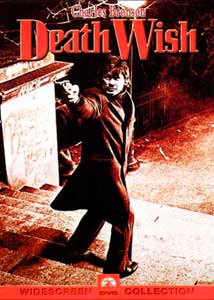
Death Wish

The 1970s sure pissed off a lot of people, and why not?  Americans had a lot to complain about, much of it directed at government, police, and in general the powers that be not getting the job done.  In movie terms, that meant angry Americans wanted to see people on-screen who were fed up with society and the system we live in.  Think Peter Finch in Network, Clint Eastwood as Dirty Harry, and in 1974's Death Wish, Charles Bronson as vigilante killer Paul Kersey.

Something about vigilante movies speaks to audiences, and for me it's an easy thing to piece together.  Watch the news, read the paper, and it seems all you see is stories of murders, shooting, rapes, violent attacks...and this is 36 years later.  Crime is everywhere, and for better or worse, police forces all over the country can't put a criminal away for every crime committed.  Are they limited by laws as to what they can and cannot do, or can they just not do all the work that's required to get the job done?  Enter the Vigilante, who isn't limited by laws, regulations, or even principles.  They do what at some point, just about every person has thought about doing.  No arrests, no trials, just kill the bad guys in the act and be done with them, making the world a better, safer place.

Vigilante movies have been around as long as movies themselves I'd wager, but they went through a rebirth in the 1960s and 1970s as audiences looked more for anti-heroes in their movies.  Death Wish was one of the most successful as it showed a civilian vigilante -- not a cop like Eastwood's Harry Callahan -- cleaning up the streets his own way.  It's the first of many, including Scorsese's Taxi Driver (another classic) two years later and even more recently with The Boondock Saints movies.  But Death Wish was one of the first, and even 36 years later, it's still easy to see why audiences were drawn to this simple, effective vigilante story.

A successful New York architect/planner, Paul Kersey (Bronson), gets a call one day at his office saying that his wife and daughter have been attacked in their apartment.  At the hospital, Kersey finds out his wife died soon after the attack, and that his daughter is in a nearly comatose state after being raped by her three attackers.  Kersey retreats into his life, not sure what to do with himself.  The police have no luck at all finding the three attackers, and slowly the anger begins to flow through Kersey.  Cautious at first, he starts to seek out the thugs and muggers prowling the city streets.  He becomes good at it though, and soon the bodies start to pile up.  A special police force headed by Det. Frank Ochoa (Vincent Gardenia) is formed to find this vigilante killer, but an odd thing starts to happen.  Dubbed simply 'the Vigilante,' he becomes a hero and more importantly, crime starts to drop dramatically.  Is Kersey then really such a bad thing?

In the early 1970s, director Michael Winner made a handful of movies similar in their dark tone and bleak outlook on life, with Death Wish probably the most well-known.  This is a low-budget movie with a cheap look and no frills whatsoever to take away from the vigilante story.  There are no big sets, no huge action sequences, or a blaring soundtrack.  Nothing distracts from the guts of the story.  Even the scenes of Bronson's Kersey gunning down baddies are handled in an almost matter of fact way, as if they didn't want to call attention to them.  Kersey is doing what he believes is the right thing to do, and stylish 70s action sequences be damned.  New York City has never looked so dreary as it does here, with the city looking like one huge, rundown, crime-ridden place.

One of my personal favorite actors, Charles Bronson delivers probably his most well-known performance here as Paul Kersey.  It's an interesting part that can be looked at as two separate characters.  One, the family man trying to cope with the death of his wife and the suffering of his daughter.  Two, there's a man pushed too far by the idiocies of modern society who decides to do something about it.  Kersey doesn't even go vigilante until halfway through the movie.  Maybe the first half of the movie isn't the most exciting thing, but it's needed to make the second half worthwhile.  When he does go vigilante, I'd wager Bronson has about 10 lines the rest of the movie, letting his pistol do his talking for him.  It's a great part for an underrated actor in my book.

Bronson dominates the movie with Gardenia's NYC detective the only other cast member that makes much of an impression.  Ochoa is a veteran cop told by his superiors to catch this rogue vigilante at the same time he's told crime is down because of this vigilante.  He's not quite comic relief, but there is an awkward, bumbling quality to Gardenia's cop.  Character actor Stuart Margolin does have a small but memorable part as a business associate of Paul's who helps bring back his extensive knowledge and ability with firearms.  Also look for a young Jeff Goldblum as Freak #1, one of the three rapist/attackers in the beginning.

Americans were fed up with just about everything in the 1970s and in a way, Death Wish allowed them to think about what could be different if just one man took a stand.  There's a surprisingly effective commentary about our modern culture and weakening of our society as crime and criminals take over.  The success of this flick inspired four sequels -- each one progressively worse than its predecessor and all equally enjoyable -- but this one is clearly the best.  It is a sparse, minimalist look at one vigilante who is fed up with the world.  At just 93 minutes, it is fast-paced and builds to a great ending, one of those perfect last shots.

Death Wish <----trailer (1974): ***/****