The Sons of Katie Elder

The Sons of Katie Elder
"First, we reunite, then find Ma and Pa's killer...then read some reviews."
Showing posts with label Ed Lauter. Show all posts

Friday, September 11, 2015

Rage (1972)

One of the beauties of Turner Classic Movie's summer programming is August's Summer Under the Stars, each day devoted to one star's films. I was able to check out several from George C. Scott that I'd never seen before, including this 1972 timely drama that you can see appealing to all sorts of audiences upset with the government, politics, and the System as a whole. Here we are with 1972's Rage.

Dan Logan (Scott) is a small-time rancher who lives in Wyoming with his 12-year old son, Chris (Nicolas Beauvy). Dan's wife died years before, leaving him to raise his son alone, something he takes to heart and very seriously. They've got a good life on the Logan spread, just father and son making a living. One night they're out camping on a hillside when Dan wakes up to find Chris unresponsive and bleeding profusely from the nose. He races into town to the hospital and Chris is immediately taken away from him. Doctors aren't sure exactly what happened, but one doctor especially, Holliford (Martin Sheen), assures him that everything will be taken care of. Dan too is asked to stay for observation, just to see if anything has happened to him too. What's going on? What Dan doesn't know is that a local army base is covering up an accident with a nerve gas accidentally being released...

Here's a trivia question for you. With what film did actor George C. Scott make his directorial debut? You're looking at it. That would be 1972's Rage. It's an interesting debut for the longtime actor. It's timely. It's hard-hitting, cynical, violent (horrifically at times), intensely uncomfortable so yeah, basically made for an early 1970's audience fed up with any sort of establishment. While it doesn't get too heavy in getting it across, it's safe to say 'Rage' is a "message" film. It wants to get a message across and make the audience get down to basics and think about what the story is really saying. The nerve gas reveal in the above plot line is a relative spoiler. You find out pretty quickly actually what's going on. The point is, it's the start of something. It's what the nerve gas represents.

That being...anyone trying to keep things under wraps from you because as a people, we're too stupid to handle something dangerous. Whether you agree with that is up to you. 'Rage' is a movie for those folks fed up with information being withheld from them, of someone in power dancing around the truth, of that person treading the fine line between the truth and a flat-out lie "for your benefit." Your establishment a-holes? Sheen plays an army doctor working undercover of sorts who really knows what's going on. Richard Basehart is Logan's longtime doctor and friend, quickly realizing the truth as he puts the clues together. Also look for Kenneth Tobey, Paul Stevens, Barnard Hughes, Ed Lauter and others trying to keep things under wraps.

Whether it be from behind the director's chair or in front of the camera, this is Scott's movie. His single father and small-time rancher character is about as archetypal American as you can get. He's created a life and carved it out of the landscape for himself and his son. He'll do anything to protect it. While there are some familiar Scott outbursts, I liked the Logan character most in the quiet moments. Dan is looking out for his son, pleased he sees his boy picking things up quickly as he grows up. We see a lot of this in an extended montage through the movie's first 15 minutes as Dan and Chris interact all over the ranch, ultimately ending up playing checkers while camping next to a small fire.

Also look for Dabbs Greer and John Dierkes in small supporting parts.

I was both intrigued and struggled with the slow pacing here in Scott's feature film directorial debut. The first hour is intensely slow as we begin to realize how bad the situation is, how dangerous the nerve gas really is, and the depths the army/establishment will go to keep that news under wraps. It is about the hour-mark when Logan puts it all together and FREAKING LASHES OUT. We're talking Death Wish meets Falling Down with any other vigilante movie you want to mention thrown in for good measure. He becomes a man possessed to right a wrong done against him. I kinda figured where the story was going, but not to these depths. It is dark. It is uncomfortable, and that's no doubt what Scott set out to do. Life ain't easy, especially when the powers that be have rooted interests in something not getting out.

The ending itself is tough to watch. It's supposed to be. As far as it goes, I wish it would have gone a little further. From the word 'go' we know this won't be a happy ending, but some more revenge and vengeance being dished out would have been so much better. So many more needed to be punished for their actions. Man, I'm getting all sorts of Old Testament here, but it's true. The actual finale is heartbreaking because it doesn't feel forced. There aren't any easy answers so my complaints of wanting more revenge being doled out go unanswered. That's life. It's tough. A depressing movie, flawed at times but interesting throughout.

Rage (1972): ***/****

Wednesday, January 22, 2014

Trouble with the Curve

I really like baseball. I also really like just about any movie Clint Eastwood has ever done. So naturally I should like a movie that combines the two things, right? Right?!? Yeah, that's what I thought, but it didn't quite turn out that way. I had modest expectations going into 2012's Trouble with the Curve, but it was surprisingly bad.

A longtime scout for the Atlanta Braves, Gus Lobel (Eastwood) has made a career out of being able to analyze a baseball player's skills and tell if they'll be able to cut it in the Majors. His contract is about to expire, just a few months away, and though he's unaware of it, the Braves are trying to decide if they should re-up with him. With the first-year player's MLB Draft fast approaching, Gus has been tasked with scouting Bo Gentry (Joe Massingill), a power-hitting third baseman projected to be either first or second pick overall. The Braves have the No. 2 pick so Gentry could fall to them, but Gus has a serious issue. He's starting to lose his vision but refuses to get any help. His daughter, Mickey (Amy Adams), an associate aiming to be a partner at her law firm, takes a few days off to accompany her Dad and help him out if possible. Their relationship is to say the least strained though, and both are working through some past and current issues, the draft approaching ever faster.

I really thought this was a can't miss kind of film. No, not an all-time classic that would rejuvenate my love of movies, but a good, old-fashioned story about family and baseball and all that good stuff. So as I mentioned, modest expectations, nothing more. Even then, I came away extremely disappointed. Basically all the reviews made a clear distinction. The script from Randy Brown is schmaltzy, sappy, too darn sweet, and oh so darn heartwarming. Everyone admitted it, but it seemed to divide the reviews. Some people said all those things and liked it (I didn't see many "love" reviews) while others said all those things and came away disappointed with a dull, cheesy movie. I'll give two guesses, but you'll only need one. Which camp do you think I'm in? 

It doesn't take a genius to watch the trailer and figure out it's going to be all of those things I mentioned above (watch the trailer below at the end of the review). I figured it would use that as a jumping off point, a springboard to bigger, better and more. Yeah, about that.....nope, it just doesn't happen. A movie that runs 111 minutes plays like one big after school special. A torn apart family, wounds still fresh and unresolved, a chance to come together and get a shot at some redemption, it gets tedious by the second or third confrontation between Eastwood's Gus and Adams' Mickey (named after Mickey Mantle). Mickey wants to deal with their checkered past, Gus a single dad who worked a lot and tried his best but really pawned off his little girl on family. It takes too long to get anywhere, it's dull getting there and the resolution is more than just predictable. You can predict it now. Go ahead, try it.

As the plodding story moved along, I kept waiting for this movie to get better. If nothing else, the talent assembled would make it worthwhile, or so I thought. It didn't. Eastwood came out of acting retirement to star here, but he's playing that same gruff, growling old man he's done in Gran Torino and any number of other movies. It's not a bad performance, just a familiar one that isn't particularly interesting. Adams tries her best here to bring it all together, a woman who's spent much of her adult (and child) life trying to adjust and cope with what happened to her as a kid. Her chemistry is okay with Eastwood, but far too much time is devoted to her 'Will they? Won't they?' possible relationship with Justin Timberlake's dreamy young baseball scout, Johnny. So Mickey is trying to help (read = save) her Dad, but her Dad is the one that's helping her out too, everyone learning a lesson in the process? Gag me.

Also look for John Goodman as a higher-up Braves official and a close friend of Gus, Robert Patrick as the Braves general manager, Matthew Lillard as a younger scout who's embraced all the stats of scouting rather than the personal analysis of watching a player, and Ed Lauter, Chelcie Ross and Raymond Anthony Thomas as fellow crotchety baseball scouts.

More than anything, I had an issue as a baseball fan of a baseball movie that doesn't know the sport it's writing about. The Red Sox are going to send an inexperienced scout like Timberlake's Johnny to scout the possible No. 1 player in the draft? And Bo is a five-tool player? He's slow, chubby and is supposed to be the next Albert Pujols? Yeah, I'm not buying it, the character an unlikable caricature. Those are all issues but nothing that would ruin a movie. That comes in the finale, a ridiculously forced ending that would happen in no real world of professional sports with millions of dollars on the line. Big, broad characters -- for good and bad -- and a story that's going to get where it wants to get, making sense be damned. A huge disappointment.

Trouble With the Curve (2012): */****

Monday, July 1, 2013

The New Centurions

Police movies seem to be about a dime a dozen these days. I just reviewed a few recently, from End of Watch to Bullitt, Crime Wave to The Offence and many more. I'd wager a majority of those films are about the detectives, the supervisors, the special investigators. On the other hand, it is the beat cops who usually play supporting roles. Well, not always (End of Watch is another exception). They get their shot at the spotlight in 1972's The New Centurions.

Fresh out of the police academy, Roy Fehler (Stacy Keach) and a new batch or rookies are assigned to precincts and departments across Los Angeles. A hopeful law student with a wife and daughter, Roy has become a cop in hopes of making some money and learning the business while studying for his law degree. He is paired with veteran beat cop Andy Silvinski (George C. Scott), a police officer who's seen everything good and bad the streets have to offer. They bond immediately and become fast friends, the veteran introducing the rookie to the ins and outs of the job, teaching how to handle anything that might present itself. As he gets used to the job though, Roy starts to realize he likes doing it, and that it's not just a job. His wife, Dorothy (Jane Alexander), wants him to leave the force, but he may be in too deep at this point. What to decide on? Your career or your family?

My above comment about police movies being a dime a dozen is not intended as a dig or insult. I very much like all those movies. Naturally, I was more than a little surprised then when I found this film from director Richard Fleischer at Netflix having heard absolutely nothing about it....ever. In an era when everyone and their mother was making police movies -- Bullitt, Dirty Harry, Branningan among many others -- it's refreshing to see one that isn't interested in the high profile cases, the so-called 'glamour' of the position. 'Centurions' focuses almost solely on the beat cops, their day-to-day jobs around the department, on patrol and in the streets, and most importantly in Roy's case, how the job affects all the other aspects of life. It's better because it is a more personal story, nothing big picture about the scandal/corruption in the force or a major case that leads the news every night.

On that personal level, the story leans toward the episodic and for the better. A movie that runs about 103 minutes covers a lot of ground, following Roy from his rookie days to his reassignment on the force to his return to the department where he started. It never feels rushed, but the story does keep moving and jumping from incident to incident. These scenes know when to cut things off, laying things out, showing us what's happening and then moves on, never overstaying their welcome. The best moments are Roy, Andy and the other departmental officers on night patrol, dealing with thieves and hookers to domestic disturbances and drunks. At times, things get a little too sunshine happy (an incident with six or seven hookers comes to mind), and composer Quincy Jones' score is a tad too 1970s funky at times, but for the most part, the positives are there. 

In the late 1970s and into the 1980s, buddy cop movies were everywhere, usually pairing a goofball newbie with a chiseled, no-nonsense veteran. Obviously, that's not the case here. I love the easy-going dynamic between Keach and Scott in every one of their scenes. Their dialogue never feels forced, their friendship anything but fake. It's natural throughout. On the force, we also meet veteran officers Clifton James and Ed Lauter to pair with a couple of newbies, Scott Wilson and a pre-CHIPs Erik EstradaJames Sikking plays a glory-hunting Vice squad officer as well.

I had an inkling where the story was going here, but I wasn't quite sure. As good as Scott is as the veteran cop, the focus is on Keach, and he doesn't disappoint. We see his struggles at home with his wife and later how he meets another woman, Lorrie (Rosalind Cash), a nurse who once patched him up following a shooting. Realistic throughout, the story takes a dark turn -- not surprisingly -- in the final act. The ending is quick, brutal and highly effective. It's a hidden gem among the cop genre, one that has that early 70s charm with a good cast and a not so typical story in a familiar genre. Well worth seeking out.

The New Centurions (1972): ***/****

Wednesday, May 1, 2013

Dollar for the Dead

In the mid to late 1990s, TNT aired a slew of made-for-TV historical movies that resonated well with audiences. A trio starred Tom Selleck, a few featured famous Indian chiefs, and a couple were surprisingly violent entries into the western genre. As a tribute to the spaghetti western genre, here we go with 1998's Dollar for the Dead.

It's in the American Southwest along the Rio Grande in the years following the Civil War, and a one-legged former Confederate soldier, Dooley (William Forsythe), is on a mission. He meets a mysterious, quiet gunman (Emilio Estevez) in a saloon and enlists his help in his dangerous mission. What is it exactly? Late in the Civil War, a Confederate payroll disappeared somewhere in Mexico, and one officer knew the location. A map was drawn across four different gun holsters, each of those given to a different man. Dooley has one, and he knows where to find the others. Somewhere in Mexico $500,000 in gold awaits whoever finds it. There's a problem though; Dooley and the gunman aren't alone. A man named Reager (NFL star Howie Long) and a small army of gunmen are riding with him to get their hands on the gunman. That's just the start though because many more are involved, especially with so much gold on the line.

Does that basic story sound familiar? Any fan of westerns/spaghetti westerns out there should hear alarm bells. This TNT western from director Gene Quintano borrows quite liberally from Sergio Leone's classic The Good, the Bad and the Ugly. Running 94 minutes, 'Dollar' is a homage, a tribute to the entire spaghetti western genre. The music from George S. Clinton sounds exactly like an Ennio Morricone soundtrack (listen to a sample HERE), and the movie was even shot on location in Almeria where hundreds of spaghetti westerns were filmed in the 1960s/1970s. Certain scenes are lifted almost entirely from classic spaghettis, paying tribute to everything from GBU to Companeros, Once Upon a Time in the West to For a Few Dollars More and countless others. It does it not to duplicate the success and popularity, but to genuinely pay tribute. If it seems too goofy, so be it, it's fun from beginning to end.

Playing a tweaked version of the Man with No Name, Estevez does a solid job as the main character, listed in the credits simply as 'Cowboy.' He wears a wide, flat-brimmed hat, a knee-length duster jacket and favors two pistols in his belt. Cowboy is a man of few words, his steely-eyed gaze intimidating anyone across from him in a gun duel. Like most spaghetti western antiheroes, Estevez is given a checkered, tortured past. Unlike most antiheroes, his backstory is also surprisingly sympathetic if somewhat predictable. I liked the dynamic between Cowboy and Dooley, unlikely partners in a do-or-die deal. At certain points, they reminded me of Clint Eastwood and Lee Van Cleef in For a Few Dollars More, young and old working together for the huge payday. Regardless, I liked Estevez a lot.

Beyond the mysterious cowboy though, there's a lot going on in general. Howie Long is similarly mysterious as Reager, the gunman built like a bear with revenge on his mind. Not quite a good guy, not quite a bad guy. Jordi Molla plays a Mexican Federale captain with a garrison nearby the hidden gold. He knows it's somewhere close but doesn't quite know where it is. Jonathan Banks is Colonel Skinner, a blood-seeking Union officer with a company of Union cavalry at his side. Ed Lauter plays Colby, a former comrade of Dooley's and fellow owner of a holster, now wasting away in a Mexican jail. Joaquim de Almeida plays a familiar part as Friar Ramon, the town priest looking out for his villagers as the gold seekers close in for the treasure. The characters are stock characters any western fans should recognize -- without much in the way of background or motivation -- but just go along for the ride.

In the style and vein of the spaghetti westerns, fans will no doubt appreciate the action here. No, that's not fair. The ridiculous amount of action. Now that said, it's goofy looking and cliched action, but it's there. The shootouts are an odd mix of spaghetti western, Hong Kong style in the John Woo vein, and some gymnastics too. At one point, Estevez's Cowboy actually shoots out the floor under him, spinning around firing into the ground. He has to fire at least 50 shots from 2 pistols without reloading. Bad guys can't hit the good guys (by a long shot), good guys hit everything they aim at, and whenever someone is actually shot, they fly back 30 feet like they've been hit by a semi-truck. Now it may seem like this is hyper-critical, but it isn't. It's goofy in its entertaining quality.

The best is saved for the finale at what looks like the ruined remains of the mountain fortress from El Condor. Anyone and everyone we've been introduced to up to this point converge on the hidden gold cache in an epic shootout that racks up an impressive body count. Oh, and in a nod to Sergio Corbucci's Django, Forsythe's Dooley unveils a gatling gun he's been hiding in a wooden coffin, and he just unloads on his countless targets below. A fun ending to a fun movie.

Dollar for the Dead (1998): ***/****

Saturday, January 19, 2013

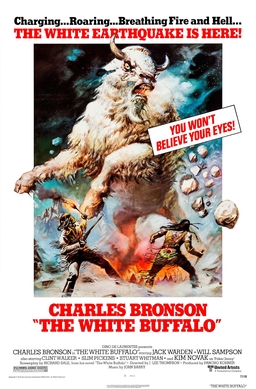
The White Buffalo

Gunfighter and army scout Wild Bill Hickok and Lakota warrior Crazy Horse are two of the most famous (even infamous), recognizable names in the history of the taming of the American west. At any point in their shortened lives -- they died a year apart in 1876 and 1877 -- did they meet? It's an interesting what-if and so goes 1977's The White Buffalo.

Having visited the East, Wild Bill Hickok (Charles Bronson) -- going under the alias 'James Otis' -- returns to the wild west. He has been tortured of late by a nightmare that plagues him night in and night out. It's the same nightmare each night; a vision of an immense white buffalo bearing down on him and ready to kill him in a second. Hickok doesn't know what to make of the dream, but when he hears rumors that a white buffalo has been spotted in the Black Hills, he goes on the hunt, bringing a trapper, Charlie Zane (Jack Warden), along for help. The famed gunfighter won't be alone though as they cross the path of Lakota chief Crazy Horse (Will Sampson) who similarly wants to hunt down and kill the alleged white buffalo. Which hunter will get him first?  

This was an odd western to watch. It's from director J. Lee Thompson of Cape Fear and The Guns of Navarone fame. The IMDB summary lists it as a quasi-Jaws ripoff, and it's not completely off base while also not being completely on-point either. Even three days since I've watched it, I'm still not sure exactly what I watched. It comes across as an odd, sometimes enjoyable episodic story that never quite finds a rhythm. Is it about Wild Bill making his return? Is it saying something more profound about the changing times of the west, and even the closing years of the "wild" west? Is it just a cool what-if about pairing two of the most interesting figures in American history? It's probably a little of all of them, but it is definitely hurt by not picking a route and sticking with it.

At its strongest, the focus is on the changing times of the west. Two men -- Hickok and Crazy Horse -- are very similar in personality, character and history. Their only difference? Hickok hates Indians, Crazy Horse hates the never-ending flow of white men into Indian land. As they both search for the white buffalo, they cross each others' paths, each saving the other man's life in a do-or-die situation. They put aside their hatred and differences aside in a quest to accomplish their mutual goals. I liked Bronson's performance a lot, even if it is pretty typical western anti-hero stuff. Sampson rises above a pretty stereotypically written part too as Crazy Horse. He avoids the stilted "Me Indian...you white man....How" conversation and plays well off of Bronson. The high point is Hickok and Crazy Horse talking across a campfire, both men wondering what the future holds.

Of the rest of the cast, Warden is the only one actually given anything more than a cameo. He has some good scenes with Bronson's Hickok, but it's a pretty standard meat and potatoes kind of role. Beyond those three parts, 'Buffalo' consists of a handful of really random cameos. We're not talking 10-15 minutes on-screen. We're talking individual scenes, some no more than a minute or two. Kim Novak gets the meatiest cameo as Poker Jenny, a woman from Hickok's past. Clint Walker also has some fun as Whistling Jack Kileen, a bear of a man gunning for Hickok. Also keep an eye out for Slim Pickens, Stuart Whitman, John Carradine, and Ed Lauter.

One of the oddest things though for 'Buffalo' is just that.....the buffalo. It doesn't look cheap, but it certainly tries for the Jaws-effect. We never really get a pristine, clear at the buffalo. Instead, we get extreme close-ups of the raging buffalo's eyes or his horns, we get far-off shots of the buffalo charging. It doesn't look ridiculous, but it sure approaches it. The final showdown among the buffalo, Hickok and Crazy Horse is pretty cool though. Sure, there are flaws. Any night scene was clearly shot on an indoor set with fake snow, trees and rocks. It looks pretty cheesy. There's also the cool scenes, an almost iconic shot of Hickok wearing his low-brimmed hat, his darkened glasses, his buckskin coat and brace of pistols. So in the end, it's a mixed bag, both good and bad.

The White Buffalo (1977): ** 1/2 /****

Thursday, April 22, 2010

Executive Action


Conspiracies theories are everywhere from something as minor as sports and rivalries to stupid like Bigfoot, Area 51, and the Loch Ness monster.  But the conspiracy to top them all is the assassination of John F. Kennedy in Dallas November 22, 1963.  Lee Harvey Oswald is known as the shooter, but for years conspiracy theorists have wondered what actually happened that November day.  Were there other shooters, was Oswald even involved or just a dupe?  

What has driven these theories all these years is that there are too many holes in the explanation provided by the lone shooter theory.  Everything doesn't add up, leading to speculation that it was all an immense conspiracy that killed JFK.  Who was part of it?  Who knows, but answers range from government to big business to right wing to extremists and some who insist Oswald was the lone shooter.  We'll almost certainly never know who killed Kennedy and how it was accomplished, but we can always wonder and theorize what actually happened.  With that idea is 1973's Executive Action.

This is a movie that doesn't wonder if there was a conspiracy to kill Kennedy, it's the conspiracy that does kill Kennedy.  A title card explains the background and says 'This is what could have happened.'  In that sense, it's extremely startling.  In the same way United 93 and World Trade Center were uncomfortable to watch because they were made so close to 9/11, Executive Action is difficult to watch because of its subject matter.  We know in the end Kennedy will be shot driving in his motorcade, but that doesn't take away from the surprise of it all.  The assassination planners are talking about killing the president of the United States in an honest, forthright manner.

It's summer 1963 and a group of powerful right-wing activists (including Burt Lancaster, Robert Ryan and Will Geer) meet together at a luxurious mansion.  Their analysts have predicted a future that has a Kennedy (John, Bobby and Ted) in the White House with other Kennedys holding key positions in the Cabinet.  None of these powerful men like the direction the country is taking with JFK in its most powerful position and have begun to put a complicated plot to kill the President.  Two teams go about preparing for the hit (led by Ed Lauter and William Watson) with black ops operatives.  While the plot is formed, the higher-ups begin to set up a plan that will paint Lee Harvey Oswald as the assassin.  Everything comes together, and then the date comes along.  November 22, 1963 will be the day.

The special features offer interviews that explain everyone involved in the movie was warned that their careers were probably over if they made the movie.  It's presented as a documentary as if this is how it happened, not just an interpretation of what might have happened.  It is a quick-moving story that never lingers long on one part of the story.  The longest segment is of course the actual assassination as three gunmen set up to shoot JFK, one in the Book Depository, one on the grassy knoll, and a third on a nearby hotel roof.  It's an eerie, spooky scene that is filmed like a scene out of any political thriller, not one where the President is shot.  Like the rest of the movie, it is unsettling to say the least.

Seeing a story like this which deals with such a controversial 'what if?' in history, I was more than a little surprised to see big names like Lancaster and Ryan involved.  The focus is clearly on the assassination conspiracy with characters being completely secondary.  Ryan is the right wing leader of the group, and Lancaster is the mysterious orchestrator of the plan with years of black ops experience working for him.  These are brilliant minds who believe the choice they've made will benefit the United States for years to come.  We're not talking a month or two down the road, but in terms of world affairs, especially U.S. involvement in Vietnam. 

Like any movie based on a conspiracy or a controversial topic, it's up to the viewer to decide how much they'll believe, or maybe more importantly, how much they'll allow themselves to believe.  Could this have happened as the movie presents it?  Sure.  No matter what you believe though, it's hard not to admit that as presented here, the conspiracy theorists have lots of ammunition to use to prove that it wasn't a lone gunman that killed Kennedy.  Believe it or not (I tend to lean toward the conspiracy side), Executive Action is a fascinating 'what if?'  We'll never know what happened but it is always interesting to wonder what did happen.

Executive Action <----trailer (1973): ***/****

Wednesday, September 23, 2009

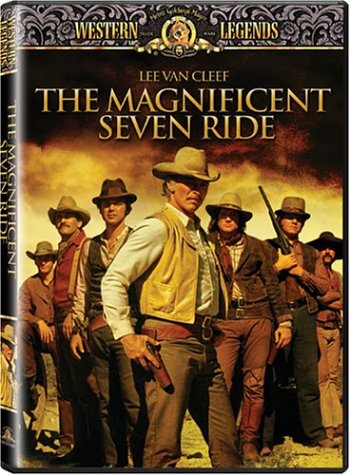
The Magnificent Seven Ride!

Probably the darkest and most cynical of the four movies, 1972's The Magnificent Seven Ride! is undone by any number of things starting from the apparently very cheap budget which affects the sets, the story, and surprisingly enough, the musical score from composer Elmer Bernstein. Ah, who knows? Maybe the studio thought adding an exclamation point in the title would fix all those problems. Close, but no cigar United Artists.

A good place to start is with the story/script. It's basically two movies which if done separately might have been good, or at least two hour-long TV shows. But of course, that might be too easy to do. My main issue though is simple, the new Magnificent Seven aren't even introduced as a group until an hour into the movie. Say what you want about the first three Mag7 movies, but Chris in anyone of his forms was putting together each group of 7 within the first 15 minutes or so. Not so here which starts a completely different storyline before even getting to a new group of specialists.

Now with a badge on his shirt, Chris Adams (Lee Van Cleef) is a marshal in a small western town with a new bride, Arilla (Mariette Hartley). Chris has built himself up quite a reputation as a tough law officer, but his wife convinces him to let go of a young prisoner she believes made one bad mistake. He does, but the boy joins a gang and during a bank robbery, they kidnap Arilla and ride out. Chris, joined by a writer, Noah Forbes (Michael Callan) trying to document his heroics, head out after the gang, only to find Arilla raped and murdered and the trio of youngsters split up.

Out on the trail looking for them, Chris meets an old friend, also now a sheriff, who is trying to stop a bandit and his gang from attacking their town. Chris declines the invitation to help, and it's not long before the friend and his posse are shot down. Feeling guilt for what he chose not to do, Chris finds the town, sans men, now occupied by just the widows, including Stefanie Powers (with some big 70s hair too) with the gang's return seemingly imminent. With no other option, Chris and Noah recruit five prisoners from the Tucson Territorial Prison (think crappy Dirty Dozen story) to help them defend the town.

The Seven: Van Cleef is an interesting choice to replace Yul Brynner and George Kennedy as Chris. A huge star because of his success in Europe, Van Cleef brings an edge to the character we haven't seen before. For him after losing his wife, he plans the town's defense like a suicide mission fulling expecting to die in the process. An interesting twist on the character for sure. In the quasi-McQueen sidekick part, Callan plays Noah as a whiny, cheap writer who questions Chris' actions, only to...gasp...come around in the end. It could have been a cool character to add to the mix, but Callan comes across as just plain annoying.

Now for the Mag7: Convict Style which seems like an easy way to keep the story moving by taking an idea from a different movie. Making it worse, none of the five convicts are developed much at all. There's Skinner (Luke Askew) and Pepe (Pedro Armendariz Jr), two gunfighters who'd like nothing more than kill Chris, Walt (William Lucking), the strong, silent type good with a shotgun, Hayes (James Sikking), a former Confederate officer adept at planning battle strategy, and Elliott (Ed Lauter in his first movie), the explosives expert. The only ones making much of an impression are Askew and Armendariz, more so because they act cool than any sort of development they have.

The "Villain": In the original, Eli Wallach's Calvera is introduced, disappears for an hour and then returns with a vengeance late. In 'Ride!' the lead bandit has one line the whole movie (a classic delivery of 'Vamanos!' if you ask me) and is played by acting powerhouse Ron Stein, a stuntman known for his parts in the Planet of the Apes TV series as 'First Gorilla.' The villain is totally wasted here and not a presence at all.

Another test of how good/bad movies can be is the groan test. How many times watching the movie do you groan at some cheesy line, horrible special effect, or set falling apart in the background? This one has its fair share including my personal favorite, 'I, Chris, degrade your woman!' in a message to Stein's De Toro character. Also, the widows left in town were gang-raped by De Toro's men and just found out their husbands are all dead. They sure cozy up to these new men awful quick, including Chris (wife raped and killed) snuggling up with Stefanie Powers (gang-raped, husband murdered, has to care for children...) days after all the bad news hits. Now that's a good script.

Besides the lack of a good story, the film has the look of a made-for-TV movie because it was filmed in the Hollywood backlots on a variety of generic looking sets straight out of Gunsmoke or Bonanza. The positive to take away is the final battle as De Toro and his men finally attack the town, but even then it's a measured positive. We know little to nothing about these men, but are supposed to feel something for them when they begin to drop like flies? Yeah, good luck with that. A disappointment all around and a sorry end to the four Magnificent Seven movies.

The Magnificent Seven Ride! <----trailer (1972): * 1/2 / ****