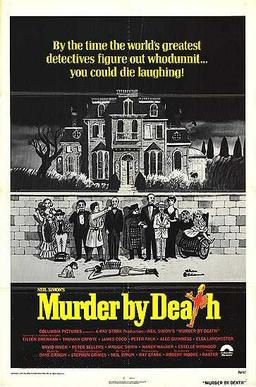
What's more fun than a murder mystery in film and on TV? The people who solve the murder mysteries!!! And no, I'm not talking about police procedurals where police officers follow the clues and catch the crooks. We're talking the out of this world observant and intelligent sleuths and detectives who follow all the minute, excruciating little details and pull theories out of thin air. They certainly get their due in a great spoof from 1976, Murder by Death.
Coming from all around the world, five world-class detectives have been brought together at an isolated country mansion by eccentric recluse Lionel Twain (writer Truman Capote). His goal? Present a murder with little evidence and let his five detectives piece things together. Whoever figures things out and fingers the murderer by dawn will receive a $1 million reward. Who are his contestants of sorts? They include Milo Perrier (James Coco), the whiny Belgian, Sam Diamond (Peter Falk), the tough guy detective, Jessica Marbles (Elsa Lanchester), the very English middle-aged woman, Dick Charleston (David Niven), the gentlemanly, smooth aging detective, and Sidney Wang (Peter Sellers), the pronunciation challenged Chinese detective. Each detective has brought a partner/sidekick/spouse but can any of the manage to solve a seemingly impossible murder mystery?
From director Robert Moore and screenwriter Neil Simon, 'Murder' is a gem in the Whodunnit genre. Throw a bunch of characters together, add in a mystery/murder or something that needs to be solved, and let the fun begin. This is a spoof of the Whodunnit genre, but it's not a stupid spoof, far from it. While the humor is far from high brow laughs, it's snappy, smart and quick. This is a very talented cast assembled here, the actors and actresses playing off each with remarkable ease. It's a quick movie at just 94 minutes, but there are laughs throughout. It was filmed on a mansion set in Burbank Studios, a closed-in, claustrophobic feel to the ever twisting and turning story. Self-contained and the better for it.
You really just can't go wrong with the sick amount of talent brought together here in the cast. Each detective is based off a classic literature character (Perrior = Hercules Poirot, Diamond = Sam Spade, Marbles = Miss Marple, Charleston = Nick Charles/The Thin Man, and Wang = Charlie Chan), each given their quirky personality traits that bring it all together nicely. Coco's Perrier is dying of starvation -- or so he believes -- as the mystery develops, Diamond does his best Humphrey Bogart impression throughout, Marbles quirky, mousy and excited, Charleston the upper class, smooth-talking Englishman, and Wang the master of logic and observation (with a touch of political incorrectness thrown in for good measure). It would be easy to see any/all of these characters getting their own movie, but when assembled together, we're talking impeccable chemistry with some sublimely perfect laughs.
Improving on the talent brought together is that each character is given a sidekick of some sort, a spouse, child, whatever. More cast listing!!! The recently departed Eileen Brennan plays Tess Skeffington, Sam's secretary and mistress, Maggie Smith plays Nora Charleston, Dick's longtime and loving wife, Estelle Windood as Miss Marple's wheelchair bound and ancient nurse, James Cromwell as Marcel, Perrier's very French chauffeur and Richard Narita as Willy, Wang's adopted Japanese son.
Oh, there's more. One of the movie's most perfectly executed running bits has Alec Guinness as Bensonmum, Twain's personal assistant and butler.....who's blind. It's almost inappropriate, a little politically incorrect when you hear about it, but like so much else going on in Simon's script, it just works. He answers the door, never realizing if anyone entered but speaking as if they're standing in front of him. He serves dinner with poor results, guides the guests to their rooms, and has a great running gag with the new cook, Yetta (Nancy Walker), a Hungarian woman who's deaf, can't talk and doesn't understand English in any way, but Guinness' Bensonmum can't see that she's holding up notes explaining herself. It's stupid almost as an idea, almost infantile in its humor, but oh goodness, it works so well. Here's a montage of so many of those great lines, watch it HERE.
Director Moore's film runs just 94 minutes, flying by at a breakneck speed. The first 60 minutes are about as perfect as a comedy can be, smart and stupid but balanced out between the two. It's beyond funny on all levels. The last 30 minutes or so come up a little short, the goofiness becoming a little too much. Capote -- an obvious scene-stealer -- delivers a great monologue ripping all these great detectives apart. He criticizes their storytelling techniques, their introduction of characters out of nowhere, ridiculous twists that come out of nowhere, and basically making it impossible to solve the mystery, whatever it should be. The ending is flat out stupid, but it's supposed to be. If you can decipher it in any way, you let me know. The struggles of the last 30 minutes prevent it from being an all-time great comedy, but flaws and all, it is still a gem.
Murder by Death (1976): *** 1/2 /****
The Sons of Katie Elder
"First, we reunite, then find Ma and Pa's killer...then read some reviews."
Showing posts with label David Niven. Show all posts
Wednesday, September 25, 2013
Monday, September 17, 2012
Around the World in 80 Days (1956)
There are epics, and then there are EPICS. In the age of such immense, gigantically-scaled films of the 1950s and 1960s, studios pulled out all the stops in hopes of impressing moviegoers. Huge all-star casts with thousands of extras, lavish sets and costumes, and in general, a sight to behold on the big screen. Some movies were just made for a viewing that only a full-size movie theater can offer, like 1956's Around the World in 80 Days.
It is the 1870s and new technological advances have made travel to far-off places not only possible but quicker, more efficient, and more entertaining. A prim and proper Englishman, Phileas Fogg (David Niven), even boasts to his fellow members of the Reform Club that he can travel completely travel around the world in just 80 days. The club members laugh at the thought, but Fogg maintains his stance and a bet is born. With a significant amount of money on the line, Fogg and his assistant/valet, Passepartout (Mexican actor Cantinflas), embark on a journey around the world against the clock with no idea of what will be actually thrown their way during their adventurous travels.
If you were trying to define what an old-school Hollywood epic is to someone who didn't know, this would be a great start. Filming in locations around the world from Japan, the U.S., Thailand, Spain, England, France, Pakistan and China, '80 Days' is a true visual stunner. The screen is filled with incredible locations packed to the gills with the cast and then hundreds and thousands of extras behind them. Director Michael Anderson filmed with a Todd-AO technique, an ultra-widescreen filming process that makes certain shots look like epically wide panoramic shots. I was impressed watching the film on my 32-inch TV. I can only imagine what this film would look like on a movie screen. As well, composer Victor Young's score (which won an Oscar) is light-hearted and fun, keeping the travels moving.
It is hard to criticize this movie on its technical levels. It is far easier to criticize the movie for basically everything else. Oh, didn't see that twist coming, did you? All that epic quality comes at the expense of character, story and any sort of development involving either of those. This is a movie you appreciate, just sit back and enjoy it. The widescreen filming process is a sight to behold, but they become tedious by the 11th or 12th such long shot of a mountain vista, train running down a track, Cantinflas fighting a bull. Yes, I get it. On visuals alone, this is a stunningly beautiful movie. But at almost three-hours long, it feels like nothing more than an extended world travel guide. There never is even the slightest sense of urgency to the 80 day deadline until the final 10 minutes. Instead we get the visual, Niven's Fogg paying someone to right a wrong, then another nature shot.
I'll go into more depth about the supporting cast of thousands in a bit, but let's start with the lead performances. David Niven is one of my favorite actors, but I came away disappointed here. His Fogg is the definition of a prim and proper Englishman. He's even asked 'Why must you be so British?' at one point. At no point though does he actually look interested in bringing the part to life. To me, Niven look bored, and that's tough to say as a fan. Famed Mexican actor Cantinflas sure takes some grief for his part as Passepartout, but I thought he did a fine job with his limited grasp of English. His bit with Red Skelton is a highlight, the duo shoveling food into the others mouth in a very funny routine. Other bigger parts include Shirley MacLaine oddly cast as an Indian princess traveling with Fogg and Passepartout, and Robert Newton as Mr. Fix, a bank investigator trailing Fogg who's convinced the Englishman is an infamous bank robber.
Then there's the cameos, a long list that must put even The Greatest Story Ever Told to shame. Take a deep breath, and here goes. Look out for Finlay Currie, Robert Morley, Noel Coward, Trevor Howard, John Gielgud, Charles Boyer, Gilbert Roland, Cesar Romero, Cedric Hardwicke, Peter Lorre, George Raft, Marlene Dietrich, Frank Sinatra, John Carradine, Buster Keaton, Joe E. Brown, Andy Devine, Victor McLaglen, John Mills and Glynis Johns among others. I include those names because I recognized them in the cast, not because I necessarily saw them in the actual film. They are the 'blink and you'll miss them' type of cameos to the point many don't even register. Sinatra is shown over his shoulder three times and then turns and smiles. Mind you, he doesn't even say anything. He SMILES. That's it. Yes, it's fun seeing all these actors/actresses together but give them something to do.
This is a tough one to review in the end. It's too long, downright dull at times, a visual treat to watch, and a movie experience unlike any other. It's flaws though are crippling. '80 Days' may be three-hour longs but because of its schizo, hyper kinetic energy that bounces all over the place, it feels significantly longer and has not aged well over the years. A movie to be appreciated for its positives for what it does amount to, even if I won't be watching it again anytime soon. Okay, maybe in a movie theater.
Around the World in 80 Days <---trailer (1956): ** 1/2/****
It is the 1870s and new technological advances have made travel to far-off places not only possible but quicker, more efficient, and more entertaining. A prim and proper Englishman, Phileas Fogg (David Niven), even boasts to his fellow members of the Reform Club that he can travel completely travel around the world in just 80 days. The club members laugh at the thought, but Fogg maintains his stance and a bet is born. With a significant amount of money on the line, Fogg and his assistant/valet, Passepartout (Mexican actor Cantinflas), embark on a journey around the world against the clock with no idea of what will be actually thrown their way during their adventurous travels.
If you were trying to define what an old-school Hollywood epic is to someone who didn't know, this would be a great start. Filming in locations around the world from Japan, the U.S., Thailand, Spain, England, France, Pakistan and China, '80 Days' is a true visual stunner. The screen is filled with incredible locations packed to the gills with the cast and then hundreds and thousands of extras behind them. Director Michael Anderson filmed with a Todd-AO technique, an ultra-widescreen filming process that makes certain shots look like epically wide panoramic shots. I was impressed watching the film on my 32-inch TV. I can only imagine what this film would look like on a movie screen. As well, composer Victor Young's score (which won an Oscar) is light-hearted and fun, keeping the travels moving.
It is hard to criticize this movie on its technical levels. It is far easier to criticize the movie for basically everything else. Oh, didn't see that twist coming, did you? All that epic quality comes at the expense of character, story and any sort of development involving either of those. This is a movie you appreciate, just sit back and enjoy it. The widescreen filming process is a sight to behold, but they become tedious by the 11th or 12th such long shot of a mountain vista, train running down a track, Cantinflas fighting a bull. Yes, I get it. On visuals alone, this is a stunningly beautiful movie. But at almost three-hours long, it feels like nothing more than an extended world travel guide. There never is even the slightest sense of urgency to the 80 day deadline until the final 10 minutes. Instead we get the visual, Niven's Fogg paying someone to right a wrong, then another nature shot.
I'll go into more depth about the supporting cast of thousands in a bit, but let's start with the lead performances. David Niven is one of my favorite actors, but I came away disappointed here. His Fogg is the definition of a prim and proper Englishman. He's even asked 'Why must you be so British?' at one point. At no point though does he actually look interested in bringing the part to life. To me, Niven look bored, and that's tough to say as a fan. Famed Mexican actor Cantinflas sure takes some grief for his part as Passepartout, but I thought he did a fine job with his limited grasp of English. His bit with Red Skelton is a highlight, the duo shoveling food into the others mouth in a very funny routine. Other bigger parts include Shirley MacLaine oddly cast as an Indian princess traveling with Fogg and Passepartout, and Robert Newton as Mr. Fix, a bank investigator trailing Fogg who's convinced the Englishman is an infamous bank robber.
Then there's the cameos, a long list that must put even The Greatest Story Ever Told to shame. Take a deep breath, and here goes. Look out for Finlay Currie, Robert Morley, Noel Coward, Trevor Howard, John Gielgud, Charles Boyer, Gilbert Roland, Cesar Romero, Cedric Hardwicke, Peter Lorre, George Raft, Marlene Dietrich, Frank Sinatra, John Carradine, Buster Keaton, Joe E. Brown, Andy Devine, Victor McLaglen, John Mills and Glynis Johns among others. I include those names because I recognized them in the cast, not because I necessarily saw them in the actual film. They are the 'blink and you'll miss them' type of cameos to the point many don't even register. Sinatra is shown over his shoulder three times and then turns and smiles. Mind you, he doesn't even say anything. He SMILES. That's it. Yes, it's fun seeing all these actors/actresses together but give them something to do.
This is a tough one to review in the end. It's too long, downright dull at times, a visual treat to watch, and a movie experience unlike any other. It's flaws though are crippling. '80 Days' may be three-hour longs but because of its schizo, hyper kinetic energy that bounces all over the place, it feels significantly longer and has not aged well over the years. A movie to be appreciated for its positives for what it does amount to, even if I won't be watching it again anytime soon. Okay, maybe in a movie theater.
Around the World in 80 Days <---trailer (1956): ** 1/2/****
Saturday, December 24, 2011
The Bishop's Wife
Ah, it's almost Christmas season. The toys and gifts, the decorations, the music, the bad sweaters. This is a holiday that's got it all. What do I love most about the Christmas season? Besides all of it I guess. Well, you're reading a movie review blog so if you guess.....movies, you win a cookie. Happy Kwanz-Hana-Solstice-Mas! Today's hopefully timely review, 1947's The Bishop's Wife.
Bishop Henry Brougham (David Niven) is in trouble. One of the youngest appointed bishops in the country, Henry is desperately seeking funds to build a new cathedral. His efforts are all-encompassing, taking over all aspects of life. His wife, Julia (Loretta Young), is drifting away, and Henry can do nothing about it. One night seeking guidance, he prays and what appears? An angel in his office by the name of Dudley (Cary Grant) who hopes to help him however he can, but now how Henry would have anticipated. Does the bishop truly believe Dudley is an angel? And what exactly does Dudley plan to do?
Comedies to drama, musicals to cartoons, I can find something redeeming in just about every Christmas movie out there. Coming up with a positive for 'Wife' was not difficult. The word(s) that come to mind? Sweet and charming. Definitely a qualifier for 'they don't make them like this anymore.' In terms of quality and emotion (not to mention some casting repeats), it would run as quite a double bill with It's a Wonderful Life. It has a message but doesn't hit you over the head with it. It's funny but doesn't try too hard. It's sweet but isn't sappy. Director Henry Koster keeps a nice balance among all those elements.
If you're going for charming, is there a better actor in the history of movies to pick than Cary Grant? I'm trying to come up with a name and keep on drawing a blank. Oddly enough, this part was one of Grant's least favorite. Why? Who knows because I think it's perfect casting. Playing the angel Dudley, Grant has that right mix of charm, intelligence and genuine interest in helping others. What separates the role from good and great is the tragic element in the character. Trying to bring Niven's Henry and Young's Julia together, Dudley falls for Julia but knows nothing can come of it. The ending for Dudley is far from a happy one, but a necessary one for the movie, and in a bigger sense that's more than just him; a perfect happy ending. Great part for Grant.
Now I debated diving into this at all because talking about religion never ends well. NEVER. So with that said, let's talk some religion! A movie about an angel will no doubt divide some viewers, but I loved the portrayal. Dudley explains his job and means of going about it several times, a guide along the way who helps make decisions. Once the decision is made though, he's gone, leaving it on the individual like they came to that point on their own. The supernatural aspect is played up at times with Dudley's abilities, and the script is pitch-perfect with a long list of one-liners and sight gags; Dudley saying he'll talk to God about a blessing, talking about his centuries-long life, and so much more.
This romantic comedy does not fall just on the shoulders of Grant, both Niven and Young helping carry the load. Niven is the viewer, the doubting Thomas who questions Dudley's reality while Young is the wife who wants back what she always had, a loving and attentive husband. Monty Woolley plays Prof. Wutheridge, an old friend of the Brougham's, James Gleason plays amiable cabbie Sylvester, Gladys Cooper is Mrs. Hamilton, a manipulative money donor, Elsa Lanchester is Matilda, the Brougham's maid, and Karolyn Grimes (year removed from playing Zuzu in 'Wonderful Life') is Debby, the Brougham's daughter. Just a good movie from top to bottom, and a Christmas classic.
The Bishop's Wife <---TCM trailer/clips (1947): ****/****
Bishop Henry Brougham (David Niven) is in trouble. One of the youngest appointed bishops in the country, Henry is desperately seeking funds to build a new cathedral. His efforts are all-encompassing, taking over all aspects of life. His wife, Julia (Loretta Young), is drifting away, and Henry can do nothing about it. One night seeking guidance, he prays and what appears? An angel in his office by the name of Dudley (Cary Grant) who hopes to help him however he can, but now how Henry would have anticipated. Does the bishop truly believe Dudley is an angel? And what exactly does Dudley plan to do?
Comedies to drama, musicals to cartoons, I can find something redeeming in just about every Christmas movie out there. Coming up with a positive for 'Wife' was not difficult. The word(s) that come to mind? Sweet and charming. Definitely a qualifier for 'they don't make them like this anymore.' In terms of quality and emotion (not to mention some casting repeats), it would run as quite a double bill with It's a Wonderful Life. It has a message but doesn't hit you over the head with it. It's funny but doesn't try too hard. It's sweet but isn't sappy. Director Henry Koster keeps a nice balance among all those elements.
If you're going for charming, is there a better actor in the history of movies to pick than Cary Grant? I'm trying to come up with a name and keep on drawing a blank. Oddly enough, this part was one of Grant's least favorite. Why? Who knows because I think it's perfect casting. Playing the angel Dudley, Grant has that right mix of charm, intelligence and genuine interest in helping others. What separates the role from good and great is the tragic element in the character. Trying to bring Niven's Henry and Young's Julia together, Dudley falls for Julia but knows nothing can come of it. The ending for Dudley is far from a happy one, but a necessary one for the movie, and in a bigger sense that's more than just him; a perfect happy ending. Great part for Grant.
Now I debated diving into this at all because talking about religion never ends well. NEVER. So with that said, let's talk some religion! A movie about an angel will no doubt divide some viewers, but I loved the portrayal. Dudley explains his job and means of going about it several times, a guide along the way who helps make decisions. Once the decision is made though, he's gone, leaving it on the individual like they came to that point on their own. The supernatural aspect is played up at times with Dudley's abilities, and the script is pitch-perfect with a long list of one-liners and sight gags; Dudley saying he'll talk to God about a blessing, talking about his centuries-long life, and so much more.
This romantic comedy does not fall just on the shoulders of Grant, both Niven and Young helping carry the load. Niven is the viewer, the doubting Thomas who questions Dudley's reality while Young is the wife who wants back what she always had, a loving and attentive husband. Monty Woolley plays Prof. Wutheridge, an old friend of the Brougham's, James Gleason plays amiable cabbie Sylvester, Gladys Cooper is Mrs. Hamilton, a manipulative money donor, Elsa Lanchester is Matilda, the Brougham's maid, and Karolyn Grimes (year removed from playing Zuzu in 'Wonderful Life') is Debby, the Brougham's daughter. Just a good movie from top to bottom, and a Christmas classic.
The Bishop's Wife <---TCM trailer/clips (1947): ****/****
Friday, October 14, 2011
Lady L
The more I see of Paul Newman, the more I come to respect him as an actor. I don't always enjoy his choice of movies or parts, but I can give credit where credit is due. He branched out, playing an eclectic list of characters and individuals over a 50-plus year career. Some efforts fall far short -- playing a Mexican bandit in The Outrage comes to mind -- but when it would have been easy to be typecast, Newman tried something else. In a hit or miss historic romantic comedy, 1965's Lady L, Newman adds another oddity to his listing, a French thief who joins a revolutionary group.
This is a movie that is also known for its director, taking a trip from around the camera where he was usually in front of it acting, Peter Ustinov. The actor from movies like Spartacus and Quo Vadis takes a crack at directing, one of just six films he did over his career. It is an odd movie overall with a story that doesn't sound like a comedy but ends up being just that, a love story with some weirdly funny (and others not so funny) moments.
An old woman nearing her 80th birthday, Lady Louise (Sophia Loren) sits down with a writer and old friend, Percy (Cecil Parker), to tell him the story of her life growing up. As a young woman, Louise worked in a Paris bordello as a laundry girl where she meets Armand (Newman), an anarchist bank robber who the French police would like nothing more than to arrest him. She joins him in his adventures and misadventures, quickly falling in love with him. Adventurous Armand eventually ends up with an extremist group looking to assassinate a Bavarian prince, causing Louise to question if she can put up with him. She meets Lord Lendale (David Niven), questioning even more now who she belongs with. Could it work somehow to be with both men?
Like most flawed movies, I'm going to slightly recommend this movie mostly because of the casting. How often are you going to see a grouping of Sophia Loren, Paul Newman and David Niven? Even when the script and the story is too cutesy for its own good, these three keep it grounded at least a little bit. Loren -- wearing heavy make-up as an old woman -- gets to show her comedic and dramatic sides, Newman plays the straight man in the ever-growing ridiculous story, and Niven gets to play a variation of himself, a prim and proper Englishman looking for a wife, possibly finding it in Loren's Louise. None of the parts are among any of the three's best, but it's still fun to see actors of their caliber working together.
Writing the plot description made me realize how off the wall this story is. Reading some background on it, 'Lady' sounded like a romantic period piece. Well, partially. The choices made are odd, especially Newman's Armand as an anarchist thief, eventually joining a revolutionary group trying to assassinate anyone and everyone. The assassination attempt is played for laughs -- Ustinov making a cameo as Prince Otto of Bavaria -- so it's hard to criticize too much, but it comes off in poor taste (to me at least). Niven's Lendale later welcomes the members of the group to stay at his villa, preparing their next attack in peace and quiet. It sounds so ridiculous that it almost works, but the story itself is too weird, too different to fully work.
Now in that craziness there are some funny moments, many coming from Claude Dauphin's part as Inspector Mercier, head of the French police trying to arrest Armand. His team of inspectors isn't quite the Keystone Cops, but their efforts to arrest Armand are surprisingly funny, alerting each other the presence of the thief through a series of gruffer and louder throat clearings. Newman's introduction is funny as well, a bank robbery where nothing is at it seems. I did laugh a few times throughout the movie, but the chuckles were lost in a sea of otherwise boring scenes.
Not a long review for this movie because I neither hated it or loved it. The movie has a great look to it, large sets and lavish costumes that reflect the setting of pre-World War I Europe in the first decades of the 1900s. It's funny, but too much and too little at different times. The cast is good but not overly impressive. Average movie that could have been better.
Lady L <---TCM trailer/clips (1965): **/****
This is a movie that is also known for its director, taking a trip from around the camera where he was usually in front of it acting, Peter Ustinov. The actor from movies like Spartacus and Quo Vadis takes a crack at directing, one of just six films he did over his career. It is an odd movie overall with a story that doesn't sound like a comedy but ends up being just that, a love story with some weirdly funny (and others not so funny) moments.
An old woman nearing her 80th birthday, Lady Louise (Sophia Loren) sits down with a writer and old friend, Percy (Cecil Parker), to tell him the story of her life growing up. As a young woman, Louise worked in a Paris bordello as a laundry girl where she meets Armand (Newman), an anarchist bank robber who the French police would like nothing more than to arrest him. She joins him in his adventures and misadventures, quickly falling in love with him. Adventurous Armand eventually ends up with an extremist group looking to assassinate a Bavarian prince, causing Louise to question if she can put up with him. She meets Lord Lendale (David Niven), questioning even more now who she belongs with. Could it work somehow to be with both men?
Like most flawed movies, I'm going to slightly recommend this movie mostly because of the casting. How often are you going to see a grouping of Sophia Loren, Paul Newman and David Niven? Even when the script and the story is too cutesy for its own good, these three keep it grounded at least a little bit. Loren -- wearing heavy make-up as an old woman -- gets to show her comedic and dramatic sides, Newman plays the straight man in the ever-growing ridiculous story, and Niven gets to play a variation of himself, a prim and proper Englishman looking for a wife, possibly finding it in Loren's Louise. None of the parts are among any of the three's best, but it's still fun to see actors of their caliber working together.
Writing the plot description made me realize how off the wall this story is. Reading some background on it, 'Lady' sounded like a romantic period piece. Well, partially. The choices made are odd, especially Newman's Armand as an anarchist thief, eventually joining a revolutionary group trying to assassinate anyone and everyone. The assassination attempt is played for laughs -- Ustinov making a cameo as Prince Otto of Bavaria -- so it's hard to criticize too much, but it comes off in poor taste (to me at least). Niven's Lendale later welcomes the members of the group to stay at his villa, preparing their next attack in peace and quiet. It sounds so ridiculous that it almost works, but the story itself is too weird, too different to fully work.
Now in that craziness there are some funny moments, many coming from Claude Dauphin's part as Inspector Mercier, head of the French police trying to arrest Armand. His team of inspectors isn't quite the Keystone Cops, but their efforts to arrest Armand are surprisingly funny, alerting each other the presence of the thief through a series of gruffer and louder throat clearings. Newman's introduction is funny as well, a bank robbery where nothing is at it seems. I did laugh a few times throughout the movie, but the chuckles were lost in a sea of otherwise boring scenes.
Not a long review for this movie because I neither hated it or loved it. The movie has a great look to it, large sets and lavish costumes that reflect the setting of pre-World War I Europe in the first decades of the 1900s. It's funny, but too much and too little at different times. The cast is good but not overly impressive. Average movie that could have been better.
Lady L <---TCM trailer/clips (1965): **/****
Labels:
1960s,
Cecil Parker,
David Niven,
Paul Newman,
Peter Ustinov,
Sophia Loren
Monday, July 18, 2011
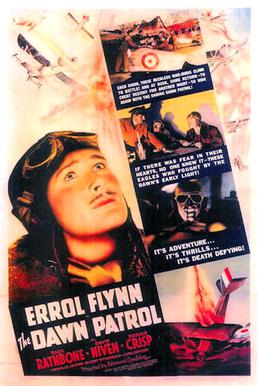
The Dawn Patrol
Maybe its the aviation aspect that studios assume viewers will be more interested in flying, but thankfully World War I pilots have been in several worthwhile movies. Most recently Flyboys struggled in theaters telling the story of American pilots flying with the French early in the war. George Peppard starred in The Blue Max, the story of a German infantry soldier turned national hero. One of the best though is 1938's The Dawn Patrol, an anti-war film that is both thrilling to watch and able to strike a nerve emotionally. That's a good combination if there ever was one.
It's 1915 in France and as a leader of one of the flights in the British 59th Squadron and one of the few pilots with experience, Capt. Courtney (Errol Flynn) consistently finds himself leading rookie, inexperienced pilots on missions where they rarely return. The war demands new pilots though and as quick as they're taught how to fly they are thrown into the fire. Courtney is constantly at odds with squadron commander Major Brand (Basil Rathbone) who realizes the idiocy of the orders he's receiving but can do nothing about it. Courtney's actions one day in destroying a rail depot actually gets Brand promoted, leaving the command post open to which Courtney is promoted. With close friend and fellow pilot, Lt. Scott (David Niven), taking over one of the flights, Courtney steps into the command position, immediately seeing that there will be no winners in this war.
I've long been aware of this movie, but just never got around to seeing it. I had a picture of gallant, heroic Errol Flynn single-handedly winning World War I from his fighter plane, dispatching hundreds of Germans at will. Flynn does play the gallant, heroic pilot, but in terms of the rest of the movie I couldn't have been more wrong. Just a year before WWII started in a time when I think of blatant, painful propaganda movies, this is an anti-war movie screaming for someone to listen to the complete idiocy of war and armed combat. Director Edmund Goulding has a film here that doesn't pull any punches. An assembly line of pilots is sent to their deaths because the war requires it, not because it makes any sense. Someone has to fight, and these inexperienced pilots fit the bill.
The best utilization of this is when Niven's Lt. Scott sees his younger brother, Donnie (Morton Lowry), among the newest batch of replacements. Up to this point both Scott and Courtney have balked at what they're doing, but the new pilots are nameless, faceless and interchangeable individuals. Now they have a boy in front of them fresh out of flight school who with his barely 10 hours of time in a plane is expected to tangle with German aces. Niven's Scott begs, implores Courtney to ground his younger brother, giving him a few days to teach him how to survive. Courtney wants to do so, desperately wants to, but as commanding officer where can he draw the line? He can't because he would have to do this for every new pilot. It tears him up inside, sending these young men to almost certain death, but he's left no other option.
Robin Hood is Flynn's more well-known and even iconic role from 1938, but his part as Captain Courtney in The Dawn Patrol is without question the better part for him. I've always liked Flynn as an actor, but I've been critical at times because he does seem to play similar characters. It is roles like this that show he may play similar characters, but he was more than a movie star, he was an actor. Courtney is forced to go through a transformation because his duty calls for it, not because he wants to. Sending men to their death takes its toll on him, but he continues on. Flynn was just 29 years old at the time, and Niven just 28 as they filmed, both showing they were on their way to bigger and better. They have a friendship on-screen that reflects their friendship off-screen so their characters are unquestionably genuine.
With some impressive aerial footage of World War I era planes, it's impossible not to get sucked into the action. We're watching these flimsy planes that look like a stiff wind would rip them apart as they maneuver and tear through the skies. In an age of planes that travel hundreds of miles in minutes, watching a movie like this can seem like ancient history. The best part of the movie though are the quieter moments, Scott and Courtney reminiscing before a mission that has little chance of success. It's the pilots wearily accepting their orders, hiding the disappointment and running out to their planes. It is Lt. Scott addressing his flight of the squadron, the movie beginning as it ends. There will be no victors, just survivors. These were gentleman fighting a brutish war, much of the time treating their German counterparts with respect. A great scene has Courtney drinking with a downed German pilot (Carl Esmond) just a few hours after shooting him down. There is a surreal nature to the proceedings that just couldn't be made up.
Rightfully so this is remembered as an Errol Flynn movie, and both Flynn and Niven are perfectly cast. Rathbone though is particularly memorable as Major Branch, the commander who wishes he could be up in the sky with his pilots instead of behind a desk. Donald Crisp is good in a supporting part as Phipps, the squadron adjutant while Barry Fitzgerald plays Bott, the squadron mechanic. This is a criminally underrated war movie, one that surprises in the effectiveness of its message. Well worth checking out.
The Dawn Patrol <---trailer (1938): *** 1/2 /****
Monday, May 30, 2011
Eye of the Devil
I'll get into the specifics more later about the pre-credit sequence that opens the movie. As someone who typically steers clear of horror movies, I couldn't pass this one up stumbling across it on TCM's schedule recently. The cast is mostly what caught my eye because the story description certainly didn't sound too interesting. This isn't a horror movie of 2011 with shock value and gore, instead building up suspense and tension with its gothic feel. What to make of it? I have no idea. It was weird, but I think...think...I liked it.
A well to-do businessman in Paris, Phillipe de Montfaucon (David Niven) must return home when news of his estate's vineyards dying reaches him. A few days later, his wife, Catherine (Deborah Kerr), joins him at the estate -- called Bellenac -- with their two children. Catherine begins to see strange, unexplainable things one night but can't find anyone to answer her questions. She even sees members of something that looks like a cult gathering in the expansive estate home, but just can't figure it out. Her mother-in-law, Countess Estelle (Flora Robson), seems to know what's going on but won't tell her a thing. She begins to worry for her safety, her children's, and also of her husband. Could he possibly be involved with these strange happenings? More importantly, if he is involved, can Catherine save him?
For starters, let's start at the start...words are fun. Before a credits sequence or a title cards, we get a lightning quick montage, edited within an inch of its life that immediately sets the tone for the rest of the movie. Now as I look for it, I of course cannot find a clip of this sequence. It is an odd assortment of quick images -- a dove pierced with an arrow, a woman's eye, a man's head, a train speeding down the tracks, among many others -- that is edited together so quickly it can be hard to make anything out of it. The sequence feels like something A Clockwork Orange would have used 5 years later. Regardless of the background though, it pulls you into the movie. You want to, you need to know what those disparate images mean and how they're related.
Cheap thrills are one thing, and genuine fear and uneasiness are another. Gory, shocking, 'Gotcha!' moments are part of the reason I dislike horror movies so much. There is a subtlety to older horror movies that more recent ones are just missing. Some complaints are that director J. Lee Thompson does go to the old horror cliche book a few too many times, but for the most part the scares are genuine. The off-center camera angles telegraph everything that's going to happen, and the dark, spooky shadows always reveal something hidden away. But still, the scares are there. 'Devil' is filmed in black and white, and it definitely has a gothic feel, especially in this immense, extravagant, lavish French manor that looks like it's out of the 1700s. Throw in composer Gary McFarland's eerie, Church choir-like score, and you've got all the makings.
I'll admit it. I'm a sucker for big names when I see a cast listing. Why else would I watch a basically unknown British horror movie from the 1960s? David Niven and Deborah Kerr in the starring roles sounded perfect for me so surprisingly enough, I thought they were the weakest parts of the cast. Niven sleepwalks through his role, disappearing for long stretches of the movie. Kerr basically looks nervous the whole movie, screaming occasionally. The rest of the cast makes up for it. Master of understated creepiness Donald Pleasence plays a creepy priest, Pere Dominic, Robson is the tortured woman who knows the whole truth, and Edward Mulhare is a longtime friend of Kerr's Catherine. The best thing going for 'Devil' is David Hemmings and Sharon Tate as Christian (an albino archer?) and Odile, brother and sister who always know more than they let on.
You know that feeling on Christmas Eve when you see your presents wrapped up nicely under the tree? Now, I loved my presents -- always have -- but the anticipation and mystery is part of the appeal. More and more, I find that's the case with movies that hold out on you until the finale with a huge, major revelation. The build-up here is all the fun because the reveal disappoints. Think mix between The Wicker Man and The Omen, but that's all I'll say. The ending never quite explains everything either, hinting at and beating around the bush, but never laying everything out. I definitely was creeped out by this movie, but the ending left me disappointed unfortunately.
Eye of the Devil <---TCM trailer (1966): ** 1/2 /****
Friday, February 4, 2011
Casino Royale (1966)
After a four-year gap since Pierce Brosnan's final James Bond movie, MI6 agent 007 returned in a big way in 2006 with Daniel Craig taking over the part of the secret agent. It was a huge success and served as an excellent reboot for the franchise, quickly climbing into my top 5 all-time Bond flicks. Why did it work? Like most of the best movies from the franchise, it stuck close to the Ian Fleming source novel that had not been made previously...in a serious fashion at least. That's where 1966's awful Casino Royale jumps in.
By 1966, star Sean Connery had already completed four 007 movies and had turned James Bond into one of the world's biggest stars. It was so popular that spoofs started popping up like James Coburn as Derek Flint and Dean Martin as Matt Helm among others. I get it, strike when the iron is hot, but in a saturated market of spy and espionage movies -- serious and spoof -- don't you want to at least turn out a quality product? With six different directors shooting different portions of the movie, this was like How the West Was Won: 007 Style. Besides an occasional laugh here and there, the only redeeming quality is an out-of-this world (if wasted) cast, but more on that later.
All over the world, American, British, Russian, and French agents are turning up dead and their agencies don't have the slightest clue or evidence as to who's pulling off the jobs. The agency heads turn to retired MI6 agent, Sir James Bond (David Niven), to root out the problem. Bond is a legend in the espionage business, but his best days are behind him, and he questions what has happened to the field he worked so well in, carving out a name and reputation for himself. He concocts a crazy plan to smoke out whoever is behind the murders; using his name, agents all over the world (Peter Sellers, Ursula Andress, Daliah Lavi, Joanna Pettet, Woody Allen, Terence Cooper) will see if working as bait draws the mastermind out of his lair. The plan might be too good though because SMERSH and mastermind Le Chiffre (Orson Welles) send agents to kill the original and still best James Bond around.
Now anyone familiar with Casino Royale -- Fleming's novel or the Craig movie -- knows that the plot described there is nothing like the book or the movie. Bond's effort to detain Le Chiffre at the baccarat table is handled in a scene that takes about 10 minutes, not an entire movie. Using other spy spoofs as an example, there is clearly potential here. A character as ripe for the picking as James Bond is hard to mess up in the humor department, but this movie is a mess. For all the subtle, perfectly delivered lines that pepper the script, there's huge scenes of excess of physical and slapstick humor that even Mel Brooks must have shaken his head at. The finale is the worst of all with one of the 14 directors obviously not knowing where to cut things off.
Let's start with the crazy amount of talent involved here behind the camera, including John Huston (also playing M in one scene) and Robert Parrish among four other less notable names. The writing too includes Sellers, Billy Wilder, and Joseph Heller. How did this much talent put together such an awful movie? On top of the cast listed above, there's also parts for Deborah Kerr, William Holden, Jean-Paul Belmondo, Peter O'Toole (on-screen for about 6 seconds), Charles Boyer, George Raft, Jacqueline Bisset, and Barbara Bouchet. What's worse is that the cast appears to be having a blast making the picture. It's just that much worse that what they're working with is beneath all of their talent. Bit parts and extended cameos for almost all of these names limit actual on-screen time, but just in terms of name power, this movie is impressive.
The only star that I thought was legitimately good was David Niven as retired 007, Sir James Bond, enjoying his retirement in an isolated English country villa only to be thrust back into the world of espionage. Because it is an older Bond, Niven has some fun with the part, poking fun at Connery's portrayal especially. He gets some good laughs from his constant curiosity of how all secret agents have become sex fiends, leaving lonely, beautiful women in every city all over the Earth. He shakes his head at all the changes he sees in the life of a spy only to embrace them once he's back into it. A professional plain and simple, Niven makes the most of the material, rising above it to deliver a worthwhile performance.
So this movie was bad, downright awful at times, okay? I am scraping the bottom of the barrel here looking for something to write about. Most of the movie was just so stupid and dumb I can't even complain. It's so bad it is surreal at times. So what can I recommend? If nothing else with this overabundance of characters, the script calls for a long list of beautiful actresses who are required to wear slinky outfits and do little else. Kerr, Lavi, Pettet, Andress, and Bouchet are all half-naked for about 90% of the movie, and that's all I've got. So stupidly bad, this movie has to be seen to be believed.
Casino Royale <---trailer (1966): */****
By 1966, star Sean Connery had already completed four 007 movies and had turned James Bond into one of the world's biggest stars. It was so popular that spoofs started popping up like James Coburn as Derek Flint and Dean Martin as Matt Helm among others. I get it, strike when the iron is hot, but in a saturated market of spy and espionage movies -- serious and spoof -- don't you want to at least turn out a quality product? With six different directors shooting different portions of the movie, this was like How the West Was Won: 007 Style. Besides an occasional laugh here and there, the only redeeming quality is an out-of-this world (if wasted) cast, but more on that later.
All over the world, American, British, Russian, and French agents are turning up dead and their agencies don't have the slightest clue or evidence as to who's pulling off the jobs. The agency heads turn to retired MI6 agent, Sir James Bond (David Niven), to root out the problem. Bond is a legend in the espionage business, but his best days are behind him, and he questions what has happened to the field he worked so well in, carving out a name and reputation for himself. He concocts a crazy plan to smoke out whoever is behind the murders; using his name, agents all over the world (Peter Sellers, Ursula Andress, Daliah Lavi, Joanna Pettet, Woody Allen, Terence Cooper) will see if working as bait draws the mastermind out of his lair. The plan might be too good though because SMERSH and mastermind Le Chiffre (Orson Welles) send agents to kill the original and still best James Bond around.
Now anyone familiar with Casino Royale -- Fleming's novel or the Craig movie -- knows that the plot described there is nothing like the book or the movie. Bond's effort to detain Le Chiffre at the baccarat table is handled in a scene that takes about 10 minutes, not an entire movie. Using other spy spoofs as an example, there is clearly potential here. A character as ripe for the picking as James Bond is hard to mess up in the humor department, but this movie is a mess. For all the subtle, perfectly delivered lines that pepper the script, there's huge scenes of excess of physical and slapstick humor that even Mel Brooks must have shaken his head at. The finale is the worst of all with one of the 14 directors obviously not knowing where to cut things off.
Let's start with the crazy amount of talent involved here behind the camera, including John Huston (also playing M in one scene) and Robert Parrish among four other less notable names. The writing too includes Sellers, Billy Wilder, and Joseph Heller. How did this much talent put together such an awful movie? On top of the cast listed above, there's also parts for Deborah Kerr, William Holden, Jean-Paul Belmondo, Peter O'Toole (on-screen for about 6 seconds), Charles Boyer, George Raft, Jacqueline Bisset, and Barbara Bouchet. What's worse is that the cast appears to be having a blast making the picture. It's just that much worse that what they're working with is beneath all of their talent. Bit parts and extended cameos for almost all of these names limit actual on-screen time, but just in terms of name power, this movie is impressive.
The only star that I thought was legitimately good was David Niven as retired 007, Sir James Bond, enjoying his retirement in an isolated English country villa only to be thrust back into the world of espionage. Because it is an older Bond, Niven has some fun with the part, poking fun at Connery's portrayal especially. He gets some good laughs from his constant curiosity of how all secret agents have become sex fiends, leaving lonely, beautiful women in every city all over the Earth. He shakes his head at all the changes he sees in the life of a spy only to embrace them once he's back into it. A professional plain and simple, Niven makes the most of the material, rising above it to deliver a worthwhile performance.
So this movie was bad, downright awful at times, okay? I am scraping the bottom of the barrel here looking for something to write about. Most of the movie was just so stupid and dumb I can't even complain. It's so bad it is surreal at times. So what can I recommend? If nothing else with this overabundance of characters, the script calls for a long list of beautiful actresses who are required to wear slinky outfits and do little else. Kerr, Lavi, Pettet, Andress, and Bouchet are all half-naked for about 90% of the movie, and that's all I've got. So stupidly bad, this movie has to be seen to be believed.
Casino Royale <---trailer (1966): */****
Sunday, January 9, 2011
The Extraordinary Seaman
When director John Frankenheimer got it right with his movies, he hit it out of the park. We're talking movies like The Train, Seven Days in May, Grand Prix, The Manchurian Candidate, and Birdman of Alcatraz. These are movies that are classics or at least near-classics and should be must-watch for any movie fan. Just about any director though has to have a couple duds on his/her resume, and until now I hadn't seen Frankenheimer's dud. For all I know, he may only have the one, but 1969's The Extraordinary Seaman is one of the worst movies I've ever seen.
Reading through Turner Classic Movies' schedule each week, I typically look for actors/actresses I'm a fan of, or if nothing else a title that sounds interesting. When I stumbled across the cast of this one, my first thought was how had I completely missed the boat on this one? David Niven in the lead? Faye Dunaway and Alan Alda in supporting roles? Mickey Rooney too? And it's a World War II story? I don't know at what point I realized this was an awful movie, but it didn't take long. We're not talking a 'so bad it's good' type movie either. No guilty pleasure, no real redeeming quality anywhere in sight. Just plain awful and no amount of talent in the cast was going to save this clunker.
After their ship is sunk somewhere in the Pacific, four sailors (including Alda, Rooney and two relative unknowns) navigate their life boat to land where they seek help while trying to avoid any Japanese forces. In their wanderings, the foursome stumbles upon an abandoned old gunship with no crew commanded by Commander Finchhaven (Niven) of the Royal Navy. With his 'new crew,' the commander goes about readying his ship for sea and hopefully Australia. The sailors, especially Alda's Lt. Krim, are suspicious of the British officer. He drinks and drinks whiskey without ever getting drunk, never sleeps or eats, and never leaves the bridge of the ship. What's going on with this possibly nutty officer on this crazy ship?
I feel stupid when I've watched a movie, hated it intensely, and then gone over to the IMDB and find it has a ridiculously high rating. Did I miss the boat on something or are movie viewers like monkeys who like what they're told to like? So when I do watch a movie, hate it, and see that a majority of voters agree on how horrifically awful something is, it makes me feel better. 'Extraordinary' has earned itself a respectable 2.4 rating from 283 votes as of this review so clearly I wasn't missing anything major here. It's just a bad movie, and that definitely made me feel slightly better about wasting 80 minutes of my life watching it. I kept waiting for it to get better, but here's a secret for you...it doesn't. Don't even bother.
My first thought when I saw the movie was only 82 minutes long was that it packed a lot into a very small window. Yeah, I couldn't have been more wrong there. Unsuccessfully trying to either make an existential dig at the lunacy of war or a slapstick comedy that is short on the laughs, Frankenheimer refuses to pick a direction to go in. If there's a message, I missed it. The same goes for any supposed laughs. He uses an odd technique though, splicing in news reel footage of WWII and then editing in his cast. The off-screen narration usually has some oddball link to what's happening to the characters, but it's incredibly random and doesn't add much to the story. It's also overused to the point where I started fast-forwarding through huge stretches of the movie. Actual run time is 82 minutes, but I'd say about 45-60 minutes is actual filmed scenes with a cast that deserves so much better.
So, yes, it's awful almost right from the start, but a cast like that has to save it a little bit, doesn't it? That's what I figured. It's not necessarily the cast's fault that what they're working with is one of the more bizarre scripts I've ever seen, but you've got to hold someone accountable. Alan Alda is playing a younger version of Hawkeye Pierce, his M.A.S.H. character, with almost all of his eccentric mannerisms and oddities present. Niven is sleep-walking through this part and doesn't bring any of his typical charm to the story. I'm not sure why Faye Dunaway signed on for this because her character is completely unnecessary and has little involvement with the story. She does look good so that might be the lone positive I take away from this movie. Rooney is the lone one at least trying, his Oglethorpe character a paranoid cook convinced everyone is a Japanese spy.
What pulled me through this movie was some sort of explanation with David Niven's character. SPOILERS When it is revealed, it's not surprisingly pretty underwhelming. His family has a long tradition of dying in battle, and he did too...in 1914. Apparently, his grandfather admiral can grant wishes from beyond the grave and forces Niven's Finchhaven to remain on Earth until he can redeem himself by sinking an enemy cruiser. The only problem? The ending is so poorly handled that nothing is resolved at all. No resolution for any of the characters is always a solid capper in my book. What a bad, downright horrible movie. Talking about downright bad taste, read the caption on the poster above. It's not often you hear Adolf Hitler thanked for something that claimed the lives of millions of people.
The Extraordinary Seaman <---TCM clips (1969): */****
After their ship is sunk somewhere in the Pacific, four sailors (including Alda, Rooney and two relative unknowns) navigate their life boat to land where they seek help while trying to avoid any Japanese forces. In their wanderings, the foursome stumbles upon an abandoned old gunship with no crew commanded by Commander Finchhaven (Niven) of the Royal Navy. With his 'new crew,' the commander goes about readying his ship for sea and hopefully Australia. The sailors, especially Alda's Lt. Krim, are suspicious of the British officer. He drinks and drinks whiskey without ever getting drunk, never sleeps or eats, and never leaves the bridge of the ship. What's going on with this possibly nutty officer on this crazy ship?
I feel stupid when I've watched a movie, hated it intensely, and then gone over to the IMDB and find it has a ridiculously high rating. Did I miss the boat on something or are movie viewers like monkeys who like what they're told to like? So when I do watch a movie, hate it, and see that a majority of voters agree on how horrifically awful something is, it makes me feel better. 'Extraordinary' has earned itself a respectable 2.4 rating from 283 votes as of this review so clearly I wasn't missing anything major here. It's just a bad movie, and that definitely made me feel slightly better about wasting 80 minutes of my life watching it. I kept waiting for it to get better, but here's a secret for you...it doesn't. Don't even bother.
My first thought when I saw the movie was only 82 minutes long was that it packed a lot into a very small window. Yeah, I couldn't have been more wrong there. Unsuccessfully trying to either make an existential dig at the lunacy of war or a slapstick comedy that is short on the laughs, Frankenheimer refuses to pick a direction to go in. If there's a message, I missed it. The same goes for any supposed laughs. He uses an odd technique though, splicing in news reel footage of WWII and then editing in his cast. The off-screen narration usually has some oddball link to what's happening to the characters, but it's incredibly random and doesn't add much to the story. It's also overused to the point where I started fast-forwarding through huge stretches of the movie. Actual run time is 82 minutes, but I'd say about 45-60 minutes is actual filmed scenes with a cast that deserves so much better.
So, yes, it's awful almost right from the start, but a cast like that has to save it a little bit, doesn't it? That's what I figured. It's not necessarily the cast's fault that what they're working with is one of the more bizarre scripts I've ever seen, but you've got to hold someone accountable. Alan Alda is playing a younger version of Hawkeye Pierce, his M.A.S.H. character, with almost all of his eccentric mannerisms and oddities present. Niven is sleep-walking through this part and doesn't bring any of his typical charm to the story. I'm not sure why Faye Dunaway signed on for this because her character is completely unnecessary and has little involvement with the story. She does look good so that might be the lone positive I take away from this movie. Rooney is the lone one at least trying, his Oglethorpe character a paranoid cook convinced everyone is a Japanese spy.
What pulled me through this movie was some sort of explanation with David Niven's character. SPOILERS When it is revealed, it's not surprisingly pretty underwhelming. His family has a long tradition of dying in battle, and he did too...in 1914. Apparently, his grandfather admiral can grant wishes from beyond the grave and forces Niven's Finchhaven to remain on Earth until he can redeem himself by sinking an enemy cruiser. The only problem? The ending is so poorly handled that nothing is resolved at all. No resolution for any of the characters is always a solid capper in my book. What a bad, downright horrible movie. Talking about downright bad taste, read the caption on the poster above. It's not often you hear Adolf Hitler thanked for something that claimed the lives of millions of people.
The Extraordinary Seaman <---TCM clips (1969): */****
Labels:
1960s,
David Niven,
Faye Dunaway,
John Frankenheimer,
Mickey Rooney,
WWII
Friday, February 5, 2010
55 Days at Peking
I'll be the first to admit that while U.S. history is one of my favorite subjects, I know very little about Asian history whether it be China, Japan or anything in between. The subject covered in 'Peking' is the Boxer Rebellion, which I've always been aware of but couldn't have told you one thing about it. Reading some reviews and critiques of the movie, it seems history was handled fairly and mostly honestly. Looking at it that way, it serves then as both a history lesson and an entertaining epic.
Arriving in 1900 Peking with a company of U.S. Marines, Major Matt Lewis (Heston) finds a city in turmoil and on the brink of war. The Boxers, a large group of anti-imperialism/anti-catholic citizens, are ready to revolt. The world powers all have an ambassador and embassy in Peking with a token force of their military -- around 400 total men -- there for protection. British ambassador Sir Arthur Robertson (David Niven) somehow convinces the other ambassadors to stay even when a revolution seems imminent that could take all their lives. The armed forces along with all family, women and children move into the Legation Quarter, a walled city that can serve as a fortress. But with limited supplies, including food and ammunition, can the multi-national group survive until reinforcements arrive?
Based on the actual Boxer Rebellion history, 'Peking' holds many similarities with 1960's The Alamo both in history and in movies with composer Dimitri Tiomkin doing the score for both. After some background, both historical and character driven, most of the movie settles in for the extended siege of the Legation Quarter. Director Nicholas Ray -- who usually worked on smaller, more manageable movies -- has his work cut out for him. Making a siege interesting to watch is a challenge, but Ray succeeds. The almost two-month long battle is never dull with plenty of tension and action, but more on that later.
Once past the big name stars, 'Peking' doesn't have a cast of thousands of A-list stars, but the leads more than handle their own. Heston is an ideal choice for the tough U.S. Marine trying to do what's right, and Niven hits all the right notes as a former soldier turned ambassador trying to prove he belongs. Rising above just an unnecessary eye candy role, Ava Gardner nails her part as Baroness Natalie Ivanoff, a woman being kicked out of the city forced to re-enter upon the attack. She has an instant connection with Heston's Lewis, but thankfully the script calls for her to dig deeper as Natalie sees the horror of the fighting. Also starring are Flora Robson as Empress Tzu-Hsi, John Ireland as Sgt. Harry, one of Heston's Marines, and Harry Andrews as Father de Bearn, a priest with some military background. There's also a worthwhile subplot with a Chinese girl (Lynne Sue Moon) who's father is a Marine.
A good test if whether the movie you're watching is an epic has an overture, intermission, and exit music. If you answered 'yes' to the question, enjoy YOUR EPIC! 'Peking' has spectacle written all over it from the cast to the sets to the thousands of extras. Huge sets were constructed in Spain, and they're a site to behold, giving the story a real authenticity that would have been lost with models or green screens. Hundreds and thousands of extras fill the screen for the battle scenes which are some of the bigger ones ever committed to the screen. With the list of differing armed forces nationalities, there's even some humor, like Ireland's Sgt. waking up soldiers in a litany of languages.
Now for whatever reason -- probably because it's a good movie and what'd be the point of it -- this movie has not been released on DVD, not a good one at least. It's one of those epics where you can honestly say 'they don't make them like that anymore.' 'Peking' is everything that was big and grand about a roadshow version of a movie with great casting, a bigger than life historical story, memorable score, huge action, and surprisingly enough, an effective message. After all, the Boxers just want their country back...even if they go about it in an extreme fashion.
I was unable to find a trailer -- an English one anyways, if you understand German I can help you out -- but TCM has posted 4 clips you can watch through their website. The print shown on TCM was pretty near flawless if you ask me so how about those studio execs get off their butts and get this one on DVD.
55 Days at Peking (1963): *** 1/2 /****
Sunday, January 24, 2010
The Charge of the Light Brigade
Made even more famous by a poem by Alfred Tennyson (check out that poem HERE), the actual charge of the Light Brigade is one of the most disastrous military events in British history. During the Crimean War, a miscommunication in orders leads to 600 light cavalry charging the wrong enemy position, one heavily guarded by Russian artillery, and being cut to pieces in the process. A movie version released in 1968 told that story, a cynical view of the incident that showed the "battle" for what it was...a disaster. But the 1936 version takes an interesting stance, the Light Brigade knew it was riding into certain death and still did it, and then changes the end result of the battle. Patriotic? Sure. Altering history? You bet. Does it all work? Not really.
It's 1854 and British soldier and member of the 27th Lancers Geoffrey Vickers (Errol Flynn) is returning from a mission and is going to see his fiance, Elsa (Olivia de Havilland) for the first time in many months. In his absense, Vickers isn't aware that Elsa has fallen in love with his brother, Perry (Patric Knowles). As he comes to term with this revelation, Geoffrey must also join the fight against a Suristani leader at the head of a nationwide uprising, Surat Khan (C. Henry Gordon) that could destroy every British outpost in India. After Khan leads an attack and massacres one of these outposts, Vickers and the entire 27th Lancers are aching for revenge and they get that chance when war breaks out and Khan sides with the Russians, hiding out with their artillery on the Balaklava Heights.
The first 60-75 minutes of the movie feels more like a French Foreign Legion movie than the background of the 27th Lancers. It works well enough but seems incredibly forced in giving the Light Brigade a motive, a reason for exacting revenge on their biggest enemy. Changing things for the sake of patriotism is a decision director Michael Curtiz made, and that doesn't work for a long list of reasons. Gordon's Khan comes across as a stereotypically evil Asian villain with no real motivation other than to kill as many British soldiers as possible. The first hour is entertaining as Vickers and his unit fights Khan, but it feels oddly out of place.
SPOILERS for the rest of the review. My biggest issue with the movie is changing the charge from a disaster where the Light Brigade is torn apart to a battle that ultimately leads to a British victory -- which it didn't -- as the brigade knowingly undertakes a suicide charge straight into cannons pointed down their throats. Making it worse, Flynn's Vickers receives orders the brigade should withdraw several miles, disregards those orders, and rewrites them so the brigade will instead attack through a mile-long valley rimmed by artillery. It pissed me off that one man would willingly send so many to their deaths, even if the Light Brigade is itching for a fight. It's changing history for the sake of changing something and it feels false right up until the very end.
All my issues aside, the attack charge is a remarkable feat in filmmaking. Hundreds of riders on horseback filled out the ranks for this epic charge, giving it an authentic depiction that no computer of CGI could do. There's something to be said for hundreds of stuntmen actually undertaking the filming of the not-so disastrous battle. Watch it HERE courtesy of a Youtube user. The scene is tainted because of the use of trip wires strung across the valley with horses running at a full gallop into those wires. Several hundred horses were killed in the process and forced the government to guarantee the safety of animals in motion pictures. It's an incredible sequence, but it is hard not to wince during the scenes.
Playing Geoffrey Vickers, Errol Flynn plays Errol Flynn as he always did. That's not a criticism because Flynn was quite a presence, a huge movie star and impeccably cool on-screen. But at the same time, it's hard to judge if he ever acted a day in his life. Queen of the 1930s de Havilland is a woman torn by two men she both loves in a part that's not as strong as most of her performances. Henry Stephenson and Nigel Bruce play stiff upper lip British officers, and David Niven, one of my favorites, has a small but good part as Randall, one of Vickers' closest friends and fellow soldier.
A film that's remembered as one of the classics of Hollywood's Golden Age, the changes to history proved to be too much for me. Making an idiotic mistake into a heroic, intentional decision did not work for me at all. Errol Flynn is very cool, as always, and the charge in the finale is something to behold, but the flaws definitely outweigh the positives.
The Charge of the Light Brigade <----trailer (1936): **/****
Friday, September 11, 2009
The Guns of Navarone
Author Alistair MacLean was a master of thrillers, suspense and adventure in his long career. Of all his books though, two have become classics unto themselves thanks to the movies that resulted from their stories, 1969's Where Eagles Dare and 1961's The Guns of Navarone. Both movies share similarities, but when comparing them 'Navarone' is the better movie and has helped serve as a blueprint for adventure movies ever since.
In both MacLean novels, the setting is WWII with an almost suicidal men on a mission story. Everything points against an expert team getting the job done, but somehow they pull through in the end. No real spoilers there. In Navarone, it's 1943 and the war is still up for grabs. In the Mediterranean on the Greek island of Kheros, 2,000 British soldiers are trapped with no way of escaping. Allied Intelligence learns the Germans are planning an assault on the island with only a week to prepare. The Allies plan to rescue the men on Kheros, but there's a problem. The only way to get ships through is a channel near the island of Navarone where two huge radar-controlled guns will sink anything in range.
With time running out, Commodore Jensen (James Robertson Justice in a great cameo appearance) assembles a crack team of operators to get to the German-held island of Navarone and destroy the guns. First up, Captain Keith Mallory (Gregory Peck), a guerilla fighter in Crete who's survived 18 months behind enemy lines and who has a special talent that will come into play. Joining Mallory is his partner in Crete, Andrea Stavros (Anthony Quinn), a Greek officer extremely capable with his hands, a knife or a sniper rifle who also has an ax to grind with Mallory. The duo will lead the team of British commandos that include Maj. Roy Franklin (Anthony Quayle), Cpl. Miller (David Niven), the explosives expert, Pvt. Butcher Brown (Stanley Baker), a specialist with machines and knives, and Pvt. Spyro Pappadimos (James Darren), a young soldier adept at killing.
The commando team must sail to Navarone and get onto the island by scaling a 400-ft cliff. They will receive help from 2 Greek resistance fighters, Maria (Irene Papas) and Anna (Gia Scala), but even with that help, they must deal with horrific weather conditions, German patrols getting ever closer, and the mounting evidence that a traitor is among the group.
In the trailer (link later), Peck somewhat arrogantly states that this may be the most exciting adventure movie you will ever see. I'd normally have an issue with someone telling me that, but I find it hard to disagree with the statement. At a somewhat leisurely 156 minutes, the movie flies by with director J. Lee Thompson letting the tension and momentum build as the team tries to overcome the odds to blow up the guns and save the men on Kheros. The movie puts together a series of great set pieces, including the team arriving at Navarone in a heavy storm and then having to scale a supposedly unguarded 400-ft cliff. Thompson doesn't rush these scenes and lets them develop.
For an adventure movie, there isn't a ton of action. It's more of a build-up with anticipation of what could happen if something goes wrong. You're constantly on edge that at any moment the Germans could close in and capture the team. So with an average amount of action, it's the actors who benefit the most. Peck is an ideal choice for the unlikely leader who must step into a command position, and Niven would seemingly be out of place in a WWII adventure movie, but he's perfect. Early on, Niven's Miller is a mood-lightener with his almost constant one-liners. It's as the movie progresses, that Niven becomes the conscience, debating about the futility of what they're doing. Great parts for both actors.
And while Peck and Niven are very good lead, Anthony Quinn makes this movie special. His Andrea Stavros is a man of few words who lets his actions speak for themselves. He lost his wife and children early in the war and seeks revenge on the Germans and also Peck's Mallory who he holds responsible. One of the coolest scenes has Stavros holding off a German patrol with only a sniper rifle on a mountainside. He later meets the team, arriving at the predestined location before them, greeting Mallory and Miller with a calm 'Good evening, gentlemen' while he smokes a pipe. In a long line of great characters, this is one of Quinn's best.
Watching this movie every year or so, it never gets old. Aided by one of Dimitri Tiomkin's best scores and a great script from producer Carl Foreman, it truly is one of the best action/adventure movies ever. Also look for a young Richard Harris early as an exhausted 'bloody' pilot. Exciting from beginning to end with a chaotic final act, The Guns of Navarone is one of the best men-on-a-mission movies you'll ever watch. If you haven't seen it, the DVD is a cheap one and worth a blind buy. If you don't want to buy it, check out Youtube where you can see it part-by-part.
The Guns of Navarone <-----trailer (1961): ****/****
In both MacLean novels, the setting is WWII with an almost suicidal men on a mission story. Everything points against an expert team getting the job done, but somehow they pull through in the end. No real spoilers there. In Navarone, it's 1943 and the war is still up for grabs. In the Mediterranean on the Greek island of Kheros, 2,000 British soldiers are trapped with no way of escaping. Allied Intelligence learns the Germans are planning an assault on the island with only a week to prepare. The Allies plan to rescue the men on Kheros, but there's a problem. The only way to get ships through is a channel near the island of Navarone where two huge radar-controlled guns will sink anything in range.
With time running out, Commodore Jensen (James Robertson Justice in a great cameo appearance) assembles a crack team of operators to get to the German-held island of Navarone and destroy the guns. First up, Captain Keith Mallory (Gregory Peck), a guerilla fighter in Crete who's survived 18 months behind enemy lines and who has a special talent that will come into play. Joining Mallory is his partner in Crete, Andrea Stavros (Anthony Quinn), a Greek officer extremely capable with his hands, a knife or a sniper rifle who also has an ax to grind with Mallory. The duo will lead the team of British commandos that include Maj. Roy Franklin (Anthony Quayle), Cpl. Miller (David Niven), the explosives expert, Pvt. Butcher Brown (Stanley Baker), a specialist with machines and knives, and Pvt. Spyro Pappadimos (James Darren), a young soldier adept at killing.
The commando team must sail to Navarone and get onto the island by scaling a 400-ft cliff. They will receive help from 2 Greek resistance fighters, Maria (Irene Papas) and Anna (Gia Scala), but even with that help, they must deal with horrific weather conditions, German patrols getting ever closer, and the mounting evidence that a traitor is among the group.
In the trailer (link later), Peck somewhat arrogantly states that this may be the most exciting adventure movie you will ever see. I'd normally have an issue with someone telling me that, but I find it hard to disagree with the statement. At a somewhat leisurely 156 minutes, the movie flies by with director J. Lee Thompson letting the tension and momentum build as the team tries to overcome the odds to blow up the guns and save the men on Kheros. The movie puts together a series of great set pieces, including the team arriving at Navarone in a heavy storm and then having to scale a supposedly unguarded 400-ft cliff. Thompson doesn't rush these scenes and lets them develop.
For an adventure movie, there isn't a ton of action. It's more of a build-up with anticipation of what could happen if something goes wrong. You're constantly on edge that at any moment the Germans could close in and capture the team. So with an average amount of action, it's the actors who benefit the most. Peck is an ideal choice for the unlikely leader who must step into a command position, and Niven would seemingly be out of place in a WWII adventure movie, but he's perfect. Early on, Niven's Miller is a mood-lightener with his almost constant one-liners. It's as the movie progresses, that Niven becomes the conscience, debating about the futility of what they're doing. Great parts for both actors.
And while Peck and Niven are very good lead, Anthony Quinn makes this movie special. His Andrea Stavros is a man of few words who lets his actions speak for themselves. He lost his wife and children early in the war and seeks revenge on the Germans and also Peck's Mallory who he holds responsible. One of the coolest scenes has Stavros holding off a German patrol with only a sniper rifle on a mountainside. He later meets the team, arriving at the predestined location before them, greeting Mallory and Miller with a calm 'Good evening, gentlemen' while he smokes a pipe. In a long line of great characters, this is one of Quinn's best.
Watching this movie every year or so, it never gets old. Aided by one of Dimitri Tiomkin's best scores and a great script from producer Carl Foreman, it truly is one of the best action/adventure movies ever. Also look for a young Richard Harris early as an exhausted 'bloody' pilot. Exciting from beginning to end with a chaotic final act, The Guns of Navarone is one of the best men-on-a-mission movies you'll ever watch. If you haven't seen it, the DVD is a cheap one and worth a blind buy. If you don't want to buy it, check out Youtube where you can see it part-by-part.
The Guns of Navarone <-----trailer (1961): ****/****
Subscribe to:
Posts (Atom)