The Sons of Katie Elder

The Sons of Katie Elder
"First, we reunite, then find Ma and Pa's killer...then read some reviews."
Showing posts with label Keenan Wynn. Show all posts

Wednesday, December 30, 2015

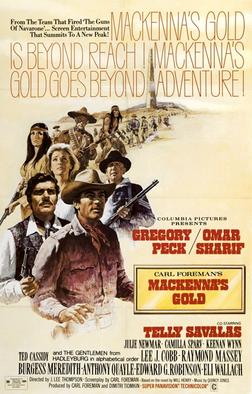
Mackenna's Gold

Oh, cable, how I love you. I basically have two channels on if I'm watching TV, either MLB Network or Encore Westerns. A whole channel devoted to western TV shows and movies?!? Aaahhh my head just exploded! It gives me a chance to revisit a whole bunch of movies I haven't seen in years, like 1969's Mackenna's Gold, a big-budget, all-star extravaganza that I remember liking (I think) on my first viewing. Does it hold up?

A marshal for the western town of Hadleyburg, Mackenna (Gregory Peck) is out on the trail when he's ambushed by an old Apache man who dies after a quick shootout. Before he dies, the Apache gives Mackenna a map to a famous, supposedly lost, canyon of gold ('Canon del Oro') that treasure hunters have long sought. Mackenna throws the map in the fire but not before noticing a couple landmarks on it. He's soon cornered by a Mexican bandit, Colorado (Omar Sharif), and his gang who similarly are looking for the canyon of gold. They're not alone. The desert seems full of treasure hunters and gold-hopefuls desperately searching for the gold. Discovering that Mackenna may hold the key to finding the canyon, he's taken along as Colorado's unwilling prisoner. The supposed location is days away across the vast desert with Mackenna, Colorado and his men forced to deal with a do-good posse out of Hadleyburg, an intervening cavalry troop and an Apache war party. How far will the prospect of gold drive all these folks?

I'm a sucker for westerns -- good and bad -- but this one is bad and just not that enjoyable. Talk about a movie where the ingredients don't come together (at all), and you've got this movie. The talent on-hand is unquestionable from director J. Lee Thompson, stars Gregory Peck and Omar Sharif leading a ridiculously deep cast, a cool, potential-filled story and a drop-dead look to it all...it should have been so much better. Or I guess I'd settle for just 'good' too. The formula seems to go after a western Guns of Navarone meets Treasure of the Sierra Madre combination, but it never jells into anything remotely coherent or especially enjoyable. That's tough to say because a cast this good should make a movie pretty decent on its own but alas, it wasn't meant to be this time! If you're looking for a Peck-Thompson-Carl Foreman pairing, stick with 'Navarone.'

Kudos to Encore Westerns. Watching the movie for the second time but first time since 2009, I watched it in widescreen, as it was meant to be. Thompson filmed in Super Panavision 70, a filming technique that fills the screen to epic proportions, almost like a panoramic picture. Shooting on-location in Monument Valley, Glen Canyon and Canyon de Chelly in Arizona adds a great visual appeal to the movie. Shots of riders galloping across these expanses are excellent to watch, a sight to behold, and unfortunately, one of the few genuine positives to take away from a western that's too long at 128 minutes. When a movie's looks are the best thing going...that's never a good thing.

Poor Gregory Peck, he looks like he's as bored as all get-out and doesn't quite know what to do. One of my all-time favorite actors, he's undone by all the shenanigans going on around him. Getting to play straight man to a murdering bandit, a gold-for-eyes posse, a bloodthirsty Apache war party, a murdering cavalry sergeant (an underused Telly Savalas), and all sorts of ancient legends coming to life is never a good thing. As reliable as anyone who's ever graced the screen, Peck is given little more to do than look out for Camilla Sparv's damsel in distress while navigating a love triangle with Julie Newmar's Apache warrior and Sparv. Yeah, you read that right. Catwoman plays an Apache warrior and looks great doing it! She even gets an odd nude swimming scene where she tries to kill both Peck and Sparv. So there's that!

So much of the rest of the cast is simply miscast. I like Sharif in just about any film he's ever done, but he's an odd choice to play our Mexican bandit, Colorado. His gang includes Keenan Wynn as a Mexican bandit named Sanchez, with Ted Cassidy (Lurch from The Addams Family), Rudy Diaz and Robert Phillips as Apache warriors. All spot-on casting! Brace for this list of appearances that amount to little more than cameos, members of a "posse" out of Hadleyburg that's looking for gold. The group includes Eli Wallach, Anthony Quayle, Lee J. Cobb, Burgess Meredith, Raymond Massey and Edward G. Robinson!!! Look at that Hollywood royalty! Unfortunately, they're introduced, given nothing to do and there basically because of their name recognition. So....yeah....there's that! Quite the cast, huh? I just wish they were given more to do. Maybe that character development was cut from the rumored 3-hour version of the film. Yeah, that's it I'm sure.
  
Just too many moving pieces that never get going in the same direction. There's virtually no story, just some character introductions and then they're off into the desert. The only detour are various ways to kill off characters in waves. Then, there's the beautiful location shooting, with a slight problem. Countless times, one after another, we see the location shots and then a quick cut to our actors in front of a rear projection shot. Nothing takes you out of the story's momentum like Peck, Sharif and Co. riding a "horse" as they tear across the desert. Throw in some odd, out of place narration (it's not Victor Jory's fault!), some painful theme ballads, and generally odd cutting and editing that is more and more jarring with each passing scene.

There's a meanness to the story that's hard to account for. Characters are introduced for the sake of dispatching them in unceremonious fashion, but the general tone of the movie itself isn't that dark. It feels like they're going for that "Greed will make you do horrible things" tone, but it's too light, fluffy and goofy to pull it off. There's some potential obviously with the all-star cast, some equally impressive camera angles and shots, and the location shooting, but there's just too much negative going on to ignore it. A stinker.

Mackenna's Gold (1969): **/****

Sunday, November 29, 2015

The War Wagon

I love westerns. I love heist movies. They're two of my favorite genres. So what happens when you combine the two? And throw in two of my all-time favorite actors? Oh, no.....it's a movie nerd alert!!! With just an air of fun hanging over the whole story and production, it's hard not to get on-board and truly enjoy the 1967 western The War Wagon.

Fresh out of jail after serving a three-year sentence for a crime he didn't commit, former rancher Taw Jackson (John Wayne) heads home with revenge on his mind. Framed by a local businessman and landowner, Pierce (Bruce Cabot), Jackson wants to exact revenge where it hurts most...Pierce's gold mine. The attempt would seem suicidal though, Pierce paying for an armor-plated wagon outfitted with a Gatling gun and guarded by 33 outriders that transports the gold from the mine to the train station that would prove to be a major deterrent to any would-be robbers. Jackson isn't about to give up though, but he does need some help, including an unlikely partnership with a hired gun named Lomax (Kirk Douglas) with whom he's had a deadly rivalry in the past and has the bullet wounds to prove it. With a small team of fellow crooks, Taw puts his plan into action to rob the armor-plated wagon, the War Wagon. But just how in hell is he going to pull this off successfully without getting shot full of holes?

This is a movie that's just hard not to like. It was a staple on AMC and TNT growing up so I saw it many times, and it's one I always look forward to revisiting every so often. This last time, well, it had been quite awhile. From tough guy director (and a Wayne favorite) Burt Kennedy, 'War' is one of those perfectly straightforward westerns with no pretensions about the changing times or a revisionist view. It's F-U-N, plain and simple, mixing so effortlessly that western setting with a heist story. Put a crew together, give them a crazy, no way in hell this works mission, and let things fall where they may. Not the best, but one of the most purely entertaining westerns to come out of the decade.

So John Wayne and...Kirk Douglas. Please and THANK YOU. The duo had worked previously together in 1965's In Harm's Way and 1966's Cast a Giant Shadow, but this is the best pairing because it just lets these two pros go to work. Yeah, the heist is fun throughout, but you watch this movie for any and all scenes between Wayne and Douglas. The dialogue crackles between them, a rivalry that treads that fine line between joking and deadly serious. There's some genuine menace in the chemistry, but you just sit back and watch things develop. The best part? They're clearly having a blast. An underrated comedic actor to begin with, Wayne gets to show off his funny chops with some great line deliveries, and Douglas is the perfect foil as Lomax, a hired gun who's a bit of a dandy but takes his job supremely seriously, especially with so much potential money on the line. You couldn't ask for a better star duo to lead the adventure film.

Any good heist needs a good heist team so who to look out for? Certainly a motley crew of crooks, including the very white Howard Keel as Levi Walking Bear, Keenan Wynn as Wes, an employee of Pierce's, and Robert Walker Jr. as Billy, an explosives expert with a drinking problem. A Wayne friend and favorite, Cabot looks to be having a ball as Pierce, the sneering, menacing crook with a whole bunch of power. Also cool to see background player Don Collier get a more visible part as Pierce's right-hand man. Also look for Joanna BarnesValora NolandBruce DernChuck Roberson (Wayne's stunt double), Emilio Fernandez, and Gene Evans rounding out the cast.

'Wagon' has a lot of little things going for it that combined make for a significantly better flick. Durango, Mexico was one of Wayne's favorite filming locations including Sons of Katie Elder, The Train Robbers, Chisum and here with 'Wagon.' The Mexican mountains and wilderness provide an intimidating, authentic backdrop to the story. Dimitri Tiomkin's score is a gem, big and booming, perfect for an adventure story and one that instantly screams 'Oh, yeah, that's Tiomkin music.' Lastly, an oh so perfectly bad theme song that you can listen to HERE. It's awful, but my goodness, is it ever catchy. I defy you to watch the movie and not to be humming along to the theme days later.

But, ah yes, the heist. There's hints along the way of what Taw, Lomax and Co. are up to, but nothing too specific. So like the best heist movies, as the caper develops, we're in the dark to the exact details, all of that adding a sense of mystery to the proceedings. Nothing too crazy here other than a matter of split-second timing, some dumb luck, and one rather prominent plot hole if you ask me. But there's no point in ripping it to pieces too hard. This is a movie that's meant to be a hell of a lot of fun, and it succeeds throughout on that premise. Wayne and Douglas are pitch perfect together and look to be having a ball.

Sit back, enjoy and let that fun take over from there.

The War Wagon (1967): ***/****
Rewrite of February 2009 review

Thursday, November 27, 2014

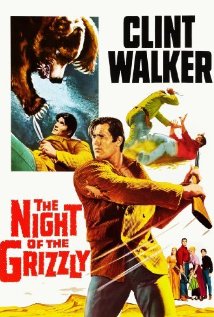
The Night of the Grizzly

So that 1975 movie about a great white shark terrorizing a summer vacation locale? What's it called? Jaws I think? Yeah, it's halfway decent. It spawned far too many ripoffs, knockoffs and lousy sequels, many of which I've reviewed here. Here's a twist for you....what about a movie that inspired Jaws? It comes from a genre you might not have thought of, the western. Here's 1966's The Night of the Grizzly.

Having worked for years as a marshal, Big Jim Cole (Clint Walker) has decided to turn in his badge. He has acquired a ranch in Wyoming from a family member and with his wife, Angie (Martha Hyer), three kids, and his former deputy, Sam Potts (Don Haggerty), is uprooting and moving for a new life. The nearby town is welcoming -- for the most part -- and the land is good farming land. Cole even has plans to raise some cattle, but he's got two problems to deal with. One, the rich landowner and fellow rancher in town, Jed Curry (Keenan Wynn), desperately wants his land and is going to stop at nothing to get that land. Two, a grizzly lives in the mountains that has terrorized the area for years. Dubbed Satan by the townspeople, the bear kills randomly, killing man and livestock alike and not just for food. If he wants his family to stay on their new land, Cole has his work cut out for him.

So did you notice how I didn't mention that whole man-killing grizzly until late in the plot description? Yeah, that wasn't an accident or oversight on my part. For a movie named 'Night of the Grizzly,' director Joseph Pevney sure doesn't seem too interested in doing much with the whole grizzly bear plot. It's just an odd movie in the end, one that can't pick a rhythm and stick with it. It is equal parts family drama that would seem more comfortable on The Waltons, odd, out of place humor, some typical western land/rancher drama, and oh yeah, that killer bear who everyone is terrified of. Dun-dun-duh!!! If you just commit to the bear story and go with it, maybe we've got something, but it plays out like there wasn't much of a script so things got fleshed out with all those other odds and ends.

The most disappointing thing about 'Grizzly' is that the cast alone has plenty of potential. Whether it was on TV or in feature films, Walker was an underrated western star. For starters, he looks like a wild west sort of guy you wouldn't want to tangle with in a fight. The former marshal turned rancher is weighed down by the family drama, Walker left to deal with his worrying wife and a gaggle of troublesome kids. Not given much to do but be the cliched bad guy, Keenan Wynn is slimy and sinister as Jed Curry, ready to do whatever it takes. Jack Elam similarly isn't given much to do other than hang out with Cole's precocious daughter, Gypsy (Victoria Paige Meyerink), in a rare change of pace good guy part. Showing up at the hour-mark in full-on intimidation mode, Leo Gordon is a convict and crook from Cole's past brought in to cause some trouble.

But seriously...it's an unstoppable killer grizzly bear!!! Focus on the bear!!! An attempt here and there at a mood-lightening laugh is one thing. But repeatedly? And at the expense of the story? Talk about a potential killer. One extended bit has little Gypsy chasing after a skunk she thinks is a cat. Oh, no! A smelly little kid who has to eat outside! Oh, and there's Nancy Kulp (of The Beverly Hillbillies) as a general store owner who's got a crush on the drunken Potts. There's also a mountain family that moonshines where we even get to see a drunken rooster stagger around the barnyard. And also, Curry's kids are stupid and awkward. They trick Potts into giving them money for whiskey...but it's a dry county. The acting is anywhere from rough to awkward to watch, and it's hard to tell whether it was because of the actors or the script. Maybe both.

The biggest comparison to Jaws comes in the finale. Much of the movie has the bear shown via a stomping paw or his fuzzy head as he stands up. When we do see the bear, it doesn't look particularly big. In the end, Cole and Gordon's baddie end up chasing the bear around a mountain. Again, lots of potential but it never adds up to anything too interesting. Steer clear of this stinker.

The Night of the Grizzly (1966): */****

Sunday, September 21, 2014

Viva Max

From the time I watched Disney's Davy Crockett episodes, I was hooked to the story of the battle of the Alamo. I read all I could about one of Texas history's most infamous events. I watched every movie I could from John Wayne's The Alamo to 1955's The Last Command and everything in between. But 20-some years, one movie managed to steer clear of my grasp...until now that is. It took me years, but I finally tracked down 1969's Viva Max.

Along the U.S./Mexico border, a company of Mexican infantry from the Rio Nuevo garrison crosses the Rio Grande river, throwing the border patrol for a loop. Their commander, Lt. General Maximilian Rodrigues de Santos (Peter Ustinov), has told his men very little about what they're actually doing, instead keeping his plans close to his vest. What exactly is he up to? In 1960s Texas over 130 years since the actual battle, General Max intends to retake the Alamo mission, now an instantly recognizable landmark sought out by millions of tourists each year. What are his motives? Well, that's for Max to reveal at his choosing. Before Max and his small army are done, the San Antonio police (including Sheriff Harry Morgan), the National Guard (including General Jonathan Winters) and the Army (including General Keenan Wynn) are all going to get involved. How can they solve this ridiculous situation peaceably?

I visited San Antonio for the first time with my Dad when I was 10 years old where I bought one of my favorite books, Frank Thompson's Alamo Movies. I've done my best to track down and catch up with all of the listed movies, but this 1969 flick managed to avoid me. The catch? This movie from director Jerry Paris is a comedy, a screwball, physical comedy at that. Yes, you read it right. A movie about a horrific, bloody massacre is a comedy. A comedy!!! That was my biggest worry heading into a flick I've long wanted to see. It wasn't that it was going to be in poor taste. I assumed on that much. But how badly in poor taste was it going to be? I hold the Alamo story above almost all else and even have a distant relative/ancestor who fought and died there in 1836. Heroic efforts on both sides ending in costly casualties. Should you even remotely touch that in the comedy department?

Just know going in that you probably will be offended at some point during this film because of that subject matter. Now all that said, I enjoyed this 1969 comedy a whole lot. Yeah, it is dumb, even stupid at times. Some efforts at physical, goofy humor fall short but as a whole? It's funny as the more subtle gags and lines work because of a talented cast stepping to the plate. This ain't rocket science but 'Max' is funny. As an Alamo buff, one thing stands out above all else. San Antonio and the Alamo allowed 'Max' to film on the mission grounds in downtown San Antonio. To film A LOT. All the footage works as a behind the scenes look at the Alamo a lot. What's left of the mission is almost miniscule compared to what the Alamo looked like in 1836 (check it out HERE), but it works as a backdrop where a Hollywood backlot wouldn't have. Issues with the humor/story aside, the visual works in effortless fashion.

Playing our title character, Ustinov throws himself into the part as Max, a Mexican general who inspires....well, no faith in his men, and that becomes his motivation. I won't give it away completely, but his motives for retaking the Alamo are far from historical reasons, revenge reasons or basically anything you'd think. His motives? Far more personal. Ustinov -- heavily tanned -- has a lot of fun with the part with his Max, a generally quiet guy who's a bit of a dandy, a bit of a doof and pretty oblivious to just about everything around him. He gets some especially funny scenes with a beautiful young woman (Pamela Tiffin) who has an odd request of the Mexican general as she's captured inside the Alamo. His right-hand man, Sergeant Valdez (scene-stealing John Astin), tries to keep his men in line and his general at the front...something that proves harder than you'd think. A very funny performance for Ustinov.

The whole cast doesn't disappoint. We're not talking subtle, smart laughs, but usually big goofy laughs and moments. Morgan, Winters and Wynn split time in the clueless command spots, Winters especially getting some laughs as the politically correct, generally inept National Guard general. I loved Astin's part, the underplayed performance as Valdez, Max's loyal, capable sergeant. Also look for Alice Ghostley as a paranoid prisoner convinced Max and his men are Chinese Communists, Kenneth Mars as her ultra-patriotic nephew with a para-military group, and Ann Morgan Guilbert (Paris' co-star and on-screen wife in The Dick Van Dyke Show) and Bill McCutcheon as a married couple who Max's infantry comes across. Also look for Gino Conforti and Larry Hankin as two of the more visible/vocal troops in Max's makeshift army.

I probably shouldn't have liked this movie, but I did. It cracked me up in all its badness. An early on-screen message says 'No one mentioned in this movie is real except for Davy Crockett, Jim Bowie, William Travis, John Wayne and Richard Widmark.' John Wayne's Alamo becomes a running gag at times, him and Widmark's name becoming passwords and countersigns as the "battle" develops. It's those smaller, quieter and smarter moments that work, especially Max's version of Travis' line in the sand moment. Still, I liked it throughout, a mindless but very entertaining way to spend 90-plus minutes. Worth tracking down if you can.

Viva Max (1969): ***/****

Thursday, June 13, 2013

Angels in the Outfield (1951)

Growing up, you appreciate some movies more than you probably should because....well, because you're a kid. When you're a kid, everything's cool. One of my favorite movies as a youngster was 1994's Angels in the Outfield. Oh, by the way, I still love that movie. It took years for me to discover that the 1994 Disney movie is actually a remake. Who knew? Here's the original, 1951's Angels in the Outfield.

It's midseason, and the Pittsburgh Pirates and foul-mouthed manager Guffy McGovern (Paul Douglas) is slowly losing his mind. Fans are turning on him, his players hate him and his "managerial tactics," and the press corps is ready to lynch him. One day, a home and garden-esque reporter, Jennifer Paige (Janet Leigh) writes a scathing column of his antics, finally pushing Guffy to the brink. Following one game, Guffy hears an angel address him, telling him to clean up his act and stop berating his team, fans and umpires alike. As long as he does that, angels will help out his team. Guffy obviously thinks it's a big prank....until the hapless Pirates start winning a whole lot of games. Could something heavenly actually be helping the Pirates? The gruff manager keeps his secret just that, secret, until one day a little girl, Bridget (Donna Corcoran), comes out to a game and actually sees the angels on the field. Is Guffy's secret blown for good?

I love sports so I'll watch basically anything even remotely sports-related. But of all the sports, baseball will always be my favorite. The sport translates seamlessly to the big screen, and this entry from director Clarence Brown is an underrated one. So story and characters aside, I think any true baseball fan will get a kick out of this one. It was filmed on location at real-life stadiums, especially Forbes Field in Pittsburgh but also look for Old Comiskey Park in Chicago and a Wrigley Field lookalike in L.A. That throwback, nostalgic feel of a baseball era long since past is evident from the opening credits -- a sample of Take Me Out to the Ball Game -- and never really lets up. There's an appreciation for baseball here that any fan should get a kick out of.

If I didn't know any better, I would have said this was a flick directed by the master of the cornball sap, Frank Capra. I was wrong, but the tone isn't far removed from typical Capra sweetness. There's always that potential with a really happy, sweet story that it goes too far, but that's not the case here. That's the word that comes to mind though; sweet. It's a good story without a mean bone in its body. We never actually see the angels out on the field or in the dugout, only that Corcoran's Bridget sees them clearly on several occasions. Is it a surprise that Douglas' gruff Guffy becomes a sweet, lovable guy? Nah, not at all. At different points I found myself questioning the movie. If angels are helping the Pirates then does that mean they're rooting against other teams? I think it's a valid question, but quickly put it out of my mind. This isn't a film interested in that at all. It's a good, old-fashioned, entertaining story.

Without featuring much in the way of star power, 'Angels' benefits from a lesser known cast. Douglas is an underrated actor, hamming it up a bit here as Guffy but never pushing too far. Leigh is mostly around as a pretty face -- no disrespect intended -- as the non-sports reporter trying to figure sports out. I thought the best part was nine-year old Corcoran as Bridget, a young orphan who spots the angels and bonds quickly with Guffy and Jennifer over the course of the season. It sounds sappy (sorry, I'll stop using that), but I thought it was a cool touch that the angels only appear to a child (an innocent), and not too cynical adults. Also look for Keenan Wynn as the angry radio man with a hatred for Guffy, Spring Byington and Ellen Corby as the nuns at the orphanage, and Bruce Bennett as Saul, a veteran pitcher trying to make it through one last season. Bing Crosby, Yankees legend Joe DiMaggio and baseball great Ty Cobb also make some cool cameos as themselves.

There are things here that I could easily criticize if I was in a foul mood, but I'm not going to. Guffy talks to an angel (voiced by James Whitmore) out on a dark baseball field with the game already in the books. We hear about 'the Heavenly Choir,' the team of angels that are helping the Pirates with some "hunches" in-game. If this sounds like a cop-out, so be it. You can't overthink/overanalyze this movie. Just enjoy it. It's that perfect mix of sappy, cornball charm with some baseball and old-fashioned Americana in it. Appreciate it and sit back.

Angels in the Outfield (1951): *** 1/2 /****

Monday, July 2, 2012

Don't Go Near the Water

This is going to sound a little odd when you consider that Glenn Ford was in over 80 movies. I've always been a fan of his, but that was without actually having seen many of his movies. As I check some more off his list, I came to a somewhat surprising revelation. I'm liking him as an actor, movie star and presence more and more. Add 1957's Don't Go Near the Water to the list. And no, this is not a Jaws prequel.

On the small South Pacific island of Tulura, the fighting in WWII seems a long way off. At a small navy base, the Navy Public Relations department is run by the stupidly gung-ho and generally clueless Lt. Commander Nash (Fred Clark), an officer who's never had a sea command, much less been on the water at all. Among his motley crew of officers who would rather be anywhere else is Lt. Max Siegel (Ford), a Harvard grad who does his best to keep his commander in check and his fellow officers from losing their minds. But even out at this remote post in the South Pacific, all sorts of loony characters and odd situations come up, all of them requiring Siegel to work his magic in one way or another.

For all the hard-hitting war movies with a message that were released following WWII, another sub-genre popped up, that of the service comedy. These were stories that focused on the day-to-day life of soldiers across the different branches, leaving the fighting and killing to the darker, more realistic stories. Saying that these movies and TV shows (McHale's Navy, Sergeant Bilko) minimized the war isn't right, and saying a "war comedy" doesn't sound correct at all, but these are fun, enjoyable movies. You look past them as anything profound, checking that sentiment at the door. Sit back and enjoy them, especially this 1957 service comedy from director Charles Walters.

Based off a 1956 novel, I don't think it's fair to say 'Water' has much of a plot. That's not a bad thing though, the easy-going story flowing nicely from vignette to vignette. None linger too long or overstay their welcome, staying around long enough to make an impression and then moving on. Once you figure out the rhythm, hopefully you enjoy the movie as much as I did. Ford's Lt. Siegel is the unifying link among all the subplots, some more interesting than others. The ones that work? One has Ensign Garrett (Earl Holliman) madly in love with a nurse, Lt. Tomlen (Anne Francis), but they can't as much as talk because she's an officer, Siegel intervening as needed. Another has Siegel teaming with Lt. Tyson (Russ Tamblyn) to blackmail a blustering war correspondent (Keenan Wynn, who better?) rather than deal with his daily blowhard complaints.

Maybe because he was steady throughout his career more than a huge breakout star, but Ford never received huge acclaim for his roles. I mostly knew him from his tough guys roles (3:10 to Yuma, The Big Heat among others), but where I've become a fan is in his parts that show off his comedic ability. He usually lets those around him show off while he plays the straight man, but he is sublimely perfect at it, especially here. One vignette has him giving the My Fair Lady treatment to a foul-mouthed soldier (Mickey Shaughnessy), and his facial expressions and physical reactions are worth the price of admission alone. More than just an action star or a comedic presence, he also gets the girl, a Tuluran beauty and schoolteacher named Melora (Gia Scala). Not a great part, but a memorable one, and another positive from the Ford filmography.

With Ford leading the way, the ensemble around him fills in all the holes as needed. What holds it all together is that this group -- no huge names, just recognizable, very capable actors/actresses -- has a ton of chemistry together. I thought Holliman and Tamblyn especially stood out as two young sailors who look to Siegel for help. Wynn is at his blustery best, a condescending know-it-all who plays everyone around him as needed. As the clueless Lt. Commander, Clark is a more obvious funny from his office headquarters. Also look for Eva Gabor as Deborah Aldrich, a war correspondent who causes a stir just by arriving with a low-cut shirt, and Jeff Richards as Lt. Pendleton, the ladies man on the island who Holliman's Garrett has to fight for Francis' Alice. All solid parts that alone don't do much, but together end up carrying the movie.

Not too much analysis needed here. Good, old-fashioned and entertaining WWII service comedy. Well worth seeking out.

Don't Go Near the Water <---TCM trailer (1957): ***/****

Friday, February 17, 2012

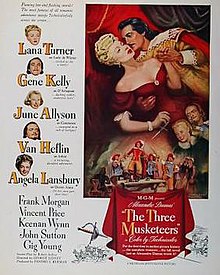
The Three Musketeers (1948)

First appearing as a serial in 1844 from French author Alexandre Dumas, The Three Musketeers have become some of literature's most popular, most famous and most well-liked characters in the history of the written word. That popularity has transitioned to film in countless efforts (ok, you can count them, but there's a lot, HERE), including 1948's The Three Musketeers.

Leaving his home and family behind, a young Frenchman named D'Artagnan (Gene Kelly) heads for Paris with hopes and dreams of joining the Musketeers of the Guard, the men who protect the King. He almost immediately meets three musketeers, Athos (Van Heflin), Porthos (Gig Young), and Aramis (Robert Coote), getting on their bad side and agreeing to duel to the death with each. Their problems are thrown by the wayside though as they see they must work together to save France from the treacherous prime minister, Richelieu (Vincent Price), who wants to start a war with rival England. With spies and traitors all around, the Musketeers -- plus D'Artagnan -- must fight for each other, for France, and for love.

Above all else, the cast here is truly impressive, a long list of recognizable names. That doesn't mean they're necessarily great performances, but well, the names are there! Not a great start, but Kelly is miscast as young D'Artagnan. He's just not believable other than his physical ability. Heflin is the only one of the three Musketeers to make any lasting impression, Young and Coote wasting away in the background. Price sneers and connives as Richelieu as only he can, but the best villain is the stunningly beautiful Lana Turner as Lady de Winter, Richelieu's most trusted agent. There's also parts for Angela Lansbury as the French queen, Anne, June Allyson as Constance, the Queen's maid and D'Artagnan's true love, Keenan Wynn as Planchet, D'Artagnan's servant, John Sutton as the Duke of Buckingham and Frank Morgan as King Louis.

What plagues this movie is something that affected so many movies in the 1940s and 1950s. It is interested in the spectacle of what's going on on the screen, and the truly impressive scale. It is intended to 'WOW!' the audience, and it does. The Technicolor technique has the action jumping off the screen, and visually it is an amazing movie to watch. The sets, the costumes, the detail. It's all there, but it's a shallow movie. Even knowing who the Musketeers were and the outline of the story, I was bored to tears. It took multiple viewings and a week-long break to even finish this one. There's no heart, no real interest in the characters. Rather than developing those bonds and the characters, we get countless fight scenes, lots of Musketeer carousing that goes nowhere.

Like anything, something good is best in small doses. The fight scenes here are a prime example. An early introduction has D'Artagnan fighting at first against and then with his new Musketeer buddies. The sword-fighting is a sight to behold, and then it keeps going....and going....and going. Kelly was a dancer first and foremost, and a talent with an incredible physical ability, but enough is enough. He jumps, he twirls, he flips, oh, and then he kills some guys. We get it, Mr. Kelly, you're extremely talented. Almost to a fault, the action -- whether it be hand-to-hand or with swords and pistols -- starts off well but doesn't know when to stop. It gets tedious, and with impressive sequences like this, that's never a good thing. Director George Sidney had to know when to pull the plug. Instead, he tries to wow the audience and ends up overdoing it. 

Now even with the thinly drawn characters and tedious action, this movie certainly has its pluses. When the story does get serious toward the end, dropping all the comedic carousing and shenanigans, wouldn't you know? The story significantly improves. As Lady de Winter, Turner especially shines, a snake waiting in the shadows to strike. There is a darkness to it as characters are killed, betrayals are unleashed, and allegiances tested. With a movie that runs at over two hours at 125 minutes, it just takes too long to get there. A darker, more straightforward Musketeers movie with this cast could have been a classic, but this 1948 version struggles to find a consistent tone. The last half hour is that good, but the build-up unfortunately is not. Still, there is too much positive going on here to not give it an at least partially positive review. Just know it's a mixed bag.

The Three Musketeers <---TCM trailer/clips (1948): ** 1/2 /****

Thursday, October 6, 2011

All the Brothers Were Valiant

I got off to a rocky start with 1953's All the Brothers Were Valiant. The story of two brothers on the high seas in the South Pacific in the 1850s seemed like so many other generic high seas adventures that flooded the market in the 1940s and 1950s. It seemed like all the samples from other movies were taken for this one down to the stock characters and idiotic decision-making. Thankfully somewhere along the way, director Richard Thorpe pulls his head out of his butt and decides to make a halfway-decent movie.

After a three year voyage, Joel Thorpe (Robert Taylor) returns to 1848 New Bedford to find out that his brother, Mark, has disappeared from his own voyage somewhere in the South Pacific. Joel is given command of his missing brother's ship -- a whaler -- and prepares for another long voyage, but not before marrying Priscilla Holt (Ann Blyth), the former sweetheart of Mark's who Joel always had a crush on. Priscilla joins Joel as they head for the South Pacific where they manage to find Mark (Stewart Granger), ready with an explanation for his missing status. Mark instantly causes problems, both with Priscilla who he wants back and almost inciting a mutiny on Joel's ship, enticing the crew with promises of pearls.

Okay, every so often I feel the need to say this. I realize it is the rare movie that is perfect and/or flawless. At least 99.99 percent of movies have something wrong with them. It's just hoping that the positives -- however many there are -- outweigh the negatives. That's why I'll be able to give 'Valiant' a positive review, a recommendation for any viewers who are curious. As bad as some parts are, as cliched as the characters and story can be, the end result is positive. I enjoyed the positives more than I hated the negatives, and that's all I'm looking for in a new movie on a first viewing.

Don't get me wrong. That first 30 minutes is particularly brutal. All the high seas cliches are there; the happy crew singing as they go about their work, the long shots of the majestic ship and its towering sails moving across the ocean, the firm but fair captain pushing his crew. It's bad, real bad. Making it worse is that Taylor and Blyth have no chemistry together. I've come around around Taylor who I wasn't always a fan of. This is not a strong part for him, a vanilla "hero" with little charisma or personality. Blythy's Priscilla is around because the story requires some tension. What woman in her right mind would board a ship with her husband with a three-year voyage ahead of them in the 1840s? Somehow, some way, she keeps her hair immaculate and her dresses pristine. Good for her.

The saving grace is Granger's arrival at about the 35-minute mark. He's the necessary bad boy hero, the good guy who has some questionable morals and/or motives. His backstory -- a flashback that runs around 10-15 minutes -- is the high point of the story, probably worthy of an entire movie on its own. Ravaged with fever in the South Pacific, he is cared for by a beautiful native girl (Betta St. John). Once healthy again, Mark joins with a marauding group of adventurers (including James Whitmore and Kurt Kasznar) searching for pearls on an isolated island with a warring tribe as its inhabitants. There is some tension, some excitement, some betrayals and backstabbing and greed in this too-short segment, starting the movie back on its more interesting path.

Thanks to Granger's introduction, the movie does get more interesting as things near the halfway point. There are still some weird coincidences and stupid decisions made, but the possible mutiny livens things up. Mutinies have a way of doing that I suppose. The drama that comes out of this second half illustrates what's wrong with the movie. It boils down to this. Granger is interesting. Taylor isn't. Granger's Mark plays everyone against each other for his own benefit, realizing his mistake in the closing minutes. It is a 1950s movie so his fate is never really in question. Taylor and his monotone voice and delivery keep us on Granger's side unfortunately so we're basically rooting for the "bad guy" of the two brothers.

Sappy love triangle and boring performances from Taylor and Blyth, this was a good movie. Granted, those are big strikes against any movie, but what are you going to do? Blyth bounces back and forth between Joel and Mark every other scene, and the resolution is too perfect to believe. I still liked the movie though in spite of basically everything in my head telling me not to like it. Among the mutinous crew, look for Keenan Wynn in Spanish-mode as Silva, the treacherous leader of the lowly crew, Michael Pate, Leo Gordon, Peter Whitney, and John Lupton. So overall, this movie barely (and it was close) gets a slightly positive recommendation. A classic it is not with some epic flaws, but I did enjoy it.

All the Brothers Were Valiant <---trailer (1953): ** 1/2 /****

Thursday, July 28, 2011

Desperate Search

Locked away in the vaults for years, 1953's Island in the Sky is a great example of a movie focusing on a bid for survival and those left behind trying to find said survivors before time runs out.  It's tense, it's emotional, and you're rooting for the search and rescue effort to work. This is by no means the first movie to deal with a similar story, but it is one of the best ones. Just a year earlier, 1952's Desperate Search did the same thing, albeit in a much worse movie. We're talking real bad here.

Vince Heldon (Howard Keel) is a divorced father of two children, Don (Lee Aaker) and Janet (Linda Lowell), who lost the custody battle with his ex-wife, Nora (Patricia Medina), and now only gets to see his kids six weeks out of the year. Vince has remarried, his wife, Julie (Jane Greer), bonding immediately with the kids. At the end of their six week visit, they put the kids on a plane back home only to hear that the plane crashed somewhere in the Canadian wilderness. Vince, a pilot, undertakes the rescue mission with friend and co-pilot, Brandy (Keenan Wynn) to find the crash site, hoping to find his kids if they survived. The search radius is immense though, and the search is made more difficult when Nora arrives on-site, wanting to take over. Out in the wilderness, Don and Janet struggle for survival, coping with dwindling supplies and a marauding mountain lion.

There is no way this movie should have been as bad as it actually is, but somehow and some way, it ends up being truly bad.  Let's get the few positives out of the way early because it won't take long. Keel and Greer are very good together with a genuine chemistry between them. Keel is most well-known for his singing ability in MGM musicals, but he shows he is more than capable of playing a leading role without actually singing. Above all else -- especially his past demons rooted in his marriage with Nora -- he puts everything on the line to find his kids. Greer too as the stepmother delivers a good performance, a woman in a tricky spot who does what's best for the family as opposed to what's best for her. That's about it in the positives though so let's get to the roasting!

With a movie that doesn't even reach a length of 75 minutes, one might think you're heading into an action-packed, tense, adrenaline-pumping movie that never slows down. Of course, director Joseph H. Lewis might not have gone along for that line of thinking. With just 73 minutes to work with, Lewis finds a way to make this movie boring, mostly with a fascination of planes flying around, taking off, landing, stuff like that. At least a half hour has to be long shots of planes flying over the Canadian wilderness, repeated over and over again. The scenery is gorgeous, but there's a limit as to how much you could and should show, especially in an already short movie.

Then there is the soap opera aspect of this MGM gem. The search and rescue mission for two little kids seems like a natural enough jumping off point for a highly dramatic story, doesn't it? I thought so. Even Keel's Vince and Greer's Julie seem to think so. The Nora character on the other hand....well, she forgot. Their failed marriage obviously tore both people apart, but Nora came out on top as Vince retreated into the bottle, losing custody of his kids. From the second she arrives to "help" the rescue mission, Nora seems more concerned about her ex-husband than the safety of her own two children.  Maybe this is just a poorly written character, but her motivations seem ridiculous. What mother in her right mind is more worried about putting their ex in their place than rescuing the children from certain death?

And now we come to the portion of the review where I feel bad for ripping a child actor, but as one performance here shows, it needs to be ripped. Just nine years old at the time, Lee Aaker is a strong point for the movie, the brave, resolute and protective brother who's going to do whatever he can to save his little sister. God bless little Linda Lowell, but she could be the most excruciatingly annoying child I've ever seen in a movie. It's not just that she whines, but how she whines; a high-pitched, gravelly, sobbing whine that goes right up your back. I tried to rationalize, thinking a little girl just survived a plane crash and is alone in the woods. But she screams, whines, and screams some more, never delivering a line that is not screaming. On the positive, Aaker at one point delivers a line so perfect it was almost as if the screenwriters knew his little sister would be that annoying. As she complains and whines, he mutters "Now why wasn't I born an only child." I'm glad I'm not the only one who felt this way.

Which brings us to the finale as Vince says 'Screw it all' to his ex-wife and the air official who's grounded him from flying.  That pesky mountain lion is back, chasing the two kiddies up a tree, Don holding off the advances with a tree branch. Vince arrives in time to save them, literally getting involved in a fight with the mountain lion, one of the most unintentionally hilarious scenes I've ever seen.  Oh, and the kids are rescued, Vince ends up with the family he deserved, and Nora is resigned to a life of being a complaining shrew when Wynn's Brandy puts her in her place. Bad movie that just keeps getting badder.

Desperate Search <--- TCM clips (1952): * 1/2 /****

Monday, June 13, 2011

Men of the Fighting Lady

Before his death in 1997, author James Michener's name was synonymous with epics in novel form.  Centennial, Texas, Alaska, Hawaii, Chesapeake, The Journey, all huge novels that fans have come to love. But before he turned to those epics, he wrote several smaller books set in the Korean War which haven't received the publicity of his other works but are nonetheless worthwhile. Similar to Michener's Bridges at Toko-Ri (and the film version), 1954's Men of the Fighting Lady is based off his novel The Forgotten Heroes of Korea.

This is an oddity when it comes to war movies for a lot of reasons.  For one, it is based during the Korean War, but other than a few shots taken at the Commies, this movie could as easily have been based in WWII.  Second, there's something missing, or maybe there's too much?  At just 79 minutes, this is one of the shortest war movies I can think of, right up there with the heavily hacked and edited Red Badge of Courage.  Reading about a true incident a key scene is based on, did director Andrew Marton fill out a story around that single incident? Or to the opposite, did he have a longer movie that was cut down to this running time? I'm looking for some sort of answer and can't find a thing. Maybe it's just an oddity among war flicks?

On board the U.S.S. Oriskany, author James Michener (Louis Calhern) comes to visit his old friend, Commander Dowling (Walter Pigeon), the medical officer on board, in hopes of landing a story. Dowling has one for him, a story concerning the fighter pilots in the still-new jets on board being used against the North Koreans and Chinese in the fighting on land. Michener sits back and listens to the story of the fighter squadron and its pilots, what drives them to do what they do, constantly putting themselves in needlessly dangerous situations when the job doesn't always call for it. Why do they do it? Do they get some sick, perverse enjoyment out of it?  Or are they just doing their duty as expected?  Looking for answers from his old friend, Michener is surprised by what he finds.

Now in 2011, a movie about fighter pilots and their newly developed jet planes seems old hat. Who hasn't seen Top Gun? And in a lot of cases, who hasn't seen Top Gun 20 or 30 times? Guilty.  But in 1954, this newly developed plane had to be impressive to audiences.  Even compared to the fighter planes from WWII, these new designs were remarkable.  Much of the story focuses on these pilots and their life aboard ship waiting for their missions.  Marton uses a ton of stock footage (bordering on too much) of these planes on those missions.  At first, it's cool. It's different, original, and the footage is impressive.  You can always have too much of a good thing though because soon enough, the footage of raids and air strikes gets tedious.

Clocking in at well under 90 minutes, the ensemble cast here in 'Fighting Lady' features some solid names, but unfortunately their efforts aren't always as developed as I'd like. There are a handful of really interesting characters but thanks to the limitations on time, some get the short end of the stick.  The squadron includes Frank Lovejoy as Lt. Commander Paul Grayson, the squadron leader who pushes his men to the limit, but he's always at the forefront of the charge, Keenan Wynn as Lt. Commander Ted Dodson, a veteran flier who begins to question Grayson's tactics, Van Johnson as Lt. Howie Thayer, the amiable pilot trapped in the middle of two warring factions in the squadron, and Dewey Martin as Ensign Schechter, the young pilot who begins to side with Dodson. Lovejoy's commander is especially pushed to the background in the last 45 minutes, odd considering how key his character was to the first half of the movie.

Two extended sequences bring this movie up from same old same old to a near-classic.  The first is based on a real-life incident that Michener wrote about. Returning from a patrol, Martin's Schechter and his plane are struck, the shrapnel blinding the pilot in the process.  Trying to guide the wounded pilot back to the carrier hundreds of miles out, Johnson's Thayer leaves formation and flies with Schechter, giving him step-by-step commands so that he can make it back. Van Johnson is one of my favorite actors, but this may be his most impressive part, and Martin is no slouch either.  Johnson's dialogue is natural and nervous, pulling anything from his sleeve that may help.  The tension builds and builds until its almost unbearable. By the time they reach the carrier, I was willing Martin and his crippled plane to land safely. This extended sequence goes on for most of a half hour, but it never lacks for energy, tension or entertainment. You can watch the whole thing HERE and continue into Parts 7 and 8.

The second sequence isn't based as much on playing to that weird adrenaline rush you get from terrifying situations. It's based in that most basic idea of being separated from your loved ones during holidays.  Soldiers, sailors, Marines, pilots, they all experience it.  It's Christmas in this story, and the Navy has arranged for many of the families of the crew to tape quick messages to their husbands, brothers, sons and boyfriends. The timing of course couldn't be worse. A pilot was killed in action just a day before so when his family's message is played for the crew, a silence hangs over the crowd. There's a moment where you realize what you're watching where it all hits home. This family has no idea their Dad and husband is dead. In terms of pure emotion, this scene hit me like a bag of rocks.

There's two ways to fix this movie (in my weird head anyways). I say this having liked it and planning to give it a positive review. It plays in two ways, an extended TV episode or a badly shortened feature length. In a shorter version, I think it could work nicely the same way a longer, more developed movie would.  More character development would be at the top of the list of possible improvements.  But as is, I really liked the movie, as much for the drama as the cast. Flawed but above average.

Men of the Fighting Lady <---trailer (1954): ***/**** 

Thursday, January 27, 2011

The Deep Six

Before he ever became a hero from World War I, Alvin C. York was a conscientious objector, opting on his draft application to put "Yes, don't want to fight" when asked if he wanted to claim an exemption. Of course, he would go on to become an American hero during WWI for his heroic actions when he and a small squad of soldiers captured over 130 German soldiers.  Think about his stance though.  What's so wrong with it? He didn't believe in killing because of his religious beliefs.  This wasn't a man trying to get out of fighting because of any political stance or objection the fighting.  He didn't want to kill his fellow man.

The idea of a conscientious objector is a sticky one because it has to be hard to read a man's true intentions.  Combat and war are a terrifying premise, and most would do anything possible to avoid it.  But regardless of personal or religious beliefs, some men slip through the cracks and make it into combat on a front-line position. That's 1958's The Deep Six, the story of a man raised as a Quaker who outgrew his childhood beliefs as he grew into an adult.  Now when his draft summons arrives in the mail, his beliefs come up again. If it came down to it, could he kill?

A successful advertising artist in Los Angeles, Alec Austen (Alan Ladd), is riding high.  His job pays well, he owns a beautiful seaside home, and he's in love and about to be engaged to his boss, beautiful Susan Cahill (Dianne Foster). When it seems everything is lining up into place, Alec relieves a draft summons for the U.S. Navy because he took an ROTC program in college and is still part of the Naval Reserves.  Raised as a Quaker, he wavers over what to do but ultimately reports for duty where he's assigned to the USS Poe, a destroyer in the Pacific captained by Commander Meredith (James Whitmore). As the Poe sails toward the Japanese and the conflict awaits, Alec begins to question if his childhood beliefs of pacifism are really gone.  When the time comes will he be able to give the order to fire, an order that will almost certainly end in the death of a human being?

Movies about war -- especially in the 1950s -- are a dime a dozen.  Doing the norm and making a flick about combat is fine by me, I love that type of story and own a fair share of those on DVD, but it's always refreshing to see a war story with a fresh spin.  This story is effective because it's hard not to feel for Ladd's Alec character.  It's only natural to be scared about how you'll respond in a situation like he is in regardless of your beliefs or ideologies.  Alec must not only worry about his own concerns, and how he'll respond, but if the choices he makes will end up taking the lives of his crew, the men he bunks and eats with on board the Poe.  Throw in that the crew (including nasty executive officer Keenan Wynn) finds out about his Quakerism and ostracizes him, and you've got a whole bucket of worms.

In a career that was cut short because of his personal demons, Ladd still made his mark on Hollywood.  He always had an easy-going way about him that played on his character's vulnerabilities and made him a likable leading man.  His Alec is quiet and unassuming, a good man pressed into a difficult choice.  He doesn't whine or moan about his predicament, doing his best to deal with it himself.  For the most part, Alec bonds well with his men because he has their best interest at heart.  In helping us to get to know his main character, director Rudolph Mate adds in the subplot with Alec's fiance Susan. Where some movies use this technique and it fails miserably, it works here, and I can't explain why the subplot didn't send me up the wall.  It just works, and it certainly makes Alec more human.  He's worried about marrying Susan because of the very real possibility that he may die at sea, sacrificing his feelings and needs/wants for his concerns on how that event that might not even happen would affect her.

Still, The Deep Six is a war movie, and the heart of the story is Alec and the USS Poe's involvement in the war in the Pacific against the Japanese.  The combat is held to a minimum with an occasional strike by a patrolling Japanese plane and saved for the end when Alec must lead a small patrol onto a Japanese-held island where five downed fliers await rescue.  The finale -- as was the case with much of the movie -- is limited by a smaller budget, but it makes up for any epic battle with the impact the fighting makes.  Filming much of his film at sea, Mate give viewers quite a look at life on a U.S. destroyer, providing some great footage with his cast (not stock footage) on board the ship.  The supporting cast includes JHP favorite Whitmore as the veteran commander, Wynn as the bloodthirsty XO, Efram Zimbalist Jr. as on-ship physician/doctor, Lt. Blanchard, and a scene-stealing William Bendix as Frenchy Shapiro, Alec's close friend and Chief officer.

Reminding me of the somewhat out of place humor in John Ford's Mister Roberts, too much time is spent with the crazy antics of the crew, including a pre-Rat Pack Joey Bishop, Perry Lopez, and voice of Alvin and the Chipmunks Ross Bagdasarian (among other cast members). The humor is unnecessary, and if it is an attempt to lighten the mood, it fails badly.  It's just not funny and takes away from the more interesting aspects of the story.  By no means enough to detract overall from the movie, but worth mentioning.

The Deep Six (1958): ***/****

Wednesday, June 23, 2010

The Internecine Project

If a movie has a gimmick, is that a bad thing?  3-D filming comes to mind, an actor/actress playing against type in a major way, a twist that no one sees coming, and many more I'm probably missing.  Sometimes that gimmick can hold an otherwise dull or average movie together and make it worth watching.  These gimmicks tend to gravitate toward thrillers, horror and action movies, but that's a general blanket statement.  They can be in any type of movie.  Generally forgotten since its release, 1974's The Internecine Project has a gimmick, and a good one at that.

This British production is interesting in that it presents a unique idea and executes it in one of the most ridiculously boring sounding sequences.  I won't spoil what it is yet, but does a man sitting in his office waiting for a phone to ring at a preordained time over the course of several hours sound interesting at all?  You wouldn't think so, but that's part of why 'Project' works so surprisingly well.  It's not groundbreaking or anything that new, but the murder mystery thriller keeps you guessing until the end when an appropriate twist ending is delivered.

About to receive a government advisor position after years of working in economic theory as a Harvard professor, Dr. Robert Elliott (James Coburn) is approached by a highly powerful and high ranking government official who also seems to have some ties in big business, E.J. Farnsworth (Keenan Wynn).  Elliott has a bit of a shadowy past during his years as an operative for the government, and these people would stand to take him down if he gains this position of power.  The only solution? Kill them.  But how can he do it without arising suspicion that he did it?  Elliott comes up with an ingenious plan that has these four people unknowingly killing each other.  The deadline is approaching though, and Elliott has little time to accomplish his task when an ex-girlfriend, a respected journalist (Lee Grant) shows up on his doorstep.

This is the type of story that keeps you guessing as to where exactly it is going through the first 30 minutes.  You know something's coming down the highway right at you, but what exactly?  When it is revealed, the simplicity of it is what makes it work.  Elliott needs these four dead and in a great handful of scenes goes to each of them (including Harry Andrews, Ian Hendry, Michael Jayston, and Christiane Kruger) explaining what they have to do to remain safe.  All of the murders will take place in one night in a 3-4 hour window with Elliott telling each of his dupes/victims to call him at a certain time and let the phone ring a specified amount of times.

And that's where the gimmicky scene of Coburn sitting in his office waiting for his private line to ring begins.  It's a scene that goes on almost 30 minutes as the four go about their business, sneaking into an apartment or office while another person is doing the same in their apartment.  All the while, Coburn's Elliott sits in his office with a checklist, crossing them off as the quartet calls him with updates.  The plan is simple but depends almost completely on timing so when the phone rings more or less than expected, Coburn of course gets nervous.  The scene is incredibly high on tension in a way I would have never thought possible.

This is the type of thriller though where you're fulling expecting a twist.  Sometimes the best twist can be not seeing it coming at all, but others just beg to reveal something or surprise the audience at the end.  'Project' from the get-go feels like a movie that is going to pull the carpet out from under you at the last possible second, and in the last five minutes it certainly does not disappoint.  I debated even making this comparison, but it reminded me a lot of 1972's The Mechanic.  Both endings caught me by surprise in their execution, but that last twist, that last surprise works beautifully here.

With a twisty story like this, the cast can tend to be replaceable whether it be the star or one of the supporting players.  I like the choice of Coburn in the lead because he always showed an ability to play the charming hero or the villainous bad guy.  As Elliott, he's a bit of an evil mastermind, but he's so smooth doing it you find yourself rooting for him -- or I did at least.  You need someone leading the way in a story similar to this, and Coburn does it well.  The movie is available on a good transfer on a recently released DVD if curious.

The Internecine Project <----trailer (1974): ** 1/2 /****

Friday, June 4, 2010

Code Two

Did you ever watch an episode of CHiPs and think 'Man, I wish they made a movie about these guys?' Yeah, me neither.  But if you did, 1953's Code Two might be just the movie for you except without Erik Estrada, way too tight biker pants, and police seducing women every chance they get.  Almost serving as a public service announcement about how cool it is to be a motorcycle cop, Code Two has its moments in a quick 69-minute running time.

Made with a relatively unknown cast and with a smallish budget, 'Code' benefits from some cool on-location shooting in Los Angeles and the surrounding area which gives a nice window into 1950s California.  Add on top of that some even cooler footage of vintage motorcycles whipping around the city, and you've basically got this movie with a ham-fisted storyline thrown in for good measure.  Let's face it, what's a motorcycle cop movie without some ridiculous crime to solve?

Heading into the police academy, three officers-to-be dream of one day being motorcycle cops.  First, there's Chuck O'Flair (Ralph Meeker), a cocky, fun-loving SOB who wants to prove he's the best.  Second, there is Harry Whenlon (Jeff Richards), the boring All-American guy devoid of all personality.  Last is Russ Hartley (Robert Horton), a husband looking to provide for his young family.  But if these three crazy kids want to be motorcycle cops, first they've got to get through Jumbo Culdane (Keenan Wynn), the tough as nails veteran instructor who will throw everything in the book at them so they're ready for their jobs.  Even if they do pass, they've got the extremely dangerous job of patrolling the streets ahead of them.

Nothing from that storyline isn't straight out of the movie script cookie cutter formula maker.  Really, the plot is probably the last thing you'd look for in a movie like that.  'Code' at its best is with the trainees going through their equivalent of boot camp to get onto the LAPD and then their bike training to become motorcycle cops.  There's some great footage of these training sequences with much of the cast -- especially Meeker and Wynn -- looking like they did much of their own riding whenever possible.

The cast is nothing special with the only characters of interest being Meeker's cocky Chuck and Wynn's tough as nails Jumbo.  The All-American boy is about as cardboard as possible, and the family man cop tries to hide his job from his wife who worries about him.  Thankfully, not too much time is devoted to either of them.  Meeker does what he does best, play an a-hole, and while he's not particularly likable, he's at least interesting.  Wynn looks to be enjoying himself the most as Jumbo -- think the police equivalent of a foul-mouthed (for the 50s at least) of a Marine drill sergeant.

The already mentioned ridiculous crime that has to be solved is a doozy.  SPOILERS  During a routine traffic stop, Harry gets knocked out and run over by a cattle truck (William Campbell is the killer), but little evidence other than a tire track is left behind to provide clues.  Meeker's Chuck ends up breaking the case which even now having finished the movie makes me shake my head.  In 1952 Los Angeles, some criminal organization is rustling cattle, transporting them in trucks, slaughtering them and butchering the meat, and apparently running some sort of illegal deli.  Chuck tracks them down and gets in a shootout with a lot of nameless henchmen just waiting to get knocked off.

A completely forgettable movie but at least its entertaining.  Also watch for a young uncredited Chuck Connors in just his fourth movie, making a quick appearance as a sheriff's deputy.  Probably worthwhile for motorheads and for a nostalgic look at 1950s Los Angeles.

Code Two <----TCM trailer (1952): ** 1/2 /****

Wednesday, January 6, 2010

Battle Circus

For 11 seasons staring in 1972, MASH dominated TV as one of the best shows around, including a series finale that still holds the record for most viewers of an episode in the U.S. with over 100 million people watching. It was a unique show that came along at the right time which viewers connected with to the point the show lasted four times longer than the war it was based in, the Korean War.

Comparing the four major wars the U.S. was involved in during the 20th Century, the Korean War was a turning point, both because the U.S. didn't win but also with the changing technology between WWII and Vietnam. In the MASH tv show, the focus was on Mobile Army Surgical Hospitals, hospitals built near the front lines so casualties could be treated quicker and more efficiently. They were always on the move, going backward or forward depending on how the fighting went, and were always on-call in case of incoming casualties that needed to be treated. MASH dealt with all this in its 11-year run, but what about a movie made during the Korean War that dealt with these MASH units? Throw in an unnecessary romance plotline, and you've got 1953's Battle Circus.

It's the middle of the Korean War and nurse Ruth McGara (June Allyson) has received a posting to MASH 66 near the front lines. There she finds a camp with a commanding officer, Lt. Col. Whalter (Robert Keith), who doesn't seem to have much in the way of respect with one of his surgeons, Major Jed Webbe (Humphrey Bogart), basically running things. Ruth tries to settle in as best she can with the chaotic life led by the troops stationed at this MASH unit. With the front lines up in the air and a Communist attack always a possibility, Ruth falls for the roguish Maj. Webbe. While showing interest in the new nurse (almost like Hawkeye Pierce in training), Webbe has little to no interest in a serious relationship with Ruth. Can those two crazy kids keep it together?

Filmed with the help of the Department of Defense and the Attorney General and released in 1953, the movie lacks the typically blunt messages of a war-time movie. Little to no propaganda is thrown at the viewer, and other than a North Korean prisoner, the enemy is almost an afterthought that is spoken of but never shown. The semi-documentary style works well in showing the inner workings of this MASH unit. Where the TV show MASH unit never seemed to move, this one is packing up and on their way several times. Some great sequences with Keenan Wynn's Sgt. Statt leading these moves illustrate how crazy these units could be at times, usually just a mile or so from the front line.

The day-to-day life of MASH 66 are obviously the worthwhile segments in Battle Circus, showing similar things the TV show would deal with almost 20 years later. Several vignettes come to mind, including a helicopter pilot (William Campbell) flying into a hot zone to pick up a wounded soldier and then later trying to reach camp in the dark with his fuel running out. It's the type of thing that almost certainly happened thousands of times during the war, but seeing it brings it to life. The finale especially works as Bogie's Webbe evacuates the hospital with guerillas closing in on all sides, all the while trying to care for the most seriously wounded patients.

For whatever reason though, the day-to-day life portrayal must not have been exciting enough for the studios because Bogart and Allyson's love story was added in. I've never been a huge fan of Allyson -- she comes across as too whiney in all the roles I've seen -- and teaming her with Bogart (who was 20 years older than her at the time) is an odd pairing. Bogie is basically Hawkeye Pierce carrying a gun and has the look of a frazzled, often exhausted surgeon dealing with the neverending flow of wounded patients. He doesn't have much in the way of chemistry with Allyson, and their scenes together ground the otherwise enjoyable/exciting story to a halt.

Too bad because much more time is spent with the falling in love storyline instead of the inner workings of the hospital. Bogie is always cool, and it's fun to see him in a war movie, but the thrown together romance derails the movie. Wynn is solid in a key supporting role, as is Keith, but the division of the storyline takes its toll late. See this one for the sequences of a front-line MASH unit and fast forward through the smaltzy love scenes.

Battle Circus <----trailer (1953): ** 1/2 /****