The Sons of Katie Elder

The Sons of Katie Elder
"First, we reunite, then find Ma and Pa's killer...then read some reviews."
Showing posts with label Van Johnson. Show all posts

Thursday, October 23, 2014

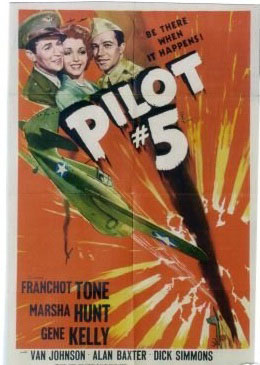
Pilot #5

Oh, propaganda flicks, you're so underplayed and subtle. Well, the better ones try at least to not hit you over the head with a message. Subtle and low-key is the way! I stumbled across 1943's Pilot #5 on Turner Classic Movies with no background or knowledge of it, but a WWII flick released right in the middle of the war? I'll give it a try if nothing else.

On the island of Java, an Allied air base has been under almost constant attack and heavy bombardment from the Japanese Navy. The attacks have wreaked havoc though where the new commander has an uncomfortable situation to resolve. The fighter squadron is down to one plane that's flyable with five pilots available. The lucky one that's chosen? George Collins (Franchot Tone), winning out over his compatriots. His mission is basically suicide though, one plane trying to run the gauntlet through Japanese forces to knock out a key Japanese carrier. As the men left behind tell their commander about the man he's chosen, George takes off in a beat-up fighter with a rigged bomb rack to do what he can. Could he somehow get through unscathed?

This World War II movie from director George Sidney popped up on Turner Classic Movie's schedule this week so I thought I'd give it a try. It clocked in at a brisk-sounding 71 minutes and featured a pretty decent cast so I figured there was little harm in giving it a shot. Even if it was lousy, it's only 71 minutes, right? Right?!? Well, it's a good thing it wasn't any longer because I probably would have bailed. 'Pilot' uses the tried and true storytelling device of...the flashback. When used properly, it can be a gem, helping add layers and background to the story. When not used properly, well, that's the case here. It derails a story I thought had some pretty decent potential.

While the cast is pretty good, no one really stood out from the rest in the end. Franchot Tone as the tortured, redemption-seeking George Collins leaves something to be desired in the old "interesting character" department. The character is just too flat for the movie's sake. We're intrigued with how he ended up in this spot but even when we find out, the payoff isn't worth it. The other pilots include Gene Kelly as the fiery, angry Vito Alessandro, Van Johnson as the jokey Everett Arnold, Alan Baxter as the all-business Winston Davis, and Dick Simmons as Henry Claven, a childhood friend of George's. These characters end up being a means to an end, a way of jumping into the flashbacks and little else. Kelly gets the most screen-time and does pretty well while Van Johnson unfortunately is completely wasted. Also look for a very young Peter Lawford as a British soldier at the base.    

Of the 71 minutes, I'd say about 50 were more concerned with the George Collins flashback...unfortunately. We see George growing up, heading off to law school, and trying to make something of his name and with a big old chip on his shoulder. He gets involved with Kelly's Vito --  a fellow lawyer and jack of all trades -- and ultimately a corrupt governor (Howard Freeman) that seems more fitting in All the King's Men than in a WWII propaganda flick. Throw in a love story lacking basically all chemistry with George's girlfriend, Freddie (Marsha Hunt), and you've got those middle flashback portions absolutely dragging along. Not a positive when you find yourself looking at the clock a whole lot in a 71-minute movie.

The beginning and ending portions are pretty decent. Dark, claustrophobic and uncomfortable as George flies into impossible odds while his fellow pilots wait back at base and listen over the radio to the developing mission. The new Dutch commander (Steven Geray) is a little much in the propaganda part, encouraging the audience to fight back against Fascism and wanting to really know the man he's sending on a suicide mission. A disappointing end result, a war movie with some potential that never really adds up.

Pilot #5 (1943): **/****

Wednesday, August 6, 2014

The Enemy General

I'll always give a war movie a try no matter the story. There are too many interesting stories to shake your head at any because you never know what you're going to get (Yeah, Forrest Gump reference!). One sub-genre of war movies I've always thought was under utilized is the story of resistance movements, especially the French Resistance during WWII. The ones that are available? Not always that good. Where does 1960's The Enemy General stand?

As the German army sweeps across Europe in the early 1940s, a resistance movement pops up and develops in France, men, women and children fighting back against the Germans in any way they can. Among one of the groups is an American O.S.S. officer, Allan Lemaire (Van Johnson), who helps train the recruits and coordinate the attacks on German positions and convoys. During one particularly costly attack, Lemaire's group believes they've accomplished their objective, killing a high-ranking German general (John Van Dreelen) held in high regard by Hitler. General Bruger survives though, organizing reprisals against a local French village. Months later as the Allies invade Europe on D-Day, Lemaire receives orders to rescue a German general sentenced to death by Hitler. The man they're supposed to save? General Bruger himself.

From director George Sherman, 'Enemy' kept popping up on a movie channel on cable so give me enough chances, and I'll do something about it. It isn't a well-known war movie in the least and features a cast without much in the star power. That's not a deal-breaker though, far from it actually. The biggest issue is that at 75 minutes 'Enemy' plays like an extended TV episode. The short running time gives the impression the story is always in a rush, but even with that said, not much is accomplished. Several sequences liberally use wartime footage of combat, of ships landing at D-Day, of soldiers hitting the beaches, of Nazi forces entering Paris. Wasn't there enough story? Wasn't there anything that could be done to flesh things out even a little bit? Apparently not, a short movie at 75 minutes that never really hits a stride in the old entertainment department.

A huge star in Hollywood in the 1940s and early half of the 1950s, Van Johnson wasn't at the height of his popularity by 1960. I often think of him as an actor who could play big, fun parts, Johnson's smile filling up the screen. And for this movie.....yeah, it's the polar opposite, his Lemaire a dark, brooding and revenge-seeking O.S.S. officer. There's potential with the character, but like so much else, it doesn't click. We never get much in the way of background other than that his fellow Resistance fighters highly respect him. His reason for revenge is as good as movie revenge gets, Bruger killing Lemaire's beautiful French fiance, Lisette (Dany Carrel), as part of a reprisal for a resistance attack. The chance for a good character is there, but Johnson doesn't bring much energy to the part, hamstringing things throughout the short running time.

Have you seen Von Ryan's Express? If you haven't, shame on you. It's one of my all-time favorites. Playing the easily despicable German general, Van Dreelen is a solid villain. Now it's good and bad all things considered. The story provides a little bit of a twist near the halfway point, but it doesn't really come as much of a surprise if you're even remotely paying attention. Still, Van Dreelen does a good job playing that oily, sinister German officer. Playing Lemaire's French sidekick, Jean-Pierre Aumont isn't given much to do other than look worried and play off Johnson's resistance leader. Also look for Jacques Marin and Hubert Noel as two resistance fighters.

Just a blah movie in the end. There's no urgency, no excitement as the story builds. Toward the end when the back and forth cat and mouse game should be wrapping up in exciting fashion, it just sorta ends. Things are wrapped up and then 'THE END' flashes across the screen. This is a flick not meant to be a classic, but I would have settled for mildly entertaining. Instead, it is a movie that's just there and nothing else. A disappointing result in the end.

The Enemy General (1960): **/****

Friday, October 26, 2012

The Price of Power

When I purchased a set of 44 spaghetti westerns for the low, low price of less than $15, I was psyched, but some selections from the group jumped out more than others. Some I'd never heard of, some I knew would be lousy, but judging from certain reviews I'd read, I was most looking forward to 1969's The Price of Power. Unfortunately, the final product just didn't live up to expectations.

A gunfighter with a reputation that hangs over him because of a 4-year jail sentence, Bill Willer (Giuliano Gemma) is in trouble. He's rumored to be a part of an assassination attempt on President James Garfield (Van Johnson), who is touring Texas with his wife. Willer's father (Antonio Casas) is gunned down investigating the matters when he stumbles upon the actual plot. Now, Bill is looking to not only clear his name but also to bring the real killers to justice while also saving the life of the President. Just all in a day's work for this anti-hero, right?

Spaghetti westerns are inherently weird, eccentric, off-the-wall and generally pretty odd. I've seen a ton of them so take anything I'm about to say with a grain of salt. From director Tonino Valerii, 'Power' is an oddity among oddities. At different points, it has conspiracy theories, long-winded speeches about politics, a not-so-subtle allusion to the JFK assassination, racist sub-plots, and is light on action compared to most. All those ingredients just didn't mix for me. On the positive, the music from composer Luis Bacalov is delightfully weird -- different from most Ennio Morricone knock-offs -- and any Sergio Leone fans will no doubt recognize countless locations from his 1968 classic, Once Upon a Time in the West. That's never a bad thing.

It's rare that a spaghetti western story has too much going on to this point. Well, that's not completely true. Usually when too much is going on, it means endless betrayals and back-stabbing, gunfights galore. That ain't the case here. There is very little gunplay at all. The Garfield addition to the story plays fast and loose with the facts -- killing him in Texas as opposed to Washington D.C. -- while also portraying it in ridiculously close fashion to the JFK assassination in Dallas. We're talking right down to the angle of the shot, and the reaction from Garfield's wife (Maria Cuadra). More than any of that, far too much time is spent in smoky backrooms as the assassination plot comes together. Head of the Pinkerton Detective Agency, Allan Pinkerton (Fernando Rey) is even involved in the plot!  It's just all too much.

The casting ranges from acceptable to lousy to odd and out of left field. I've liked Gemma in several other spaghettis I've seen, but his performance here is fairly vanilla. A revenge-seeking gunfighter is nothing new to the western, but it's dull here. The best part of the character is his friendship with Jack (Ray Saunders), a black man who fought with Bill in the Civil War. Warren Vanders is the slick aide to Garfield, McDonald, always up to something for the good of the country. It's also pretty cool and worth pointing out that Benito Stefanelli -- usually a background player; a bandit or gunman in Leone's westerns -- gets a prominent role as the treacherous Sheriff Jefferson. An uncredited/unlisted Michael Harvey plays Wallace, the obsessed leader of the assassination plot. Plenty of other characters are cycled in and out in a revolving door, none making an impression. A badly dubbed Johnson is surprisingly good as President Garfield.

I thought there was certainly potential here as the story developed, incorporating the racial overtones of a long dead Confederate movement trying to revive the Civil War. Throwing Bill's black friend, Jack, into the mix, adds quite an interesting element into the story, especially when he's believed to be the assassin. It never clicks into place though. Just far too many elements working against each other for any of those separate elements to be truly effective. A disappointing, mediocre final product. You can watch the entire movie HERE at Youtube.

The Price of Power <---trailer (1969): **/****

Monday, June 13, 2011

Men of the Fighting Lady

Before his death in 1997, author James Michener's name was synonymous with epics in novel form.  Centennial, Texas, Alaska, Hawaii, Chesapeake, The Journey, all huge novels that fans have come to love. But before he turned to those epics, he wrote several smaller books set in the Korean War which haven't received the publicity of his other works but are nonetheless worthwhile. Similar to Michener's Bridges at Toko-Ri (and the film version), 1954's Men of the Fighting Lady is based off his novel The Forgotten Heroes of Korea.

This is an oddity when it comes to war movies for a lot of reasons.  For one, it is based during the Korean War, but other than a few shots taken at the Commies, this movie could as easily have been based in WWII.  Second, there's something missing, or maybe there's too much?  At just 79 minutes, this is one of the shortest war movies I can think of, right up there with the heavily hacked and edited Red Badge of Courage.  Reading about a true incident a key scene is based on, did director Andrew Marton fill out a story around that single incident? Or to the opposite, did he have a longer movie that was cut down to this running time? I'm looking for some sort of answer and can't find a thing. Maybe it's just an oddity among war flicks?

On board the U.S.S. Oriskany, author James Michener (Louis Calhern) comes to visit his old friend, Commander Dowling (Walter Pigeon), the medical officer on board, in hopes of landing a story. Dowling has one for him, a story concerning the fighter pilots in the still-new jets on board being used against the North Koreans and Chinese in the fighting on land. Michener sits back and listens to the story of the fighter squadron and its pilots, what drives them to do what they do, constantly putting themselves in needlessly dangerous situations when the job doesn't always call for it. Why do they do it? Do they get some sick, perverse enjoyment out of it?  Or are they just doing their duty as expected?  Looking for answers from his old friend, Michener is surprised by what he finds.

Now in 2011, a movie about fighter pilots and their newly developed jet planes seems old hat. Who hasn't seen Top Gun? And in a lot of cases, who hasn't seen Top Gun 20 or 30 times? Guilty.  But in 1954, this newly developed plane had to be impressive to audiences.  Even compared to the fighter planes from WWII, these new designs were remarkable.  Much of the story focuses on these pilots and their life aboard ship waiting for their missions.  Marton uses a ton of stock footage (bordering on too much) of these planes on those missions.  At first, it's cool. It's different, original, and the footage is impressive.  You can always have too much of a good thing though because soon enough, the footage of raids and air strikes gets tedious.

Clocking in at well under 90 minutes, the ensemble cast here in 'Fighting Lady' features some solid names, but unfortunately their efforts aren't always as developed as I'd like. There are a handful of really interesting characters but thanks to the limitations on time, some get the short end of the stick.  The squadron includes Frank Lovejoy as Lt. Commander Paul Grayson, the squadron leader who pushes his men to the limit, but he's always at the forefront of the charge, Keenan Wynn as Lt. Commander Ted Dodson, a veteran flier who begins to question Grayson's tactics, Van Johnson as Lt. Howie Thayer, the amiable pilot trapped in the middle of two warring factions in the squadron, and Dewey Martin as Ensign Schechter, the young pilot who begins to side with Dodson. Lovejoy's commander is especially pushed to the background in the last 45 minutes, odd considering how key his character was to the first half of the movie.

Two extended sequences bring this movie up from same old same old to a near-classic.  The first is based on a real-life incident that Michener wrote about. Returning from a patrol, Martin's Schechter and his plane are struck, the shrapnel blinding the pilot in the process.  Trying to guide the wounded pilot back to the carrier hundreds of miles out, Johnson's Thayer leaves formation and flies with Schechter, giving him step-by-step commands so that he can make it back. Van Johnson is one of my favorite actors, but this may be his most impressive part, and Martin is no slouch either.  Johnson's dialogue is natural and nervous, pulling anything from his sleeve that may help.  The tension builds and builds until its almost unbearable. By the time they reach the carrier, I was willing Martin and his crippled plane to land safely. This extended sequence goes on for most of a half hour, but it never lacks for energy, tension or entertainment. You can watch the whole thing HERE and continue into Parts 7 and 8.

The second sequence isn't based as much on playing to that weird adrenaline rush you get from terrifying situations. It's based in that most basic idea of being separated from your loved ones during holidays.  Soldiers, sailors, Marines, pilots, they all experience it.  It's Christmas in this story, and the Navy has arranged for many of the families of the crew to tape quick messages to their husbands, brothers, sons and boyfriends. The timing of course couldn't be worse. A pilot was killed in action just a day before so when his family's message is played for the crew, a silence hangs over the crowd. There's a moment where you realize what you're watching where it all hits home. This family has no idea their Dad and husband is dead. In terms of pure emotion, this scene hit me like a bag of rocks.

There's two ways to fix this movie (in my weird head anyways). I say this having liked it and planning to give it a positive review. It plays in two ways, an extended TV episode or a badly shortened feature length. In a shorter version, I think it could work nicely the same way a longer, more developed movie would.  More character development would be at the top of the list of possible improvements.  But as is, I really liked the movie, as much for the drama as the cast. Flawed but above average.

Men of the Fighting Lady <---trailer (1954): ***/**** 

Sunday, May 1, 2011

Siege at Red River

I feel kind of stupid using a historical lead for a movie of this caliber, but hey, write what you know, when you know it.  I needed a lead, and this one came to mind.  As late as the Civil War, military "tactics" involved opposing armies standing across from each other in an open field and firing at each other.  Brilliant planning and nice use of soldiers' lives, huh? Well, weapons makers obviously saw the lunacy of it and started developing weapons that could kill men faster and more efficiently. Enter the Gatling gun, one of the first rapid fire guns and predecessor to the modern machine gun. It was developed during the Civil War but never actually used in combat.

Still, that allows for some good storytelling opportunities of the gun almost being used in the Civil War and later during the fighting between the cavalry and the Indians in the west.  So take it with a grain of salt, 1954's Siege at Red River is pure historical drivel that doesn't always make a ton of sense (in a lot of ways). It's another odd, little Civil War western that is sold as part of a DVD packaging of a bunch of average to bad westerns. There are so many elements working against each other and working together in subsequent scenes that there is no way on God's green earth this movie should work...in any way.  It does though, flaws and all.  'Red River' is no classic, and maybe it's not even very good all things considered. I liked it though, and that's all I care about, entertain value.

After robbing a Union train in Ohio of one of the few models of a Gatling gun in existence, Confederate spies Capt. James Farraday (Van Johnson) and Sgt. Benjy Guderman (Milburn Stone, later of Gunsmoke fame) travel west to avoid the Union soldiers searching for the missing gun. They are holed up in a small western town where a Pinkerton agent, Kelso (Jeff Morrow) and Union cavalry commanded by Lt. Braden (Craig Hill) arrive soon after, not knowing who has the gun, only that someone in town is hiding it. Farraday and Guderman meet a young woman, Nora (Joanne Dru), the owner of a nursing home, hoping she'll be able to help, but ultimately turn to a horse wrangler/rustler, Manning (Richard Boone), to help them get through the Union lines. The Pinkerton agent and the cavalry are closing in though, but they've got to keep their eyes on Manning too who looks like he'll take the first chance he can get to turn them in for the biggest payday.

I don't know if I can think of a single western that features as many discordant elements all in one place as this movie.  For the most part, that's a positive.  It starts as a Civil War movie, moves west, and then by the end is a straight cavalry vs. Indians flick. In between those things, we've got a traveling salesman (Johnson) selling "muscle builders" while also performing the song, Tapioca, as a signal to other Confederate agents. Then there's Van Johnson as a driven, almost obsessed Confederate agent. On the other side, there's Van Johnson, ladies man who woos Joanne Dru. Also for good measure, Stone's Sgt. Benny gets Dru drunk to throw her off their trail, Morrow's Kelso doesn't tell anyone what's going on and then flips out when things don't go his way, Hill's Lt. Braden is a talented scout/tracker masquerading as an officer, and by the end we've got an epic grouping of Indian tribes that threaten to take over the American west...oh, and there's the Civil War too.

An underrated actor and one of my favorites, Van Johnson is an interesting choice to play the lead in this Civil War western.  He had a knack for starring in comedies, even romantic comedies, but was nonetheless able to play heavy dramatic roles.  In 1954 along with 'Red River,' he starred in one of his most dramatic roles, The Caine Mutiny.  This is a mix of a little bit of everything.  As needed, Johnson moves back and forth seamlessly between drama, action, romance and comedy.  It's always the sign of a good actor when it doesn't feel forced watching that change back and forth. As the straight villain, Richard Boone nails his part, the wrangler/rustler who has some ulterior motives as to what he wants to do with the Gatling gun. His Brett Manning has a bit of the gay caballero thing going on, with an odd outfit that includes a "very stylish" tie and his penchant for using a whip to strike rivals. A little flamboyant, but a worthy rivalry through all the craziness.

Not all the weirdness works though, and there's a fair share.  For one, and it's a big issue, is the whole driving force of the movie.  Johnson and Stone rob a Union train (which is a mess itself with people shooting each other left and right with no explanation) in hopes of turning the tide of the war which isn't going well for the South.  So the robbery seems to take place in Ohio -- judging by a map that's shown after the robbery -- and then head....southwest into Indiana and Missouri.  Head east or southeast, but not that direction. The decision to do so in the story is for one reason and one reason alone....the story requires the Indians to be a key part of the story late. It's just a ridiculous premise, turn the tide of war by going where there are no Confederate armies for hundreds and thousands of smiles.  Then there's Joanne Dru who will she is a fine actress has a knack for ruining westerns she's in (see Red River and She Wore a Yellow Ribbon, the 2nd one not so much). She's very tolerable here until her change of tone drunk scene out of a bad slapstick comedy. She also falls for Van Johnson with the snap of a finger after hating him for most of the movie.

Little things end up being the tipping point here.  Director Rudolph Mate has a real mess of a movie overall. Through the haze of the mess, it is a beautiful movie.  I'm really not sure where this story is supposed to take place, but seeing similar locations as John Ford used in Fort Apache and some other westerns is never a bad thing. The Utah locations are a big selling point here, especially late when the Civil War plot gets left behind for a more traditional western oater.  The finale is a gem as the all-powerful Gatling gun gets stolen and re-stolen and then is finally used late during an Indian attack on a lonely cavalry outpost. As is the formula opened up by the movie, we've got a Union patrol, an enormous Indian war party, a Gatling gun, and Johnson's Confederate spy wavering over what he should do.  For good measure, the cavalry and Indians have one last go at each other at a shallow water hole. Reading other reviews, I see I'm one of the few who liked this movie. It isn't great, and I can't say I'll seek it out again. But for a western I went into with low expectations, they were easily met and then some.

Siege at Red River (1954): ***/****