Yuck, here we are again. War movies that aren't content to just be war movies. What else gets added to the formula? A love story, two tortured souls brought together because, God bless it, the universe just wants it to happen! Those crazy kids, they just belong together even if the war will do its best to keep them apart. Today's entry is 1951's Force of Arms.
It's 1943 and the fighting in Italy is intensifying all along the front. After weeks and months on the line, an infantry platoon commanded by Sgt. Joe Peterson (William Holden) is tasked with one more objective. Though it costs heavy casualties, the platoon retakes an important position from the Germans. The entire unit is awarded five days of leave far removed from the muddy, cold front lines, Peterson meets a WAC, Lt. Eleanor MacKay (Nancy Olson), who he starts off on a rocky path almost immediately. Still, as they argue and test each other back and forth, both Joe and Eleanor can't deny their attraction to each other. The clock is ticking though as the soldier and the WAC must decide where to go next before Joe returns to the front line fighting. Can they come to terms with how they feel about each other in time?
Gag me, I hate when I have to write plot descriptions like this. Don't get me wrong. If there's a good romance war story out there, I'll give it a fair shot. Also, I don't really count Casablanca. I'm talking war stories, men on the front lines when the story takes a detour for some loving away from the front. Director Michael Curtiz's flick has a ton of potential because the portions focusing on the fighting, on Peterson taking a leadership role, of the platoon both in action and resting, that is 'Force' at its strongest. Too much time is spent on the budding relationship between Holden and Olson in the process. 'Force' is filmed in black and white with some cool location shooting, California filling in surprisingly well for Italy. It has a gritty, worn look, but dang, enough with the love story.
Holden is one of my favorites, and Olson has more than held her own in Sunset Blvd., Battle Cry and several other flicks. They have some decent chemistry together, but this script does them absolutely no favors. They meet in a military cemetery in the dead of the night and at no point does Holden's Peterson ever think "Hmm, I wonder what she's doing here? Maybe someone she knew...died?" From there, we get to know two folks working through some stuff -- Peterson the war wearing him down day to day, Eleanor trying to overcome a lost love -- with death hanging in the air. They wonder aloud what love really is, question if they truly can love, take dreamy walks on the Italian countryside, and share tons of scandalous hugs where they rub faces. A love story is one thing. One that moves this sluggishly with not enough of a payoff? Yeah, not good.
At times, 'Force' reminded me of 1959's Never so Few, a WWII story that is at its strongest when it focuses on the war, on the soldiers, on the combat. That's 'Force' in a nutshell. The story starts at its strongest as Peterson's platoon is tasked with retaking a German-held position on a rocky hill. This isn't large scale warfare but a small unit of soldiers going toe to toe against another small unit of soldiers. The violence isn't graphic, but it's startling and quick just the same. That's most of the action/combat scenes, including the platoon moving into position under heavy German guns and later navigating an Italian town with winding streets and German shells and mortars raining down on them. As quick as these segments are over, the script jumps right back to the love story. Oh, joy.
Beyond Holden in the soldier department, look for Frank Lovejoy as Major Bradford, the unit's commanding officer and an old friend of Peterson's from back home. Commanding officer and one of his trusted officers but also friends with a past. In Peterson's platoon, look for Gene Evans as McFee, worried what his wife is up to back home, Dick Wesson as Kleiner, a capable soldier and a capable smartass, Paul Picerni as Sheridan, the smooth Italian (similar to the part he played in To Hell and Back), Ross Ford as Hooker, the southern farmer, Ron Hagerthy as Minto, Peterson's runner, and a young Don Gordon in one of his first speaking parts as Sgt. Webber. I like the group dynamic, their friendships, their arguments. It feels natural, and I just wish there was more of it.
A mixed bag unfortunately. When it's good, it's pretty good. When it's bad, love is pretty rough to watch.
Force of Arms (1951): **/****
The Sons of Katie Elder
"First, we reunite, then find Ma and Pa's killer...then read some reviews."
Showing posts with label Frank Lovejoy. Show all posts
Sunday, September 14, 2014
Monday, August 26, 2013
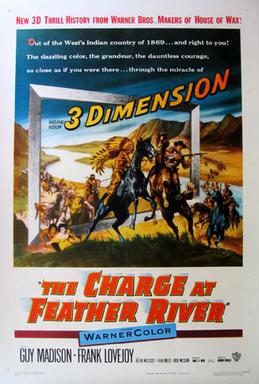
The Charge at Feather River
Why are some movies remembered and others aren't? It can be the tiniest thing, something that lingers with audiences long after viewing. A childhood favorite of mine, seemingly always airing on TNT, is 1953's The Charge at Feather River. What's it got going for it? Well, two things, an early use of 3-D technology that works surprisingly well and an iconic death scene that's influenced everything from Indiana Jones to Star Wars.
In the months following the end of the Civil War, former Union soldier Miles Archer (Guy Madison) returns to a ruined ranch with no cattle. He's approached by the commander at the nearby fort to undertake a dangerous mission. The railroad is moving into Cheyenne territory, leaving one last chance to get back two sisters who have long been held prisoners of the Cheyenne. Archer is less than enthused to take on this suicide mission, but he takes it on just the same, bringing a capable sergeant, Baker (Frank Lovejoy), to help him command a squad of prisoners from the guardhouse. Archer's squad heads into Cheyenne territory, but they find that only one of the women, Anne (Helen Westcott), even wants to be rescued while the other, Jennie (Vera Miles), is engaged to a chief, Thunder Hawk. More surprises await on this dangerous mission, Archer working to protect himself from threats inside and out.
According to a recent airing on Turner Classic Movies, 'Charge' was the highest grossing western released in 1953. Not bad when you consider Shane, Hondo, and The Naked Spur were all released that year. It's nothing special as a western, but it is enjoyable throughout. Director Gordon Douglas' movie is a solid cavalry vs. Indians western, featuring some cool locations and a memorable score from composer Max Steiner (borrowing some from his They Died With Their Boots On score). Listen to Steiner's main theme HERE. Using a familiar theme of saving captives from raiding Indians (The Searchers, Major Dundee), it's a pretty good example of what a pretty straightforward B-western can be. Some cool characters, good action and musical score. It doesn't have to be groundbreaking to be enjoyable.
What was the appeal then? No doubt some of the success had to do with the original release being in 3-D. I've never been a fan of 3-D filming, gone on record far too many times with that, but there is a cheesy charm when it's handled right. Maybe it has something to do with the 1953 release as opposed to 2013, but it's fun to watch. At different points, we get arrows, tomahawks, spears and lances chucked directly at the camera. Right in the midst of a battle, it can be a fun, diverting gimmick. At one point late, Lovejoy's Sgt. Baker even spits tobacco juice right at the camera!!! Twice!!! Take that rattlesnake about to bite him! Go figure, but the 3-D technique works here pretty well.
Taking a break from his starring role on TV's Adventures of Wild Bill Hickok, Madison is his typical workmanlike self, a tried and true hero to lead the way in an impossible mission. He's never flashy, but he was a good hero in countless westerns like this. Lovejoy too is well-cast as Baker, the necessary sidekick and right hand man, given a rivalry with Pvt. Ryan (Steve Brodie), who was trying to make a move on Baker's wife. Westcott is okay as the quasi-love interest while Miles gets to villain it up as Jennie, the captive turned future Indian princess. Madison's Guardhouse Brigade includes Cullen (Dick Wesson), a drunken thief providing some comic relief, Johnson (Onslow Stevens), a journalist/artist along for the mission, Johnny (Ron Hagerthy), the kidnapped sisters' younger brother, the treacherous Morgan (Neville Brand), Smiley (Henry Kulky), the boozing private, Zebulon (Lane Chandler), a former Confederate cavalry officer, and Connors (James Brown), the capable soldier.
It's a pretty straightforward formula once Archer and Co. get out on the mission road. We've got about 15-20 men on a dangerous mission in enemy territory. Who's going to make it, and who isn't? Various trials and tribulations are thrown at Archer's squad, providing some cool action scenes as they try and make it to safety with warring Indians seemingly all around them. The action is never on a large scale, but it's well put together, especially the finale with Thunder Hawk's war party closing in on all sides. What else to talk about? The scream of a certain Pvt. Wilhelm as he's hit with an arrow. Watch HERE. It is a scream that's been used in several movies since, including both the Star Wars and Indiana Jones series. Watch a compilation HERE. It's something little that helps make a good western particularly memorable. Solid western all-around.
The Charge at Feather River (1953): ***/****
In the months following the end of the Civil War, former Union soldier Miles Archer (Guy Madison) returns to a ruined ranch with no cattle. He's approached by the commander at the nearby fort to undertake a dangerous mission. The railroad is moving into Cheyenne territory, leaving one last chance to get back two sisters who have long been held prisoners of the Cheyenne. Archer is less than enthused to take on this suicide mission, but he takes it on just the same, bringing a capable sergeant, Baker (Frank Lovejoy), to help him command a squad of prisoners from the guardhouse. Archer's squad heads into Cheyenne territory, but they find that only one of the women, Anne (Helen Westcott), even wants to be rescued while the other, Jennie (Vera Miles), is engaged to a chief, Thunder Hawk. More surprises await on this dangerous mission, Archer working to protect himself from threats inside and out.
According to a recent airing on Turner Classic Movies, 'Charge' was the highest grossing western released in 1953. Not bad when you consider Shane, Hondo, and The Naked Spur were all released that year. It's nothing special as a western, but it is enjoyable throughout. Director Gordon Douglas' movie is a solid cavalry vs. Indians western, featuring some cool locations and a memorable score from composer Max Steiner (borrowing some from his They Died With Their Boots On score). Listen to Steiner's main theme HERE. Using a familiar theme of saving captives from raiding Indians (The Searchers, Major Dundee), it's a pretty good example of what a pretty straightforward B-western can be. Some cool characters, good action and musical score. It doesn't have to be groundbreaking to be enjoyable.
What was the appeal then? No doubt some of the success had to do with the original release being in 3-D. I've never been a fan of 3-D filming, gone on record far too many times with that, but there is a cheesy charm when it's handled right. Maybe it has something to do with the 1953 release as opposed to 2013, but it's fun to watch. At different points, we get arrows, tomahawks, spears and lances chucked directly at the camera. Right in the midst of a battle, it can be a fun, diverting gimmick. At one point late, Lovejoy's Sgt. Baker even spits tobacco juice right at the camera!!! Twice!!! Take that rattlesnake about to bite him! Go figure, but the 3-D technique works here pretty well.
Taking a break from his starring role on TV's Adventures of Wild Bill Hickok, Madison is his typical workmanlike self, a tried and true hero to lead the way in an impossible mission. He's never flashy, but he was a good hero in countless westerns like this. Lovejoy too is well-cast as Baker, the necessary sidekick and right hand man, given a rivalry with Pvt. Ryan (Steve Brodie), who was trying to make a move on Baker's wife. Westcott is okay as the quasi-love interest while Miles gets to villain it up as Jennie, the captive turned future Indian princess. Madison's Guardhouse Brigade includes Cullen (Dick Wesson), a drunken thief providing some comic relief, Johnson (Onslow Stevens), a journalist/artist along for the mission, Johnny (Ron Hagerthy), the kidnapped sisters' younger brother, the treacherous Morgan (Neville Brand), Smiley (Henry Kulky), the boozing private, Zebulon (Lane Chandler), a former Confederate cavalry officer, and Connors (James Brown), the capable soldier.
It's a pretty straightforward formula once Archer and Co. get out on the mission road. We've got about 15-20 men on a dangerous mission in enemy territory. Who's going to make it, and who isn't? Various trials and tribulations are thrown at Archer's squad, providing some cool action scenes as they try and make it to safety with warring Indians seemingly all around them. The action is never on a large scale, but it's well put together, especially the finale with Thunder Hawk's war party closing in on all sides. What else to talk about? The scream of a certain Pvt. Wilhelm as he's hit with an arrow. Watch HERE. It is a scream that's been used in several movies since, including both the Star Wars and Indiana Jones series. Watch a compilation HERE. It's something little that helps make a good western particularly memorable. Solid western all-around.
The Charge at Feather River (1953): ***/****
Labels:
1950s,
Frank Lovejoy,
Gordon Douglas,
Guy Madison,
Neville Brand,
Vera Miles,
westerns
Friday, August 9, 2013
The Hitch-Hiker
You're driving along on a highway and see a man standing there on the side of the road. He's got his thumb up indicating he'd like a ride. What should you do? Well, if you've seen any horror and/or thriller movies EVER, then hit the gas and keep on moving. Back in the 1950s, motorists were far more gullible/nice/trusting and had no issues picking up hitchhikers. I imagine 1953's The Hitch-Hiker went a long way to reversing that trend.
Heading out on a fishing trip, friends Roy Collins (Edmond O'Brien) and Gilbert Bowen (Frank Lovejoy) are driving along on the highway when they spot a man at the side of the road thumbing for a ride. They pull over and pick him up, thinking nothing of it. Within minutes though, the man pulls a gun and begins issuing orders as to where they're going and how they'll get there. Roy and Gilbert hear on the radio that the man is Emmett Myers (William Talman), a convicted killer and a psychopath on the run from the police. With no real alternative to escape with Myers' gun pointed at their heads, the friends are forced to go along with the killer's demands. He tells them to head south into the desert and eventually Mexico. Can they manage to escape before he kills them? Can the police find them in time?
Like the best thrillers, the formula here is simple. Throw something at the audience that could actually happen to them. Yes, this situation depends on you being really dumb and picking up a hitchhiker along the side of the road, but the gist is the same. You're trying to help someone out, and it epically blows up in your face. Upon picking up Myers, Roy and Gilbert are quickly informed that as soon as Myers reaches his destination in Mexico, he's going to kill them both. Does it get scarier/creepier than that? These two friends are actually driving themselves to their own deaths. As a premise, it works. In execution? Eh, not so much.
'Hiker' is now known as the first film noir helmed by a female director, in this case actress turned director Ida Lupino, who took over the film when Elmer Clifton became sick and couldn't continue. Lupino has a knack for putting the right elements into place for a successful flick, but it never gels here. To say this movie is predictable is an understatement. Maybe in 1953, this was fresh for audiences, but watching it for the first time 60 years later, there is little to no energy or urgency. That's not a good thing when death hangs in the air over two main characters. It only runs 73 minutes, but it's basically a series of episodic scenes of Roy and Gilbert progressively losing it while seeing how mentally unbalanced Emmett is. A few scenes pack some punch, but for the most part I was bored.
With a limited cast, the focus is mostly on our lead trio. Even there, I came away disappointed. It's not necessarily any of their fault, just a script that never gives any of them much to do beyond stereotypes. Edmond O'Brien is one of my favorites, but he doesn't have much going here. His sole requirement is looking worried (understandably considering the situation) as he becomes more and more unhinged. As his buddy, Lovejoy fares slightly better, but not much. His Gilbert is eerily, freakishly calm, and his key character trait? He speaks Spanish so he can translate! Yeah! Talman is a relative bright spot as psychotic killer Myers only because he brings some energy to the part, however obviously demented. Really though, with no background or real rooting interest for Roy and Gilbert, it's hard to get behind them and root for them.
Watching a movie released in 1953, it's not hard to see where this story is going. A sadistic killer with no qualms about killing anyone and everyone? Two innocent fishermen? Predictable is one thing, but the ending even manages to find another way to disappoint. I won't give it away here so apologies for no spoilers, but the resolution is beyond unsatisfying. I certainly wanted to like this movie, but it never came together. There is some cool location shooting in the Alabama Hills around Lone, Pine California that does a fine job standing in for the Mexican desert. The story is based on the real-life story of killer Billy Cook, but that real-life drama simply doesn't translate enough to succeed. Watch the full movie HERE.
The Hitch-Hiker (1953): **/****
Heading out on a fishing trip, friends Roy Collins (Edmond O'Brien) and Gilbert Bowen (Frank Lovejoy) are driving along on the highway when they spot a man at the side of the road thumbing for a ride. They pull over and pick him up, thinking nothing of it. Within minutes though, the man pulls a gun and begins issuing orders as to where they're going and how they'll get there. Roy and Gilbert hear on the radio that the man is Emmett Myers (William Talman), a convicted killer and a psychopath on the run from the police. With no real alternative to escape with Myers' gun pointed at their heads, the friends are forced to go along with the killer's demands. He tells them to head south into the desert and eventually Mexico. Can they manage to escape before he kills them? Can the police find them in time?
Like the best thrillers, the formula here is simple. Throw something at the audience that could actually happen to them. Yes, this situation depends on you being really dumb and picking up a hitchhiker along the side of the road, but the gist is the same. You're trying to help someone out, and it epically blows up in your face. Upon picking up Myers, Roy and Gilbert are quickly informed that as soon as Myers reaches his destination in Mexico, he's going to kill them both. Does it get scarier/creepier than that? These two friends are actually driving themselves to their own deaths. As a premise, it works. In execution? Eh, not so much.
'Hiker' is now known as the first film noir helmed by a female director, in this case actress turned director Ida Lupino, who took over the film when Elmer Clifton became sick and couldn't continue. Lupino has a knack for putting the right elements into place for a successful flick, but it never gels here. To say this movie is predictable is an understatement. Maybe in 1953, this was fresh for audiences, but watching it for the first time 60 years later, there is little to no energy or urgency. That's not a good thing when death hangs in the air over two main characters. It only runs 73 minutes, but it's basically a series of episodic scenes of Roy and Gilbert progressively losing it while seeing how mentally unbalanced Emmett is. A few scenes pack some punch, but for the most part I was bored.
With a limited cast, the focus is mostly on our lead trio. Even there, I came away disappointed. It's not necessarily any of their fault, just a script that never gives any of them much to do beyond stereotypes. Edmond O'Brien is one of my favorites, but he doesn't have much going here. His sole requirement is looking worried (understandably considering the situation) as he becomes more and more unhinged. As his buddy, Lovejoy fares slightly better, but not much. His Gilbert is eerily, freakishly calm, and his key character trait? He speaks Spanish so he can translate! Yeah! Talman is a relative bright spot as psychotic killer Myers only because he brings some energy to the part, however obviously demented. Really though, with no background or real rooting interest for Roy and Gilbert, it's hard to get behind them and root for them.
Watching a movie released in 1953, it's not hard to see where this story is going. A sadistic killer with no qualms about killing anyone and everyone? Two innocent fishermen? Predictable is one thing, but the ending even manages to find another way to disappoint. I won't give it away here so apologies for no spoilers, but the resolution is beyond unsatisfying. I certainly wanted to like this movie, but it never came together. There is some cool location shooting in the Alabama Hills around Lone, Pine California that does a fine job standing in for the Mexican desert. The story is based on the real-life story of killer Billy Cook, but that real-life drama simply doesn't translate enough to succeed. Watch the full movie HERE.
The Hitch-Hiker (1953): **/****
Labels:
1950s,
Edmond O'Brien,
Film Noir,
Frank Lovejoy,
Ida Lupino
Friday, July 6, 2012
Breakthrough (1950)
Maybe it's the difference in wars, but with the conflicts in Iraq and Afghanistan, movies about those conflicts have almost 100% in theaters. Audiences don't want to see those stories that are so fresh in their minds and memories. Why then after WWII were audiences hit with waves of war movies? Was it just a different war? Did people feel differently? Was it because the United States won? I'm trying to figure it out myself. Released just five years after the war, 1950's Breakthrough is a strong example of what was to come in the war genre.
In England in the spring of 1944, the Allied invasion force is prepping for the coming invasion of France. Among the armies is Lt. Joe Mallory (John Agar), a young, inexperienced officer fresh out of training school. He's been given command of a veteran rifle platoon that's been fighting in North Africa and Italy for two-plus years, with their former commander, Capt. Hale (David Brian), now placed in command of the company. Hale turns to Sgt. Bell (Frank Lovejoy), the similarly veteran soldier, to help Mallory adjust and keep an eye on the platoon. With the coming D-Day invasion, the platoon will have to count on each other if they hope to make it through the campaign alive.
This straight forward, no frills WWII flick premiered recently on Turner Classic Movies so I took my chance and recorded it, remembering seeing an old VHS box of it years before at a local video store but never picking it up. It isn't a classic, but it is interesting to watch considering how much it foreshadowed what war films would become over the next 10 years. From director Lewis Seiler, it is an early example of a unit picture, a story focusing on a squad, platoon, company, regiment, brigade...you get the idea. Lovejoy's narration is solid without trying to be the end-all, be-all in narration, and the story chooses to focus on the platoon's involvement in the fighting, not the bigger picture of how the war effort is going.
I can't quite put my finger on it, but there was something appealing about this war movie. It doesn't have that whitewashed feeling of so many WWII movies made so close to the end of the war. It's war with one side fighting the other. No bigger picture about why they fought or for who. The Germans are the enemy, but they're not demonized. The Americans are regular troops from all walks of life, individuals forced to work together to help each other survive. It isn't a graphic movie, but it is certainly intense, especially considering its 1950 release, including one battle sequence late. The story follows the 3rd Platoon from spring 1944 to late summer 1944, following them through training, onto Omaha Beach at Normandy, and then through the hedgerows in the French countryside. The formula -- from the episodic story elements to the character archetypes -- would be used countless other times in the years to come, but this is one of the earliest ventures and one of the best.
I'll say again, but 'cliched' isn't necessarily a bad thing. The character archetypes here have been used in countless war movies before and since and will keep on being used as long as there's more war movies. The three lead performances are some of the basics, Brian's Hale the hard-edged commander, Agar's Mallory the newbie trying to learn on the job, and Lovejoy's Bell the veteran soldier who knows how to survive and get his men to do the same. Lovejoy especially represents himself well, having some fun with a familiar character. The platoon includes Cpl. Dominick (William Campbell), the motor-mouth aspiring politician, Rojeck (Paul Picerni), the natural soldier and better complainer, Finley (Greg McClure), the fitness freak, Nelson (Richard Monahan), the wet behind the ears newbie, Henderson (Edward Norris), the family man, Jimbo (Matt Willis), the amiable Southerner, Hansen (Dick Wesson), the jokester, with William Self and Danny Arnold having less visible parts.
Nothing fancy, and nothing that will startle or amaze you, just a good, old-fashioned war story. Solid casting, fast-moving, effective and interesting story, and an honest, forthright look and feel of what it must be to be a soldier. Well worth tracking down a copy if you can find one.
Breakthrough <---short Youtube clip (1950): ***/****
In England in the spring of 1944, the Allied invasion force is prepping for the coming invasion of France. Among the armies is Lt. Joe Mallory (John Agar), a young, inexperienced officer fresh out of training school. He's been given command of a veteran rifle platoon that's been fighting in North Africa and Italy for two-plus years, with their former commander, Capt. Hale (David Brian), now placed in command of the company. Hale turns to Sgt. Bell (Frank Lovejoy), the similarly veteran soldier, to help Mallory adjust and keep an eye on the platoon. With the coming D-Day invasion, the platoon will have to count on each other if they hope to make it through the campaign alive.
This straight forward, no frills WWII flick premiered recently on Turner Classic Movies so I took my chance and recorded it, remembering seeing an old VHS box of it years before at a local video store but never picking it up. It isn't a classic, but it is interesting to watch considering how much it foreshadowed what war films would become over the next 10 years. From director Lewis Seiler, it is an early example of a unit picture, a story focusing on a squad, platoon, company, regiment, brigade...you get the idea. Lovejoy's narration is solid without trying to be the end-all, be-all in narration, and the story chooses to focus on the platoon's involvement in the fighting, not the bigger picture of how the war effort is going.
I can't quite put my finger on it, but there was something appealing about this war movie. It doesn't have that whitewashed feeling of so many WWII movies made so close to the end of the war. It's war with one side fighting the other. No bigger picture about why they fought or for who. The Germans are the enemy, but they're not demonized. The Americans are regular troops from all walks of life, individuals forced to work together to help each other survive. It isn't a graphic movie, but it is certainly intense, especially considering its 1950 release, including one battle sequence late. The story follows the 3rd Platoon from spring 1944 to late summer 1944, following them through training, onto Omaha Beach at Normandy, and then through the hedgerows in the French countryside. The formula -- from the episodic story elements to the character archetypes -- would be used countless other times in the years to come, but this is one of the earliest ventures and one of the best.
I'll say again, but 'cliched' isn't necessarily a bad thing. The character archetypes here have been used in countless war movies before and since and will keep on being used as long as there's more war movies. The three lead performances are some of the basics, Brian's Hale the hard-edged commander, Agar's Mallory the newbie trying to learn on the job, and Lovejoy's Bell the veteran soldier who knows how to survive and get his men to do the same. Lovejoy especially represents himself well, having some fun with a familiar character. The platoon includes Cpl. Dominick (William Campbell), the motor-mouth aspiring politician, Rojeck (Paul Picerni), the natural soldier and better complainer, Finley (Greg McClure), the fitness freak, Nelson (Richard Monahan), the wet behind the ears newbie, Henderson (Edward Norris), the family man, Jimbo (Matt Willis), the amiable Southerner, Hansen (Dick Wesson), the jokester, with William Self and Danny Arnold having less visible parts.
Nothing fancy, and nothing that will startle or amaze you, just a good, old-fashioned war story. Solid casting, fast-moving, effective and interesting story, and an honest, forthright look and feel of what it must be to be a soldier. Well worth tracking down a copy if you can find one.
Breakthrough <---short Youtube clip (1950): ***/****
Labels:
1950s,
Frank Lovejoy,
John Agar,
Paul Picerni,
William Campbell,
WWII
Monday, June 13, 2011
Men of the Fighting Lady
Before his death in 1997, author James Michener's name was synonymous with epics in novel form. Centennial, Texas, Alaska, Hawaii, Chesapeake, The Journey, all huge novels that fans have come to love. But before he turned to those epics, he wrote several smaller books set in the Korean War which haven't received the publicity of his other works but are nonetheless worthwhile. Similar to Michener's Bridges at Toko-Ri (and the film version), 1954's Men of the Fighting Lady is based off his novel The Forgotten Heroes of Korea.
This is an oddity when it comes to war movies for a lot of reasons. For one, it is based during the Korean War, but other than a few shots taken at the Commies, this movie could as easily have been based in WWII. Second, there's something missing, or maybe there's too much? At just 79 minutes, this is one of the shortest war movies I can think of, right up there with the heavily hacked and edited Red Badge of Courage. Reading about a true incident a key scene is based on, did director Andrew Marton fill out a story around that single incident? Or to the opposite, did he have a longer movie that was cut down to this running time? I'm looking for some sort of answer and can't find a thing. Maybe it's just an oddity among war flicks?
On board the U.S.S. Oriskany, author James Michener (Louis Calhern) comes to visit his old friend, Commander Dowling (Walter Pigeon), the medical officer on board, in hopes of landing a story. Dowling has one for him, a story concerning the fighter pilots in the still-new jets on board being used against the North Koreans and Chinese in the fighting on land. Michener sits back and listens to the story of the fighter squadron and its pilots, what drives them to do what they do, constantly putting themselves in needlessly dangerous situations when the job doesn't always call for it. Why do they do it? Do they get some sick, perverse enjoyment out of it? Or are they just doing their duty as expected? Looking for answers from his old friend, Michener is surprised by what he finds.
Now in 2011, a movie about fighter pilots and their newly developed jet planes seems old hat. Who hasn't seen Top Gun? And in a lot of cases, who hasn't seen Top Gun 20 or 30 times? Guilty. But in 1954, this newly developed plane had to be impressive to audiences. Even compared to the fighter planes from WWII, these new designs were remarkable. Much of the story focuses on these pilots and their life aboard ship waiting for their missions. Marton uses a ton of stock footage (bordering on too much) of these planes on those missions. At first, it's cool. It's different, original, and the footage is impressive. You can always have too much of a good thing though because soon enough, the footage of raids and air strikes gets tedious.
Clocking in at well under 90 minutes, the ensemble cast here in 'Fighting Lady' features some solid names, but unfortunately their efforts aren't always as developed as I'd like. There are a handful of really interesting characters but thanks to the limitations on time, some get the short end of the stick. The squadron includes Frank Lovejoy as Lt. Commander Paul Grayson, the squadron leader who pushes his men to the limit, but he's always at the forefront of the charge, Keenan Wynn as Lt. Commander Ted Dodson, a veteran flier who begins to question Grayson's tactics, Van Johnson as Lt. Howie Thayer, the amiable pilot trapped in the middle of two warring factions in the squadron, and Dewey Martin as Ensign Schechter, the young pilot who begins to side with Dodson. Lovejoy's commander is especially pushed to the background in the last 45 minutes, odd considering how key his character was to the first half of the movie.
Two extended sequences bring this movie up from same old same old to a near-classic. The first is based on a real-life incident that Michener wrote about. Returning from a patrol, Martin's Schechter and his plane are struck, the shrapnel blinding the pilot in the process. Trying to guide the wounded pilot back to the carrier hundreds of miles out, Johnson's Thayer leaves formation and flies with Schechter, giving him step-by-step commands so that he can make it back. Van Johnson is one of my favorite actors, but this may be his most impressive part, and Martin is no slouch either. Johnson's dialogue is natural and nervous, pulling anything from his sleeve that may help. The tension builds and builds until its almost unbearable. By the time they reach the carrier, I was willing Martin and his crippled plane to land safely. This extended sequence goes on for most of a half hour, but it never lacks for energy, tension or entertainment. You can watch the whole thing HERE and continue into Parts 7 and 8.
The second sequence isn't based as much on playing to that weird adrenaline rush you get from terrifying situations. It's based in that most basic idea of being separated from your loved ones during holidays. Soldiers, sailors, Marines, pilots, they all experience it. It's Christmas in this story, and the Navy has arranged for many of the families of the crew to tape quick messages to their husbands, brothers, sons and boyfriends. The timing of course couldn't be worse. A pilot was killed in action just a day before so when his family's message is played for the crew, a silence hangs over the crowd. There's a moment where you realize what you're watching where it all hits home. This family has no idea their Dad and husband is dead. In terms of pure emotion, this scene hit me like a bag of rocks.
There's two ways to fix this movie (in my weird head anyways). I say this having liked it and planning to give it a positive review. It plays in two ways, an extended TV episode or a badly shortened feature length. In a shorter version, I think it could work nicely the same way a longer, more developed movie would. More character development would be at the top of the list of possible improvements. But as is, I really liked the movie, as much for the drama as the cast. Flawed but above average.
Men of the Fighting Lady <---trailer (1954): ***/****
This is an oddity when it comes to war movies for a lot of reasons. For one, it is based during the Korean War, but other than a few shots taken at the Commies, this movie could as easily have been based in WWII. Second, there's something missing, or maybe there's too much? At just 79 minutes, this is one of the shortest war movies I can think of, right up there with the heavily hacked and edited Red Badge of Courage. Reading about a true incident a key scene is based on, did director Andrew Marton fill out a story around that single incident? Or to the opposite, did he have a longer movie that was cut down to this running time? I'm looking for some sort of answer and can't find a thing. Maybe it's just an oddity among war flicks?
On board the U.S.S. Oriskany, author James Michener (Louis Calhern) comes to visit his old friend, Commander Dowling (Walter Pigeon), the medical officer on board, in hopes of landing a story. Dowling has one for him, a story concerning the fighter pilots in the still-new jets on board being used against the North Koreans and Chinese in the fighting on land. Michener sits back and listens to the story of the fighter squadron and its pilots, what drives them to do what they do, constantly putting themselves in needlessly dangerous situations when the job doesn't always call for it. Why do they do it? Do they get some sick, perverse enjoyment out of it? Or are they just doing their duty as expected? Looking for answers from his old friend, Michener is surprised by what he finds.
Now in 2011, a movie about fighter pilots and their newly developed jet planes seems old hat. Who hasn't seen Top Gun? And in a lot of cases, who hasn't seen Top Gun 20 or 30 times? Guilty. But in 1954, this newly developed plane had to be impressive to audiences. Even compared to the fighter planes from WWII, these new designs were remarkable. Much of the story focuses on these pilots and their life aboard ship waiting for their missions. Marton uses a ton of stock footage (bordering on too much) of these planes on those missions. At first, it's cool. It's different, original, and the footage is impressive. You can always have too much of a good thing though because soon enough, the footage of raids and air strikes gets tedious.
Clocking in at well under 90 minutes, the ensemble cast here in 'Fighting Lady' features some solid names, but unfortunately their efforts aren't always as developed as I'd like. There are a handful of really interesting characters but thanks to the limitations on time, some get the short end of the stick. The squadron includes Frank Lovejoy as Lt. Commander Paul Grayson, the squadron leader who pushes his men to the limit, but he's always at the forefront of the charge, Keenan Wynn as Lt. Commander Ted Dodson, a veteran flier who begins to question Grayson's tactics, Van Johnson as Lt. Howie Thayer, the amiable pilot trapped in the middle of two warring factions in the squadron, and Dewey Martin as Ensign Schechter, the young pilot who begins to side with Dodson. Lovejoy's commander is especially pushed to the background in the last 45 minutes, odd considering how key his character was to the first half of the movie.
Two extended sequences bring this movie up from same old same old to a near-classic. The first is based on a real-life incident that Michener wrote about. Returning from a patrol, Martin's Schechter and his plane are struck, the shrapnel blinding the pilot in the process. Trying to guide the wounded pilot back to the carrier hundreds of miles out, Johnson's Thayer leaves formation and flies with Schechter, giving him step-by-step commands so that he can make it back. Van Johnson is one of my favorite actors, but this may be his most impressive part, and Martin is no slouch either. Johnson's dialogue is natural and nervous, pulling anything from his sleeve that may help. The tension builds and builds until its almost unbearable. By the time they reach the carrier, I was willing Martin and his crippled plane to land safely. This extended sequence goes on for most of a half hour, but it never lacks for energy, tension or entertainment. You can watch the whole thing HERE and continue into Parts 7 and 8.
The second sequence isn't based as much on playing to that weird adrenaline rush you get from terrifying situations. It's based in that most basic idea of being separated from your loved ones during holidays. Soldiers, sailors, Marines, pilots, they all experience it. It's Christmas in this story, and the Navy has arranged for many of the families of the crew to tape quick messages to their husbands, brothers, sons and boyfriends. The timing of course couldn't be worse. A pilot was killed in action just a day before so when his family's message is played for the crew, a silence hangs over the crowd. There's a moment where you realize what you're watching where it all hits home. This family has no idea their Dad and husband is dead. In terms of pure emotion, this scene hit me like a bag of rocks.
There's two ways to fix this movie (in my weird head anyways). I say this having liked it and planning to give it a positive review. It plays in two ways, an extended TV episode or a badly shortened feature length. In a shorter version, I think it could work nicely the same way a longer, more developed movie would. More character development would be at the top of the list of possible improvements. But as is, I really liked the movie, as much for the drama as the cast. Flawed but above average.
Men of the Fighting Lady <---trailer (1954): ***/****
Subscribe to:
Posts (Atom)