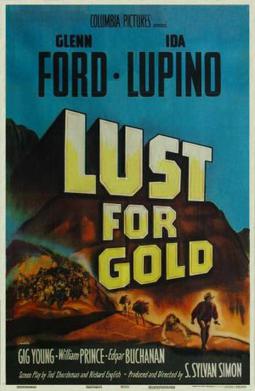
As Gordon Gekko profoundly said, 'Greed is good.' One of the all-time great films dealing with one of the seven deadly sins was released in 1948, Treasure of the Sierra Madre, a frightening look at what gold can do to one's minds. It's one of the all-time classics, making 1949's Lust for Gold an odd choice. Was it an effort to build off its success? Whatever the reason, it doesn't work despite some potential.
It's 1948 in Arizona, a treasure-hunter of sorts, Barry Storm (William Prince), is walking through the Superstition Mountains looking for a supposedly long-lost mine, the Lost Dutchman. He's actually following a famous treasure hunter who states he's got the mystery figured out, but Storm is stunned when he hears a gunshot and soon after finds the treasure hunter dead. He walks to the nearest town, still several days away, to report the murder, quickly realizing this isn't some innocent old treasure hunt. Storm is quickly cleared of suspicion, but his interest makes some curious as he claims to be the grandson of the original owner of the Dutchman mine. As the police waits for a break in the case, Storm sits back and listens to the legendary story of how the mine came to be, including how his grandfather, Jacob Walz (Glenn Ford), came to be involved.
This was an interesting movie, not always for the good. From director S. Sylvan Simon (and an uncredited George Marshall), 'Lust' does have its positives and negatives. It plays at times like a pseudo-documentary, a film noir meets a rough and tumble western. Unfortunately, it never really gels as one coherent film. I liked the framing device in the story, a 90-minute story split about 55 (the Glenn Ford part) and 35 (the 1948 part) divvying things up appropriately. It comes with a message from the state of Arizona -- almost like a Welcome Guide, "Come and see Arizona!" -- stating that the mine is still out there somewhere. It is based off a book by the real Barry Storm, called Thunder Gods Gold, and it plays like a pandering effort to sell some copies of the book. Prince's Storm's narration is a little much too, almost an attempt to sound like a James Cagney-esque gangster. "The gold's out there, I tells ya! Don't believe me, eh?!?"
Oddly enough though, I enjoyed the 1948 portion of the story far more than the 1885 portion. Prince is okay as the intrepidly curious Storm, jobless and interested in finding the lost mine that's supposedly filled with literally tons of gold. The film noir in the desert plays well, dead bodies and potshots piling up over the years as treasure hunters supposedly near the location of the lost mine. In addition to Prince, look for Paul Ford as the local sheriff with Will Geer and an uncredited Jay Silverheels (later Tonto on The Lone Ranger) as his two deputies. The mystery builds nicely and when things wrap up back in 1885, we get some solid resolution. The ending was pretty exciting, wrapping things up that the first 20-25 minutes set up.
Surprising for me was how dull the actual 1880 Arizona western was. It starts off well, greed, murder and betrayal introduced early to the point I thought I had stumbled onto a hidden gem from a genre I love. Well, I didn't. The story detours quickly and is never able to recover. Glenn Ford gets a rare turn as a bad guy -- an out and out bad guy -- but it's wasted because after he finds the gold mine by some rather duplicitous means (read = Murder) the story hamstrings the character as it devolves into a forced love triangle with Ida Lupino's Julia and her husband who she fights with constantly and would like to divorce, played to smarmy annoyingness by Gig Young. Wait, she loves her husband, but she doesn't because she loves Jacob but she doesn't love him either. Gag me, the story goes nowhere, turning a potentially really good story about what greed can do to people into a lame, glacially-moving love triangle. A love triangle of sorts. You've gotta be kidding me.
In the flashback portion, also look for Edgar Buchanan as a grizzled old trail hand working with Ford's Jacob and uncredited parts for Arthur Hunnicutt and Antonio Moreno as two rivals who may hold the key to the location of the lost gold mine. Even western veteran John Doucette turns up for a quick appearance in a barber shop talking about how much gold may be out there.
There are parts that worked surprisingly well. The explanation of how the gold came to be in the mine is a gem, an Apache war party descending on a heavily-guarded escort in a surprisingly graphic action scene. The same for the intro to the 1880s flashback, Glenn Ford's Jacob straight up murdering folks. How many movies can you say that about? Glenn Ford is a good guy for goodness sake! The ending in the flashback has some potential too, but by then I was so bored with the Ford-Lupino-Young part of the story I just didn't care. A movie that has its moments, but not enough of them unfortunately.
Lust for Gold (1949): **/****
The Sons of Katie Elder
"First, we reunite, then find Ma and Pa's killer...then read some reviews."
Showing posts with label Ida Lupino. Show all posts
Wednesday, March 12, 2014
Monday, August 12, 2013
Guns, Girls and Gangsters
The 1950s were the age of the sex kitten blondes, especially Marilyn Monroe and later Jayne Mansfield. Where one succeeds, others follow and beyond Monroe and Mansfield was another bleach blonde movie star, Mamie Van Doren. She never reached the stardom of either Monroe or Mansfield, but became a bit of a cult favorite in the late 1950s and 1960s in some really odd, entertaining and bizarre flicks. Case in point, 1959's Guns, Girls and Gangsters.
Released from prison, Chuck Wheeler (Gerald Mohr) has a plan in mind that will net him some $2 million, a plan he developed with another prisoner in jail. He enlists the unwilling help of the prisoner's wife, Vi Victor (Van Doren), to do a key part of the job while also assembling a small team of crooks to help him pull it off. The objective? Knock off an armored car traveling from Las Vegas to Los Angeles packed to the guts with casino winnings from the New Year's holiday. His plan depends on precision detail, and he's confident he can pull it off, even planning ahead for a smooth getaway. There's a problem though. He wants Vi too and not just the money, quite the issue when his prisoner friend and Vi's husband, Mike Bennett (Lee Van Cleef), escapes from prison following Vi's letter asking for a divorce. Can the plan hold together before Mike comes after them?
My first introduction to Mamie Van Doren is a good one. While she's not a great actor, she fits in well with this hard-edged B-movie. Too often in 1950s B-movies, pretty actresses (often models turned actresses) were able to single-handedly ruin films with their bad acting. So, Van Doren doesn't have a ton of range, and the script doesn't call for any huge action scenes, but she more than holds her own with an almost entirely male cast. She has a good chemistry with Mohr especially, and if there was a question....yes, the sex kitten angle is on display. Van Doren is always in a variety of ridiculously tight dresses, night gowns and/or lingerie, and swimsuits. Yes, her looks don't hurt the appeal here. There, it had to be said. Oh, and she gets two chances to sing and perform so there's that too. Watch them HERE.
As a B-movie film noir though, 'Guns' typically succeeds. As a B-movie, it can get away with following the bad guys and leaving the good guys by the wayside for the most part. Everyone is a bad guy, it just depends on what shade of bad you are. Van Doren's Vi? Bad but almost by default. Mohr's Weaver? Pretty bad dude, but maybe...just maybe...he'll have a redemptive moment. Van Cleef's Mike? Oh, he's doomed. Bet on it. I liked the generally dark take on everything, an uncredited narrator keeping things moving with a brisk pace for a 70-minute flick. It has the feel of an episode of Dragnet, any number of 1950/1960s police procedurals. Mostly filmed on studio sets, 'Guns' does have a couple ventures outside, providing some solid location shooting.
Even starting with Van Doren as the top-billed star, there isn't exactly any star power here. Van Doren is solid, a quasi-femme fatale caught in a sticky heist situation. A tough guy star of countless B-movies and a guest star on TV shows, Mohr is a very good anti-hero in the lead, although I suppose I'm using the 'hero' part lightly. Van Cleef is a scene-stealer, still a relative unknown relegated to supporting parts in westerns and crime stories, his Mike like an exposed wire just waiting to spark. Grant Richards plays Darren, the mobster with money problems (with Carlo Fiore as his main henchman) while the always reliable Paul Fix is Largo, an ex-con working with Weaver to pull off the job. Elaine Edwards and John Baer play Ann and Steve Thomas, owners of a highway motel and fix-it shop who unknowingly become part of Weaver's plan.
The early going can be a little slow as Weaver and Vi meet, fight, talk, fight and then decide to work together. Once the heist is actually brought along, the pace quickens for the better. The heist angle is ahead of its time and most definitely has a hard-edge to it, our main characters ready to dispatch anyone standing in their way. Like any heist movie, part of the fun is seeing an impossible plan come together (and ultimately how it will fail), and 'Guns' does it right. So while not a classic, it is an enjoyable enough B-movie film noir. Worth giving a watch if nothing else.
Guns, Girls and Gangsters (1959): ** 1/2 /****
Released from prison, Chuck Wheeler (Gerald Mohr) has a plan in mind that will net him some $2 million, a plan he developed with another prisoner in jail. He enlists the unwilling help of the prisoner's wife, Vi Victor (Van Doren), to do a key part of the job while also assembling a small team of crooks to help him pull it off. The objective? Knock off an armored car traveling from Las Vegas to Los Angeles packed to the guts with casino winnings from the New Year's holiday. His plan depends on precision detail, and he's confident he can pull it off, even planning ahead for a smooth getaway. There's a problem though. He wants Vi too and not just the money, quite the issue when his prisoner friend and Vi's husband, Mike Bennett (Lee Van Cleef), escapes from prison following Vi's letter asking for a divorce. Can the plan hold together before Mike comes after them?
My first introduction to Mamie Van Doren is a good one. While she's not a great actor, she fits in well with this hard-edged B-movie. Too often in 1950s B-movies, pretty actresses (often models turned actresses) were able to single-handedly ruin films with their bad acting. So, Van Doren doesn't have a ton of range, and the script doesn't call for any huge action scenes, but she more than holds her own with an almost entirely male cast. She has a good chemistry with Mohr especially, and if there was a question....yes, the sex kitten angle is on display. Van Doren is always in a variety of ridiculously tight dresses, night gowns and/or lingerie, and swimsuits. Yes, her looks don't hurt the appeal here. There, it had to be said. Oh, and she gets two chances to sing and perform so there's that too. Watch them HERE.
As a B-movie film noir though, 'Guns' typically succeeds. As a B-movie, it can get away with following the bad guys and leaving the good guys by the wayside for the most part. Everyone is a bad guy, it just depends on what shade of bad you are. Van Doren's Vi? Bad but almost by default. Mohr's Weaver? Pretty bad dude, but maybe...just maybe...he'll have a redemptive moment. Van Cleef's Mike? Oh, he's doomed. Bet on it. I liked the generally dark take on everything, an uncredited narrator keeping things moving with a brisk pace for a 70-minute flick. It has the feel of an episode of Dragnet, any number of 1950/1960s police procedurals. Mostly filmed on studio sets, 'Guns' does have a couple ventures outside, providing some solid location shooting.
Even starting with Van Doren as the top-billed star, there isn't exactly any star power here. Van Doren is solid, a quasi-femme fatale caught in a sticky heist situation. A tough guy star of countless B-movies and a guest star on TV shows, Mohr is a very good anti-hero in the lead, although I suppose I'm using the 'hero' part lightly. Van Cleef is a scene-stealer, still a relative unknown relegated to supporting parts in westerns and crime stories, his Mike like an exposed wire just waiting to spark. Grant Richards plays Darren, the mobster with money problems (with Carlo Fiore as his main henchman) while the always reliable Paul Fix is Largo, an ex-con working with Weaver to pull off the job. Elaine Edwards and John Baer play Ann and Steve Thomas, owners of a highway motel and fix-it shop who unknowingly become part of Weaver's plan.
The early going can be a little slow as Weaver and Vi meet, fight, talk, fight and then decide to work together. Once the heist is actually brought along, the pace quickens for the better. The heist angle is ahead of its time and most definitely has a hard-edge to it, our main characters ready to dispatch anyone standing in their way. Like any heist movie, part of the fun is seeing an impossible plan come together (and ultimately how it will fail), and 'Guns' does it right. So while not a classic, it is an enjoyable enough B-movie film noir. Worth giving a watch if nothing else.
Guns, Girls and Gangsters (1959): ** 1/2 /****
Labels:
1950s,
Heist movies,
Ida Lupino,
Lee Van Cleef,
Paul Fix
Friday, August 9, 2013
The Hitch-Hiker
You're driving along on a highway and see a man standing there on the side of the road. He's got his thumb up indicating he'd like a ride. What should you do? Well, if you've seen any horror and/or thriller movies EVER, then hit the gas and keep on moving. Back in the 1950s, motorists were far more gullible/nice/trusting and had no issues picking up hitchhikers. I imagine 1953's The Hitch-Hiker went a long way to reversing that trend.
Heading out on a fishing trip, friends Roy Collins (Edmond O'Brien) and Gilbert Bowen (Frank Lovejoy) are driving along on the highway when they spot a man at the side of the road thumbing for a ride. They pull over and pick him up, thinking nothing of it. Within minutes though, the man pulls a gun and begins issuing orders as to where they're going and how they'll get there. Roy and Gilbert hear on the radio that the man is Emmett Myers (William Talman), a convicted killer and a psychopath on the run from the police. With no real alternative to escape with Myers' gun pointed at their heads, the friends are forced to go along with the killer's demands. He tells them to head south into the desert and eventually Mexico. Can they manage to escape before he kills them? Can the police find them in time?
Like the best thrillers, the formula here is simple. Throw something at the audience that could actually happen to them. Yes, this situation depends on you being really dumb and picking up a hitchhiker along the side of the road, but the gist is the same. You're trying to help someone out, and it epically blows up in your face. Upon picking up Myers, Roy and Gilbert are quickly informed that as soon as Myers reaches his destination in Mexico, he's going to kill them both. Does it get scarier/creepier than that? These two friends are actually driving themselves to their own deaths. As a premise, it works. In execution? Eh, not so much.
'Hiker' is now known as the first film noir helmed by a female director, in this case actress turned director Ida Lupino, who took over the film when Elmer Clifton became sick and couldn't continue. Lupino has a knack for putting the right elements into place for a successful flick, but it never gels here. To say this movie is predictable is an understatement. Maybe in 1953, this was fresh for audiences, but watching it for the first time 60 years later, there is little to no energy or urgency. That's not a good thing when death hangs in the air over two main characters. It only runs 73 minutes, but it's basically a series of episodic scenes of Roy and Gilbert progressively losing it while seeing how mentally unbalanced Emmett is. A few scenes pack some punch, but for the most part I was bored.
With a limited cast, the focus is mostly on our lead trio. Even there, I came away disappointed. It's not necessarily any of their fault, just a script that never gives any of them much to do beyond stereotypes. Edmond O'Brien is one of my favorites, but he doesn't have much going here. His sole requirement is looking worried (understandably considering the situation) as he becomes more and more unhinged. As his buddy, Lovejoy fares slightly better, but not much. His Gilbert is eerily, freakishly calm, and his key character trait? He speaks Spanish so he can translate! Yeah! Talman is a relative bright spot as psychotic killer Myers only because he brings some energy to the part, however obviously demented. Really though, with no background or real rooting interest for Roy and Gilbert, it's hard to get behind them and root for them.
Watching a movie released in 1953, it's not hard to see where this story is going. A sadistic killer with no qualms about killing anyone and everyone? Two innocent fishermen? Predictable is one thing, but the ending even manages to find another way to disappoint. I won't give it away here so apologies for no spoilers, but the resolution is beyond unsatisfying. I certainly wanted to like this movie, but it never came together. There is some cool location shooting in the Alabama Hills around Lone, Pine California that does a fine job standing in for the Mexican desert. The story is based on the real-life story of killer Billy Cook, but that real-life drama simply doesn't translate enough to succeed. Watch the full movie HERE.
The Hitch-Hiker (1953): **/****
Heading out on a fishing trip, friends Roy Collins (Edmond O'Brien) and Gilbert Bowen (Frank Lovejoy) are driving along on the highway when they spot a man at the side of the road thumbing for a ride. They pull over and pick him up, thinking nothing of it. Within minutes though, the man pulls a gun and begins issuing orders as to where they're going and how they'll get there. Roy and Gilbert hear on the radio that the man is Emmett Myers (William Talman), a convicted killer and a psychopath on the run from the police. With no real alternative to escape with Myers' gun pointed at their heads, the friends are forced to go along with the killer's demands. He tells them to head south into the desert and eventually Mexico. Can they manage to escape before he kills them? Can the police find them in time?
Like the best thrillers, the formula here is simple. Throw something at the audience that could actually happen to them. Yes, this situation depends on you being really dumb and picking up a hitchhiker along the side of the road, but the gist is the same. You're trying to help someone out, and it epically blows up in your face. Upon picking up Myers, Roy and Gilbert are quickly informed that as soon as Myers reaches his destination in Mexico, he's going to kill them both. Does it get scarier/creepier than that? These two friends are actually driving themselves to their own deaths. As a premise, it works. In execution? Eh, not so much.
'Hiker' is now known as the first film noir helmed by a female director, in this case actress turned director Ida Lupino, who took over the film when Elmer Clifton became sick and couldn't continue. Lupino has a knack for putting the right elements into place for a successful flick, but it never gels here. To say this movie is predictable is an understatement. Maybe in 1953, this was fresh for audiences, but watching it for the first time 60 years later, there is little to no energy or urgency. That's not a good thing when death hangs in the air over two main characters. It only runs 73 minutes, but it's basically a series of episodic scenes of Roy and Gilbert progressively losing it while seeing how mentally unbalanced Emmett is. A few scenes pack some punch, but for the most part I was bored.
With a limited cast, the focus is mostly on our lead trio. Even there, I came away disappointed. It's not necessarily any of their fault, just a script that never gives any of them much to do beyond stereotypes. Edmond O'Brien is one of my favorites, but he doesn't have much going here. His sole requirement is looking worried (understandably considering the situation) as he becomes more and more unhinged. As his buddy, Lovejoy fares slightly better, but not much. His Gilbert is eerily, freakishly calm, and his key character trait? He speaks Spanish so he can translate! Yeah! Talman is a relative bright spot as psychotic killer Myers only because he brings some energy to the part, however obviously demented. Really though, with no background or real rooting interest for Roy and Gilbert, it's hard to get behind them and root for them.
Watching a movie released in 1953, it's not hard to see where this story is going. A sadistic killer with no qualms about killing anyone and everyone? Two innocent fishermen? Predictable is one thing, but the ending even manages to find another way to disappoint. I won't give it away here so apologies for no spoilers, but the resolution is beyond unsatisfying. I certainly wanted to like this movie, but it never came together. There is some cool location shooting in the Alabama Hills around Lone, Pine California that does a fine job standing in for the Mexican desert. The story is based on the real-life story of killer Billy Cook, but that real-life drama simply doesn't translate enough to succeed. Watch the full movie HERE.
The Hitch-Hiker (1953): **/****
Labels:
1950s,
Edmond O'Brien,
Film Noir,
Frank Lovejoy,
Ida Lupino
Friday, October 28, 2011
Beware, My Lovely
Okay, for starters, I like both Robert Ryan and Ida Lupino a lot for their acting talents. When I see either of those names pop up in credits, I'm encouraged. That's basically why I was drawn into 1952's Beware, My Lovely. It's a film noir with a more psychological twist, but it ends up disappointing even with the considerable talent involved.
Running a boarding house, Helen Gordon (Lupino) does her best to keep her house in shape and her boarders living comfortably. It's 1918, and she is still recovering from the loss of her husband who was killed fighting in Europe in WWI. In hopes of helping her around the house, she hires a local handyman, Howard Wilton (Ryan), to do some odds and ends around the horse before Christmas, fast approaching on the calendar. Howard is a good worker if a little off, going about his business but constantly talking to himself and Helen. Is there something seriously wrong with the man though? Helen finds out the truth when she becomes a prisoner in her own house.
I've written reviews of over 30 film noirs to this point, and I imagine there will be plenty more of them coming down the road. This isn't your typical noir with gangsters and mobsters, betrayals and backstabbings, anti-hero gunmen and hookers and ladies of the night with a heart of gold. The tension and the mystery are there to a point, but it feels more like a stage-based play flipped into a movie. The whole story basically takes place in Gordon's boarding house as Howard's "issues" come to light. To a point, the house ends up becoming more of an interesting character than either Mrs. Gordon or the crazy Howard. That's never a good sign when an inanimate object is more interesting than...well, real people.
Chicago-born actor Robert Ryan is a personal favorite of mine. In movies like The Wild Bunch, The Professionals, The Naked Spur and so many others, he shows an innate ability to play this flawed, beaten down tough guy. Earlier in his career -- like here in 'Beware' -- he played some of his darkest roles, parts that ranged from down and out bad guys to flawed anti-heroes. Racists, killers, anything, Ryan could and did play the part. That this movie isn't very good is not Ryan's fault. He's just working with what's provided him. SPOILERS STOP READING SPOILERS Ryan's Howard is what I like to call "movie crazy." It makes little sense what happens to him, but he has to be confused as to what's going on in his head so in steps "movie crazy." I'd call it bi-polar if anything.
Just as Ryan rose to fame in so many film noirs, Ida Lupino did the same. If you needed a frail-looking, vulnerable female actor, Lupino was a great start. And just like Ryan, it's not on her shoulders that this movie bored me to tears. She's still recovering from her husband's death two years prior, and even putting herself in a dangerous situation is trying to figure out what's wrong in Howard's head, what makes him tick. It's not the actors. It's the gimmick that holds it all together that doesn't end up working.
Floating in and out of these epically violent blackouts, Howard has his moments of clarity where he's a decent person. But with a snap of his finger though, he resorts back to the aggressive, ultra-intimidating violent individual. So why doesn't Lupino's Helen just haul ass when he's coherent? Because she wants to help him? Hey, look, it's a stupid movie gimmick! There are other elements that don't work, some revolving around Howard's possible homosexuality. There are hints he may be gay, may be impotent, but nothing is ever spelled out. It's frustrating watching that. In my head, it's like the story is hinting that gay = crazy. I could be off base -- I was on my phone playing Pacman about 45 minutes in -- but that was my initial reaction.
Bored to tears with a frustrating movie that I thought sounded like it had potential. If you're going to watch this movie, I'd recommend it for Robert Ryan and Ida Lupino, but that's about it. Their performances make something out of nothing, but I still can't say you should seek this movie out.
Beware, My Lovely <---TCM trailer (1952): */****
Running a boarding house, Helen Gordon (Lupino) does her best to keep her house in shape and her boarders living comfortably. It's 1918, and she is still recovering from the loss of her husband who was killed fighting in Europe in WWI. In hopes of helping her around the house, she hires a local handyman, Howard Wilton (Ryan), to do some odds and ends around the horse before Christmas, fast approaching on the calendar. Howard is a good worker if a little off, going about his business but constantly talking to himself and Helen. Is there something seriously wrong with the man though? Helen finds out the truth when she becomes a prisoner in her own house.
I've written reviews of over 30 film noirs to this point, and I imagine there will be plenty more of them coming down the road. This isn't your typical noir with gangsters and mobsters, betrayals and backstabbings, anti-hero gunmen and hookers and ladies of the night with a heart of gold. The tension and the mystery are there to a point, but it feels more like a stage-based play flipped into a movie. The whole story basically takes place in Gordon's boarding house as Howard's "issues" come to light. To a point, the house ends up becoming more of an interesting character than either Mrs. Gordon or the crazy Howard. That's never a good sign when an inanimate object is more interesting than...well, real people.
Chicago-born actor Robert Ryan is a personal favorite of mine. In movies like The Wild Bunch, The Professionals, The Naked Spur and so many others, he shows an innate ability to play this flawed, beaten down tough guy. Earlier in his career -- like here in 'Beware' -- he played some of his darkest roles, parts that ranged from down and out bad guys to flawed anti-heroes. Racists, killers, anything, Ryan could and did play the part. That this movie isn't very good is not Ryan's fault. He's just working with what's provided him. SPOILERS STOP READING SPOILERS Ryan's Howard is what I like to call "movie crazy." It makes little sense what happens to him, but he has to be confused as to what's going on in his head so in steps "movie crazy." I'd call it bi-polar if anything.
Just as Ryan rose to fame in so many film noirs, Ida Lupino did the same. If you needed a frail-looking, vulnerable female actor, Lupino was a great start. And just like Ryan, it's not on her shoulders that this movie bored me to tears. She's still recovering from her husband's death two years prior, and even putting herself in a dangerous situation is trying to figure out what's wrong in Howard's head, what makes him tick. It's not the actors. It's the gimmick that holds it all together that doesn't end up working.
Floating in and out of these epically violent blackouts, Howard has his moments of clarity where he's a decent person. But with a snap of his finger though, he resorts back to the aggressive, ultra-intimidating violent individual. So why doesn't Lupino's Helen just haul ass when he's coherent? Because she wants to help him? Hey, look, it's a stupid movie gimmick! There are other elements that don't work, some revolving around Howard's possible homosexuality. There are hints he may be gay, may be impotent, but nothing is ever spelled out. It's frustrating watching that. In my head, it's like the story is hinting that gay = crazy. I could be off base -- I was on my phone playing Pacman about 45 minutes in -- but that was my initial reaction.
Bored to tears with a frustrating movie that I thought sounded like it had potential. If you're going to watch this movie, I'd recommend it for Robert Ryan and Ida Lupino, but that's about it. Their performances make something out of nothing, but I still can't say you should seek this movie out.
Beware, My Lovely <---TCM trailer (1952): */****
Saturday, January 22, 2011
The Sea Wolf
Based on the real life incident, the mutiny on the H.M.S. Bounty has been a ripe picking ground for movies over the years with a handful of flicks released over the years. It's a solid story of how horrifically bad living on the sea was as a sailor in the 1700s. At a certain point though, all other mutinies at sea feel like they're borrowing liberally from any of the Bounty stories. You start seeing repeats and do-overs, the evil, despicable captain and the crew pushed to its limits. That's why 1941's The Sea Wolf never amounts to anything better than a decent story, we've seen it before and will see it again.
Starting a movie based off a novel by famed novelist Jack London is usually about as solid a footing as a studio can pick. I grew up reading Call of the Wild and White Fang and loved them, but I'll admit I've never read London's The Sea Wolf, one of over 20-plus novels he wrote in his short career. Not having read the book, I can't fairly compare the novel to the movie, but with a little Wikipedia investigating it didn't take long to find out how much was changed from one medium to the next. Hollywood studios at work turning a solid, respected story into a dumbed down version that they believe audiences will love. Nice work all around.
In 1900 in the Pacific Ocean, there is one ship -- named The Ghost -- that no sailor willingly wants to work on. The ship's captain, Wolf Larsen (Edward G. Robinson), is a rabid tyrant, treating his men cruelly with little regard for anything but their job at hand, hunting seal. But on this trip, Larsen doesn't have a particular objective, he's running from something. On board are three new passengers including George Leach (John Garfield), a man similarly hiding from his past, and two passengers rescued at sea following a collision, Ruth Webster (Ida Lupino), an escaped convict from a women's prison, and Humphrey Van Weyden (Alexander Knox), a writer. All three want off the ship for one reason or another, but Larsen has no intention of changing his plans for everyone else regardless of the cost.
I will say before I rip into the movie that I liked the style of the film overall with director Michael Curtiz turning in a typically polished finished product. 'Wolf' plays like a film noir on the high seas where each character is flawed from their past and are thrown together to piece everything into place. There are no real good guys -- although Knox's Van Weyden is pretty close -- and everyone else is in shades of gray. For a movie from Warner Bros. in the early 1940s, it has a dark, shadowy look that ends up playing well because the Ghost is clearly a stage, a set built. No real-life adventures on the high seas here, too pricey. Money was spent on the film though, and it's enjoyable enough to watch.
Molding London's novel though from a book to a movie, some major changes were made, and even I didn't need to look this one up. As a writer, London doesn't seem the type to waste a lot of pages developing a hackneyed relationship between two characters who fall madly in love with each other almost at first glance. It's just not his style if you ask me. Well, the studios thought that would be a good route to take with the story. Lupino and Garfield were some of the best and most recognizable stars from the 1940s with talent to spare, but they're wasted here. Neither character was even in the book so the script adds them to apparently bring in a wider audience. Instead, this "relationship" falls flat and drags the movie downhill quickly.
Where the movie gets it right working off of London's novel was the odd bond that develops between Robinson's Wolf Larsen -- a smaller Capt. Bligh with more of a cruel streak -- and Knox's Van Weyden. As individual characters, you feel you actually get to know them through this high seas cruise. Robinson plays Larsen as a ball of contradictions, one second an intelligent, rational individual and the next, a raving lunatic pitting his men against each other. Knox makes Humphrey the most sympathetic character, a man forcefully enlisted to work with the crew even though he knows nothing of being a sailor. His writing talents come out, and when Larsen finds out about his honest analysis of this captain, he's not angry or disappointed. Maybe it's his pride, his ego, but he's intrigued and encourages Van Weyden to continue writing.
Too bad more of the movie couldn't have been devoted to that portion of the story. Robinson has that intensity in his parts that so few actors can pull off and not make it feel forced. His performance carries the movie as he drips with anger and even a little lunacy. Knox in the quieter part doesn't get lost along the way, managing to keep up with Robinson. Other strong supporting parts include Gene Lockhart as Dr. Louie, a drunk doctor who yearns for his glory days of the past, and Barry Fitzgerald playing against type in a particularly nasty part as Cookie, the ship's cook and an informant for Larsen about the goings on with the crew. The movie is all right overall, but it could have been better.
The Sea Wolf <---trailer (1941): ** 1/2 /****
Starting a movie based off a novel by famed novelist Jack London is usually about as solid a footing as a studio can pick. I grew up reading Call of the Wild and White Fang and loved them, but I'll admit I've never read London's The Sea Wolf, one of over 20-plus novels he wrote in his short career. Not having read the book, I can't fairly compare the novel to the movie, but with a little Wikipedia investigating it didn't take long to find out how much was changed from one medium to the next. Hollywood studios at work turning a solid, respected story into a dumbed down version that they believe audiences will love. Nice work all around.
In 1900 in the Pacific Ocean, there is one ship -- named The Ghost -- that no sailor willingly wants to work on. The ship's captain, Wolf Larsen (Edward G. Robinson), is a rabid tyrant, treating his men cruelly with little regard for anything but their job at hand, hunting seal. But on this trip, Larsen doesn't have a particular objective, he's running from something. On board are three new passengers including George Leach (John Garfield), a man similarly hiding from his past, and two passengers rescued at sea following a collision, Ruth Webster (Ida Lupino), an escaped convict from a women's prison, and Humphrey Van Weyden (Alexander Knox), a writer. All three want off the ship for one reason or another, but Larsen has no intention of changing his plans for everyone else regardless of the cost.
I will say before I rip into the movie that I liked the style of the film overall with director Michael Curtiz turning in a typically polished finished product. 'Wolf' plays like a film noir on the high seas where each character is flawed from their past and are thrown together to piece everything into place. There are no real good guys -- although Knox's Van Weyden is pretty close -- and everyone else is in shades of gray. For a movie from Warner Bros. in the early 1940s, it has a dark, shadowy look that ends up playing well because the Ghost is clearly a stage, a set built. No real-life adventures on the high seas here, too pricey. Money was spent on the film though, and it's enjoyable enough to watch.
Molding London's novel though from a book to a movie, some major changes were made, and even I didn't need to look this one up. As a writer, London doesn't seem the type to waste a lot of pages developing a hackneyed relationship between two characters who fall madly in love with each other almost at first glance. It's just not his style if you ask me. Well, the studios thought that would be a good route to take with the story. Lupino and Garfield were some of the best and most recognizable stars from the 1940s with talent to spare, but they're wasted here. Neither character was even in the book so the script adds them to apparently bring in a wider audience. Instead, this "relationship" falls flat and drags the movie downhill quickly.
Where the movie gets it right working off of London's novel was the odd bond that develops between Robinson's Wolf Larsen -- a smaller Capt. Bligh with more of a cruel streak -- and Knox's Van Weyden. As individual characters, you feel you actually get to know them through this high seas cruise. Robinson plays Larsen as a ball of contradictions, one second an intelligent, rational individual and the next, a raving lunatic pitting his men against each other. Knox makes Humphrey the most sympathetic character, a man forcefully enlisted to work with the crew even though he knows nothing of being a sailor. His writing talents come out, and when Larsen finds out about his honest analysis of this captain, he's not angry or disappointed. Maybe it's his pride, his ego, but he's intrigued and encourages Van Weyden to continue writing.
Too bad more of the movie couldn't have been devoted to that portion of the story. Robinson has that intensity in his parts that so few actors can pull off and not make it feel forced. His performance carries the movie as he drips with anger and even a little lunacy. Knox in the quieter part doesn't get lost along the way, managing to keep up with Robinson. Other strong supporting parts include Gene Lockhart as Dr. Louie, a drunk doctor who yearns for his glory days of the past, and Barry Fitzgerald playing against type in a particularly nasty part as Cookie, the ship's cook and an informant for Larsen about the goings on with the crew. The movie is all right overall, but it could have been better.
The Sea Wolf <---trailer (1941): ** 1/2 /****
Labels:
1940s,
Edward G. Robinson,
Ida Lupino,
John Garfield,
Michael Curtiz
Tuesday, October 12, 2010
Out of the Fog
For over 30 years, something called the Hays Code dominated Hollywood, basically making sure that anything shown on-screen was censored within an inch of its life. Its effect lessened over the years, but in the 1940s especially you got a sense of that censorship. The good guys always won, and even if those decent characters did something bad, they were going to pay for it and often enough with their lives. You more or less train yourself to pick out the ending before it happens because studios just didn't get away with those things.
I'm sure there are other examples -- Gone With the Wind comes to mind as a not-so happy ending -- but I can't think of many. Somewhere in a murky, middle ground is an early film noirish movie that pushes the limit, but only to a certain point, 1941's Out of the Fog. Directed by Anatole Litvak, the story hovers for awhile, not quite sure where to go but ends up righting itself nicely in the end, and even with a bit of a twist.
In a quiet, little fishing village on the East coast, a small-time racketeer, Harold Goff (John Garfield), moves in when he sees a chance to make some money. He starts intimidating all the local business owners and residents, demanding they pay him "protection money." Two old friends and fishing buddies, Jonah (Thomas Mitchell) and Olaf (John Qualen), are two of Goff's clients, and even though they object, they don't know what else to do to stop Goff from taking everything they own. Meekly, they decide to go along with the demands, but just about everybody has a limit, and Jonah meets his when Goff starts dating his daughter, Stella (Ida Lupino). Pushed too far, how far then will Jonah and Olaf go to right the situation?
For a movie released in 1941, 'Fog' felt like it got away with a lot of things that a censor should have caught. Directors, actors and studios found ways to be very subtle and sneak things past censors, but this is pushing the limits. SPOILERS STOP READING SPOILERS Jonah and Olaf decide to off Goff by drowning him out at sea. Long story short, their plan doesn't work but Goff drowns in the process. So technically, they never committed murder even if they did put a plan into action. At this point, I'm expecting them to get caught and sent to jail. Joke was on me, the movie ends as happy as can be with everything wrapped up nicely. It certainly caught me off guard because even when "good" characters commit a transgression, they typically have to pay for it. Not so here, but the ending works. END OF SPOILERS
In a career that was cut tragically short when he died at the age of 49, Garfield made a living for doing characters like his Harold Goff. For being an all around son of a bitch, he's the most amiable racketeer you'll ever meet. Garfield had this way about him that drew you in as a viewer even when his actions are pretty despicable. His Goff is a guy you'd love to punch just once in the face, but he's so charming, so friendly in his intimidation techniques you don't even mind. Of course he does have a mean streak right up his back which comes out in a few creepy scenes so you know things aren't going to end well for his character. Still, it's a great villainous part, and one of many strong parts in Garfield's cut-short career.
Garfield is easily the best thing 'Fog' has going for it, but I loved the rest of the cast. Lupino wasn't a classically pretty woman, but there's just something about her in all the movies I've seen with her. She has this innocence about her but also a hard edge, and you end up seeing why her Stella is so caught up with this new bad boy in town. Mitchell is one of my all-time favorite character actors even if he did always play a variation on the same character. He's so likable in his parts that it is refreshing to see a little harder mindset as his Jonah prepares to do some bad, bad things. Qualen usually drives me nuts in most of his parts (especially his pairings with John Ford), but he's neutral enough here not to be a problem. Eddie Albert plays George, Stella's thrown aside boyfriend, and George Tobias has an odd very out of place part as a local businessman that doesn't justify the high billing he got.
One other thing beside some cool, mood setting use of a constant fogginess/smokiness permeating the set (a good choice) is something else that possibly slipped by the censors. I got a very distinct gay vibe between the Mitchell and Qualen characters. This could be me overanalzying the situation, but they acted like more than just longtime friends. Who knows for sure, but to prove me wrong you'll have to check it out.
Out of the Fog <---trailer (1941): ***/****
I'm sure there are other examples -- Gone With the Wind comes to mind as a not-so happy ending -- but I can't think of many. Somewhere in a murky, middle ground is an early film noirish movie that pushes the limit, but only to a certain point, 1941's Out of the Fog. Directed by Anatole Litvak, the story hovers for awhile, not quite sure where to go but ends up righting itself nicely in the end, and even with a bit of a twist.
In a quiet, little fishing village on the East coast, a small-time racketeer, Harold Goff (John Garfield), moves in when he sees a chance to make some money. He starts intimidating all the local business owners and residents, demanding they pay him "protection money." Two old friends and fishing buddies, Jonah (Thomas Mitchell) and Olaf (John Qualen), are two of Goff's clients, and even though they object, they don't know what else to do to stop Goff from taking everything they own. Meekly, they decide to go along with the demands, but just about everybody has a limit, and Jonah meets his when Goff starts dating his daughter, Stella (Ida Lupino). Pushed too far, how far then will Jonah and Olaf go to right the situation?
For a movie released in 1941, 'Fog' felt like it got away with a lot of things that a censor should have caught. Directors, actors and studios found ways to be very subtle and sneak things past censors, but this is pushing the limits. SPOILERS STOP READING SPOILERS Jonah and Olaf decide to off Goff by drowning him out at sea. Long story short, their plan doesn't work but Goff drowns in the process. So technically, they never committed murder even if they did put a plan into action. At this point, I'm expecting them to get caught and sent to jail. Joke was on me, the movie ends as happy as can be with everything wrapped up nicely. It certainly caught me off guard because even when "good" characters commit a transgression, they typically have to pay for it. Not so here, but the ending works. END OF SPOILERS
In a career that was cut tragically short when he died at the age of 49, Garfield made a living for doing characters like his Harold Goff. For being an all around son of a bitch, he's the most amiable racketeer you'll ever meet. Garfield had this way about him that drew you in as a viewer even when his actions are pretty despicable. His Goff is a guy you'd love to punch just once in the face, but he's so charming, so friendly in his intimidation techniques you don't even mind. Of course he does have a mean streak right up his back which comes out in a few creepy scenes so you know things aren't going to end well for his character. Still, it's a great villainous part, and one of many strong parts in Garfield's cut-short career.
Garfield is easily the best thing 'Fog' has going for it, but I loved the rest of the cast. Lupino wasn't a classically pretty woman, but there's just something about her in all the movies I've seen with her. She has this innocence about her but also a hard edge, and you end up seeing why her Stella is so caught up with this new bad boy in town. Mitchell is one of my all-time favorite character actors even if he did always play a variation on the same character. He's so likable in his parts that it is refreshing to see a little harder mindset as his Jonah prepares to do some bad, bad things. Qualen usually drives me nuts in most of his parts (especially his pairings with John Ford), but he's neutral enough here not to be a problem. Eddie Albert plays George, Stella's thrown aside boyfriend, and George Tobias has an odd very out of place part as a local businessman that doesn't justify the high billing he got.
One other thing beside some cool, mood setting use of a constant fogginess/smokiness permeating the set (a good choice) is something else that possibly slipped by the censors. I got a very distinct gay vibe between the Mitchell and Qualen characters. This could be me overanalzying the situation, but they acted like more than just longtime friends. Who knows for sure, but to prove me wrong you'll have to check it out.
Out of the Fog <---trailer (1941): ***/****
Labels:
1940s,
Eddie Albert,
Film Noir,
George Tobias,
Ida Lupino,
John Garfield,
Thomas Mitchell
Subscribe to:
Posts (Atom)

