The Sons of Katie Elder

The Sons of Katie Elder
"First, we reunite, then find Ma and Pa's killer...then read some reviews."
Showing posts with label Bing Crosby. Show all posts

Tuesday, December 17, 2013

Holiday Inn

It's that time of the year, the holiday season. Everyone has their favorite Christmas movies, right? I grew up in a house that always watched It's a Wonderful Life and White Christmas. Oh, and Jingle All the Way, Home Alone and many others are frequent watches come December. Then there's 1942's Holiday Inn, one my Dad and his siblings grew up on, one I hadn't seen all the way through since I was a kid. Thanks to a film series at Orland Marcus, I was able to watch it on the big screen.

A successful singer, songwriter and entertainer, Jim Hardy (Bing Crosby) is ready to walk away from his busy entertainment lifestyle. He's bought a farm in the Connecticut countryside and is going to move there with Lila (Virginia Dale), his singing/dancing partner, after one last show. Well, that's the plan at least. Lila instead chooses to go with Jim's rival and quasi-partner, Ted Hanover (Fred Astaire), leaving Jim to move to his spacious farm and country inn by himself. The country life doesn't seem to agree with him, forcing the talented entertainer to come up with a new plan. Looking to provide a new sort of entertainment outlet, Jim decides to open the inn as Holiday Inn, a club/restaurant that's only open on the major holidays. With some help from a young, talented singer/dancer, Linda Mason (Marjorie Reynolds), he puts his plan into action that works immediately....until Ted shows up on his doorstep.

My parents have said over the years I was born in the wrong generation. Case in point? Old movies, almost all of my favorite movies released before 1970. So when chances come along to see some of these old classics in theaters, I've gotta jump at the chance. This musical comedy from director Mark Sandrich doesn't scream 'BIG SCREEN!' like say, Lawrence of Arabia, but in its original black and white format, it looks great 71 years since its original release. It isn't a prototypical Christmas movie -- covering a whole lot of holidays -- but there is a certain holiday charm to it, an old school charm that plays well now in 2013. It's funny with a talented cast, has some good musical numbers and deserves its place with the rest of the frequent watches come December and the holiday season.

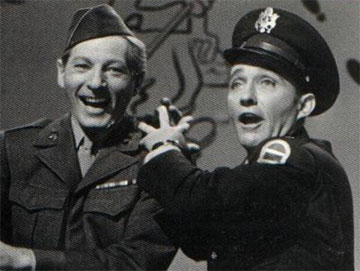
For me, it's hard not to compare 'Holiday' to 1954's White Christmas, one of my all-time favorites. Both films rely on the chemistry (and quasi-rivalry) with its two male leads, Crosby and Astaire here, Crosby and Danny Kaye in 'White.' Here between Bing Crosby and Fred Astaire, it ain't so much of a friendship, leaning far more to the rivalry-side. It plays like two high school students trying to one-up each other, Crosby's Jim falling for Reynolds' Linda, Astaire's Ted also falling for her as a dancer partner, wanting to take her to the big time as an entertainer. So friendship is out the window, but the rivalry does provide some fireworks, the rivalry nonetheless showing off that chemistry between the duo. It's always fun too when the two rivals get to fight over the ladies in their lives, notably the angelic Linda and the conniving, man-eating Lila. Also look for Walter Abel as Danny, Ted's conniving manager with dollar signs for eyes.

Enough with acting and story, onto the songs!!! Yeah, I know, pretty manly intro. When the music is from composer Irving Berlin, it doesn't matter the movie. I'm going to be on board. 'Holiday' is probably most famous for really putting one of the best Christmas songs ever, White Christmas, out there for audiences to appreciate. For the four people who haven't heard the song, listen to it HERE. With Bing Crosby singing, we're talking about one classic Christmas carol. 'Holiday' even won an Oscar for the song while picking up nominations for best writing and best original story. It deserves its status as a worthwhile, classic holiday movie for that song alone.

More than just one song though, 'Holiday' has 12 different songs written expressly for the script/screenplay. The story more than anything is simply an excuse to string the songs together into something coherent more than just a stage/entertainment show. That's where the style comes in, Jim's Holiday Inn only opening for the major holidays, stylish calendar inserts introducing one number after another. Without posting a boatload of links, check a series of them out HERE. There is most definitely a variety to choose from. Some give Bing a chance to sing, others a chance for Fred to dance and with crossovers featuring both, not to mention Linda and Lila getting into the action. Never a dull moment, and musical numbers that are entertaining without being awkwardly embarrassing and find new ways to get those numbers into a story.

There is one other thing worth mentioning. A musical number for Lincoln's birthday, Abraham, has Bing and Marjorie, the band and the waitstaff in blackface. All sorts of politically incorrect in this very politically correct era. Naturally, it doesn't age well to the point its laughable in its execution. Decent enough song, but it's hard not to chuckle at it now. Watch it HERE. I didn't find it particularly offensive, but be forewarned, some people are offended far easier than I am. Also in the cringe-worthy department is Jim's cook/maid/housekeeper, Mamie (Louise Beavers). Not bad stuff, just a little dated. Still, the movie itself is a gem, well worth checking out for the holiday seasons.

Holiday Inn (1942): ***/****

Thursday, June 13, 2013

Angels in the Outfield (1951)

Growing up, you appreciate some movies more than you probably should because....well, because you're a kid. When you're a kid, everything's cool. One of my favorite movies as a youngster was 1994's Angels in the Outfield. Oh, by the way, I still love that movie. It took years for me to discover that the 1994 Disney movie is actually a remake. Who knew? Here's the original, 1951's Angels in the Outfield.

It's midseason, and the Pittsburgh Pirates and foul-mouthed manager Guffy McGovern (Paul Douglas) is slowly losing his mind. Fans are turning on him, his players hate him and his "managerial tactics," and the press corps is ready to lynch him. One day, a home and garden-esque reporter, Jennifer Paige (Janet Leigh) writes a scathing column of his antics, finally pushing Guffy to the brink. Following one game, Guffy hears an angel address him, telling him to clean up his act and stop berating his team, fans and umpires alike. As long as he does that, angels will help out his team. Guffy obviously thinks it's a big prank....until the hapless Pirates start winning a whole lot of games. Could something heavenly actually be helping the Pirates? The gruff manager keeps his secret just that, secret, until one day a little girl, Bridget (Donna Corcoran), comes out to a game and actually sees the angels on the field. Is Guffy's secret blown for good?

I love sports so I'll watch basically anything even remotely sports-related. But of all the sports, baseball will always be my favorite. The sport translates seamlessly to the big screen, and this entry from director Clarence Brown is an underrated one. So story and characters aside, I think any true baseball fan will get a kick out of this one. It was filmed on location at real-life stadiums, especially Forbes Field in Pittsburgh but also look for Old Comiskey Park in Chicago and a Wrigley Field lookalike in L.A. That throwback, nostalgic feel of a baseball era long since past is evident from the opening credits -- a sample of Take Me Out to the Ball Game -- and never really lets up. There's an appreciation for baseball here that any fan should get a kick out of.

If I didn't know any better, I would have said this was a flick directed by the master of the cornball sap, Frank Capra. I was wrong, but the tone isn't far removed from typical Capra sweetness. There's always that potential with a really happy, sweet story that it goes too far, but that's not the case here. That's the word that comes to mind though; sweet. It's a good story without a mean bone in its body. We never actually see the angels out on the field or in the dugout, only that Corcoran's Bridget sees them clearly on several occasions. Is it a surprise that Douglas' gruff Guffy becomes a sweet, lovable guy? Nah, not at all. At different points I found myself questioning the movie. If angels are helping the Pirates then does that mean they're rooting against other teams? I think it's a valid question, but quickly put it out of my mind. This isn't a film interested in that at all. It's a good, old-fashioned, entertaining story.

Without featuring much in the way of star power, 'Angels' benefits from a lesser known cast. Douglas is an underrated actor, hamming it up a bit here as Guffy but never pushing too far. Leigh is mostly around as a pretty face -- no disrespect intended -- as the non-sports reporter trying to figure sports out. I thought the best part was nine-year old Corcoran as Bridget, a young orphan who spots the angels and bonds quickly with Guffy and Jennifer over the course of the season. It sounds sappy (sorry, I'll stop using that), but I thought it was a cool touch that the angels only appear to a child (an innocent), and not too cynical adults. Also look for Keenan Wynn as the angry radio man with a hatred for Guffy, Spring Byington and Ellen Corby as the nuns at the orphanage, and Bruce Bennett as Saul, a veteran pitcher trying to make it through one last season. Bing Crosby, Yankees legend Joe DiMaggio and baseball great Ty Cobb also make some cool cameos as themselves.

There are things here that I could easily criticize if I was in a foul mood, but I'm not going to. Guffy talks to an angel (voiced by James Whitmore) out on a dark baseball field with the game already in the books. We hear about 'the Heavenly Choir,' the team of angels that are helping the Pirates with some "hunches" in-game. If this sounds like a cop-out, so be it. You can't overthink/overanalyze this movie. Just enjoy it. It's that perfect mix of sappy, cornball charm with some baseball and old-fashioned Americana in it. Appreciate it and sit back.

Angels in the Outfield (1951): *** 1/2 /****

Saturday, September 22, 2012

Let's Make Love

Oh, no, here I go again doing another musical review. Okay, that's not entirely true. A comedy with musical numbers, but I'm definitely leaning more toward the musical department with this one. Drawn in by a talented cast, I nonetheless came away unimpressed with 1960's Let's Make Love. Scandalous title? I suppose people had sex in the 1950s/1960s, but do they have to rub it in our face like this?

A billionaire who has everything in the world he could ever want, Jean-Marc Clement (Yves Montand) is internationally known as quite the ladies man. He's approached by one of his PR men, Alexander Coffman (Tony Randall), with news of an off-Broadway play that's going to poke some serious fun at him. Jean-Marc wants to go check out a rehearsal, see what it's all about, but there's a hiccup. Arriving at rehearsal, two things happen. First, he is immediately struck by Amanda (Marilyn Monroe), one of the actresses, and second, he's mistaken for an impressionist of....himself. He's hired and in hopes of getting the girl, goes along with the plan to play himself. And let the hijinks and shenanigans begin!

Far more for the cast aspect than the musical, I dove headfirst into this George Cukor-directed quasi-musical. The potential early-on was certainly there, but over the course of a 119-minute movie that potential never actually left the landing pad. It has a somewhat checkered past as everyone from Gregory Peck to Yul Bynner turned down the part (find the full list HERE at Wikipedia), an uncredited Arthur Miller revised the script to give more screentime to Mrs. Arthur Miller -- Marilyn for those keeping track at home -- and oh, by the way, Monroe and Montand had on-set affair. Awkward much?

My revised stance on musicals is that if there is a worthwhile cast I should at least give it a try. Of the three names listed above though, Monroe is the only one who ends up being even remotely memorable. She sings, she dances, and once again shows that she is not just eye candy. Side note: She looks beautiful. End of side note. Monroe could act too, and not just a ditzy blonde. Montand is a little stiff for the part, and while I've liked him in everything else I've seen him in, he just isn't very likable here. Chemistry off-screen with Monroe maybe, but on-screen, I never bought their possibly budding relationship. As for Randall, it's just not his fault. He provides some laughs early on, but the script basically has his character written out in the second half. He sits and watches other people act/dance/sing. Literally. He sits there off stage and has to smile. What a waste of a very funny comedic actor.

So that potential I was talking about, huh? I thought I'd stumbled upon a hidden gem early on. The opening montage, a history of the rich but always ill-fated Clement family, is hysterical in its dark humor. Montand's face is super-imposed on images throughout the Clement history, a succession of his ancestors earning their millions and dying in some tragically funny way. The laughs sort of dry up after that opening three minutes. That's a good sign of a movie if there ever was. Also look for three cameos that make the draggy middle portions almost watchable. As Jean-Marc tries to impress Monroe's Amanda, he hires coaches in the form of Milton Berle (comedy), Bing Crosby (singing) and Gene Kelly (dancing). Playing themselves, the trio provides some much needed laughs.

Mostly though, things never click. Clocking in at just under two hours, this is a painfully slow movie. There are eight different musical numbers that aren't that bad in themselves, but when they slow up an already slow-moving story, we're in for a long ride. I'll recommend it for Monroe, Randall and the cameos -- too short though they are -- but I was bored almost from the start with this one, and it never gets better.

Let's Make Love <---trailer (1960): **/****

Sunday, February 20, 2011

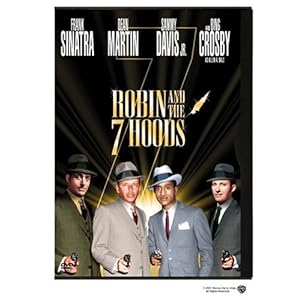
Robin and the 7 Hoods

In the early 1960s, the unquestioned kings of cool were the Rat Pack. NO ONE was cooler than this group of singers, actors, entertainers, performers, whatever you want to call them. Frank Sinatra, Dean Martin, Sammy Davis Jr., Peter Lawford, and Joey Bishop were to quote Bill Curtis in 'Anchorman'...."the balls." They oozed suaveness and style and pulled it off effortlessly because they just were cool. They didn't need to try to be cool. The Rat Pack toured, they put shows on in New York, Las Vegas and around the world, and expanding into all markets, guest starred on TV shows and thankfully (in my mind at least) ventured into movies too.

The movies range from good to bad, the high point being the original Ocean's 11 while others like 4 For Texas, Sergeants 3, and a few others that aren't really official Rat Pack movies but feature much or some of the group anyways, like 1959's Never So Few.  These were not movies intended to sweep the awards season. These were just fun movies that were perfect flicks to watch with a big bowl of popcorn where you could sit back and shut your brain off for a couple hours and be entertained.  It was Frank and his crew being themselves, shooting it out, wooing some ladies, and generally doing some boozing and partying.  The one I'd never seen before was 1964's Robin and the 7 Hoods. A twist on the well-known Robin Hood story sounded appealing with Robin being transported to 1920s Prohibition gangster-filled Chicago. How could you go wrong? Make it a musical.

A well-known Chicago gangster, Big Jim (an uncredited Edward G. Robinson), is knocked off by all the Chicago mafiosos at a birthday party hosted in his honor.  The power in the city is up for grabs with one gangster, Guy Gisborne (Peter Falk), swooping in and taking things over. He develops a plan with the crooked cops that not everyone agrees with, especially a gangster from the Northside of the city, Robbo (Sinatra). Robbo has no interest in pooling his interests and starts to prepare for facing the wrath of the organized gangsters. With his own crew, including transplanted Indiana gangster Little John (Martin), sharp-shooting Will (Davis Jr.) and Alan A. Dale (Bing Crosby), Robbo accidentally donates a large sum of money to charity, earning the trust and favor of Chicago. It's not so easy though because Guy is still working with Big Jim's power-hungry daughter (Barbara Rush) who has her eyes set on her recently passed father's death.

My one defense going into this Gordon Douglas directed flick was that I really didn't know going in that it was a musical.  The other Rat Pack movies were more about the cool factor, the heists, the shootouts, the partying, the camaraderie, the inside jokes, and all those things are present here. A story about rival almost warring 1920s Chicago gangsters is almost impossible to mess up on entertainment value alone. But the story's flowing along, things are being put into motion and WHAM! Frankie, Deano, Bing, and Sammy start singing.  It's not that the songs are bad, anything but with the immense talents involved, it's that there are songs at all.  This is a story that would have worked just fine as a Rat Pack takes on 1920s Chicago story.

So what carries the movie in between the detours for some singing is what else? That cast.  Call Sinatra a one-note actor, but he did that one-note perfectly. He's not the typical leading man, relying more on humor and even at times a dark cynicism to play his part. It's Sinatra though, and he's cooler than you. Get used to it. Dean Martin is my favorite member of the Rat Pack, and he's the ideal second banana to Sinatra. Davis Jr. shines in a supporting role as Will, and Crosby is a high point as Will A. Dale.  Falk was never bad, especially in parts like this that let him ham it up in every scene.  As the conniving daughter, Rush is generally wasted playing a character that could have been completely removed from the movie for the better. Victor Buono and Robert Foulk are also good as Chicago police officials with their hooks in the mob.

With all these different elements working together and against each other (depending on the scene), the movie struggles to find any sort of rhythm.  With just the natural comedic chemistry this cast has together, you're going to get some laughs almost by accident or default.  That's not fair though because there are some genuinely funny lines, and a few running gags that produce genuine laughs. But the laughs come few and far between for the most part, the scenes in between dragging along at a snail's pace.  Even fast forwarding through some of the lengthier musical numbers, the 123-minute running time felt more like three or four hours.  Stepping in as a film editor, I'd take out the music, add some more humor, a little more gunplay, and you've got a winner.  If only, if only.

Boring at times, highly entertaining at others, there is just too much talent involved in this Rat Pack production not to give it a mild recommendation. Even at their worse, Frank, Dean and Co. were very likable with an on-screen presence that few other actors/performers have ever shown.  They all have an easygoing way about them that gives the impression of watching a group of friends hanging around shooting the shit. If nothing else -- and this might not mean as much to a non-Chicagoan -- Sinatra sings 'My Kind of Town.' It's hard to mess that up.

Robin and the 7 Hoods <---trailer (1962): ** 1/2 /****

Thursday, December 24, 2009

White Christmas

Ah, the Christmas movie. Everyone's got a favorite, and if they don't, well they're just lying. It's hard for me to pick just one, It's a Wonderful Life is surely top 2 (review to come in the next day or so), but then there's also A Christmas Story, Christmas Vacation, Jingle All the Way, and even Bad Santa. But right up there with 'Wonderful Life' is Irving Berlin's 1954 musical White Christmas.

This is one of the few musicals I can actually watch, partially because it's a Christmas musical (and what could possibly go wrong with that?) and also because Christmas crooner Bing Crosby is the star. Just like everyone has their favorite Christmas movie, usually anyone you ask can quickly identify their favorite Xmas song too, and for me, it's just about anything Crosby sings. His version of Berlin's White Christmas is the quintessential holiday song and serves as a nice jumping off point for this 50s musical.

Two song and dance men, Bob Wallace (Crosby) and Phil Davis (Danny Kaye), have hit it big since teaming up after WWII (Davis saved Wallace's life and basically guilts Bob into working with him). Their shows tour the country, filling theaters with their unique performances. While touring in Florida, they get a message from an old war buddy asking them to go check out his sisters' show. So Bob and Phil head to a club and see Betty (Rosemary Clooney) and Judy (Vera Ellen) Haynes put on their show. Through some shenanigans with a hotel owner, a sheriff and a burnt rug (it's not worth it to explain it all), all four end up on a train bound for Vermont where the Haynes sisters have been hired at the Pine Tree Inn, a ski lodge.

Arriving in Vermont, the quartet find there's no snow for skiing during the holidays and to top it off, their old commanding general, Thomas Waverly (Dean Jagger) owns the struggling inn. Quick thinkers that they are, Bob and Phil decide to bring their hugely popular show up and get some business going for Gen. Waverly. Whatever acts they can't get, they'll have the Haynes sisters fill in. As the plan snowballs though, Bob has one more surprise up his sleeve with noisy housekeeper and all-around busybody Emma (Mary Wickes in a very funny supporting part) always trying to figure out what's going on

At 120 minutes, it might seem somewhat long for a musical but the story never goes more than a few minutes without a musical number of some sort, whether it be Ellen and Kaye dancing, the whole cast doing a minstrel number (my personal favorite), the foursome spontaneously bursting into song about snow (another gem), or Clooney singing a love song. The point is the whole movie is an excuse for a very talented cast to show off their talents. The actual story while highly enjoyable and sometimes heartbreaking -- poor General Waverly -- is completely lost in the ongoing musical numbers. Ellen was a highly respected dancer in Hollywood, Clooney can sing with the best of them, and Crosby and Kaye are equally adept at song, dance or comedy. Composer Irving Berlin pulls out all the stops in delivering a long list of quality musical numbers.

This is a movie that's obvious as you watch it that the cast and crew had fun making it. Fred Astaire was originally supposed to star only to be replaced by Danny Kaye. Sure, it would have been great to see Crosby and Astaire in another holiday classic -- think Holiday Inn 2 -- but Crosby and Kaye are perfect together with on-screen chemistry to spare, including one hilarious bit as they perform as the Haynes sisters. Here's the girls' version, and then here's the gents' spin on it. Of course, it is a musical so there does have to be some romantic fireworks as Crosby ends up with Clooney and Kaye with Ellen. All four actors work together so effortlessly in making this Christmas classic. Clooney didn't act in many movies, but I've always had a crush on her because of this part. She can sing, do comedy and is the definition of a classic beauty.

A fun movie all around, and what would you expect from director Michael Curtiz, who also made a little film called Casablanca, maybe you've heard of it? Filmed in Vistavision with tons of bright colors and great visuals, this isn't just a typical musical but a great movie overall with dead-on casting, plenty of humor to spread around, and of course, some great musical numbers. Remember, that's coming from a musical-phobe who usually avoids them like the plague. A perfect Christmas movie and one I look forward to watching every year. Check it out on Youtube starting here, although I'd highly recommend the DVD.

White Christmas <----trailer (1954): ****/****

Tuesday, November 17, 2009

The Country Girl

Something about stars who died too soon endear themselves to audiences, actors like James Dean, Montgomery Clift, and Grace Kelly. In a movie career that lasted barely six years, Kelly made just 11 movies, more often than not playing a glamorous leading lady with style too spare. And why not? She is one of the most classically beautiful women to ever appear on the silver screen. But years before Charlize Theron figured it out, Kelly went completely unglamorous in a role that won her the only Oscar of her career.

The movie was 1954's The Country Girl based on a Clifford Odets play and also features some great performances from crooner Bing Crosby and always reliable William Holden. Fifty-plus years later, the film feels slightly dated and comes across as somewhat boring visually. It's a play turned into a movie that never left the stage for lack of a better description. But visuals aside, The Country Girl relies almost solely on the success of its three stars to make this movie memorable, and in that way it is a great success. Kelly won the Oscar for Best Actress, Crosby was nominated for Best Actor, and somehow Holden was snubbed a nomination for one of his best performances.

With just weeks to go before his play opens in theaters, director Bernie Dodd (Holden) is still looking for that ideal lead. He picks Frank Elgin (Crosby), a past his prime performer who's fallen out of the limelight after years at the top of his game. Dodd's producer and financial backer, Philip Cook (Anthony Ross), is not so convinced that Elgin is the right man for the job, but Dodd insists and demands and gets his way. Elgin has gone through some struggles over the years since the tragic death of his son, including a long stretch where he downed bottles of liquor as quick as he could find it.

But even with all these warning signs, Dodd continues to work with Elgin because he thinks he'll catch lightning in a bottle with his performance. As the opening day draws near, Dodd sees more and more how Elgin's wife Georgie (Kelly) controls her husband's life in almost every way. Then as a result, Frank seems to suffer, especially in his on-stage performances. But what Dodd is seeing is not the whole picture as Elgin puts up a brave front when talking with the director who stood up for him. When he's with his wife, Frank is a quiet, worried man who lacks any self-esteem and blames himself for their son's death (which is revealed in a flashback). Can director Dodd figure this out in time to save his show and job?

There are other background and supporting characters here and there, but Kelly, Crosby and Holden dominate the movie and a scene doesn't go by that at least two of these three aren't in. Kelly beat out Judy Garland, Dorothy Dandridge, Audrey Hepburn and Jane Wyman out for the Oscar, an award she fully deserved. The costuming department dulls down Kelly's beauty as much as possible, having her wear a large pair of glasses, putting her in quiet, dark clothes, and pulling her hair back. Filmed in black and white, Kelly looks like a mother in her mid 30s who has suffered through some horrific stretches in her life.

Her performance is solid throughout, but she takes it into another gear late in the movie in a confrontation with Holden's Dodd after Frank has started drinking again. Obvious SPOILERS but check it out HERE courtesy of Youtube several minutes into this clip. Too often, a beautiful actress or a handsome actor isn't respected for their acting abilities because they're just so nice to look at. And while Kelly was always a strong presence in her roles -- including her movies with Alfred Hitchcock -- her part in The Country Girl shows that she can handle a darker, meaty character. A fully-deserved Academy Award often remembered more for her beauty and style than acting ability.

As for her co-stars, Kelly had a ton of chemistry with both Crosby and Holden. She'd work with Crosby again in High Society two years later and with Holden the same year in The Bridges at Toko-Ri. Crosby is known for his singing and dancing ability more than anything (White Christmas is a personal favorite), but his boozing performer here is a less than pleasant fellow with his fair share of personal flaws. During the casting process, Crosby almost turned down the role because he thought he was too old, but the fact that he was significantly older than both Kelly and Holden works well in terms of the character. Just like Kelly, not your typical Crosby, but one that shows he was not just a song and dance man.

Now for Holden, who was probably one of the biggest male stars in Hollywood in the 1950s, with classics like Sunset Blvd., Bridge on the River Kwai, Sabrina, and Stalag 17 among others. Often criticized for basically playing a variation of...well, himself, he was the lone actor here not to get an Oscar nomination. To be fair, it was a loaded year, here's the 1954 nominees. As an audience, we see what the Elgin's marriage is like, but Holden's Dodd is in the dark. For all he knows, Georgie is a controlling, manipulative wife when really she's trying to protect her husband. But Dodd is always likable and sympathetic, a driven career man trying to avoid a flop of epic proportions.

A dated movie that is very 1950s, but in a good way. Youtube has it available in segments, starting here with Part 1 of 11. Filmed entirely on indoor sets, the movie won't lose any scope if you watch it on your computer. It's a movie that depends on the characters with nothing else to distract from a sometimes heartbreaking story about a couple struggling through their marriage and the director just trying to make a successful play. Highly recommend this one.

The Country Girl <----trailer (1954): ***/****