Anyone who's read more than a review or two of mine has most likely seen I'm kinda a big fan of spaghetti westerns, a new genre that audiences around the world ate up. But before the spaghetti westerns hit their craze in the 1960s, a different genre had already captivated audiences, the sword and sandal epic, like 1960's The Revolt of the Slaves.
It's been 300 years since the death of Jesus, and Christianity continues to spread throughout the Roman Empire, forcing the emperor, Massimiano (Dario Moreno), to take action. At the home of one powerful Roman, a new slave, Vibio (Lang Jeffries), has been purchased who shows a lot of fire and refusal to be kept down. He's caught the eye of his owner's daughter, Fabiola (Rhonda Fleming), for good and bad. She's intrigued by this mysterious new slave who isn't afraid of her or any refusal to do what she says. Vibio is actually a Christian too, caught up in the new religious movement. Both Vibio and Fabiola find themselves caught up in the fighting when Fabiola's younger sister, Agnese (Wandisa Guida), joins the Christianity movement while also catching the eye of the head of the Roman secret police.
Unavailable to watch on VHS or DVD -- that I could find at least -- this sword and sandals epic from director Nunzio Malasomma aired recently on Turner Classic Movies in a very clean, good-looking widescreen print. So many of these Italian sword and sandal epics have a stigma of being cheesy, cheap and goofy, but some money was clearly spent on this 1960 flick. The sets are impressive in scale, the wardrobe and costuming definitely aiding the cause as well. When the story does venture outside, the Italian countryside provides a fresh change of scenery, and composer Angelo Francesco Lavagnino's score is solid as well.
A lot of the little things definitely lean toward the positive here, but in the process, the story gets left by the wayside. To say the story drifts is generous and polite. People talk and scheme, Christians meet, Christians run, Romans pursue, and then we start over again. Rinse, lather and repeat. We see the same chases repeatedly, the same discussions and arguments, and needless to say, it gets tedious almost immediately. It finishes up in 102 minutes, but 'Revolt' feels significantly longer. The premise is there, the makings of a good script, but it never comes together quite like you'd want.
Much of that involves the actors. As far as star power goes.......well, there isn't any. Jeffries doesn't have much in the way of personality on the big screen, a bit of a problem when you're the leading man. The one name I recognized coming in, Fleming is all right as heroine of sorts Fabiola. The character is interesting, but there's something special missing. It also seems that mostly Fleming was cast for her physical talents, dressed up in a variety of low-cut and tight outfits. In that department, she comes up aces. The most interesting character is unfortunately a supporting part that disappears for long stretches, Sebastian (Ettore Manni), a Roman prefect at the head of his legion forced to hide the fact he's a Christian. A movie from his perspective would have been far more interesting if you ask me. Also worth mentioning is Fabio (Gino Cervi), Fabiola's father, Cervino (Serge Gainsbourg), the effeminate, snaky head of the Roman secret police, Valerio (Fernando Rey), a suitor of Agnese's, and Tertulio (Antonio Casas), a prisoner converting to Christianity.
The meandering, drifting story does feature a handful of fun if hokey-looking action scenes. Very, very choreographed hand-to-hand combat sequences are pretty goofy as stunt men wait to take punches and then fall dramatically. The highlight though is the finale in a mini-Colosseum, Christians tortured and killed by the bunch in all sorts of inventive ways. Underneath the arena floor, Vibio and his fighters battle with the African troops favored by the secret police. As for the cop-out ending, well, that's best left untouched. Good action, exciting stuff, and it just comes too late to be of much use.
Revolt of the Slaves (1960): **/****
The Sons of Katie Elder
"First, we reunite, then find Ma and Pa's killer...then read some reviews."
Showing posts with label Fernando Rey. Show all posts
Tuesday, May 21, 2013
Friday, October 26, 2012
The Price of Power
When I purchased a set of 44 spaghetti westerns for the low, low price of less than $15, I was psyched, but some selections from the group jumped out more than others. Some I'd never heard of, some I knew would be lousy, but judging from certain reviews I'd read, I was most looking forward to 1969's The Price of Power. Unfortunately, the final product just didn't live up to expectations.
A gunfighter with a reputation that hangs over him because of a 4-year jail sentence, Bill Willer (Giuliano Gemma) is in trouble. He's rumored to be a part of an assassination attempt on President James Garfield (Van Johnson), who is touring Texas with his wife. Willer's father (Antonio Casas) is gunned down investigating the matters when he stumbles upon the actual plot. Now, Bill is looking to not only clear his name but also to bring the real killers to justice while also saving the life of the President. Just all in a day's work for this anti-hero, right?
Spaghetti westerns are inherently weird, eccentric, off-the-wall and generally pretty odd. I've seen a ton of them so take anything I'm about to say with a grain of salt. From director Tonino Valerii, 'Power' is an oddity among oddities. At different points, it has conspiracy theories, long-winded speeches about politics, a not-so-subtle allusion to the JFK assassination, racist sub-plots, and is light on action compared to most. All those ingredients just didn't mix for me. On the positive, the music from composer Luis Bacalov is delightfully weird -- different from most Ennio Morricone knock-offs -- and any Sergio Leone fans will no doubt recognize countless locations from his 1968 classic, Once Upon a Time in the West. That's never a bad thing.
It's rare that a spaghetti western story has too much going on to this point. Well, that's not completely true. Usually when too much is going on, it means endless betrayals and back-stabbing, gunfights galore. That ain't the case here. There is very little gunplay at all. The Garfield addition to the story plays fast and loose with the facts -- killing him in Texas as opposed to Washington D.C. -- while also portraying it in ridiculously close fashion to the JFK assassination in Dallas. We're talking right down to the angle of the shot, and the reaction from Garfield's wife (Maria Cuadra). More than any of that, far too much time is spent in smoky backrooms as the assassination plot comes together. Head of the Pinkerton Detective Agency, Allan Pinkerton (Fernando Rey) is even involved in the plot! It's just all too much.
The casting ranges from acceptable to lousy to odd and out of left field. I've liked Gemma in several other spaghettis I've seen, but his performance here is fairly vanilla. A revenge-seeking gunfighter is nothing new to the western, but it's dull here. The best part of the character is his friendship with Jack (Ray Saunders), a black man who fought with Bill in the Civil War. Warren Vanders is the slick aide to Garfield, McDonald, always up to something for the good of the country. It's also pretty cool and worth pointing out that Benito Stefanelli -- usually a background player; a bandit or gunman in Leone's westerns -- gets a prominent role as the treacherous Sheriff Jefferson. An uncredited/unlisted Michael Harvey plays Wallace, the obsessed leader of the assassination plot. Plenty of other characters are cycled in and out in a revolving door, none making an impression. A badly dubbed Johnson is surprisingly good as President Garfield.
I thought there was certainly potential here as the story developed, incorporating the racial overtones of a long dead Confederate movement trying to revive the Civil War. Throwing Bill's black friend, Jack, into the mix, adds quite an interesting element into the story, especially when he's believed to be the assassin. It never clicks into place though. Just far too many elements working against each other for any of those separate elements to be truly effective. A disappointing, mediocre final product. You can watch the entire movie HERE at Youtube.
The Price of Power <---trailer (1969): **/****
Labels:
1960s,
Fernando Rey,
Giuliano Gemma,
spaghetti westerns,
Van Johnson
Wednesday, March 28, 2012
Navajo Joe
Since Burt Reynolds began working on TV in the late 1950s, the actor has pretty much never stopped working, doing movies and television shows over the years. But of all those parts -- and there's been some stinkers -- Reynolds thinks one stands below all the rest, his worst performance and movie ever. So goes 1966's Navajo Joe.
At the head of a gang of bloodthirsty cutthroats and murdering scalphunters, a bandit named Duncan (Aldo Sambrell) leads a vicious attack on a peaceful Navajo village. Men, women and children are massacred, their scalps taken for $1 bounty each. Duncan's gang moves on, working with a corrupt town official, Dr. Lynne (Pierre Cressoy) to rob a train and his own town of over $500,000. The job seems simple enough, but a survivor of the massacre remains, one warrior named Joe (Reynolds), who appears and disappears around the gang, killing one, two and three men with each of his attacks. Duncan becomes obsessed with killing him, especially with all that money on the line.
As Reynolds has claimed, is this his worst part? No, there's much worse out there, but as a movie, this wouldn't be a great introduction to spaghetti westerns. Stick with the Sergio Leone movies first, and then move on to lesser known entries like this. From director Sergio Corbucci (the "Other Sergio"), 'Joe' is rougher, cynical, aggressively in your face, and brutal. Corbucci was a shoot from the hip kind of director, rogue-like behind the camera with touches of an amateur. His camera is always moving, the shooting angles are always a tad off, and they never have (his earlier films at least) the polish of the Leone films. None of that's a bad thing, just know what to expect from Mr. Corbucci. With Django, The Mercenary, Companeros, The Hellbenders, and The Great Silence, he's responsible for some of the best spaghetti westerns around so he's not a talent-less schlub behind the camera.
So how about Reynolds as a Navajo warrior dispatching a gang of scalphunters? It is far from his worst work, but it ain't a great performance either. It's far from his fault. The script for 'Joe' isn't exactly the most well-written thing around, with plot holes and jumps in story all over the place. The 30-year old actor does his best though, and to his credit he commits. It's more of a physical performance than real acting (although thankfully he doesn't try to pull off an Indian "accent"). He leaps all over the screen, shooting, stabbing, jumping, strangling Duncan's gang. There are some unintentionally funny lines -- not just Reynolds, the whole cast -- but above all else, Reynolds looks comfortable. Looking to avenge his wife's death amongst the massacre, Joe is not going to be slowed up, no matter the odds.
As his opponent, familiar spaghetti western face Aldo Sambrell doesn't disappoint as the vicious half-breed, Duncan. Usually relegated to supporting parts, filling out gangs or playing a sheriff or bounty hunter, Sambrell does not disappoint when he jumps into a starring role. His Duncan is a great spaghetti baddie, on the brink of lunacy with past demons threatening to tear him apart. His gang seems to fluctuate as needed -- anywhere between 20-50 guys -- all of them ending up being characters without names, mostly because of their personal, unique and eccentric looks. Some include Jeffrey (Lucio Rosato), Duncan's half-brother, Robledo (Lorenzo Robledo), the quick-draw, trick-shot specialist, Sancho (Alvaro de Luna), the knife fighter, and Monkey (Simon Arriaga), the former Confederate soldier, among many others. Also look for Fernando Rey as what else? A Mexican priest, a role he played fairly often in the spaghetti era. Nicoletta Machiavelli plays Estella, a half-breed woman (Mexican/Indian), who sides with Joe in his efforts.
Besides Reynolds in the starring role, the thing that has helped 'Joe' live on some 40-plus years later is Ennio Morricone's musical score. It is one of the more unique, quirky scores Morricone ever did, and that's saying something considering how many unique, quirky scores he did in spaghetti westerns. The main theme especially stands out, a woman chanting (seemingly in some sort of pain) before a male choir and instruments kick in. Give it a listen HERE. One of the best things going for the movie on its own, it's received a rebirth thanks to 1999's Election. A young Reese Witherspoon is running for her high school's student body president and in the voting process, tears down all her opponent's posters. What music is playing? Morricone's chanting choir score. Spot-on use of his music too. Watch one example HERE.
So watching this movie for the first time in five years or so, I didn't like it as much as I remembered. It's still good in that guilty pleasure sense, but it's not a classic. The selling point will be the action, and it's particularly brutal. Shooting, stabbing, even a death by scalpel. Navajo Joe alone takes out 26 -- by my count, it's probably light -- of Duncan's gang, who also have over 10 guys killed attacking a heavily guarded train. We see some uses of squibs, and with Corbucci's touch, it is fairly graphic. It isn't a great movie overall, but it is a fun movie, best to watch with some friends and have some laughs.
Navajo Joe <---trailer (1966): ** 1/2 /****
Thursday, November 10, 2011
The Desert of the Tartars
I'd like to think I'm not a movie snob. I try to be open with all movies, but as I've discovered the thousands and thousands of films out there, some are just more challenging than others. We're not supposed to like or enjoy them, or even hate them for that matter. You're just supposed to watch the film and experience it. You challenge yourself sometimes with movies like these, like 1976's The Desert of the Tartars.
Completing his three years at the military academy, young Lt. Drogo (Jacques Perrin) has received his orders, riding to his post with dreams and hopes of adventure and heroism. He has been assigned to Fort Bastiano, a lonely, isolated posting along the country's border. He finds that nothing is as he thought it would. The fort looks out over the desert and a horizon that hasn't seen the enemy -- the Tartars -- in years. Are they even out there somewhere across the desert? Days turns to weeks, weeks to months and months to years here at the fort. The officers and garrison watch time move past them at a glacial pace, questioning what they're doing at this post. Will the Tartars ever come back? Will they attack?
How do you describe a movie like this? It is based off a controversial novel by Dino Buzzati that for years defied a novel-to-film adaptation. At different points, 'Tartars' is surreal, symbolic, other-worldly, philosophical, existential and so much more. It is a movie about waiting and what if? What is coming? What do you do with yourself as you wait? It is an incredibly striking film -- both good and bad -- that I have little to no idea how to interpret. I found myself wondering if the setting was a variation on Purgatory, not Heaven and not quite Hell but clearly not normal life either. I can't say I liked the movie, but it has to be seen to be believed in its weirdness, eccentricity and existentialism.
My thoughts on the Purgatory-like setting come from the visual look of the movie. Italian director Valerio Zurlini turns out one of the most visually imposing movies I've ever seen, an almost apocalyptic setting that looks like it could be the edge of the known world. Zurlini and cinematographer Luciano Tovoli create a world, this isolated fortress completely removed from the real world, miles away from civilization and all it offers. 'Tartars' was filmed in Bam, Iran, the immensely spacious but sparsely occupied fortress becoming another character in the story. Spacious is a good way to describe the movie. It is an immense movie. The desert all around is bigger than it seems because of what it represents, fear, intimidation, and in a weird way...hope. What's out there? These men are driven to the point they welcome an enemy sighting. One of the most beautifully simple visual movies I've ever seen, aided by Ennio Morricone's haunting, almost classical score.
In a story where basically nothing happens for the 146-minute running time, your enjoyment -- or hatred -- of this movie will no doubt come from the characters and their development, their own personal handling of this bizarre posting. Zurlini and star Perrin worked hand in hand to get this movie done, Perrin even contributing much of his own money to help complete the movie while serving as one of the film's producers. He does an incredible job as the young idealistic Lt. Drogo, the inexperienced but very capable soldier who both resents and welcomes his posting to Fort Bastiano. Where this performance works, where all the performances work really, is that the actors bring these individuals to life without much in the way of dialogue. They say a lot with their faces, looks saying more than words ever could. Perrin is great at it especially, and the physical transformation Drogo goes through is remarkable. A very strong lead, one that trickles down to the rest of the cast.
Assembling an international who's who cast, Zurlini has a truly impressive cast here. Max von Sydow plays Captain Hortiz, posted at Bastiano the last 19 years and supposedly the last man at the post to see a Tartar on the horizon. Giuliano Gemma is Major Mattis, the obsessed, career-driven officer with little in the way of personal interaction. Jean-Louis Trintignant has a small part but a good one as Rivone, the post's doctor who sees the men disintegrating around him. Fernando Rey's Nathanson is the one officer who's seen combat but is a shell of himself after suffering a horrific combat wound. Vittorio Gassman plays Fillmore, the beleaguered commandant in a no-win situation. Helmut Griem is Simeon, Drogo's fellow officer and best friend at the post, the two men almost willing a Tartar enemy to show up. These are not showy performances, none of them calling attention to themselves, but that doesn't mean they don't make an impression.
Now this far into the review, you're probably thinking 'Hey, this is pretty positive.' And it is. I intended it that way. What works well here is a home run. What doesn't work is awful. I'm not exaggerating when I say that in 146 minutes almost nothing happens. Visual and beautiful to look at is one thing, impressive performances another, but NOTHING happens. Zurlini wants to put you to sleep, just like the characters on-screen. He wants to lull you into this uncomfortable silence, this possibly impending doom. Even a surprise in the final moments is so underplayed that it doesn't make the impact it could have. The final 30 minutes do pick up the pace -- thankfully and mercifully -- to the point where the ending is effective in that sense of doom.
So where does it fall in the end? The deliberately slow pacing no matter how much I try to push aside as a minor complaint just isn't. This was a difficult movie for me to get through especially considering the two-plus hour run-time. I'd like to believe the performances from the very deep cast and the incredible look of the movie are enough to recommend the movie, but even there I'm struggling. It is a movie that defies ratings in a way, but the positives are that good. Barely....just barely, I'll go positive here.
The Desert of the Tartars <---trailer (1976): ** 1/2 /****
Friday, May 20, 2011
Land Raiders
Thanks to the huge success of Sergio Leone's Dollars trilogy starring Clint Eastwood in Europe and around the world, American studios were left trying to figure things out and somehow keep up. American audiences had grown somewhat tired of the same old westerns by the late 1960s so seeing the success the spaghetti western genre made, the studios made similar movies that's become part of a whole new sub-genre of westerns, Italian westerns made with American backing.
These were movies that at first glance look and feel like a hard-hitting, dark spaghetti western. Give it a closer look though, and things are a little different. The casts lean more toward American actors and actresses for one, and for the most part, they ease up on the gas. So with that, you see movies like 100 Rifles and El Condor among others. Of course, some went all-in, throwing all their chips in, taking everything that made the spaghetti westerns so good and taking it up a notch or two. I saw the end to 1969's Land Raiders a hundred times or so growing up on TBS' Afternoon Movie, and thanks to Netflix Instant watch, I caught up with it this week in its entirety.
In the Arizona territory in the 1870s, Vince Carden (Telly Savalas) has assembled millions of acres of land, his Carden Ranch dominating the area. He has hopes of building the ranch bigger and bigger, making himself the richest man around. His younger brother, Paul (George Maharis), has ridden back to see his ailing father after several years away from the ranch, a falling out with his brother driving the family apart. Paul still despises his brother for what he did in the past, but their family problems look ready to be swept away. An Apache war party is terrorizing the territory, and Vince sees the potential to wipe out every Apache for hundreds of miles around. His plan though has the potential to backfire, putting the lives of everyone else in the territory at risk.
Writing past reviews of spaghetti westerns, I haven't been shy about my love for the genre. This darker, even harsher quasi-spaghetti is going to fall under that category. It isn't a particularly good movie with its fair share of cheese, bad acting, and low-budget qualities. I still like it though. Director Nathan Juran uses a handful of familiar locations in Almeria, albeit the greener, more picturesque areas of the region. I recognized the town from Django Kill! (among others), and the church from Guns of the Magnificent Seven. Composer Bruno Nicolai's score -- a frequent collaborator with spaghetti master Ennio Morricone -- seems to sample from a long list of spaghetti scores, but it's good samples if nothing else. I can't place the main theme (listen HERE), but even its familiar tune (especially the quieter moments) work well.
Like many westerns, 'Raiders' has its roots in some Greek tragedy, even Biblical roots with Maharis as the Prodigal Son returning home after years away from his family. In the darker, almost gothic tones of the movie, you get that sense of Greek tragedy, the family tearing itself apart, the individual members on the brink of killing each other. The motivating force here is a mystery with a young Mexican girl, Luisa (Jocelyn Lane), who was engaged to Paul but died under mysterious circumstances, apparently linked to Vince. A handful or so of grainy, fuzzy flashbacks pepper the story, adding a second layer to the proceedings even if it is clear what actually happened right away. I'm not saying Land Raiders is any sort of modern classic -- far from it -- but it is interesting, striving for something more than just a 90-minute shoot 'em up.
With the idea of the quasi-spaghetti comes the casting of two American actors as the leads, one a future TV star and the other a TV star of the past. Savalas is one of my favorites, a versatile actor who could play good, bad, amoral, and in between. Here, he's fully embracing his epically bad side. There is not a redeeming character about his Vince character, and that's the beauty of it. He's one bad dude, and you know karma is coming around to kick him square in the butt. Five years removed from Route 66, Maharis was still trying to become a bigger star, something he never really attained. His Paul is the more sympathetic of the two Carden/Cardenas brothers, even if Maharis makes a pretty bad attempt at a heavy Spanish accent and looks like a gay caballero all duded up immaculately in clothes that look like they've never seen the trail.
Trying to one-up the spaghetti westerns, 'Raiders' certainly does its best to push the boundaries as so many movies did in the late 1960s. This movie has it all, surprising amounts of language (Savalas even calls a woman a bitch), some gratuitous nudity, and over the top violence that uses squibs and gallons of that ultra-red blood-like substance. Where other movies edit this type of thing into the movie in a subtle fashion, 'Raiders' doesn't really care. A woman captured by Apaches has her shirt ripped off. Oh, a topless woman! The camera lingers a little too long. The violence is a little shocking, some graphic depictions of scalpings, among other things. Changing times for the western genre, and Land Raiders doesn't disappoint in trying to do something very different.
Leading into the supporting cast, one odd note. Character actor Paul Picerni plays two parts in a bizarre fashion, no explanation provided. The studio clearly thought it could pull a fast one, listing one character as played by Picerni, the other by H.P. Picerni. One character is a murdering gunman working for Vince, the other an old fun-loving Mexican friend of Paul's. Too weird, just one of those things I guess. Other parts worth mentioning include Arlene Dahl as Martha, Paul's wife, Janet Landgard as Kate, a young girl all grown up with a crush on Paul, Guy Rolfe as Major Tanner, the local cavalry commander, and Phil Brown as Sheriff John Mayfield, Kate's father caught in the middle of a situation with no easy way out. Even look for spaghetti regular Fernando Rey as what else? A priest. A good western that isn't really that good at all, but it's a solid guilty pleasure.
Land Raiders <---trailer (1969): ***/****
Labels:
1960s,
Fernando Rey,
George Maharis,
Paul Picerni,
Telly Savalas,
westerns
Thursday, October 7, 2010
The Running Man (1963)
In a career that spanned just over 30 movies, Reed carved a niche out for himself as a solid storyteller able to make the usual/the norm visually interesting. Of the movies I've seen of his, the camera style is unique with a variety of types of shots from angles and perspectives you wouldn't normally think of. He often filmed in black and white -- although not in 'Running' -- and had an eye for creating a movie that was interesting to watch in terms of story and to the eye, never a boring sequence in sight. Okay, maybe one or two, but less than most directors.
After an insurance claim is denied because he let the renewal go a few days late, pilot Rex Black (Laurence Harvey) concocts a plan to get some badly needed money. He fakes his own death in a crash at sea after signing up for a new insurance plan, and a few months later his wife Stella (Lee Remick) gets a check from the insurance company that assures they'll never be poor again. Stella waits a few months and meets Rex -- now posing as an Aussie businessman with bleach blond hair -- in Spain where they prepare for their future. Rex begins to bring up the idea of pulling the insurance scam again only to have a surprise dropped in his lap. The insurance agent (Alan Bates) who handled the recent case with Stella is in Spain too. But what are his intentions? Is he vacationing or investigating? Paranoia and worry settle in, but can Rex and Stella figure out what's going on before it's too late?
If I've figured anything out about Reed and his storytelling technique, it's that he likes to keep his viewers guessing. And after some slow early moments here, Reed ratchets up the tension with each passing scene. When Bates' Stephen shows up in the same Spanish town, the new couple of crooks are instantly put on the defensive. Rex and Stella can't be mean or ignore this curious stranger without setting off alarm bells, but is Stephen just interested in Stella or is it something deeper? Even though they're crooks, I found myself rooting for the couple, well maybe just Stella. There's not really much of a twist when the answer comes, but the more surprising things come in the last 20-30 minutes after the supposed twist.
For a story meant to keep you on your toes, Reed has a way of disarming you in the same scenes he sends a shiver up your back. The movie was filmed in Andalucia and Gibraltar, and for fans of spaghetti westerns, you even see some familiar locations, especially the bullfighting ring from A Bullet For Sandoval. So while the story develops, the background works almost as a travel guide for the area from the sun-swept country roads near the ocean to the idyllic little towns with its motels, markets and vendors. Choosing not to film in black and white was a wise choice here as Spain gets to show off its beauty.
As the credits rolled at the beginning of the movie, all I could think was "Man, after those first three names I don't recognize anybody." Well, my worries were unfounded as the main trio dominates the movie with little outside interference from the supporting cast. I continue to catch up with Harvey who I've only see in four or five movies. He can be very theatrical in his parts, but the guy can straight up act. His character goes through the biggest transformation, and not always a good one; a slighted man looking for a second chance after a mistake to a vengeful, greedy individual wanting piles of cash. Remick is his wife, a woman who loves her husband despite what he becomes. Bates is the wild card, keeping you guessing as to exactly what's he up to. Of the supporting cast, the only face I recognized was Fernando Rey as a Spanish police investigator.
During the last act of the movie, the old idea that "bad things happen to bad people" certainly rings true. I didn't necessarily like the ending as one character keeps a huge secret to themselves rather than reveal it. The impact is obviously huge and caught me off guard and disappointed at the same time. None of this is enough to deter me from recommending the movie. After those early struggles with pacing, 'Running' finds it rhythm and quickly settles in for the ride.
The Running Man <---TCM clips (1963): ***/****
Labels:
1960s,
Carol Reed,
Fernando Rey,
Laurence Harvey,
Lee Remick
Friday, April 16, 2010
A Town Called Hell
When watching a spaghetti western, there's a certain amount of weirdness to be expected. After all, these were typically European directors/producers/screenwriters interpreting the American west so weirdness just comes with the territory. But beyond anti-heroes and crazy villains, the spaghettis were often heavy on graphic violence, religious imagery and symbolism, and no penchant for having to have a happy ending. Basically, everything I like in a western.
For years, the craziest spaghetti I saw was 1967's Django Kill! which features some truly disgusting violence, a gang of gay cowboys, and...wait, that's enough, violence and gay cowboys is a good explanation. Last night on Netflix Instant viewing, I checked out 1971's A Town Called Hell for a couple reasons, I've never been able to actually track a copy down, and two, the cast looks ridiculously good. It's not a straight Italian spaghetti western with British and Spanish backing, but it's got all the right elements. If anything, it's got too many elements. This one is all over the place and ranks right up there with Django Kill! for new weirdest spaghetti.
It's 1905 in Mexico (right in the middle of the Mexican revolution for you history buffs). A widower, Alvira (Stella Stevens) rides into the dusty, rundown town of Bastardo -- not 'Hell' as the title implies. She is offering $20,000 for the man who murdered her husband, but she doesn't know who he is, only that he's in the town. Alvira's only clue is a name...'Aguila.' But other than that, she's got nothing to go on. Three key people in Bastardo seem to have information. There's the Priest (Robert Shaw), the Colonel (Martin Landau) with his army detachment, and Don Carlos (Telly Savalas), the town's corrupt mayor/bandit. But nothing comes easy, and the betrayals start flying and the bodies start to add up.
Where to start? Spaghetti westerns generally had an extremely dark tone full of cynicism and violence, lots of anti-establishment feelings. 'Hell' certainly qualifies because no character is safe. The violence isn't graphic but it is brutal in its honesty. There are hangings, stabbings, shootings, and so much more. The setting for this is a really desert town that has fortress walls on all sides, and even though the movie was made/filmed in Spain, it looks like Mexico in all its dusty, dirty glory. I'm positive I'm reading too much into this, but the town could be some sort of purgatory, some bizarre version of hell. Or it could just be a whacked out western, you make the decision.
The story itself is too interesting with director Robert Parrish mixing and matching left and right. An IMDB user stated there's at least 15 plots, they just last 2 or 3 minutes before moving on, and really, that's a pretty accurate description of this gothic, dark western. Stevens sleeps in a coffin at night and has a pale deaf-mute protector, Spectre (Dudley Sutton), with her at all times. Savalas is a violent dictator with an iron fist on this town...until he doesn't anymore when his men turn on him, crucifying him. Shaw has a vivid dream where Stevens' Alvira kills him in his sleep. Landau as a Mexican officer? That does seem pretty logical. A flashback with a sped-up version of the Battle of New Orleans and a bizarre, confusing backstory just caps it all off. That's the movie in a nutshell, always moving and never slowing up enough to know how ridiculous it all sounds.
Through all of the craziness, there's a really cool if sometimes odd cast. Robert Shaw is one of my favorite actors, and he's the star here. Simply named 'the Priest,' he has a past that still gnaws at him, and he seems to be the only person who knows who 'Aguila' is. On a non-consequential level, Shaw is also sporting a badass handlebar mustache and mutton chop-like sideburns. Savalas is the shirtless bandit mayor (honestly, in his 30 minutes he never has a shirt on) who gets to ham it up. His departure about 30 minutes does come as a surprise, mostly because we never see how he gets whacked. Landau is the only one who doesn't work because well, he's not Mexican. He's loud and obnoxious but still isn't a good villain. Stevens is wasted -- but looks good doing it -- and appears like she wandered into the set and just started reciting lines.
There's also supporting parts for Fernando Rey as an old blind man who may hold the key to Aguila's identity, spaghetti western regular Aldo Sambrell as Calebra, one of Don Carlos' thugs, TV star Michael Craig in flashback as Paco, one of the Priest's partners, and Al Lettieri as La Bomba, Carlos' not so smart treacherous right hand man. What I liked about this western -- and I did like it -- was the general weirdness of it all. There's this great cast and no story (not a coherent one at least), but all the little things add up. Recommending this almost in spite of itself.
A Town Called Hell <----trailer (1971): ** 1/2 /****
Saturday, September 19, 2009
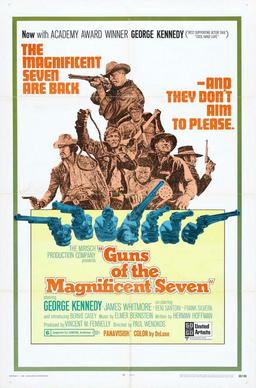
Guns of the Magnificent Seven
Now this may just be me, but George Kennedy doesn't resemble Yul Brynner too much. After two Magnificent Seven movies with Brynner as the star, the third movie starred a new 'Chris' leading a new 7, Kennedy. Of course the posters over at IMDB have to nail this down. So is he the same character? A different man named Chris? Did he undergo extensive plastic surgery? Okay, maybe not that last one, but you get the idea.
Three years removed from Return of the Magnificent Seven comes director Paul Wendkos' take on the popular series, 1969's Guns of the Magnificent Seven. It's a departure from the first two movies with Kennedy, a year removed from his Oscar from Cool Hand Luke, stepping into the saddle. But where 'Return' was basically a rehash of the original classic, 'Guns' gets points for originality both in story and casting. Also, having Elmer Bernstein's score doesn't hurt, especially with some new notes in the music.
Deep in Mexico, a revolutionary leader, Quintero (Fernando Rey) is captured by a sadistic Mexican colonel, Diego (Michael Ansara), who runs a prison that resembles a fortress more than anything else. One of Quintero's most loyal followers, Maximilliano (Reni Santoni) heads north to look for help in getting Quintero out of prison before it's too late. In a border town, Max finds a man named Chris (Kennedy) who's in the process of saving another man, Keno (Monte Markham), from a lynch mob. Chris agrees to help out and assembles a group of specialists to help him in the prison break. They seek help from a local bandit Lobero (Frank Silvera) and his gang -- quite a change of pace since the 1st one, huh? -- but the odds still seem impossible.
The Seven: Kennedy is more than capable of handling the lead role, and while he doesn't look like Brynner at all, he brings the same characteristics to the part; loyal, honest, and always willing to stand up for the downtrodden. As for the other six, this is by far the most unique group when comparing the three sequels. Markham as Keno, the Steve McQueen right hand man role, isn't given a ton to do after his introduction, but as a right hand man, he does what he's supposed to; look cool while helping the leader. Santoni's Max is a youngster with little fighting experience but who wants nothing more than to join the fight.
In adding a black character, Bernie Casey's Cassie, a dynamite expert, the dimension of race is added and even more so with another member of the seven, Slater (Joe Don Baker), a one-armed Confederate gunslinger. Cassie and Slater would seem to have nothing in common, but a friendship develops when they realize how similar they really are. James Whitmore, as solid as ever, plays Levi, an aging knife fighter who's settled down with a family but takes the job for the $. Adding some depth to the character, Levi bonds with Emil (Tony Davis), a young Mexican boy looking for his father. Unfortunately, the 7th member, P.J. (Scott Thomas) receives little development which is a shame because a expert gunfighter/rope thrower dying of tuberculosis has some potential.
The Villain: A definite step up here after Emilio Fernandez's part in 'Return.' Michael Ansara plays Diego to a T. He's a sadistic commandant trying to snuff out the revolution in his district no matter what the cost, especially when it comes to torturing his prisoners. One torture scene midway through the movie shows a creative way to take care of prisoners, bury them in sand up to their throats and then trample and suffocate them with horses walking all around them. Ansara's Diego isn't as developed as much as Calvera or Lorca, but he's just a straight bad guy and sometimes that's all you need.
Some critics said this movie is too slow-going and to be fair, there isn't a ton of action. But really, none of these movies are action-packed. Characters are introduced, we get to know them, and then throw in the action so that when some of the 7 do eventually die, their deaths mean something emotionally. The finale in 'Guns' is on par with the shootout at the end of the original. Finally ready for their assault, Chris leads the 7 and a small group of farmers in an attack on Diego's prison, dubbed the 'Cave of the Rats,' and his 200-man garrison.
It's loud, chaotic and violent, and completely different from the rest of the series. For one, the 7 go on the attack instead of waiting to be attacked against larger numbers. Second, two characters are killed almost at the outset of the battle, and for awhile it looks like the plan might actually fail. Semi-SPOILER I'm convinced Max was supposed to die, he gets absolutely riddled by at least 3 Mexican soldiers, but he's there at the end, apparently just wounded. This would have been the first Mag7 movie to kill 5 of the 7 END OF SPOILER. The attack is a great action sequence from start to finish, and the prison set looks pretty cool too, and even with some other surprises as to who survives and who doesn't to keep you guessing.
A worthy sequel to the original for sure. It does justice in every way while still putting its own spin on a familiar story. Good casting and a strong script that really fleshes out the new members of the Magnificent Seven with a great, action-packed finale. Next up...the finale, The Magnificent Seven Ride!
Guns of the Magnificent Seven <----trailer (1969): ***/**** (Best tagline ever: 7 Against 700; They Just Couldn't Lose!) MASSIVE SPOILERS: Cool fan-made video breaking movie down
Wednesday, September 16, 2009
Return of the Magnificent Seven
The sequel picks up 10 years after the conclusion of the first movie. Chico (Julian Mateos instead of Horst Buchholz) is still living in the village he helped save with his wife Petra (Elisa Montes) and son. But one day, a gang of bandits ride into the village and basically kidnap every male and march them out into the desert. Petra goes for help, finding Chris (Brynner) in a nearby border town. Assembling a new group of seven, with Vin (Robert Fuller instead of Steve McQueen), Chris rides south to rescue Chico and the other men from the village.
What they find is a small city being built in the middle of the desert, the workings of an eccentric rancher, Francisco Lorca (Emilio Fernandez). Lorca needs all these men to build the town and most importantly, a church, in honor of his two sons who were killed on the location during a recent uprising. Chris and the six bully Lorca out of the way, but the Mexican rancher won't go quietly, forcing the Mag7 to hole up and try to defeat Lorca and all his gunhands.
The new Magnificent Seven: With two more sequels to go, I'll get this out of the way now. You can't cast a movie with the caliber of actors that were in the first one. Brynner is back, and we do get some background information on him which is cool to find out about. McQueen was reportedly offered the part of Vin but chose not to reprise the role unfortunately. It's an average western as is, but with him, it might move up a notch. Fuller is capable enough but doesn't bring a ton of personality to the part. And in the upgrade department, Mateos makes a good Chico. For one, he's actually Hispanic, not German.
On to the new members of the seven, led by Warren Oates and Claude Akins, two great character actors ideally suited for key supporting roles here. Oates plays Colbee, a gunslinger with a wandering eye for the women, signing up with Chris when he hears about a village occupied by only women. It's a funny part, but one with some darkness to it as Colbee explains some of his background with Chris. Akins is Frank, a gunman looking to get himself shot up for the guilt he holds from something in his past. Also joining the group are Virgilio Teixeira as Luis, a Mexican bandit Chris frees from jail, and Jordan Christopher as Manuel, a young Mexican boy inexperienced with guns looking for somewhere to belong.
The Villain: Eli Wallach set the bar about as high as it could go with his part as Calvera so it would be difficult to live up to the original. Emilio Fernandez (Mapache in The Wild Bunch) just isn't as strong an opponent as Wallach's Calvera, and that's with about five times the amount of gunmen with him. His back story is interesting, but it makes him seem like a weak old man, not an intimidating, half-crazy madman. Fernando Rey has a small part as the wise village priest.
Overall, that's the problem with this first sequel. At 95 minutes, 'Return' is 33 minutes shorter than the first movie. The script seems thrown together in a rush job once the seven are assembled. Then, once the situation is laid out, it's basically 35 minutes of siege fighting as Lorca and his men attack the seven in a half-built church. The action scenes are well put together, if a little ridiculous (especially the finale), but with little build-up they're just there. The same issues are there with Chris and Vin questioning what they've done all these years, surprisingly enough producing some emotional moments.
Part of me wants to say that if this movie was just released on its own with no predecessor, it'd be a more highly regarded movie. But following in the rather large footsteps of the original, it would be almost impossible to match the enjoyment and excitement. 'Return' is worthwhile and an entertaining western in spite of some flaws, but don't expect a classic going in and you should be okay.
Return of the Magnificent Seven <-----trailer (1966): ** 1/2 /****
Labels:
1960s,
Burt Kennedy,
Claude Akins,
Fernando Rey,
Julian Mateos,
Sequels,
Warren Oates,
westerns,
Yul Brynner
Subscribe to:
Posts (Atom)