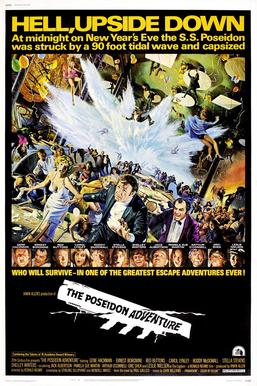
Every so often I get embarrassed when it comes to movies. Yeah, those movies you should have seen by now. The classics for good and bad, the great performances, an award-winning something or other. We've all got them. I do my best to make sure that list is ever-shrinking, but there are gaps. So while I've reviewed all sorts of dud disaster flicks from The Swarm to When Time Ran Out, I'd never seen one of the first disaster films all the way through in one sitting until a recent viewing. Here's 1972's The Poseidon Adventure. Don't judge me. You think you're better than me?!?
Sailing from New York City to Athens, the S.S. Poseidon is making one last voyage after years of service around the world, a ship destined for the scrap heap. That voyage is behind schedule though, and its captain (Leslie Nielsen) is under pressure to make up some serious time with so much money on the line. That speed may make up lost time but it puts the ship, crew and passengers at serious risk, but none of them know what awaits. Sailing through the Mediterranean, the Poseidon receives news of an immense earthquake off the Greek coast and its repercussions are heading right for the fully-loaded passenger ship. During a New Year's Eve celebration, an enormous wave moving at dangerous speeds is coming right for them. The ship is capsized in the wave's wake with much of the crew and many passengers killed. One small group survives though, and led by a fiery, trouble-making reverend, Scott (Gene Hackman), they try to make it through an upside down apocalyptic environment that was their ocean liner. Can they make it to the hull and possible rescue?
When it comes to disaster movies, I typically associate two movies with kick-starting the genre into its highest popularity. First, there's 1970's Airport. Second, well, here we sit. Though I've seen the entire movie here, I'd never before seen it in one viewing where I just sat down and blazed through it. Thanks, TCM! I didn't love it, but I did like it. It's difficult to watch this movie in 2015 and see it with a fresh light. This is a movie that has impacted hundreds of flicks since its release in 1972. So now on a fist-time view over 40 years later, it feels cliched, familiar and at times, overdone. None of those criticisms prove to be a deal-breaker in the end, but it will definitely impact your viewing. Still, this is a movie that helped launch an entire genre that was everywhere in theaters for almost a full decade. They weren't always classics -- or even that good -- but let's give credit where it is due.
One of the biggest impacts 'Poseidon' had on its future is the casting. This disaster movie from director Ronald Neame (and an uncredited Irwin Allen, the producer as well) assembles a pretty solid all-star cast. Future flicks would take the all-star cast concept to ridiculous levels where EVERYONE in Hollywood would make an appearance. If the script here is a little goofy, who better to keep righting the ship than Gene Hackman? I submit No One. His Reverend Scott is angry, a leader, a fighter and not interested in any excuses or garbage. When all else seems lost, he keeps his motley crew of survivors to keep moving as the water levels keep on rising. He's also rocking an impressive combover and a very stylish turtleneck. With a lot of actors, maybe the part gets a tad hammy, but because it's Gene Hackman, you go along for the ride. It's Hackman!
So what's the appeal of the ensemble all-star cast? Let's get down to business. We want to see which celebrity lives and which celebrity is due for an overdramatic death scene. So who is possible fodder for that finale? A Just Hit Play favorite, Ernest Borgnine goes for the gusto as Rogo, a police officer traveling with his new bride, a former hooker (Stella Stevens). There's also an older Jewish couple (Shelley Winters, Jack Albertson) traveling to see their grandson, two siblings (Pamela Sue Martin, Eric Shea) going to meet their parents, a lonely, middle-aged man (Red Buttons) who bonds with the ship band singer (Carol Lynley), and a member of the ship's crew, a waiter (Roddy McDowall). Winters was nominated for a Best Supporting Actress and comes across the best. The kids are pretty shrill, Borgnine and Hackman yell a lot, and Buttons is also very solid. A little hit or miss, but a strong cast overall.
How about some originality? Well, a capsized ocean liner quickly filling with water sure is a unique starting point. The survivors have to navigate their potential tomb...upside down. It's a hellish, claustrophobic, steamy, smoky environment littered with dead bodies and an ever-rising water level. You definitely feel like you're there with the survivors as they navigate this almost other-worldly situation. It's a cool premise that definitely pays dividends. The early, doom-building scenes are also incredibly effective as is the actual capsizing scene, just one epically uncomfortable extended sequence featuring some very cool special effects.
Sure, things get a touch overdone at times, especially with the pissing contest between Hackman and Borgnine for control of the group. Sure, the God/religion/faith aspects get to be a little much. Overall, it's an enjoyable movie that I've got to give a notch up simply because of its profound impact on countless movies released in its wake. Any movie that is still impacting flicks over 40 years later is okay in my book. Took quite a long time to sit down and watch it, but 'Poseidon' was worth the wait.
The Poseidon Adventure (1972): ***/****
The Sons of Katie Elder
"First, we reunite, then find Ma and Pa's killer...then read some reviews."
Showing posts with label Stella Stevens. Show all posts
Friday, April 3, 2015
Friday, February 6, 2015
Sol Madrid
Though the name might not be instantly recognizable, director Brian G. Hutton has been at the helm of two of my favorite movies, both of them WWII flicks, Where Eagles Dare and Kelly's Heroes. He only directed nine movies while also acting in film and television so those directing efforts? Gotta scoop them up when you can. Turner Classic Movies helped me out last week, screening 1968's Sol Madrid.
An undercover Interpol officer with a checkered past, Sol Madrid (David McCallum) has been tasked with possibly his most dangerous mission yet. A longtime right-hand man to a Mafia boss in NYC, Harry Mitchell (Pat Hingle) has gone rogue and stole $500,000 from the boss while running away with said boss' girlfriend. The catch? Mitchell has a computer-like mind and is able to remember everything he's ever done for the Mob. If Interpol or the FBI can bring him in and convince him to testify, the case is almost a sure thing against the Mafia. Madrid follows some leads and finds out that Mitchell has headed south of the border to Mexico and is hiding out with a rival mob boss in Acapulco. How can Madrid get to him and then convince him? Well, it starts with finding the mob boss' girlfriend, Stacey (Stella Stevens), and convincing her to help with the promise of protection. Can it all work out?
Even considering the very cool cast assembled here, I'd never even remotely heard of this one. But courtesy of TCM, here we sit! This is a movie I wanted to love but ended up only liking it. I'll get into the cast more in a bit, but it's NUTS! Filmed in Acapulco, featuring an appropriately quirky score from Lalo Schifrin, and a style and winding story that seems like a 1960s bizarre-o film noir...'Madrid' should have been better. That's it. It just should have been better in plain and simple words. This is a 1960s crime thriller that is missing that one special thing to make it a really solid, memorable flick. As is? It's okay, pretty cool in moments, kinda dumb/weird in others.
That cast though....man, it's worth watching just to see the collection of talent assembled. Let's start with the other Man from U.N.C.L.E., David McCallum himself. He never grew into a huge star -- he's probably most well-known for his Ducky role in NCIS -- but it's always cool to see him in a leading role, especially an anti-hero role like this. We meet Sol Madrid as he's resting in an apartment full of drugged-out heroin users. What an introduction! From there, it's one cold-blooded decision after another, all the while observing what's going on around him and planning steps in advance of everyone around him. Brutal, calculating and looking at the bottom line, Madrid risks it all over and over again. And that name? Sol Madrid?!? Sounds very fake, but damn, I wish I had a badass, ridiculously goofy and cool name like that.
I'm a sucker for ensemble casts though, and what we've got here for 'Madrid' is pretty impressive. Stevens specialized in these type of roles in the late 60s and early 70s as the damaged woman so it's right in her wheelhouse! She certainly has some fiery scenes with McCallum's Madrid. How about some tough guys?!? Hey, everybody, it's Telly Savalas as Emil Dietrich, a drug supplier with a rivalry against the Mafia! Next up, Ricardo Montalban as Jalisco, another undercover officer and Madrid's contact who may be too comfortable in his job. Oh, and there's Rip Torn as Villanova, the mob boss with a vengeful streak right up his back. Not a bad group, huh?
Also look for Paul Lukas as an older, experienced mobster, Michael Ansara as a Mexican police officer, Perry Lopez as Francisco, Dietrich's enforcer, and Michael Conrad as Scarpi, a mafia hitman tasked with killing Madrid and Stacey.
Probably the biggest flaw in this 90-minute flick is the story. It's far from pointed and doesn't seem to know where it's going, where it wants to end up. To get his hands on Mitchell, McCallum's Madrid partners up with Dietrich to bring huge amounts of heroin into the U.S. In a painfully slow scene, we actually see the smuggling effort, bringing an already slow pace down to a snail's speed. Things pick up in the final act with some good twists and finally some action, but as a whole, this isn't a consistent movie. Decent, pretty entertaining but with some serious flaws.
Sol Madrid (1968): ** 1/2 /****
An undercover Interpol officer with a checkered past, Sol Madrid (David McCallum) has been tasked with possibly his most dangerous mission yet. A longtime right-hand man to a Mafia boss in NYC, Harry Mitchell (Pat Hingle) has gone rogue and stole $500,000 from the boss while running away with said boss' girlfriend. The catch? Mitchell has a computer-like mind and is able to remember everything he's ever done for the Mob. If Interpol or the FBI can bring him in and convince him to testify, the case is almost a sure thing against the Mafia. Madrid follows some leads and finds out that Mitchell has headed south of the border to Mexico and is hiding out with a rival mob boss in Acapulco. How can Madrid get to him and then convince him? Well, it starts with finding the mob boss' girlfriend, Stacey (Stella Stevens), and convincing her to help with the promise of protection. Can it all work out?
Even considering the very cool cast assembled here, I'd never even remotely heard of this one. But courtesy of TCM, here we sit! This is a movie I wanted to love but ended up only liking it. I'll get into the cast more in a bit, but it's NUTS! Filmed in Acapulco, featuring an appropriately quirky score from Lalo Schifrin, and a style and winding story that seems like a 1960s bizarre-o film noir...'Madrid' should have been better. That's it. It just should have been better in plain and simple words. This is a 1960s crime thriller that is missing that one special thing to make it a really solid, memorable flick. As is? It's okay, pretty cool in moments, kinda dumb/weird in others.
That cast though....man, it's worth watching just to see the collection of talent assembled. Let's start with the other Man from U.N.C.L.E., David McCallum himself. He never grew into a huge star -- he's probably most well-known for his Ducky role in NCIS -- but it's always cool to see him in a leading role, especially an anti-hero role like this. We meet Sol Madrid as he's resting in an apartment full of drugged-out heroin users. What an introduction! From there, it's one cold-blooded decision after another, all the while observing what's going on around him and planning steps in advance of everyone around him. Brutal, calculating and looking at the bottom line, Madrid risks it all over and over again. And that name? Sol Madrid?!? Sounds very fake, but damn, I wish I had a badass, ridiculously goofy and cool name like that.
I'm a sucker for ensemble casts though, and what we've got here for 'Madrid' is pretty impressive. Stevens specialized in these type of roles in the late 60s and early 70s as the damaged woman so it's right in her wheelhouse! She certainly has some fiery scenes with McCallum's Madrid. How about some tough guys?!? Hey, everybody, it's Telly Savalas as Emil Dietrich, a drug supplier with a rivalry against the Mafia! Next up, Ricardo Montalban as Jalisco, another undercover officer and Madrid's contact who may be too comfortable in his job. Oh, and there's Rip Torn as Villanova, the mob boss with a vengeful streak right up his back. Not a bad group, huh?
Also look for Paul Lukas as an older, experienced mobster, Michael Ansara as a Mexican police officer, Perry Lopez as Francisco, Dietrich's enforcer, and Michael Conrad as Scarpi, a mafia hitman tasked with killing Madrid and Stacey.
Probably the biggest flaw in this 90-minute flick is the story. It's far from pointed and doesn't seem to know where it's going, where it wants to end up. To get his hands on Mitchell, McCallum's Madrid partners up with Dietrich to bring huge amounts of heroin into the U.S. In a painfully slow scene, we actually see the smuggling effort, bringing an already slow pace down to a snail's speed. Things pick up in the final act with some good twists and finally some action, but as a whole, this isn't a consistent movie. Decent, pretty entertaining but with some serious flaws.
Sol Madrid (1968): ** 1/2 /****
Monday, April 25, 2011
Advance to the Rear
Comedies seem to go through their ups and down patches like any genre movie does. In the last 10 years or so, R-rated comedies have seen a resurgence in popularity while in the 1990s it was romantic comedies and in the 1980s raucous, mind-numbingly stupid sex comedies. The 1970s and even the tail end of the 1960s? I guess it depends on the movie. Prior to that though in the age of big screen spectacles and epics, there was an innocence to comedies that was lost over the years. Epic comedies (how weird does that sound?) like The Great Race, It's a Mad, Mad, Mad World, The Russians are Coming and many more dominated movies.
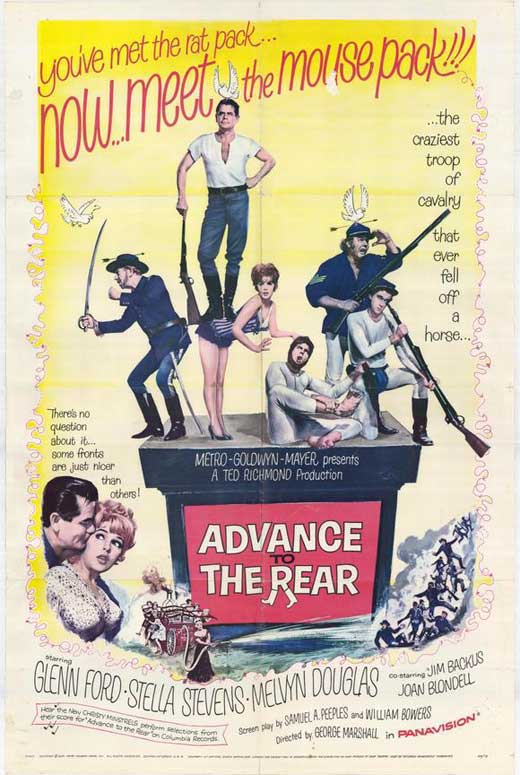
Take 1964's Advance to the Rear, a comedic spoof of one of the funniest times in American history...the Civil War. There's no way that should work, right? America's bloodiest conflict doesn't seem like its ripe for the picking for a big-screen spoof. Somehow it does though, even if it isn't on the level of the previously mentioned comedies. It's no classic, but it accomplishes what it sets out to do. It is funny in a ridiculously stupid way, full of slapstick humor, some romance, and a cast full of recognizable names, all of them playing bumbling idiots. That's a formula for success if there ever was one.
It's 1862, and lawyer turned infantry soldier Captain Jared Heath (Glenn Ford) is the aide to a veteran of West Point and all-around clueless officer, Colonel Claude Brackenbury (Melvyn Douglas). Supposed to lead an attack on a Confederate position, Brackenbury's regiment instead turns and runs from the field of battle thanks to a simple miscommunication. The unit is made an example of for their cowardice and receives order to go west to a remote outpost, also taking along misfits and screw-ups from other units in the Union army. Dubbed Company Q, they head west by riverboat. Confederate intelligence catches wind of the new unit and assumes they're some sort of specialized unit meant to perform a dangerous mission. A beautiful Confederate spy, Martha Lou Williams (Stella Stevens), is sent west to investigate, and see exactly what these "special soldiers" are up to.
Slapstick comedy is completely hit-or-miss with me. I grew up watching The Three Stooges and Laurel and Hardy shorts so I do like some of it. But if it isn't handled correctly, it's going to go poorly, and do it fast. The problem is that you have to fully commit to doing the slapstick so you open things up to look completely stupid if it isn't funny. The physical humor here isn't bad, but it certainly isn't good either. Director George Marshall uses all sorts of wacky techniques, almost telling us when to laugh. Sound effects seem like they were used from a Batman TV episode and are painfully out of place. A soldier skis down a hill on tree branch skis? Add the sound of a plane taking off. Someone goes flying through the air? Cue the sound barrier being broken. Sound effects and sped-up action screams out desperation to me, and there's a good amount of it here.
When I think of Glenn Ford, I typically think of an underrated dramatic actor, someone able to move across genres and be believable and successful in all types of movies. Comedy? Not really the first thing that comes to mind. I was pleasantly surprised then when Ford as Capt. Jared Heath, a ladies man and the rare competent soldier in the bunch, ends up carrying the movie. By far, he's the biggest bright spot going for this 1960s comedy. He delivers his lines in such a deadpan fashion while also handling the more physical scenes that it seems effortless. Ford has a great chemistry with the always beautiful Stella Stevens (who poses as a showgirl briefly) in the romantic scenes and also with Douglas' clueless Colonel Brackenbury, the experienced officer who can't stand his aide and his way of going about things. Their exchanges of cracks back and forth help make up for some of the worst examples of slapstick, as do the scenes with Ford and Stevens. Ford's Heath quickly figures out she's a Confederate spy, but because he wants to marry her lets it go by the wayside. I don't blame him.
There was some wasted potential with the supporting cast to develop them into some better, even funnier characters. Jim Backus and Whit Bissell are the equally idiotic Union generals who send Company Q out west only to realize they've sent them to lead an actual dangerous mission that could turn the tide of the war. Joan Blondell plays Easy Jenny, the leader of the showgirls who take a shining to Heath and his men. Michael Pate has a small part as Charlie Thin Elk, an Indian chief who went to West Point in the 1830s. James Griffith plays Hugo Zattig, the leader of a group of Confederate renegades. As for Company Q, there's Alan Hale Jr. as Sgt. Davis, Andrew Prine as Pvt. Selous, always hiccuping, and Jesse Pearson as Cpl. Geary, a soldier who always has horses following him around because of his unique smell. There were some other interesting soldiers -- a klepto, a firebug, a boxer, a brawler -- who are introduced but never get much to do. If the movie was longer (it's only 100 minutes) like other 60s comedies, it's safe to say there would be some more development among Company Q.
It feels funny watching a Civil War comedy no matter how much of the humor does or doesn't work. Marshall films it in a great-looking widescreen fashion -- in black and white at that -- making it feel like an epic action/adventure flick, not a spoof. It is funny at times, but not as funny as it could have been. I wanted to like the movie more than I did. It's decent enough but nothing more. Also worth watching to see John Wayne's stunt man Chuck Roberson get a speaking role as a Confederate guerrilla. It is available to watch at Youtube starting HERE.
Advance to the Rear <--- TCM trailer (1964): ** 1/2 /****
Take 1964's Advance to the Rear, a comedic spoof of one of the funniest times in American history...the Civil War. There's no way that should work, right? America's bloodiest conflict doesn't seem like its ripe for the picking for a big-screen spoof. Somehow it does though, even if it isn't on the level of the previously mentioned comedies. It's no classic, but it accomplishes what it sets out to do. It is funny in a ridiculously stupid way, full of slapstick humor, some romance, and a cast full of recognizable names, all of them playing bumbling idiots. That's a formula for success if there ever was one.
It's 1862, and lawyer turned infantry soldier Captain Jared Heath (Glenn Ford) is the aide to a veteran of West Point and all-around clueless officer, Colonel Claude Brackenbury (Melvyn Douglas). Supposed to lead an attack on a Confederate position, Brackenbury's regiment instead turns and runs from the field of battle thanks to a simple miscommunication. The unit is made an example of for their cowardice and receives order to go west to a remote outpost, also taking along misfits and screw-ups from other units in the Union army. Dubbed Company Q, they head west by riverboat. Confederate intelligence catches wind of the new unit and assumes they're some sort of specialized unit meant to perform a dangerous mission. A beautiful Confederate spy, Martha Lou Williams (Stella Stevens), is sent west to investigate, and see exactly what these "special soldiers" are up to.
Slapstick comedy is completely hit-or-miss with me. I grew up watching The Three Stooges and Laurel and Hardy shorts so I do like some of it. But if it isn't handled correctly, it's going to go poorly, and do it fast. The problem is that you have to fully commit to doing the slapstick so you open things up to look completely stupid if it isn't funny. The physical humor here isn't bad, but it certainly isn't good either. Director George Marshall uses all sorts of wacky techniques, almost telling us when to laugh. Sound effects seem like they were used from a Batman TV episode and are painfully out of place. A soldier skis down a hill on tree branch skis? Add the sound of a plane taking off. Someone goes flying through the air? Cue the sound barrier being broken. Sound effects and sped-up action screams out desperation to me, and there's a good amount of it here.
When I think of Glenn Ford, I typically think of an underrated dramatic actor, someone able to move across genres and be believable and successful in all types of movies. Comedy? Not really the first thing that comes to mind. I was pleasantly surprised then when Ford as Capt. Jared Heath, a ladies man and the rare competent soldier in the bunch, ends up carrying the movie. By far, he's the biggest bright spot going for this 1960s comedy. He delivers his lines in such a deadpan fashion while also handling the more physical scenes that it seems effortless. Ford has a great chemistry with the always beautiful Stella Stevens (who poses as a showgirl briefly) in the romantic scenes and also with Douglas' clueless Colonel Brackenbury, the experienced officer who can't stand his aide and his way of going about things. Their exchanges of cracks back and forth help make up for some of the worst examples of slapstick, as do the scenes with Ford and Stevens. Ford's Heath quickly figures out she's a Confederate spy, but because he wants to marry her lets it go by the wayside. I don't blame him.
There was some wasted potential with the supporting cast to develop them into some better, even funnier characters. Jim Backus and Whit Bissell are the equally idiotic Union generals who send Company Q out west only to realize they've sent them to lead an actual dangerous mission that could turn the tide of the war. Joan Blondell plays Easy Jenny, the leader of the showgirls who take a shining to Heath and his men. Michael Pate has a small part as Charlie Thin Elk, an Indian chief who went to West Point in the 1830s. James Griffith plays Hugo Zattig, the leader of a group of Confederate renegades. As for Company Q, there's Alan Hale Jr. as Sgt. Davis, Andrew Prine as Pvt. Selous, always hiccuping, and Jesse Pearson as Cpl. Geary, a soldier who always has horses following him around because of his unique smell. There were some other interesting soldiers -- a klepto, a firebug, a boxer, a brawler -- who are introduced but never get much to do. If the movie was longer (it's only 100 minutes) like other 60s comedies, it's safe to say there would be some more development among Company Q.
It feels funny watching a Civil War comedy no matter how much of the humor does or doesn't work. Marshall films it in a great-looking widescreen fashion -- in black and white at that -- making it feel like an epic action/adventure flick, not a spoof. It is funny at times, but not as funny as it could have been. I wanted to like the movie more than I did. It's decent enough but nothing more. Also worth watching to see John Wayne's stunt man Chuck Roberson get a speaking role as a Confederate guerrilla. It is available to watch at Youtube starting HERE.
Advance to the Rear <--- TCM trailer (1964): ** 1/2 /****
Sunday, April 10, 2011
Synanon
The Synanon organization was devoted to drug rehabilitation, helping junkies and addicts kick the habit they'd developed. Founded in 1958 in Santa Monica, California by Charles Dederich, the organization existed until the late 1980s before finally going under. They were obviously doing something right to last over 30 years. Their success in the early 1960s was even parlayed into a feature film, 1965's appropriately titled Synanon. Made on location in Santa Monica at the Synanon Home where its patients went through treatment, the movie was made with the support of the organization, which made me wonder. Why didn't they insist on a more positive story, or if nothing else, at least a better written script?
Coming off a heroin high one night on the boardwalk, ex-con and thug Zankie Albo (Alex Cord) finds himself in front of the Synanon House on the beach and checks himself in. At the lowest of lows though, being sober sounds like a good thing. When you're off your high, not so much, and Zankie has to convince the Synanon administration (Edmond O'Brien as Dederich, along with Richard Conte and singer Eartha Kitt) that he's on the up and up. Zankie goes back and forth but decides to stick around, partially because he's got an eye for another patient, Joaney (Stella Stevens), while also dealing with a fellow patient and person from his past, Ben (Chuck Connors). Going along with the program though and genuinely trying to get better, it seems only a matter of time before his demons get the best of him.
The biggest reason I watched this flick was the cast, no huge stars but actors who I'm always glad to see. The performances though are more hit or miss. O'Brien is a one-note character, the tough-talking administrative leader of the house, always glowering down at its patients with his tough love mentality. Conte plays a variation of so many of his performances, a condescending guy who thinks he knows everything. Basically, that asshole everyone knows. Kitt is okay but isn't given a ton to do. Cord, Stevens, and Connors are the best thing going for the movie. All three characters are deeply flawed individuals with their pasts looming over them. What clicks together is that individually or as a group, there's nothing very redeeming about them, but they're still interesting to watch. In the end, one character does get a chance to redeem themselves and move on to something better.
Now if I'm supporting a Hollywood feature film about my organization, I'm making certain demands about how things are going to be portrayed. With an organization like Synanon, that can be trouble because you're dealing with drug rehab (albeit a seemingly white-washed version). If you show it as it is, this is going to be one of the darkest movies ever. If you censor it as it feels like in the film at times, you're not doing the story justice. Director Richard Quine is trapped somewhere in the middle with moments of incredible darkness followed by moments of adoring adulation of the organization. Going back and forth like the story does, that's not the biggest concern. It's a reliance on story conventions that soap operas would be jealous of. Maybe it seemed innovative or ahead of its time in 1965, but now in 2011, it's all been done and seen. Shocking then, but not so much now.
What aids the movie through its ups and downs has little to do with the actual story of this organization trying to aid patients in their drug rehab. It's a very stylish, well-made look at Santa Monica, California, providing a bit of a time capsule for a really cool time period. Filming was done at the original Synanon house on the Santa Monica beach although I'm guessing indoor scenes were filmed on a studio. Other than though, as a viewer we feel like we're there at the house with the patients. Quine shoots on the streets surrounding the house, in and around the seedy bars nearby, and uses some unique angles that take you out of a typical comfort zone. It's not an aggressive style, but it doesn't just settle to put the camera in front of the cast and let them go. With a soft jazz score by Neal Hefti, 'Synanon' gives a window into 1960s California that transports you into the story.
Trying to look past the cliches and stereotypes the script relies on far too much, I was genuinely impressed with the performances by Cord, Stevens and Connors. I've only seen Alex Cord in a handful of really average movies, but I've always liked him as an actor. Besides the ridiculously odd but still cool name -- Zankie Albo -- the character is interesting even if I would have liked a little more background. Stevens plays up her sex kitten image and then throws you for a twist the same way Connors does, shedding his Lucas McCain image from The Rifleman. So overall, while the movie wasn't that good, some of the performances were good enough to give this a slight recommendation.
Synanon <--- TCM clips (1965): ** 1/2 /****
Wednesday, May 5, 2010
The Silencers
Last month I reviewed Murderer's Row, the second of four Matt Helm movies. Starring Dean Martin, these were spoofs that had some fun with the spy movie that was at the height of its popularity thanks to the success of the James Bond franchise. In the last week or so, TCM had a spoof night and wouldn't you know it, another Matt Helm movie was on. Having already jumped into these movies mid-series, I caught up with the first Helm movie, 1966's The Silencers.
Mulling over what to write about this one, all I could come up is that this wasn't going to be a very long review. Judging by the two movies I've seen in the series, these are basically cookie-cutter variations on themselves. To a point, the Bond movies are like that too, but there's almost always something unique, something different in each entry. Not so much with the Helm movies. I didn't think Murderers' Row was that good, but I gave it a lukewarm positive review because it was still mildly entertaining. As for The Silencers, it wasn't nearly as good, not even close.
Brought out of retirement, ICE agent Matt Helm (Martin) is given a dangerous mission that involves the prevention of the destruction of the world....well, sort of. Supervisor MacDonald (James Gregory) informs him that an organization called Big O (oh, that's too easy) has a plan to explode an atomic bomb over an American nuclear site in Alamogordo, and that Helm must stop the plan. Working with an old partner/fling, Tina (Daliah Lavi), Helm heads to meet an agent who may have key information on the plan, but she's killed and the only suspect is a ditzy redhead, Gail Hendricks (Stella Stevens). Working with Gail, all Helm has is a phrase mumbled before the agent's death to work off of and time is running out.
This is one of the more pointless plotlines I've ever come across in a movie. It takes quite awhile to even get the story to a point where something is revealed, and then Helm spends the next half hour seducing every woman he meets. Then with 15 or 20 minutes left, it seems director Phil Karlson remembered they had to wrap things up and gets back to the story. Everything is wrapped up nicely with a bow, and voila, let's move on to the next 3 Matt Helm movies. I'm not looking for a Bond-esque twisting and turning storyline, but something, anything at all would be nice.
This was Martin at the absolute height of his popularity with his Rat Pack fame turning into a variety show that aired for almost 10 years. The same thing I wrote for Murderers' Row applies here with Martin playing himself and doing a lot of drinking and seducing whenever he gets the chance and singing much of the soundtrack -- including one good dig at Frank Sinatra. I'd have to go back and watch, but I'd bet no more than a minute goes by whenever he meets a woman from being introduced to kissing her. If you thought James Bond got around, all I can say is check out Matt Helm. And then there's the drinking, including one very dated scene where Helm is guzzling scotch while at the wheel of his -- wait for it -- secret agent station wagon dubbed 'the sex wagon' by Stevens' Gail. Not exactly an Aston Martin if you ask me.
With that flimsy storyline, it seems a waste to misuse this great cast. Gregory is the straight man, always shaking his head at Helms' antics, and Lavi is the sex kitten with a past with Helms. In the few movies I've seen with her, Stevens shows a knack for comedic timing, but here she's the clueless ditz along for the ride. Of those movies, this does continue a trend of having her in the slinkiest costumes around. Also here for this debacle are Robert Webber and Arthur O'Connell as O agents with Victor Buono as an Asian O mastermind behind the diabolical plan. None of these typically solid actors is given much to do and are generally wasted.
There are some funny moments, like a gun that fires backwards and turns Stevens into a hardcore spy too once she figures it out, but overall this movie is easily forgettable. All I'm looking for in a spy spoof is some laughs here and there, but even in that department this one fails. Now I'm wary of checking out the other two Matt Helm movies. If nothing else, they can't be as bad as this one.
The Silencers <----TCM clips (1966): * 1/2 /****
Mulling over what to write about this one, all I could come up is that this wasn't going to be a very long review. Judging by the two movies I've seen in the series, these are basically cookie-cutter variations on themselves. To a point, the Bond movies are like that too, but there's almost always something unique, something different in each entry. Not so much with the Helm movies. I didn't think Murderers' Row was that good, but I gave it a lukewarm positive review because it was still mildly entertaining. As for The Silencers, it wasn't nearly as good, not even close.
Brought out of retirement, ICE agent Matt Helm (Martin) is given a dangerous mission that involves the prevention of the destruction of the world....well, sort of. Supervisor MacDonald (James Gregory) informs him that an organization called Big O (oh, that's too easy) has a plan to explode an atomic bomb over an American nuclear site in Alamogordo, and that Helm must stop the plan. Working with an old partner/fling, Tina (Daliah Lavi), Helm heads to meet an agent who may have key information on the plan, but she's killed and the only suspect is a ditzy redhead, Gail Hendricks (Stella Stevens). Working with Gail, all Helm has is a phrase mumbled before the agent's death to work off of and time is running out.
This is one of the more pointless plotlines I've ever come across in a movie. It takes quite awhile to even get the story to a point where something is revealed, and then Helm spends the next half hour seducing every woman he meets. Then with 15 or 20 minutes left, it seems director Phil Karlson remembered they had to wrap things up and gets back to the story. Everything is wrapped up nicely with a bow, and voila, let's move on to the next 3 Matt Helm movies. I'm not looking for a Bond-esque twisting and turning storyline, but something, anything at all would be nice.
This was Martin at the absolute height of his popularity with his Rat Pack fame turning into a variety show that aired for almost 10 years. The same thing I wrote for Murderers' Row applies here with Martin playing himself and doing a lot of drinking and seducing whenever he gets the chance and singing much of the soundtrack -- including one good dig at Frank Sinatra. I'd have to go back and watch, but I'd bet no more than a minute goes by whenever he meets a woman from being introduced to kissing her. If you thought James Bond got around, all I can say is check out Matt Helm. And then there's the drinking, including one very dated scene where Helm is guzzling scotch while at the wheel of his -- wait for it -- secret agent station wagon dubbed 'the sex wagon' by Stevens' Gail. Not exactly an Aston Martin if you ask me.
With that flimsy storyline, it seems a waste to misuse this great cast. Gregory is the straight man, always shaking his head at Helms' antics, and Lavi is the sex kitten with a past with Helms. In the few movies I've seen with her, Stevens shows a knack for comedic timing, but here she's the clueless ditz along for the ride. Of those movies, this does continue a trend of having her in the slinkiest costumes around. Also here for this debacle are Robert Webber and Arthur O'Connell as O agents with Victor Buono as an Asian O mastermind behind the diabolical plan. None of these typically solid actors is given much to do and are generally wasted.
There are some funny moments, like a gun that fires backwards and turns Stevens into a hardcore spy too once she figures it out, but overall this movie is easily forgettable. All I'm looking for in a spy spoof is some laughs here and there, but even in that department this one fails. Now I'm wary of checking out the other two Matt Helm movies. If nothing else, they can't be as bad as this one.
The Silencers <----TCM clips (1966): * 1/2 /****
Friday, April 16, 2010
A Town Called Hell
When watching a spaghetti western, there's a certain amount of weirdness to be expected. After all, these were typically European directors/producers/screenwriters interpreting the American west so weirdness just comes with the territory. But beyond anti-heroes and crazy villains, the spaghettis were often heavy on graphic violence, religious imagery and symbolism, and no penchant for having to have a happy ending. Basically, everything I like in a western.
For years, the craziest spaghetti I saw was 1967's Django Kill! which features some truly disgusting violence, a gang of gay cowboys, and...wait, that's enough, violence and gay cowboys is a good explanation. Last night on Netflix Instant viewing, I checked out 1971's A Town Called Hell for a couple reasons, I've never been able to actually track a copy down, and two, the cast looks ridiculously good. It's not a straight Italian spaghetti western with British and Spanish backing, but it's got all the right elements. If anything, it's got too many elements. This one is all over the place and ranks right up there with Django Kill! for new weirdest spaghetti.
It's 1905 in Mexico (right in the middle of the Mexican revolution for you history buffs). A widower, Alvira (Stella Stevens) rides into the dusty, rundown town of Bastardo -- not 'Hell' as the title implies. She is offering $20,000 for the man who murdered her husband, but she doesn't know who he is, only that he's in the town. Alvira's only clue is a name...'Aguila.' But other than that, she's got nothing to go on. Three key people in Bastardo seem to have information. There's the Priest (Robert Shaw), the Colonel (Martin Landau) with his army detachment, and Don Carlos (Telly Savalas), the town's corrupt mayor/bandit. But nothing comes easy, and the betrayals start flying and the bodies start to add up.
Where to start? Spaghetti westerns generally had an extremely dark tone full of cynicism and violence, lots of anti-establishment feelings. 'Hell' certainly qualifies because no character is safe. The violence isn't graphic but it is brutal in its honesty. There are hangings, stabbings, shootings, and so much more. The setting for this is a really desert town that has fortress walls on all sides, and even though the movie was made/filmed in Spain, it looks like Mexico in all its dusty, dirty glory. I'm positive I'm reading too much into this, but the town could be some sort of purgatory, some bizarre version of hell. Or it could just be a whacked out western, you make the decision.
The story itself is too interesting with director Robert Parrish mixing and matching left and right. An IMDB user stated there's at least 15 plots, they just last 2 or 3 minutes before moving on, and really, that's a pretty accurate description of this gothic, dark western. Stevens sleeps in a coffin at night and has a pale deaf-mute protector, Spectre (Dudley Sutton), with her at all times. Savalas is a violent dictator with an iron fist on this town...until he doesn't anymore when his men turn on him, crucifying him. Shaw has a vivid dream where Stevens' Alvira kills him in his sleep. Landau as a Mexican officer? That does seem pretty logical. A flashback with a sped-up version of the Battle of New Orleans and a bizarre, confusing backstory just caps it all off. That's the movie in a nutshell, always moving and never slowing up enough to know how ridiculous it all sounds.
Through all of the craziness, there's a really cool if sometimes odd cast. Robert Shaw is one of my favorite actors, and he's the star here. Simply named 'the Priest,' he has a past that still gnaws at him, and he seems to be the only person who knows who 'Aguila' is. On a non-consequential level, Shaw is also sporting a badass handlebar mustache and mutton chop-like sideburns. Savalas is the shirtless bandit mayor (honestly, in his 30 minutes he never has a shirt on) who gets to ham it up. His departure about 30 minutes does come as a surprise, mostly because we never see how he gets whacked. Landau is the only one who doesn't work because well, he's not Mexican. He's loud and obnoxious but still isn't a good villain. Stevens is wasted -- but looks good doing it -- and appears like she wandered into the set and just started reciting lines.
There's also supporting parts for Fernando Rey as an old blind man who may hold the key to Aguila's identity, spaghetti western regular Aldo Sambrell as Calebra, one of Don Carlos' thugs, TV star Michael Craig in flashback as Paco, one of the Priest's partners, and Al Lettieri as La Bomba, Carlos' not so smart treacherous right hand man. What I liked about this western -- and I did like it -- was the general weirdness of it all. There's this great cast and no story (not a coherent one at least), but all the little things add up. Recommending this almost in spite of itself.
A Town Called Hell <----trailer (1971): ** 1/2 /****
For years, the craziest spaghetti I saw was 1967's Django Kill! which features some truly disgusting violence, a gang of gay cowboys, and...wait, that's enough, violence and gay cowboys is a good explanation. Last night on Netflix Instant viewing, I checked out 1971's A Town Called Hell for a couple reasons, I've never been able to actually track a copy down, and two, the cast looks ridiculously good. It's not a straight Italian spaghetti western with British and Spanish backing, but it's got all the right elements. If anything, it's got too many elements. This one is all over the place and ranks right up there with Django Kill! for new weirdest spaghetti.
It's 1905 in Mexico (right in the middle of the Mexican revolution for you history buffs). A widower, Alvira (Stella Stevens) rides into the dusty, rundown town of Bastardo -- not 'Hell' as the title implies. She is offering $20,000 for the man who murdered her husband, but she doesn't know who he is, only that he's in the town. Alvira's only clue is a name...'Aguila.' But other than that, she's got nothing to go on. Three key people in Bastardo seem to have information. There's the Priest (Robert Shaw), the Colonel (Martin Landau) with his army detachment, and Don Carlos (Telly Savalas), the town's corrupt mayor/bandit. But nothing comes easy, and the betrayals start flying and the bodies start to add up.
Where to start? Spaghetti westerns generally had an extremely dark tone full of cynicism and violence, lots of anti-establishment feelings. 'Hell' certainly qualifies because no character is safe. The violence isn't graphic but it is brutal in its honesty. There are hangings, stabbings, shootings, and so much more. The setting for this is a really desert town that has fortress walls on all sides, and even though the movie was made/filmed in Spain, it looks like Mexico in all its dusty, dirty glory. I'm positive I'm reading too much into this, but the town could be some sort of purgatory, some bizarre version of hell. Or it could just be a whacked out western, you make the decision.
The story itself is too interesting with director Robert Parrish mixing and matching left and right. An IMDB user stated there's at least 15 plots, they just last 2 or 3 minutes before moving on, and really, that's a pretty accurate description of this gothic, dark western. Stevens sleeps in a coffin at night and has a pale deaf-mute protector, Spectre (Dudley Sutton), with her at all times. Savalas is a violent dictator with an iron fist on this town...until he doesn't anymore when his men turn on him, crucifying him. Shaw has a vivid dream where Stevens' Alvira kills him in his sleep. Landau as a Mexican officer? That does seem pretty logical. A flashback with a sped-up version of the Battle of New Orleans and a bizarre, confusing backstory just caps it all off. That's the movie in a nutshell, always moving and never slowing up enough to know how ridiculous it all sounds.
Through all of the craziness, there's a really cool if sometimes odd cast. Robert Shaw is one of my favorite actors, and he's the star here. Simply named 'the Priest,' he has a past that still gnaws at him, and he seems to be the only person who knows who 'Aguila' is. On a non-consequential level, Shaw is also sporting a badass handlebar mustache and mutton chop-like sideburns. Savalas is the shirtless bandit mayor (honestly, in his 30 minutes he never has a shirt on) who gets to ham it up. His departure about 30 minutes does come as a surprise, mostly because we never see how he gets whacked. Landau is the only one who doesn't work because well, he's not Mexican. He's loud and obnoxious but still isn't a good villain. Stevens is wasted -- but looks good doing it -- and appears like she wandered into the set and just started reciting lines.
There's also supporting parts for Fernando Rey as an old blind man who may hold the key to Aguila's identity, spaghetti western regular Aldo Sambrell as Calebra, one of Don Carlos' thugs, TV star Michael Craig in flashback as Paco, one of the Priest's partners, and Al Lettieri as La Bomba, Carlos' not so smart treacherous right hand man. What I liked about this western -- and I did like it -- was the general weirdness of it all. There's this great cast and no story (not a coherent one at least), but all the little things add up. Recommending this almost in spite of itself.
A Town Called Hell <----trailer (1971): ** 1/2 /****
Wednesday, October 28, 2009
The Ballad of Cable Hogue
Abandoned in the desert by his partners Taggart (L.Q. Jones) and Bowen (Strother Martin), desert drifter Cable Hogue (Jason Robards) endures five days without water as he attempts to walk to the next far-off town. As he lies down ready to give up and die, he sees a drop of water on his boot and discovers a hidden water hole deep in the sand. A stagecoach passes by (Slim Pickens riding shotgun) and tells him there's no water for 40 miles between towns for the stagecoach route. Seeing a chance for some serious cash, Cable files a claim and sets up shop out in the desert, charging 10 cents for a person to drink and 25 cents for animals.
As the money starts to roll in, so do the people. First, there's Reverend Joshua Sloane (David Warner), a minister who travels across the west preaching and generally getting in trouble with married women. Second, there's Hildy (Stella Stevens), a prostitute in a nearby town who falls for Cable but must decide whether to stay with him or continue on to San Francisco where she'll marry a rich man. Holding everything up is Cable who is content to wait at his water hole, Cable Springs, until Taggart and Bowen eventually show up and give him a chance at revenge.
With maybe two guns fired the whole movie, the attention is clearly on the story. It's the early 20th Century so like The Wild Bunch or Ride the High Country, Peckinpah's movie deals with the changing times in the wild west. While a key twist revolves around the times and the advancing technology, the story otherwise could be set anywhere in any time period. Cable's little operation out in the desert is a quaint little American dream, coming full circle when Pickens brings him an American flag to fly. It's a story that is in no rush to get its message across, letting things out here and there.
The high point of 'Cable' is star Jason Robards. Two years removed from one of his best parts -- Cheyenne in Once Upon a Time in the West -- Robards gives Cable a hard edge. Warner's Joshua deems Cable not a good man or a bad man, just a man. He's a likable character, a fella who doesn't care much for people or their cities in towns. He's content to live his life out in the desert (Arizona and New Mexico were the filming locations) and let his money pile up. In her on-screen nudity phase, Stevens plays the hooker with a heart of gold who falls in love with Cable. There's a natural chemistry between the actors although it's hard not to notice that Stevens is naked, half-naked, or undressing just about every time she's in view.
As strong as the leads are, the movie in general suffers from what I like to call the makings of a folksy western. Westerns in the 70s went away from gunfights and action, focusing more on lyrical storytelling, lots of folk songs, and some truly unnecessary comedy, and 'Cable' is no exception. A song over the credits, Tomorrow is the Song I Sing, and Butterfly Mornin's (sung by Stevens) grind the already slow-moving pace to a complete halt. With some low-brow humor, Peckinpah also speeds up the film like a bad Benny Hill episode which looks out of place and amateurish when comparing it to the director's other movies. Adding to the comedy, Warner's horny reverend feels out of place and generally comes across as painfully unfunny.
The revenge storyline is left by the wayside for much of the movie, and that's fine. Robards is appealing on-screen, and it's as enjoyable to see his watering hole station grow and his interactions with Warner, Pickens, and R.G. Armstrong as a stagecoach supervisor, and Peter Whitney as a bank officer who bankrolls Cable. But when the revenge aspect steps back to the forefront, it does not ring true. The whole ending seems a little forced. The premise is an ideal one, similar to The Wild Bunch without the epic gunbattle, but in execution it doesn't work. SPOILER Cable gets run over by a car and basically is fine, laughs at his own death, has Warner eulogize him, and then dies off-screen. He's such a strong character it is a shame he is dispatched like he is. END OF SPOILER
'Cable' is an uneven effort from Peckinpah that ranges from great -- the first hour and Robards' performance -- to below average (folk songs, comedy, forced ending). If you are a fan of Bloody Sam, I'd definitely say 'watch this one.' The volatile director only made 16 movies, and it'd be hard to recommend completely passing over one of them.
The Ballad of Cable Hogue <---trailer (1970): ** 1/2 /****
Subscribe to:
Posts (Atom)