The Sons of Katie Elder

The Sons of Katie Elder
"First, we reunite, then find Ma and Pa's killer...then read some reviews."
Showing posts with label Jason Robards. Show all posts

Thursday, April 7, 2016

Hour of the Gun

One of the seminal moments in American history, especially in the 19th Century, the gunfight at the O.K. Corral is synonymous with the wild, wild west. It was a gunfight that only lasted 15 or 20 seconds, but the men involved would became famous because of their actions. What about after the gunfight though? What happened next? That is a story that is far less well-known, but it gets a fascinating examination in a mostly forgotten 1967 western, Hour of the Gun.

It's October 26, 1881 in the Arizona silver boom-town of Tombstone. Deputy Marshal Wyatt Earp (James Garner), his two brothers, and their friend Doc Holliday (Jason Robards), are heading for a fight after a long-running, long-simmering feud with Ike Clanton (Robert Ryan) and his gang of gunmen, bandits and rustlers. A gunfight ensues with three men -- all outlaws -- killed while Wyatt's brothers are wounded. The fight does nothing to end the feud, only adding fuel to the fire. The immediate response begins in a courtroom as Wyatt, Doc and the Earp brothers are brought up on charges for their actions that led to the gunfight and then for outright murder. This won't be resolved with words though. Too much has passed between the two sides with too many deaths for it to be fixed so easily. Wyatt and Doc live by the gun as does Ike Clanton. Let the bullets fly and those who get caught in the way...so be it.

From the first time I saw 1993's Tombstone, I was fascinated not just by the gunfight at the OK Corral but what happened after it. Unless I'm missing a flick, this is the first western to dive in headfirst to the aftermath. An unofficial sequel from his film 10 years earlier, Gunfight at the OK Corral, director John Sturges turns in a dark, moody, character-driven angle of the story. There's gunplay but not a ton. The story condenses months and months of history into a tightly-packed 105-minutes but one that doesn't feel too rushed. It's a daunting extended stretch to handle but Sturges and writer Edward Anhalt do a pretty solid job condensing and tweaking and twisting here to make it more manageable.

Two years later, Sam Peckinpah's The Wild Bunch would kick open the door for the western, effectively starting the genre on a path that proved to be its doom. The spaghetti westerns started it, Peckinpah continued and the revisionist westerns of the 1970's finished it off. Where's 'Hour' fit? Somewhere in between. It isn't a revisionist western. It's just a straightforward, mostly honest, not heroic interpretation of the real-life events. There aren't heroes, just less unlikable individuals. Case in point is Garner's Wyatt, not the crisp, clean, honest lawman he's often portrayed as. Here, he's a hypocrite, blinded with rage and almost completely driven by it. Towns are run by the rich, everything depends on power and money, and that power depends on backstabbing, back-shooting and all sorts of underhanded dealings. This ain't no good guys in white hats vs. bad guys in black hats. A precursor of the things to come in the western genre.

In film or on television, James Garner has a reputation as a likable presence, a sympathetic hero so....it's awesome to see him take these darker roles, like 1970's A Man Called Sledge. As we've learned, Wyatt Earp wasn't necessarily the heroic, noble lawman he's often portrayed as. 'Hour' delves right into that concept. Here, he's a revenge-seeking murderer hiding behind a marshal's badge and a warrant for arrest. It's a fascinating character and not necessarily sympathetic. Garner doesn't disappoint with this darker role. Just wish he had done more roles like this!

The key relationship in all the Earp/Tombstone movies though is between Wyatt Earp, the law officer, and Doc Holliday, the gambling dentist slowly dying of tuberculosis. All Holliday performances pale in comparison to Val Kilmer in 1993's Tombstone, but Robards is pretty damn good and belongs in close second with Dennis Quaid in the otherwise painful Wyatt Earp. Robards does what he always does. He quietly steals all his scenes to the point you don't even realize he's doing it. His chemistry with Garner is impeccable, a friendship with more of an edge than we're used to seeing. Their arguments become heated to the point of lashing out violently. Through it all though, there's an unspoken bond between them, two loners, two outsiders who have found the unlikeliest of friends. Two excellent leading performances.

Beyond Ryan, 'Hour' is light on star power, but that's not a bad thing. Ryan's Ike Clanton is probably the most exaggerated part here with the movie Clanton not resembling the actual historical Clanton. Still, it's Robert Ryan in sneering, condescending villain mode, and that ain't a bad thing. Wyatt's misfit posse includes Monte Markham, William Windom and Lonny Chapman. Their targets include Michael Tolan, Robert Philips, Steve Inhat and a very young Jon Voight. Too many familiar faces from film and television to mention, but also look for Albert Salmi, Karl Swenson and Bill Fletcher among many others.

I can't quite put my finger on it, but I liked 'Hour' much more on this second viewing than the first (it had been at six or seven years). It isn't an easy western to watch, and doesn't do much to pull you in in any sort of obvious fashion. That said, there's just something about it. Filmed in Mexico with cinematographer Lucien Ballard (one of the all-time greats), the movie looks stunning. Throw in one of Jerry Goldsmith's more underrated scores and it all adds up. Listen to the score HERE. It's a familiar story by now, that of Wyatt Earp and the OK Corral, but this adult western holds together quite well. Highly recommended.

Hour of the Gun (1967): ***/****

Thursday, November 6, 2014

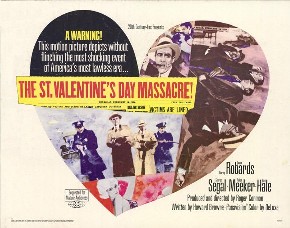
The St. Valentine's Day Massacre

I grew up in Chicago so I love just about everything in the Windy City, all the sports teams, the downtown area, all that great food from Chicago style hot dogs to Chicago style pizza. But that Chicago history? My goodness, there are some dark moments from the Black Sox scandal to the Chicago Fire, the riots at the 1968 Democratic convention and generally all sorts of political corruption and deception. One of the most violent incidents in the city's history? That's told in a 1967 B-movie, The St. Valentine's Day Massacre.

It's early 1929 and the streets of Chicago are filled with warring gangsters from two rival gangs. On one side is Al Capone (Jason Robards), a brutal, possibly maniacal Italian gangster with Mafia ties, who rules Chicago's South Side with an iron fist. Running the city's North side is George 'Bugs' Moran (Ralph Meeker), his Irish gang trying to hold onto their territory.  Things across the city are building to an unavoidable confrontation as both sides fight for control of thousands of speakeasies, Prohibition still raging. Capone has grown tired of Moran's gang trying to build up their power and has put into work a plan to execute his rival gang leader. Can one gang win out over the other? Can anyone win with the city's streets riddled with bullets and blood?

Everyone's heard of producer/director extraordinaire Roger Corman? He's one of Hollywood's all-time greats at getting movies made on the cheap so basically the King of B-Movies. That's not a bad thing, and I say it as a compliment. This generally forgotten 1967 gangster flick is one of his best, telling the true story of one of Chicago's darkest moments. It was filmed on studio streets -- cheaper than Chicago's downtown area -- but it works, giving the city a closed in, wintery and claustrophobic effect. This is a flick that works almost like a quasi-documentary, like something you'd see on The History Channel...but darker, much darker. With narrator Paul Frees and his perfectly gravelly voice laying things out, introducing dates, people and times, it all fits together like puzzle pieces.

Where 'Massacre' separates itself from the quasi-documentary feel is that darkness, that gangster world we're thrust into. Low budget though it may be, the movie looks great with countless gangsters wearing impeccably cool suits with fedoras, rocking vicious tommy guns and 1920s boats of cars that look as cool as ever now in 2014 as they would have in 1929. As for the real life gangsters, this isn't The Godfather where you kinda sorta maybe sympathize with the Corleones, however vicious and murdery they are. There ain't a single sympathetic character anywhere in sight. These are nasty, brutal, violent folks interested in making money and killing some rival gangsters in the process. You're not rooting for anybody. You're not hoping these guys come out unscathed. You just wanna see how it all shakes out and who's gonna make it. Let me tell you...not many do.

One of the coolest aspects of 'Massacre' is its ridiculously deep cast. We're not talking a disaster flick type of cast full of aging A-list stars. We're talking a couple very solid movie stars/actors at the top and a cast backing them up absolutely packed to the guts with familiar, recognizable character actors. As for the leads, Robards is terrifyingly hammy as everyone's favorite Chicago gangster, Al Capone. He's got that look in his eye, you just never know what he's going to do next. Meeker is excellent too in a more understated but just as sinister part, Bugs Moran, an Irish gangster and Capone's main rival for power. Also look for a young George Segal in one of his best early roles, playing Peter Gusenberg, one of Moran's enforcers/lieutenants working closely with his brother, another enforcer, Frank (David Canary) while constantly fighting with live-in girlfriend (Jean Hale).

Okay, brace yourself because you're about to get hit with a whole lot of links to actor's IMDB pages. These are all the real-life people involved in the 1920s world of Chicago gang wars, an extremely interesting historical time if you're interested in the subject matter. On the Capone side keep an eye out for Clint Ritchie as the massacre's mastermind, Frank Silvera, Harold J. Stone, Paul Richards, Joe Turkel, Alex Rocco, Leo Gordon, John Agar, and Richard Bakalyan and Jack Nicholson (Yes, that Jack Nicholson) as two hired mafia killers. On the Moran side of things, watch for Bruce Dern, Kurt Kreuger, Tom Reese. Some appearances are quicker than others, but it's cool to see so many people in one movie, even if it is only for a scene or two.

Just an entertaining dark and dirty movie. If you're a fan of history whether it be Chicago or gangsters or anything in between, this gritty, cynical, particularly vicious flick is for you. I loved it.

The St. Valentine's Day Massacre (1967): *** 1/2 /****

Tuesday, May 27, 2014

Tora! Tora! Tora!

One of the most infamous days in American history, December 7, 1941 is one of those instantly recognizable dates. The ones that live on in history itself. The Japanese surprise attack on Pearl Harbor was a world-changer, the United States thrust into World War II in a flash. Released in 1970, Tora! Tora! Tora! takes an almost documentary look at one of the most horrific days in American history.

In 1941, World War II is raging across Europe, Adolf Hitler's army marching and conquering all over the continent. In Japan, a new commander, Admiral Yamamoto (So Yamamura), has been named in the Japanese Navy with huge plans in play. Negotiations have been going on for months with the America and will continue for months to come. The American fleet all over the Pacific waits and braces for an attack that many believe is imminent while American intelligence back in Washington D.C. tries to decipher countless pieces of information, clues and evidence that will point to Japan's intentions. Will the Japanese attack? At the navy base at Pearl Harbor in the Hawaiian islands, Admiral Himmel (Martin Balsam) tries to decide what to do next. As the end of November 1941 nears, a meticulous Japanese plan of attack is put into action; much of the fleet sailing toward Pearl Harbor to unleash a surprise attack that hopes to cripple the American navy.

From director Richard Fleischer, with Kinji Fukasaku and Toshio Masuda directing the Japanese sequences, 'Tora' is the anti-Longest Day. While that 1962 epic told the true story of the D-Day invasion at Normandy with an epic cast of Hollywood legends, 'Tora' goes for the true story angle but without the star power. Fleischer and Co. are interested in the details, the history, the build-up, the intelligence, the government responses, all those little things that history buffs will eat up. It takes a little while to get going -- clocking in at 144 minutes overall -- but it is never dull and once it finds its rhythm, the momentum gets going in a big way. This was a movie that struggled in American theaters but was a huge hit in Japanese theaters. Why is that you ask?

Well, the true story of the attack on Pearl Harbor is hard to believe in itself. There's no way it should have worked on so many levels. That's where 'Tora' is special. The Japanese surprise attack was a brilliant military plan, a reliance on air power leading to the success and that almost complete surprise on the American naval base. From the American side, any number of people and issues impacted the attack. Intelligence reports were handled slowly and sent to the wrong people and places. When the radar spotted the hundreds of Japanese fighters, reports were ignored. It's an amazing series of events, Fleischer's movie interested in all those little things. 'Tora' finds its groove near the hour-mark as the attack becomes imminent. The shots of the Japanese fighters and bombers taking off from carrier decks in the pre-dawn darkness as the sun rises in front of them are eerie, oddly beautiful and intensely uncomfortable as we know what their plan will accomplish.

That's the movie at it's absolute best. Nominated for five Academy Awards, 'Tora' won the award for Best Special Effects. Why? Because of the extended attack on Pearl Harbor, bringing one of the darkest moments in American history to life. The Pearl Harbor sequence is remarkable, starting about the 100-minute mark. The amount of ground it covers is remarkable from the attacks on Battleship Row to Hickam Field and anything and everything in between of military importance. The camera films from ground level to put the American POV in perspective while also filming in the air to give the view the Japanese pilots saw as they attacked. The sequence of the Japanese planes flying across Hawaii to Pearl Harbor especially resonated with me in terms of the reality of what we're watching. Amazing aerial sequences, some incredible stuntwork, and composer Jerry Goldsmith's score boosting it all up a notch, this is a sequence that works on all levels. It brings the horrors of the real-life incident to life to the point it is uncomfortable to watch. A great sequence.

With hopes of leaving the focus on the true story of the attack on Pearl Harbor, the cast was filled out with recognizable, respected actors who didn't exactly have star power. Among the high-ranking American military, look for Balsam, James Whitmore and Jason Robards, and with the Intelligence, E.G. Marshall and Wesley Addy. Among the Japanese there's Yamamura as Admiral Yamamoto with Takahiro Tamura as the flight commander leading the attack on Pearl with and Eijiro Tono as the Admiral leading the attack group across the Pacific toward Hawaii. There's gotta be a 100 or so speaking roles so far too many to mention here, but also look for Joseph Cotten, Richard Anderson and Neville Brand among many others.

An interesting movie basically across the board. Told from both the American and Japanese perspectives on seemingly countless levels, you get an excellent sense of the events leading up to the attack on Pearl Harbor, the actual attack, and the immediate fallout. It ends on a somber note, the world truly thrust into the war at this point on an international level, Yamamoto expressing his thoughts. "I fear all we have done is to awaken a sleeping giant and filled it with a terrible resolve." Profound words and a fitting end to the movie.

Tora! Tora! Tora! (1970): ***/****

Saturday, May 28, 2011

The Journey

One of the 1950's most popular films, 1956's The King and I was loved by audiences, award shows, and critics alike.  Maybe the biggest reason for the movie's popularity -- besides the Rodgers and Hammerstein music and the epic story -- was the pairing of its two stars, Yul Brynner and Deborah Kerr.  I haven't seen the movie in years but still remember their chemistry. It was only a matter of time before they were paired in a movie together again, that coming three years later with 1959's The Journey.

The story is based during the Hungarian Revolution of 1956. My background in said revolution is that there was in fact a revolution in Hungary in 1956.  As much as I like history, you just can't read and learn about everything.  The setting -- while specific -- is applicable to any world conflict. It is based in individuals in a bad situation trying to reach some sort of safety, some feeling of normalcy.  Through these situations, you often bond through your trials. For all its uniqueness concerning a conflict in a far-off part of the world though, 'Journey' isn't always the most exciting movie, resorting to its star power to carry it through the slower portions.

It's 1956 in Budapest, Hungary, and an English woman, Diane Ashmore (Kerr), arrives at the airport trying to get out of the country and back home to England.  She's given some tough news though; the Hungarian people are revolting against their Russian/Soviet rulers, and all traffic in and out of the country has been canceled. However, transportation has been arranged for Diane and 13 other international passengers trying to leave Hungary. They will board a bus and drive the 250 miles to safety at the Austrian border. Before they reach the border though, they're stopped and inspected by the local commander, a Russian major, Surov (Brynner), who won't let them pass until everyone is approved. Diane starts to worry because she knows a secret about a fellow passenger on board, Fleming (Jason Robards), that threatens to get them all shot.

This is an all-around kind of weird movie. It isn't like so many other movies, but not always in a good or bad way. It is just different. Director Anatole Litvak films his movie in Hungary on some of the locations where the actual revolution took place just three years before in 1956. It certainly gives the movie a feeling of realism, of authenticity that couldn't have been duplicated on a Hollywood backlot (even if it does look like a studio at times). Instead, much of the story is set in a small hotel and its surrounding buildings.  There is a washed out look to The Journey that I suppose could have been the TCM print, but I don't know for sure. I can't put my finger on it, but something about the film just didn't click with me.

With two leads like Kerr and Brynner at the forefront of the movie, it's understandable that you want them to carry the movie as much as possible.  Their performances are the least of the movie's problems.  Their chemistry together is hard to disagree with. They're just good together.  Kerr is quiet and composed, eventually pushed to the point of nerves taking over while Brynner is bigger than life, able to dominate the screen just by standing there.  But in developing these characters, the story requires them to fall for each other. The final 20-30 minutes come along, and they're fighting off urges that I just didn't see building up throughout the movie. It's dialogue and more dialogue and more dialogue. The movie is a tad long at 126 minutes, taking quite awhile to get where it's going.

As if Kerr and Brynner weren't enough to satisfy most moviegoers, Jason Robards makes his feature film debut as Fleming, the mysterious passenger on-board who has all the other passengers concerned what he's up to. SPOILERS STOP READING SPOILERS Kerr is trying to sneak him out of the country, past lovers reunited after he escaped from a Russian prison. END OF SPOILERS Robards is one of the more underrated actors from the era, and he shows off the talent we'd all get to see in the coming years. Filling out the international list of passengers is Robert Morley as the scene-stealing, stiff upper lip Englishman, Deverill, E.G. Marshall and Anne Jackson as an American couple traveling with their kids (including a 5-year old Ron Howard), and other characters from Egypt, France, Germany, and in an interesting twist, a Jewish man. There was potential here for more development among these characters, and yes, I know the focus is on the leads. The 14 passengers though screamed out for a mini-series, something that would have given them a chance to shine. Also look for Senta Berger in a bit part as a serving girl at the hotel.

Maybe the biggest problem 'Journey' has going for it is a lack of focus. Brynner's Surov is investigating these international passengers, but nothing ever seems to get done. He spends most of the time riding his prized horse, eating and drinking with the passengers who are scared to death of him, and all the while, Kerr's Diane worries he'll figure out what's going on. By the way, he does....and pretty quickly.  There is no urgency though at all, and the movie's pacing suffers.  The ending makes up for it some in terms of surprise and shock value, a moving finale that definitely caught me off guard. I just wish more of the movie could have been like that.

The Journey <---trailer (1959): ** 1/2 /****

Wednesday, March 31, 2010

A Big Hand for the Little Lady

I looked this up to be sure -- thanks, Wikipedia -- but the game of poker has been around since the 15th Century in different forms.  It's always been there, but since online gambling became so popular and ESPN's World Series of Poker has been put on TV seemingly around the clock, poker (especially Texas Hold 'Em) has experienced a rebirth, a rejuvenation over the last 10 years or so.  Watching a card game wouldn't appear to be the most exciting thing, but 1966's A Big Hand for the Little Lady proves otherwise, among other movies like The Sting, The Cincinnati Kid, and Rounders.

This is a comedy western -- typically not my favorite thing -- that keeps the humor pretty low-key with almost all of the focus on one specific card game and its development.  The story is almost exclusively in one location, the back room of a saloon, with a few quick detours outside for more money or booze.  I'm not comparing it to 12 Angry Men as a whole, but in terms of storytelling it is very similar with the jury room changed to a saloon's back room.  I was really enjoying the movie for the first 80 minutes, and then it happened.  The movie phenomena known as....THE UNNECESSARY TWIST!  More on that later.

Riding into Laredo, a husband and wife, Meredith (Henry Fonda) and Mary (Joanne Woodward) with their son must stop for repairs on their wagon.  They're bound for San Antonio and the 40 acres they've purchased to live on.  Stopping at the saloon, Meredith hears about a high-stakes poker game going on in the back room.  Each year, five local businessmen lock themselves away and play until someone takes all the winnings.  Meredith asks if he can sit in and quickly changes his mind, thinking he could win the game judging by the players' abilities.  But his luck is not so good, and he has to use all the money the family's saved.  Then, his luck turns.  He gets the hand of a lifetime, but in the excitement of the hand, a heart attack incapacitates him.  Who can finish out the hand for him, even with a lack of funds?  Why his wife of course.

This western has the look and feel of a TV western that's entirely set on a western town set, like Gunsmoke or Bonanza.  The visual look of 'Big Hand' isn't very important though because the focus is on this poorly lit, smoky backroom where the annual card game is played out.  The five players are all recognizable faces if not huge stars and are clearly the highlight of the movie.  They include Henry Drummond (Jason Robards), a cantankerous land owner, Benson Trop (Charles Bickford), the woman-hating undertaker, Otto Habershaw (Kevin McCarthy), the educated lawyer, Dennis Wilcox (Robert Middleton), the ranch owner, and Jesse Buford (John Qualen), the cheapskate cattle baron.  The quintet has a history and a background that comes from 16 years of playing that comes across perfectly.  Robards' Drummond walked out on his daughter's slow-moving wedding to play, and McCarthy's Otto bailed on a court case where his defendant could hang.  Little touches make these characters work.

Later in his career, Fonda veered into playing darker characters, straight villains like Once Upon a Time in the West, or even deeply flawed people, like here or in The Rounders.  His Meredith has a gambling background -- an addiction to poker is hinted at -- and he can't ignore the allure of this high-stakes game.  Woodward is the angelic wife who trusts her husband implicitly even when he's made such a backslide into the life he promised he would avoid.  As he fights through a heart attack, he tells her to play out the hand.  Mary has never played poker in her life, but when Meredith tells her it is the hand of a lifetime, she trusts him.  The only problem? They're out of money so she turns to the town banker C.P. Ballinger (Paul Ford) while the town doctor (Burgess Meredith) tends to her husband.

And then there was the twist, revealed about 80 minutes into the movie but not about to be revealed here.  Looking back, I can't remember any hints of what's to come so I guess that's a testament to the twist working so well.  Maybe unlike so many other twist/revelation storylines, we're not supposed to have any inkling.  But it is such a departure from the humor of the story up to that point, it feels completely unnecessary and for me, wasted any goodwill the majority of the movie had racked up.  If that wasn't bad enough, there's about 15 minutes more after the twist is revealed that drags on and on.  Not only was I disappointed in the direction the story took, I've got to endure scenes that serve no real purpose.  Pass on that.

It's all too bad because with the cast and their impressive talents -- especially Robards and McCarthy -- this comedic western had a chance to do something great.  I was actually angry at the twist reveal.  Not because it didn't work, the story has no plot holes and looking back everything worked.  It is because the twist is stupid and unnecessary for a movie with a good story.  I would have ended the movie at the end of the poker game and been done with it instead of sitting through almost 20 more minutes of movie.  I couldn't find a trailer so the link below is a TCM-provided clip.

A Big Hand for the Little Lady <----clips (1966): **/****

Wednesday, October 28, 2009

The Ballad of Cable Hogue

If director Sam Peckinpah is remembered for one thing and one thing only, I'd be hard pressed to say anything other than transforming on-screen violence. His western classic The Wild Bunch took movie violence to a whole new level after Bonnie and Clyde opened the door two years prior. Lost in the shuffle of all the blood and guts was the fact that Peckinpah was a talented director who could tell a great story...it just so happened a lot of times it was with slow-motion violence. Movies like Junior Bonner and The Ballad of Cable Hogue show what Peckinpah was capable of when he left out the squibs.

Abandoned in the desert by his partners Taggart (L.Q. Jones) and Bowen (Strother Martin), desert drifter Cable Hogue (Jason Robards) endures five days without water as he attempts to walk to the next far-off town. As he lies down ready to give up and die, he sees a drop of water on his boot and discovers a hidden water hole deep in the sand. A stagecoach passes by (Slim Pickens riding shotgun) and tells him there's no water for 40 miles between towns for the stagecoach route. Seeing a chance for some serious cash, Cable files a claim and sets up shop out in the desert, charging 10 cents for a person to drink and 25 cents for animals.

As the money starts to roll in, so do the people. First, there's Reverend Joshua Sloane (David Warner), a minister who travels across the west preaching and generally getting in trouble with married women. Second, there's Hildy (Stella Stevens), a prostitute in a nearby town who falls for Cable but must decide whether to stay with him or continue on to San Francisco where she'll marry a rich man. Holding everything up is Cable who is content to wait at his water hole, Cable Springs, until Taggart and Bowen eventually show up and give him a chance at revenge.

With maybe two guns fired the whole movie, the attention is clearly on the story. It's the early 20th Century so like The Wild Bunch or Ride the High Country, Peckinpah's movie deals with the changing times in the wild west. While a key twist revolves around the times and the advancing technology, the story otherwise could be set anywhere in any time period. Cable's little operation out in the desert is a quaint little American dream, coming full circle when Pickens brings him an American flag to fly. It's a story that is in no rush to get its message across, letting things out here and there.

The high point of 'Cable' is star Jason Robards. Two years removed from one of his best parts -- Cheyenne in Once Upon a Time in the West -- Robards gives Cable a hard edge. Warner's Joshua deems Cable not a good man or a bad man, just a man. He's a likable character, a fella who doesn't care much for people or their cities in towns. He's content to live his life out in the desert (Arizona and New Mexico were the filming locations) and let his money pile up. In her on-screen nudity phase, Stevens plays the hooker with a heart of gold who falls in love with Cable. There's a natural chemistry between the actors although it's hard not to notice that Stevens is naked, half-naked, or undressing just about every time she's in view.

As strong as the leads are, the movie in general suffers from what I like to call the makings of a folksy western. Westerns in the 70s went away from gunfights and action, focusing more on lyrical storytelling, lots of folk songs, and some truly unnecessary comedy, and 'Cable' is no exception. A song over the credits, Tomorrow is the Song I Sing, and Butterfly Mornin's (sung by Stevens) grind the already slow-moving pace to a complete halt. With some low-brow humor, Peckinpah also speeds up the film like a bad Benny Hill episode which looks out of place and amateurish when comparing it to the director's other movies. Adding to the comedy, Warner's horny reverend feels out of place and generally comes across as painfully unfunny.

The revenge storyline is left by the wayside for much of the movie, and that's fine. Robards is appealing on-screen, and it's as enjoyable to see his watering hole station grow and his interactions with Warner, Pickens, and R.G. Armstrong as a stagecoach supervisor, and Peter Whitney as a bank officer who bankrolls Cable. But when the revenge aspect steps back to the forefront, it does not ring true. The whole ending seems a little forced. The premise is an ideal one, similar to The Wild Bunch without the epic gunbattle, but in execution it doesn't work. SPOILER Cable gets run over by a car and basically is fine, laughs at his own death, has Warner eulogize him, and then dies off-screen. He's such a strong character it is a shame he is dispatched like he is. END OF SPOILER

'Cable' is an uneven effort from Peckinpah that ranges from great -- the first hour and Robards' performance -- to below average (folk songs, comedy, forced ending). If you are a fan of Bloody Sam, I'd definitely say 'watch this one.' The volatile director only made 16 movies, and it'd be hard to recommend completely passing over one of them.

The Ballad of Cable Hogue <---trailer (1970): ** 1/2 /****