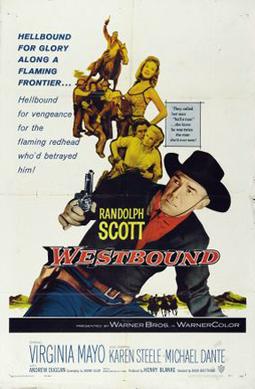
Well, I did it. It may have taken me years, but I finally did it! Thanks to a recent airing on Turner Classic Movies (my go-to movie station), I was able to finally watch the only Budd Boetticher-Randolph Scott pairing I had not seen. That entry? From 1959, Westbound, actually the sixth of seven films the director and star worked together on. Where does it end up among the seven? Read on and find out!
It's late in the Civil War as the Union and Confederacy continue the bloody fighting, both sides looking for more gold to bankroll all the fighting. One of the keys? Getting that gold from California across the southwest to safety so it can be deposited in banks and mints. In steps John Hayes (Scott), an extremely capable Union cavalry officer who has a background in running a stagecoach line. He's now being sent to start up a line on the fly, one that will be running coaches full of gold being shipped as fast as humanly possible. The task is incredibly difficult, especially because Southerners in abundance are going to do their damnedest to stop him from succeeding. First up on that list is his former employee, Clay Putnam (Andrew Duggan), a Confederate sympathizer who's hijacked much of the already-established stage line. Into it all, Hayes steps in with little room for error and less time to get things right.
As a western fan, it is hard not to like these films, these seven pairings between Boetticher and Scott. Their reputation has grown over the years -- thankfully! -- to the point that western fans look to these films as some of the best of the genre, a canon to be recognized. Where does 'Westbound' fall? Right in the middle. I liked it a lot, but I can't put it on the same level as 7 Men from Now and Ride Lonesome, my two favorites of the bunch. It's better too than Decision at Sundown and Buchanan Rides Alone, putting it instead among Comanche Station and The Tall T as the 'good, but not great' entries. None of them are bad, just some better than others. 'Westbound' is one that grew on me during its 72-minute running time. Something clicked in about the 25-minute mark or so, and I was hooked.
I've made no bones about my dislike and worry over so many heavy, overdone adult westerns from the 1950's. The drama, the emotion, the betrayals, it was all laid on so thick. One of many beauties of the Boetticher/Scott films is their outlook on the west. There was good, bad and those caught in the middle, those who have to decide to do what's right (and possibly dangerous) or just go along with the easy payday, what's easy. Among westerns -- and films, stories in general -- there's nothing more direct than good vs. evil. Where will everyone fall in the end? Boetticher follows the similar formula, the same archetypes and at just 72-minutes, 'Westbound' is a fast-moving, often dark, adult western that flies by. An excellent, underrated final product.
Leading the way and navigating through the good and bad is star Randolph Scott, an ideal lead for these movies, a necessary front man. Movie-in and movie-out, Scott was what these movies needed. His John Hayes is no different, resolute in getting the job done no matter what odds are stacked against him. He doesn't see black or white or shades of grey. Hayes sees what is right and intends to get the job done. There's never a doubt of his intentions. These aren't anti-heroes, but instead, a last wave of true western heroes. Scott throws himself into those parts with abandon. He's believable. You buy it that he will never take the easy way out. But you ask, even when a lost love (Virginia Mayo) is waiting there to be swept away? NO! Our hero wouldn't dream of it! What about a lovely young bride (Karen Steele) who he's clearly attracted to? Double NO! It just ain't gonna happen, a true western hero, a dying breed by 1959 in the genre.
There's some good parts all around in this Boetticher western. I liked Duggan a lot as Putnam, the Confederate sympathizer determined to stop Hayes but even he has limits. His enforcer, Mace (Michael Pate), has no such limits, providing some tense moments as their plan is put into action. Mayo is Putnam's wife, a woman torn by her past feelings of Scott's Hayes and her genuine feelings for her current husband. Steele is a bright spot also as Jeanie Miller, a young bride to Rod (Michael Dante), a Union soldier who lost an arm in the fighting and was sent home. There's an interesting dynamic among Hayes, Jeanie and Rod as the stage plan comes together that takes some surprising turns as the story develops. Wally Brown provides some comic relief as Stubbs, the stagecoach driver, with John Daheim memorable as the sneering henchman of Mace's...Russ.
Nothing flashy, nothing too out of the ordinary. It wouldn't fit with Boetticher's straightforward, no-nonsense smile. This is a western at its finest with a story that doesn't pull any punches, a hero who it's easy to root for, villains you can't wait to see get their due, and all of it wrapped tightly in a nice 72-minute package. If you're a fan of the other Boetticher/Scott pairings, you'll definitely enjoy this one too.
Westbound (1959): ***/****
The Sons of Katie Elder
"First, we reunite, then find Ma and Pa's killer...then read some reviews."
Showing posts with label Michael Pate. Show all posts
Tuesday, February 16, 2016
Monday, October 13, 2014
The Great Sioux Massacre
I caught part of They Died With Their Boots On recently on a cable movie channel. It got me thinking. There just isn't many movies made about George Armstrong Custer, and then I quickly corrected myself. There aren't many good movies about Custer. Yeah, Boots is good if dated, and the TV miniseries Son of the Morning Star is an exception. Well, here we sit with another entry. Where does 1965's The Great Sioux Massacre end up?
Having received new orders, Lt. William Benton (Darren McGavin) rides west to the fort where the Seventh Cavalry is stationed. He's looking forward to meeting his new commander, Colonel George Armstrong Custer (Philip Carey), a renowned Indian fighter who's reputation precedes him. Tensions with the Plains Indians are rising with each passing month, but that's just part of the problem for Benton. A woman from his past, Caroline Reno (Julie Sommars), is stationed at the post with her angry, alcoholic father, one of Custer's officers, Major Marcus Reno (Joseph Cotten). Benton immediately requests a transfer to avoid the drama, but Colonel Custer convinces him to stick it out. A fight with the Indians is coming, and Custer has some master plans for his cavalry regiment and for his future beyond.
One of the most fascinating personalities in American history, George Armstrong Custer is a divisive individual. Was he a hero, a brilliant military strategist and Indian fighter? Was he a bumbling officer, a gloryhound seeking his own fame? It's some of both most likely, but the moral of the story is pretty simple. This isn't a good movie. From director Sidney Salkow, 'Sioux' takes the history of the late 1860s and into the 1870s, throws it into a blender and pours what's left into this 102-minute B-western. He rewrites the history that is really interesting in itself and makes it....well, not interesting. That takes some doing when you consider the background.
So where to start? It's based on Custer, the Seventh Cavalry and the Battle of the Little Big Horn, but there are tweaks at basically all turns. Everyone else is named after the historical individuals they're based on, except for McGavin's Lt. Benton, supposedly based on Lt. William Benteen. The actual Benteen isn't interesting though so let's switch things up!!! In the facts, Benteen and Major Reno were both born in 1834, but here Benteen (um, Benton) has dated Reno's daughter. Yeah, personal drama! Reno is also apparently an angry Southerner who still holds a grudge against the North. Benton is also a Southerner with McGavin sporting a painfully awkward southern accent. Seriously, folks? Are we really doing this? We're degenerating a really fascinating historical story into a really forced, not worthwhile love story.
But somehow and some way Colonel Custer will save us. Right? Right?!? No, not especially. Carey doesn't have the star power or charisma to bring Colonel Custer to life. There is so much potential for character development and really delving into the guts of a military leader with an instantly recognizable name. Some of the actual history is explored, especially Custer's efforts to expose government corruption surrounding the Indian agencies. Before the Battle of the Little Bighorn, the actual Custer was actually removed from command and potentially facing some serious threats from President Grant. The story and facts are interesting, but the actual execution is not unfortunately in the film. Also look for Nancy Kovack as Libby, Custer's supportive wife.
Much of the screentime is focused on Custer, Benton and Reno, wasting some potentially cool supporting parts. I thought the most interesting character was the cavalry scout, Dakota (John Matthews), a white man who saw his family wiped out by Indians. Also look for Michael Pate as Sitting Bull and Iron Eyes Cody as Crazy Horse, underutilized as warrior counterparts to our bumbling cavalry officers. There's also House Peters Jr. appearing late as Cambridge, a reporter tasked with building up Custer's heroic actions.
So Custer couldn't save things. Could the actual battle scene, the infamous Custer's last stand? Um, no. Throughout the movie in hopes of hiding the film's small budget, footage is liberally borrowed from a 1954 western, Sitting Bull, also directed by Salkow. Small world, huh?!? Basically any shot of cavalry leaving the fort or riding across the plains or heading into battle is from the 1954 movie, not the 1965 one. The filming locations are vastly different so this footage stands out like a sore thumb. Just not good. Oh, so not good.
The Great Sioux Massacre (1965): * 1/2 /****
Having received new orders, Lt. William Benton (Darren McGavin) rides west to the fort where the Seventh Cavalry is stationed. He's looking forward to meeting his new commander, Colonel George Armstrong Custer (Philip Carey), a renowned Indian fighter who's reputation precedes him. Tensions with the Plains Indians are rising with each passing month, but that's just part of the problem for Benton. A woman from his past, Caroline Reno (Julie Sommars), is stationed at the post with her angry, alcoholic father, one of Custer's officers, Major Marcus Reno (Joseph Cotten). Benton immediately requests a transfer to avoid the drama, but Colonel Custer convinces him to stick it out. A fight with the Indians is coming, and Custer has some master plans for his cavalry regiment and for his future beyond.
One of the most fascinating personalities in American history, George Armstrong Custer is a divisive individual. Was he a hero, a brilliant military strategist and Indian fighter? Was he a bumbling officer, a gloryhound seeking his own fame? It's some of both most likely, but the moral of the story is pretty simple. This isn't a good movie. From director Sidney Salkow, 'Sioux' takes the history of the late 1860s and into the 1870s, throws it into a blender and pours what's left into this 102-minute B-western. He rewrites the history that is really interesting in itself and makes it....well, not interesting. That takes some doing when you consider the background.
So where to start? It's based on Custer, the Seventh Cavalry and the Battle of the Little Big Horn, but there are tweaks at basically all turns. Everyone else is named after the historical individuals they're based on, except for McGavin's Lt. Benton, supposedly based on Lt. William Benteen. The actual Benteen isn't interesting though so let's switch things up!!! In the facts, Benteen and Major Reno were both born in 1834, but here Benteen (um, Benton) has dated Reno's daughter. Yeah, personal drama! Reno is also apparently an angry Southerner who still holds a grudge against the North. Benton is also a Southerner with McGavin sporting a painfully awkward southern accent. Seriously, folks? Are we really doing this? We're degenerating a really fascinating historical story into a really forced, not worthwhile love story.
But somehow and some way Colonel Custer will save us. Right? Right?!? No, not especially. Carey doesn't have the star power or charisma to bring Colonel Custer to life. There is so much potential for character development and really delving into the guts of a military leader with an instantly recognizable name. Some of the actual history is explored, especially Custer's efforts to expose government corruption surrounding the Indian agencies. Before the Battle of the Little Bighorn, the actual Custer was actually removed from command and potentially facing some serious threats from President Grant. The story and facts are interesting, but the actual execution is not unfortunately in the film. Also look for Nancy Kovack as Libby, Custer's supportive wife.
Much of the screentime is focused on Custer, Benton and Reno, wasting some potentially cool supporting parts. I thought the most interesting character was the cavalry scout, Dakota (John Matthews), a white man who saw his family wiped out by Indians. Also look for Michael Pate as Sitting Bull and Iron Eyes Cody as Crazy Horse, underutilized as warrior counterparts to our bumbling cavalry officers. There's also House Peters Jr. appearing late as Cambridge, a reporter tasked with building up Custer's heroic actions.
So Custer couldn't save things. Could the actual battle scene, the infamous Custer's last stand? Um, no. Throughout the movie in hopes of hiding the film's small budget, footage is liberally borrowed from a 1954 western, Sitting Bull, also directed by Salkow. Small world, huh?!? Basically any shot of cavalry leaving the fort or riding across the plains or heading into battle is from the 1954 movie, not the 1965 one. The filming locations are vastly different so this footage stands out like a sore thumb. Just not good. Oh, so not good.
The Great Sioux Massacre (1965): * 1/2 /****
Labels:
1960s,
Custer,
Joseph Cotten,
Michael Pate,
Philip Carey,
westerns
Tuesday, March 4, 2014
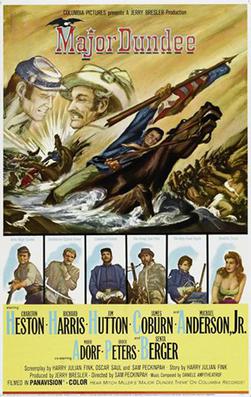
Major Dundee
It's late in 1864, the Civil War raging back east, but in the New Mexico territory, an Apache war party led by Sierra Charriba (Michael Pate), massacres a troop of U.S. cavalry, kidnapping three boys from a local ranch at the same time. The commander of a nearby Confederate prison camp, Major Amos Dundee (Charlton Heston) decides to go after the Apaches, rescuing the kids and bringing Charriba to justice. Without abandoning the camp though, he must assemble a ragtag group of Confederate prisoners, black infantry, inexperienced officers, cowboys, drunks, bandits and thieves to capture the Apaches. At his right hand is a Confederate officer and friend from the past but now a sworn enemy, Capt. Benjamin Tyreen (Richard Harris). Dundee's company of irregular cavalry hits the trail, following the Apache war party into Mexico, tangling with occupying French forces as well. The Apaches and the French are just two enemies though, the Union and Confederate loyalties among the company threatening to tear Dundee's command apart from the inside.
The production history of this Peckinpah western has quite the checkered past. The production in Mexico went way over budget and way over schedule. Depending on what you read, Peckinpah's original cut for 'Dundee' was anywhere between three and four hours long. When the studio took it away from him, it was cut down to just over two hours. A DVD released in 2005 had a new, never before seen version with almost 15 additional minutes added to the running time. Some additional footage was found that was unable to be reinserted back into the film, but as is, we'll probably never know/see Peckinpah's intended version. So what's the end result with the 136-minute version? A far better western than the 123-minute version that features some good performances, a ridiculously deep cast, some ahead of its time vicious action, and a story that drifts needlessly at times.
What was Peckinpah's goal? He wanted to make an epic western, a new western in the vein of the John Ford cavalry movies. It was supposed to be big and violent full of scope and vision. 'Dundee' doesn't quite live up to that, but in terms of pure entertainment, it's hard to beat. It starts with Charlton Heston in the titular role. Like Peckinpah's best movies, Dundee is the flawed anti-hero like nobody's business. The story almost becomes Moby Dick in the Civil War west. Dundee has been posted to this isolated prison camp because of a command decision he made at Gettysburg (hinted at, never spelled out), and he intends to right that wrong. His plan? Get the kids back, take out Sierra Charriba, become a hero again. The problem? Dundee may not be cut out for command. He's equal parts brilliant strategist with overreaching egoist. His pride and ego get in the way of things, the mission into Mexico becoming an obsession. Quite the performance, one that doesn't always get the notoriety it deserves in Heston's already impressive filmography.
One of Peckinpah's favorite storytelling devices was the anti-hero and his right hand man, sometimes a former friend turned unwilling ally, a device used to its best ability four years later in The Wild Bunch. Here, that relationship is between Heston's Dundee and Richard Harris' Capt. Ben Tyreen. Again, their checkered history (friendship turned bitter rivalry, even hatred) all leads up to this, two men forced to work together. Harris is one of my favorite actors, and this is my favorite performance of many, one of my all-time favorite characters in any film. Harris' Tyreen is everything Dundee wants to be; intelligent, charming, a good leader, and well liked and respected by his men. Tyreen has one great line after another, Harris bringing this character to life, a Irish immigrant turned cashiered American officer to Confederate renegade. The dynamic between Dundee and Tyreen provides some of the movie's best dialogue scenes, the confrontations crackling with energy. Kudos to both actors for developing that chemistry to its fullest.
Brace yourself though. This movie has one sick cast of tough guy actors, many from the Peckinpah stock character Hall of Fame. Jim Hutton provides some laughs as Lt. Graham, a bumbling artillery officer assigned to the cavalry. James Coburn is a scene-stealer as Samuel Potts, Dundee's one-armed, bearded, quick-witted scout, as is Mario Adorf as the feisty, loyal Sgt. Gomez, Dundee's most capable Union soldier. Michael Anderson Jr. does a fine job too as Trooper Ryan, Dundee's young bugler, providing the narration from his in-mission journal. There's also Brock Peters as Aesop, the leader of the small contingent of black infantry, Slim Pickens as Wiley, the drunken mule-packer, R.G. Armstrong as Reverend Dahlstrom, the shotgun-wielding preacher, and Dub Taylor as Priam, the disheveled horse thief. As for Tyreen's Confederates, there's Ben Johnson as the tough Sgt. Chillum, L.Q. Jones and Warren Oates as Arthur and O.W. Hadley, and John Davis Chandler as Jimmy Lee, the troublemaker. Also look for Karl Swenson as Dundee's second-in-command at the prison camp. Just a ridiculously deep cast full of great characters.
Where the movie struggles some -- but is also damn entertaining in those struggles -- is the final 40 minutes. The story does drift too much from the Apaches to the French to Dundee's lost weekend in Durango and a brief love affair with Senta Berger's Teresa. Trooper Ryan's narration gets choppy, weeks slipping by in a flash. The saving grace is back-to-back action sequences, one a showdown with the Apaches in a box canyon, the other a bloody, violent battle with French lancers in the Rio Grande. This is Peckinpah at his action best, clearly an indicator of where his movies would go, especially with The Wild Bunch. Watch the scene with the French and see how brutal it is, how graphic it could have been if censors allowed it. Characters are unceremoniously killed off (blink and you'll miss it), including one surprising death, but it's just a great action scene leading to a quick ending.
Most Peckinpah fans don't list this as their favorite, maybe not even one of their favorites. I just really like this movie, always have, and the longer version with the additional 15 minutes or so really does help make it better. The musical score from composer Daniele Amfitheatrof takes some heat, especially the Major Dundee theme (listen HERE), but I like it, almost as a guilty pleasure. Filming on location in Mexico, including stops in Durango, a gorgeous waterfall location at El Saltito, and many more, all add to that authentic flavor. You really feel like you're on an odyssey across Mexico, seeing a variety of spots, locations and cities. One of my favorite westerns, a heavily flawed but just a damn entertaining movie in the end. Hard to beat, even if we'll never see that epic 4-hour version Peckinpah intended.
Major Dundee (1965): ****/****
Rewrite of August 2009 review
Wednesday, January 29, 2014
PT 109
John
F. Kennedy is known for any number of things from a tragically
shortened life. His beautiful wife, Jackie, his supposed affairs with
Marilyn Monroe among others, his charm and popularity, his turbulent
presidency that included the Cuban Missile Crisis, and most tragically,
his assassination under the rifle of Lee Harvey Oswald. One of the most
fascinating parts of his adventure-filled life? His World War II
exploits as told in 1963's PT 109.
While the fighting rages in the Solomon Islands in the Pacific in 1943, Lt. John F. Kennedy (Cliff Robertson) arrives at a small naval base specializing in patrol torpedo boats (PT) meant to keep Japanese forces at bay. Kennedy is given command of PT 109, a beat-up old boat that has seen far better days. He's given just a week to get the 109 ready for action, assembling a crew, including Ensign Leonard Thom (Ty Hardin), cleaning the boat, and rehabbing the engines. They manage to come in under deadline, Kennedy, his crew and the 109 thrust immediately into action. The day-to-day life of a PT boat is a dangerous one though, the boats meant to be used to buy time while the U.S. Navy still tries to recover from Pearl Harbor. Patrols, routine or not, rescues, deliveries, Kennedy and his crew take it all on, but the mission that will put them all in the history books awaits one pitch-black night in the Blackett Strait in the Solomon Islands.
One of my favorite movies growing up, I can still go back and visit this 1963 WWII movie from director Leslie H. Martinson and enjoy it from beginning to end. This isn't the most hard-hitting of movies, but like some other WWII movies from Warner Bros., there is a distinct visual look, a professionalism and a straightforward style that plays well. Could things be tightened up a bit with a 140-minute movie? Sure, here and there, but it's an excellent story and film just the same. It was filmed in the Florida Keys, and it's sunny and sandy with plenty of palm trees to help stand in for the Solomon Islands in the Pacific. The musical score from composers David Buttolph and William Lava knows when to lighten the mood and when to show the developing drama, a score that sounds similar to another Warner Bros. WWII movie, 1962's Merrill's Marauders.
Released in theaters less than six months before his death in Dallas, PT 109 was made with the help of Kennedy right in the midst of his term as President. He even had final say on the actor who would play him, Robertson being his ultimate choice. It ends up being a great pick, one that makes the movie far more memorable in my eyes. Besides the striking physical resemblance -- look at Robertson in an iconic JFK picture HERE -- Robertson nails the heroic, likable, charming part of a future American president. That's the movie's goal, to show Kennedy as a hero. More on the details in the next paragraph, but Kennedy's actions were more than enough so Martinson didn't have to stretch things too much. Robertson's Kennedy is smart, quick with a comeback and a plan, a leader who's respected by his men and fellow officers, and a capable commander with a knack for doing the right thing. It's not the most in-depth characterization, but it never set out to be. Kudos to Robertson, already one of my favorites.
Semi-SPOILERS from here on in. The truth of the story behind PT 109 is remarkable in itself. Patrolling in the Blackett Strait a dark August night, the 109 was struck by a Japanese destroyer similarly on patrol. Kennedy's boat was ripped in two pieces, two crewmen killed in the collision. Banding the men together, Kennedy got the survivors to swim to a far-off island and hopefully wait for survival. What followed is and was an inspiring story in itself, Kennedy ultimately winning the the Congressional Medal of Honor for his heroic actions. The movie itself is divided into two halves, the first introducing Kennedy, the crew, the boat and their exploits, the second half following its chapter in history as a Japanese destroyer tears the little boat apart. Both halves are excellent, but it's hard to beat the second half as the survivors desperately wait for help in one form or another, Kennedy swimming out into the Strait at night to flag down an American ship.
While the focus is obviously on Robertson as Kennedy, the supporting cast is very solid without stealing the spotlight. Hardin as 2nd-in-command Ensign Thom has a good chemistry with Robertson, Robert Blake, Norman Fell, and Biff Elliot starring as the most visible of the 109's crew. James Gregory is a scene-stealer as Commander Ritchie, the leader of a squadron of PT boats, a veteran officer who's never seen combat but is always searching for the best out of his men. Even Robert Culp shows up at the halfway point as Ensign Barney Ross, an old friend of Kennedy's who ends up on the 109 for its fateful mission, Michael Pate making a memorable appearance as Evans, an Australian coastwatcher who plays an integral part in the eventual rescue of Kennedy and the remaining survivors. Also lending his voice talents in an uncredited narrator role is Andrew Duggan.
This isn't a WWII movie that rewrites the genre. It is a movie meant to honor the heroics of future president John F. Kennedy, and it does it well. Exciting with some good action, some genuine laughs and some lighter moments, and Robertson in a great leading part as Kennedy himself.
PT 109 (1963): *** 1/2 /****
Rewrite of August 2010 review
While the fighting rages in the Solomon Islands in the Pacific in 1943, Lt. John F. Kennedy (Cliff Robertson) arrives at a small naval base specializing in patrol torpedo boats (PT) meant to keep Japanese forces at bay. Kennedy is given command of PT 109, a beat-up old boat that has seen far better days. He's given just a week to get the 109 ready for action, assembling a crew, including Ensign Leonard Thom (Ty Hardin), cleaning the boat, and rehabbing the engines. They manage to come in under deadline, Kennedy, his crew and the 109 thrust immediately into action. The day-to-day life of a PT boat is a dangerous one though, the boats meant to be used to buy time while the U.S. Navy still tries to recover from Pearl Harbor. Patrols, routine or not, rescues, deliveries, Kennedy and his crew take it all on, but the mission that will put them all in the history books awaits one pitch-black night in the Blackett Strait in the Solomon Islands.
One of my favorite movies growing up, I can still go back and visit this 1963 WWII movie from director Leslie H. Martinson and enjoy it from beginning to end. This isn't the most hard-hitting of movies, but like some other WWII movies from Warner Bros., there is a distinct visual look, a professionalism and a straightforward style that plays well. Could things be tightened up a bit with a 140-minute movie? Sure, here and there, but it's an excellent story and film just the same. It was filmed in the Florida Keys, and it's sunny and sandy with plenty of palm trees to help stand in for the Solomon Islands in the Pacific. The musical score from composers David Buttolph and William Lava knows when to lighten the mood and when to show the developing drama, a score that sounds similar to another Warner Bros. WWII movie, 1962's Merrill's Marauders.
Released in theaters less than six months before his death in Dallas, PT 109 was made with the help of Kennedy right in the midst of his term as President. He even had final say on the actor who would play him, Robertson being his ultimate choice. It ends up being a great pick, one that makes the movie far more memorable in my eyes. Besides the striking physical resemblance -- look at Robertson in an iconic JFK picture HERE -- Robertson nails the heroic, likable, charming part of a future American president. That's the movie's goal, to show Kennedy as a hero. More on the details in the next paragraph, but Kennedy's actions were more than enough so Martinson didn't have to stretch things too much. Robertson's Kennedy is smart, quick with a comeback and a plan, a leader who's respected by his men and fellow officers, and a capable commander with a knack for doing the right thing. It's not the most in-depth characterization, but it never set out to be. Kudos to Robertson, already one of my favorites.
Semi-SPOILERS from here on in. The truth of the story behind PT 109 is remarkable in itself. Patrolling in the Blackett Strait a dark August night, the 109 was struck by a Japanese destroyer similarly on patrol. Kennedy's boat was ripped in two pieces, two crewmen killed in the collision. Banding the men together, Kennedy got the survivors to swim to a far-off island and hopefully wait for survival. What followed is and was an inspiring story in itself, Kennedy ultimately winning the the Congressional Medal of Honor for his heroic actions. The movie itself is divided into two halves, the first introducing Kennedy, the crew, the boat and their exploits, the second half following its chapter in history as a Japanese destroyer tears the little boat apart. Both halves are excellent, but it's hard to beat the second half as the survivors desperately wait for help in one form or another, Kennedy swimming out into the Strait at night to flag down an American ship.
While the focus is obviously on Robertson as Kennedy, the supporting cast is very solid without stealing the spotlight. Hardin as 2nd-in-command Ensign Thom has a good chemistry with Robertson, Robert Blake, Norman Fell, and Biff Elliot starring as the most visible of the 109's crew. James Gregory is a scene-stealer as Commander Ritchie, the leader of a squadron of PT boats, a veteran officer who's never seen combat but is always searching for the best out of his men. Even Robert Culp shows up at the halfway point as Ensign Barney Ross, an old friend of Kennedy's who ends up on the 109 for its fateful mission, Michael Pate making a memorable appearance as Evans, an Australian coastwatcher who plays an integral part in the eventual rescue of Kennedy and the remaining survivors. Also lending his voice talents in an uncredited narrator role is Andrew Duggan.
This isn't a WWII movie that rewrites the genre. It is a movie meant to honor the heroics of future president John F. Kennedy, and it does it well. Exciting with some good action, some genuine laughs and some lighter moments, and Robertson in a great leading part as Kennedy himself.
PT 109 (1963): *** 1/2 /****
Rewrite of August 2010 review
Labels:
1960s,
Cliff Robertson,
James Gregory,
Michael Pate,
Norman Fell,
Robert Blake,
Robert Culp,
Ty Hardin,
WWII
Sunday, May 27, 2012
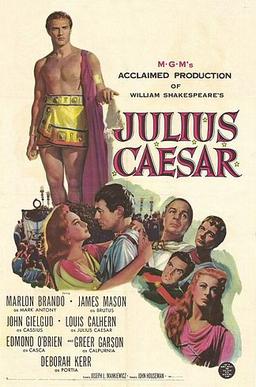
Julius Caesar (1953)
So this William Shakespeare guy....pretty talented, huh? A poet and playwright, he is basically the benchmark for everything in literature. And thanks to my upbringing in English classes through high school and college, I basically hate Shakespeare. I was forced to read his writings and resented basically every minute of it. That only partially explains my hate for 1953's Julius Caesar, but it is certainly part of it.
In ancient Rome, senator Julius Caesar (Louis Calhern) returns to an adoring public, many touting him as the future ruler of the Roman empire. Caesar's ambition is feared throughout the Senate, even leading many of his fellow Senators to plot against him, including the idealistic Brutus (James Mason) and cynical, scorned Cassius (John Gielgud). They worry that his ambition, along with close friend and fellow Senator, Mark Antony (Marlon Brando), will spell Rome's doom. They begin to form a plan, one that could change the country's future for years to come.
Now I'm going to say something early and just be done with it. I don't intend this review to sound like a whiny high school student although no doubt it will to a certain point. I can appreciate Shakespeare as an immense talent, but that doesn't mean I like anything about reading his work. I can appreciate that his talents have influenced basically every form of literature written since. But actually reading it? Some of the most difficult experiences I've ever had with the written word. Long, uninterrupted scenes of dialogue/monologues have a knack for putting me to sleep quickly. But....but.....even knowing this, I sought out this 1953 film, mostly because of the extraordinary talent assembled here. Unfortunately, I disliked it as much as I've always disliked Shakespeare's works whether it be in books and plays or film and television.
Where my objection comes from is Shakespeare's style. In writing, it is extremely difficult for me to get through the dialogue, and seeing it in a film didn't help. Well written it most certainly is, but it is stilted, awkward, forced and for me, difficult to follow. It doesn't seem to make a difference who's reciting the lines because the talent in this cast is truly impressive. And yes, I know these are stage-based stories, but seeing actors -- no matter the talent -- stand and wave and yell and recite several minutes of expressive yet still stilted dialogue doesn't scream out 'ENTERTAINING!' to me. Acting is one thing, and method acting a whole other beast, but I've never understood the appeal of loud, verbose, exaggerated stage acting, and that's what this movie is. It's 120 minutes of very talented actors talking and talking and...well, you get the idea.
With so much talent assembled for this film in the cast and director Joseph Mankiewicz behind the camera, I just assumed my issues would go by the wayside. With three movies to his name (Streetcar, The Men, Viva Zapata), Brando is a bright spot as Mark Anthony. His famous address of the Roman people following Caesar's assassination especially stands out. Then throw in Mason, Calhern, Gielgud, Edmond O'Brien, Greer Garson and Deborah Kerr? How could that not be worthwhile? I chalk it up more to Shakespeare's style than anything, but I just didn't care. I know the story, know where it will end up, and who makes it and who doesn't. Also look for Michael Ansara, Michael Pate, John Doucette, Lawrence Dobkin and Rhys Williams in smaller supporting parts.
I'm ready to take all sorts of heat for my dislike of this movie, but I hated it almost from the start. Besides the stilted, overdone stage acting, it is an incredibly dull story to watch. It was filmed in black and white on a soundstage, the camera and focus on the actors, not the huge scale or lavish sets. Bored to tears. There's just only so many ways to hear a classically trained actor speaking in the most prim and proper English ever written. So go ahead, let me have it if you so choose. I'm admitting I don't like Shakespeare. Karma is going to kick me square in the butt at some point.
Julius Caesar <---TCM trailer/clips (1953): */****
In ancient Rome, senator Julius Caesar (Louis Calhern) returns to an adoring public, many touting him as the future ruler of the Roman empire. Caesar's ambition is feared throughout the Senate, even leading many of his fellow Senators to plot against him, including the idealistic Brutus (James Mason) and cynical, scorned Cassius (John Gielgud). They worry that his ambition, along with close friend and fellow Senator, Mark Antony (Marlon Brando), will spell Rome's doom. They begin to form a plan, one that could change the country's future for years to come.
Now I'm going to say something early and just be done with it. I don't intend this review to sound like a whiny high school student although no doubt it will to a certain point. I can appreciate Shakespeare as an immense talent, but that doesn't mean I like anything about reading his work. I can appreciate that his talents have influenced basically every form of literature written since. But actually reading it? Some of the most difficult experiences I've ever had with the written word. Long, uninterrupted scenes of dialogue/monologues have a knack for putting me to sleep quickly. But....but.....even knowing this, I sought out this 1953 film, mostly because of the extraordinary talent assembled here. Unfortunately, I disliked it as much as I've always disliked Shakespeare's works whether it be in books and plays or film and television.
Where my objection comes from is Shakespeare's style. In writing, it is extremely difficult for me to get through the dialogue, and seeing it in a film didn't help. Well written it most certainly is, but it is stilted, awkward, forced and for me, difficult to follow. It doesn't seem to make a difference who's reciting the lines because the talent in this cast is truly impressive. And yes, I know these are stage-based stories, but seeing actors -- no matter the talent -- stand and wave and yell and recite several minutes of expressive yet still stilted dialogue doesn't scream out 'ENTERTAINING!' to me. Acting is one thing, and method acting a whole other beast, but I've never understood the appeal of loud, verbose, exaggerated stage acting, and that's what this movie is. It's 120 minutes of very talented actors talking and talking and...well, you get the idea.
With so much talent assembled for this film in the cast and director Joseph Mankiewicz behind the camera, I just assumed my issues would go by the wayside. With three movies to his name (Streetcar, The Men, Viva Zapata), Brando is a bright spot as Mark Anthony. His famous address of the Roman people following Caesar's assassination especially stands out. Then throw in Mason, Calhern, Gielgud, Edmond O'Brien, Greer Garson and Deborah Kerr? How could that not be worthwhile? I chalk it up more to Shakespeare's style than anything, but I just didn't care. I know the story, know where it will end up, and who makes it and who doesn't. Also look for Michael Ansara, Michael Pate, John Doucette, Lawrence Dobkin and Rhys Williams in smaller supporting parts.
I'm ready to take all sorts of heat for my dislike of this movie, but I hated it almost from the start. Besides the stilted, overdone stage acting, it is an incredibly dull story to watch. It was filmed in black and white on a soundstage, the camera and focus on the actors, not the huge scale or lavish sets. Bored to tears. There's just only so many ways to hear a classically trained actor speaking in the most prim and proper English ever written. So go ahead, let me have it if you so choose. I'm admitting I don't like Shakespeare. Karma is going to kick me square in the butt at some point.
Julius Caesar <---TCM trailer/clips (1953): */****
Saturday, April 21, 2012
The Desert Rats
When I think of Richard Burton,
I think Actor with a capital A. A little eccentric, maybe a little more
nutty, but at his heart a true actor in the sense of the word. What I
like so much about Burton was that when he could have been some crazy,
pretentious Shakespearean nutcase, he didn't...at least on film. He did
fun, entertaining movies, not just acting movies. Early in his career in
1953's The Desert Rats, we get the best of both worlds.
It's spring 1941, and German Field Marshal Edwin Rommel (James Mason) and his army are pushing the Allied forces back further with each passing day. In the Libyan port city of Tobruk, Allied forces -- predominantly English and Australian -- have been completely cut off by Rommel's army and have been given the order to hold the city until relief comes. Among those soldiers trapped in the city is Capt. MacRoberts (Burton), a Scotsman who was one of the few survivors from his unit caught in a German ambush. He's given command of an inexperienced, newly arrived company of Australian infantry. He's forced to whip them into shape quickly as the German noose around the city tightens.
If it is a WWII movie about the North African campaign, it appears the story must focus solely on Tobruk. Whether it's this flick, Raid on Rommel, the aptly named Tobruk, Play Dirty, even The Rat Patrol, a North Africa campaign has to deal with this famous port city. Not a classic movie, it's especially interesting considering the time it was released. By 1953, WWII was still fresh enough in people's minds, but director Robert Wise isn't making a propaganda movie here. This isn't evil Nazis battling infallible Brits. It's just two sides fighting it out in the desert without any notion of a bigger picture. It certainly marked a change in trends the years passed since the end of WWII.
For a generally forgotten WWII movie from the 1950s, I came away quite impressed with the action sequences. An extended siege -- the German siege of Tobruk lasted eight months -- isn't necessarily the most exciting thing to watch, but Wise keeps things moving in his 88-minute long movie. An early tank battle in a driving sandstorm sets the tone, not a huge scale battle but harrowing nonetheless. Commando raids across the desert to German lines are handled in a brutally efficient montage, and a deep behind enemy lines raid after a German ammo dump is the high point. The action isn't just there for action's sake though. We see the wearing down of the soldiers, the toll the extended siege has on them, especially in a fitting, moving finale as the end of the siege nears.
Just 28 years old when he starred in 'Desert Rats,' Burton is the unquestioned star here. He's a commander who looks out for his men, pushing them because he knows it will benefit them when the battles begin. His MacRoberts doesn't care if his men hate him. Their hatred can be a motivator as survival hangs in the balance. He has some excellent scenes with Robert Newton's Bartlett, MacRobert's former schoolteacher who's now a drunk and questioning his own bravery (or lack of). It's a subtle shift too, but the character ends up changing for the better by the end. Reprising his role from 1951's The Desert Fox, Mason is basically making a cameo appearance as Rommel, making the most of his few short scenes. Robert Douglas and Torin Thatcher play the British commanders in Tobruk with Chips Rafferty, Charles Tingwell, an uncredited Michael Pate, Charles Davis and Ben Wright playing some of MacRobert's men.
Covering so much ground in terms of time in an 88-minute movie, the story does feel rushed at different parts. A 2-hour movie could have fleshed things out a little, but as is, the movie is pretty solid on its own. There is that problem of having German characters talk in German for entire scenes without subtitles, but most of them are early on in the film. I have this weird thing about understanding what's going on in the movies I'm watching, but maybe that's just me. Subtitles, please! Still a very enjoyable, well-made WWII story.
The Desert Rats <---trailer (1953): ***/****
It's spring 1941, and German Field Marshal Edwin Rommel (James Mason) and his army are pushing the Allied forces back further with each passing day. In the Libyan port city of Tobruk, Allied forces -- predominantly English and Australian -- have been completely cut off by Rommel's army and have been given the order to hold the city until relief comes. Among those soldiers trapped in the city is Capt. MacRoberts (Burton), a Scotsman who was one of the few survivors from his unit caught in a German ambush. He's given command of an inexperienced, newly arrived company of Australian infantry. He's forced to whip them into shape quickly as the German noose around the city tightens.
If it is a WWII movie about the North African campaign, it appears the story must focus solely on Tobruk. Whether it's this flick, Raid on Rommel, the aptly named Tobruk, Play Dirty, even The Rat Patrol, a North Africa campaign has to deal with this famous port city. Not a classic movie, it's especially interesting considering the time it was released. By 1953, WWII was still fresh enough in people's minds, but director Robert Wise isn't making a propaganda movie here. This isn't evil Nazis battling infallible Brits. It's just two sides fighting it out in the desert without any notion of a bigger picture. It certainly marked a change in trends the years passed since the end of WWII.
For a generally forgotten WWII movie from the 1950s, I came away quite impressed with the action sequences. An extended siege -- the German siege of Tobruk lasted eight months -- isn't necessarily the most exciting thing to watch, but Wise keeps things moving in his 88-minute long movie. An early tank battle in a driving sandstorm sets the tone, not a huge scale battle but harrowing nonetheless. Commando raids across the desert to German lines are handled in a brutally efficient montage, and a deep behind enemy lines raid after a German ammo dump is the high point. The action isn't just there for action's sake though. We see the wearing down of the soldiers, the toll the extended siege has on them, especially in a fitting, moving finale as the end of the siege nears.
Just 28 years old when he starred in 'Desert Rats,' Burton is the unquestioned star here. He's a commander who looks out for his men, pushing them because he knows it will benefit them when the battles begin. His MacRoberts doesn't care if his men hate him. Their hatred can be a motivator as survival hangs in the balance. He has some excellent scenes with Robert Newton's Bartlett, MacRobert's former schoolteacher who's now a drunk and questioning his own bravery (or lack of). It's a subtle shift too, but the character ends up changing for the better by the end. Reprising his role from 1951's The Desert Fox, Mason is basically making a cameo appearance as Rommel, making the most of his few short scenes. Robert Douglas and Torin Thatcher play the British commanders in Tobruk with Chips Rafferty, Charles Tingwell, an uncredited Michael Pate, Charles Davis and Ben Wright playing some of MacRobert's men.
Covering so much ground in terms of time in an 88-minute movie, the story does feel rushed at different parts. A 2-hour movie could have fleshed things out a little, but as is, the movie is pretty solid on its own. There is that problem of having German characters talk in German for entire scenes without subtitles, but most of them are early on in the film. I have this weird thing about understanding what's going on in the movies I'm watching, but maybe that's just me. Subtitles, please! Still a very enjoyable, well-made WWII story.
The Desert Rats <---trailer (1953): ***/****
Labels:
1950s,
James Mason,
Michael Pate,
Richard Burton,
Robert Wise,
WWII
Tuesday, February 21, 2012
Rogue's March
Like The Beatles or any other popular group, everyone has their favorite Rat Pack member. Okay, maybe not everyone, but I needed something to write about so back off. Dean Martin is mine, followed closely by Frank Sinatra, Sammy Davis Jr., Joey Bishop and bringing up the rear, Peter Lawford. I've never thought of him as a great actor -- typically excelling at playing the condescending ass -- but with 1953's Rogue's March I might be coming around a bit.
A clerk who's never seen a second of actual combat, Capt. Dion Lenbridge (Lawford) gets by because his father, Colonel Lenbridge (Leo G. Carroll), is the commander of his regiment around the turn of the 19th Century. As the battalion is preparing to ship out to India, Dion is set up to look like a traitor for having sold secrets documents to Russian agents. The charge is false, but he has no way of reputing it. Before his long sentence begins, Dion escapes and fakes his own death to get the heat off his back. He has a plan though so he joins up with a different British unit under a false name as a private. Somehow and some way, he's going to redeem his honor and clear his name for the treacherous acts he's been accused of.
To be fair to Lawford as an actor, I'm more familiar with the movies he did later in his career near and around his Rat Pack days. He didn't have to act in those movies. He had to be cool more than anything else, but his cool always came across as smarmy and arrogant (to me at least). Lawford though had been working regularly in films since the early 1940s and has quite a few solid roles to his name, this one included. It's not a great role, and he doesn't really call all that much attention to himself. Like the movie on the whole, things pick up in the second half when he has nothing to lose. He's gotten his comeuppance and now has to fight to prove his innocence no matter how difficult or dangerous. Good, solid part, and a believable heroic lead.
As for the movie itself, it reflects Lawford in the lead role. It is a good, entertaining movie that never amounts to anything greater. The early goings as Lawford's Dion (what the hell kind of name is that even? I want to punch him for the name alone) is set up to take a fall are a little slow-going, but once he fakes his death the story picks up momentum. Director Allan Davis is balancing a lot of characters and relationships in a relatively short movie at 84 minutes so naturally some are not dealt with as much as we might like. 'March' has the distinct feel of the classic Gunga Din from the British army in India to the battle scenes to the hidden, menacing enemy. There's a reason it's been forgotten over the years, but you can certainly do worse.
With a fair share of British character actors (and Americans playing Brits), Lawford doesn't have to carry the movie on his own. Richard Greene plays Capt. Thomas Garron, Dion's old friend who knows the charges cannot be true and a soldier as brave as his friend. Janice Rule is Jane, Dion's fiance who doesn't seem too surprised when said dead fiance comes back from beyond the grave. Carroll is the prim and proper veteran British officer with a stiff upper lip, weighing his sentiment for his son with what he owes to the men of his command. Buried away down in the cast listing are Sean McClory, Michael Pate, and Skelton Knaggs as McGinty, Crane and Fish as three of Dion's friends in the regiments when he re-enlists. Also look for John Lupton as Lt. Jersey, an inexperienced officer who looks to Dion in the heat of battle.
Where 'March' most resembles the classic Gunga Din is in the finale, a British regiment trying to hold off an attack by Indian riflemen. The battle sequences are greatly enhanced by some on-location shooting, 'March' actually being filmed in the spot where the story takes place, the Khyber Pass, a mountain pass linking Pakistan and Afghanistan. The American Southwest wouldn't have held a candle to this spot. The black and white photography aids the location shooting, giving that desert an even more desolate and isolated feel, and the scale of the final battle is pretty impressive for such a small movie. It definitely helps make up for the lack of action in the build-up.
Rogue's March (1953): ** 1/2 /****
A clerk who's never seen a second of actual combat, Capt. Dion Lenbridge (Lawford) gets by because his father, Colonel Lenbridge (Leo G. Carroll), is the commander of his regiment around the turn of the 19th Century. As the battalion is preparing to ship out to India, Dion is set up to look like a traitor for having sold secrets documents to Russian agents. The charge is false, but he has no way of reputing it. Before his long sentence begins, Dion escapes and fakes his own death to get the heat off his back. He has a plan though so he joins up with a different British unit under a false name as a private. Somehow and some way, he's going to redeem his honor and clear his name for the treacherous acts he's been accused of.
To be fair to Lawford as an actor, I'm more familiar with the movies he did later in his career near and around his Rat Pack days. He didn't have to act in those movies. He had to be cool more than anything else, but his cool always came across as smarmy and arrogant (to me at least). Lawford though had been working regularly in films since the early 1940s and has quite a few solid roles to his name, this one included. It's not a great role, and he doesn't really call all that much attention to himself. Like the movie on the whole, things pick up in the second half when he has nothing to lose. He's gotten his comeuppance and now has to fight to prove his innocence no matter how difficult or dangerous. Good, solid part, and a believable heroic lead.
As for the movie itself, it reflects Lawford in the lead role. It is a good, entertaining movie that never amounts to anything greater. The early goings as Lawford's Dion (what the hell kind of name is that even? I want to punch him for the name alone) is set up to take a fall are a little slow-going, but once he fakes his death the story picks up momentum. Director Allan Davis is balancing a lot of characters and relationships in a relatively short movie at 84 minutes so naturally some are not dealt with as much as we might like. 'March' has the distinct feel of the classic Gunga Din from the British army in India to the battle scenes to the hidden, menacing enemy. There's a reason it's been forgotten over the years, but you can certainly do worse.
With a fair share of British character actors (and Americans playing Brits), Lawford doesn't have to carry the movie on his own. Richard Greene plays Capt. Thomas Garron, Dion's old friend who knows the charges cannot be true and a soldier as brave as his friend. Janice Rule is Jane, Dion's fiance who doesn't seem too surprised when said dead fiance comes back from beyond the grave. Carroll is the prim and proper veteran British officer with a stiff upper lip, weighing his sentiment for his son with what he owes to the men of his command. Buried away down in the cast listing are Sean McClory, Michael Pate, and Skelton Knaggs as McGinty, Crane and Fish as three of Dion's friends in the regiments when he re-enlists. Also look for John Lupton as Lt. Jersey, an inexperienced officer who looks to Dion in the heat of battle.
Where 'March' most resembles the classic Gunga Din is in the finale, a British regiment trying to hold off an attack by Indian riflemen. The battle sequences are greatly enhanced by some on-location shooting, 'March' actually being filmed in the spot where the story takes place, the Khyber Pass, a mountain pass linking Pakistan and Afghanistan. The American Southwest wouldn't have held a candle to this spot. The black and white photography aids the location shooting, giving that desert an even more desolate and isolated feel, and the scale of the final battle is pretty impressive for such a small movie. It definitely helps make up for the lack of action in the build-up.
Rogue's March (1953): ** 1/2 /****
Thursday, October 6, 2011
All the Brothers Were Valiant
I got off to a rocky start with 1953's All the Brothers Were Valiant. The story of two brothers on the high seas in the South Pacific in the 1850s seemed like so many other generic high seas adventures that flooded the market in the 1940s and 1950s. It seemed like all the samples from other movies were taken for this one down to the stock characters and idiotic decision-making. Thankfully somewhere along the way, director Richard Thorpe pulls his head out of his butt and decides to make a halfway-decent movie.
After a three year voyage, Joel Thorpe (Robert Taylor) returns to 1848 New Bedford to find out that his brother, Mark, has disappeared from his own voyage somewhere in the South Pacific. Joel is given command of his missing brother's ship -- a whaler -- and prepares for another long voyage, but not before marrying Priscilla Holt (Ann Blyth), the former sweetheart of Mark's who Joel always had a crush on. Priscilla joins Joel as they head for the South Pacific where they manage to find Mark (Stewart Granger), ready with an explanation for his missing status. Mark instantly causes problems, both with Priscilla who he wants back and almost inciting a mutiny on Joel's ship, enticing the crew with promises of pearls.
Okay, every so often I feel the need to say this. I realize it is the rare movie that is perfect and/or flawless. At least 99.99 percent of movies have something wrong with them. It's just hoping that the positives -- however many there are -- outweigh the negatives. That's why I'll be able to give 'Valiant' a positive review, a recommendation for any viewers who are curious. As bad as some parts are, as cliched as the characters and story can be, the end result is positive. I enjoyed the positives more than I hated the negatives, and that's all I'm looking for in a new movie on a first viewing.
Don't get me wrong. That first 30 minutes is particularly brutal. All the high seas cliches are there; the happy crew singing as they go about their work, the long shots of the majestic ship and its towering sails moving across the ocean, the firm but fair captain pushing his crew. It's bad, real bad. Making it worse is that Taylor and Blyth have no chemistry together. I've come around around Taylor who I wasn't always a fan of. This is not a strong part for him, a vanilla "hero" with little charisma or personality. Blythy's Priscilla is around because the story requires some tension. What woman in her right mind would board a ship with her husband with a three-year voyage ahead of them in the 1840s? Somehow, some way, she keeps her hair immaculate and her dresses pristine. Good for her.
The saving grace is Granger's arrival at about the 35-minute mark. He's the necessary bad boy hero, the good guy who has some questionable morals and/or motives. His backstory -- a flashback that runs around 10-15 minutes -- is the high point of the story, probably worthy of an entire movie on its own. Ravaged with fever in the South Pacific, he is cared for by a beautiful native girl (Betta St. John). Once healthy again, Mark joins with a marauding group of adventurers (including James Whitmore and Kurt Kasznar) searching for pearls on an isolated island with a warring tribe as its inhabitants. There is some tension, some excitement, some betrayals and backstabbing and greed in this too-short segment, starting the movie back on its more interesting path.
Thanks to Granger's introduction, the movie does get more interesting as things near the halfway point. There are still some weird coincidences and stupid decisions made, but the possible mutiny livens things up. Mutinies have a way of doing that I suppose. The drama that comes out of this second half illustrates what's wrong with the movie. It boils down to this. Granger is interesting. Taylor isn't. Granger's Mark plays everyone against each other for his own benefit, realizing his mistake in the closing minutes. It is a 1950s movie so his fate is never really in question. Taylor and his monotone voice and delivery keep us on Granger's side unfortunately so we're basically rooting for the "bad guy" of the two brothers.
Sappy love triangle and boring performances from Taylor and Blyth, this was a good movie. Granted, those are big strikes against any movie, but what are you going to do? Blyth bounces back and forth between Joel and Mark every other scene, and the resolution is too perfect to believe. I still liked the movie though in spite of basically everything in my head telling me not to like it. Among the mutinous crew, look for Keenan Wynn in Spanish-mode as Silva, the treacherous leader of the lowly crew, Michael Pate, Leo Gordon, Peter Whitney, and John Lupton. So overall, this movie barely (and it was close) gets a slightly positive recommendation. A classic it is not with some epic flaws, but I did enjoy it.
All the Brothers Were Valiant <---trailer (1953): ** 1/2 /****
After a three year voyage, Joel Thorpe (Robert Taylor) returns to 1848 New Bedford to find out that his brother, Mark, has disappeared from his own voyage somewhere in the South Pacific. Joel is given command of his missing brother's ship -- a whaler -- and prepares for another long voyage, but not before marrying Priscilla Holt (Ann Blyth), the former sweetheart of Mark's who Joel always had a crush on. Priscilla joins Joel as they head for the South Pacific where they manage to find Mark (Stewart Granger), ready with an explanation for his missing status. Mark instantly causes problems, both with Priscilla who he wants back and almost inciting a mutiny on Joel's ship, enticing the crew with promises of pearls.
Okay, every so often I feel the need to say this. I realize it is the rare movie that is perfect and/or flawless. At least 99.99 percent of movies have something wrong with them. It's just hoping that the positives -- however many there are -- outweigh the negatives. That's why I'll be able to give 'Valiant' a positive review, a recommendation for any viewers who are curious. As bad as some parts are, as cliched as the characters and story can be, the end result is positive. I enjoyed the positives more than I hated the negatives, and that's all I'm looking for in a new movie on a first viewing.
Don't get me wrong. That first 30 minutes is particularly brutal. All the high seas cliches are there; the happy crew singing as they go about their work, the long shots of the majestic ship and its towering sails moving across the ocean, the firm but fair captain pushing his crew. It's bad, real bad. Making it worse is that Taylor and Blyth have no chemistry together. I've come around around Taylor who I wasn't always a fan of. This is not a strong part for him, a vanilla "hero" with little charisma or personality. Blythy's Priscilla is around because the story requires some tension. What woman in her right mind would board a ship with her husband with a three-year voyage ahead of them in the 1840s? Somehow, some way, she keeps her hair immaculate and her dresses pristine. Good for her.
The saving grace is Granger's arrival at about the 35-minute mark. He's the necessary bad boy hero, the good guy who has some questionable morals and/or motives. His backstory -- a flashback that runs around 10-15 minutes -- is the high point of the story, probably worthy of an entire movie on its own. Ravaged with fever in the South Pacific, he is cared for by a beautiful native girl (Betta St. John). Once healthy again, Mark joins with a marauding group of adventurers (including James Whitmore and Kurt Kasznar) searching for pearls on an isolated island with a warring tribe as its inhabitants. There is some tension, some excitement, some betrayals and backstabbing and greed in this too-short segment, starting the movie back on its more interesting path.
Thanks to Granger's introduction, the movie does get more interesting as things near the halfway point. There are still some weird coincidences and stupid decisions made, but the possible mutiny livens things up. Mutinies have a way of doing that I suppose. The drama that comes out of this second half illustrates what's wrong with the movie. It boils down to this. Granger is interesting. Taylor isn't. Granger's Mark plays everyone against each other for his own benefit, realizing his mistake in the closing minutes. It is a 1950s movie so his fate is never really in question. Taylor and his monotone voice and delivery keep us on Granger's side unfortunately so we're basically rooting for the "bad guy" of the two brothers.
Sappy love triangle and boring performances from Taylor and Blyth, this was a good movie. Granted, those are big strikes against any movie, but what are you going to do? Blyth bounces back and forth between Joel and Mark every other scene, and the resolution is too perfect to believe. I still liked the movie though in spite of basically everything in my head telling me not to like it. Among the mutinous crew, look for Keenan Wynn in Spanish-mode as Silva, the treacherous leader of the lowly crew, Michael Pate, Leo Gordon, Peter Whitney, and John Lupton. So overall, this movie barely (and it was close) gets a slightly positive recommendation. A classic it is not with some epic flaws, but I did enjoy it.
All the Brothers Were Valiant <---trailer (1953): ** 1/2 /****
Labels:
1950s,
James Whitmore,
Keenan Wynn,
Leo Gordon,
Michael Pate,
Robert Taylor,
Stewart Granger
Monday, April 25, 2011
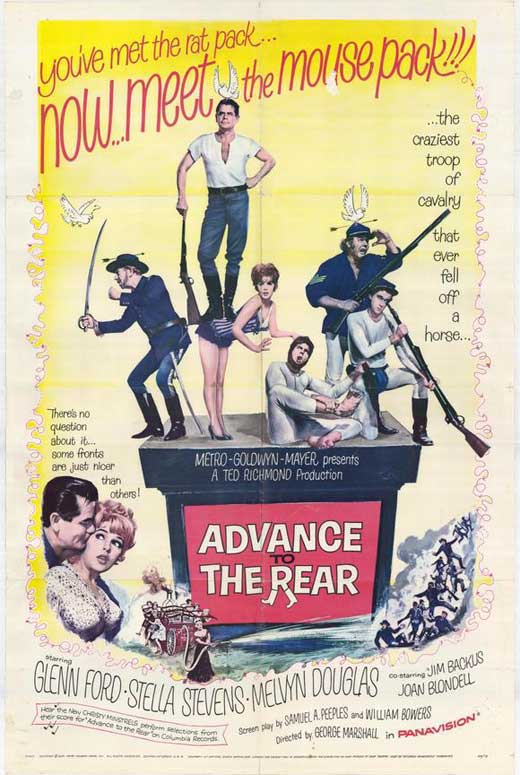
Advance to the Rear
Comedies seem to go through their ups and down patches like any genre movie does. In the last 10 years or so, R-rated comedies have seen a resurgence in popularity while in the 1990s it was romantic comedies and in the 1980s raucous, mind-numbingly stupid sex comedies. The 1970s and even the tail end of the 1960s? I guess it depends on the movie. Prior to that though in the age of big screen spectacles and epics, there was an innocence to comedies that was lost over the years. Epic comedies (how weird does that sound?) like The Great Race, It's a Mad, Mad, Mad World, The Russians are Coming and many more dominated movies.
Take 1964's Advance to the Rear, a comedic spoof of one of the funniest times in American history...the Civil War. There's no way that should work, right? America's bloodiest conflict doesn't seem like its ripe for the picking for a big-screen spoof. Somehow it does though, even if it isn't on the level of the previously mentioned comedies. It's no classic, but it accomplishes what it sets out to do. It is funny in a ridiculously stupid way, full of slapstick humor, some romance, and a cast full of recognizable names, all of them playing bumbling idiots. That's a formula for success if there ever was one.
It's 1862, and lawyer turned infantry soldier Captain Jared Heath (Glenn Ford) is the aide to a veteran of West Point and all-around clueless officer, Colonel Claude Brackenbury (Melvyn Douglas). Supposed to lead an attack on a Confederate position, Brackenbury's regiment instead turns and runs from the field of battle thanks to a simple miscommunication. The unit is made an example of for their cowardice and receives order to go west to a remote outpost, also taking along misfits and screw-ups from other units in the Union army. Dubbed Company Q, they head west by riverboat. Confederate intelligence catches wind of the new unit and assumes they're some sort of specialized unit meant to perform a dangerous mission. A beautiful Confederate spy, Martha Lou Williams (Stella Stevens), is sent west to investigate, and see exactly what these "special soldiers" are up to.
Slapstick comedy is completely hit-or-miss with me. I grew up watching The Three Stooges and Laurel and Hardy shorts so I do like some of it. But if it isn't handled correctly, it's going to go poorly, and do it fast. The problem is that you have to fully commit to doing the slapstick so you open things up to look completely stupid if it isn't funny. The physical humor here isn't bad, but it certainly isn't good either. Director George Marshall uses all sorts of wacky techniques, almost telling us when to laugh. Sound effects seem like they were used from a Batman TV episode and are painfully out of place. A soldier skis down a hill on tree branch skis? Add the sound of a plane taking off. Someone goes flying through the air? Cue the sound barrier being broken. Sound effects and sped-up action screams out desperation to me, and there's a good amount of it here.
When I think of Glenn Ford, I typically think of an underrated dramatic actor, someone able to move across genres and be believable and successful in all types of movies. Comedy? Not really the first thing that comes to mind. I was pleasantly surprised then when Ford as Capt. Jared Heath, a ladies man and the rare competent soldier in the bunch, ends up carrying the movie. By far, he's the biggest bright spot going for this 1960s comedy. He delivers his lines in such a deadpan fashion while also handling the more physical scenes that it seems effortless. Ford has a great chemistry with the always beautiful Stella Stevens (who poses as a showgirl briefly) in the romantic scenes and also with Douglas' clueless Colonel Brackenbury, the experienced officer who can't stand his aide and his way of going about things. Their exchanges of cracks back and forth help make up for some of the worst examples of slapstick, as do the scenes with Ford and Stevens. Ford's Heath quickly figures out she's a Confederate spy, but because he wants to marry her lets it go by the wayside. I don't blame him.
There was some wasted potential with the supporting cast to develop them into some better, even funnier characters. Jim Backus and Whit Bissell are the equally idiotic Union generals who send Company Q out west only to realize they've sent them to lead an actual dangerous mission that could turn the tide of the war. Joan Blondell plays Easy Jenny, the leader of the showgirls who take a shining to Heath and his men. Michael Pate has a small part as Charlie Thin Elk, an Indian chief who went to West Point in the 1830s. James Griffith plays Hugo Zattig, the leader of a group of Confederate renegades. As for Company Q, there's Alan Hale Jr. as Sgt. Davis, Andrew Prine as Pvt. Selous, always hiccuping, and Jesse Pearson as Cpl. Geary, a soldier who always has horses following him around because of his unique smell. There were some other interesting soldiers -- a klepto, a firebug, a boxer, a brawler -- who are introduced but never get much to do. If the movie was longer (it's only 100 minutes) like other 60s comedies, it's safe to say there would be some more development among Company Q.
It feels funny watching a Civil War comedy no matter how much of the humor does or doesn't work. Marshall films it in a great-looking widescreen fashion -- in black and white at that -- making it feel like an epic action/adventure flick, not a spoof. It is funny at times, but not as funny as it could have been. I wanted to like the movie more than I did. It's decent enough but nothing more. Also worth watching to see John Wayne's stunt man Chuck Roberson get a speaking role as a Confederate guerrilla. It is available to watch at Youtube starting HERE.
Advance to the Rear <--- TCM trailer (1964): ** 1/2 /****
Take 1964's Advance to the Rear, a comedic spoof of one of the funniest times in American history...the Civil War. There's no way that should work, right? America's bloodiest conflict doesn't seem like its ripe for the picking for a big-screen spoof. Somehow it does though, even if it isn't on the level of the previously mentioned comedies. It's no classic, but it accomplishes what it sets out to do. It is funny in a ridiculously stupid way, full of slapstick humor, some romance, and a cast full of recognizable names, all of them playing bumbling idiots. That's a formula for success if there ever was one.
It's 1862, and lawyer turned infantry soldier Captain Jared Heath (Glenn Ford) is the aide to a veteran of West Point and all-around clueless officer, Colonel Claude Brackenbury (Melvyn Douglas). Supposed to lead an attack on a Confederate position, Brackenbury's regiment instead turns and runs from the field of battle thanks to a simple miscommunication. The unit is made an example of for their cowardice and receives order to go west to a remote outpost, also taking along misfits and screw-ups from other units in the Union army. Dubbed Company Q, they head west by riverboat. Confederate intelligence catches wind of the new unit and assumes they're some sort of specialized unit meant to perform a dangerous mission. A beautiful Confederate spy, Martha Lou Williams (Stella Stevens), is sent west to investigate, and see exactly what these "special soldiers" are up to.
Slapstick comedy is completely hit-or-miss with me. I grew up watching The Three Stooges and Laurel and Hardy shorts so I do like some of it. But if it isn't handled correctly, it's going to go poorly, and do it fast. The problem is that you have to fully commit to doing the slapstick so you open things up to look completely stupid if it isn't funny. The physical humor here isn't bad, but it certainly isn't good either. Director George Marshall uses all sorts of wacky techniques, almost telling us when to laugh. Sound effects seem like they were used from a Batman TV episode and are painfully out of place. A soldier skis down a hill on tree branch skis? Add the sound of a plane taking off. Someone goes flying through the air? Cue the sound barrier being broken. Sound effects and sped-up action screams out desperation to me, and there's a good amount of it here.
When I think of Glenn Ford, I typically think of an underrated dramatic actor, someone able to move across genres and be believable and successful in all types of movies. Comedy? Not really the first thing that comes to mind. I was pleasantly surprised then when Ford as Capt. Jared Heath, a ladies man and the rare competent soldier in the bunch, ends up carrying the movie. By far, he's the biggest bright spot going for this 1960s comedy. He delivers his lines in such a deadpan fashion while also handling the more physical scenes that it seems effortless. Ford has a great chemistry with the always beautiful Stella Stevens (who poses as a showgirl briefly) in the romantic scenes and also with Douglas' clueless Colonel Brackenbury, the experienced officer who can't stand his aide and his way of going about things. Their exchanges of cracks back and forth help make up for some of the worst examples of slapstick, as do the scenes with Ford and Stevens. Ford's Heath quickly figures out she's a Confederate spy, but because he wants to marry her lets it go by the wayside. I don't blame him.
There was some wasted potential with the supporting cast to develop them into some better, even funnier characters. Jim Backus and Whit Bissell are the equally idiotic Union generals who send Company Q out west only to realize they've sent them to lead an actual dangerous mission that could turn the tide of the war. Joan Blondell plays Easy Jenny, the leader of the showgirls who take a shining to Heath and his men. Michael Pate has a small part as Charlie Thin Elk, an Indian chief who went to West Point in the 1830s. James Griffith plays Hugo Zattig, the leader of a group of Confederate renegades. As for Company Q, there's Alan Hale Jr. as Sgt. Davis, Andrew Prine as Pvt. Selous, always hiccuping, and Jesse Pearson as Cpl. Geary, a soldier who always has horses following him around because of his unique smell. There were some other interesting soldiers -- a klepto, a firebug, a boxer, a brawler -- who are introduced but never get much to do. If the movie was longer (it's only 100 minutes) like other 60s comedies, it's safe to say there would be some more development among Company Q.
It feels funny watching a Civil War comedy no matter how much of the humor does or doesn't work. Marshall films it in a great-looking widescreen fashion -- in black and white at that -- making it feel like an epic action/adventure flick, not a spoof. It is funny at times, but not as funny as it could have been. I wanted to like the movie more than I did. It's decent enough but nothing more. Also worth watching to see John Wayne's stunt man Chuck Roberson get a speaking role as a Confederate guerrilla. It is available to watch at Youtube starting HERE.
Advance to the Rear <--- TCM trailer (1964): ** 1/2 /****
Thursday, June 24, 2010
Something of Value
Think of a movie star from the 1950s or 1960s. There's a long list of possibilities, but chances are you picked a white actor or actress. Now think of a black movie star from the same period. A handful come to mind, but only one was a huge star and for good reason, Sidney Poitier. For most of 20 years, black characters in movies were there for punchlines or for comic relief, but when Poitier burst onto the scene he opened the door for serious roles, including becoming the first African-American to win an Academy Award.
One reason Poitier is held in such high regard is the caliber of the movie he typically starred in. He rarely went slumming, taking a paycheck for any old role. Look up and down at his filmography and there just aren't many duds in the bunch. Some are clearly better than others, but even the ones that don't reach classic status at least tried something new and different. Movies like The Defiant Ones and In the Heat of the Night are probably his most famous roles, both dealing with racism in one form or another. One that's been generally forgotten and past by dealing with similar topics, 1957's Something of Value.
Having grown up together in Africa, Peter (Rock Hudson) and Kimani (Poitier) are somewhat oblivious to their differences in skin color. They've grown up as friends and even more than that, as brothers. But it's 1945 in Kenya, and the differences start to stare them dead in the face. Kimani's father is sentenced to prison for doing something his culture -- not the British law -- observes. Fed up with the system, Kimani joins a violent revolutionary group called 'Mau Mau' that hopes to take Africa back from the British. As the revolution grows and the body count increases daily, Peter tries to find Kimani, hoping to convince him that the way he has chosen is not the correct one, and that peace is possible. It's been years though, and it may be too late to save either man.
I'm a victim of this as much as anyone, but sometimes I look at movies from the 1950s and think of everything as whitewashed and censored to the point where everything is bland -- a la Leave it to Beaver of Happy Days. Those blanket statements can be helpful at times, but they're almost never true. 'Value' certainly pokes holes in my whitewashed theory in showing a particularly bloody, surprisingly gory depiction of an African uprising. It is filmed in black and white, but that doesn't take away the very visceral feeling you get during the battle scenes. Director Richard Brooks would have been hard-pressed to tell this story in any sense of a whitewashed fashion, but he doesn't take the easy way out telling this story, and the movie is better for that decision.
Based on a novel by Robert Ruark, Brooks' movie is clearly divided into two stories after an opening segment introducing us to Peter and Kimani. Once the story divides itself, it's either one or the other character. Long segments focus exclusively on Peter or Kimani through their lives amidst the chaos of the Mau Mau rebellion. Peter marries his longtime sweetheart (Dana Wynter) and has to deal with the massacre of some of his close family. He tries to move on with sister Elizabeth (Wendy Hiller) and father Henry (Walter Fitzgerald), but the fighting might not let them. Kimani too starts a family as he tries to convince fellow revolutionaries that there is a peaceful way to protest but quickly gets nowhere.
Their stories are obviously on a collision course when the two will meet again, vastly different men than they were in their early 20s. The white settlers (including a bloodthirsty Michael Pate) do their best to wipe out the revolution while the Mau Mau fighters plan on fighting to the last man, except for Kimani who sees how futile continuing the fight would be. The ending caught me off guard in some of the decisions made, but not in a negative 'I hated that decision' way. I haven't read the novel to compare, but Brooks goes for a realistic, depressing ending that still somehow offers a glimpse of hope, of survival in the end.
Some complaints spoke to the casting of Hudson as a British settler, and to be fair, he doesn't even attempt an accent of any sort. Is that really a bad thing though? For me, the casting was one of the strongest parts of the movie, especially Hudson and Poitier who play so well off each other in their few scenes together. Wynter and Hiller play strong female characters trying to survive this hellish life they have, and Fitzgerald is the stout father figure that can't be shaken. Pate plays the straight evil villain to perfection while Juano Hernandez plays Njogu, a sympathetic figure of the revolution who keeps his faith through it all. Also look for Ivan Dixon (Sgt. Kinch in Hogan's Heroes) as Lathela, Peter's right-hand man. Generally forgotten, but definitely worth looking for.
Something of Value <---trailer (1957): ***/****
One reason Poitier is held in such high regard is the caliber of the movie he typically starred in. He rarely went slumming, taking a paycheck for any old role. Look up and down at his filmography and there just aren't many duds in the bunch. Some are clearly better than others, but even the ones that don't reach classic status at least tried something new and different. Movies like The Defiant Ones and In the Heat of the Night are probably his most famous roles, both dealing with racism in one form or another. One that's been generally forgotten and past by dealing with similar topics, 1957's Something of Value.
Having grown up together in Africa, Peter (Rock Hudson) and Kimani (Poitier) are somewhat oblivious to their differences in skin color. They've grown up as friends and even more than that, as brothers. But it's 1945 in Kenya, and the differences start to stare them dead in the face. Kimani's father is sentenced to prison for doing something his culture -- not the British law -- observes. Fed up with the system, Kimani joins a violent revolutionary group called 'Mau Mau' that hopes to take Africa back from the British. As the revolution grows and the body count increases daily, Peter tries to find Kimani, hoping to convince him that the way he has chosen is not the correct one, and that peace is possible. It's been years though, and it may be too late to save either man.
I'm a victim of this as much as anyone, but sometimes I look at movies from the 1950s and think of everything as whitewashed and censored to the point where everything is bland -- a la Leave it to Beaver of Happy Days. Those blanket statements can be helpful at times, but they're almost never true. 'Value' certainly pokes holes in my whitewashed theory in showing a particularly bloody, surprisingly gory depiction of an African uprising. It is filmed in black and white, but that doesn't take away the very visceral feeling you get during the battle scenes. Director Richard Brooks would have been hard-pressed to tell this story in any sense of a whitewashed fashion, but he doesn't take the easy way out telling this story, and the movie is better for that decision.
Based on a novel by Robert Ruark, Brooks' movie is clearly divided into two stories after an opening segment introducing us to Peter and Kimani. Once the story divides itself, it's either one or the other character. Long segments focus exclusively on Peter or Kimani through their lives amidst the chaos of the Mau Mau rebellion. Peter marries his longtime sweetheart (Dana Wynter) and has to deal with the massacre of some of his close family. He tries to move on with sister Elizabeth (Wendy Hiller) and father Henry (Walter Fitzgerald), but the fighting might not let them. Kimani too starts a family as he tries to convince fellow revolutionaries that there is a peaceful way to protest but quickly gets nowhere.
Their stories are obviously on a collision course when the two will meet again, vastly different men than they were in their early 20s. The white settlers (including a bloodthirsty Michael Pate) do their best to wipe out the revolution while the Mau Mau fighters plan on fighting to the last man, except for Kimani who sees how futile continuing the fight would be. The ending caught me off guard in some of the decisions made, but not in a negative 'I hated that decision' way. I haven't read the novel to compare, but Brooks goes for a realistic, depressing ending that still somehow offers a glimpse of hope, of survival in the end.
Some complaints spoke to the casting of Hudson as a British settler, and to be fair, he doesn't even attempt an accent of any sort. Is that really a bad thing though? For me, the casting was one of the strongest parts of the movie, especially Hudson and Poitier who play so well off each other in their few scenes together. Wynter and Hiller play strong female characters trying to survive this hellish life they have, and Fitzgerald is the stout father figure that can't be shaken. Pate plays the straight evil villain to perfection while Juano Hernandez plays Njogu, a sympathetic figure of the revolution who keeps his faith through it all. Also look for Ivan Dixon (Sgt. Kinch in Hogan's Heroes) as Lathela, Peter's right-hand man. Generally forgotten, but definitely worth looking for.
Something of Value <---trailer (1957): ***/****
Labels:
1950s,
Africa,
Juano Hernandez,
Michael Pate,
Richard Brooks,
Rock Hudson,
Sidney Poitier
Tuesday, June 22, 2010
The Silver Chalice
They can't all be winners, right? Over a long career, at some point movie stars have to have a dud every so often. In most cases though you'll never hear the star actually admit that part of the equation. Well, most cases other than Paul Newman. One of Hollywood's greatest actors and a true legend, even Newman had to start somewhere, making his screen debut in 1954's The Silver Chalice. It's been critically roasted, and more than that, roasted by Newman who took out a full page ad in a newspaper in the 1960s to encourage TV viewers not to watch this movie when it was shown on TV. Now that's the kind of honesty we need more of.
Let's get this out of the way early. 'Chalice' is a bad movie, a truly bad movie, that is entertaining in its awfulness. It was an early trendsetter in huge Biblical epics like The Ten Commandments, The Robe, King of Kings, Spartacus and many others. But you know what all those epics had going for them? A somewhat decent script and some actual scale in terms of sets, costuming and 'a cast of thousands.' Directed by Victor Saville, 'Chalice' has none of those things. Other than an impressive cast full of not quite yet stars and some hopefully unintentionally funny scenes, this one is a big stinker.
Twenty years after the death and resurrection of Jesus Christ, a Greek silversmith in Antioch by the name of Basil (Newman) is fighting for his freedom after his uncle throws him into slavery. He is offered freedom by a man named Joseph of Arimathea (Walter Hampden) who presents a challenge for him as an artist. Joseph owns the cup Jesus used during the Last Supper and wants to give it a proper resting place in the form of an immense chalice that will feature the faces of all those closest to Jesus, mainly the apostles. Basil accepts the challenge and goes to work, but surrounding powers want to get their hands on the Holy Grail, including a revolutionary group led by Mijamin (Joseph Wiseman) and a magician named Simon (Jack Palance).
I'll start with the positives -- however few there were. The cast is something to behold because many of the actors and actresses involved went on to much bigger and better things, Newman obviously at the top of that list. There's also Italian beauty Pier Angeli, future Bonanza star Lorne Greene as Peter, a young Natalie Wood as a slave girl, E.G. Marshall as Basil's adopted father, Michael Pate as Angeli's worrying father, and Virginia Mayo as the key ingredient in the always interesting love triangle. Of course some of these parts are nothing more than a 'blink and you'll miss them' appearance, but with as 'involving' as the story is, it shouldn't be hard.
One of the selling points of these huge historical epics was the lavish sets, costumes and uses of thousands of extras. 'Chalice' basically passes on all three of those -- okay, the costumes are interesting. The sets are absolutely ridiculous, and I'm guessing about $18 was spent putting them together. It's very clear these are on soundstages with gigantic stage-like curtains in the background standing in for actual background. At times, the sets look like Legos or Duplos assembled by toddlers. They're so bad it becomes funny to see how cheesy they look. Check out the backgrounds in THIS scene, the inside of a temple. It looks like they drew in 'the bricks' with a sharpie marker.
Newman later stated in interviews that he thought this was his worst ever performance. I haven't seen all of them, but I'm inclined to agree. He's miscast as a Greek to begin with, and he hasn't developed that on-screen persona, that charm that made him so likable in so many later movies. The rest of the cast isn't exactly challenging for any Oscars either. Mayo looks done up like some sort of drag queen with eyebrows that look like they'd stab someone. Her sexy magician's assistant (seems right at home in a biblical movie) is torn between Basil and Simon, but she looks too ridiculous to even take too seriously. As for the rest of the cast, Angeli has a sexy accent, and Wiseman is a creepy enough 2nd villain.
But more than all the cheap sets and sluggish dialogue, the one star really breathing some life into the movie is Jack Palance as Simon, a magician who believes he has the talent, the ability to convince the Christians he is more powerful than Christ. He chews scenery like nobody's business, hamming it up with his monologues and magic tricks. His Simon also provides one so unintentionally funny moment late in the movie that I almost felt bad for having laughed...almost being the key word. It's the one true worthwhile part of this dud, but if curious, watch it at Youtube starting here with Part 1 of 15.
The Silver Chalice <----trailer (1954): * 1/2 /****
Let's get this out of the way early. 'Chalice' is a bad movie, a truly bad movie, that is entertaining in its awfulness. It was an early trendsetter in huge Biblical epics like The Ten Commandments, The Robe, King of Kings, Spartacus and many others. But you know what all those epics had going for them? A somewhat decent script and some actual scale in terms of sets, costuming and 'a cast of thousands.' Directed by Victor Saville, 'Chalice' has none of those things. Other than an impressive cast full of not quite yet stars and some hopefully unintentionally funny scenes, this one is a big stinker.
Twenty years after the death and resurrection of Jesus Christ, a Greek silversmith in Antioch by the name of Basil (Newman) is fighting for his freedom after his uncle throws him into slavery. He is offered freedom by a man named Joseph of Arimathea (Walter Hampden) who presents a challenge for him as an artist. Joseph owns the cup Jesus used during the Last Supper and wants to give it a proper resting place in the form of an immense chalice that will feature the faces of all those closest to Jesus, mainly the apostles. Basil accepts the challenge and goes to work, but surrounding powers want to get their hands on the Holy Grail, including a revolutionary group led by Mijamin (Joseph Wiseman) and a magician named Simon (Jack Palance).
I'll start with the positives -- however few there were. The cast is something to behold because many of the actors and actresses involved went on to much bigger and better things, Newman obviously at the top of that list. There's also Italian beauty Pier Angeli, future Bonanza star Lorne Greene as Peter, a young Natalie Wood as a slave girl, E.G. Marshall as Basil's adopted father, Michael Pate as Angeli's worrying father, and Virginia Mayo as the key ingredient in the always interesting love triangle. Of course some of these parts are nothing more than a 'blink and you'll miss them' appearance, but with as 'involving' as the story is, it shouldn't be hard.
One of the selling points of these huge historical epics was the lavish sets, costumes and uses of thousands of extras. 'Chalice' basically passes on all three of those -- okay, the costumes are interesting. The sets are absolutely ridiculous, and I'm guessing about $18 was spent putting them together. It's very clear these are on soundstages with gigantic stage-like curtains in the background standing in for actual background. At times, the sets look like Legos or Duplos assembled by toddlers. They're so bad it becomes funny to see how cheesy they look. Check out the backgrounds in THIS scene, the inside of a temple. It looks like they drew in 'the bricks' with a sharpie marker.
Newman later stated in interviews that he thought this was his worst ever performance. I haven't seen all of them, but I'm inclined to agree. He's miscast as a Greek to begin with, and he hasn't developed that on-screen persona, that charm that made him so likable in so many later movies. The rest of the cast isn't exactly challenging for any Oscars either. Mayo looks done up like some sort of drag queen with eyebrows that look like they'd stab someone. Her sexy magician's assistant (seems right at home in a biblical movie) is torn between Basil and Simon, but she looks too ridiculous to even take too seriously. As for the rest of the cast, Angeli has a sexy accent, and Wiseman is a creepy enough 2nd villain.
But more than all the cheap sets and sluggish dialogue, the one star really breathing some life into the movie is Jack Palance as Simon, a magician who believes he has the talent, the ability to convince the Christians he is more powerful than Christ. He chews scenery like nobody's business, hamming it up with his monologues and magic tricks. His Simon also provides one so unintentionally funny moment late in the movie that I almost felt bad for having laughed...almost being the key word. It's the one true worthwhile part of this dud, but if curious, watch it at Youtube starting here with Part 1 of 15.
The Silver Chalice <----trailer (1954): * 1/2 /****
Tuesday, May 18, 2010
Hondo and the Apaches
Growing up, I watched my fair share of Saturday morning cartoons. But over a two or three year span when I was in grammar school through junior high, TNT aired old western TV shows like Wild, Wild West and How the West Was Won along with newer shows like The Adventures of Brisco County Jr. I remember getting up early to watch one show especially, Hondo, a TV version based off a Louis L'Amour novel. It only lasted one season back in 1967, but I loved it and watched the episodes repeatedly.
In hopes of making it more popular, ABC even released a version in theaters, 1967's Hondo and the Apaches, two episodes combined to make a 97-minute feature length movie. VHS tapes are getting harder to find, but thankfully I was able to tape it off of TCM last week. The movie is the first two episodes of the series edited together into one story, serving as an introduction to all the key players and setting. Certain changes were made to transfer the novel from a movie to a TV show, but overall, it got the right spirit of L'Amour's source novel. It's long since forgotten, but I'll always love the old show and the movie version.
Riding through the Southwest, gunslinger Hondo Lane (Ralph Taeger) is recruited by General Crook (William Bryant) to scout for the U.S. Cavalry in the region. Lane had an Apache wife prior to the Civil War and even lived among the Apaches for years, making him an obvious choice to work as a scout. He somewhat unwillingly takes the job and brings his orders to Fort Lowell where a new commander, Capt. Richards (Gary Clarke), is in command. Richards is in a corner as a group of miners, led by a man named Gallagher (Robert Taylor), cries out for protection while the Apaches are on the warpath. Hondo might have a solution though and heads out to search for Apache chief, Vittoro (Michael Pate), to see if he can arrange a peace.
First on TV in 1967, Hondo came along at the tail end of the hugely successful, very popular western TV phase American audiences clamored for. It didn't have a ton of success -- thanks to some unfortunate competition on other networks -- and was canceled after just one season. Indoor scenes were usually handled in studios, but for the most part, Hondo filmed on location in the deserts the story was set in. The location shooting definitely benefited the show in its too short run. But overall -- whether as a movie or a TV show -- it does a lot of things right in making an authentic, enjoyable western.
Stepping into John Wayne's shoes was most likely a tough task for Ralph Taeger, but he puts his own spin on the Hondo Lane character. Taeger was only in a handful of movies and a few more TV shows which is unfortunate because he's got some talent. He benefits obviously from L'Amour's creation of such a cool, badass western hero. Taeger makes Hondo a little laid back while also being willing to stick up for himself or what he believes in. Hondo Lane is very capable of taking care of himself -- with gun or fist -- and has to be living in such a dangerous situation. Too bad Taeger never became such a big star because he comes across as incredibly likable but also a really tough, hard-edged western scout.
Taylor and Michael Rennie helped open the show as guest stars, giving the movie/show some credibility with an otherwise little known cast. Neither actor is given a ton to do, but they look to be having fun with their supporting parts. Also joining the show's regular cast is Kathie Browne as Angie Dowd, a married shopkeeper in an abusive marriage who Hondo saves from Apache attack, Noah Beery Jr as Buffalo Baker, a fellow scout around for some comedic relief, and 10-year old Buddy Foster as Johnny Dowd, Angie's son who idolizes Hondo. All three characters are from L'Amour's novel with a few tweaks here and there for the sake of a TV show instead of a 90-minute movie like Wayne's 1953 version.
As for the theater version, it is a good introduction to the TV show. It is not always the fastest-moving story, but an action scene is never too far away. The best is saved for the end as the Apaches launch an all-out attack on Gallagher's mine. Getting there is a lot of the fun though thanks to Taeger in the lead as all-around badass Hondo Lane and a solid supporting cast. I'm holding out for some sort of DVD release, but I'm not counting on it. For now, I'll keep on looking and remember how much I liked the show growing up.
Hondo and the Apaches <--- opening credits (1967): ***/****
In hopes of making it more popular, ABC even released a version in theaters, 1967's Hondo and the Apaches, two episodes combined to make a 97-minute feature length movie. VHS tapes are getting harder to find, but thankfully I was able to tape it off of TCM last week. The movie is the first two episodes of the series edited together into one story, serving as an introduction to all the key players and setting. Certain changes were made to transfer the novel from a movie to a TV show, but overall, it got the right spirit of L'Amour's source novel. It's long since forgotten, but I'll always love the old show and the movie version.
Riding through the Southwest, gunslinger Hondo Lane (Ralph Taeger) is recruited by General Crook (William Bryant) to scout for the U.S. Cavalry in the region. Lane had an Apache wife prior to the Civil War and even lived among the Apaches for years, making him an obvious choice to work as a scout. He somewhat unwillingly takes the job and brings his orders to Fort Lowell where a new commander, Capt. Richards (Gary Clarke), is in command. Richards is in a corner as a group of miners, led by a man named Gallagher (Robert Taylor), cries out for protection while the Apaches are on the warpath. Hondo might have a solution though and heads out to search for Apache chief, Vittoro (Michael Pate), to see if he can arrange a peace.
First on TV in 1967, Hondo came along at the tail end of the hugely successful, very popular western TV phase American audiences clamored for. It didn't have a ton of success -- thanks to some unfortunate competition on other networks -- and was canceled after just one season. Indoor scenes were usually handled in studios, but for the most part, Hondo filmed on location in the deserts the story was set in. The location shooting definitely benefited the show in its too short run. But overall -- whether as a movie or a TV show -- it does a lot of things right in making an authentic, enjoyable western.
Stepping into John Wayne's shoes was most likely a tough task for Ralph Taeger, but he puts his own spin on the Hondo Lane character. Taeger was only in a handful of movies and a few more TV shows which is unfortunate because he's got some talent. He benefits obviously from L'Amour's creation of such a cool, badass western hero. Taeger makes Hondo a little laid back while also being willing to stick up for himself or what he believes in. Hondo Lane is very capable of taking care of himself -- with gun or fist -- and has to be living in such a dangerous situation. Too bad Taeger never became such a big star because he comes across as incredibly likable but also a really tough, hard-edged western scout.
Taylor and Michael Rennie helped open the show as guest stars, giving the movie/show some credibility with an otherwise little known cast. Neither actor is given a ton to do, but they look to be having fun with their supporting parts. Also joining the show's regular cast is Kathie Browne as Angie Dowd, a married shopkeeper in an abusive marriage who Hondo saves from Apache attack, Noah Beery Jr as Buffalo Baker, a fellow scout around for some comedic relief, and 10-year old Buddy Foster as Johnny Dowd, Angie's son who idolizes Hondo. All three characters are from L'Amour's novel with a few tweaks here and there for the sake of a TV show instead of a 90-minute movie like Wayne's 1953 version.
As for the theater version, it is a good introduction to the TV show. It is not always the fastest-moving story, but an action scene is never too far away. The best is saved for the end as the Apaches launch an all-out attack on Gallagher's mine. Getting there is a lot of the fun though thanks to Taeger in the lead as all-around badass Hondo Lane and a solid supporting cast. I'm holding out for some sort of DVD release, but I'm not counting on it. For now, I'll keep on looking and remember how much I liked the show growing up.
Hondo and the Apaches <--- opening credits (1967): ***/****
Labels:
1960s,
Michael Pate,
Noah Beery Jr,
Robert Taylor,
westerns
Monday, November 9, 2009
Ten Tall Men
Aldrich's classic perfected this formula with Lee Marvin leading a group of 12 prisoners sentenced to death or extended prison sentences. But to say that formula is limited to just war movies would be wrong as westerns, historical movies, and action/adventure also put their own personal spin on the idea. Even Michael Bay's The Rock used Sean Connery as a prisoner turned savior. Making this premise easier to spin comes easy for French Foreign Legion stories, like 1951's Ten Tall Men, where this international group of soldiers often came from the dregs of society to begin with.
So starts Ten Tall Men where Sgt. Mike Kincaid (Burt Lancaster) and his two corporals and close friends Luis Delgado (Gilbert Roland) and Pierre Molier (Kieron Moore) return to their Foreign Legion post in Tarfa with a prisoner. Kincaid gets thrown in the stockade for going after the acting unit commander's girlfriend (Mari Blanchard). Put in the cell next to the prisoner he brought in, Kincaid finds out the Rif tribes are organizing and plan to attack the city in less than a week.
Approaching the unit commander, Lt. Kruger (Stephen Bekassy), Kincaid offers a proposition; let him take out a group of prisoners currently rotting away in the cells and slow up the Rif tribes until the regiment can return to help defend the city. Kruger somewhat suspiciously approves so Kincaid rides out with Luis and Pierre and seven prisoners in tow. Now, the tough sergeant must figure out how to slow up the upcoming attack while also keeping his guardhouse squad under control. Kincaid decides on a risky plan, kidnap the daughter (Jody Lawrance) of one of the chieftains who is responsible for bringing the previously warring tribes together.
'Tall Men' was released a year before another Lancaster movie, The Crimson Pirate, that while dealing with vastly different subjects, is similar in tone. Both movies were made to be as entertaining as possible with no deeper meanings or awards aspirations. Filmed in Technicolor, this Legionnaire story is colorful, full of action and over the top characters. Even when the evil Rif tribesmen, led by Gerald Mohr's Khalif Hussein, start to track down Kincaid's squad there's never a real sense of danger because in the end you know Kincaid's going to get the job done, and of course, get the girl, the Rif princess who hates him at first but ultimately falls for him. Totally didn't see that twist coming, right?
This is the type of role that Lancaster was born to play, extravagant, over the top, a lover of life who's always ready to flash his famous grin at whatever is put in front of him. Later in his career, Lancaster played a fair share of more serious, low-key characters, but this is him at his best. And less than five years removed from his screen debut in The Killers, Lancaster -- a circus performer before he got into movies -- does almost all his own stunts. In the Beau Geste/Gunga Din vein of the trio of friends, Roland gets to be the flamboyant 'Mamacita'-shouting Spanish legionnaire and Moore plays the equally nutty Frenchman. The convict squad Kincaid puts together includes Michael Pate, John Dehner, Mike Mazurki, George Tobias, and Nick Dennis.
With a Foreign Legion story, there isn't as much action as one might expect where its predecessors like Beau Geste and Gunga Din (even if it isn't Foreign Legion) were heavy on the gunfights and shootouts from the start. What's here is decent although a lot of it is tongue in cheek. As opposed to the Legionnaires gunning down Rif tribesmen, there's a lot of fistfights and hand to hand struggles. Let's face it, what solves a dispute better than a good old-fashioned brawl with crazy sound effects? The story though is a lot of fun, giving star Lancaster and the cast a chance to ham it up for some exciting action. A nice enough way to pass 90 minutes.
Ten Tall Men (1951): ** 1/2 /****
Saturday, October 24, 2009
The Killer is Loose
While some directors are known for their rather lengthy movies -- David Lean, Francis Ford Coppola -- others are known for keeping their flicks pretty short. Take Budd Boetticher who over a long career in Hollywood directed 22 movies, many of them westerns and cop stories. Of the 22, just three actually run longer than 90 minutes. In fact, many barely top out at 80 minutes. But Boetticher was a director who packed everything in, made those short running times full of action and suspense.Saying someone is a good B-movie director might seem like an insult, but what's wrong with knowing the formula, sticking to it, and releasing taut, well-told stories that don't dawdle with unnecessary scenes and stories? Boetticher is mostly known for his collaborations with western star Randolph Scott as the director-actor combo teamed up for a handful of classics like Seven Men from Now and Ride Lonesome. I haven't seen many non-western Boetticher movies but caught his police thriller The Killer Is Loose this week.
Trying to solve a bank robbery, detectives Sam Wagner (Joseph Cotten) and Chris Gillespie (Michael Pate) and beat cop Denny (Alan Hale Jr) discover that the bank manager was involved with the hold-up. Heading to his house before the manager can run, they corner him, but Leon Poole (Wendell Corey) isn't going quietly. But in the standoff when the police finally burst in, Leon's wife is shot and killed by Sam when she runs into the room. Poole is sent to prison for a 10-year sentence, but not before delivering a message to Sam, "I'll settle this." Poole bides his time in prison, gets sent to an honor farm and promptly breaks out, killing several people in the process.
Wagner gets the call that Poole has escaped and knows that the convict turned murderer is going to come for his wife Lila (Rhonda Fleming). With the whole LA police force looking for him, can Poole still reach Wagner's house and even up the score? Sam certainly thinks so and sets up a dangerous trap with himself as the bait. Not a wasted moment here with a suspenseful manhunt story. Still, the police are pretty clueless at times, having Poole in their grasp several times only to let him slip through. Especially in the end, which is otherwise nicely nervewracking, the police see to not want to catch Poole. Just take him already!
Boetticher is guilty of one of my biggest pet peeves in the movies; the plot device necessary to keep the story moving because it doesn't make any sense in any other way. When cornering Poole in his apartment -- door locked, lights turned off inside -- Wagner and Gillespie smash through the door that Poole has already fired through twice. The detectives hit the ground and when someone enters the room (yes, Poole's wife), Wagner opens fire and kills her. What exactly was Poole's wife hoping to accomplish? Did she not hear the gunfire and yelling from her spot in the bedroom? Of course, Poole needs something to set him off and this episode does nicely.
Other than the rather forced twist, the story works well. Cotten does well with the world weary cop trying to protect his wife and keep her in the dark as to how much danger she's in. Fleming pulls the shrill wife off well who wants to know what is going on, but when she does find out, freaks out in a big way by threatening to leave her husband. The strongest casting is Corey as Poole, a pretty average guy with a normal life who is transformed into an eeriely calm murderer after his wife's death. He doesn't want to be pushed to violence, but when he is, watch out because he explodes in a big way. The character had to have some influence on Alfred Hitchcock and Anthony Perkins for the portrayal of Norman Bates in Psycho as well. Good but not great police thriller with a few flaws.
The Killer Is Loose (1956): ** 1/2 /****
Labels:
1950s,
Budd Boetticher,
Cops,
Film Noir,
Joseph Cotten,
Michael Pate,
Rhonda Fleming,
Wendell Corey
Subscribe to:
Posts (Atom)