Having helped make a name for himself in the late 1940s with film noirs like Border Incident, Side Street, Raw Deal, director Anthony Mann spun that success into a string of his best films over a span of about four years, including an interesting, adult-themed western from 1950, The Furies.
Running his cattle ranch, the Furies, with an iron fist, T.C. Jeffords (Walter Huston) has created an empire unto himself. He doesn't tolerate weakness in those around him and is always looking out for his own well-being no matter the cost/expense to others. At his side and helping him run the ranch is his fiery daughter, Vance (Barbara Stanwyck), who looks up to her father in every way and adopted his brutality as her own. As Vance decides she wants a husband who can keep up with her, the Furies falls on tough times with T.C. looking for any sort of income. Making matters worse is that T.C. proposes to Flo Burnett (Judith Anderson), a rich Easterner, a decision that does not sit well with Vance.
As I've written about before, the late 1940s and early 1950s were a key period in the transitioning of the wild west on film. Gone were the singing cowboys, straight-laced good guys and so obviously evil bad guys. The westerns became more adult-oriented. There weren't good guys and bad guys, just not-so-nice good guys and less evil bad guys. In other words? More realistic. These significantly darker stories have allusions from everything to Greek mythology to Shakespeare and everything in between. Hints of incest are there (incredibly subtle, but there) with countless more betrayals, back-stabbings and murders lurking in the corners.
Blending his film noir roots with the western makes for an easy transition for Mann in the director's chair. Picked up by the Criterion Collection, it's easy to see why. The film lives in both the film noir world and the western world, making for a great combination. All the film noir elements are there -- shadowy, smoky settings, the femme fatale, the conniving shady businessman and so many more -- and 'Furies' is certainly benefited from the black and white photography. Westerns can look beautiful in color, especially late 1940s ventures like She Wore a Yellow Ribbon, but there is an effective simplicity to the black and white. It was filmed on-location in the Arizona desert, the starkness and isolated feeling hanging over the ever-darkening developing story. Franz Waxman's score is worthwhile too.
One of my issues reading Greek mythology in high school and college was simple; too many characters. 'Furies' has a lot of characters, all of them looking out for themselves. A film noir star herself, Stanwyck seems at ease in the western. A tough female star is always a welcome addition to the genre, throwing away the notion of the damsel in distress. Huston gets to ham it up a bit as T.C., but he does a great job. Wendell Corey is the conniving Rip Darrow, a banker and saloon owner looking for revenge who also takes a shine to Stanwyck's Vance. Gilbert Roland makes the most of a supporting part as Juan Herrera who with his family is about to be kicked off the Jeffords' land, including his mother (Blanche Yurka), who's believed to be an old witch. Thomas Gomez as some fun as El Tigre, Jeffords' cattle boss, leading a supporting cast that includes Beulah Bondi, Albert Dekker, John Bromfield, and Wallace Ford.
With a 109-minute running time, I wasn't always sure where 'Furies' was heading. Well, check that. You know it won't be a happy ending, but it takes an interesting route getting there. All the back-stabbing and betrayals are present as anyone and everyone starts to turn on each other. Always pay attention though, it is the 1940s and karma, she is a....well, you know. Past transgressions must be paid for. The final scene is a little too hunky-dory, a little too sweet for my liking, but the build-up is solid enough to not be ruined by the cop-out finale at the Jeffords' ranch. Credit to Mann for combining film noir and an adult western so smoothly. It's missing that special something that keeps it from classic status, but it's an above average western.
The Furies (1950): ***/****
The Sons of Katie Elder
"First, we reunite, then find Ma and Pa's killer...then read some reviews."
Showing posts with label Wendell Corey. Show all posts
Thursday, December 6, 2012
Wednesday, September 28, 2011
I Walk Alone
When I think of Kirk Douglas, the first movie that comes to mind is Spartacus, a historical epic where he plays the leader of a slave revolution against the Roman Empire. It is a strong hero's role, the underdog fighting an empire. To a lesser extent, I think of parts like 20,000 Leagues Under the Sea or Seven Days in May, again Douglas in a heroic good guy role. Like so many actors though, Douglas had to put his time in, including 1948's I Walk Alone.
It was a trend early in his career, Douglas playing the villain, and not those likable rogues he would play later when he was an established star. We're talking out-and-out bad guys, backstabbing and betrayal around every corner. But relative unknown or established star, Douglas pulls it off. Even when he was the hero, he always had that edge to him under the surface...a good guy who was capable of bad when the time came. 'Walk' is nothing special in itself, a pretty average film noir overall, but the performances from Douglas and his two co-stars make it worthwhile.
After serving a 14-year sentence in prison, Frankie Madison (Burt Lancaster) has finally received his parole. His release has been a long time coming, especially because of his deteriorating relationship with his old friend and partner, Noll 'Dink' Turner (Douglas). During his time in jail, Frankie was not visited by Dink even once, only receiving a monthly carton of cigarettes. Now an established club owner, Turner is suspicious of his old pal's motives, and rightfully so. Before Frankie was sent away, the two men made an agreement, one Frankie has been counting on to start over with his life. It is an agreement that Turner has no intention of living up to. With money and fame on the line, what will happen when the two meet?
I should point something out before I dive too far into the review, something that will no doubt make me look not so good, but what are you going to do? When I recorded this off TCM recently, I accidentally hit 'Mute' on the remote. Our new digital recording literally tapes what's going on at that moment. In other words, it doesn't tape something and you can turn it up or put closed captioning on. It is as is. Sssssssso in other words, I had to watch this movie via closed captioning on mute. Yeah, I'm pretty much a genius. Just a word of warning.
The last half of the 1940s was a stomping ground for up and coming actors to make a name for themselves. Think of actors like Robert Mitchum, Lancaster and Douglas. The latter two would both shoot to stardom in the years following, and obviously hit it off, working together in movies like Gunfight at the O.K. Corral, Seven Days in May, and The Devil's Disciple. It's fitting that they worked so well together. Both Lancaster and Douglas were two of the most versatile actors to ever grace the screen. Intense drama, high-flying action, physical and/or smart comedy, they could do it all. They were intensely likable as actors -- for me at least -- and seeing them play off each other is always enjoyable.
As old friends turned rivals, the duo is the biggest reason I can recommend this movie. Playing heavy dramatic roles, these two are intense, like caged animals just waiting to attack each other. They play mind games back and forth, seeing who will blink first. A short flashback shows their history that set up the current dilemma, a promise made in a pressure situation coming back to bite them both in the butt. Lancaster is driven to do right and gets what he's owed while Douglas is the slippery baddie looking out for No. 1 and that's all. Lizabeth Scott (<---I don't know where the 'E' went) plays Kay, a singer working in Turner's club who at first takes pity on Frankie only to genuinely fall for him while Kristine Miller plays Mrs. Richardson, a well-to-do widow and possible sugar momma to Turner. Wendell Corey has a good supporting part as Dave, Turner's beaten down, mousey accountant.
The movie itself is pretty blah overall. The story takes place over a 24-hour time period, and a whole lot sure gets accomplished in such a quick time span. As good as the acting and the performances are, the story lacks any real energy. The mind games back and forth are interesting, but it's extremely obvious where everything is heading; Frankie vs. Noll, man to man. It's never boring, but it never amounts to a particularly memorable movie. Check it out for the acting, and remember to keep the volume up.
I Walk Alone <---TCM trailer (1948): ** 1/2 /****
It was a trend early in his career, Douglas playing the villain, and not those likable rogues he would play later when he was an established star. We're talking out-and-out bad guys, backstabbing and betrayal around every corner. But relative unknown or established star, Douglas pulls it off. Even when he was the hero, he always had that edge to him under the surface...a good guy who was capable of bad when the time came. 'Walk' is nothing special in itself, a pretty average film noir overall, but the performances from Douglas and his two co-stars make it worthwhile.
After serving a 14-year sentence in prison, Frankie Madison (Burt Lancaster) has finally received his parole. His release has been a long time coming, especially because of his deteriorating relationship with his old friend and partner, Noll 'Dink' Turner (Douglas). During his time in jail, Frankie was not visited by Dink even once, only receiving a monthly carton of cigarettes. Now an established club owner, Turner is suspicious of his old pal's motives, and rightfully so. Before Frankie was sent away, the two men made an agreement, one Frankie has been counting on to start over with his life. It is an agreement that Turner has no intention of living up to. With money and fame on the line, what will happen when the two meet?
I should point something out before I dive too far into the review, something that will no doubt make me look not so good, but what are you going to do? When I recorded this off TCM recently, I accidentally hit 'Mute' on the remote. Our new digital recording literally tapes what's going on at that moment. In other words, it doesn't tape something and you can turn it up or put closed captioning on. It is as is. Sssssssso in other words, I had to watch this movie via closed captioning on mute. Yeah, I'm pretty much a genius. Just a word of warning.
The last half of the 1940s was a stomping ground for up and coming actors to make a name for themselves. Think of actors like Robert Mitchum, Lancaster and Douglas. The latter two would both shoot to stardom in the years following, and obviously hit it off, working together in movies like Gunfight at the O.K. Corral, Seven Days in May, and The Devil's Disciple. It's fitting that they worked so well together. Both Lancaster and Douglas were two of the most versatile actors to ever grace the screen. Intense drama, high-flying action, physical and/or smart comedy, they could do it all. They were intensely likable as actors -- for me at least -- and seeing them play off each other is always enjoyable.
As old friends turned rivals, the duo is the biggest reason I can recommend this movie. Playing heavy dramatic roles, these two are intense, like caged animals just waiting to attack each other. They play mind games back and forth, seeing who will blink first. A short flashback shows their history that set up the current dilemma, a promise made in a pressure situation coming back to bite them both in the butt. Lancaster is driven to do right and gets what he's owed while Douglas is the slippery baddie looking out for No. 1 and that's all. Lizabeth Scott (<---I don't know where the 'E' went) plays Kay, a singer working in Turner's club who at first takes pity on Frankie only to genuinely fall for him while Kristine Miller plays Mrs. Richardson, a well-to-do widow and possible sugar momma to Turner. Wendell Corey has a good supporting part as Dave, Turner's beaten down, mousey accountant.
The movie itself is pretty blah overall. The story takes place over a 24-hour time period, and a whole lot sure gets accomplished in such a quick time span. As good as the acting and the performances are, the story lacks any real energy. The mind games back and forth are interesting, but it's extremely obvious where everything is heading; Frankie vs. Noll, man to man. It's never boring, but it never amounts to a particularly memorable movie. Check it out for the acting, and remember to keep the volume up.
I Walk Alone <---TCM trailer (1948): ** 1/2 /****
Labels:
1940s,
Burt Lancaster,
Film Noir,
Kirk Douglas,
Wendell Corey
Friday, March 11, 2011
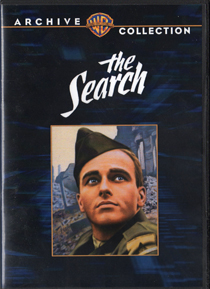
The Search
Some topics are just more difficult than others to translate to the movies, and the Holocaust is one of them. Still, there have been countless attempts in both film, television, and miniseries since the end of WWII, many of them very good. Almost always there's a message of hope, but these are not easy movies to watch. Of all the millions killed though, what about the millions more who survived somehow and were scarred the rest of their lives? What about the collateral damage of the war? How did Europe survive? Released just three years after the end of World War II, 1948's The Search is one of the best movies I've ever seen documenting a post-war reconstruction, both on the cities and countries, but on those people -- especially the kids -- who survived the ordeal.
World War II has ended, and the reconstruction of Europe has begun. Concentration camps have been liberated meaning countless thousands and millions of people now have to be dealt with, among them thousands of orphaned children. One little boy, Karel Malik (Ivan Jandl), is a survivor of Auschwitz and is now mute because his mind has regressed in a way to protect itself. Karel runs away from the American Red Cross workers trying to help him, eventually meeting American soldier/engineer, Ralph Stevenson (Montgomery Clift). Not sure what to do with the boy, the soldier takes him in, trying to rehabilitate him, get him used to the world again. They bond quickly, the American soldier even hoping to bring him home to America. But all the while -- unknown to them -- Karel's mother (also a survivor of the death camps), Hannah (Jarmila Novotna) is searching displaced children's camps one by one, desperately searching for her son.
With all the stories of soldiers in combat, large-scale conflicts where millions of lives were lost, the effect of war on the civilians can so often be left behind. Seeing that effect on one little boy who's not even 10-years old provides one of the more moving war stories I've ever seen. Director Fred Zinnemann shows a post-war Europe, the ruined cities, the empty streets, the squalor in the conditions, the desperate fight for survival from day-to-day. It's hard to fathom it all, that kids who should have been in grammar school were forced to live like that.
In an age where it seems every child actor ever has no real acting ability and just hams it up, seeing little Jandl's performance is remarkable. He was honored with an Academy Award as a juvenile for his part. His life story following the movie is tragic because the Czech government saw how much hope he gave to audiences, and basically imprisoned this little boy for the rest of his life. But on this performance alone, it's one of the best I've ever seen given by a child actor (he was 12 at the time). His eyes are so expressive, you see the pain, the pure terror in them, the atrocities he had to see. Getting a second chance to see the world isn't always an awful place, he opens up to Clift's Steve character, becoming healthy again, first learning to speak again, and then learning to speak English word by word.
In just his second feature film, Clift shows his remarkable talent as well. This is a part that in the wrong hands wouldn't have worked because it would be easy to overshadow the Karel role. Clift never goes that far. His part is quiet, easy-going, and caring as he tries to help this boy however he can. There was potential here to get sappy, to go down the road of blatant propaganda, the American savior swooping in and making everything right. It never goes that way thankfully. Clift is interested in helping this one boy, meeting him one day on the streets and offering him a second sandwich he brought along for lunch. There's an ebb and flow to it all, seeing how much the boy can handle and in what way to do it. In a career shortened by his death at the age of 45, this is one of his best.
So separately these two performances could carry a movie on their own, and combining them? Well, you've got a real winner. The early going in the movie takes a little time to get moving as everything falls into place. Once Karel -- Jimmy as Steve names him -- and Steve meet, the pace quickens. Scenes of him trying to get Jimmy to speak (starting with just 'yes' and 'no') are heartbreaking in their effectiveness, tugging at your heart strings like there's no tomorrow. It just gets worse/better (depending on how you look at) as Jimmy learns English one word at a time with some help from Steve and fellow soldier Jerry Fisher (Wendell Corey). The performances from Novotna as Karel/Jimmy's mother is equally moving, one woman desperately searching for her son, and Aline MacMahon as Mrs. Murray, a Red Cross worker trying to help thousands of people, fill out the supporting cast.
Cynic that I am when it comes to most things, I started worrying about the end of the story pretty soon after Steve meets little Karel. It has to have a happy ending, this perfect little story, doesn't it? The tone early on shows that the story isn't afraid to pull punches so I wondered if it would be a satisfying ending. Thankfully, my concerns were unfounded. In one of those endings that has you worried these characters are going to miss each other by the slimmest of seconds, everything fits together. I'm not talking a tear in your eyes, I'm talking streaming down your face. Moving, powerful, and gut-wrenching all at once, this was a great movie, and one that all moviegoers should get a chance to see.
The Search <---trailer (1948): ****/****
Wednesday, December 30, 2009
Holiday Affair
After being arrested for possession of marijuana in 1948, Robert Mitchum had his work cut out for him in the eyes of the studio. How could audiences go see the movies of a man who would do something so horrible? Hindsight here is of course 20/20 -- audiences didn't care both at the time and in the long term -- but nutbag himself Howard Hughes insisted Mitchum clean up his act some, including acting in a sweet, little Christmas movie, 1949's Holiday Affair.From his days as a supporting bit player to later in his career as a big-time movie star, Mitchum played a huge variety of roles, but they were often based in one similar character...a laconic but still tough, very capable man who usually ended up on the good side, usually in a film noir or a western. Sure, there were exceptions like his villainous turns in Night of the Hunter and Cape Fear where's he is downright frightening, but typically he took roles that were in his wheelhouse. But of all the Mitchum movies I've seen, Holiday Affair is the first, wait for it, romantic comedy I ever saw him in.
Mitchum plays Steve Mason, a department store salesman with dreams of heading to the west coast to design sailing boats. He's an all-around good guy, if a little quirky. But one day at the store, he doesn't turn in Connie Ennis (Janet Leigh), a comparison shopper looking for the best deals around town. As a result, Steve gets fired. Connie offers to take him to lunch -- because that makes up for losing your job -- and Steve ends up helping her the rest of the day posing as her husband. He even helps bring some of her purchases home where he meets Carl (Wendell Corey), Connie's fiance, and her 6-year old son, Timmy (Gordon Gebert), who's father was killed in WWII.
Well, Carl is no idiot and sees that right away Steve is a bit of a threat to his idyllic little life he's got planned out (I shouldn't say that, it makes it sound like Carl is an evil genius). Making it tougher, precocious Timmy clicks right away with the quirky Steve. Seeing he's caused a bit of a stir, Steve excuses himself and leaves but that's not the end for him and Connie and Carl and Timmy. Set in New York in the days around Christmas and New Year, this was a harmless enough romantic comedy. I didn't spoil how the ending goes, but if you can't figure it out, you haven't seen enough romantic comedies.
For a change it is nice to see Mitchum play completely against type. Just like other actors often typecast into a certain part -- John Wayne comes to mind -- Mitchum had a ton of ability onscreen. He was an actor, not just a movie star, so seeing him do some comedy is great after so many parts where he is a tough detective or a roaming gunfighter. The same goes for Janet Leigh who was often in big period epics like The Vikings or darker roles like Psycho or The Naked Spur. As a single mother, she's trying to stay connected with her deceased husband while caring for her son. Now to Corey, who's perfect as the other guy schlub, the man who starts with the girl but is destined not to get her in the end. It's only a matter of how long before it happens. Also look for a young Harry Morgan in a great one-scene appearance as a police lieutenant trying to figure exactly what's going on with Steve, Connie and Carl.
Nothing really spectacular about this one at all with a generally cheap TV feel to the story. Eight-year old Gebert is surprisingly good for a child actor, handling his scenes well enough with Mitchum, Leigh and Corey to the point he's not overshadowed. He does have the syndrome so often present in romantic comedies; kids that say things no real kid would ever say, but it's never obnoxious. Even with nothing to set this apart from most other B-movies, it's enjoyable and it is hard to mess up a Christmas movie. Couldn't find a trailer, but TCM has four clips available to watch.
Holiday Affair (1949): ** 1/2 /****
Labels:
1940s,
Christmas,
Janet Leigh,
Robert Mitchum,
Wendell Corey
Saturday, October 24, 2009
The Killer is Loose
While some directors are known for their rather lengthy movies -- David Lean, Francis Ford Coppola -- others are known for keeping their flicks pretty short. Take Budd Boetticher who over a long career in Hollywood directed 22 movies, many of them westerns and cop stories. Of the 22, just three actually run longer than 90 minutes. In fact, many barely top out at 80 minutes. But Boetticher was a director who packed everything in, made those short running times full of action and suspense.Saying someone is a good B-movie director might seem like an insult, but what's wrong with knowing the formula, sticking to it, and releasing taut, well-told stories that don't dawdle with unnecessary scenes and stories? Boetticher is mostly known for his collaborations with western star Randolph Scott as the director-actor combo teamed up for a handful of classics like Seven Men from Now and Ride Lonesome. I haven't seen many non-western Boetticher movies but caught his police thriller The Killer Is Loose this week.
Trying to solve a bank robbery, detectives Sam Wagner (Joseph Cotten) and Chris Gillespie (Michael Pate) and beat cop Denny (Alan Hale Jr) discover that the bank manager was involved with the hold-up. Heading to his house before the manager can run, they corner him, but Leon Poole (Wendell Corey) isn't going quietly. But in the standoff when the police finally burst in, Leon's wife is shot and killed by Sam when she runs into the room. Poole is sent to prison for a 10-year sentence, but not before delivering a message to Sam, "I'll settle this." Poole bides his time in prison, gets sent to an honor farm and promptly breaks out, killing several people in the process.
Wagner gets the call that Poole has escaped and knows that the convict turned murderer is going to come for his wife Lila (Rhonda Fleming). With the whole LA police force looking for him, can Poole still reach Wagner's house and even up the score? Sam certainly thinks so and sets up a dangerous trap with himself as the bait. Not a wasted moment here with a suspenseful manhunt story. Still, the police are pretty clueless at times, having Poole in their grasp several times only to let him slip through. Especially in the end, which is otherwise nicely nervewracking, the police see to not want to catch Poole. Just take him already!
Boetticher is guilty of one of my biggest pet peeves in the movies; the plot device necessary to keep the story moving because it doesn't make any sense in any other way. When cornering Poole in his apartment -- door locked, lights turned off inside -- Wagner and Gillespie smash through the door that Poole has already fired through twice. The detectives hit the ground and when someone enters the room (yes, Poole's wife), Wagner opens fire and kills her. What exactly was Poole's wife hoping to accomplish? Did she not hear the gunfire and yelling from her spot in the bedroom? Of course, Poole needs something to set him off and this episode does nicely.
Other than the rather forced twist, the story works well. Cotten does well with the world weary cop trying to protect his wife and keep her in the dark as to how much danger she's in. Fleming pulls the shrill wife off well who wants to know what is going on, but when she does find out, freaks out in a big way by threatening to leave her husband. The strongest casting is Corey as Poole, a pretty average guy with a normal life who is transformed into an eeriely calm murderer after his wife's death. He doesn't want to be pushed to violence, but when he is, watch out because he explodes in a big way. The character had to have some influence on Alfred Hitchcock and Anthony Perkins for the portrayal of Norman Bates in Psycho as well. Good but not great police thriller with a few flaws.
The Killer Is Loose (1956): ** 1/2 /****
Labels:
1950s,
Budd Boetticher,
Cops,
Film Noir,
Joseph Cotten,
Michael Pate,
Rhonda Fleming,
Wendell Corey
Subscribe to:
Posts (Atom)