So those Avengers movies...they seem to be kinda popular judging by the money they're raking in at the box office. I thought The Avengers was great. I loved the first Iron Man but thought the movies progressively went downhill with the sequels. As for the two Thor movies, I thought Thor was a great lead character, but the movies itself were disappointing. So what's that leave? That's right, my personal favorite, Steve Rogers himself. He returns by his better known name in 2014's Captain America: The Winter Soldier.
With the epic battle in New York in the rear view mirror, Steve Rogers, a.k.a. Captain America (Chris Evans) himself, is working for SHIELD. He takes on countless missions around the world, anything and everything that threatens national and international security, often with Black Widow (Scarlett Johansson) working with him. Captain America and the Black Widow pull off one dangerous mission in the Indian Ocean, but it has dangerous repercussions. It actually exposes a breach within Shield and now Captain America is made to look like a traitor to everything he has defended for all these years. With all of SHIELD's resources on his trail, he's now on his own as he tries to stop a diabolical plan that could kill millions while also proving his innocence. His biggest obstacle? A mysterious, seemingly in destructible assassin dubbed the Winter Soldier.
A plot description for an Avengers movie is pretty unnecessary. Without hearing a word about the story, you either know you will or won't be seeing this flick. From directors Anthony and Joe Russo, 'Soldier' is another gem, another worthy addition to the Avengers franchise. Apparently I'm not the only one who thought so as the most recent Captain America earned over $700 million internationally at the box office. All the ingredients are there -- great cast, epic action, well-written script, some well-placed humor -- but there's a reason the Captain movies are my favorite. They're big, giant blockbusters, but they're more than that. These are genuinely smart movies. I don't know if I can say the same for either Iron Man or Thor entries.
It all starts with Chris Evans reprising his role as Captain America. He's long been one of my favorite actors, and this is obviously his biggest and most recognizable role. I love how they've developed the Steve Rogers character. It's been a couple years since the Avengers, and Steve/Captain is still adjusting to the 21st Century after six-plus decades being frozen in a glacier. His chemistry with Johansson's Black Widow/Natasha is evident in all their scenes together, and it's definitely cool to see individuals among the Avengers get some time to themselves, not just as part of the group. Also cool? Like you needed to know, but Samuel L. Jackson is back as Nick Fury, SHIELD's tough, efficient leader. Throw these three epically cool characters together, and you've got quite a lot of heroes to lead the way.
Also returning with varying amounts of screentime are Cobie Smulders as SHIELD agent Hill, Toby Jones, and Hayley Atwell as Peggy Carter, Steve's possible love interest from the 1940s, now a grandma struggling with health issues.
How about some fresh blood too?!? When I saw that Robert Redford was part of the cast, I almost lost my mind. Robert REDFORD?!? Here he plays Alexander Pierce, a powerful senator backing the defensive efforts of SHIELD who has a long history working with Fury. It's a cool part, one that adds another dimension to the already enjoyable story. Anthony Mackie is a welcome addition to as Sam Wilson, a para-rescue vet who forms a quick friendship with Steve when things hit the fan. Frank Grillo and Callan Mulvey play members of a strike force working with SHIELD while Emily VanCamp plays Steve's neighbor holding a key secret. Some cool parts to add to an already very talented cast.
So go figure, but this Captain America movie has some pretty cool action sequences. Crazy, right? I don't want to give away too much because the various twists and turns should come as a surprise and not be spoiled in a review. The action though is pretty solid, from a smaller scale scene early on where Captain, Widow and a Strike force team take out a group of commandos holding hostages to chases sprinkled throughout the story. I thought the coolest was Jackson's Fury trying to evade an ambush on the streets of Washington D.C., just an effortlessly smooth extended sequence that some cool tricks up its sleeve. And the finale? Yeah, pretty nuts, a gigantic battle in scale and size in the skies in and around Washington. The finale in The Avengers set the bar pretty high in that department, and 'Soldier' does its best to reach those heights.
Just a good movie with a lot to recommend. This is a blockbuster -- $700 million!!! -- that's got a brain. Even the Winter Soldier (Sebastian Stan) isn't an out-and-out villain, but a tortured baddie forced into something he had no control over. There's a pretty major twist near the halfway point that I didn't love, but it does work when all things are considered, both for this movie and the Captain America and Avengers franchise going forward. Highly recommended, an easy flick to sit back, watch and appreciate.
Captain America: The Winter Soldier (2014): *** 1/2 /****
The Sons of Katie Elder
"First, we reunite, then find Ma and Pa's killer...then read some reviews."
Showing posts with label Robert Redford. Show all posts
Tuesday, December 16, 2014
Monday, June 9, 2014
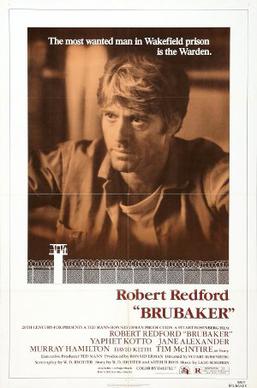
Brubaker
Well, it may be time to add a new label and genre for the right-hand column. I've written double-digit reviews about prisoners-of-war stories but what about good, old-fashioned prison stories? Movies like The Shawshank Redemption, Cool Hand Luke, Papillon, and plenty others ranging from classics to good to just bad. It's official. I'll add the Prison movie to the list, and here's a new one, 1980's Brubaker.
A new shipment of prisoners is arriving at the Wakefield State Prison, among them a quiet, mysterious prisoner who puts his head down and minds his own business. The prisoner quickly sees how horrific prison life is from abusive guards -- both physical, mental and sexual abuse -- to cramped living quarters, insect-ridden food to corruption on all levels of how the prison is run. After several days though, the prisoner reveals himself as Henry Brubaker (Robert Redford), the prison's new warden who's been tasked with cleaning up the prison, both for the prisoners and as a government-funded location. His appearance scares countless people to death, their corrupt, nasty world about to get thrown for a loop. His methods are demanding and fast-acting, making many people incredibly nervous. With pressure from inside and out, can Brubaker clean up the prison? Or has he pushed too far and endangered his own life?
From director Stuart Rosenberg, 'Brubaker' asks some interesting questions. Prison reform is meant to make sure that prisoners are treated like decent human beings. They don't deserve to be beaten, abused, violated and treated like dirt. Or do they? As the movie points out in snippets, these men are criminals, found guilty of a variety of crimes from rape to murder, robbery to manslaughter and all sorts of pleasant stuff in between. How well do they deserve to be treated considering the crimes they've been found guilty of committing? Should we rehabilitate prisoners so they can reenter the world as better individuals or simply let them waste away in under-funded prisons? The answer is probably somewhere in between. And enough of the social commentary, on with the movie!
'Brubaker' is a good movie, a story featuring some social commentary that for the most part avoids getting too obvious with its message. It is based on the book Accomplices to the Crime: The Arkansas Prison Scandal, the warden posing as a prisoner made up for the sake of the film. This is dark stuff from the get-go, Brubaker's undercover mission incredibly uncomfortable to watch. Things only get worse as he undertakes his new job, so many people around him -- inside and outside the prison -- trying to stop him, or at least slow him down. 'Brubaker' was filmed at Junction City Prison (recently closed) in Ohio, giving the story a filthy, seedy look that adds to the tension and the reality Rosenberg was aiming for. It doesn't feel like some Hollywood studio posing as a prison. It is a prison, and that goes a long ways toward authenticity. Also worth mentioning is composer Lalo Schifrin's score, equal parts underplayed and quiet with fast-moving, adrenaline-pumping sequences.
Who best to lead the way as a progressive prison warden who's not interested in whips, abuses, punishments and beatings? Why Robert Redford of course, at the height of his popularity. In his personal life, Redford has gotten behind and backed causes he believed to be worthwhile so this doesn't feel forced as an acting role. I would have liked some more background about the Brubaker character -- how did he end up here? What drives him? What's his motivation -- but an intelligent, thoughtful warden who becomes almost obsessed with accomplishing his mission is a great hero to lead the way. Redford was, is and will be a likable star to lead the way in a movie, and he's the best thing going here. Also look for Jane Alexander as Lillian Gray, his government connection, their background and relationship hinted at but never specified.
There's plenty of solid supporting parts to back Redford, starting with Yaphet Kotto as Coombes, a trusty who Brubaker counts on to help his reform get rolling while also questioning what's going on, and David Keith as Larry Lee Bullen, a lifer, a prisoner who's piled up three felonies and earned himself a life sentence. The scenes among Redford, Kotto and Keith are some of the strongest throughout the 132-minute movie. As for other trustees, look for Matt Clark, Tim McIntire, Everett McGill, Val Avery, and Joe Spinell. Murray Hamilton plays the evil Governor with Albert Salmi, M. Emmet Walsh, and Wilford Brimley also representing the evil System.
Just a good movie with a strong cast and an interesting story that takes some surprising twists as the it develops. The ending gets a little heavy-handed with a slow clap and all, but the movie as a whole is easy to recommend.
Brubaker (1980): ***/****
A new shipment of prisoners is arriving at the Wakefield State Prison, among them a quiet, mysterious prisoner who puts his head down and minds his own business. The prisoner quickly sees how horrific prison life is from abusive guards -- both physical, mental and sexual abuse -- to cramped living quarters, insect-ridden food to corruption on all levels of how the prison is run. After several days though, the prisoner reveals himself as Henry Brubaker (Robert Redford), the prison's new warden who's been tasked with cleaning up the prison, both for the prisoners and as a government-funded location. His appearance scares countless people to death, their corrupt, nasty world about to get thrown for a loop. His methods are demanding and fast-acting, making many people incredibly nervous. With pressure from inside and out, can Brubaker clean up the prison? Or has he pushed too far and endangered his own life?
From director Stuart Rosenberg, 'Brubaker' asks some interesting questions. Prison reform is meant to make sure that prisoners are treated like decent human beings. They don't deserve to be beaten, abused, violated and treated like dirt. Or do they? As the movie points out in snippets, these men are criminals, found guilty of a variety of crimes from rape to murder, robbery to manslaughter and all sorts of pleasant stuff in between. How well do they deserve to be treated considering the crimes they've been found guilty of committing? Should we rehabilitate prisoners so they can reenter the world as better individuals or simply let them waste away in under-funded prisons? The answer is probably somewhere in between. And enough of the social commentary, on with the movie!
'Brubaker' is a good movie, a story featuring some social commentary that for the most part avoids getting too obvious with its message. It is based on the book Accomplices to the Crime: The Arkansas Prison Scandal, the warden posing as a prisoner made up for the sake of the film. This is dark stuff from the get-go, Brubaker's undercover mission incredibly uncomfortable to watch. Things only get worse as he undertakes his new job, so many people around him -- inside and outside the prison -- trying to stop him, or at least slow him down. 'Brubaker' was filmed at Junction City Prison (recently closed) in Ohio, giving the story a filthy, seedy look that adds to the tension and the reality Rosenberg was aiming for. It doesn't feel like some Hollywood studio posing as a prison. It is a prison, and that goes a long ways toward authenticity. Also worth mentioning is composer Lalo Schifrin's score, equal parts underplayed and quiet with fast-moving, adrenaline-pumping sequences.
Who best to lead the way as a progressive prison warden who's not interested in whips, abuses, punishments and beatings? Why Robert Redford of course, at the height of his popularity. In his personal life, Redford has gotten behind and backed causes he believed to be worthwhile so this doesn't feel forced as an acting role. I would have liked some more background about the Brubaker character -- how did he end up here? What drives him? What's his motivation -- but an intelligent, thoughtful warden who becomes almost obsessed with accomplishing his mission is a great hero to lead the way. Redford was, is and will be a likable star to lead the way in a movie, and he's the best thing going here. Also look for Jane Alexander as Lillian Gray, his government connection, their background and relationship hinted at but never specified.
There's plenty of solid supporting parts to back Redford, starting with Yaphet Kotto as Coombes, a trusty who Brubaker counts on to help his reform get rolling while also questioning what's going on, and David Keith as Larry Lee Bullen, a lifer, a prisoner who's piled up three felonies and earned himself a life sentence. The scenes among Redford, Kotto and Keith are some of the strongest throughout the 132-minute movie. As for other trustees, look for Matt Clark, Tim McIntire, Everett McGill, Val Avery, and Joe Spinell. Murray Hamilton plays the evil Governor with Albert Salmi, M. Emmet Walsh, and Wilford Brimley also representing the evil System.
Just a good movie with a strong cast and an interesting story that takes some surprising twists as the it develops. The ending gets a little heavy-handed with a slow clap and all, but the movie as a whole is easy to recommend.
Brubaker (1980): ***/****
Labels:
1980s,
David Keith,
Matt Clark,
Murray Hamilton,
Prisons,
Robert Redford,
Yaphet Kotto
Wednesday, March 19, 2014
All Is Lost
Live or die, survival at its most base. You choose. How much do you want to live? On an isolated mountaintop. In the desert. In a wasteland. On the expansive, seemingly endless high seas. Food, water and supplies are dwindling, and there is absolutely no guarantee that help is on the way. None. How far can you push yourself to keep on going, to keep on fighting? So goes 2013's All Is Lost.
Somewhere in the Indian Ocean, some 1,700 nautical miles from the Sumatra Strait, a man (Robert Redford) is sailing along on his sailboat. He wakes up below deck and promptly steps into ankle-deep water. He finds a hole in the side of his boat and heads to the top deck and is stunned at what he find. An immense shipping container has struck the side of his sailboat, imbedding itself and letting the water not so slowly seep in. The boat is able to sail, but the man is forced to improvise quickly, finding something that can serve as a patch to stop the flowing water. He fixes it, buying at least some time. The situation is dire just the same though. His radio and all of his equipment have been destroyed in the water, his food and water is limited, and it looks like he's sailing right into horrific weather. Time is running out, but this man is going to do his damnedest to live, to survive.
What a flick. I guess I should call this a film, not a movie, but a film. Director J.C. Chandor's follow-up film to his debut, Margin Call, deserves the moniker 'film' too. This isn't a story interested in special effects, in gimmicks, in anything forced or even remotely fake. Above all else, this is a story that plain and simple is interested in primal survival. There aren't any distractions from the mission at hand here. Robert Redford is the only person we even see the entire movie. This is a man adrift at sea surrounded by thousands of miles of open water. It takes place over eight days, the opening scene leaving the finale open-ended with a voiceover that's longer than any future dialogue we'll see in a 106-minute movie. Oh, and limited though that dialogue may be, Chandor wrote the script too, a series of trials and tribulations that would test any one man's will to keep living.
So that Robert Redord fella, he's pretty cool, huh? A true Hollywood legend who has done it all from acting to directing to producing to starting up the Sundance Film Festival, there really isn't much Redford hasn't done in films. As far as film roles go, this one is certainly a new and different part. More importantly, more impressive is that Redford takes over this movie with very few words said. Adrift at sea, surviving and nothing else, this is a quiet, intense, thoughtful, introspective performance. Listed in the credits solely as 'Our Man,' Redford makes us root for this man because that's all there is to do. We don't get any flashbacks, no background, no mentions of his family, kids, a wife, if he even has any of those. It's almost like the story takes place in an existential bubble. The only real interference is the potential of being rescued. Those moments are fleeting though -- never dwelling on them -- with the focus solely on Redford, doing so much with so little. It's a mannerism here. A facial expression here. Very natural, never forced and dripping with authenticity.
Like its character, 'Lost' is as minimalist as it comes. Survive or die. We don't get any distractions or detours. This is a man at sea somewhere in the Indian Ocean. There's a pretty decent sized hole in his boat, water flows in, his supplies are low, his radio is out, and He Wants To Live. Don't think this is an action-packed movie, Robert Redford dealing with pirates and sharks and all sorts of hell the ocean can offer. The look of the movie is excellent, showing claustrophobic scenes on his boat, the Virginia Jean (his wife? a long-lost love? Who knows?), as the water drips in, and then huge wide shots (frightening in its beauty and immensity) of the expansiveness of the Indian Ocean. These are shots that put in perspective how small one boat is, how small one man is. It's easy to see how the ocean could swallow up that one boat, that one man up in an instant. We see storms rolling in on the horizon, and it's as unsettling as anything you could see in a thriller or horror flick. Uncomfortable throughout a 106-minute movie. Kudos to cinematographers Frank DeMarco and Peter Zuccarini for filming a beautiful, uncomfortable movie.
A series of little episodes that all feature one individual's desperate desire to live does provide for some slow-moving portions here. Some scenes are more intense than others, simple as that. The opener is a subtle gem as the man finds a shipping container imbedded in his boat. "How the hell did this happen?!?" is what I would have been screaming. Two different storms roll in, providing hellaciously uncomfortable sequences, death hanging in the air. The most nerve-inducing sequences have the man (now in a raft) trying to float into the shipping lanes...and succeeding. Two sequences show the complete and utter desperation he feels, survival so close. The best scene is the finale though, his energy and will running out, even resorting to writing a message and throwing it off the raft in a bottle. The final scene is open-ended, Chandor even admitting he wants viewers to pick how it ends, to make their own conclusions. Until my buddy brought something up, I never even considered it open-ended so that will be up to you.
One last thing. I really liked composer Alex Ebert's score, the winner at the Golden Globes but not even getting an Oscar nomination. The lead singer of Edward Sharpe and the Magnetic Zeros, Ebert's score is understated at its best, a soft, eerie, ethereal score playing over the man's desperate attempts. Listen to the entire soundtrack HERE, the sample I'm talking about playing immediately. Not quite a trance score, but there is a simple, elegant sound to Ebert's score that fits with the story and its tone in perfect unison. A difficult movie in general, probably not for everyone, but definitely worth checking out and experiencing.
All Is Lost (2013): ***/****
Somewhere in the Indian Ocean, some 1,700 nautical miles from the Sumatra Strait, a man (Robert Redford) is sailing along on his sailboat. He wakes up below deck and promptly steps into ankle-deep water. He finds a hole in the side of his boat and heads to the top deck and is stunned at what he find. An immense shipping container has struck the side of his sailboat, imbedding itself and letting the water not so slowly seep in. The boat is able to sail, but the man is forced to improvise quickly, finding something that can serve as a patch to stop the flowing water. He fixes it, buying at least some time. The situation is dire just the same though. His radio and all of his equipment have been destroyed in the water, his food and water is limited, and it looks like he's sailing right into horrific weather. Time is running out, but this man is going to do his damnedest to live, to survive.
What a flick. I guess I should call this a film, not a movie, but a film. Director J.C. Chandor's follow-up film to his debut, Margin Call, deserves the moniker 'film' too. This isn't a story interested in special effects, in gimmicks, in anything forced or even remotely fake. Above all else, this is a story that plain and simple is interested in primal survival. There aren't any distractions from the mission at hand here. Robert Redford is the only person we even see the entire movie. This is a man adrift at sea surrounded by thousands of miles of open water. It takes place over eight days, the opening scene leaving the finale open-ended with a voiceover that's longer than any future dialogue we'll see in a 106-minute movie. Oh, and limited though that dialogue may be, Chandor wrote the script too, a series of trials and tribulations that would test any one man's will to keep living.
So that Robert Redord fella, he's pretty cool, huh? A true Hollywood legend who has done it all from acting to directing to producing to starting up the Sundance Film Festival, there really isn't much Redford hasn't done in films. As far as film roles go, this one is certainly a new and different part. More importantly, more impressive is that Redford takes over this movie with very few words said. Adrift at sea, surviving and nothing else, this is a quiet, intense, thoughtful, introspective performance. Listed in the credits solely as 'Our Man,' Redford makes us root for this man because that's all there is to do. We don't get any flashbacks, no background, no mentions of his family, kids, a wife, if he even has any of those. It's almost like the story takes place in an existential bubble. The only real interference is the potential of being rescued. Those moments are fleeting though -- never dwelling on them -- with the focus solely on Redford, doing so much with so little. It's a mannerism here. A facial expression here. Very natural, never forced and dripping with authenticity.
Like its character, 'Lost' is as minimalist as it comes. Survive or die. We don't get any distractions or detours. This is a man at sea somewhere in the Indian Ocean. There's a pretty decent sized hole in his boat, water flows in, his supplies are low, his radio is out, and He Wants To Live. Don't think this is an action-packed movie, Robert Redford dealing with pirates and sharks and all sorts of hell the ocean can offer. The look of the movie is excellent, showing claustrophobic scenes on his boat, the Virginia Jean (his wife? a long-lost love? Who knows?), as the water drips in, and then huge wide shots (frightening in its beauty and immensity) of the expansiveness of the Indian Ocean. These are shots that put in perspective how small one boat is, how small one man is. It's easy to see how the ocean could swallow up that one boat, that one man up in an instant. We see storms rolling in on the horizon, and it's as unsettling as anything you could see in a thriller or horror flick. Uncomfortable throughout a 106-minute movie. Kudos to cinematographers Frank DeMarco and Peter Zuccarini for filming a beautiful, uncomfortable movie.
A series of little episodes that all feature one individual's desperate desire to live does provide for some slow-moving portions here. Some scenes are more intense than others, simple as that. The opener is a subtle gem as the man finds a shipping container imbedded in his boat. "How the hell did this happen?!?" is what I would have been screaming. Two different storms roll in, providing hellaciously uncomfortable sequences, death hanging in the air. The most nerve-inducing sequences have the man (now in a raft) trying to float into the shipping lanes...and succeeding. Two sequences show the complete and utter desperation he feels, survival so close. The best scene is the finale though, his energy and will running out, even resorting to writing a message and throwing it off the raft in a bottle. The final scene is open-ended, Chandor even admitting he wants viewers to pick how it ends, to make their own conclusions. Until my buddy brought something up, I never even considered it open-ended so that will be up to you.
One last thing. I really liked composer Alex Ebert's score, the winner at the Golden Globes but not even getting an Oscar nomination. The lead singer of Edward Sharpe and the Magnetic Zeros, Ebert's score is understated at its best, a soft, eerie, ethereal score playing over the man's desperate attempts. Listen to the entire soundtrack HERE, the sample I'm talking about playing immediately. Not quite a trance score, but there is a simple, elegant sound to Ebert's score that fits with the story and its tone in perfect unison. A difficult movie in general, probably not for everyone, but definitely worth checking out and experiencing.
All Is Lost (2013): ***/****
Wednesday, February 12, 2014
The Great Waldo Pepper
Ever heard of barnstorming? Well, you should have so shame on you. In the 1920s, flying circuses traveled across America, pilots performing ridiculously dangerous (some would say suicidal) stunts and tricks to amuse and dazzle audiences. A movie I stumbled across on Netflix does a really good job giving a look at the dangerous world of barnstorming, 1975's The Great Waldo Pepper.
It's 1926 in Nebraska and Waldo Pepper (Robert Redford), a very talented pilot trying to create a reputation and name for himself, is scraping by. He flies all over the state, doing tricks and aerial stunts for anyone who will pay to see it, offering 5-minute rides for $5, all the money going toward the development of a new single-wing plane built by his friend and engineer, Ezra Stiles (Edward Hermann). Waldo has a bit of a rivalry with another pilot, Axel Olsson (Bo Svenson), especially when Axel moves into his territory, but seeing the business struggle and the money start to dry up, the pilot duo teams up. Their idea? Do something that audiences have never seen before, a stunt that will assure them a reputation and audiences wherever they go. Waldo and Axel intend to walk on their wings while flying thousands of feet up in the air.
I could be wrong -- and I often am -- but I believe this 1975 aviation flick sat in my Netflix queue for the last 10 months or so after I watched another aviation flick, 1965's Those Magnificent Men in Their Flying Machines. It's also the third pairing between director George Roy Hill and star Redford, having worked previously together in Butch Cassidy and the Sundance Kid and The Sting. This is a movie that loves its story, loves where it came from. It loves flying, aviation, the pilots, the history, any and all of it. If there's a surprise, it's that near the halfway point the story takes a surprising turn for the dark. The tone early on is light, a tad jokey, composer Henry Mancini's score adding to the fun, entertaining mood. The differences in tone work overall after the initial shock (and the scene that switches it up is a SHOCKER). Light and fun meets dark and surprising, I wouldn't think that would work, but it does.
Above all else, 'Waldo' is definitely worth seeking out because of some ridiculous aerial sequences. If this movie was released in the modern CGI (computer generated images) era, there would be no, NO, actual footage of the pilots, their planes and their tricks. But how about 1975? There weren't special effects like that. Everything had to be done for real or with some real cheesy-looking effects. The footage here is astounding. Hill and cinematographer Robert Surtees put their cameras up in the air with the planes and let the pilots do their thing. With the cameras mounted on the planes (or flying with them close by), it feels as a viewer that we're flying with them. Point of view shots really add to that sense of realism. Making it cooler? Redford, Svenson and the cast are up there too, one more authentic touch to an already authentic feel. We see pilots doing loops, some upside down -- one called an outside loop -- and others walking on the wings of their bi-planes. On a purely visual level, the film is a great experience.
Right in the midst of his acting heyday before he turned to directing more, Redford is at his best as Waldo Pepper, the pilot who wants more. He's able to do the drama, the comedy, all of it, playing a charming, likable rogue who becomes almost obsessed with making a name for himself. I wasn't quite sure what to expect out of the story going in -- only knowing it was about an early era in aviation -- so it caught me off guard when such an interesting character was leading the way. Much of that success comes from the dark twist the story takes near the halfway point, Redford's Waldo getting another layer or two to the character. If there's a weakness, it's the scenes with his former love, played by Margot Kidder, the scenes slowing the pace down with some attempts at drama. Mostly though, the character is great. He missed out on the dogfights in World War I and desperately wants to get a chance to be a hero, to be idolized no matter the inherent risks in a suicidal job. An underrated performance from Redford.
With an episodic story, we get plenty of other characters Waldo meets along the way. I really liked the rivalry turned friendship between Waldo and Svenson's Otto, two very talented pilots who are good on their own but may be better working together. The most dramatic part goes to Bo Brundin as Ernst Kessler, the famous German ace from WWI, a hero in Waldo's eyes who questions why he's been deemed a hero internationally by the public. Redford and Brundin have a couple great dialogue exchanges later, building to a surprising ending, slightly open-ended but it's easy to draw conclusions. A young Susan Sarandon has a supporting part as Mary Beth, a young woman Waldo meets and becomes part of the act with Waldo and Otto. Geoffrey Lewis makes the most of his smaller part as Newt, Waldo's former commander and a current Air Commerce inspector. And last, look for Philip Bruns as Dillhoefer, the owner of the air circus always looking for the next big thing in aerial stunts.
A very pleasant surprise for any number of reasons from Redford's lead performance as extremely talented pilot Waldo Pepper to the one impressive aerial sequence after another, one better than the last, especially in the final scene. Period correct planes, cool aerial stunts, it's a gem.
The Great Waldo Pepper (1975): ***/****
It's 1926 in Nebraska and Waldo Pepper (Robert Redford), a very talented pilot trying to create a reputation and name for himself, is scraping by. He flies all over the state, doing tricks and aerial stunts for anyone who will pay to see it, offering 5-minute rides for $5, all the money going toward the development of a new single-wing plane built by his friend and engineer, Ezra Stiles (Edward Hermann). Waldo has a bit of a rivalry with another pilot, Axel Olsson (Bo Svenson), especially when Axel moves into his territory, but seeing the business struggle and the money start to dry up, the pilot duo teams up. Their idea? Do something that audiences have never seen before, a stunt that will assure them a reputation and audiences wherever they go. Waldo and Axel intend to walk on their wings while flying thousands of feet up in the air.
I could be wrong -- and I often am -- but I believe this 1975 aviation flick sat in my Netflix queue for the last 10 months or so after I watched another aviation flick, 1965's Those Magnificent Men in Their Flying Machines. It's also the third pairing between director George Roy Hill and star Redford, having worked previously together in Butch Cassidy and the Sundance Kid and The Sting. This is a movie that loves its story, loves where it came from. It loves flying, aviation, the pilots, the history, any and all of it. If there's a surprise, it's that near the halfway point the story takes a surprising turn for the dark. The tone early on is light, a tad jokey, composer Henry Mancini's score adding to the fun, entertaining mood. The differences in tone work overall after the initial shock (and the scene that switches it up is a SHOCKER). Light and fun meets dark and surprising, I wouldn't think that would work, but it does.
Above all else, 'Waldo' is definitely worth seeking out because of some ridiculous aerial sequences. If this movie was released in the modern CGI (computer generated images) era, there would be no, NO, actual footage of the pilots, their planes and their tricks. But how about 1975? There weren't special effects like that. Everything had to be done for real or with some real cheesy-looking effects. The footage here is astounding. Hill and cinematographer Robert Surtees put their cameras up in the air with the planes and let the pilots do their thing. With the cameras mounted on the planes (or flying with them close by), it feels as a viewer that we're flying with them. Point of view shots really add to that sense of realism. Making it cooler? Redford, Svenson and the cast are up there too, one more authentic touch to an already authentic feel. We see pilots doing loops, some upside down -- one called an outside loop -- and others walking on the wings of their bi-planes. On a purely visual level, the film is a great experience.
Right in the midst of his acting heyday before he turned to directing more, Redford is at his best as Waldo Pepper, the pilot who wants more. He's able to do the drama, the comedy, all of it, playing a charming, likable rogue who becomes almost obsessed with making a name for himself. I wasn't quite sure what to expect out of the story going in -- only knowing it was about an early era in aviation -- so it caught me off guard when such an interesting character was leading the way. Much of that success comes from the dark twist the story takes near the halfway point, Redford's Waldo getting another layer or two to the character. If there's a weakness, it's the scenes with his former love, played by Margot Kidder, the scenes slowing the pace down with some attempts at drama. Mostly though, the character is great. He missed out on the dogfights in World War I and desperately wants to get a chance to be a hero, to be idolized no matter the inherent risks in a suicidal job. An underrated performance from Redford.
With an episodic story, we get plenty of other characters Waldo meets along the way. I really liked the rivalry turned friendship between Waldo and Svenson's Otto, two very talented pilots who are good on their own but may be better working together. The most dramatic part goes to Bo Brundin as Ernst Kessler, the famous German ace from WWI, a hero in Waldo's eyes who questions why he's been deemed a hero internationally by the public. Redford and Brundin have a couple great dialogue exchanges later, building to a surprising ending, slightly open-ended but it's easy to draw conclusions. A young Susan Sarandon has a supporting part as Mary Beth, a young woman Waldo meets and becomes part of the act with Waldo and Otto. Geoffrey Lewis makes the most of his smaller part as Newt, Waldo's former commander and a current Air Commerce inspector. And last, look for Philip Bruns as Dillhoefer, the owner of the air circus always looking for the next big thing in aerial stunts.
A very pleasant surprise for any number of reasons from Redford's lead performance as extremely talented pilot Waldo Pepper to the one impressive aerial sequence after another, one better than the last, especially in the final scene. Period correct planes, cool aerial stunts, it's a gem.
The Great Waldo Pepper (1975): ***/****
Labels:
1970s,
Bo Svenson,
Geoffrey Lewis,
George Roy Hill,
Robert Redford,
Susan Sarandon
Thursday, October 3, 2013
The Company You Keep
Fully content to direct films as he likes and sees fit while also staying in the background of the Sundance Film Festival, it's easy to forget what a legend Robert Redford really is. He's one of the few remaining legitimate screen legends from the 1960s and 1970s. When he does make a film -- directing/acting -- moviegoers and fans should jump. Or as the case with 2012's The Company You Keep, he does both, directing and acting.
A single dad with an 11-year old daughter and his own private law practice, Jim Grant (Redford) is still adjusting to a new life since his wife died over the last few years. He's approached one day in his office by a young journalist, Ben Shepard (Shia LaBeouf), investigating a story about the recent arrest of a woman who was part of a murder/bank robbery in the late 1970s, the woman a member of an underground peace movement. Jim is less than interested in helping, making Ben that much more curious. He investigates further and finds out why. Jim Grant is not who he's saying. In fact, he may have been a part of the underground movement and one of three suspects at the bank robbery turned murder. The FBI is quick to pounce, but it's already too late. Jim is on the run and looking for someone from his past. Ben meanwhile is continuing his investigation and starts to question if maybe he's stumbled upon something else.
Not surprisingly, I think the best thing going for this film was that Redford and his talents are associated with it. While it received mixed reviews -- 56% at Rotten Tomatoes, 6.3 at IMDB -- and wasn't given much of a chance in theaters, 'Company' is successful because it is content being exactly what it is. No explosions, no gunfights, no real chases, just a smart political thriller that for the most part kept me interested throughout. I think at times it is a little sluggish, lacking a certain energy. On the other hand, it is always refreshing to watch a well-made thriller that doesn't resort to any common denominators. As many other reviews point out, it may be most successful because it shows what happened to the 1960s/1970s revolutionaries. Full of fire and brimstone 30 and 40 years ago, what did they do after their revolutionary times had passed? It's an interesting premise and jumping off point.
So hold the gunfights, explosions, chases and ultra-quick editing, and what is Robert Redford's character? It reminded me slightly of Jason Bourne, a man on the run and desperately trying to evade his pursuers until he can prove what he needs to prove. In his first acting role since 2007's Lions for Lambs, Redford doesn't disappoint, bringing a character to life we think we know all about only to learn more and more. We see him with his second life of sorts, caring for his 11-year old daughter, Isabel (singer Jackie Evancho). We learn he regrets certain incidents from his past and is desperately working to right wrongs. Like few others, Redford does it with relative ease, a cool factor on display like few others working in film or in any other era. Now 77 years old, Redford is as cool as ever. His acting roles are fewer and far between of late so appreciate them when they come along.
Oh, by the way, most of Hollywood is also in this movie. Apparently a whole lot of very talented individuals wanted to work with Redford because he assembles a cast that is ridiculous top to bottom. I'm coming around a bit on Shia LaBeouf who does a fine job here as an investigative journalist, Ben, who finds out a story needs to be fully investigated before reporting on it. It's an interesting character arc. Who else? How about Stanley Tucci basically making a cameo as Ben's hard-edged, tough editor. How about Terrence Howard as the lead FBI agent pursuing Redford's Jim with Anna Kendrick as a young agent on his team? Oh, and there's also Chris Cooper as Jim's younger brother, Brendan Gleeson as a former police chief with lots of info, Stephen Root as a friend seeking Jim's help and Brit Marling as a college student Ben meets in the course of his investigation.
Wow, that's a pretty impressive cast. Huh? Oh, there's more? Yes, it continues. There are other key parts with Julie Christie playing a woman from Jim's past who he desperately needs to talk to with Sam Elliott, Nick Nolte and Richard Jenkins all playing key figures from Jim's revolutionary underground past. And yes, Susan Sarandon plays an accomplice of sorts to the murder that sets the ball in motion. With this much talent, some of the parts are really just extended cameos, but the pure acting depth here is amazing to watch. Yes, maybe it is only a scene or two, but it's fun to watch all these very talented actors and actresses do their thing.
If there is a weakness here, it's in the final 30 minutes of a 122-minute long movie. The build-up can be slow at times, but the mystery and all the unanswered questions pick things up as needed. Unfortunately in the final half hour, the script resorts to too many past ideologies and principles that drove these characters back in the 60s and 70s. It doesn't quite limp to the finish line, but it's not quite the snappy ending I was hoping for. Things are wrapped up a little too nicely, a little too tidy. That said, I still feel very comfortable recommending this film for any number of reasons, ranging anywhere from the very impressive cast to the general throwback feel of a good, old-fashioned political thriller. A good movie, and that ain't a bad thing.
The Company You Keep (2012): ***/****
A single dad with an 11-year old daughter and his own private law practice, Jim Grant (Redford) is still adjusting to a new life since his wife died over the last few years. He's approached one day in his office by a young journalist, Ben Shepard (Shia LaBeouf), investigating a story about the recent arrest of a woman who was part of a murder/bank robbery in the late 1970s, the woman a member of an underground peace movement. Jim is less than interested in helping, making Ben that much more curious. He investigates further and finds out why. Jim Grant is not who he's saying. In fact, he may have been a part of the underground movement and one of three suspects at the bank robbery turned murder. The FBI is quick to pounce, but it's already too late. Jim is on the run and looking for someone from his past. Ben meanwhile is continuing his investigation and starts to question if maybe he's stumbled upon something else.
Not surprisingly, I think the best thing going for this film was that Redford and his talents are associated with it. While it received mixed reviews -- 56% at Rotten Tomatoes, 6.3 at IMDB -- and wasn't given much of a chance in theaters, 'Company' is successful because it is content being exactly what it is. No explosions, no gunfights, no real chases, just a smart political thriller that for the most part kept me interested throughout. I think at times it is a little sluggish, lacking a certain energy. On the other hand, it is always refreshing to watch a well-made thriller that doesn't resort to any common denominators. As many other reviews point out, it may be most successful because it shows what happened to the 1960s/1970s revolutionaries. Full of fire and brimstone 30 and 40 years ago, what did they do after their revolutionary times had passed? It's an interesting premise and jumping off point.
So hold the gunfights, explosions, chases and ultra-quick editing, and what is Robert Redford's character? It reminded me slightly of Jason Bourne, a man on the run and desperately trying to evade his pursuers until he can prove what he needs to prove. In his first acting role since 2007's Lions for Lambs, Redford doesn't disappoint, bringing a character to life we think we know all about only to learn more and more. We see him with his second life of sorts, caring for his 11-year old daughter, Isabel (singer Jackie Evancho). We learn he regrets certain incidents from his past and is desperately working to right wrongs. Like few others, Redford does it with relative ease, a cool factor on display like few others working in film or in any other era. Now 77 years old, Redford is as cool as ever. His acting roles are fewer and far between of late so appreciate them when they come along.
Oh, by the way, most of Hollywood is also in this movie. Apparently a whole lot of very talented individuals wanted to work with Redford because he assembles a cast that is ridiculous top to bottom. I'm coming around a bit on Shia LaBeouf who does a fine job here as an investigative journalist, Ben, who finds out a story needs to be fully investigated before reporting on it. It's an interesting character arc. Who else? How about Stanley Tucci basically making a cameo as Ben's hard-edged, tough editor. How about Terrence Howard as the lead FBI agent pursuing Redford's Jim with Anna Kendrick as a young agent on his team? Oh, and there's also Chris Cooper as Jim's younger brother, Brendan Gleeson as a former police chief with lots of info, Stephen Root as a friend seeking Jim's help and Brit Marling as a college student Ben meets in the course of his investigation.
Wow, that's a pretty impressive cast. Huh? Oh, there's more? Yes, it continues. There are other key parts with Julie Christie playing a woman from Jim's past who he desperately needs to talk to with Sam Elliott, Nick Nolte and Richard Jenkins all playing key figures from Jim's revolutionary underground past. And yes, Susan Sarandon plays an accomplice of sorts to the murder that sets the ball in motion. With this much talent, some of the parts are really just extended cameos, but the pure acting depth here is amazing to watch. Yes, maybe it is only a scene or two, but it's fun to watch all these very talented actors and actresses do their thing.
If there is a weakness here, it's in the final 30 minutes of a 122-minute long movie. The build-up can be slow at times, but the mystery and all the unanswered questions pick things up as needed. Unfortunately in the final half hour, the script resorts to too many past ideologies and principles that drove these characters back in the 60s and 70s. It doesn't quite limp to the finish line, but it's not quite the snappy ending I was hoping for. Things are wrapped up a little too nicely, a little too tidy. That said, I still feel very comfortable recommending this film for any number of reasons, ranging anywhere from the very impressive cast to the general throwback feel of a good, old-fashioned political thriller. A good movie, and that ain't a bad thing.
The Company You Keep (2012): ***/****
Wednesday, May 29, 2013
Quiz Show
Everyone loves a good game show, don't they? Who Wants to Be a Millionaire, Jeopardy, The Price is Right, Wheel of Fortune, Deal or No Deal, they're all entertaining, bringing millions of viewers in. There's always something shady though -- to me at least -- about a lot of game shows. Some seem far too easy, others just the opposite and far too difficult. Let the conspiracy theories fly when whopping amounts of money are involved. Based on a true story, 1994's Quiz Show jumps right into some backstage shenanigans.
Starring on one of 1950 TVs most popular shows, Twenty One, New Yorker Herb Stempel (John Turturro) is on a huge hot streak, having won the trivia show and advanced in six straight weeks with thousands of dollars of winnings. His ratings have plateaued though, and the studio wants a new winning contestant, forcing Herb to answer a question incorrectly as he faces personable, good-looking Charles Van Doren (Ralph Fiennes). A very intelligent man and trivia whiz himself, Van Doren goes on a crazy streak, winning week after week and making the money to boot, American audiences falling for him instantly and catapulting him to stardom. Watching the show though, a Congressional lawyer/investigator Dick Goodwin (Rob Morrow) is suspicious of what's going on, smelling some sort of fix or conspiracy. He couldn't be right, could he?
From director Robert Redford, this 1994 film received almost unanimous support from critics and fans, even earning nominations for Best Picture, Best Director, Best Supporting Actor, Best Adapted Screenplay (no wins). It is based off the true story of the game show Twenty One, a highly popular television game show that caused a scandal when it was revealed contestants were coached and/or given answers. The end result is a highly polished, well told story that features a great cast and a well-written script that is easy to appreciate. In the end unfortunately, something is missing that keeps it from being a classic. I liked it, but as the movie moves along I liked it a little less. More on that later.
With a deep cast assembled, the main focus nonetheless remains on three characters; Morrow's Goodwin, Fiennes' Van Doren and Turturro's Stempel. Three young, talented actors all bring these real life individuals to life, not just cardboard cutouts of real people. I thought Turturro should have gotten the Best Supporting Actor nod, but that instead went to screen vet Paul Scofield as Van Doren's father. Turtorro's Herb is quirky to say the least, a man with seemingly infinite knowledge who resents what was taken away from him and wants to gain some fame in the aftermath. As his replacement, Fiennes is smooth, suave and likable as Van Doren, the contestant who questions the morals of what they're doing but eventually goes along with it. The actor without much of a following, Morrow too does a fine job as Goodwin, a dogged investigator who stops at nothing to get truth and answers when he senses something amiss. It's a good trio to lead the way.
Along with Scofield as Van Doren's father, 'Quiz' is almost showing off with its talented cast. David Paymer and Hank Azaria are an excellent team together in their sliminess, Dan Enright and Albert Freedman, the Twenty One executive and his assistant who head the behind the scenes corruption on the show (with some higher studio "encouragement"). Christopher McDonald is good in a smaller part as Jack Barry, the smooth, popular host of Twenty One. Also look for Mira Sorvino as Goodwin's wife, and director turned actor Martin Scorsese as an advertising executive who more than has his say in how contestants perform (i.e. = who advances and who doesn't). As well, there's a handful of parts for actors who would become recognizable faces on film and television in the coming years. Check out the cast listing or give it a watch and see who you can spot.
One other aspect worth mentioning is the attention to detail. Everything from the clothes and wardrobe to the haircuts and cars, furniture and decor, sets to dialogue, it feels like we've been transported to the 1950s. Everyone almost always seems to be smoking a cigarette/cigar in a nice little touch too. More than the look though, we get a sense of what 1950s America and television was like. We see families surrounding TVs to catch the latest installment of their favorite shows. Quite a departure from the 6,000 channels available to most viewers now, huh? We see news spreading at a different pace -- no Twitter, Facebook, e-mail -- and an innocence balancing out with a more sinister reasoning with dollars as the bottom line. It's the little things.
So enough with the positives. It clocks in at 133 minutes, and from the 60-minute mark on, it feels long. Very long. Movies almost solely dependent on talking, dialogue and a script are tricky. The dialogue and acting is all good here with a lot of talent putting it all together, but it feels repetitive, even slow-moving in long stretches. I won't say self indulgent, but it's awful close. When the tension and drama should be ratcheted up during the Congressional hearings, I'd already lost interest. So much time is spent on the relationship between Goodwin and Van Doren that it takes away from the natural drama of the situation. It's still a good movie, but the issues here definitely affected the final ranking, tearing it down a notch.
Quiz Show (1994): ** 1/2 /****
Starring on one of 1950 TVs most popular shows, Twenty One, New Yorker Herb Stempel (John Turturro) is on a huge hot streak, having won the trivia show and advanced in six straight weeks with thousands of dollars of winnings. His ratings have plateaued though, and the studio wants a new winning contestant, forcing Herb to answer a question incorrectly as he faces personable, good-looking Charles Van Doren (Ralph Fiennes). A very intelligent man and trivia whiz himself, Van Doren goes on a crazy streak, winning week after week and making the money to boot, American audiences falling for him instantly and catapulting him to stardom. Watching the show though, a Congressional lawyer/investigator Dick Goodwin (Rob Morrow) is suspicious of what's going on, smelling some sort of fix or conspiracy. He couldn't be right, could he?
From director Robert Redford, this 1994 film received almost unanimous support from critics and fans, even earning nominations for Best Picture, Best Director, Best Supporting Actor, Best Adapted Screenplay (no wins). It is based off the true story of the game show Twenty One, a highly popular television game show that caused a scandal when it was revealed contestants were coached and/or given answers. The end result is a highly polished, well told story that features a great cast and a well-written script that is easy to appreciate. In the end unfortunately, something is missing that keeps it from being a classic. I liked it, but as the movie moves along I liked it a little less. More on that later.
With a deep cast assembled, the main focus nonetheless remains on three characters; Morrow's Goodwin, Fiennes' Van Doren and Turturro's Stempel. Three young, talented actors all bring these real life individuals to life, not just cardboard cutouts of real people. I thought Turturro should have gotten the Best Supporting Actor nod, but that instead went to screen vet Paul Scofield as Van Doren's father. Turtorro's Herb is quirky to say the least, a man with seemingly infinite knowledge who resents what was taken away from him and wants to gain some fame in the aftermath. As his replacement, Fiennes is smooth, suave and likable as Van Doren, the contestant who questions the morals of what they're doing but eventually goes along with it. The actor without much of a following, Morrow too does a fine job as Goodwin, a dogged investigator who stops at nothing to get truth and answers when he senses something amiss. It's a good trio to lead the way.
Along with Scofield as Van Doren's father, 'Quiz' is almost showing off with its talented cast. David Paymer and Hank Azaria are an excellent team together in their sliminess, Dan Enright and Albert Freedman, the Twenty One executive and his assistant who head the behind the scenes corruption on the show (with some higher studio "encouragement"). Christopher McDonald is good in a smaller part as Jack Barry, the smooth, popular host of Twenty One. Also look for Mira Sorvino as Goodwin's wife, and director turned actor Martin Scorsese as an advertising executive who more than has his say in how contestants perform (i.e. = who advances and who doesn't). As well, there's a handful of parts for actors who would become recognizable faces on film and television in the coming years. Check out the cast listing or give it a watch and see who you can spot.
One other aspect worth mentioning is the attention to detail. Everything from the clothes and wardrobe to the haircuts and cars, furniture and decor, sets to dialogue, it feels like we've been transported to the 1950s. Everyone almost always seems to be smoking a cigarette/cigar in a nice little touch too. More than the look though, we get a sense of what 1950s America and television was like. We see families surrounding TVs to catch the latest installment of their favorite shows. Quite a departure from the 6,000 channels available to most viewers now, huh? We see news spreading at a different pace -- no Twitter, Facebook, e-mail -- and an innocence balancing out with a more sinister reasoning with dollars as the bottom line. It's the little things.
So enough with the positives. It clocks in at 133 minutes, and from the 60-minute mark on, it feels long. Very long. Movies almost solely dependent on talking, dialogue and a script are tricky. The dialogue and acting is all good here with a lot of talent putting it all together, but it feels repetitive, even slow-moving in long stretches. I won't say self indulgent, but it's awful close. When the tension and drama should be ratcheted up during the Congressional hearings, I'd already lost interest. So much time is spent on the relationship between Goodwin and Van Doren that it takes away from the natural drama of the situation. It's still a good movie, but the issues here definitely affected the final ranking, tearing it down a notch.
Quiz Show (1994): ** 1/2 /****
Labels:
1990s,
Hank Azaria,
John Turturro,
Martin Scorsese,
Ralph Fiennes,
Robert Redford
Friday, September 7, 2012
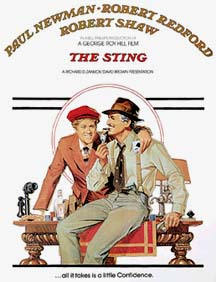
The Sting
Pairing Paul Newman and Robert Redford, the duo ended up being a match made in heaven for 1969's Butch Cassidy and the Sundance Kid. Could the pairing work again? Oh, you bet. Teaming up again for 1973's The Sting, Newman and Redford again show off an impeccable chemistry, a great back and forth, and a whole lot of talent in one of the 1970s best movies and one of my all-time favorites.
Working in 1936 Joliet just outside of Chicago, con man Johnny Hooker (Redford) pushes too far on one con when he and his partner, Luther (Robert Earl Jones), steal some $11,000 from a money runner working for big-time New York mobster Doyle Lonnegan (Robert Shaw). The mobster hears about it and in the aftermath, Luther is killed. On the run and always looking over his shoulder, Hooker seeks out Henry Gondorff (Newman), an infamous con man himself who's now on the run from the F.B.I. after a con of his went south. Hooker teams up with Gondorff, hoping to run a long con on Lonnegan to exact some revenge. With countless thieves, con men and grifters working their magic, a long list of things need to happen to pull the job off, but Gondorff and Hooker go to work knowing if the con fails, they may pay for it with their lives.
The Newman-Redford pairing -- along with Butch and Sundance director George Roy Hill -- is clearly one that works and is a key reason for the movie's success. I don't say this often because I don't want to overdo and/or overuse it, but The Sting is one of those rare perfect movies. All the scenes work without any extra fat on the bone. Even at 129 minutes, it flows effortlessly. The script (which won an Oscar) is one of the all-time greats. On first viewing, it might be a little difficult to keep up with everything, but in the end it fits together like puzzle pieces clicking into place. Smart, funny and well-written, the script helps bring this criminal underworld to life....in a nice way. It's the 1930s "criminal" underworld that the movies presented.
A period piece like this depends on a couple different thing. The first and usually most important? Does it look and feel authentic to the period it is set in? That's a safe answer here. The look of the movie ends up being an additional character. You genuinely feel like you're watching 1930s Chicago from the sets to the bad-ass suits to the cars zipping around the downtown streets. Much of the film was shot in California backlots, but several scenes were filmed on-location in Chicago, including LaSalle Street Station, Union Station and the Penn Central Freight Yards. What most people will remember from 'Sting' though is the music, starting with Scott Joplin's whistle-worthy theme, The Entertainer. It gives the story a light-hearted touch -- almost a goofy feel -- but it ends up working perfectly with the tone. The locations, sets, costumes, and music all contribute to a great retro style -- along with title cards introducing the scenes -- that is hard to replicate.
So Newman and Redford, pretty cool, huh? They just don't make stars like this anymore. Watching talented actors of this caliber on-screen, it's just fun. Their chemistry never feels forced. It's just two guys playing off each other like they have been doing it their entire lives. While both actors play prominent roles, more focus is given to Redford's Johnny Hooker, a talented if younger grifter looking for some revenge. He learns the ropes from Newman's more experienced, somewhat grizzled con man. Redford was even nominated for an Oscar for his performance, but both have their moments. Newman especially gets some laughs in his scene where he meet Shaw's Lonnegan, posing as a drunken but rather lucky poker player who throws the hook out there so the crew can reel in their target. Putting on a big, boisterous entrance, Newman (entering with "Sorry I was late, I was taking a crap") hits all the right notes in a part that allows Redford most of the spotlight.
In one of his most memorable roles before his death at the age of 51, Shaw is a great villain to counter Newman and Redford's very likable crooks. His Lonnegan will kill anyone who gets in his way and isn't picky or squeamish about doing so. As for the rest of the cast, Charles Durning is appropriately double-handed as Lt. Snyder, a Joliet cop with a grudge against Hooker. Putting together a team of thieves, Gondorff assembles Kid Twist (Harold Gould), the smooth-talking organizer, J.J. Singleton (Ray Walston), the veteran con man with a knack for investigating, Eddie Niles (John Heffernan), the numbers specialist, Billie (Eileen Brennan), his madam of sorts, and Erie Kid (Jack Kehoe), Hooker's former partner who's down on his luck. Dana Elcar has a small part too as F.B.I. agent Polk, hot on Gondorff's trail.
What I love most about The Sting though is how it all comes together in the end. We're given all these clues, characters and situations early on, but we're never quite sure how it fits together. The title cards sort of help -- The Hook, The Set-Up, The Sting -- but it's great to see the con come together so smoothly. Gondorff has hinted that it's not always the job that's the toughest. It's the aftermath and getting away alive. With that in mind, the last 30 minutes throws a handful of twists our way, all of them working, some working epically well. It's a great finale full of twists, surprises and some laughs. A great movie from start to finish.
The Sting <---trailer (1973): ****/****
Working in 1936 Joliet just outside of Chicago, con man Johnny Hooker (Redford) pushes too far on one con when he and his partner, Luther (Robert Earl Jones), steal some $11,000 from a money runner working for big-time New York mobster Doyle Lonnegan (Robert Shaw). The mobster hears about it and in the aftermath, Luther is killed. On the run and always looking over his shoulder, Hooker seeks out Henry Gondorff (Newman), an infamous con man himself who's now on the run from the F.B.I. after a con of his went south. Hooker teams up with Gondorff, hoping to run a long con on Lonnegan to exact some revenge. With countless thieves, con men and grifters working their magic, a long list of things need to happen to pull the job off, but Gondorff and Hooker go to work knowing if the con fails, they may pay for it with their lives.
The Newman-Redford pairing -- along with Butch and Sundance director George Roy Hill -- is clearly one that works and is a key reason for the movie's success. I don't say this often because I don't want to overdo and/or overuse it, but The Sting is one of those rare perfect movies. All the scenes work without any extra fat on the bone. Even at 129 minutes, it flows effortlessly. The script (which won an Oscar) is one of the all-time greats. On first viewing, it might be a little difficult to keep up with everything, but in the end it fits together like puzzle pieces clicking into place. Smart, funny and well-written, the script helps bring this criminal underworld to life....in a nice way. It's the 1930s "criminal" underworld that the movies presented.
A period piece like this depends on a couple different thing. The first and usually most important? Does it look and feel authentic to the period it is set in? That's a safe answer here. The look of the movie ends up being an additional character. You genuinely feel like you're watching 1930s Chicago from the sets to the bad-ass suits to the cars zipping around the downtown streets. Much of the film was shot in California backlots, but several scenes were filmed on-location in Chicago, including LaSalle Street Station, Union Station and the Penn Central Freight Yards. What most people will remember from 'Sting' though is the music, starting with Scott Joplin's whistle-worthy theme, The Entertainer. It gives the story a light-hearted touch -- almost a goofy feel -- but it ends up working perfectly with the tone. The locations, sets, costumes, and music all contribute to a great retro style -- along with title cards introducing the scenes -- that is hard to replicate.
So Newman and Redford, pretty cool, huh? They just don't make stars like this anymore. Watching talented actors of this caliber on-screen, it's just fun. Their chemistry never feels forced. It's just two guys playing off each other like they have been doing it their entire lives. While both actors play prominent roles, more focus is given to Redford's Johnny Hooker, a talented if younger grifter looking for some revenge. He learns the ropes from Newman's more experienced, somewhat grizzled con man. Redford was even nominated for an Oscar for his performance, but both have their moments. Newman especially gets some laughs in his scene where he meet Shaw's Lonnegan, posing as a drunken but rather lucky poker player who throws the hook out there so the crew can reel in their target. Putting on a big, boisterous entrance, Newman (entering with "Sorry I was late, I was taking a crap") hits all the right notes in a part that allows Redford most of the spotlight.
In one of his most memorable roles before his death at the age of 51, Shaw is a great villain to counter Newman and Redford's very likable crooks. His Lonnegan will kill anyone who gets in his way and isn't picky or squeamish about doing so. As for the rest of the cast, Charles Durning is appropriately double-handed as Lt. Snyder, a Joliet cop with a grudge against Hooker. Putting together a team of thieves, Gondorff assembles Kid Twist (Harold Gould), the smooth-talking organizer, J.J. Singleton (Ray Walston), the veteran con man with a knack for investigating, Eddie Niles (John Heffernan), the numbers specialist, Billie (Eileen Brennan), his madam of sorts, and Erie Kid (Jack Kehoe), Hooker's former partner who's down on his luck. Dana Elcar has a small part too as F.B.I. agent Polk, hot on Gondorff's trail.
What I love most about The Sting though is how it all comes together in the end. We're given all these clues, characters and situations early on, but we're never quite sure how it fits together. The title cards sort of help -- The Hook, The Set-Up, The Sting -- but it's great to see the con come together so smoothly. Gondorff has hinted that it's not always the job that's the toughest. It's the aftermath and getting away alive. With that in mind, the last 30 minutes throws a handful of twists our way, all of them working, some working epically well. It's a great finale full of twists, surprises and some laughs. A great movie from start to finish.
The Sting <---trailer (1973): ****/****
Labels:
1970s,
Charles Durning,
Comedy,
George Roy Hill,
Paul Newman,
Robert Redford,
Robert Shaw
Monday, October 17, 2011
The Conspirator
Stunned by the assassination of President Lincoln, Civil War veteran and inexperienced lawyer Frederick Aiken (James McAvoy) is assigned the impossible. Just weeks after Lincoln's death, Aiken is assigned as defense counsel to Mary Surratt (Robin Wright), the owner of a Washington boarding house believed to be involved with the assassination plot. The country is still mourning the tragic and sudden loss of the President, and there are cries for revenge, for retribution, including against Surratt who claims she's innocent. Even Aiken struggles to come to a conclusion, balancing out his personal feelings to his country with his obligation as a lawyer. With Surratt's life very much on the line, Aiken must decide what to do, choosing whether he can actually defend this woman in a court that seems rigged to watch him fail.
It is the rare historical period piece that hits theaters over the recent years so you have to enjoy them when they do come along. When there's the talent involved here -- with director Robert Redford -- it's an almost must watch situation. The look of the movie is impressive from the uniforms down to the locations that give you the feeling of being in 1865 Washington. 'Conspirator' is at its best setting things up, bringing the time to life for history buffs and viewers being introduced to a new subject. Composer Mark Isham's score isn't a classic, but it is both epic and moody as needed.
What doesn't work so well is based in the pacing. It starts with an obvious but still major problem. I've always liked history -- and have been to Ford's Theatre several times -- so I'm familiar with Mary Surratt's name. Whether you are or aren't (or even just read the Wiki link above), there isn't much mystery here. You know how it's going to end so so-called "twists" don't produce that desired result. Getting to the ending though, the story gets bogged down in the repetitious, yawn-producing courtroom scenes. The story revels in the period accuracy, and it sounds like the speech patterns of the 1860s, but that doesn't mean it is always interesting. The pacing is leisurely to say the least, and in general doesn't have much urgency. When you know where the movie's going to end up, some sense of tension or question would have been nice.
For a movie called 'The Conspirator,' I came away surprised. If anything, it could be called 'The Conspirator's Lawyer.' McAvoy does a very solid job as Aiken, the real-life figure assigned to defend Mrs. Surratt. The story focuses far more on him and his personal struggles than those of Surratt. Wright similarly is good if not great as Mary, portrayed as a martyr of sorts, an almost too angelic one. It just would have been nice to see her more, get to know her better as opposed to a one-note religious woman looking out for her kids' well-being at her own cost. McAvoy is torn apart inside, trying to figure out how to defend his client, putting his career on the line to see how far he can go. Their scenes lack a certain energy, but McAvoy makes the best impression in the courtroom as he desperately tries to do his job.
Working with a director -- and in general Hollywood legend -- with Redford's talent, I'm assuming actors are knocking down his door to get parts in his movies. McAvoy and Wright clearly have the biggest roles, but a handful of other parts rise above their smallish screentime. Tom Wilkinson (a British senator from Maryland?!?) plays Senator Reverdy Johnson, a man who believes even the guiltiest among us deserves a trial. A nearly unrecognizable Kevin Kline is Secretary of War Edwin Stanton, the movie's villain (because every movie needs one. An underrated actress, Evan Rachel Wood is memorable as Anna, Mary's suffering daughter trying to help her mother while Danny Huston plays Joseph Holt, the prosecuting attorney. Colm Meaney is wasted as General Hunter, head of the commission/trial. Among other smaller parts, Justin Long and Alexis Bledel fail to make much of an impression as Aiken's friend and a long-time girlfriend. Norman Reedus is the only other one of the conspirators to get more than a line or two.
It is the rare period piece so I always feel like I should enjoy these movies no matter the quality. I came away disappointed here with a historical story that should have been more interesting. There are aspects of the trial that shine some light on the cover-ups and whitewashing that was done to Surratt, efforts handled so a guilty verdict would come along no matter how ridiculously fixed things were. As a director, Redford is clearly in Surratt's corner, but he never actually spells it out mostly because as history, we'll never know for sure of Surratt's innocence or guilt. With a small footnote in our nation's history, I just wished the movie had been more enjoyable.
The Conspirator <---trailer (2010): **/****
Saturday, December 11, 2010
Butch Cassidy and the Sundance Kid
When you start reading about movie stars, the flicks they were in, and the processes it took to get these movies made, interesting tidbits of trivia always seem to pop up. Some of my favorites are finding out what movies the stars didn't pick to act in. Can you imagine Steve McQueen playing The Sundance Kid alongside Paul Newman? I can't say I'm not curious to see how that would have turned out, but it's hard to picture anyone but Newman and Robert Redford in the classic 1969 western Butch Cassidy and the Sundance Kid.
Say anything you want about this movie, but I've yet to find anyone who can't appreciate the chemistry between Newman and Redford. It's a change of pace for a western released in the late 1960s, a mix of comedy and action with a big dollop of the buddy movie thrown in. It doesn't go as far as revising the old west, but it certainly is a more romantic portrayal of a time that was really anything but romantic. Director George Roy Hill tells the story of two real outlaws though, and he picked the right two historical bandits. Yes, they robbed banks and trains, rustled cattle, and lived outside of the law, but all sorts of records exist that in real life these two men were actually pretty affable guys. That's the movie. If there are two better characters, more likable characters in a movie, I'm hard-pressed to think of them.
It's the first few years of the 1900s, and the wild west is dying out as civilization, technology, and the future are taking over. Leading the Hole in the Wall gang, outlaws Butch Cassidy (Newman) and the Sundance Kid (Redford) hang on to the last gasps of the life they know, robbing banks and trains for the easy pickings. But the window is closing on the outlaw life as the railroad company hires a super-posse to hunt them down and kill them. So along with Sundance's girlfriend, Etta Place (Katharine Ross), the outlaw duo travel to Bolivia to avoid being caught. But no matter what they do, it doesn't seem to work for them, and it's only a matter of time before the door completely closes on them.
Reviewing this movie, it's hard to describe the plot because there isn't much of a plot. And as I read back over, that review is much darker than the actual tone of the movie. However, whether you know the real life history of Butch and Sundance or not, at a certain point you can predict how this movie is going to end. It is a western that deals with the closing days of the west, and the men who refuse to change with the times. 'B and S' doesn't go down the dark route that The Wild Bunch does, but that doesn't take away from the still-moving ending (but more on that later). The tone here is light and comedic, only building to a darker conclusion because it is the natural course of things. There's no way to change the ending without seriously handicapping the rest of the movie.
For starters, Newman and Redford are two of the most likable Hollywood stars to ever star in a movie. Then throw in this great script from William Goldman that allows them to have these great dialogue exchanges full of great comedic one-liners, and you've got this perfect storm of acting and writing. Read IMDB's Memorable Quotes for an idea of some of the phenomenal writing, which even out of context is still priceless. Newman as the affable, joking Butch and Redford as the more serious Sundance have this banter down to an art with a chemistry that hasn't been duplicated in westerns or action movies since. The best test is the end though after a gunfight goes horrifically wrong and both men -- gravely wounded -- continue to bitch and moan at each other. Staring death in the face (whether they know it or not), they still argue back and forth. Outlaws yes, and maybe a bit more romantically portrayed than actual wild west outlaws, but my all-time favorite teaming of two actors.
With a virtually plotless story, the movie allows Newman and Redford to experiment with their parts, and certain parts resonate more than others. Burt Bacharach's Raindrops Keep Falling On My Head is very much a sign of the times the movie it was made, but it isn't as bad as some critics make it out. It's all part of the generally light-hearted, comedic tone of the movie. A great extended sequence that runs almost a full half hour as Butch and Sundance running from a faceless posse we never seen in close-up, continually asking 'Who are those guys?, leading up to the infamous, hysterical cliff exchange (watch HERE). But for all the comedy, there's emotion here, including one of my favorites as the duo takes jobs as payroll guards and are forced to shoot it out with a gang of Bolivian bandits. Sundance's softly delivered line 'We went straight...now what?" says it all, and leads into the frustratingly depressing ending.
Stop reading if you don't want to know the ending SPOILERS Forced back to a life of robbing and stealing, Butch and Sundance get cornered in a small Bolivian mountain village. Facing Bolivian police, they make a desperate grab for more ammunition only to have a company of Bolivian cavalry arrive to help the police. With nowhere to go and not knowing what awaits them outside, Butch and Sundance go out in a blaze of glory, charging into a wall of gunfire. I've read that their deaths were actually filmed (or so I've heard), but thankfully Goldman uses a freeze frame instead, and it's a wise decision. As a viewer, we like these characters too much to see them go out like Bonnie and Clyde or The Wild Bunch. The gunfight leading up to the finale is a doozy (watch it HERE) and worth mentioning in its own right. The ending of course isn't a happy one, but it's a necessary one. Still, it's hard either way. There's a moment where Sundance steps out into the open over a wounded Butch to protect him that says everything about these two men. Friends till the end.
So can you tell I like this movie? Yeah, me neither. As a western fan, I'm a sucker for just about anything, but Butch and Sundance is a step above. Newman and Redford have never been better, and together they are perfect. In the supporting cast look for Strother Martin as Percy Garrett, a "colorful" mine owner, Jeff Corey as a sheriff who delivers a speech that predicts what awaits Butch and Sundance, and Cloris Leachman as Dolores, a hooker with an eye on Butch. I don't say it often, but one of those few perfect movies.
Butch Cassidy and the Sundance Kid <---trailer (1969): ****/****
Say anything you want about this movie, but I've yet to find anyone who can't appreciate the chemistry between Newman and Redford. It's a change of pace for a western released in the late 1960s, a mix of comedy and action with a big dollop of the buddy movie thrown in. It doesn't go as far as revising the old west, but it certainly is a more romantic portrayal of a time that was really anything but romantic. Director George Roy Hill tells the story of two real outlaws though, and he picked the right two historical bandits. Yes, they robbed banks and trains, rustled cattle, and lived outside of the law, but all sorts of records exist that in real life these two men were actually pretty affable guys. That's the movie. If there are two better characters, more likable characters in a movie, I'm hard-pressed to think of them.
It's the first few years of the 1900s, and the wild west is dying out as civilization, technology, and the future are taking over. Leading the Hole in the Wall gang, outlaws Butch Cassidy (Newman) and the Sundance Kid (Redford) hang on to the last gasps of the life they know, robbing banks and trains for the easy pickings. But the window is closing on the outlaw life as the railroad company hires a super-posse to hunt them down and kill them. So along with Sundance's girlfriend, Etta Place (Katharine Ross), the outlaw duo travel to Bolivia to avoid being caught. But no matter what they do, it doesn't seem to work for them, and it's only a matter of time before the door completely closes on them.
Reviewing this movie, it's hard to describe the plot because there isn't much of a plot. And as I read back over, that review is much darker than the actual tone of the movie. However, whether you know the real life history of Butch and Sundance or not, at a certain point you can predict how this movie is going to end. It is a western that deals with the closing days of the west, and the men who refuse to change with the times. 'B and S' doesn't go down the dark route that The Wild Bunch does, but that doesn't take away from the still-moving ending (but more on that later). The tone here is light and comedic, only building to a darker conclusion because it is the natural course of things. There's no way to change the ending without seriously handicapping the rest of the movie.
For starters, Newman and Redford are two of the most likable Hollywood stars to ever star in a movie. Then throw in this great script from William Goldman that allows them to have these great dialogue exchanges full of great comedic one-liners, and you've got this perfect storm of acting and writing. Read IMDB's Memorable Quotes for an idea of some of the phenomenal writing, which even out of context is still priceless. Newman as the affable, joking Butch and Redford as the more serious Sundance have this banter down to an art with a chemistry that hasn't been duplicated in westerns or action movies since. The best test is the end though after a gunfight goes horrifically wrong and both men -- gravely wounded -- continue to bitch and moan at each other. Staring death in the face (whether they know it or not), they still argue back and forth. Outlaws yes, and maybe a bit more romantically portrayed than actual wild west outlaws, but my all-time favorite teaming of two actors.
With a virtually plotless story, the movie allows Newman and Redford to experiment with their parts, and certain parts resonate more than others. Burt Bacharach's Raindrops Keep Falling On My Head is very much a sign of the times the movie it was made, but it isn't as bad as some critics make it out. It's all part of the generally light-hearted, comedic tone of the movie. A great extended sequence that runs almost a full half hour as Butch and Sundance running from a faceless posse we never seen in close-up, continually asking 'Who are those guys?, leading up to the infamous, hysterical cliff exchange (watch HERE). But for all the comedy, there's emotion here, including one of my favorites as the duo takes jobs as payroll guards and are forced to shoot it out with a gang of Bolivian bandits. Sundance's softly delivered line 'We went straight...now what?" says it all, and leads into the frustratingly depressing ending.
Stop reading if you don't want to know the ending SPOILERS Forced back to a life of robbing and stealing, Butch and Sundance get cornered in a small Bolivian mountain village. Facing Bolivian police, they make a desperate grab for more ammunition only to have a company of Bolivian cavalry arrive to help the police. With nowhere to go and not knowing what awaits them outside, Butch and Sundance go out in a blaze of glory, charging into a wall of gunfire. I've read that their deaths were actually filmed (or so I've heard), but thankfully Goldman uses a freeze frame instead, and it's a wise decision. As a viewer, we like these characters too much to see them go out like Bonnie and Clyde or The Wild Bunch. The gunfight leading up to the finale is a doozy (watch it HERE) and worth mentioning in its own right. The ending of course isn't a happy one, but it's a necessary one. Still, it's hard either way. There's a moment where Sundance steps out into the open over a wounded Butch to protect him that says everything about these two men. Friends till the end.
So can you tell I like this movie? Yeah, me neither. As a western fan, I'm a sucker for just about anything, but Butch and Sundance is a step above. Newman and Redford have never been better, and together they are perfect. In the supporting cast look for Strother Martin as Percy Garrett, a "colorful" mine owner, Jeff Corey as a sheriff who delivers a speech that predicts what awaits Butch and Sundance, and Cloris Leachman as Dolores, a hooker with an eye on Butch. I don't say it often, but one of those few perfect movies.
Butch Cassidy and the Sundance Kid <---trailer (1969): ****/****
Labels:
1960s,
2010s,
Katharine Ross,
Paul Newman,
Robert Redford,
Strother Martin,
westerns
Tuesday, August 3, 2010
Downhill Racer
Through some 30-plus movies, Robert Redford has made a career of playing that roguish character you can't help but like. Women want to be with him, and men want to be him. The man has been in his fair share of classics, but through them all he never truly played an out-and-out villain. Sure, there were characters that weren't on the straight and narrow, but they weren't all bad. Tell me the Sundance Kid isn't the coolest wild west outlaw ever. So maybe never a bad guy, but how about someone you just hate and is incredibly dislikable?
That's 1969's Downhill Racer, a somewhat odd choice for Criterion to release on DVD but who knows what's really going on with DVD/studio releases. Redford plays a character that is by no means a bad guy, but he's clearly not the good guy either. He's interested in only himself and doesn't really care who gets knocked down in the process as long as it benefits him. Besides some other issues I had with the movie, that was the biggest one. Through all his characters, I can say that I like Robert Redford as a star and an actor. Watching him play someone who is so egocentric was a tough pill to swallow.
When a key member of the U.S. national ski team is knocked out with an injury, coach Eugene Claire (Gene Hackman) is forced to improvise to fill out his roster. He turns to a young skier, Dave Chappellet (Redford), who clearly has the talent to be great but was never able to put it all together. Still two years away from the winter Olympics, Dave joins the team and quickly alienates everyone around him with his interest in himself above all others. But in the process, he starts to win races and creates quite a name for himself. With the Olympics drawing near and his star becoming ever brighter, can Dave get a hold of himself and his ever-growing arrogance coupled with his huge talent?
The story itself is nothing new in relation to a sports movie or any other rags to riches story. It's been done before with the down and out, poor individual gets a chance to amount to something more. There's the inevitable rise to power and of course, that fall down the backside of that hill. For the most part, 'Downhill' does its best to avoid most of the cliches you might have seen in a similar story elsewhere. But it still feels like we've been here before as a viewer. The one detour comes from the ending which certainly surprised me. I'm still mulling it over and not quite sure what to say about it other than I could have thought of a better ending. Still, the whole tone of the Chappellet character has been unapologetic so why mess with it?
Now just because I didn't like Redford's character doesn't mean the character isn't a good one. Redford does an excellent job as this ambitious young skier who wants to be the best at what he does, consequences and repercussions be damned. Through a quick scene with his father we see that his behavior isn't anything new, he's most likely been doing it for years. It's probably Redford's easiest character to hate, but that doesn't take away from his solid performance. Hackman unfortunately is wasted as the ski team's coach, usually having to confront Chappellet about his actions before fading into the background for long stretches. Swedish beauty Camilla Sparv plays Carole, Dave's fling/girlfriend, while Jim McMullan plays Johnny Creech, the ski team's best athlete and therefore Dave's rival, and Karl Michael Vogler plays Machet, a well-to-do businessman with a lot to lose.
Director Michael Ritchie tells his generally plotless story -- it covers almost 3 full years -- with a documentary-like filmmaking style. The skiing sequences (filmed in Austria and Switzerland) are the movie at their best, exciting and fast-paced, as well as the scenes of the event of the downhill race with the crowds gathering, vendors setting up shop, and media preparing to cover the event. An annoying smooth jazz score is played over several of these scenes, but thankfully that part of the score is generally left by the wayside. My one complaint is that obviously Redford and the cast couldn't actually do their own skiing. Thankfully, Ritchie doesn't use any tricks to make it look like they are skiing. He wisely just lets his stunt men do their thing.
For all the good though that comes from the documentary-like storytelling, it goes out the window to a certain point in the non-skiing scenes. It can be dull watching Chappellet brood his way through life, pissing everyone in his life off and not looking like he cares one bit. I'm not saying make him a different character depending on the scene, but by the end of the movie you're rooting against the guy...or at least I was. I WANTED him to lose in the Olympics. As for whether he does win or lose and how you feel about it, check the movie out.
Downhill Racer <---trailer (1969): ** 1/2 /****
That's 1969's Downhill Racer, a somewhat odd choice for Criterion to release on DVD but who knows what's really going on with DVD/studio releases. Redford plays a character that is by no means a bad guy, but he's clearly not the good guy either. He's interested in only himself and doesn't really care who gets knocked down in the process as long as it benefits him. Besides some other issues I had with the movie, that was the biggest one. Through all his characters, I can say that I like Robert Redford as a star and an actor. Watching him play someone who is so egocentric was a tough pill to swallow.
When a key member of the U.S. national ski team is knocked out with an injury, coach Eugene Claire (Gene Hackman) is forced to improvise to fill out his roster. He turns to a young skier, Dave Chappellet (Redford), who clearly has the talent to be great but was never able to put it all together. Still two years away from the winter Olympics, Dave joins the team and quickly alienates everyone around him with his interest in himself above all others. But in the process, he starts to win races and creates quite a name for himself. With the Olympics drawing near and his star becoming ever brighter, can Dave get a hold of himself and his ever-growing arrogance coupled with his huge talent?
The story itself is nothing new in relation to a sports movie or any other rags to riches story. It's been done before with the down and out, poor individual gets a chance to amount to something more. There's the inevitable rise to power and of course, that fall down the backside of that hill. For the most part, 'Downhill' does its best to avoid most of the cliches you might have seen in a similar story elsewhere. But it still feels like we've been here before as a viewer. The one detour comes from the ending which certainly surprised me. I'm still mulling it over and not quite sure what to say about it other than I could have thought of a better ending. Still, the whole tone of the Chappellet character has been unapologetic so why mess with it?
Now just because I didn't like Redford's character doesn't mean the character isn't a good one. Redford does an excellent job as this ambitious young skier who wants to be the best at what he does, consequences and repercussions be damned. Through a quick scene with his father we see that his behavior isn't anything new, he's most likely been doing it for years. It's probably Redford's easiest character to hate, but that doesn't take away from his solid performance. Hackman unfortunately is wasted as the ski team's coach, usually having to confront Chappellet about his actions before fading into the background for long stretches. Swedish beauty Camilla Sparv plays Carole, Dave's fling/girlfriend, while Jim McMullan plays Johnny Creech, the ski team's best athlete and therefore Dave's rival, and Karl Michael Vogler plays Machet, a well-to-do businessman with a lot to lose.
Director Michael Ritchie tells his generally plotless story -- it covers almost 3 full years -- with a documentary-like filmmaking style. The skiing sequences (filmed in Austria and Switzerland) are the movie at their best, exciting and fast-paced, as well as the scenes of the event of the downhill race with the crowds gathering, vendors setting up shop, and media preparing to cover the event. An annoying smooth jazz score is played over several of these scenes, but thankfully that part of the score is generally left by the wayside. My one complaint is that obviously Redford and the cast couldn't actually do their own skiing. Thankfully, Ritchie doesn't use any tricks to make it look like they are skiing. He wisely just lets his stunt men do their thing.
For all the good though that comes from the documentary-like storytelling, it goes out the window to a certain point in the non-skiing scenes. It can be dull watching Chappellet brood his way through life, pissing everyone in his life off and not looking like he cares one bit. I'm not saying make him a different character depending on the scene, but by the end of the movie you're rooting against the guy...or at least I was. I WANTED him to lose in the Olympics. As for whether he does win or lose and how you feel about it, check the movie out.
Downhill Racer <---trailer (1969): ** 1/2 /****
Labels:
1960s,
Camilla Sparv,
Gene Hackman,
Robert Redford,
Sports
Wednesday, July 21, 2010
The Last Castle
In about a year and a half or so I've written over 350 reviews while trying to cover a wide range of movies and actors from all sorts of different genres. Some names come up more than others, but I feel really bad about missing one in particular, the always cool Robert Redford. In 350-plus reviews, I didn't do one Redford movie. It wasn't an intentional slight, and all I can come up with is that I've tried to review movies I haven't seen in the past. Looking at Redford's filmography, I've seen about half so that explains it to a certain point. So anyways, here goes, a Redford review starting with 2001's The Last Castle.
One of the biggest stars of the 1960s and 1970s, Redford has stepped back from the limelight over the last 15 years, content to direct more than act while also organizing the annual Sundance Film Festival. At 74 years old, he is one of those few actors you could really call a 'movie star.' He has aged gracefully without any sort of controversy or media event to scar his career, and he is as cool as ever. In 'Castle,' he was making his first on-screen appearance in three years, and even though Redford is typically strong in the lead, the movie just can't sustain any sort of momentum before derailing in the final act.
A decorate army general, Lt. General Gene Irwin (Redford) has been court martialled and sentenced to serve a 10-year team in a military prison. It is a maximum security prison full of the dredges from all the armed forces with a brutal commander, Colonel Winters (James Gandolfini), in charge, doing his best to remain order while also having some fun at the prisoners' expense. Early on as he begins to serve his sentence, Irwin is content to sit back and let the days go by. But soon enough, he sees Winters for what he really is; a sadistic commander watching over his prison like a puppetmaster, making the prisoners do things for his entertainment. Irwin refuses to go along with what he sees and puts a complicated plan into action for ousting Winters.
Prison or P.O.W. movies have a popularity all to themselves, and because of that there's a tried and true formula to follow. 'Castle' does deviate from the formula in one big way; the prisoners aren't trying to escape. As military criminals, they realize to a point where are they really going to go? So with any escape plans out the window, the story settles into a battle of wills between two type-A personalities, Redford's Irwin and Gandolfini's Winters. While obviously not as good a movie overall, the dynamic here reminded me of The Bridge on the River Kwai with the struggle for power a key ingredient to the story.
At the age of 65 making this movie, Redford looks like he's about 45, maybe 50 if you push it. Since he started directing movies in the early 90s, he's acted less so it's always good to see him in front of the camera. As Lt. General Irwin, he's clearly the more sympathetic character. We find out midway through the movie why he was court martialed and therefore why early on he just wanted to do his time and avoid any of the politics of a general being in a military prison. Seeing Winters play his mind games with prisoners and generally manipulate the facility for his enjoyment finally pushes Irwin too far, including one incident with a marine (Clifton Collins Jr. in a great supporting part) where unnecessary violence is taken to a new level by the commandant.
Right in the middle of his huge success as part of The Sopranos, Gandolfini does his fair share of scenery-chewing as the prison commander. He butts heads instantly with Irwin when he overhears a comment about his military antique collection and it goes downhill from there. What works so well with this dynamic is the egos involved. Both men want to prove they're better than the other, even when the situation is escalated to a whole new level. I'm not a huge Gandolfini fan, but he is a really fun actor to watch. Also in the cast is Delroy Lindo as General Wheeler, an old friend of Irwin's suspicious of what's really happening in the prison, Mark Ruffalo as Yates, a prisoner no one likes who may or may not be playing both sides, and Steve Burton as Capt. Peretz, Winters' aide.
Through the first hour of 'Castle,' I was liking where the story was building to if not loving it. After that, the whole movie rolls over a land mine, derails, hits a wall, whatever you want to call it. Pushed too far, Irwin -- a master of command and strategy -- leads a coup from inside the prison against the heavily outnumbered guards. On a purely action scale, the last half hour is everything you could ask for. But from where the story is coming, it comes out of nowhere with no warnings or explanations which would have helped fill in some holes. It's just a weird ending that made me realize what a weird movie this was as a whole. Take away the performances from Redford and Gandolfini, and this movie is pretty bad in a cartoonish way. Go figure.
The Last Castle <----trailer (2001): **/****
One of the biggest stars of the 1960s and 1970s, Redford has stepped back from the limelight over the last 15 years, content to direct more than act while also organizing the annual Sundance Film Festival. At 74 years old, he is one of those few actors you could really call a 'movie star.' He has aged gracefully without any sort of controversy or media event to scar his career, and he is as cool as ever. In 'Castle,' he was making his first on-screen appearance in three years, and even though Redford is typically strong in the lead, the movie just can't sustain any sort of momentum before derailing in the final act.
A decorate army general, Lt. General Gene Irwin (Redford) has been court martialled and sentenced to serve a 10-year team in a military prison. It is a maximum security prison full of the dredges from all the armed forces with a brutal commander, Colonel Winters (James Gandolfini), in charge, doing his best to remain order while also having some fun at the prisoners' expense. Early on as he begins to serve his sentence, Irwin is content to sit back and let the days go by. But soon enough, he sees Winters for what he really is; a sadistic commander watching over his prison like a puppetmaster, making the prisoners do things for his entertainment. Irwin refuses to go along with what he sees and puts a complicated plan into action for ousting Winters.
Prison or P.O.W. movies have a popularity all to themselves, and because of that there's a tried and true formula to follow. 'Castle' does deviate from the formula in one big way; the prisoners aren't trying to escape. As military criminals, they realize to a point where are they really going to go? So with any escape plans out the window, the story settles into a battle of wills between two type-A personalities, Redford's Irwin and Gandolfini's Winters. While obviously not as good a movie overall, the dynamic here reminded me of The Bridge on the River Kwai with the struggle for power a key ingredient to the story.
At the age of 65 making this movie, Redford looks like he's about 45, maybe 50 if you push it. Since he started directing movies in the early 90s, he's acted less so it's always good to see him in front of the camera. As Lt. General Irwin, he's clearly the more sympathetic character. We find out midway through the movie why he was court martialed and therefore why early on he just wanted to do his time and avoid any of the politics of a general being in a military prison. Seeing Winters play his mind games with prisoners and generally manipulate the facility for his enjoyment finally pushes Irwin too far, including one incident with a marine (Clifton Collins Jr. in a great supporting part) where unnecessary violence is taken to a new level by the commandant.
Right in the middle of his huge success as part of The Sopranos, Gandolfini does his fair share of scenery-chewing as the prison commander. He butts heads instantly with Irwin when he overhears a comment about his military antique collection and it goes downhill from there. What works so well with this dynamic is the egos involved. Both men want to prove they're better than the other, even when the situation is escalated to a whole new level. I'm not a huge Gandolfini fan, but he is a really fun actor to watch. Also in the cast is Delroy Lindo as General Wheeler, an old friend of Irwin's suspicious of what's really happening in the prison, Mark Ruffalo as Yates, a prisoner no one likes who may or may not be playing both sides, and Steve Burton as Capt. Peretz, Winters' aide.
Through the first hour of 'Castle,' I was liking where the story was building to if not loving it. After that, the whole movie rolls over a land mine, derails, hits a wall, whatever you want to call it. Pushed too far, Irwin -- a master of command and strategy -- leads a coup from inside the prison against the heavily outnumbered guards. On a purely action scale, the last half hour is everything you could ask for. But from where the story is coming, it comes out of nowhere with no warnings or explanations which would have helped fill in some holes. It's just a weird ending that made me realize what a weird movie this was as a whole. Take away the performances from Redford and Gandolfini, and this movie is pretty bad in a cartoonish way. Go figure.
The Last Castle <----trailer (2001): **/****
Subscribe to:
Posts (Atom)