Ever heard of barnstorming? Well, you should have so shame on you. In the 1920s, flying circuses traveled across America, pilots performing ridiculously dangerous (some would say suicidal) stunts and tricks to amuse and dazzle audiences. A movie I stumbled across on Netflix does a really good job giving a look at the dangerous world of barnstorming, 1975's The Great Waldo Pepper.
It's 1926 in Nebraska and Waldo Pepper (Robert Redford), a very talented pilot trying to create a reputation and name for himself, is scraping by. He flies all over the state, doing tricks and aerial stunts for anyone who will pay to see it, offering 5-minute rides for $5, all the money going toward the development of a new single-wing plane built by his friend and engineer, Ezra Stiles (Edward Hermann). Waldo has a bit of a rivalry with another pilot, Axel Olsson (Bo Svenson), especially when Axel moves into his territory, but seeing the business struggle and the money start to dry up, the pilot duo teams up. Their idea? Do something that audiences have never seen before, a stunt that will assure them a reputation and audiences wherever they go. Waldo and Axel intend to walk on their wings while flying thousands of feet up in the air.
I could be wrong -- and I often am -- but I believe this 1975 aviation flick sat in my Netflix queue for the last 10 months or so after I watched another aviation flick, 1965's Those Magnificent Men in Their Flying Machines. It's also the third pairing between director George Roy Hill and star Redford, having worked previously together in Butch Cassidy and the Sundance Kid and The Sting. This is a movie that loves its story, loves where it came from. It loves flying, aviation, the pilots, the history, any and all of it. If there's a surprise, it's that near the halfway point the story takes a surprising turn for the dark. The tone early on is light, a tad jokey, composer Henry Mancini's score adding to the fun, entertaining mood. The differences in tone work overall after the initial shock (and the scene that switches it up is a SHOCKER). Light and fun meets dark and surprising, I wouldn't think that would work, but it does.
Above all else, 'Waldo' is definitely worth seeking out because of some ridiculous aerial sequences. If this movie was released in the modern CGI (computer generated images) era, there would be no, NO, actual footage of the pilots, their planes and their tricks. But how about 1975? There weren't special effects like that. Everything had to be done for real or with some real cheesy-looking effects. The footage here is astounding. Hill and cinematographer Robert Surtees put their cameras up in the air with the planes and let the pilots do their thing. With the cameras mounted on the planes (or flying with them close by), it feels as a viewer that we're flying with them. Point of view shots really add to that sense of realism. Making it cooler? Redford, Svenson and the cast are up there too, one more authentic touch to an already authentic feel. We see pilots doing loops, some upside down -- one called an outside loop -- and others walking on the wings of their bi-planes. On a purely visual level, the film is a great experience.
Right in the midst of his acting heyday before he turned to directing more, Redford is at his best as Waldo Pepper, the pilot who wants more. He's able to do the drama, the comedy, all of it, playing a charming, likable rogue who becomes almost obsessed with making a name for himself. I wasn't quite sure what to expect out of the story going in -- only knowing it was about an early era in aviation -- so it caught me off guard when such an interesting character was leading the way. Much of that success comes from the dark twist the story takes near the halfway point, Redford's Waldo getting another layer or two to the character. If there's a weakness, it's the scenes with his former love, played by Margot Kidder, the scenes slowing the pace down with some attempts at drama. Mostly though, the character is great. He missed out on the dogfights in World War I and desperately wants to get a chance to be a hero, to be idolized no matter the inherent risks in a suicidal job. An underrated performance from Redford.
With an episodic story, we get plenty of other characters Waldo meets along the way. I really liked the rivalry turned friendship between Waldo and Svenson's Otto, two very talented pilots who are good on their own but may be better working together. The most dramatic part goes to Bo Brundin as Ernst Kessler, the famous German ace from WWI, a hero in Waldo's eyes who questions why he's been deemed a hero internationally by the public. Redford and Brundin have a couple great dialogue exchanges later, building to a surprising ending, slightly open-ended but it's easy to draw conclusions. A young Susan Sarandon has a supporting part as Mary Beth, a young woman Waldo meets and becomes part of the act with Waldo and Otto. Geoffrey Lewis makes the most of his smaller part as Newt, Waldo's former commander and a current Air Commerce inspector. And last, look for Philip Bruns as Dillhoefer, the owner of the air circus always looking for the next big thing in aerial stunts.
A very pleasant surprise for any number of reasons from Redford's lead performance as extremely talented pilot Waldo Pepper to the one impressive aerial sequence after another, one better than the last, especially in the final scene. Period correct planes, cool aerial stunts, it's a gem.
The Great Waldo Pepper (1975): ***/****
The Sons of Katie Elder
"First, we reunite, then find Ma and Pa's killer...then read some reviews."
Showing posts with label George Roy Hill. Show all posts
Wednesday, February 12, 2014
Friday, September 7, 2012
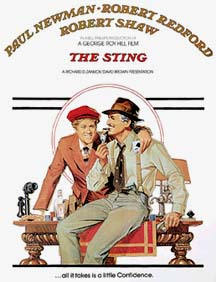
The Sting
Pairing Paul Newman and Robert Redford, the duo ended up being a match made in heaven for 1969's Butch Cassidy and the Sundance Kid. Could the pairing work again? Oh, you bet. Teaming up again for 1973's The Sting, Newman and Redford again show off an impeccable chemistry, a great back and forth, and a whole lot of talent in one of the 1970s best movies and one of my all-time favorites.
Working in 1936 Joliet just outside of Chicago, con man Johnny Hooker (Redford) pushes too far on one con when he and his partner, Luther (Robert Earl Jones), steal some $11,000 from a money runner working for big-time New York mobster Doyle Lonnegan (Robert Shaw). The mobster hears about it and in the aftermath, Luther is killed. On the run and always looking over his shoulder, Hooker seeks out Henry Gondorff (Newman), an infamous con man himself who's now on the run from the F.B.I. after a con of his went south. Hooker teams up with Gondorff, hoping to run a long con on Lonnegan to exact some revenge. With countless thieves, con men and grifters working their magic, a long list of things need to happen to pull the job off, but Gondorff and Hooker go to work knowing if the con fails, they may pay for it with their lives.
The Newman-Redford pairing -- along with Butch and Sundance director George Roy Hill -- is clearly one that works and is a key reason for the movie's success. I don't say this often because I don't want to overdo and/or overuse it, but The Sting is one of those rare perfect movies. All the scenes work without any extra fat on the bone. Even at 129 minutes, it flows effortlessly. The script (which won an Oscar) is one of the all-time greats. On first viewing, it might be a little difficult to keep up with everything, but in the end it fits together like puzzle pieces clicking into place. Smart, funny and well-written, the script helps bring this criminal underworld to life....in a nice way. It's the 1930s "criminal" underworld that the movies presented.
A period piece like this depends on a couple different thing. The first and usually most important? Does it look and feel authentic to the period it is set in? That's a safe answer here. The look of the movie ends up being an additional character. You genuinely feel like you're watching 1930s Chicago from the sets to the bad-ass suits to the cars zipping around the downtown streets. Much of the film was shot in California backlots, but several scenes were filmed on-location in Chicago, including LaSalle Street Station, Union Station and the Penn Central Freight Yards. What most people will remember from 'Sting' though is the music, starting with Scott Joplin's whistle-worthy theme, The Entertainer. It gives the story a light-hearted touch -- almost a goofy feel -- but it ends up working perfectly with the tone. The locations, sets, costumes, and music all contribute to a great retro style -- along with title cards introducing the scenes -- that is hard to replicate.
So Newman and Redford, pretty cool, huh? They just don't make stars like this anymore. Watching talented actors of this caliber on-screen, it's just fun. Their chemistry never feels forced. It's just two guys playing off each other like they have been doing it their entire lives. While both actors play prominent roles, more focus is given to Redford's Johnny Hooker, a talented if younger grifter looking for some revenge. He learns the ropes from Newman's more experienced, somewhat grizzled con man. Redford was even nominated for an Oscar for his performance, but both have their moments. Newman especially gets some laughs in his scene where he meet Shaw's Lonnegan, posing as a drunken but rather lucky poker player who throws the hook out there so the crew can reel in their target. Putting on a big, boisterous entrance, Newman (entering with "Sorry I was late, I was taking a crap") hits all the right notes in a part that allows Redford most of the spotlight.
In one of his most memorable roles before his death at the age of 51, Shaw is a great villain to counter Newman and Redford's very likable crooks. His Lonnegan will kill anyone who gets in his way and isn't picky or squeamish about doing so. As for the rest of the cast, Charles Durning is appropriately double-handed as Lt. Snyder, a Joliet cop with a grudge against Hooker. Putting together a team of thieves, Gondorff assembles Kid Twist (Harold Gould), the smooth-talking organizer, J.J. Singleton (Ray Walston), the veteran con man with a knack for investigating, Eddie Niles (John Heffernan), the numbers specialist, Billie (Eileen Brennan), his madam of sorts, and Erie Kid (Jack Kehoe), Hooker's former partner who's down on his luck. Dana Elcar has a small part too as F.B.I. agent Polk, hot on Gondorff's trail.
What I love most about The Sting though is how it all comes together in the end. We're given all these clues, characters and situations early on, but we're never quite sure how it fits together. The title cards sort of help -- The Hook, The Set-Up, The Sting -- but it's great to see the con come together so smoothly. Gondorff has hinted that it's not always the job that's the toughest. It's the aftermath and getting away alive. With that in mind, the last 30 minutes throws a handful of twists our way, all of them working, some working epically well. It's a great finale full of twists, surprises and some laughs. A great movie from start to finish.
The Sting <---trailer (1973): ****/****
Working in 1936 Joliet just outside of Chicago, con man Johnny Hooker (Redford) pushes too far on one con when he and his partner, Luther (Robert Earl Jones), steal some $11,000 from a money runner working for big-time New York mobster Doyle Lonnegan (Robert Shaw). The mobster hears about it and in the aftermath, Luther is killed. On the run and always looking over his shoulder, Hooker seeks out Henry Gondorff (Newman), an infamous con man himself who's now on the run from the F.B.I. after a con of his went south. Hooker teams up with Gondorff, hoping to run a long con on Lonnegan to exact some revenge. With countless thieves, con men and grifters working their magic, a long list of things need to happen to pull the job off, but Gondorff and Hooker go to work knowing if the con fails, they may pay for it with their lives.
The Newman-Redford pairing -- along with Butch and Sundance director George Roy Hill -- is clearly one that works and is a key reason for the movie's success. I don't say this often because I don't want to overdo and/or overuse it, but The Sting is one of those rare perfect movies. All the scenes work without any extra fat on the bone. Even at 129 minutes, it flows effortlessly. The script (which won an Oscar) is one of the all-time greats. On first viewing, it might be a little difficult to keep up with everything, but in the end it fits together like puzzle pieces clicking into place. Smart, funny and well-written, the script helps bring this criminal underworld to life....in a nice way. It's the 1930s "criminal" underworld that the movies presented.
A period piece like this depends on a couple different thing. The first and usually most important? Does it look and feel authentic to the period it is set in? That's a safe answer here. The look of the movie ends up being an additional character. You genuinely feel like you're watching 1930s Chicago from the sets to the bad-ass suits to the cars zipping around the downtown streets. Much of the film was shot in California backlots, but several scenes were filmed on-location in Chicago, including LaSalle Street Station, Union Station and the Penn Central Freight Yards. What most people will remember from 'Sting' though is the music, starting with Scott Joplin's whistle-worthy theme, The Entertainer. It gives the story a light-hearted touch -- almost a goofy feel -- but it ends up working perfectly with the tone. The locations, sets, costumes, and music all contribute to a great retro style -- along with title cards introducing the scenes -- that is hard to replicate.
So Newman and Redford, pretty cool, huh? They just don't make stars like this anymore. Watching talented actors of this caliber on-screen, it's just fun. Their chemistry never feels forced. It's just two guys playing off each other like they have been doing it their entire lives. While both actors play prominent roles, more focus is given to Redford's Johnny Hooker, a talented if younger grifter looking for some revenge. He learns the ropes from Newman's more experienced, somewhat grizzled con man. Redford was even nominated for an Oscar for his performance, but both have their moments. Newman especially gets some laughs in his scene where he meet Shaw's Lonnegan, posing as a drunken but rather lucky poker player who throws the hook out there so the crew can reel in their target. Putting on a big, boisterous entrance, Newman (entering with "Sorry I was late, I was taking a crap") hits all the right notes in a part that allows Redford most of the spotlight.
In one of his most memorable roles before his death at the age of 51, Shaw is a great villain to counter Newman and Redford's very likable crooks. His Lonnegan will kill anyone who gets in his way and isn't picky or squeamish about doing so. As for the rest of the cast, Charles Durning is appropriately double-handed as Lt. Snyder, a Joliet cop with a grudge against Hooker. Putting together a team of thieves, Gondorff assembles Kid Twist (Harold Gould), the smooth-talking organizer, J.J. Singleton (Ray Walston), the veteran con man with a knack for investigating, Eddie Niles (John Heffernan), the numbers specialist, Billie (Eileen Brennan), his madam of sorts, and Erie Kid (Jack Kehoe), Hooker's former partner who's down on his luck. Dana Elcar has a small part too as F.B.I. agent Polk, hot on Gondorff's trail.
What I love most about The Sting though is how it all comes together in the end. We're given all these clues, characters and situations early on, but we're never quite sure how it fits together. The title cards sort of help -- The Hook, The Set-Up, The Sting -- but it's great to see the con come together so smoothly. Gondorff has hinted that it's not always the job that's the toughest. It's the aftermath and getting away alive. With that in mind, the last 30 minutes throws a handful of twists our way, all of them working, some working epically well. It's a great finale full of twists, surprises and some laughs. A great movie from start to finish.
The Sting <---trailer (1973): ****/****
Labels:
1970s,
Charles Durning,
Comedy,
George Roy Hill,
Paul Newman,
Robert Redford,
Robert Shaw
Subscribe to:
Posts (Atom)