The Sons of Katie Elder

The Sons of Katie Elder
"First, we reunite, then find Ma and Pa's killer...then read some reviews."
Showing posts with label Deborah Kerr. Show all posts

Tuesday, March 18, 2014

The Gypsy Moths

Skydiving has always fascinated me, but I've never had the guts to do it. Odd considering I'm typically scared to death of heights, huh? Meh, big deal! Years ago on a DVD I can't remember, I caught a trailer for a movie from the 1960s about skydiving with a great cast that looked like a light, fun and entertaining flick. Well, I caught up with how many years later, and let me tell you, 1969's The Gypsy Moths ain't what I thought it was going to be.

It's the Fourth of July weekend when a three-man skydiving team, Mike Rettig (Burt Lancaster), an experienced diver, Joe Browdy (Gene Hackman), the motor-mouthed owner/diver, and Malcolm Webson (Scott Wilson), a young but talented diver, drive into a small Kansas town looking to put on a show and make some cash. Malcolm grew up in the little town, the group even staying at the home of some of Malcolm's family. Their mindsets on basically everything is vastly different from the townspeople, including the family, causing some riffs between the barnstorming skydivers and the town-based population. Joe's team gets out on the town though, advertising and getting the word out about their coming show. It won't be easy to put the show together though with weather concerns, and those problems are amplified when the group argues over whether Mike should do a dangerous cape jump as a grand finale.

This 1969 flick comes from one of my favorite directors, John Frankenheimer, the man behind The Train, The Manchurian Candidate and Seven Days in May among others. 'Moths' never got a full theatrical release in the United States, audiences only discovering it years later. The reasoning? My guess would be it was a couple years too early. In the 1970s, this movie may have flourished. There's surprising amounts of nudity, a forthright attitude about sex, adultery, life in general. Whatever the reason though, it didn't really get a chance with American audiences. Frankenheimer has even said in interviews that this was his favorite film he directed. That's all the convincing I need, but in very disappointing fashion, the movie doesn't amount to a great final package.

Some of that definitely comes from a perception of mine because I thought I was getting a different movie. That's not all of it though. I adjusted and went with a far darker story than I thought I would be watching. The screenplay from William Hanley looks to give a little slice of smalltown America and what better time to do that than a 4th of July weekend? Frankenheimer filmed on location all around Kansas, giving an authenticity that wouldn't work if it was filmed on a Hollywood backlot. It doesn't translate overall though. I think the movie is too thoughtful, too introspective, too brooding for its own good. These skydivers sure are moody, depressed, fighting amongst themselves and instantly clashing with the townspeople with their callous(?) outlooks on life. The first hour is painfully slow and so darkly down and depressing that I couldn't get into it at all. For me, that's saying something. I'm usually a big proponent of the darker the better in terms of story.

Whatever the tone though, 'Moths' has quite the cast. Are they used well? Eh, not really. I didn't really understand Lancaster's Mike character. He's a longtime skydiving veteran, an adrenaline junkie who's beginning to see the adrenaline wear off. Are his skydiving days beyond him? He may have found a future with Deborah Kerr's Elizabeth Brandon, a married woman and Malcolm's quasi-aunt. They're instantly drawn to each other, but it's never clear why. As near as I can figure, they're drawn to something different, Mike a settled down life with a wife and family, Elizabeth a wild and free life lived on the road to the fullest. Mostly, this relationship comes out of nowhere, one of those horrible movie relationships where two people fall for each other immediately with some knowing looks. This affair/relationship does push the story to some surprising twists, but the twist didn't have quite the dramatic shock I'm assuming was intended. Surprising? Yes. Effective dramatically? Eh, not quite.

The rest of the cast okay, nothing special. There is a chemistry among Lancaster, Hackman and Wilson, but there's not enough of it. When it does come around, it's too late. Hackman is solid as ever, a fast-talking charmer, the engine that makes the team go. He meets and clicks with a waitress (Sheree North, topless dancing and all) immediately as the skydiving show fast approaches. Wilson is moody and worrying and quiet as Malcolm, an underdeveloped character that falls for a young boarder, Annie (Bonnie Bedelia), at her aunt's home. These are all potentially interesting characters, but something just doesn't click to bring it all together. Also look for William Windom as Kerr's husband, seemingly seeing what's going on but not doing much about it.

The final 45 minutes at least make an effort to get the audience's adrenaline pumping. After all the introspective, slow-moving drama of the first hour, it is desperately needed as the skydiving team heads to their show. The footage is pretty crazy, cameramen jumping with the actual skydivers to get some great skydiving action. There are these ridiculous moments where you sit back and think "Man, that guy is hanging off the plane's wing waiting to drop. What if his parachute doesn't open?" The skydiving footage is the high point of the movie, no doubt about it, but it wasn't enough to save this Frankenheimer film for me. Unfortunate end result, a disappointing effort in the end that never connects.

The Gypsy Moths (1969): **/****

Wednesday, August 22, 2012

The Sundowners

Teaming up for John Huston's Heaven Knows, Mr. Allison in 1957, stars Deborah Kerr and Robert Mitchum made up a perfect pair in an underrated movie. Don't fix what isn't broken, right? Just three years later, the duo teamed up again with equally positive results, this time in 1960's The Sundowners.

Working and living in the Australian Outback, Irish-Australian Paddy Carmody (Mitchum) is constantly on the go, taking odd jobs wherever he can to support his family. Along for the ride with him is his wife, Ida (Kerr), and his teenage son, Sean (Michael Anderson Jr.). While Paddy loves the roving, even nomadic lifestyle, Ida and Sean want to settle down somewhere, especially one farm along a river they find in Bulinga. Paddy can't quite bring himself to do it, refusing to be tied down anywhere, but for the sake of his family, he takes a job shearing sheep at a ranch with hopes of saving enough money to purchase the farm. Paddy's old ways may prove to be harder to fix than anything as Ida and Sean dream of their farm.

Thanks to my own forgetfulness and stubbornness, this 1960 movie from director Fred Zinnemann has long avoided me. I was finally able to catch up with it, and it was well worth the wait. This is a big movie, clocking in at 133 minutes, with a scale that's meant to impress you. According to the always-reliable Wikipedia page, Zinnemann spent 12 weeks in Australia shooting everything from the land itself to shots of sheep herding. The actual movie -- filmed on location with the cast in Australia -- looks great, from the vast horizons in the Outback to the towns that pop up along the way. Some money was clearly spent on establishing that sense of reality, and it pays dividends immediately.

For all its impressive scale though, 'Sundowners' is most successful because it works in terms of story on a personal level. It is a big, expansive story, but the focus is on the Carmody family and their journey (through good and bad) as they search for some sort of normal. Paddy? He loves his roving life. Ida and Sean? They want a home to call their own. In terms of its portrayal of a family, the story reminded me at times of a John Ford story where family (immediate and extended) is the most important thing in life. Thankfully, it avoids all the schmaltzy, sugary sweet portrayals of family that Ford often fell back on. No slapstick humor here, just the authentic feel of a family striving to be together and to be something together.

Some actors and actresses just have chemistry, and that's certainly the case with Kerr and Mitchum working together. Showing off that same chemistry they had in 'Mr. Allison,' the duo gets the ball rolling immediately. Some on-screen couples just had that back and forth that doesn't feel like acting. Like here, it has the very real feel of a couple that has spent years and years married through the trials and tribulations, the good and the bad. Who better to play an amiable but sometimes hard-drinking middle-aged man who refuses to be tied down to one single place? I can't come up with anyone better than Mitchum for that part. As for Kerr, she is quickly climbing my list of favorite actresses. She has this easy-going charm that is hard not to fall for. Her Ida obviously loves Paddy, but she admits he also can drive her batty at times too. Their relationship doesn't feel forced. It feels genuine.

What will set this apart from a lot of aspiring epics is the cast. We're not talking Ben-Hur or Lawrence of Arabia here. Instead, it's an epic-looking movie that focuses on a handful of key characters on a smaller scale so in other words? Not a big cast. Peter Ustinov is a scene-stealer as Rupe Venneker, a former ship's captain (possibly) who headed back to land and in general loves everything about life. He signs on with the Carmodys as they undertake driving a sheep herd to market, working as a drover alongside Paddy, and becomes almost an adopted member of the family. In just his second credited role, Anderson Jr. holds his own on-screen with Kerr, Mitchum and Ustinov. His wide-eyed innocence at the world is a good fit alongside his roving Dad, weary Mom, and always mischievous (in a good way) Rupe. In an Oscar nominated part for Best Supporting Actress, Glynnis Johns plays Mrs. Firth, a hotel/saloon owner who takes a shine to Ustinov's Rupe. Also, look for John Meillon, Ronald Fraser and Chips Rafferty as some of Paddy's fellow sheep-shearers.

Struggling in theaters in 1960, 'Sundowners' apparently didn't catch on with audiences. Zinnemann thought it was because it was advertised as a From Here to Eternity knock-off of sorts. Again, Wikipedia is never wrong, right? Whatever the reason for its struggles, I liked it. It's nothing profound or different, but just a good story about family. The road-weary Kerr looking at a done-up woman on a train and wanting to be her, even just for a second. The roving Mitchum, genuinely distraught after a mistake he made cost the family dearly. It's the little things in this quasi-epic that never aspires to EPIC status, but it just don't need to. Enjoy.

The Sundowners <---TCM trailer/clips (1960): ***/****

Sunday, May 27, 2012

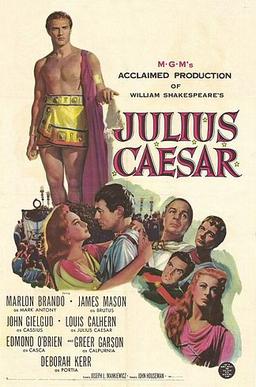
Julius Caesar (1953)

So this William Shakespeare guy....pretty talented, huh? A poet and playwright, he is basically the benchmark for everything in literature. And thanks to my upbringing in English classes through high school and college, I basically hate Shakespeare. I was forced to read his writings and resented basically every minute of it. That only partially explains my hate for 1953's Julius Caesar, but it is certainly part of it.

In ancient Rome, senator Julius Caesar (Louis Calhern) returns to an adoring public, many touting him as the future ruler of the Roman empire. Caesar's ambition is feared throughout the Senate, even leading many of his fellow Senators to plot against him, including the idealistic Brutus (James Mason) and cynical, scorned Cassius (John Gielgud). They worry that his ambition, along with close friend and fellow Senator, Mark Antony (Marlon Brando), will spell Rome's doom. They begin to form a plan, one that could change the country's future for years to come.

Now I'm going to say something early and just be done with it. I don't intend this review to sound like a whiny high school student although no doubt it will to a certain point. I can appreciate Shakespeare as an immense talent, but that doesn't mean I like anything about reading his work. I can appreciate that his talents have influenced basically every form of literature written since. But actually reading it? Some of the most difficult experiences I've ever had with the written word. Long, uninterrupted scenes of dialogue/monologues have a knack for putting me to sleep quickly. But....but.....even knowing this, I sought out this 1953 film, mostly because of the extraordinary talent assembled here. Unfortunately, I disliked it as much as I've always disliked Shakespeare's works whether it be in books and plays or film and television.

Where my objection comes from is Shakespeare's style. In writing, it is extremely difficult for me to get through the dialogue, and seeing it in a film didn't help. Well written it most certainly is, but it is stilted, awkward, forced and for me, difficult to follow. It doesn't seem to make a difference who's reciting the lines because the talent in this cast is truly impressive. And yes, I know these are stage-based stories, but seeing actors -- no matter the talent -- stand and wave and yell and recite several minutes of expressive yet still stilted dialogue doesn't scream out 'ENTERTAINING!' to me. Acting is one thing, and method acting a whole other beast, but I've never understood the appeal of loud, verbose, exaggerated stage acting, and that's what this movie is. It's 120 minutes of very talented actors talking and talking and...well, you get the idea.

With so much talent assembled for this film in the cast and director Joseph Mankiewicz behind the camera, I just assumed my issues would go by the wayside. With three movies to his name (Streetcar, The Men, Viva Zapata), Brando is a bright spot as Mark Anthony. His famous address of the Roman people following Caesar's assassination especially stands out. Then throw in Mason, Calhern, Gielgud, Edmond O'Brien, Greer Garson and Deborah Kerr? How could that not be worthwhile? I chalk it up more to Shakespeare's style than anything, but I just didn't care. I know the story, know where it will end up, and who makes it and who doesn't. Also look for Michael Ansara, Michael Pate, John Doucette, Lawrence Dobkin and Rhys Williams in smaller supporting parts.

I'm ready to take all sorts of heat for my dislike of this movie, but I hated it almost from the start. Besides the stilted, overdone stage acting, it is an incredibly dull story to watch. It was filmed in black and white on a soundstage, the camera and focus on the actors, not the huge scale or lavish sets. Bored to tears. There's just only so many ways to hear a classically trained actor speaking in the most prim and proper English ever written. So go ahead, let me have it if you so choose. I'm admitting I don't like Shakespeare. Karma is going to kick me square in the butt at some point.

Julius Caesar <---TCM trailer/clips (1953): */****

Monday, April 9, 2012

Black Narcissus

For hundreds and thousands of years, missionaries have tried to spread their beliefs and principles to the unexposed, those who are unaware and might or might not be willing to change. Film has explored the life and goals of missionaries countless times -- some better and less pretentious than others, but I've watched one that defies description and any predecessor or anything since, 1947's Black Narcissus.

An order of sisters has received an invitation from an Indian general (Esmond Knight) to come to his region and work at a convent and work with the people. Sister Clodagh (Deborah Kerr), a young nun, has been chosen to lead the new convent and is sent to the isolated mission/convent in the Himalayas with four nuns traveling with her, all of them with special skills designed to make the transition easier. The five nuns arrive to find a world unlike anything they've experienced with Mr. Dean (David Farrar), the only white man around for miles, a sort of unofficial guide for them. Clodagh and the sisters settle in, but nothing seems to work for them. Their intentions are pure, but it seems they are doomed to failure from the start.

This is maybe the most beautifully shot movie in the history of movies. Let's get that out there early and let that sink in. Visually stunning, breathtakingly beautiful and frightening at the same time with the credit going to cinematographer and future director Jack Cardiff. Full of color -- from the whites and blues of the nuns' clothes to the vibrant colors of the Indian villagers -- almost every single shot could be freeze-framed and placed on your wall as a work of art. The mission built into the side of a cliff is almost other-worldly (even if the sets were in a studio with liberal and spot-on uses of matte paintings). The wind never stops blowing and the air is always clear at this mission that seems to float above the world. Call it over-analyzing, but it almost serves like a purgatory of sorts for these nuns where a decision must be made on which direction to take. More on the visuals to come.

What originally caught my eye when I read the description at TCM's website was actually a picture....this ONE. Besides the chill that went up my back when I saw it, I knew this wasn't going to be a typical "clean," white-washed missionary story of the 1940s. A character study of nuns and the Indian villagers, yes, but this movie is not that simply described. This movie has all the tension and scares of a Gothic horror movie. We're talking an incredibly uncomfortable movie to watch. With some major spoilers, check out the pictures at THIS review. I thought the movie was going one way, and then it goes another, turning on a dime. I started to question exactly where it was going, what it was building to and was genuinely surprised where it ended up. The last 20 minutes are a straight horror film from the choir singing (with composer Brian Easdale's score) to Cardiff's unsettling visuals.

The visuals, the uniquely dark storytelling, all of that has helped make Black Narcissus a classic over the 60-plus years. However the acting is just as worthy in bringing up even if it's somewhat overshadowed by the visuals and that sense of impending, building doom. Just 26 years old at the time, Deborah Kerr does an amazing job as Sister Clodagh, a young nun who's joined the order because of an incident from her past. Wearing her immaculate white uniform, her face wrapped up tightly, Kerr looks angelic in the part. She doesn't resent her posting, fully committing herself to making it work, but she immediately sees that basically everything in front of her is working against her. Farrar's Dean is an interesting counter, a somewhat mysterious Englishman who's drifted east to India. Why exactly? We never find out. A tortured soul just the same, he serves as a sounding board for Kerr's Clodagh.

Sister Clodagh's nuns include Sister Philippa (Flora Robson), the oldest of the nuns and one struggling with her reasoning for her faith, Sister Honey (Jenny Laird), the youngest and most naive of the group, Sister Briony (Judith Furse), the strongest physically and the healer, and Sister Ruth (Kathleen Byron), the most fragile one who starts to become unhinged mentally. As a group, they're uniformly solid, but it is Byron (with the creepiest, most unsettling eyes EVER) who steals the show. Star of The Jungle Book, Sabu plays the Young General, the son of the older General, a young man trying to learn as much as he can through the sisters. Eddie Whalely Jr. plays Joseph, the Indian boy working with the sisters as a translator, and May Hallatt as Ayah, the somewhat off live-in caretaker of the cliff-side mission. Also making an appearance without saying a word in a key part is the very white Jean Simmons (with heavy makeup) as Kanchi, the Indian girl with a reputation.

I very much enjoyed this movie, or at least as much as you're supposed to enjoy a creepy, moving and unsettling story of five nuns working a mission in the Himalayas. Maybe 'enjoy' isn't the right word. I think we're supposed to appreciate a movie like this more than anything. I don't know if I got the dark message 'Narcissus' worked toward or if I missed something, but it is a movie unlike any I've seen.

Black Narcissus <---TCM trailer/clips (1947): ****/****

Monday, May 30, 2011

Eye of the Devil

How long does it take for a movie to grab your attention? You always read reports that a movie has about five minutes to bring you in because you've already made your decision whether it is going to be good or bad.  I'm impatient in any number of things, but with movies, I have a tad bit more patience. I've seen some awful flicks saved (partially at least) by great twist or surprise endings. At the other end of the spectrum, 1966's Eye of the Devil grabbed me instantly. I had to know what the odd opening sequence meant.

I'll get into the specifics more later about the pre-credit sequence that opens the movie. As someone who typically steers clear of horror movies, I couldn't pass this one up stumbling across it on TCM's schedule recently.  The cast is mostly what caught my eye because the story description certainly didn't sound too interesting.  This isn't a horror movie of 2011 with shock value and gore, instead building up suspense and tension with its gothic feel. What to make of it? I have no idea. It was weird, but I think...think...I liked it.

A well to-do businessman in Paris, Phillipe de Montfaucon (David Niven) must return home when news of his estate's vineyards dying reaches him. A few days later, his wife, Catherine (Deborah Kerr), joins him at the estate -- called Bellenac -- with their two children. Catherine begins to see strange, unexplainable things one night but can't find anyone to answer her questions. She even sees members of something that looks like a cult gathering in the expansive estate home, but just can't figure it out. Her mother-in-law, Countess Estelle (Flora Robson), seems to know what's going on but won't tell her a thing. She begins to worry for her safety, her children's, and also of her husband. Could he possibly be involved with these strange happenings? More importantly, if he is involved, can Catherine save him?

For starters, let's start at the start...words are fun.  Before a credits sequence or a title cards, we get a lightning quick montage, edited within an inch of its life that immediately sets the tone for the rest of the movie. Now as I look for it, I of course cannot find a clip of this sequence.  It is an odd assortment of quick images -- a dove pierced with an arrow, a woman's eye, a man's head, a train speeding down the tracks, among many others -- that is edited together so quickly it can be hard to make anything out of it. The sequence feels like something A Clockwork Orange would have used 5 years later. Regardless of the background though, it pulls you into the movie. You want to, you need to know what those disparate images mean and how they're related.

Cheap thrills are one thing, and genuine fear and uneasiness are another. Gory, shocking, 'Gotcha!' moments are part of the reason I dislike horror movies so much. There is a subtlety to older horror movies that more recent ones are just missing. Some complaints are that director J. Lee Thompson does go to the old horror cliche book a few too many times, but for the most part the scares are genuine. The off-center camera angles telegraph everything that's going to happen, and the dark, spooky shadows always reveal something hidden away.  But still, the scares are there. 'Devil' is filmed in black and white, and it definitely has a gothic feel, especially in this immense, extravagant, lavish French manor that looks like it's out of the 1700s.  Throw in composer Gary McFarland's eerie, Church choir-like score, and you've got all the makings.

I'll admit it. I'm a sucker for big names when I see a cast listing. Why else would I watch a basically unknown British horror movie from the 1960s?  David Niven and Deborah Kerr in the starring roles sounded perfect for me so surprisingly enough, I thought they were the weakest parts of the cast.  Niven sleepwalks through his role, disappearing for long stretches of the movie. Kerr basically looks nervous the whole movie, screaming occasionally.  The rest of the cast makes up for it. Master of understated creepiness Donald Pleasence plays a creepy priest, Pere Dominic, Robson is the tortured woman who knows the whole truth, and Edward Mulhare is a longtime friend of Kerr's Catherine. The best thing going for 'Devil' is David Hemmings and Sharon Tate as Christian (an albino archer?) and Odile, brother and sister who always know more than they let on.

You know that feeling on Christmas Eve when you see your presents wrapped up nicely under the tree? Now, I loved my presents -- always have -- but the anticipation and mystery is part of the appeal.  More and more, I find that's the case with movies that hold out on you until the finale with a huge, major revelation. The build-up here is all the fun because the reveal disappoints.  Think mix between The Wicker Man and The Omen, but that's all I'll say. The ending never quite explains everything either, hinting at and beating around the bush, but never laying everything out.  I definitely was creeped out by this movie, but the ending left me disappointed unfortunately.

Eye of the Devil <---TCM trailer (1966): ** 1/2 /**** 

Saturday, May 28, 2011

The Journey

One of the 1950's most popular films, 1956's The King and I was loved by audiences, award shows, and critics alike.  Maybe the biggest reason for the movie's popularity -- besides the Rodgers and Hammerstein music and the epic story -- was the pairing of its two stars, Yul Brynner and Deborah Kerr.  I haven't seen the movie in years but still remember their chemistry. It was only a matter of time before they were paired in a movie together again, that coming three years later with 1959's The Journey.

The story is based during the Hungarian Revolution of 1956. My background in said revolution is that there was in fact a revolution in Hungary in 1956.  As much as I like history, you just can't read and learn about everything.  The setting -- while specific -- is applicable to any world conflict. It is based in individuals in a bad situation trying to reach some sort of safety, some feeling of normalcy.  Through these situations, you often bond through your trials. For all its uniqueness concerning a conflict in a far-off part of the world though, 'Journey' isn't always the most exciting movie, resorting to its star power to carry it through the slower portions.

It's 1956 in Budapest, Hungary, and an English woman, Diane Ashmore (Kerr), arrives at the airport trying to get out of the country and back home to England.  She's given some tough news though; the Hungarian people are revolting against their Russian/Soviet rulers, and all traffic in and out of the country has been canceled. However, transportation has been arranged for Diane and 13 other international passengers trying to leave Hungary. They will board a bus and drive the 250 miles to safety at the Austrian border. Before they reach the border though, they're stopped and inspected by the local commander, a Russian major, Surov (Brynner), who won't let them pass until everyone is approved. Diane starts to worry because she knows a secret about a fellow passenger on board, Fleming (Jason Robards), that threatens to get them all shot.

This is an all-around kind of weird movie. It isn't like so many other movies, but not always in a good or bad way. It is just different. Director Anatole Litvak films his movie in Hungary on some of the locations where the actual revolution took place just three years before in 1956. It certainly gives the movie a feeling of realism, of authenticity that couldn't have been duplicated on a Hollywood backlot (even if it does look like a studio at times). Instead, much of the story is set in a small hotel and its surrounding buildings.  There is a washed out look to The Journey that I suppose could have been the TCM print, but I don't know for sure. I can't put my finger on it, but something about the film just didn't click with me.

With two leads like Kerr and Brynner at the forefront of the movie, it's understandable that you want them to carry the movie as much as possible.  Their performances are the least of the movie's problems.  Their chemistry together is hard to disagree with. They're just good together.  Kerr is quiet and composed, eventually pushed to the point of nerves taking over while Brynner is bigger than life, able to dominate the screen just by standing there.  But in developing these characters, the story requires them to fall for each other. The final 20-30 minutes come along, and they're fighting off urges that I just didn't see building up throughout the movie. It's dialogue and more dialogue and more dialogue. The movie is a tad long at 126 minutes, taking quite awhile to get where it's going.

As if Kerr and Brynner weren't enough to satisfy most moviegoers, Jason Robards makes his feature film debut as Fleming, the mysterious passenger on-board who has all the other passengers concerned what he's up to. SPOILERS STOP READING SPOILERS Kerr is trying to sneak him out of the country, past lovers reunited after he escaped from a Russian prison. END OF SPOILERS Robards is one of the more underrated actors from the era, and he shows off the talent we'd all get to see in the coming years. Filling out the international list of passengers is Robert Morley as the scene-stealing, stiff upper lip Englishman, Deverill, E.G. Marshall and Anne Jackson as an American couple traveling with their kids (including a 5-year old Ron Howard), and other characters from Egypt, France, Germany, and in an interesting twist, a Jewish man. There was potential here for more development among these characters, and yes, I know the focus is on the leads. The 14 passengers though screamed out for a mini-series, something that would have given them a chance to shine. Also look for Senta Berger in a bit part as a serving girl at the hotel.

Maybe the biggest problem 'Journey' has going for it is a lack of focus. Brynner's Surov is investigating these international passengers, but nothing ever seems to get done. He spends most of the time riding his prized horse, eating and drinking with the passengers who are scared to death of him, and all the while, Kerr's Diane worries he'll figure out what's going on. By the way, he does....and pretty quickly.  There is no urgency though at all, and the movie's pacing suffers.  The ending makes up for it some in terms of surprise and shock value, a moving finale that definitely caught me off guard. I just wish more of the movie could have been like that.

The Journey <---trailer (1959): ** 1/2 /****

Friday, February 4, 2011

Casino Royale (1966)

After a four-year gap since Pierce Brosnan's final James Bond movie, MI6 agent 007 returned in a big way in 2006 with Daniel Craig taking over the part of the secret agent.  It was a huge success and served as an excellent reboot for the franchise, quickly climbing into my top 5 all-time Bond flicks.  Why did it work? Like most of the best movies from the franchise, it stuck close to the Ian Fleming source novel that had not been made previously...in a serious fashion at least.  That's where 1966's awful Casino Royale jumps in.

By 1966, star Sean Connery had already completed four 007 movies and had turned James Bond into one of the world's biggest stars.  It was so popular that spoofs started popping up like James Coburn as Derek Flint and Dean Martin as Matt Helm among others.  I get it, strike when the iron is hot, but in a saturated market of spy and espionage movies -- serious and spoof -- don't you want to at least turn out a quality product?  With six different directors shooting different portions of the movie, this was like How the West Was Won: 007 Style.  Besides an occasional laugh here and there, the only redeeming quality is an out-of-this world (if wasted) cast, but more on that later.

All over the world, American, British, Russian, and French agents are turning up dead and their agencies don't have the slightest clue or evidence as to who's pulling off the jobs.  The agency heads turn to retired MI6 agent, Sir James Bond (David Niven), to root out the problem. Bond is a legend in the espionage business, but his best days are behind him, and he questions what has happened to the field he worked so well in, carving out a name and reputation for himself.  He concocts a crazy plan to smoke out whoever is behind the murders; using his name, agents all over the world (Peter Sellers, Ursula Andress, Daliah Lavi, Joanna Pettet, Woody Allen, Terence Cooper) will see if working as bait draws the mastermind out of his lair. The plan might be too good though because SMERSH and mastermind Le Chiffre (Orson Welles) send agents to kill the original and still best James Bond around.

Now anyone familiar with Casino Royale -- Fleming's novel or the Craig movie -- knows that the plot described there is nothing like the book or the movie.  Bond's effort to detain Le Chiffre at the baccarat table is handled in a scene that takes about 10 minutes, not an entire movie.  Using other spy spoofs as an example, there is clearly potential here.  A character as ripe for the picking as James Bond is hard to mess up in the humor department, but this movie is a mess.  For all the subtle, perfectly delivered lines that pepper the script, there's huge scenes of excess of physical and slapstick humor that even Mel Brooks must have shaken his head at.  The finale is the worst of all with one of the 14 directors obviously not knowing where to cut things off.

Let's start with the crazy amount of talent involved here behind the camera, including John Huston (also playing M in one scene) and Robert Parrish among four other less notable names.  The writing too includes Sellers, Billy Wilder, and Joseph Heller.  How did this much talent put together such an awful movie? On top of the cast listed above, there's also parts for Deborah Kerr, William Holden, Jean-Paul Belmondo, Peter O'Toole (on-screen for about 6 seconds), Charles Boyer, George Raft, Jacqueline Bisset, and Barbara Bouchet. What's worse is that the cast appears to be having a blast making the picture.  It's just that much worse that what they're working with is beneath all of their talent.  Bit parts and extended cameos for almost all of these names limit actual on-screen time, but just in terms of name power, this movie is impressive.

The only star that I thought was legitimately good was David Niven as retired 007, Sir James Bond, enjoying his retirement in an isolated English country villa only to be thrust back into the world of espionage.  Because it is an older Bond, Niven has some fun with the part, poking fun at Connery's portrayal especially.  He gets some good laughs from his constant curiosity of how all secret agents have become sex fiends, leaving lonely, beautiful women in every city all over the Earth.  He shakes his head at all the changes he sees in the life of a spy only to embrace them once he's back into it.  A professional plain and simple, Niven makes the most of the material, rising above it to deliver a worthwhile performance.

So this movie was bad, downright awful at times, okay? I am scraping the bottom of the barrel here looking for something to write about.  Most of the movie was just so stupid and dumb I can't even complain.  It's so bad it is surreal at times.  So what can I recommend? If nothing else with this overabundance of characters, the script calls for a long list of beautiful actresses who are required to wear slinky outfits and do little else.  Kerr, Lavi, Pettet, Andress, and Bouchet are all half-naked for about 90% of the movie, and that's all I've got.  So stupidly bad, this movie has to be seen to be believed.

Casino Royale <---trailer (1966): */****

Wednesday, March 10, 2010

Quo Vadis

Everyone has their favorite movie stars, but what about stars you dislike?  For me, I've never been able to understand Robert Taylor's appeal.  He is as wooden as can be and never seems to actually act.  His lines whether he's content, pissed or in love always come out the same...monotone in his already deep, flat voice.  Unfortunately for me, Taylor was in many westerns, war and adventure movies that appeal to me.  He isn't always bad -- Bataan is a classic -- but I've rarely come away from one of these movies thinking highly of his performance.

One of his more wooden parts comes in the 1951's Quo Vadis, one of the first Technicolor historical epics that include Ben-Hur, Spartacus, Cleopatra, Fall of the Roman Empire and many more.  This is a BIG movie with a cast of thousands, gigantic sets, and an appropriately large story involving the growth of Christianity in the years following Jesus' death and resurrection.  But with all those positives going for the movie, Taylor is cast as the lead.  I don't believe he was the right actor to carry such a big production.  His stiff performance is the movie's weakest element in an otherwise enjoyable epic.

After a 3-year campaign, Roman legion commander Marcus Vinicius (Taylor) returns home to Rome triumphantly at the head of his army.  Staying at the home of a former general, Marcus is struck by the beauty of the general's adopted daughter, Lygia (Deborah Kerr).  He does everything he can to win her over but ends up driving her further away with his boorish, violent ways.  Somehow, Lygia does fall for Marcus but her Christian beliefs confuse him.  As he tries to win her back, Roman emperor Nero (Peter Ustinov) goes about ruling his empire, always teetering on the brink of insanity.  Looking for inspiration, he orders Rome to be burned down, forcing Marcus to find Lygia and her family before the city is destroyed.

Stories set in ancient times have a romantic feel to them that is nearly impossible to ruin in movie-form.  Almost three-hours long, 'Quo Vadis' was a big-budget success that audiences flocked to.  Made in Italy, it is a beautifully shot movie whether the scenes are on the elaborate sets built for the movie or the quiet scenes set in the Italian countryside.  It's a very professional movie without a ton of heart, but so often these epics were about the spectacle.  No CGI in the 1950s so all those scenes of enormous crowds were actually filmed.  I've said it before, but there's always something appealing about a director actually filming something as opposed to creating it on a computer.

Other than Taylor's struggles in the lead, the cast is top notch if not instantly recognizable.  Kerr as the object of Marcus' affections is very good as Lygia.  Her character is a Christian and basically is given no flaws, making her feelings for Taylor's Marcus all that much harder to comprehend.  He basically forces himself on her, and when that doesn't work buys her.  All the while, he doesn't understand why she won't have him.  Other cast members making a strong impression include Leo Genn as Petronius, Marcus' uncle and one of Nero's closest adviser, Patricia Laffan as Poppea, Nero's slutty wife, and Buddy Baer as Ursus, a giant of a man devoted to keeping Lygia safe from trouble in whatever form it comes.

The romance storyline has its awkward moments but is decent enough when looked at as a whole.  The highlight of the movie though is Peter Ustinov as Emperor Nero, a role which earned him an Oscar nomination for a supporting role (Genn was nominated too but neither won).  Ustinov's Nero is often petty and childlike with a vindictive streak that has no bounds.  He is almost cartoonish in his performance of an emperor who fancies himself a demi-god and a portal through which the Roman gods speak to the people.  His performance is mesmerizing, both funny and frightening all at once, and the main reason to watch this movie.  You almost want to feel bad for him at times because he's so easily manipulated, but this is one crazy dude.

Another interesting sub-plot revolves around the growth of Christianity with the story beginning some 30 years after Jesus' death.  His apostle Peter (Finlay Currie) plays a key part in the story when being a Christian was forbidden and punishable by death.  Keeping their faith under wraps, the Christians meet secretly at night in some of the movie's best sequences.  In the finale Nero realizes his burning of Rome did not go over as planned -- who would have thought that? -- and blames this new fledgling religion.  They are burned alive and eaten by lions in the Colisseum in a remarkable sequence late.  It all makes for an interesting subplot when the love angle gets a little dull.

Not the best of the historical studio epics, but one still worth watching, especially for Peter Ustinov's performance as Nero.  I'd recommend watching this one on the TV, but it is available to watch on Youtube, starting with Part 1 of 22.  Get a comfortable chair before you sit down for three hours at the computer.

Quo Vadis <-----trailer (1951): ** 1/2 /****

Wednesday, March 3, 2010

The Night of the Iguana

Making his directorial debut in 1941, John Huston did the equivalent of sprinting out of the box, making 1941's The Maltese Falcon for his first movie. Huston just kept on going, turning in classic after classic in a career that spanned five decades and almost 50 movies. Of course, they weren't all classics, and the Hollywood veteran did slow down by the late 1950s. His movies always had a hard, realistic edge that never pulled any punches with their storytelling.

One of his lesser known but highly regarded movies among critics, 1964's The Night of the Iguana, was ahead of its time in its ability to tackle some controversial subject matter and deal with it in an honest and forthright fashion. So a couple years before the drug culture and hippies and Woodstock came along -- and all the freeing attitudes movies dealt with in the late 60s and early 70s -- Huston's movie deals with lesbians, statutory rape, threesomes, pot, and a defrocked priest who may or may not have had an inappropriate relationship with a minor, and all of this taking place at a run-down Mexican resort.

Leading a tour bus through Mexico, a former priest, Reverend T. Lawrence Shannon (Richard Burton), doesn't seem to be able to avoid trouble. One of the women on his tour believes he's trying to seduce an underage girl (Sue Lyon) when really the girl, Charlotte, is pursuing Shannon.  Pushed to his limit, Shannon freaks out and drives the bus to an old inn cut into a mountainside overlooking the sea near Puerto Vallarta.  The women running the inn, Maxine (Ava Gardner), is an old friend of his and is only a few weeks removed from her husband's death.  While Shannon deals with the problems among his customers, a woman shows up at the inn, Hannah Jelkes (Deborah Kerr), who with her poet grandfather is traveling around the world with what little money they have.

Watching this over the last couple days, my first reaction was that the proceedings are all very theatrical from the limited sets to the verbose, larger than life characters.  Needless to say, finding out 'Iguana' is based on a play by Tennessee Williams didn't come as much of a surprise.  Huston filmed the movie in Mexico -- one of his favorite locations -- and more specifically Puerto Vallarta, but limits much of the story to this seaside inn.  The story is almost completely self-contained at the inn and limits the number of people/characters around.  It's secluded and because of this, the story keys in exclusively on this variety of people and their issues.  No distractions, no diversions, just some weird folks working things out.

The casting is phenomenal with Huston giving his leads -- Burton, Gardner, and Kerr -- a lot of leeway in how to bring their characters to life.  I would have paid to listen to Burton read a phone book, his voice is perfect for movies.  His Rev. T. Lawrence Shannon is a tough one to read because we don't see the incidents from his past that caused him to be kicked out of the priesthood.  Did he or didn't he do it? Who really knows for sure?  However you decide to interpret the character, Shannon is fascinating as Burton presents him.  This is a good example of a scenery-chewing role with lots of yelling, screaming and theatrics a-plenty.  Kerr is just the opposite -- as she almost always was onscreen.  She's quiet, well-spoken, dignified and a lady, in the process stealing the scenes the duo have together.

One particular scene with Burton and Kerr late in the movie is the high point and really allows you to get to know these characters.  But the real star of the movie is Gardner from character introduction to final scene.  She's often remembered as all beauty and no ability because, let's face it, she's drop dead gorgeous.  But Ava Gardner was a great actress as well and could easily carry a movie if it was required.  She isn't needed to carry 'Iguana' but she does it anyway.  Her Maxine lives her life as she tries to transition with her husband's death, and in the process really doesn't care what people think of her or her actions.  Throw in a group of middle-aged religious women staying at her inn, and we've got ourselves a situation.

It's a good thing these three main performances are so good -- as is the small supporting cast -- because the subject matter could have easily overshadowed the characters.  Of all the things mentioned before, none of them are in your face with an aggressive 'hey, look at what we're talking about style!'  Huston doesn't linger on these moments, instead mentioning them and moving on.  At one point, Burton's Shannon urinates on the luggage of one of the women, but unless you listen closely you'd never know what he did.  He may go for the shock value, but it's over so quick it never gets old, repetitive, or exploitative.  It's still more than a little odd hearing about some of these things -- like lesbians or Ava Gardner having a threesome in the ocean with two young Mexican men -- but Huston handles it in a way that is appropriate for the time and the story.

This was a weird movie all-around that got better as the story developed.  The first hour was a little slow-going for my taste but picks up when Kerr shows up, seemingly out of nowhere, at Gardner's little inn.  The last hour is great with the leads really getting a chance to show off their chops and dive right into the story.  It's a beautiful movie filmed in black and white that if nothing else will surely bring up some interesting conversations.  Very different from most movies made in 1964, and for that reason alone worth checking out.  Available to watch on Youtube, starting with Part 1 of 11.

The Night of the Iguana <----trailer (1964): ***/****

Monday, April 20, 2009

Netflix review #16: Heaven Knows, Mr. Allison

For every movie with a cast of thousands, there's plenty that counter with only one or two leads and a few extras in the background. What's tricky about movies with so small a cast is that success depends almost completely on whether the audience likes those leads. Thanks to Deborah Kerr and Robert Mitchum, John Huston's Heaven Knows, Mr. Allison can be considered quite a success. And yes, I debated doing Borat and putting "Great success" instead.

Somewhere in the Pacific in WWII, an inflatable raft floats up on a beautiful island paradise. A marine wearily steps out and begins to explore the island only to discover the other occupant is a young, pretty Irish nun, Sister Angela (Deborah Kerr). He introduces himself as Corporal Allison (Robert Mitchum), a U.S. Marine who got separated from his recon patrol when Japanese artillery hit the sub they were being dropped from. Teaming up, the unlikely duo look to survive on an island that provides everything they need. Questions come up as to whether they should try to sail to Fiji, but an answer is provided when a Japanese infantry company shows up to set up a weather station? All Allison and Sister Angela can do is hope the Allied advance across the ocean takes them to this island.

What I really enjoyed here was the straight-forward, no frills storyline of two people on an island trying to get by and hopefully be rescued. Sure, other things are thrown in, like the Japanese soldiers arriving, but those scenes provide some of the movie's more tense moments. Very easily, this movie could have been thrown on its side and forgotten since its 1957 release if the two main leads, Kerr and Mitchum, weren't so good in their roles. I give a lot of credit to director John Houston, always able to get a good performance out of his actors, for casting the leads so well.

Riding the huge success of The King and I, Kerr gives a great performance as Sister Angela, a nun whose faith brought her to this island, and it's this faith that keeps her going. She delivers a semi-twist about 2/3 of the way in, but it never feels forced. Angela is innocent and slightly naive, but that doesn't mean her character isn't a strong one. And most importantly, she has a chemistry with Mitchum because if that wasn't there the whole movie goes bottom up. I wrote in the last couple weeks about 'cool' actors, and I forgot to include Mitchum. As a really smooth, laid back presence, Mitchum seems to be taken for granted as an actor sometimes. But here he shows what he can do, delivering one of his better parts as Allison. He grew up on his own and is tougher for it, but he's gentle with Angela and a gentleman all around in trying to help her.

Reading the synopsis of a man and a woman on a deserted island, I couldn't help but think the two would end up together, even if one was a nun, and one as classically pretty as Deborah Kerr. The movie does deal with this as the relationship changes and develops, but it's never awkward. One scene shows how much Allison looks out for Angela following the Japanese arrival. She almost gets sick eating raw fish so he sneaks into the Japanese camp to steal food. He gets in easily enough but has to hide for hours as two Japanese soldiers unknowingly corner him. Allison's just trying to help a friend, even if he has feelings for her, and Sister Angela is horribly worried something has happened to him. A good sum-up of the relationship is that scene, two individuals who become close friends in a dangerous situation.

The Fox War Classic DVD comes in at under $15 over at Amazon. Filming locations in Trinidad and Tobago look amazing in the widescreen presentation on the disc. In the special features department, there's a trailer, four MovieTone clips about WWII in the Pacific that run about 7 minutes, and a handful of trailers for other Fox War Classics. It's a very good movie carried completely by its leads, Kerr and Mitchum. Definitely give this old-fashioned, good storytelling film a try.