The Sons of Katie Elder

The Sons of Katie Elder
"First, we reunite, then find Ma and Pa's killer...then read some reviews."
Showing posts with label spaghetti westerns. Show all posts

Friday, May 1, 2015

Guns for San Sebastian

You know who’s pretty cool? Anthony Quinn. I don’t always think of Mr. Quinn as one of my favorite movie stars, but my goodness, did this man have a hell of a career. Zorba the Greek, The Guns of Navarone, Viva Zapata, Lawrence of Arabia, he did it all. One of my favorites though is a little known, generally forgotten quasi-spaghetti western from 1967,Guns for San Sebastian.

It’s the late 1740s in Mexico, and bandit Leon Alastray (Quinn) is in trouble and on the run. Wounded after the rest of his gang is killed or captured, Leon is saved by a faithful, well-meaning old priest, Father Joseph (Sam Jaffe). When Joseph refuses to turn Leon over, he quietly accepts his punishment to the far-off, possibly abandoned desert town of San Sebastian. Feeling like he owes the old priest, Leon accompanies him far out into the desert to the town and finds…nothing. When their plan goes awry though and the villagers return, it is Leon who must pretend to be a priest and help the village not just recover, but survive. Why? The villagers have come under the “protection” of a half-breed bandit, Teclo (Charles Bronson), who is also working with the warring Yaqui Indians. What is Leon to do?

This quasi-spaghetti western from director Henri Verneuil has virtually no reputation within the genre. Why? Well, it’s a spaghetti western in name only really. It isn’t gunfighter anti-heroes and evil bandits and extreme violence. To call it an epic isn’t fair, but it is an above average, highly entertaining period piece. It is set in Mexico in the 1740s so not your typical background setting, but for me, it worked because ‘Guns’ is trying something different. This is a gem, one of my favorite underrated movies that deserves a far bigger reputation.

For starters, it’s Anthony Quinn. What a great actor, what a great presence. Accused at times of stealing scenes and other times of chewing the scenery, I’ve always thought just the opposite. He just goes with the part. His Leon character is fascinating both within the spaghetti western but also the western genre in general. He’s not a cardboard cutout, an emotionless killer. Leon goes through a change over the course of the movie. We see him grow and develop and fight for what he believes is right. It just so happens that his decision-making now impacts a whole village. I’ll get into this more in a bit, but the obvious comparison for the film and character is The Magnificent Seven.

Quinn’s Leon has been a bad, bad dude with bounties over his head and soldiers always on his trail. Out of desperation and survival, he follows this priest into a desert wasteland. Once he arrives in San Sebastian, Leon starts to make tough choices, not just selfish choices. So where The Magnificent Seven had seven gunfighters, here we have only one, but the premise is the same, bad guys to anti-heroes to gunfighters doing what’s right, not necessarily what’s easy. He also gets to cozy up to one of the women in the village (Anjanette Comer) who knows his secret. It’s just a cool dynamic though, the supposed savior and the village needing some sort of help, familiar but tweaked.

So if we have an interesting flawed main character, we need a worthy opponent, right? Who better than Charles Bronson? In the mid 1960s headed to Europe and became one of the world’s biggest stars, and he’s having some fun here. It isn’t the most well-written, developed villain, but it’s a good part. Who else to look for? Jaffe is excellent in a smaller part and Comer is good too, shoving aside the helpless female role that’s all too familiar in the western. Jorge Martinez de Hoyos too has a fun part as Cayetano, an architect tasked with building a wall-like fort around San Sebastian to hold back an attack. Jaime Fernandez plays Golden Lane, the Yaqui chief, with some familiar faces among the villagers if you’re a fan of ‘Magnificent Seven’ and The Wild Bunch. There’s also small parts for Silvia PinalLeon AskinPedro Armendariz Jr., and Jorge Russek.    

‘Guns’ has a ton going for it beyond the acting. As mentioned, the story is both familiar and unique in how it develops. It was filmed on-location in Mexico with several familiar locations in and around Durango, including El Saltito waterfalls that’s also been seen in Major Dundee, The Train Robbers and Sons of Katie Elders among others. It’s the rare spaghetti western filmed away from Spain and Italy. Also, master of the genre when it comes to soundtracks, composer Ennio Morricone delivers an absolute gem, a beautiful score that isn’t as big and booming as some of his more well-known scores. Listen to an extended sample HERE.  Morricone’s score playing over the final scene is one of my all-time favorites. As always, it’s always a plus when the littler things come through in such strong fashion.

I’ve seen this movie three or four times now, and it gets better each time. Great performances, interesting story, an impressively staged, large-scale action scene, memorable score, and an excellent, appropriate ending. Highly recommended and well worth tracking down.

Guns for San Sebastian (1967): *** ½ /****

Wednesday, December 31, 2014

Take a Hard Ride

Time for a little genre crossover today, one I love, one I'm fascinated by if I don't really like. The love genre? The spaghetti western. The disappointing fascination? Blaxploitation. Both genres were fan friendly flicks that weren't going to rewrite film, but dammit, they were going to be entertaining in a low budget fashion. Today's combo flick? That's 1975's Take a Hard Ride.

Having helped deliver a herd of cattle to market, a cowboy named Pike (Jim Brown) finds himself in a sticky spot. The rancher in charge of the herd dies soon after selling his cattle, begging Pike to return the money to his wife back at their ranch in northern Mexico. It's a hefty sum -- some $86,000 -- but Pike is a man of his word and intends to deliver the money. He begins to ride south toward Mexico, picking up some help in the form of shifty gambler, Tyree (Fred Williamson), and a mute tracker raised by Indians, Kashtok (Jim Kelly). The news of Pike's mission has spread like wildfire though, and anyone who can heft a gun is on their trail, all of them hoping to get their hands on that lucrative pile of money. One seems more dangerous than the others, a renegade bounty hunter named Kiefer (Lee Van Cleef), and he's not going to make this easy for Pike. Can the cowboy keep his word and get to Mexico safely?

What an interesting premise. This 1975 western had American and Italian backing so it's not a straight spaghetti western, but the down and dirty feel is still there. Director Antonio Margheriti shot his movie in the Canary Islands, giving 'Ride' a very distinct, unique look. No familiar locations here from countless other spaghetti westerns! The score leans more toward the American side and feels out of place at times. As a whole, the idea is pretty cool. You don't see a lot of African American actors starring in a western, much less three of them with some solid star power and name recognition. Throw three black actors into a spaghetti western formula and let things fall where they may. Now all that said....the idea is pretty good. What about the execution?

It falls short, but I'm gonna cover some positives first. The biggest positive is pretty easy to spot, and that's the cast, especially the leads. In Brown, Williamson and martial artist turned star Kelly, 'Ride' offers three of the biggest stars of the blaxploitation, three stars who had worked together a year before in 1974's Three the Hard Way. The cowboy, the gambler and the tracker are three archetypal characters in the western genre, and the trio has some fun with the roles. Brown is solid and not flashy, the quiet cowboy who believes in doing the right thing, even if that decision could prove deadly. Williamson gets the showiest part as Tyree, the gambler, a well-dressed, back-stabbing dandy who has no qualms about killing to get his hands on some money. In the coolest part, Kelly is mostly presence, his mute tracker killing quickly, efficiently and in brutal fashion at times.

Some cool characters for sure, and they look to be having a lot of fun throughout. I especially liked the dynamic between Brown's Pike and Williamson's Tyree, the duo reminding me some of Gary Cooper and Burt Lancaster in the very important 1954 western, Vera Cruz. These are two polar opposites, and that idea plays well. Pike wants to return the money no matter what, agreeing to let Tyree to tag along because an extra gun on the trail is never a bad thing. Oh, by the way, Tyree tells Pike he intends to kill him once they reach the end of the trail. Fun, huh? They have an excellent chemistry as two guys who aren't hiding anything. They're just waiting for their showdown somewhere down the trail. Also, that Lee Van Cleef guy is around too. He's awesome as always if underused. His presence is intimidating whether he's on-screen or not, a menacing gunman ready to dispatch whoever stands in his way.

Now, about that whole execution thing. I loved the premise of the movie, combining two hugely popular genres. The execution is a different story. It struggles to find a tone, juggling squib-heavy violence with buddy humor, and the blaxploitation's love of everything....well, how do I say this? Hatred of white people? The supporting characters are pretty cut and dry whether it's evil or stupid or both. Catherine Spaak plays Catherine, a widow on the trail with our heroes, prompting Tyree to say "Two black men, an Indian and a white woman." Laughs ensue! Barry Sullivan plays a law officer who puts away his badge to go after the money while Harry Carey Jr. and Robert Donner play two ignorant, bumbling cowboys doing the same. There's also some Johnny Rebs wanting to continue the Civil War, a greedy Mexican bandit, a cute Mexican boy, and two black guys on the trail who bitch and moan like a married couple. Talk about broad strokes.

With a 103-minute running time, things drifted too much for my liking. We get riding/talking scenes, brief shootout, campfire scene and then repeat. As well, the ending seems like one big old cop-out on numerous levels. Things build and build to a showdown, a proper shootout...and we don't get it. Now it may seem like I'm being overly critical, but I did enjoy this movie, just not as much as I would have liked. Still worth watching though, especially for western and blaxploitation fans alike. Even Dana Andrews makes a quick appearance early on!

Take a Hard Ride (1975): ** 1/2 /****

Friday, May 9, 2014

A Fistful of Dollars

By 1964, the spaghetti western genre -- westerns typically made in Italy and Spain with Italian backing -- was alive and well, but not quite what people think of now. The genre was still in its infancy, light, even family-oriented westerns that were cheap knockoffs of American westerns. That changed in 1964, one movie kicking in the door and changing the genre and westerns as a whole in a huge way. The movie? 1964's A Fistful of Dollars.

In the small, south of the border town of San Miguel, a nameless gunfighter (Clint Eastwood) rides into town and promptly catches the attention of three gunfighters. He callously shoots them down in the street and heads to the saloon. There he meets the saloon owner, Silvanito (Jose Calvo), who fills him in on the town and its background. Things are run by two warring families, the Rojos, three brothers led by the maniacal, Ramon (Gian Maria Volonte), and the Baxters, led by the town sheriff, John (Wolfgang Lukschy). The two families are always going at it, and the mysterious gunfighter sits directly in the middle. Seeing a chance to make some serious money, the gunman pits the two families against each other, his job made that much easier when a troop of Mexican cavalry rides into San Miguel transporting a gold shipment headed for the U.S.

Wow, what a movie from director Sergio Leone as he kicks off his Dollars trilogy. A director with a handful of films to his name -- some credited, some not -- Leone put his name on the map with this western. This is unlike just about any western that came before it. Leave it to an Italian director working in Spain with an international cast and crew to rewrite the most American of genres. Tweaking Akira Kurosaw's Yojimbo, this is dark, dirty, brutally sadistic and cynical from the characters to the story and everything in between. There aren't so much good guys and bad guys, just less bad guys. No one is safe. The violence is aggressive, stylish and in your face. 'Fistful' helped propel the western into a new age, Leone's For a Few Dollars More and The Good, the Bad and the Ugly hitting theaters in the two years following. It all started here, and it starts in a big way.

A recognizable face from TV's Rawhide, Clint Eastwood was far from a star in 1964. He was a definite TV star and had some supporting parts in films, but in 1964, he signed on to star in this Euro-western with a director he knew little about. What a wise decision it was, Eastwood propelling to international stardom thanks in great part to the Leone westerns. This is the definition of a western anti-hero. He isn't typically interested in what's right or living up to his word. He's looking to survive, make some money and move on. He earned the nickname the Man with No Name -- he's called Joe here, Manco and Blondie in the other Dollars movies -- for these movies, a gunfighter and drifter who moves from job to job. For the most part, he's a man of few words, typically letting his six-shooter do his talking. He squints and stares, sometimes revealing that "I'm up to something" smirk.

Much of the character is in the visual. Eastwood's Man with No Name wears a hat pulled down tight on his head, a long poncho over his frame, a calfskin vest and denim shirt, tight blue jeans, and plain boots with his gunbelt worn low on his hip. His face is covered in a short beard, almost a five-o'clock shadow. Talk about doing a 180 from the typical white hat-wearing western hero. That's a big part of the spaghettis appeal, credit going to Leone in general. The west was hot, dirty and sweaty, and it reflects in the look of the movie. The Almeria locations, the wardrobes, the town sets, all these little things add up to the success of the movie. Oh, and there's that composer, Ennio Morricone, turning in a memorable score that he would top with the next two movies. A good score, but he would set the bar high with each passing movie. Listen to an extended sample HERE. It's all those little things that add up from the look to the style to soundtrack to the stylish opening credits, and they all add up here nicely.

Working again with Leone a year later as the villain in For a Few Dollars More, Volonte became one of the all-time great western villains as the psychotic, pot-smoking Indio. It took that crazy performance to keep this performance in the background. Volonte delivers a gem of a part as Ramon Rojo, the fiery leader of the Rojo family. He's a brutal, calculating killer who's a dead-shot with a rifle. In Eastwood's Joe, he sees an expert gunman who can cause problems. Snake-like, sinister and creepy, a great lead performance. His brothers include Sieghardt Rupp and Antonio Prieto Puerto, his gang including spaghetti regulars Benito Stefanelli, Aldo Sambrell and Mario Brega. Along with Lukschy as the Baxter patriarch, look for Margarita Lozano as his wife and Bruno Carotenuto as their oldest son, Antonio.

In a lot of ways, 'Fistful' feels like a dry run for what's to come. The cynicism, the style, the characters, the shootouts, Leone would improve on it all over the next two movies. The gunfights are quick and harsh, and the finale as Joe stands down Ramon, his brothers and their gang shows that style that would become iconic in 'FAFDM' and 'GBU.' The close-ups, sometimes extreme close-ups of faces and eyes, the violent fanning of the gun for rapid fire effect. It's all there. Is it a great movie? No, but it's really good. A modern comparison is easy, Christopher Nolan's Batman trilogy. Batman Begins is a really good movie, but the next two movies are simply better. That said, the first one had to lay out the groundwork for what was to come. An excellent movie, a huge turning point for where westerns would go in the mid to late 1960s.

A Fistful of Dollars (1964): ***/****

Wednesday, April 16, 2014

Minnesota Clay

For right or wrong, movie fans think Sergio Leone created the spaghetti western genre. They would be wrong. With his Dollars trilogy, especially Fistful of Dollars, he didn't create the genre but instead put it squarely on the map, put it in the spotlight. Spaghetti westerns had been around for several years but in an earlier, nicer form. Leone would flip that formula. One pre-Leone spaghetti is pretty decent, a mix of an American and Italian western, 1964's Minnesota Clay.

Wasting away for years at a labor camp in the desert, Minnesota Clay (Cameron Mitchell) has had enough, vowing to prove his innocence. Years before, Clay was sent to prison in a frame-up job, found guilty for gunning down two men. In reality, it was self-defense, but a bribed court didn't see it that way.  He manages to escape, heading for home but in his hometown of Mesa Encantada, Clay finds the town being run by two rival gangs, one a gang of Mexican bandits led by General Ortiz (Fernando Sancho), the other run by a man called Fox (Georges Riviere), an old friend originally hired to protect the town. Looking to clear his name, Clay finds himself pitted against both gangs, working to save his own skin before they turn on him. His reputation as one of the fastest guns around is about to be tested in a big way.

Part of the 50 Spaghetti Western collection I bought several years ago, I was pleasantly surprised by this one. I knew this next tidbit but didn't remember it going in, but 'Minnesota' is from director Sergio Corbucci, later of Django, The Great Silence, The Mercenary and Companeros fame, among others. Corbucci's big hit, Django, would hit theaters internationally two years later, but here in 1964 with the genre still in its infancy, Corbucci shows his potential with a middling movie. It still has touches of American westerns (forced love interest, forced comedic moments), but there's also some clear, early examples of where the genre is/was heading. There's some familiar locations, decent if not memorable music from Piero Piccioni (he did much better) and a story eerily similar to Fistful of Dollars which was based off Akira Kurosawa's Yojimbo. Not great, but better in general than some early spaghetti entries.

Over the last year, I've been watching The High Chaparral, a TV western that aired for four seasons and is now on syndication, letting me catch up two episodes at a time. One of the stars? Cameron Mitchell who I like a lot as Buck Cannon, a loving life cowboy. I've seen plenty of movies with him, but nothing quite like this. A recognizable face in American westerns, it's cool to see him head to Italy and star in this early spaghetti. It isn't a flashy part but a good one just the same. Gravelly-voiced, steely-eyed and looking for redemption, Mitchell's Minnesota Clay is a good example of where the spaghetti western anti-hero would go in the coming years. Some time is wasted with his daughter (Diana Martin) who doesn't know her father and her bumbling suitor (Alberto Cevenini), not enough focus on his possibly doomed attempt to clear his name. Not the biggest name to lead the way in a western but Mitchell more than holds his own.

The supporting cast is a good example of how the spaghetti western genre helped change the western in general. We've got some very good characters and very evil characters with little in between. Riviere is the slimy, smooth Fox, a manipulative businessman with a gang of killers to back him up, Gino Pernice as his main enforcer, Scratchy (quite an imposing name, huh?). Sancho does what he did best, the crazy, overacting, cliched, stereotypical Mexican bandit right down to the crossed bandoliers, the greasy mustache, the maniacal laughing, all a lot of fun. Ethel Rojo gets to femme fatale it up as Estella, a saloon girl who attaches herself to anyone who can help her out. Rounding out 'the good' department, Antonio Casas plays Jonathan Mulligan, Clay's old friend who took his daughter in as his own.

Maybe the biggest thing that audiences ate up with spaghetti westerns was the brutality, just the out and out violent, vicious qualities. No one was safe. NO ONE. Everyone was a possible target. Corbucci especially took those qualities to heart in his movies (Django, Silence, The Hellbenders), and this 1964 western is a good preview. Corbucci loved torturing his anti-heroes, gunslingers who were crippled, maimed, wounded and handicapped, forced to overcome these things to save the day in the end...and sometimes fail. There isn't a ton of gunplay here, most of it saved for two shootouts late. The finale especially is pretty cool, a partially blinded Clay forced to take on a small gang of gunmen. The American and Italian versions had different endings, and for a change, the American ending was better.

A solid spaghetti western all-around.

Minnesota Clay (1964): ** 1/2 /****

Monday, September 23, 2013

Sabata

Mostly a supporting player in countless film and TV westerns, Lee Van Cleef had a solid if unspectacular career as an on-screen tough guy through the 1950s and early 1960s. He was given rebirth though with the ever-increasing popularity of the spaghetti western genre, especially working with Italian director Sergio Leone in For a Few Dollars More and The Good, the Bad and the Ugly. It was a rejuvenation of sorts with a long line of some classic and near-classic spagettis to the point he was given his own genre iconic character, 1969's Sabata.

A $100,000 Army payroll has been robbed from the bank in Daugherty City, but in the getaway outside of town, a mysterious gunman, Sabata (Van Cleef), guns down seven of the bandits, returning the money to the town and earning himself a $5,000 reward. There's a problem though. Three of the town's most prominent citizens, including local ranch and land owner, Stengel (Franco Ressel), was behind the robbery and are now worried if they can be implicated for the job. Sabata is able to put the pieces together of how the robbery is pulled off and quickly figures out who was behind it, seeing a chance for a huge payday. Stengel and his cohorts are less than convinced paying him off will accomplish anything, sending a litany of hired guns and killers after Sabata. With an unlikely duo backing him, Sabata readies for each and every attack, worrying all the time about a similarly talented hired gun, Banjo (William Berger), who hasn't made his allegiance known just yet.  

This would be the first of three Sabata movies, followed by Adios, Sabata and The Return of Sabata and both released in 1971, all of them directed by Gianfranco Parolini. Where the Sergio Leone westerns are classics above the genre and others are message-oriented with an action shell, the Sabata movies are about as good as they get in terms of pure entertainment. They even border on campy at times. We've got great characters -- good and bad -- with a fun story, a non-stop line of quickly-paced and choreographed gunfights and enough cool guns, gadgets and contraptions to keep everyone interested. It's not so much a story as a series of showdowns and gunfights followed by some negotiations that never amount to much and another series of showdowns and gunfights. If it sounds simple, it is, and it's a lot of fun for all 111 minutes.

Right up there on par with Colonel Douglas Mortimer as his coolest character, Van Cleef nails the part as the mysterious gunman, Sabata. It starts with the style, the gunman in black, his flat-brimmed hat, the impeccable suit, the flowing coat. It continues with his weaponry, Sabata a deadshot with just about anything that shoots. He doesn't wear a gunbelt, favoring an odd four-barrelled derringer and a rifle with an extended barrel. He's ready for anything thrown at him, almost like an other-worldly specter hovering over the town. As far as cool factor goes, Van Cleef has it in spades. It's that ever-present smirk, that quick mocking laugh. He speaks almost solely in one-liners, but it works without being too goofy. Van Cleef found a home in the genre and by 1969 he was a star (the Leone flicks, Day of Anger, Death Rides a Horse, The Big Gundown), but this is one of my favorites for him, and he's cooler than ever.

That's part of the beauty of the weirdness and eccentricity of the spaghetti westerns. We get these bizarre quirky characters that are so goofy it works. Start with Berger's Banjo, a gunman who's seemingly worked with Sabata in the past (in some capacity) and always totes a banjo...with a surprise inside. His long red hair hangs to his shoulder, he wears bells on his pants and around his neck, and he's always ready with a one-liner of his own. His scenes with Van Cleef are pretty perfect, two badass gunfighters going toe to toe. Sabata's crew are gems themselves including Carrincha (Ignazio Spalla), a drunken, knife-throwing Mexican veteran of the Civil War and Alley Cat (Aldo Canti), an athletic, acrobatic Indian. It's the weirdest crew of western characters, but it just works.

Also look for Ressel as the manipulatively evil and combover wearing Stenger, wielding a knife-shooting cane, with Antonio Gradoli and Gianni Rizzo as Ferguson and Judge O'Hara, his two partners in crime. Spaghetti western babe Linda Veras plays Jane, Banjo's dancehall girl with familiar faces Spartaco Conversi, Marco Zuanelli and Claudio Undari as Oswald, a Stengel henchman, rounding out the cast.  

With a character that's seemingly indestructible at the forefront, you'd think it might not be that interesting a flick to watch. You'd be wrong. It becomes a test of how he'll defeat his enemies, not a test of if. As my buddy Steve said as we watched Sabata at the Music Box Theatre, Sabata becomes the MacGyver of westerns. He shoots with a variety of trick shots, well-placed shots, and gimmicks galore. The shootouts are fun throughout, with the finale including Sabata, Carrincha and Alley Cat attacking Stengel's heavily fortified ranch with gunfire, gatling guns, dynamite, acrobatics and explosions galore. I loved the ending too, holding back on the meanness or cynical qualities of the other darker westerns, but still has some great twists.

Also worth mentioning is the score from Marcello Giombini. The main theme especially is a gem -- listen HERE -- but it works well throughout. Listen to more of the score HERE with some clips in the video. It incorporates everything from Banjo playing his banjo to some lighter touches, like recurring sound effects leading up to gunfights and even some uses of church organ. It all combines to give the movie that lighter touch, that fun touch. That's the movie. It's got can't miss gunmen, a banjo-wielding gunman, an acrobatic Indian who bounces through the movie and never slows down. A real gem of the spaghetti western genre.

Sabata (1969): *** 1/2 /****
Rewrite of October 2009 review

Wednesday, September 4, 2013

The Mercenary

If Sergio Leone is the Founding Father of the spaghetti western, Sergio Corbucci has to be the really cool uncle in the family. He directed some of the coolest and most entertaining westerns to come out of the genre, everything from Django to The Great Silence, Hellbenders to Navajo Joe. Thanks to the Music Box Theatre on the northside of Chicago showcasing spaghetti westerns all summer, I was able to catch up with 1968's The Mercenary.

It's the 1910s and the Mexican Revolution is raging all over the country. Among those fighting is a peon turned bandit, Paco (Tony Musante), who dreams of fighting back against authority, doing something his father was never able to do. Leading a bloody uprising at the silver mine he works at, Paco gets his chance, earning himself a small group of followers. They soon meet Kowalski (Franco Nero), a Polish gun-for-hire who saves himself from a nasty death by agreeing to work with Paco and his men...for a price. Kowalski gives them weapons, ammunition and equipment, more importantly leading them with tactics and strategy. From town to town they attack the government troops, Paco gaining national notoriety while Kowalski earns more and more money. Their fame and notoriety has come at a price with the Mexican army hunting them down, including a dandy of a hired gun, Curly (Jack Palance). All their paths seemed destined to cross.

Over a span of just five years (1966-1970), Corbucci directed six different spaghetti westerns that are considered must-see flicks in the genre, and this is certainly one of them. Where Leone has a reputation of a master filmmaker, Corbucci doesn't have the same pull. His efforts -- while highly entertaining, sometimes highly controversial/weird -- are more straightforward. The movies have more of a rogue, renegade quality that at times feels like its a blood and guts amateur quality. The camera is off-center, cuts and edits are rough to say the least. The counter is that they're usually a hell of a lot of fun. Some like Django are shocking in their violence, others like The Great Silence are shocking but in terms of an almost romantically doomed storyline. Somewhere in between? The Mercenary, just an entertaining flick all around.

'Mercenary' comes from a subgenre dubbed 'the Zapata western' that dealt with the Mexican Revolution, usually focusing on political issues in one way or another. In that sense, it deals with a lot of familiar characters and themes. Nero's Kowalski is the almost necessary outsider, the gunrunner, the mercenary, the hired gun, any variation of American and/or foreign adventurers/profiteers who find themselves in Mexico with a chance to make money. Musante's Paco is the illiterate peon who wants more, who doesn't want to be held down. If there's some fame and riches in the process for him, so be it. Then there's Palance's Curly, the sadistically unique villain that every good western needs. The politics are there but not too heavy-handed, Kowalski and Paco talking about what they hope to achieve, what they can achieve, about what the people should get/want and what the government actually provides.

So, yes, there is politics, but the focus here is far more on the really cool characters and the really cool action. The similarities are obvious in the casting to Leone's Good, Bad and Ugly, assembling a trio of antiheroes -- one worse than the others -- and it works here perfectly too. Nero as Kowalski is a movie-stealer, his Polish mercenary who's out for money, riches and adventure and willing to sell his services to the highest bidder. It's the visual too, his long duster, his tight-fitting vest and tailored shirts, his flat brim hat, his Fu Manchu mustache and long sideburns, even a little guyliner for good measure. Kowalski is smooth, smoother and smoothest, letting absolutely nothing rattle him. It's that confidence that oozes out in the roll, the little touches Nero brings to the part, like striking matches on anything and everything; a woman's breast, a dead man's boot as he hangs from a noose, a rival's gunbelt among others. It is a great leading part, and another great part from the always criminally cool Franco Nero.

Two years later, Corbucci would basically remake this movie with 1970's Companeros. Nero and Palance would return in similar roles with Tomas Milian replacing Musante. While Musante has a good chemistry with Nero and he's very watchable, it just isn't a great part. He gets lost in the shuffle at times, his idealistically fun yet clueless revolutionary not quite living up to expectations. Musante also gets the love interest, Giovanni Ralli as Columba, the Mexican woman caught up in his revolutionary band. And then there's Palance as Curly. Spaghetti westerns had gay characters all over the place, but it's a scream to watch at times. Curly is the definition of a gay caballero, his immaculately coiffed hair, flowers in his jacket lapels, his almost-dainty mannerisms, and adding a nice touch just because, crossing himself over his victims and as he passes crucifixes and churches. An underused part, but a great villain just the same.

Also look for familiar spaghetti western faces Lorenzo Robledo, Raf Baldassarre and plenty of others rounding out the supporting cast. The focus is most definitely on Nero, Musante, Palance and Ralli as the story develops. Having worked with Corbucci in 1966's Django, Eduardo Fajardo returns here as Col. Garcia, the Mexican officer at the head of the regular army column always in pursuit of Kowalski, Paco and his band. And because it'd be criminal to not mention him, Ennio Morricone (working with Bruno Nicolai) turns in another memorable score, this one featuring three main themes, all of them gems. Give it a listen HERE.

Onto the action! Onto the gunfights! There are plenty here, the episodic story of Kowalski and Paco working together well to provide plenty of shootouts, both on a small scale and the large. When it is on-screen, the action is big and chaotic, explosions and shootouts, featuring machine guns, cannons and even an airplane attack late. Corbucci adds a nice touch, hinting at a coming attack at one point, but only lets us hear about its bloody details later. The best though is in the Leone mold, a shootout in an empty bull ring, Kowalski serving as the ringmaster. The buildup is great, the payoff even better. Now the fact that the movie goes on for another 15 unnecessary minutes is an issue, but a minor complaint. A spaghetti western with a great cast and fun action, just a lot of fun to watch.

The Mercenary (1968): ***/**** 

Tuesday, September 3, 2013

Four of the Apocalypse

Spaghetti westerns are inherently dark and twisted, a view of the American west that is based in some sort of historical reality but done up with a heavy dose of steroids. Some obviously are tougher to handle than others, my toughest to get through being 1967's Django Kill! Well, I've got a new spaghetti western that I had trouble getting through. Uncomfortable and dull to boot, it's 1975's Four of the Apocalypse.

Thrown into jail in the western town of Salt Flats, gambler Stubby Preston (Fabio Testi) finds himself sharing the jail with three other people; Bunny (Lynne Frederick), a pregnant prostitute, Clem (Michael J. Pollard), a dimwitted drunk, and Bud (Harry Baird), a drunk who sees ghosts all around him. That night, Salt Flats comes under attack by a gang of bandits, much of the townspeople killed in the attack. The quartet is untouched, leaving them on their own with no guns and little supplies to get to the nearest town across the desert. Stubby and his motley trail mates head out into the desert, meeting an assortment of people along the way. One of them is a bandit named Chaco (Tomas Milian) who at first seems helpful enough but quickly shows his true colors. Now they must band together more than ever if they hope to survive both the desert and Chaco's sadistic tendencies.

A writer and director with a ton of scripts and feature films to his name, 'Apocalypse' director Lucio Fulci is known above all else as the king of gore in the 1970s and 1980s. His love of gore obviously found a home in the Italian horror genre, but he departed long enough early in his career for this spaghetti western. In the years since its release, that's what 'Apocalypse' is known for more than ever...the violence. The action is kept to a minimum, but the early attack on Salt Flats is horrifically bloody, huge bright red blood squibs seemingly throwing up out of people. One scene has Chaco carving up a living man's stomach, probably the most uncomfortable scene in the entire movie. There's an edge of the uncomfortable throughout the movie. It isn't always the violence that startles us, but the build-up instead, the personal nature of it. There's also some cannibalism, rape, massacres, and crippling knee shots for those tallying at home.

The unfortunate part is that the violence is used to shock us, but to what end? What is Fulci trying to say here? What's his message? I think at some point he set out to make an allegory, a metaphor about the world in its entirety. We get four people with some huge flaws -- gambling, prostitution, alcoholics, insane -- and they are thrust into this apocalyptic, end of the world type situation. It's a world where anything goes and seemingly no law exists. It sounds good, huh? I thought so, but the execution isn't there. At one scene, it is the darkest, most disturbing movie you've ever seen, and the next, a town of all men up in the snow-capped mountains are celebrating the birth of a baby boy. It just doesn't fit together. A message needed to be picked and stuck to it. Instead, I feel like Fulci is trying to deliver some profound message that never quite comes to fruition.

Not helping the cause is a script that doesn't make any of the characters that interesting and/or sympathetic. Testi is far from your prototypical spaghetti western hero, and that's a cool change of pace. On the other hand, he's a helpless, whiny doofus who can't see trouble until it hits him in the face. Frederick is required to look worried, Pollard is Pollard, goofy and aloof with that constant confusing grin on his face, and Baird hams it up, describing all the ghosts and dead people he sees. None are that interesting to watch, making their plight in the desert uninteresting and taking away any emotional investment we have away in rooting for them to make it. Spaghetti regular Bruno Corazzari is solid as Lemmy, a drunken doctor up in the mountains who helps care for Bunny while Adolfo Lastretti has a fun if underused part as a gun-toting preacher. Also look quickly for Donald O'Brien as the sheriff of Salt Flats.   

The best thing going for 'Apocalypse' is Milian as Chaco, for good and bad. This is a villain so sadistic, so pure evil that it becomes almost unbearable to watch these scenes. He baits the desert travelers and then turns on them, feeding them some sort of hallucinogen and then proceeds to torture them in various ways, always with a smile on his face. His look/appearance is a big part of the character, long, flowing hair, a bandana around his head, long, colorful robes, maybe a little mascara under there, and what appears to be crucifixes carved under his eyes. In a would-be allegory about life, is Chaco's evil supposed to be the Devil? Is he just the Devil, straight up? That's up to you to decide, but his scenes are the most interesting thing in this story, even as uncomfortable as they are to watch.

Intentions of a profound story that doesn't amount to anything aside, I think my biggest issue here is a cardinal sin in filmmaking. This is an incredibly dull, downright boring film. It has no real redeeming qualities other than Milian's performance. What is it trying to say? Is it trying to say anything? In between bits of shocking violence, we get long stretches of Stubby and his fellow travelers walking across deserts, through the hills and all to a ridiculously awful folk-like soundtrack from Italian songwriters. It is out of place and just too folksy for its own good. I found myself fast-forwarding a lot late in the film, and even Stubby looking for some vengeance in the last act could save this bomb. Very disappointing negative review.

Four of the Apocalypse (1975): */****

Tuesday, June 11, 2013

The Relentless Four

First airing in January 1966 and running for three seasons, TV's Batman became one of the all-time great campy shows to ever grace the screen. It made Batman himself, Adam West, a star, an unlikely superhero with his ridiculously deadpan delivery. Before his starring role though, he was like a lot of actors, taking supporting parts in both film and television. But did you know Batman was actually in a spaghetti western? The answer to that trivia question is 1965's The Relentless Four.

A Texas Ranger working in Arizona, Sam Garrett (West) tries to rescue a pardoned criminal but fails. Instead, four bounty hunters gun the man down before Garrett can save him. The Ranger however can still prevent them from earning their bounty, costing them some $500. Garrett thinks nothing of it as he just does his job, but the bounty hunters, led by Lobo (Claudio Undari), aren't so forgiving. The quartet sets him up as the murderer of a very rich, very successful local rancher, and they've got witnesses to boot. With everyone against him now and a date with the hangman's noose drawing ever closer, Garrett must not find a way to prove his innocence and catch the real killers at the same time.

From director Primo Zeglio, 'Four' is an average example of what an early spaghetti western was. Just a year removed from Sergio Leone's classic A Fistful of Dollars (which helped jump start the whole sub-genre), spaghettis were still in their infancy. They weren't as nasty as some later entries, still reflecting the cleanness of American westerns with a bit of that throwback feel. In other words, they're neither truly Italian or American, instead some messy ground in between. 'Four' uses some of the same locations 'Fistful' used -- and to great benefit -- while also exploring some of the Almerian desert that isn't so familiar. The score from Marcello Giombini is a step above the average, including a really bad, really catchy theme song, 'Ranger,' sung by Ettore Lovecchio.

So Batman plays a spaghetti western hero? If that's not the start to a winning formula, I don't know what it is. Unfortunately, West and his instantly recognizable monotone voice have been dubbed so we don't get the pleasure of actually hearing him speak. He's a solid lead but nothing special, sticking closer to the American western hero than the spaghetti anti-hero. There's also the issue of his action scenes. Every time he punches someone -- and he does that a lot -- I kept waiting to see 'BAM!' or 'ZOW!' appear on the screen in the true Batman vein. Yes, I realize the show hadn't been created yet. I'm trying to be funny. The fight scenes are pretty bad by the way, hokey and just not authentic-looking in the least.

Beyond West as Ranger Sam Garrett, 'Four' has no star power, not even a little. I recognized a few faces from other spaghetti westerns, some other Euro flicks, but none of them can be considered huge stars. Undari is a decent counter to West's Garrett but as far as worthy villains go, he's standard vanilla. His bounty hunter counterparts include Renato Rossini, Jose Jaspe and Raf Baldassarre. Roberto Camardiel is memorable as Anders, the rancher who becomes a pawn, Paola Barbara as his blood-seeking wife with Dina Loy as his less bloodthirsty daughter. Luis Induni plays the Sheriff, caught in the middle between his duty and his friendship with Sam while John Bartha plays John, Sam's friend trying to shield him from being gunned down.

For about 30 minutes here, I enjoyed 'Four.' It was nothing special, but it was fun and a good-looking spaghetti western at that. Somewhere along the road, it loses its footing. It becomes downright dumb, even repetitive in a 90-minute movie. At one point, West's Sam could basically end it all, righting everything that's happened to him, but he throws his guns away and runs.......runs.....from his wounded opponent. The finale features a twist so epically stupid it made me laugh. Too bad because the potential was there for an early forerunner of the darkness of the spaghetti westerns. But no, it's dumb, and making it worse, a final wrap-up scene expands on it, actually explaining the badness. Probably worthwhile only for fans of either spaghetti westerns, Batman's Adam West, or those.....nah, that's it. Just those two.

The Relentless Four (1965): **/****  

Thursday, May 30, 2013

My Name is Nobody

The truth of the wild west was that it was a particularly nasty place. Of all the sheriffs, marshals, cowboys, bandits, gunfighters and hired guns that gained infamy -- good or bad -- in the years following the Civil War, I feel safe saying very few got to choose their ending. Many died bloody in horrifically violent fashion. It's a simple theme of countless westerns; choosing how you go out, how you die when your time is up. Among other things, it's a theme that makes up the best parts of 1973's My Name is Nobody.

A famous gunfighter who's gained notoriety wherever he goes, Jack Beauregard (Henry Fonda) has decided to leave his infamous reputation behind him. It's 1899, and the west that he knew is becoming a thing of the past. His plan is simple; buy a ticket on a ship in New Orleans and sail away to Europe where no one knows him or his own past. That's his plan at least. On the trail, he keeps meeting a younger gunfighter known simply as Nobody (Terence Hill) who has his own plans for Beauregard. He's followed Beauregard's busy and checkered past and finding out that he intends to retire, wants him to do otherwise in glorious, bloody fashion. Nobody wants Jack to face off against the infamous Wild Bunch, a gang of 150 killers and gunmen, stamping his name in the history books.

From director Tonino Valerii, 'Nobody' is one weird revisionist-comedy-spaghetti western. It is based on a story idea from spaghetti western directing legend Sergio Leone, and there are rumors/reports that he even directed some scenes here. It is both equal parts goofy, slapstick comedy and some really poignant scenes about the closing days of the wild west. Often times, it plays almost like a tribute to the western genre, both American and spaghetti westerns. On the other hand, it creates its own identity while still paying tribute. Composer Ennio Morricone's score borrows liberally from his previous scores -- most notably Fonda's Frank Theme in Once Upon a Time in the West -- and even uses samples of Wagner's Valkyrie score (listen HERE) for the Wild Bunch theme. Give the main theme a try HERE, a little lighter in theme and tone. The locations, the music, the obvious love of the genre, it's all there.

Using a familiar western pairing of the experienced, veteran gunfighter and the young up-start looking to make a name for himself, 'Nobody' again takes something familiar and makes it different while still working. Fonda is the veteran gunfighter, his Jack Beauregard having simply outlived the era that made him a known name. He just wants to retire, leave the name behind, and more importantly the target painted squarely on his back. Hill's mysterious Nobody isn't going to allow it, wanting his hero to go out in a blaze of glory. He may not want to allow it, but he never forces Jack to do anything, just keeps on talking and talking, trying to convince him to follow the path he should take. They have a great dynamic; Fonda amused at first by Nobody, Hill with an ever-present smile on his face. Nothing is ever spelled out, but there's almost a protecting angel aura hanging over him. However it's interpreted, it's two good parts.

Either Fonda or Hill is in almost every scene, but 'Nobody' has an interesting, even surprising supporting cast. Jean Martin plays Sullivan, a mine owner in business with the Wild Bunch to distribute his stolen gold (an odd, unnecessary storyline). Familiar American faces R.G. Armstrong, Geoffrey Lewis, Steve Kanaly and Leo Gordon make quick appearances as various gunfighters gunning with and gunning for Jack. Among several familiar spaghetti western faces look for Mario Brega and Benito Stefanelli among others.

The biggest thing preventing this tribute western is a self-indulgent streak right up its back. I like Hill a lot as an actor, but I've never been a huge fan of his overly comedic parts. His Trinity westerns are infamous for a slapstick comedy that typically divides fans into the love/hate department. The first 80 minutes here give Hill plenty of chances -- far too many -- to show off that physical ability. One scene has Nobody in a bar seeing if he can chug booze/beer, throw the glass over his shoulder and shoot it before it hits the ground. Watch it HERE. While interesting in itself, it just goes on too long. Then there's the sped-up fight scenes, Hill slapping opponents over and over again before they can draw a gun on him. These are all things that could be funny/worthwhile in small doses, but it just goes on too long here.

The saving grace here is the final 30 minutes, a pretty perfect finale that helps the movie end on quite the high note. Nobody finally gets Jack to believe in his Wild Bunch shootout, an artsy, well-done sequence that pits Jack against the small army of gunmen on an open prairie. The follow-up is even better and offers a solid twist as Jack and Nobody end up in New Orleans. No spoilers here, but it works well. The highlight though is Jack's letter to Nobody about the changing times, what to look out for, and how the world and wild west has changed. It's a simple, eloquent ending that manages to wrap up on quite the freeze frame. The movie in its entirety is a mixed bag, but I loved it when it works.

My Name is Nobody (1973): ***/****  

Monday, May 20, 2013

A Reason to Live, A Reason to Die

I seem to have checkered pasts when it comes to tracking down hard-to-find movies that I really want to see. On first effort, something goes wrong; cable goes out, recording the wrong film/time, ninjas....that sort of thing. I actually saw this 1972 spaghetti western two years ago via Netflix streaming, but it was the heavily edited 92-minute version. It aired recently on MGM HD and was listed at the much longer, less-edited 111 minute version. Well, point to you MGM, you fooled me. It was the 92-minute version, but here's the review just the same, 1972's A Reason to Live, A Reason to Die.

It's early in the Civil War and as the fighting picks up in the Southwest, Colonel Pembroke (James Coburn), a disgraced Union officer, is looking for vengeance. He has been labeled a coward and a traitor for surrendering Fort Holman, a key position in the territory, to the Confederates without a shot fired. Now, he's got a plan to exact his revenge on the man who took the fort from him, a Confederate major named Ward (Telly Savalas). A frontal assault on the mountaintop fortress would be suicide so he intends to take the fort back on a nearly suicidal commando mission. Commanders won't grant him any troops so instead he ends up with a small squad of convicts, seven men he saves from the gallows, including a man from his past, Eli (Bud Spencer). His odds seem slim as his convicts squad seems more interested in killing him than completing the mission, but heavily guarded and fortified Fort Holman awaits.

It's pretty obvious watching the heavily-edited 92-minute version of this spaghetti western from director Tonino Valerii that some important and major portions of the story were edited. Much of the 20-to-25 minutes that were cut (lengths vary depending on sources) were from an opening prologue that establish how Pembroke and Eli meet in the war-torn Southwest. Instead, we get a dropped-in opening that actually gives away much of the ending. Ta-da, then we're back to the beginning -- sort of -- and away we go with the mission. At different times, the story does feel disjointed, out of sorts, a little rushed and at ends. Can I think of anymore cliches? Nah, that's good for now. The longer version was released on DVD via Wild East, but that DVD is currently worth $190 at Amazon so I don't see a viewing happening any time soon so for now, the heavily-edited version it is!

Now take the rest of what I'm about to write with a grain of salt. I love spaghetti westerns, and I love men-on-a-mission movies. So with that said, is this movie especially good? Nope, but I still liked it a lot. Obviously with the Civil War setting, this isn't your typical gunfighters and bandits spaghetti western. The Civil War background certainly adds a nice touch to a familiar genre. 'Reason' is also aided by some familiar locations from movies like Once Upon a Time in the West, The Deserter and others. The best use though is the fortress from El Condor, here as Confederate garrison Fort Holman. It appears gigantic and imposing, a fortress that's impossible to take down. It's a good-looking western, and the score from Riz Ortolani is a little schizophrenic but pretty cool. Give it a sample HERE with the main theme.

If the basic storyline sounds familiar, it should. It's a not subtle rip-off of 1967's The Dirty Dozen and countless other convicts turned commandos flick. Coburn is solid but nothing special as the revenge-seeking Pembroke, his backstory giving him a sympathetic edge, but he's mailing it in here. Spencer is the star, given more screentime and providing more interest in general. Savalas is given absolutely nothing to do in an appearance that is little more than a cameo. Pembroke's convict commandos lack the star power, basically a unique group of murderers/rapists/thieves and deserters that include Spencher's Eli, Sgt. Brent (Reinhard Kolldehoff), the Union NCO, MacIvers (Guy Mairesse), a murdering muleskinner, Wendel (Ugo Fangareggi), Pickett (Benito Stefanelli), a deserter and rapist, Fernandez (Adolfo Lastretti), a thief who doomed 30 Union soldiers with a bad deal, and a half-breed Apache (Joseph Persaud). The group reminded me of a similar convict crew in 1969's Play Dirty, unique faces with no real background who are meant to be picked off one-by-one. Cool group just the same.

Spaghetti western fans going in shouldn't expect much in the way of action or violence the first 50 minutes or so. If you're looking for a positive, it's this; they were saving all the action for the last 40 minutes!!! Pembroke and his convict commandos make their play attacking Fort Holman in an explosive finale that features an orgy of Gatling guns, explosions and some impressive stuntwork. Like the movie itself, it's a lot of fun. Yes, stupid fun with a whole lot of flaws, but fun just the same. Oh, and the name is one of the coolest ever.

A Reason to Live, A Reason to Die (1972): ***/****

Wednesday, May 1, 2013

Dollar for the Dead

In the mid to late 1990s, TNT aired a slew of made-for-TV historical movies that resonated well with audiences. A trio starred Tom Selleck, a few featured famous Indian chiefs, and a couple were surprisingly violent entries into the western genre. As a tribute to the spaghetti western genre, here we go with 1998's Dollar for the Dead.

It's in the American Southwest along the Rio Grande in the years following the Civil War, and a one-legged former Confederate soldier, Dooley (William Forsythe), is on a mission. He meets a mysterious, quiet gunman (Emilio Estevez) in a saloon and enlists his help in his dangerous mission. What is it exactly? Late in the Civil War, a Confederate payroll disappeared somewhere in Mexico, and one officer knew the location. A map was drawn across four different gun holsters, each of those given to a different man. Dooley has one, and he knows where to find the others. Somewhere in Mexico $500,000 in gold awaits whoever finds it. There's a problem though; Dooley and the gunman aren't alone. A man named Reager (NFL star Howie Long) and a small army of gunmen are riding with him to get their hands on the gunman. That's just the start though because many more are involved, especially with so much gold on the line.

Does that basic story sound familiar? Any fan of westerns/spaghetti westerns out there should hear alarm bells. This TNT western from director Gene Quintano borrows quite liberally from Sergio Leone's classic The Good, the Bad and the Ugly. Running 94 minutes, 'Dollar' is a homage, a tribute to the entire spaghetti western genre. The music from George S. Clinton sounds exactly like an Ennio Morricone soundtrack (listen to a sample HERE), and the movie was even shot on location in Almeria where hundreds of spaghetti westerns were filmed in the 1960s/1970s. Certain scenes are lifted almost entirely from classic spaghettis, paying tribute to everything from GBU to Companeros, Once Upon a Time in the West to For a Few Dollars More and countless others. It does it not to duplicate the success and popularity, but to genuinely pay tribute. If it seems too goofy, so be it, it's fun from beginning to end.

Playing a tweaked version of the Man with No Name, Estevez does a solid job as the main character, listed in the credits simply as 'Cowboy.' He wears a wide, flat-brimmed hat, a knee-length duster jacket and favors two pistols in his belt. Cowboy is a man of few words, his steely-eyed gaze intimidating anyone across from him in a gun duel. Like most spaghetti western antiheroes, Estevez is given a checkered, tortured past. Unlike most antiheroes, his backstory is also surprisingly sympathetic if somewhat predictable. I liked the dynamic between Cowboy and Dooley, unlikely partners in a do-or-die deal. At certain points, they reminded me of Clint Eastwood and Lee Van Cleef in For a Few Dollars More, young and old working together for the huge payday. Regardless, I liked Estevez a lot.

Beyond the mysterious cowboy though, there's a lot going on in general. Howie Long is similarly mysterious as Reager, the gunman built like a bear with revenge on his mind. Not quite a good guy, not quite a bad guy. Jordi Molla plays a Mexican Federale captain with a garrison nearby the hidden gold. He knows it's somewhere close but doesn't quite know where it is. Jonathan Banks is Colonel Skinner, a blood-seeking Union officer with a company of Union cavalry at his side. Ed Lauter plays Colby, a former comrade of Dooley's and fellow owner of a holster, now wasting away in a Mexican jail. Joaquim de Almeida plays a familiar part as Friar Ramon, the town priest looking out for his villagers as the gold seekers close in for the treasure. The characters are stock characters any western fans should recognize -- without much in the way of background or motivation -- but just go along for the ride.

In the style and vein of the spaghetti westerns, fans will no doubt appreciate the action here. No, that's not fair. The ridiculous amount of action. Now that said, it's goofy looking and cliched action, but it's there. The shootouts are an odd mix of spaghetti western, Hong Kong style in the John Woo vein, and some gymnastics too. At one point, Estevez's Cowboy actually shoots out the floor under him, spinning around firing into the ground. He has to fire at least 50 shots from 2 pistols without reloading. Bad guys can't hit the good guys (by a long shot), good guys hit everything they aim at, and whenever someone is actually shot, they fly back 30 feet like they've been hit by a semi-truck. Now it may seem like this is hyper-critical, but it isn't. It's goofy in its entertaining quality.

The best is saved for the finale at what looks like the ruined remains of the mountain fortress from El Condor. Anyone and everyone we've been introduced to up to this point converge on the hidden gold cache in an epic shootout that racks up an impressive body count. Oh, and in a nod to Sergio Corbucci's Django, Forsythe's Dooley unveils a gatling gun he's been hiding in a wooden coffin, and he just unloads on his countless targets below. A fun ending to a fun movie.

Dollar for the Dead (1998): ***/****

Monday, April 22, 2013

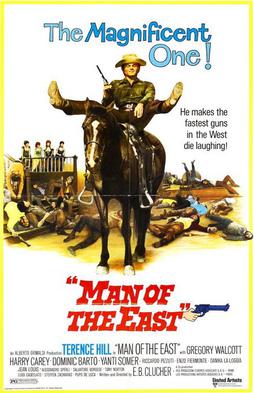
Man of the East

By 1972, director Enzo Barboni and star Terence Hill had already teamed up for movies over back to back years that audiences ate up, 1970's My Name is Trinity and 1971's Trinity is STILL My Name. His follow-up is an unofficial sequel to those two flicks, and it's a good one. Thanks to MGM's HD TV channel, I was able to find and watch a pristine version of 1972's Man of the East.

On his father's dying wish, Thomas Moore (Hill), an Englishman from Boston, travels west to visit land owned by his father. Thomas is a gentleman who rides bicycles rather than a horse, recites poetry, and plays the violin. In other words, he isn't exactly cut out for the wilds of the wild west. En route, his stagecoach is robbed by three bandits, but he manages to hide his money and make it to his father's cabin unscathed. Who's waiting? The bandits, Bull (Gregory Walcott), Monkey (Dominic Barto), and Holdy Joe (Harry Carey Jr.), are there too, but he doesn't realize who they are. There's a catch. The trio used to be in Tom's father's gang, and in his dying wish, asks the trio to look after his son and teach him how to be a man who can survive in the west. They've got their work cut out for them, especially when Tom shows interest in Candida (Yanti Somer), the daughter of the local powerful rancher.

Stars like Clint Eastwood, Franco Nero and Lee Van Cleef helped make spaghetti western heroes into a tough guy category of their own. Then there's Terence Hill (real name Mario Girotti), a spaghetti western star who typically starred in somewhat lighter toned films. The Trinity movies aren't full-on spoofs, but they're not as dark as most other genre entries. Hill is perfect as a believable hero who's very capable but a little goofy too. It isn't always that ultra-sinister, anti-hero gunslinger. Hill was an incredible physical presence, handling most of his own stunts -- riding, fighting -- but also selling the humor without overdoing it. An out of place easterner, his morning stretching routine is sublimely perfect, the three bandits looking on in amazed confusion. Watch it HERE. As an actor, Hill has an easygoing charm that makes him incredibly likable whenever he's on-screen. It seems like a little thing, but it goes a long way.

I recorded this spaghetti western not knowing exactly what to expect, but it's difficult to find so I had to jump at the chance. I wasn't expecting Three Men and an Easterner (that's a Three Men and a Baby reference for those who are confused). It's even got some touches of 3 Godfathers, starring John Wayne, Pedro Armendariz and Carey Jr (also starring here). What's more surprising? How effective the story is. Walcott's Bull is the bullish, freakishly strong one, Barto's Monkey the fast-talking, goofy fast draw, and Carey Jr.'s Holy Joe the bible-thumping preacher who condemns drinking, smoking, gambling and visiting hookers...while doing all of those things. Extremely close with Tom's father dating back to their Army days, the trio takes a genuine interest in his son, doing their best to make sure he doesn't get himself shot up. I loved the dynamic among the group, the three rough and ready bandits hovering around like guardian angels. Funny, surprising in its effectiveness in the drama department, it came as a pleasant surprise.

Playing the love interest searching for her own one and only true love, Somer is solid as Candida, the young women who falls for Thomas as he recites poetry to her on a train trip. Her father, Frank Olsen (Enzo Fiermonte), worries for his daughter's well-being and wants her to have nothing to do with the somewhat doofy Thomas. Riccardo Pizzuti plays Morton, Olsen's right hand man and chief henchman who is Thomas' main rival when it comes to young Candida.

It's been years since I've watched the Trinity movies, but I typically avoid comedic spaghetti westerns whenever possible. This one from director Barboni goes a long way to helping turn my opinion. It's funny, very funny. The laughs aren't always the obvious, stupid, spoof-life ones, but genuine ones that come from good dialogue and acting (Crazy, isn't it?). There's some sight gags, especially Bull cradling a little furball of a dog wherever he goes, or the bandit trio demanding a crowd of on-lookers freeze in place, the crowd obliging mid-stride. There's the previously mentioned morning stretch routine, but my favorite was probably Thomas' insistence on riding a bicycle instead of a horse. The visual of him pedaling into town with the mounted trio behind him is priceless. One other running bit really delivers nicely too. A bounty hunter duo (Salvatore Borghese and Bernard Farber) keeps getting closer to capturing Bull, but the immense bandit keeps tripping them up. The immaculately dressed bounty hunters are almost identical in appearance, duded up with long black jackets and vests. They even move alike, producing some truly funny moments.

I didn't love everything here in this comedic spaghetti western. I didn't love the budding romance between Thomas and Candida, their relationship slowing things down. At 125 minutes, 'East' is also a tad bit long in the tooth, meandering along the way at different times. Mostly though, I liked it a lot. It was filmed on location in Plitvice Lakes National Park in Yugoslavia, a refreshing -- and beautiful -- change of pace from the typical sun-scored deserts. I liked the musical score from the De Angelis brothers too, a mix of lighter and more serious tunes. There isn't much in the way of gunplay, but a big, brawling barroom fight packs a serious punch (did you catch my pun there?). A very pleasant surprise, I liked this one a lot.

Man of the East (1972): *** 1/2 /****    

Monday, April 8, 2013

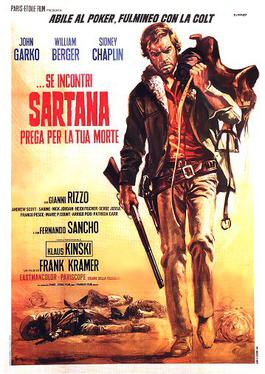
If You Meet Sartana, Pray For Your Death

The Man with No Name Dollars trilogy, Trinity, Django, Sabata, all characters that have their own series in the spaghetti western genre. I've seen at least parts of all those character series, and recently jumped into another, the Sartana series, starting with 1968's If You Meet Sartana, Pray for Your Death

A stagecoach has been robbed, and all its passengers lay dead. As the robbers loot the bodies, a mysterious gunman, Sartana (Gianni Garko), steps in front of them and guns them down. Not long after, a second stagecoach is attacked, this time carrying a huge gold shipment for a town up the trail. The only issue? The strongbox doesn't contain any gold at all....it's just heavily loaded with rocks. Who's up to something? Sartana seems to know, pitting all sides against each other. Another gunman, Lasky (William Berger), has been well-involved with all the robbery, murder and betrayal and is suspicious of what Sartana is up to. Sartana has too many enemies though as he investigates the disappearance of the gold. His only option is simple; pit all sides against each other and swoop in at the opportune time.

This spaghetti western is everything that's both good and bad about the genre. When it's entertaining, it's very entertaining (movie specific: this one's bad but entertaining). When it's bad.....it's very bad. For director Gianfranco Parolini, 'Pray' plays more like a test run for his infinitely better 1969 spaghetti classic, Sabata. The basic premise is almost entirely the same story. Garko's Sartana is a younger Sabata (played to perfection by Lee Van Cleef). The tone is light with some acrobatic gunmen and generally goofy atmosphere. The music from composer Piero Piccioni is pretty forgettable, a disappointment considering how good some of his other scores (The Deserter) were. There are some cool locations although the movie hamstrings itself by using the same locations repeatedly. I swear Sartana rides through the same hilly sand dune at least four different times.

Belonging in the short list of coolest spaghetti western title characters, Sartana is a pretty cool anti-hero gunfighter. He's a gentleman and dresses the part, favoring a suit, vest, cravat and overcoat that resembles a cape. He uses a long-range Winchester rifle and a multi-barreled derringer pistol. Sartana is a gambler as well as an accomplished gun, an ability that plays well in an early card game. Mostly I like the character because it hints -- in not so subtle fashion -- that Sartana is some sort of angelic killer, an angel of death. He seemingly can't be shot (check out the opening scene HERE) or hurt by enemies while appearing at will out of thin air. I like Garko a lot in the role, one he would play three more times, bringing a lighter touch to the anti-hero gunslinger. He's smooth with a gun and a bit of a smartass with whoever he meets. It's different, and I liked it a lot.

Spaghetti western diehards will eat this one up in the casting department with some really odd and really cool casting. Berger is over the top and goofy as Lansky, a brutally efficient hired gun with murder and blackmail on his mind. He's also completely undone whenever Sartana plays the tune from the watch of a man Lansky has killed. Klaus Kinski shows up in a bizarre cameo as Morgan, a knife-throwing killer with little bells for spurs. He's around for about 3 minutes, but it's Kinski so it's cool. Fernando Sancho does what he does best, playing a slimy, greasy, cackling Mexican bandit/general -- here General Tampico Mendoza -- who gets caught up in the killing. Sydney Chaplin and Gianni Rizzo play the two conniving businessmen in town who are up to something, Heidi Fischer playing Rizzo's equally conniving wife. Spaghetti western regular Salvatore Borghese makes a too quick appearance as Moreno, one of Sancho's main henchman.

There is a part of almost all spaghetti westerns that are inherently stupid, but you just go along (well, if you're a fan at least). Unfortunately, 'Pray' has so many of these moments it's hard to take even remotely serious. I liked the movie, but I can appreciate it and all its badness. If you did a drinking game after every time someone maniacally laughs, you'd be drunk in minutes thanks to maniacal laughing coffin maker Dusty (Franco Pesce). Sancho cackles and laughs, eating the same greasy piece of chicken in countless scenes. Berger's Lansky literally crumbles at just the sound of a musical watch. The script is pretty bad in itself -- Sartana's bedroom kinkiness a highlight -- and doesn't offer much of a story. The "story" requires people to connive and worry, Sartana shows up, plans are thrown out and started over. An impressive body count here with some fun action scenes too. It's bad. No doubt about it, but I was entertained throughout.     

If You Meet Sartana, Pray for Your Death (1968): ** 1/2 /****

Friday, February 22, 2013

Coffin Full of Dollars

A spaghetti western is like a pizza....for me at least. And yes, I realized I'm comparing Italian movies to Italian food. I'm clever like that. Even the lousy ones, they're still halfway decent. There are some truly bad spaghetti westerns out there, but they're almost always entertaining (sometimes because they're so bad). So with 1971's Coffin Full of Dollars -- how could you not appreciate the awesomeness of these names?!? -- there's nothing hugely memorable, but I liked it just the same.

Returning home from the Civil War, George Hamilton (Jeff Cameron) discovers that the family home has been burned down, and everyone inside was killed. The only clue to the perpetrator is a gold watch he finds in the wreckage. It belongs to a bandit leader, Hagen (Klaus Kinski), seeking revenge for the deaths of his brothers at the hands of the Hamiltons (Confused yet?). Going by the alias the Nevada Kid, Hamilton hits the trail to find Hagen and his small army of gunmen. He teams up with an amiable enough bounty hunter, John (Gordon Mitchell), who would like nothing more than to get a crack at the lucrative bounties hanging over the heads of Hagen and his gunmen. As the duo gets closer, they find out they've stumbled into a plan where Hagen stands to "earn" $10,000. Who gets out alive?

I stumbled across this one via On Demand and jumped at the chance. With some 600 spaghetti westerns made in the late 1960s and 1970s, you've got to take advantage when you find one like this you've never even heard of. A quick search over at Amazon shows that this 1971 spaghetti is only available in a difficult to find Region-2 DVD so not exactly readily available. It's pretty standard stuff, but that's not a bad thing. The version I saw clocked in at 82 minutes, but some versions are reported to be just over 90 minutes. A whole lot of stuff is going on, a whole lot of bullets fly through the air, and in the end, a whole lot of people get shot down in some pretty impressive shootouts. What more could you ask for?

From director Demofilo Fidani (who also wrote the script), the budget clearly isn't large in any sense of the word. We see some familiar spaghetti western locations and even some non-desert locales, but the story and scale (or lack of) is always on a smaller, more personal level. We don't get saloons packed to the gills with extras. There's some awkward cuts and editing, shots going on for too long rather than just transitioning to new scenes. The music from Coriolano Gori is pretty normal spaghetti music, good in the moment if not memorable.

Through all the general craziness and off the wall story, the characters/actors do have a lot of fun. An Italian actor who specialized in spaghetti westerns, gladiator epics and Italian war movies, Cameron does a solid job as George Hamilton (that name couldn't have been an accident), a polished gunslinger seeking revenge. Spaghetti regular Kinski's appearance amounts to little more than a cameo, disappearing for long stretches of the film, but whenever he is actually on-screen, it's good stuff. The same for Mitchell who isn't given much to do, but he commits as his muzzle-loading, rifle-toting bounty hunter pairs with the Nevada Kid and hams it up as presented. Jack Betts has some fun as Tamayo, Hagen's second-hand man who keeps messing up, Simonetta Vitelli is Monica, a young woman ransomed off by Hagen and rescued by the Nevada Kid, and Ray Saunders is Sam, a freed slave who ends up helping the Kid's efforts.

Blah blah blah. Shootouts! Gunfights! Action, action, action! In an otherwise standard western, the action here is exciting and dare I say....above average. Yes, it tends to be a little goofy with highly exaggerated deaths and tumbles, some generally very stunt-conscious nameless henchmen, and guns that never need to be reloaded. There's a handful of quick shootouts that are worthwhile, but two major set pieces set the bar. One has the Kid and John navigating a ghost town full of Hagen's gun men in hopes of rescuing Monica while the finale has the duo fighting their way through Hagen's isolated town similarly full of rival gunfighters. I liked this movie. I didn't love it, but I enjoyed it just the same. An enjoyable enough way to spend 90 minutes. Watch the full movie HERE.

Coffin Full of Dollars (1971): ** 1/2 /****

Thursday, December 13, 2012

Hate Thy Neighbor

With characters like the Man With No Name, Django, Sabata, Sartana and several others, the spaghetti western genre became famous (infamous depending on the reviewer) for highly memorable lead characters. Then there's 1968's Hate Thy Neighbor -- what a great title -- where the interesting lead has been dropped in favor of two much more interesting bad guys.

Running from a gang of gunmen, a man is killed -- along with his wife -- for a map of a nearby but hidden goldmine. The gang's leader, Gary Stevens (George Eastman), is working for a local businessman/rancher with a sadistic streak, Chris Malone (Horst Frank). Together, they intend to find the location of the goldmine and split whatever they find. Their plan hits a roadblock though when the dead man's brother, Ken Dakota (Spiros Focas), shows up to pick up his nephew who survived the shooting. Dakota finds out not only that his brother was murdered, but who did it. Now, it's just a matter of time before the three paths collide.

This is a spaghetti western lost in the shuffle over the years. I suppose that happens when some 600 movies were made from one genre over about 10 years. Some were good, some were bad, and some were awful. This one has no star power and doesn't do a ton to differentiate itself from the pack. There are some interesting camera angles, and the score from Robby Poitevin is okay in the moment if not particularly memorable. The story is familiar (countless spaghettis relied on revenge as a story-driver), but at the same time it's never dull. Clocking in just 84 minutes, there is little in the way of wasted time, and I enjoyed it to the end, eccentricities and all.

As far as lead characters go, I'm straining to think of one who was more dull than Focas' Ken Dakota. Okay, that's not fair. His name is pretty cool, but that's about it. He shows up looking for answers about his brother's death, and sort of meanders along getting those answers. I don't know if it's his fault, but the script gives him nothing to do, and Focas isn't exactly a charismatic actor. He's too goody-two shoes for a spaghetti western anti-hero. His budding romance with Peggy (the always lovely Nicoletta Machiavelli) and his fatherly relationship with nephew, Pat (Claudio Castellani), feel like they've been hijacked from an after school special. The final scene could even be the freeze frame of a 1980s sitcom episode. Basically it feels like an American western in its portrayal of the hero.

Thankfully, director Ferdinando Baldi seems to recognize that his hero is just a means to an end. He needs someone to set off the bad guys, and these bad guys carry the movie. Besides having maybe the most boring, Dilbert-like character name (Gary Stevens? Really? That's the best you could come up with?), Eastman is a scene-stealer as Gary. He's got a smile like a rattlesnake and will gun his enemies down without a second thought. As the classier, suaver villain, Frank is the perfect counter to Easman's tougher villain. Their life and death rivalry is something else. Reviews point to their cat-and-mouse game back and forth, and it certainly works. Each would like nothing more than to kill the other, but as is so often the case with greed, they need each other....for the time being. I would have loved a movie focusing exclusively on these two, but I'll take what's here.

It's Frank's Chris Malone that provides some of the movie's most memorable, eccentric moments. Like a Roman lord, he has his "slaves" fight to the death in a corral. They're given a wooden shield worn over their wrist and a Wolverine-like blade on their other hand. Guarded on all sides by riflemen, a duo fights to the death and Malone and his wife (Ivy Holzer) watches from their elevated seats. There are two different fights in the ring, and they're doozies worth the price of admission alone. Malone also unleashes an elaborate torture on Gary to get some information out of him that includes hanging upside down, a pit of snakes and hungry rats gnawing at the ropes holding him up. Diabolically evil much?

Two other parts worth mentioning, one normal, one typically eccentric. Paolo Magalotti plays Jose, Malone's trusted right-hand man, and makes the most of the pretty standard part. A highlight? Jose and his men save Gary from hanging by distracting his guards via some Spanish guitar action. Odd? Yes, but a hilariously bad scene.  As for the typically eccentric, Robert Risso plays Duke, Ken's sidekick, a shotgun-wielding, accordion-playing undertaker/coffin maker. I can honestly say I've never typed a sentence like that before. So while the main character's interest levels are lacking, the rest of the movie certainly makes up for it. Well worth giving a watch!

Hate Thy Neighbor (1967): ***/****