
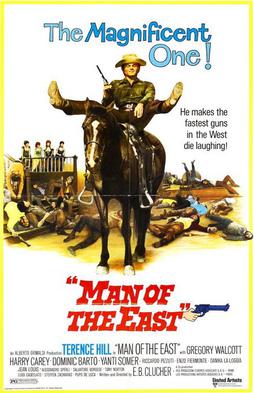
On his father's dying wish, Thomas Moore (Hill), an Englishman from Boston, travels west to visit land owned by his father. Thomas is a gentleman who rides bicycles rather than a horse, recites poetry, and plays the violin. In other words, he isn't exactly cut out for the wilds of the wild west. En route, his stagecoach is robbed by three bandits, but he manages to hide his money and make it to his father's cabin unscathed. Who's waiting? The bandits, Bull (Gregory Walcott), Monkey (Dominic Barto), and Holdy Joe (Harry Carey Jr.), are there too, but he doesn't realize who they are. There's a catch. The trio used to be in Tom's father's gang, and in his dying wish, asks the trio to look after his son and teach him how to be a man who can survive in the west. They've got their work cut out for them, especially when Tom shows interest in Candida (Yanti Somer), the daughter of the local powerful rancher.
Stars like Clint Eastwood, Franco Nero and Lee Van Cleef helped make spaghetti western heroes into a tough guy category of their own. Then there's Terence Hill (real name Mario Girotti), a spaghetti western star who typically starred in somewhat lighter toned films. The Trinity movies aren't full-on spoofs, but they're not as dark as most other genre entries. Hill is perfect as a believable hero who's very capable but a little goofy too. It isn't always that ultra-sinister, anti-hero gunslinger. Hill was an incredible physical presence, handling most of his own stunts -- riding, fighting -- but also selling the humor without overdoing it. An out of place easterner, his morning stretching routine is sublimely perfect, the three bandits looking on in amazed confusion. Watch it HERE. As an actor, Hill has an easygoing charm that makes him incredibly likable whenever he's on-screen. It seems like a little thing, but it goes a long way.
I recorded this spaghetti western not knowing exactly what to expect, but it's difficult to find so I had to jump at the chance. I wasn't expecting Three Men and an Easterner (that's a Three Men and a Baby reference for those who are confused). It's even got some touches of 3 Godfathers, starring John Wayne, Pedro Armendariz and Carey Jr (also starring here). What's more surprising? How effective the story is. Walcott's Bull is the bullish, freakishly strong one, Barto's Monkey the fast-talking, goofy fast draw, and Carey Jr.'s Holy Joe the bible-thumping preacher who condemns drinking, smoking, gambling and visiting hookers...while doing all of those things. Extremely close with Tom's father dating back to their Army days, the trio takes a genuine interest in his son, doing their best to make sure he doesn't get himself shot up. I loved the dynamic among the group, the three rough and ready bandits hovering around like guardian angels. Funny, surprising in its effectiveness in the drama department, it came as a pleasant surprise.
Playing the love interest searching for her own one and only true love, Somer is solid as Candida, the young women who falls for Thomas as he recites poetry to her on a train trip. Her father, Frank Olsen (Enzo Fiermonte), worries for his daughter's well-being and wants her to have nothing to do with the somewhat doofy Thomas. Riccardo Pizzuti plays Morton, Olsen's right hand man and chief henchman who is Thomas' main rival when it comes to young Candida.
It's been years since I've watched the Trinity movies, but I typically avoid comedic spaghetti westerns whenever possible. This one from director Barboni goes a long way to helping turn my opinion. It's funny, very funny. The laughs aren't always the obvious, stupid, spoof-life ones, but genuine ones that come from good dialogue and acting (Crazy, isn't it?). There's some sight gags, especially Bull cradling a little furball of a dog wherever he goes, or the bandit trio demanding a crowd of on-lookers freeze in place, the crowd obliging mid-stride. There's the previously mentioned morning stretch routine, but my favorite was probably Thomas' insistence on riding a bicycle instead of a horse. The visual of him pedaling into town with the mounted trio behind him is priceless. One other running bit really delivers nicely too. A bounty hunter duo (Salvatore Borghese and Bernard Farber) keeps getting closer to capturing Bull, but the immense bandit keeps tripping them up. The immaculately dressed bounty hunters are almost identical in appearance, duded up with long black jackets and vests. They even move alike, producing some truly funny moments.
I didn't love everything here in this comedic spaghetti western. I didn't love the budding romance between Thomas and Candida, their relationship slowing things down. At 125 minutes, 'East' is also a tad bit long in the tooth, meandering along the way at different times. Mostly though, I liked it a lot. It was filmed on location in Plitvice Lakes National Park in Yugoslavia, a refreshing -- and beautiful -- change of pace from the typical sun-scored deserts. I liked the musical score from the De Angelis brothers too, a mix of lighter and more serious tunes. There isn't much in the way of gunplay, but a big, brawling barroom fight packs a serious punch (did you catch my pun there?). A very pleasant surprise, I liked this one a lot.
Man of the East (1972): *** 1/2 /****

