The Sons of Katie Elder

The Sons of Katie Elder
"First, we reunite, then find Ma and Pa's killer...then read some reviews."
Showing posts with label Film Noir. Show all posts

Tuesday, January 26, 2016

The Strange Love of Martha Ivers

Kirk Douglas is a Hollywood legend. With too many classic films to his name to mention, from Spartacus to Paths of Glory and countless others in between, Douglas is one of the few who deserves that legend status. What's so crazy about his career? He didn't have a climbing period of supporting roles, bit parts and background players. He dove right in, starting with a hugely important part in his screen debut, 1946's The Strange Love of Martha Ivers.

It's 1928 in the up-and-coming town of Iverstown in Pennsylvania when three teenagers from vastly different backgrounds and upbringings are witness to a horrific crime that results in murder. The truth never comes out though, putting the three teenagers on again, vastly different paths into the future. Fast forward to 1946 when the now grown-up Sam Masterson (Van Heflin) drives back into town looking to get his car fixed. He discovers that the other two teenagers have married, with Martha (Barbara Stanwyck) having become one of the most powerful businesswomen in the state with all sorts of public influence. Her husband, Walter (Douglas), is an equally powerful district attorney with political aspirations but really, it's Martha pulling his strings. Now after so many years have passed, the secret that bonds the trio threatens to tear everything down. Martha and Walter are convinced Sam is looking for a payoff. What is his intention exactly?

This is a flick that's hard to peg down. Not quite a romance or a mystery, not quite a thriller or film noir. Instead, director Lewis Milestone's film manages to blend all those elements into one very solid movie. At different points, it is all of those disparate pieces, providing a wave of different tones that might not work together but somehow...they just do. Filmed in black and white, there's a dark, shadowy and sinister look to it all. As well, there's that vein of small-town Americana where everyone has their secrets but no one ever gets called out on them. I will add it is an odd film when you take it all in, but there's something oddly appealing about it, the romance-thriller-mystery-film noir final product.

What holds it all together for me was the characters. We've got four main characters, all of them very human, very flawed and very vulnerable. I don't want to give spoilers away to the opening intro (it runs about 20-25 minutes) but it does involve a murder. If that doesn't provide some pyrotechnics some 17 years later, I don't know what will! Stanwyck, Heflin, Douglas and Lizabeth Scott as a troubled young woman brought into the years-old drama are all on-point in bringing their characters to life, the ensemble working quite well together. They all get their moments to shine and none disappoint. The chemistry between Stanwyck and Heflin is smoldering, as is between Heflin and Scott. In an age of movies that had a tendency to get a little overdone in the acting department, 'Strange' manages to harness all the melodrama and keep it relatively reserved (thankfully!). This is an acting movie, and the actors don't disappoint!

I came away especially impressed with Douglas in his first on-screen appearance and his first-ever film role. His Walter O'Neil is a product of his childhood and later, his marriage to Stanwyck's Martha. As Heflin's Sam points out, he's still a scared-looking little kid. Knowing where Douglas' career would go (and go quickly), it's startling to see him as an alcoholic, sniveling, weakling of a man. What's better? He nails the part. There's a perfect intensity to the proceedings, but he's perfectly believable as a grown man who can basically make a decision for himself. An underrated actor, Heflin delivers one of his best performances as Sam Masterson, a gambler, a WWII vet and with a checkered past to his name who still remains confident that something will come along because...well, because it always has before. Excellent parts for all four leads.

If there's an issue here, it's the pacing. At 116 minutes, 'Strange' can be a tad on the slow side. We spend a lot of time just introducing our characters and laying things out, most of an hour-plus actually. It's only then the wheels go into motion as we start to figure out what everyone's intentions are. What is Sam's plan? Is he interested in blackmail or is he just in the wrong place at the wrong time? What is Scott's Toni's background? Does Martha still have feelings for Sam? A lot to deal with for sure in the closing 45-50 minutes. So that said, I enjoyed the first hour more with its sense of mystery and foreboding doom hanging in the air over this budding industrial town. I was surprised by the ending itself because I just wasn't sure how dark this story would go...but it goes.

An excellent flick all-around, definitely worth checking out.

The Strange Love of Martha Ivers (1946): ***/****

Thursday, April 23, 2015

His Kind of Woman

Occasionally I have some genuine freak-out moments. Case in point? I’ve been writing movie reviews here with Just Hit Play since January 2009. I must be getting old! I’ve mentioned before though the timing of starting some of these reviews. I watched some good, even great, movies in the months right before I started this site but never reviewed them, not feeling confident enough to review months later from memory. That’s today’s review, a film noir from 1951, His Kind of Woman, that’s one of my favorites.

A down on his luck gambler living in Los Angeles, Dan Milner (Robert Mitchum) is drifting along with the clothes on his back and very little money in his pocket. Then, his luck turns on a dime, but it seems so easy. A mysterious man with underworld connections offers him a huge payday if he’ll simply leave the country and visit Mexico. There’s a catch though. He can’t know why, only get to a remote hotel on the Baja California peninsula and wait. From there, he won’t be able to return to the United States for at least a year. Suspicious but in need of the money, Milner takes the deal and heads to Mexico. There at the hotel, he meets a beautiful singer, Lenore (Jane Russell), in pursuit of a popular Hollywood actor, Mark Cardigan (Vincent Price), and an odd assortment of guests and locals. Milner sits back and waits for what’s heading his way. What has he gotten himself into exactly?

I saw this 1951 film noir in November 2008, two months before I started writing these reviews. Talk about bad timing, huh? I loved it, something pulling me in and keeping me interested throughout its two-hour running time. It comes from bazillionaire Howard Hughes and had a whole bunch of production problems that become evident in the final act. Now that said, there’s something charming and fun about it from beginning to end. It hasn’t been distributed much, if at all, since its release and ‘Kind’ doesn’t have a huge following. The moral of the story is simple. It should. I highly recommend it.

To say this is a film noir is limiting. It is to be sure, but it tries to do a lot more and generally, succeeds on most of those fronts. Director John Farrow (and an uncredited Richard Fleischer when Hughes didn’t like Farrow’s work) is at the helm of an equal parts film noir, love story, comedy with some action and shootouts thrown in. It isn’t always perfect, but the script makes a mostly successful go at it. Six different people are listed at the IMDB page for this movie as having written part of ‘Kind’ (again reflecting the behind the scenes drama). It’s smart. The dialogue crackles. The story is sorta kinda there, relying on the actors to bring the at-times slow story to life. I think the biggest compliment I can say is that it almost plays like a spoof of the film noir genre itself…but never truly becomes a spoof. Now that takes some doing. Not too light, not too heavy-handed, but more importantly and more successfully, somewhere in between.

Just a few weeks ago, I reviewed 1952’s Macao, another pairing of stars Robert Mitchum and Jane Russell. I watched ‘Kind’ back in 2008 in my Jane Russell phase. I’d never seen her films but fell hard for her right away, and this was only my second Russell film I believe. Again, talk about an on-screen match made in heaven. It’s easy to say Mitchum does the same thing movie in and movie out – that laconic, loner anti-hero – but he brings a different edge and energy with each passing film. I loved his Milner character, a man who knows he’s in trouble but keeps going along to figure out what’s up. The same for Russell’s Lenore, a young woman looking for love but with a fair share of failed attempts behind her. The duo just WORKS so well together. Their scenes are pretty pitch perfect throughout. They’re believable, you like them, and they seem to like each other. How can you go wrong?

What surprised me about the movie’s general unknown quality is the cast. With the cast assembled, how does it not have more of a reputation even by accident? Mitchum and Russell are excellent, but it’s Vincent Price who steals the show. His Mark Cardigan is an Errol Flynn-like movie star, a swashbuckler who’s looking for his movie star life to become his real life. A little too much at times, but very funny. Still not enough? There’s also Tim Holt as an investigating cop, Charles McGraw as a thug and enforcer, Raymond Burr as a mobster trying to get back into the U.S., Jim Backus as a talkative investment banker, Philip Van Zandt as the hotel owner, and an uncredited Anthony Caruso a brooding sidekick to Burr. Not bad at all.

An additional character worth mentioning is the hotel set on the Baja California peninsula. It’s so 1940s/1950s stylish with its bungalows and pool and just some really cool architecture. The sets date the movie a bit, but it truly becomes an additional character. The ending? Yeah, things fall apart a bit as the last 40 minutes get a little too kooky. Even when it goes off the tracks though, ‘Kind’ is still a really fun movie. Definitely worth seeking out, the 1951 film noir popping up occasionally on Turner Classic Movie’s schedule.

His Kind of Woman (1951): *** 1/2 /****

Wednesday, April 15, 2015

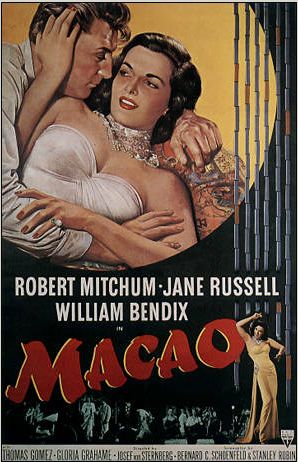
Macao

They don't have the all-time classics to their names that other film couples did. They weren't Tracy and Hepburn or Bogart and Hepburn or Wayne and O'Hara. But you know what stars Robert Mitchum and Jane Russell had in their two films together? An easy-going, sizzling charm that oozed off the screen. I'm hoping to write reviews for both soon, starting here with 1952's Macao, their second pairing.

Just 40 or so miles from Hong Kong, the city of Macao in the years following World War II has become a den of gambling, corruption, violence and any number of any other vices. One particularly crooked casino owner with his hands in everything, Vince Halloran (Brad Dexter), is especially worried though after he and his men killed an investigating officer from New York. They're playing the waiting game for the officer's replacement...and maybe some more heavy duty reinforcements. Coming ashore from a ship traveling from Hong Kong, all but three passengers are recognized, leading Halloran to believe one of them is the cop. The suspects? A Navy veteran on the run, Nick Cochran (Mitchum), a talkative salesman, Lawrence Trumble (William Bendix), and a nightclub singer looking for a job, Julie Benson (Russell). Who is the right one to target? Just which one is the cop looking to take Halloran in?

If that doesn't sound like the most pointed plot description, well, it ain't. Director Josef von Sternberg (along with some uncredited work from Nicholas Ray) was a silent film director who drifted along a touch when the sound era moved into the film industry. The Wikipedia page for 'Macao' specifically says "When von Sternberg's scenes made no sense dramatically..." so you know he wasn't always interested in a Point A to Point B (or C-through-Z) story to begin with. Production actually wrapped on filming in 1950, and then the finished product sat on the shelf for most of two years. How come? Producer Howard Hughes' track record basically. Decisions didn't have to make a whole lot of sense when your boss is one of the world's richest people. What's the end result then for this shelved, quasi-film noir?

It's good to great early on because of its randomness and general kookiness. It derails some in the last 20 minutes of its 80-minute running time. Let's focus on the positive though. 'Macao' is genuinely fun as everything is laid out and established. It mixes classic film noir with international intrigue with the huge chemistry between Mitchum and Russell with some laughs along the way. Long story short...it is a pleasant, enjoyable movie. It is dark, but not as dark as most film noirs. Some reviews point to that lack of a unified tone as a negative but the helter-skelter tone really worked for me. Should it have? Probably not but something clicks for me. Filmed in black and white with some stock footage of Macao and Hong Kong mixed in with the seedy Hollywood sets for the two cities, Sternberg's film has style and a great visual look.

Blah blah blah with all that film analysis. Let's talk about movie star chemistry!!! Robert Mitchum and Jane Russell are two of my favorites. Mitchum was that perfect tough guy anti-hero who just didn't give a crap. Russell was a solid actress, singer and performer who fit in well with the tough guys when her film roles allowed it. The end result? Two actors who don't look like they're acting. They're just hanging out, having a ton of fun bringing these two characters together. Their chemistry is evident from Scene No. 1 and never lets up. Not remembered as a great role -- and rightfully so -- Mitchum is pretty perfect, laconic and laid back with a checkered past hanging over his head. The same for Russell's Julie, bouncing from city to city looking for work. Oh, and Russell is drop dead gorgeous here. Hughes made her a star by utilizing her....natural talent I'll say. She's beautiful, and she's even given a chance to sing two songs.

The rest of the cast is solid throughout. I especially liked Bendix as Lawrence C. Trumble, fast-talking, looking to blow off some steam traveling salesman. His almost manic delivery pairs well with Mitchum's slower-paced line reads. Dexter is perfectly slimy as Halloran, the black market casino dealer always with an eye on shady deals and easy money. Also look for Thomas Gomez as the corrupt police officer working with Halloran, poorly and under-used Gloria Grahame as Halloran's much-maligned girlfriend, Philip Ahn as Halloran's steely-eyed enforcer, and Vladimir Sokoloff as a mysterious blind man who seems to pop up at the right moment whenever needed. A fun cast with some cool parts.

Now that line before about von Sternberg's lack of dramatic timing, yeah, that comes into play in the last 20 minutes. The cool, couldn't care less style loses all momentum. The finale turns into a big chase scene that doesn't keep the adrenaline flowing unfortunately. The ending itself feels a tad rushed, a disappointing end to an otherwise very enjoyable movie.

Macao (1952): ** 1/2 /****

Tuesday, March 31, 2015

Highway 301

I was worried about 90 seconds into 1950's Highway 301. Real worried. This crime thriller from the Age of Film Noir looked to be diving into the genre flick...with a warning that crime is BAD. Oh no! Worse? Those warnings come from the real-life governors of three states. So immediately a story that sounded like it had a ton of potential was turning into something not so appealing. Did it drive out of the nasty detour? Thankfully, YES.

It's the early 1930s and a gang of vicious killers and bank robbers are cutting a swath across a three-state area including Virginia, Maryland and Pennsylvania. No job is too big or small and no life is worth more much to this small gang of gangsters that's been dubbed the Tri-State Gang. At their head is an escaped convict, George Legenza (Steve Cochran), who leads the gang with a brutally efficient, sinister hand. If anything (ANYTHING) gets in the gang's way, he'll plug it with a bullet and move on no questions asked, no emotions hanging in the air. The gang's dubious exploits and a trail of dead bodies has caught the eye of the F.B.I. and law enforcement agencies all over the three state area. Legenza and his gang haven't been too interested in hiding their faces, and that decision may come back to bite them. Time is running out and the gauntlet is getting tighter and tighter.

Right up there with war, western and sci-fi flicks, one of my favorite genres is and has been the film noir genre. This 1950 crime thriller from director Andrew L. Stone isn't an out-and-out film noir entry. Instead, it has that distinct noir feel -- mood and style against a dark, often nighttime backdrop -- mixed in with a more straightforward crime thriller. This is based on a true story (read more about the gang HERE) so 'Highway' has the distinct feel of a crime thriller documentary, almost like something TV's Dragnet would focus on in the next two decades. We get that fly on the wall feel. We see both sides, crooks and cops, with characters often addressing the camera directly, especially those on the law enforcement side. It is a style that finds a groove between the noir genre and the more straightforward crime thriller angle, and all for the better.

That blending of genre works because....well, this is a particularly nasty movie for a 1950 audience. Yeah, 1950s film noir and crime thrillers were particularly dark, but there was almost always some flawed, imperfect anti-hero who you could slightly root for. The focus here in 'Highway' does detour some from the gang but not a lot. This is a movie about a murdering, ruthless bloody gang. Cochran is a vile, nasty scene-stealer. An actor who never became a huge star, usually starring in B-movies and appearing on countless TV shows, Cochran is the perfect villain here. His Legenza -- an escaped convict with murder and burglary raps on his record -- is emotionless, his brutal crimes not fazing him in the least. He kills because he doesn't want to get caught. It is a business decision and little else. Something in his way? With the snap of a finger, Legenza will knock you off. Just a terrifyingly effective bad guy who doesn't get the attention he deserves in the genre.

Watch out for the rest of the Tri-State Gang too though. Cochran's Legenza is the head of the snake, but this isn't a bunch to take on lightly. Also look for Robert Webber and Wally Cassell as the most visible of the gang, Legenza's most trusted men. Neither man is as efficiently and brutally cold as their gang leader, but it's close. Adding an interesting angle to the gang is the wives of the members, including the cynical, smart-mouthed Virginia Grey (with Cassel) and innocent Canadian woman Gaby Andre who marries Webber not knowing what her newlywed husband's occupation truly is. It's a cool change of pace within the genre-bender, showing female characters amidst the gangland chaos. Not as visible as the other parts of the game, also look for Richard Egan and Edward Norris to round out the gang.

Director/writer Stone is at the helm of a surprisingly good, interesting flick here. It crackles along at 83 minutes, covering a lot of ground and mixing in some robberies and heists with some shootouts, betrayals and chases along the way. It's never really in doubt how this will end once law enforcement (including lead officer Edmon Ryan) gets heavily involved, but it remains solid throughout as we see exactly how this gang will meet its end. When it comes along, it is a very satisfying finale. Not a well-known film, but one that's easy to recommend. A very dark, cool change of scenery for an at times familiar genre.

Highway 301 (1950): ***/****

Saturday, December 7, 2013

The Good Die Young

Four actors that I like a lot but were never huge stars. A British crime drama with touches of American film noir. Oh, and I've never heard of this movie...at all. Released in 1954, The Good Die Young popped up recently on Turner Classic Movie's schedule, and I couldn't pass up the chance.

On a quiet night on the streets of London, four men sit in a car, one of them, 'Rave' Ravenscourt (Laurence Harvey) passing pistols out to the other three. The quartet is readying themselves to pull off a robbery that will net them each some serious money. What drove them to this point? How did they get here? How did they become so desperate that these four non-criminal types would turn to armed robbery? Rave, Joe Halsey (Richard Basehart), Eddie Blaine (John Ireland) and Mike Morgan (Stanley Baker) are just that though, incredibly desperate with nowhere else to turn. Can they somehow pull the job off?

Tweaked from a novel by Richard MacAulay, 'Die' certainly sounded pretty good to me. Director Lewis Gilbert's film was transplanted from America to London, a nice touch, and certainly pays tribute to its American film noir influences. Filmed in a shadowy, moody black and white, the look of the film reflects the pretty dark, doomed tone of the story. I liked composer Georges Auric's score, appropriately dark and foreboding, building up to the finale we all could see coming. As well, the acting is solid across the board, but I still managed to come away disappointed here. I'm disappointed I was disappointed too, mostly because I really wanted to like this one.

What mostly caught my eye was the casting of the four leads. Laurence Harvey, Richard Basehart, John Ireland and Stanley Baker?!? And in a quasi-film noir?!? The excitment unfortunately ends there. Following the quick, hard-hitting, mysterious opening, the rest of 'Die' is all flashback leading up to what we've already seen. The story bounces among the four different storylines/main characters, the quartet eventually meeting in a London bar and bonding over their generally pathetic situations. They meet everyday, drinking early and often even though none of them really have any money. Obviously, this part was necessary to show the depths they've all sunk to, but they get tedious...very quickly. The movie only runs 94 minutes, but it feels significantly longer. I guess I was expecting more of the crime drama angle so my expectations may have been slightly off, but I still struggled in those later portions before the actual crime.

The acting is still pretty decent even if it just gets to be one thing on top of another late. Harvey becomes the villain, his Rave a suave, smooth, debonaire gentleman who married Eve (Margaret Leighton), a very rich, well to do woman who's got a few years on him. Basehart's Joe is trying to get his British wife, Mary (Joan Collins), to come back to the states with him, ripping her from his evil mother-in-law's grip, (played by Freda Jackson). An infantryman in Germany, Ireland's Eddie is married to Denise (Gloria Grahame), a small-time actress aspiring to be more and with her co-stars too. Lastly, there's Baker's Mike, a boxer trying to leave the ring with the little money he's saved with his loving wife, Angela (Rene Ray), but her family keeps causing them issues. Of the four, Harvey and Baker represent themselves the best, or at least in the most interesting fashion. Also look for Robert Morley in a one-scene part as Rave's father who hates everything that his son has become.

If there is a saving grace in 'Die,' it's the last 20 minutes or so, the flashbacks left behind as the actual robbery develops. Harvey's Rave manages to convince them all to go in on the job, the amateur crooks deciding whether the reward is worth risk. If noirs and crime dramas have taught us anything, it's that crime just will not pay in the long run, and that foreboding sense comes true here. It's the ending you would expect here. I wanted to like the movie a whole lot more, but it loses its momentum in the first hour. Worth seeking out for the cast, but disappointing on most other levels.

The Good Die Young (1954): **/****

Tuesday, August 13, 2013

The Burglar

With a career that spanned three decades, Dan Duryea had quite a career in film and television, racking up over 100 different roles. He never became a huge star, instead becoming one of the best character actors to ever grace the screens in Hollywood. Like most character actors, he did get a crack or two at his own movies, one he could carry himself, and he doesn't disappoint in 1957's The Burglar.

Having grown up as a thief, always improving his skills and ability, Nat Harbin (Duryea) doesn't have many equals. He's a small-time thief though, never gaining much in the way of notoriety over the years. He pulls jobs that net him enough money to get him to the next job while also caring for his step sister, Gladden (Jayne Mansfield), who helps him and two other thieves. With his most recent job, Nat steals a necklace worth $150,000 but much to the dismay of his team, he sits on, waiting for the heat to cool down and the cops to back off. With each passing day though, the heat intensifies, and his two partners get more and more anxious. When Nat senses the cops are closing in, he sends Gladden to Atlantic City to hide out only to find out that a crooked cop (Stewart Bradley) is following her. Now it becomes a race against time to see who can get to her first.

I came away impressed with a lot of things from this Paul Wendkos-directed film noir. It is based on a novel by David Goodis (who also wrote the script), and it is the better for it. The best thing going here is Duryea as the anti-hero thief, a thief with a code of honor. It is the type of character that would pop up more and more in the late 1950s and into the 1960s. He's a criminal, a thief, no doubt about it, but he does operate by a code of sorts. No guns, no betrayals (if possible) and no messing around, just get the job done. His background is explained, showing how he ends up caring for Gladden, how he came to be the man he is. It is a quiet, perfectly understated part that gives Duryea a chance to shake off his bad guy typecasting. With a bit of that doom cloud hanging over his head, it is apparent things may not end well for him, but maybe, just maybe, there's a chance for him to get out clean.

Using Duryea's starring performance as a jumping off point, 'Burglar' manages to rise above the good but not great film noir list with some impressive style decisions. Yes, it is filmed in black and white, bringing to life the shadows and dim lights that populate the criminal underworld, but it's more than that. Wendkos takes what we know of the noir genre and makes it more of an arthouse film, an almost existential film. It is a lonely, isolated world, and Wendkos brings it to life with some startling jump cuts, some odd, off-center camera angles and a solid, appropriately jazzy, unsettling score from composer Sol Kaplan. The pacing can be a tad slow early on with some long, dull monologues, but once things get rolling, it doesn't really slow down, right up until the surprising finale.

While Duryea's performance is noteworthy, I think at least part of this movie's relatively unknown status is because the rest of the cast lacks any name recognition. Building up her sex kitten status, Mansfield shows she doesn't have a ton of acting range, but she's solid. Her looks are dulled down for the first half -- baggy clothes and all -- and then at the halfway point....ta-da! Bathing suit! Martha Vickers plays Della, a middle-aged woman with a checkered past, looking for something new in her life...and maybe with an ace up her sleeves. As the sinister, hovering villain, Bradley is a good counter, a bad guy with greed as his only real motivation and nothing else. Working with Nat as his partners on jobs are Peter Capell as Baylock, an older crook looking to retire and Mickey Shaughnessy as Dohmer, a brutish thug who is always worrying.

Shaking off the somewhat slow start, 'Burglar' picks up the pace when Nat realizes the crooked cop is on their trail. The ending is almost inevitable in its execution, but that doesn't take away from that tension-packed build-up. Nat and Co. head to Atlantic City to find Gladden, but when they run into a motorcycle officer that recognizes them, the plan takes a wicked plan. 'Burglar' films its finale on location in Atlantic City -- a time capsule to the late 1950s -- and it becomes a race against time as Nat, Gladden, cops (crooked and legit) all converge on the Steel Pier. It really finds its noir roots in the finale, a downbeat ending that nonetheless works extremely well. Highly recommended, shaking off a sluggish start. Watch the movie HERE at Youtube.

The Burglar (1957): ***/****

Friday, August 9, 2013

The Hitch-Hiker

You're driving along on a highway and see a man standing there on the side of the road. He's got his thumb up indicating he'd like a ride. What should you do? Well, if you've seen any horror and/or thriller movies EVER, then hit the gas and keep on moving. Back in the 1950s, motorists were far more gullible/nice/trusting and had no issues picking up hitchhikers. I imagine 1953's The Hitch-Hiker went a long way to reversing that trend.

Heading out on a fishing trip, friends Roy Collins (Edmond O'Brien) and Gilbert Bowen (Frank Lovejoy) are driving along on the highway when they spot a man at the side of the road thumbing for a ride. They pull over and pick him up, thinking nothing of it. Within minutes though, the man pulls a gun and begins issuing orders as to where they're going and how they'll get there. Roy and Gilbert hear on the radio that the man is Emmett Myers (William Talman), a convicted killer and a psychopath on the run from the police. With no real alternative to escape with Myers' gun pointed at their heads, the friends are forced to go along with the killer's demands. He tells them to head south into the desert and eventually Mexico. Can they manage to escape before he kills them? Can the police find them in time?

Like the best thrillers, the formula here is simple. Throw something at the audience that could actually happen to them. Yes, this situation depends on you being really dumb and picking up a hitchhiker along the side of the road, but the gist is the same. You're trying to help someone out, and it epically blows up in your face. Upon picking up Myers, Roy and Gilbert are quickly informed that as soon as Myers reaches his destination in Mexico, he's going to kill them both. Does it get scarier/creepier than that? These two friends are actually driving themselves to their own deaths. As a premise, it works. In execution? Eh, not so much.

'Hiker' is now known as the first film noir helmed by a female director, in this case actress turned director Ida Lupino, who took over the film when Elmer Clifton became sick and couldn't continue. Lupino has a knack for putting the right elements into place for a successful flick, but it never gels here. To say this movie is predictable is an understatement. Maybe in 1953, this was fresh for audiences, but watching it for the first time 60 years later, there is little to no energy or urgency. That's not a good thing when death hangs in the air over two main characters. It only runs 73 minutes, but it's basically a series of episodic scenes of Roy and Gilbert progressively losing it while seeing how mentally unbalanced Emmett is. A few scenes pack some punch, but for the most part I was bored.

With a limited cast, the focus is mostly on our lead trio. Even there, I came away disappointed. It's not necessarily any of their fault, just a script that never gives any of them much to do beyond stereotypes. Edmond O'Brien is one of my favorites, but he doesn't have much going here. His sole requirement is looking worried (understandably considering the situation) as he becomes more and more unhinged. As his buddy, Lovejoy fares slightly better, but not much. His Gilbert is eerily, freakishly calm, and his key character trait? He speaks Spanish so he can translate! Yeah! Talman is a relative bright spot as psychotic killer Myers only because he brings some energy to the part, however obviously demented. Really though, with no background or real rooting interest for Roy and Gilbert, it's hard to get behind them and root for them.

Watching a movie released in 1953, it's not hard to see where this story is going. A sadistic killer with no qualms about killing anyone and everyone? Two innocent fishermen? Predictable is one thing, but the ending even manages to find another way to disappoint. I won't give it away here so apologies for no spoilers, but the resolution is beyond unsatisfying. I certainly wanted to like this movie, but it never came together. There is some cool location shooting in the Alabama Hills around Lone, Pine California that does a fine job standing in for the Mexican desert. The story is based on the real-life story of killer Billy Cook, but that real-life drama simply doesn't translate enough to succeed. Watch the full movie HERE.

The Hitch-Hiker (1953): **/****

Sunday, July 7, 2013

Double Indemnity

In 1944, director Billy Wilder was a young, up and coming filmmaker with just three films to his name. The film noir genre was in its infancy too, a film popping up here and there that introduce audiences to things that would later become commonplace within the genre. With one fell swoop, Wilder put his name on the map in a big way and helped blow up the film noir in a huge way (that's a positive). The film? A classic, 1944's Double Indemnity.

An experienced and successful insurance salesman with 11 years under his belt, Walter Neff (Fred MacMurray) is very good at what he does, able to sell policies to people who didn't even want insurance. On one house visit where he's looking to re-up on an auto policy, Walter meets Phyllis Dietrichson (Barbara Stanwyck), a young woman who's married but it's far from a happy marriage. He is magnetically drawn to her and can't stop thinking about her. Getting to know her better, Walter finds out about Phyllis and her background with her husband (Tom Powers). Moral of the story? Phyllis wants out, and Walter is going to help. He intends to get her husband to unknowingly sign a life insurance policy and then kill him. A longtime salesman, he's got a perfect plan to pull it off and have him and Phyllis split the $100,000 payout. Could it actually work?

One of the great films from Hollywood's Golden Era (and Hollywood history in general), 'Indemnity' is one of those movies I just never sought out even though I knew its reputation. It was worth the wait. Watching it on a first viewing, it seems familiar -- if in a good way. Why? Because hundreds of movies have tried to duplicate its success in the 60-plus years since its release. The duped male anti-hero, the brutal femme fatale, the characters in general who are interested in me-first, everyone else....well, never. The entire genre in general was ahead of its time, but this was one of the first examples, and it definitely deserves its classic status.

Based off a 'ripped from the headlines' story, the script from director Wilder and another halfway decent writer, Raymond Chandler, is like much of the movie, far ahead of its time. In its incredible darkness, honest depiction of just how nasty people can be with money on the line, it feels like a movie that would have been right at home in the equally dark/sinister late 1960s and 1970s. The script lays it all out there, setting it up and letting Walter's predicament get the best of...well, everyone. The dialogue seems a little stilted at times, but it's sharp and quick and well-written for the most part (obviously delivered pretty well too).

The cast doesn't call for too many key roles, but on a bigger level, it doesn't need more characters. MacMurray and Stanwyck are perfectly cast, playing off each other so well. In past reviews, I've mentioned my troubles with watching MacMurray in darker roles because I'm used to him as the star of My 3 Sons or any number of Disney movies, but there's a sinister charm that works nicely here. Stanwyck is the equally sinister femme fatale, like a snake waiting to strike. A match made in movie heaven (eh, maybe hell. We know this won't end well). In a scene-stealing part, Edward G. Robinson is Keyes, the inspector at the insurance company tasked with seeking out payouts that aren't on the level. Robinson expressed some concern at the time that he was taking a supporting part, but he needn't have been worried. 

The development of Walter's plan is what sets this movie apart from the rest. Wilder and Chandler's script develops flawlessly, the tension building and building with each passing scene. The actual execution of the plan (oh, watch out, murder!) is tough to watch. We're clearly not rooting for them to succeed and murder someone, but at the same time, it's almost unbearable to watch because at the same time, you don't want them to get caught. It's the fallout afterward that is even tougher to watch. Wilder uses another ahead of its time technique, revealing in the opening scene courtesy of Neff that the plan will not succeed. That could be a dealbreaker for a lesser movie. We basically know the ending a minute into the movie, but it adds an interesting layer to the film. Okay, it's not going to work. How then is it going to crumble?

A classic movie from Hollywood's Golden Era for a reason. This would start Wilder on a ridiculously successful path that would help elevate him to one of Hollywood's all-time great directors. The style, the characters, the dark story and script, the score from composer Miklos Rozsa, it all works well, like puzzle pieces fitting together. Any movie that has influenced so many other films in the years following its release is/was clearly doing something right. Too bad I took so long catching up with it, but it is the rare film that was worth the wait.

Double Indemnity (1944): *** 1/2 /****

Wednesday, July 3, 2013

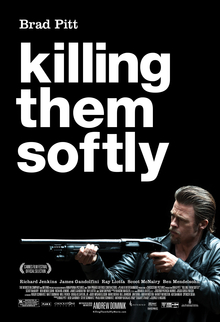
Killing Them Softly

As an author, the name George V. Higgins doesn't set off trip wires and alarms about all the classics he's written. His fans love him though, love him for his bestselling crime novels that brought the darkness, reality and extreme violence and betrayals of the criminal underworld to life. I'd seen -- but haven't read -- The Friends of Eddie Coyle and liked it. One of Higgins' novels, Cogan's Trade, received a big screen adaptation last year, 2012's Killing Them Softly.

With the help of a businessman, Squirrel (Vincent Curatola), an ex-con, Frankie (Scott McNairy) and a drug addict acquaintance, Russell (Ben Mendelsohn), have a plan to net some easy money. Frankie and Russell will rob an illegal high stakes poker game run by Markie Trattman (Ray Liotta), the owner of a ring of illegal games. In his past, Markie secretly took down one of his own games, and Squirrel intends to set him up as the fall guy for his upcoming job. The actual robbery goes down pretty smoothly, but the fall-out is severe. With mob ties to the card game, a feared enforcer, Jackie Cogan (Brad Pitt) is called in to handle the situation. He's got to find out who was involved, who was behind it, and who's lying to him. Brutality, intimidation, straight murder, Jackie isn't afraid to pull out all the stops to find out what he needs to know and get paid in the process.

What I liked most about this film noir-like crime flick is simple. Based off a novel Higgins wrote in the 1970s, 'Killing' feels like those down and dirty crime dramas of the 1970s. There is a throwback feel to it that works on an effortless level. Some of the style, especially Pitt with his slicked back hair and duded up look, has that retro feel. Mostly though, it's that ever-present sense of doom. In this criminal world as the movie presents, there is no hope, no light, no potential for happiness in the end. Anyone and everyone is trying to look out for No. 1. Betrayals, murder, backstabbing, all are fair if it helps you get somewhere or something. That ultra-dark cynicism plays well. We know from the start that none of what we are about to see will go down smoothly. Blood will be spilled and money will be made, but at what cost?

That sounds like it's right up my alley, doesn't it? An almost artsy feel of a 1960s/1970s French crime drama mixed with the tones of a barebones American crime drama from the 1970s? That's got to be good, right? Well, it never amounts to much. This movie plays like a dirtier, far more foul-mouthed version of something Aaron Sorkin would have written. 'Killing' is absolutely obsessed with dialogue. When written well, that can be enough to carry a movie, but the dialogue here gets tedious and serves no real purpose at a certain point. How many times can we hear Frankie and Russell talk about their sexual preferences before we just become numb to it all? I appreciate a slower, more character driven story that doesn't focus exclusively on action, but it's got to go somewhere. We get a long dialogue scene.........and another.........and another. An already short movie (in running time at least) at 97 minutes, it feels far longer, and I was using the fast forward option liberally.

What ends up being the biggest waste here is the cast. There's lots of dialogue here, but it feels like actors showing off but without any substance. Pitt is a bright spot (not a surprise) as brutal, quiet and effective Jackie, a man who has a special skill -- enforcing/killing -- and puts it to his advantage. McNairy and Mendelsohn are appropriately slimy while Liotta isn't given much to do unfortunately as Trattman, a marked man. James Gandolfini plays Mickey, a down on his luck hit man who Jackie recruits for another job, hamming, whoring and drinking it up. Richard Jenkins is maligned and beaten down as Driver, Jackie's link to the mob. Sam Shepard makes a bizarrely quick one-scene cameo as Dillon, an older enforcer with the biggest reputation around.

The story itself has some flaws, but I think director/writer Andrew Dominik makes a really bad style decision. Any transition scene -- car driving, men walking, whatever -- has a voiceover being played over the visual. We hear George W. Bush and Barack Obama talking about the economic crisis, country unity, working together. It all comes together in the end in the final scene, but it's not worth the payoff we get. Instead, it comes across as a heavy-handed, obnoxious stylish storytelling device that handicaps the movie. As a film, it just can't quite figure out what's going on. Is it darkly funny? Just dark? A metaphor for something bigger, more profound? All of the above, none of it? If you're going to tell a crime story, do it. Don't get all mixed up in a message about America's current economic state.

Too bad overall. Lots of potential, and when it works in small snippets, it reminds me of a mix between The Departed and No Country for Old Men. Too often though it doesn't do enough to give it a recommendation (even a mild one). Sorry to report I came away disappointed in a big way.

Killing Them Softly (2012): **/****

Sunday, May 12, 2013

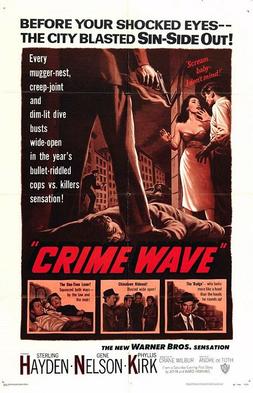
Crime Wave

I've been thinking about this for three days now since I watched 1954's Crime Wave, and I've got nothing. I really do try to come up with interesting intros to the reviews, even taking some pride in it. I'm stumped here though so let's cut to the chase. A film noir with a solid cast and director, I liked this movie a lot. Good enough? Yeah, let's get going.

In the dead of night in Los Angeles, three escaped convicts led by Doc Penny (Ted de Corsia) rob a gas station, grabbing $130, but as they make their getaway, an investigating police officer on patrol gets in their way and is callously gunned down. The news spreads through police departments/offices throughout the city, and in minutes, a huge manhunt led by Lt. Sims (Sterling Hayden) is under way. The city is all but shut down in hopes of capturing the trio, but they seem to have disappeared. Sims and the police start to investigate where they could be hiding with Sims thinking they've holed up somewhere with an ex-con. Suspect No. 1? An ex-con named Steve Lacey (Gene Lacey) who Sims put away years ago and has supposedly gone clean. Time is running out though, and there's a chance that maybe the crooks slipped away, the murder going unresolved.

I come away more and more impressed with the entire genre of film noir flicks the more I'm introduced to them. I was always aware of the more well-known, well respected noirs, but as I try to review more and more reviews, I'm finding more and more worthwhile entries to the genre. This one from director Andre de Toth is one that doesn't get much in the way of recognition, but it's everything that's right about the genre. It was filmed on location in Los Angeles, Burbank and Glendale, its shadowy streets, alleys and neighborhoods providing a backdrop to the story. It looks great, and it doesn't waste any time with its 75-minute running time. Cops, crooks, and those caught in the middle. Hard to mess up that formula, but de Toth does a great, workmanlike job here.

Early on in 'Crime,' I thought I was watching a quasi-remake of Jules Dassin's 1948 noir The Naked City. That film plays almost like a documentary of how the cops handle the investigation following a crime. Seeing both the police perspective and that of the crooks on the run, 'Crime' is similar in its portrayal. We see suspects brought in for questioning, the police searching for clues, following any leads that might lead to bringing the cop killers to justice. The story takes an interesting, even surprising turn in the second half, focusing more on Nelson's Steve and his troubles. He's moved on from his criminal past, marrying Ellen (Phyllis Kirk), a woman who accepts what he was but loves him for what he is now. This goes down the more traditional route in its noir roots, Steve, Sims and the police, and Doc and the crooks all converging on a collision course.

As far as casting goes, 'Crime' lacks the star power of more well-known film noirs, but I liked the cast. Hayden especially stands out as Lt. Sims, a veteran police officer who's seen just about everything the streets have to offer. Early on, he's so driven -- even obsessed -- I thought the story might have him develop into the bad guy. As the villain, de Corsia is appropriately greasy/slimy with a young Charles Bronson (listed as Buchinsky) and Nedrick Young as his convict cohorts. Jay Novello plays a doctor and ex-con who accidentally killed a patient, now working as a vet who gets caught up in the manhunt while the uncredited duo of Timothy Carey and Jim Hayward as two other ex-cons brought into Doc's plan. Dub Taylor makes a quick appearance as the gas station attendant while Hank Worden plays Steve's trusting boss.  

Not too much analysis required here. It's a good film noir with a solid story, good casting and quick-moving pacing. Not a hugely well known film noir, but one I enjoyed a lot. Oh, and 1950s Los Angeles looks pretty cool. It almost feels like Joe Friday should come in to assist on the investigation.

Crime Wave (1954): ***/****

Thursday, April 25, 2013

Dangerous Mission

Having produced movies since the 1930s, RKO Pictures had to try different things to keep up with movies from other studios with more money to burn. They had to try something to keep up, giving audiences a reason to come out and see their films. Take 1954's Dangerous Mission, a generally pretty normal noir-ish film that capitalizes on some cool location shooting.

Witness to a mob killing in a night club, Louise Graham (Piper Laurie) is on the run with both mobsters and the police looking for her. She's hidden out in Glacier National Park, starting a job at a souvenir stand at one of several hotels offered to tourists. As the search intensifies -- the mob wanting to kill her, the police wanting to bring her in as a witness -- several newcomers have arrived in the park, including smooth-talking New Yorker Matt Hallett (Victor Mature), an ex-Marine. What are his intentions? Is he "visiting" to protect Louise or to kill her? Looking out for Louise's safety, Park Ranger Joe Parker (William Bendix) starts to investigate the newcomer, but keeps his eye on some others, including amiable photographer Paul Adams (Vincent Price).  Just what is everyone up to?

It doesn't take a nuclear physicist to figure what the appeal for me was in the 1954 RKO movie. The best thing going for director Louis King's film is the location shooting at Glacier National Park. Yes, I know it's not the same park, but I visited Yellowstone National Park with my family, and visually stunning doesn't begin to describe the place. The same goes for Glacier, especially a time capsule-esque look we get here to 1954 Glacier. Yes, indoor sets are clearly back in Hollywood, but we get enough of Mature, Laurie and Co. actually walking around in the park, including in and around Saint Mary Lake (I think, I could be way off). So while the budget was obviously limited and the scale kept on a smaller level, this B-movie makes the attempt to lure audiences in. It's a gimmick, but one that pays off in the end.

As long as we're throwing compliments out here, we might as well continue on. Clocking in at just 75 minutes, 'Dangerous' isn't too interested in deep back stories, any history at all. Here's the story, here's the characters, now deal with it. Of course, there's more to it than that. The opening 40 minutes is a gem because of a couple of key omissions. For one, that would be that no one is properly introduced. We never actually even see Laurie's Louise, just hear her scream upon stumbling into the murder scene. The same for Mature and Price. In a mobster scene, we see a man's arm draped in a chair -- but nothing else -- with orders to find and kill the witness as quickly as possible. Cue Mature driving into the park (packing a gun) and then the hotel where Louise works. Anyone with two working brain cells can no doubt deduce who's who, but it's another cool gimmick that went a long way. It's Clue: The RKO Film Noir Version.

And even in a small scale flick that doesn't hit the 90-minute mark, there's still some solid casting. I've always been a fan of Mature, and he looks to be enjoying himself here. Throw in Price, Laurie, and Bendix, and you've got a good mix. Also look for Betta St. John as Mary, an Indian girl and friend of Louise, Harry Cheshire as Elster, the guffawing, boozing Texan who may know more than he's letting on, and Steve Darrell as Katoonai Tiller, Mary's father who's wanted for murder. Also keep an eye out for Dennis Weaver in a bit part as a Ranger clerk.

While 'Dangerous' does have some surprising positives, there's some familiar negatives to boot. It is only 75 minutes long, but my estimation, there's probably about 45 minutes of actual story (and that might be generous). To flesh things out, we see an avalanche take out a house party, Mature's Matt getting a loose livewire under control. We get lots of goofing around and drinking and smoking, even a sighting of the dreaded love triangle as Matt and Paul battle -- in the goofy sense -- for Louise. Mature, Price and Bendix later have to put out an immense, fast-moving forest fire. It's ridiculous. They laugh and laugh, but at no point does Louise really question what's going on. She's running for her life but decides to keep a very high profile position in Glacier. Maybe......just maybe......one of these guys wants to kill her? I don't know, I could be way off base here.

And to counter balance the actual shooting on location in Glacier, we also some awfully cheap cutaways to indoor sets posing as Glacier. To say they stand out like a sore thumb is an understatement. It's pretty straightforward stuff, but I still liked it. The purpose seems to be entertainment -- however they get it done -- including a reliance on always dressing Piper Laurie in outfits that look like she's one sneeze away from popping out of her dress/shirt/skirt. Subtle it is not, but B-movies weren't meant to be. Not bad if you find a copy.

Dangerous Mission (1954): ** 1/2 /****  

Friday, February 1, 2013

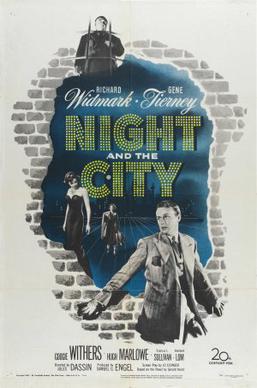
Night and the City

A director with over 20 credits to his name, Jules Dassin has his fair share of classics and memorable movies. But as a director, he hit his stride and reeled off a crazy list of film noir successes in the late 1940s including Brute Force, Thieves' Highway, The Naked City, and welcoming in the new decade, 1950's Night and the City.

An American living in London and trying to make things work with his longtime girlfriend, Mary (Gene Tierney), Harry Fabian (Richard Widmark) wants nothing more than to make it big and make a name for himself. The only problem? Harry has no real charm or talent to do it other than his own charm. In other words, he's a hustler and a con man, always looking for the big thing that will rocket him to the top. In debt and in trouble, Harry might finally have found his in. He meets Gregorious (real-life strongman/wrestler Stanislaus Zbyszko), an internationally renowned wrestler trying to build up the wrestling community/shows in London. It seems like a sure thing, an easy way to make a ton of money, but there's another problem. Gregorious' son, Kristo (Herbert Lom), already has a stranglehold on London wrestling and isn't going to give it away easily.

Released in the heyday of the film noir, 'City' has a trump card that makes it different (and better) from many other noirs of the time. I always think of noirs as taking places in NYC, Los Angeles, any number of small, grimy American towns with all sorts of shady dealings going on in the back alleys. As for this film? Dassin doesn't film his noir in a studio or back lot, he shot on location in and around London. It's a great look to the film, giving the sense of another character in the already incredibly dark story. Sure, much of the story takes place inside (in a studio), but whenever possible, Dassin shot on the streets, alleys, docks and landmarks of London. Filming in black and white, Dassin plays on the usual noir conventions -- darkness, smoke and shadows -- and transports it to London. It's a beyond perfect choice.

Another convention of the noir genre is the general nastiness of the world. Anyone and everyone is looking out for themselves. In other words, always watch your back. Even in the nastiest of movies, there was always that one beacon of light, one good person. Beyond a poor dock owner (Maureen Delaney) who's mixed up in the black market but a good person, there's nary a redeemable character anywhere in sight. In terms of story alone, this is easily one of the darkest, most cynical film noirs I've ever seen. We see the London criminal underworld in all that darkness. But with a talented director like Dassin behind the camera, it's an incredibly stylish if dark look at that world. Dassin uses his camera like few other directors of the time did, including one tracking shot from the back of an open-top convertible navigating London at night. It's a very simple, straightforward scene, but it looks great, and it was certainly far ahead of its time in style.

Still carving out a name for himself as an actor after the star-making role in Kiss of Death, Widmark again shows a knack for playing less than sympathetic characters (if significantly psychotic than Tommy Udo). If there was ever a doomed character in a film noir, Widmark's Harry Fabian has to be near the top of the list. The best part? He's not completely unsympathetic. Harry desperately wants to be something, but he's got no actual way to do it. Instead, he cons, hustles, talks and connives his way into everything he wants and needs. Widmark does a great job showing both sides of this character, but it's apparent from the start where things will end up. In his desperation, Harry simply pushes too far, pitting both sides against each other, and his precarious house of cards hangs in the balance. Another above average performance from a rising star.

And then there's the rest of the nastiness, a whole bunch of similarly despicable characters with their eyes always on the cash. Fabian works for Phillip Nosseross (Francis L. Sullivan), a condescending, immense man who owns a successful night club (maybe a strip club of sorts) with his wife, Helen (Googie Withers). She's also working with Fabian -- behind her husband's back -- to open up a nightclub with a forged license. In a smaller but still effective part, Lom is an ideal intense villain who does have a bit of a human side (however limited). The real-life strongman, Zbyszko is a natural on-screen, a scene-stealer as Gregorious, trying to create a name for a young Greco-Roman wrestler, Nikolas (Ken Richmond). His part is also highlighted by a brutal, knock-down fight with a rival wrestler, the Strangler (Mike Mazurki). Another halfway decent person is Hugh Marlowe's Adam, Mary's neighbor who may have his eyes set on her. Those are the big parts, but even the bit parts are nasty, all of which we see as Harry explores London.

I liked this one a lot right from the start. The only weakness comes in the finale. It's far from slow-moving, but the pacing takes a little time getting to where it wants to be. The issue is that anyone with a working brain knows exactly where it's going. It's not enough to ruin the movie -- not by a long shot -- but it's a minor flaw worth pointing out. An otherwise excellent film noir with a great cast, great look and perfect use of on-location shooting.

Night and the City (1950): ***/****     

Thursday, October 25, 2012

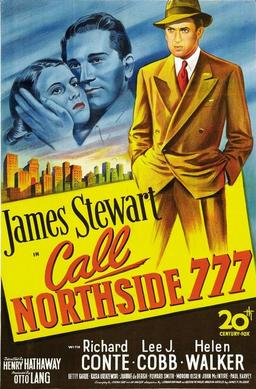
Call Northside 777

This is going to sound simple, but certain movies make me think of the message. Watching old films from basically any Hollywood film is one of my favorite things to do. It can give a window into times long since past. We see towns and cities as they were, not as they are. An all-around solid quasi-documentary, film noir-ish mystery, 1948's Call Northside 777 is a gem.

A reporter for the Chicago Times newspaper, reporter P.J. McNeal (James Stewart) is given a new assignment. An 11-year old murder case from 1932 is in the news, both Frank Wiciek (Richard Conte) and Tomek Zaleska (an uncredited George Tyne) serving 99-year prison sentences for the murder of a Chicago police officer. Wiciek's mother, Tillie (Kasia Orzazewski), a blue collar worker if there ever was, has offered a $5,000 reward for finding the real murder, exonerating her son. McNeal writes the mother's story, but it grabs attention of readers who want more of this story leaving McNeal to explore the long-retired murder case. Ever the suspicious reporter, McNeal goes along but questions the case. Could Frank actually be guilty?

Based on a true story involving the murder of a Chicago police officer (read about it HERE, SPOILERS obviously), 'Call' is an interesting movie for all the right reasons. From director Henry Hathaway, it is part documentary, part investigative procedural, part film noir. The good thing? It moves among those three different genres effortlessly. Clocking in at 112 minutes, it isn't always the quickest-paced flick, but it moves around a lot so that's excusable. A story in the shadows, taking advantage of the black and white photography, it's a great movie to watch.

For me though, this movie is worthwhile for two reasons. One, Hathaway filmed on location in Chicago. This is a great window into late 1940s Chicago. Trivia question and answer for you, but this was the first Hollywood feature film to film on location in Chicago. Where so many films from the 1940s would limit themselves to Hollywood sets, 'Call' gets a whole lot of points for filming in downtown Chicago, but the suburbs as well. Curious what the Windy City looked like 60-plus years ago? This is your movie. The other reason; as a writer who's written for the Chicago Sun-Times, it's a great precursor for All the President's Men. We see how journalists and investigators worked in a pre-Internet age, doing their investigating the old-fashioned way. It's the little things, ain't it?

Already an established star by 1947, Stewart does a solid, workmanlike job as reporter P.J. McNeal. Cynical to a point because the job requires it, McNeal is skeptical of the whole case but takes it on because it's a decent story that readers are curious about it. As the real story comes out though, he starts to question even more, giving Stewart a good chance to flex a little dramatically. Go crusading journalist! Conte is solid in a supporting role as the possibly falsely-convicted Frank while Orzazewski is a scene-stealer as his mother, Tillie. Usually a tough guy actor, Lee J. Cobb plays Kelly, McNeal's editor at the Chicago Times. Joanne De Bergh has a small but essential part as Helen, Frank's wife who supports his innocence. Also look for John McIntire as a former state's attorney trying to cover his butt and an uncredited E.G. Marshall in a small part.

There are some oddities here I feel I have to point out. For a story that's built on the small details, the little pieces of evidence, the movie itself.....isn't. Several rather key questions go unanswered in the end. We find out what happens to Conte's Frank, but what about his supposed partner, Tyne's Tomek? Why is Cobb's editor so dead-set on following this story up? A backstory is hinted at, but never dealt with. The ending is effective, but with a 112-minute movie, it comes together a little quickly, almost like Hathaway ran out of time or money. Still, these are problems but not ones that can ruin a movie. Highly recommend checking this one out.

Call Northside 777 <---trailer (1948): ***/****

Friday, August 31, 2012

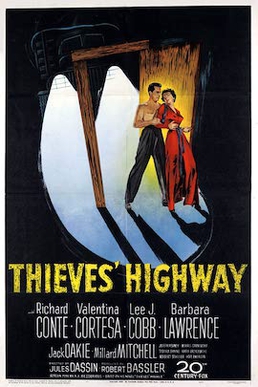
Thieves' Highway

I hate it when that happens. You know what I mean. A movie comes highly recommended in one way or another -- a friend, a movie review, an IMDB rating, a Netflix recommendation -- and you assume you're really going to enjoy it a lot...only to, well, come away somewhat empty. That was my biggest reaction from 1949's Thieves' Highway, a highly recommended if not hugely well-known film noir.

A war veteran returning home to his family and girlfriend, Polly (Barbara Lawrence) in Fresno, Nico Garcos (Richard Conte) is stunned by what he finds. His father has been crippled in a driving accident, but it's more than that. The circumstances were shady at best as conniving businessman Mike Figlia (Lee J. Cobb) also robbed him of $1,900 that he owed him in the process. Nico is enraged, wanting to exact revenge, and he concocts a plan with a down-on-his-luck truck driver, Kinney (Millard Mitchell), to buy and ship a truck-full of apples that Figlia would be interested in purchasing. Nico has his plan, but even he can't be too sure of what is in store for all involved.

From director Jules Dassin, 'Thieves' has a lot going for it. As a film noir, it is highly effective in its amoral portrayal of that seedy underbelly of the criminal black market. Conte is the anti-hero, revenge on his mind and little else. Cobb is the conniving, slimy Figlia, a villain without anything even remotely close to being a redeeming quality. The look of the movie -- much of it shot on location in Fresno and its markets -- is perfect; that blend of shadowy, smoky doom that film noirs specialized in. You just know nothing good is going to come out of that shadowy alleyway, don't you? It is a particularly nasty world, one of manipulation, greed, bribery, and a me-first and screw the rest sort of attitude.

So as a fan of incredibly dark stories, why then didn't I like this one? I can't quite put my finger on it. Maybe I've seen the darkness of such stories and it doesn't hit me as much as it might have audiences in 1949. Mostly though, I never felt a connection to any of the proceedings, whether it be the characters or the developing story. There was a little part of me that was incredibly amused by the portrayal of the seedy underworld of.....produce???? Yeah, I suppose the apple business is pretty cutthroat. I don't mean to minimize the movie like that, but it never felt quite as sinister as it could have. Yes, everyone is in it for themselves, and Conte's Nico wants to right a wrong and exact revenge on the man who crippled his father, but it's never truly an interesting story, for me at least.

The reviews I've read are almost uniformly positive about the casting, and I agree to a point. Many though tout Conte as delivering a career-best performance. I'm not seeing it. I'm a fan -- if not a huge one -- but I always think of Conte at his best in a key supporting role. When he has to carry a movie on his own, I've never thought too highly of those movies. Mostly, he doesn't look too interested in the revenge angle. His easy-going delivery is broken up by these quick outbursts of rage/anger, but they never felt even close to being realistic. On the other hand, Lee J. Cobb is at his best, a villain you love to hate. He has eyes for making as much of a profit as he can with no regard for anything else. If lives are destroyed in the process, so be it. He doesn't care as long as he's making some money.

The rest of the cast are familiar members from the Film Noir Stock Characters list. Valentina Cortese plays Rica, the subtly played hooker with a heart of gold. She takes some money from Cobb's Figlia to keep Nico busy, but quickly realizes the error of her ways (good timing, huh?). I didn't really see much in the way of chemistry between Cobb and Cortese either. Mitchell is solid if unspectacular as the equally ambitious truck driver, Kinney, while Joseph Pevney and Jack Oakie are underused as Pete and Slob, two rival truck drivers trying to move in on Nico's plan. Their bumbling partner act is played for laughs early, but thankfully, the duo takes a turn for the serious as things escalate.

Who knows? Maybe I'm missing something here. I've been guilty of that before. As a fan of dark, realistic stories, I thought this one sounded like a sure thing. The dog eat dog world portrayed in 'Thieves' is interesting on a small level, but it never amounted to much for me. Making it worse, the happy ending comes completely out of left field. At least stick to your guns. If you're going for dark, stay dark.

Thieves' Highway <---trailer (1949): **/****

Monday, August 27, 2012

Chicago Confidential

Part Law and Order, part Dragnet, 1957's Chicago Confidential is an odd duck in movie terms. It's not a bad movie, but it's not good either. You can easily see it playing in some dumpy drive-in or cheap second-run theater. The oddest thing? I can't help but wonder if district attorneys across the country paid to have it made. It's almost a recruiting video for the profession, wrapped up nicely in a quick 75 minutes.

The district attorney in Chicago, Jim Fremont (Brian Keith) seems destined for bigger and better things, maybe even in the governor's office. For now though, he has one huge case in front of him that could make or break his career aspirations. The head of a union, Artie Blaine (Dick Foran), has been accused of murder, killing one of his staff who was supposed to have confidential papers that could possibly cripple the union. It seems like an open and shut case with evidence mounting up against Blaine, but Fremont begins to smell a rat, and he's right. With help from Blaine's girlfriend, Laura (Beverly Garland), Fremont tries to prove the murder was a frame set up by the mob interested in infiltrating the up to now clean union.

Aired recently on TCM in a Dick Foran tribute day, 'Confidential' is a weird one. At just 75 minutes, it plays like an extended TV episode, maybe a two-part episode if anything. With such a short run time, it is too short to make much of an impression and not long enough to be truly bad. As it is, this Sidney Salkow-directed film just sort of is. Not bad, not good, just sort of there. The narration spells every little thing out for us as a moronic audience, and the sets look like they were pilfered from a police procedural TV show.

So why watch this one? It's unabashed desire to show how cool district attorneys is certainly unique if not interesting. You can see Sam Waterston's Jack McCoy of Law and Order taking that leading part that Keith plays. Strong, resolute, and undeterred by the threats of organized crime, Keith's D.A. Fremont is going to accomplish his objectives no matter the detours thrown at him. But it goes beyond that. When he starts to think Foran's Blaine is innocent, he goes on an investigation of his own. In the final scene when everything has been righted, the narrator says proudly "Nothing can stop a district attorney" or something of that ilk. Subtle it is not. Stupidly entertaining? A little.

In a part that doesn't give him much room to flex and show off his acting ability, Keith is serviceable as D.A. Fremont. He's doing the best he can with a poorly written, sometimes dull character. Foran similarly isn't given much to do other than looked worried and/or angry. Garland as the crusading girlfriend ends up being more shrill than anything else, grating with every passing scene. The bright spots? The bad guys, evil in everything they do and reveling in their despicable actions. Douglas Kennedy plays Harrison, the mobster using Blaine's union as a means of moving organized crime into the city. His two brutal thugs are played by John Indrisano and Jack Lambert, both uncredited parts that deserved some more screentime. Elisha Cook Jr. is good in a small part as Candymouth Dixon, a lush who accidentally witnesses the dumping of the body early on. Later the host of the 1960s classic Home Run Derby, Mark Scott plays a cop working with Fremont.

Through all of its faults, 'Confidential' is certainly trying to be something different. In terms of police procedurals, we see the wide variety of techniques used by law enforcement in the 1950s, especially an interesting bit about voice analysis as a key piece of evidence surfaces. But in the end, it never amounts to a whole lot. It's a generally dull story made tolerable by Keith and Foran in the leads.

Chicago Confidential <---trailer (1957): **/****

Friday, January 27, 2012

Pushover

As I mentioned in my review of Billy Wilder's The Apartment, I have a hard time seeing Fred MacMurray as anything but the star of Disney movies like The Absent-Minded Professor and The Shaggy Dog or on the TV show My Three Sons. An all-American Dad if there ever was one so I have trouble going along with his darker roles like in 1954 film noir Pushover

Working a case, middle-aged police officer Paul Sheridan (MacMurray) meets Lona (Kim Novak), the girlfriend of a gangster, Wheeler (Paul Richards) who's recently robbed a bank, escaping with $210,000 but killing a bank guard in the process. Bored with his life, Paul falls for her hard even when she figures out he's a cop. Upset with her situation of an absentee boyfriend, Lona similarly falls for Paul. Paul's precinct is working a stakeout in hopes of catching Lona's boyfriend, putting Paul in an interesting predicament. He comes up with a plan though, leaving his whole life behind him, taking the money if Wheeler shows up, and starting life over with Lona. Nothing comes easy though.

As a film noir, this has all the requisite pieces from the shadowy setting to the femme fatale in Novak to the anti-hero looking out for himself. Making her film debut, Novak is a bright spot as Lona McLane, the gangster's girlfriend frustrated with her situation. The 21-year old beauty was always gorgeous, but director Richard Quine shoots her like an angel....albeit one with a manipulative streak. Drop dead gorgeous came to mind anytime she was on the screen. Also a positive is the opening bank robbery, a silent sequence interrupted by gunfire. The early portions of the movie are especially good, MacMurray and Novak getting away with some risque scenes (for the time at least).

But as things start to develop with the gangster, the girl and the cash, my problems with MacMurray arose once again. I just don't buy him as a bad guy. Check that. He's not a bad guy, just a weak good guy who makes some epically bad, stupid decisions. The reviews pointed out that Novak manipulates MacMurray's Paul into stealing the stolen money, but I didn't see that. He is attracted to a younger, beautiful woman and sees a whole new life through her. The Paul character is still too much of a weakling though, and I had trouble buying him in the lead role. The other police officers include his partner, McAllister (Philip Carey), who's looking for a wife, Lt. Eckstrom (E.G. Marshall), the officer in charge, and Dolan (Allen Nourse), the veteran cop nearing his retirement and pension.

Once MacMurray's plan hits the fan, the story picks up to a pretty breakneck pace. It is 1954, and the Hollywood movie code still dictated that bad guys got their due. So in other words, once Paul starts making bad decisions, there's no end in sight. One mistake rolls onto another one, especially when Lola's neighbor (Dorothy Malone) sees Paul coming out of her apartment. It's only a matter of time before Paul's flimsy house of cards comes tumbling down, and when he does it is epically bad.

I should mention one thing though that ranks up there with MacMurray as some major issues in this 1954 film noir. A stakeout isn't exactly an exciting visual experience. Instead of spicing it up, Pushover actually shows it in all its excruciating detail. In an 88-minute movie, we get uninterrupted shots of policemen looking through binoculars, officers walking to a car and changing positions with other officers, that sort of thing. Pretty exciting, huh? Yeah, you bet. On the whole, the movie is pretty decent, but the negatives are hard to avoid.

Pushover <---TCM trailer/clips (1954): ** 1/2 /****

Saturday, November 19, 2011

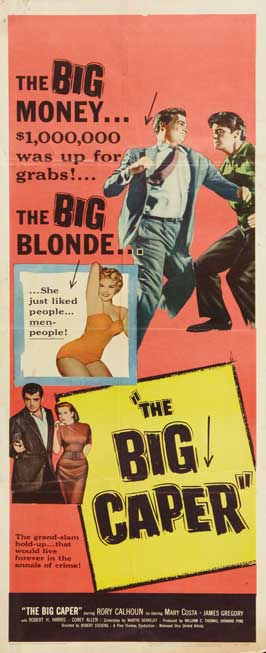
The Big Caper

Nothing flashy, nothing new to the genre, I still very much liked 1957's The Big Caper. Solid cast, interesting B-movie characters, and some bad guys as part of a heist crew that are just too much to believe. A classic? Nope, but it's pretty good for what it is, an entertaining heist movie that doesn't try to be anything that it isn't.

Several months removed from his last successful job, Frank Harper (Rory Calhoun) has ran out of money and has found a new job, one that he could retire on if it goes through. A poorly guarded bank with minimal security twice a month holds the payroll for the Marine base and Camp Pendleton, and to Frank, the money is begging to be taken. He approaches partner and bankroll, Flood (James Gregory), who agrees to go along with the plan. As a set-up, Frank and Flood's girl, Kay (Mary Costa), move into town, buy a gas station and a house, setting up shop as a young, married couple. Creating an alibi, they live there several months in preparation for the job, and then Flood's crew shows up. Let the trouble begin.

The one twist on the familiar noir-heist thriller was the 'what if?' concept added into the story. Setting up a nice, little life for themselves, Frank and Kay become a part of suburban life. Frank makes a profit at his gas station, Kay creates a home for the "couple" and things are looking all around pretty good for them. Kay wants nothing more than to get away from the menacing Flood while Frank's tortured past and childhood seemingly won't let him appreciate what he has.  Kay tries like crazy to convince him otherwise. We're not talking Shakespeare here, but it was nice to see at least some effort by a movie made to bring something new to the heist flick. The effort is very much appreciated.

A Just Hit Play favorite, Calhoun does what he does best here, the bad guy who maybe isn't so bad. He does the tough guy like nobody's business, treading that fine line between straight villain and flawed hero.  It's good to see him in a non-western too where he got pigeon-holed throughout the 1950s.  There's a definite chemistry with Costa, bringing some heart to their scenes together in idyllic suburban life. For you trivia fans, Costa was the voice of Princess Aurora in Disney's Sleeping Beauty so there you go. Being the more obvious sinister villain that he was born to play, Gregory is a scene-stealer, the crime kingpin who puts everything in motion. He doesn't seem like that bad of a guy until some problems arise pre-heist, and well, things go downhill from there. Not big names leading the way, but all strong performances.

This is a 1957 B-movie noirish heist story, and the bad guys have to be very bad to make Calhoun's Frank be sympathetic. Mission accomplished in that department. Let's start with some of Flood's crew, beginning with Zimmer (Robert H. Harris), an explosives expert who will create several diversions during the robbery. His flaw? He's an alcoholic pyromaniac who can never have too much gin. Next, there's Roy (Corey Allen), a fitness freak with some rapist tendencies, or at least some sexual issues that Flood plays up. There's also Harry (Paul Picerni), a ladies man and all-around dope, and Dutch (Florenz Ames), the safecracker who wants nothing to do with the crew or the take, just a flat rate for his services. Quite a crew to say the least, one of the more eccentric, eclectic heist crews I can think of.

So has any heist in a movie ever gone smoothly, including the getaway? Okay, the Ocean's 11 remake doesn't count. Of course George Clooney and Co. are going to pull off the job. It's pretty clear that this heist won't go smoothly. For starters, it's a supposed "easy" job, and we all know how that goes.  Translation = Epic fail. The heist sequence -- about 20 minutes long -- is solid, ratcheting up the tension, but it is in the aftermath where 'Caper' falls short a bit. Yes, it's Doom and Gloom time. I wanted an epically downer ending, but the story and/or script just doesn't have the guts. It is far from a happy ending, but more could have been done. Still good, but it could have been great.

This movie across the board has a lot going for it. Director Robert Stevens keeps things moving with an 84-minute movie that is aided by some California locations and a jazzy score from Albert Glasser that is good in that really obvious way, music blaring to tell you what's coming next. Basically a completely forgotten flick, well worth checking out if you stumble across it.

The Big Caper (1957): ***/****