Ever heard of a carpetbagger? It is a particularly nasty piece of American history. Following the Civil War, they were northerners who moved into the south looking to make a profit off the Reconstruction Era. You see them briefly in Gone With the Wind, even a John Wayne western like The Undefeated, but because it was such a despicable profession of sorts...well, we're not going to see a whole lot of movies about them. When we do, like 1953's Thunder Over the Plains, they're the easiest of villains to root against.
It's 1869, some four years removed from the end of the Civil War, and the wounds are still fresh from the war. Texas has not yet been readmitted to the Union as a state with tensions high as carpetbaggers ravage the Texans trying to get back on their feet with corruption and high taxes. A Robin Hood-like bandit, Ben Westman (Charles McGraw), has stepped forward and with a small, loyal gang wreaks havoc on the carpetbaggers' efforts to earn their ill-got profits. A Texan who fought on the Union side and remains in the cavalry, Capt. David Porter (Randolph Scott) finds himself in a sticky situation. He tends to agree with Westman's actions, but he's honor-bound by duty to try and bring Westman to justice. All sides are pulling at the captain, both inward and outward, as he deals with pressure from his own commander, his wife, his fellow officers and the $-for-eyes carpetbaggers.
By the 1950s, star Randolph Scott was doing westerns exclusively. From 1945 on, Scott only made two non-western films. Think about that. This was a man who knew what he wanted, what he liked doing at work, and what audiences wanted to see him do. John Wayne would take a similar approach in the latter stages of his legendary career. The issue becomes that other than Scott's pairings with director Budd Boetticher (7 different films) and later Sam Peckinpah (Ride the High Country), his 1950s westerns are typically okay at best and dull and far too familiar at worst. Unfortunately, 'Thunder' falls into that category. While it has some potential and Scott is reliable as ever, it's just missing that special something and ends up going off the rails near the halfway point.
That ends up being the most frustrating part in this western from director Andre de Toth. 'Thunder' has a ton of potential. For a 1953 western, it's surprisingly dark. The post-Civil War setting in Texas during Reconstruction isn't exactly commonplace in the genre. There is a variety of characters with some great heroes and equally awful villains. But in a movie that runs just 82 minutes, it can't sustain that energy. The story begins to meander near the 45-minute mark and limps to the finish. One pretty major subplot isn't even addressed or given a worthwhile resolution....so yeah, that kinda sucks. Everything gets all jumbled together with too many characters and twists and secondary plots, and the ship never rights itself. A western that could have been pretty good ends up being disappointing and below average.
So while I'm not a huge fan of Randolph Scott's western, I am a big fan of Scott himself. This is a part he specialized in, the resolute, loyal and tough as nails western hero who's going to do what's right no matter what it takes. A sheriff, a cavalry officer, a drifter, he played tweak versions on this throughout the last 17 years of his career and did it well. He's undone by a script that has his Capt. Porter simply trying to keep too many plates spinning. At home, his wife (Phyllis Kirk) incessantly talks about leaving for a different post. At the fort, his friend and commander (Henry Hull) nags and nags without actually offering any help. As well, a new officer arrives in the form of Capt. Bill Hodges (Lex Barker), who resents the posting, isn't too partial about using his new silver pistol and has his eyes set on Mrs. Porter. It's not Scott's fault. All the way, he's going for it. A true pro even in one of his lesser efforts.
Who else to look for? Buried deep in the credits are Hugh Sanders and Elisha Cook Jr. as the corrupt carpetbagger and the the equally corrupt tax commissioner sticking it to recovering Texas. In the familiar face department, look for Lane Chandler, James Brown and a very young Fess Parker in supporting roles.
I wish I liked this one more. Scott is excellent, and McGraw's Ben Westman is a very cool character that is underutilized. I would have loved to see a movie that focused far more on those two characters and their very interesting dynamic. As is, 'Thunder' disappoints. It has potential, but it never delivers unfortunately.
Thunder Over the Plains (1953): **/****
The Sons of Katie Elder
"First, we reunite, then find Ma and Pa's killer...then read some reviews."
Showing posts with label Elisha Cook Jr.. Show all posts
Tuesday, March 17, 2015
Monday, April 28, 2014
Johnny Cool
Some faces just stick with you as you watch more and more movies. A glare, a stare, a smile, a laugh, a maniacal laugh at that, just something easily remembered. Henry Silva qualifies on basically all of those things, a character actor who made a career out of playing supporting parts, usually crazy, psychopathic villains. He was GOOD at it, beyond good, a great bad guy. Then there's 1963's Johnny Cool where Silva got a starring role as the definition of an anti-hero bordering on out-and-out bad guy.
As a young teenager in 1940s Sicily with World War II raging, young Salvatore Giordano sees his mother killed by a German soldier. He joins the Italian partisans, becoming a hero across the countryside both during the war and after. Years pass and now Salvatore (Silva) is infamously known around the country and even internationally. Some know him simply as a bandit chieftain, others as a modern day Robin Hood. An exiled American gangster, Johnny Colini (Marc Lawrence), arranges a faked death for Salvatore as he has far bigger plans for him. Colini teaches Salvatore how to act and look like a gentleman, but more importantly he turns him into an unstoppable killer. His intended targets? The men who helped orchestrate Colini's exile. If Salvatore -- taking the gangster's name -- can pull it off, Colini's empire will be his.
Yikes. What a vicious, brutal movie. From director William Asher, it's even darker when you consider it was released in 1963. Playing like a hard-boiled, brutal, in your face film noir, 'Cool' is the definition of a B-movie. It's gritty and doesn't feel faked from beginning to end. While there are indoor/studio shots, there is also plenty of on-location scenes from New York City to Los Angeles to Las Vegas. The gloomy, impending doom, jazz-heavy score from Billy May and Johnny Worth permeates Asher's gangster/underworld story. This is a story based in smoky nightclubs, in backroom gambling halls, in gangsters' offices in high rises. Filmed in black and white, there's a great, throwback style throughout. I didn't love the movie -- little slow-moving at times -- but it does have a lot going for it.
From possibly unhinged supporting player to...partially unhinged leading player....Yeah, okay, maybe this part isn't a huge departure for Silva, but it's a chance he doesn't disappoint with. While there's a strong ensemble working with him, this is Silva's movie, plain and simple. It's cool to see the transformation his character goes through, from revenge-seeking teenager to infamous bandit to killing machine. It would have been cool to see some more background, more motivation -- is he solely interested in riches and fame? Is it something else, something more? -- but we see a man who becomes obsessed with achieving his goal. It's pretty apparent from the second we meet Salvatore/Johnny that this is one doomed dude, but the route he takes is certainly fascinating. Silva brings that intensity we've come to expect from the veteran character actor. A very interesting part.
The rest of the cast has its positives and negatives. Ever seen 1960s TV sitcom Bewitched? Yeah, Samantha herself, Elizabeth Montgomery plays Darien, a divorced woman looking for some excitement and getting more than she figured when she joins up with Silva's Johnny. How about some of Johnny's hopeful victims? There's Telly Savalas (sporting some hair), Jim Backus, John McGiver Brad Dexter and Mort Sahl. If that wasn't enough, also look for Joey Bishop, Sammy Davis Jr., Richard Anderson, Elisha Cook Jr. Beyond Montgomery and Savalas, no one on this list is around for more than a couple minutes, the story almost becoming a revolving door of quick cameos. Still, cool to see some big names like this all in one cast.
Mostly though, this is a dark movie to sit back and watch without much in the way of a sympathetic character. Silva's Salvatore/Johnny becomes a killing machine who's beyond saving. Fascinating to watch, far from an even remotely sympathetic anti-hero. Much of the violence is off-screen, but it's pretty hardcore just the same. You don't have to see it to know that a man getting bashed in the head with a shotgun is gonna be rather graphic. People are dispatched with no build-up, no tension. Just BOOM! You're dead. And that ending....wow, just wow. We don't see what's going on, but the foreshadowing is rough. An interesting movie, but beware of what you're getting into.
Johnny Cool (1963): **/****
As a young teenager in 1940s Sicily with World War II raging, young Salvatore Giordano sees his mother killed by a German soldier. He joins the Italian partisans, becoming a hero across the countryside both during the war and after. Years pass and now Salvatore (Silva) is infamously known around the country and even internationally. Some know him simply as a bandit chieftain, others as a modern day Robin Hood. An exiled American gangster, Johnny Colini (Marc Lawrence), arranges a faked death for Salvatore as he has far bigger plans for him. Colini teaches Salvatore how to act and look like a gentleman, but more importantly he turns him into an unstoppable killer. His intended targets? The men who helped orchestrate Colini's exile. If Salvatore -- taking the gangster's name -- can pull it off, Colini's empire will be his.
Yikes. What a vicious, brutal movie. From director William Asher, it's even darker when you consider it was released in 1963. Playing like a hard-boiled, brutal, in your face film noir, 'Cool' is the definition of a B-movie. It's gritty and doesn't feel faked from beginning to end. While there are indoor/studio shots, there is also plenty of on-location scenes from New York City to Los Angeles to Las Vegas. The gloomy, impending doom, jazz-heavy score from Billy May and Johnny Worth permeates Asher's gangster/underworld story. This is a story based in smoky nightclubs, in backroom gambling halls, in gangsters' offices in high rises. Filmed in black and white, there's a great, throwback style throughout. I didn't love the movie -- little slow-moving at times -- but it does have a lot going for it.
From possibly unhinged supporting player to...partially unhinged leading player....Yeah, okay, maybe this part isn't a huge departure for Silva, but it's a chance he doesn't disappoint with. While there's a strong ensemble working with him, this is Silva's movie, plain and simple. It's cool to see the transformation his character goes through, from revenge-seeking teenager to infamous bandit to killing machine. It would have been cool to see some more background, more motivation -- is he solely interested in riches and fame? Is it something else, something more? -- but we see a man who becomes obsessed with achieving his goal. It's pretty apparent from the second we meet Salvatore/Johnny that this is one doomed dude, but the route he takes is certainly fascinating. Silva brings that intensity we've come to expect from the veteran character actor. A very interesting part.
The rest of the cast has its positives and negatives. Ever seen 1960s TV sitcom Bewitched? Yeah, Samantha herself, Elizabeth Montgomery plays Darien, a divorced woman looking for some excitement and getting more than she figured when she joins up with Silva's Johnny. How about some of Johnny's hopeful victims? There's Telly Savalas (sporting some hair), Jim Backus, John McGiver Brad Dexter and Mort Sahl. If that wasn't enough, also look for Joey Bishop, Sammy Davis Jr., Richard Anderson, Elisha Cook Jr. Beyond Montgomery and Savalas, no one on this list is around for more than a couple minutes, the story almost becoming a revolving door of quick cameos. Still, cool to see some big names like this all in one cast.
Mostly though, this is a dark movie to sit back and watch without much in the way of a sympathetic character. Silva's Salvatore/Johnny becomes a killing machine who's beyond saving. Fascinating to watch, far from an even remotely sympathetic anti-hero. Much of the violence is off-screen, but it's pretty hardcore just the same. You don't have to see it to know that a man getting bashed in the head with a shotgun is gonna be rather graphic. People are dispatched with no build-up, no tension. Just BOOM! You're dead. And that ending....wow, just wow. We don't see what's going on, but the foreshadowing is rough. An interesting movie, but beware of what you're getting into.
Johnny Cool (1963): **/****
Wednesday, November 20, 2013
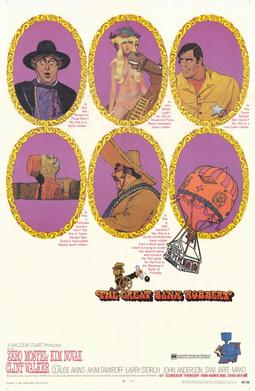
The Great Bank Robbery (1969)
From banks to trains, stagecoaches to payrolls and everything in between, wild west bandits, robbers and thieves had plenty of choices as to who and where to rob. But how about an impenetrable bank built specifically to hold back any would-be robbers? That's the basis for 1969's The Great Bank Robbery, a western spoof.
Having just pulled off a successful robbery of a government gold shipment, notorious outlaw Slade (Claude Akins) heads to the town of Friendly, Texas to stash his takings in a bank built by outlaws for outlaws. No one....no one can rob it. Well, that perfect bank is about to be tested. A con man and robber posing as a priest, Rev. Pious Blue (Zero Mostel), with his assistants, including "Sister" Lyda (Kim Novak), to tunnel into the bank. At the same time, a Mexican bandit (Akim Tamiroff), and his gang are prepping for an attack on the town and bank. Also, a Texas Ranger, Ben Quick (Clint Walker), has been sent to Friendly to investigate and to see if he can get into the bank too. His plan? Hire a group of Chinese laundry workers to tunnel into the bank as well. Well, this should be interesting as all these different groups unknowingly working toward the same goal.
Western comedies usually aren't my thing....like at all. This one worried me some with its low IMDB rating and generally across the board negative reviews. Still, the cast sounded pretty appealing, and who am I kidding? I'll give any western -- even a spoof-life comedy -- a shot when it comes right down to it. Well, I'm really glad I did. Is it dumb, even too stupid for its own good? Oh, yes, very much. Director Hy Averback works on a straightforward, broad comedic strokes level. This is not any subtle English humor. This is stereotyped Mexican bandits and Chinamen, one goofier situation on top of each other, and a madcap finale that includes colliding horses and wagons, a getaway via a hot air balloon and a cannon cutting loose on a church steeple. Nothing academic, smart or subtle here. We're talking LAUGH! moments. That said, I cracked up and liked it a lot.
Committing to the goofiness is a very solid cast that embraces the stupid. Walker plays the straight man, Texas Ranger Ben Quicky who is a good trailsman, a fast draw with his pistol and a gentleman to the end. Mostel is a scene-stealer as Reverend Pious Blue, a con man with an eye on a pot of gold. He even gets a goofy musical number with a boys choir that comes out of nowhere. Novak gets to sex kitten it up as Sister Lyda, always with a couple strategic buttons undone here and there. Lyda ends up being a diversion for the questioning Ranger Quick. Their scene together when Lyda gives Ben some peyote candy is priceless (watch it HERE), the Ranger no idea he's hallucinating. As for Pious' "assistants," look for John Fiedler as Br. Dismas (explosives), Peter Whitney as Br. Jordan (tunneling/engineering), and Sam Jaffe as Br. Lilac (art forger). In addition to the stereotypical (if fun) Mexican bandit, Papa, played by Tamiroff, is Larry Storch as his dim-witted but well-meaning son, Juan.
My favorite part goes to western veteran/regular and character actor Claude Akins as the outlaw and man in black, Slade. His part is underplayed to perfection in putting a new spin on that familiar character of the western baddie. Akins as Slade is a philosophical wondering man, calling all those around him "Scum" and "Scum of the Earth." When he shoots people -- kinda a must in the business he's chosen -- he questions "Why do they always make me do that?" He's a brooding, almost depressed man, always keeping his right hand man, Jeb (Elisha Cook Jr.), down with a series of threats and putdowns. A great, scene-stealing part for the always reliable Claude Akins. Also look for John Anderson as Kincaid, the crooked mayor and bank owner, Mako as Secret Agent Fong, working with Quick to find out what's going on, and Ruth Warrick as Mrs. Applebee, a curvy townswoman who takes an interest in Reverend Pious.
I can appreciate this comedy isn't rewriting the genre, and maybe it isn't even that good. But I keep coming back to one of my old standbys. Was I entertained? Throughout, even if that madcap finale is a little much and the movie just sort of ends. The always reliable Clint Walker, sex kitten Novak with a quasi-nude scene, Akins in a memorable part, there's a lot going for this comedic western that isn't trying to rewrite the genre. It's supposed to be fun and goofy and stupid. I liked it throughout.
The Great Bank Robbery (1969): ***/****
Having just pulled off a successful robbery of a government gold shipment, notorious outlaw Slade (Claude Akins) heads to the town of Friendly, Texas to stash his takings in a bank built by outlaws for outlaws. No one....no one can rob it. Well, that perfect bank is about to be tested. A con man and robber posing as a priest, Rev. Pious Blue (Zero Mostel), with his assistants, including "Sister" Lyda (Kim Novak), to tunnel into the bank. At the same time, a Mexican bandit (Akim Tamiroff), and his gang are prepping for an attack on the town and bank. Also, a Texas Ranger, Ben Quick (Clint Walker), has been sent to Friendly to investigate and to see if he can get into the bank too. His plan? Hire a group of Chinese laundry workers to tunnel into the bank as well. Well, this should be interesting as all these different groups unknowingly working toward the same goal.
Western comedies usually aren't my thing....like at all. This one worried me some with its low IMDB rating and generally across the board negative reviews. Still, the cast sounded pretty appealing, and who am I kidding? I'll give any western -- even a spoof-life comedy -- a shot when it comes right down to it. Well, I'm really glad I did. Is it dumb, even too stupid for its own good? Oh, yes, very much. Director Hy Averback works on a straightforward, broad comedic strokes level. This is not any subtle English humor. This is stereotyped Mexican bandits and Chinamen, one goofier situation on top of each other, and a madcap finale that includes colliding horses and wagons, a getaway via a hot air balloon and a cannon cutting loose on a church steeple. Nothing academic, smart or subtle here. We're talking LAUGH! moments. That said, I cracked up and liked it a lot.
Committing to the goofiness is a very solid cast that embraces the stupid. Walker plays the straight man, Texas Ranger Ben Quicky who is a good trailsman, a fast draw with his pistol and a gentleman to the end. Mostel is a scene-stealer as Reverend Pious Blue, a con man with an eye on a pot of gold. He even gets a goofy musical number with a boys choir that comes out of nowhere. Novak gets to sex kitten it up as Sister Lyda, always with a couple strategic buttons undone here and there. Lyda ends up being a diversion for the questioning Ranger Quick. Their scene together when Lyda gives Ben some peyote candy is priceless (watch it HERE), the Ranger no idea he's hallucinating. As for Pious' "assistants," look for John Fiedler as Br. Dismas (explosives), Peter Whitney as Br. Jordan (tunneling/engineering), and Sam Jaffe as Br. Lilac (art forger). In addition to the stereotypical (if fun) Mexican bandit, Papa, played by Tamiroff, is Larry Storch as his dim-witted but well-meaning son, Juan.
My favorite part goes to western veteran/regular and character actor Claude Akins as the outlaw and man in black, Slade. His part is underplayed to perfection in putting a new spin on that familiar character of the western baddie. Akins as Slade is a philosophical wondering man, calling all those around him "Scum" and "Scum of the Earth." When he shoots people -- kinda a must in the business he's chosen -- he questions "Why do they always make me do that?" He's a brooding, almost depressed man, always keeping his right hand man, Jeb (Elisha Cook Jr.), down with a series of threats and putdowns. A great, scene-stealing part for the always reliable Claude Akins. Also look for John Anderson as Kincaid, the crooked mayor and bank owner, Mako as Secret Agent Fong, working with Quick to find out what's going on, and Ruth Warrick as Mrs. Applebee, a curvy townswoman who takes an interest in Reverend Pious.
I can appreciate this comedy isn't rewriting the genre, and maybe it isn't even that good. But I keep coming back to one of my old standbys. Was I entertained? Throughout, even if that madcap finale is a little much and the movie just sort of ends. The always reliable Clint Walker, sex kitten Novak with a quasi-nude scene, Akins in a memorable part, there's a lot going for this comedic western that isn't trying to rewrite the genre. It's supposed to be fun and goofy and stupid. I liked it throughout.
The Great Bank Robbery (1969): ***/****
Labels:
1960s,
Akim Tamiroff,
Claude Akins,
Clint Walker,
Comedy,
Elisha Cook Jr.,
John Anderson,
Kim Novak,
westerns,
Zero Mostel
Monday, August 27, 2012
Chicago Confidential
Part Law and Order, part Dragnet, 1957's Chicago Confidential is an odd duck in movie terms. It's not a bad movie, but it's not good either. You can easily see it playing in some dumpy drive-in or cheap second-run theater. The oddest thing? I can't help but wonder if district attorneys across the country paid to have it made. It's almost a recruiting video for the profession, wrapped up nicely in a quick 75 minutes.
The district attorney in Chicago, Jim Fremont (Brian Keith) seems destined for bigger and better things, maybe even in the governor's office. For now though, he has one huge case in front of him that could make or break his career aspirations. The head of a union, Artie Blaine (Dick Foran), has been accused of murder, killing one of his staff who was supposed to have confidential papers that could possibly cripple the union. It seems like an open and shut case with evidence mounting up against Blaine, but Fremont begins to smell a rat, and he's right. With help from Blaine's girlfriend, Laura (Beverly Garland), Fremont tries to prove the murder was a frame set up by the mob interested in infiltrating the up to now clean union.
Aired recently on TCM in a Dick Foran tribute day, 'Confidential' is a weird one. At just 75 minutes, it plays like an extended TV episode, maybe a two-part episode if anything. With such a short run time, it is too short to make much of an impression and not long enough to be truly bad. As it is, this Sidney Salkow-directed film just sort of is. Not bad, not good, just sort of there. The narration spells every little thing out for us as a moronic audience, and the sets look like they were pilfered from a police procedural TV show.
So why watch this one? It's unabashed desire to show how cool district attorneys is certainly unique if not interesting. You can see Sam Waterston's Jack McCoy of Law and Order taking that leading part that Keith plays. Strong, resolute, and undeterred by the threats of organized crime, Keith's D.A. Fremont is going to accomplish his objectives no matter the detours thrown at him. But it goes beyond that. When he starts to think Foran's Blaine is innocent, he goes on an investigation of his own. In the final scene when everything has been righted, the narrator says proudly "Nothing can stop a district attorney" or something of that ilk. Subtle it is not. Stupidly entertaining? A little.
In a part that doesn't give him much room to flex and show off his acting ability, Keith is serviceable as D.A. Fremont. He's doing the best he can with a poorly written, sometimes dull character. Foran similarly isn't given much to do other than looked worried and/or angry. Garland as the crusading girlfriend ends up being more shrill than anything else, grating with every passing scene. The bright spots? The bad guys, evil in everything they do and reveling in their despicable actions. Douglas Kennedy plays Harrison, the mobster using Blaine's union as a means of moving organized crime into the city. His two brutal thugs are played by John Indrisano and Jack Lambert, both uncredited parts that deserved some more screentime. Elisha Cook Jr. is good in a small part as Candymouth Dixon, a lush who accidentally witnesses the dumping of the body early on. Later the host of the 1960s classic Home Run Derby, Mark Scott plays a cop working with Fremont.
Through all of its faults, 'Confidential' is certainly trying to be something different. In terms of police procedurals, we see the wide variety of techniques used by law enforcement in the 1950s, especially an interesting bit about voice analysis as a key piece of evidence surfaces. But in the end, it never amounts to a whole lot. It's a generally dull story made tolerable by Keith and Foran in the leads.
Chicago Confidential <---trailer (1957): **/****
The district attorney in Chicago, Jim Fremont (Brian Keith) seems destined for bigger and better things, maybe even in the governor's office. For now though, he has one huge case in front of him that could make or break his career aspirations. The head of a union, Artie Blaine (Dick Foran), has been accused of murder, killing one of his staff who was supposed to have confidential papers that could possibly cripple the union. It seems like an open and shut case with evidence mounting up against Blaine, but Fremont begins to smell a rat, and he's right. With help from Blaine's girlfriend, Laura (Beverly Garland), Fremont tries to prove the murder was a frame set up by the mob interested in infiltrating the up to now clean union.
Aired recently on TCM in a Dick Foran tribute day, 'Confidential' is a weird one. At just 75 minutes, it plays like an extended TV episode, maybe a two-part episode if anything. With such a short run time, it is too short to make much of an impression and not long enough to be truly bad. As it is, this Sidney Salkow-directed film just sort of is. Not bad, not good, just sort of there. The narration spells every little thing out for us as a moronic audience, and the sets look like they were pilfered from a police procedural TV show.
So why watch this one? It's unabashed desire to show how cool district attorneys is certainly unique if not interesting. You can see Sam Waterston's Jack McCoy of Law and Order taking that leading part that Keith plays. Strong, resolute, and undeterred by the threats of organized crime, Keith's D.A. Fremont is going to accomplish his objectives no matter the detours thrown at him. But it goes beyond that. When he starts to think Foran's Blaine is innocent, he goes on an investigation of his own. In the final scene when everything has been righted, the narrator says proudly "Nothing can stop a district attorney" or something of that ilk. Subtle it is not. Stupidly entertaining? A little.
In a part that doesn't give him much room to flex and show off his acting ability, Keith is serviceable as D.A. Fremont. He's doing the best he can with a poorly written, sometimes dull character. Foran similarly isn't given much to do other than looked worried and/or angry. Garland as the crusading girlfriend ends up being more shrill than anything else, grating with every passing scene. The bright spots? The bad guys, evil in everything they do and reveling in their despicable actions. Douglas Kennedy plays Harrison, the mobster using Blaine's union as a means of moving organized crime into the city. His two brutal thugs are played by John Indrisano and Jack Lambert, both uncredited parts that deserved some more screentime. Elisha Cook Jr. is good in a small part as Candymouth Dixon, a lush who accidentally witnesses the dumping of the body early on. Later the host of the 1960s classic Home Run Derby, Mark Scott plays a cop working with Fremont.
Through all of its faults, 'Confidential' is certainly trying to be something different. In terms of police procedurals, we see the wide variety of techniques used by law enforcement in the 1950s, especially an interesting bit about voice analysis as a key piece of evidence surfaces. But in the end, it never amounts to a whole lot. It's a generally dull story made tolerable by Keith and Foran in the leads.
Chicago Confidential <---trailer (1957): **/****
Saturday, February 25, 2012
Drum Beat
History provides all sorts of little tidbits, small, little-known stories that are often enough lost in the history books. The development of the American west had countless examples of this in the 19th Century, small-scale incidents that were major at the time, but were generally forgotten. Made in 1954, Drum Beat is a solid and generally forgotten western telling the story of the Modoc War in 1872 and 1873.
A well-known and respected Indian fighter, Johnny MacKay (Alan Ladd) has been tasked with a mission from President Grant (Hayden Rorke). In the Oregon territory, the Modoc tribe has left the reservation and causing problems for the white settlers. Johnny is hired as a peace commissioner with the hopes of both the white settlers and and Modoc Indians signing a treaty that will bring a halt to all the violence. He is skeptical of the two sides working together, but Johnny travels back west hoping to meet with Captain Jack (Charles Bronson), the chief of this group of Modocs. The Indians are less than cooperative though, and peace won't come easily.
From director Delmer Daves, this is a BIG western. It isn't an epic that runs 3-hours with intermission and a cast of thousands, but it is nonetheless big. It was filmed in Cinerama and takes full advantage of the on-location shooting in Sonora. You can see and feel the immensity of the frontier as the settlers tangle with the warring Indians. The developing story is somewhat familiar in that sense, but it never feels dull. Yes, there are scenes that rely solely on the natural background, long, uninterrupted scenes of riders moving across a horizon. At 111 minutes, it is a tad long in the tooth, but it's not a deal breaker. Victor Young's score is appropriately sweeping without overpowering anything on-screen, and thankfully the Ballad of Drum Beat is only played over the opening credits.
With Daves at the helm, the story is just solid. He's an underrated, underappreciated director who was consistent throughout his career, directing one excellent movie after another. The story is familiar here -- settlers/whites vs. Indians -- but it doesn't feel familiar. Credit to Ladd and Bronson there. I really liked Ladd's performance as Johnny MacKay, an Indian fighter who's good at what he does but doesn't necessarily enjoy it. Bronson as an Indian seems like a bad choice, but that too works. It borders on a caricature but never goes too far. He looks out for the best interest of his tribe...at first...only to get swept up in the glory of fighting. Their scenes together are surprisingly good, especially their final scene in the closing minutes. The fight leading up to that scene ain't too shabby either.
An ensemble cast of familiar faces backs up Ladd and Bronson, Audrey Dalton leading the way as Nancy, an Easterner who's moved west to help the cause and surprise, surprise...falls for Ladd's Johnny! Who saw that coming?!? Oh, everybody? My bad. Marisa Pavan and Anthony Caruso rise above stereotypes as Toby and Mannock, two peaceful Modocs working with Johnny and not against him. Robert Keith plays Bill, an older frontiersman with a grudge while Rodolfo Acosta and Perry Lopez play two of Bronson's warriors. Look for recognizable character actors Willis Bouchey, Elisha Cook Jr., Strother Martin and Denver Pyle in small parts.
As a quasi-western buff, I do have to poke some holes in this story. A title card starts with 'This is true except for the fictional characters and storylines needed to dramatize the truth.' So basically a cop-out. A true story until the truth isn't entertaining enough. Sonora, Arizona does not look like Oregon in the least, and the Modocs look and are portrayed more like Apaches than any other tribe. Just weird observations that ran through my head. Still a good movie, especially a large-scale battle on a Modoc fortress on an impenetrable rock formation, with an interesting cast.
Drum Beat <---credits/opening (1954): ***/****
A well-known and respected Indian fighter, Johnny MacKay (Alan Ladd) has been tasked with a mission from President Grant (Hayden Rorke). In the Oregon territory, the Modoc tribe has left the reservation and causing problems for the white settlers. Johnny is hired as a peace commissioner with the hopes of both the white settlers and and Modoc Indians signing a treaty that will bring a halt to all the violence. He is skeptical of the two sides working together, but Johnny travels back west hoping to meet with Captain Jack (Charles Bronson), the chief of this group of Modocs. The Indians are less than cooperative though, and peace won't come easily.
From director Delmer Daves, this is a BIG western. It isn't an epic that runs 3-hours with intermission and a cast of thousands, but it is nonetheless big. It was filmed in Cinerama and takes full advantage of the on-location shooting in Sonora. You can see and feel the immensity of the frontier as the settlers tangle with the warring Indians. The developing story is somewhat familiar in that sense, but it never feels dull. Yes, there are scenes that rely solely on the natural background, long, uninterrupted scenes of riders moving across a horizon. At 111 minutes, it is a tad long in the tooth, but it's not a deal breaker. Victor Young's score is appropriately sweeping without overpowering anything on-screen, and thankfully the Ballad of Drum Beat is only played over the opening credits.
With Daves at the helm, the story is just solid. He's an underrated, underappreciated director who was consistent throughout his career, directing one excellent movie after another. The story is familiar here -- settlers/whites vs. Indians -- but it doesn't feel familiar. Credit to Ladd and Bronson there. I really liked Ladd's performance as Johnny MacKay, an Indian fighter who's good at what he does but doesn't necessarily enjoy it. Bronson as an Indian seems like a bad choice, but that too works. It borders on a caricature but never goes too far. He looks out for the best interest of his tribe...at first...only to get swept up in the glory of fighting. Their scenes together are surprisingly good, especially their final scene in the closing minutes. The fight leading up to that scene ain't too shabby either.
An ensemble cast of familiar faces backs up Ladd and Bronson, Audrey Dalton leading the way as Nancy, an Easterner who's moved west to help the cause and surprise, surprise...falls for Ladd's Johnny! Who saw that coming?!? Oh, everybody? My bad. Marisa Pavan and Anthony Caruso rise above stereotypes as Toby and Mannock, two peaceful Modocs working with Johnny and not against him. Robert Keith plays Bill, an older frontiersman with a grudge while Rodolfo Acosta and Perry Lopez play two of Bronson's warriors. Look for recognizable character actors Willis Bouchey, Elisha Cook Jr., Strother Martin and Denver Pyle in small parts.
As a quasi-western buff, I do have to poke some holes in this story. A title card starts with 'This is true except for the fictional characters and storylines needed to dramatize the truth.' So basically a cop-out. A true story until the truth isn't entertaining enough. Sonora, Arizona does not look like Oregon in the least, and the Modocs look and are portrayed more like Apaches than any other tribe. Just weird observations that ran through my head. Still a good movie, especially a large-scale battle on a Modoc fortress on an impenetrable rock formation, with an interesting cast.
Drum Beat <---credits/opening (1954): ***/****
Monday, August 30, 2010
The Indian Fighter
During the heyday of the movie western in the 1940s and 1950s, directors like John Ford, Anthony Mann, and Budd Boetticher dominated the box office. Some were bigger scale, others made on a smaller budget with less scope. But while these directors are generally easily remembered for their work, others went about their work as a director producing quality movies that weren't classics at one end or awful bombs at the other. They were typically solid if unspectacular movies that audiences ate up but never left a huge impression.
Hungarian director Andre De Toth made a career out of these movies, hard-hitting westerns that were usually light on the corniness factor and heavy on action and blood and guts that were often ahead of its time. He specialized in westerns and action movies and also ended up doing his fair share of television directing in the 1960s when the offers weren't there to direct movies. I'd seen a couple De Toth movies, and liked them, especially his last movie, Play Dirty, a WWII men on a mission movie starring Michael Caine. But a majority of his movies were westerns, including 1955's The Indian Fighter.
In the years following the Civil War, Sioux chief Red Cloud (Eduard Franz) is dealing with the increased flow of white settlers into his tribe's land. A scout for the cavalry, Johnny Hawks (Kirk Douglas), is doing his best to keep the peace between the Indians and the white settlers heading west. Hawks is leading a wagon train to Oregon and hoping to get through without any incidents, but two saddle tramps (Walter Matthau and Lon Chaney Jr) traveling with the wagon train are looking for gold. The delicate balance for peace is hanging in the balance, and no matter how much Hawks does to keep it together, these two gunmen are looking for trouble and no one's going to stop them.
Wagon train stories are nothing new to the western and go back about as far as the genre goes. Growing up I played my fair share of Oregon Trail on the PC so I'm a fan, but this western was missing something. A simple straightforward story is nothing to shake your head at because I've watched too many movies that go on and on with no real purpose. But this is one leisurely story, seemingly more content to let Douglas romance an Indian girl (Elsa Martinelli) and let the Oregon filming locations fill in any gaps in the story. The locations are gorgeous to look at, but beautiful filming locations always work better for me when they're a key part of the story, not filling in for the story.
I don't have a lot of pet peeves when it comes to movies, but one major issue I've always had is when one actor plays two different roles. I'm not talking twin characters either, just two different people. 'Indian' has two such parts, Harry Landers and Hank Worden playing both an Indian warrior and a cavalry soldier. How hard is it to get another actor to play a bit part that any goon off the street could play? If the budget is that tight, I feel bad for the director. Worse than that, Worden is dubbed with a ridiculously deep voice as a warrior almost like the moviemakers knew they were trying to get away with something with the dual roles. It is just a pet peeve and doesn't usually ruin a movie for me, but it is certainly on my mind as I keep seeing the same actor pop up over and over again.
Besides that complaint, the cast is pretty good, starting with Douglas in the lead. An incredibly gifted physical actor, Douglas was always at home in the westerns where he was allowed to show off, whether it was in a man-to-man fight or his ability to leap onto horses with a jump. His Hawks character is torn between his respect for the Indians and an "obligation" to his white brethren. The love angle is a little weird because Hawks forces himself on Martinelli's Indian girl, she pulls a knife, he backs off, and the next time around when he jumps her again, she's all for it. Seeing Matthau in a villainous turn was cool and former Mrs. Kirk Douglas, Diana Douglas, plays a single mother. There's also supporting roles from Walter Abel, Alan Hale Jr., Ray Teal, and Elisha Cook Jr. as a cavalry photographer.
Now what some earlier westerns often forget is that the west was a pretty nasty place. De Toth embraces that nastiness in terms of betrayals, murders and double crosses while also showing some fairly graphic violence for a movie released in 1955. Stabbings, shootings, scalpings and explosions are never gory and the camera doesn't linger, but it's presented and that's better than a lot of westerns. Some great stuntwork is on display here, and the action scenes are enjoyable in an otherwise average western.
The Indian Fighter <---TCM trailer (1955): **/****
Hungarian director Andre De Toth made a career out of these movies, hard-hitting westerns that were usually light on the corniness factor and heavy on action and blood and guts that were often ahead of its time. He specialized in westerns and action movies and also ended up doing his fair share of television directing in the 1960s when the offers weren't there to direct movies. I'd seen a couple De Toth movies, and liked them, especially his last movie, Play Dirty, a WWII men on a mission movie starring Michael Caine. But a majority of his movies were westerns, including 1955's The Indian Fighter.
In the years following the Civil War, Sioux chief Red Cloud (Eduard Franz) is dealing with the increased flow of white settlers into his tribe's land. A scout for the cavalry, Johnny Hawks (Kirk Douglas), is doing his best to keep the peace between the Indians and the white settlers heading west. Hawks is leading a wagon train to Oregon and hoping to get through without any incidents, but two saddle tramps (Walter Matthau and Lon Chaney Jr) traveling with the wagon train are looking for gold. The delicate balance for peace is hanging in the balance, and no matter how much Hawks does to keep it together, these two gunmen are looking for trouble and no one's going to stop them.
Wagon train stories are nothing new to the western and go back about as far as the genre goes. Growing up I played my fair share of Oregon Trail on the PC so I'm a fan, but this western was missing something. A simple straightforward story is nothing to shake your head at because I've watched too many movies that go on and on with no real purpose. But this is one leisurely story, seemingly more content to let Douglas romance an Indian girl (Elsa Martinelli) and let the Oregon filming locations fill in any gaps in the story. The locations are gorgeous to look at, but beautiful filming locations always work better for me when they're a key part of the story, not filling in for the story.
I don't have a lot of pet peeves when it comes to movies, but one major issue I've always had is when one actor plays two different roles. I'm not talking twin characters either, just two different people. 'Indian' has two such parts, Harry Landers and Hank Worden playing both an Indian warrior and a cavalry soldier. How hard is it to get another actor to play a bit part that any goon off the street could play? If the budget is that tight, I feel bad for the director. Worse than that, Worden is dubbed with a ridiculously deep voice as a warrior almost like the moviemakers knew they were trying to get away with something with the dual roles. It is just a pet peeve and doesn't usually ruin a movie for me, but it is certainly on my mind as I keep seeing the same actor pop up over and over again.
Besides that complaint, the cast is pretty good, starting with Douglas in the lead. An incredibly gifted physical actor, Douglas was always at home in the westerns where he was allowed to show off, whether it was in a man-to-man fight or his ability to leap onto horses with a jump. His Hawks character is torn between his respect for the Indians and an "obligation" to his white brethren. The love angle is a little weird because Hawks forces himself on Martinelli's Indian girl, she pulls a knife, he backs off, and the next time around when he jumps her again, she's all for it. Seeing Matthau in a villainous turn was cool and former Mrs. Kirk Douglas, Diana Douglas, plays a single mother. There's also supporting roles from Walter Abel, Alan Hale Jr., Ray Teal, and Elisha Cook Jr. as a cavalry photographer.
Now what some earlier westerns often forget is that the west was a pretty nasty place. De Toth embraces that nastiness in terms of betrayals, murders and double crosses while also showing some fairly graphic violence for a movie released in 1955. Stabbings, shootings, scalpings and explosions are never gory and the camera doesn't linger, but it's presented and that's better than a lot of westerns. Some great stuntwork is on display here, and the action scenes are enjoyable in an otherwise average western.
The Indian Fighter <---TCM trailer (1955): **/****
Labels:
1950s,
Andre De Toth,
Elisha Cook Jr.,
Kirk Douglas,
Walter Matthau,
westerns
Thursday, August 27, 2009
The Killing
So after watching two Sterling Hayden movies last week on his TCM day and a third thanks to Netflix, The Killling, I've decided I need to go in a different direction with my movies for a little while. To be fair, the two on TCM were B-movies, Ten Days to Tulara and Battle Taxi, but they weren't even good B-movies. I figured The Killing sounded pretty good, but something just didn't click for me in actually watching it.
The story is gritty and realistic especially when considering it was released in 1956. With director Stanley Kubrick at the helm, the movie takes on an almost documentary like feel to it. Fresh out of prison after serving a five-year sentence, Johnny Clay (Hayden) is putting his master plan into effect. With a small crew, Clay intends to knock off a racetrack cash room (not unlike The Split would do 10 years later) on a day when hundreds and thousands of bets will go to the tickettakers. Clay figures the take will be just over $2 million dollars.
Clay has developed a complicated plan that requires split-second timing with help from a handful of people, some who know what they're doing and others who will remain in the dark, as Clay himself will actually pull off the actual robbery in the chaos they cause. But when you bring so many different people together, personality conflicts come up that you can't plan for in advance. Even the most detailed, well thought out plan can go awry with something that comes out of left field. The aftermath of the robbery and the ending provides a nice, little twist with that thought in mind.
I can't throw Hayden under the bus here for his performance because he's an ideal choice for the quiet, hardened ex-con looking to get his life back on track with his wife (Coleen Gray). The whole cast is good in roles that don't require any background or backstory. This is who they are, and Kubrick presents them as that without any unnecessary clutter. Clay's team includes Jay C. Flippen as the bankroller, Ted de Corsia as a cop who'll play an important role in the getaway, Elisha Cook Jr as an attendant with some problems at home with his wife (Marie Windsor), and Joe Sawyer as a bartender at the racetrack.
Watching The Killing some 50 years after its release, my first thought was 'I've seen this before' because it's style and story have been reused and taken into the lexicon of heist and robbery movies. It's not fair to hold that against The Killing because they couldn't account for the impact it would have on the sub-genre, but it is hard not to notice it. Kubrick tells the story in non-linear fashion, showing one character's involvement and then bouncing back 3 hours to another character. The negative to come from this is a very cheesy sounding narrative that sounds like something plunked from a Dragnet episode.
With that type of storyline, the heist is well-handled because we see things before they always know what they mean in the context of the robbery. Two parts especially stand out as Clay hires two men, Timothy Carey as a marksman, Carey's scenes with MASSIVE SPOILERS, and Kola Kwariani as a strongman, Kola's introduction, to cause diversions during the robbery. I liked both subplots and would have liked to know more about them, but maybe that's not what Kubrick was going for. Also, the subplot which becomes a major turning point in the movie, whipped Cook Jr and wife Windsor, are difficult to watch because Windsor is such a nasty character. Her plan with boyfriend Vince Edwards ends up making quite an impact on the aftermath.
I'd like to give The Killing a higher ranking, but I just couldn't get into it. Like I said though, I can't blame the movie itself for that. It set the groundwork for future heist/robbery movies with its style and frankness in dealing with thieves turning on each other and the double and triple cross. Maybe I'll give this one a try down the road because I can appreciate that it is a good movie, just not one I necessarily liked.
The Killing <----trailer (1956): ** 1/2 /****
The story is gritty and realistic especially when considering it was released in 1956. With director Stanley Kubrick at the helm, the movie takes on an almost documentary like feel to it. Fresh out of prison after serving a five-year sentence, Johnny Clay (Hayden) is putting his master plan into effect. With a small crew, Clay intends to knock off a racetrack cash room (not unlike The Split would do 10 years later) on a day when hundreds and thousands of bets will go to the tickettakers. Clay figures the take will be just over $2 million dollars.
Clay has developed a complicated plan that requires split-second timing with help from a handful of people, some who know what they're doing and others who will remain in the dark, as Clay himself will actually pull off the actual robbery in the chaos they cause. But when you bring so many different people together, personality conflicts come up that you can't plan for in advance. Even the most detailed, well thought out plan can go awry with something that comes out of left field. The aftermath of the robbery and the ending provides a nice, little twist with that thought in mind.
I can't throw Hayden under the bus here for his performance because he's an ideal choice for the quiet, hardened ex-con looking to get his life back on track with his wife (Coleen Gray). The whole cast is good in roles that don't require any background or backstory. This is who they are, and Kubrick presents them as that without any unnecessary clutter. Clay's team includes Jay C. Flippen as the bankroller, Ted de Corsia as a cop who'll play an important role in the getaway, Elisha Cook Jr as an attendant with some problems at home with his wife (Marie Windsor), and Joe Sawyer as a bartender at the racetrack.
Watching The Killing some 50 years after its release, my first thought was 'I've seen this before' because it's style and story have been reused and taken into the lexicon of heist and robbery movies. It's not fair to hold that against The Killing because they couldn't account for the impact it would have on the sub-genre, but it is hard not to notice it. Kubrick tells the story in non-linear fashion, showing one character's involvement and then bouncing back 3 hours to another character. The negative to come from this is a very cheesy sounding narrative that sounds like something plunked from a Dragnet episode.
With that type of storyline, the heist is well-handled because we see things before they always know what they mean in the context of the robbery. Two parts especially stand out as Clay hires two men, Timothy Carey as a marksman, Carey's scenes with MASSIVE SPOILERS, and Kola Kwariani as a strongman, Kola's introduction, to cause diversions during the robbery. I liked both subplots and would have liked to know more about them, but maybe that's not what Kubrick was going for. Also, the subplot which becomes a major turning point in the movie, whipped Cook Jr and wife Windsor, are difficult to watch because Windsor is such a nasty character. Her plan with boyfriend Vince Edwards ends up making quite an impact on the aftermath.
I'd like to give The Killing a higher ranking, but I just couldn't get into it. Like I said though, I can't blame the movie itself for that. It set the groundwork for future heist/robbery movies with its style and frankness in dealing with thieves turning on each other and the double and triple cross. Maybe I'll give this one a try down the road because I can appreciate that it is a good movie, just not one I necessarily liked.
The Killing <----trailer (1956): ** 1/2 /****
Subscribe to:
Posts (Atom)