The Sons of Katie Elder

The Sons of Katie Elder
"First, we reunite, then find Ma and Pa's killer...then read some reviews."
Showing posts with label Nehemiah Persoff. Show all posts

Sunday, August 18, 2013

The Comancheros

Following Texas' war for independence with Mexico in 1836, the expansive republic was on its own for government, economy and protection without help from outsiders. Who came to the forefront to help protect the fledgling republic? The Texas Rangers, and no, not the Major League Baseball team, instead a small group of law officers who patrolled Texas trying to protect its citizens. Recurring characters in the western genre, one of the best portrayals of the Rangers is 1961's The Comancheros.

It's 1843 when a Louisiana gambler, Paul Regret (Stuart Whitman), finds himself on the run following an accidental death in a duel. Regret heads for Texas but as he readies to disembark from the riverboat, he is instead arrested for murder by a Texas Ranger, Captain Jake Cutter (John Wayne). The duel was fair by all accounts, but the dead man was the son of a powerful judge who wants vengeance. Intending to bring Regret back to Louisiana, Cutter instead finds himself working with the man. All through the territory, Comanche raiding parties are attacking one ranch and homestead after another. Cutter has long thought the Comanches are being led by a gang of white men who pull the strings, but he has no proof. Posing as a gunrunner and with Regret as his somewhat unwilling partner, Cutter heads into Comanche territory and finds just what he thought he would, a gang of drifters, bandits and killers -- Comancheros -- working with the Comanches. Can they get out alive?

The 1960s were a big time for John Wayne. He wasn't just a box office star, but by now after 30-plus years in the business, he was a screen legend. This was the decade where -- for better or worse -- he started playing himself more than meaty roles like The Searchers, She Wore a Yellow Ribbon, and The Man Who Shot Liberty Valance. His mindset changed some as he started to make movies that typically had one objective....please the audience. These were movies meant to entertain, movies the whole family could go see. They would revolve around action-packed stories, good casts of familiar faces, great locations and whistle-worthy scores, movies like this one, The Undefeated, Sons of Katie Elder, McLintock!, Donovan's Reef and Hatari. This is a prime example of that type of movie. It's fun, exciting and with a whole lot of action. A groundbreaking, innovative western? Nope, but as far as popcorn movies go, it's hard to beat.

This obviously isn't a comedy western, but it isn't as dark and downbeat as the plot description might imply. For me, the best thing going for 'Comancheros' has always been the pairing of Wayne and Whitman, an Odd Couple pairing that works extremely well. It almost plays like a buddy western movie, the resolute Ranger and the roguish gambler. Wayne especially gets to show off a comedic side that most of his movies just didn't allow. His backwoods Ranger mispronounces Monsieur as Mon-sewer, providing some good laughs throughout. Whitman too looks right at home alongside the Duke, the duo exchanging some great dialogue scenes together on the trail. It looks easy watching them. Regret is far from a veteran trailsman, but he picks it up quick. Cutter bristles at times with his prisoner's unique ways, but thrust into a do-or-die situation, they end up becoming unlikely friends. Two good lead performances for sure.

While the A-list names might not be there, 'Comancheros' offers a very solid cast, one all western fans should appreciate. Lee Marvin makes what amounts to a cameo as Tully Crow, a brutal, vicious Comanchero, stealing the show and providing some great moments with Wayne in their scenes together. The one weak point is Ina Balin as Pilar, a beautiful young woman who falls for Regret and vice versa. Her scenes are pretty painful, especially as she "analyzes" love. Nehemiah Persoff is similarly a scene-stealer as Graile, the handicapped, brutal leader of the Comancheros with Michael Ansara as his sadistic henchman, Amelung, and also look for Jack Elam as one of the Comancheros. As for the other Rangers, look for Bruce Cabot as Major Henry and Patrick Wayne as Tobe, a young ranger along on the mission into Comanchero territory. Also look for the beautiful Joan O'Brien as Melinda, a widow who cares deeply for Cutter (and maybe more...uh-oh!) with Wayne's daughter Aissa playing Melinda's daughter.  

Looking at the credits, Michael Curtiz is listed as the director, but Curtiz became sick during filming and was unable to complete the movie, dying soon after its release. Wayne stepped in and directed in uncredited fashion, finishing the movie. The story itself is pretty episodic, the first 45 minutes spent with the hunt and escape and hunt and escape between Regret and Cutter. It covers a lot of ground before the Comancheros are even introduced, but it's never dull and never really slows down. There actually isn't a ton of action, but what's there is enjoyable. What is noteworthy is a talented cast clearly having some fun with a story that's hard not to go along with. Also worth mentioning, Elmer Bernstein's memorable score, especially the theme. Listen to it HERE. Get your popcorn ready, sit back and enjoy this one.

The Comancheros (1961): ***/****

Friday, March 15, 2013

The Dangerous Days of Kiowa Jones

The 1950s and early 1960s were the era of the TV westerns. Countless shows from Bonanza to Gunsmoke, The Rifleman to Rawhide and many more dotted the TV landscape. Audiences wanted to see them, and the studios and channels obliged them. By 1966 though, their popularity was waning a bit. A TV movie that was never picked up as a show, The Dangerous Days of Kiowa Jones, was unfortunately a tad bit too late.

A drifting cowboy on the trail to a job, Kiowa Jones (Robert Horton) stumbles across two prisoners at an isolated cabin guarded by Marshal Duncan (Gary Merrill), a peace officer slowly dying from fever and smallpox. Duncan enlists Jones' help, swearing him in as a deputy to help him transport the duo. The cowboy wants nothing to do with it, but goes along with Duncan's plan just the same. It's less than a day later though when the Marshal dies from the fever, leaving Jones to bring the two prisoners to justice in Fort Smith. There's a problem though. One of the prisoners, Bobby Jack Wilkes (Sal Mineo), has made a standing offer. Anyone who rescues him from the hangman's noose will be rewarded with $2,000. As if his impromptu job wasn't tough enough, now Jones has to defend his prisoners from every man in the territory who can carry a gun.

First shown on TV in 1966, 'Kiowa' wasn't picked up by a network. It's unfortunate because it certainly has some potential. I think the biggest positive is Horton as the titular Kiowa Jones. He had already starred in Wagon Train and A Man Called Shenandoah so he was familiar with audiences and the genre. In other words, he knew what worked. Horton was never a huge star on film or on television, and besides the oh so awful but oh so good The Green Slime, I'd never seen him in anything in either format. The best TV westerns had memorable lead characters, and I feel like Horton's Kiowa Jones certainly had the potential to be a pretty memorable lead.

Why is that you ask? Simple. Like I reviewed recently in A Man Called Gannon, there's something iconic and even a little romantic about the concept of a drifting cowboy. Everything he owns is on his horse with him. He rides from town to town and job to job, living on his own and by his own code of ethics and morals. Horton is able to put a fresh spin on it. His Kiowa Jones is a likable, easy-going cowboy who carries a rifle but doesn't wear a pistol. Thrust into the unlikely position as a deputy, he commits to it because he gave his word. Nothing else. It would be easy to ride out, leave the Marshal behind. He could even hand over his prisoners to any of the gunmen trying to free Bobby Jack. The best part? Kiowa wants nothing to do with the $1,000 reward he would earn by delivering the prisoners. His reasoning? He'd just get in trouble with it. He likes his easy-going lifestyle. That money would just be a hassle. I really, really liked what Horton did with the Kiowa Jones character.

Getting the prisoners to Fort Smith provides about as difficult as you would assume, but 'Kiowa' introduces a solid list of supporting characters along the trail. Doing what seems like a rift on Billy the Kid, Mineo is a scene-stealer as Bobby Jack. He cackles and laughs hysterically, defying Kiowa to just let him go. The dynamic between the two reminded me a little of Anthony Mann's The Naked Spur, albeit on a smaller, less dark level. Nehemiah Persoff is similarly a scene-stealer as Skoda, Kiowa's second prisoner and a gypsy who's accepted his fate with the hangman, predicting what comes with his tarot cards. In an interesting addition, Diane Baker plays Amilia Rathmore, a middle-aged, single, even a little plain woman traveling by wagon to her new teaching post. I especially liked the give and take between her and the trail-wise Kiowa.

On the trail, also look for Royal Dano as Otto, an aging family patriarch out for revenge against Bobby Jack, with his two sons (Lonny Chapman and Zalman King) along for the ride. Harry Dean Stanton and Val Avery make a quick appearance as two greedy bounty hunters tailing Kiowa, Bobby Jack and Skoda with dollar signs for eyes. Robert H. Harris plays Dobie, the hangman.  

Clocking in at 98 minutes, the story in 'Kiowa' is episodic, dealing with one issue at a time before moving on. It is a TV movie so the budget wasn't gigantic. The entire movie is spent on the trail so there's no need for extras or towns. Nighttime scenes are clearly indoor sets, but with my penchant for anything 1960s and/or westerns, there's a certain cheeseball charm to the lack of budget. The music is a little goofy at times, little too light-hearted, but it works. Mostly though, I liked this movie a lot for the casting. I loved Horton as Kiowa. It's a fun part, but there's a darkness to it as evident when the peaceful Kiowa is forced to kill a man. It's a surprisingly dramatic moment in a surprisingly good western. Too bad it was never picked up as a show, but this is a pretty good stand-alone flick on its own.

The Dangerous Days of Kiowa Jones (1966): ***/****

Friday, February 8, 2013

Some Like It Hot

Some movies are just perfect. That's it. They just are. Ridiculously spot-on casting, great direction and writing, and a story and style that have more than withstood the test of time. In 2000, it was even voted the greatest American comedy of all-time. I'm not alone in this stance, but it's one of my favorites, 1959's Some Like It Hot.

Working in 1929 Chicago, down on their luck musicians Joe (Tony Curtis) and Jerry (Jack Lemmon) are looking for any kind of work.....any. Picking up a car to drive to Champaign, they accidentally witness a gangland massacre, gangster Spats Colombo (George Raft) and his crew knocking off seven rival gangsters. The only problem? They were spotted, and now they're desperately on the run. With no money, they resort to the only option available.....posing as female musicians leaving Chicago for Miami with an all-female band. There's no way the ridiculous plan could work, could it? Joe/Geraldine and Jerry/Daphne pass their first test and blend in with the band. Both fall right away for Sugar Kane (Marilyn Monroe), a ukelele-playing singer in the group. Uh-oh, let the hijinks begin, and Spats and his mobsters are still looking for them.

There is chemistry among actors, and then there's chemistry: Some Like It Hot style. I feel comfortable comparing Curtis and Lemmon to Paul Newman in Robert Redford in Butch and Sundance, my high point for on-screen chemistry in a buddy relationship. Other cast pairings were mentioned as director Billy Wilder put his movie together (Curtis and Frank Sinatra as one), but it's hard to imagine any other duo working quite this well. Obviously, you can attribute some to a lot of that success to the script written by Wilder and I.A.L. Diamond, but the actors have to turn that great script into great performances at some point. What I love about their parts is that both men are given their chance to play straight man and comedian in interchangeable parts. That's the beauty of the.....oh, yes.....cross-dressing.

From other films like Tootsie (very good) to White Chicks (end of the world bad) to TV shows like Bosom Buddies, cross-dressing is nothing new in a film/TV medium. What is it that's so funny about men dressing up as women? That's a question left best unanswered. The moral of the story is simple; it is funny, very funny when handled correctly. According to Curtis interviews, both he and Lemmon went through extensive "lady training" to be believable women because to a point, if we don't believe the duo as women, the movie is going to struggle. Yes, they look ridiculous in their wigs, dresses, heels and stockings, but somehow and some way, they make it work. Curtis as saxophone-playing Josephine plays it straight, quite and demure, always pursing "her" lips while Lemmon as lively bull fiddle-wielding Daphne (instead of Geraldine) gets to live it up in a showier, more physical part. It's a match made in heaven, and one that makes the movie the fondly remembered classic it is.

More than just the chemistry between Curtis and Lemmon is the chemistry consistently on display across the entire cast. Monroe could do drama and comedy, but I don't know if she was ever better than she was here as Sugar Kane, the goofy, somewhat ditzy blonde who just wants to find her true love. Shallow side note; she looks stunningly beautiful here, Wilder dressing her up in as risque fashion as possible (her intro especially has become an iconic scene). Her comedic timing is pretty perfect whether it be with Curtis or Lemmon. Both "female musicians" fall for Sugar immediately. Curtis' Joe poses as a young bajillionaire -- coke bottle glasses and all, ridiculous and spot-on Cary Grant voice impression along for the ride -- in hopes of wooing her while Lemmon's Jerry works from the inside of sorts, unfortunately becoming Sugar's fast friend and confidant. The triangle-like relationship (square-like I suppose even) is a gem to watch, just three actors having fun on-screen, and it shows from the start. 

In terms of screen-time, those three dominate the movie, but in smaller parts the supporting cast help brings the movie up another notch. Building off his reputation as a long-time tough guy, Raft plays it straight throughout as the tough as nails Spats Colombo -- always up to something -- with Mike Mazurki and Harry Wilson playing his dim-witted, machine-gun wielding associates. Pat O'Brien makes a quick but memorable appearance as Detective Mulligan, the cop tailing Spats. Nehemiah Persoff makes a cameo as Little Bonapart, a mafioso trying to clear up the problem Spats created. Joan Shawlee plays Sweet Sue, the conductor of her all-female band, Sweet Sue and Her Society Syncopators, with Dave Barry as Beinstock, the maligned band manager. The best part goes to Joe E. Brown as Osgood Fielding III, a horndog of a millionaire who's got the hots for Daphne, including one of the most famous closing lines to a movie ever.

As a director, Billy Wilder had his fair share of gems, but this has always been my personal favorite. Whether it be his script with Diamond or his directing, it's a flawless film. It runs 122 minutes, but it never drags, and I can't come up with a wasted or unnecessary scene. Curtis said he and Lemmon had to do little to no improvising because the script didn't need it. The lines are perfect as is. He made a wise choice filming in black and white too, giving it that authentic, throwback feel that gives a sense of 1920s Chicago and Miami. 'Hot' filmed in California (standing in for Miami) at the beautiful Hotel del Coronado, an unreal looking building that feels like it would be on scenic Miami Beach. And last, the score from composer Adolph Deutsch, a jazzy score that will put a smile on your face at its first note. The scenes of Joe and Jerry running from mobsters is given that comedic touch courtesy of Deutsch's score, which you can sample HERE.

The defining factor in a comedy being truly classic is the quotability, that memorable scene or line that lingers long after the movie is over. It's Curtis' running bit doing his Cary Grant impression, "piloting" a motorboat backwards because he can't put it in drive. It's Lemmon -- as Daphne -- trying to move in on Sugar only to have his train car berth taken over by the female band for a drinking and tickling party, doing a tango (with a straight face) with Brown's Osgood and later celebrating their engagement with a maraca dance. That's just a sampling, 'Hot' never goes long without a laugh. It's beyond a classic, and not just one of the best comedies around, but one of Hollywood's all-time great movies.

Some Like It Hot (1959): ****/****

Saturday, November 10, 2012

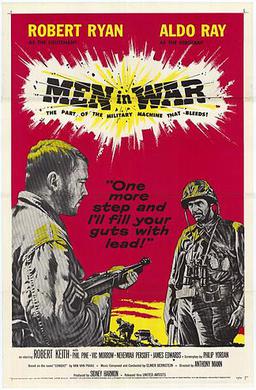
Men in War

The Korean War was unlike any war Americans had ever been involved in. The movies made about it certainly reflected that. There was nothing simple about it, no easy answer, but I suppose that applies to all wars. One of the best movies about Korea is also one that has gone criminally unrecognized over the years, 1957's Men in War

Following a horrifically costly engagement late in 1950 in Korea, Lt. Benson (Robert Ryan) finds himself in command of the ragged remains of his rifle platoon. With just 17 men and no idea where the rest of the battalion is, Benson leads his men to a prearranged objective that he's not even sure still exists. Along the way, they run into Sgt. Montana (Aldo Ray), a stubborn and very capable soldier who's transporting by jeep his shell-shocked commanding officer, the Colonel (Robert Keith). When Benson commandeers the jeep, Montana goes along more than a little unwillingly. Together, the motley group continues to their objective, an otherwise ordinary location, simply titled Hill 465. What awaits there? None of them know.

Never even mentioned among the best war movies around, this Korean War has been criminally neglected since its 1957. From director Anthony Mann, it is a cynical, extremely dark, very realistic, and even a tad existential at times. While it is based in Korea, it really could be any war. The infantry soldiers trudge on, fighting a mostly unseen enemy, just trying to survive. We learn nothing about anyone, and there's no bigger picture of the war. These men are separated from their possibly annihilated unit and walking in heavily occupied enemy territory. The North Koreans appear as needed; in the aftermath of a firefight, two survivors talk quietly -- not really hiding either -- where seconds before bullets and grenades were raining down on them. This is war and the effect it has on the individual.

Beyond that simple story is a realistic story. I try not to use this description too much, but it was truly ahead of its time. We're introduced to Benson's platoon in the aftermath of the attack that separated his platoon from the battalion. The men look exhausted to the point of fainting. One man has been killed -- stabbed in the back with a bayonet -- by a North Korean scout, and so it starts. The cynicism is palpable. Benson mumbles 'Son of a...' before veering off. Ray's Montana shoots a surrendering North Korean, albeit one reaching for a hidden pistol. Later, a second prisoner is used for bait to see if the platoon has been spotted. Filmed in a close-up black and white, I felt like a fly on the wall as a viewer. We feel like we're right there with the foot soldiers. By no means a flashy filming style, but the story doesn't call for it. Also worth mentioning is Elmer Bernstein's eerie but spot-on musical score.

Playing on the basic notion of the unit picture, 'War' has an impressive tough guy cast. It's great to see Ryan get a good guy role. Very capable of playing a hellishly bad villain, Ryan is a perfect choice to play the beaten down officer who must buck up to get his men to safety. Ray as his counter is just as spot-on, a similarly experienced soldier but one with a simpler mission. That angle (protecting your commanding officer) would be used 20 years later in A Bridge Too Far. Benson's platoon includes Riordan (Phillip Pine), the radioman, Lewis (Nehemiah Persoff), the unhinged sergeant, Zwickley (Vic Morrow), the scared to death private, Killian (James Edwards), the mechanic, and Davis (L.Q. Jones), the medic and BAR man. Seven other soldiers are listed in the cast but under the dirt, grime and three-day stubble, it's hard to distinguish them.

For the most part here, the story is fairly familiar. Nothing crazy or out of the blue. The platoon deals with North Korean scouts trying to pick them off, bickering amongst the men, even stumbling into a minefield. Where it distinguishes itself is in the finale as Benson's men reach Hill 465. There is nothing special about the hill, just a big chunk of jagged rock....that's occupied by North Koreans. The small-scale battle has elements of the surreal. The enemy fires only occasionally, only appearing for brief close-ups. In its small scale, it is a very personal, aggressive, and uncomfortable depiction of battle. Soldiers are killed, but we barely see their faces to know who it is. The film ends on a dour note, but an effective one just the same.

A war film that deserves better. Effective message that is never overbearing, great casting, almost documentary-like feel from Mann, all amount to a film well worth watching.

Men in War <---Youtube clip (1957): *** 1/2 /****

Wednesday, March 21, 2012

The Badlanders

Released in 1950 and based off a novel by writer W.R. Burnett, The Asphalt Jungle has withstood the test of time and still remains one of the best examples of a film noir ever released. It is a classic that deserves its reputation built up over the years. Just eight years later, the successful noir was back in theaters with a little twist, it was now a western, the movie 1958's The Badlanders.

Having served a majority of his sentence, Peter van Hoek (Alan Ladd), better known as 'the Dutchman,' is released early from the Yuma territorial prison. A mining engineer, Dutchman maintains that he was framed for a robbery of a gold shipment, still claiming his innocence. He's got a plan to get back at those who set him up, robbing a supposedly useless mine that never produced any gold, or so it seemed. Dutchman enlists the help of McBain (Ernest Borgnine), another recently released prisoner, and Vincente (Nehemiah Persoff), a dynamite specialist, to help in the plan which will require split second timing. The plan seems perfect, but one never knows what might come up when so much gold is involved.

I've never hidden the fact that I'm not a fan of remakes, especially remakes of movies like The Asphalt Jungle that didn't need to be touched. On the other hand, if you're going to do a remake, add something new, a unique feature or departure from the original, much like director Delmer Daves did here. Transplanting the team of crooks, robbers and specialists to the dusty desert of the wild west is an inspired choice. 'Badlanders' was filmed in Old Tucson, Arizona, a filming location western fans will be especially familiar with. The lonely western town surrounded by mountains is a great backdrop to the heist story. As a fan of both westerns and heist flicks, I couldn't help but like this one. How often do we actually see western heists? Few and far between.

The cast is streamlined some, certain characters tweaked or completely dropped from 'Asphalt.' The focus is on Ladd's Dutchman and Borgnine's McBain. Ladd's quiet, easy-going and understated acting style works here, even if a little more visible revenge-seeking would have helped. His background is never fully explained, but we know he wants some revenge, and he's had years to think about it. Playing his partner in crime, Borgnine shows a different side of his acting ability. He isn't the loud, aggressive thug he played so often in the 1950s as he built up a name for himself. His McBain was sent to prison on a manslaughter charge and then saw his land and home pulled out from under him. He too wants revenge but doesn't know where to start until the Dutchman approaches him with a plan. A subplot with McBain and Anita (Katy Jurado), a prostitute in town, helps develop the character as well.

Having two very solid leads in those roles is both good and bad. The good is obvious; it's fun to see Ladd and Borgnine working together on this heist. The bad in an 85-minute movie? The focus is on them, but little else gets dealt with. We hear about both Dutchman and McBain's predicament, their background in getting sent to the Yuma prison, but that's all. We hear, but there's little in the way of details. When Dutchman sets up the plan, are the higher-ups in town the ones who set him up? Does he intend to get them back or just earn himself some money? Not even breaking the 90-minute mark, things feel rushed, like key scenes and explanations were left in the editing room. The villains aren't developed, subplots that are there feel forced and/or pointless, and all the sudden the movie's over. It's an enjoyable ride along the way, but it could have been much better.

Throwing so many different elements into an 85-minute long movie is unfortunate because there's just too much going on. Jurado's Anita is a bright spot, making the most of her time with Borgnine's McBain as the heist plan comes together, but Persoff doesn't come across as well as the Mexican dynamite expert. As mentioned though, the villains are weak and poorly developed. Kent Smith is Lounsberry, the town hot-shot who will serve as a fence for the stolen gold, Robert Emhardt playing Sample, a partner in the coming double-cross. Claire Kelly is Ada (sexy name, huh?), Lounsberry's girlfriend literally locked away in a hotel room until she's needed, there because Ladd's Dutchman needs a love interest. Supporting player in the original 'Asphalt,' Anthony Caruso is Comanche, one of Sample's gunhands while Adam Williams does what he did best, playing a possibly unhinged, highly dangerous gunfighter, albeit a deputy named Leslie.

Like a lot of movies, this one had the potential to be an above average, pretty memorable western, but it never quite gets there. Where 'Asphalt' reveled in its darkness and cynicism, 'Badlanders' refuses to go there, especially in its ending which is just too nice and tidy when it could have been incredibly dark and surprising. It's still a good movie with some solid performances, but it isn't as good as it could have been.

The Badlanders <---TCM trailer (1958): ** 1/2 /****

Friday, October 7, 2011

The Hook

A title card for 1963's The Hook makes an interesting distinction about war. Paraphrased a bit, it says that for war and all its major campaigns, violent battles, and conflict on such an epic scale, the actual art of war is a very personal thing that is based at the individual level. It is the individual doing the fighting. That's something that sounds incredibly obvious, but in terms of a successful anti-war movie, that idea is almost always present.

This little known Korean War movie has more or less been lost to the decades since 1963. Before it showed up on Turner Classic Movie's schedule in September, I had never even heard of it.  Because of its subject matter, it is pretty clear why it has been forgotten over the last six decades.  The story revolves around orders for three American GI's to murder their North Korean prisoner soon after capturing him. In other words, a story with the most obvious of anti-war messages. It doesn't always work with some holes in the plot, but the message comes through clearly without being overbearing.  Definitely a movie that deserves a better fate since its 1963 release.

Working to load barrels of fuel onto a ship as part of an American withdrawal, Sgt. Briscoe (Kirk Douglas) and two privates, Dennison (Robert Walker Jr.) and Hatchett (Nick Adams) are strafed by a North Korean plane, their commanding officer killed in the raid. The plane crashes near the ship they're loading, and Dennison swims out to save the wounded North Korean (Pancho Magalona). Moving out on the Finnish ship run by Captain Van Ryn (Nehemiah Persoff), the trio bring the wounded prisoner with, planning to turn him over to the authorities when they reach their base. Just hours into the voyage though, they receive a startling radio message. The base has been badly hit in a bombing raid, and all the North Korean prisoners were overrun and killed by the locals. The order is simple; execute the prisoner before they reach the base. The enemy is the enemy, but can these three do it?

As far as subject matter, 'Hook' is years ahead of its time, coming two years before the United States was even involved officially in Vietnam. Even the most naive among us can appreciate that brutal and horrific things are done in war, atrocities that are crimes against man. Often times, there are incidents that happen far from the battle as opposing sides meet as is the case here. That's what the story boils down to. All hatred and prejudices aside, the act is a war crime, out and out murder, no matter that they're doing what they're ordered to.  It is a talky movie, the three soldiers all battling with their inner struggles and personal morality about what they've been told to do. Acts like this have almost certainly been committed in war since the dawn of time, but does that make it any easier to handle? Not really. Death is death no matter how you cut it.

The individual face of the war comes across in the roles of the three soldiers, Douglas, Walker Jr., and Adams.  Looking for some sort of existential symbolism or meaning, Persoff's captain is even a bit of a God-like figure, watching from above as the situation deteriorates. Okay, enough with that mumbo-jumbo and deeper meanings. The performances keep the movie based, especially Douglas as Sgt. Briscoe, a 19-year Army vet a year away from retirement and his pension. As the highest ranking soldier, he is handed the unenviable task of carrying out the order, bullying his two men into the act. It's Douglas at his best, a brother/father-like figure looking out for their well-being balanced out with a manipulative, conniving way of getting things done. His monologue about a patrol gone bad on Guadalcanal in WWII is an actor showing how good he is at what he does. Both hero and villain, he makes Briscoe an interesting character, no doubt about it.

Some of my concern about 'Hook' was the casting of Walker Jr. and Adams alongside Douglas, fearing they would be overshadowed. That wasn't the case thankfully. Walker's Dennison is the smart, thinking soldier, questioning aloud what they're supposed to do. North Korean or not, their prisoner is a man, a father and a husband. He intends to fight Briscoe about the execution every step of the way. I think it would have been more interesting for Dennison's character if he wavered even a little about the orders, just for that added dimension, but he's resolute in his stance. Adams too does not disappoint, his Hatchett a diminutive soldier who Briscoe has a hold on. He starts to see the folly in his ways as he is pushed and pushed to do what he doesn't want to do. A Filipino actor who only starred in a handful of American movies, Magalona does much with a character that has no speaking lines, communicating his fear and terror with his eyes. It's a good part, one that could have been a throwaway piece, an idea more than a human being.

What prevents 'Hook' from being an anti-war classic is the ending, which I won't spoil here. As is, the ending works in George Seaton's film. It is effective with a touch of irony and hope for the future still there. The finale delivers a twist in that irony, going down a path I didn't see coming. Once the twist is revealed though, more -- much more -- could have been done to really slam home the anti-war ideas. There was potential for a shocking, startling, surprising ending that would have made this an even more memorable conclusion. As is so often the case, my issue is what could have been done. This ending does work, but it is a safer ending. Still, I very much enjoyed this movie. It has been wrongly forgotten and deserves more of a following or audience.

The Hook <---TCM trailer (1963): ***/****

Wednesday, March 23, 2011

The Harder They Fall

The beauty of sports for me has always been in the simplicity of the actions. A quarterback finding a wide receiver downfield, hitting him in stride. A shortstop and second baseman turning a flawless double play. A basketball player drilling a clutch jump shot with the game on the line. The list is endless, every sport providing its own special moments. But that is just sports at its most basic. Throw in money, ego, and greed, and something as perfect as sport can be easily corrupted. One of the best examples I’ve seen showing the corruption of sport is 1956’s The Harder They Fall.

A boxing story, this movie belongs to be mentioned in the same breath as Rocky and Raging Bull, two universally known boxing classics.  Like few other sports, boxing translates so effortlessly to the screen mostly because of its tragic element. Baseball players ruin their arms, football players risk long-term damage, hockey players lose teeth, but boxing is in a whole other league. Without swords, assorted weapons and some sort of armors, boxers are modern-day gladiators. In a small ring with people cheering them on, they pound away on each other. What isn’t tragic about that?

Out-of-work newspaper sports columnist, Eddie Willis (Humphrey Bogart) is at a crossroads looking for any sort of new profession. He accepts an offer from a boxing club owner, Nick Benko (Rod Steiger), who has long pursued him for work as a press agent. Desperately in need of money, Eddie takes the job as a press agent for a young South American boxer, Toro Moreno (professional wrestler Mike Lane), a beast of a man with all the physical attributes but none of the skill it requires to be a boxer. Nick says don’t worry about it, for Eddie just to do what he does best and build the inexperienced fighter up. It starts off as nothing, a few fights fixed here and there as Toro’s reputation builds. But going down a bad road that will end poorly for everyone involved, Eddie starts to question what he’s doing. Is the money at the end of the road worth what he’s doing?

An honest, depressing and heartbreaking look at the business of boxing, ‘Harder’ is an indictment of the sport and everything and everyone involved in it.  Director Mark Robson doesn’t pull any punches – sorry for the bad choice of words – in laying this story out.  Everyone involved has a bulls-eye squarely painted on their back. The movie is about these people, the ones looking for the easy money at the expense of the fighters who are similarly taking advantage of a small window of opportunity they have to be successful. In the process, the fighters basically throw themselves to the wolves, hoping to make enough money in a short time span to help them live the rest of their life. Not everyone is so lucky, many hanging on to boxing longer than they should have, putting their health, well-being and lives at risk.

One of Hollywood’s best actors and maybe the biggest icon, Humphrey Bogart died at 57 years old just a few weeks after this movie was released in theaters. For a swan song, it would have been hard for Bogart to pick a last role. This is Bogie at his understated best, inhabiting this character who genuinely has the best intentions at heart but ends up going down a road he never anticipated seeing. He’s desperate and makes decisions he might not have otherwise. His Eddie Willis character is the heart of the movie, the conscience who knows everything he’s seen isn’t right. He's a human element in a sea of robotic people with dollar signs for eyes, especially in his scenes with his wife, played to perfection by Jan Sterling. It is a great performance for the Hollywood legend, and a fitting end to an amazing career.

Matching Bogie’s quiet, understated performance and going in the opposite direction is Steiger, ever the brimming ball of energy ready to explode at the slightest push. During filming of the movie, Bogart apparently thought the younger Steiger was overacting, exaggerating his performance in every scene he was in.  It’s hard to tell. This was Steiger in most of his movies. He’s the villain, the shadiest of bad guys who convinces you that he’s on your side as long as you’re valuable. Then the second you have played out your string, he cuts you loose. He has two scenes that stand above the rest, both monologues that illustrates how suave Nick can be in getting you on his side. Nehemiah Persoff, Felice Orlandi, and Val Avery co-star as his yes-men and muscle. Harold J. Stone has a great supporting part as a TV sportscaster who sees through the charade while real-life boxer Jersey Joe Walcott is very memorable as Toro's trainer, George.

Right in the middle of this and being pulled on all sides is Lane as Toro, the good-hearted, naïve South American boxer who had no idea what he was getting into.  Lane was a bear of a man in real life – no CGI here – standing 6'5 and looking the part of the most imposing boxer you’ve ever seen. Playing up the sympathy angle, you genuinely feel for this character, the unknowing dupe of all these businessmen around him. In a rags to riches story though, the ending isn’t quite what you’d expect but in a good way. It’s a great ending if not a happy, Hollywood ending. Appropriate for the story though and the characters especially. Track this movie down. It’s a forgotten classic. Give it a try at Youtube, starting HERE.

The Harder They Fall <---TCM clips (1956): *** 1/2 /****

Wednesday, January 19, 2011

Fate is the Hunter

When I think of disaster movies, I think The Poseidon Adventure and other 1970s epically bad but still enjoyable movies with huge casts of stars and dated special effects.  Through the 1950s and 1960s, disaster movies were made, just not on the same scale.  Only part of 1964's Fate is the Hunter really matches up with any of the criteria for a disaster flick, but it foreshadows what was to come in the coming decades as audiences watched planes crash, earthquakes tear apart the world, towering buildings go up in flames and much, much more.

Director Ralph Nelson takes control of the helms here in this quasi-disaster flick which is both ahead of its time in storytelling but also very dated at times.  Nelson is one of those hidden gems of a director you stumble across every so often.  He was never pigeon-holed into one specific type of movie and ended up directing films across countless genres.  Action, western, drama, comedy, message movies, he tried them all and did them all well.  Never flashy but always getting the job done in above average fashion, Nelson doesn't have a true classic to his name, but his filmography is nonetheless littered with worthwhile movies.

On a flight from Los Angeles to Seattle, veteran pilot Capt. Jack Savage (Rod Taylor) and his crew run into mechanical problems and are forced to crash land on a beach, the jet airliner exploding on contact with a pier running across the beach. Everyone on board other than one stewardess (Suzanne Pleshette) is killed, and the public, the corporation, and the media want answers.  What happened that caused Savage to attempt such a difficult maneuver? All evidence points to pilot error being the cause, but airline executive, former pilot and friend of Savage's, Sam McBane (Glenn Ford), thinks something else happened. Time is running out though, and McBane must prove Savage's innocence before a board of inquiry pins the blame on the deceased pilot.

Wasting little time surprising the viewer, Nelson kills off star Rod Taylor before the credits even roll.  Just when you think Taylor's Savage has successfully landed his jet airliner carrying 49 passengers...BOOM! The plane explodes, and 'Fate is the Hunter' pops up on the screen.  Talk about a tone-setter. No worries though for Taylor fans, this is not the last we'll see of him.  His involvement in the movie from there on in besides his character being constantly talked about is through flashbacks that flesh him out as an individual.  It's those little bits of character that should help us decide if this experienced, always calm and capable pilot was really incapable of dealing with what seemed like a minor mechanical issue.  Long story short, don't miss the first 10 minutes, or you'll be lost.

The problem any movie faces when it has such a strong start is sustaining that energy over the length of the movie.  That's where 'Hunter' struggles.  The investigation is interesting enough because it's hard not to be curious about what actually caused the plane to malfunction in such a surprising way.  But Ford's questioning gets tedious quickly.  The flashbacks are beyond tedious and serve only to make Savage more of a 3-D character.  After the first flashback, it becomes too much.  We get it.  He's a good pilot who is cocky, arrogant, not always likable and quite the ladies man.  But is a movie really going to peg Taylor as a boozehound who caused the deaths of over 50 people? I think not.  It's not a matter of if, it's a matter of how Taylor didn't crash the plane because he was drunk. 

Worse than that though (as a Lost fan I can appreciate even the slowest of flashbacks) is the direction Ford's character and the story takes overall in the final half hour.  Now granted, the word 'Fate' is in the movie's title.  As the evidence comes together and Ford's McBane talks to all these possible witnesses, he begins to question if maybe, just maybe, fate played a role in that plane crashing.  An out of season bird may have flown into the engine, three other planes were all off-schedule by a few minutes, the pier was supposed to have been removed a week earlier, it just doesn't add up.  Was something else at play here? Ford's testimony is even worse when he admits all this.  I can't tell if it is just all too sappy or handled poorly, but if Nelson was trying to deliver a message with this change in direction it didn't work.  I haven't read the source novel to know one way or another, but the ending disappoints on a lot of levels.

The redeeming factor through all the negatives is the impressive cast assembled here.  Ford is never flashy but is as reliable as always with Taylor making the most of his posthumous part...in character at least. Pleshette has a small but integral part (and looks great by the way). Also look for Nancy Kwan, Constance Towers, Jane Russell in a cameo as herself in 1945, Nehemiah Persoff, an uncredited Dorothy Malone, Max Showalter, Wally Cox and many more recognizable faces even if you don't know their name. Other than the cast and some nice-looking black and white camerawork, I struggled to get through this movie.  Potentially good but never amounts to anything much.

Fate is the Hunter <---trailer (1964): **/****